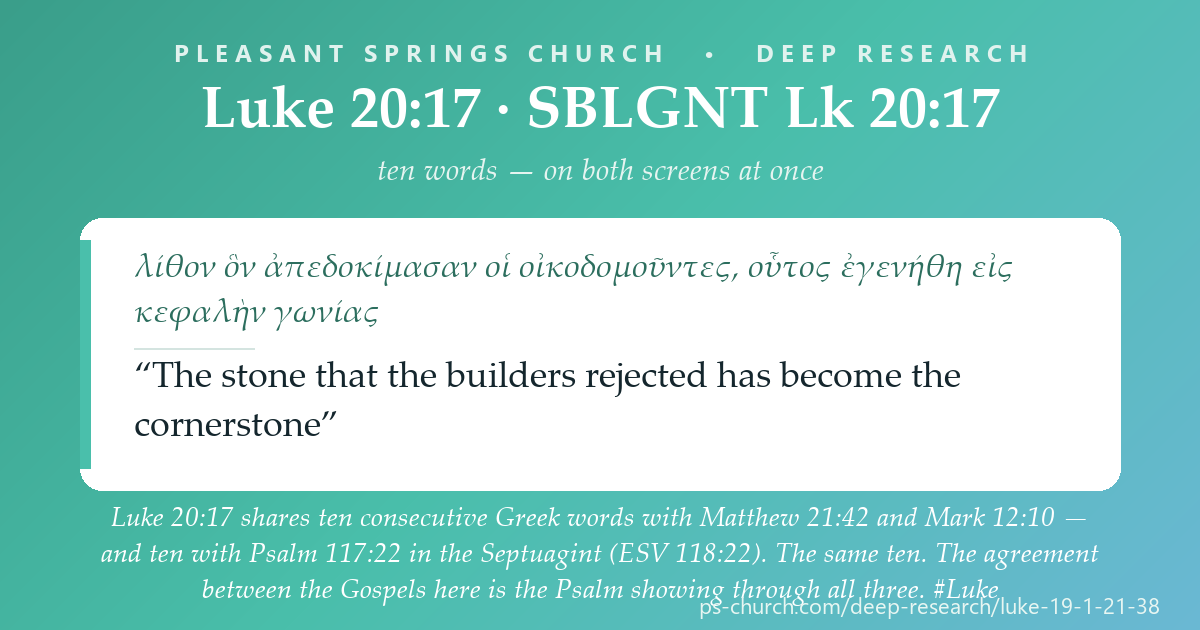
Two rows in these three chapters return the same number on both screens. Luke 20:17 shares ten consecutive Greek words with Matthew 21:42 and Mark 12:10 — and ten consecutive words with Psalm 117:22 in the Septuagint. Not ten and eight. The same ten, in the same order, letter for letter. Luke 20:43 does it again against Psalm 109:1: ten on the Old Testament screen, ten on the New. Which means the deepest agreement between these Gospels here is not agreement between the Gospels at all — it is one Psalm showing through three of them at once. The control sits in Luke’s own second volume: Acts 4:11 quotes the same Psalm 117:22 and measures 3, because it uses different words. And the reverse case is at the entry, where all four Gospels quote Psalm 117:26 and Matthew, Mark and John each reach six — while Luke reaches three, because he sets βασιλεύς, the King, down in the middle of the quotation and the run breaks at it. He proves it himself at Luke 13:35, where the same line without the insertion measures six. Three rows in the passage reach thirteen against the New Testament, and those three reach four, four and five against the Old. See the method →
Luke 19:1–21:38 (selections)
Greek New Testament (SBLGNT, via MorphGNT) · ESV★ And the passage’s own numbering is unbroken. Counted off disk: SBLGNT Luke 19 = 48 verses, Luke 20 = 47, Luke 21 = 38 — 133 verses under 133 consecutive numbers, with no gap. That is worth saying because this Gospel does have two gaps: there is no Luke 17:36 and no Luke 23:17 in the Greek printed here, which is why SBLGNT Luke holds 1,149 verses against a printed numbering that runs to 1,151. Neither gap is in this passage.
The Shape of the Passage
A double frame around a sequence — and the frame is measured, not assertedThe book never names its author, and these three chapters do not either. What they supply is a set of habits that can be counted, and a set of things the writer expects a reader to already know. Both are reported here; neither is turned into a name.
Author
Whoever wrote these chapters wrote Acts — and quoted the same Psalm twice, in two different Greek versions. Luke 20:17 quotes CATSS Psalm 117:22 at a run of 10. Acts 4:11 quotes the same Psalm and measures 3, because it puts the line into different words: ὁ ἐξουθενηθεὶς ὑφ’ ὑμῶν τῶν οἰκοδόμων rather than ὃν ἀπεδοκίμασαν οἱ οἰκοδομοῦντες. The same author, the same Psalm, and a run of 10 in one book and 3 in the other. That is the single most useful control on this page, because it shows what the screen actually measures: not whether a verse is a citation, but whether it reproduces a wording.
A place-name habit the run engine can see. Twice in this passage the hill east of the city is given as a proper noun, τὸ ὄρος τὸ καλούμενον Ἐλαιῶν — and those are the only two occurrences in the Greek New Testament. Acts 1:12 does the same thing in the genitive, Ἐλαιῶνος. Eight other New Testament verses, including two of Luke’s own, use the ordinary phrase instead. The habit is real; it is not absolute; and a page that reported only the strong half would be misleading.
And a writer who splits a quotation across a verse boundary. Matthew 22:44, Mark 12:36 and Hebrews 1:13 each carry the whole of Psalm 109:1 in one verse and each measures 14 against it. Luke puts the same quotation in two verses, 20:42 and 20:43, and they measure 8 and 10. ⚠️ That difference is an artefact of verse division and of this page’s method, not a fact about Luke’s text, and it is named here so that nobody reads the numbers the wrong way round.
Audience
Readers who knew the Psalter well enough to be quoted at without a reference. 19:38 says blessed is the one who comes in the name of the Lord and names no source; 20:17 says what then is this that is written and gives no chapter; 20:42 does say ἐν βίβλῳ ψαλμῶν, which is as specific as this passage gets. Three quotations from two Psalms, and one bibliographic note between them.
Readers who knew what a chief tax collector was, and why sitting down to eat with one was a scandal. 19:7 has the crowd grumble that he has gone in to lodge παρὰ ἁμαρτωλῷ ἀνδρί and does not explain the objection. The office named at 19:2, ἀρχιτελώνης, occurs once in the Greek New Testament and Luke does not gloss it. The fourfold restitution Zacchaeus offers at 19:8 is not explained either, and the page does not supply a legal background it did not read (see Stage 2).
Readers for whom the temple was still standing in the sentence, and gone by the time they read it. 21:5 opens the discourse with somebody admiring the ἀναθήματα, the votive offerings — a word that occurs once in the Greek New Testament and is not the same word as ἀνάθεμα, a curse, which occurs six times. Whether 19:43–44 and 21:20 were written before or after the events they describe is a question this page cannot touch, because the screen measures words and not dates. What it can report is that 19:44 and 21:20 share no word form at all with each other, and almost nothing with anything else.
Orient on Jericho and the tax farm, on the entry and the royal acclamation, on the second temple and its destruction, and on the Son of Man — before touching a number.
Search by topic: Luke, Gospel of; Jericho; tax collectors and publicans; Zacchaeus; restitution; parable; minas and talents; triumphal entry; Mount of Olives; Hosanna; Jerusalem, destruction of; temple, Herodian; Sanhedrin; Sadducees; levirate marriage; resurrection; Messiah, son of David; widows; Olivet discourse; abomination of desolation; Son of Man; times of the Gentiles; Synoptic problem.
Which articles are relevant?
- Anchor Bible Dictionary — “Luke, Gospel of,” “Jericho,” “Tax Collector,” “Olives, Mount of,” “Temple, Jerusalem,” “Sadducees,” “Levirate Marriage,” “Son of Man.”
- Dictionary of Jesus and the Gospels (IVP) — “Triumphal Entry,” “Temple Cleansing,” “Apocalyptic Teaching,” “Destruction of Jerusalem,” “Taxes,” “Resurrection,” “Son of David.”
- New International Dictionary of NT Theology & Exegesis — ἀρχιτελώνης, ἐπισκοπή, ἐδαφίζω, κεφαλὴ γωνίας, ἰσάγγελος, ὑστέρημα, καιροὶ ἐθνῶν.
- Commentary on the New Testament Use of the Old Testament, ed. G. K. Beale and D. A. Carson (Baker, 2007) — the Luke chapter, where 19:38, 19:46, 20:17, 20:42–43 and 21:24–27 are treated verse by verse.
- None of these were consulted for the measurements below. The measurements were run on the text files named in the footer.
Settle the numbering first — and note where the offset actually bites
Every page on this shelf states its versification offset, including where the answer is that there is none. On a New Testament book there is no second column to be offset from. But on this passage the offset decides how two of the page’s headline references must be written.
| Luke 19 | Luke 20 | Luke 21 | this passage | |
|---|---|---|---|---|
| SBLGNT (MorphGNT) | 48 | 47 | 38 | 133 |
| a public-domain English file (off disk, consulted for the count only) | 48 | 47 | 38 | 133 |
| the printed verse numbers | 1–48 | 1–47 | 1–38 | 133 numbers, 133 verses, no gap |
Counted off disk. Unlike Luke 17 and Luke 23, this passage has no missing verse number in any column — every reference on this page means the same verse in the Greek and in the ESV. (SBLGNT Luke prints no 17:36 and no 23:17, which is why the book holds 1,149 verses under a numbering that runs to 1,151. Neither gap falls here.)
The offset that does bite is the Psalter’s.
| row | quoted Psalm, Greek numbering | same Psalm, MT and ESV numbering | run |
|---|---|---|---|
| Luke 19:38 | CATSS Psalm 117:26 | Psalm 118:26 | 3 |
| Luke 20:17 | CATSS Psalm 117:22 | Psalm 118:22 | 10 |
| Luke 20:42 | CATSS Psalm 109:1 | Psalm 110:1 | 8 |
| Luke 20:43 | CATSS Psalm 109:1 | Psalm 110:1 | 10 |
The Greek Psalter runs one number behind the Hebrew from Psalm 9/10 through Psalm 147, because it joins Hebrew Psalms 9 and 10 into one. Both of this page’s deepest Old Testament runs fall inside that range, so every citation here is written twice — once in the numbering of the text that was actually searched, once in the numbering a reader will find in an English Bible. The house rule on this shelf is that the Septuagint chapter and verse is shown alongside the English wherever they differ, and here they differ.
A tax farm at Jericho, a hill with two names, a siege-word, and a coin worth almost nothing — with the limits of what was actually consulted stated in each case.
The tax farm, the fourfold restitution, and what this page did NOT read
Luke 19:2 calls Zacchaeus an ἀρχιτελώνης — a word that occurs once in the Greek New Testament and is never explained. Jericho sat on the balsam and date trade and on the road up from the Jordan, and the chief of a tax district there would have been a wealthy man; the text says so directly (καὶ αὐτὸς πλούσιος) and explains nothing further.
At 19:8 he offers half his goods to the poor and fourfold restitution to anyone he has defrauded. The verb is συκοφαντέω, which occurs twice in the Greek New Testament and both times in Luke (3:14; 19:8). ⚠️ What could not be checked here. The fourfold figure is regularly connected to Exodus 22:1 and to Roman law on furtum manifestum, and to rabbinic discussion of a tax collector’s repentance. No papyri, no Roman legal text, no rabbinic tractate and no inscription were consulted for this page. Those readings are reported from the reference works named in Stage 1 and none of them was verified from a primary document on this disk. What the measurement adds is negative and firm: Luke 19:1–10 tops out at a run of 5 against everything outside Luke, and at 5 against the whole Greek Old Testament — and both fives are narrative formulae, not contacts. The 5 against the Old Testament is at 19:9 and the tied verse is Genesis 24:5, because the five words are and he said to him.
Two names for one hill
Eight New Testament verses call it τὸ ὄρος τῶν ἐλαιῶν, the mount of the olives, in one case or another. Two call it τὸ ὄρος τὸ καλούμενον Ἐλαιῶν, the mount called Olive-grove. Both of those two are in this passage.
| form | where |
|---|---|
| τὸ ὄρος τῶν ἐλαιῶν | Matthew 21:1 · 24:3 · 26:30; Mark 11:1 · 13:3 · 14:26; Luke 19:37 · Luke 22:39 |
| τὸ ὄρος τὸ καλούμενον Ἐλαιῶν | Luke 19:29 · Luke 21:37 — and nowhere else |
| τοῦ καλουμένου Ἐλαιῶνος | Acts 1:12 |
This is a lexical and distributional fact, and the page does not turn it into a theory of sources. Luke uses both forms, three verses apart at 19:29 and 19:37. What is countable is that the proper-noun form brackets the temple section exactly, and that the pair run between 19:29 and 21:37 is 5.
A siege word, a votive word, and a coin
Luke 19:43–44 puts three words into two sentences that the rest of the New Testament never uses. χάραξ, a palisade or siege-rampart, occurs once; περικυκλόω, to encircle, once; and one verse later ἐδαφίζω, to level to the ground, once. Three siege terms, three hapax legomena, four verses that measure 3 against everything outside Luke.
21:5 has admirers of the temple pointing at its ἀναθήματα. The word is a votive offering hung up in a sanctuary; it occurs once in the Greek New Testament, and it is not the word ἀνάθεμα, an accursed thing, which occurs six times and is spelled with an epsilon. ⚠️ The two nouns are one letter apart and manuscripts do confuse them; no critical apparatus was consulted for this page and the reading printed here is simply the SBL edition’s.
21:2 gives the widow two λεπτά. The coin is named three times in the Greek New Testament: Mark 12:42, Luke 12:59 and here. Mark adds a gloss for a Roman reader — ὅ ἐστιν κοδράντης — and Luke does not. The temple treasury chest, γαζοφυλάκιον, is named five times in the Greek New Testament and four of the five are this scene in the two Gospels. No numismatic source, no Mishnah tractate on the temple chests, and no archaeological report was consulted here.
Six words that carry these three chapters, and how rare each one actually is.
Once in the Greek New Testament — Luke 19:2. So is the συκομορέα he climbs at 19:4. The name Ζακχαῖος stands three times and all three are in this chapter.
Four times in the Greek New Testament — Luke 19:44; Acts 1:20; 1 Timothy 3:1; 1 Peter 2:12. The ESV gives it as visitation here, office at Acts 1:20, overseer at 1 Timothy 3:1 and visitation again at 1 Peter 2:12. Four occurrences will not settle a gloss, and this page does not settle one. The four-word phrase καιρὸν τῆς ἐπισκοπῆς σου occurs once.
Five times in the Greek New Testament — Matthew 21:42, Mark 12:10, Luke 20:17, Acts 4:11, 1 Peter 2:7 — and all five are quoting or echoing the same two words of CATSS Psalm 117:22 (Psalm 118:22 in the ESV). Three of the five carry ten consecutive words of the Psalm; Acts 4:11 carries three.
Once in the Greek New Testament — Luke 20:36, of those counted worthy of the resurrection. Matthew 22:30 and Mark 12:25 say the same thing in the same scene with a phrase instead of a word (ὡς ἄγγελοι). Luke 20:36 measures 3 against the whole non-Lukan New Testament, in a tie band of 1, and the partner is Romans 8:14 — not either parallel.
Once in the Greek New Testament — Luke 21:5. Not to be confused with ἀνάθεμα, an accursed thing, six times (Acts 23:14; Romans 9:3; 1 Corinthians 12:3, 16:22; Galatians 1:8, 1:9 — Mark 14:71 is the related verb, not this noun). One letter apart, opposite senses, and no apparatus was consulted here.
Once in the Greek New Testament — Luke 21:24. The row measures 3 against the non-Lukan New Testament in a tie band of 6, and 3 against the whole Greek Old Testament in a band of 16. The phrase is Luke’s and the measurement finds no source for it. That is a real result and not a gap: it means no verse in either corpus held here repeats these words.
The three chapters counted, word by word
133 verses; 2,038 words in the MorphGNT text of Luke 19–21.
| word or phrase | in the whole Greek NT | here |
|---|---|---|
| ἀρχιτελώνης | 1 | 19:2 — a hapax |
| συκομορέα | 1 | 19:4 — a hapax |
| κατασφάζω | 1 | 19:27 — a hapax |
| χάραξ | 1 | 19:43 — a hapax |
| περικυκλόω | 1 | 19:43 — a hapax |
| ἐδαφίζω | 1 | 19:44 — a hapax |
| ἐκκρέμαμαι | 1 | 19:48 — a hapax (hanging on his words) |
| ἐγκάθετος | 1 | 20:20 — a hapax |
| ἰσάγγελος | 1 | 20:36 — a hapax |
| ἀνάθημα | 1 | 21:5 — a hapax |
| ἀποψύχω | 1 | 21:26 — a hapax (fainting with fear) |
| κραιπάλη | 1 | 21:34 — a hapax |
| λικμάω | 2 | 20:18 (the other is Matthew 21:44) |
| προσδοκία | 2 | 21:26 (the other is Acts 12:11) |
| συκοφαντέω | 2 | 19:8 (the other is Luke 3:14) |
| μνᾶ | 9 | 19:13, 16, 18, 20, 24, 25 — all nine |
| ἀνάθεμα (a curse) | 6 | none — printed to keep it apart from 21:5 |
| ὡσαννά | 6 | none — the word is absent from Luke entirely |
| ὑστέρημα | 9 | 21:4 — the only one that is not Pauline |
| γαζοφυλάκιον | 5 | 21:1 — three of the other four are Mark 12 |
| τὸ ὄρος τὸ καλούμενον Ἐλαιῶν | 2 | 19:29 and 21:37 — both |
⚠️ A hapax count is not an argument. Twelve of the words checked for this page occur once in the Greek New Testament. That is a normal figure for 2,038 words of Greek narrative, no exhaustive hapax census was run, and does not on its own mean anything about the writer. It is printed because several of the twelve cluster: three siege terms in two verses (19:43–44), and two commercial terms in the Zacchaeus scene. Clustering is worth noticing; it is not evidence, and this page does not treat it as evidence.
Two rows that measure the same on both screens, a three-way tie at thirteen, a citation that measures two against the law it names, and the counter-examples printed in the same tables.
The measurement
All 133 verses of Luke 19:1–21:38 were screened twice: once against the 6,778 non-Lukan verses of the Greek New Testament, once against the 30,637 verse units of the Greek Old Testament held on this disk. Contiguous runs of whole word forms, never lemmas, with the tie band beside every run.
Against the non-Lukan New Testament, across the 133 rows: 132 reach two, 101 reach three, 69 reach four, 46 reach five, 31 reach six, 26 reach seven, 19 reach eight, 17 reach nine, 10 reach ten, 5 reach eleven, 3 reach thirteen, and nothing reaches fourteen. Against the Greek Old Testament: all 133 reach two, 97 reach three, 38 reach four, 9 reach five, 3 reach eight, 2 reach ten, and nothing reaches eleven.
| row | deepest partner outside Luke | run | band | deepest partner in the Greek OT held here | run | band |
|---|---|---|---|---|---|---|
| Luke 20:28 | Mark 12:19 | 13 | 1 | Genesis 38:9 | 4 | 1 |
| Luke 21:32 | Matthew 24:34 | 13 | 1 | Isaiah 28:17 | 4 | 1 |
| Luke 21:33 | Mark 13:31 | 13 | 1 | 1 Maccabees 2:37 · Genesis 2:1 · Joel 4:16 | 5 | 3 |
| Luke 21:23 | Matthew 24:19 · Mark 13:17 | 11 | 2 | — | 4 | 46 |
| Luke 21:31 | Mark 13:29 | 11 | 1 | Psalms of Solomon 17:3 | 4 | 1 |
| Luke 20:17 | Matthew 21:42 · Mark 12:10 | 10 | 2 | Psalm 117:22 = ESV 118:22 | 10 | 1 |
| Luke 20:43 | Acts 2:35 · Hebrews 1:13 | 10 | 2 | Psalm 109:1 = ESV 110:1 | 10 | 1 |
| Luke 20:46 | Mark 12:39 | 10 | 1 | Song 3:2 | 4 | 1 |
| Luke 20:8 | Mark 11:33 | 10 | 1 | — | 2 | 923 |
| Luke 21:8 | Matthew 24:5 | 10 | 1 | — | 4 | 8 |
| Luke 20:42 | Matthew 22:44 · Mark 12:36 | 9 | 2 | Psalm 109:1 | 8 | 1 |
| Luke 20:25 | Matthew 22:21 | 9 | 1 | Genesis 24:56 | 5 | 1 |
| Luke 21:27 | Mark 13:26 | 9 | 1 | Daniel 7:13 — run 1 | 3 | 7 |
| Luke 19:46 | Matthew 21:13 · Mark 11:17 | 5 | 2 | Isaiah 56:7 · Obadiah 1:18 | 4 | 2 |
| Luke 19:38 | Matthew 21:9 · Mark 11:9 · John 12:13 | 3 | 5 | Psalm 117:26 | 3 | 20 |
| Luke 19:6 | Revelation 20:9 · Matthew 7:25 | 1 | 4,443 | — | 2 | — |
★ The finding: two rows return the same number on both screens, and the same words
Luke 20:17 reaches 10 against the non-Lukan New Testament and 10 against the Greek Old Testament. Luke 20:43 does the same. In both cases the run string on the two screens is byte-for-byte identical.
| row | the shared run, normalised | vs NT | vs Greek OT |
|---|---|---|---|
| Luke 20:17 | λιθον ον απεδοκιμασαν οι οικοδομουντες ουτος εγενηθη εις κεφαλην γωνιας | 10 (band 2) | 10 (band 1) |
| Luke 20:43 | εως αν θω τους εχθρους σου υποποδιον των ποδων σου | 10 (band 2) | 10 (band 1) |
When a row’s Old Testament run and its New Testament run are the same length and the same string, the two numbers are not two facts. They are one fact seen twice: the words belong to the Psalm, and everything that carries them — Luke, Matthew, Mark, Acts, Hebrews — is carrying the Psalm.
The census, screened across all 7,927 Greek New Testament verses.
| every NT verse reaching 8+ against… | run |
|---|---|
| CATSS Psalm 117:22 (ESV 118:22) | |
| Matthew 21:42 | 10 |
| Mark 12:10 | 10 |
| Luke 20:17 | 10 |
| 1 Peter 2:7 | 9 |
| Acts 4:11 | 3 — the same author, the same Psalm, different Greek |
| CATSS Psalm 109:1 (ESV 110:1) | |
| Matthew 22:44 | 14 |
| Mark 12:36 | 14 |
| Hebrews 1:13 | 14 |
| Luke 20:43 | 10 |
| Acts 2:34 | 10 |
| Acts 2:35 | 10 |
| Luke 20:42 | 8 |
⚠️ Why Luke’s two rows are shallower than Matthew’s and Mark’s, and why that is not a fact about Luke. Matthew, Mark and Hebrews carry the whole of Psalm 109:1 inside a single verse; Luke splits it across 20:42 and 20:43. This screen measures verse by verse, so a quotation split by a verse division is measured twice at half length. The 14 and the 10 are therefore not comparable, and the page says so rather than letting the table imply that Luke quotes less exactly. Joined, Luke’s two verses carry the same quotation the others do.
⚠️ Four counter-examples, printed so that no run above is read as more than a run
1. The verse that names Moses and measures two against him. Luke 20:28 opens Μωϋσῆς ἔγραψεν ἡμῖν and then states the levirate law. Against CATSS Deuteronomy 25:5, the law being named, the run is 2. Against the whole Greek Old Testament it is 4, tie band 1, and the tied verse is Genesis 38:9 — the death of Onan — because Genesis 38 uses σπέρμα τῷ ἀδελφῷ where Deuteronomy 25:5 does not. Against Mark 12:19 the same row runs 13. A citation formula is not a verbal contact, and this row proves it in one line.
2. The Son of Man in a cloud, and Daniel 7:13. Luke 21:27 measures 9 with Mark 13:26 and 1 with Daniel 7:13 — in both Greek Daniels held here, the Old Greek and Theodotion. The shared word is καί. Every commentary names Daniel 7 at this verse and the screen cannot see it. The reason is visible: cloud singular against clouds plural, and articles present against articles absent.
3. The house of prayer, and Obadiah. Luke 19:46 says it is written and quotes Isaiah 56:7 and Jeremiah 7:11. It measures 4 against the whole Greek Old Testament, tie band 2, and one of the two tied verses is Obadiah 1:18, which has no relation to it at all. The Obadiah page prints this same pair as its own standing counter-example; here it appears from the other end, and it says the same thing. A run of four with a band of two is not evidence.
4. The verse that touches nothing. Luke 19:6 — so he hurried and came down and received him joyfully — is the one row in all 133 that does not reach even two consecutive words anywhere in the 6,778 non-Lukan verses of the Greek New Testament. Its tie band is 4,443. A band of four thousand is the screen saying: this shares single ordinary words with more than half the corpus and two consecutive words with none of it. The most famous sentence in the Zacchaeus story is, verbally, the emptiest row on this page.
The entry: four Gospels, one Psalm, and the run that Luke breaks
All four Gospels quote CATSS Psalm 117:26 (ESV 118:26) at the entry. Three reach six. Luke reaches three.
| verse | run against CATSS Psalm 117:26 | the shared words |
|---|---|---|
| Matthew 21:9 | 6 | εὐλογημένος ὁ ἐρχόμενος ἐν ὀνόματι κυρίου |
| Mark 11:9 | 6 | the same six |
| John 12:13 | 6 | the same six |
| Luke 19:38 | 3 | εὐλογημένος ὁ ἐρχόμενος — then βασιλεύς, and the run stops |
| Luke 13:35 | 6 | the same six — the same evangelist, the same line, without the insertion |
Luke 13:35 is the control that turns this from a curiosity into a result. It is not that Luke quotes the Psalm less closely; it is that at 19:38 he puts one word inside it, and a contiguous-run screen cuts at an insertion. The pair run between Luke 19:38 and Luke 13:35 is 3, for the same reason. And a second Lukan fingerprint is in the same verse: the six New Testament occurrences of ὡσαννά are all in Matthew, Mark and John; Luke has none, anywhere in the Gospel, and writes peace in heaven and glory in the highest instead — three words of which (δόξα ἐν ὑψίστοις) stand at Luke 2:14.
Where the runs sit, chapter by chapter
| rows | reach 5+ vs non-Lukan NT | reach 9+ | ceiling | ceiling vs Greek OT | |
|---|---|---|---|---|---|
| Luke 19 | 48 | 11 | 1 | 9 | 5 |
| Luke 20 | 47 | 22 | 7 | 13 | 10 |
| Luke 21 | 38 | 13 | 9 | 13 | 5 |
The gradient is the plainest structural fact the numbers produce. Chapter 19 is Luke’s own: one row in forty-eight reaches nine, and the material that nobody else has — Zacchaeus, the minas, the tears over the city — sits at three, four and five. From 20:1 the runs climb and stay high, and they stay high because from 20:1 onward Luke is telling the same temple confrontations that Matthew and Mark tell. ⚠️ That is a description of the distribution, not an explanation of it. The screen cannot say why the material Luke shares is worded alike and the material he alone has is worded differently; it can only say that it is. Direction of influence is not asserted here or anywhere on this page.
What this page could not check, where it is weakest, and the claims on it that a specialist would push back on first.
⚠️ What was NOT consulted, and what therefore cannot be claimed
No critical apparatus, on any side. The Greek printed here is the SBL edition as digitized by MorphGNT and nothing else. Luke 19–21 carries variant readings that matter — among them whether βασιλεύς stands at 19:38 and in what position, and whether 21:5 reads ἀναθήμασιν or ἀναθέμασιν. This page’s central finding about 19:38 depends on a word whose text is disputed, and it says so here rather than burying it. If a different edition were screened, that row could move. The two rows at 20:17 and 20:43, which are the page’s headline, are far more stable — but they were not checked against an apparatus either.
No Hebrew was screened for this page. The Psalms behind 19:38, 20:17 and 20:42–43 were measured only in Greek, against CATSS. Nothing here says anything about how the Hebrew of Psalm 118 or Psalm 110 relates to the Greek, and a reader should not take the Greek agreement as a claim about the Hebrew.
No Second Temple, rabbinic, Roman or documentary material. No Qumran text, no Josephus on the siege — which is the obvious comparison for 19:43–44 and 21:20–24 and was not made — no Mishnah, no papyri on tax farming, no numismatics for the λεπτόν, no inscriptions, no archaeological report on the Herodian temple. Everything this page says about culture in Stage 2 is either a count taken off the text files or a reading reported from the reference works, and each is labelled.
The Greek Old Testament held here is not the whole Septuagint. It is 64 CATSS files, 30,637 verse units. Isaiah, Jeremiah, Lamentations, Ezekiel and Daniel are present on this disk and were screened, which is what makes the Daniel 7:13 and Isaiah 56:7 measurements above possible. But a null result against this corpus is a null result against this corpus.
Where this page is weakest
The claim that ‘the run belongs to the Psalm’ is an inference, not a measurement. What was measured is that three verses share the same ten words with each other and with Psalm 117:22, and that the strings are identical. That is consistent with three evangelists independently reproducing a Greek Psalter they all knew, and it is equally consistent with two of them copying the third. The measurement cannot distinguish those, and the page does not pretend to. What it rules out is only the reading that the ten words are evidence of literary contact between the Gospels specifically, since the same ten stand in a text older than all three.
The 19:38 finding rests on a single inserted word. It is a real measurement — 3 against 6, with Luke 13:35 as an internal control at 6 — but it is one word wide, and the word is text-critically contested (above). A page that presented it as a settled fact about Luke’s theology of kingship would be overreaching, and this one presents it as a fact about a run.
The chapter-by-chapter gradient is partly an artefact of what the other Gospels contain. Luke 19 measures low against the non-Lukan New Testament in large part because 19:1–27 and 19:41–44 have no parallel anywhere — so there is nothing for them to be deep against. That is close to circular, and the table is printed with the caveat attached.
And one thing the low numbers do NOT mean. Luke 21:20–24 is saturated with Old Testament language — the trampling of Jerusalem, the sword, the captivity among the nations — and its five rows top out at 4 against the whole Greek Old Testament (21:21 and 21:23, and both fours are ordinary vocabulary). The screen sees no contact because there is no verbatim contact, and that is not evidence that the language is not scriptural. It is evidence that Luke is not quoting. The same applies to 19:41–44, whose Old Testament ceiling is 5 — and that 5, at 19:42, is the phrase on this day tied with four unrelated verses. The absence of a run is not the absence of a background, and this page would be badly misread if its numbers were taken that way.
Reading list
- Joseph A. Fitzmyer, The Gospel according to Luke X–XXIV (Anchor Bible 28A, 1985) — the standard technical treatment of these chapters.
- François Bovon, Luke 3: A Commentary on the Gospel of Luke 19:28–24:53 (Hermeneia, 2012), and Luke 2 (2013) for 19:1–27.
- John Nolland, Luke 18:35–24:53 (WBC 35C, 1993).
- Nicholas Perrin, Jesus the Temple (2010) — on the entry and the temple act, which this page measures and does not interpret.
- Steve Moyise and Maarten J. J. Menken, eds., The Psalms in the New Testament (2004) — the volume that treats Psalms 110 and 118 across the corpus, which is exactly the question this page’s two headline rows raise and cannot settle.
- Mark Goodacre, The Case Against Q (2002), and Christopher M. Tuckett, Q and the History of Early Christianity (1996) — the two sides of the question the thirteen-word runs bear on and do not decide.
- None of these were consulted for the measurements on this page, which were run on the text files named in the footer.
Ten words, counted twice, that turn out to belong to somebody else.
What the two screens found by agreeing with each other
Run a verse against the New Testament and you learn who else says it. Run it against the Greek Old Testament and you learn what it is quoting. Twice in these three chapters the two questions came back with the same answer — the same number and the same ten words — and that coincidence is the whole finding. Luke 20:17 does not agree with Matthew and Mark about a stone; all three of them are saying Psalm 118:22, and the agreement is what is left when the Psalm is subtracted. Luke 20:43 is the same again with Psalm 110:1.
And the mirror image sits six chapters back in the same book. At the entry, three Gospels carry six words of Psalm 118:26 and Luke carries three — not because he knows it less well, but because he sets a word down in the middle of it. The King. He had already quoted the line whole at 13:35. Here, coming down the Mount of Olives with the city in front of him, he breaks it open to put a title inside.
Which is the honest summary of what this page is for. The engine found the doubled ten and the broken six and would never have found the frame; a reader sees at once that the passage begins and ends on the same hill and could not have found the doubled ten. Both are in the text. The page prints the runs, the tie bands, and the four places where the numbers mislead — the citation that measures two against the law it names, the Son of Man who measures one against Daniel, the house of prayer tied with Obadiah, and the verse that touches nothing at all.
The passage opens with a short man in a tree who is told to come down because the visitor is staying at his house tonight, and it closes with the whole people coming early in the morning to the temple to hear him. In between he weeps over a city for not knowing the time of its visitation. Today salvation has come to this house.
Every Deep Research page traces its passage across the whole sweep — the Old Testament, the Second-Temple world between the testaments (historical witnesses, not Scripture), and the New Testament. Follow the thread:
Pleasant Springs Church — Deep Research
Research method after Michael S. Heiser’s Bible Research Method (examine dictionaries → ancient literature → important words → textual connections → academic publications → share), with the Pleasant Springs “Author & Audience” foundation. Scripture set in the Hebrew, the Greek editions named on each page and the ESV (Old Testament), and the Greek New Testament and the ESV (New Testament), per the practice of Pleasant Springs Church. Luke research grounded in Fitzmyer (Anchor Bible), Bovon (Hermeneia) and Nolland (WBC), with Moyise and Menken on the Psalms in the New Testament — none of which were consulted for any number on this page. Text: Greek New Testament from the SBL edition as digitized by MorphGNT; Greek Old Testament from Rahlfs’ Septuaginta as digitized by CATSS; Hebrew from the Masoretic text as printed in Sefaria’s Miqra according to the Masorah, which was not screened for this page. No critical apparatus was consulted on any side. ⚠️ VERSE NUMBERING — Luke is a New Testament book, so there is no Masoretic or Septuagint Luke and no MT/LXX offset for the passage itself. Counted off disk: SBLGNT Luke 19 = 48 verses, Luke 20 = 47, Luke 21 = 38, and the 133 verse numbers run consecutively with no gap in the Greek or the ESV. (This Gospel does have two gaps — there is no 17:36 and no 23:17 in the Greek printed here, so SBLGNT Luke holds 1,149 verses under a numbering that runs to 1,151 — and neither falls in this passage.) The offset that does apply here is the Psalter’s. The Greek Psalter runs one number behind the Hebrew from Psalm 9/10 through Psalm 147, and this page’s three quoted Psalms all fall inside that range: CATSS Psalm 117:22 = ESV Psalm 118:22; CATSS Psalm 117:26 = ESV Psalm 118:26; CATSS Psalm 109:1 = ESV Psalm 110:1. Every citation on this page is written in both numberings. ⚠️ The measurement, in full. Greek against Greek. MorphGNT field 6, the normalised word (the column that already resolves elision and the movable nu); CATSS FORM column (cols 0–24), beta-code transliterated first. Both sides lowercased, accents and breathings dropped, final sigma folded, then filtered to Greek letters — the same filter applied to both corpora, together with the editions’ own spelling equivalences (οὐ/οὐκ/οὐχ, ἐκ/ἐξ, the movable nu). Contiguous runs of whole word FORMS, never lemmas. Corpus: the 133 MorphGNT rows of Luke 19–21 against the 6,778 non-Lukan verses of the Greek New Testament, and against 30,637 verse units across the 64 CATSS files held here. The Psalm censuses screened all 7,927 Greek New Testament verses against one CATSS verse each. Exhaustive and deterministic; nothing sampled, so no seed applies. The tie band — how many target verses reach the same maximum — is printed beside every run on this page. ⚠️ A known limit of the method, named because it changes a number on this page. The screen measures verse by verse. Luke splits Psalm 109:1 across 20:42 and 20:43, where Matthew, Mark and Hebrews each carry it inside one verse; so Luke’s rows measure 8 and 10 where theirs measure 14. That is an artefact of verse division and not a fact about Luke’s text. ⚠️ What was NOT measurable. No Hebrew screen was run for this page. No apparatus, no versions, no patristic citations, no Qumran text, no Josephus, no rabbinic material, no papyri on tax farming, no numismatics, no inscriptions, no archaeology. Allusions that are not verbatim — Daniel 7 behind 21:27, Zechariah and the prophets behind 21:20–24, Genesis and Exodus behind the restitution at 19:8 — are invisible to this screen, and their absence from the numbers is not evidence against them. Luke 21:27 and Luke 19:46 are printed in the codex precisely to make that visible. ⚠️ Direction of influence is never asserted. Nothing here says Luke is reading Mark, that Mark is reading Luke, that either is reading Matthew, or that any of them draws on a common source. Where three Gospels share ten words that also stand in a Psalm, the page reports the three runs, the Psalm, and the tie bands, and stops. Typology is handled per the house position: what the text says, what the New Testament itself draws, and what we see from this side of the cross — with the seeing left to the reader.
Scripture quotations marked ESV are from the ESV® Bible (The Holy Bible, English Standard Version®), © 2001 by Crossway, a publishing ministry of Good News Publishers. ESV Text Edition: 2016. Used by permission. All rights reserved. The ESV text may not be quoted in any publication made available to the public by a Creative Commons license, and the ESV may not be translated in whole or in part into any other language. www.esv.org
|
Did this study bless you today? 💚 Give to Support PS Church100% of gifts go to the General Fund — thank you. |