Nehemiah 11 holds both extremes of this shelf’s measurement at once. Verse 11 shares ten consecutive Hebrew words with 1 Chronicles 9:11 and with no other verse in the Hebrew Bible — the longest chain on this page, and it is a list of fathers. Fifteen verses later, in a ten-verse stretch, eight verses share no two consecutive words with anything at all — 11:26–29 and 11:32–35, across 23,168 other verse units. The chapter that copies most also says what nothing else says. And then chapter 13: a man whose name never appears in it, saying my God five times and Remember four — three of the four for himself, and one, at 13:29, against somebody else. That prayer — μνήσθητί μου ὁ θεός — stands four times in the whole Greek Old Testament screened here, and all four of them are his. In the Greek New Testament the two-word form stands once, and a dying man says it. See the method →
Nehemiah 11:1–13:31 (selections)
Hebrew (Masoretic) · Greek (CATSS, Rahlfs’ Septuaginta, 2 Esdras) · ESV⚠️ THE GREEK CHAPTER NUMBER IS NOT THE ENGLISH ONE. Nehemiah is 2 Esdras in Rahlfs, continuous with Ezra: Nehemiah n = 2 Esdras n + 10. So Nehemiah 11 is 2 Esdras 21, Nehemiah 13 is 2 Esdras 23, and every Greek row on this page carries both numbers.
⚠️ TWELVE VERSE UNITS OF THIS PASSAGE ARE ABSENT FROM THE GREEK. Nine in chapter 11 — 11:16, 20, 21, 28, 29, 32, 33, 34, 35 — and three in chapter 12 — 12:4, 5, 6. Chapter 13 is complete in the Greek, all thirty-one verses. An “absent” verse unit means the CATSS file carries no row with that label; the page did not collate a printed Rahlfs against the digitisation, and says so.
The Shape of the Passage
Sequence — two registers, one mirror walked on stone, and a chapter that undoes itThese three chapters change person twice, and the changes are countable. Chapters 11 and 12 are largely third-person registers. From 12:31 the text is first person — I brought up… I followed… I and half the officials with me — and chapter 13 never leaves it. Nehemiah’s name stands seven times in the Hebrew of the book, the last of them at 12:47, and not once in chapter 13. What replaces it is אֱלֹהַי, my God, which stands eleven times in the book and five of them in chapter 13.
Author
A first-person memoir inside a compiled book. The registers in 11:3–12:26 read like archive; 12:31–13:31 reads like a man writing about himself. The page does not adjudicate between the standard accounts of how the two got joined — a Nehemiah Memoir incorporated by a compiler, or a single author working from records — because nothing in the local corpora can settle it.
What can be counted is the pronoun. Chapter 13 has no narrator standing outside it. Every action in it is I, and every appeal in it is to my God. The last words of the book are addressed, not reported.
Audience
A city that had to be filled by conscription. 11:1–2 is the social fact underneath everything else on this page: Jerusalem had walls and not enough people to live inside them. A tenth are drafted by lot; the rest are blessed for volunteering. The audience is a province of a few tens of thousands under Persian administration, not a nation.
And a readership that keeps lists. Two-thirds of this passage is names. A register is a claim: these households belong, and here is the line that proves it. Chapter 13’s expulsions are the same claim enforced. The lists and the reforms are one argument, not two.
Orient on the registers, on the dedication, and on a numbering that is clean here and messy three chapters earlier.
Search by topic: Nehemiah, book of; Ezra-Nehemiah; 1 Esdras; 2 Esdras / Esdras B; Jerusalem, population of; casting lots; Levites; gatekeepers; Nethinim / temple servants; dedication of the wall; Tobiah the Ammonite; Sabbath, Second Temple; intermarriage; Tirshatha; chapter and verse divisions, history of.
Which articles are relevant?
- Anchor Bible Dictionary — “Nehemiah, Book of,” “Ezra-Nehemiah, Books of,” “Esdras, First Book of,” “Jerusalem (Persian period),” “Tobiah,” “Levites,” “Nethinim.”
- Dictionary of the OT: Historical Books (IVP) — “Ezra and Nehemiah, Books of,” “Lists,” “Priests and Levites,” “Sabbath,” “Marriage and Divorce.”
- NIDOTTE — זָכַר, תּוֹדָה, עָזַב, נָכְרִי, גּוֹרָל.
- Dictionary of NT Use of the OT (Beale & Carson) — on the Sabbath controversies in Luke, and on Acts’ use of Second-Temple institutional vocabulary.
Settle the numbering — three seams, all of them before this passage
Nehemiah is one of the messier books to cite, and the whole of the mess is in chapters 3–10. This page’s passage is clean. The table below was derived for this page by counting the corpora on disk — the Masoretic text, the CATSS Greek of 2 Esdras, and the English verse shape — not copied from a printed concordance.
| chapter | Masoretic | CATSS 2 Esdras | English |
|---|---|---|---|
| 3 | 38 | 37 (36 present) | 32 |
| 4 | 17 | 17 | 23 |
| 7 | 72 | 73 | 73 |
| 9 | 37 | 37 | 38 |
| 10 | 40 | 40 | 39 |
| 11 | 36 | 36 (27 present) | 36 |
| 12 | 47 | 47 (44 present) | 47 |
| 13 | 31 | 31 | 31 |
| whole book | 405 | 392 present | 406 |
The three seams, stated exactly:
1. Chapters 3 and 4. The Hebrew closes chapter 3 six verses later than the English does. MT 3:33–38 = ESV 4:1–6, and MT 4:1–17 = ESV 4:7–23. So “Nehemiah 4:9” is we prayed to our God and set a guard in English and something else entirely in Hebrew.
2. Chapter 7, and this one is a missing verse rather than a shifted number. ESV 7:68 — they had 736 horses, 245 mules — has no verse of its own in the Masoretic text as this edition prints it. The Hebrew runs from the servants and singers of 7:67 straight to the camels and donkeys. The Greek does have it, at 2 Esdras 17:68. That single verse is the entire difference between the Masoretic 405 and the English 406.
3. Chapters 9 and 10. MT 10:1 = ESV 9:38 — the sentence about the sealed covenant. Everything after it runs one behind in English: MT 10:2–40 = ESV 10:1–39. This page cites the covenant clause we will not forsake the house of our God as ESV 10:39 = MT 10:40, with both numbers, for exactly this reason.
4. And the passage on this page has no offset at all. Chapters 11, 12 and 13 run 36 / 47 / 31 in the Hebrew, in the Greek and in the English. Every reference on this page is the same number in all three columns.
The Greek chapter number is a different matter and never goes away: Nehemiah n = 2 Esdras n + 10. Rahlfs prints Ezra and Nehemiah as one book of twenty-three chapters. A commentary citing “2 Esdras 23” is citing Nehemiah 13.
A lottery, a procession, and a storeroom with the wrong man in it.
The lot, and what it was for
Jerusalem in 11:1 is a walled city that nobody wants to live in. Chapter 7:4 had said it plainly — the city was wide and large, but the people within it were few, and no houses had been rebuilt. Farmland was outside; a house inside the wall meant leaving the land that fed you. So the leaders are already there, and the rest הִפִּילוּ גוֹרָלוֹת, cast lots, to move one household in ten.
And then verse 2 does something the rest of the ancient Near East’s resettlement records do not. It says the people blessed the men הַמִּתְנַדְּבִים — the ones who volunteered — τοὺς ἑκουσιαζομένους in the Greek, the same participle used for freewill offerings. A draft with a volunteer clause attached, and a public thank-you.
What a register is doing in a book of Scripture
Two-thirds of this passage is names, and readers skip it. Under Persian administration a register was the instrument by which a person or a household was, or was not, part of the community — entitled to a share of the tithe, to a place in the priestly rota, to a house inside the wall. Ezra 2:62 shows the other side of it: priests whose registration could not be found among those enrolled in the genealogies were excluded from the priesthood as unclean.
So the lists in Nehemiah 11–12 and the expulsions in Nehemiah 13 are the same instrument used twice. The register says who is in; chapter 13 acts on who is not. That is why the book puts them next to each other, and why the page treats them as one unit.
The two choirs, and a word that belongs to the altar
The dedication in 12:27–43 is the one piece of pure ceremony in the book. Levites are hunted down out of the villages; the priests purify themselves, then the people, and then the gates and the wall — stonework treated as something that can be made clean. Then two תּוֹדֹת are set on top of the wall and sent in opposite directions.
The word for the choirs is the word for a sacrifice, and both columns show it.
| form | corpus screened | occurrences | where |
|---|---|---|---|
| תּוֹדֹת (plural) | 23,204 Masoretic verse units | 3 | Psalm 56:13 (ESV 56:12); Nehemiah 12:31, 12:40 (12:40 carries the article) |
| תּוֹדַת (singular construct) | 23,204 Masoretic verse units | 2 | Leviticus 7:13, 7:15 |
| περὶ αἰνέσεως | 30,348 Greek OT verse units | 3 | 2 Esdras 22:31, 22:38; Leviticus 7:12 |
The Greek screen lands the wall-dedication choirs in Leviticus 7 by an exact phrase — the law of the thank-offering — and the Hebrew lands there by the same noun in a different form. תּוֹדָה means both thanksgiving and the sacrifice you bring when you give it, and the Greek row carries the sacrificial phrase. The men walking the wall are not described as a choir singing thanks; they are described as a thank-offering, moving. The page does not say why the Greek reads as it does.
Scope: the Hebrew figure is over the whole 39-book Masoretic corpus held here. The Greek figure is over the 30,348 verse units a run screen sees — 64 CATSS files minus the Odes, which are excluded because Ode 9 is Luke 1 and Ode 13 is Luke 2 copied into a Greek Old Testament manuscript, and ten further Odes are second copies of passages already counted in Exodus, Deuteronomy, 1 Samuel, Habakkuk, Isaiah, Jonah and Daniel. Counting them would count the same verse twice.
Tobiah in the chamber
Nehemiah 13:4–9 is the sharpest scene in the book and it turns on real estate. Eliashib the priest, who was appointed over the chambers of the house of our God, is related by marriage to Tobiah the Ammonite — the man who in chapter 4 had said that a fox going up on their wall would break it down. Eliashib clears out a storeroom and gives it to him.
The storeroom was where the tithe was kept. 13:5 lists what came out to make room: the grain offering, the frankincense, the vessels, the tithes of grain and wine and oil which were given by commandment to the Levites, singers and gatekeepers. Verse 10 is the consequence, and the two verses are cause and effect: the Levites had not been given their portions, so they had gone back to their fields. The temple staff went home because a room was rented out.
Nehemiah’s response is one verse long and physical: I threw all the household furniture of Tobiah out of the chamber (13:8). Then he has the rooms purified and the vessels brought back. The Greek keeps the whole scene, verse for verse; chapter 13 is the only chapter of this passage the Greek has in full.
Six words, and one of them is the page.
Nine occurrences in the whole Hebrew Bible — and six of them are Nehemiah’s. Screened over all 23,204 Masoretic verse units: Nehemiah 5:19, 6:14, 13:14, 13:22, 13:29, 13:31 — then Lamentations 1:7 and 1:9, where the same consonants are a perfect verb with Jerusalem as its subject and not an address to God at all — and 2 Chronicles 6:42. The only other person in the Hebrew Bible who says this word to God is Solomon, dedicating the temple.
Eleven times in Nehemiah — 2:8, 2:12, 2:18, 5:19, 6:14, 7:5, 13:14 (twice), 13:22, 13:29, 13:31. Five of the eleven are in chapter 13, where his own name never appears. The Greek does not carry the possessive at all: it has ὁ θεός as a vocative, with μου attached to the verb, and at 13:31 it reads ὁ θεὸς ἡμῶν — our God.
The two choirs of 12:31 and 12:40. The plural stands three times in the Hebrew Bible — Psalm 56:13 and these two; the singular construct תּוֹדַת stands twice, and both are Leviticus 7, the law of the thank-offering. The Greek row has περὶ αἰνέσεως, a phrase that stands three times in 30,348 Greek verse units — twice here and once at Leviticus 7:12.
The covenant of ESV 10:39 (MT 10:40) ends we will not forsake the house of our God. Nehemiah 13:11 asks why is the house of God forsaken? — the same root, now passive. Those are the only two places in the book where it takes the house of God, and the Greek preserves the pair with ἐγκαταλείπω in both.
A closed set of ten across the Hebrew Bible. The indefinite phrase נָשִׁים נָכְרִיּוֹת stands eight times — 1 Kings 11:1, six times in Ezra 10, and Nehemiah 13:27 — and the definite form twice, Ezra 10:11 and Nehemiah 13:26. Solomon, Ezra, Nehemiah. Nobody else. The Greek reproduces the same distribution over its own rows.
Ten occurrences across the 30,348 Greek Old Testament verse units screened here: Genesis 40:14 (Joseph in prison), Judges A 16:28 (Samson blinded), Jeremiah 15:15, Psalm 24:7 (ESV 25:7), Tobit 3:3 in both recensions — a witness, not Scripture — and four Nehemiahs. In the Greek New Testament it stands exactly once: Luke 23:42.
The four-word prayer, screened
This is the measurement the page is named for, and it is worth seeing at full width.
| sequence | Greek OT (30,348 units) | Greek NT (7,927 verses) | where |
|---|---|---|---|
| μνήσθητί μου ὁ θεός | 4 | 0 | 2 Esdras 15:19, 23:14, 23:22, 23:31 — Nehemiah 5:19, 13:14, 13:22, 13:31, and nothing else |
| μνήσθητί μου | 10 | 1 | OT: Genesis 40:14, Judges A 16:28, Jeremiah 15:15, Psalm 24:7, Tobit 3:3 ×2, and the four Nehemiahs. NT: Luke 23:42 |
| μνήσθητι (the bare imperative) | — | 2 | Luke 16:25 and Luke 23:42 — both in Luke, both spoken across a gulf nobody can cross |
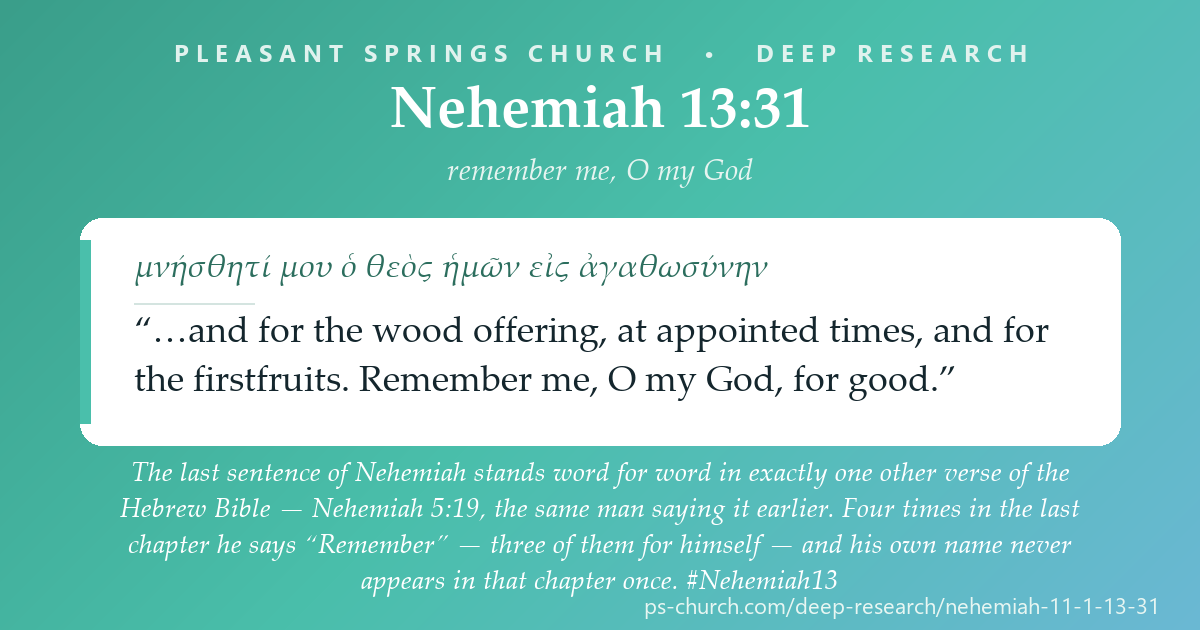
| εἰς ἀγαθωσύνην (the book’s last two words) | 1 | 0 | 2 Esdras 23:31 and nowhere else |
The company Nehemiah keeps in that first list is worth reading slowly. Joseph asking the cupbearer to remember him when things go well — and being forgotten for two years. Samson, blind, asking God to remember him once more. Jeremiah under persecution. A psalmist asking God to remember him and not his sins. ⚠️ Tobit is on this list as a measurement partner, not as Scripture, and the page labels it every time it appears.
What the screen cannot do: it counts word FORMS, not lemmas and not parsings. The Hebrew figure of nine for זכרה includes Lamentations 1:7 and 1:9, where the identical consonants are a third-person perfect — Jerusalem remembers — and not an imperative at all. The page prints nine and then tells you that two of the nine are a different word wearing the same letters. The same caution applies to למואל at 12:38, which is Lemuel in Proverbs 31 and leftward here.
Four screens: a genealogy, a silence, a Sabbath, and a run that means nothing.
1. Nehemiah 11 against 1 Chronicles 9 — where the parallel lives and where it dies
The two chapters are read together in every commentary. This is what the overlap actually measures, verse by verse, over consonantal word forms.
| Nehemiah 11 | best partner in 1 Chr 9 | longest shared run | the words |
|---|---|---|---|
| 11:3 | 9:2 | 3 | בעריהם ישראל הכהנים |
| 11:7 | 9:7 | 3 | בן משלם בן |
| 11:11 | 9:11 | 10 | בן חלקיה בן משלם בן צדוק בן מריות בן אחיטוב |
| 11:12 | 9:12 | 4 | ועדיה בן ירחם בן |
| 11:15 | 9:14 | 9 | ומן הלוים שמעיה בן חשוב בן עזריקם בן חשביה |
| 11:17 | 9:15 | 4 | ומתניה בן מיכא בן |
| 11:20 | 9:2 | 3 | ישראל הכהנים הלוים |
| 11:24 | 9:4 | 2 | בן יהודה |
| 11:25 | 9:3 | 1 | יהודה |
| 11:26–30, 32–35 | — | 0 | nothing shared |
The parallel is alive for twenty-five verses and then it is not. Nehemiah 11:11 and 1 Chronicles 9:11 share ten consecutive word forms, and screened against the whole Masoretic corpus that ten-word chain has a tie band of one — 1 Chronicles 9:11 is the only other verse in the Hebrew Bible that carries it. 11:15 reaches nine, again with a tie band of one. Then from 11:25 the shared wording thins to a single word. 11:26–30 and 11:32–35 share nothing at all with 1 Chronicles 9; the two verses that still reach anything, 11:31 and 11:36, reach one word and two.
The page states the shape and refuses the causal story. Nothing here says Nehemiah copied Chronicles, or Chronicles copied Nehemiah, or that both drew on a temple archive. What is measured is that the Jerusalem register is shared and the village list is not.
2. The silence — and the counter-example the page prints against itself
Screened against every other verse in the Hebrew Bible, eight verses of Nehemiah 11 share no two consecutive words with anything. 11:26, 27, 28, 29, 32, 33, 34, 35 — the village lists of Judah and of Benjamin. Screened over 23,168 other Masoretic verse units. ⚠️ A zero here means shares no two consecutive words, not shares no word — run with the single-word fallback switched on, the same chapter has no zeros at all; every verse shares at least one word with something. Both passes were also run on the ketiv as well as the qere, and the same eight verses came out both times.
And six of those eight are also among the nine verses of Nehemiah 11 the Greek does not have. Greek-absent, nine: 11:16, 20, 21, 28, 29, 32, 33, 34, 35. No-two-word-contact, eight: 11:26, 27, 28, 29, 32, 33, 34, 35. The two sets share six members: 28, 29, 32, 33, 34, 35. Two screens run for different reasons on different corpora, and six of the eight fall inside the nine. The page reports the overlap and offers no account of it whatever — the three Greek absences that fall inside the living part of the Chronicles parallel (11:16, 20, 21) are enough to show it is not a simple rule.
⚠️ NOW THE COUNTER-EXAMPLE, BECAUSE EIGHT IS NOT A REMARKABLE NUMBER. The same screen run on Nehemiah 12 returns nineteen such verses out of forty-seven — 12:2–6, 9, 13–21, 25, 33, 41, 42. Nehemiah 12 is more than twice as “unique” as Nehemiah 11 by this measure, and nobody would call chapter 12 remarkable. What the number is measuring is name-lists: strings of personal and place names shared by no other verse because no other verse lists those particular people. Nehemiah 13, which has no lists, returns zero such verses out of thirty-one. Across the whole passage: 27 of 114 verses, and all 27 of them in chapters 11 and 12.
Which is the honest way round to put it. The eight silent verses in chapter 11 are not evidence of anything special about chapter 11. They are evidence that a register is a kind of writing that cannot be quoted — and that the same chapter also holds the longest quotable chain on the page, at verse 11, fifteen verses before the silence starts.
3. The Sabbath paragraph and Jeremiah 17
Three verses of Nehemiah 13:15–22 have their single deepest contact in the entire Hebrew Bible in one chapter of Jeremiah, and each of the three has a tie band of one.
| row | deepest partner (23,173 verse units screened) | run | tie band | the shared words |
|---|---|---|---|---|
| Neh 13:15 | Jeremiah 17:27 | 3 | 1 | ירושלם ביום השבת |
| Neh 13:19 | Jeremiah 17:21 | 3 | 1 | משא ביום השבת |
| Neh 13:22 | Jeremiah 17:27 | 4 | 1 | לקדש את יום השבת |
| Neh 13:17 | Nehemiah 2:19 | 4 | 1 | הזה אשר אתם עשים |
| Neh 13:18 | Jeremiah 16:10 and six others | 4 | 7 | את כל הרעה הזאת |
Jeremiah 17:19–27 is the oracle in which the prophet is told to stand in the gate of the people and say: bear no burden on the Sabbath day. Nehemiah 13:19 is a man standing in the gate of Jerusalem, shutting the doors so that no burden comes in on the Sabbath day. The vocabulary of the two is the same vocabulary, and outside these two places the Hebrew Bible does not use it.
⚠️ The page does not say who read whom. It does not say Nehemiah is enacting Jeremiah, or that Jeremiah 17:19–27 was composed with Nehemiah in view, or which is prior. The measurement is that three verses of one paragraph have band-one contact with one chapter, and that is a strong result and not an argument. Contrast the row directly above it in the same paragraph: 13:18 also reaches four, and its tie band is seven — all this great evil is a formula shared with 1 Samuel, 1 Kings, Jeremiah, Job, Daniel and 2 Chronicles. Same run length, and it means nothing.
4. Nehemiah 11–13 against the Greek New Testament
All 102 CATSS rows of 2 Esdras 21–23 screened against all 7,927 verses of the Greek New Testament. Distribution: 88 of the 102 rows reach two, 52 reach three, 14 reach four, 1 reaches five, and nothing reaches six. Two rows reach zero — 2 Esdras 22:2 and 22:3, the priestly name-list of Nehemiah 12:2–3, which share no word at all with the Greek New Testament. (Greek-side screens use the single-word fallback, so a zero here really does mean no word in common.)
| row | deepest NT partner | run | tie band | the shared words |
|---|---|---|---|---|
| Neh 13:23 | Revelation 9:6 | 5 | 1 | καὶ ἐν ταῖς ἡμέραις ἐκείναις |
| Neh 11:1 | Acts 13:27 | 4 | 1 | ἐν Ιερουσαλημ καὶ οἱ |
| Neh 11:19 | Revelation 6:11 | 4 | 1 | καὶ οἱ ἀδελφοὶ αὐτῶν |
| Neh 13:19 | Luke 14:5 | 4 | 1 | ἐν ἡμέρᾳ τοῦ σαββάτου |
| Neh 13:17 | Luke 4:36 | 4 | 1 | τίς ὁ λόγος οὗτος |
| Neh 12:43, 12:44, 13:1 | Mt 13:1, Lk 10:12, Ac 2:41, 2 Th 1:10 | 4 | 4 | ἐν τῇ ἡμέρᾳ ἐκείνῃ |
| Neh 13:15 | Lk 2:1, 4:2, Ac 2:18, 7:41, 9:37, Re 9:6, Lk 14:5 | 4 | 7 | ἐν ταῖς ἡμέραις ἐκείναις |
| Neh 13:14 | Mark 15:34 and twelve others | 3 | 13 | μου ὁ θεός |
| Neh 13:31 | Mark 5:5 and eleven others | 3 | 12 | καὶ ἐν τοῖς |
⚠️ READ THE TOP ROW AND THE BOTTOM ROW TOGETHER. THIS IS THE POINT OF THE WHOLE PAGE.
The deepest measured contact between these three chapters and the New Testament is five words, tie band one — the highest and most distinctive number on the page — and it means and in those days. It joins the verse about mixed marriages in Nehemiah 13 to a verse in Revelation about men seeking death and not finding it. There is no relationship between them. It is a date formula.
Meanwhile the row this page is named for, Nehemiah 13:31, has a deepest run of three on the phrase and in the, with a tie band of twelve. The screen never surfaces this verse at all. The thing that actually connects it to the New Testament — μνήσθητί μου, which occurs once in the whole Greek New Testament — measures two, and a run of two is beneath notice on any distribution table ever printed on this shelf.
So the numbers and the meaning point in opposite directions, and both get printed. This is the standing rule here: the measurement finds verbatim contact, not allusion, and the number never makes the judgement. The five-word run at 13:23 is the page’s own counter-example, printed at full strength, so that the two-word one at 13:31 is not read as more than it is.
5. The covenant clause and its breach
The strongest connection in chapter 13 is not to another book. It is to five chapters earlier in this one.
| verse | Hebrew | Greek | English |
|---|---|---|---|
| ESV 10:39 = MT 10:40 | וְלֹא נַעֲזֹב אֶת־בֵּית אֱלֹהֵינוּ | καὶ οὐκ ἐγκαταλείψομεν τὸν οἶκον τοῦ θεοῦ ἡμῶν | “We will not neglect the house of our God.” |
| 13:11 | מַדּוּעַ נֶעֱזַב בֵּית־הָאֱלֹהִים | διὰ τί ἐγκατελείφθη ὁ οἶκος τοῦ θεοῦ | “Why is the house of God forsaken?” |
Same root in the Hebrew — עזב, active then passive — and the Greek keeps the pairing with ἐγκαταλείπω. These are the only two places in Nehemiah where the verb takes the house of God. The covenant that was signed and sealed in chapter 10 is being read back to the officials who signed it, in the form of a question.
The Greek διὰ τί ἐγκατελείφθη is the only passive of this verb in 2 Esdras. Its four active second-person forms are all in the great prayer of chapter 9 — 2 Esdras 19:17, 19, 28 and 31 — and three of the four are negated, you did not forsake them. The fourth is not: 2 Esdras 19:28 (Nehemiah 9:28) reads and you gave them into the hands of their enemies. The book uses one verb in chapter 9 for God’s keeping and for his handing over, for the people’s promise in chapter 10, and for their failure in chapter 13. The page notes the pattern and does not build a doctrine on a Greek verb-stem.
Where this page is weakest, and what could not be checked at all.
The limits of what was measured
Every figure on this page came from four text files and nothing else. The Masoretic corpus (Sefaria’s Miqra according to the Masorah, 23,204 verse units, 39 books), the CATSS digitisation of Rahlfs’ Septuaginta (64 files, 30,637 verse units held, 30,348 seen by a run screen once the Odes are excluded), the SBL Greek New Testament via MorphGNT (7,927 verses), and the ESV. No commentary produced any number here.
⚠️ No critical apparatus was consulted, for either language, and that matters more for this passage than for most. The nine absences in Greek Nehemiah 11 and the three in Nehemiah 12 are reported as properties of the CATSS file as it stands on this disk. Whether Rahlfs’ printed text marks them, whether they are present in Vaticanus or Alexandrinus or Sinaiticus, and whether the digitisation dropped anything, were not checked. The same caution applies to the missing horses-and-mules verse at 7:68: this page says it is absent from the Masoretic edition used here, and does not claim it is absent from every Hebrew witness. It is not.
⚠️ 1 Esdras is a real gap in this page. 1 Esdras is held here and is screened as part of the 30,348 — but 1 Esdras stops before Nehemiah, ending in the middle of the Ezra 10 / Nehemiah 8 material, and this page did not investigate what that implies about how Ezra-Nehemiah circulated. Josephus’ retelling in Antiquities XI, which does cover Nehemiah, was not consulted at all.
⚠️ The Jeremiah 17 result is a run screen, not a source-critical argument. Three band-one contacts in one paragraph is a strong number. It is not a demonstration that either text knew the other. A shared institutional vocabulary — the way people who administer a Sabbath gate actually talk — would produce the same measurement, and the page cannot distinguish the two. Direction of influence is not asserted anywhere on this page.
What could not be checked at all
No Qumran material — and there is very little for Nehemiah, which is itself worth knowing and was not investigated here. No Targum, no Syriac, no Vulgate, no Aquila, Symmachus or Theodotion. No Elephantine papyri, which are the closest contemporary documentary evidence for a Persian-period Jewish community and would bear directly on the intermarriage and Sabbath sections. No Persian administrative sources. No archaeology of Persian-period Jerusalem, which is where the argument about the city’s size and population actually lives.
And one thing this page deliberately does not do. Nehemiah 13:23–27 is a scene in which a governor curses men, beats some of them, pulls out their hair and makes them swear an oath, over marriages. The page reports what the text says and measures its vocabulary. It does not offer an ethical adjudication of the episode, and it does not use the measured link to Solomon as a way of making the scene comfortable. The connection the text itself draws is to Solomon, and the reader can hold the two together without help.
One more honest limit: the ESV footprint of the Deep Research shelf is tracked by a tool that keys off a second English line-list which was removed from every builder on 30 August 2026. The automated report therefore returns zero and is currently uninformative — a tooling regression, not a licensing clearance. Counted instead off the builders themselves on 30 August 2026: this page prints fifteen verses of Nehemiah in its codex and quotes fragments of eight more in its prose — 4:9, 7:4, 7:68, 10:39, 12:30, 12:43, 13:4 and 13:8. Across the whole shelf the codex rows come to 56 of the book’s 406 verses — fourteen per cent, with prose fragments on top of that, and comfortably inside Crossway’s half-a-book limit either way. Most rows quote a clause rather than a whole verse, so a whole-verse count overstates what is reproduced.
Reading list
- H. G. M. Williamson, Ezra, Nehemiah (Word Biblical Commentary 16).
- Joseph Blenkinsopp, Ezra-Nehemiah: A Commentary (Old Testament Library).
- Jacob L. Wright, Rebuilding Identity: The Nehemiah Memoir and its Earliest Readers.
- Lester L. Grabbe, A History of the Jews and Judaism in the Second Temple Period, vol. 1.
- Oded Lipschits, The Fall and Rise of Jerusalem — on Persian-period population.
- None of these were consulted for the measurements on this page, which were run on the text files named in the footer.
A book that ends with a man asking not to be forgotten.
The lists and the prayer
Two-thirds of this passage is names, and the names are borrowed. Ten consecutive words of Nehemiah 11:11 stand in 1 Chronicles 9:11 and nowhere else; nine of 11:15 stand in 1 Chronicles 9:14 and nowhere else. Whoever assembled this register was working from the same material somebody else had already worked from. That is what a register is for.
And then the register stops and a voice starts. From 12:31 the text is I. By chapter 13 the man’s name has disappeared from his own book — seven times in the Hebrew, and the last of them at 12:47 — and what stands in its place is אֱלֹהַי, my God, five times in thirty-one verses.
The imperative he uses four times in that chapter is not a common biblical idiom. Measured: זָכְרָה stands nine times in the whole Hebrew Bible and six of them are his; the Greek μνήσθητί μου ὁ θεός stands four times in 30,348 Greek Old Testament verse units and all four are his. The only other man in Scripture who says זָכְרָה to God is Solomon, dedicating the temple (2 Chronicles 6:42) — and the only king of Israel Nehemiah 13 names is Solomon.
Nehemiah does not end with the wall. The wall is finished in chapter 6 and dedicated in chapter 12 with two choirs on top of it and the joy of Jerusalem heard from a distance. One chapter later the storeroom is a guest room, the Levites are back in their fields, and the wine presses are working on the Sabbath. The book ends with the reform half-done and the reformer asking to be remembered. Not reward me. זָכְרָה־לִּי אֱלֹהַי לְטוֹבָה — remember me, my God, for good — four words, and the only other verse in the Hebrew Bible that carries them is Nehemiah 5:19, which is the same man saying it earlier.
Two centuries later, the one Second-Temple book that praises him picks the same root. Sirach 49:13: καὶ Νεεμιου ἐπὶ πολὺ τὸ μνημόσυνον — and of Nehemiah the remembrance is great. Sirach is a witness on this shelf and not Scripture, and the page notes the vocabulary and asserts nothing about dependence. But the man asked three times not to be forgotten — and once, at 13:29, asked God to remember somebody else — and the sentence that survives him is about his memory.
Nehemiah is now complete on this shelf
Every Deep Research page traces its passage across the whole sweep — the Old Testament, the Second-Temple world between the testaments (historical witnesses, not Scripture), and the New Testament. Follow the thread:
Pleasant Springs Church — Deep Research
Research method after Michael S. Heiser’s Bible Research Method (examine dictionaries → ancient literature → important words → textual connections → academic publications → share), with the Pleasant Springs “Author & Audience” foundation. Scripture set in the Hebrew, the Greek editions named on each page and the ESV (Old Testament), and the Greek New Testament and the ESV (New Testament), per the practice of Pleasant Springs Church. Nehemiah research grounded in Williamson (WBC), Blenkinsopp (OTL), Wright (Rebuilding Identity) and Grabbe. Text: Hebrew from the Masoretic text as printed in the edition consulted — Sefaria’s Miqra according to the Masorah; no critical apparatus was consulted for the Hebrew. Greek from Rahlfs’ Septuaginta as digitized by CATSS, where Nehemiah is 2 Esdras 11–23; Greek New Testament from the SBL edition via MorphGNT. The standing caution for this shelf applies: these pages say “the CATSS Greek row reads…” and never call a Greek reading early or late. ⚠️ VERSE NUMBERING — three seams, and none of them in this passage. Derived for this page by counting the corpora on disk. MT 3:33–38 = ESV 4:1–6 and MT 4:1–17 = ESV 4:7–23; ESV 7:68 has no verse of its own in this Masoretic edition though the Greek has it at 2 Esdras 17:68; MT 10:1 = ESV 9:38, so MT 10:2–40 = ESV 10:1–39. Totals: Masoretic 405 verse units, ESV 406 verses, CATSS 2 Esdras 11–23 392 present. Chapters 11, 12 and 13 run 36 / 47 / 31 in all three columns, so every reference on this page carries the same number in Hebrew, Greek and English. The Greek chapter number is always ten higher: Nehemiah n = 2 Esdras n + 10. ⚠️ Twelve verse units of this passage are absent from the Greek. Nehemiah 11:16, 20, 21, 28, 29, 32, 33, 34, 35 and 12:4, 5, 6. Chapter 13 is complete. “Absent” means the CATSS file carries no row with that label; no printed Rahlfs was collated against the digitisation, and no manuscript witnesses were checked. ⚠️ What a zero means, on each side. The Hebrew screens on this page run without the single-word fallback, so a zero means shares no two consecutive words with any other verse — the eight silent verses of Nehemiah 11 all share individual words. The Greek New Testament screen runs with it, so the two zeros there (2 Esdras 22:2 and 22:3) mean share no word at all. Both Hebrew screens were run twice, on the qere and on the ketiv, and reported only where the two passes agreed. ⚠️ The Greek measurement, in full. Greek against Greek. CATSS FORM column (cols 0–24), beta-code transliterated first; MorphGNT field 6, the normalised word. Both sides lowercased, accents and breathings dropped, final sigma folded, then filtered to Greek letters — the same filter applied to both corpora, and MorphGNT’s own spelling equivalences (ou/ouk/ouch, ek/ex, the movable nu) applied on both sides, so these figures are higher than anything this shelf published before 30 August 2026. Word forms, never lemmas. Corpus: the 102 CATSS rows of 2 Esdras 21–23 against 7,927 verses across 27 MorphGNT files. Greek Old Testament phrase counts are over 30,348 verse units — the 64 CATSS files less the Odes, which are excluded because Ode 9 is Luke 1, Ode 13 is Luke 2, and ten further Odes are second copies of passages already counted elsewhere. Exhaustive and deterministic; nothing sampled, so no seed applies. ⚠️ Deuterocanonical hits are witnesses, not Scripture. Tobit 3:3 appears in the μνήσθητί μου count and Sirach 49:13 in the Canon Thread. Both are labelled every time they appear. ⚠️ Direction of influence is never asserted. Nothing here says Nehemiah 11 copies 1 Chronicles 9 or the reverse, that Nehemiah 13 enacts Jeremiah 17 or the reverse, that Luke 23:42 draws on Nehemiah, that Sirach 49:13 is responding to Nehemiah’s prayer, or what produced any Greek reading — including the shortened 11:23, the dropped name at 12:47, and our God for my God in the last sentence of the book. Typology is handled per the house position: what the text says, what the New Testament itself draws, and what we see from this side of the cross — with the seeing left to the reader.
Scripture quotations marked ESV are from the ESV® Bible (The Holy Bible, English Standard Version®), © 2001 by Crossway, a publishing ministry of Good News Publishers. ESV Text Edition: 2016. Used by permission. All rights reserved. The ESV text may not be quoted in any publication made available to the public by a Creative Commons license, and the ESV may not be translated in whole or in part into any other language. www.esv.org
|
Did this study bless you today? 💚 Give to Support PS Church100% of gifts go to the General Fund — thank you. |