The wall is finished, and the city is empty — “wide and large, but the people within it were few.” So the governor calls an enrolment, and then does something narrators almost never do: he tells you where his next sixty-seven verses came from. “I found the book of the genealogy… and I found written in it.” And the claim can be checked. Screened verse by verse against the whole Hebrew Bible, 64 of the 72 verses of Nehemiah 7 find their deepest partner in Ezra 2 — thirteen of them word for word — and the eight that do not are exactly the seams: the five verses of Nehemiah’s own frame, one bare numeral, the one paragraph where the two copies genuinely differ, and the closing sentence, whose unique partner anywhere else in the Hebrew Bible is Ezra 3:1. Then the seventh month arrives and the people ask for a different book. And in the prayer that follows — the longest in the Old Testament — the deepest verbatim contact with anything else in Scripture is not Exodus 34:6. It is Jonah 4:2. See the method →
Nehemiah 7:1–9:38 (selections)
Hebrew · Greek (Rahlfs, 2 Esdras) · ESVThen the seventh month arrives, the people gather as one man at the Water Gate and ask for a different book; they weep, keep Booths, and three weeks later come back in sackcloth with dirt on their heads to say the whole national story out loud, back to God. And the unit ends with a second document — this one they write themselves and sign.
⚠️ Numbering: two one-verse offsets inside these three chapters, and they run in opposite directions. Nehemiah n = 2 Esdras n+10, so these chapters are 2 Esdras 17–19 (and 9:38 is 2 Esdras 20:1). Counted against all three columns:
(1) In chapter 7 the English runs one AHEAD of the Hebrew from verse 69 on. The Masoretic Text as printed here has 72 verses in Nehemiah 7; the Greek has 73; the ESV has 73. The verse the Hebrew does not carry is the one about the horses and mules, which the Greek has at 2 Esdras 17:68 — ἵπποι ἑπτακόσιοι τριάκοντα ἕξ ἡμίονοι διακόσιοι τεσσαράκοντα πέντε — and which Ezra 2:66 carries in Hebrew. So MT 7:68 = ESV 7:69 and MT 7:72 = ESV 7:73, and here the Greek follows the English numbering.
(2) At the 9/10 seam the English runs one BEHIND the Hebrew. The Masoretic Text puts “because of all this we make a firm covenant in writing” at 10:1; English versions make it 9:38. So MT 10:1 = ESV 9:38, and here the Greek follows the Hebrew (2 Esdras 20:1). Chapters 8 and 9 are otherwise numbered alike in all three, at 18 and 37 verses. Rows above are labelled by the ESV number with the Hebrew in brackets where they differ.
⚠️ The Hebrew here is one printed edition. The verse the Masoretic column lacks is present in other Hebrew witnesses and in the parallel at Ezra 2:66; no critical apparatus was consulted for this page, and every statement about “the Hebrew” means Sefaria’s Miqra according to the Masorah as held on this disk.
The Shape of the Passage
Sequence — two documents and two assembliesChapter 7 also closes the unit studied on Nehemiah 5:1–7:73, and chapters 8–9 open the unit studied on Nehemiah 8:1–13:31. This page deliberately straddles that join, because the join is where the measurable thing is: a quoted document, its two seams, and the assembly the seam hands over to.
Author
He tells you he is quoting. 7:5 is one of the plainest source citations in the Hebrew Bible: I found the book of the genealogy of those who came up at the first, and I found written in it — and then sixty-seven verses that are not his sentences. Most ancient writers do not announce their documents. This one does, and the announcement is verifiable by measurement: from the verse immediately after it, every verse but three finds its deepest partner in the whole Hebrew Bible in Ezra 2.
He is an administrator, and it shows in what he keeps. The first-person material in this unit is short and practical — doors hung, gatekeepers posted, gates not opened until the sun is hot, two named men put in charge, one of them praised in six Hebrew words for being a more faithful and God-fearing man than many. Then he stops writing and lets a list speak. The register is his evidence, not his composition, and he treats it that way.
And then he steps out of the frame entirely. Nehemiah is barely present in chapters 8 and 9 — named once in the whole of chapter 8, at 8:9, and not once in chapter 9. At that single mention the Greek column drops his Persian title and prints only the name. Whoever assembled this book was willing to give the two best chapters in it to somebody else.
Audience
People for whom a list was a legal instrument. A register of who came back is not antiquarian in a Persian province. It is how you establish who may claim land, who may serve at the altar, and who may not — which is why the one paragraph inside the register that the text slows down for is the priests who could not find their entry and were excluded until a priest with Urim and Thummim should arise (7:64–65). The document had teeth.
People who had to be told what the book said. 8:2 defines the assembly as “…men and women and all who could understand what they heard.” That is a population who did not simply read Hebrew off a scroll for themselves, in a city where the language question was live enough that Nehemiah later complains about children who cannot speak Judean. The reading at the Water Gate is an act of translation and instruction, and the text says so.
And people rehearsing an identity out loud. The confession of chapter 9 is not information — every hearer knew the story. It is a community saying, in the first person plural, we did this and you did that, and ending not with a petition but with a statement of position: “we are slaves this day… we are in great distress.” The signed covenant of 9:38 is what a community does after saying that.
Orient on the Persian-period province, on the register and its double, on the Tirshatha and the Nethinim, and on the seventh-month festival calendar.
Search by topic: Nehemiah; Ezra–Nehemiah as one book; the golah list (Ezra 2 / Nehemiah 7); Yehud as a Persian province; Tirshatha; Nethinim / temple servants; daric; Urim and Thummim; the Water Gate; Feast of Booths (Sukkot); Day of Atonement; penitential prayer; 1 Esdras.
Which articles are relevant?
- Ezra–Nehemiah as a single book. In the Hebrew tradition and in the Greek alike these are not two books but one — the Greek column calls the whole of it 2 Esdras and runs the chapters straight through, so Nehemiah 7 is 2 Esdras 17. That is not a curiosity of numbering; it is the reason a register can appear twice inside what is, in the manuscripts, one scroll.
- The golah list. The register of returnees stands three times in the surviving literature: Ezra 2, Nehemiah 7, and 1 Esdras 5. Every dictionary treatment will discuss the differences in the individual totals against the identical grand total of 42,360. This page measures the wording rather than arbitrating the arithmetic.
- Tirshatha. A Persian administrative title, not a Hebrew word, used of the governor. It occurs five times in the Hebrew Bible and all five are in Ezra–Nehemiah.
- Nethinim. The given ones — a class of temple servants named in the register and again in 7:73. The Greek does not translate the word; it writes it out in Greek letters, ναθινιμ.
- The seventh month. The three chapters run on a festival calendar: the first day (trumpets) is the reading; the fifteenth to the twenty-second is Booths; the twenty-fourth is the fast of chapter 9. The Day of Atonement, the tenth, is not mentioned. Commentators disagree about what to make of that; the page notes it and does not resolve it.
- Daric. The Persian gold coin named in 7:70–72 [MT 7:69–71]. Whether a coin of Darius can stand in a document of Cyrus’s reign is a standard dating question in the literature; it is named here as an open question and is not used as evidence for anything on this page.
What a Persian-period list was for, and what happens when you can measure the same list three times.
The comparison that matters in this stage is not Nehemiah against a myth but Nehemiah against a second and a third copy of his own document — two in Hebrew, one in an independent Greek rendering. That is a rare opportunity and it produces a warning as much as a finding.
What does the surrounding world contribute?
- Lists are the characteristic document of the Persian empire, and of the archives that survive from it. The Aramaic papyri from the Jewish garrison at Elephantine — a fifth-century community contemporary with Nehemiah — are overwhelmingly of this kind: name lists, contribution lists, ration lists, marriage contracts, petitions to the governor. A register of households and their gifts to the treasury is exactly the sort of paper such a community kept. Nehemiah 7 does not read like literature because it is not; it reads like the contents of a box.
- The same list, translated twice, is barely the same text. This is a measurement, and it is the most useful methodological result on this page. Screened Greek against Greek: 2 Esdras 17 against 2 Esdras 2 — the same list inside the same translation — puts 24 of its 73 rows at a run of 5 or more and reaches 11. 2 Esdras 17 against 1 Esdras 5 — the same list in a different Greek rendering — puts 4 rows of 73 at 5 or more and reaches 7, with 35 rows at 2 or less. Same names, same towns, same numbers; almost no shared wording. Verbatim-run depth measures transmission, not sameness of content, and every run figure on this page has to be read with that in front of it.
- Josephus retells all of this in Antiquities 11, and rearranges it freely — he is a witness to how the story was told in the first century, not a witness to the text. He is not levelled with Scripture anywhere on this page.
- Public reading with interpretation is a recognisable institution, not an innovation of this chapter. 8:8 — the Levites giving the sense so that the people understood the reading — is the practice later formalised in synagogue reading and in the Targums. That verse is printed and treated at length on Nehemiah 8:1–13:31 and is deliberately not duplicated here.
- The great national confession is a genre with neighbours. Psalm 106, Daniel 9, Ezra 9 and Baruch 1–2 all do a version of it. Measured against Psalm 106 and Daniel 9 the contact is real but shallow — 9:10 shares 8 consecutive Greek words with Daniel (Theodotion) 9:15, Baruch 2:11 and Jeremiah 39:20 alike (Greek chapter numbers throughout; Rahlfs’s Jeremiah 39:20 is MT Jeremiah 32:20), at a tie band of 3, which is the signature of a fixed liturgical clause rather than of a citation.
A Persian title, a word the translator refused to translate, the church’s loanword, and a formula whose word order can be counted.
Every count below is over the corpora held on this disk and is stated with its denominator. Where a count folds homographs together — as the Hebrew אמן does — that is said out loud rather than smoothed over.
A Persian title for the governor, carried into Hebrew untranslated. It occurs in five verses of the Hebrew Bible and no others — Ezra 2:63, Nehemiah 7:65, 7:69 [ESV 7:70], 8:9 and 10:2 [ESV 10:1]. The Greek column transliterates it twice and drops it three times: Αθερσαθα stands at 2 Esdras 2:63 and 17:65 and nowhere else in the Greek held here. At 2 Esdras 17:70 the Greek does something else again — it writes τῷ Νεεμια, to Nehemiah, where the Hebrew has the title.
“The given ones” — a class of temple servants. Counted across the Masoretic corpus it stands 17 times in 15 verses, and every one of them is in Ezra, Nehemiah or 1 Chronicles 9:2 — it occurs nowhere else in the Hebrew Bible. The Greek does not translate the word at all; it writes it in Greek letters, ναθινιμ — 11 times in that exact spelling, with three more in two further transliterations (ναθινιν once, ναθιναῖοι twice): 14 in all, and every one of the 14 stands inside 2 Esdras. A translator who renders everything else stops at this one and copies the sound — which is what translators do with a technical term whose Greek equivalent they do not have.
The congregational response, doubled: אָמֵן ׀ אָמֵן. Counted as a consonantal form, אמן stands 32 times in the Masoretic corpus — but that count folds in homographs (the guardian of Esther 2:7, the craftsman of Song 7:2), so it is a count of a written string and not of a word, and is reported as such. What is clean is the Greek: αμην occurs 9 times in the 30,348 screened Greek Old Testament verse units held here and 128 times in the Greek New Testament. The word the church says at the end of every prayer entered Greek as a loan, not as a translation, and Nehemiah 8:6 is one of the nine places where the Greek Old Testament does it.
“Gracious and merciful” — and the order is measurable. That sequence occurs in 8 verses of the Hebrew Bible: Joel 2:13, Jonah 4:2, Psalm 111:4, Psalm 112:4, Psalm 145:8, 2 Chronicles 30:9 and both of Nehemiah’s. The reverse order, רַחוּם וְחַנּוּן, occurs in exactly three: Exodus 34:6, Psalm 86:15 and Psalm 103:8. Nehemiah 9:17 is not quoting Exodus 34:6’s wording; it is using the other form of the formula, and that single fact is what produces the run measured in Stage 4.
The word for the signed covenant. In this exact form it occurs in five verses of the Hebrew Bible: Genesis 20:12 and Joshua 7:20, where it is an adverb (“indeed, truly”); 2 Kings 5:12 and Song of Songs 4:8, where it is a place — the river and the mountain. Nehemiah 10:1 [ESV 9:38] is the only verse in the Hebrew Bible where it means a written agreement. (With a prefixed conjunction it appears once more, at Nehemiah 11:23, of a fixed provision — counted and disclosed rather than quietly folded in.) The Greek renders it πίστιν, and the ESV “a firm covenant.”
Two things reported rather than tidied:
- The Greek names Ezra twice where the Hebrew does not. At 8:8 the Hebrew has no stated subject — they read and gave the sense — and Rahlfs supplies ἐδίδασκεν Εσδρας. At 9:6 the Hebrew runs straight on from the Levites of 9:5 into “You are the Lord, you alone,” and Rahlfs opens with καὶ εἶπεν Εσδρας. Two chapters, two places where an open Hebrew subject becomes Ezra in the Greek. That is an observation about the two columns. It is not a claim that anybody changed anything, and this page does not make one.
- 9:17 has a ketiv/qere in the middle of its deepest run, and the run was measured both ways. The qere reads וְרַב־חֶסֶד; the ketiv reads ורב וחסד. Reading the qere, Nehemiah 9:17 shares 6 consecutive word forms with Jonah 4:2 at a tie band of 1. Reading the ketiv, it shares 5, at a tie band of 1. Both passes give the same unique partner and differ only in depth, so the finding survives the variant — and the page prints both numbers rather than the flattering one.
Sixty-four verses out of seventy-two, eight seams, one prayer whose closest relative in the Bible is Jonah, and a run of six into the New Testament that means nothing at all.
Three screens produced every figure below. Hebrew: consonantal word forms against the 23,204 verse units of the Masoretic corpus, contiguous runs only, single-word matches not counted — so a 0 on this page means “shares no two consecutive words,” not “shares nothing”. Greek Old Testament: over 30,348 screened verse units of the 64 CATSS files held here. Greek New Testament: against all 7,927 verses of the SBLGNT via MorphGNT, with MorphGNT’s own spelling equivalences applied (ou/ouk/ouch, ek/ex, the movable nu) — so these figures run higher than anything published on this shelf before 30 August 2026 and must not be compared with it. Tie band is printed beside every run.
Which cross-references matter?
- Nehemiah 7 → Ezra 2 — 64 of 72 verses, and the eight exceptions are the point. Screened verse by verse against the whole Masoretic corpus — not against Ezra 2, but against everything — 64 of the 72 verses of Nehemiah 7 find their single deepest partner in Ezra 2. On that same screen the depths run 3 or more for 67 rows and 5 or more for 35, and the two deepest are 16 at 7:63 (the Barzillai priests, tie band 1) and 14 at 7:67 (tie band 1). Compared directly against Ezra 2 alone, verse for verse, thirteen of the seventy-two verses are word-for-word identical to their Ezra 2 partner, form for form, with nothing added or dropped.
- And the eight that are not. 7:1, 7:3 and 7:4 top out at a run of 2 with tie bands of 34, 28 and 4 — formulaic Hebrew that matches everywhere and therefore nowhere. 7:2 runs 3. 7:5 — the verse in which he says he found the book — runs 4 at tie band 1, and its partner is Nehemiah 5:7, his own earlier chapter: את החרימ ואת הסגנימ, “the nobles and the officials.” 7:24 is a numeral row matching the numeral formulas of 1 Chronicles at band 23. 7:69 [ESV 7:70] is the gifts paragraph, band 44. And 7:72 [ESV 7:73] has one unique deepest partner in the whole Hebrew Bible: Ezra 3:1, run 5, band 1. Every one of the eight is either Nehemiah’s own frame, a bare numeral, the one paragraph where the two registers genuinely differ, or the seam.
- Counter-measurement, printed against the whole preceding paragraph. Run depth is a measure of shared wording, and shared wording is not the same as shared content. The proof is on this page: 2 Esdras 17 against 1 Esdras 5 — the identical register, rendered into Greek by a different hand — puts only 4 of 73 rows at a run of 5 or more and 35 rows at 2 or less. If someone showed you those numbers cold you would conclude the two chapters were unrelated. They are the same list. Read the 64-of-72 figure as evidence of one written source copied, and not as a general licence to infer relationship from run depth.
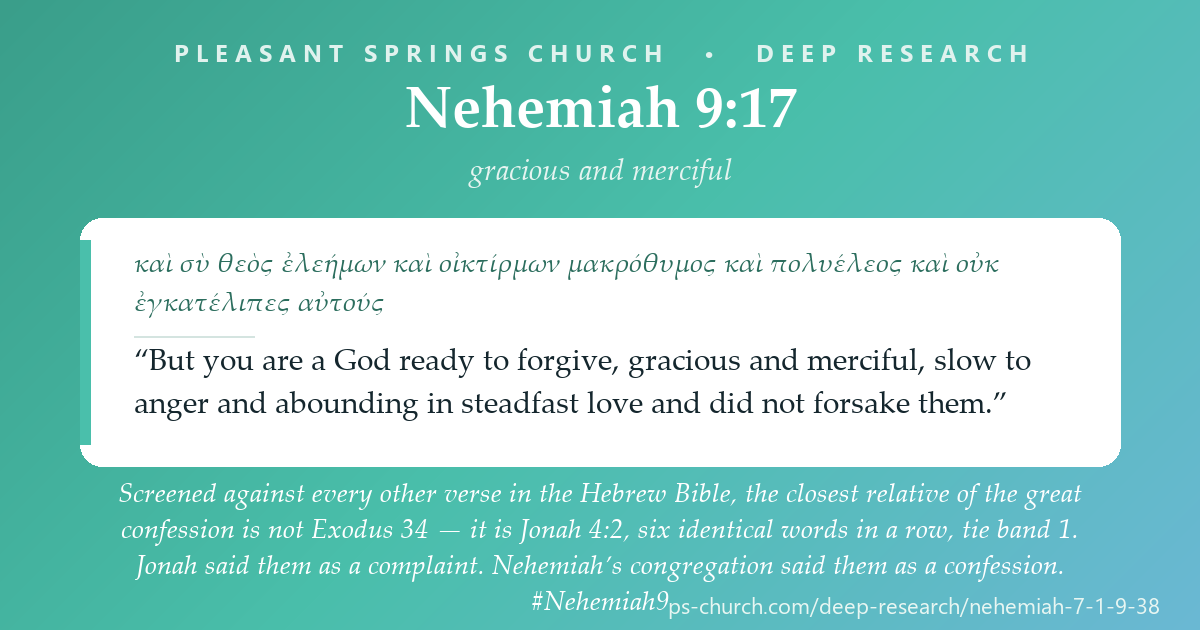
- Nehemiah 9:17 → Jonah 4:2 — run 6 in Hebrew, run 7 in Greek, tie band 1 in both. This is the finding this page did not expect. Screened against every other verse in the Hebrew Bible, the deepest verbatim contact anywhere in the great confession is חנונ ורחומ ארכ אפימ ורב חסד — and its one and only partner at that depth is Jonah 4:2. Screened independently on the Greek side over 29,676 verse units, 2 Esdras 19:17 against Jonah 4:2 gives ελεημων και οικτιρμων μακροθυμοσ και πολυελεοσ και — 7 words, tie band 1. Two corpora, two languages, one unique answer.
- And what it is not: Exodus 34:6 measures 4. The verse everyone reaches for — “the Lord, the Lord, a God merciful and gracious” — shares 4 consecutive words with Nehemiah 9:17, and so do Numbers 14:18, Joel 2:13 and Psalms 86:15 and 103:8. All five share the same four: ארכ אפימ ורב חסד. The reason Jonah measures deeper is a word order and a missing pronoun. Exodus has the adjectives the other way round (רחומ וחנונ); Joel 2:13 has them Nehemiah’s way but puts הוא between the halves, which cuts the run at four. Jonah 4:2 has nothing in between. Three verses in the Hebrew Bible carry both halves of the formula; only two carry them consecutively, and they are Jonah 4:2 and Nehemiah 9:17.
- The deepest New Testament run in these chapters is a coincidence, and the page prints it as one. The 129 Greek verse units of 2 Esdras 17–19 plus 20:1 were screened against all 7,927 verses of the Greek New Testament. The distribution is flat — 24 rows reach 4, nothing reaches 5 — and one row stands alone above it: 2 Esdras 17:5 → Luke 23:13, run 6, tie band 1: και τουσ αρχοντασ και τον λαον. In Nehemiah that is the governor assembling the nobles and the officials and the people for an enrolment. In Luke it is Pilate calling together the chief priests and the rulers and the people to condemn a man. Six identical words and no relationship whatever. (The same run measures 6 with and without MorphGNT’s spelling fold, so it is not an artefact of the new normalisation either.)
- Nehemiah 9 → Acts 7 — nothing reaches 5. Stephen’s speech and the great confession are the two long retellings of the same national story in the two Testaments. Screened against each other — 37 Greek verses against 60 — the deepest contact is 4, reached four times, and every one of the four is a stock phrase: και τω σπερματι αυτου, και οι πατερεσ ημων, εισ την γην ην. Two speeches about identical events, and no distinctive shared wording at all. That is worth more than a positive result: it shows what a shared story looks like when there is no shared text.
- Chapter 8 is the least derivative chapter of the three, and it is the chapter about reading. Screened against the whole Masoretic corpus, nothing in Nehemiah 8 exceeds a run of 5, and the two verses that reach it — 8:1 and 8:14 — do so on two different stock legal clauses. 8:1 shares תורת משה אשר צוה יהוה, “the Law of Moses that the Lord commanded,” with 2 Kings 14:6 at band 1; 8:14 shares אשר צוה יהוה ביד משה, “that the Lord commanded by the hand of Moses,” with Leviticus 8:36 and Numbers 36:13 at band 2. Sixteen of the eighteen verses sit at 2 or 3. The chapter in which Israel receives the whole of its written tradition is written in almost none of its words.
- “As one man” — 9 verses in the Hebrew Bible, and the last two are the two assemblies after the two copies of the register. כְּאִישׁ אֶחָד occurs at Numbers 14:15, Judges 6:16, 20:1, 20:8, 20:11, 1 Samuel 11:7, 2 Samuel 19:15 — and then Ezra 3:1 and Nehemiah 8:1. Both times it follows the same list, and both times it precedes a gathering in the seventh month.
- Nehemiah 9:6 and 9:7 carry a phrase found in only one other verse. אַתָּה־הוּא יְהוָה, “you are the Lord,” occurs in three verses of the Hebrew Bible: Jeremiah 14:22, Nehemiah 9:6 and Nehemiah 9:7. Two of the three are the opening two lines of this prayer.
- The deepest Greek Old Testament run in these chapters is 11, and it is a nations list. Screened over the 29,676 Greek Old Testament verse units held here that are not Ezra–Nehemiah, 2 Esdras 19:8 shares 11 consecutive word forms with Exodus 3:17, tie band 1: την γην των χαναναιων και χετταιων και αμορραιων και φερεζαιων και. Second is 2 Esdras 18:18 against Exodus 12:15 at 9, tie band 1. Both are fixed lists — the peoples of the land and the days of a festival — which is exactly where deep runs are cheapest, and no direction of influence is asserted for either.
- One more coincidence, printed because it is funny and because it is instructive. 2 Esdras 20:1 [ESV 9:38], the sentence that begins the signed covenant, shares 4 words with Luke 16:26, tie band 1: και εν πασιν τουτοισ — “and besides all this,” the clause that introduces the great chasm in the parable. Nothing connects the two verses but the connective.
What was consulted, what was not, what could not be checked, and where this page is weakest.
The commentaries first. Then, at length, the limits — because a page built on measurement is worth exactly what its scope statement is worth.
Commentaries & studies:
- H. G. M. Williamson, Ezra, Nehemiah (WBC) — the standard technical treatment of the relationship between Ezra 2 and Nehemiah 7 and of the composition of chapters 8–9.
- Joseph Blenkinsopp, Ezra–Nehemiah (OTL) — on the golah list as a legal instrument and on the penitential prayer as a genre.
- Jacob M. Myers, Ezra, Nehemiah (Anchor Bible) — on the Persian-period administrative background, the Tirshatha and the daric.
- Mark J. Boda, Praying the Tradition — the standing study of the origins of the language of Nehemiah 9, which asks precisely the question this page measures and answers it with a much wider notion of dependence than a verbatim run can reach.
- Tamara Cohn Eskenazi, In an Age of Prose — on documents, lists and the act of citing them inside Ezra–Nehemiah.
What this page could not check, and where it is weakest:
- The 64-of-72 figure is the strongest-looking thing here and it is a statement about wording only. It says that 64 verses of Nehemiah 7 have Ezra 2 as their deepest verbatim partner in the Hebrew Bible. It does not say which chapter is prior, whether one writer saw the other, or whether both copied a third document — and the honest answer is that the measurement cannot distinguish those cases and this page does not try. The 1 Esdras 5 counter-measurement is printed in Stage 2 and again in Stage 4 precisely so the number is not read as more than it is.
- No critical apparatus was consulted, and that limits every textual statement on the page. The Hebrew is one printed edition (Sefaria’s Miqra according to the Masorah); the Greek is one printed edition (Rahlfs, as digitized by CATSS). When this page says “the Hebrew has no verse for the horses and mules” or “the Greek reads to Nehemiah,” it means exactly that and no more. Other Hebrew manuscripts do carry the horses verse — it stands in the parallel at Ezra 2:66 in this same Hebrew corpus — and the Lucianic and Antiochene Greek traditions were not examined at all. A reader who needs the manuscript evidence should go to Göttingen and to Williamson’s notes.
- The Odes are excluded from every Greek Old Testament figure. The corpus held here is 64 CATSS files totalling 30,637 verse units; a run screen sees 30,348, because the Odes are held out. Ode 9 is Luke 1 and Ode 13 is Luke 2 copied into a Greek Old Testament manuscript, and ten further Odes are second copies of Exodus 15, Deuteronomy 32, 1 Samuel 2, Habakkuk 3, Isaiah 26, Jonah 2, Daniel 3, Isaiah 5 and Isaiah 38. Leaving them in would inflate every ‘this phrase occurs N times’ count — and it would have put the αμην figure above at 12 instead of 9. It would not have touched this page’s central finding: the duplicated Jonah Ode is Jonah 2, not Jonah 4, and the Greek screen re-run with the Odes left in returns the same run of 7 against Jonah 4:2 at the same tie band of 1.
- The Jonah result is a result about a formula, and formulas travel. Six identical words is a real and unique measurement, and it is still six words of a liturgical clause that at least eight verses of the Hebrew Bible use in some form. The page’s claim is the narrow one — that Nehemiah 9:17 stands closer, word for word, to Jonah 4:2 than to Exodus 34:6 — and it does not claim that the prayer is drawing on Jonah, or that either text is prior. Boda’s work argues dependence on Exodus 34 on grounds a run screen cannot see, and that argument is not answered here.
- The arithmetic of the register was not audited. Ezra 2 and Nehemiah 7 give different figures for many individual families while both reaching the same grand total of 42,360, and the sum of the individual entries in each does not reach that total. This page measured wording and did not attempt the numbers, which are a genuine and unresolved problem in the literature. Nothing here depends on them.
- The dating questions are named and left open. Whether the daric in 7:70–72 is anachronistic in a document of Cyrus’s reign; whether Nehemiah 8–9 originally stood in the Ezra material and was moved; whether Ezra and Nehemiah were contemporaries at all. Each of these is live in the literature, none of them was settled here, and no measurement on this page turns on any of them.
- The absence of the Day of Atonement from this festival calendar was not explained. The chapters name the first day, the fifteenth to the twenty-second, and the twenty-fourth; the tenth is not mentioned. That is an observation about what the text does and does not say. Every explanation offered for it in the literature goes beyond the text, and none is adopted here.
- No direction of influence is asserted anywhere on this page — not between Nehemiah 7 and Ezra 2, not between Nehemiah 9:17 and Jonah 4:2 or Exodus 34:6, not between 2 Esdras 17:5 and Luke 23:13, and not between the Hebrew and Greek columns where they differ. Where the Greek names Ezra and the Hebrew does not, both are printed and neither is corrected.
- What a zero would have meant, since the page reports none. The Hebrew screen was run with single-word matches not counted, so a 0 would have meant “shares no two consecutive words with any other verse in the Masoretic corpus.” No verse in Nehemiah 7–9 comes out at 0 on that screen. The lowest are the formulaic frame verses at 2, and their tie bands (34 and 28) are the thing worth noticing about them, not their depth.
A governor who cites his sources, a chapter about reading that borrows nobody’s words, and a prayer whose nearest relative is a sulking prophet.
Name what you learned, why it matters, and one concrete response.
What should we carry away — and do?
- He told us he was quoting, and the text bears him out. “I found the book… and I found written in it” — and from the very next verse the wording stops being his and becomes Ezra 2’s, for sixty-seven verses, and then becomes his again in a single closing sentence. A man who kept the receipts and said where he got them. That is not a small virtue in a leader, and it is measurable two and a half thousand years later.
- The chapter about the Bible is the least biblical-sounding chapter of the three. Nehemiah 8 is where Israel gets its Scriptures read to it from daybreak to midday, and nothing in it shares more than five consecutive words with the rest of the Hebrew Bible. Receiving the word is described in ordinary words. The event was not made to sound scriptural; it was just written down.
- “Gracious and merciful” is not a quotation of Exodus here — it is the version of the sentence that a man said when he was angry that God had forgiven somebody. Jonah threw that formula at God as a complaint. Nehemiah’s congregation says the same six words, in the same order, as a confession. The identical sentence is an accusation in one mouth and a hope in another, and no measurement will tell you which one you are making.
- Six words can mean nothing. The deepest verbatim link between these three chapters and the Greek New Testament is Nehemiah 7:5 and Luke 23:13 — the rulers and the people, gathered in one case for a census and in the other to condemn Jesus. A chart of parallels will show you that link and will not tell you it is worthless. Ask, every time, whether the shared words are doing the same work.
- One concrete response. Nehemiah 9 is the whole national story told back to God in the first person plural — we did this, you did that — and it ends without asking for anything. This week, write out your own version: three things you have done and three things God has done, in that order, and stop before the request. The eleven “you”s in that prayer are the load-bearing word; make yours the same.
Nehemiah 9:17 · to share
Hebrew + Greek (Rahlfs, 2 Esdras) + ESVEvery Deep Research page traces its passage across the whole sweep — the Old Testament, the Second-Temple world between the testaments (historical witnesses, not Scripture), and the New Testament. Follow the thread:
Pleasant Springs Church — Deep Research
Research method after Michael S. Heiser’s Bible Research Method (examine dictionaries → ancient literature → important words → textual connections → academic publications → share), with the Pleasant Springs “Author & Audience” foundation. Scripture set in the Hebrew, the Greek editions named on each page and the ESV (Old Testament), and the Greek New Testament and the ESV (New Testament), per the practice of Pleasant Springs Church. Nehemiah 7–9 research grounded in Williamson (WBC), Blenkinsopp (OTL), Myers (Anchor) and Boda (Praying the Tradition), with every figure on the page re-derived locally. Book name: in the Septuagint Ezra–Nehemiah is one book, 2 Esdras (Ἔσδρας Βʹ), and Nehemiah n = 2 Esdras n+10. Text: Hebrew from the Masoretic Text (Sefaria, Miqra according to the Masorah), qere printed and read; Greek from Rahlfs’s Septuaginta (CATSS digitization), printed without editorial punctuation and with proper names unaccented; English ESV. ⚠️ Versification — there are TWO one-verse offsets inside this page’s scope and they run in opposite directions. (1) In chapter 7 the Masoretic column as printed here has 72 verses where the Greek and the ESV have 73: the Hebrew carries no verse for the horses and mules, which stands at 2 Esdras 17:68 and at Ezra 2:66, so MT 7:68 = ESV 7:69 through MT 7:72 = ESV 7:73 and the Greek follows the English numbering. (2) At the 9/10 seam MT 10:1 = ESV 9:38, and there the Greek follows the Hebrew (2 Esdras 20:1). Chapters 8 and 9 are otherwise numbered alike in all three columns, at 18 and 37 verses — the ESV’s chapter 9 simply carries a thirty-eighth verse, and that verse is MT 10:1. Counted against all three columns, not assumed; rows are labelled by the ESV number with the Hebrew in brackets where they differ. Measurement: Hebrew runs were taken against the 23,204 verse units of the Masoretic corpus, consonantal word forms only, contiguous only, never lemmas, with single-word matches not counted — so a zero would mean ‘shares no two consecutive words’ and no verse in these chapters produces one. Greek Old Testament figures are over 30,348 screened verse units of the 64 CATSS files held here (30,637 in total; the Odes are excluded, because two of them are Luke 1 and Luke 2 and ten more are second copies of passages already counted — one of which is Jonah 2). Greek New Testament runs were taken against all 7,927 verses of the SBLGNT via MorphGNT, with MorphGNT’s own spelling equivalences applied (ou/ouk/ouch, ek/ex, the movable nu) — so these figures run higher than anything published on this shelf before 30 August 2026 and must not be compared with it. Tie bands are printed beside every run. ⚠️ The page’s central figure is printed with its own counter-example beside it: 64 of 72 verses of Nehemiah 7 have Ezra 2 as their deepest Masoretic partner — and the same register rendered into Greek by a second hand (2 Esdras 17 against 1 Esdras 5) puts only 4 of 73 rows at a run of 5 or more, which is the proof that run depth measures transmission and not sameness of content. ⚠️ The Jonah 4:2 result was run twice, once reading the qere (run 6) and once the ketiv (run 5); both passes give the same unique partner at tie band 1, and both numbers are printed. ⚠️ Where the columns differ they are both printed and neither is corrected — the Greek supplies καὶ εἶπεν Εσδρας at 9:6 and τῷ Νεεμια at 7:70 where the Hebrew has neither, reads ἐν Αἰγύπτῳ at 9:17 where the Hebrew has בְּמִרְיָם, and gives Hanani and Hananiah the same name at 7:2. No critical apparatus was consulted: every statement about “the Hebrew” or “the Greek” is a statement about one printed edition on this disk, not about the manuscript tradition. No direction of influence is asserted anywhere on this page. The literary structure printed above is labelled a sequence, because that is what it is; the only bracket claimed is the gatekeepers-singers-Levites frame at 7:1 and 7:72 [ESV 7:73], which was counted. The arithmetic of the register was not audited and nothing here depends on it. Josephus is read as a witness to first-century retelling and never levelled with Scripture. Typology is handled per the house position.
Scripture quotations marked ESV are from the ESV® Bible (The Holy Bible, English Standard Version®), © 2001 by Crossway, a publishing ministry of Good News Publishers. ESV Text Edition: 2016. Used by permission. All rights reserved. The ESV text may not be quoted in any publication made available to the public by a Creative Commons license, and the ESV may not be translated in whole or in part into any other language. www.esv.org
|
Did this study bless you today? 💚 Give to Support PS Church100% of gifts go to the General Fund — thank you. |