A man in the winter palace at Susa asks after a city he has never seen, and the answer takes his legs out from under him: the wall is broken down and the gates are burned. He sits down and weeps. He fasts and prays — and the two dates in 1:1 and 2:1 quietly tell you for how long. About four months. Only in the last four words of chapter 1 does he mention what he does for a living: “now I was cupbearer to the king.” And that clause opens on the same two Hebrew words as the last clause of verse 1 — and I was in Susa the citadel… and I was cupbearer to the king. The phrase occurs seven times in the whole Hebrew Bible; two of the seven are these two verses. Then a night ride round a ruin with nobody told, and a proposal, and a jeer. And then the chapter everyone skips — thirty-two verses of names against stretches of masonry. Which turns out to be the most measurably distinctive Hebrew in the passage. Nothing in it shares more than three consecutive words with any other verse in the Hebrew Bible, and four of its verses share not even two. Its signature verb occurs thirty-four times in the book of Nehemiah and all thirty-four are inside it. And it is a closed ring: it opens at the Sheep Gate and ends at the Sheep Gate — a phrase that occurs three times in the whole Hebrew Bible, two of them these two verses. The ring closes at 3:32, six verses before the Hebrew chapter does. See the method →
Nehemiah 1:1–3:32 (selections)
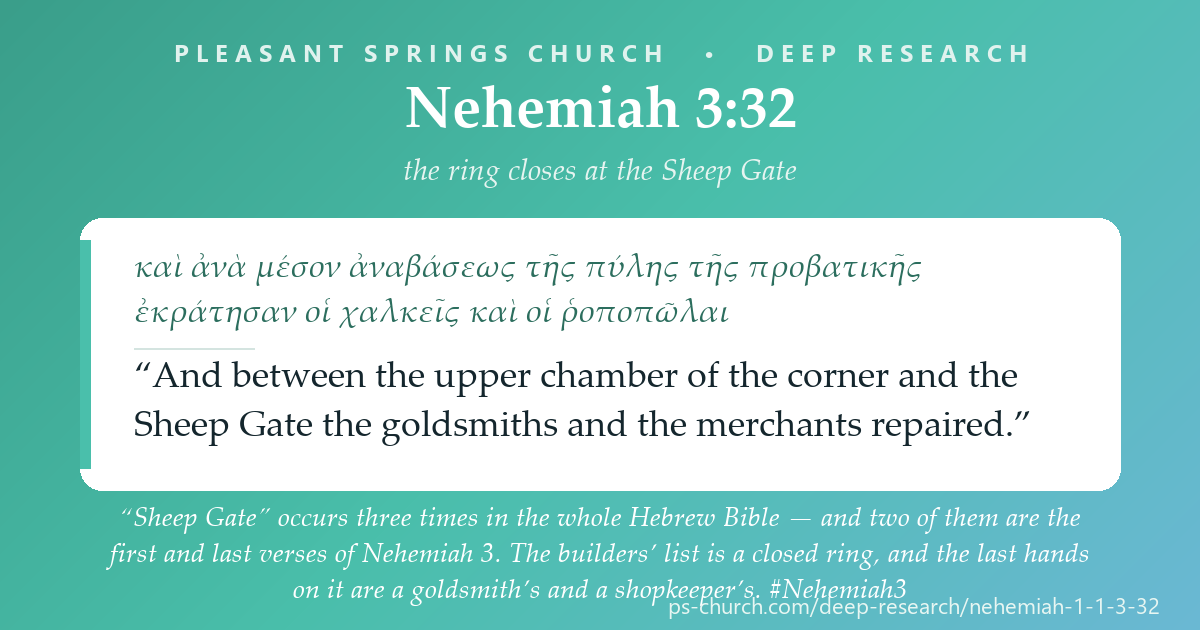
Hebrew (Masoretic) · Greek (CATSS/Rahlfs, 2 Esdras) · ESVChapter 3 opens at the Sheep Gate (3:1) and ends at the Sheep Gate (3:32). That is not an impression; it is countable. The phrase “Sheep Gate” occurs three times in the entire Hebrew Bible — Nehemiah 3:1, 3:32 and 12:39 — and two of the three are the first and last verses of this chapter. The Greek agrees exactly: προβατικός occurs three times in the 30,348 Greek Old Testament verse units screened here, at 2 Esdras 13:1, 13:32 and 22:39, the same three verses.
And a second measurement lands on the same seam. The verb that drives the chapter, הֶחֱזִיק / הֶחֱזִיקוּ (“repaired,” more literally took hold of), occurs thirty-four times in the book of Nehemiah, and all thirty-four stand inside 3:1–32 — first at 3:4, last at 3:32. Of the forty occurrences of those two unprefixed forms in the whole Hebrew Bible, thirty-four are in these thirty-two verses.
This matters because the Hebrew chapter does not stop there. Masoretic Nehemiah 3 runs to verse 38. English versions break at 3:32 and start chapter 4. The ring, and the verb, both stop at 3:32 — six verses before the Hebrew chapter does. The English division sits on a seam the vocabulary already marks. That seam is where this page ends; the opposition that follows is taken up in the Nehemiah 1–4 study.
Numbering, stated in full. ⚠️ In Greek, Nehemiah is the second half of 2 Esdras and the chapters run on continuously from Ezra: Nehemiah n = 2 Esdras n+10. Verified at both ends of this passage by content, not assumed: 2 Esdras 11:1 is “the words of Nehemiah son of Hacaliah,” and 2 Esdras 13:1 is Eliashib and the Sheep Gate.
⚠️ Within this passage the Hebrew and the English verse numbers are identical. There is nothing to convert between the Masoretic column and the ESV column anywhere in 1:1–3:32. The famous Nehemiah offset — MT 3:33–38 = ESV 4:1–6, and MT 4:1–17 = ESV 4:7–23 — begins at the verse after this study ends. It is stated here because the shelf states the offset everywhere, including where there is none to state.
⚠️ One verse of this passage is absent from Rahlfs. Counted against both columns: Masoretic Nehemiah 3:1–32 has thirty-two verses; 2 Esdras 13:1–32 has thirty-one, running 13:6 → 13:8. The missing one is 3:7, Melatiah the Gibeonite and Jadon the Meronothite. The Greek column above prints the absence rather than quietly supplying the verse from somewhere else.
The Shape of the Passage
A sequence, with two measured rings inside itRing one, around chapter 1. Verse 1 and verse 11 both close with a clause that opens on the same two words: וַאֲנִי הָיִיתִי, “and I was…” — in Susa the citadel; cupbearer to the king. That phrase occurs seven times in the whole Hebrew Bible (Psalm 109:25; Daniel 8:2, 8:5, 10:4, 10:9; Nehemiah 1:1 and 1:11), and two of the seven are the first and last verses of this chapter. The Greek preserves it exactly: καὶ ἐγὼ ἤμην occurs six times in the 30,348 Greek Old Testament verse units screened here, two of them 2 Esdras 11:1 and 11:11. The frame is the man’s position — where he stood and what he did there — and the whole of his grief and his prayer is set inside it.
Ring two, around chapter 3. The phrase “Sheep Gate” occurs three times in the whole Hebrew Bible; two of the three are Nehemiah 3:1 and 3:32, the first and last verses of the building list, and the Greek marks the same three verses with προβατικός. Nehemiah 3 is a closed circuit that begins and ends at the gate the sheep came through to be sacrificed — and it closes at 3:32, six verses before the Masoretic chapter does.
Behind these chapters stand the return, the finished temple and the stopped work of Ezra 1–6 — a house standing in a city with no wall. In front of them stand four waves of opposition, and the reforms of Nehemiah 5–7.
Author
A first-person memoir that keeps its own worst moments in. The “I” starts in 1:1 and does not stop. It records that he wept, that he mourned for days, that he rode out at night and told nobody, and later that he was “very much afraid” in front of the king. These are things only he could have known to write down, and none of them make him look commanding.
He buries the one fact that makes the story possible. Eleven verses of grief and prayer go by before the last clause of chapter 1 says, as if in passing, “now I was cupbearer to the king.” The Greek names the office plainly — οἰνοχόος. A modern writer would have opened with it.
And in chapter 3 he almost disappears. The governor of the province writes thirty-two verses about a wall and puts himself in none of them. The names are other people’s: priests, goldsmiths, perfumers, merchants, temple servants, men from Jericho and Tekoa and Gibeon and Mizpah, and one man’s daughters. The measurable oddity of the chapter is exactly this — it is the least quotable, least borrowed, most locally specific block of Hebrew in the passage (see Stage 4), because it is a list of ordinary people and their sections and nothing else.
Audience
People living in a settlement that was not legally a city. In the Persian period an unwalled place had no standing, no defence and no future. 1:3 is not sentimental language; it is a statement about viability — and by then the temple had been standing for roughly seventy years with the wall still down.
People who could check the list. Chapter 3 names individuals, families, trades and towns against specific stretches of masonry. To a reader a generation later, that was a document you could walk: this is the bit your grandfather built. It also recorded, permanently, that the nobles of Tekoa did not.
People fluent in the court style of an empire. Nehemiah 2:5 does not sound like prophecy; it sounds like the book of Esther, and the measurement says so: “if it pleases the king, and if…” is five consecutive words shared with Esther 8:5, tie band 1. The audience knew what it cost to ask a Persian king for anything, and would have heard the formula land.
Orient on the office, the city, the gates, the opponents — and on what “2 Esdras” means when you go looking for this book in Greek.
Search by topic: Nehemiah; cupbearer; Susa (Shushan); Artaxerxes I; Persian provincial administration; Sanballat; Tobiah; Geshem; Elephantine papyri; Wadi Daliyeh; Jerusalem walls and gates; Sheep Gate; Dung Gate; Valley Gate; Tower of Hananel; Tekoa; Beth-haccherem; Esdras, books of.
Which articles are relevant?
- Anchor Bible Dictionary — “Nehemiah,” “Cupbearer,” “Susa,” “Artaxerxes,” “Jerusalem (Walls and Gates),” “Sanballat,” “Tobiah,” “Geshem,” “Wadi Daliyeh,” “Esdras, Second Book of.”
- Dictionary of the OT: Historical Books (IVP) — “Ezra and Nehemiah, Books of,” “Nehemiah,” “Prayer,” “Jerusalem,” “Persia, Persians,” “Fortifications,” “Lists.”
- NIDOTTE / TDOT — חָזַק (ḥāzaq / hiphil heḥəzîq, take hold, reinforce, repair), פָּרַץ (pāraṣ, breach), פָּלַל (hiṯpallēl, pray), לֵב (lēḇ, heart), מַשְׁקֶה (mašqeh, cupbearer).
- On the Greek — the NETS introduction to 2 Esdras (Esdras B), for the continuous numbering across Ezra and Nehemiah and the character of the translation. Anyone looking up “Nehemiah” in a Greek concordance and finding nothing is looking under the wrong name.
Bibliography surfaced:
- H. G. M. Williamson, Ezra, Nehemiah (WBC); Joseph Blenkinsopp, Ezra–Nehemiah (OTL); Lester L. Grabbe, Ezra–Nehemiah. Critical scholarship: the philological and topographical work is used and the historical conclusions are weighed, not adopted wholesale.
- On the topography of chapter 3, any recent survey of Persian-period Jerusalem — read knowing that the line of the wall and the extent of the city are genuinely disputed. See Stage 5.
What a cupbearer was, why the gate list reads like a document rather than a story, and who the neighbours actually were.
First the office and the archive-shaped chapter. Then the external witnesses — named narrowly, because a papyrus that proves a man existed does not corroborate a narrative.
Which parallels shed light on these chapters?
Cupbearer is an access position, not a serving job. Across the ancient Near East the man who tasted the king’s wine had to be trusted absolutely and stood physically closest to the monarch. Tobit 1:22 has Ahikar holding the office together with the signet and the accounts. 1:11 therefore explains the mechanics of the entire book — and it also explains 2:2. A man whose face the king reads daily cannot hide four months of grief.
Chapter 3 is shaped like an administrative document, and the Hebrew shows it. Its spine is a repeated formula — next to him / next to them… repaired… — with a name, a patronymic or a town, and a stretch of wall. The verb הֶחֱזִיק carries thirty-four of those entries and does nothing else in the book. This is what a survey looks like when it is written down: labour assigned by household and guild against measured sections, which is how large works were organised under the Persian administration and how the Chronicler records temple duty by course.
The neighbours are documented officials. Sanballat appears as governor of Samaria in the Elephantine papyri, and the family recurs across generations in the Wadi Daliyeh documents. Tobiah’s name and family are plausibly connected with the later Tobiads in Ammon; Geshem fits the Qedarite chieftains named in Arabian inscriptions. That is why the first attack in 2:19 is a legal charge and not a raid. The external evidence establishes that these were real provincial administrators. It does not corroborate the events of the narrative, and this page does not claim that it does.
- The Elephantine papyri (Aramaic documents from Persian Egypt — witnesses, not Scripture) — including the reference to the sons of Sanballat, governor of Samaria.
- The Wadi Daliyeh papyri (Samarian administrative documents — witnesses, not Scripture) — the Sanballat family in the Samarian governorship over several generations.
- Arabian and Assyrian inscriptions on Qedar (royal and votive texts — witnesses, not Scripture) — for Geshem the Arab and what an Arab chieftain’s standing amounted to.
- Tobit 1:22 (Second-Temple; Apocrypha — a witness, not Scripture in our confession) — Ahikar as royal cupbearer, keeper of the signet, administrator. Cited only for the standing of the office.
- Josephus, Antiquities 11.5.6–8 (§§159–183) (Second-Temple — a witness, not Scripture) — his retelling of the mission. He gives the wall two years and four months. A retelling, and a reminder that ancient readers also found the fifty-two days of 6:15 striking.
Nehemiah 3 has a reputation as the boring chapter — a list of names between the drama of chapter 2 and the drama of chapter 4. The measurements say something else about it.
It is a closed ring. It opens at the Sheep Gate and ends at the Sheep Gate, and that phrase occurs three times in the whole Hebrew Bible; two of the three are these two verses. It is verbally isolated. Measured against 23,172 other verses of the Masoretic corpus, no verse in 3:1–32 shares more than three consecutive words with anything else in the Hebrew Bible — and four of them share none at all. And it is the only place its own verb lives: all thirty-four occurrences of הֶחֱזִיק/הֶחֱזִיקוּ in the book stand between 3:4 and 3:32.
The theological weight of the chapter is carried by its dullness. Nobody in it is doing anything memorable; everybody in it is doing one section. A high priest consecrates a gate. Goldsmiths and perfumers — people whose trades are precision indoors — are out on a wall. A district ruler works his stretch “he and his daughters” (3:12), two Hebrew words a copyist could easily have tidied into sons and did not, and which the Greek keeps: καὶ αἱ θυγατέρες αὐτοῦ. And the single criticism in the whole list falls on people who declined: the nobles of Tekoa “would not stoop to serve their Lord” (3:5) — while the Tekoites themselves took not one section but two (3:5, 3:27).
One verb that lives in one chapter, one gate that closes a ring, and a court formula borrowed from a Persian palace.
Count הֶחֱזִיק across the book, not just the chapter — the result is the finding. Then count שַׁעַר הַצֹּאן across the whole Bible, and notice where the two hits fall.
“Repaired” in English; in Hebrew, took hold of, made firm, reinforced. Measured: the unprefixed forms הֶחֱזִיק and הֶחֱזִיקוּ occur forty times in the whole Hebrew Bible, and thirty-four of the forty are inside Nehemiah 3:1–32. The book’s five other hiphil forms all stand outside the chapter: three participles מַחֲזִיקִים — men holding weapons (4:16, 4:21 ESV) and people holding fast to the oath (10:29 ESV) — the participle מַחֲזֶקֶת of the hand that held a weapon (4:17 ESV), and הֶחֱזַקְתִּי at 5:16, where Nehemiah uses the verb of himself. The chapter is not about building from nothing; it is about taking hold of what was already there.
“The Sheep Gate.” Three occurrences in the entire Hebrew Bible, and two of them are the first and last verses of this chapter. (Two of the three carry the bare שַׁעַר הַצֹּאן, 3:1 and 12:39; at 3:32 it takes the preposition, לְשַׁעַר הַצֹּאן.) The Greek matches verse for verse: προβατικός occurs three times in the 30,348 Greek Old Testament verse units screened here — 2 Esdras 13:1, 13:32, 22:39 — and exactly once in the Greek New Testament, at John 5:2, the pool “by the Sheep Gate.” That is a shared word in different inflections, not shared text: the run between 2 Esdras 13:1 and John 5:2 is zero, meaning no two consecutive words in common.
“And I was…” The last clause of verse 1 and the last clause of verse 11 open on the same two words, and they frame the chapter: and I was in Susa the citadel / and I was cupbearer to the king. Measured: the phrase occurs seven times in the whole Hebrew Bible — Psalm 109:25; Daniel 8:2, 8:5, 10:4, 10:9; and these two — so two of the seven are the opening and closing verses of Nehemiah 1. The Greek preserves the frame: καὶ ἐγὼ ἤμην occurs six times in the 30,348 Greek Old Testament verse units screened here, two of them 2 Esdras 11:1 and 11:11. That the other five Hebrew occurrences cluster in Daniel — another Judean in another Persian court — is worth noticing and is not evidence of anything.
“Cupbearer” — literally one who gives drink. The Greek is exact and technical: οἰνοχόος, wine-pourer. The word arrives in the last four words of chapter 1, after the weeping, the fasting and the whole prayer. Same office as Pharaoh’s cupbearer in Genesis 40, and as Ahikar’s in Tobit (Apocrypha, a witness). It is the reason a man in Susa can do anything at all about a wall in Judah.
“The great and awesome God… who keeps the covenant.” Measured: Nehemiah 1:5 and Daniel 9:4 share five consecutive words, and the tie band is 1 — no third verse in the Hebrew Bible reaches that depth against 1:5. Two long penitential prayers in the same idiom. This page does not say which way the borrowing went, or whether either writer saw the other; the measurement shows where the shared language sits and nothing more. The Greek renders it as a triple: ὁ ἰσχυρὸς ὁ μέγας καὶ ὁ φοβερός.
“If it pleases the king.” The Persian court formula, and the measurement places it exactly. Nehemiah 2:5 and Esther 8:5 share five consecutive words, tie band 1; Nehemiah 2:7 shares four with Esther 1:19 and 3:9, tie band 5. When Nehemiah opens his mouth in front of Artaxerxes he does not sound like a prophet. He sounds like the book of Esther — which is what a man who had spent four months rehearsing would sound like.
“Heart.” “I told no one what my God had put into my heart to do.” The governor’s survey is conducted at night, unannounced, and the reason is given in one clause. The Greek column differs here: where the Hebrew has “to do for Jerusalem,” 2 Esdras 12:12 reads μετὰ τοῦ Ισραηλ, “with Israel.” Both are printed above; the page does not adjudicate.
Reported rather than tidied:
- The Greek does not vary its rendering of the chapter’s verb nearly as much as one might expect. Counted in 2 Esdras 13:1–32: ἐκράτησεν/ἐκράτησαν twenty-eight times and κατέσχεν/κατέσχοσαν four — thirty-two occurrences of two verbs that both mean took hold of, against the Hebrew’s thirty-four. The shortfall is accounted for: 3:7 is absent from the Greek altogether, and the columns differ over the verb at 3:8, 3:15 and 3:19. The drumbeat survives translation.
- Three column differences in this passage that a reader should see rather than be spared. 2:1 — Hebrew “I had not been sad in his presence,” Greek “there was no other in his presence.” 2:12 — Hebrew “to do for Jerusalem,” Greek “to do with Israel.” 3:14 — Hebrew “he rebuilt it,” Greek “he and his sons, and they roofed it.” All three are printed in the codex with a translation note. None of them is adjudicated here, and no claim is made about which text is prior.
- A ketiv/qere at 1:9. The word rendered “and bring them” is written והבואתים and read וַהֲבִיאוֹתִים. The read form is printed. The whole Hebrew corpus on this shelf is screened on the qere, and the difference here is orthographic.
Where this passage’s language actually sits — and the counter-examples that keep the numbers honest.
Two screens, both exhaustive and deterministic. (1) Every verse of Hebrew Nehemiah 1–3 against every other verse of the 39-book Masoretic corpus — 23,166 to 23,193 targets depending on the source block, on consonantal word forms, contiguous runs only, never lemmas. (2) Every verse of Greek 2 Esdras 11–13 — 67 CATSS rows — against all 7,927 verses of the Greek New Testament. Both report the tie band: how many target verses reach the same maximum. A run without its band is not a finding.
What the Hebrew screen found:
- Nehemiah 1:1 ↔ Nehemiah 1:11 — the chapter frames itself. Both verses end וַאֲנִי הָיִיתִי… The phrase occurs seven times in the whole Hebrew Bible: Psalm 109:25; Daniel 8:2, 8:5, 10:4, 10:9; and Nehemiah 1:1 and 1:11. Two of the seven are the first and last verses of this chapter, and the Greek shows the same frame (καὶ ἐγὼ ἤμην, six occurrences in the 30,348 Greek Old Testament verse units screened here, two of them 2 Esdras 11:1 and 11:11). This is the page’s structural claim about chapter 1, and it is a count, not an impression.
- Nehemiah 1:5 ↔ Daniel 9:4 — five consecutive words, tie band 1. הָאֵל הַגָּדוֹל וְהַנּוֹרָא שֹׁמֵר הַבְּרִית, “the great and awesome God who keeps the covenant.” The deepest contact anywhere in Nehemiah 1, and it is with the other great exilic penitential prayer. Band 1 means nothing else in the Hebrew Bible reaches that depth against this verse. Direction of influence is not asserted and cannot be measured.
- Nehemiah 1:7 ↔ Deuteronomy 7:11 — five words, tie band 1. “…and the statutes and the rules that…” The confession is built out of Deuteronomy’s own vocabulary, which is what 1:8 says it is doing: “remember the word that you commanded your servant Moses.”
- Nehemiah 1:9 ↔ Deuteronomy 30:4 — three words. בִּקְצֵה הַשָּׁמַיִם מִשָּׁם, “in the uttermost parts of heaven, from there.” Nehemiah is praying that promise back to God in Susa — about as far east as an Israelite had been taken.
- Nehemiah 1:11 ↔ 1 Kings 8:28 and Daniel 9:17 — four words, tie band 3. “…to the prayer of your servant, and to…” Solomon’s temple dedication language, used a thousand miles from the temple. The band of 3 is the honest reading: this is shared liturgical idiom, not a quotation.
- Nehemiah 2:5 ↔ Esther 8:5 — five words, tie band 1; Nehemiah 2:7 ↔ Esther 1:19 and 3:9 — four words, tie band 5. The court language of chapter 2 measures against the Persian court book, not against prophecy.
What the same screen found in chapter 3 — and the counter-example printed beside it:
Nothing in Nehemiah 3:1–32 reaches four. Against 23,172 other verse units of the Masoretic corpus, the deepest run anywhere in the builders’ list is three consecutive words — seven verses reach it, all of them on personal names (Eliashib the high priest, Meremoth son of Uriah, Meshullam son of Berechiah). Chapter 1 reaches five twice; chapter 2 reaches five once. The building list is the flattest block in the passage.
And four of its verses share no two consecutive words with any other verse in the entire Hebrew Bible: 3:22, 3:24, 3:27 and 3:32. On the Hebrew-side convention used here (unigram_fallback=False) a zero means exactly that and no more — no two consecutive words. All four verses do share individual words with plenty of other verses. Two of the four (3:24, thirteen words; 3:27, twelve) are of ordinary length for the chapter, whose mean is about sixteen; 3:22 is a five-word verse and the zero there is worth less.
Now the counter-example, printed so the zeros are not read as more than they are. Twenty-one verses of Nehemiah 3:1–32 max out at a run of two, and the tie bands on those twos are enormous: 3:9 has a band of 23, 3:8 a band of 19, 3:29 a band of 15. The shared text is וְעַל־יָדָם and עַל־יָדוֹ — “and next to them,” “next to him.” That is a formula, not a connection. The same screen that produces the four striking zeros also produces twenty-one meaningless twos, and both come out of the same run of the same tool. This is why the shelf prints the band.
What the Greek-against-Greek screen found — and why the deepest run is the least significant:
Across the 67 CATSS rows of 2 Esdras 11–13 (= Nehemiah 1–3) against all 7,927 verses of the Greek New Testament: all 67 reach two, 36 reach three, 11 reach four, one reaches five, and nothing reaches six. For scale, the whole of Greek Ezra–Nehemiah — 672 rows — tops out at six, once. The New Testament does not quote Nehemiah 1–3 anywhere, and the screen is consistent with that.
The single five is 2 Esdras 13:14 (Nehemiah 3:14) against John 4:12, tie band 1 — καὶ οἱ υἱοὶ αὐτοῦ καί, “and his sons, and.” Band 1 makes it look like a signal. It is not, and there are two independent reasons to say so.
First, three of those five words are not in the Hebrew. Masoretic Nehemiah 3:14 reads “he rebuilt it”; the Greek reads “he and his sons, and they roofed it.” The page’s deepest measured New Testament contact rests entirely on a Greek plus. Second, the words themselves are the commonest possible Greek. John 4:12 is the Samaritan woman at the well — “our father Jacob… drank from it himself,” and the Greek runs on καὶ οἱ υἱοὶ αὐτοῦ καὶ τὰ θρέμματα αὐτοῦ — and his sons and his livestock. There is no thematic contact with a man repairing the Dung Gate. It is a formula colliding with a formula, and it is worth printing precisely because it looks like more than it is. (The irony is free: the deepest verbal contact between the Nehemiah material and the New Testament falls in the mouth of a Samaritan, in a book whose chief antagonist is the governor of Samaria. That is an observation, not an argument.)
The next band down shows the same thing. Eleven rows reach four. Some have band 1 — 2 Esdras 11:10 against Revelation 14:14 (καὶ ἐν τῇ χειρί), 11:11 against John 17:26 (τὸ ὄνομά σου καί), 12:8 against Revelation 21:14 (τὸ τεῖχος τῆς πόλεως, “the wall of the city”). And one has a band of 16: 2 Esdras 11:4 shares καὶ ἐγένετο ἐν τῷ with sixteen verses, fifteen of them in Luke. Same depth, and one of them is Lukan style and nothing else.
Connections worth reading, with the measurement attached:
- Nehemiah 3:1, 3:32 → John 5:2 — the Sheep Gate. προβατικός occurs three times in the 30,348 Greek Old Testament verse units screened here, all in 2 Esdras, two of them the frame of this chapter; and once in the Greek New Testament, at the pool where a man had lain thirty-eight years. Shared word, different inflections, and a measured run of zero — no two consecutive words in common. The link is lexical and thematic; this page claims no allusion and no citation. What it will say is that the gate the sheep came through for sacrifice is the first thing the high priest rebuilds and consecrates, and the last thing the list names.
- Nehemiah 1:5–11 → Daniel 9:4–19; Ezra 9:6–15; Deuteronomy 30:1–5. The family of long confessional prayers that quote the covenant back to God. Measured contact: five words with Daniel 9:4 (band 1), five with Deuteronomy 7:11 (band 1), three with Deuteronomy 30:4. A shared prayer tradition, demonstrated by measurement rather than asserted.
- Nehemiah 1:11 → Genesis 40:1–23; Tobit 1:22. The cupbearer’s office. Joseph read a cupbearer’s dream in a prison; Ahikar held the post in Assyria (Apocrypha, a witness). Proximity to the king is the mechanism of this book.
- Nehemiah 2:5, 2:7 → Esther 1:19; 3:9; 8:5. “If it pleases the king.” Five words with Esther 8:5 at band 1; four with Esther 1:19 and 3:9 at band 5. Two Judeans in two Persian palaces using the same submitted formula — and both of them asking for the life of their people.
- Nehemiah 3:12 → Numbers 27:1–11; Judges 5:7. Shallum’s daughters on the wall; Zelophehad’s daughters winning an inheritance ruling; Deborah. The Greek keeps the daughters (καὶ αἱ θυγατέρες αὐτοῦ) even where, two verses later, it supplies sons the Hebrew does not have.
- Nehemiah 3:5 → Matthew 21:28–31; Philippians 2:5–8. “Their nobles would not stoop to serve their Lord” — the one criticism in the whole list, and it is about stooping. Named as a resonance and nothing more: there is no verbal contact between these texts, and none is claimed.
What was consulted, what was not, what could not be checked, and where this page is weakest.
The commentaries first. Then, at length, the limits — because the value of a measured page is entirely in whether it says what it could not measure.
Commentaries & studies:
- H. G. M. Williamson, Ezra, Nehemiah (WBC) — the standard treatment; especially careful on chapter 3 and on the relation of the Nehemiah memoir to the rest of the book.
- Joseph Blenkinsopp, Ezra–Nehemiah (OTL) — strong on the Persian provincial setting and on Sanballat, Tobiah and Geshem.
- Lester L. Grabbe, Ezra–Nehemiah — on the historical questions, including the size and population of Persian-period Jerusalem.
- The NETS introduction to 2 Esdras — on the character of the Greek translation, which is notoriously literal and which is why the Hebrew drumbeat of chapter 3 survives into Greek almost intact.
What this page could NOT check, and where it is weakest:
- ⚠️ No Hebrew manuscript evidence was consulted beyond the Masoretic text held here. The three column differences reported at 2:1, 2:12 and 3:14 are differences between one Hebrew text and one Greek text on this disk. Whether a Qumran fragment, a Vorlage reconstruction, or another Greek witness bears on any of them was not checked and cannot be checked from these corpora. The plus at 3:14 — which carries this page’s deepest New Testament run — may be a translator’s expansion, a different Hebrew text, or a harmonisation toward 3:12. This page does not know which, and says so rather than choosing.
- ⚠️ The Greek is CATSS/Rahlfs and nothing else. No apparatus was read; no Lucianic or Origenic recension was compared; the Alexandrinus and Vaticanus readings behind Rahlfs’s text were not weighed. “Absent from Rahlfs” is a statement about one printed edition, not about the Greek tradition. 3:7 may well stand in other Greek witnesses.
- ⚠️ The run screen finds verbatim contact, not allusion. It cannot see a thought reused in different words, and it cannot see word order that has shifted. Everything reported above as a “connection” with no run attached — the Sheep Gate and John 5, the nobles who would not stoop and Philippians 2 — is an editorial judgement, and is labelled as one.
- ⚠️ The four zeros in chapter 3 are a property of the corpus screened, not of the universe. They are measured against the 39-book Masoretic corpus only. They say nothing about Ben Sira, Qumran, or any other Hebrew outside that canon.
- ⚠️ The topography of chapter 3 is genuinely disputed and this page does not attempt it. Which gate stood where, how much of the Persian-period city the circuit enclosed, and how the list maps onto excavated remains are all contested. Estimates of the population have moved by an order of magnitude in living memory. The page reports the shape of the list, not the shape of the wall.
- ⚠️ The relative order of Ezra and Nehemiah is unresolved — it turns on which Artaxerxes is meant. See the Ezra 7–10 study. The canonical order is followed here without any claim that it settles the history.
- ⚠️ The identification of the Nehemiah memoir is a critical reconstruction. That chapters 1–7 and parts of 12–13 derive from a first-person source is widely held; its original genre — royal report, dedicatory memorial, self-defence — is argued. Chapter 3 is in the third person and reads like an archival document, which has led many to treat it as a source incorporated rather than composed. That is an observation about the material and not a judgement on its accuracy, and this page takes no position.
- ⚠️ ESV footnotes and textual apparatus were not used to typeset the English. The English column is the ESV as quoted under Crossway’s standing permission; where the Hebrew and Greek differ, the codex prints both columns and a translation note rather than following either version silently.
Four months, one clause held back, and thirty-two verses of people who each took one section.
Name what you learned, why it matters, and one concrete response.
What should we carry away — and do?
- He prayed for four months before he asked for anything. The two dates are the argument: Chislev in 1:1, Nisan in 2:1, the same twentieth year. And when the moment came, the request had a duration, named officials, and a specific quantity of timber. Prayer and preparation were not two activities.
- The most important sentence in chapter 1 is the last four words. “Now I was cupbearer to the king.” He does not lead with his access; he leads with his grief. But the access is real, and he uses it. Where you already stand is not an accident to be apologised for.
- The chapter people skip is the chapter that is measurably unlike anything else. Nothing in Nehemiah 3:1–32 shares more than three consecutive words with any other verse in the Hebrew Bible; four of its verses share not even two. That is what a list of actual named people doing actual specific work looks like when you measure it. It cannot be generalised because it is not general.
- One concrete response. The ring closes because party after party each took one section — thirty-four entries between 3:4 and 3:32, and the gates before them. A goldsmith did not become a mason; he took a stretch of wall. Somebody’s daughters took theirs. The only people criticised in the whole list are the ones who would not stoop. Find the section next to you this week and take hold of that one — which is what the verb in this chapter actually means.
Nehemiah 3:32 · to share
Hebrew + Greek (CATSS/Rahlfs, 2 Esdras) + ESVEvery Deep Research page traces its passage across the whole sweep — the Old Testament, the Second-Temple world between the testaments (historical witnesses, not Scripture), and the New Testament. Follow the thread:
Pleasant Springs Church — Deep Research
Research method after Michael S. Heiser’s Bible Research Method (examine dictionaries → ancient literature → important words → textual connections → academic publications → share), with the Pleasant Springs “Author & Audience” foundation. Scripture set in the Hebrew, the Greek editions named on each page and the ESV (Old Testament), and the Greek New Testament and the ESV (New Testament), per the practice of Pleasant Springs Church. Nehemiah 1–3 research grounded in Williamson (WBC), Blenkinsopp (OTL) and Grabbe. Numbering — stated in full, including where there is nothing to state. Within 1:1–3:32 the Masoretic and ESV verse numbers are identical; there is nothing to convert anywhere in this passage. The well-known Nehemiah offset — MT 3:33–38 = ESV 4:1–6 and MT 4:1–17 = ESV 4:7–23 — begins at the verse after this study ends and belongs to the next page. In Greek this book is the second half of 2 Esdras (Ἔσδρας Βʹ), numbered continuously from Ezra, so Nehemiah n = 2 Esdras n+10 — verified at both ends of this passage by content: 2 Esdras 11:1 is “the words of Nehemiah son of Hacaliah” and 2 Esdras 13:1 is the Sheep Gate. Text: Hebrew from the Masoretic Text (Sefaria, Miqra according to the Masorah), read on the qere; Greek from Rahlfs’s Septuaginta in the CATSS digitization, printed without editorial punctuation and with proper names unaccented; English ESV. ⚠️ One verse of this passage is absent from Rahlfs — 3:7; 2 Esdras 13 runs 13:6 → 13:8. Counted against both columns, not assumed, and the codex prints the absence rather than supplying the verse. ⚠️ Three places where the Hebrew and Greek columns differ are printed with translation notes and NOT adjudicated — 2:1 (“I had not been sad in his presence” / “there was no other in his presence”), 2:12 (“for Jerusalem” / “with Israel”) and 3:14 (“he rebuilt it” / “he and his sons, and they roofed it”). Measurements. Hebrew screens run against the 39-book Masoretic corpus (23,166–23,193 non-source verse units depending on the block), on consonantal word forms, contiguous runs only, never lemmas or roots; a zero on the Hebrew side means “shares no two consecutive words,” not “shares no word” — the four zeros in chapter 3 all share individual words. The Greek-against-Greek screen runs 67 CATSS rows of 2 Esdras 11–13 against all 7,927 verses of the Greek New Testament, applying MorphGNT’s own spelling equivalences (ou/ouk/ouch, ek/ex, the movable nu) so that a run is not cut where the two editions merely spell a word differently. Both screens are exhaustive and deterministic; nothing is sampled, so no seed applies. The Greek Old Testament word and phrase counts on this page — προβατικός three times, καὶ ἐγὼ ἤμην six — are over 30,348 verse units: the 64 CATSS files less the Odes (excluded because Ode 9 is Luke 1), not the 30,637 units held on disk. The tie band is reported beside every run, and the page prints its own counter-examples: the deepest New Testament run (five words, band 1) is a formula resting on a Greek plus, and twenty-one of chapter 3’s verses max out at two with tie bands as high as 23. The two rings in the structure diagram are counts, not impressions — וַאֲנִי הָיִיתִי occurs seven times in the Masoretic corpus, two of them Nehemiah 1:1 and 1:11; שַׁעַר הַצֹּאן occurs three times, two of them Nehemiah 3:1 and 3:32; and both frames are visible in the Greek column as well. Direction of influence is never asserted — not for Nehemiah 1:5 and Daniel 9:4, not for Nehemiah 2:5 and Esther 8:5, and not for the plus at 3:14. Where a connection is thematic rather than verbal — the Sheep Gate and John 5:2, the nobles who would not stoop and Philippians 2 — it is labelled an editorial judgement and its measured run (zero) is printed. Tobit is tagged Apocrypha — a witness, not Scripture in our confession. Stage 5 states what was not consulted: no Hebrew manuscript evidence beyond the Masoretic text held here, no Greek apparatus or recension, and no attempt at the contested topography of chapter 3.
Scripture quotations marked ESV are from the ESV® Bible (The Holy Bible, English Standard Version®), © 2001 by Crossway, a publishing ministry of Good News Publishers. ESV Text Edition: 2016. Used by permission. All rights reserved. The ESV text may not be quoted in any publication made available to the public by a Creative Commons license, and the ESV may not be translated in whole or in part into any other language. www.esv.org
|
Did this study bless you today? 💚 Give to Support PS Church100% of gifts go to the General Fund — thank you. |