Two of Pharaoh’s officers — the chief cupbearer and the chief baker — are cast into the prison where Joseph, sold and slandered, is held. On one night each dreams a dream, and Joseph, the wronged man, still notices their grief and hands the diviner’s craft back to heaven: “Do not interpretations belong to God?” The cupbearer will be restored, the baker hanged, both on the third day — and then the sting: “the chief cupbearer did not remember Joseph, but forgot him,” and two silent years pass. Faithfulness in obscurity, glory deflected to God, hope deferred, and a timing more merciful than it felt. This study works Genesis 40:1–23. See the method →
Genesis 40:8, 14, 15, 19, 23
Hebrew · LXX · ESVThe Shape of the Passage
Parallel panelsGenesis sets its most God-silent chapter in a dungeon — no theophany, no promise renewed, only two dreams, a right interpretation, and a man forgotten — because the covenant’s deepest work often happens where God seems most absent and his timing most cruel.
Author
Moses places chapter 40 at the hinge of the Joseph narrative (chs 37–50), Genesis’s great unbroken novella. Joseph has been stripped and sold by his brothers (ch 37), has kept his integrity and lost his freedom under Potiphar’s wife (ch 39 — “How then can I do this great wickedness and sin against God?”, 39:9), and now sits in the royal prison, entrusted with the very officials he will serve. The narrator’s craft is deliberate: across the whole Joseph story God almost never appears or speaks on the surface — and yet no reader doubts he is the chief actor. Here he is named a single time, and by Joseph: “Do not interpretations belong to God?” (40:8). Pharaoh’s Egypt was thick with professional dream-diviners who read omens for a fee; Joseph, who could have traded his gift for favor, refuses the credit at the outset. Interpretation is not technique but revelation, and revelation belongs to the Giver.
Faithful in the pit. The chapter’s quiet marvel is that a man so wronged is still attending to others: he finds the officers “troubled” and asks, “Why are your faces downcast today?” (40:7). Betrayed, enslaved, imprisoned, Joseph neither sulks nor schemes; he serves where he is, exercises his God-given gifting in obscurity, and tells the truth — to the cupbearer a word of life, to the baker a word of death he does not soften (40:19). His one act of self-interest is entirely legitimate: he asks the cupbearer to remember him (40:14), pleading his innocence — “I was indeed stolen… I have done nothing” (40:15). Faith uses means; it is not passivity. But the means fail: “the chief cupbearer did not remember Joseph, but forgot him” (40:23), and the story hangs there, mid-air, for “two whole years” (41:1).
The sovereignty of the delay. That forgetting is the chapter’s hardest word — and, read from the far end of the story, its most merciful. Had the cupbearer remembered at once, Joseph would have gone home a freed slave, a footnote. Instead God’s clock ran two more years, until Pharaoh himself dreamed and no diviner could help — and only then was Joseph brought up, to rise and save nations (41:14; 45:5–8; 50:20). The narrator lets us feel the hope deferred without yet explaining it, so that Israel would learn to trust a God who governs even a courtier’s forgetfulness. The verb frames it: man does not remember (40:23), but the God who “remembered Noah” (8:1) and “remembered Abraham” (19:29) has not forgotten the pit.
Audience
Israel heard its own life in this dungeon. A people who knew slavery, exile, and the long ache of promises not yet kept could recognize Joseph’s prison as a parable of their own waiting. The chapter answers the exile’s question — where is God when he is silent and his timing seems merciless? — not with a theophany but with a pattern: God is at work in the dreams no one else can read, in the delay that feels like abandonment, in the forgotten man he has not forgotten. Egypt’s diviners cannot do what a Hebrew prisoner can, because the God of Abraham holds the future and gives its meaning to whom he wills (cf. Dan 2:27–28).
Obscurity, integrity, and God’s clock. For the church, Genesis 40 is a school for the unseen years. It teaches faithful service where no one is watching and nothing seems to move; the deflection of glory (“interpretations belong to God”) that marks every true servant; the legitimacy of asking for help without staking one’s hope on it; and above all the trust that God’s delays are not God’s absence. Hope deferred makes the heart sick (Prov 13:12); Joseph lived that sickness for years and was proven right. The church’s teachers have also long noticed, and held carefully as devotional analogy, the shape of the two prisoners — both “lifted up” on the third day, one to life and one to death, their destinies parted at a word — a resonance that would later ring at another tree, where two men were lifted up beside a third, and the promise “today you will be with me” fell to one (Lk 23:39–43). Resonance, not the literal sense; but the shape is there for those who have eyes.
Orient on Egyptian court offices, dream divination, imprisonment, and the Joseph narrative.
Search by topic: Joseph, cupbearer / butler, baker, dreams and dream interpretation, Egypt (Middle Kingdom court), prison, providence.
Which articles are relevant?
- Anchor Bible Dictionary — “Joseph (son of Jacob),” “Dreams,” “Cupbearer,” “Egypt (Prisons / Court Officials),” “Baker.”
- Dictionary of the OT: Pentateuch — “Joseph,” “Dreams,” “Egypt, Egyptians,” “Providence.”
- NIDOTTE / TDOT — pathar / pithron (interpret / interpretation), chalam / chalom (dream), zakar (remember), shakach (forget), chesed (kindness).
Bibliography surfaced:
- Gordon Wenham (WBC), Victor Hamilton (NICOT), Kenneth Mathews (NAC), Bruce Waltke, Nahum Sarna (JPS) on Genesis.
- Studies of the Joseph narrative (von Rad; Westermann; Alter) and of dreams in the ancient Near East and the OT.
- Kenneth Kitchen and James Hoffmeier on Egyptian court offices, titles, and the plausibility of the Joseph setting.
Court cupbearers, Egyptian dream-lore, and the God who gives the meaning.
Read the prison scene against Egyptian court culture and the ancient trade in dream interpretation — and mark where the narrative quietly overturns it.
Which parallels shed light on religion and worldview?
The offices are real. “Chief cupbearer” and “chief baker” render genuine Egyptian court titles: the cupbearer (a trusted intimate who tasted and served the king’s wine, often a confidential adviser) and the overseer of the royal bakery. Both were high officials whose disgrace and detention “in the house of the captain of the guard” (40:3) fit what we know of Egyptian administration. The narrative’s texture — titles, the birthday feast at which a monarch reviewed cases and dispensed clemency or execution (40:20), the very menu of vine and bread — sits comfortably in its Egyptian world. Scripture’s point, though, is not local color but the reach of the covenant God into a foreign court.
Dreams for sale — and a gift refused for profit. Egypt possessed an elaborate professional dream-lore: manuals of omens, trained interpreters, temple diviners who read the future for a price. In such a world a gifted Hebrew might have set himself up as a rival expert. Joseph does the opposite. Faced with two men grieved that “there is no one to interpret” (40:8 — no professional, none of Egypt’s guild), he answers not “I can” but “Do not interpretations belong to God?” The contrast will sharpen in the next chapter, where all Egypt’s magicians fail Pharaoh and Joseph says again, “It is not in me; God will give Pharaoh a favorable answer” (41:16). Revelation is not a technique to be mastered or marketed; it is a gift, and the servant who knows this refuses the glory the diviners would have seized.
The grim symmetry of the third day. The two dreams are twins that end apart. Each turns on three (three branches, three baskets) and resolves “in three days”; each uses the identical idiom, “Pharaoh will lift up your head” (40:13, 19) — but for the cupbearer it means restoration to office and for the baker a hanging, the phrase twisting from honor to horror by two words: “from you” (40:19). Joseph does not flinch from the hard word; he tells the baker the truth. Ancient hearers felt the justice and the terror at once: the same event, the king’s birthday, is life to one man and death to another, and the difference lies not in Joseph’s skill but in what God had already determined and disclosed. The birds that will eat the baker’s flesh (40:19) seal an ancient world’s worst dishonor — a body unburied.
- Genesis 41:1–36 — the sequel: Pharaoh’s dreams, the magicians’ failure, and Joseph’s “It is not in me; God will give Pharaoh a favorable answer” (41:16); the delay of ch 40 was the door.
- Daniel 2:1–30 — a later court, the same theology: the diviners cannot; “there is a God in heaven who reveals mysteries” (Dan 2:28). Interpretation belongs to God.
- Genesis 8:1; 19:29; 30:22 — God “remembered” Noah, Abraham, Rachel: the covenant verb standing behind the cupbearer’s failure to remember (40:23).
The Joseph narrative is the least overtly religious stretch of Genesis and the most profoundly providential. God works no miracle in chapter 40, sends no angel, speaks no promise; he is named exactly once, on the lips of a prisoner. And yet everything in the chapter is his doing — the dreams given on a single night, the meanings withheld from Egypt’s experts and entrusted to a Hebrew slave, the two officers thrown into precisely the cell where the interpreter waited, and, most pointedly, the forgetting. Modern readers instinctively read 40:23 as tragedy: the ingratitude of a rescued man, hope deferred, two years wasted. The narrator invites a second reading. Joseph’s premature release would have returned him to Canaan a freedman with a grievance; his delayed release would lift him to Pharaoh’s right hand to preserve the covenant family and much of the ancient world through famine. The cupbearer’s forgetfulness was not the failure of providence but its instrument. This is the doctrine the whole novella exists to teach, and Joseph himself will finally speak it plainly: ‘You meant evil against me, but God meant it for good’ (50:20). Between the pit and the palace lie years that feel like abandonment — and are not. The chapter trains the faithful to hold still in the dark, serving where they are, telling the truth, deflecting the glory, and trusting a clock they cannot see.
The vocabulary of the dungeon: interpretation, remembrance, and the lifted head.
Watch the God-given pithron, the framing verbs remember and forget, the emphatic protest of innocence, and the two-edged “lift up the head.”
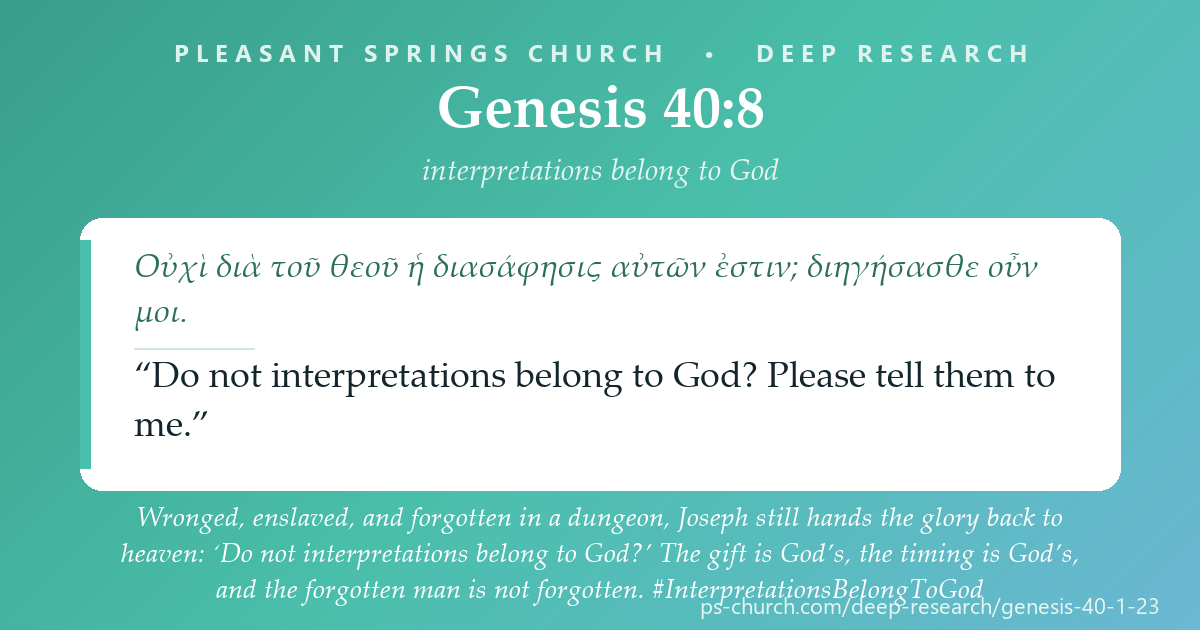
“Interpretations belong to God” — pithron, interpretation, from pathar (to interpret, unfold). Joseph hands the diviner’s craft back to heaven; the meaning of dreams is revelation, not technique (cf. 41:16; Dan 2:28). The LXX renders it διασάφησις (a making-clear).
“Interpreter” — the participle of the root pathar (which returns as a finite verb at 40:16, 22): the officers grieve that there is “no poter” (no professional in the cell), unaware the true one stands before them. The whole Joseph story turns on who can, and cannot, read a dream.
“Remember” and “kindness.” Joseph asks the cupbearer to zakar him and do him chesed (loyal kindness; LXX ἔλεος). The verb frames the sting: “he did not remember” (40:23) — yet the God who “remembered Noah” (8:1) is at work in the delay.
“I was indeed stolen” — the Hebrew infinitive absolute doubles the verb for emphasis (“stolen I was stolen”); the LXX matches it with κλοπῇ ἐκλάπην (“by theft I was stolen”). Joseph protests real innocence — kidnapped, wrongly jailed — without bitterness or revenge.
“Lift up the head” — a court idiom for review and reckoning. To the cupbearer it means restoration to honor; to the baker, with “from you” added, the gallows. The same words, life and death, parted by God’s prior verdict disclosed in the dream.
“And he forgot him” — from shakach, to forget; paired with “did not remember” for a double weight. Man’s forgetfulness opens two silent years (41:1) — hope deferred (Prov 13:12) that God’s timing turns to salvation.
How the rest of Scripture fills out the scene:
- Genesis 41:16, 25, 28, 38–39; Daniel 2:27–28, 47 — interpretation belongs to God, not to magicians: the theology of 40:8 vindicated before two pagan kings.
- Genesis 8:1; 19:29; 30:22; 1 Samuel 1:19–20 — God “remembers” his own: the covenant sense of zakar behind the cupbearer’s failure to remember (40:23).
- Proverbs 13:12; Psalm 105:17–22; Psalm 13:1–2 — hope deferred and the ache of “how long?”; the psalmist’s reading of Joseph’s iron-fettered years until “the word of the Lord tested him.”
- Genesis 45:5–8; 50:20; Romans 8:28 — the delay explained: what men meant for evil, and mere forgetfulness left undone, God meant for good (see nothing can separate us).
From a forgotten prisoner to the God who forgets no one.
Trace the God-given interpretation, the faithful sufferer, and the sovereign delay toward their fuller biblical horizon.
Which cross-references matter?
- Genesis 37:5–11 — Joseph’s own two dreams that began his troubles now meet the two dreams that begin his rise: the dreamer becomes the interpreter; the wheel of the narrative turns.
- Genesis 41:9–13 — “I remember my offenses today”: the cupbearer at last recalls Joseph — but only when Pharaoh’s own dream forces it, exactly when God intended and not a day before.
- Psalm 105:17–22 — Israel’s own commentary: Joseph “sold as a slave,” feet hurt with fetters, “until what he had said came to pass” — the delay read as testing and providence.
- Daniel 1–2; Acts 7:9–10 — the faithful exile in a pagan court whom God is with and finally exalts; Stephen’s summary: “God was with him and rescued him out of all his afflictions.”
- Luke 23:39–43; Romans 8:28 — two prisoners lifted up on the third day, parted to life and death (held as devotional resonance); the God who works all things together for good (see Romans 8).
What is most admirable in Joseph here is not his gift but his character in exercising it. He is a wronged man — stolen from home, falsely accused, unjustly jailed — and every wronged man is tempted to make his gift serve his grievance: to flatter the powerful, to trade truth for advantage, to nurse resentment into cynicism. Joseph does none of this. He notices the sorrow on two faces that are not his concern. He gives God the credit before he gives the interpretation. He asks the cupbearer for help, plainly and without groveling, and pleads his innocence without a word of revenge against the brothers who sold him or the mistress who framed him. And he tells the baker the truth — a death sentence — because a servant of the God of truth does not soften what God has said. Then he is forgotten, and the text does not spare us the silence. The lesson is not that faithfulness is always rewarded on our schedule; it plainly is not. The lesson is that faithfulness in obscurity is its own obedience, that the God who seems to have forgotten has not, and that the years which look wasted are the very years in which he is preparing a deliverance larger than the one we asked for. Joseph wanted out of prison; God was getting him ready to save the world that had put him there.
The scholarship on Genesis 40:1-23.
The commentators on the Joseph narrative; the studies of ancient dreams, Egyptian court life, and the theology of providence.
Commentaries & studies:
- Gordon J. Wenham (WBC), Victor P. Hamilton (NICOT), Kenneth A. Mathews (NAC), Bruce K. Waltke, Nahum M. Sarna (JPS) on Genesis.
- Gerhard von Rad and Claus Westermann on the Joseph narrative; Robert Alter on its artistry and repetition.
- Kenneth A. Kitchen and James K. Hoffmeier on the Egyptian setting; studies of dreams and dream interpretation in the ancient Near East (Oppenheim).
Interpretation notes worth keeping:
- ‘Interpretations belong to God’ (40:8). Not false modesty but a doctrine of revelation: the meaning of the future is God’s to give. It rebukes both pagan divination and any servant tempted to market a gift as his own skill (cf. 41:16; Dan 2:28).
- The two dreams (40:9–19). Twinned by structure (threes, the ‘lift up the head’ idiom) and split by verdict. Joseph interprets each on its own terms and does not tailor the message to please; truth-telling, even lethal truth, marks the true interpreter.
- ‘Remember me’ (40:14). Joseph’s request is faith using ordinary means, not a lapse of trust. The failure of the means (40:23) does not indict his asking; it displays that deliverance is finally God’s work on God’s clock (41:1, 9–14).
- The delay (40:23–41:1). ‘Two whole years’ is theologically loaded: the same forgetfulness that wounds Joseph positions him for exaltation. Providence is meticulous and free at once — God ordains the timing without coercing the cupbearer’s all-too-human negligence.
- The devotional analogy. Two men lifted up on the third day, one to life and one to death (later echoed at Luke 23:39–43), and the beloved-son-betrayed pattern of the wider Joseph story, are rich for preaching — but hold them as resonance built on real narrative shape, not as the chapter’s literal sense: the house discipline for typology throughout this library.
From a forgotten dungeon to the God who keeps perfect time.
Name what you learned, why it matters, and one concrete response.
What should we carry away — and do?
- Give God the credit. “Do not interpretations belong to God?” Whatever gift you carry — insight, skill, opportunity — is a trust, not a trophy. The true servant deflects the glory before he uses the gift.
- Be faithful where no one is watching. Betrayed and imprisoned, Joseph still noticed downcast faces, served, and told the truth — even the hard truth. Obscurity is not exemption from obedience; it is often where obedience is forged.
- Trust the delay. The cupbearer forgot; God did not. The two years that felt like wasted abandonment were the very road to a rescue larger than the one Joseph asked for. Hope deferred is not hope denied.
Step in response: name the “two years” you are living right now — the waiting room, the overlooked labor, the prayer that seems forgotten — and choose Joseph’s posture within it: serve the person in front of you, tell the truth, hand the glory back to God, and ask for help without staking your hope on it. Write down one place where, looking back, a delay you resented turned out to be God’s better timing — and let it teach you to wait on him now. The God who “remembered Noah” has not forgotten your pit.
Genesis 40:8 · to share
LXX + ESVEvery Deep Research page traces its passage across the whole sweep — the Old Testament, the Second-Temple world between the testaments (historical witnesses, not Scripture), and the New Testament. Follow the thread:
Pleasant Springs Church — Deep Research
Research method after Michael S. Heiser’s Bible Research Method (examine dictionaries → ancient literature → important words → textual connections → academic publications → share), with the Pleasant Springs “Author & Audience” foundation. Scripture set in the Hebrew, the Greek editions named on each page and the ESV (Old Testament), and the Greek New Testament and the ESV (New Testament), per the practice of Pleasant Springs Church. Genesis 40:1–23 research grounded in Wenham, Hamilton, Mathews, Waltke, and Sarna, with von Rad and Westermann on the Joseph narrative and Kitchen and Hoffmeier on its Egyptian setting; the chapter read as Genesis’s most God-silent yet most providential scene — God named once, as the giver of dream-interpretation (40:8; cf. 41:16; Dan 2:28), against Egypt’s professional divination; Joseph’s faithful service and truth-telling in the pit, his legitimate plea to be remembered (40:14) and his emphatic protest of innocence (gunnov gunnavti, 40:15; LXX κλοπῇ ἐκλάπην); the two dreams twinned by the “lift up the head” idiom (40:13, 19) and split to life and death on the third day; and the closing forgetfulness (40:23) that opens “two whole years” (41:1), read with Psalm 105:17–22 and Genesis 45:5–8; 50:20 as the sovereignty of God’s timing — the two-prisoners resonance (Lk 23:39–43) held as devotional analogy, not the literal sense, per the house discipline for typology. No Tetragrammaton stands in the chapter; God is Elohim only (40:8).
Scripture quotations marked ESV are from the ESV® Bible (The Holy Bible, English Standard Version®), © 2001 by Crossway, a publishing ministry of Good News Publishers. ESV Text Edition: 2016. Used by permission. All rights reserved. The ESV text may not be quoted in any publication made available to the public by a Creative Commons license, and the ESV may not be translated in whole or in part into any other language. www.esv.org
|
Did this study bless you today? 💚 Give to Support PS Church100% of gifts go to the General Fund — thank you. |