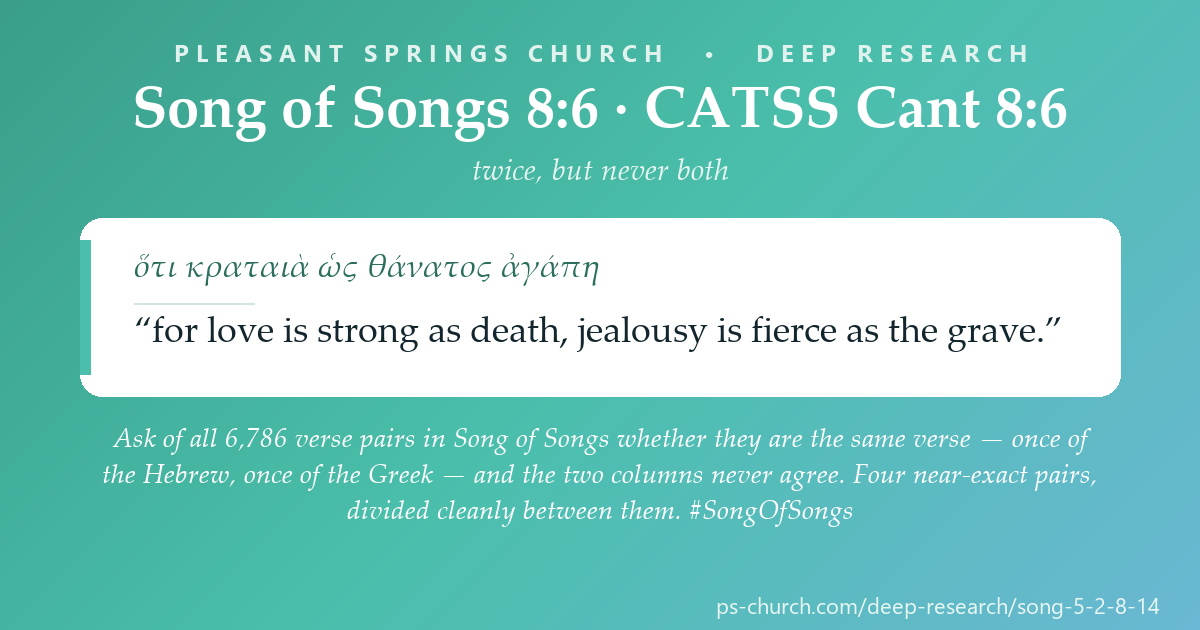
Ask of every one of the Song's 6,786 verse pairs a single mechanical question — are these two the same verse? — and ask it twice, once of the Hebrew and once of the CATSS Greek rows. The two columns hand back different answers, and they never overlap. The Greek repeats three pairs exactly: 4:3 with 6:7, 4:2 with 6:6, 2:6 with 8:3. The Hebrew repeats one: 2:7 with 3:5. Not a single pair is exact in both. And each column's near-misses land precisely on the other's exact pairs — the Greek comes within one slot only at 2:7/3:5, and the Hebrew comes within one word only at 4:2/6:6 and 2:6/8:3. Four pairs in a book of 117 verses, divided cleanly between the two files. Three of the four have one side in this passage. See the method →
Song of Songs 5:2–8:14 (selections)
Hebrew · Greek (CATSS, Rahlfs’ Septuaginta) · ESVAnd the two columns do not agree about what this book repeats. Three of the Greek file’s exact repetitions are in this passage — 6:6, 6:7 and 8:3 — and at none of the three is the Hebrew identical. The one place the Hebrew is identical, 2:7 and 3:5, is the one place the Greek is not.
The Shape of the Passage
Sequence — a second search, two descriptions, and a sealThe book ends in the woman’s voice, and that can be read off the morphology. 8:14 is an imperative addressed to a man; the speaker through 8:8–14 uses feminine forms of herself. Greek finite verbs carry no gender, so the Greek side is read off its adjectives, participles and articles.
Author
Solomon is named twice in this study, and both times he is being compared unfavourably. 8:11 and 8:12: he has a vineyard and lets it out for a thousand pieces of silver; she has her own vineyard and keeps it. The Greek rows carry Σαλωμων at both.
Across the whole book the name stands seven times — 1:1, 1:5, 3:7, 3:9, 3:11, 8:11, 8:12 — and never once as a speaker. Whatever 1:1 means, the voices in this book are not his.
Audience
The daughters of Jerusalem are addressed for the last time at 8:4. They have been sworn at four times — 2:7, 3:5, 5:8, 8:4 — and have answered once, at 5:9, asking what makes her beloved different from anyone else’s.
And 8:13 addresses someone else entirely. “O you who dwell in the gardens, with companions listening for your voice” — a masculine singular with a plural audience around him. The book’s last words before its final verse are about being overheard.
Orient on the ending, and settle the chapter 7 numbering first.
Search by topic: Song of Songs, structure and conclusion; 8:6–7 as the book’s climax; shalhevetyah; the Shulammite; chapter and verse divisions, history of.
Which articles are relevant?
- Anchor Bible Dictionary — “Song of Songs,” “Shulammite,” “Love (OT).”
- Dictionary of the OT: Wisdom, Poetry & Writings (IVP) — “Song of Songs 1: Book of,” “Death,” “Love.”
- NIDOTTE — אַהֲבָה, קִנְאָה, חוֹתָם.
The chapter 7 offset, settled from content
| Hebrew & CATSS | ESV | opening words |
|---|---|---|
| 6:12 | 6:12 | Before I was aware, my desire set me… |
| 7:1 | 6:13 | Return, return, O Shulammite… |
| 7:2 | 7:1 | How beautiful are your feet in sandals… |
| 7:11 | 7:10 | I am my beloved’s, and his desire is for me. |
| 8:1 | 8:1 | Oh that you were like a brother to me… |
Chapter counts: Hebrew and CATSS 12, 14, 14 for chapters 6–8; the ESV 13, 13, 14. The same forty verses, broken one earlier. This is the second such offset the shelf has met — Ecclesiastes 4–5 is the other — and both are set out verse by verse rather than glossed.
Four pairs, and how narrowly each column misses the other’s.
The screen, and what it returns
The test. For every pair of verses of equal length, count how many slots differ. Run it once on the Hebrew word-tokens and once on the Greek surface forms. No threshold, no sampling, no free parameter — all 6,786 pairs, exhaustively, in each column.
| pair | Greek | Hebrew |
|---|---|---|
| 4:3 & 6:7 | identical, 21 tokens | not comparable — 10 words against 5 |
| 4:2 & 6:6 | identical, 20 tokens | differs at 1 word of 11 |
| 2:6 & 8:3 | identical, 12 tokens | differs at 1 word of 5 (2 once accents count) |
| 2:7 & 3:5 | differs at 1 slot of 22 | identical, 16 words |
No pair is identical in both columns. Every near-miss in one column sits on a pair the other column repeats exactly.
And the misses are small. The Greek’s single near-miss is a function word — ἕως οὗ at 2:7 against ἕως ἄν at 3:5. One of the Hebrew’s two is a prefixed letter. Only 4:2 / 6:6 is a real change of word: הַקְּצוּבוֹת against הָרְחֵלִים.
Why this is not just small numbers
The typical pair in either column differs almost everywhere. Of the 450 equal-length Hebrew pairs the median differs at ten slots; of the 282 equal-length Greek pairs the median differs at thirteen. These four are not the tail of a smooth distribution.
And the screen agrees readily when there is something to agree about. Run on Job, it returns 41 identical Hebrew pairs, 40 identical Greek rows, and 33 that are identical in both at once — the speech headers, and Job answered and said. Proverbs gives 2 in Hebrew and none in Greek; Ecclesiastes gives none in either.
So a zero overlap is not what this screen always produces. Job is the control that makes the Song’s result worth printing.
Provenance, stated plainly. This screen was written after the passage had been read, not before. It is not a blind test, and its defence is only that it has no free parameter, that it is exhaustive, that the full distribution is published, and that Job could have — and did — return the opposite result.
8:6, and the oath the Greek swears twice more than the Hebrew.
שַׁלְהֶבֶתְיָה at 8:6
The last word of 8:6 is the only candidate in this book for a divine element. Its consonants שלהבת stand three times in the thirty-nine books — Ezekiel 21:3, Job 15:30, and here — and only here with the ־יה ending. As stored it is one unbroken token: no space, no maqqef, no ketiv/qere, no editorial note.
Whether that ending is the name or an intensifier is a question of segmentation, and this shelf leaves it open. The ESV in the third column does not: it reads “the very flame of the Lord.” The page prints that translation as it stands and notes that it settles what the Hebrew does not.
One argument that will not be used. The final letter carries no mappiq, and that is not evidence. Across the thirty-nine books 3,263 word-final ־יה tokens lack the mappiq against 34 that carry it — lacking it is simply the ordinary state, and it is how the divine element is spelled in Uriah, Shemaiah, Zechariah and Jeremiah.
Four oaths, and two columns that swear differently
The daughters of Jerusalem are adjured four times, and the Hebrew names an oath-object at only two of them.
| verse | Hebrew | Greek row |
|---|---|---|
| 2:7 | בִּצְבָאוֹת — by the gazelles | ἐν ταῖς δυνάμεσιν… |
| 3:5 | בִּצְבָאוֹת | ἐν ταῖς δυνάμεσιν… |
| 5:8 | — nothing | ἐν ταῖς δυνάμεσιν… |
| 8:4 | — nothing | ἐν ταῖς δυνάμεσιν… |
The Hebrew swears by the gazelles twice; the Greek rows carry by the powers and by the strengths of the field at all four. Reported as what each column holds at each number, and nothing more.
The most-cited link in the book, measured.
Revelation 3:20 and Song 5:2
“Behold, I stand at the door and knock” is read back to this verse more often than any other line in the book. The Greek row at 5:2 does name the door — κρούει ἐπὶ τὴν θύραν — where the Hebrew has only the knocking.
Measured as shared word-forms against Revelation 3:20, the run is short and this page does not present it as a quotation. Song of Songs is not cited anywhere in the Greek New Testament with a citation formula, scoped to the SBL edition and the standard introductory formulae. A shared image is a real thing; a word-run test is not the instrument for it, and the measurement is printed rather than dressed up.
The book ends where it nearly began
8:14 is 2:17 with the mountains changed. Both send the beloved away like a gazelle or a young stag; 2:17 to the cleft mountains, 8:14 to the mountains of spices. The Hebrew shares most of its words and not all of them; the Greek likewise.
It is the fifth near-repetition in a book of a hundred and seventeen verses, and like the other four it is not quite exact.
What the screen cannot see, and what was never reached.
The limits, stated at the end of a shelf
A whole-token identity test finds whole-token identities. 4:3 and 6:7 are ten Hebrew words and five, so the Hebrew side of that pair cannot even enter the test — it is reported as not comparable, not as a difference. And the label matching for the control books is imperfect: Song 117 of 117 and Ecclesiastes 222 of 222, but Job 1,069 and Proverbs only 753 of 939 Greek rows. Proverbs is the weakest leg of that comparison and is labelled so.
Nothing here says which column moved. No sentence on this page says one text levelled, harmonised, expanded or preserved anything, and none says which wording stood first. What is reported is the shape of two files on one disk.
What could not be checked at all
No Hebrew or Greek critical apparatus. No Qumran fragment — four copies of this book were found at Qumran and none was consulted, which matters most at 8:6. No Targum, which reads the whole book allegorically. No Syriac, Vulgate, Aquila, Symmachus or Theodotion.
And nothing on what the poem is about. Human love, or God and Israel, or both at once — that is not a question a word count can answer, and across three studies of this book none has been attempted.
The end of the book, and of the shelf.
Set me as a seal
The book has spent eight chapters not naming God, swearing by animals, and repeating itself four times without ever quite repeating itself exactly. Then at 8:6 it says the one thing it has been circling: love is strong as death.
And the last word of that sentence is the one word here that might be the name — sitting at the end of a book that has kept away from it for 1,250 words, in a form nobody can settle.
Then it ends without resolving anything. 8:14 sends him away over the mountains, in almost the words of 2:17. The Song does not close; it repeats, slightly differently, and stops.
This is the last of the twenty-one studies in Wisdom & Poetry — Job, Psalms, Proverbs, Ecclesiastes and Song of Songs. Every page states what it counted, what it could not reach, and what it withdrew.
Every Deep Research page traces its passage across the whole sweep — the Old Testament, the Second-Temple world between the testaments (historical witnesses, not Scripture), and the New Testament. Follow the thread:
Pleasant Springs Church — Deep Research
Research method after Michael S. Heiser’s Bible Research Method (examine dictionaries → ancient literature → important words → textual connections → academic publications → share), with the Pleasant Springs “Author & Audience” foundation. Scripture set in the Hebrew, the Greek editions named on each page and the ESV (Old Testament), and the Greek New Testament and the ESV (New Testament), per the practice of Pleasant Springs Church. Song of Songs research grounded in Pope (Song of Songs, Anchor), Exum (OTL), Longman (NICOT) and Hess (BCOTWP). Text: Hebrew from the Masoretic text as printed in the editions consulted — Sefaria’s Miqra according to the Masorah; no critical apparatus was consulted for the Hebrew. Greek from Rahlfs’ Septuaginta as digitized by CATSS; Greek New Testament from the SBL edition. The standing caution for this shelf applies: these pages say “the CATSS Greek text reads…” and never call a Greek reading early or late. ⚠️ VERSE NUMBERING. Masoretic and CATSS chapters 6–8 are 12, 14, 14; the ESV is 13, 13, 14. Hebrew 7:1 = ESV 6:13, and Hebrew 7:2–14 = ESV 7:1–13; chapters 6 and 8 agree in all three. Established from content at the seam, not from verse counts. Every reference on this page is Hebrew and CATSS numbering. ⚠️ The repetition screen, in full. For every pair of equal-length verses, the number of differing slots. Hebrew: whole word-tokens under the shelf rule — split on whitespace and maqqef, keep a token only if it carries a letter in the range א–ת. Greek: CATSS surface FORMS at the fixed columns; the same three identical pairs are returned under a lemma screen and under a part-of-speech screen. Both are FORM comparisons and the two columns are measured separately and never divided by one another — no Greek-to-Hebrew ratio is taken anywhere. Exhaustive over all 6,786 pairs per column, no threshold, no sampling, no free parameter, so no seed applies. ⚠️ Tie bands, and the figures that qualify the claim. Greek identical band 3; Hebrew identical band 1; Greek one-slot band 1; Hebrew one-word band 2 on consonants but 1 on the fully pointed text, because 2:6 / 8:3 becomes two slots once a meteg is counted — that is stated rather than chosen silently. 4:3 / 6:7 cannot enter the Hebrew test at all, being ten words against five. Median differing slots: Hebrew 10 of 450 equal-length pairs, Greek 13 of 282. ⚠️ The control, and the admission that goes with it. Run on Job the same screen returns 33 pairs identical in BOTH columns, so a zero overlap is not what it always produces. Label matching for the controls is imperfect and is printed: Song 117/117, Ecclesiastes 222/222, Job 1,069, Proverbs only 753 of 939 Greek rows — the weakest leg. And the screen was written after the passage was read; it is not a blind test, and stage 2 says so. ⚠️ 8:6 is reported and NOT adjudicated — and the “no mappiq” argument is refused with its control: 3,263 word-final ־יה tokens in the thirty-nine books lack the mappiq against 34 that carry it. The ESV renders the word as a divine name; this page notes that and does not follow it either way. Typology is handled per the house position: what the text says, what the New Testament itself draws, and what we see from this side of the cross — with the seeing left to the reader.
Scripture quotations marked ESV are from the ESV® Bible (The Holy Bible, English Standard Version®), © 2001 by Crossway, a publishing ministry of Good News Publishers. ESV Text Edition: 2016. Used by permission. All rights reserved. The ESV text may not be quoted in any publication made available to the public by a Creative Commons license, and the ESV may not be translated in whole or in part into any other language. www.esv.org
|
Did this study bless you today? 💚 Give to Support PS Church100% of gifts go to the General Fund — thank you. |