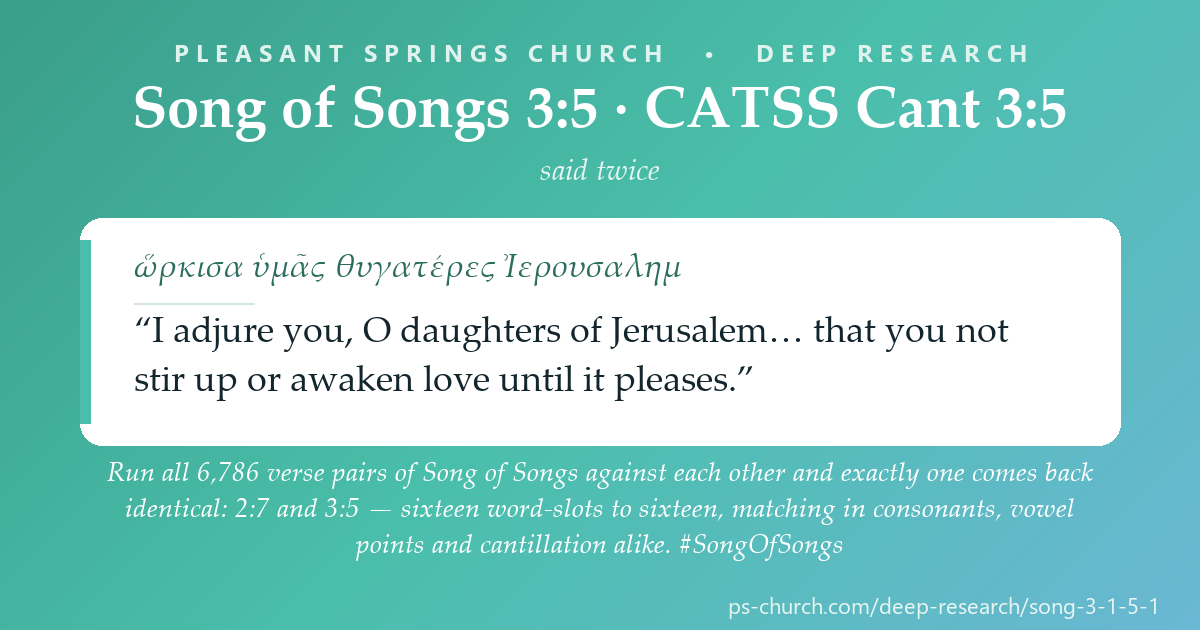
Song of Songs 3:5 is half of the only verse this book writes out twice. Run all 6,786 of its verse pairs against each other and exactly one comes back identical: 2:7 and 3:5, sixteen word-slots to sixteen — the same in consonants, the same with the vowel points, and the same with the cantillation marks too. Not one slot differs. The book's next-longest verbatim repetition is eight words, and nothing at all falls in between. The Greek column does not agree. Its rows at 2:7 and 3:5 differ at one slot — οὗ against ἄν — and what it does repeat token for token lies three verses later, at 4:2 and 4:3. So the two files on this disk crown different passages as the thing this book says most exactly twice, and 3:1–5:1 happens to contain both of them. See the method →
Song of Songs 3:1–5:1 (selections)
Hebrew · Greek (CATSS, Rahlfs’ Septuaginta) · ESVThe Greek column does not crown the same passage. Its rows at 2:7 and 3:5 differ at one slot. What it does hold identical lies at 4:2 and 4:3 — also inside this study. So the two files disagree about which verse this book repeats most exactly, and 3:1–5:1 contains both answers.
The Shape of the Passage
Sequence — a search, a procession, a poem, a gardenThree voices can be told apart here on morphology alone. The woman speaking of herself, the man addressing her, and a plural group addressed at 3:5 and again at 5:1. Greek finite verbs carry no gender, so the Greek side is read off its adjectives, participles and articles.
Author
Solomon is named three times in this study and never speaks. 3:7, 3:9 and 3:11 — all inside the procession, all in the third person, all describing something of his that other people are looking at. The Greek rows carry Σαλωμων at each.
The poem itself is spoken by people the book does not name. Whatever 1:1 means by אֲשֶׁר לִשְׁלֹמֹה, the voices inside the book are not given names, and this page does not supply any.
Audience
The daughters of Jerusalem are addressed at 3:5, and the daughters of Zion at 3:11. Two different phrases four verses apart, and 3:11 is the only place in the book that says Zion.
And at 5:1 the address changes again. The verse ends turning to a plural group — אִכְלוּ רֵעִים, φάγετε πλησίοι, eat, friends — which is the only time in this study anyone speaks to a company rather than to one person.
Orient on refrains, on the descriptive poem, and on the garden.
Search by topic: Song of Songs, structure and refrains; wasf / descriptive poem; the adjuration formula; garden imagery in the Song; Solomon’s palanquin.
Which articles are relevant?
- Anchor Bible Dictionary — “Song of Songs,” “Wasf,” “Palanquin.”
- Dictionary of the OT: Wisdom, Poetry & Writings (IVP) — “Song of Songs 3: History of Interpretation,” “Refrain,” “Imagery.”
- NIDOTTE — שָׁבַע, גַּן, רַעְיָה.
The claim, stated at the size it will bear
2:7 and 3:5 are the only identical verse pair in Song of Songs. That is a claim about this book, and it is exact. It is not a claim about the Bible.
| book | longest identical verse pair | where |
|---|---|---|
| 1 Kings | 25 words | 19:10 // 19:14 |
| Numbers | 20 | 7:25 // 7:31 |
| 1 Chronicles | 18 | 8:33 // 9:39 |
| Leviticus | 17 | 3:10 // 3:15 |
| Song of Songs | 16 | 2:7 // 3:5 |
| Exodus | 15 | 26:2 // 36:9 |
| Psalms | 14 | 42:12 // 43:5 |
| Judges | 9 | 17:6 // 21:25 |
Song of Songs is fifth. Twenty-four of the thirty-nine books contain no identical verse pair at all. The words “only in the Bible” and “the longest” do not belong anywhere near this finding, and they are not used.
How exact the repetition is, and how the test could have failed.
Identical at three levels, not one
The two verses were compared three times, at increasing strictness.
| compared on | slots | differing | book’s next-longest |
|---|---|---|---|
| consonants alone | 16 | 0 | 8 |
| consonants + vowel points | 16 | 0 | 8 |
| consonants + points + cantillation | 16 | 0 | 8 |
The gap is the point. Sixteen, then eight, then nothing between — the result is not balanced on a threshold, and moving the threshold anywhere from nine to fifteen returns the same single pair.
The accents could have failed, and here is a case where they do
Matching cantillation is not automatic. The Masoretic file writes 104 of this book’s 861 pointed word-types under more than one accentuation.
The control sits inside this study. The word for the watchmen stands at 3:3 and again at 5:7. Consonants identical, vowel points identical — and the accents differ, one carrying a zaqef qatan and the other a tevir. Two occurrences of one word in one book, and the marks are not the same.
So the sixteen matching accents at 2:7 and 3:5 are a result, not a foregone conclusion.
Where the Greek column puts its own record.
The Greek file repeats different verses
In the CATSS Greek file the rows at 2:7 and 3:5 are twenty-two tokens each and agree at twenty-one of them. The odd slot is second from the end: one row reads ἕως οὗ θελήσῃ and the other ἕως ἂν θελήσῃ.
What that file does hold identical is elsewhere — and mostly here.
| Greek rows | tokens | identical? |
|---|---|---|
| 4:3 and 6:7 | 21 | yes — the file’s longest |
| 4:2 and 6:6 | 20 | yes |
| 2:6 and 8:3 | 12 | yes |
| 2:7 and 3:5 | 22 | no — one slot differs |
Two of the Greek file’s three identical row pairs begin in this passage — and its longest repeated stretch of consecutive tokens, forty-four of them, starts at 4:1 and again at 6:5.
What is and is not being said. Two columns are measured separately and each is reported on its own terms. Nothing here says one column levelled, harmonised, varied or preserved anything, and nothing says which wording stood first. The οὗ / ἄν difference is a distribution and that is all it is.
One letter at 4:12
4:12 reads גַּן נָעוּל and then גַּל נָעוּל — two words one letter apart, a garden and a spring. The Greek row has κῆπος κεκλεισμένος twice, the same phrase both times.
This page reports what each column carries at that verse and does not choose between them, or suggest that either is a correction of the other.
A yardstick, and a link that is not there.
How much do wisdom books repeat themselves?
The same all-pairs screen, run on the books this shelf uses as its yardstick.
| book | identical verse pairs | longest verbatim run |
|---|---|---|
| Song of Songs | 1 | 16 words |
| Proverbs | 3 groups | 8 |
| Job | 6 groups | 5 |
| Ecclesiastes | 0 | — |
| Lamentations | 0 | — |
The Psalter is deliberately not the yardstick here; this shelf has been caught out by it before, and it is an outlier on repetition as on much else.
Revelation and the garden
The bride and the garden of 4:12–5:1 are often read forward to Revelation 21–22. Measured as shared word-forms, there is nothing there.
Song of Songs is also not quoted anywhere in the Greek New Testament with a citation formula — scoped to the SBL edition and to a search for the standard introductory formulae. Shared imagery is a real thing and a word-run test is not the instrument for it; this page reports the measurement it ran and does not dress it up as more.
What the screen cannot see, and what was not reached.
The limits of a verbatim test
A whole-token identity test finds whole-token identities. A repetition realised with one word inserted, one suffix changed, or one different spelling is invisible to it. That is exactly why 4:2 and 6:6 — which differ by a single Hebrew token — count here as an eight-word run and not as an identical verse.
And the book repeats itself constantly in ways this screen cannot count. The adjuration is sworn four times, not twice; the other two, at 5:8 and 8:4, run to fourteen and twelve words and share only a four-word opening with 3:5. The finding is about exactness, not about how often the book says a thing again.
What could not be checked at all
No Hebrew or Greek critical apparatus. No Qumran fragment — four copies of this book were found at Qumran and none was consulted. No Targum, Syriac, Vulgate, Aquila, Symmachus or Theodotion. Nothing bearing on the גַּן / גַּל question at 4:12, which is precisely where those witnesses would matter.
And nothing on date, authorship, or what the poem is about.
A line worth saying exactly twice.
The one thing the book repeats without changing a mark
Of everything in this book — the praise, the searching, the spices, the procession — the line it writes out twice without altering a consonant, a vowel or an accent is a warning.
“That you not stir up or awaken love until it pleases.”
It stands at 2:7 and again at 3:5, and both times it comes directly after the woman has got what she wanted — at 2:6 his arm around her, at 3:4 having brought him into her mother’s house. The book puts the brake immediately after the embrace, both times, in the same words.
That last sentence is a reading of where the verses sit, not a measurement. The measurement is only that the two lines are identical.
Every Deep Research page traces its passage across the whole sweep — the Old Testament, the Second-Temple world between the testaments (historical witnesses, not Scripture), and the New Testament. Follow the thread:
Pleasant Springs Church — Deep Research
Research method after Michael S. Heiser’s Bible Research Method (examine dictionaries → ancient literature → important words → textual connections → academic publications → share), with the Pleasant Springs “Author & Audience” foundation. Scripture set in the Hebrew, the Greek editions named on each page and the ESV (Old Testament), and the Greek New Testament and the ESV (New Testament), per the practice of Pleasant Springs Church. Song of Songs research grounded in Pope (Song of Songs, Anchor), Exum (OTL), Longman (NICOT) and Hess (BCOTWP). Text: Hebrew from the Masoretic text as printed in the editions consulted — Sefaria’s Miqra according to the Masorah; no critical apparatus was consulted for the Hebrew. Greek from Rahlfs’ Septuaginta as digitized by CATSS; Greek New Testament from the SBL edition. The standing caution for this shelf applies: these pages say “the CATSS Greek text reads…” and never call a Greek reading early or late. ⚠️ What was compared, and on which side. Hebrew: sequences of whole word-tokens under the shelf rule — split on whitespace and maqqef, keep a token only if it carries a letter in the range א–ת — compared as strings at three levels: consonants alone, consonants plus vowel points, and the token exactly as stored. Greek: sequences of CATSS surface FORMS read at the fixed columns. Both are FORM comparisons, never lemma counts, and the two columns are measured separately and never divided by one another — no Greek-to-Hebrew ratio is taken anywhere on this page. ⚠️ Tie bands are reported as the SET reaching the maximum. Hebrew all-pairs maximum 16, band size 1 = {2:7, 3:5}; runner-up 8, band 1. Greek all-pairs maximum 21, band 1 = {4:3, 6:7}. Across all 25 CATSS files the longest repeated consecutive run is 44 tokens, band 1, and it is in this book. ⚠️ This is NOT a record in the Hebrew Bible, and the screen was allowed to prove it. The identical-verse screen run over all thirty-nine books places Song of Songs fifth, behind 1 Kings at 25 words, Numbers at 20, 1 Chronicles at 18 and Leviticus at 17. The full ranking is printed in stage 1. “Only”, “unique”, “alone” and “the longest in the Bible” are barred around this finding. ⚠️ Negatives are scoped twice — to this MAM text and this CATSS file as they sit on disk, AND to whole-token string identity at the levels named. A repetition realised with one word inserted, one suffix changed or one different spelling is invisible to the test, which is stated in stage 5 rather than left for a reader to discover. ⚠️ Every procedure is exhaustive and deterministic — all 6,786 verse pairs per column enumerated, nothing sampled or randomised, so no seed applies. Runs and ordinals are taken from the physical order of rows in each file, never inferred from label numbering. ⚠️ Numbering. MT and CATSS both 117 verses in eight chapters (17, 17, 11, 16, 16, 12, 14, 14), zero lettered rows, and the ESV agrees at every chapter — so no conversion arises anywhere in this study. Typology is handled per the house position: what the text says, what the New Testament itself draws, and what we see from this side of the cross — with the seeing left to the reader.
Scripture quotations marked ESV are from the ESV® Bible (The Holy Bible, English Standard Version®), © 2001 by Crossway, a publishing ministry of Good News Publishers. ESV Text Edition: 2016. Used by permission. All rights reserved. The ESV text may not be quoted in any publication made available to the public by a Creative Commons license, and the ESV may not be translated in whole or in part into any other language. www.esv.org
|
Did this study bless you today? 💚 Give to Support PS Church100% of gifts go to the General Fund — thank you. |