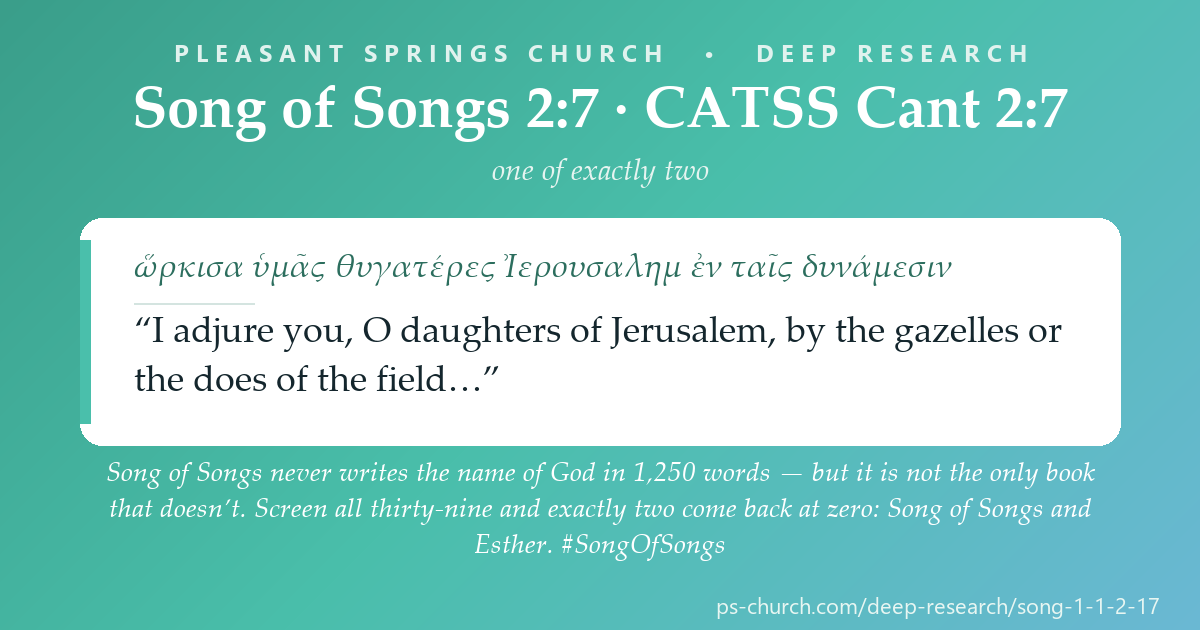
Song of Songs never writes the name of God. Screen its 1,250 words for every spelling — the Tetragrammaton, the Elohim family, El, Adonai, Shaddai, the short form Yah — and the count is zero; across these opening 34 verses the screen has 327 words to catch and catches nothing. The sentence usually attached to that fact is that it is the only book in the Bible that never names God, and that is not what the counting returns. Run the same screen over all thirty-nine books and two come back at zero: Song of Songs and Esther — and Esther is more than twice as long. What these chapters do show is how narrowly the zero is kept. The two letters of El stand seven times and the vowels already in the text make every one of them something else. The three letters of Shaddai stand twice, and both times the word is a breast. And at 2:7 the oath is sworn by the gazelles — בִּצְבָאוֹת, consonant for consonant the hosts of the divine title. See the method →
Song of Songs 1:1–2:17 (selections)
Hebrew · Greek (CATSS, Rahlfs’ Septuaginta) · ESVWhat the whole book does not contain is a name. Not the Tetragrammaton, not the Elohim family, not El, Adonai, Shaddai, or the short form Yah — nothing, in 1,250 words. The Greek file keeps the same silence: κύριος zero, θεός zero, in all 2,025 of its words.
The Shape of the Passage
Sequence — two voices, and a refrain that stops themThe book is mostly in a woman’s voice, and that is a measurement, not an impression. It can be read off the gender morphology: feminine adjectives and participles on the speaker, masculine on the one addressed, and a plural feminine group listening. Greek finite verbs carry no gender, so the Greek side is read off its adjectives, participles and articles instead.
Author
1:1 says אֲשֶׁר לִשְׁלֹמֹה — which is Solomon’s. The Greek row has ὅ ἐστιν τῷ Σαλωμων. The relative particle can carry more than one relation, and this page does not choose between them.
The name stands again at 1:5, in a simile. “like the curtains of Solomon” — and there the speaker is the woman, comparing herself to something of his. Whatever 1:1 means, the book is not written as his speech.
Audience
Somebody is being addressed inside the poem, and it is not the reader. The בְּנוֹת יְרוּשָׁלַ͏ִם, daughters of Jerusalem, are spoken to at 1:5 and adjured at 2:7 — a feminine plural group who never answer.
The oath at 2:7 is the sharpest thing in the study. An oath ordinarily names God. This one names animals — and the animal it names is spelled with the consonants of a divine title. Whether that is a coincidence of the language or something the poem is doing is not a question a word count can settle, and this page does not pretend it can.
Orient on a book with no divine name, and on how it came to be read.
Search by topic: Song of Songs, book of; allegorical interpretation of the Song; divine names, absence of; Esther, absence of God in; Hebrew love poetry.
Which articles are relevant?
- Anchor Bible Dictionary — “Song of Songs,” “Names of God in the OT,” “Esther, Book of.”
- Dictionary of the OT: Wisdom, Poetry & Writings (IVP) — “Song of Songs 1: Book of,” “Song of Songs 2: History of Interpretation,” “Love Poetry.”
- NIDOTTE — דּוֹד, רַעְיָה, צְבָאוֹת.
The claim, and the correction
“The only book in the Bible that never mentions God” is the standard sentence about this book. On the counting done here it is wrong, and the correction is small but it matters.
| book | words | divine-name tokens |
|---|---|---|
| Song of Songs | 1,250 | 0 |
| Esther | 3,055 | 0 |
| the other thirty-seven books | — | every one returns a hit |
The set of books reaching zero has exactly two members. The honest claim is not that the Song is alone; it is that the Song is one of exactly two — and that it holds the silence in a quarter of the words.
Only the combined screen narrows it to two. Taken one name at a time the answer is different every time: three books carry no Tetragrammaton (Ecclesiastes, Esther, Song), four carry no Elohim-family form (Esther, Lamentations, Obadiah, Song), nine carry no El. It is the union that gives two.
How narrowly the zero is kept.
Three near-misses, resolved by the vowels already in the text
The book writes the consonants of a divine name eleven times, and the pointing makes every one of them something else.
| consonants | could be | what the pointing gives | where |
|---|---|---|---|
| אל | El, God | segol — the preposition to (5×) patah — the negative do not (2×) tsere — the divine name — 0× | 2:4, 3:4, 4:6, 6:11, 8:2 1:6, 7:3 |
| שדי | Shaddai, the Almighty | a breast — neither token carries the patah and dagesh the name needs | 1:13, 8:1 |
| אדני | Adonai, my Lord | sockets, bases — pointed patah / sheva / tsere | 5:15 |
Two of the three fall inside this study — the negative at 1:6 and the preposition at 2:4, with the breast at 1:13.
And the closest miss of all, at 2:7
The oath at 2:7 is sworn בִּצְבָאוֹת — by the gazelles. Those are the consonants of צְבָאוֹת, the hosts of the divine title.
The skeleton stands at exactly two verses in the book, 2:7 and 3:5, and nowhere else. Both are the adjuration formula.
And the Greek row does not read animals there at all. ἐν ταῖς δυνάμεσιν καὶ ἐν ταῖς ἰσχύσεσιν τοῦ ἀγροῦ — by the powers and by the strengths of the field. Both of the Hebrew’s animals stand in that row as abstract nouns.
What is reported and what is not. That the consonants coincide is a fact about the Hebrew language, and it is printed as one. That the Greek row carries δυνάμεις and ἰσχύες is a fact about that row. Whether either is doing anything deliberate is not something a count can reach, and no claim is made about one text acting on the other.
The one verse that is genuinely open, and it is not in this passage.
8:6 and the word שַׁלְהֶבֶתְיָה
At 8:6 — outside this study, at the far end of the book — stands the one word that could carry a divine element. “Love is strong as death… its flashes are flashes of fire, שַׁלְהֶבֶתְיָה.” The word ends in the two letters that spell the short form of the name.
As it is stored it is one unbroken token: no space, no maqqef, no ketiv/qere, no editorial note. The consonants שלהבת stand three times in the thirty-nine books — Ezekiel 21:3, Job 15:30, and here — and only here with the ending.
Whether that ending is the divine name or an intensifying suffix is a question of segmentation, and this page leaves it open.
One argument that will not be used, because it does not work. The final letter carries no mappiq, and it is tempting to treat that as settling the matter. It settles nothing: across the thirty-nine books 3,263 word-final -יה tokens lack the mappiq against 34 that carry it, so lacking it is simply the ordinary state. It is also the ordinary spelling of the divine element in Uriah, Shemaiah, Hananiah, Zechariah and Jeremiah. The absence is evidence of nothing.
Two voices, read off the grammar
The book alternates between a woman’s voice and a man’s, and the Hebrew marks it. At 1:5 the speaker calls herself שְׁחוֹרָה, a feminine form, and the Greek row has μέλαινα, also feminine. The addressees at 1:5 and 2:7 are בְּנוֹת / θυγατέρες, a feminine plural.
A trap this shelf has met before. The second-person feminine singular pronoun אַתְּ is written with the same two letters as the accusative particle אֶת. A consonantal search cannot separate them, and any count of feminine address forms that does not say how it handled that is not checkable. And the Greek side cannot be read off its verbs at all — Greek finite verbs carry no gender — only off its adjectives, participles and articles.
What this Greek book shares with the one before it.
Two silences that are the same silence
The Greek file keeps the Hebrew’s zero. Across all 117 rows and 2,025 words, κύριος stands zero times and θεός zero times.
And it shares two other absences with Greek Ecclesiastes, the book studied immediately before it on this shelf.
| Greek book | words | δέ | σύν |
|---|---|---|---|
| Song of Songs | 2,025 | 0 | 0 |
| Ecclesiastes | 4,546 | 0 | 34 |
| Proverbs | 11,164 | 563 | 1 |
| Job | 13,561 | 740 | 4 |
Two of the twenty-five Greek books on this disk carry no δέ at all, and they are these two. That is a set of two, not a book standing alone — the same shape as the finding this page is built on, and worth saying in the same words.
Where they part is σύν. Greek Ecclesiastes uses it thirty-four times with an accusative, a construction no other Greek book on this disk uses once. Greek Song of Songs does not use the word at all.
The New Testament
Song of Songs is not quoted in the Greek New Testament with a citation formula. Scoped to the SBL edition and to a search for the standard introductory formulae.
Shared wording between this book and the New Testament runs shallow. Where earlier pages on this shelf have printed a deep run — Proverbs 3:12 with Hebrews 12:6 at eleven words — nothing here approaches it, and the page does not manufacture one.
Two arguments refused, and what could not be reached.
The screen was built so it could fail, and the failure end is the only robust one
The divine-name screen deliberately over-generates. It fires on the consonants first and resolves by the pointing afterwards, so it can only move a book off the zero list, never onto it. A book at zero under this screen is at zero under any stricter one.
The other end of the same ranking is not usable and is not printed. Ranked by divine-name density, the top book leads the second by under one token per thousand words — inside the margin between two independent implementations of the same screen. Zero is robust because zero is zero; a maximum that close is not a record.
What could not be checked at all
No Hebrew or Greek critical apparatus. No Qumran fragment — and four copies of this book were found at Qumran, none of them consulted here. No Targum, which matters more for this book than most, since the Targum reads it allegorically throughout. No Syriac, Vulgate, Aquila, Symmachus or Theodotion.
And nothing on the question every reader of this book asks. Whether the poem is about human love, or about God and Israel, or about both, is not a question a word count can answer. This page counts what is on the page and stops.
A silence held for 1,250 words.
The book that keeps not saying it
Eight chapters, 1,250 words, and not once the name. And it is not for lack of getting close: the letters are there eleven times, and each time the vowels turn them into something ordinary — to, do not, a breast, a socket.
Then at 2:7 a woman swears an oath, which in this language is where the name belongs, and she swears it by gazelles whose name is spelled like hosts.
Whether that is a poem being careful or a language being crowded is not something this page can tell you. What it can tell you is that the silence is real, that it is kept exactly, and that one other book in the canon keeps it too.
Every Deep Research page traces its passage across the whole sweep — the Old Testament, the Second-Temple world between the testaments (historical witnesses, not Scripture), and the New Testament. Follow the thread:
Pleasant Springs Church — Deep Research
Research method after Michael S. Heiser’s Bible Research Method (examine dictionaries → ancient literature → important words → textual connections → academic publications → share), with the Pleasant Springs “Author & Audience” foundation. Scripture set in the Hebrew, the Greek editions named on each page and the ESV (Old Testament), and the Greek New Testament and the ESV (New Testament), per the practice of Pleasant Springs Church. Song of Songs research grounded in Pope (Song of Songs, Anchor), Exum (OTL), Longman (NICOT) and Hess (BCOTWP). Text: Hebrew from the Masoretic text as printed in the editions consulted — Sefaria’s Miqra according to the Masorah; no critical apparatus was consulted for the Hebrew. Greek from Rahlfs’ Septuaginta as digitized by CATSS; Greek New Testament from the SBL edition. The standing caution for this shelf applies: these pages say “the CATSS Greek text reads…” and never call a Greek reading early or late. ⚠️ The divine-name screen, in full. Spellings tested: the Tetragrammaton; יה with mappiq; אלהים, anything beginning אלהי־, אלוה; אל with tsere; אדני with qamats on the nun; שדי with patah on the shin and dagesh in the dalet — each with up to two leading prefix letters stripped. The zero band has exactly two members, Song of Songs and Esther, so the words “only”, “alone” and “unique” are barred on this dimension. Scoped to this MAM file on disk and to exactly these spellings. Taken one name at a time the zero lists are different and larger; only the union gives two. ⚠️ Homograph screens are published with their false positives. Every consonantal near-miss is listed in stage 2 and resolved by the pointing already in the text, not by judgement: seven אל tokens, two שדי, one אדני, and the two צבאות at 2:7 and 3:5. Counts are FORM counts on the consonantal skeleton with a vowel gate; no Hebrew lemmatiser is held here. ⚠️ 8:6 is reported and NOT adjudicated — and the “no mappiq” argument is refused with its control printed: 3,263 word-final -יה tokens in the thirty-nine books lack the mappiq against 34 that carry it, so its absence shows nothing. ⚠️ The maximum end of the density ranking is not published as a record — the leader’s margin is under one token per thousand words, inside the difference between two implementations of the same screen. Only the zero end is reported, because zero is zero. ⚠️ Numbering. MT and CATSS both 117 verses in eight chapters (17, 17, 11, 16, 16, 12, 14, 14), zero lettered rows, and the ESV agrees at every chapter — so no conversion arises anywhere in this study. Typology is handled per the house position: what the text says, what the New Testament itself draws, and what we see from this side of the cross — with the seeing left to the reader.
Scripture quotations marked ESV are from the ESV® Bible (The Holy Bible, English Standard Version®), © 2001 by Crossway, a publishing ministry of Good News Publishers. ESV Text Edition: 2016. Used by permission. All rights reserved. The ESV text may not be quoted in any publication made available to the public by a Creative Commons license, and the ESV may not be translated in whole or in part into any other language. www.esv.org
|
Did this study bless you today? 💚 Give to Support PS Church100% of gifts go to the General Fund — thank you. |