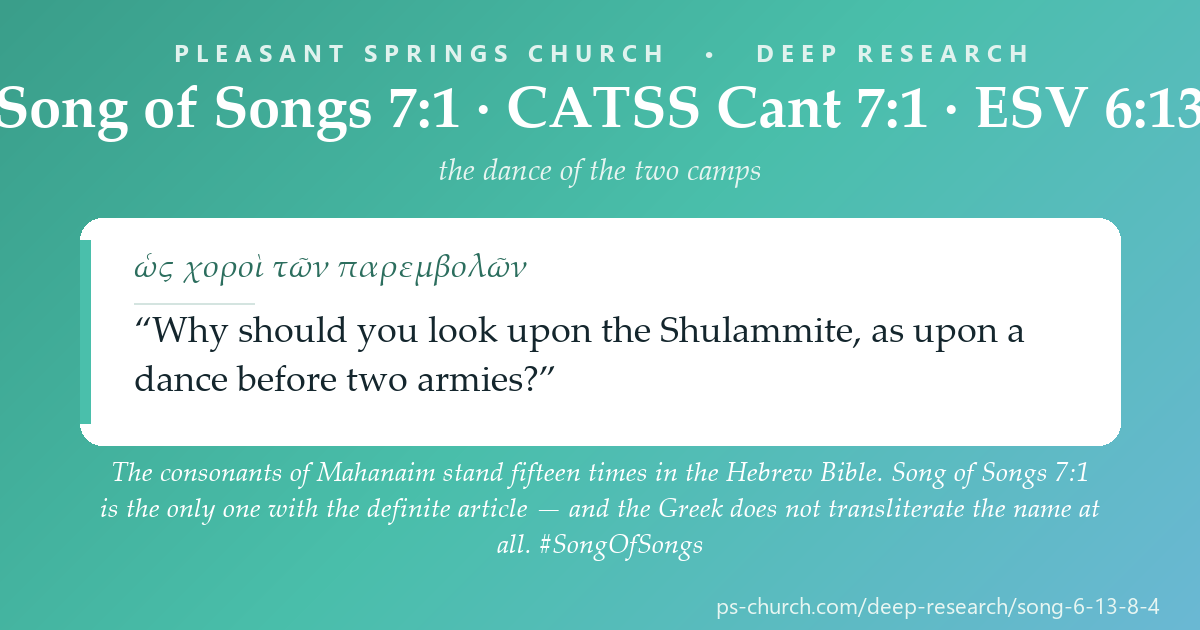
The consonants מחנים stand fifteen times in the Masoretic corpus. Thirteen are the town east of the Jordan where Jacob met the angels and where David sheltered from Absalom; one is the ordinary plural, camps. The fifteenth is Song of Songs 7:1, and it is the only one carrying the definite article. Look at the Greek row for the same verse and the name is not there at all: the CATSS text reads ὡς χοροὶ τῶν παρεμβολῶν — as dances of the camps — the same plural noun by which Jacob names the place at Genesis 32:3, where the Greek also declines to transliterate. Elsewhere in the mapped Greek Old Testament the name is transliterated in seven verses, in four different spellings. And in the verse before this one and the verse after it, the same Greek file does the opposite trick twice: it makes a man's name out of the ordinary Hebrew word for a noble — Αμιναδαβ at 6:12, Ναδαβ at 7:2 — the only two places in twenty-nine occurrences where it does. See the method →
Song of Songs 7:1–8:2 (Hebrew & CATSS) = ESV 6:13–8:2
Hebrew · Greek (CATSS, Rahlfs’ Septuaginta) · ESVThe Greek row is longer than the Hebrew in every one of these sixteen rows, and in all eighteen verses of the passage. 183 Hebrew word-tokens against 296 Greek surface forms — not once equal, not once shorter. That ratio is the reason no run length on this page is compared across the two columns.
The Shape of the Passage
Frame + sequence, turning once — not a chiasmWho is speaking in this passage can be read off the suffixes, and only off the suffixes. The Hebrew text of the Song carries no speaker headings. The italic She and He in an English Bible are the editors’, and different editions divide the speeches differently. What the consonants and points will support is grammatical person, and that is what is counted here.
Author
Solomon is not named once in these eighteen verses. The name stands seven times in the book — 1:1, 1:5, 3:7, 3:9, 3:11, 8:11, 8:12 — and none of them is here. A king appears at 7:6, unnamed and tied up in someone’s hair.
What the passage does name is places. Mahanaim, Heshbon, Bath-rabbim, Lebanon, Damascus, Carmel — six in fourteen verses, four of them in one verse. Every one of them lies north or east of Jerusalem; not one is in the south. The page reports the list and draws no date from it, because a list of place names does not carry a date.
Audience
The passage opens with a plural voice and closes with a plural addressed. At 7:1 two plural verbs ask to look at her. At 8:4 the daughters of Jerusalem are put under oath for the fourth and last time. Between those two, every verb belongs to one of two people.
And the second person changes gender in the middle. Sixteen feminine suffixes stand in 7:2–7:10, fifteen of them on body-part nouns. From 8:1 the suffixes are masculine and they sit on verbs she performs — I would lead you, I would bring you, I would give you to drink. The one who was looked at in 7:1 is doing all the acting by 8:2.
Settle the numbering first, then look up the two words nobody agrees about.
Search by topic: Mahanaim; Shulammite; Shunem and Abishag; wasf (the Arabic descriptive song); Song of Songs, structure; chapter and verse divisions, history of; teshuqah; mandrake.
Which articles are relevant?
- Anchor Bible Dictionary — “Mahanaim,” “Shulammite,” “Song of Songs,” “Heshbon.”
- Dictionary of the OT: Wisdom, Poetry & Writings (IVP) — “Song of Songs 1: Book of,” “Love,” “Imagery.”
- NIDOTTE — מַחֲנֶה, מְחוֹלָה, תְּשׁוּקָה, נָדִיב.
- Anchor Bible Dictionary — “Versification” and the article on chapter division, for why an English Bible breaks chapter 7 one verse later than the Hebrew does.
The chapter 7 offset, settled by counting three files
| chapter | Hebrew (MAM) | CATSS Cant | ESV |
|---|---|---|---|
| 1–5 | 17, 17, 11, 16, 16 | 17, 17, 11, 16, 16 | 17, 17, 11, 16, 16 |
| 6 | 12 | 12 | 13 |
| 7 | 14 | 14 | 13 |
| 8 | 14 | 14 | 14 |
Hebrew 7:1 = ESV 6:13. Hebrew 7:2–14 = ESV 7:1–13. Chapter 8 agrees again. The same 117 verses in all three; one chapter break falls one verse later in the English. This is the third such offset the shelf has met inside the Writings — Ecclesiastes 4–5 and the Psalter are the others — and it is set out verse by verse rather than glossed.
The Greek here is the CATSS digitization of Rahlfs’ Septuaginta. It follows the Hebrew verse division of this book exactly, all 117 rows, which is not true of every book on this shelf.
The Shulammite, and the word one letter away from her
הַשּׁוּלַמִּית occurs twice in the Hebrew Bible, both times in 7:1. Once with the article, once with the preposition and the article. It occurs nowhere else at all, and no dictionary can tell you what it means because there is no second occurrence to compare it with.
One letter away is a word that occurs five times. הַשּׁוּנַמִּית, the Shunammite — 1 Kings 1:3, 1:15, 2:17 of Abishag, and 2 Kings 4:12 and 4:25 of the woman of Shunem. The two words differ by ל for נ. That is the measurement, and it is all the measurement is. Whether the Song’s word is a form of Shunem, a feminine of Solomon, a word for peace, or a title nobody has recovered is a question a letter count cannot decide, and this page does not decide it.
And the word for the dance
The consonants מחלת stand as a whole word four times in the Hebrew Bible, and a fifth time here under a prefixed כ. The four are pointed מָחֲלַת and read as a name or a musical term — Genesis 28:9, 2 Chronicles 11:18, and the superscriptions of Psalms 53 and 88. The fifth is here, pointed כִּמְחֹלַת, the construct of the noun for a round dance. Four further words carry the same four letters inside them — Exodus 15:20, Exodus 32:19, 1 Samuel 18:19 and 2 Samuel 21:8 — and are not counted here.
So in three consecutive words 7:1 has a form that is a proper name everywhere else and a proper name that is pointed here as a common noun with the article on it. The page reports both facts and reads nothing into their standing together.
Mahanaim across the Greek Old Testament, counted verse by verse.
The screen
The test. Find every Masoretic verse containing the consonants מחנים. For each, open the corresponding row in the CATSS Greek files held here and record whether the Greek transliterates the name or translates it. No threshold, no sampling; the list is fifteen verses long — eleven of them in the table below, the other four named in the note under it.
| verse | Greek row | what it does |
|---|---|---|
| Genesis 32:3 | Παρεμβολή… Παρεμβολαί | translates — twice, singular then plural |
| 2 Samuel 2:8 | ἐκ τῆς παρεμβολῆς εἰς Μαναεμ | both at once |
| 2 Samuel 2:12 | Μαναεμ | transliterates |
| 2 Samuel 2:29 | εἰς τὴν παρεμβολήν | translates |
| 2 Samuel 17:24, 17:27, 19:33 | Μαναϊμ | transliterates |
| 1 Kings 2:8 | εἰς παρεμβολάς | translates |
| 1 Kings 4:14 | Μααναιν | transliterates |
| 1 Chronicles 6:65 | Μααναιμ | transliterates |
| Song 7:1 | ὡς χοροὶ τῶν παρεμβολῶν | translates — plural, with the article |
Seven of these verses transliterate, in four different spellings — Μαναεμ, Μαναϊμ, Μααναιν, Μααναιμ. Five translate, and 2 Samuel 2:8 does both inside one clause. Song 7:1 is with the five.
Three of the five give a plural — Genesis 32:3, 1 Kings 2:8 and Song 7:1. Genesis 32:3 is the verse in which Jacob, having seen the camp of God, names the place, and the Greek there does not transliterate either. The row that names the place and the row at Song 7:1 carry the same plural noun. That is the whole of the observation; no line here says one verse is reaching for the other.
What that does NOT establish. Nothing on this page says the Song is quoting Genesis, that a translator saw Genesis while working, or that either text is prior. Both facts are facts about two files.
The two exclusions, and the one apparent exception. Numbers 13:19 has the same consonants as the ordinary plural of “camp”. Numbers is held here as a CATSS file but is not mapped to a book name, so its row has to be read straight off the file: it gives neither the name nor παρεμβολή but ἐν τειχήρεσιν ἢ ἐν ἀτειχίστοις, in walled towns or unwalled — so it belongs in neither column of the table. Its opening ה is the interrogative particle, not the definite article, so it is not a second instance of the article either. The three Joshua occurrences are excluded because the Greek Joshua on disk is the A and B texts, which this substrate does not map to one book. Two of the three Joshua rows transliterate and the third is doubtful; including the two would raise the transliteration count from seven verses to nine and change nothing else.
The dance itself
The Greek at 7:1 has χοροί, a dance in a ring. It is the only χορ- dance word anywhere in the Greek Canticles. The Hebrew מְחֹלָה behind it accounts for eight verses in the Masoretic corpus: Miriam at the sea (Exodus 15:20), the golden calf (Exodus 32:19), Jephthah’s daughter (Judges 11:34), the women of Shiloh at the vineyards (Judges 21:21), the women who came out to meet Saul (1 Samuel 18:6) and the song they sang about his thousands (1 Samuel 21:12 and 29:5), and this verse. Seven of the eight are danced by women; one is danced round an idol.
Which makes the pairing with a military plural — camps, or armies — readable in more than one way. This page prints the ESV’s text in the third column, says in the codex note that the Hebrew allows the other reading just as well, and stops there.
The descriptive song, and the direction it runs
Three times this book describes a body part by part. 4:1–7 runs head downward. 6:4–7 runs head downward and stops early. 7:2–7:6 runs the other way: sandals, thighs, navel, belly, breasts, neck, eyes, nose, head.
It is the only one of the three that ascends, and it is also the only one that begins below the waist. That is an observation about word order in a Hebrew text and nothing more; the comparison often made with the Arabic waṣf is a comparison with a genre attested many centuries later, and this page does not lean on it.
Three words: the one that occurs three times, the one that becomes a man, and the one the English does not follow.
Three occurrences in the Masoretic corpus and no more: Genesis 3:16, Genesis 4:7, Song of Songs 7:11. Exhaustive over 23,204 verse units.
Eleven occurrences in the Greek Old Testament held here, of which Cant 7:11 is one. The two Genesis verses do NOT use it; they use ἀποστροφή.
Twenty-nine occurrences in twenty-six verses. Two of those verses — Song 6:12 and 7:2 — are the only places the Greek makes a proper name of the word.
Fifteen occurrences of the consonants; Song 7:1 is the only one with the article.
The word that stands three times
Search the whole Masoretic corpus for תשוק and it returns three verses.
| verse | Hebrew | Greek row |
|---|---|---|
| Genesis 3:16 | תְּשׁוּקָתֵךְ | ἡ ἀποστροφή σου |
| Genesis 4:7 | תְּשׁוּקָתוֹ | ἡ ἀποστροφὴ αὐτοῦ |
| Song 7:11 | תְּשׁוּקָתוֹ | ἡ ἐπιστροφὴ αὐτοῦ |
The Hebrew column ties the three together. The Greek column does not. Genesis 4:7 and Song 7:11 are the identical Hebrew word, letter for letter and point for point — and the two Greek rows differ in their prefix. ἀποστροφή is a turning away; ἐπιστροφή is a turning toward.
And that prefix does something inside this chapter. The στρεφ- root stands seven times in the Greek Canticles: ἀπόστρεψον at 2:17 and 6:5, then ἐπίστρεφε four times in 7:1 and ἐπιστροφή at 7:11. Every ἐπι- form in the book is in this chapter, and they bracket it. In the Hebrew there is no such bracket: 7:1 has שׁוּבִי four times (its only four occurrences in the book) and 7:11 has a word from an entirely different root.
Stated as what the two files contain. No claim is made that anyone designed the Greek bracket, and none that the Hebrew lost one.
The word that becomes a man’s name
נָדִיב — noble, willing-hearted, prince — stands twenty-nine times in the Masoretic corpus, in twenty-six verses. A Greek row is held here for every one of the twenty-six. In twenty-four of the twenty-six the Greek gives a common noun; not one of them gives a name. CATSS Psalm 106:40 — the Greek row of Masoretic Psalm 107:40 — has ἄρχοντας.
Two do not. Both are in this book, and 7:1 stands between them.
| verse | Hebrew | Greek row |
|---|---|---|
| Song 6:12 | מַרְכְּבוֹת עַמִּי־נָדִיב | ἅρματα Αμιναδαβ |
| Song 7:2 | בַּת־נָדִיב | θύγατερ Ναδαβ |
Song 6:12 is the verse immediately before the Shulammite verse, and 7:2 the verse immediately after it. The two places in the Hebrew Bible where this Greek reads a name instead of a noun sit on either side of the one verse this page is about. Ναδαβ is a personal name seven times in the Greek 1 Chronicles; here it is in a line addressed to a woman.
The two awkward references are named. Numbers is held here as a CATSS file but is not mapped to a book name, so Numbers 21:18 has to be read straight off the file: it gives ἄρχοντες. And Masoretic Proverbs 25:7 does not stand at 25:7 in the CATSS Proverbs file, whose chapter order differs from the Hebrew; it stands at CATSS Proverbs 32:7 and gives δυνάστου. Both are common nouns, and both are stated rather than quietly dropped.
The word the English does not follow
At 7:10 the third column is not translating the first. The Hebrew ends דּוֹבֵב שִׂפְתֵי יְשֵׁנִים — moving the lips of sleepers. The Greek row ends χείλεσίν μου καὶ ὀδοῦσιν — my lips and teeth. The ESV prints “gliding over lips and teeth” and carries a footnote reading Hebrew: lips of sleepers.
The two Hebrew words differ by one letter. ישנים against שנים. That is the whole of what can be shown from the two files on this disk. Which reading is older, and whether either is a slip, is a question for an apparatus this page did not open.
The same kind of thing happens again at 7:13, where the Hebrew דֹּדַי (my love) and the noun the Greek row read are the same three consonants under different vowel points. Both are printed in the codex; neither is adjudicated.
Two screens run over this passage: Hebrew against the Hebrew Bible, Greek against the Greek New Testament. They disagree about where the contact is.
Chapter 7 is the loneliest chapter in the book
The screen. For every verse, the longest run of consecutive consonantal word forms it shares with any other verse in the 39-book Masoretic corpus, its own book excluded. Exhaustive over 23,087 non-source verse units. A row reported as 0 shares no two consecutive words with anything.
| chapter | verses at 0 | of |
|---|---|---|
| 1 | 9 | 17 |
| 2 | 6 | 17 |
| 3 | 4 | 11 |
| 4 | 7 | 16 |
| 5 | 6 | 16 |
| 6 | 6 | 12 |
| 7 | 10 | 14 |
| 8 | 4 | 14 |
52 of the book’s 117 verses share no two consecutive words with anything outside it. Ten of chapter 7’s fourteen do — the highest rate of any chapter in the book. 7:1, 7:4, 7:6, 7:7, 7:8, 7:9, 7:10, 7:11, 7:12 and 7:14. The four that do reach two share only ordinary strings: מעשה ידי at 7:2 in a tie band of eleven, אל יחסר at 7:3 in a band of one, על שער at 7:5 in a band of one, and אתן את at 7:13 in a band of fourteen.
What a zero means here. This screen runs without a unigram fallback, so 0 means “shares no two consecutive words,” not “shares no word.” Every one of these verses shares plenty of individual words.
The Greek repeats what the Hebrew does not
Take the same verse pair to both columns and ask the same question.
| pair | Greek run | Hebrew run |
|---|---|---|
| 6:11 & 7:13 | 8 | 1 |
| 3:4 & 8:2 | 10 | 3 |
| 4:5 & 7:4 | 8 | 4 |
| 6:3 & 7:11 | 5 | 2 |
| 5:6 & 7:11 | 4 | 2 |
| 2:13 & 7:14 | 2 | 2 |
| 2:6 & 8:3 | 12 | 2 |
| 2:7 & 8:4 | 13 | 5 |
6:11 and 7:13 share eight consecutive Greek words — αἱ ῥόαι ἐκεῖ δώσω τοὺς μαστούς μου σοί — and one Hebrew word, הַגֶּפֶן. The six-word tail of that Greek run occurs in exactly two of the 30,348 verse units of Greek Old Testament held here, and they are these two. The Hebrew 6:11 has no clause of the kind at all: it ends with the pomegranates in bloom and stops.
And it happens a second time inside this passage, at the other end of it. 3:4 and 8:2 share ten consecutive Greek words — εἰς οἶκον μητρός μου καὶ εἰς ταμίειον τῆς συλλαβούσης με — and three consecutive Hebrew words, אֶל־בֵּית אִמִּי. The five-word tail of that Greek run occurs in exactly two of the 30,348 verse units held here, and they are these two. Both of the passage’s widest column gaps have the same shape: a Greek row carrying, verbatim, a clause that stands in the Hebrew somewhere else in the book. The page reports the shape and does not explain it.
The correction this table needs, printed with it. The Greek rows of this passage are longer than the Hebrew by a factor of about 1.6 — 296 forms against 183 tokens — so some of every gap in this table is length and not agreement. That accounts for 6.4 against 4 at 4:5/7:4. It does not account for 8 against 1, or for 12 against 2. No figure in this table is divided by any other; the two columns are measured separately and reported side by side.
Against the Greek New Testament: nothing reaches four
The screen. Each of these eighteen CATSS rows against all 7,927 verses of the Greek New Testament, contiguous runs of whole normalised word forms, with MorphGNT’s own spelling equivalences applied to both sides. The tie band is the number of New Testament verses that reach the same depth.
| row | run | band | where |
|---|---|---|---|
| 7:9 | 3 | 2 | Mt 19:5, Eph 5:31 — αὐτοῦ καὶ ἔσονται |
| 7:11 | 3 | 2 | 2 Cor 12:9 ἐπ’ ἐμὲ ἡ; Ac 2:18 μου καὶ ἐπί — two different runs of three |
| 8:1 | 3 | 1 | Ac 17:27 — καί γε οὐ(κ) |
| 8:2 | 3 | 1 | Ga 1:15 — μητρός μου καί |
| 8:3 | 3 | 1 | Lk 7:46 — τὴν κεφαλήν μου |
| 8:4 | 3 | 11 | Mt 6:2 and ten others — καὶ ἐν ταῖς |
| 7:1 | 2 | 370 | ἐν σοί — a formula |
Nothing in this passage reaches four. In the book as a whole five rows do — 3:2, 3:11, 4:3, 6:7 and 8:7 — and none of them is here.
And the page prints its own counter-examples. 7:11 shares ἐπ’ ἐμὲ ἡ with 2 Corinthians 12:9, that the power of Christ may rest upon me. 7:9 shares αὐτοῦ καὶ ἔσονται with the one-flesh verse in Matthew 19:5 and Ephesians 5:31. Both look like something. Both are three common words in a row and both are accidents. They are printed here so that no other run of three on this page is read as more than it is. Song of Songs is not quoted anywhere in the Greek New Testament with a citation formula — scoped to the SBL edition and the standard introductory formulae.
One figure on this page moved this month. 8:1’s deepest run read 2 before 30 August and reads 3 now. The third word is the negative: οὐκ in the CATSS row, οὐ in Acts 17:27, and MorphGNT’s own normalised column declares the two to be one word. Five rows in Canticles moved — 4:2, 5:6, 6:6, 6:8 and 8:1 — and 8:1 is the only one in this passage. The correction can only ever raise a run, never lower one, so nothing published before was overstated.
The acrostic screen: nothing
Chapter 7 has fourteen verses and the Hebrew alphabet has twenty-two letters, so an acrostic was never likely; it was checked anyway. The initial letters of the fourteen verses run ש מ ש ש צ ר מ ז א ו א ל נ ה — ten distinct letters, no alphabetic sequence, no reverse sequence, no repetition scheme. Reported as a negative result.
What this page could not check, and where it is weakest.
The limits of every screen used above
The Mahanaim table is a table of two files, not of the Septuagint. The Greek Old Testament held here is 64 CATSS files, 30,637 verse units, of which a run screen sees 30,348 because the Odes are excluded — Ode 9 is Luke 1 and Ode 13 is Luke 2 copied into a Greek Old Testament manuscript, and ten more Odes are second copies of Exodus 15, Deuteronomy 32, 1 Samuel 2, Habakkuk 3, Isaiah 26, Jonah 2, Daniel 3, Isaiah 5 and Isaiah 38. Counting them would count the same verse twice. Three Joshua occurrences of Mahanaim were excluded from the table because the Greek Joshua on disk is the A and B texts and this substrate does not map them to one book. The table is therefore ten verses plus Song 7:1, not the whole biblical record.
A run screen finds verbatim contact and nothing else. It cannot see an allusion, an image, a shared idea, or a quotation in different words. The eight-word Greek run at 6:11/7:13 is a fact about word forms; what it means is a separate question that no count answers.
And the deepest weakness of this page: the two headline findings were noticed before they were measured. The article on Mahanaim and the two Nadab names were seen by reading the verses, and the screens were then written to test them. That is not a blind test. Its only defence is that each screen is exhaustive over a stated corpus and has no free parameter — fifteen Mahanaim verses, twenty-six נָדִיב verses, every one of them screened. The Mahanaim list is printed verse by verse; the נָדִיב list is not, and only its two exceptions are named. A reader who wants the other twenty-four has the count and the search that produced it, and not the rows.
What was not consulted at all
No Hebrew critical apparatus and no Greek one. No Qumran fragment — four copies of this book were found at Qumran, and 4QCanta and 4QCantb both omit material from these chapters; none was consulted, and that is a real gap on a page about what one chapter does and does not share. No Targum, which reads the whole book as the history of Israel and turns 7:1 into something else entirely. No Syriac, no Vulgate, no Aquila, Symmachus or Theodotion. No commentary was opened while the measurements were being taken.
The three Hebrew words in 7:3 whose meaning is disputed are not adjudicated here. The page prints the ESV’s rendering in the third column and says plainly that it is one reading among several. The same applies to הַשּׁוּלַמִּית, to בָּרְהָטִים at 7:6, and to סַנְסִנָּיו at 7:9.
And nothing here says what the poem is about. Human love, or God and Israel, or Christ and the church, or all of them at once — four studies of this book on this shelf, and not one has tried to settle it with a word count, because a word count cannot.
What would falsify the page
A Hebrew manuscript of Song 7:1 without the article on המחנים would weaken the opening claim; the claim is about the Masoretic text as printed in Sefaria’s Miqra according to the Masorah and nothing wider. A Greek witness reading a transliterated name at Cant 7:1 would weaken the second. And if the CATSS Proverbs and the missing Numbers row turned out to transliterate נָדִיב, the “only two” would become “only four” — which is why the two unchecked verses are named above rather than buried.
The last dark chapter in the book.
What to take away
The Song has been asked to be about one thing for two thousand years, and it keeps refusing to say. Chapter 7 is the place where that refusal is measurable. Ten of its fourteen verses share no two consecutive words with any verse outside this book. It is the loneliest chapter in a book that is already the loneliest in the Hebrew Bible.
And at its head stands a verse nobody can pin down. A woman called by a title that occurs nowhere else. A dance whose word is a proper name everywhere else. A place name wearing the definite article it wears in no other verse — so that you cannot tell whether the line means the dance of Mahanaim or a dance between two camps. The English has to choose one; the Hebrew does not, and never has.
What the Greek column did with it is worth sitting with. It did not transliterate. It gave the plural noun that also stands at Genesis 32:3, where Jacob, having seen the camp of God, names the place — and the same file, in the verse before this one and the verse after it, turned an ordinary Hebrew noun into two men’s names. The same translator’s instinct, running in opposite directions inside six verses. Whatever else the Song is, it is a book that has always been hard to read, and the oldest translation we have of it was already finding it hard.
This is the fourth study of Song of Songs on this shelf and the one that closes it: with chapter 7 covered, every chapter of the book has been quoted. Read it alongside Twice, But Never Both, which measures the book’s repetitions from the other side.
Every Deep Research page traces its passage across the whole sweep — the Old Testament, the Second-Temple world between the testaments (historical witnesses, not Scripture), and the New Testament. Follow the thread:
Pleasant Springs Church — Deep Research
Research method after Michael S. Heiser’s Bible Research Method (examine dictionaries → ancient literature → important words → textual connections → academic publications → share), with the Pleasant Springs “Author & Audience” foundation. Scripture set in the Hebrew, the Greek editions named on each page and the ESV (Old Testament), and the Greek New Testament and the ESV (New Testament), per the practice of Pleasant Springs Church. Song of Songs research grounded in Pope (Song of Songs, Anchor), Exum (OTL), Longman (NICOT), Hess (BCOTWP) and Keel (The Song of Songs, CC). Text: Hebrew from the Masoretic text as printed in the editions consulted — Sefaria’s Miqra according to the Masorah; no critical apparatus was consulted for the Hebrew. Greek from Rahlfs’ Septuaginta as digitized by CATSS; Greek New Testament from the SBL edition via MorphGNT. The standing caution for this shelf applies: these pages say “the CATSS Greek text reads…” and never call a Greek reading early or late, and never assert which column moved. ⚠️ VERSE NUMBERING. Masoretic and CATSS chapters 6–8 are 12, 14, 14; the ESV is 13, 13, 14. Hebrew 7:1 = ESV 6:13, and Hebrew 7:2–14 = ESV 7:1–13; chapters 1–5 and chapter 8 agree in all three columns, and so do the first twelve verses of chapter 6. Established by counting the three files, not from a table. Every reference on this page is Hebrew and CATSS numbering, and every codex row names its ESV number. ⚠️ SCOPE OF THE CORPORA. Masoretic: 23,204 verse units, 39 books; the internal Hebrew screen runs against 23,087 non-source units once this book is excluded. Greek Old Testament: 64 CATSS files, 30,637 verse units HELD, of which a run screen sees 30,348 because the Odes are excluded as second copies of material already counted (Ode 9 is Luke 1; Ode 13 is Luke 2; ten more duplicate Exodus 15, Deuteronomy 32, 1 Samuel 2, Habakkuk 3, Isaiah 26, Jonah 2, Daniel 3, Isaiah 5 and Isaiah 38). Greek New Testament: 7,927 verses. ⚠️ TIE BANDS ARE PRINTED WITH EVERY RUN. A run of 3 in a band of 2 and a run of 2 in a band of 370 are both on this page and are not the same kind of thing. The deepest New Testament contact anywhere in this passage is 3, and the page names the two that look like citations and says they are not. ⚠️ THE SPELLING FOLD, AND THE ONE FIGURE IT MOVED. Cross-corpus runs now apply MorphGNT’s own spelling equivalences — ou/ouk/ouch, ek/ex, the movable nu — read off the edition’s text and normalised columns rather than hand-written. On this passage exactly one row moved: 8:1, from 2 to 3, against Acts 17:27. Five rows in the book moved. The fold can only raise a run, never lower one. ⚠️ NO CROSS-COLUMN RATIOS. The Greek rows here are about 1.6 times as long as the Hebrew (296 forms to 183 tokens). No run length is divided by another anywhere on this page; the two columns are measured separately and set side by side, with the length gap printed beside them. ⚠️ THE STRUCTURE DIAGRAM IS NOT A CHIASM and does not claim to be. Two of its seven rungs are measured pairings — the plural frame at 7:1 and 8:4, and the suffix reversal, sixteen feminine to six masculine. The rest is a sequence and is labelled a sequence. Typology is handled per the house position: what the text says, what the New Testament itself draws, and what we see from this side of the cross — with the seeing left to the reader.
Scripture quotations marked ESV are from the ESV® Bible (The Holy Bible, English Standard Version®), © 2001 by Crossway, a publishing ministry of Good News Publishers. ESV Text Edition: 2016. Used by permission. All rights reserved. The ESV text may not be quoted in any publication made available to the public by a Creative Commons license, and the ESV may not be translated in whole or in part into any other language. www.esv.org
|
Did this study bless you today? 💚 Give to Support PS Church100% of gifts go to the General Fund — thank you. |