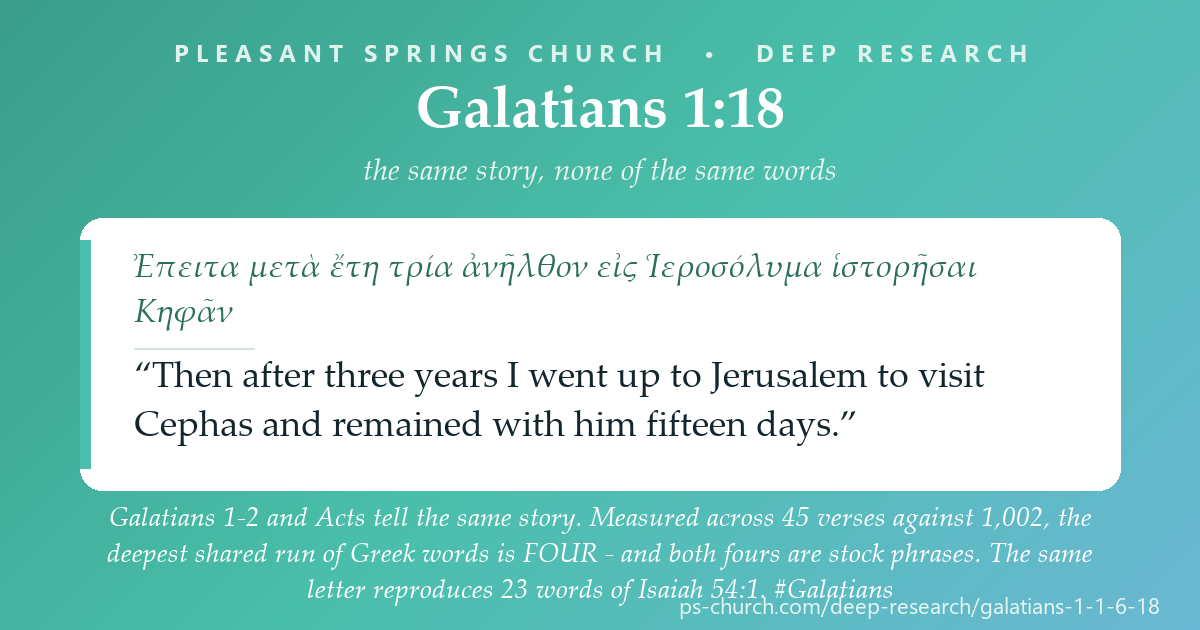
Galatians 1 and 2 tell a story the book of Acts also tells. Damascus. Arabia. A first visit to Jerusalem. Fourteen years. A meeting with James and Cephas and John. A confrontation at Antioch. Two accounts, one set of events, and both of them in Greek. So we measured them against each other, expecting the overlap to show. It does not. Across all 45 verses of Galatians 1–2, screened against every one of the 1,002 verses of Acts, the deepest run of shared consecutive words is four — and there are only two rows that reach it. One is τὴν ἐκκλησίαν τοῦ θεοῦ, the church of God. The other is κυρίου ἡμῶν Ἰησοῦ Χριστοῦ, of our Lord Jesus Christ — and it is in the letter’s greeting, not in its narrative. The method is not blind: run the same screen on Luke against Acts and it finds ten. Two books by one author, and the ten is a line of Psalm 110 that both of them quote. And Galatians itself can run deep — it reproduces twenty-three consecutive words of Isaiah 54:1. So the letter quotes at depth, and narrates at none. Whether the two accounts agree, conflict, or describe different occasions is not something a word count can decide, and this page does not decide it. What the count shows is that whoever wrote either one was not working from the wording of the other. See the method →
Galatians 1:1–6:18 (selections)
Greek New Testament (SBLGNT / MorphGNT) · ESV★ And the result that set this page’s thesis was not what we expected. Galatians 1–2 and the book of Acts narrate the same events. Across all 45 verses of those two chapters, the deepest run of shared consecutive Greek words with any of the 1,002 verses of Acts is four — and both fours are stock phrases, one of them sitting in the letter’s greeting. Meanwhile the same letter reproduces twenty-three consecutive words of Isaiah 54:1. Stage 4 gives the full measurement, the tie bands, the controls and the counter-examples.
The Shape of the Passage
A sequence, not a chiasm — and the page will not pretend otherwiseGalatians is the letter whose author spends two chapters establishing who he is and where he got his message — so the author question here is not a modern reconstruction, it is the letter’s own subject. The audience question is the harder one, and this page reports that it is unsettled rather than picking a side.
Author
The letter names Paul in its first word and then argues for the naming. Παῦλος ἀπόστολος opens exactly six verses of the Greek New Testament — 2 Corinthians, Ephesians, Colossians, 1 Timothy, 2 Timothy and this letter. (Romans opens Παῦλος δοῦλος and 1 Corinthians Παῦλος κλητὸς ἀπόστολος.) Only this letter follows the two words with a denial — not from men nor through man — and only this letter then spends forty-five verses backing the denial up with a chronology. Galatians is not a letter that has to be argued into Paul’s hand; it is the letter other letters are dated against. This page assumes nothing else about it.
And the vocabulary is ordinary, which is worth printing because the opposite is often assumed. Counted here from the MorphGNT lemma column: 32 lemmas occur once in Galatians and nowhere else in the Greek New Testament, in a letter of 2,226 words — 14.4 per thousand. Romans runs 16.3, Philippians 24.6, Colossians 23.4, 1 Timothy 42.1. Galatians is one of the least lexically unusual letters in the corpus. Its strangeness is in its temper, not its wordstock.
Where the rare words cluster is itself measurable, and it is not where a reader would guess: 10 of the 32 are in chapter 2, and four of the ten are in 2:14 alone — the sentence Paul says he spoke to Peter’s face.
Audience
Churches, plural, in a region the letter names twice and locates never. 1:2 addresses ταῖς ἐκκλησίαις τῆς Γαλατίας, the churches of Galatia, and 3:1 calls them ἀνόητοι Γαλάται. Those are the only two markers of where the READERS are. The letter names Damascus, Arabia, Jerusalem, Syria, Cilicia, Judaea, Antioch and Sinai — every one of them on Paul’s side of the story and none of them on theirs. No city of the audience is named. No named individual in the audience appears anywhere. Whether Galatia here means the old ethnic territory in the north or the Roman province in the south — and therefore whether the readers are the people of Acts 13–14 or people Acts never mentions — is not decidable from the text of the letter, and this page does not decide it.
What the letter does say about them is concrete and unhappy. They are turning to a different gospel and doing it quickly (1:6). They received Paul when he was ill (4:13–14). They are being pressed to be circumcised (6:12) and to keep days and months and seasons and years (4:10). Someone is troubling them (1:7, 5:10). The letter was written into a live crisis, and it does not pause to be polite.
Orient on Galatia, on the north/south question, and on the two things this letter is famous for: a chronology and a phrase.
Search by topic: Galatians, Letter to; Galatia; North Galatian and South Galatian hypotheses; Jerusalem Council; Antioch incident; Cephas / Peter; works of the law; justification; faith of Christ (pistis Christou); circumcision; Judaizers; allegory in Paul.
Which articles are relevant?
- Anchor Bible Dictionary — “Galatians, Epistle to the,” “Galatia,” “Jerusalem, Council of,” “Antioch (Syria),” “Cephas.”
- Dictionary of Paul and His Letters (IVP) — “Galatians, Letter to,” “Chronology of Paul,” “Works of the Law,” “Justification,” “Opponents of Paul,” “Circumcision.”
- New International Dictionary of NT Theology and Exegesis — ἐλευθερία, νόμος, δικαιόω, ἀνάθεμα, στίγμα.
- Dictionary of NT Use of the OT (Beale & Carson) — on Galatians 3 and 4, which between them carry eight explicit Old Testament citations.
- Dictionary of Biblical Imagery — “Yoke,” “Leaven,” “Adoption,” “Barren Woman.”
Settle the numbering — there is nothing to convert here
A New Testament letter has no Hebrew column and no Septuagint column of its own. The Greek printed on this page is the language the letter was composed in, not a translation of a Hebrew original. What still has to be checked is whether the verse divisions agree, and here they do.
| 1 | 2 | 3 | 4 | 5 | 6 | total | |
|---|---|---|---|---|---|---|---|
| SBL Greek NT | 24 | 21 | 29 | 31 | 26 | 18 | 149 |
| ESV | 24 | 21 | 29 | 31 | 26 | 18 | 149 |
Counted from the corpora themselves, not copied from a table: 149 verse units in the MorphGNT file, and 149 addressable verses in the public-domain English text held on disk beside it. No ESV file for Galatians is held on this disk, so the ESV row is the printed edition’s own divisions rather than a count. Every reference on this page therefore means the same verse in both columns. Old Testament pages on this shelf frequently do not have that luxury — Nahum carries a one-verse offset in two of its three chapters — which is why the question is asked every time.
But the passages Galatians quotes DO cross the offset question
Four of the eight Old Testament texts Galatians cites sit in books where the Hebrew and Greek numbering agree at the point of citation — Genesis 15:6, Genesis 21:10, Deuteronomy 21:23 and Deuteronomy 27:26 are the same verse in the Masoretic text, in CATSS Greek and in the ESV. So is Isaiah 54:1 and so is Habakkuk 2:4.
One does not, and the page says so where it matters. Galatians 2:16 ends with a line that also stands at Romans 3:20, and behind both lies Psalm 143:2 in the English and Hebrew numbering, which is Psalm 142:2 in the Greek — the Septuagint runs one behind the Masoretic text from Psalm 9/10 through Psalm 147. Every measurement on this page against that verse was run against CATSS Psalm 142:2 and is labelled MT/ESV 143:2 · LXX 142:2 wherever it appears.
A curse formula, a legal metaphor, and a body that is used as evidence.
ἀνάθεμα — what the Greek Old Testament does with the word, and what Galatians does with it
Counted across the 30,348 screened verse units of Greek Old Testament — 30,637 are held, and the 289 units of the Odes are set aside — the ἀναθεμ- group stands 31 times in 23 verses, and it is a word of devoted destruction, not of church discipline. In the Greek of Deuteronomy, Joshua and the historical books it renders the Hebrew herem — a thing handed over to God and therefore removed from ordinary use, often by being destroyed.
★ This paragraph used to be a guess with a warning attached, and the warning turned out to be right. When this page was first written the count was 14 occurrences over 44 CATSS files, and the note under it said that Joshua, Leviticus and Numbers — “three of the books where the usage is densest” — were not on this disk, so the characterisation was not a complete count. All three arrived on 30 August 2026 and the screen was re-run. The prediction holds. Greek Joshua alone carries 12 of the 31 — more than a third of every occurrence in the Greek Old Testament, packed into seven verses: the fall of Jericho and the Achan narrative, Joshua B 6:17, 6:18, 7:1, 7:11, 7:12, 7:13 and 22:20. Leviticus 27:28 uses ἀνάθεμα twice in one verse, of a thing devoted to the Lord and therefore not redeemable; Numbers 21:2–3 has Israel vowing to devote a city and then naming the place for the vow. Those three books supply 16 of the 31.
One of the thirty-one pulls the other way, and it is worth naming because it shows the word had a second life. 2 Maccabees 2:13 uses ἀναθημάτων of royal letters about votive offerings — things dedicated to the sanctuary rather than devoted to destruction. 2 Maccabees is held on this shelf as a WITNESS, NOT AS SCRIPTURE, and it is cited here only for what a Greek word could mean in the period between the Testaments.
In the Greek New Testament the exact form ἀνάθεμα stands in five verses: Romans 9:3, 1 Corinthians 12:3, 1 Corinthians 16:22, Galatians 1:8 and Galatians 1:9. Two of the five are consecutive verses of this letter, and in the second one the writer says he is repeating himself on purpose: as we have said before, so now I say again.
The herem background is still reported from lexica as well as from the files; what changed is that the count above is now a count over the whole Greek Old Testament this shelf holds rather than over a corpus with the three densest books missing.
στίγμα at 6:17 — a word from outside the religious vocabulary
In ordinary Greek a στίγμα is a mark made by a puncture or a brand: on slaves, on soldiers, on animals, and in some cults on devotees. It is a mark of ownership before it is anything else. The word occurs once in the Greek New Testament and once in the 64 CATSS files held here — Song of Songs 1:11, μετὰ στιγμάτων τοῦ ἀργυρίου, with studs of silver, of an ornament rather than a wound. στιγμή at Isaiah 29:5 is a different word — a moment — and is not counted here. ⚠️ The corpus grew from 44 files to 64 after this count was first made and the count did not move. The twenty new files added exactly one στιγμ- token, στιγμήν at 2 Maccabees 9:11 — and it is the other word again, by the moment, of Antiochus’ pain increasing. 2 Maccabees is a WITNESS on this shelf, NOT SCRIPTURE. The brand is still a single occurrence in the whole Greek Old Testament held here.
The letter uses it as evidence. Having opened by refusing a human commission, it closes by producing a physical one — and it does so immediately after saying that the people pressing circumcision want to make a good showing in the flesh (6:12). One mark in the flesh set against another.
The documentary and inscriptional evidence for branding — papyri, slave sale contracts, military records — is where this usage is actually demonstrated, and none of it was consulted for this page. Stage 5 repeats the warning.
Galatia, and the honest state of the geography
By the first century Galatia named two different things: an ethnic territory in central Asia Minor settled by Celtic-speaking peoples in the third century BC, and a Roman province created in 25 BC that reached much further south and took in Antioch of Pisidia, Iconium, Lystra and Derbe.
The letter gives no help. It names the region at 1:2 and the people at 3:1 and stops. It names no city of theirs, no synagogue, no magistrate, no local cult, and no person in the audience by name. Any reconstruction of the destination is therefore an argument from Acts and from Roman provincial administration, not from Galatians — and this page keeps that boundary visible, because the next stage is going to show how little Galatians and Acts actually share.
Seven words, each counted rather than characterised.
Counted over the SBL Greek New Testament as digitised by MorphGNT (7,927 verses) and over the 64 CATSS Greek Old Testament files held here (30,637 verse units held, 30,348 screened — the Odes are set aside). The single-word cards below count the MorphGNT LEMMA column, so every inflected form is included — the word form νόμος itself stands only 8 times in Galatians while the lemma stands 32. Where a card says ‘the exact form’ it means the form. Every RUN measured on this page is of normalised word forms, never lemmas.
32 occurrences in 2,226 words — 14.4 per thousand, the highest rate of any book in the Greek New Testament. Romans has more in total (74) but a lower rate (10.5). James 5.8, Hebrews 2.8, 1 Corinthians 1.3.
11 occurrences in the Greek New Testament; 4 of them in Galatians (2:4, 5:1, 5:13 twice). No other book has more than two.
Exactly 6 verses of the Greek New Testament, in exactly 2 books — Romans 3:20 and 3:28, Galatians 2:16, 3:2, 3:5 and 3:10. Eight occurrences across those six verses, and three of the eight are inside Galatians 2:16.
The exact form stands in 5 verses: Romans 9:3, 1 Corinthians 12:3 and 16:22, Galatians 1:8 and 1:9. Two of the five are consecutive verses here.
6 occurrences in 4 verses — and 3 of the 6 are in Galatians 3:28. The others: 1 Corinthians 6:5, Colossians 3:11, James 1:17.
16 occurrences in the Greek New Testament; 3 of them run the chronology of Galatians 1–2 at 1:18, 1:21 and 2:1. A sequence marker, and the reason the structure diagram above says sequence.
1 occurrence in the Greek New Testament (6:17, lemma) and 1 in the 64 CATSS Greek Old Testament files held here — Song of Songs 1:11, of silver studs on an ornament. The last concrete noun in the letter.
The thirty-two, and where they sit
Counted from the MorphGNT lemma column over all 27 books: 32 lemmas occur once in Galatians and in no other book of the Greek New Testament. Widen the test to lemmas found only in Galatians at any frequency and the figure is 37. Both are given because they answer different questions.
At 14.4 per thousand words that is an unremarkable rate — Romans 16.3, Philippians 24.6, Colossians 23.4, 1 Timothy 42.1, 2 Timothy 48.6, Titus 47.0. Only 1 Thessalonians (12.2), 1 Corinthians (12.3) and 2 Thessalonians (9.8) come in lower among the Pauline letters. Whatever makes Galatians feel unlike the other letters, it is not the wordstock.
The distribution inside the letter is the interesting part. Ten of the thirty-two are in chapter 2, and four of those ten are in 2:14: ὀρθοποδέω (to walk straight), ἐθνικῶς (Gentile-fashion), Ἰουδαϊκῶς (Jew-fashion) and ἰουδαΐζω (to live as a Jew). Only one other verse in the letter reaches even three — 5:26, with κενόδοξος, προκαλέομαι and φθονέω. The one verse that quotes a confrontation word for word is the one verse that needed words no other letter needed.
Others, so the class of word is visible: βασκαίνω (to bewitch, 3:1), ἀλληγορέω (to speak allegorically, 4:24), ἐκπτύω (to spit out, 4:14), δάκνω (to bite, 5:15), μυκτηρίζω (to sneer at, 6:7), φρεναπατάω (to deceive oneself, 6:3), στίγμα (brand-mark, 6:17). They are the words an argument needs, not the words a system needs.
Cephas and Peter — a naming fact, reported without a conclusion
In the text this shelf holds, Galatians calls the same man Κηφᾶς at 1:18, 2:9, 2:11 and 2:14, and Πέτρος at 2:7 and 2:8. Κηφᾶς occurs in nine verses of the Greek New Testament: John 1:42, four in 1 Corinthians, and these four.
⚠️ This is a fact about one printed edition, not about the manuscript tradition. Other editions and the Byzantine text read Πέτρος at 2:11 and 2:14. No critical apparatus was consulted for this page, so the alternation reported above is what SBLGNT prints and nothing more. It is printed because it is checkable, and flagged because a reader could otherwise take it for a settled textual fact.
Every verse of Galatians screened against the rest of the Greek New Testament and against the Greek Old Testament held here — with the tie band beside every run.
Greek against Greek. MorphGNT field 6, the normalised word form (the column that resolves elision and the movable nu), lowercased with accents and breathings dropped and final sigma folded; the CATSS FORM column put through the same filter after beta-code transliteration. Word forms, never lemmas. Contiguous runs only. The tie band is how many other verses reach the same depth; a run without its band is misleading.
First, the counter-examples — because the deepest numbers in this book prove nothing
The two deepest runs Galatians has anywhere in the Greek New Testament are tied at nine, and both are standing epistolary forms.
| Galatians | against | run | tie band | what it is |
|---|---|---|---|---|
| 1:3 | 2 Thessalonians 1:2 | 9 | 1 | The salutation. grace to you and peace from God the Father and… — a form, not a quotation. |
| 1:5 | 2 Timothy 4:18 | 9 | 1 | A doxology, whole. to whom be the glory forever and ever. Amen. |
| 6:18 | Romans 16:20 · Romans 16:24 · 1 Thessalonians 5:28 · 2 Thessalonians 3:18 | 8 | 4 | The benediction. Deep, and shared with four verses at once. |
| 2:20 | John 5:25 · Ephesians 4:13 · 1 John 5:13 | 4 | 3 | The most quoted sentence in the letter, and one of its shallowest rows. |
Print those first and the reader is properly warned. Depth alone is not evidence of contact, and shallowness is not evidence of independence. A greeting, a doxology and a benediction all run deep because they are fixed forms. What makes a run worth reporting is depth with a narrow band and a reason to look.
Now the finding — Galatians 1–2 against the book of Acts
These two chapters and the book of Acts narrate the same events. A conversion near Damascus; a period away; a first visit to Jerusalem; a return to Syria and Cilicia; a later Jerusalem meeting with James and Peter about Gentiles and circumcision; Antioch. If any two texts in the New Testament ought to share wording, it is these.
All 45 verses of Galatians 1–2, screened against all 1,002 verses of Acts:
| run reached | how many of the 45 rows |
|---|---|
| 1 word only | 1 |
| 2 words | 27 |
| 3 words | 15 |
| 4 words | 2 |
| 5 or more | 0 |
And the two rows that reach four are both stock phrases.
| Galatians | against | run | tie band | the shared words |
|---|---|---|---|---|
| 1:13 | Acts 20:28 | 4 | 1 | τὴν ἐκκλησίαν τοῦ θεοῦ — the church of God. Galatians is persecuting it; Acts is telling elders to shepherd it. |
| 1:3 | Acts 15:26 | 4 | 1 | κυρίου ἡμῶν Ἰησοῦ Χριστοῦ — of our Lord Jesus Christ. A title, and it is in the greeting, not in the narrative. |
So inside the narrative itself, nothing reaches four — and the five verses that actually move Paul from place to place reach TWO, in very wide bands.
| Galatians | the move | deepest run with any verse of Acts | tie band |
|---|---|---|---|
| 1:17 | to Arabia and back to Damascus | 2 — εἰς Ἱεροσόλυμα | 37 |
| 1:18 | to Jerusalem, to see Cephas | 2 — the same two words | 34 |
| 1:21 | into Syria and Cilicia | 2 — ἦλθον εἰς | 16 |
| 2:1 | up to Jerusalem again, with Barnabas and Titus | 2 | 12 |
| 2:11 | Cephas came to Antioch | 2 — ὅτε δέ | 19 |
Galatians 1:18 and Acts 9:26–28 — the same journey to the same city — share no two consecutive words at all with each other; 1:19 and Acts 9:28 share τοῦ κυρίου. The meeting of Galatians 2:9 and the whole of Acts 15 share no run above two, in a band of four. Every one of these is a formula in a wide band, which is the measurement’s way of saying: no contact.
The controls — is the method just blind, or is the contact really absent?
Control 1: the same screen on Luke against Acts. Two books universally taken to be by one hand. All 1,149 verses of Luke against all 1,002 of Acts: the deepest run is ten, at Luke 20:43 against Acts 2:35, in a tie band of one — and the ten is a line of Psalm 110 that both books quote. Luke 20:42 reaches eight against Acts 2:34, the line before it. Luke 2:1 reaches six against Acts 9:37 on a narrative formula. The method finds deep contact when deep contact is there.
Control 2: Galatians against every other book, one at a time.
| book | verses in it | deepest run with Galatians | the row |
|---|---|---|---|
| Romans | 430 | 8 | 5:14 → Romans 13:9 |
| Philippians | 104 | 8 | 1:5 → Philippians 4:20 (doxology) |
| 1 Thessalonians | 89 | 8 | 6:18 → 1 Thessalonians 5:28 (benediction) |
| 2 Thessalonians | 47 | 9 | 1:3 → 2 Thessalonians 1:2 (salutation) |
| 1 Corinthians | 437 | 7 | 1:3 → 1 Corinthians 1:3 (salutation) |
| James | 108 | 7 | 3:6 → James 2:23 (Genesis 15:6) |
| Matthew | 1068 | 6 | 5:14 → Matthew 19:19 |
| Hebrews | 303 | 6 | 1:5 → Hebrews 13:21 (doxology) |
| Acts | 1002 | 5 | 6:14 and 6:18 → Acts 15:26 — of our Lord Jesus Christ, a divine title; 6:18 is the benediction |
Acts is the second-longest book in the New Testament by word count (18,412 words against Luke’s 19,446) and the third by verse count, and it is the only one that tells this letter’s story, and its ceiling with Galatians is a divine title in a closing formula. Size does not explain it: Matthew is longer and reaches six; Romans is less than half the length and reaches eight.
⚠️ The honest limit of the control. Four books do come in lower than Acts — John at four, 1 John at four, 2 John at three and 3 John at two — so a ceiling of five is not a record. The finding is not that Acts is uniquely far from Galatians; it is that Acts is no closer to Galatians than books which narrate nothing in common with it. Telling the same story made no measurable difference at all.
⚠️ And what this does NOT establish. It does not establish that the two accounts disagree, that either writer was ignorant of the other, or that the events differ. Two people describing the same afternoon in their own words would produce exactly this measurement, and so would one writer working from oral report rather than from a document. This shelf never asserts direction of influence, and it does not convert a silence into a contradiction.
Galatians 5:14 and Galatians 2:16 — twin contacts with Romans, and both are Scripture handled loosely
Strip out the greeting, the doxology and the benediction, and the two deepest contacts Galatians has anywhere in the New Testament are both with Romans, and both are places where the two letters are handling the same Old Testament sentence.
| Galatians | against | run | tie band | and against the Old Testament behind it |
|---|---|---|---|---|
| 5:14 | Romans 13:9 | 8 | 1 | 6 against CATSS Leviticus 19:18, tie band 1 — measured 30 August 2026, when Greek Leviticus reached this disk. This cell used to read NOT MEASURABLE HERE. |
| 2:16 | Romans 3:20 | 7 | 1 | 2 against CATSS Psalm 142:2 (MT/ESV 143:2). Neither letter reproduces more than two consecutive words of it. |
At 5:14 the shared eight are ἐν τῷ· Ἀγαπήσεις τὸν πλησίον σου ὡς σεαυτόν. The six-word core without the ἐν τῷ stands in exactly six verses of the Greek New Testament — Matthew 19:19 and 22:39, Mark 12:31, Romans 13:9, James 2:8 and Galatians 5:14. Luke 10:27 has five of the six. Galatians and Romans are one word-pair deeper than everybody else, and nothing else in the New Testament is at their depth.
★ And the six-word core is Leviticus 19:18, word for word — which this page could not check until Greek Leviticus reached the disk on 30 August 2026. CATSS Leviticus 19:18 ends καὶ ἀγαπήσεις τὸν πλησίον σου ὡς σεαυτόν ἐγώ εἰμι κύριος. Every New Testament verse carrying the command reproduces the Greek exactly. So the eight that Galatians and Romans share is the Septuagint’s six plus the same two-word hinge, ἐν τῷ, in front of it — and that hinge, not the commandment, is what the two letters actually share with each other. The possibility this page raised against itself before Leviticus arrived — if the Greek of Leviticus 19:18 reads exactly as both letters have it, the eight is much less interesting than it looks — is now measured, and it is half right: the six are the Septuagint’s, the two are theirs.
| New Testament verse | run against CATSS Leviticus 19:18 | the shared words |
|---|---|---|
| Matthew 19:19 | 7 | καὶ ἀγαπήσεις τὸν πλησίον σου ὡς σεαυτόν — it keeps Leviticus’ καί |
| Matthew 22:39 · Mark 12:31 · Romans 13:9 · James 2:8 · Galatians 5:14 | 6 | the six-word core |
| Luke 10:27 | 5 | it drops ἀγαπήσεις from the second half of the double command |
Note which verse wins. Galatians and Romans are the deepest pair in the New Testament, and neither of them is the deepest against the source — Matthew 19:19 is, by one word, because it alone keeps the καί that Leviticus has. Nothing about priority follows from any of this.
At 2:16 the shared seven are ἐξ ἔργων νόμου οὐ δικαιωθήσεται πᾶσα σάρξ — and the Septuagint Psalm reads ὅτι οὐ δικαιωθήσεται ἐνώπιόν σου πᾶς ζῶν — no living thing shall be justified before you, not no flesh shall be justified by works of law. The five words the two letters add to the Psalm are the same five words in the same order — ἐξ ἔργων νόμου in front of it, and πᾶσα σάρξ in place of πᾶς ζῶν.
Which of those two letters was written first, and whether either had the other in front of it, is not something a run-screen can determine and is not claimed here. The measurable shape is: where Galatians agrees most closely with another New Testament letter, both of them are one step away from the same Old Testament line.
The deepest run in the letter — Galatians 4:27 and Isaiah 54:1, and a flaw in this shelf’s own tooling
Galatians 4:27 reproduces the Greek of Isaiah 54:1 for twenty-three consecutive words. Word for word, in order, from Εὐφράνθητι to τὸν ἄνδρα. Isaiah then adds εἶπεν γὰρ κύριος, which Galatians does not carry.
⚠️ The shelf’s standard screen reports 13, and 13 is wrong. Here is exactly why, because a page that hid this would be hiding a fault in its own instrument. MorphGNT’s field 6 — the normalised column this shelf measures on, chosen because it resolves elision and the movable nu — also folds οὐκ and οὐχ to οὐ. The CATSS Greek Old Testament column does not. Both texts read ἡ οὐκ ὠδίνουσα at the tenth word, and the normaliser turns the Galatians side into ἡ οὐ ὠδίνουσα and breaks the run there. The screen therefore returns two blocks — nine words, then thirteen — where the texts are in fact identical across all twenty-three.
| what was measured | result |
|---|---|
| the shelf’s standard screen (MorphGNT field 6 vs CATSS FORM) | 13, tie band 1 — and a separate block of 9 before it |
| the same screen re-run on MorphGNT field 5, the printed text column | 23 |
| tokens in the Greek NT whose text column is οὐκ or οὐχ | 930 |
| …of which the normalised column folds to οὐ | 930 — all of them |
| tokens in the screened CATSS corpus that are οὐκ or οὐχ | 3,962 (3,992 counting the Odes, which are no longer screened; 3,256 when this page was written against 44 files) |
So every cross-corpus run on this shelf that crosses a negated verb is cut at the negative. That is a systematic floor, not a random error: the published numbers are never too high, but they can be too low, and Galatians 4:27 is the sharpest case any page here has hit. This page prints 13 as the standard-method figure and 23 as the true agreement, and reports the cause rather than quietly using the number it prefers. The normaliser is frozen — every published figure on this shelf depends on it — so nothing was changed to produce the 23. It was obtained by re-running the same screen on a different column and is labelled as such.
The whole book, screened
All 149 verses of Galatians against the other 7,778 verses of the Greek New Testament.
Across the 149 rows: 145 reach two consecutive shared words, 96 reach three, 35 reach four, 13 reach five, 8 reach six, 7 reach seven, 4 reach eight, 2 reach nine, and nothing reaches ten. Four rows reach only one — 3:3, 4:16, 5:12 and 5:26 — that is, they share isolated words and no two-word sequence at all with any other verse in the New Testament.
Against the Greek Old Testament held here, the profile is much flatter and much more lopsided: 143 of the 149 rows reach two, 66 reach three, 17 reach four, 9 reach five, 5 reach six, 3 reach seven — then a gap, then 1:5 at nine and 4:27 at thirteen. The deepest after those two are 3:6 against Genesis 15:6 (seven, band one), 4:30 against Genesis 21:10 and 5:14 against Leviticus 19:18 (six, band one each). Four rows reach five, and one of them is 1:15 against Judges A 16:17 — from my mother’s womb, which is a phrase, not a citation.
⚠️ THIS PARAGRAPH USED TO SAY SOMETHING FALSE, and the enlarged corpus is what caught it. Measured against 44 CATSS files and 23,061 verse units it read: “141 of the 149 rows reach two, 57 reach three, 16 reach four, 8 reach five, 3 reach six, 2 reach seven — and then nothing at all until 4:27 at thirteen. Nothing in the book reaches eight, nine, ten, eleven or twelve.” Every one of those figures was correct for that corpus. The last sentence is now false.
| claim | 44 files · 23,061 units | 64 files, Odes set aside · 30,348 units screened |
|---|---|---|
| rows reaching two | 141 | 143 |
| rows reaching three | 57 | 66 |
| rows reaching four | 16 | 17 |
| rows reaching five | 8 | 9 |
| rows reaching six | 3 | 5 — 5:14 joins on Leviticus 19:18 |
| rows reaching seven | 2 | 3 |
| “nothing reaches eight through twelve” | true | FALSE — 1:5 reaches nine |
| Galatians 1:5, the doxology | 5, tie band 2 | 9, tie band 1 — 4 Maccabees 18:24 |
| Galatians 3:16 tie band | 17 | 20 (21 for one day, while the Odes were screened — see below) |
The nine is Galatians 1:5 against 4 Maccabees 18:24, and the two lines are identical. ἡ δόξα εἰς τοὺς αἰῶνας τῶν αἰώνων ἀμήν — to whom be the glory unto the ages of the ages, amen — nine words, word for word, tie band of one. It is now the second-deepest run Galatians makes into the Greek Old Testament held here, deeper than any of the letter’s six explicit citations except Isaiah 54:1.
⚠️ And it means nothing, for two separate reasons that must both be said. First, 4 Maccabees is held on this shelf as a WITNESS, NOT AS SCRIPTURE — a first-century Greek treatise on reason and the passions, not a book Pleasant Springs receives as canonical, and a hit in it is a fact about Greek rather than about Scripture. Second, it is a doxology. This page has already said, of the letter’s deepest New Testament runs, that a salutation and a benediction prove nothing about quotation. A closing doxology shared with a Hellenistic Jewish treatise is the same finding from the other side: the formula was in the air, and depth alone is not evidence of contact. The page prints it because a page that re-ran its screens and buried the one result that embarrasses its own distribution table would not be worth reading.
And the loosest citations are the ones the letter flags most loudly.
| Galatians | cites | longest run with the cited Greek text | note |
|---|---|---|---|
| 4:27 (it is written) | Isaiah 54:1 | 13 by the standard screen, 23 by the text column | The deepest in the book. |
| 3:6 | Genesis 15:6 | 7 | Same words, different order at the start. |
| 4:30 (what does the Scripture say) | Genesis 21:10 | 6 | — |
| 3:16 | Genesis 13:15 · 17:8 | 4, tie band 20 (17 at 44 files; 21 for one day) | A run of four in a band of twenty is a formula, and the argument at 3:16 turns on a singular noun, not on a run. The three verses the enlarged corpus added to the band are Exodus 28:43, Numbers 18:19 and Numbers 25:13. ⚠️ There was a fourth, and it has been removed: Odes 9:55, which is Luke 1:55. See the note below the table. |
| 3:13 (it is written) | Deuteronomy 21:23 | 3 | Galatians has ἐπικατάρατος; the Greek of Deuteronomy has κεκατηραμένος ὑπὸ θεοῦ. |
| 3:11 | Habakkuk 2:4 | 3 | A real divergence, stated plainly: the Greek of Habakkuk reads ἐκ πίστεώς μου, by MY faithfulness. Galatians has no μου at all, and neither does Romans 1:17. Hebrews 10:38 keeps it and moves it — ὁ δὲ δίκαιός μου ἐκ πίστεως ζήσεται, my righteous one. Three New Testament uses of one Greek line, three different placements of one word. |
| 3:10 (it is written) | Deuteronomy 27:26 | 2 | Both open ἐπικατάρατος πᾶς and then part company. |
| 3:12 | Leviticus 18:5 | 3, tie band 5 | Measured 30 August 2026; this cell read NOT MEASURABLE HERE until Greek Leviticus reached the disk. The three are ζήσεται ἐν αὐτοῖς. The run stops one word early because Leviticus has a word Paul drops: Leviticus reads ὃ ποιήσας ἄνθρωπος ζήσεται, which if a man do, he shall live; Galatians reads ὁ ποιήσας αὐτὰ ζήσεται. And the tie band of five is the finding: the same three words stand at Ezekiel 20:11, 20:13 and 20:21 and at 2 Esdras 19:29 (Nehemiah 9:29). Paul is quoting a sentence the Greek Old Testament repeats. |
| 5:14 | Leviticus 19:18 | 6, tie band 1 | Also measured 30 August 2026, and also formerly NOT MEASURABLE HERE. Exact, all six words: ἀγαπήσεις τὸν πλησίον σου ὡς σεαυτόν. This is the letter’s closest verbatim agreement with a text it does not announce it is quoting. |
★ With those two cells filled, all six of Galatians’ explicit Old Testament citations are measured for the first time. Isaiah 54:1 at thirteen (twenty-three on the text column), Genesis 15:6 at seven, Genesis 21:10 at six, Leviticus 19:18 at six, Deuteronomy 21:23 at three, Leviticus 18:5 at three, Habakkuk 2:4 at three, Genesis 13:15/17:8 at four in a band of twenty, Deuteronomy 27:26 at two. The two Leviticus citations come in at the top and the bottom of that spread — the one Paul quotes to make his case for love fulfilling the law is nearly exact, and the one he quotes to make his case against the law barely clears the floor.
⚠️ ONE MEMBER OF THE 3:16 TIE BAND HAS BEEN REMOVED, AND IT WAS LUKE MATCHING LUKE. THE PAGE NAMES IT RATHER THAN LETTING THE NUMBER DROP IN SILENCE.
For one day — between the corpus fetch of 30 August 2026 and the exclusion of the Odes — Galatians 3:16’s tie band read 21, and the twenty-first member of it was Odes 9:55. Ode 9 is Luke chapter 1 — the Magnificat and the Benedictus, excerpted from the Gospel for liturgical use and copied back into a Greek Old Testament manuscript — and Odes 9:55 is Luke 1:55, twelve of whose fourteen words agree with the Gospel verse exactly. So a band that was supposed to count Old Testament verses sharing καὶ τῷ σπέρματι αὐτοῦ with Galatians was counting a verse of Luke. The band is 20.
It is a small error and it is worth the space anyway. A tie band is the whole reason this shelf can tell a citation from a formula, and a band inflated by New Testament text filed under an Old Testament shelfmark cannot do that job. Elsewhere on the shelf the same file did far worse: screened, Odes 9:48 matches Luke 1:48 at eighteen consecutive words — a run fewer than a dozen pairs in the entire corpus exceed, and it is a Gospel measured against itself. The instrument was not malfunctioning. It found a real, exact agreement between two files on this disk. What it could not know is that the two files are the same text, and nothing short of opening the file will tell you so.
The Odes are the fourteen liturgical canticles appended to the Greek Psalter. They stay on this disk and they are still read; they are simply out of anything this shelf calls “the Greek Old Testament”, for two reasons. Two of them are New Testament text — Ode 9 is Luke 1, Ode 13 is Luke 2, the Nunc Dimittis. Ten of them are second copies of passages already in the corpus — Ode 1 is Exodus 15, Ode 2 Deuteronomy 32, Ode 3 1 Samuel 2, Ode 4 Habakkuk 3, Ode 5 Isaiah 26, Ode 6 Jonah 2, Odes 7 and 8 Daniel (Th) 3, Ode 10 Isaiah 5, Ode 11 Isaiah 38 — so a verse standing once appears to stand twice, and any tie band touching a canticle is doubled for no textual reason. The shelf holds 30,637 verse units in 64 files and screens 30,348; the difference is exactly the 289 units of the Odes, and this page uses the screened figure wherever a number came out of a screen.
Nothing else on this page moved. The whole-book distribution against the Greek Old Testament is identical with the canticles out — 143 rows at two, 66 at three, 17 at four, 9 at five, 5 at six, 3 at seven, 1:5 at nine and 4:27 at thirteen. Galatians 1:5 still reaches nine against 4 Maccabees 18:24 at a band of one, 4:27 still reaches thirteen against Isaiah 54:1, and the ἀνάθεμα group still stands 31 times in 23 verses. Two figures moved: this tie band, and the οὐκ/οὐχ token count in Stage 4, which is 3,962 screened rather than 3,992 held.
A run-screen finds verbatim contact, not allusion. Galatians leans on Genesis 1:27 at 3:28 (ἄρσεν καὶ θῆλυ) and on the whole Hagar and Sarah narrative through 4:21-31 without either producing a long run. The absence of a run is not the absence of a source.
Where this page is weakest, and what was not reached.
The Galatians-and-Acts finding is a measurement of wording, and only of wording
What the number supports: neither text reproduces the other’s sentences. That is all a run-screen can say, and it says it firmly — 45 verses, 1,002 verses, nothing above four, and the two fours are stock phrases.
What the number does not support, and where a careless reader would go wrong:
- It is not evidence that the accounts conflict. Harmonising and non-harmonising reconstructions of Paul’s chronology both predict low verbal overlap.
- It is not evidence that Luke did not know Paul, or that Paul did not know Luke. Shared acquaintance produces shared facts, not shared phrasing.
- It is not evidence about which Jerusalem visit of Acts corresponds to Galatians 2. That is the central historical question in Galatians scholarship and this page cannot touch it, because the argument runs on chronology, geography and the internal logic of Acts, none of which is measurable from a word list.
- The screen compares normalised word forms. Two accounts could agree substantially in vocabulary while sharing few consecutive forms, and this measurement would not show it. No lemma-level or semantic comparison was run.
The corpus gap that bit hardest here is closed, and the page prints what closing it did
This section used to be a confession. It is now a record. Until 30 August 2026 this shelf held 44 CATSS files and 23,061 verse units, and twenty files were missing: Exodus, Leviticus, Numbers, both Joshua recensions, Judith, both Tobit recensions, 2, 3 and 4 Maccabees, Odes, Wisdom, Psalms of Solomon, Baruch, the Epistle of Jeremiah, and the Bel and Susanna texts. All twenty arrived; the shelf now holds 64 files and 30,637 verse units, and every Greek Old Testament screen on this page was re-run against all of them. ⚠️ One of the twenty has since been taken back out of the screening corpus: the Odes, whose Ode 9 is Luke 1 and whose Ode 13 is Luke 2, and ten more of whose canticles are second copies of passages already counted. 30,637 units are held; 30,348 are screened. The screens were re-run a second time, and one published figure on this page moved — the Galatians 3:16 tie band, from 21 to 20, because the twenty-first member of it was Odes 9:55, which is Luke 1:55. It is set out in Stage 4.
What this page said before, and what it says now:
| the claim, on 44 files | on 64 files |
|---|---|
| “Galatians quotes Leviticus twice and this shelf cannot check either.” | Both checked. 3:12 against Leviticus 18:5 = 3, band 5; 5:14 against Leviticus 19:18 = 6, band 1. |
| “The 5:14 finding is a New Testament measurement with its Old Testament side missing. If the Greek of Leviticus 19:18 reads exactly as both letters have it, the eight is much less interesting than it looks.” | It does read exactly as both letters have it. The Septuagint supplies six of the eight; Galatians and Romans supply the other two, ἐν τῷ. This page named the possibility before it could test it, and the test went against the page. |
| “Nothing in the book reaches eight, nine, ten, eleven or twelve.” | False now. 1:5 reaches nine against 4 Maccabees 18:24 — a WITNESS, NOT SCRIPTURE — and it is a doxology. |
| “Joshua, Leviticus and Numbers, three of the books where ἀνάθεμα is densest, are not among the files here.” | Confirmed by measurement. The group went from 14 occurrences to 31, and Joshua alone carries seven of them. |
| “Every zero in the Greek Old Testament on this page is a zero over 44 files, not over the Septuagint.” | Now a zero over 64 files — the complete upstream lxxmorph set. Still not a statement about every Septuagint manuscript, and still not a statement about the canon: Judith, Tobit, Wisdom, Sirach, Baruch, the Epistle of Jeremiah, 1–4 Maccabees, Odes, the Psalms of Solomon, Bel and Susanna are all measurement partners on this shelf and none of them is Scripture here. |
Why this is printed rather than swapped in. A measured claim is a claim about a corpus on a particular day. Three of this page’s published figures moved and one published sentence became false. The way to be trusted about the ones that did not move is to say plainly which ones did.
The tooling fault this page found in itself
The οὐκ / οὐ asymmetry described in Stage 4 is a real defect and it affects more than this page. Any published cross-corpus run on this shelf that would have crossed a negated verb is a floor rather than a value. The direction of the error is known — always an undercount, never an overcount — but the size of it has not been audited across the shelf, and this page does not claim it has.
The normaliser was deliberately not changed. It is frozen because every previously published number depends on it, and silently re-deriving old figures under new rules would be worse than reporting the fault. The 23 on this page was obtained by re-running the same screen against a different MorphGNT column and is labelled that way everywhere it appears.
What could not be checked at all
No Greek critical apparatus, for any verse — including the Κηφᾶς / Πέτρος readings at 2:11 and 2:14, which this page reports from one printed edition. No documentary papyri or inscriptions, which is where στίγμα would actually be tested. No Josephus and no Philo. No Apostolic Fathers — and Polycarp’s letter to the Philippians overlaps this material. No Qumran, which is where the phrase behind works of the law is most argued over and where 4QMMT sits. No Roman provincial epigraphy for Galatia.
And the two great interpretive questions in this letter are left open here, on purpose. Whether πίστεως Ἰησοῦ Χριστοῦ at 2:16 means faith in Jesus Christ or the faithfulness of Jesus Christ is a question about the force of a genitive, and a count of its three occurrences — Romans 3:22, Galatians 2:16, Galatians 3:22 — does not settle it. What works of the law denotes is a question about first-century Judaism, and the count of six verses in two books does not settle that either. A page that reported a count and then announced a meaning would be overreaching, and this one stops at the count.
Reading list
- J. Louis Martyn, Galatians (Anchor Bible 33A, 1997).
- Richard N. Longenecker, Galatians (WBC 41, 1990).
- F. F. Bruce, The Epistle to the Galatians (NIGTC, 1982) — still the standard presentation of the South Galatian case.
- Hans Dieter Betz, Galatians (Hermeneia, 1979) — the rhetorical-analysis reading of the letter’s shape, against which the sequence diagram above should be tested.
- Douglas J. Moo, Galatians (BECNT, 2013).
- James D. G. Dunn, “The New Perspective on Paul,” BJRL 65 (1983) — the origin of the modern argument about works of the law.
- None of these were consulted for the measurements on this page, which were run on the text files named in the footer.
One letter, two kinds of memory.
The same story, none of the same words
Galatians is short, angry, and in a hurry. It skips the thanksgiving. It curses twice in two verses. It calls its readers foolish. It records what one apostle said to another in front of everybody, and it does that in a sentence containing four words no other book of the New Testament uses.
Two chapters of it retell events that Acts also retells. We measured the two accounts against each other expecting the seams to show, and they do not show at all. Forty-five verses against a thousand and two, and nothing shared above four consecutive words — one of those fours being the word church with the word God, and the other sitting in a greeting.
And then the same letter turns to Isaiah and reproduces twenty-three words in a row. That is what the measurement actually shows: not that Galatians is careless with sources, but that it treats two kinds of material in two completely different ways. Scripture it repeats. Its own life it tells in its own words. Which is what an eyewitness does, and what a copyist never does — though a word count cannot prove even that, and this page will not pretend it can.
New Testament shelf: this is the whole of Galatians, all six chapters, 149 verses, Greek New Testament and ESV.
Every Deep Research page traces its passage across the whole sweep — the Old Testament, the Second-Temple world between the testaments (historical witnesses, not Scripture), and the New Testament. Follow the thread:
Pleasant Springs Church — Deep Research
Research method after Michael S. Heiser’s Bible Research Method (examine dictionaries → ancient literature → important words → textual connections → academic publications → share), with the Pleasant Springs “Author & Audience” foundation. Scripture set in the Hebrew, the Greek editions named on each page and the ESV (Old Testament), and the Greek New Testament and the ESV (New Testament), per the practice of Pleasant Springs Church. Galatians research grounded in Martyn (Anchor), Longenecker (WBC), Bruce (NIGTC), Betz (Hermeneia) and Moo (BECNT), with Dunn (1983) named as the origin of the modern works of the law debate. Text: Greek New Testament from the SBL edition as digitized by MorphGNT; Greek Old Testament from Rahlfs’ Septuaginta as digitized by CATSS. ⚠️ VERSE NUMBERING — there is no offset in this book. The SBL Greek New Testament runs 24 / 21 / 29 / 31 / 26 / 18 = 149 verses, counted from the file itself, and a public-domain English text on disk counts the same 149; the ESV prints the same divisions — no ESV file for Galatians is held here. Every reference on this page means the same verse in both columns. Stated because this shelf states it everywhere, including where there is nothing to convert. One text this page measures against does carry an offset: the Psalm behind Galatians 2:16 and Romans 3:20 is MT/ESV 143:2 and CATSS/LXX 142:2, and every measurement was run against the Greek numbering and labelled with both. ⚠️ The measurement, in full. Greek against Greek. MorphGNT field 6, the normalised word form; the CATSS FORM column (cols 0–24) beta-code transliterated first. Both sides lowercased, accents and breathings dropped, final sigma folded, then filtered to Greek letters — the same filter applied to both corpora. Word forms, never lemmas, except where the page says ‘lemma’ explicitly, which is the vocabulary count. Corpus: the 149 MorphGNT rows of Galatians against 7,778 New Testament verses in the other 26 files, and against 30,348 verse units screened across 64 CATSS files — the shelf holds 30,637 and sets aside the 289 units of the Odes, two of whose canticles are New Testament text (Ode 9 is Luke 1, Ode 13 is Luke 2) and ten of which are second copies of passages already in the corpus. Exhaustive and deterministic; nothing sampled, so no seed applies. ⚠️ The corpus grew after this page was written, and it is dated. The Greek Old Testament on this shelf went from 44 CATSS files and 23,061 verse units to the complete upstream set of 64 files and 30,637 verse units on 30 August 2026, and every Greek Old Testament screen here was re-run. Three published figures moved — the whole-book distribution, the ἀνάθεμα count and the 3:16 tie band — one published sentence became false, and two cells that read NOT MEASURABLE HERE are now measured. ⚠️ Then the Odes were taken back out of the screening corpus — 30,637 units held, 30,348 screened — because Ode 9 is Luke 1 and Ode 13 is Luke 2, and ten more canticles are second copies of passages already counted. The 3:16 tie band moved once more, from 21 to 20: its twenty-first member had been Odes 9:55, which is Luke 1:55. All of it is set out in Stages 4 and 5 rather than silently replaced. ⚠️ The book’s deepest New Testament runs are forms, and the page says so first. Galatians 1:3 against 2 Thessalonians 1:2 and Galatians 1:5 against 2 Timothy 4:18, both nine consecutive words in a tie band of one — a salutation and a doxology. 6:18 reaches eight in a band of four and is a benediction. Depth alone is not evidence of quotation. ⚠️ A defect in this shelf’s own tooling, disclosed rather than patched. MorphGNT’s normalised column folds οὐκ and οὐχ to οὐ — all 930 such tokens in the Greek New Testament — while the CATSS column keeps 3,962 of them unfolded across the screened corpus (3,992 counting the Odes, which are no longer screened; 3,256 across the 44 files held when this page was written). Every cross-corpus run that crosses a negated verb is therefore cut short. At Galatians 4:27 the standard screen returns 13 where the two texts actually agree across 23. The normaliser is frozen and was NOT changed; the 23 was obtained by re-running the same screen on MorphGNT’s text column and is labelled as such wherever it appears. The size of this effect across the rest of the shelf has not been audited. ⚠️ Not measured here. No critical apparatus for any verse, including the Κηφᾶς / Πέτρος readings at 2:11 and 2:14. No documentary papyri, no inscriptions, no Josephus, no Philo, no Apostolic Fathers, no Qumran. Greek Leviticus is now held — it was one of twenty CATSS files absent when this page was written, and both of Galatians’ Leviticus citations, 3:12 and 5:14, are measured above. Exodus, Numbers, Joshua, Wisdom, Judith, Tobit, 2–4 Maccabees, Odes, Psalms of Solomon, Baruch, the Epistle of Jeremiah, Bel and Susanna are also now held. ⚠️ Held as measurement partners, not as Scripture — where a run on this page lands in one of the deuterocanonical files it is named and labelled every time. ⚠️ Direction of influence is never asserted. Nothing here says that Galatians used Acts or that Acts used Galatians, that Galatians used Romans or Romans Galatians, or that either writer had the other in front of him. Nothing here says the accounts of Galatians 1–2 and Acts 9, 11 and 15 agree or conflict. A run of four in a corpus of a thousand verses is a shape, not a verdict. Typology is handled per the house position: what the text says, what the New Testament itself draws, and what we see from this side of the cross — with the seeing left to the reader.
Scripture quotations marked ESV are from the ESV® Bible (The Holy Bible, English Standard Version®), © 2001 by Crossway, a publishing ministry of Good News Publishers. ESV Text Edition: 2016. Used by permission. All rights reserved. The ESV text may not be quoted in any publication made available to the public by a Creative Commons license, and the ESV may not be translated in whole or in part into any other language. www.esv.org
|
Did this study bless you today? 💚 Give to Support PS Church100% of gifts go to the General Fund — thank you. |