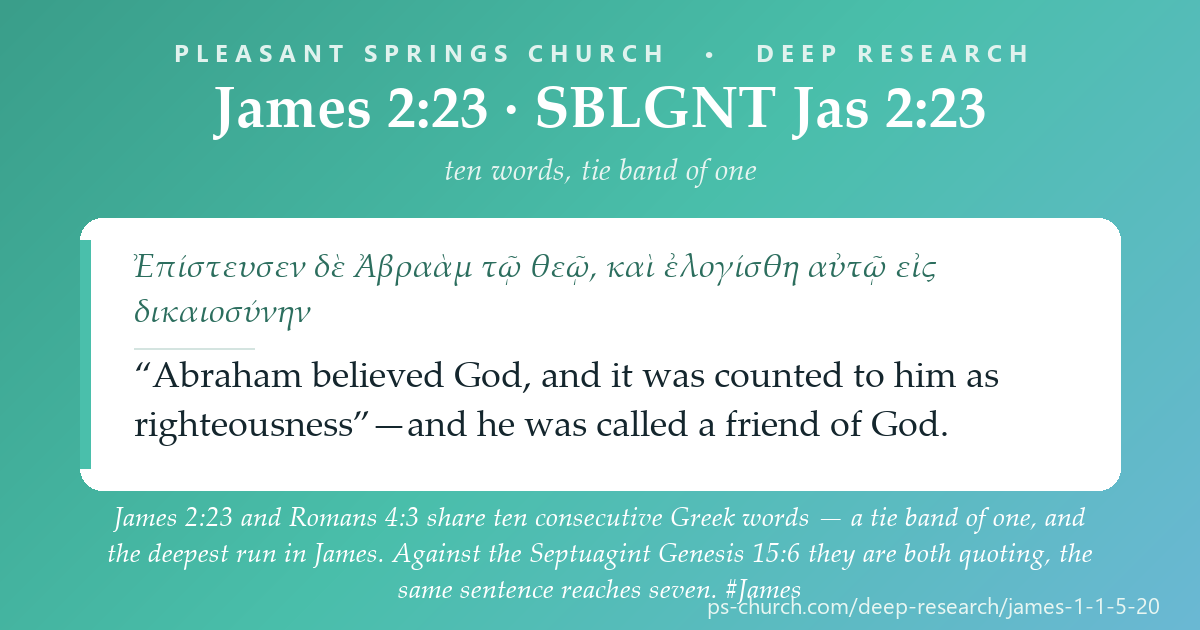
James 2:23 quotes Genesis 15:6. So does Romans 4:3. Screened word for word against all 7,927 verses of the Greek New Testament, James 2:23 and Romans 4:3 share ten consecutive words — the deepest run anywhere in the letter, with a tie band of one. Against the Septuagint Genesis they are both citing, the same sentence reaches seven. The three surplus words are the opening three: Abraham believed with a different connective and a different form of the name — a form Genesis does not give him for another two chapters. Then it happens again. James 4:6 shares eight consecutive words with 1 Peter 5:5 and six with Septuagint Proverbs 3:34, and the two surplus words are the two that stand where the Septuagint’s line has Lord. Twice, the letter most often read as the New Testament’s odd man out lands nearer another New Testament book than the Old Testament verse it names. The measurement says agreement. It does not say who read whom, and neither does this page. Stage 4 prints the counter-examples in the same table. See the method →
James 1:1–5:20 (selections)
Greek New Testament (SBLGNT, via MorphGNT) · ESV★ And twice in this letter the quotation lands closer to another New Testament book than to the Old Testament verse it names. James 2:23 shares ten consecutive words with Romans 4:3 and seven with Septuagint Genesis 15:6. James 4:6 shares eight with 1 Peter 5:5 and six with Septuagint Proverbs 3:34. Both times the surplus is exactly the wording that leaves the Greek Old Testament behind. Stage 4 gives the measurement, the tie bands, and the counter-examples.
The Shape of the Passage
A sequence inside a frame — and deliberately not a chiasmThe letter names its writer once and tells you nothing else about him. Ἰάκωβος θεοῦ καὶ κυρίου Ἰησοῦ Χριστοῦ δοῦλος — James, a slave of God and of the Lord Jesus Christ. No apostle, no brother of the Lord, no city, no date. Everything beyond that is inference, and this page keeps the inference separate from the count.
Author
Iakobos is Jacob. The Greek Ἰάκωβος is the declinable form of the name the Greek Old Testament writes Ιακωβ — Hebrew יַעֲקֹב. Counted in the Greek Old Testament screened here — 30,348 verse units, which is the 30,637 held in 64 CATSS files less the 289 units of the Odes: Ιακωβ 400 times, Ἰάκωβος not once. This line read 404 for one day. The four that came out are Odes 2:9 and 2:15 — which are Deuteronomy 32:9 and 32:15, already counted under their own shelfmark — and Odes 12:1 and 12:8, the Prayer of Manasseh. The finding is unaffected and the arithmetic is printed rather than adjusted: 400 in the screened corpus, 404 in everything the disk holds, and zero for Ἰάκωβος under either. English gets James through Latin Iacomus and Norman French. A man named Jacob writes to the twelve tribes. Whether the page should make anything of that is a judgement, not a measurement, and it is left to the reader.
One measured coincidence, reported without a conclusion. The infinitive χαίρειν opens exactly three pieces of correspondence in the New Testament: Acts 15:23, Acts 23:26 and James 1:1. Acts 15:23 is the letter of the Jerusalem council, in the chapter where a James gives the ruling. That is a fact about two Greek texts; it is not an argument about who wrote this one, and the page will not turn it into one.
What the letter does not contain. The name Jesus twice. No cross, no resurrection, no gospel, no church except one word at 5:14, no Gentiles, no circumcision, no Spirit doing anything (πνεῦμα twice, and neither is a doctrine). The silences are as measurable as the words, and they are why the letter has been dated to almost every decade of the first century.
Audience
“To the twelve tribes in the Dispersion.” ταῖς δώδεκα φυλαῖς ταῖς ἐν τῇ διασπορᾷ. The phrase δώδεκα φυλαῖς shares three words with Ezekiel 47:13 in the Greek held here, and the letter never explains whether it means Jewish believers scattered outside Judea, the whole people of God under an old name, or both.
The readers meet in a συναγωγή (2:2) and are called an ἐκκλησία (5:14). Both words, in one short letter. They have elders and anointing oil; they have a rich visitor with a gold ring and a poor one in filthy clothes; they have day labourers whose wages are being withheld and merchants planning a year of trade in another city.
They are quarrelling, and the letter says so plainly. κρίνω and κριτής stand ten times between them, six of them in 4:11–12 alone. The recipients are judging each other, and the letter answers that there is one lawgiver and judge.
Orient on the letter, on Jewish wisdom paraenesis, and on the James–Paul question before touching a single number.
Search by topic: James, Letter of; James the brother of the Lord; diaspora; paraenesis; wisdom literature; justification; works of the law; Jerusalem council; anointing of the sick.
Which articles are relevant?
- Anchor Bible Dictionary — “James, Letter of,” “James (person),” “Diaspora,” “Paraenesis.”
- Dictionary of the Later New Testament & Its Developments (IVP) — “James,” “Faith and Works,” “Riches and Poverty,” “Tongue.”
- New International Dictionary of NT Theology & Exegesis — δίψυχος, δοκίμιον, ἔργον, πίστις, ταπεινός.
- Commentary on the New Testament Use of the Old Testament, ed. G. K. Beale and D. A. Carson (Baker, 2007) — the James chapter, which is where the Genesis 15:6 and Proverbs 3:34 quotations are discussed at length.
- These were not consulted for the measurements below. The measurements were run on the text files named in the footer.
Settle the numbering first — and note what is different about a New Testament page
Every page on this shelf states its versification offset, including the pages where the answer is that there is none. On a New Testament book the answer is stronger than that: there is no second column to be offset from.
| ch 1 | ch 2 | ch 3 | ch 4 | ch 5 | total | |
|---|---|---|---|---|---|---|
| SBLGNT (MorphGNT) | 27 | 26 | 18 | 17 | 20 | 108 |
| ESV | 27 | 26 | 18 | 17 | 20 | 108 |
| Full English versification | 27 | 26 | 18 | 17 | 20 | 108 |
The SBLGNT row and the English versification row were counted off disk; the ESV row is the printed edition’s shape, because no ESV James file is held here. There is no Masoretic James and no Septuagint James, so the columns on this page are Greek New Testament and English, and every chapter-and-verse number means the same verse in all of them.
But the offset problem is still in the room, because James quotes books that have one. The Greek Deuteronomy held here numbers the sixth to ninth commandments as four separate verses, 5:17–20, in the order adultery, murder, theft, false witness. The Masoretic text puts all four inside verse 17, in the order murder, adultery, theft, false witness. James 2:11 names the first two in the Greek order. A page that quoted ‘Deuteronomy 5:17’ without saying which column it meant would be naming two different commandments at once.
A Greek letter-opening, a Job with an ending the Hebrew does not have, and a drought with a length the Greek Kings does not give it.
The letter form, and the one greeting that is not Christian
Seventeen of the twenty-one New Testament letters open with a Christianised greeting — χάρις ὑμῖν καὶ εἰρήνη or something built from it. Three carry no opening greeting formula at all (Hebrews, 1 John, 3 John). James opens with the plain Hellenistic χαίρειν, the word on ten thousand ordinary papyrus letters, and no other New Testament letter does.
Counted in the Greek New Testament: the form χαίρειν occurs seven times. Three are epistolary openings — Acts 15:23, Acts 23:26, James 1:1. Acts 23:26 is Claudius Lysias writing to Felix, a Roman officer’s dispatch. Acts 15:23 is the council’s letter to Antioch. The remaining four (Romans 12:15; 2 Corinthians 2:3; 2 John 10, 11) are the verb doing its ordinary work.
⚠️ What was not checked. The documentary papyri are not held on this disk. That χαίρειν is the standard opening of a Greek private letter is reported from the reference works, not measured here. What was measured is the seven New Testament occurrences and which three of them open a letter.
“The steadfastness of Job” — and a Greek Job with five verses more than the Hebrew
James 5:11 appeals to τὴν ὑπομονὴν Ἰώβ and to τὸ τέλος κυρίου — the endurance of Job, and the end the Lord made.
The Greek Job held here uses that word-group freely: ὑπομονή / ὑπομένω stands fifteen times across the book (3:9; 6:11; 7:3; 8:15; 9:4; 14:14; 14:19; 15:31; 17:13; 20:26; 22:21; 32:4; 32:16; 33:5; 41:3 — eleven spelled ὑπομ-, four augmented to ὑπεμ-). And the Greek Job does not stop where the Hebrew stops: CATSS carries five extra verses, 42:17a–e, which the Masoretic text has no counterpart for. 42:17a says Job will rise again with those whom the Lord raises; 42:17b–e identify him with Jobab of Edom and make him the fifth from Abraham.
What that does and does not license. It means a reader of the Greek Job met a book with an explicit resurrection line at the end of it. It does not mean James read that ending — the measurement finds no verbal contact between James 5:11 and Job 42:17a–e, and the page asserts nothing about which Job James knew.
Elijah’s three years and six months, which the Greek Kings does not have
James 5:17 says the sky was shut ἐνιαυτοὺς τρεῖς καὶ μῆνας ἕξ. So does Luke 4:25. The Greek 3 Kingdoms says something else.
| text | how long |
|---|---|
| CATSS 3 Kingdoms 18:1 | ἐν τῷ ἐνιαυτῷ τῷ τρίτῳ — in the third year |
| James 5:17 | three years and six months |
| Luke 4:25 | three years and six months |
James 5:17 and Luke 4:25 share a run of 3 (καὶ μῆνας ἕξ) — short, and the two sentences are otherwise unlike each other. What is worth reporting is not the run but the number: a figure two New Testament books carry and the Greek Kings on this disk does not. Whether it comes from a common tradition, from a way of counting the reign, or from somewhere else, the page cannot say, and does not.
Five words that carry the letter, and how rare each one actually is.
James 1:8 and 4:8, and nowhere else in the Greek New Testament — the two occurrences are the letter’s own bookends on the theme. Searched across the whole Greek Old Testament held here: zero occurrences. James is the earliest text on this disk that uses it. Literally two-souled: not a hypocrite, a man who genuinely wants both things.
James 1:3. Two occurrences in the Greek New Testament, and the other is 1 Peter 1:7 — in a clause the two books share five consecutive words of (τὸ δοκίμιον ὑμῶν τῆς πίστεως), tie band 1. It is the assayer’s word: what a furnace does to metal, not what a court does to a defendant.
One Greek word doing both jobs, and James turns on the hinge in the space of eleven verses. At 1:2 πειρασμοῖς is something to count as joy; at 1:13 πειραζόμενος is something God does not do to anyone. All six occurrences of the noun and verb in James fall inside 1:2–14, and there are none in chapters 2–5.
Fifteen occurrences in James, twelve of them in chapter 2, against nineteen occurrences of πίστις / πιστεύω, sixteen of them in the same chapter. The famous quarrel is lexically real and it is local: outside 2:14–26 the two words barely meet in this letter.
James 5:4. Two occurrences in the Greek New Testament: this one and Romans 9:29, where Paul is quoting Isaiah 1:9. It is צְבָאוֹת carried across in Greek letters rather than rendered — the same choice the Greek Isaiah held here makes at 1:9 and 5:9. Which text carried it to which, the page does not say.
The letter counted, word by word
1,739 words, 555 distinct lemmas, 108 verses. Counted off the MorphGNT file.
| word | times in James | where |
|---|---|---|
| ἀδελφός | 19 (15 as direct address) | all five chapters; a 20th if ἀδελφή at 2:15 is counted with it |
| πίστις / πιστεύω | 19 | 16 in chapter 2, 14 of them in 2:14–26 |
| θεός | 16 | chapters 1–4 |
| ἔργον | 15 | 12 in chapter 2, all of them in 2:14–26 |
| κύριος | 14 | 8 of them in chapter 5 |
| νόμος | 10 | 1:25; 2:8–12; 4:11 (4×) |
| ἁμαρτία | 7 | 1:15 (2×); 2:9; 4:17; 5:15, 16, 20 |
| ὑπομονή / ὑπομένω | 5 | 1:3, 1:4, 1:12, 5:11 (2×) — none in chapters 2–4 |
| γλῶσσα | 5 | 1:26; 3:5, 6 (2×), 8 |
| Ἰησοῦς | 2 | 1:1 and 2:1, and nowhere else |
| ἀγάπη (the noun) | 0 | the verb ἀγαπάω stands 3× |
Words the letter does not contain at all: σταυρός, ἀνάστασις, εὐαγγέλιον, ἐλπίς. The page reports the absences as counts, not as arguments about date or theology.
Fifty-five imperatives — the densest book in the New Testament
Counted from the MorphGNT parsing column, mood field, across all 27 New Testament files: James carries 55 imperative verb forms in 108 verses.
| book | imperatives | verses | per verse | % of all its words |
|---|---|---|---|---|
| James | 55 | 108 | 0.51 | 3.16% |
| 2 Timothy | 33 | 83 | 0.40 | 2.67% |
| 1 Timothy | 43 | 113 | 0.38 | 2.70% |
| 1 Peter | 35 | 105 | 0.33 | 2.09% |
| Colossians | 30 | 95 | 0.32 | 1.90% |
| Romans | 61 | 430 | 0.14 | 0.86% |
| 1 John | 9 | 105 | 0.09 | 0.42% |
James is first on both measures, and the gap to second place is about a quarter again. Exhaustive over the corpus and deterministic; nothing sampled. The caveat: this counts imperative forms, as tagged by MorphGNT. It does not count the hortatory subjunctives, the future indicatives used as commands, or the participles that function as imperatives — so the true rate of commanding is higher in every book, James included, and a different tagging would move every row a little.
Two quotations that land nearer the New Testament than the Old — and three results in the same table that show why that has to be handled carefully.
The measurement
All 108 verses of James were screened twice: once against the other 7,819 verses of the Greek New Testament, once against the 30,348 verse units of the Greek Old Testament screened here — the 30,637 held in 64 CATSS files, less the 289 units of the Odes, which stay on the disk and are not screened (stage 5 says why). Contiguous runs of whole word forms, never lemmas, with the tie band beside every run.
Against the rest of the Greek New Testament, across the 108 rows: all 108 reach two, 74 reach three, 21 reach four, 8 reach five, 5 reach six, 3 reach seven, 2 reach eight, 1 reaches ten, and nothing reaches eleven. Against the Greek Old Testament: all 108 reach two, 71 reach three, 15 reach four, 6 reach five, 3 reach six, 1 reaches seven, and nothing reaches eight.
Re-run 30 August 2026 on the enlarged corpus. Over the 44 files this page was first built on (23,061 units) the same screen gave 66 / 13 / 5 / 2 / 1. Every band grew or held; none shrank — which is what a larger target corpus must do. ⚠️ Re-run a third time the same day, with the Odes withdrawn from the screening corpus: the distribution did not move at all — 71 / 15 / 6 / 3 / 1 over 30,348 units exactly as over 30,637. Two tie bands did move, and stage 5 names both.
| row | deepest partner in the rest of the NT | run | band | deepest partner in the Greek OT held here | run | band |
|---|---|---|---|---|---|---|
| James 2:23 | Romans 4:3 | 10 | 1 | Genesis 15:6 | 7 | 1 |
| James 4:6 | 1 Peter 5:5 | 8 | 1 | Proverbs 3:34 | 6 | 1 |
| James 5:12 | 2 Corinthians 1:17 | 7 | 1 | Job 13:12 · Job 19:13 · Joshua (B) 14:8 | 3 | 3 |
| James 2:8 | Gal 5:14 · Rom 13:9 · Mk 12:31 · Mt 19:19 · Mt 22:39 | 6 | 5 | Leviticus 19:18 — its own source, measurable since 30 Aug 2026 | 6 | 1 |
| James 4:15 | 1 Corinthians 4:19 | 6 | 1 | Ezekiel 29:9 | 3 | 1 |
| James 1:3 | 1 Peter 1:7 | 5 | 1 | nothing above two | 2 | 44 |
| James 2:1 | the phrase ‘our Lord Jesus Christ’ | 5 | 35 | 1 Esdr 8:45 · 1 Macc 14:35 · … (witnesses, not Scripture) | 3 | 17 |
| James 5:4 | Mk 7:33 · Lk 1:44 · Lk 9:44 · Ac 11:22 | 3 | 4 | Isaiah 5:9, alone (this cell read ‘Isaiah 5:9 · Odes 10:9’ at a band of 2 until 30 August 2026 — but Ode 10 is Isaiah 5, so the two hits were one text) | 5 | 1 |
| James 1:8 | Lk 1:6 · Lk 24:27 · 1 Cor 14:33 · … | 3 | 4 | Deut 10:12 · Deut 11:22 · 1 Kgdms 18:14 · … | 5 | 6 |
Rows run the other way too, and two of them belong in the same table. Sixteen of the 108 rows measure deeper against the Greek Old Testament than against the rest of the New Testament — and the two widest are James 5:4 and James 1:8, 5 against 3 in each case. James 5:4 is the sharper of those two: five words with Isaiah 5:9 at a tie band of one, against three words and a band of four in the New Testament. The letter is not uniformly closer to the New Testament, and the page is not arguing that it is. What the page leads with is two specific rows, and they are the two quotations.
The two rows that do the same thing twice
James 2:23 — ten with Romans, seven with Genesis.
| text | the sentence |
|---|---|
| CATSS Genesis 15:6 | καὶ ἐπίστευσεν Αβραμ τῷ θεῷ, καὶ ἐλογίσθη αὐτῷ εἰς δικαιοσύνην |
| James 2:23 | ἐπίστευσεν δὲ Ἀβραὰμ τῷ θεῷ, καὶ ἐλογίσθη αὐτῷ εἰς δικαιοσύνην |
| Romans 4:3 | ἐπίστευσεν δὲ Ἀβραὰμ τῷ θεῷ, καὶ ἐλογίσθη αὐτῷ εἰς δικαιοσύνην |
| Galatians 3:6 | καθὼς Ἀβραὰμ ἐπίστευσεν τῷ θεῷ, καὶ ἐλογίσθη αὐτῷ εἰς δικαιοσύνην — run of 7 with James, the same as the Septuagint |
| Masoretic Genesis 15:6 | וְהֶאֱמִן בַּיהֹוָה וַיַּחְשְׁבֶהָ לּוֹ צְדָקָה — he believed in the Lord, and he counted it to him as righteousness |
Three divergences run in the same direction, and James and Paul are on the same side of all three. The Hebrew says believed in the Lord; the Greek and both New Testament verses say believed God. The Hebrew verb is active, he counted it; the Greek and both New Testament verses are passive, it was counted. And the Greek Genesis calls him Abram — correctly, since Genesis 17:5 has not happened yet — while James and Paul both call him Abraham.
James 4:6 — eight with 1 Peter, six with Proverbs.
| text | the sentence |
|---|---|
| CATSS Proverbs 3:34 | κύριος ὑπερηφάνοις ἀντιτάσσεται ταπεινοῖς δὲ δίδωσιν χάριν |
| James 4:6 | ὁ θεὸς ὑπερηφάνοις ἀντιτάσσεται ταπεινοῖς δὲ δίδωσιν χάριν |
| 1 Peter 5:5 | ὁ θεὸς ὑπερηφάνοις ἀντιτάσσεται ταπεινοῖς δὲ δίδωσιν χάριν |
| Masoretic Proverbs 3:34 | אִם־לַלֵּצִים הוּא־יָלִיץ וְלַעֲנָוִים יִתֶּן־חֵן — at the scorners he scorns, but to the humble he gives grace |
Here the Hebrew and the Greek are not two wordings of one sentence but two sentences: לֵצִים are mockers, not the proud, and יָלִיץ is he mocks, not he opposes. James and 1 Peter carry the Greek shape and then depart from it identically, in the same two words.
⚠️ What the page will not say. Not that James is quoting Paul. Not that Paul is quoting James. Not that either is quoting 1 Peter, or 1 Peter either of them, or that all of them are drawing on a lost collection of proof-texts. Direction of influence is never asserted on this shelf, and two rows — however clean their tie bands — cannot establish one. What is measured is that the agreement is there, that it is longer than the agreement with the Greek Old Testament in both cases, and that the surplus falls in exactly the words where the New Testament wording and the Septuagint part company.
The counter-examples, printed in the same section
1. James 5:12 and Matthew 5:37: everyone pairs them, and the run is 2.
James 5:12 — do not swear… let your yes be yes and your no be no — is the closest thing in the letter to a saying of Jesus, and Matthew 5:37 is the saying. Measured: a run of 2, ναὶ ναί. Meanwhile 2 Corinthians 1:17 gives a run of 7 with a tie band of 1 (τὸ ναὶ ναὶ καὶ τὸ οὒ οὔ) — and 2 Corinthians 1:17 is Paul explaining why he changed a travel itinerary. The deep run is the accident and the shallow one is the relationship.
2. James 1:10–11 and Isaiah 40: the allusion everyone sees, measuring 3.
| comparison | run | shared words |
|---|---|---|
| James 1:11 vs Septuagint Isaiah 40:6 | 1 | καί |
| James 1:11 vs Septuagint Isaiah 40:7 | 3 | καὶ τὸ ἄνθος |
| 1 Peter 1:24 vs Septuagint Isaiah 40:7 | 7 | ἐξηράνθη ὁ χόρτος καὶ τὸ ἄνθος ἐξέπεσεν |
Two New Testament passages use the same image of Isaiah 40 — the grass, the flower, the withering. One of them is a citation and measures 7; the other is a free reworking and measures 3. The screen can tell them apart; it cannot tell you that the second is dependent on Isaiah at all. It only ever finds verbatim contact.
3. James 2:8: a run of 6 with a tie band of 5.
Ἀγαπήσεις τὸν πλησίον σου ὡς σεαυτόν is six consecutive words — deeper than most of this letter reaches — and it is shared with Matthew 19:19, Matthew 22:39, Mark 12:31, Romans 13:9 and Galatians 5:14 alike. Five verses tied means the run is a fixed formula in Greek, and tells you nothing about which book got it from which. A run without its band would have made this look like a discovery.
4. ‘Covers a multitude of sins’ measures 2.
James 5:20 and 1 Peter 4:8 are routinely printed together, and they do share πλῆθος ἁμαρτιῶν — a run of 2, in a tie band of 87: eighty-seven New Testament verses share two consecutive words with James 5:20, and 1 Peter 4:8 is one of them. By the numbers alone there is nothing here at all, and the phrase is still obviously the same phrase. Against Septuagint Proverbs 10:12, which is where the thought is usually traced, James 5:20 shares no two consecutive words at all: the Greek Proverbs there reads πάντας δὲ τοὺς μὴ φιλονεικοῦντας καλύπτει φιλία, which is a different sentence from the Hebrew’s love covers all offences as well.
Where this page is weakest, what it could not reach, and what would break it.
The hole that closed: Greek Leviticus and Greek Exodus are on this disk now
James’s clearest Old Testament citation is Leviticus 19:18, and until 30 August 2026 this page could not measure it. It can now, and the result is the strongest single number on the page.
James 2:8 against Greek Leviticus 19:18: a run of six unbroken word forms — ἀγαπήσεις τὸν πλησίον σου ὡς σεαυτόν, you shall love your neighbour as yourself — at a tie band of one. Screened against all 30,348 verse units, Leviticus 19:18 is the only place in the Greek Old Testament screened here that reaches it.
Printed until 30 August 2026: “The single largest hole: Greek Leviticus and Greek Exodus are not on this disk… So James 2:8 could not be run against its own source text… This is a limit of the disk, not a finding. Anyone re-running these screens after fetching Exodus and Leviticus should expect the Leviticus 19:18 row to move, and should expect it to move toward a longer run, not a shorter one.”
The corpus went from 44 CATSS files (23,061 verse units) to 64 files (30,637 verse units) on 30 August 2026, and the prediction was right. The James 2:8 row moved from 3 at a tie band of 7 — a scatter of formulaic contacts in the books that happened to be held — to 6 at a tie band of 1, its actual source. The page named in advance what would falsify it, and then the measurement was run.
Four other rows moved, and none of them moved the way the headline did. James 5:4’s tie band went from 1 to 2: Isaiah 5:9 was joined by Odes 10:9 — the Song of Isaiah, that is, Isaiah 5 copied out as an Ode, so the two hits are one text and not two. James 5:12’s band went 2 to 3 (Joshua B 14:8). James 1:3’s went 31 to 45 and James 2:1’s 15 to 17 — both of those are formulas getting more formulaic, which is the correct direction. Not one run on this page got shorter and not one tie band shrank. A larger target corpus cannot do either.
⚠️ And on the same day two of those bands came back down, because the Odes were withdrawn from the screening corpus altogether. The Odes are the liturgical canticles appended to the Greek Psalter. They stay on this disk; they are out of anything this shelf calls the Greek Old Testament, for two reasons. (1) Two of them are New Testament text. Ode 9 is Luke 1 — the Magnificat and the Benedictus — and Ode 13 is Luke 2, the Nunc Dimittis; screened, Ode 9:48 matches Luke 1:48 at eighteen consecutive words, which is Luke measuring its own text under an Old Testament shelfmark. (2) Ten of them are second copies of passages already in the corpus — Ode 1 = Exodus 15, 2 = Deuteronomy 32, 3 = 1 Samuel 2, 4 = Habakkuk 3, 5 = Isaiah 26, 6 = Jonah 2, 7 and 8 = Daniel Th 3, 10 = Isaiah 5, 11 = Isaiah 38 — so a tie band touching a canticle was doubled for no textual reason. 30,637 units held, 30,348 screened.
This page is one of the clearest illustrations of the second reason on the shelf, and the fix moved two numbers. James 5:4 goes back to a tie band of 1 — Isaiah 5:9 alone, which is what it always was; the band of 2 lasted one day and was Isaiah 5 counted twice. James 1:3 goes from 45 to 44, the row that left being Odes 2:43, which is Deuteronomy 32:43 and was already in the band under its own shelfmark. Nothing else moved: the distribution is still 71 / 15 / 6 / 3 / 1, James 2:8 is still 6 against Leviticus 19:18 at a band of 1, and sixteen rows still measure deeper against the Greek Old Testament than against the rest of the New Testament. No hit removed from this page was in Ode 9 or Ode 13 — James touches neither Luke canticle — so nothing here was ever Luke matching Luke. The bands that moved were the doubling, not the self-measurement.
And James 2:11 can now be set beside both Decalogues instead of one — which turns out to be worth doing.
The run itself does not move: James writes μὴ μοιχεύσῃς (aorist subjunctive) where both Greek Decalogues write οὐ μοιχεύσεις (future indicative), so it scores 1 against Exodus 20:13 exactly as it already scored 1 against Deuteronomy 5:17. The order, however, is evidence. James names adultery first and murder second. So does Greek Deuteronomy 5 — 17 adultery, 18 murder, 19 stealing — and so does Greek Exodus 20 — 13 adultery, 14 stealing, 15 murder. The Hebrew of both Decalogues does not: Masoretic Exodus 20:13 and Deuteronomy 5:17 alike run murder, adultery, stealing. James is following the Greek order and not the Hebrew one — and so are Romans 13:9 and Luke 18:20, while Mark 10:19 and Matthew 19:18 keep the Hebrew order.
And the two Greek Decalogues do not agree with each other: both put adultery first, but Exodus puts stealing second and murder third, while Deuteronomy puts murder second and stealing third. That divergence is inside the Greek tradition itself and is named here rather than smoothed over. It was invisible to this page while only one of the two Greek Decalogues was on the disk.
What the two headline results depend on, and how they could be wrong
They depend on one printed edition on each side. The New Testament figures are the SBL Greek New Testament as digitised by MorphGNT; the Old Testament figures are Rahlfs’ Septuaginta as digitised by CATSS. Neither has a critical apparatus on this disk. The run of 10 between James 2:23 and Romans 4:3 is an exact agreement between two printed texts; manuscripts of both verses vary, and a different edition could shorten or lengthen it. The same goes for the 8 between James 4:6 and 1 Peter 5:5.
They also depend on a decision about what a ‘word’ is. The screen normalises both sides the same way — lowercased, accents and breathings dropped, final sigma folded — and compares word forms, not lemmas. That is why James 2:11 scores 1 against Greek Deuteronomy 5:17 while quoting it recognisably: μὴ μοιχεύσῃς and οὐ μοιχεύσεις are the same commandment and not the same words. A lemma-based screen would give different numbers everywhere on this page, and would be a different measurement, not a better one.
And two rows are two rows. The pattern the page leads with rests on James 2:23 and James 4:6. Those happen to be the letter’s only two Old Testament quotations introduced by an explicit formula and traceable to a book that is held here, so the sample is not arbitrary — but it is a sample of two, and the page says so rather than calling it a rule.
What could not be checked at all
No Greek critical apparatus, no papyri (P20, P23, P74 and P100 all carry parts of James and none was consulted), no patristic citations, no Qumran or rabbinic material, no Syriac, Latin or Coptic versions. No documentary papyri for the letter form. No commentary on James was read for any figure on this page.
And the historical questions stay open, because the measurement is silent on them. Which James this is, when the letter was written, whether its author knew Romans or Romans knew it, whether James 2:14–26 is answering Paul or answering a misuse of Paul or answering neither — counting shared word-runs cannot decide any of that, and this page does not pretend otherwise. What it offers is the measurement the arguments have to fit.
One more that is easy to overstate. James and 1 John are the only two New Testament letters whose last two verses carry no greeting, no grace-wish, no peace-wish, no doxology and no Amen. That was checked verse by verse across all twenty-one letters — but 1 John still closes with a vocative address (τεκνία), and James closes with a third-person imperative. The two endings are abrupt in different ways, and ‘the only letter that ends without a farewell’ would have been a tidier sentence and a false one.
Reading list
- Dale C. Allison Jr., A Critical and Exegetical Commentary on the Epistle of James (ICC, 2013).
- Richard Bauckham, James: Wisdom of James, Disciple of Jesus the Sage (1999).
- Luke Timothy Johnson, The Letter of James (Anchor Bible 37A).
- Martin Dibelius, James (Hermeneia) — the classic case that the letter is unstructured paraenesis, which is the case this page’s structure diagram takes seriously.
- Scot McKnight, The Letter of James (NICNT, 2011).
- None of these were consulted for the measurements on this page, which were run on the text files named in the footer.
A letter of commands, and two sentences it holds in common with the rest of the book.
Ten words
James is the most commanding book in the New Testament — fifty-five imperatives in a hundred and eight verses, more per verse than any other — and it names Jesus twice. It has no cross in it, no resurrection, no gospel, no word for love as a noun. It calls its readers brothers nineteen times and then tells them to stop favouring the rich, stop judging each other, stop swearing, stop planning a year they may not live to see.
And when it stops commanding long enough to quote, twice, the quotation comes out matching another New Testament book more exactly than the Greek Old Testament it names. Ten consecutive words with Romans 4:3; eight with 1 Peter 5:5. Both times the extra words are precisely the ones that step away from the Septuagint — Abraham where Genesis still says Abram, God where Proverbs says the Lord.
The page does not know what to make of that, and says so. It could be a shared way of saying these verses that was already old when all three were written. It could be one book reading another, in either direction. It could be two of them and not the third. The measurement establishes the agreement and stops there, and on the same page it prints the run of 7 between James 5:12 and a verse of Paul about travel plans — so that nobody reads a tie band of one as more than a tie band of one.
The letter that keeps insisting the proof of faith is what you do ends without a goodbye: whoever brings back a sinner from his wandering will save his soul from death and will cover a multitude of sins. Then nothing. No grace, no peace, no Amen — just the last instruction, and the reader left holding it.
Every Deep Research page traces its passage across the whole sweep — the Old Testament, the Second-Temple world between the testaments (historical witnesses, not Scripture), and the New Testament. Follow the thread:
Pleasant Springs Church — Deep Research
Research method after Michael S. Heiser’s Bible Research Method (examine dictionaries → ancient literature → important words → textual connections → academic publications → share), with the Pleasant Springs “Author & Audience” foundation. Scripture set in the Hebrew, the Greek editions named on each page and the ESV (Old Testament), and the Greek New Testament and the ESV (New Testament), per the practice of Pleasant Springs Church. James research grounded in Allison (ICC), Johnson (Anchor), Bauckham, McKnight (NICNT) and Dibelius (Hermeneia) — none of which were consulted for any number on this page. Text: Greek New Testament from the SBL edition as digitized by MorphGNT; Greek Old Testament from Rahlfs’ Septuaginta as digitized by CATSS; Hebrew from the Masoretic text as printed in Sefaria’s Miqra according to the Masorah. No critical apparatus was consulted on any side. The standing caution for this shelf applies: these pages say “the CATSS Greek row reads…” and never call a reading early or late. ⚠️ VERSE NUMBERING — James is a New Testament book, so there is no Masoretic or Septuagint column and no offset to state. Counted anyway: SBLGNT James runs 27 / 26 / 18 / 17 / 20 = 108 verses off disk, a complete English versification counted the same way agrees, and the ESV prints the same shape — no ESV James file is held here to count. Stated because this shelf states it everywhere, including where there is nothing to convert. The offset does bear on one row: Greek Deuteronomy numbers the sixth to ninth commandments 5:17–20 in the order adultery-murder-theft-false witness, while the Masoretic text carries all four inside verse 17 with murder first, and James 2:11 names the first two in the Greek order. ⚠️ The measurement, in full. Greek against Greek. MorphGNT field 6, the normalised word (the column that already resolves elision and the movable nu); CATSS FORM column (cols 0–24), beta-code transliterated first. Both sides lowercased, accents and breathings dropped, final sigma folded, then filtered to Greek letters — the same filter applied to both corpora. Contiguous runs of whole word FORMS, never lemmas. Corpus: the 108 MorphGNT rows of James against the other 7,819 verses of the Greek New Testament, and against the 30,348 verse units screened out of the 30,637 held across 64 CATSS files — the 289 units of the Odes are held and not screened. Exhaustive and deterministic; nothing sampled, so no seed applies. The tie band — how many target verses reach the same maximum — is printed beside every run on this page. ⚠️ Corpus history, because the numbers moved. This page was first built against 44 CATSS files, 23,061 verse units, and printed a distribution of 66 / 13 / 5 / 2 / 1 with James 2:8 at a run of 3 and a tie band of 7, under the heading “Greek Exodus, Leviticus, Numbers and Joshua are not among the CATSS files held here.” Those four books, plus the deuterocanon, arrived on 30 August 2026, taking the shelf to 64 files, 30,637 verse units, and every screen on this page was re-run. Six figures moved and stage 5 names all six: James 2:8 from 3/band 7 to 6/band 1 against Leviticus 19:18 itself; the distribution to 71 / 15 / 6 / 3 / 1; the deeper-against-the-Old-Testament count from fifteen rows to sixteen; and the tie bands at James 5:4 (1 to 2), 5:12 (2 to 3), 1:3 (31 to 45) and 2:1 (15 to 17). Nothing got shorter. The count of Ιακωβ rose from 359 to 404, and Ἰάκωβος still stands at zero — the enlarged corpus strengthened that finding rather than overturning it. ⚠️ Then the Odes came back out of the screen, the same day, and three of those figures moved again. The Odes are the canticles appended to the Greek Psalter; two of them are New Testament text (Ode 9 is Luke 1, Ode 13 is Luke 2) and ten are second copies of passages already held, so the shelf holds them and does not screen them. 30,637 held, 30,348 screened. On this page: James 5:4’s band goes 1 → 2 → 1 (Odes 10:9 is Isaiah 5:9, which the table already had); James 1:3’s goes 31 → 45 → 44 (Odes 2:43 is Deuteronomy 32:43, likewise); and Ιακωβ goes 359 → 404 → 400 (Odes 2:9 and 2:15 are Deuteronomy 32:9 and 32:15; Odes 12:1 and 12:8 are the Prayer of Manasseh). The distribution, the sixteen-row count and the James 2:8 headline are unchanged. Nothing removed from this page came out of Ode 9 or Ode 13, so no figure here was ever Luke measured against Luke — the trap that bites elsewhere on the shelf did not bite here. ⚠️ Deuterocanonical files are witnesses, not Scripture. Judith, Tobit, Wisdom, Baruch, the Letter of Jeremiah, 1–4 Maccabees, Sirach, Susanna, Bel, 1 Esdras and the Psalms of Solomon are measured against and are labelled as witnesses wherever a hit lands in one — as at James 2:1 (1 Esdras, 1 Maccabees). They are measurement partners; the shelf does not call them Scripture. ⚠️ The Odes were on that list until 30 August 2026 and are not on it now. They are not a lesser witness; they are not an independent one. Two of the canticles are New Testament text and ten are second copies of passages the corpus already holds, so they are held on the disk and excluded from the screen — which is why the James 5:4 cell above reads Isaiah 5:9 alone rather than Isaiah 5:9 and Odes 10:9. ⚠️ What is still NOT measurable. No papyri, no apparatus, no versions, no patristic citations. Joshua A is a partial file — CATSS carries only 15:21–19:45 of the A recension — so a Joshua negative is a negative on the B text plus that fragment. ⚠️ The imperative count. MorphGNT parsing column, mood field = D, across all 27 New Testament files: James 55 in 108 verses. It counts imperative forms only — not hortatory subjunctives, not commanding futures, not imperatival participles — so every book’s real rate is higher than the table shows. ⚠️ Direction of influence is never asserted. Nothing here says James is reading Paul, that Paul is reading James, that either is reading 1 Peter, or that any of them is drawing on a common collection. The page reports that the agreement is longer than the agreement with the Septuagint in both cases, and stops. Typology is handled per the house position: what the text says, what the New Testament itself draws, and what we see from this side of the cross — with the seeing left to the reader.
Scripture quotations marked ESV are from the ESV® Bible (The Holy Bible, English Standard Version®), © 2001 by Crossway, a publishing ministry of Good News Publishers. ESV Text Edition: 2016. Used by permission. All rights reserved. The ESV text may not be quoted in any publication made available to the public by a Creative Commons license, and the ESV may not be translated in whole or in part into any other language. www.esv.org
|
Did this study bless you today? 💚 Give to Support PS Church100% of gifts go to the General Fund — thank you. |