Jubilees keeps time two ways. It stamps every event with a jubilee, a week of years and a year — and it also tells you how old Abram is. In chapter 12 the two agree to the year: the burning of the house of idols falls in the sixtieth year of the life of Abram, that is, in the fourth week, in the fourth year, and the arithmetic gives sixty. In chapter 14 the same kind of sentence comes apart. Ishmael is born in the fifth year of this week; and this was the eighty-sixth year in the life of Abram — but the fifth year of that week is AM 1965, and Abram was born in 1876. By the book’s own calendar he is 89; by its own words, 86. One chapter later he calls himself a hundred years old in a year when, by the calendar as printed, he is 110 (103 if the ordinal Charles marks corrupt is read third). The Geʻez and the English agree on every one of those numbers, so the disagreement is in the Geʻez too, not only in Charles’s English. What follows measures it, sets it beside the Masoretic, Greek and Samaritan Genesis, and then measures, Geʻez against Geʻez, what these chapters share word for word with Genesis — at most six words in a row — and reads, column by column, the places where the Masoretic and Greek Genesis differ: at all five where a 1917 note names the Masoretic or the Greek, Jubilees carries the Greek’s reading, twice where Dillmann’s Geʻez Genesis does not — and at a sixth, flagged by a note that names only the Revised Version and the Targum (Genesis 14:14), it does not. It is not Scripture for us; it is filed with the Pseudepigrapha and the Second-Temple witnesses, and nothing taught here rests on it. See the method →
← Jubilees 6–10 · the series opens at Prologue & 1 · Jubilees 17–23 →
The Book of Jubilees is a Second-Temple Jewish retelling of Genesis and the first half of Exodus, commonly dated to the second century BC and framed as a revelation to Moses on Sinai, dictated by ‘the angel of the presence’ (see Prologue & 1). It is not Scripture for us. It is canonical in the Ethiopian Orthodox Church, and Hebrew fragments of it were found at Qumran. We read it as a window into how Jews in the centuries before Christ read Genesis — and we read it critically, testing everything by the canon and saying where it adds to Scripture or departs from it. Its 364-day calendar, its law of the eighth day, and its ‘heavenly tablets’ are the book’s own positions; this page reports them and does not endorse them.
⚠️ What this page can and cannot measure — read this first.
HELD: Charles’s English of all 50 chapters (1,307 verses + the Prologue); VanderKam’s Geʻez of all 50 (the same 1,307 verses); Dillmann’s Geʻez Genesis (1,526 verses, Septuagint numbering); the Masoretic Genesis; the Greek Genesis (CATSS); the Samaritan Genesis 5 and 11 only (Chester Beatty 751); Josephus’s Antiquities book 1 in Whiston’s English; Dillmann’s Geʻez Exodus and the CATSS Greek Exodus (one verse is read, Exodus 19:6); the SBLGNT; and the Qumran Hebrew fragments of Jubilees in Scripta Qumranica Electronica — 11Q12, fetched for this page, and the other editions the series has fetched (fourteen Jubilees manuscripts plus 4Q176, 4Q176a, 4Q176b, 4Q482 and 4Q483; Mas 1j could not be fetched), 19 in all.
NOT HELD: any Greek, Latin or Syriac Jubilees; any Hebrew Jubilees beyond the Qumran fragments; VanderKam’s apparatus; the Ethiopic manuscripts; Charles’s own 1895 Ethiopic edition, from which his English was made.
CONSEQUENCE: no Greek New Testament run is possible against a Geʻez or English text, and none is attempted; English is never measured against anything. The page’s measurements are four: the book’s own dates, read from both the English and the Geʻez; Geʻez Jubilees against Geʻez Genesis, word for word; the Hebrew fragment against the Masoretic text; and, at the eight places where a 1917 note names the Masoretic, Greek or Samaritan text (and a ninth that a note flags otherwise), what each text of Genesis and of Jubilees contains — read column by column, never matched across languages.
Jubilees 11–16 — thirteen verses, with what was measured at each
English: R. H. Charles (1902; SPCK reprint 1917) · notes measured against the GeʻezThe year the whole Abram clock runs from. “This week” is the second week of the thirty-ninth jubilee (11:14), so the birth falls in Anno Mundi 49×38 + 7×1 + 7 = 1876. Charles printed 1876 in his margin; the Geʻez verse carries the same ordinal, ሳብዕ ‘seventh’.
No raven comes into Abram’s story in Genesis; its one raven is Noah’s (8:7). Screened against all 1,526 verses of the Geʻez Genesis, this verse reaches only a three-word locative formula (into the place where), shared by Genesis 13:3, 13:4 and 40:3 — run 3, tie band 3; and from the Genesis side, Genesis 13:3 and 13:4 each share those words with four Jubilees verses (band 4). A formula, not a source.
The two clocks agree here. The sixtieth year of Abram’s life is said to be the fourth year of the fourth week of the fortieth jubilee: AM 1936, and 1936 − 1876 = 60. Note the sentence’s own that is — it equates the age and the date, and here the equation holds.
The English and the digitised Geʻez disagree on the length of the stay. Charles: two weeks of years (fourteen). The Geʻez file’s verse ends ክልኤ ፡ ዓመታተ, two years. Arithmetic only: Haran dies in AM 1936 (12:12–14); fourteen years on is 1950; the next stamp (12:16) is 1951. The Qumran fragment that covers this line (11Q12 frg. 8) preserves only עם here — every letter of the duration is restoration (the editors restore שני שבועי שנים, two weeks of years: a restoration, not a witness). But VanderKam’s own English translation, printed on the same host page as the Geʻez, reads two weeks of years here, as Charles does — so the two-word Geʻez may be a keying slip in the digitisation (compare 12:1, Stage 2) rather than a reading of his edition. Only the printed book would settle it, and it is not held.
Charles brackets ‘(be) with thee, and’ as an interpolation — the 1917 key: [ ] Words so enclosed are interpolated. The Geʻez carries the clause without brackets, ወእግዚአብሔር ፡ ምስሌከ (and the Lord with thee). And the Hebrew fragment 11Q12 frg. 9, line 5, preserves the letters מכה ויש — which its editors complete as עמכה וישמרכה, with thee, and may he keep thee. Four of the preserved letters fall inside Charles’s bracket.
A gap in Charles; a bracket in the Geʻez. Charles’s text begins with lacuna dots. The digitised critical text prints, inside square brackets, a passage in which Abram gives the tithe ለመልከ ፡ ጼዴቅ — to Melchizedek. The file does not say what its brackets mean. Screened, the bracketed words share no two consecutive words with Genesis 14:18–20.
The page’s counter-example. In the Geʻez this verse is four words long, and three of them stand in the Geʻez of Genesis 15:6 — yet the two share no two consecutive words, folded or not. Genesis puts Abram and to him between the shared words, and spells was counted ወተኈለቆ where Jubilees has ወተኆለቆ. Run 0. Fold that one pair of letters as well (ḫo with ḫʷa, an interchange the declared fold leaves out) and the run is 2, band 1 — Genesis 15:6 and no other verse: ለእግዚአብሔር ፡ ወተኆለቆ, in the Lord, and it was counted (to) him. The zero is a fact about one spelling; the page prints both numbers. And the four texts do not agree on the two small words. The Masoretic 15:6 has no name and has to him (לו); the Greek and Dillmann’s Geʻez have both the name and to him; the Geʻez of Jubilees 14:6 has no name and no separate word for to him, though its verb ends in the object suffix -o — and Charles’s English has to him, as does VanderKam’s own translation of this Geʻez on the host page, credited to him.
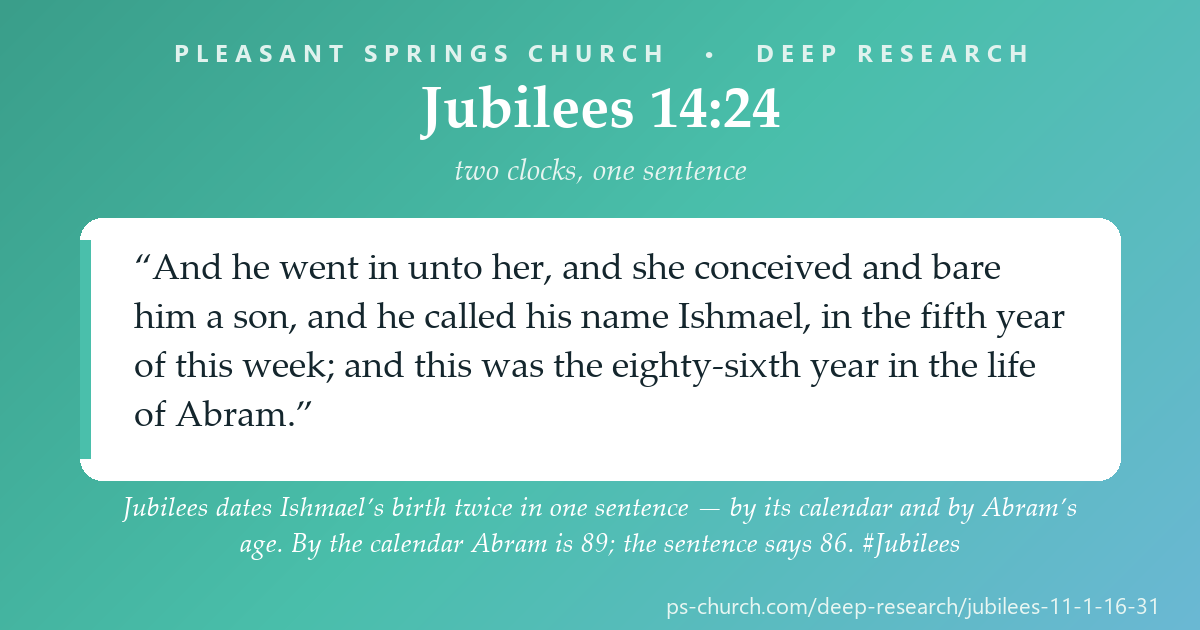
Both clocks in one sentence — and they disagree. This week is the first week of the forty-first jubilee (13:16), so the fifth year is AM 1965: Abram, born 1876, is 89. The same sentence calls it the eighty-sixth year of his life, and the Geʻez has the same number, ሰማንያ ፡ ወስድስቱ. Genesis 16:16 gives 86 in the Masoretic and Greek texts.
Charles marks ‘fourth’ corrupt († †) and the 1917 note reads Read "third." As printed — and the Geʻez has the same ordinal, ዘራብዑ — the year is AM 1986, and Abram is 110. Read ‘third’, it is AM 1979 and Abram is 103. Genesis 17:1 says 99.
The deepest run in the six chapters. Six consecutive Geʻez words — ኪዳንየ ፡ ማእከሌየ ፡ ወማእከሌከ ፡ ወማእከለ ፡ ዘርእከ ፡ እምድኅሬከ, my covenant between me and thee and between thy seed after thee — shared with Genesis 17:7 and with no other Genesis verse (tie band 1); and from the Genesis side, Genesis 17:7’s deepest partner among all 1,307 verses of Jubilees is this one (band 1).
The angels ‘so created’. The note printed with the 1917 edition glosses the phrase: i. e. have been created circumcised. The Geʻez reads ከመዝ ፡ ፍጥረቶሙ, thus is their creation. The book’s claim, reported; Genesis has no counterpart (screen: run 2, a formula, band 3).
Isaac’s year, by the text as transmitted. 16:12 puts the conception in the sixth month and names no year; read as the year 15:1 dated (AM 1986, the last stamp before it), a birth in the third month falls in the next year, AM 1987 — the year 16:15 then stamps. Abraham is 111. Charles printed 1980 in the margin here, which follows only from his emendation. Genesis 21:5: 100.
The first feast of tabernacles ‘on the earth’. No Genesis counterpart: the deepest Geʻez run is two words of formula, tie band 4. Charles’s note: In 20-31 we have an account of the Feast of Tabernacles which is marked by peculiar features.
The Geʻez is never printed in full. The page measures against J. C. VanderKam’s critical text (1989), digitised by Ran HaCohen, whose licence chain is disputed; a few words appear only where they carry a measured finding, each marked as Geʻez. The Geʻez Genesis is A. Dillmann’s Octateuchus Aethiopicus (1853), public domain, digitised by Ran HaCohen, Beta maṣāḥəft, CC BY-SA 4.0. The Hebrew of 11Q12 is the Scripta Qumranica Electronica transcription (R. G. Kratz, I. Kottsieper, A. Steudel, on the basis of the Qumran-Wörterbuch text, after M. Abegg), CC BY-SA 4.0.
Versification — stated, as on every page, and here it is a third state. There is no Masoretic, Septuagint, King James, ESV or Vulgate Jubilees on this disk: the Masoretic corpus has 39 books and no Jubilees, the CATSS, King James Apocrypha and Clementine loaders raise when asked for it, and no ESV of the book exists. Two witnesses carry the whole text: Charles’s English (the Prologue is his chapter 0) and VanderKam’s Geʻez. Their shape for chapters 11–16 is identical: 24·31·29·24·34·31 = 173 verses in each. Agreement of count is not agreement of division, so the division was checked by content: 13 proper names, 116 verse-occurrences in the English, and every one stands in the same verse of the Geʻez. The Geʻez has two more — 11:14, where the grandfather ’Abrâm is spelled so in Charles, and 13:10, where Charles reads the place-name Bealoth. Offset between the two: none — but one clause falls on different sides of a verse boundary: (Abram) armed his household servants ends Charles’s 13:24 and opens the Geʻez 13:25 (as it does VanderKam’s English on the host page).
The Genesis it runs beside (Gen 11:20–21:4) has the same chapter shape in the Masoretic, the CATSS Greek and Dillmann’s Geʻez — 32·20·18·24·21·16·27·33·38·18·34 for chapters 11–21 — except that Dillmann’s source has no verse 19:23 (absent there, not lost in extraction). So the Genesis side of the screen holds 231 rows for 11:20–21:4, not 232.
The Shape of the Passage
Dated sequence with three ordinance blocks (measured)The three ordinance blocks are measured, not imposed. The verb ordain stands in 8 verses of chapters 11–16 in Charles’s English — and, verse for verse, a form of the same Geʻez verb stands in the same eight. All eight lie between 13:25 and 16:30: the tithe (13:25, 13:26), circumcision (15:25, 15:29), Isaac’s name and circumcision (16:3, 16:14) and Booths (16:29, 16:30). The heavenly tables occur in 5 verses, all in 15:25–16:29, and the phrase no limit of days exactly twice, at 13:26 and 16:30 — the first block and the last.
And the narrative between them is stamped. 25 jubilee–week–year stamps stand in 23 verses, from 11:1 to 16:15; the ordinance blocks carry none. So the shape is a dated story that stops three times to legislate.
This is a sequence, not a chiasm. The three blocks are not mirrors of one another, and the page does not pair the narrative sections.
⚠️ Where this page sits. Jubilees is filed under Pseudepigrapha & Second Temple. It is not part of the Protestant canon or of the Apocrypha printed in the older Protestant Bibles. Nothing taught at Pleasant Springs rests on it.
Author
Anonymous, writing as an angel. The whole book is framed as the angel of the presence dictating to Moses on Sinai, and in these six chapters that voice breaks the surface again and again: the word of the Lord was sent to Abram through me; I opened his mouth; we made a covenant with Abram; I announce unto thee; we appeared unto Abraham; Lot we saved; we blessed him. The narrator was in the story.
Dates on almost every page. Twenty-five date stamps in six chapters, every one in jubilees, weeks of years and years — and three places where the story stops to lay down law ‘for ever’. It is in those dates that this page finds the seam.
Audience
Israelites told what to keep, and when. The tithe, the eighth day, the feast of first-fruits in the middle of the third month (the 1917 note on 15:1: i. e. the 15th of Sivan.), the seven days of Booths — each traced back to Abraham and each ‘ordained’. 15:33–34 foresees Israelites who leave their sons uncircumcised — they have treated their members like the Gentiles — and threatens them.
And readers who already know Genesis. The book has almost nothing of the Abimelech story or of the night at Lot’s door; what it has that Genesis does not is how Abram came to reject the idols, and when, to the year, everything happened. This page reports that emphasis and tests it, and does not adopt the calendar.
Orient on Jubilees, on its chronology, and on the Abraham legends that grew up beside Genesis.
Search by topic: Jubilees, Book of; chronology of the patriarchs; Anno Mundi; jubilee (Lev 25); Mastema; heavenly tablets; circumcision; Feast of Tabernacles; Melchizedek; Abraham in early Jewish literature.
Which articles are relevant?
- Anchor Bible Dictionary — “Jubilees, Book of” (J. C. VanderKam), “Chronology,” “Calendars,” “Melchizedek,” “Circumcision.”
- Eerdmans Dictionary of Early Judaism — look under Jubilees, calendars, rewritten scripture and Abraham. Topics to search, not article titles verified here.
- Dictionary of New Testament Background (IVP) — look under Jubilees and circumcision. Likewise topics, not verified titles.
- On the text — any article that says which Ethiopic edition it quotes (Dillmann 1859, Charles 1895, VanderKam 1989). This page found Charles’s English and the digitised Geʻez of VanderKam’s text disagreeing on a number at 12:15 (his own translation sides with Charles); an article that does not name its edition cannot be checked against either.
Bibliography surfaced:
- James C. VanderKam, The Book of Jubilees: A Critical Text (CSCO 510, Scriptores Aethiopici 87; Peeters, 1989) — the Geʻez measured on this page, digitised without its apparatus.
- James C. VanderKam, Jubilees (Hermeneia, 2 vols) — a two-volume commentary. Not consulted for this page.
- R. H. Charles, The Book of Jubilees, or the Little Genesis (1902; SPCK reprint with an introduction by G. H. Box, 1917) — the English quoted here.
- J. T. A. G. M. van Ruiten, Abraham in the Book of Jubilees (Brill) — on these chapters, by its title. Not consulted.
- James L. Kugel, A Walk Through Jubilees; Michael Segal, The Book of Jubilees — book-length studies. Not consulted.
- F. García Martínez, E. J. C. Tigchelaar and A. S. van der Woude, Qumran Cave 11.II (DJD XXIII) — the edition of 11Q12. Not consulted; the page uses the SQE transcription.
The book’s own calendar, the Genesis texts it can be measured against, and the Abraham legends around it.
Jubilees dates by the Nth jubilee, the Mth week, the Kth year. A jubilee is 49 years and a week seven, so the year from creation (Anno Mundi) is 49(N−1) + 7(M−1) + K. Every date below is computed from the words of the text by that rule — read from Charles’s English and from the ordinals in the Geʻez — and only then compared with Charles’s printed margin.
The book’s own dates: do the English, the Geʻez and Charles’s margin agree?
25 date stamps in 23 verses. For every one, the ordinal words Charles translates stand in the same Geʻez verse — with one exception, at 12:1, where the Geʻez has no year ordinal (only its year) and its word for week is keyed በኡባዔ ፡ ሳድስ, which is not a Geʻez word (the expected form is subāʿē). The host page carries the same reading, so it is not an extraction loss; whether it is a keying slip or the edition’s text cannot be settled without the printed book.
Charles printed 20 margin years beside chapters 11–16. 19 of them are exactly what the rule gives from the words on the page (one, 1890 at 11:16, from Abram’s stated age of two weeks of years). The twentieth is not. Beside Isaac’s birth (16:13) he printed 1980; the text as printed — in his English and in the Geʻez — gives 1987. 1980 follows only if ‘fourth’ in 15:1 and 16:15 is read ‘third’, the emendation the 1917 notes give as Charles’s: Read "third" as in xv. 1 (Charles). The margin is a computation from an emended text, and the page treats it as a cross-check, never as the measurement.
The two clocks, side by side
| Jubilees | Event | Clock 1: the age it states | Clock 2: its date → age (born AM 1876) | Genesis (MT, LXX) |
|---|---|---|---|---|
| 11:16 | Abram turns from the idols | two weeks of years (14) | — (the age is the only clock) | — |
| 12:12 | the house of idols burned | sixtieth year | AM 1936 → 60 | — |
| 12:16–22 | the night of the stars; the call | — | AM 1951 → 75 | 75 at the departure (12:4) |
| 12:28 | Abram will leave Haran | — | AM 1953 → 77 | 75 (12:4) |
| 14:24 | Ishmael born | eighty-sixth year | AM 1965 → 89 | 86 (16:16; Geʻez 87) |
| 15:1, 15:17 | first-fruits; ‘a hundred years old’ | a hundred (his own words) | AM 1986 → 110 (read ‘third’: 103) | 99 (17:1, 17:24) |
| 16:13 | Isaac born | — | AM 1987 → 111 (read ‘third’: 104) | 100 (21:5) |
The convention, stated. The page reads the sixtieth year of the life of Abram as the year sixty years after his birth-year, because that is the reading under which 12:12’s own that is balances; read the other way (the birth-year as year one), 12:12 is itself a year out and 14:24 four years. Either way the two clocks part at 14:24.
Where the text first equates the two clocks (12:12) they agree. At 14:24, the only other verse where one sentence carries both, they are three years apart. Then the distance widens, though the comparisons are softer: at the feast of 15:1 the calendar gives 110 against Abraham’s own a hundred years old (15:17) — the softest of the three, since Genesis’s Abraham says a hundred at ninety-nine (17:1, 17:17); and at Isaac’s birth, where Jubilees states no age at all, the calendar gives 111 against Genesis 21:5’s 100. Read with Charles’s emendation, the three distances are 3, 3 and 4. Measured from both texts; the page does not say which clock the author meant, or whether he meant either to be read against the other.
And the stated ages are Genesis’s. Eighty-six at Ishmael is Genesis 16:16 in the Masoretic and Greek texts; a hundred years old at 15:17 is Abraham’s own question in Genesis 17:17. The week-dates have no Genesis counterpart at all. Where Jubilees states an age it shares with Genesis, its calendar puts that age somewhere else. Dillmann’s Geʻez Genesis, for the record, reads 16:16 as ፹ወ[፯] — eighty-seven, the seven in square brackets, which in his edition marks an omission supplied from later Ethiopic manuscripts.
The patriarchs’ ages: Jubilees beside every Genesis held here
| Begetting | Jubilees, from its dates | MT | LXX | SP | Geʻez Gen | Josephus | Jubilees nearer |
|---|---|---|---|---|---|---|---|
| Reu → Serug | 108 (AM 1579→1687) | 32 | 132 | 132 | 132 | 130 | LXX/SP |
| Serug → Nahor | 57 (AM 1687→1744) | 30 | 130 | 130 | 135 — 130 + (5) | 132 | MT |
| Nahor → Terah | 62 (AM 1744→1806) | 29 | 79 | 79 | 79 — [70] + 9 | 120 | LXX/SP |
| Terah → Abram | 70 (AM 1806→1876) | 70 | 70 | 70 | 70 — [70] | 70 | all equal |
No single tradition. Reu’s age at Serug’s birth (108) sits nearer the Greek and Samaritan 132; Serug’s (57) nearer the Masoretic 30; Nahor’s (62) nearer the Greek and Samaritan 79; and Terah’s 70 is everybody’s. Summed over the four begettings Jubilees runs 297 years against the Masoretic 161 and the Greek and Samaritan 411. Arithmetic, not descent: the page does not infer from a nearer number which text anyone read. Reu’s birth is the one date taken from outside the range (10:18, AM 1579).
Terah’s death — the arithmetic only. Genesis 11:26 gives Terah 70 at Abram’s birth and 12:4 Abram 75 at the departure, so Terah is 145 when Abram leaves; 11:32 gives him 205 years in the Masoretic and Greek texts and in Dillmann’s Geʻez — and 145 in the Samaritan. Stephen in Acts 7:4 places the move from Haran after Terah’s death. Jubilees has Terah alive and speaking at the departure (12:29, AM 1953, when by its dates he is 147) — and Jubilees narrates no death of Terah at all: in both its texts his name stands in 7 verses between 11:10 and 12:29 and once more, in a list of wives, at 34:20. (Cross-text arithmetic, printed only as arithmetic: Jubilees’ year for Terah’s birth plus the Samaritan’s 145 gives AM 1951, the year of the night of the stars.) The page reports the four figures and the narrative facts. It does not harmonise them.
Which parallels shed light on the world of the text?
- Josephus, Antiquities book 1, chapters 6–7 (Whiston’s divisions) — held here in Whiston’s English. His chain is another set again: Ragau had Serug at one hundred and thirty; Nahor was born to Serug in his hundred and thirty-second year; Terah begat Abram in his seventieth year; Terah dies when he had lived to be two hundred and five years old. And the same story shape as Jubilees 12: Terah leaves Chaldea on account of his mourning for Haran (the file’s OCR prints the name Ilaran), who in Jubilees 12:14 dies in Ur just before Terah goes forth; Abram reasons from the heavens that the sun, the moon and all the heavenly bodies are subservient to Him that commands them — as Jubilees 12:17 has all in the hand of the Lord. Whiston prints Nahor’s age at the next begetting as 120 but names the son Haran; the table gives the number with that caveat.
- The Apocalypse of Abraham (not held) — the 1917 note on 12:1–14: This section has remarkable parallels, both in thought and expression, with chaps. i.-viii. of the Apocalypse of Abraham. Reported; not checked here.
- The later legend of the furnace (not held) — the same note: In the later (Rabbinic) forms of the legend Abram's birth excites the alarm of Nimrod, who endeavours to destroy him in a furnace of fire. In Jubilees the fire is Abram’s, and the one who dies in it is his brother.
- The seed-plough of 11:23–24 — the 1917 note: In Rabbinical tradition Noah is the inventor of the plough and kindred instruments. Reported, not checked.
- Melchizedek and the tithe — the 1917 note on 13:25: Charles suspects a lacuna at the beginning of 25. It adds that a tithe paid to an uncircumcised priest was a difficulty to later Jews, citing Justin’s Dialogue with Trypho 19. Reported as the note’s argument; the page measures only the gap and the bracket (Stage 4).
Weeks, tablets, ravens, a tongue, a prince, and one verb — counted in the Geʻez.
Counts are over the Geʻez file (1,307 verses) and Charles’s English (the same 1,307), and the page says which. Geʻez words are shown only a few at a time, each where it carries a count. Geʻez: VanderKam’s critical text (1989), digitised by Ran HaCohen.
The unit the whole chronology turns on. It stands in 23 Geʻez verses of chapters 11–16: 22 of the 23 date-stamped verses, plus 11:16’s two weeks of years — and the 23rd stamped verse, 12:1, is the one keyed with the non-word. Twenty-five stamps, and not one of them in the three ordinance blocks.
5 verses in chapters 11–16, in both texts, and all five in 15:25–16:29: circumcision, Isaac’s name, the judgement on Lot’s seed, and Booths twice. Across the whole book the exact phrase stands in 27 Geʻez verses; Charles has heavenly tables in 29 (the two extra are 3:31 and 4:5). Nothing in chapters 11–14 is said to be on them.
Seven verses, all in chapter 11 (11:11–23), and once more in the whole book (37:23). 11:11 spells the word two ways in one verse — ቋዓተ and ቋአት — the ‘ayin/’alef interchange this page’s declared fold exists to absorb.
Three times in the whole Geʻez book: 12:26, 12:27 and 43:15. At 12:26 the angel opens Abram’s mouth and speaks with him in Hebrew in the tongue of the creation, a language ceased from the mouths of all the children of men since Babel. The book’s claim; reported.
Charles names him at 11:5 and 11:11; the Geʻez file spells the name so only at 11:11 — at 11:5 it reads ወስቴማ. Across the book Charles has the name in 12 verses; a search for the Geʻez spelling finds 11 — the same verses less 11:5. A one-letter difference that a name search would report as a missing Mastema.
Twice in the whole Geʻez book: 14:6 (Abram) and 31:23, where it is said of Isaac. Dillmann’s Genesis 15:6 spells it ወተኈለቆ — a labialised letter where Jubilees has an o-vowel, an interchange the declared fold does not cover.
Counted here, not assumed:
- 173 verses; 6,347 whitespace tokens of English (16 of them lacuna dots, 2 bare brackets); 3,124 Geʻez words under the page’s tokenisation (Stage 4). The English runs about two words to each Geʻez one.
- Ordain: 8 verses, all in 13:25–16:30 — the same eight in both languages (13:25, 13:26, 15:25, 15:29, 16:3, 16:14, 16:29, 16:30).
- No limit of days: 13:26 and 16:30 in chapters 11–16; six verses in the whole English book (6:14, 13:26, 16:30, 30:10, 32:10, 49:8).
- Charles’s signs in 11–16: ( ) 28 times outside brackets; [ ] five times (12:29, 15:34, 16:5, 16:15–16, 16:31); † † three times (13:1 Asshur, and fourth at 15:1 and 16:15).
- Square brackets in the Geʻez file: eight pairs in the whole book, three of them here — 13:25, 15:10 and 15:24. At 15:10 and 15:24 they enclose exactly the words Charles put in parentheses (And I shall give to thee and to thy seed after thee) and (and those born in the house): ወእሁብ ፡ ለከ ፡ ወለዘርእከ ፡ እምድኅሬከ and ወልደ ፡ ቤቱ. Two editors, eighty-seven years apart, marking the same words.
Geʻez against Geʻez, Hebrew against Hebrew — and the New Testament named, not measured.
The new measurement. Every Geʻez verse of Jubilees 11–16 was screened against all 1,526 verses of Dillmann’s Geʻez Genesis, and every Genesis verse of 11:20–21:4 against all 1,307 verses of Jubilees, with the shelf’s run engine: the longest stretch of consecutive identical words, and the tie band — how many verses reach the same depth. Tokenisation, declared: words are split at the Geʻez word-divider and at spaces; the full stop and the other Ethiopic punctuation marks are dropped; square brackets, parentheses and asterisks are removed but the words inside them kept; Ethiopic numerals are split off as words of their own (Dillmann writes them fused to the next word). Numbers can never match: Dillmann’s Genesis writes them in numerals (222 numeral characters in the file), while the Jubilees file spells every number in words and holds not one numeral — so the ages of Genesis 11 can score only on the words around them. The fold, declared: the letters manuscripts interchange — the three h-series to one, the two s-series to one, ’alef and ‘ayin to one, the two ṣ-series to one, each in all seven orders — are merged in the folded column and left apart in the raw one; labialised letters are not folded. Zero means no two consecutive words: single shared words are not counted. ⚠️ Two editors, two manuscript bases — VanderKam 1989 and Dillmann 1853 — so agreement is a lower bound, and disagreement may be editorial.
The distribution, both ways:
Jubilees → Genesis, 173 verses: 131 reach two, 39 reach three, 7 reach four, 4 reach five, 1 reaches six, and nothing reaches seven; 42 share no two consecutive words with any Genesis verse. Folded: 132, 39, 7, 4, 2 reach six, none seven; 41 at zero.
Genesis → Jubilees, 231 verses of Gen 11:20–21:4: 174 reach two, 43 three, 8 four, 4 five, 1 six, none seven; 57 at zero. Folded: 174, 44, 8, 4, 2; 57 at zero.
The fold moves three Jubilees rows: 14:4 rises from five to six (its first word is spelled with one ṣ in Jubilees and the other in Genesis), 16:2 rises from zero to two, and 13:20 keeps its three but its band widens from 2 to 5. No headline number below changes by more than that one word.
| Jubilees | Genesis | Run | Run, folded | Band among 1,526 Genesis verses | Band among 1,307 Jubilees verses |
|---|---|---|---|---|---|
| Jub 15:9 | Gen 17:7 | 6 | 6 | 1 | 1 |
| Jub 14:4 | Gen 15:5 | 5 | 6 | 1 | 1 |
| Jub 14:1 | Gen 15:1 | 5 | 5 | 1 | 1 |
| Jub 15:15 | Gen 17:15 | 5 | 5 | 1 | 1 |
| Jub 12:22 | Gen 12:1 | 4 | 4 | 1 | 2 |
| Jub 13:19 | Gen 13:14 | 4 | 4 | 1 | 1 |
| Jub 14:13 | Gen 15:13 | 4 | 4 | 1 | 2 |
Six is the ceiling. In six chapters that run beside Genesis 11:20–21:4, the Geʻez of Jubilees never shares more than six consecutive words with the Geʻez of Genesis, and the seven verses that reach four are all band 1 on the Jubilees side. The two Geʻez texts do not read as copies of one another; whatever the relationship behind them, it is not visible as long verbatim runs. G. H. Box’s introduction to the 1917 reprint states the consensus of its day: It is generally agreed that both the Ethiopic and Latin versions were translated from the Greek. Reported; not measured here — and if it is so, any Geʻez–Geʻez agreement may have arisen at any stage of either text’s history.
Band one is common, not rare. Of the 131 Jubilees verses that reach two or more, 46 have a single deepest Genesis partner; and in 124 of the 131, at least one of those Genesis partners finds this Jubilees verse among its own deepest in return. A reciprocal pair of two words is still two words; the table below prints every row so that no single row has to be taken on trust.
All 173 verses — each verse’s deepest Geʻez Genesis partner, its tie band, and the band from the Genesis side
Read Gen 17:7 (6·1 ↩) as: Genesis 17:7 is a deepest partner of this verse; Genesis 17:7’s own deepest run among all 1,307 verses of Jubilees is 6, reached by 1 verse; ↩ means this Jubilees verse is one of them. Where more than four Genesis verses tie, the first four in Genesis order are shown. A folded value is given only where the fold changes the row.
| Jubilees | Run | Band (of 1,526 Genesis verses) | Deepest partners — each with its own deepest run back into Jubilees · band |
|---|---|---|---|
| 11:1 | 3 | 1 | Gen 4:25 (6·1) |
| 11:2 | 3 | 1 | Gen 6:1 (3·1 ↩) |
| 11:3 | 0 | — | no two consecutive words with any verse of Genesis |
| 11:4 | 2 | 1 | Gen 3:7 (2·3 ↩) |
| 11:5 | 2 | 26 | Gen 1:11 (2·39 ↩); Gen 1:14 (3·1); Gen 1:15 (3·1); Gen 1:17 (3·1) … and 22 more |
| 11:6 | 0 | — | no two consecutive words with any verse of Genesis |
| 11:7 | 3 | 1 | Gen 21:20 (3·2 ↩) |
| 11:8 | 3 | 1 | Gen 21:20 (3·2 ↩) |
| 11:9 | 2 | 2 | Gen 21:5 (2·7 ↩); Gen 41:46 (4·4) |
| 11:10 | 2 | 3 | Gen 4:17 (3·4); Gen 4:25 (6·1); Gen 24:36 (2·19 ↩) |
| 11:11 | 2 | 29 | Gen 1:22 (2·42 ↩); Gen 1:25 (4·2); Gen 1:30 (3·2); Gen 4:16 (3·8) … and 25 more |
| 11:12 | 0 | — | no two consecutive words with any verse of Genesis |
| 11:13 | 2 | 1 | Gen 4:3 (2·2 ↩) |
| 11:14 | 2 | 2 | Gen 21:21 (2·32 ↩); Gen 28:6 (2·28 ↩) |
| 11:15 | 2 | 6 | Gen 4:25 (6·1); Gen 12:8 (2·54 ↩); Gen 16:15 (2·8 ↩); Gen 16:16 (2·7 ↩) … and 2 more |
| 11:16 | 2 | 5 | Gen 8:10 (2·55 ↩); Gen 13:6 (2·9 ↩); Gen 19:28 (2·16 ↩); Gen 38:9 (3·2) … and 1 more |
| 11:17 | 2 | 1 | Gen 49:18 (2·2 ↩) |
| 11:18 | 2 | 24 | Gen 1:22 (2·42 ↩); Gen 1:25 (4·2); Gen 1:30 (3·2); Gen 3:24 (3·1) … and 20 more |
| 11:19 | 3 | 3 | Gen 13:3 (3·4 ↩); Gen 13:4 (3·4 ↩); Gen 40:3 (5·1) |
| 11:20 | 2 | 26 | Gen 2:11 (3·5); Gen 7:11 (2·8 ↩); Gen 8:9 (2·32 ↩); Gen 9:15 (3·1) … and 22 more |
| 11:21 | 2 | 33 | Gen 2:11 (3·5); Gen 7:7 (2·12 ↩); Gen 7:13 (2·9 ↩); Gen 7:23 (3·3) … and 29 more |
| 11:22 | 2 | 7 | Gen 19:25 (3·2); Gen 34:24 (2·13 ↩); Gen 34:30 (3·7); Gen 39:16 (2·34 ↩) … and 3 more |
| 11:23 | 2 | 23 | Gen 1:22 (2·42 ↩); Gen 1:25 (4·2); Gen 1:30 (3·2); Gen 4:16 (3·8) … and 19 more |
| 11:24 | 2 | 20 | Gen 1:12 (2·11 ↩); Gen 1:20 (2·6 ↩); Gen 1:29 (3·2); Gen 7:6 (2·18 ↩) … and 16 more |
| 12:1 | 3 | 2 | Gen 22:1 (5·1); Gen 22:11 (5·1) |
| 12:2 | 0 | — | no two consecutive words with any verse of Genesis |
| 12:3 | 2 | 2 | Gen 23:6 (2·9 ↩); Gen 47:4 (3·10) |
| 12:4 | 2 | 13 | Gen 4:12 (2·3 ↩); Gen 6:6 (2·6 ↩); Gen 6:17 (4·1); Gen 7:4 (4·1) … and 9 more |
| 12:5 | 0 | — | no two consecutive words with any verse of Genesis |
| 12:6 | 2 | 1 | Gen 48:19 (2·1 ↩) |
| 12:7 | 0 | — | no two consecutive words with any verse of Genesis |
| 12:8 | 2 | 7 | Gen 18:25 (2·6 ↩); Gen 20:8 (3·2); Gen 24:28 (2·6 ↩); Gen 29:12 (2·6 ↩) … and 3 more |
| 12:9 | 2 | 4 | Gen 21:5 (2·7 ↩); Gen 21:21 (2·32 ↩); Gen 28:6 (2·28 ↩); Gen 41:46 (4·4) |
| 12:10 | 3 | 1 | Gen 4:25 (6·1) |
| 12:11 | 2 | 2 | Gen 21:21 (2·32 ↩); Gen 28:6 (2·28 ↩) |
| 12:12 | 0 | — | no two consecutive words with any verse of Genesis |
| 12:13 | 0 | — | no two consecutive words with any verse of Genesis |
| 12:14 | 2 | 1 | Gen 11:28 (2·2 ↩) |
| 12:15 | 2 | 36 | Gen 4:16 (3·8); Gen 11:31 (2·23 ↩); Gen 12:5 (2·21 ↩); Gen 12:8 (2·54 ↩) … and 32 more |
| 12:16 | 2 | 4 | Gen 2:19 (2·13 ↩); Gen 8:7 (2·12 ↩); Gen 11:5 (2·13 ↩); Gen 24:21 (2·2 ↩) |
| 12:17 | 0 | — | no two consecutive words with any verse of Genesis |
| 12:18 | 2 | 6 | Gen 22:6 (3·1); Gen 27:17 (2·9 ↩); Gen 38:28 (2·5 ↩); Gen 39:6 (2·7 ↩) … and 2 more |
| 12:19 | 2 | 1 | Gen 19:34 (2·7 ↩) |
| 12:20 | 0 | — | no two consecutive words with any verse of Genesis |
| 12:21 | 0 | — | no two consecutive words with any verse of Genesis |
| 12:22 | 4 | 1 | Gen 12:1 (4·2 ↩) |
| 12:23 | 3 | 2 | Gen 12:2 (3·2 ↩); Gen 18:18 (3·4 ↩) |
| 12:24 | 0 | — | no two consecutive words with any verse of Genesis |
| 12:25 | 2 | 4 | Gen 22:11 (5·1); Gen 25:22 (2·10 ↩); Gen 25:23 (2·10 ↩); Gen 26:28 (3·1) |
| 12:26 | 0 | — | no two consecutive words with any verse of Genesis |
| 12:27 | 0 | — | no two consecutive words with any verse of Genesis |
| 12:28 | 2 | 19 | Gen 11:31 (2·23 ↩); Gen 12:5 (2·21 ↩); Gen 13:12 (2·23 ↩); Gen 16:3 (3·3) … and 15 more |
| 12:29 | 2 | 1 | Gen 11:28 (2·2 ↩) |
| 12:30 | 2 | 2 | Gen 11:31 (2·23 ↩); Gen 21:22 (2·1 ↩) |
| 12:31 | 2 | 1 | Gen 3:19 (2·2 ↩) |
| 13:1 | 3 | 11 | Gen 16:3 (3·3 ↩); Gen 31:18 (4·1); Gen 35:6 (3·4 ↩); Gen 37:1 (3·10 ↩) … and 7 more |
| 13:2 | 0 | — | no two consecutive words with any verse of Genesis |
| 13:3 | 2 | 28 | Gen 3:11 (2·8 ↩); Gen 4:6 (2·9 ↩); Gen 4:9 (2·9 ↩); Gen 4:10 (2·14 ↩) … and 24 more |
| 13:4 | 2 | 5 | Gen 12:7 (2·7 ↩); Gen 12:8 (2·54 ↩); Gen 33:20 (2·1 ↩); Gen 35:3 (2·4 ↩) … and 1 more |
| 13:5 | 2 | 6 | Gen 2:8 (2·16 ↩); Gen 12:8 (2·54 ↩); Gen 22:14 (3·3); Gen 31:25 (2·16 ↩) … and 2 more |
| 13:6 | 0 | — | no two consecutive words with any verse of Genesis |
| 13:7 | 0 | — | no two consecutive words with any verse of Genesis |
| 13:8 | 0 | — | no two consecutive words with any verse of Genesis |
| 13:9 | 2 | 3 | Gen 3:14 (3·1); Gen 3:17 (5·1); Gen 49:26 (2·3 ↩) |
| 13:10 | 2 | 52 | Gen 1:11 (2·39 ↩); Gen 1:14 (3·1); Gen 1:15 (3·1); Gen 1:17 (3·1) … and 48 more |
| 13:11 | 2 | 14 | Gen 4:16 (3·8); Gen 12:4 (3·1); Gen 12:10 (2·21 ↩); Gen 12:11 (2·23 ↩) … and 10 more |
| 13:12 | 0 | — | no two consecutive words with any verse of Genesis |
| 13:13 | 2 | 2 | Gen 12:17 (2·1 ↩); Gen 16:1 (2·2 ↩) |
| 13:14 | 2 | 5 | Gen 11:31 (2·23 ↩); Gen 12:5 (2·21 ↩); Gen 14:12 (3·1); Gen 14:14 (2·8 ↩) … and 1 more |
| 13:15 | 3 | 3 | Gen 13:3 (3·4 ↩); Gen 13:4 (3·4 ↩); Gen 40:3 (5·1) |
| 13:16 | 2 | 5 | Gen 22:11 (5·1); Gen 25:22 (2·10 ↩); Gen 25:23 (2·10 ↩); Gen 26:28 (3·1) … and 1 more |
| 13:17 | 0 | — | no two consecutive words with any verse of Genesis |
| 13:18 | 2 | 8 | Gen 2:17 (2·8 ↩); Gen 11:31 (2·23 ↩); Gen 12:5 (2·21 ↩); Gen 14:12 (3·1) … and 4 more |
| 13:19 | 4 | 1 | Gen 13:14 (4·1 ↩) |
| 13:20 | 3 (folded 3, band 5) | 2 | Gen 13:15 (3·3 ↩); Gen 41:49 (3·1 ↩) |
| 13:21 | 2 | 4 | Gen 12:4 (3·1); Gen 12:7 (2·7 ↩); Gen 12:8 (2·54 ↩); Gen 15:18 (2·8 ↩) |
| 13:22 | 2 | 2 | Gen 14:1 (2·1 ↩); Gen 14:9 (2·1 ↩) |
| 13:23 | 3 | 1 | Gen 14:12 (3·1 ↩) |
| 13:24 | 2 | 5 | Gen 11:31 (2·23 ↩); Gen 12:5 (2·21 ↩); Gen 14:12 (3·1); Gen 14:14 (2·8 ↩) … and 1 more |
| 13:25 | 2 | 4 | Gen 12:4 (3·1); Gen 17:23 (3·1); Gen 27:12 (4·1); Gen 29:20 (2·13 ↩) |
| 13:26 | 2 | 1 | Gen 29:20 (2·13 ↩) |
| 13:27 | 0 | — | no two consecutive words with any verse of Genesis |
| 13:28 | 2 | 1 | Gen 45:1 (2·5 ↩) |
| 13:29 | 3 | 1 | Gen 14:23 (3·1 ↩) |
| 14:1 | 5 | 1 | Gen 15:1 (5·1 ↩) |
| 14:2 | 2 | 3 | Gen 15:2 (2·2 ↩); Gen 15:3 (2·2 ↩); Gen 38:16 (2·2 ↩) |
| 14:3 | 0 | — | no two consecutive words with any verse of Genesis |
| 14:4 | 5 (folded 6, band 1) | 1 | Gen 15:5 (5·1 ↩) |
| 14:5 | 2 | 1 | Gen 1:8 (2·10 ↩) |
| 14:6 | 0 | — | no two consecutive words with any verse of Genesis |
| 14:7 | 2 | 8 | Gen 15:7 (3·2); Gen 17:1 (3·2); Gen 28:4 (4·1); Gen 28:13 (3·3) … and 4 more |
| 14:8 | 2 | 1 | Gen 15:8 (2·1 ↩) |
| 14:9 | 2 | 1 | Gen 15:9 (2·1 ↩) |
| 14:10 | 2 | 9 | Gen 14:2 (2·7 ↩); Gen 14:3 (2·7 ↩); Gen 14:7 (2·8 ↩); Gen 14:8 (2·7 ↩) … and 5 more |
| 14:11 | 2 | 2 | Gen 13:4 (3·4); Gen 41:39 (2·8 ↩) |
| 14:12 | 0 | — | no two consecutive words with any verse of Genesis |
| 14:13 | 4 | 1 | Gen 15:13 (4·2 ↩) |
| 14:14 | 0 | — | no two consecutive words with any verse of Genesis |
| 14:15 | 2 | 1 | Gen 15:15 (2·1 ↩) |
| 14:16 | 2 | 7 | Gen 15:16 (2·2 ↩); Gen 18:12 (2·3 ↩); Gen 18:13 (3·3); Gen 44:28 (2·1 ↩) … and 3 more |
| 14:17 | 0 | — | no two consecutive words with any verse of Genesis |
| 14:18 | 2 | 15 | Gen 7:13 (2·9 ↩); Gen 8:15 (2·22 ↩); Gen 9:8 (2·22 ↩); Gen 15:4 (3·3) … and 11 more |
| 14:19 | 0 | — | no two consecutive words with any verse of Genesis |
| 14:20 | 2 | 3 | Gen 6:3 (2·27 ↩); Gen 12:4 (3·1); Gen 13:15 (3·3) |
| 14:21 | 2 | 1 | Gen 41:39 (2·8 ↩) |
| 14:22 | 2 | 2 | Gen 16:4 (2·7 ↩); Gen 38:8 (3·1) |
| 14:23 | 2 | 5 | Gen 16:3 (3·3); Gen 30:9 (4·1); Gen 34:8 (2·1 ↩); Gen 38:14 (3·1) … and 1 more |
| 14:24 | 3 | 3 | Gen 30:23 (3·5 ↩); Gen 38:3 (3·5 ↩); Gen 38:18 (3·1 ↩) |
| 15:1 | 0 | — | no two consecutive words with any verse of Genesis |
| 15:2 | 0 | — | no two consecutive words with any verse of Genesis |
| 15:3 | 3 | 2 | Gen 12:1 (4·2); Gen 13:14 (4·1) |
| 15:4 | 3 | 1 | Gen 17:7 (6·1) |
| 15:5 | 3 | 1 | Gen 17:3 (3·1 ↩) |
| 15:6 | 0 | — | no two consecutive words with any verse of Genesis |
| 15:7 | 3 | 1 | Gen 17:5 (3·1 ↩) |
| 15:8 | 2 | 2 | Gen 17:6 (2·1 ↩); Gen 35:11 (3·1) |
| 15:9 | 6 | 1 | Gen 17:7 (6·1 ↩) |
| 15:10 | 3 | 1 | Gen 28:4 (4·1) |
| 15:11 | 3 | 5 | Gen 17:15 (5·1); Gen 17:19 (3·4 ↩); Gen 18:13 (3·3 ↩); Gen 18:26 (3·3 ↩) … and 1 more |
| 15:12 | 0 | — | no two consecutive words with any verse of Genesis |
| 15:13 | 2 | 1 | Gen 17:13 (2·1 ↩) |
| 15:14 | 2 | 1 | Gen 17:14 (2·1 ↩) |
| 15:15 | 5 | 1 | Gen 17:15 (5·1 ↩) |
| 15:16 | 2 | 1 | Gen 17:16 (2·1 ↩) |
| 15:17 | 3 | 1 | Gen 17:17 (3·1 ↩) |
| 15:18 | 3 | 1 | Gen 17:18 (3·1 ↩) |
| 15:19 | 3 | 1 | Gen 17:19 (3·4 ↩) |
| 15:20 | 0 | — | no two consecutive words with any verse of Genesis |
| 15:21 | 2 | 2 | Gen 17:21 (2·1 ↩); Gen 21:9 (2·1 ↩) |
| 15:22 | 2 | 1 | Gen 35:13 (2·2 ↩) |
| 15:23 | 3 | 2 | Gen 12:4 (3·1 ↩); Gen 17:23 (3·1 ↩) |
| 15:24 | 2 | 8 | Gen 19:37 (3·13); Gen 23:10 (2·12 ↩); Gen 32:20 (2·10 ↩); Gen 32:33 (3·14) … and 4 more |
| 15:25 | 2 | 1 | Gen 29:20 (2·13 ↩) |
| 15:26 | 2 | 30 | Gen 2:6 (2·6 ↩); Gen 2:9 (2·8 ↩); Gen 2:19 (2·13 ↩); Gen 3:14 (3·1) … and 26 more |
| 15:27 | 2 | 3 | Gen 26:28 (3·1); Gen 41:48 (2·29 ↩); Gen 50:20 (2·5 ↩) |
| 15:28 | 2 | 11 | Gen 2:6 (2·6 ↩); Gen 2:9 (2·8 ↩); Gen 2:19 (2·13 ↩); Gen 4:10 (2·14 ↩) … and 7 more |
| 15:29 | 2 | 5 | Gen 25:4 (2·3 ↩); Gen 32:33 (3·14); Gen 42:5 (3·3); Gen 45:21 (3·1) … and 1 more |
| 15:30 | 0 | — | no two consecutive words with any verse of Genesis |
| 15:31 | 2 | 3 | Gen 17:4 (2·1 ↩); Gen 17:5 (3·1); Gen 36:7 (2·2 ↩) |
| 15:32 | 2 | 1 | Gen 49:10 (2·28 ↩) |
| 15:33 | 0 | — | no two consecutive words with any verse of Genesis |
| 15:34 | 2 | 7 | Gen 19:24 (2·3 ↩); Gen 22:16 (3·1); Gen 23:6 (2·9 ↩); Gen 24:50 (2·3 ↩) … and 3 more |
| 16:1 | 2 | 1 | Gen 18:1 (2·15 ↩) |
| 16:2 | 0 (folded 2, band 1) | — | no two consecutive words with any verse of Genesis |
| 16:3 | 0 | — | no two consecutive words with any verse of Genesis |
| 16:4 | 0 | — | no two consecutive words with any verse of Genesis |
| 16:5 | 3 | 3 | Gen 19:37 (3·13 ↩); Gen 32:33 (3·14 ↩); Gen 47:26 (4·1) |
| 16:6 | 0 | — | no two consecutive words with any verse of Genesis |
| 16:7 | 3 | 1 | Gen 19:29 (3·1 ↩) |
| 16:8 | 2 | 28 | Gen 1:11 (2·39 ↩); Gen 1:14 (3·1); Gen 1:15 (3·1); Gen 1:17 (3·1) … and 24 more |
| 16:9 | 2 | 33 | Gen 1:14 (3·1); Gen 1:15 (3·1); Gen 1:17 (3·1); Gen 1:22 (2·42 ↩) … and 29 more |
| 16:10 | 3 | 1 | Gen 20:1 (3·1 ↩) |
| 16:11 | 3 | 5 | Gen 21:33 (3·4 ↩); Gen 22:19 (5·1); Gen 26:23 (3·4 ↩); Gen 28:10 (3·4 ↩) … and 1 more |
| 16:12 | 2 | 4 | Gen 21:1 (2·1 ↩); Gen 24:51 (2·2 ↩); Gen 41:54 (2·2 ↩); Gen 45:21 (3·1) |
| 16:13 | 3 | 3 | Gen 21:2 (3·1 ↩); Gen 30:23 (3·5 ↩); Gen 38:3 (3·5 ↩) |
| 16:14 | 0 | — | no two consecutive words with any verse of Genesis |
| 16:15 | 3 | 5 | Gen 21:33 (3·4 ↩); Gen 22:19 (5·1); Gen 26:23 (3·4 ↩); Gen 28:10 (3·4 ↩) … and 1 more |
| 16:16 | 2 | 3 | Gen 27:10 (2·5 ↩); Gen 50:5 (3·1); Gen 50:16 (2·7 ↩) |
| 16:17 | 0 | — | no two consecutive words with any verse of Genesis |
| 16:18 | 2 | 3 | Gen 26:28 (3·1); Gen 41:48 (2·29 ↩); Gen 50:20 (2·5 ↩) |
| 16:19 | 2 | 2 | Gen 27:33 (2·4 ↩); Gen 50:9 (2·3 ↩) |
| 16:20 | 3 | 5 | Gen 21:33 (3·4 ↩); Gen 22:19 (5·1); Gen 26:23 (3·4 ↩); Gen 28:10 (3·4 ↩) … and 1 more |
| 16:21 | 2 | 4 | Gen 4:14 (2·22 ↩); Gen 6:12 (3·1); Gen 7:3 (3·1); Gen 40:20 (2·1 ↩) |
| 16:22 | 2 | 3 | Gen 7:4 (4·1); Gen 7:10 (2·16 ↩); Gen 33:16 (2·7 ↩) |
| 16:23 | 2 | 7 | Gen 7:6 (2·18 ↩); Gen 16:12 (2·6 ↩); Gen 24:2 (2·7 ↩); Gen 39:5 (3·1) … and 3 more |
| 16:24 | 2 | 3 | Gen 37:25 (2·5 ↩); Gen 41:39 (2·8 ↩); Gen 43:11 (2·8 ↩) |
| 16:25 | 3 | 1 | Gen 50:14 (3·1 ↩) |
| 16:26 | 2 | 4 | Gen 9:12 (2·15 ↩); Gen 26:28 (3·1); Gen 41:48 (2·29 ↩); Gen 50:20 (2·5 ↩) |
| 16:27 | 0 | — | no two consecutive words with any verse of Genesis |
| 16:28 | 0 | — | no two consecutive words with any verse of Genesis |
| 16:29 | 2 | 9 | Gen 6:8 (2·11 ↩); Gen 6:11 (2·10 ↩); Gen 8:10 (2·55 ↩); Gen 8:12 (2·8 ↩) … and 5 more |
| 16:30 | 2 | 2 | Gen 29:20 (2·13 ↩); Gen 34:7 (2·8 ↩) |
| 16:31 | 2 | 2 | Gen 21:27 (2·2 ↩); Gen 22:6 (3·1) |
Shallow, but precise: Jubilees 15 and Genesis 17 in lockstep
Told nothing about where Jubilees 15 stands, the screen sends 15:13, 15:14, 15:15, 15:16, 15:17, 15:18 and 15:19 each to Genesis 17 at the same verse number — seven consecutive verses, every one with tie band 1 among the 1,526 verses of Genesis — at depths of only 2, 2, 5, 2, 3, 3 and 3. 15:21 lands on Genesis 17:21 too, tied with 21:9. From the Genesis side six of the seven return the match at band 1; Genesis 17:19’s three words are shared by Jubilees 15:11, 15:15, 15:19 and 17:6 (band 4), and Genesis 17:21’s deepest partner is 15:21 alone. Depth is not rarity: a run of two with a band of one, on the right verse, is a stronger signal than a run of four shared with eleven verses.
Across the eleven sections of the 1917 headings, the deepest partner of 56 of the 173 Jubilees verses lands inside the Genesis range the heading cites (57 folded) — counting a verse when any one of its tied deepest partners lands there; if every tied partner must, 25 (26 folded). 13:10’s deepest run, two words, is shared with 52 Genesis verses, and it lands on the strength of one of them (Genesis 12:8) — so the table prints both counts:
| Jubilees section | Genesis the 1917 heading cites | Verses | Deepest partner lands there (any tied partner) | … (every tied partner) | ≥2 inside that range | Deepest inside |
|---|---|---|---|---|---|---|
| 11:1–15 | Gen 11:20–30 | 15 | 0 | 0 | 1 | 2 (11:7 → Gen 11:29) |
| 11:16–24 | — none cited — | 9 | 0 | 0 | 0 | — |
| 12:1–14 | Gen 11:27–30 | 14 | 1 | 1 | 1 | 2 (12:14 → Gen 11:28) |
| 12:15–31 | Gen 11:31–12:3 | 17 | 5 | 1 | 5 | 4 (12:22 → Gen 12:1) |
| 13:1–21 | Gen 12:4–20; 13:11–18 | 21 | 11 | 1 | 13 | 4 (13:19 → Gen 13:14) |
| 13:22–29 | Gen 14 | 8 | 4 | 3 | 4 | 3 (13:23 → Gen 14:12) |
| 14:1–20 | Gen 15 | 20 | 10 | 6 | 10 | 5 (14:1 → Gen 15:1) |
| 14:21–24 | Gen 16:1–4, 11 | 4 | 2 | 0 | 2 | 2 (14:22 → Gen 16:4) |
| 15:1–34 | Gen 17 | 34 | 17 | 11 | 19 | 6 (15:9 → Gen 17:7) |
| 16:1–9 | Gen 18–19 | 9 | 4 | 2 | 4 | 3 (16:5 → Gen 19:37) |
| 16:10–31 | Gen 21:1–4 | 22 | 2 | 0 | 2 | 3 (16:13 → Gen 21:2) |
Chapter 11 and 12:1–14 — Abram’s family, his youth, the idols — land once in 38 verses, under either count. Chapters 13–15 land 44 times in 87 (21 if every tied partner must land). And from the Genesis side the same contrast: of Genesis 17’s 27 verses, 21 have their deepest Jubilees partner in chapters 11–16 (16 if every tied partner must be there); of Genesis 19’s 37 held verses, 5 do (1), and 13 share no two consecutive words with any verse of Jubilees. The ranges are the 1917 headings’, and they are coarse; the counts inherit that.
Where the Masoretic and the Greek differ, which does Jubilees carry?
No word is matched across languages here. Each column is read on its own, and the question is only what it contains. The places are not chosen by this page: they are every place in chapters 11–16 where a 1917 note names the Masoretic, the Greek or the Samaritan text and sets Jubilees’ wording against the Masoretic or the Greek on a point of content — eight notes. At six of them the Masoretic and Greek texts on this disk differ from each other (five in Genesis, one in Exodus; the table below); at two they agree (the caution rows further down). Notes on the spelling of a name (Serug, Ellasar, Tidal) and one thematic comparison with Deuteronomy 32:8 are left aside. So, by that rule, is note 94:8 — and it marks a sixth Genesis place where the Masoretic and the Greek differ, so it is printed here, outside the table: R.V. "led forth"; the rendering "armed" has the support of the Targum Onkelos. At Genesis 14:14 the Masoretic has וירק (the R.V.’s led forth), the Greek ἠρίθμησεν, numbered, and Dillmann’s Geʻez ኈለቆሙ, he counted them; both texts of Jubilees have armed — (Abram) armed his household servants in Charles, ወአስተረሰየ ፡ ልደ ፡ ቤቱ in the Geʻez (VanderKam’s English: armed his household servants). There Jubilees does not carry the Greek’s reading; the note sets its armed beside the Targum’s rendering of the Masoretic verb.
| Where | Masoretic | Greek (CATSS) | Geʻez Genesis / Exodus (Dillmann) | Geʻez Jubilees | Charles |
|---|---|---|---|---|---|
| Gen 12:6 · Jub 13:1 (note 92:2) the tree at Shechem | אלון מורה oak of Moreh | τὴν δρῦν τὴν ὑψηλήν the lofty oak | ዕፅ ፡ ነዋኅ lofty tree | ድርሰ ፡ ነዋኅ lofty oak (Charles; VanderKam’s English a tall oak tree; no Geʻez lexicon held) | a lofty oak |
| Gen 15:2 · Jub 14:2 (note 96:1) Masek: a name or not? | ובן משק ביתי the son of the m-sh-q of my house | ὁ δὲ υἱὸς Μασεκ the son of Masek | ወልደ ፡ ማሴቅ son of Masek | ወወልደ ፡ ማሴቅ and the son of Masek | the son of Mâsêq |
| Gen 15:19–21 · Jub 14:18 (note 97:5) the Hivites | absent (ten names) | τοὺς Ευαίους (eleven) | absent (ten names) | ወለኤዌውስ (eleven) | the Hivites |
| Gen 17:14 · Jub 15:14 (note 100:2) ‘on the eighth day’ | absent | τῇ ἡμέρᾳ τῇ ὀγδόῃ | በሳ[ምን]ት ፡ ዕለት | በዕለተ ፡ ሳምንት | on the eighth day |
| Gen 17:16 · Jub 15:16 (note 100:4, which prints ‘Gen. xvii. 22’) whom the second blessing names | וברכתיה I will bless her … ממנה from her | εὐλογήσω αὐτόν him … ἐξ αὐτοῦ from him | no second blessing; ይወጽኡ ፡ እምኔሃ from her, in Dillmann’s square brackets | ወእባርኮ him … እምኔሁ from him | I shall bless him … proceed from him |
| Exod 19:6 · Jub 16:18 (note 105:4) kingdom and priests | ממלכת כהנים a kingdom of priests | βασίλειον ἱεράτευμα a royal priesthood | እለ ፡ መንግሥት ፡ እለ ፡ ትሠውዑ ፡ ሊተ roughly, ‘those of the kingdom, who sacrifice to me’ | መንግሥተ ፡ ወክህነተ a kingdom and priesthood | a kingdom and priests |
At all five Genesis places in the table, Jubilees carries what the Greek carries, in the Geʻez and in Charles’s English alike. Dillmann’s Geʻez Genesis does so at three of the five (12:6, 15:2, 17:14 — at 17:14 the letters that make eighth stand in his square brackets, supplied from later manuscripts) and not at the other two: it has no Hivites, and no second blessing. So at 15:21 and 17:16 the Geʻez of Jubilees stands with the Greek Genesis against the Geʻez Genesis. At Exodus 19:6 Jubilees has neither shape: a kingdom and priests in Charles, a kingdom and priesthood in the Geʻez (VanderKam’s own English on the host page: a kingdom, a priesthood) — two nouns, joined by and in both.
The caution rows — where the Masoretic and the Greek agree and Jubilees does not stand with them:
| Where | Masoretic | Greek (CATSS) | Geʻez Genesis / Exodus (Dillmann) | Geʻez Jubilees | Charles |
|---|---|---|---|---|---|
| Gen 15:19–21 · Jub 14:18 (note 97:4) the Hittites | החתי | τοὺς Χετταίους | ወዘቄጥዮስ | absent; a name none of the three has stands after the Rephaim, ወለፈከሬውስ | the Phakorites |
| Gen 17:12 · Jub 15:12 (note 99:5) the child’s age | בן שמנת ימים of eight days | ὀκτὼ ἡμερῶν of eight days | በሳ[ምን]ት ፡ ዕለት on the eighth day | ሳምንት ፡ ዕለት eighth day | the child on the eighth day |
At 15:12 the 1917 note says of Jubilees’ wording: Our text here may be a deliberate alteration. On this disk Dillmann’s Geʻez Genesis 17:12 has the same eighth day (its letters for eighth again in his square brackets), so the wording is not peculiar to Jubilees in the Geʻez; whether it is simply how Geʻez says of eight days cannot be settled from these files.
Eight places and 14:14, picked out by an editor’s notes: a note-led check, not a survey. The notes also cite the Samaritan, which is held here only for Genesis 5 and 11. Agreement is reported as what each column contains; the page does not say which text anyone read.
⚠️ The page’s counter-examples — printed so the rest are not over-read
- Jubilees 14:6 → Genesis 15:6: run 0, raw and folded. The verse Romans 4:3, Galatians 3:6 and James 2:23 quote from Genesis. Three of Jubilees’ four Geʻez words stand in Genesis 15:6, which reads ወአምኖ ፡ አብራም ፡ ለእግዚአብሔር ፡ ወተኈለቆ ፡ ሎቱ ፡ ጽድቀ — but Abram and to him stand between them, the fourth is spelled differently, and the run engine sees no pair. Fold that spelling (Stage 5) and 14:6 reaches 2 against Genesis 15:6 alone. From the Genesis side the screen sends Genesis 15:6 to another chapter: its deepest Jubilees partner is 31:23, two words, ሎቱ ፡ ጽድቀ (to him … righteousness), band 1 both ways — and with the extra fold three, ወተኆለቆ ፡ ሎቱ ፡ ጽድቀ, still band 1. It is said there of Isaac, not of Abram. A zero is not an absence, and a band of one is not a source.
- The 42 Jubilees verses at zero are not ‘free composition’ as a list. They include the ravens (11:12), the idols (12:2, 12:5, 12:7), the burning (12:12–13), the prayer (12:20–21) and the Hebrew tongue (12:26–27) — and also 14:3, 14:6, 14:12, 14:14, 14:17, 15:6, 15:12 and 15:20, every one of which the 1917 notes align with a verse of Genesis 15 or 17. The screen cannot tell the two kinds apart, and the page does not pretend it can. The full list: 11:3, 11:6, 11:12, 12:2, 12:5, 12:7, 12:12, 12:13, 12:17, 12:20, 12:21, 12:24, 12:26, 12:27, 13:2, 13:6, 13:7, 13:8, 13:12, 13:17, 13:27, 14:3, 14:6, 14:12, 14:14, 14:17, 14:19, 15:1, 15:2, 15:6, 15:12, 15:20, 15:30, 15:33, 16:2, 16:3, 16:4, 16:6, 16:14, 16:17, 16:27, 16:28.
- The 57 Genesis verses at zero are not ‘what Jubilees passes over’ as a list either. 27 of them are in Genesis 18–20 (the bargaining for Sodom, the night at Lot’s door, the Abimelech story), where Jubilees 16 has almost nothing; but 9 are the genealogy of 11:20–30, which Jubilees 11 dates in its own form and whose ages, written in numerals in Dillmann, could never match; and 15:12 and 15:17 have counterparts, by the 1917 notes, in 14:13–16 and 14:17–18, worded otherwise. The full list: Genesis 11:20, 11:21, 11:22, 11:23, 11:24, 11:25, 11:26, 11:27, 11:30, 12:13, 12:18, 12:19, 13:2, 13:5, 14:11, 14:13, 14:15, 14:21, 15:11, 15:12, 15:17, 15:19, 15:20, 15:21, 16:6, 16:8, 16:9, 17:12, 17:24, 17:26, 18:4, 18:5, 18:8, 18:9, 18:11, 18:14, 18:17, 18:28, 18:30, 18:32, 18:33, 19:4, 19:6, 19:7, 19:11, 19:14, 19:15, 19:16, 19:17, 19:18, 19:20, 19:26, 19:32, 19:36, 20:4, 20:5, 20:12.
- ‘Restored from Gen. xvii. 8’ — but not from Dillmann’s 17:8. At 15:10 Charles put (And I shall give to thee and to thy seed after thee) in parentheses, and the 1917 note gives the source: The bracketed words (lost through homoioteleuton) are restored from Gen. xvii. 8. VanderKam’s Geʻez has the same words in square brackets (Stage 3). Screened alone, those four Geʻez words share no two consecutive words with Dillmann’s Genesis 17:8 — whose Geʻez has neither to thee nor after thee there — and reach three with one verse only, Genesis 28:4 (band 1). The Masoretic and Greek 17:8 both carry the clause; Dillmann’s Geʻez has only part of it (I will give … to thy seed).
- Melchizedek’s title is elsewhere. Genesis 14:19’s deepest Jubilees partners are 22:6 and 25:11 (run 4, band 2): ልዑል ፡ ዘፈጠረ ፡ ሰማየ ፡ ወምድረ, Most High, who created heaven and earth — Abraham’s blessing and Rebecca’s; and each of those two finds Genesis 14:19 and nothing else (band 1). Not chapter 13, the chapter that runs beside Genesis 14.
Hebrew against Hebrew: 11Q12 against the Masoretic text
One Qumran manuscript overlaps these chapters as far as this page found: 11Q12, fragments 8 and 9, which the editors’ reconstruction places at 12:15–17 and 12:28–29. (The search was a name search — Abram, Abraham, Terah, Nahor, Sarai, Hagar, Ishmael, Lot, Isaac, Mastema and others — over the preserved letters of all 19 SQE editions held on this disk, not a reading of every fragment; Mas 1j (SQE edition 1164) could not be fetched and is not held.) Fragment 8 preserves 20 Hebrew letters and the edition restores 147; fragment 9 preserves 32 and restores 132.
One more 11Q12 fragment may belong here and cannot be placed. Fragment 11 preserves a single whole word, אברם, Abram, with no letter restored around it and no placement in the transcription. In Charles’s English the name Abram stands in 37 verses, every one between 11:15 and 15:7, where it becomes Abraham — so if the word is the patriarch’s name in Jubilees, it comes from these chapters. One word cannot be placed more exactly, and cannot be measured. (A search of the Geʻez for the same name also finds 46:10, where the file spells Moses’ father Amram so; Charles reads Amram there.)
Two preserved letter-groups do carry the book’s dating: fragment 8 line 3 begins בחמש, in the fifth (12:16’s fifth year), and fragment 9 line 2 has ויהי בשב, restored in the seventh (12:28) — though the three letters בשב would also begin in the week.
Screened against all 23,204 verses of the Masoretic text, the preserved whole words reach a run of two exactly once: הוא יוצא, he is going out (12:28), shared with one verse only — 1 Samuel 18:16, הוא יוצא, said of David. Run 2, band 1, and a coincidence. The only other preserved pair, לו תרח (to him, Terah), stands together in no verse of the Hebrew Bible; every other preserved word stands alone. The fragment is too small to measure anything against Genesis; what it can do is the 12:29 bracket (The Passage, above).
The New Testament — named, not measured
No run is possible: Jubilees survives here in Geʻez and English, and the shelf measures Greek only against Greek. These are the connections a reader will meet, named with their texts and nothing more:
- Genesis 15:6 is quoted in Romans 4:3, Galatians 3:6 and James 2:23 — quotations of Genesis, not of Jubilees. Jubilees 14:6 carries the sentence (see The Passage).
- Romans 4:9–12 argues from the order of Genesis 15 and 17 — righteousness counted before circumcision. Jubilees dates the two covenants by its own calendar, AM 1964 (14:1) and AM 1986 (15:1): 22 years apart as printed, 15 with Charles’s emendation. Genesis gives no year for chapter 15; it puts Abram at 86 in 16:16 and at 99 in 17:1.
- Galatians 3:17 — Paul’s figure of 430 years between the promise and the law. Jubilees 14:13 has four hundred years (Genesis 15:13), and the 1917 note there sets the figures side by side: Our text reckons the period from the birth of Isaac (when Abraham was 100 years old). St. Paul (Gal. iii. 16-17) reckons 430 years from the announcement. The note’s reckoning, reported; not checked here.
- Acts 7:2–4 — Stephen: the call in Mesopotamia before Haran, and the move after Terah’s death. Jubilees has the call in Haran (12:22) and Terah alive at the departure.
- Hebrews 7:1–10 — the tithe to Melchizedek, the argument’s centre. In Charles’s Jubilees the verse where the tithe appears (13:25) begins with a lacuna.
- Galatians 4:21–31 — Hagar and Sarah. Acts 7:53, Galatians 3:19, Hebrews 2:2 — the law given through angels. Jubilees, for its part, is told by an angel to Moses (1:27; 2:1). Named side by side; the page draws no line between them.
- 1 Peter 2:9; Revelation 1:6; 5:10 — Jubilees 16:18 has a kingdom and priests and a holy nation (Exodus 19:6; see the table above). 1 Peter 2:9 has the same two words as the Greek Exodus, βασίλειον ἱεράτευμα; Revelation 5:10 has βασιλείαν καὶ ἱερεῖς, a kingdom and priests — two nouns joined by and, the shape both texts of Jubilees carry (the Geʻez noun is the abstract priesthood, Charles’s English priests). The 1917 note: cf. Rev. v. 10, i. 6, which agree with our text substantially. What each text contains, reported; no run, and no claim about who read whom.
What this page could not check, what it found wrong in the sources, and where it is weakest.
This is the section that makes the shelf trustworthy. Three texts, three editors, two languages that cannot be measured against each other — so more than usual could not be checked.
⚠️ What this page could NOT check:
- What VanderKam’s square brackets mean. The digitisation has no apparatus. At 15:10 and 15:24 they coincide with words Charles supplied; at 13:25 they enclose the Melchizedek sentence. Whether that sentence is in his manuscripts, and which, is not knowable from this disk.
- Whether the digitised two years at 12:15 is VanderKam’s text or a keying slip — his translation on the host page reads two weeks of years, as Charles’s does; the printed edition is not held, and the Qumran letters here are all restoration.
- Charles’s interpolation judgements in general. The Geʻez carries all five of his bracketed passages in 11–16 without brackets — besides 12:29, ከመ ፡ ይስረይ ፡ ወይትኀደጉ, ናሁ, በከመ ፡ ንቤላ ፡ ለሳራ, ስብዕ ፡ ለዕለት; only at 12:29 does a Hebrew witness survive to speak, and there it has the bracketed letters. One fragment does not refute the other four.
- The Latin, Greek and Syriac witnesses to Jubilees — none held; no reading of 11–16 has been checked against them.
- The commentaries. VanderKam’s Hermeneia volumes and van Ruiten’s Abraham in the Book of Jubilees were not consulted; the scholarly discussion of the Abraham chronology is not summarised here, and the page claims no originality for noticing it.
- The rest of the Samaritan Genesis. Only chapters 5 and 11 are held, so the Samaritan column stops at 11:32, and the 1917 notes’ appeals to the Samaritan at Genesis 15:20, 17:14 and 17:16 cannot be checked here.
- Where 11Q12 fragment 11 belongs. It preserves one word, Abram, and nothing on this disk places it.
- The Apocalypse of Abraham, Genesis Rabbah, the Genesis Apocryphon — not held and not consulted; the only statements on the page about later Abraham legends are the 1917 notes’, labelled so.
⚠️ Faults found in the sources while building this page — reported, not fixed:
- Geʻez 12:1 reads a non-word for week and has no year ordinal; the host page’s own parallel English has seventh year. Same reading at the source, so not an extraction loss.
- Geʻez 12:15 reads two years where the host page’s own parallel English (VanderKam’s translation) has two weeks of years. Again the same reading at the source.
- Geʻez 11:5 spells Mastema with a different first letter from the other eleven occurrences, so a search for the name finds 11 Geʻez verses against Charles’s 12.
- Charles’s margin years are stored by host page, not by verse, in the build log; the page assigns each to its verse by reading the raw page around it.
- The live pages for Prologue & 1 and chapter 2 credit ‘R. H. Charles, 1913 (public domain), lightly modernized’. The text on this disk is the 1917 SPCK reprint of the 1902 translation, and this page quotes it unmodernised. Reported, not edited.
⚠️ Where this page is weakest:
- The Geʻez-against-Geʻez screen compares two editions, not two manuscripts. A disagreement may be VanderKam’s or Dillmann’s choice; an agreement may be two editors choosing alike. The six-word ceiling is a fact about these files.
- The fold is partial, and that changes a printed number. It does not touch labialised letters, so 14:6’s was counted and Genesis 15:6’s stay two different words, and 14:6 scores 0. Fold that one pair and it scores 2, band 1, against Genesis 15:6 alone. The page prints both; other labialised spellings were not tested.
- The chronology assumes the referents of this week and this jubilee — the last explicit stamp — takes 15:3–24 and 16:1–12, which carry no stamp of their own, as falling in the years of the stamps before them, and dates Isaac’s birth from months, not from a stamp. Charles’s margin agrees with every such assumption up to 13:17.
- The readings table is note-led. Its eight places are the ones an editor of 1902–1917 chose to annotate, and the rule that picks them (the note must name the Masoretic, Greek or Samaritan text) leaves out one Genesis difference a note flags another way — 14:14, where Jubilees does not carry the Greek (Stage 4). It is not a survey of every difference between the Masoretic and Greek Genesis in chapters 11–21, and a survey might come out otherwise.
- The section table uses the 1917 headings’ Genesis ranges, which are coarse; the 13:1–21 heading, for one, does not cite Genesis 13:1–10.
- The name check is not a collation. It shows the two texts number their verses alike and place every name in the same verse — not that every clause does (13:24/25 does not); it does not show they say the same thing in each.
Commentaries & studies:
- J. C. VanderKam, The Book of Jubilees: A Critical Text (CSCO 510, 1989) and The Book of Jubilees (translation, CSCO 511, 1989).
- J. C. VanderKam, Jubilees (Hermeneia).
- R. H. Charles, The Book of Jubilees (1902); G. H. Box, introduction to the SPCK reprint (1917).
- A. Dillmann, Octateuchus Aethiopicus (1853–55).
- J. T. A. G. M. van Ruiten, Abraham in the Book of Jubilees (Brill).
- DJD XXIII (11Q12) and DJD XIII (the Cave 4 Jubilees manuscripts).
A book that wanted every year accounted for — and what its arithmetic shows.
Name what you learned, why it matters, and one concrete response.
What should we carry away — and do?
- Check the arithmetic, even of a book that loves arithmetic. Jubilees counts in jubilees and weeks with great care, and its own two clocks still disagree by chapter 14. Precision is not the same as consistency.
- Where Genesis is silent, Jubilees speaks. How Abram came to reject idols, how old he was when he did, which day the feast fell on — Genesis does not say, and Jubilees does, to the year. What Scripture leaves unsaid is not an invitation to supply it with certainty.
- The church’s view, labelled as such: Jubilees makes the eighth-day law eternal and says it was written on the heavenly tables. Pleasant Springs reads the New Testament as settling the matter otherwise: Abraham was counted righteous before he was circumcised (Romans 4:9–12), and circumcision is not laid on Gentile believers (Acts 15; Galatians 5:2–6).
- One concrete response. Read Genesis 15:1–6 aloud this week, and then Romans 4:18–22. Jubilees has the sentence too; Paul shows what it is for.
Jubilees 14:24 · to share
English (Charles, 1902; SPCK 1917)Every Deep Research page traces its passage across the whole sweep — the Old Testament, the Second-Temple world between the testaments (historical witnesses, not Scripture), and the New Testament. Follow the thread:
Pleasant Springs Church — Deep Research
Research method after Michael S. Heiser’s Bible Research Method (examine dictionaries → ancient literature → important words → textual connections → academic publications → share), with the Pleasant Springs “Author & Audience” foundation. Scripture set in the Hebrew, the Greek editions named on each page and the ESV (Old Testament), and the Greek New Testament and the ESV (New Testament), per the practice of Pleasant Springs Church. ⚠️ Status: Jubilees is not Scripture for Pleasant Springs; it is filed under Pseudepigrapha & Second Temple, read critically and tested by the canon. English: R. H. Charles, The Book of Jubilees (1902; SPCK reprint 1917), public domain — quoted verbatim from the transcription held here (sacred-texts.com, whose notice asks that its attribution be kept: scanned at sacred-texts.com, July 2004, John Bruno Hare, redactor). Geʻez Jubilees: J. C. VanderKam, The Book of Jubilees: A Critical Text (CSCO 510, 1989), digitised by Ran HaCohen — used as measurement substrate only, never printed in full; a few words are shown where they carry a measured finding. Geʻez Genesis: A. Dillmann, Octateuchus Aethiopicus (1853), digitised by Ran HaCohen, Beta maṣāḥəft, CC BY-SA 4.0. Hebrew: the Masoretic text (Sefaria, Miqra according to the Masorah); 11Q12 from Scripta Qumranica Electronica (Kratz, Kottsieper, Steudel, after the Qumran-Wörterbuch and M. Abegg), CC BY-SA 4.0. Geʻez Exodus: the same Dillmann edition (1853–55), digitised by Ran HaCohen, Beta maṣāḥəft, CC BY-SA 4.0. Greek Genesis and Exodus: CATSS. Greek New Testament: SBLGNT. The other Qumran Jubilees editions searched: Scripta Qumranica Electronica, CC BY-SA 4.0. G. H. Box’s introduction to the 1917 SPCK reprint, public domain, quoted once. Samaritan Genesis 5 and 11: Chester Beatty 751, Schorch/Halle transcription via the DT-UCPH Text-Fabric dataset (Hoejgaard, Naaijer & Schorch), CC BY-NC 4.0. Josephus: Whiston’s translation (1737), public domain. Notes quoted from the 1917 SPCK edition are labelled. Direction of influence is nowhere asserted.
Scripture quotations marked ESV are from the ESV® Bible (The Holy Bible, English Standard Version®), © 2001 by Crossway, a publishing ministry of Good News Publishers. ESV Text Edition: 2016. Used by permission. All rights reserved. The ESV text may not be quoted in any publication made available to the public by a Creative Commons license, and the ESV may not be translated in whole or in part into any other language. www.esv.org
|
Did this study bless you today? 💚 Give to Support PS Church100% of gifts go to the General Fund — thank you. |