The famine has not lifted, the grain is gone, and Egypt’s lord will not see them without Benjamin. Jacob cannot bear to risk Rachel’s last son — until Judah steps forward and stakes himself: “I will be a pledge of his safety… then let me bear the blame forever.” The man who once sold a brother now offers his own life for one. Jacob relents into faith — “may God Almighty grant you mercy… if I am bereaved, I am bereaved” — and when fear grips the brothers over the returned silver, grace answers: “your God… has put treasure in your sacks.” Simeon is restored, Joseph weeps at the sight of Benjamin, and men who came in dread end the day drinking and merry at a stranger’s table. This study works Genesis 43:1–34. See the method →
Genesis 43:9, 11, 14, 23, 34
Hebrew · LXX · ESVThe Shape of the Passage
Parallel panelsGenesis 43 is a chapter of costly stepping-forward: a son becomes surety, a father lets go, and grace ambushes fear at a stranger’s table — providence working reconciliation through ordinary need and one man’s pledge.
Author
Moses holds the family at an impasse. The grain from Egypt is eaten, the famine grinds on (43:1–2), and the way forward is barred by the Egyptian lord’s condition: no face without Benjamin (42:20; 43:3–5). Jacob, still grieving Joseph and clutching Rachel’s last son, first refuses to see it, chiding his sons for ever mentioning another brother (43:6). Into the deadlock steps Judah. Where Reuben had earlier offered his own two sons as forfeit (42:37) — a grotesque pledge Jacob ignored — Judah offers himself: “I will be a pledge of his safety. From my hand you shall require him… then let me bear the blame forever” (43:9). The narrator wants the contrast felt. This is the same Judah who proposed selling Joseph for profit (37:26–27) and who abandoned Tamar until she cornered his conscience (ch 38); the man is being remade before our eyes, and his rising surety here is the hinge on which the whole reconciliation will turn (44:18–34).
Jacob’s relinquishment. The old man yields not in resignation but in a prayer that is half faith and half grief: “may El Shaddai — God Almighty — grant you mercy (rachamim) before the man… and as for me, if I am bereaved of my children, I am bereaved” (43:14). It is the very name under which the covenant of countless offspring was first sworn to him and his fathers (17:1; 28:3; 35:11) — Jacob commits his most vulnerable point to the God who makes barren houses fruitful. He sends what wisdom he can (a present of the land’s choice fruits, double the silver, 43:11–12) and then lets the outcome go. “If I am bereaved, I am bereaved” is not fatalism; it is the surrender of a man who has learned that the promise runs through hands he cannot control.
Grace at the steward’s door. Brought to Joseph’s house, the brothers are terrified — sure the returned silver is a trap to enslave them (43:18). Their stammered explanation at the door is met by a sentence that turns the whole scene: “Peace to you, do not be afraid. Your God and the God of your father has put treasure in your sacks for you” (43:23). The steward speaks better than a servant should — he confesses the brothers’ own money received and names a hidden Giver behind it. Simeon, left bound in chapter 42, is brought out; the feast is spread; Joseph, seeing his full brother Benjamin, is so overcome he must leave the room to weep (43:30). The chapter ends in an astonishing table: brothers seated in exact birth order they never disclosed, Benjamin’s portion five times theirs, and men who came in dread now drinking and merry with the brother they do not yet know.
Audience
Israel heard its own genealogy of grace in this chapter. The tribe that would give the nation its kings and, at last, its Messiah is named from Judah — and Genesis is careful to show that Judah did not begin as a hero. He began as a man who sold a brother; he becomes a man who will not let a brother be lost, offering his own life as bond. Israel, prone to measure worth by birth order and early record, is taught that God remakes the chosen line through repentance, not résumé. And the family’s survival hangs, as ever, not on their competence but on a providence they cannot see: bread purchased with silver that keeps mysteriously returning, a lord who tests and provides at once, a God quietly at work in a foreign palace.
Surety, providence, and the table. For the church, Genesis 43 gathers three threads that run to the heart of the gospel. First, surety: Judah pledges himself for a brother he cannot guarantee, accepting the blame that is not properly his — a costly responsibility Scripture will later name of another son of Judah, “the guarantor of a better covenant” (Heb 7:22). Held as devotional analogy rather than the chapter’s literal sense, the shape is unmistakable: a man of Judah steps between the beloved and the loss, offering himself. Second, providence: the God who “put treasure in your sacks” is the same God who works all things — even famine and fear — toward a good the actors cannot yet see (Rom 8:28; and Joseph will say it plainly in 45:5–8). Third, the table: reconciliation in Scripture keeps arriving as a shared meal — estranged brothers seated together, fear melting into fellowship — the pattern that runs from this feast to the Lord’s own table and the marriage supper to come (Lk 15:23; 1 Cor 11; Rev 19:9).
Orient on surety and the pledge, El Shaddai, ancient hospitality, and the Joseph narrative.
Search by topic: surety / pledge, Judah, El Shaddai, famine, Egypt, meals and hospitality, steward, Benjamin, Joseph narrative.
Which articles are relevant?
- Anchor Bible Dictionary — “Judah (son of Jacob),” “Benjamin,” “Surety / Pledge,” “Joseph,” “Meals,” “Famine.”
- Dictionary of the OT: Pentateuch — “Joseph,” “Judah,” “God, Names of” (El Shaddai), “Hospitality,” “Providence.”
- NIDOTTE / TDOT — ’arav (stand surety / pledge), rachamim (mercy, compassion), shalom (peace), matmon (treasure, hidden hoard), Shadday (Almighty).
Bibliography surfaced:
- Gordon Wenham (WBC), Victor Hamilton (NICOT), Kenneth Mathews (NAC), Bruce Waltke, Nahum Sarna (JPS) on Genesis.
- Studies of the Joseph narrative (Gen 37–50) as a unified novella; of Judah’s characterization across chs 37, 38, 43–44; and of surety / pledge in Israelite law and wisdom (Prov 6:1–5; 11:15; 17:18).
- Beale & Carson, Commentary on the NT Use of the OT; treatments of Hebrews 7:22 and Romans 8:28 on suretyship and providence.
The pledge, the hidden treasure, and the shared table of reconciliation.
Read Judah’s surety, the steward’s reassurance, and the birth-order feast against ancient custom and the Bible’s theology of providence.
Which parallels shed light on religion and worldview?
Surety as self-binding. In the ancient world a pledge (Hebrew ’arav, “to go surety”) was a legally weighty act: one person made himself answerable, body and property, for another’s obligation. Israel’s own wisdom would warn sharply against standing surety for a stranger’s debt (Prov 6:1–5; 11:15; 17:18) — precisely because it could cost the surety everything. That is what makes Judah’s offer so grave. He does not merely promise to try; he places himself under the penalty, “from my hand you shall require him… let me bear the blame forever” (43:9). Reuben’s earlier pledge had offered his sons as forfeit (42:37); Judah offers himself. The difference between the two pledges measures the difference between a man managing risk and a man laying down his own security for a brother.
The God who hides treasure in sacks. The steward’s words at the door (43:23) are the chapter’s theological center. The brothers see only a terrifying anomaly — silver that should not be there, evidence they cannot explain. The steward reframes it as gift: “your God and the God of your father has put treasure (matmon, a hidden hoard) in your sacks.” What looks like a trap is grace; what looks like their own guilt returning is provision they did not earn. This is the Joseph narrative’s whole doctrine of providence in miniature: God works unseen through the very things that frighten his people, and the same hand that permits the famine fills the sack with bread and silver both. The Bible tells this smiling theology again and again — Ruth “happening” on Boaz’s field (Ruth 2:3), Esther’s sleepless king (Est 6:1), all things working together for good (Rom 8:28, 31–39).
The table that heals. Meals in the ancient Near East created covenant bonds — to eat with someone was to be, for that hour, at peace with them. Egyptian custom kept Hebrews at a separate table (43:32), and the brothers were seated apart from Joseph; yet the scene is thick with reconciliation waiting to break. They are placed in exact birth order — a thing no stranger could know — and marvel at it (43:33); Benjamin, the beloved’s beloved, receives a portion five times the rest, and instead of the old jealousy that once sold a favored brother, they “drank and were merry with him” (43:34). The narrator is testing them by the very fault that broke the family — favoritism — and this time it does not bite. The table is where estranged brothers are being re-made into one family, which is why Scripture’s reconciliations so often end at a feast (Lk 15:23; Rev 19:9).
- Genesis 42:37; 44:18–34 — Reuben’s pledge and Judah’s climactic self-offer: read Judah’s surety here against its fulfillment in the plea for Benjamin.
- Proverbs 6:1–5; 11:15; 17:18; 22:26–27 — the gravity of standing surety in Israelite wisdom: what Judah is really risking.
- Ruth 2:3; Esther 6:1; Romans 8:28 — the hidden hand of providence working through “coincidence,” fear, and famine.
The most quietly devastating detail in Genesis 43 is the silver. The brothers cannot stop thinking about it — the money returned in their sacks after the first journey — because to them it can only mean one thing: a charge is being built against them, and they are about to be seized as slaves and thieves (43:18). They rehearse their innocence at the door like men already condemned. And then the steward, who has no earthly reason to comfort foreigners, tells them the truth they could not have reached on their own: the money is not evidence; it is grace, and God put it there. Here is the Joseph story’s theology of providence in a single sentence. The same events that terrify the guilty are, in the hand of God, provision for the very people they frighten. The brothers read their returning silver as impending judgment; heaven had loaded it as gift. This is exactly how providence tends to feel from inside a famine — ambiguous, alarming, easily mistaken for threat — which is why the people of God so often need a steward at the door to say what they cannot yet see: do not be afraid; your God has put treasure in your sacks. The chapter does not ask us to pretend the famine is not real or the fear unfounded. It asks us to believe that the God who governs the famine is also filling the sack, and that the frightening thing in our hands may be the very grace we prayed for, arriving in a disguise we did not expect. Faith is learning to hear the steward over the pounding of our own hearts.
The vocabulary of the second journey: surety, God Almighty, mercy, and hidden treasure.
Watch Judah’s pledge, Jacob’s El Shaddai and prayer for mercy, the steward’s peace and treasure, and the fearless feast at the close.
“I will be a pledge / surety for him” — from ’arav, to make oneself answerable for another’s debt or safety. Judah binds his own life to Benjamin’s return; wisdom warns how costly such a pledge can be (Prov 6:1–5). The word carries the whole weight of his transformation.
“God Almighty” — the covenant name of promised fruitfulness (17:1; 28:3; 35:11). Jacob commits his most vulnerable son to the God who fills barren houses. The LXX here reads simply “my God” (ὁ θεός μου) — an early divergence from the Hebrew title.
“Mercy, compassion” — from the root for “womb” (rechem): a mother’s-heart tenderness. Jacob prays it of God toward “the man,” not knowing the man is his own son, whose compassion for Benjamin will break him into tears (43:30).
“Treasure, hidden hoard” — the steward’s word for the returned silver. What the brothers read as a trap, faith names as gift: “your God… has put treasure in your sacks.” Providence hides provision inside the very thing that frightens (cf. Rom 8:28).
“Peace to you” — the steward’s greeting to men braced for arrest. The first word of grace in the reconciliation; the same word the risen Christ will speak to frightened disciples behind locked doors (Jn 20:19).
“And they drank and were merry” — brothers who came in dread now feast without fear, Benjamin honored fivefold and no jealousy left. The LXX heightens it to “became drunk” (ἐμεθύσθησαν). The old favoritism that broke the family no longer bites.
How the rest of Scripture fills out the scene:
- Genesis 42:37; 43:9; 44:32–33 — from Reuben’s pledge of his sons to Judah’s pledge of himself: the surety that becomes self-substitution in the next chapter.
- Genesis 17:1; 28:3; 35:11; 49:25 — El Shaddai, the name of promised increase: Jacob prays the covenant name over the son he can least afford to lose.
- Proverbs 6:1–5; 11:15; 17:18 — the wisdom on standing surety: how much Judah is really staking.
- Romans 8:28, 31–39; Hebrews 7:22 — God working all things for good; the guarantor of a better covenant: the chapter’s providence and surety at their furthest horizon (see nothing can separate us).
From a pledge at Hebron to a Surety at Calvary, and a table of peace.
Trace the surety, the hidden providence, and the reconciling table toward their New Testament fulfillment.
Which cross-references matter?
- Genesis 42:1–38 — the first journey and Simeon left bound: the fear and silver that Genesis 43 resolves (see the brothers’ first descent).
- Genesis 44:18–34 — Judah’s surety made good: he offers to stay a slave in Benjamin’s place — costly responsibility become self-substitution.
- Genesis 45:5–8; 50:19–20 — the providence the steward names (“your God… has put treasure”) spoken openly by Joseph: God’s good purpose over and through real human evil (see Joseph revealed).
- Hebrews 7:22; Romans 8:28 — Jesus, of Judah’s line, “the guarantor of a better covenant”; the God who works all things for good: surety and providence fulfilled.
- Luke 15:22–24; Revelation 19:9 — the reconciling feast: fatted calf and marriage supper — estrangement ending, as here, at a shared table.
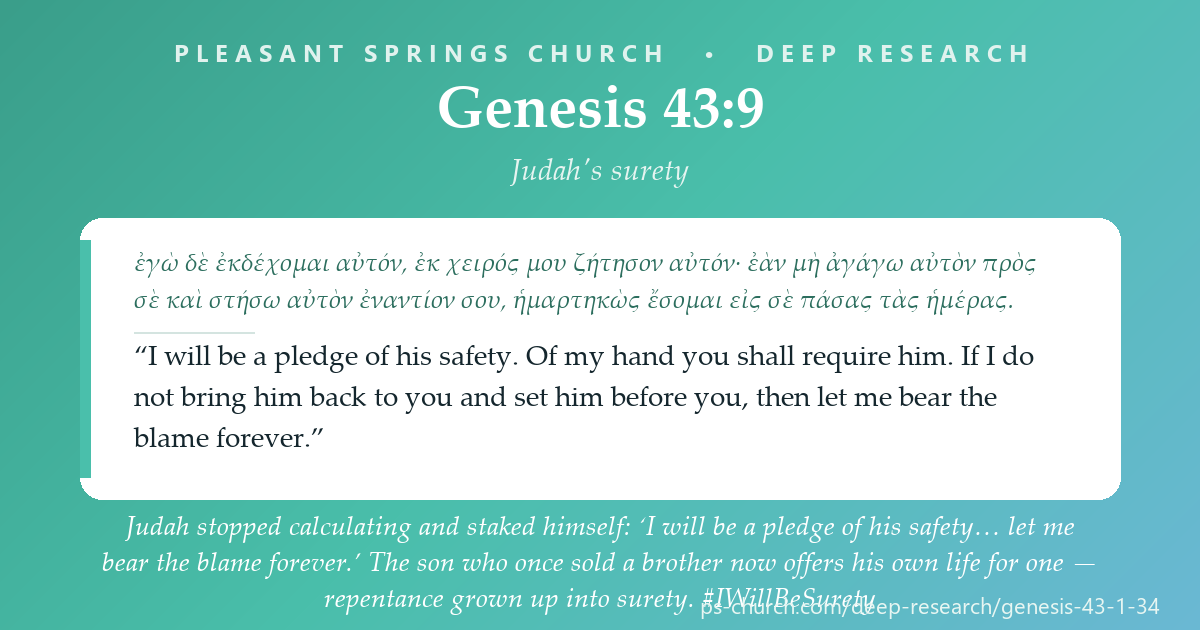
It is worth pausing over how far Judah has traveled. When Joseph was in the pit, it was Judah who said, coolly, ‘What profit is it if we kill our brother? Come, let us sell him’ (37:26–27) — a brother reduced to a transaction. When Tamar was pregnant, it was Judah who ordered her burned before his own hypocrisy was exposed (38:24–26). This is not a promising man. And yet here he is, standing before his broken father, offering himself as bond for the one brother Jacob cannot bear to lose: ‘I will be a pledge of his safety. From my hand you shall require him… let me bear the blame forever’ (43:9). The verb is the language of the law court and the loan — to make oneself answerable, to accept another’s penalty as one’s own. In chapter 44 he will make it good, begging to remain a slave in Benjamin’s place so the boy can go home to his father (44:33–34). The old teachers of the church could never read this without a catch in the breath, and rightly — not because Judah is a secret Christ, but because the Spirit was teaching Israel, in a real man’s real repentance, the very shape that salvation would one day take: a son of Judah who steps between the beloved and the loss, who takes the blame that is not his, who offers himself so that others may go free. Scripture even makes the line explicit — from this Judah comes the tribe, the throne, and at last the one whom Hebrews calls ‘the guarantor of a better covenant’ (7:22). Hold it as devotional analogy, not allegory forced on the text; but do hold it, for it is genuinely there. God was writing the gospel into the family tree long before he wrote it on a cross.
The scholarship on Genesis 43:1-34.
The commentators on the Joseph narrative; the studies of Judah’s characterization, ancient surety, and providence.
Commentaries & studies:
- Gordon J. Wenham (WBC), Victor P. Hamilton (NICOT), Kenneth A. Mathews (NAC), Bruce K. Waltke, Nahum M. Sarna (JPS) on Genesis.
- Robert Alter and studies of the Joseph novella (Gen 37–50) as unified narrative art; treatments of Judah’s development across chs 37–38, 43–44.
- G. K. Beale & D. A. Carson, eds., Commentary on the NT Use of the OT; studies of suretyship (Heb 7:22) and providence (Rom 8:28) in the Joseph story.
Interpretation notes worth keeping:
- Reuben vs. Judah (42:37; 43:9). Reuben pledges his sons’ lives; Jacob ignores it. Judah pledges his own; Jacob relents. The narrative rewards the surety who stakes himself, not the one who bets others.
- El Shaddai and the LXX (43:14). The Hebrew names the covenant title “God Almighty”; the Greek reads “my God.” The MT drives the ESV; the divergence is worth noting, not overreading — both confess the one God of the fathers.
- The steward’s theology (43:23). A servant confesses a Giver behind the silver. Whether or not he shares Joseph’s faith, the narrator uses his mouth to state the chapter’s doctrine: providence hides grace inside what frightens.
- Joseph’s tears (43:30). He must leave the room to weep at the sight of his full brother — the reconciliation is real emotion, not stagecraft, though he still withholds his name for the testing yet to come (ch 44).
- The devotional analogy. Judah-as-surety and Joseph-as-sufferer-exalted point forward to Christ — the guarantor of a better covenant, the provider of bread in famine. Hold these as resonance built on real textual patterns (Heb 7:22), not as the chapter’s literal sense — the house discipline for typology throughout this library.
From a costly pledge to the grace that fills the sack and sets the table.
Name what you learned, why it matters, and one concrete response.
What should we carry away — and do?
- Step into costly responsibility. Judah stopped managing risk and staked himself: “I will be a pledge of his safety.” Repentance grows up when it stops calculating and starts bearing the blame for a brother.
- Read the returning silver as grace. What frightens you may be the very provision you prayed for, arriving in disguise. “Your God… has put treasure in your sacks” — do not be afraid.
- Let the table heal. Reconciliation in Scripture keeps ending at a shared meal, favoritism disarmed and fear gone. Come to the table you have been avoiding; peace is often served there.
Step in response: is there a brother or sister whose burden you have been keeping at arm’s length, offering to try rather than to bear? Consider what it would mean to stand surety — to make yourself answerable, to accept a cost that is not strictly yours — the way Judah did, and the way the greater Son of Judah did for us (Heb 7:22). And take the thing in your hands that looks like a trap this week — the anxious circumstance, the unexplained turn — and ask the steward’s question over it: is this not treasure my God has put in the sack? Then sit down at a table you have been avoiding, and let peace begin.
Genesis 43:9 · to share
LXX + ESVEvery Deep Research page traces its passage across the whole sweep — the Old Testament, the Second-Temple world between the testaments (historical witnesses, not Scripture), and the New Testament. Follow the thread:
Pleasant Springs Church — Deep Research
Research method after Michael S. Heiser’s Bible Research Method (examine dictionaries → ancient literature → important words → textual connections → academic publications → share), with the Pleasant Springs “Author & Audience” foundation. Scripture set in the Hebrew, the Greek editions named on each page and the ESV (Old Testament), and the Greek New Testament and the ESV (New Testament), per the practice of Pleasant Springs Church. Genesis 43:1–34 research grounded in Wenham, Hamilton, Mathews, Waltke, and Sarna, with Alter on the Joseph novella; the chapter read as the turning of Judah from the man of chs 37–38 into the surety who stakes himself (’e‘ervennu, 43:9; cf. Prov 6:1–5), his pledge climaxing in the self-substitution of ch 44; Jacob’s El Shaddai and prayer for rachamim (43:14; LXX “my God”) as covenant faith over his most vulnerable point; the steward’s “your God… has put treasure in your sacks” (43:23, matmon) as the Joseph narrative’s doctrine of providence — grace hidden inside what frightens (Rom 8:28); and the birth-order feast, Joseph’s tears, and Benjamin’s fivefold portion (43:30–34) as reconciliation arriving at a table. The Judah-as-surety and Joseph-as-sufferer-exalted readings held as devotional analogy on real textual patterns (Heb 7:22; Rev 5:5), not the literal sense — per the house discipline for typology. All names of God in the chapter are Elohim / El Shaddai (ordinary “God” / “God Almighty”); no Tetragrammaton appears.
Scripture quotations marked ESV are from the ESV® Bible (The Holy Bible, English Standard Version®), © 2001 by Crossway, a publishing ministry of Good News Publishers. ESV Text Edition: 2016. Used by permission. All rights reserved. The ESV text may not be quoted in any publication made available to the public by a Creative Commons license, and the ESV may not be translated in whole or in part into any other language. www.esv.org
|
Did this study bless you today? 💚 Give to Support PS Church100% of gifts go to the General Fund — thank you. |