Three things in these four chapters can be shown rather than argued. The deepest run is thirteen words — Isaiah 11:10 and Romans 15:12, tie band of one — and only five rows in the whole of Greek Isaiah go deeper. The chapter division between 8 and 9 falls inside a New Testament quotation: Matthew 4:15–16 quotes two verses that an English Bible numbers 9:1 and 9:2 and the Hebrew and Greek number 8:23 and 9:1, and each measures six with a tie band of one. And the three verses this passage is most preached from measure 3, 4 and 1 — the stumbling stone of 8:14, whose Greek column is a negation; the belt of righteousness of 11:5, whose deepest New Testament partner is John the Baptist’s leather belt; and the wolf lying down with the lamb in 11:6, which shares no two consecutive words with any verse of the New Testament at all. See the method →
Isaiah 8:1–11:16 (selections, Hebrew and Greek numbering)
Hebrew (Masoretic) · Greek (CATSS, Rahlfs’ Septuaginta) · ESV⚠️ The consequence is that Matthew’s quotation is cut in half by the chapter division. Matthew 4:15–16 quotes two verses. In an English Bible they are Isaiah 9:1–2 and they are in the same chapter. In the Hebrew and the Greek they are 8:23 and 9:1 and they are in different chapters. Each of the two measures a run of six with a tie band of one, so the screen sees a single quotation straddling a chapter boundary that the screen itself knows nothing about. Every reference on this page is Hebrew and CATSS numbering, with the ESV number beside it wherever the two part.
⚠️ Other Isaiah seams, none of them here. The derivation also found chapter 2 (MT 22, LXX 21) and chapter 56 (MT 12, LXX 11) disagreeing between the Hebrew and Greek columns. And the English parts from the Hebrew once more, at the end of chapter 63: MT and CATSS both run ch 63 = 19 verses and ch 64 = 11 where the English runs 19 and 12, so ENGLISH 64:1 = MT 63:19b. None of the three is in this passage, and this page makes no claim about any of them.
The Shape of the Passage
Sequence — Assyria comes as a flood and goes as a highwayThese four chapters are the only stretch of Isaiah that names its own occasion, its own king and its own children. Ahaz is on the throne, Damascus and Samaria are allied against Jerusalem, and Assyria is the power everyone is calculating about. The prophet’s two sons are walking arguments — their names are the message.
Author
A man with a wife called the prophetess and two sons with sentences for names. 8:3 has הַנְּבִיאָה, the prophetess, and a second son; 7:3 already had שְׁאָר יָשׁוּב, Shear-jashub, standing beside his father at the aqueduct. 8:18 draws the whole household into the message: I and the children whom the Lord has given me are signs and portents.
Isaiah speaks in the first person here more than almost anywhere else in the book. 8:1, 8:3, 8:5, 8:11, 8:17, 8:18 — the Lord said to me, I went to, I will wait. The measured consequence is small and real: 8:16 and 8:17 are the only two verses in chapter 8 that share no two consecutive words with any other verse in the Hebrew Bible.
Audience
Judah under Ahaz, and then a wider room. 8:1–15 addresses a people who have refused the waters of Shiloah and are afraid of the wrong things. 8:12–13 tells them what to fear instead. By 10:20 the audience has become the remnant of Israel, and by 11:10 it is the nations.
The two Assyrian dates the text depends on. Tiglath-pileser III took Damascus and stripped the northern territories — including Zebulun and Naphtali, the two names in 8:23 — in the 730s BC; Samaria fell in 722. The book speaks of the first as imminent and of Assyria’s own fall as further off. No cuneiform source was consulted for this page; those dates are named as the frame the argument sits in, not as something checked here.
Orient on the Syro-Ephraimite crisis, on sign-names, and on an offset that moves a famous quotation from one chapter to another.
Search by topic: Immanuel; Maher-shalal-hash-baz; Shear-jashub; Syro-Ephraimite war; Ahaz; Tiglath-pileser III; remnant; Jesse; branch and shoot imagery; chapter and verse divisions, history of.
Which articles are relevant?
- Anchor Bible Dictionary — “Immanuel,” “Isaiah, Book of,” “Ahaz,” “Syro-Ephraimite War,” “Remnant,” “Jesse.”
- Dictionary of the OT: Prophets (IVP) — “Immanuel,” “Messiah,” “Remnant,” “Sign Acts,” “Zion Traditions.”
- NIDOTTE — שְׁאָר, נֵס, גֶּזַע, נֵצֶר, מְסִלָּה.
- Commentary on the New Testament Use of the Old Testament (Beale & Carson) — on Matthew 4:15–16, Romans 9:27, Romans 15:12 and Hebrews 2:13.
Settle the numbering first — the seam is inside this passage
Isaiah is aligned chapter for chapter across the whole book, and the verse numbers part company between the Hebrew and the English in two places. One of them is here. The Hebrew and the Greek verse counts below were derived from the files on this disk; the English column is not held on this disk and is stated, not derived. The other seam is at the end of chapter 63 — measured here, MT and CATSS both run ch 63 = 19 verses and ch 64 = 11, where the English runs 19 and 12, so ENGLISH 64:1 = MT 63:19b and ENGLISH 64:2–12 = MT 64:1–11. It is not in this passage.
| ch 8 | ch 9 | ch 10 | ch 11 | 8–9 total | |
|---|---|---|---|---|---|
| Masoretic | 23 | 20 | 34 | 16 | 43 |
| CATSS Greek | 23 | 20 | 34 | 16 | 43 |
| English | 22 | 21 | 34 | 16 | 43 |
ENGLISH 9:1 = MT/LXX 8:23. ENGLISH 9:2–21 = MT/LXX 9:1–20. Chapters 10 and 11 are identical in all three. The Hebrew and the Greek keep the Zebulun and Naphtali sentence as the last verse of chapter 8; the English promotes it to the first verse of chapter 9.
Practical consequence, and it is not academic. “Isaiah 9:1” means Galilee of the nations in an English Bible and the people who walked in darkness in a Hebrew or Greek one. A commentary, a lectionary or a cross-reference that does not say which system it is using is ambiguous at exactly the verse Matthew quotes. This page always prints both numbers where they differ. The derivation also turned up two other Hebrew/Greek disagreements in Isaiah — chapter 2 (MT 22 verses, LXX 21) and chapter 56 (MT 12, LXX 11) — neither of which is in this passage.
Two boys with sentences for names, and an empire that is a rod before it is a road.
The sign-children, and what the Greek column does with their names
Three names are given as signs in Isaiah 7–8, and each one is a sentence.
| name | where | what it says | the Greek row |
|---|---|---|---|
| שְׁאָר יָשׁוּב Shear-jashub | 7:3; as a sentence again at 10:21 and 10:22 | a remnant shall return | half translated at 7:3 — ὁ καταλειφθεὶς Ιασουβ; at 10:21 no name at all, only τὸ καταλειφθὲν |
| עִמָּנוּ אֵל Immanuel | 7:14, 8:8, 8:10 — and nowhere else in the Hebrew Bible | God with us | transliterated at 7:14 (Εμμανουηλ); translated at 8:8 and 8:10 |
| מַהֵר שָׁלָל חָשׁ בַּז Maher-shalal-hash-baz | 8:1, 8:3 — and nowhere else | swift to the spoil, quick to the plunder | translated both times — ὀξέως προνομὴν ποιῆσαι σκύλων, ταχέως σκύλευσον ὀξέως προνόμευσον |
The pattern is worth stating carefully. Across these two chapters the Greek column generally renders the sense of a sign-name rather than carrying the name across — and the one place it does carry a name across is 7:14, the verse Matthew quotes as a name. The page reports the pattern. It does not claim the pattern is deliberate, and it does not say which column came first.
One measured link between the two sign-children: כִּי בְּטֶרֶם יֵדַע הַנַּעַר, before the boy knows, stands in exactly two verses of the Hebrew Bible — 7:16, of Immanuel, and 8:4, of Maher-shalal-hash-baz. Four consecutive words, tie band of one.
The name on the tablet turns up again in chapter 10
The two nouns of the boy’s name are שָׁלָל, spoil, and בַּז, plunder. Both come back at 10:6 as Assyria’s commission.
10:6: God sends the nation לִשְׁלֹל שָׁלָל וְלָבֹז בַּז — to take spoil and seize plunder. Screened Hebrew against Hebrew, those four words reach a run of four with a tie band of one, and the one partner is Ezekiel 38:12 — the Gog oracle, which uses the same pair of verbs. Gog has its own study here. The page notes the shared idiom and claims no relationship between the two passages.
And in between, 8:4 says the boy will not be old enough to say my father before שְׁלַל שֹׁמְרוֹן, the spoil of Samaria, is carried off. The name, the prophecy and the commission of the empire are the same two words.
Assyria as the rod, and the one thing the passage says about instruments
10:5 opens Woe to Assyria, the rod of my anger, and 10:15 asks the question the whole chapter turns on.
Shall the axe boast over him who hews with it, or the saw magnify itself against him who wields it?Isaiah 10:15, ESV
The Greek row asks the same question with different tools and a different verb: μὴ δοξασθήσεται ἀξίνη ἄνευ τοῦ κόπτοντος ἐν αὐτῇ, shall an axe be glorified without the one cutting with it? — the Hebrew has the axe boasting over the woodcutter; the row has it glorified without him.
The standing caution about ancient Near Eastern material. Assyrian royal inscriptions are full of kings boasting exactly as 10:8–11 has this one boast, and that parallel is real and widely discussed. No cuneiform text was consulted for this page. It is named as the kind of evidence the historical reading rests on, not as something checked here.
A name that is a sentence, a remnant that is a name, six qualities that become seven, and a road.
7:14, 8:8, 8:10 — three occurrences in the whole Hebrew Bible and no more. Two of them are in this chapter. The Greek row transliterates it at 7:14 and translates it at 8:8 and 8:10, and the four-word translation μεθ’ ἡμῶν ὁ θεός is what Matthew 1:23 puts after the name.
The load-bearing noun of chapter 10 and the last word of the passage’s argument. It is a boy’s name at 7:3, a sentence at 10:21–22, and the people who walk the highway at 11:16. The Greek row uses no single word for it — τὸ καταλειφθέν, κατάλειμμα, ὑπόλοιπον, καταλειφθέντι in four different places.
Twice in the Hebrew Bible: 9:5 (ESV 9:6) and 10:21. The child’s throne-name and the remnant’s destination are the same two words. The Greek column carries the link in neither place — Μεγάλης βουλῆς ἄγγελος at 9:5 and θεὸν ἰσχύοντα at 10:21.
11:1. A tree that has already been felled — which is why 10:33–34 stands where it does. The row has ῥίζα, root, for this and for שֹׁרֶשׁ in the next line, so the Hebrew’s two images become one word.
11:2, in the last pair of the spirit list, where the Hebrew has יִרְאַת יְהוָה, the fear of the Lord. Because the row then renders the same Hebrew phrase again at 11:3 as πνεῦμα φόβου θεοῦ, the Greek column ends with seven qualities where the Hebrew has six.
11:16, the last verse — and 7:3, where Isaiah is told to meet Ahaz at the highway to the Washer’s Field. The word occurs at both ends of the Immanuel material. The Greek row has δίοδος, a way through.
Six or seven? Count the spirit list in both columns
This is the clearest place in the passage where the two columns give different totals, and it can be counted rather than argued.
| Hebrew 11:2–3 | Greek row 11:2–3 | |
|---|---|---|
| heading | רוּחַ יְהוָה | πνεῦμα τοῦ θεοῦ |
| 1–2 | חָכְמָה וּבִינָה | σοφίας καὶ συνέσεως |
| 3–4 | עֵצָה וּגְבוּרָה | βουλῆς καὶ ἰσχύος |
| 5–6 | דַּעַת וְיִרְאַת יְהוָה | γνώσεως καὶ εὐσεβείας |
| 7 | — 11:3 opens וַהֲרִיחוֹ בְּיִרְאַת יְהוָה, his delight is in the fear of the Lord, and it is not a seventh רוּחַ | πνεῦμα φόβου θεοῦ — 11:3 opens with a fifth πνεῦμα |
| qualities | six | seven |
Wisdom, understanding, counsel, might, knowledge, piety, fear of God. The traditional list of seven gifts of the Spirit is the Greek column’s list. The page states the count and takes no position on how the tradition arrived at it, on which reading is earlier, or on what the translator was doing.
Every row of these four chapters against the whole Greek New Testament, and the Hebrew against the rest of the Hebrew Bible.
The whole passage, screened
All 93 CATSS rows of Isaiah 8–11 against all 7,927 verses of the Greek New Testament. 89 reach two, 64 reach three, 19 reach four, 5 reach six, 3 reach seven, 2 reach ten, 1 reaches 13, and nothing reaches 14.
| row | deepest NT partner | run | tie band | the shared words |
|---|---|---|---|---|
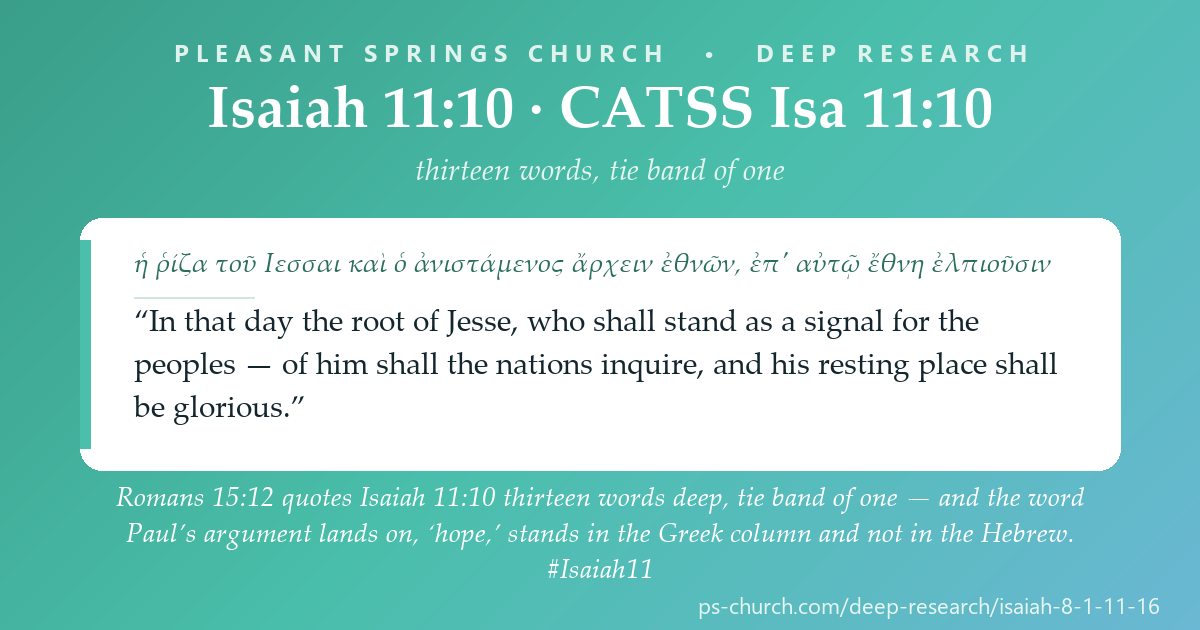
| 11:10 | Romans 15:12 | 13 | 1 | ἡ ῥίζα τοῦ Ιεσσαι καὶ ὁ ἀνιστάμενος ἄρχειν ἐθνῶν ἐπ’ αὐτῷ ἔθνη ἐλπιοῦσιν |
| 8:18 | Hebrews 2:13 | 10 | 1 | ἰδοὺ ἐγὼ καὶ τὰ παιδία ἅ μοι ἔδωκεν ὁ θεός |
| 10:22 | Romans 9:27 | 7 | 1 | Ισραηλ ὡς ἡ ἄμμος τῆς θαλάσσης τό |
| 8:23 ESV 9:1 | Matthew 4:15 | 6 | 1 | πέραν τοῦ Ιορδάνου Γαλιλαία τῶν ἐθνῶν |
| 9:1 ESV 9:2 | Matthew 4:16 | 6 | 1 | ἐν χώρᾳ καὶ σκιᾷ θανάτου φῶς |
| 10:18 | Luke 21:21 | 4 | 1 | τὰ ὄρη καὶ οἱ |
| 11:5 | Mark 1:6 | 4 | 1 | τὴν ὀσφὺν αὐτοῦ καί |
| 10:20, 10:27 | Matthew 13:1 &c. | 4 | 4 | ἐν τῇ ἡμέρᾳ ἐκείνῃ — a formula |
| 11:4 | Luke 4:22, 2 Thess 2:8, Rev 19:21 | 4 | 3 | τοῦ στόματος αὐτοῦ καί |
The top five are all citations, and every one of them has a tie band of one. Two of them — Romans 9:27 and Romans 15:12 — name Isaiah in the sentence that quotes them, so the New Testament itself, and not this screen, is what makes them citations. Hebrews 2:13 says and again twice. Matthew 4:14 says that what was spoken by the prophet Isaiah might be fulfilled.
Thirteen words: Isaiah 11:10 and Romans 15:12
The deepest run on this page, and it is worth seeing where it starts and where it stops.
καὶ ἔσται ἐν τῇ ἡμέρᾳ ἐκείνῃ ἡ ῥίζα τοῦ Ιεσσαι καὶ ὁ ἀνιστάμενος ἄρχειν ἐθνῶν ἐπ’ αὐτῷ ἔθνη ἐλπιοῦσιν καὶ ἔσται ἡ ἀνάπαυσις αὐτοῦ τιμή
…λέγει ἔσται ἡ ῥίζα τοῦ Ἰεσσαί καὶ ὁ ἀνιστάμενος ἄρχειν ἐθνῶν, ἐπ’ αὐτῷ ἔθνη ἐλπιοῦσιν
It starts at ἡ ῥίζα because Paul does not carry in that day over, and it stops at ἐλπιοῦσιν because Paul does not carry and his rest shall be honour over. Thirteen words in between, identical in sequence, and no other verse of the New Testament reaches thirteen with this row.
And the thing the run makes visible is the divergence, not the agreement. The Hebrew of 11:10 says the root stands as a signal (לְנֵס) and the nations seek him (יִדְרֹשׁוּ). The Greek row says the one rising to rule nations, and the nations ἐλπιοῦσιν, will hope. Romans 15 is an argument about hope — the next verse is may the God of hope fill you with all joy — and the word Paul’s argument lands on stands in this Greek column and not in the Hebrew. The page reports that. It does not say the Hebrew was changed, or that the translator anticipated Paul, or which text Paul had in front of him.
Two boundary checks. ἡ ῥίζα τοῦ Ιεσσαι stands once in the 30,348 Greek Old Testament verse units screened here, at this verse. And Revelation’s root is a different root: ἡ ῥίζα Δαυίδ at 5:5 and ἡ ῥίζα καὶ τὸ γένος Δαυίδ at 22:16 — root of David, not root of Jesse, and each measures two against this row.
Print the counter-examples — the famous verses that measure almost nothing
If a page prints its deep runs and not its shallow ones it teaches the reader something false. Here are the shallow ones.
| verse | what it is preached as | measured | and the words are… |
|---|---|---|---|
| 8:14 | the stumbling stone of Romans 9:33 and 1 Peter 2:8 | 3, band 3 | καὶ οὐ ὡς — at Matthew 7:29, Mark 1:22 and Romans 5:16. The negation, not the stone. |
| 8:13 | the source of 1 Peter 3:15 | 1 against 1 Peter 3:15 | κύριον. 1 Peter writes κύριον δὲ τὸν Χριστὸν ἁγιάσατε where the row has κύριον αὐτὸν ἁγιάσατε. |
| 11:5 | the belt of righteousness and faithfulness | 4, band 1 | τὴν ὀσφὺν αὐτοῦ καί — at Mark 1:6, John the Baptist’s leather belt. A tie band of one and a pure coincidence. |
| 11:6 | the peaceable kingdom | 1, band 5,301 | single words only. No two consecutive words shared with any verse of the New Testament. |
| 11:4 | slaying the wicked with the breath of his lips — 2 Thess 2:8 | 4, band 3 | τοῦ στόματος αὐτοῦ καί, tied with Luke 4:22, the gracious words that came from his mouth, which has nothing to do with it. |
11:5 is the sharpest warning on this page. A tie band of one is normally the signal that a run is not a formula. Here it is a run of four, band one, and it is an accident: τὴν ὀσφὺν αὐτοῦ καί is his loins, and, and the two verses that share it are a messianic king’s belt and a wilderness preacher’s. Band of one plus a short run means nothing at all. Depth and band have to be read together, and even then the words have to be looked at.
And 8:13 is the warning in the other direction. Nobody disputes that 1 Peter 3:14–15 is using Isaiah 8:12–13; 1 Peter 3:14 reaches τὸν δὲ φόβον, three words, and 3:15 reaches one. A shallow run is not evidence that a text is not being used. The screen measures verbatim sequence and nothing else, and this page has now printed a case in each direction.
The stumbling stone: which Isaiah verse is Romans 9:33 actually running with?
Romans 9:33 puts two Isaiah sentences together, and the screen can separate them.
| comparison | longest shared run | the words |
|---|---|---|
| CATSS Isaiah 28:16 vs Romans 9:33 | 6 | καὶ ὁ πιστεύων ἐπ’ αὐτῷ οὐ |
| CATSS Isaiah 8:14 vs Romans 9:33 | 2 | ἐπ’ αὐτῷ — and those two words come from the trust clause at the start of 8:14, not from the stone |
| CATSS Isaiah 8:14 vs 1 Peter 2:8 | 1 | καί |
The reason is on the page above: the Greek row of 8:14 is a negation. καὶ οὐχ ὡς λίθου προσκόμματι συναντήσεσθε αὐτῷ οὐδὲ ὡς πέτρας πτώματι — and you will NOT meet him as a stumbling stone, nor as a rock of falling. It also uses πτῶμα where Romans and 1 Peter have σκάνδαλον. The words Romans 9:33 and 1 Peter 2:8 use for the stone stand in the Hebrew of Isaiah 8:14 and not in this Greek row. The page reports the difference between the columns and asserts nothing about how it arose or which is earlier.
What the 30 August spelling fold did to one of these figures
Cross-corpus runs on this shelf now apply the Greek editions’ own spelling equivalences — οὐ / οὐκ / οὐχ, ἐκ / ἐξ, and the movable nu. Isaiah 8:14 is a place where that changes the answer.
| Isaiah 8:14 vs the Greek New Testament | deepest run | the words |
|---|---|---|
| with the fold (what this page reports) | 3, band 3 | καὶ οὐ ὡς — the row has οὐχ, Matthew 7:29 has οὐχ too, and both fold to οὐ |
| without the fold | 2, band 524 | καὶ ἐάν |
The figure printed on this page is the folded one, which is the shelf’s current convention. Any run figure on a Deep Research page written before 30 August 2026 was measured without the fold and may be lower than the same measurement is now. Nothing on this page was copied from a sibling; every number here was re-run on 31 August 2026.
The Hebrew side: what these chapters share with the rest of the Hebrew Bible
Every Hebrew verse of chapters 8, 10 and 11 against the rest of the Masoretic corpus — 23,204 verse units less the chapter being screened, so 23,181, 23,170 and 23,188 respectively. On this screen 0 means “shares no two consecutive words with any other verse” — not “shares no word”.
| row | deepest Hebrew partner | run | tie band | the shared words |
|---|---|---|---|---|
| 10:4 | Isaiah 5:25, 9:11, 9:16, 9:20 | 8 | 4 | בְּכָל־זֹאת לֹא־שָׁב אַפּוֹ וְעוֹד יָדוֹ נְטוּיָה — the refrain |
| 11:9 | Isaiah 65:25 | 7 | 1 | לֹא־יָרֵעוּ וְלֹא־יַשְׁחִיתוּ בְּכָל־הַר קָדְשִׁי |
| 8:11 | Isaiah 18:4, 31:4 | 5 | 2 | כִּי כֹה אָמַר יְהוָה אֵלַי |
| 8:4 | Isaiah 7:16 | 4 | 1 | כִּי בְּטֶרֶם יֵדַע הַנַּעַר — the two sign-children |
| 10:6 | Ezekiel 38:12 | 4 | 1 | לִשְׁלֹל שָׁלָל וְלָבֹז בַּז |
| 11:7 | Isaiah 65:25 | 4 | 1 | וְאַרְיֵה כַּבָּקָר יֹאכַל תֶּבֶן |
| 11:1 | none | 0 | — | shares no two consecutive words with any other verse in the Hebrew Bible |
Thirteen of the 73 rows in chapters 8, 10 and 11 return zero — 8:16, 8:17; 10:1, 10:2, 10:5, 10:18, 10:19, 10:30, 10:31, 10:34; 11:1, 11:4, 11:8. The one that matters is 11:1. There shall come forth a shoot from the stump of Jesse is quoted, sung and preached more than anything else in these four chapters, and as a sequence of Hebrew words it exists exactly once.
And the peaceable kingdom is not a one-off inside Isaiah. 11:9 returns at 65:25 — seven consecutive Hebrew words, tie band of one — and 11:7 returns there too. The vision at the front of the book comes back at the back of it.
Isaiah 11:9 and Habakkuk 2:14 — the parallel everyone pairs, measured
These two sentences are quoted together constantly. In Hebrew they share two consecutive words.
| the sentence | |
|---|---|
| Isaiah 11:9 | כִּי מָלְאָה הָאָרֶץ דֵּעָה אֶת־יְהוָה כַּמַּיִם לַיָּם מְכַסִּים |
| Habakkuk 2:14 | כִּי תִּמָּלֵא הָאָרֶץ לָדַעַת אֶת־כְּבוֹד יְהוָה כַּמַּיִם יְכַסּוּ עַל־יָם |
| longest shared run | 2 — יְהוָה כַּמַּיִם |
Everything else differs. Isaiah has a perfect verb and Habakkuk an imperfect; Isaiah has the noun דֵּעָה and Habakkuk an infinitive לָדַעַת; Habakkuk has כְּבוֹד, glory, and Isaiah has no word for it; and the last three words stand in a different order — Isaiah as waters to the sea covering, Habakkuk as waters they cover over sea. In English the two are nearly interchangeable. In Hebrew they are two sentences that agree about an image and about almost nothing else.
This is the plainest illustration on the page of what the screen does and does not do. Two verses can be about the same thing, in the same words in translation, and share almost no verbatim sequence. The measurement finds contact, not kinship, and it does not tell you which way anything went. Habakkuk has its own page.
What was not consulted, what could not be checked, and where this page is weakest.
What could not be checked at all
No Hebrew or Greek critical apparatus. The Hebrew is Sefaria’s Miqra according to the Masorah as it stands; the Greek is CATSS’ digitization of Rahlfs. Where this page says “the row reads…” it means that file, and nothing about which reading is older.
No Qumran material, and for this passage that is a real gap. The great Isaiah scroll, 1QIsaa, is complete for all four of these chapters and is the single most obvious witness anybody would want at 8:14, at 9:1–2 and at 11:10, and none of it was consulted. Anything this page says about how the columns differ is said about two printed editions and no manuscript evidence at all.
No Targum Jonathan, no Peshitta, no Vulgate, no Aquila, Symmachus or Theodotion. The seven-gift reading in stage 3 has a long history in the Latin tradition and this page has not read a word of that tradition; it has only counted what is in the Greek column on this disk.
No cuneiform sources. Tiglath-pileser III, the annexation of Zebulun and Naphtali, and the Assyrian royal boast behind 10:8–11 are named as the historical frame, not checked.
And the ESV column was not verified against a held ESV text. No ESV file for Isaiah exists in this project and no Crossway API key has ever been issued to it. The English above was typed. Its verse alignment rests on the verse counts and the chapter openings, which were derived from the files on this disk and are printed in stage 1. The Hebrew and Greek columns were not typed — they were pulled programmatically out of the corpus files and then checked back against them token for token, all sixteen rows in both languages.
Where this page is weakest
The structure diagram is the softest thing here, and it is labelled a sequence for that reason. Isaiah 8–11 is not a chiasm and this page does not draw one. The Assyrian frame (flood at 8:7, highway at 11:16) and the felled-forest-to-stump junction at 10:33–11:1 are readings of the imagery, not measurements. The only measured element of the diagram is the refrain, and its five occurrences are printed with their references so a reader can check them.
The seven-versus-six count is a count, and everything around it is not. That the Greek column ends 11:2–3 with seven qualities and the Hebrew with six can be verified in ten seconds from the text printed above. That the church’s seven gifts came through this column is not something this page has demonstrated, and it does not claim to have.
The Immanuel finding depends on a corpus with a boundary. μεθ’ ἡμῶν ὁ θεός stands twice in the 30,348 Greek Old Testament verse units screened here. That corpus is 64 CATSS files — 30,637 verse units in all, of which the Odes are excluded from every run screen on this shelf because ten of them are second copies of passages already counted and two of them, Odes 9 and 13, are Luke 1 and Luke 2 copied into a Greek Old Testament manuscript. Screening a Greek Old Testament against the Greek New Testament with the Odes left in would find Luke quoting Luke. The screened figure is the one this page prints.
And the hardest thing in this passage is not textual. 10:5–19 says that an empire doing what empires do is a rod in God’s hand and is guilty for doing it, in the same paragraph. The page does not resolve that, and the text does not either — it goes on to the remnant and then to the stump.
Reading list
- Joseph Blenkinsopp, Isaiah 1–39 (Anchor Yale Bible 19).
- H. G. M. Williamson, Isaiah 6–12 (International Critical Commentary).
- John N. Oswalt, The Book of Isaiah, Chapters 1–39 (NICOT).
- Hans Wildberger, Isaiah 1–12 (Continental Commentary).
- Ronald L. Troxel, LXX-Isaiah as Translation and Interpretation — the standard treatment of the questions this page deliberately declines to answer.
- None of these were consulted for the measurements on this page, which were run on the text files named in the footer.
A flood, a stump, and a road.
The two ends of the passage
Assyria comes into these chapters as water. The Lord is bringing up against them the waters of the River, mighty and many… and it will reach even to the neck (8:7–8). It goes out of them as a road. And there will be a highway from Assyria for the remnant that remains of his people, as there was for Israel when they came up from the land of Egypt (11:16).
The same empire, the same land, and the direction of travel reversed. In between, the empire is told it is an axe that has begun to boast, and a forest is cut down, and out of one stump something grows.
What the measurements added, and what they did not
The measurements did three things on this page. They showed that a chapter division cuts a New Testament quotation in half, which no amount of reading in English can show. They showed that Paul’s thirteen-word quotation lands on a word — hope — that stands in the Greek column and not in the Hebrew. And they showed that the four verses in this passage that Christians know best are, as sequences of words, almost entirely absent from the New Testament.
What they did not do is decide anything about meaning. That Isaiah 11:6 shares no two consecutive words with any verse of the Greek New Testament does not make it less true, less quoted or less loved. It makes it a vision the New Testament did not need to restate. The screen counts words in a row. Everything else is reading.
Isaiah 8, 10 and 11 were dark on the coverage map before this page. Chapter 9 was already lit by the child born, and chapter 7 by the sign of the virgin. This study closes the four-chapter block those two sat inside.
Every Deep Research page traces its passage across the whole sweep — the Old Testament, the Second-Temple world between the testaments (historical witnesses, not Scripture), and the New Testament. Follow the thread:
Pleasant Springs Church — Deep Research
Research method after Michael S. Heiser’s Bible Research Method (examine dictionaries → ancient literature → important words → textual connections → academic publications → share), with the Pleasant Springs “Author & Audience” foundation. Scripture set in the Hebrew, the Greek editions named on each page and the ESV (Old Testament), and the Greek New Testament and the ESV (New Testament), per the practice of Pleasant Springs Church. Isaiah research grounded in Blenkinsopp (Anchor Yale), Williamson (ICC), Oswalt (NICOT) and Wildberger. Text: Hebrew from the Masoretic text as printed in the editions consulted — Sefaria’s Miqra according to the Masorah; no critical apparatus was consulted for the Hebrew, and no Qumran manuscript was consulted at all — 1QIsaa is complete for these chapters and was not used. Greek from Rahlfs’ Septuaginta as digitized by CATSS; Greek New Testament from the SBL edition via MorphGNT. The standing caution for this shelf applies: these pages say “the CATSS Greek row reads…” and never call a Greek reading early or late. ⚠️ VERSE NUMBERING — a one-verse offset, and it is inside this passage. Derived from the files on this disk on 31 August 2026, not taken from a table. Masoretic and CATSS Isaiah both run chapter 8 = 23 verses and chapter 9 = 20; the English runs 22 and 21. ENGLISH 9:1 = MT/LXX 8:23, and ENGLISH 9:2–21 = MT/LXX 9:1–20. Chapter 8 verses 1–22 and the whole of chapters 10 (34 verses) and 11 (16 verses) carry the same numbers in all three columns. Established from content at the seam. The same derivation found the Hebrew and Greek columns disagreeing at chapter 2 (MT 22, LXX 21) and chapter 56 (MT 12, LXX 11); neither is in this passage and this page makes no claim about either. ⚠️ The Greek measurement, in full. Greek against Greek. CATSS FORM column (cols 0–24), beta-code transliterated first; MorphGNT field 6, the normalised word. Both sides lowercased, accents and breathings dropped, final sigma folded, then filtered to Greek letters — the same filter applied to both corpora. Word forms, never lemmas. Cross-corpus runs apply the editions’ own spelling equivalences — οὐ / οὐκ / οὐχ, ἐκ / ἐξ, the movable nu — a convention adopted on 30 August 2026. On this page that fold changes exactly one printed figure: Isaiah 8:14’s deepest New Testament run is 3 with the fold and 2 without it. Every figure here was re-run on 31 August 2026; none was copied from a sibling page. Corpus: the 93 CATSS rows of Isaiah 8–11 against 7,927 verses across 27 MorphGNT files, and, for the phrase searches, 30,348 verse units of Greek Old Testament — the 30,637 units in the 64 CATSS files held here minus the Odes, which are excluded from every run screen because ten of them duplicate passages already counted and Odes 9 and 13 are Luke 1 and Luke 2. Exhaustive and deterministic; nothing sampled, so no seed applies. ⚠️ The Hebrew measurement. Hebrew against Hebrew over the non-source verse units of the 39-book Masoretic corpus — 23,204 less the chapter being screened, so 23,181 for chapter 8, 23,170 for chapter 10 and 23,188 for chapter 11. Qere read; cantillation and vowel points removed; final forms folded; maqqef treated as a word separator. On that screen a reported 0 means “shares no two consecutive words with any other verse”, not “shares no word” — which is the sense in which Isaiah 11:1 is unique. ⚠️ The ESV column was NOT verified against a held ESV text. No ESV file for Isaiah exists on this disk and no Crossway API key exists in this project; the English was typed, and its verse alignment rests on the verse counts and chapter openings derived above. The Hebrew and Greek columns were pulled programmatically from the corpus files and re-checked against them token for token — sixteen of sixteen rows in both languages. ⚠️ Direction of influence is never asserted. Nothing here says that Paul read this Greek column or that Hebrew one, that a translator changed anything, that the Greek row of 8:14 negated its source or that its source was positive, that the seven qualities of 11:2–3 in Greek are an expansion or the six in Hebrew a contraction, or that the church’s seven gifts descend from this column. The page prints both columns and the counts. Typology is handled per the house position: what the text says, what the New Testament itself draws, and what we see from this side of the cross — with the seeing left to the reader.
Scripture quotations marked ESV are from the ESV® Bible (The Holy Bible, English Standard Version®), © 2001 by Crossway, a publishing ministry of Good News Publishers. ESV Text Edition: 2016. Used by permission. All rights reserved. The ESV text may not be quoted in any publication made available to the public by a Creative Commons license, and the ESV may not be translated in whole or in part into any other language. www.esv.org
|
Did this study bless you today? 💚 Give to Support PS Church100% of gifts go to the General Fund — thank you. |