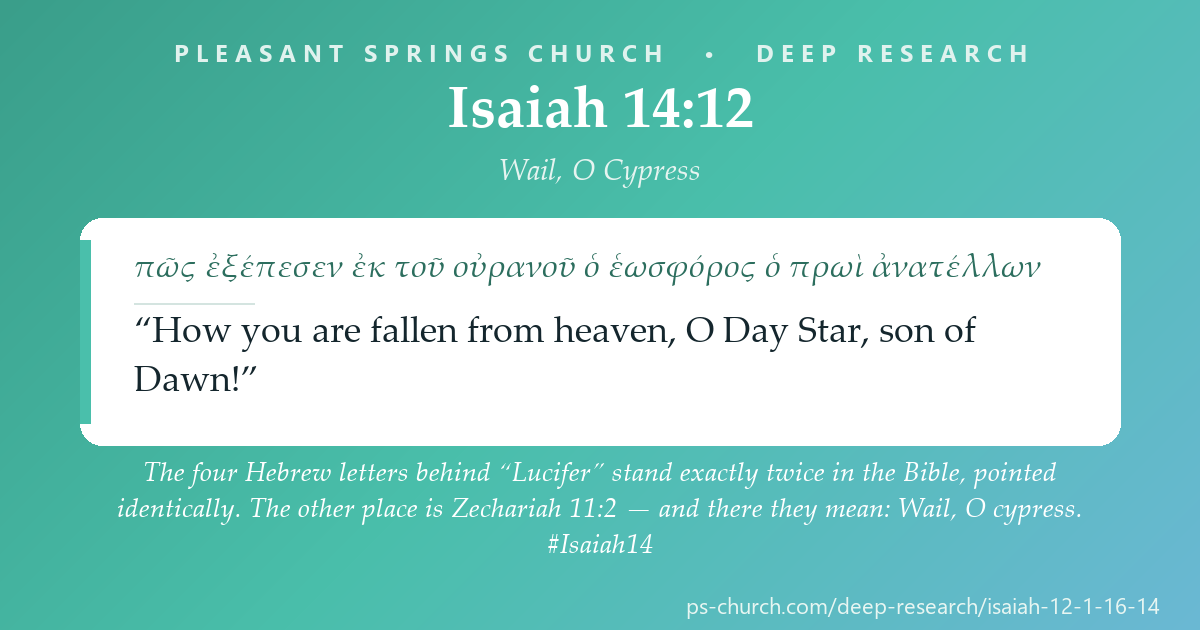
Four Hebrew letters in Isaiah 14:12 — הילל — became, by way of the Greek ἑωσφόρος and the Latin lucifer, a proper name for the devil. Those four letters stand exactly twice in the Hebrew Bible, pointed identically both times. The other place is Zechariah 11:2, and there nobody has ever taken them for a name, because there they are plainly an imperative: Wail, O cypress! The same command opens this very oracle six verses into chapter 13. Three more things this page can show rather than assert. The deepest New Testament run in all 83 verses is six words, and it is Isaiah 13:10 in Matthew 24:29 and Mark 13:24 — while the verse everyone pairs with Luke 10:18 reaches three, with a tie band of seventy. Chapter 12 turns out to be stitched out of older songs: verse 2 is Exodus 15:2 cut by one word, verse 4 runs seven words with 1 Chronicles 16:8, and verse 3, between them, shares no two consecutive words with any other verse in the Bible. And the Moab oracle’s famous overlap with Jeremiah 48 — thirteen towns named in both — never once reaches four consecutive words, in Hebrew or in Greek. See the method →
Isaiah 12:1–16:14 (selections)
Hebrew · Greek (CATSS, Rahlfs’ Septuaginta) · ESVWhat was measured for this page. All 83 Greek rows of these five chapters against all 7,927 verses of the Greek New Testament; all 83 Hebrew verses against every other verse of the 23,204-unit Masoretic corpus; Isaiah 15–16 verse by verse against Jeremiah 48 in Hebrew and against Greek Jeremiah 31 — which is the same oracle — in Greek; the two occurrences of הילל; the seven occurrences of ἑωσφόρος; and the five occurrences of lucifer in the Clementine Vulgate. Every figure on this page came out of those runs.
⚠️ NUMBERING — there is no offset in this passage. Derived from the two corpora on this disk, not assumed: Masoretic and CATSS Isaiah both run 6 / 22 / 32 / 9 / 14 across chapters 12 to 16, and the ESV runs the same. The only two chapters in the whole of Isaiah where the Hebrew and the Greek disagree on verse count are chapter 2 (MT 22, LXX 21) and chapter 56 (MT 12, LXX 11), and both are outside this passage. There is one genuine seam elsewhere in the book — English 64:2–12 = MT 64:1–11, because the Hebrew ends chapter 63 with a long verse 19 — and it is nowhere near here. Every reference on this page carries the same number in all three columns.
⚠️ One offset does matter to this page, and it is Jeremiah’s. The Moab oracle this passage is constantly compared with is Jeremiah 48 in Hebrew and Jeremiah 31 in the Greek — Greek Jeremiah orders the oracles against the nations differently. Both were screened, and the page names which numbering it is using every time.
The Shape of the Passage
Sequence — two songs, two oracles, and a singing that stopsThese five chapters raise the authorship question in its sharpest form, and the page will not pretend to settle it. Isaiah 13:1 names Isaiah son of Amoz, an eighth-century Jerusalemite. The oracle under that name is against Babylon, which in the eighth century was a subject city of Assyria and not yet the power that would take Judah away. 14:28 dates the Philistia oracle by the death of King Ahaz, which is eighth-century and specific. Both facts are in the text; the page prints both and adjudicates neither.
Author
A name in the superscription, and a date in the middle. 13:1 attributes the Babylon oracle to יְשַׁעְיָהוּ בֶּן־אָמוֹץ, and its last five words stand word for word inside Isaiah 2:1, tie band one — no other verse in the Hebrew Bible has that sequence. Whoever compiled the book used the same formula at both places.
The Greek column keeps the name and loses the pun. Ησαιας υἱὸς Αμως — and Αμως is also how the Greek spells the prophet Amos, who is a different man with a different Hebrew name (אָמוֹץ against עָמוֹס). A distinction the Hebrew keeps and the Greek does not.
Audience
Addressed to Babylon and Moab; written for people who would sing. 14:3–4 says it plainly: when the Lord has given you rest… you will take up this taunt. The taunt-song is scripted for Judah to perform. So is chapter 12: its two halves are addressed first to one person and then to a crowd.
And the audience is expected to know the older songs by heart. 12:2 is Exodus 15:2 with one word inserted; 12:4 is 1 Chronicles 16:8 word for word for seven words. Neither is announced as a quotation. The page measured both rather than asserting them, and does not say which text had the words first.
Orient on the oracle collection, on Babylon in an eighth-century book, and on a numbering that for once causes no trouble at all.
Search by topic: Isaiah, book of; oracles against the nations; massa / burden; Babylon; Chaldeans; day of the LORD; Helel; Day Star; Lucifer; Sheol; Rephaim; Moab; Mesha; Ar; Kir-hareseth; Sibmah.
Which articles are relevant?
- Anchor Bible Dictionary — “Isaiah, Book of,” “Babylon,” “Moab,” “Helel,” “Day Star,” “Sheol,” “Rephaim,” “Oracles against the Nations.”
- Dictionary of the OT: Prophets (IVP) — “Isaiah: Book of,” “Nations,” “Day of the LORD,” “Divine Assembly,” “Mythology.”
- NIDOTTE — מַשָּׂא, ילל, הלל, שְׁאוֹל, רנן, גָּאוֹן.
- Dictionary of NT Use of the OT (Beale & Carson) — on Matthew 24:29 and Mark 13:24–25, and on Matthew 11:23 / Luke 10:15.
- None of these were consulted for the measurements below. They are where a reader should go for what this page did not do.
Settle the numbering first — and here there is nothing to settle
Isaiah is one of the easy books. Across chapters 12 to 16 the Hebrew, the Greek and the English agree verse for verse.
| ch 12 | ch 13 | ch 14 | ch 15 | ch 16 | total | |
|---|---|---|---|---|---|---|
| Masoretic | 6 | 22 | 32 | 9 | 14 | 83 |
| CATSS Greek | 6 | 22 | 32 | 9 | 14 | 83 |
| ESV | 6 | 22 | 32 | 9 | 14 | 83 |
The Masoretic and CATSS rows were counted off the two corpora on this disk; the ESV row is read off the printed English, which is not held here as a file. Across the whole book the Hebrew and the Greek disagree on verse count in exactly two chapters — chapter 2 (MT 22, LXX 21) and chapter 56 (MT 12, LXX 11) — and neither is in this passage. There is a real English/Hebrew seam at the end of chapter 63, where the Hebrew’s long verse 19 supplies what English prints as 64:1, so English 64:2–12 = MT 64:1–11. It is fifty chapters away from here.
⚠️ But one offset does bite this page, and it belongs to Jeremiah. The Moab oracle everyone compares with Isaiah 15–16 is Jeremiah 48 in Hebrew and English and Jeremiah 31 in the Greek: Greek Jeremiah places the oracles against the nations in a different order and at different chapter numbers. Both were screened for this page and each reference below says which numbering it is in.
A star that falls, a mountain where gods meet, and a road through Moab.
The name, letter by letter — and the other place it stands
This is the page’s central measurement, and it is small enough to check by hand.
| verse | the Hebrew | how it is read | Greek column | Vulgate |
|---|---|---|---|---|
| Isaiah 14:12 | הֵילֵל בֶּן־שָׁחַר | a noun — Day Star, son of Dawn | ὁ ἑωσφόρος ὁ πρωὶ ἀνατέλλων | Lucifer, qui mane oriebaris |
| Zechariah 11:2 | הֵילֵל בְּרוֹשׁ | an imperative — Wail, O cypress! | ὀλολυξάτω πίτυς | Ulula, abies |
| Isaiah 13:6 | הֵילִילוּ | an imperative plural — Wail! | ὀλολύζετε | Ululate |
Two occurrences of הילל in the entire Hebrew Bible, and the Masoretes pointed them the same way both times — הֵילֵל, tsere–yod then tsere, at Isaiah 14:12 and at Zechariah 11:2. Searched across all 23,204 verse units. Widen the search to the consonants with a prefix or a suffix attached and there are five: these two plus Jeremiah 47:2, Ezekiel 21:17 and Joel 1:5, and all three of those are unambiguously the verb ילל, to howl.
What is and is not being claimed. The two ancient versions both read Isaiah 14:12 as a noun and Zechariah 11:2 as a verb, and they are the earliest readers anyone can check. This page is not proposing that Isaiah 14:12 means wail. It is reporting that the form is identical to a form the Bible elsewhere uses as a command to howl, that the same oracle opens with that command six verses earlier, and that the reading as a name rests on the versions and on the context rather than on anything unique in the letters.
Where the tradition of Lucifer actually comes from — counted
The Latin word lucifer stands five times in the Clementine Vulgate. Only one of the five has a capital letter, and the capital is a printer’s.
| place | the Latin | what it means there |
|---|---|---|
| Isaiah 14:12 | Lucifer, qui mane oriebaris | the king of Babylon, addressed as the morning star |
| Job 11:17 | orieris ut lucifer | Zophar to Job: you will shine out like the morning |
| Job 38:32 | numquid producis luciferum in tempore suo | a constellation God brings out on time |
| Psalm 109:3 (=110:3) | ex utero, ante luciferum, genui te | the begetting of the king — read of Christ from the second century on |
| 2 Peter 1:19 | et lucifer oriatur in cordibus vestris | the morning star rising in the heart of a believer |
Read straight off the Clementine text held here, book by book. Four of the five are the plain morning star, and two of those four the church has read of Christ. The Greek behind 2 Peter 1:19 is φωσφόρος, which occurs once in the New Testament; Revelation 22:16 has Jesus say ἐγώ εἰμι… ὁ ἀστὴρ ὁ λαμπρός, ὁ πρωϊνός, the bright morning star, using different words again. Measured, Greek Isaiah 14:12 shares 0 words with 2 Peter 1:19 and 1 word with Revelation 22:16.
The Greek side behaves the same way. ἑωσφόρος stands seven times across the 30,348 Greek Old Testament verse units a run screen sees here: 1 Samuel 30:17, Job 3:9, 11:17, 38:12, 41:10, Psalm 109:3 and Isaiah 14:12. Four of the seven are in Job, where it is simply dawn. It is not a proper name anywhere in the Greek Old Testament held on this shelf.
The mount of assembly, and what the Greek column does with it
Isaiah 14:13 has two phrases that a reader of the Greek alone cannot see.
| Hebrew | literally | Greek column |
|---|---|---|
| כּוֹכְבֵי־אֵל | the stars of El | τῶν ἄστρων τοῦ οὐρανοῦ — the stars of heaven |
| הַר־מוֹעֵד | the mount of meeting / assembly | ἐν ὄρει ὑψηλῷ — on a high mountain |
| בְּיַרְכְּתֵי צָפוֹן | in the far reaches of Zaphon / the north | τὰ ὄρη τὰ ὑψηλὰ τὰ πρὸς βορρᾶν — the high mountains toward the north |
Three phrases, and in each of them the Hebrew has language of a divine assembly on a mountain and the Greek has topography. The page reports the difference and does not explain it — nothing here says one column changed the other, and nothing here says which is earlier.
⚠️ NOT VERIFIABLE FROM LOCAL CORPORA. Commentaries routinely compare Isaiah 14:12–15 with Ugaritic material about Athtar, the god who tries to sit on Baal’s throne, and with Mount Zaphon as Baal’s mountain. No Ugaritic text is held on this shelf and none was consulted. The comparison is named here as the kind of evidence that is offered for reading these verses against Canaanite myth, and it is not evidence this page checked. What this page checked is what the Hebrew and Greek columns say.
The Moab road, and what a shared route is not
Isaiah 15–16 and Jeremiah 48 walk the same country, and that is a real fact about the two texts. It is a fact about place names, not about sentences.
| town | Isaiah 15–16 | Jeremiah 48 (MT) |
|---|---|---|
| Nebo | 15:2 | 48:1, 48:22 |
| Heshbon | 15:4, 16:8, 16:9 | 48:2, 48:34, 48:45 |
| Elealeh | 15:4, 16:9 | 48:34 |
| Jahaz | 15:4 | 48:34 |
| Zoar | 15:5 | 48:34 |
| Nimrim | 15:6 | 48:34 |
| Sibmah | 16:8, 16:9 | 48:32 |
| Jazer | 16:8, 16:9 | 48:32 |
| Eglath-shelishiyah | 15:5 | 48:34 |
| Kir | 15:1, 16:7, 16:11 | 48:31, 48:36 |
| Horonaim | 15:5 חוֹרֹנַיִם | 48:5 חוֹרֹנַיִם, 48:34 חֹרֹנַיִם |
| Dibon | 15:2 דִּיבֹן | 48:18, 48:22 דִּיבוֹן — never spelled alike |
| Luhith | 15:5 הַלּוּחִית | 48:5 הַלֻּחִית — never spelled alike |
| Ar, Medeba, Dimon | 15:1, 15:2, 15:9 | — not in Jeremiah 48 |
Thirteen towns named in both and three named only by Isaiah, on a strict word-form search allowing a single prefixed letter. And two of the thirteen are never spelled the same way in the two books. Dibon is דִּיבֹן in Isaiah and דִּיבוֹן in Jeremiah; Luhith is הַלּוּחִית in Isaiah and הַלֻּחִית in Jeremiah. Horonaim goes both ways — Jeremiah 48:5 matches Isaiah exactly and Jeremiah 48:34 does not. This matters for every number on this page, because a run screen that keeps vowel letters counts a plene spelling as a different word, and the Luhith difference is one of the three places where a single letter cuts a run.
The one thing that can be dated in the Moab material was not consulted. The Mesha Stele — the ninth-century Moabite inscription that names several of these towns — is the standard external witness for the geography, and no epigraphic text was read for this page. Neither was any Assyrian or Babylonian record bearing on the fall of Babylon in 539. Both are named here as the kind of evidence the historical picture rests on, not as anything checked.
A name that is also a command, a burden that is also a lifting, and a verb that runs the length of the passage.
Isaiah 14:12. Exactly two occurrences in the Hebrew Bible with this pointing, and the other — Zechariah 11:2 — is the imperative wail. The Greek column reads a noun here (ἑωσφόρος) and a verb there (ὀλολυξάτω); so does the Vulgate.
Isaiah 13:1 and 15:1. 40 occurrences of this exact form in the Hebrew Bible; nine of them head the oracles of Isaiah 13–23, two of those nine in this passage. From נשא, to lift — the same noun means a load carried. The Greek column does not keep one word for it: ὅρασις (vision) at 13:1, τὸ ῥῆμα (the word) at 15:1.
12:6, 14:7, 16:10 — the only three occurrences of the root in these 83 verses. Zion is told to sing; the earth breaks out singing when the tyrant falls; and in the vineyards of Moab no songs are sung. Commanded, granted, stopped.
Isaiah 14:12. Seven occurrences across the 30,348 Greek Old Testament verse units screened here, four of them in Job, where it is plainly the dawn. Not a proper name anywhere in the Greek Old Testament held on this shelf. The New Testament word for the morning star is a different one, φωσφόρος, once, at 2 Peter 1:19.
14:9, 14:11, 14:15 — the taunt’s destination, three times. The Greek column has ᾅδης each time, and at 14:15 the two words ᾅδου καταβήσῃ stand in the Greek New Testament exactly once, at Matthew 11:23.
16:6, where Isaiah stacks four words from the root גאה in a single verse. Jeremiah 48:29 stacks four from the same root and adds גֹּבַהּ and רֻם on top of them — and the run between the two verses is three words, because one of them writes גֵּא and the other גֵּאֶה.
Thirteen verses that stand alone in the whole Hebrew Bible
Screened against every other verse of the 23,204-unit Masoretic corpus, thirteen of these 83 verses share no two consecutive words with anything — one verse in six.
| chapter | verses with max = 0 |
|---|---|
| 12 | 12:3 |
| 13 | 13:3, 13:12, 13:16 |
| 14 | 14:5, 14:6, 14:11, 14:16, 14:19, 14:25, 14:30 — seven, more than any other chapter here |
| 15 | none |
| 16 | 16:3, 16:5 |
Eleven of the thirteen are lines of destruction. Two are not, and those two are the ones worth naming.
| verse | result | what it says |
|---|---|---|
| Isaiah 12:3 | max = 0 | With joy you will draw water from the wells of salvation |
| Isaiah 16:5 | max = 0 | a throne… in the tent of David, one who judges and seeks justice |
⚠️ What a zero means on this screen. The Hebrew-side screen used here counts contiguous runs and does not fall back to single words, so 0 means: shares no two consecutive words with any other verse in the Hebrew Bible. It does not mean the words are rare. Isaiah 12:3 uses מַיִם, which stands 265 times. What is unusual is the sequence — and two of its five words, וּשְׁאַבְתֶּם and מִמַּעַיְנֵי, occur nowhere else in the Bible in that form.
The placement is worth seeing. Isaiah 12:3 sits between two verses that are quotations — verse 2 from the Song of the Sea, verse 4 from the psalm David gave the Levites — and it is the one line in the chapter that is not made of older words. And Isaiah 16:5 sits in the middle of two chapters of ruin, and is the one promise in them.
Every run in these five chapters, with its tie band, including the ones that come out small.
The whole New Testament screen, in one table
All 83 Greek rows of Isaiah 12–16 against all 7,927 verses of the Greek New Testament. One row reaches six. No row reaches five. Eight reach four.
| run | rows | note |
|---|---|---|
| 6 | 1 | Isaiah 13:10 — Matthew 24:29 and Mark 13:24 |
| 5 | 0 | nothing at all in this band |
| 4 | 8 | four of the eight are one formula — see below |
| 3 | 49 | |
| 2 | 24 | |
| 1 | 1 |
The eight rows at four, with their bands:
| row | partner | band | shared words |
|---|---|---|---|
| Isa 12:1 | Mt 13:1 and others | 4 | ἐν τῇ ἡμέρᾳ ἐκείνῃ |
| Isa 12:4 | Mt 13:1 and others | 4 | ἐν τῇ ἡμέρᾳ ἐκείνῃ |
| Isa 14:3 | Mt 13:1 and others | 4 | ἐν τῇ ἡμέρᾳ ἐκείνῃ |
| Isa 14:4 | Mt 13:1 and others | 4 | ἐν τῇ ἡμέρᾳ ἐκείνῃ |
| Isa 14:18 | Lk 22:25, Ac 11:13, Heb 3:2 | 3 | οἱ βασιλεῖς τῶν ἐθνῶν / ἐν τῷ οἴκῳ αὐτοῦ |
| Isa 12:5 | Romans 9:17 | 1 | ἐν πάσῃ τῇ γῇ |
| Isa 15:3 | Matthew 6:2 | 1 | καὶ ἐν ταῖς ῥύμαις |
| Isa 16:13 | Luke 2:50 | 1 | τὸ ῥῆμα ὃ ἐλάλησεν |
Four of the eight are ἐν τῇ ἡμέρᾳ ἐκείνῃ, in that day — a phrase so common that its band is four and its partners include the opening line of a parable chapter. The three with a band of one are all coincidences: Isaiah 15:3 is Moab wailing on the housetops and Matthew 6:2 is hypocrites trumpeting in the streets; Isaiah 16:13 and Luke 2:50 both happen to say the word which he spoke. The page prints them precisely so that a run of four is not read as more than it is.
The one deep run, and where it stops
Isaiah 13:10 is the only row in the 83 to reach past four, and it reaches six with a tie band of two.
| text | the line |
|---|---|
| CATSS Isaiah 13:10 | … καὶ ἡ σελήνη οὐ δώσει τὸ φῶς αὐτῆς |
| Matthew 24:29 | … καὶ ἡ σελήνη οὐ δώσει τὸ φέγγος αὐτῆς |
| Mark 13:24 | … καὶ ἡ σελήνη οὐ δώσει τὸ φέγγος αὐτῆς |
Six words, and the seventh is a synonym. The Hebrew of this clause has a different verb from either: וְיָרֵחַ לֹא־יַגִּיהַּ אוֹרוֹ, and the moon will not make its light shine — the root נגה, to shine, not to give. The Greek column has give, and both Gospels have give. The page reports that the Gospel line stands with the Greek column at that verb and departs from it at the very next word, and asserts nothing about who read what.
Mark 13:25 also reaches three with Isaiah 14:12 — ἐκ τοῦ οὐρανοῦ, stars falling from heaven — which is the same three words Luke 10:18 reaches with it, in a sentence about something else entirely.
Isaiah 14:12 and Luke 10:18 — the page’s own counter-example
No pairing in these five chapters is quoted more often than How you are fallen from heaven beside I saw Satan fall like lightning from heaven. Measured, it is the weakest kind of contact this shelf reports.
| comparison | run | tie band | words |
|---|---|---|---|
| CATSS Isaiah 14:12 vs Luke 10:18 | 3 | 70 | ἐκ τοῦ οὐρανοῦ |
| CATSS Isaiah 14:12 vs Revelation 22:16 | 1 | — | ὁ |
| CATSS Isaiah 14:12 vs 2 Peter 1:19 | 0 | — | nothing at all |
| CATSS Isaiah 13:21 vs Revelation 18:2 | 1 | — | καί |
| CATSS Isaiah 12:3 vs John 7:37–38 | 1 | — | καί / ἐκ |
| CATSS Isaiah 14:15 vs Matthew 11:23 | 2 | 256 | ᾅδου καταβήσῃ — but that pair of words occurs once |
A tie band of seventy means seventy other New Testament verses reach the same depth with Isaiah 14:12, because ἐκ τοῦ οὐρανοῦ is ordinary Greek for out of heaven and John 6 alone contributes a dozen of them. The measurement does not make the theological connection wrong — it makes it a connection of picture and theme rather than of wording, which is a different claim and a smaller one. And the strongest evidence on the table is not the deepest run on it: two words, ᾅδου καταβήσῃ, standing once in the whole Greek New Testament, where Jesus turns the Babylon taunt on Capernaum.
Two more that come out small and are printed anyway. Isaiah 13:21 — ruined Babylon full of wild creatures, and the Greek column even supplies δαιμόνια — is universally cited behind Revelation 18:2. Shared run: one word. And Isaiah 12:3, you will draw water from the wells of salvation, is the verse behind the water-drawing at the Feast of Booths that John 7:37 is set at. Shared run with John 7:37 or 7:38: one word.
The Moab doublet — and the one it should be compared to
Isaiah 15–16 and Jeremiah 48 are the standard example of a prophetic doublet. Measured verse by verse in both languages, they never once reach four consecutive words.
| Isaiah verse | deepest partner in Jeremiah 48 | run | shared |
|---|---|---|---|
| 15:5 | Jer 48:34 | 3 | עֶגְלַת שְׁלִשִׁיָּה כִּי |
| 16:6 | Jer 48:29 | 3 | שָׁמַעְנוּ גְאוֹן מוֹאָב |
| 16:9 | Jer 48:32 | 3 | עַל קֵיצֵךְ וְעַל |
| 15:2 | Jer 48:22 | 2 | נְבוֹ וְעַל |
| 16:8 | Jer 48:32 | 2 | יַעְזֵר נָגָעוּ |
| the other 18 verses | various | 2 or 1 |
Now the comparison that gives the number a scale. The Obadiah / Jeremiah 49 overlap, measured on this shelf by the same screen, reaches five twice and four three times inside its first eight verses — Obadiah 2 and Jeremiah 49:15 share הִנֵּה קָטֹן נְתַתִּיךָ בַגּוֹיִם בָּזוּי, five words, and Obadiah 4 and Jeremiah 49:16 share five more. That is what a verbal doublet looks like on this measurement. The Moab pair does not look like it.
The Greek column says the same thing about the same texts. Screening all 23 rows of Greek Isaiah 15–16 against all 44 rows of Greek Jeremiah 31 — which is Hebrew Jeremiah 48 — the deepest run is again three, and it is καὶ ἔσται εἰς, which carries no information at all.
And three times the run is cut by a single letter. Isaiah 15:5 and Jeremiah 48:5 have nearly the same clause; Isaiah writes הַלּוּחִית and Jeremiah הַלֻּחִית, and the run drops to two. Isaiah 16:6 writes גֵּא where Jeremiah 48:29 writes גֵּאֶה, and the run stops at three. Isaiah 15:5 writes חוֹרֹנַיִם where Jeremiah 48:34 writes חֹרֹנַיִם — though Jeremiah 48:5, five verses earlier, spells it exactly as Isaiah does. These are spelling differences, not different words — and this page names every one of them rather than quietly smoothing them, because the whole finding depends on how the runs were counted.
Chapter 12 is made of older songs, and the seams can be pointed at
| verse | partner | run | band | what cuts it |
|---|---|---|---|---|
| 12:2 | Exodus 15:2 and Psalm 118:14 | 3 | 2 | the divine name. Exodus and the Psalm share six words with each other; Isaiah has all six, with יְהֹוָה inserted after the third |
| 12:3 | nothing | 0 | — | shares no two consecutive words with any verse in the Bible |
| 12:4 | 1 Chronicles 16:8 | 7 | 1 | nothing — this is the deepest Hebrew run in the passage |
| 12:4 | Psalm 105:1 | 6 | — | one vowel letter. The Psalm spells the seventh word עֲלִילוֹתָיו; Isaiah and Chronicles both have עֲלִילֹתָיו |
And the Greek column hides half of it. In Hebrew, Isaiah 12:2 and Exodus 15:2 share עׇזִּי וְזִמְרָת יָהּ. In Greek they share a different four words — ἐγένετό μοι εἰς σωτηρίαν, the second half of the line — because the two Greek columns have two different things at עׇזִּי וְזִמְרָת יָהּ: ἡ δόξα μου καὶ ἡ αἴνεσίς μου κύριος in Isaiah, βοηθὸς καὶ σκεπαστής in Exodus. A reader working only from the Greek can see half the quotation; a reader working only from the English sees all of it and none of the seams.
Was any of this an acrostic? No — screened, and reported
All five chapters were run through the verse-initial acrostic screen, because Isaiah does contain alphabetic material elsewhere and the question should be asked rather than assumed. None of the five is an acrostic. Chapter 12’s six verses begin waw, he, waw, waw, zayin, tsade; the longest run of letters in alphabetical order anywhere in the five is two. The screen sees verse-initial letters only, so a colon-internal acrostic of the kind found in Nahum 1 would be invisible to it, and that limitation is stated rather than glossed.
Where this page is weakest, what it did not consult, and what it cannot decide.
The limits — named
The largest question these chapters raise is one this page cannot answer, and it should not be allowed to look as though it could. Isaiah 13–14 is an oracle against Babylon in a book headed by an eighth-century prophet, at a time when Babylon was not the threat. Whether the oracle is Isaiah’s, whether it was written later and placed under his name, or whether an earlier poem about an Assyrian king was redirected, is argued at length in the literature and turns on evidence — redactional, historical, linguistic — that no run screen touches. The page states the two facts the text itself gives (the superscription at 13:1, the date at 14:28) and stops.
The Ugaritic comparison is the single biggest gap. Nearly every modern treatment of Isaiah 14:12–15 reads it against Canaanite myth — Athtar, Baal, Mount Zaphon. No Ugaritic text is held on this shelf; none was consulted; and nothing on this page rests on it. What the page can show is what the two columns print: the Hebrew has the stars of El and the mount of assembly, and the Greek has stars of heaven and a high mountain. Readers who want the Ugaritic argument should go to the commentaries below and should be told plainly that this page is not one of them.
The measurement finds verbatim contact, not allusion — and on this passage that cuts against the page’s own most interesting claim. A screen that counts consecutive word forms will always undercount a doublet whose two halves share ideas, a route and a dozen proper names but not sentences. The correct conclusion from the Moab numbers is that Isaiah 15–16 and Jeremiah 48 are not verbally parallel in the way Obadiah and Jeremiah 49 are — not that they are unrelated. They are obviously related. The page has measured one specific kind of relation and says so.
And the הילל finding has a limit that must be printed beside it. Two occurrences is a very small sample. The reading of Isaiah 14:12 as a noun is supported by the Greek, by the Vulgate, by the parallel בֶּן־שָׁחַר (son of dawn, which wants a noun beside it) and by the whole shape of the taunt. Nothing here overturns that. What the measurement adds is that the form is not distinctive, that the same oracle uses the wailing verb at 13:6, and that the certainty many readers feel about the word comes from the translation history rather than from the Hebrew.
What could not be checked at all
No Hebrew or Greek critical apparatus. No Qumran material — and for Isaiah that is a serious gap, since the Great Isaiah Scroll (1QIsaa) is the best-preserved biblical manuscript from Qumran and covers all five of these chapters; it was not consulted, and several of the spelling differences this page reports (הַלּוּחִית / הַלֻּחִית, עֲלִילֹתָיו / עֲלִילוֹתָיו) are exactly the sort of thing a scroll reading would bear on. No Targum, Syriac, Aquila, Symmachus or Theodotion. No Ugaritic. No Mesha Stele, no Assyrian or Babylonian chronicle, no Herodotus.
The Latin here is the Clementine Vulgate as held on this shelf, which is a printed edition of 1592 and not Jerome’s autograph; the capital on Lucifer at Isaiah 14:12 is an editorial decision of that tradition, and the page says so rather than resting anything on it. The Vulgate is a witness on this shelf and is never levelled with Scripture.
⚠️ The Hebrew and the Greek on this page were read off the files; the English was not. There is no ESV text of Isaiah on this disk and no Crossway API key on this machine, so the English column of the codex was typed by hand from the ESV and then proofread, verse by verse, against the Hebrew and the Greek printed beside it. The Hebrew and the Greek were rebuilt directly out of the corpus files, cantillation and all; the English is the one column on this page that is not machine-bound, and no measurement on this page depends on it.
The Greek Old Testament figures on this page are counted over the corpus actually screened here: 64 CATSS files, 30,637 verse units held, of which a run screen sees 30,348. The difference is the Odes, which are excluded because they are not an independent witness — Ode 9 is Luke 1 and Ode 13 is Luke 2 copied into a Greek Old Testament manuscript. Ten more Odes are second copies of material already counted elsewhere in the Greek Old Testament — checked against the file: Ode 1 is Exodus 15, Ode 2 Deuteronomy 32, Ode 3 1 Samuel 2, Ode 4 Habakkuk 3, Ode 5 Isaiah 26, Ode 6 Jonah 2, Odes 7 and 8 Daniel 3, Ode 10 Isaiah 5 and Ode 11 Isaiah 38. Counting them would double-count Isaiah against itself three times over — Odes 5, 10 and 11. The remaining two — the Prayer of Manasseh and the morning hymn — are not in the Hebrew canon at all.
Reading list
- Joseph Blenkinsopp, Isaiah 1–39 (Anchor Yale Bible 19).
- H. G. M. Williamson, Isaiah 1–27 (International Critical Commentary, in progress).
- John Goldingay on Isaiah — series and volume not verified against any catalogue held on this shelf; the ICC Isaiah volumes named above are Williamson’s.
- Hans Wildberger, Isaiah 13–27 (Continental Commentary).
- Ronald L. Troxel, LXX-Isaiah as Translation and Interpretation — on the Greek column’s habits, including its handling of place names.
- None of these were consulted for the measurements on this page, which were run on the text files named in the footer.
A word read two ways, and a song that stops.
The same four letters
Six verses into the Babylon oracle the prophet says הֵילִילוּ — wail. Twenty-eight verses later he addresses the king of Babylon as הֵילֵל בֶּן־שָׁחַר. The Greek column has a verb at the first and a noun at the second, the Latin does the same, and the whole of Western Christian demonology follows the second reading.
The one other place those four letters stand in the Hebrew Bible — Zechariah 11:2, pointed exactly the same — is Wail, O cypress, for the cedar has fallen. A tree told to howl because a bigger tree came down. Which is, if you say it out loud, more or less what Isaiah 14 is about.
And there is one word that runs the whole length of these five chapters, and it is not the one anybody remembers. In 12:6 Zion is told to shout and sing. In 14:7, when the tyrant falls, the whole earth breaks out into singing — the same root. In 16:10, in the vineyards of Moab, no songs are sung. Three occurrences, and no more: commanded, granted, stopped. The passage that gave the devil his name also, and more quietly, tracks what happens to a song.
This study takes Isaiah 12 through 16 — the song of salvation and the first two oracles against the nations. Elsewhere on this shelf: Isaiah 7:14, Isaiah 9:6–7, Isaiah 52:13–53:12 and Isaiah 61:1–3. The day-of-the-LORD formula measured at 13:6 also stands in Obadiah 15 and in Joel.
Every Deep Research page traces its passage across the whole sweep — the Old Testament, the Second-Temple world between the testaments (historical witnesses, not Scripture), and the New Testament. Follow the thread:
Pleasant Springs Church — Deep Research
Research method after Michael S. Heiser’s Bible Research Method (examine dictionaries → ancient literature → important words → textual connections → academic publications → share), with the Pleasant Springs “Author & Audience” foundation. Scripture set in the Hebrew, the Greek editions named on each page and the ESV (Old Testament), and the Greek New Testament and the ESV (New Testament), per the practice of Pleasant Springs Church. Isaiah 12–16 research grounded in Blenkinsopp (Anchor Yale), Williamson (ICC), Goldingay, Wildberger and Troxel on LXX-Isaiah. Text: Hebrew from the Masoretic text as printed in the edition consulted — Sefaria’s Miqra according to the Masorah, cantillation kept and section markers stripped; no critical apparatus was consulted for the Hebrew. Greek from Rahlfs’ Septuaginta as digitized by CATSS; Greek New Testament from the SBL edition via MorphGNT; Latin from the Clementine Vulgate, a witness on this shelf and never levelled with Scripture. The standing caution for this shelf applies: these pages say “the CATSS Greek row reads…” and never call a Greek reading early or late. ⚠️ VERSE NUMBERING — there is no offset in this passage. Derived from the files on this disk: Masoretic and CATSS Isaiah both run 6 / 22 / 32 / 9 / 14 across chapters 12–16, and so does the ESV. Across the whole book the two corpora differ on verse count only at chapter 2 (MT 22, LXX 21) and chapter 56 (MT 12, LXX 11); the one English seam, English 64:2–12 = MT 64:1–11, is fifty chapters from here. The offset that does matter to this page is Jeremiah’s: the Moab oracle compared with Isaiah 15–16 is Jeremiah 48 in Hebrew and Jeremiah 31 in the Greek, and both were screened under their own numbers. ⚠️ The English column was typed by hand. No ESV text of Isaiah is held on this disk and no Crossway API key is present, so the ESV lines in the codex were set by hand and proofread against the Hebrew and the Greek printed beside them. The Hebrew and Greek columns were rebuilt directly from the corpus files, cantillation and all, and every number on this page was measured on those files rather than on the English. ⚠️ The Greek measurement, in full. Greek against Greek. CATSS FORM column (cols 0–24), beta-code transliterated first; MorphGNT field 6, the normalised word. Both sides lowercased, accents and breathings dropped, final sigma folded, then filtered to Greek letters — the same filter applied to both corpora — and cross-corpus runs apply MorphGNT’s own spelling equivalences (ou/ouk/ouch, ek/ex, the movable nu), so a shared run is not cut at a word the two editions merely spell differently. Figures on this page are therefore higher than a page written before 30 August 2026 would report, and no run figure here was copied from a sibling page — every one was re-measured. Word forms, never lemmas. Corpus: the 83 CATSS rows of Isaiah 12–16 against 7,927 verses across 27 MorphGNT files. The Greek Old Testament counts are over 64 CATSS files, 30,637 verse units held, of which a run screen sees 30,348 — the Odes are excluded because they are second copies of material already counted, Ode 9 being Luke 1 and Ode 13 Luke 2, and ten more being duplicates of Exodus 15, Deuteronomy 32, 1 Samuel 2, Habakkuk 3, Isaiah 5, Isaiah 26, Isaiah 38, Jonah 2 and Daniel 3 twice. Exhaustive and deterministic; nothing sampled, so no seed applies. ⚠️ The Hebrew measurement, in full. Hebrew against Hebrew over the 23,204-unit Masoretic corpus. Markup stripped; the qere read; cantillation and vowel points removed; final letter-forms folded to medial; maqqef treated as a word separator and never as a weld. Contiguous runs of whole consonantal word forms, never lemmas and never roots. A row reported as 0 on this screen shares no two consecutive words with any other verse in the Hebrew Bible — it may still share individual words, and Isaiah 12:3 and 16:5 both do. Because vowel points are removed but vowel letters are not, a plene or defective spelling ends a run; every place on this page where that happens is named (12:4 against Psalm 105:1, 15:5 against Jeremiah 48:5 and 48:34, 16:6 against Jeremiah 48:29). ⚠️ Direction of influence is never asserted. Nothing here says that Matthew or Mark is quoting Greek Isaiah, that Jeremiah 48 is copying Isaiah 15–16 or the reverse, that Isaiah 12:2 is quoting Exodus 15:2 rather than both drawing on something older, that Luke 10:18 has Isaiah 14:12 in view, or what produced any Greek reading — including the stars of heaven at 14:13, the wall of Moab at 15:1, the three-year-old heifer at 15:5 and the demons at 13:21. The reading of הֵילֵל as a proper name is reported as a history of translation, not corrected. Typology is handled per the house position: what the text says, what the New Testament itself draws, and what we see from this side of the cross — with the seeing left to the reader.
Scripture quotations marked ESV are from the ESV® Bible (The Holy Bible, English Standard Version®), © 2001 by Crossway, a publishing ministry of Good News Publishers. ESV Text Edition: 2016. Used by permission. All rights reserved. The ESV text may not be quoted in any publication made available to the public by a Creative Commons license, and the ESV may not be translated in whole or in part into any other language. www.esv.org
|
Did this study bless you today? 💚 Give to Support PS Church100% of gifts go to the General Fund — thank you. |