Damascus is told it will stop being a
city. A people beyond the rivers of Cush send ambassadors in papyrus boats and are told that God is
watching quietly and will prune at the right moment. Egypt gets twenty-five verses that open with the
Lord arriving on a cloud and close with him calling Egypt
my people. And then, in flat prose dated by an Assyrian campaign, a prophet takes off his
sackcloth and his sandals and walks Jerusalem naked and barefoot for three years.
This study measures rather than asserts. Screened against the Greek New Testament, these four chapters
yield three runs of five and nothing deeper. Two of the three are stock phrases the rest
of the Greek Bible carries in eleven and in four of its verses, and the page prints those first so that nothing
else is over-read. The third is five words that the Greek Bible says only twice —
once in the 30,348 Greek Old Testament verse units screened here, at Isaiah 19:16, and once in the
7,927 verses of the Greek New Testament, at 1 Corinthians 2:3. Along the way: a half-verse where the
Hebrew names a City of Destruction and the Greek names a City of Righteousness, each
unique to that verse in its own corpus; the only appearance of Sargon’s name in the Hebrew Bible,
which the Greek does not have; ten “in that day” clauses counted out of Isaiah’s
forty-five; and Sargon’s own account of the man who fled Ashdod for Cush and was sent back in
fetters.
See the method →
Isaiah 17:1–20:6 (selections)
Hebrew · Greek (CATSS / Rahlfs) · ESVWhat was measured. Every verse of Isaiah 17–20 was screened twice: the Hebrew against the whole 23,204-verse Masoretic corpus, and the Greek against all 7,927 verses of the Greek New Testament. The Greek screen finds three runs of five, nothing deeper, and each with a tie band of 1. Two of the three are formulas that the rest of the corpus repeats. The third is not. The five words at 19:16, ἐν φόβῳ καὶ ἐν τρόμῳ, occur exactly once in the 30,348 Greek Old Testament verse units screened here and exactly once in the Greek New Testament — and the New Testament verse is 1 Corinthians 2:3, where Paul is describing his own arrival at Corinth and is not quoting anybody.
⚠️ Numbering. Chapters 17, 18, 19 and 20 are numbered alike in Hebrew, Greek and English, and there is no versification offset anywhere in this passage. The verse counts are 14, 7, 25 and 6 in both the Masoretic text and the Greek on this disk — counted chapter by chapter against both corpora, not assumed. (Isaiah as a whole is chapter-for-chapter aligned; the two chapters where the corpora here disagree on verse count are 2 and 56, both outside this passage. Two English seams are also outside it: the Hebrew and the Greek end chapter 8 with a verse 23 that English prints as 9:1, so English 9:2–21 is 9:1–20 in the Hebrew and the Greek; the same thing happens at 63:19 / 64:1.) Where the Hebrew and the Greek say different things — and at 17:9, 18:2, 18:4, 19:18, 19:25 and 20:1 they do — both are printed and neither is corrected into the other.
What this page does not claim. It never says that Paul is quoting Isaiah, that Luke is quoting Isaiah, or that any Greek translator misread anything. A run screen finds shared word forms. It cannot see a hand.
The Shape of the Passage
Sequence — three oracles and a sign-act, on a counted refrainThese four chapters sit inside the block of oracles against the nations that runs from Isaiah 13 to Isaiah 23. Behind them is chapter 7, where a king was offered a sign and refused it. In front of them, in chapters 36–37, an Assyrian officer stands under the wall of Jerusalem and asks Hezekiah exactly the question Isaiah 20:6 asks: what are you trusting in?
Author
He is writing with a map open. Damascus, Aram, Ephraim, Cush, Egypt, Zoan, Memphis, Ashdod, Assyria — the four chapters run the whole road from Syria to Nubia and name the stops on it one at a time. This is not a preacher generalising about “the nations.” It is someone who knows which delegation came by river and which came by road.
And he dates one of them. Isaiah 20 opens with a fixed point: the year the Assyrian commander-in-chief came to Ashdod, sent by Sargon. That is the only time Sargon’s name appears in the Hebrew Bible, and it happens to be a name the Assyrian records confirm, with a campaign the Assyrian records describe. A writer who wanted his oracles unfalsifiable would not have put a regnal date on one.
He does something at the end of chapter 19 that almost nothing else in the prophets does. A chapter that opens in judgement on Egypt closes with God calling Egypt my people and Assyria the work of my hands — the same phrase he uses of Israel at 29:23 and 60:21 and, in the book, of nobody else. The two empires that had ground Israel between them get Israel’s vocabulary. The Greek of the verse does not have that title at all, and Stage 4 prints what it has instead.
Audience
A small kingdom being courted by both sides. Judah in the late eighth century was being asked to join an anti-Assyrian coalition — by Damascus and Samaria first, by Ashdod and a Nubian-ruled Egypt afterwards. Every one of these chapters is about a power somebody was proposing to trust. The audience was not being taught geography. It was being talked out of a treaty.
People who could see the sign walking past. Isaiah 20 is not a vision; it is three years of public behaviour. Whatever exactly ʿārōm meant in practice — and Stage 3 declines to settle it — the point is that it was watched. The audience of chapter 20 is anyone who was in Jerusalem between roughly 713 and 711 BC and had eyes.
And, later, people living in Egypt reading about Egypt. By the second century BC there was a large Jewish population in Egypt, a temple at Leontopolis, and a Greek Isaiah being read there. It is worth noticing that the Greek of 19:18 has a City of Righteousness where the Hebrew has a City of Destruction, and that in the Greek of 19:25 the blessing lands on Jews living in Egypt rather than on Egypt itself. This page reports both readings and does not adjudicate either.
Orient on the oracle-against-the-nations form, on Damascus and Aram, on Cush and the Twenty-fifth Dynasty, on Egypt, and on prophetic sign-acts.
Search by topic: oracle / burden (maśśā’); Damascus; Aram; Ephraim; Syro-Ephraimite war; Cush / Nubia; Twenty-fifth Dynasty; Egypt (history of); Zoan / Tanis; Noph / Memphis; Nile; Ashdod; Sargon II; tartan / turtānu; sign-act (prophetic symbolism); Leontopolis; Elephantine; necromancy and mediums; “in that day” (day of the LORD).
Which articles are relevant?
- Anchor Bible Dictionary — “Damascus,” “Aram,” “Cush,” “Egypt, History of (Third Intermediate and Late Periods),” “Zoan,” “Memphis,” “Ashdod,” “Sargon,” “Tartan,” “Leontopolis,” “Elephantine,” “Prophetic Symbolic Actions.”
- Dictionary of the Old Testament: Prophets (IVP) — “Oracles against the Nations,” “Day of the LORD,” “Sign Acts,” “Egypt,” “Cush, Cushite.”
- The New Interpreter’s Dictionary of the Bible — “Isaiah, Book of,” § on chapters 13–23; “Nakedness”; “Papyrus.”
- Where the dictionaries will disagree with each other, and the page says so rather than picking: whether Isaiah 19:16–25 is from the eighth century or much later; whether the “altar in the midst of Egypt” is a prediction of Leontopolis, a description of something already standing, or neither; and what ʿārōm in 20:2 actually describes. None of those three is decidable from any corpus held here.
The one thing to fix before reading further:
“Cush” is not a vague southern haze. In the years these chapters describe, Egypt was ruled by a Nubian dynasty — the Twenty-fifth — whose kings came from what the Hebrew calls Cush and the Greek calls Αἰθιοπία. That is why Isaiah 18 (Cush) and Isaiah 19–20 (Egypt) sit beside each other, and why 20:3–5 treats them as one prospect: a sign and a portent against Egypt and Cush. When Judah was being invited into an anti-Assyrian alliance, the power on offer was Nubian-ruled Egypt. The oracles are about a live diplomatic proposal.
Sargon’s own account of the Ashdod affair, the papyrus boats, the temple at Leontopolis, and the Jewish colony that really did speak the language of Canaan in Egypt.
Read Isaiah 20 beside Sargon II’s annals, which describe the same campaign from the other side; then read Isaiah 19:18–19 beside Josephus on Leontopolis and beside the Elephantine papyri. Ancient texts are witnesses to the world around Scripture. They are never levelled with it.
Sargon’s account of the man who fled to Cush — checked at first hand:
Isaiah 20 is dated to an Assyrian campaign against Ashdod. The Assyrian record of that campaign survives, and it says this:
“Iamani from Ashdod, afraid of my armed force, left his wife and children and fled to the frontier of M[usru] which belongs to Meluhha (i.e., Ethiopia) and hid there like a thief. … The terror-inspiring glamor of Ashur, my lord, overpowered the king of Meluhha and he threw him in fetters on hands and feet, and sent him to me, to Assyria.”Sargon II, Annals (Room XIV), in ANET 285 — read from the copy held here, not quoted at second hand; Pritchard’s parenthetical glosses are dropped and nothing else is altered
That is Isaiah 20:5–6 from the winner’s side. A rebel at Ashdod runs to Cush for protection; Cush hands him over. Isaiah’s coastlanders say, “this is what has happened to those in whom we hoped… and we, how shall we escape?” The prophet’s three years of walking barefoot are addressed to people who were about to make the bet that Iamani made.
- The same page of ANET also uses Isaiah’s word. Sargon’s annals call Sib’e “the turtan of Egypt” (ANET 285). Hebrew תַּרְתָּן in Isaiah 20:1 is that Assyrian military title, not a personal name. It occurs in exactly two verses of the Hebrew Bible — Isaiah 20:1 and 2 Kings 18:17 — and both are Assyrian officers. Counted.
- The Assyrian practice the sign-act imitates. Isaiah 20:4 says the captives will be led away “naked and barefoot, with buttocks uncovered.” The Lachish reliefs from Sennacherib’s palace at Nineveh — a decade later, in 701 BC, and the best-preserved Assyrian depiction of a Judean deportation — show captives driven out of a captured city on foot. Isaiah is not inventing an image; he is performing a policy. (Reliefs cited from the standard publications for content; no image was examined here, and this page makes no claim about what the deportees on those panels are or are not wearing.)
- The papyrus boats of 18:2. Light bundled-reed craft on the Nile are described by Herodotus (Histories 2.96 on Egyptian river boats) and by Pliny (Natural History 13.21–26 on the uses of papyrus, including boats). The Greek Isaiah has something else at that point: instead of vessels of papyrus it has ὅμηρα καὶ ἐπιστολὰς βυβλίνας, “hostages and papyrus letters.” Both readings are printed in the codex above.
- Leontopolis — the altar in the midst of Egypt. Josephus reports that Onias IV, son of a deposed high priest, obtained permission from Ptolemy VI to build a temple in the Heliopolite nome, and cited Isaiah’s prophecy of an altar in Egypt as his warrant (Antiquities 13.62–73; the temple’s closure under Vespasian is at War 7.420–436). Josephus is a witness, not Scripture, he is cited here from the standard English for content only, and his Greek was not screened against anything. Whether Isaiah 19:19 predicts Leontopolis, or Onias is reading a text that was already old, or both, is not decidable here.
- Five cities that speak the language of Canaan (19:18). The Elephantine papyri — a fifth-century-BC Judean military colony on the southern frontier of Egypt, with its own temple to YHW and its own Aramaic correspondence with Jerusalem (ANET 491–492) — are the hardest evidence that Judean communities really did settle in Egypt and really did keep their own worship there. They are not the five cities. Nobody knows which five cities are meant, and the Hebrew and the Greek do not even agree on what one of them was called.
- The Nubian dynasty in Egypt. Shabaka, Shebitku and Taharqa — the Twenty-fifth Dynasty — ruled Egypt from Cush in exactly this period, which is why chapter 18 addresses a power “beyond the rivers of Cush” that is nonetheless an Egyptian power. Taharqa appears in 2 Kings 19:9 and Isaiah 37:9 as “Tirhakah king of Cush.”
- ⚠️ What is NOT claimed. That Isaiah read Assyrian annals, or that Assyrian scribes read Isaiah. Two texts describe one campaign. The overlap is historical, not literary, and no run screen was or could be run across a cuneiform corpus — none is held here.
A heading word the Greek renders five ways, a refrain that is countable, a phrase that changes owner, a city with two opposite names, and five Greek words that occur once in each Testament.
Every count in this section is exhaustive over the corpora on disk: the 23,204-verse Masoretic text, the 30,348 Greek Old Testament verse units screened (the 30,637 units of the 64 CATSS files held, less the Odes), and the 7,927 verses of the Greek New Testament. Counts are of whole word forms, never lemmas.
The heading word of the nations-block. It opens ten verses in Isaiah — 13:1, 15:1, 17:1, 19:1, 21:1, 21:11, 21:13, 22:1, 23:1 and 30:6 — and the Greek renders it three different ways: ὅρασις (13:1, 19:1, 30:6), τὸ ῥῆμα (15:1, 17:1, 22:1), τὸ ὅραμα (21:1, 21:11, 23:1) — and at 21:13 it is not represented at all. Two of those headings are on this page, and they are rendered differently from each other: 17:1 is “the word,” 19:1 is “the vision.” Counted verse by verse against both corpora on disk.
201 verses of the Hebrew Bible; 45 of them in Isaiah; 10 of those 45 in these four chapters. Three in chapter 17 (verses 4, 7, 9), none in chapter 18, six in chapter 19 (16, 18, 19, 21, 23, 24) and one in chapter 20 (verse 6). Counted exhaustively over the 23,204-verse Masoretic corpus. It is not a date. It is a marker that says: here is the next panel.
At 17:8 this is contempt: the altars a man made and must stop looking at. The exact two-word sequence stands in four verses of the Hebrew Bible (Isaiah 17:8, Psalm 28:5, Job 1:10, Job 34:19). Eight chapters later, at 19:25, the same construct comes back with a first-person suffix — וּמַעֲשֵׂה יָדַי, and the work of MY hands — and it is God’s title for Assyria. In Isaiah, God uses “the work of my hands” of a people three times: 19:25, 29:23 and 60:21. The other two are Israel. The suffixes differ, so no run screen joins 17:8 to 19:25; the link is a reading, and is offered as one.
“City of ha-heres” at 19:18. The two-word phrase עִיר הַהֶרֶס occurs in exactly one verse of the Hebrew Bible. The Greek reads πόλις-ασεδεκ, transliterating a Hebrew ha-ṣedeq — righteousness — and that Greek form likewise occurs in exactly one verse of the 30,348 screened. One consonant apart in Hebrew; opposite in meaning; and each side’s reading is unique to this verse in its own corpus. Both counted.
Three verses in the whole Hebrew Bible, and all three are Isaiah 20 (verses 2, 3, 4). The Greek is γυμνὸς καὶ ἀνυπόδετος, and ἀνυπόδετος — unshod — stands in four Greek Old Testament verses (2 Kingdoms 15:30, Isaiah 20:2, 20:3, Micah 1:8) and in none of the 7,927 verses of the Greek New Testament. How much clothing ʿārōm removes is disputed and is not settled here; the same word stands at 1 Samuel 19:24, where Saul has stripped off his clothes, and at Micah 1:8, where the prophet goes “stripped and naked” — and neither verse says how much was left. What is certain is that it was visible and it was shaming.
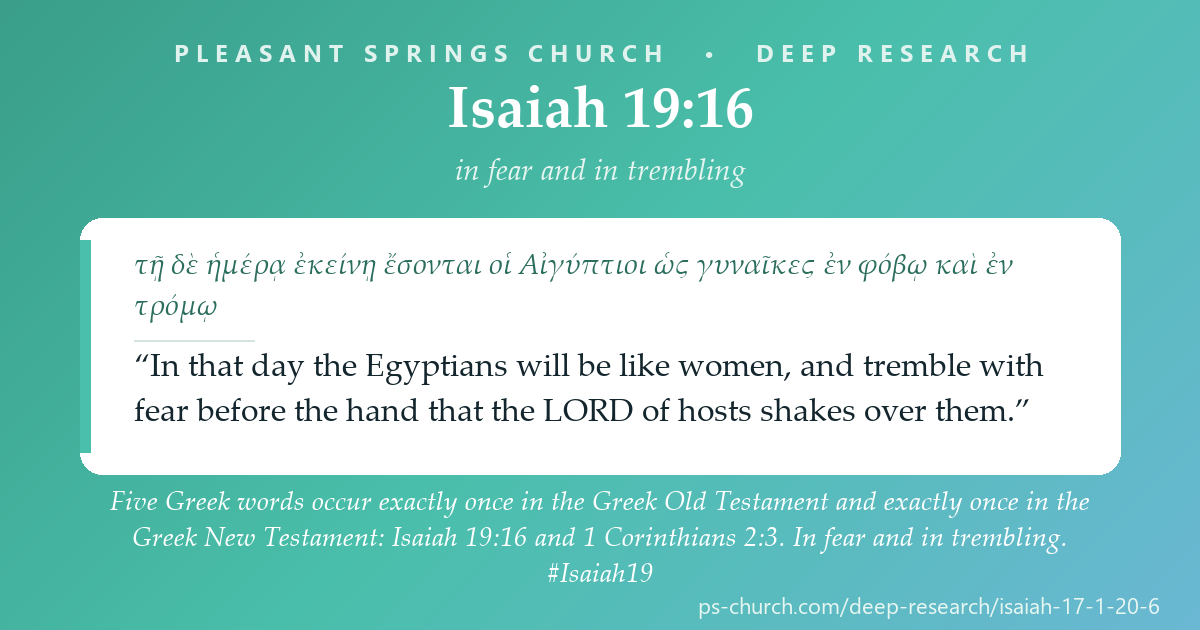
Exactly one occurrence in the 30,348 Greek Old Testament verse units screened here — Isaiah 19:16 — and exactly one in the 7,927 verses of the Greek New Testament: 1 Corinthians 2:3. Paul’s more usual pairing is the genitive φόβου καὶ τρόμου, which stands in three New Testament verses (2 Corinthians 7:15, Ephesians 6:5, Philippians 2:12) and in none of the Greek Old Testament; and the nominative φόβος καὶ τρόμος stands in three Greek Old Testament verses (Exodus 15:16, Judith 2:28, and Psalm 54:6 in the Greek numbering — Psalm 55:5 in English) and in none of the New Testament. Each corpus has its own case of the pair. The one form they share, they share once each. See Stage 4.
Two names in one verse that the two corpora do not agree about:
- Sargon. סַרְגוֹן occurs in exactly one verse of the Hebrew Bible, Isaiah 20:1. The Greek does not have the name at all. σαργων occurs nowhere in the 30,348 verse units screened here; Isaiah 20:1 in Greek reads ὑπὸ Αρνα βασιλέως Ἀσσυρίων. Both counted. Why the Greek has a different name is not decided here — it is exactly the kind of question that needs a critical edition with an apparatus, and Stage 5 says why this page does not have one.
- An accident worth printing so that nobody over-reads it. The letters of Αρνα at Isaiah 20:1 are the same six letters as ἄρνα, the accusative of ἀρήν, “lamb,” which occurs in six other verses of the corpus screened here (Exodus 23:19, 34:26; Leviticus 3:7; Deuteronomy 14:21; 1 Kingdoms 7:9; 2 Kingdoms 6:13) and is a lamb in every one of them. That is a spelling coincidence and nothing else. CATSS capitalises it here as a proper name; the accents differ; and a page that made anything of it would be doing exactly what this shelf exists to stop.
- Tartan. תַּרְתָּן occurs in two verses (Isaiah 20:1, 2 Kings 18:17) and is the Assyrian title turtānu, commander-in-chief — a title Sargon’s own annals use of an Egyptian officer (ANET 285). The Greek treats it as a personal name, Ταναθαν, which occurs in exactly one verse of the screened corpus. The ESV renders it as the title: “the commander in chief.”
- A hapax in the middle of chapter 19. עִוְעִים (19:14, ESV “a spirit of confusion”) occurs in exactly one verse of the Hebrew Bible. So does the form צִלְצַל at 18:1 (ESV “whirring wings”). Two words whose meaning depends on etymology rather than on usage, because there is no second usage to check against. Every English rendering of either is a reasoned guess, including the ESV’s, and this page does not improve on it.
Three Greek runs of five, two of which mean nothing; one pair of words that occurs once in each Testament; and four verses that share no two consecutive words with any other verse in the Hebrew Bible.
Every verse of Isaiah 17–20 was screened twice. The Hebrew ran against the whole 23,204-verse Masoretic corpus minus the source chapter; the Greek ran against all 7,927 verses of the Greek New Testament, with MorphGNT’s own spelling equivalences applied (ou / ouk / ouch, ek / ex, the movable nu), so these figures are higher than any run figure published on this shelf before 30 August 2026 and were re-measured, not copied. Runs are contiguous whole word forms, never lemmas. Every run carries its tie band.
What the Greek New Testament screen found — the formulas first:
Across all 52 verses of Isaiah 17–20 against the 7,927 verses of the Greek New Testament: 51 reach two, 32 reach three, 11 reach four, 3 reach five, and nothing reaches six. There are exactly three runs of five, and each has a tie band of 1. Two of the three are formulas, and the page prints them as formulas before it prints anything else.
- Isaiah 18:6 ↔ Matthew 13:32 — τὰ πετεινὰ τοῦ οὐρανοῦ καί, “the birds of the heaven and.” Run 5, tie band 1. But the same five words occur in 11 verses of the Greek Old Testament (Genesis 2:19; 3 Kingdoms 12:24m; Psalm 8:9; Psalm 49:11; Hosea 2:14; Isaiah 18:6; Ezekiel 31:6, 31:13, 32:4, 38:20; Zephaniah 1:3). The tie band is 1 only because the New Testament happens to say it once. This is a stock phrase for carrion birds, not a contact.
- Isaiah 17:8 ↔ Acts 7:41 — τοῖς ἔργοις τῶν χειρῶν αὐτῶν, “in the works of their hands.” Run 5, tie band 1. The same sequence occurs in four Greek Old Testament verses (4 Kingdoms 22:17; 2 Chronicles 34:25; Isaiah 17:8; Jeremiah 1:16) — every one of them about idols, which is a good reason for Stephen’s speech about the golden calf to reach for it, and not a reason to say he is quoting Isaiah. And the run exists only in Greek: the Hebrew of 17:8 has his hands, singular, and on the Hebrew screen the verse reaches 2 with a tie band of 12.
- And the formula that reaches four, twice. Isaiah 17:4 and 19:21 both reach 4 against ἐν τῇ ἡμέρᾳ ἐκείνῃ with a tie band of 4 (Matthew 13:1, Luke 10:12, Acts 2:41 and others). That is “in that day” in Greek. It is the most common clause in the passage and it is worth nothing at all as a connection.
And the run that is not a formula:
Isaiah 19:16 ↔ 1 Corinthians 2:3. Run 5, tie band 1, on the five words ἐν φόβῳ καὶ ἐν τρόμῳ. Unlike the other two, this sequence is not scattered through the corpus. It occurs exactly once in the 30,348 Greek Old Testament verse units screened here, and exactly once in the 7,927 verses of the Greek New Testament. One and one.
Then the counter-check, which is what makes the figure mean something. Paul’s usual form of the pair is the genitive φόβου καὶ τρόμου — 2 Corinthians 7:15, Ephesians 6:5, Philippians 2:12 — and that form occurs zero times in the Greek Old Testament screened here. The Greek Old Testament’s usual form is the nominative φόβος καὶ τρόμος — Exodus 15:16, Judith 2:28, and Psalm 54:6 in the Greek numbering, which is Psalm 55:5 in English — and that form occurs zero times in the New Testament. Each corpus has its own case of the pair. The one shape they share is the doubled-preposition dative, and each has it once.
⚠️ What this does not establish. 1 Corinthians 2:3 is not marked as a citation, carries no introductory formula, and is Paul describing how he arrived at Corinth: “And I was with you in weakness and in fear and much trembling.” Isaiah 19:16 is about Egypt shaking before the hand of the Lord of hosts. This page does not say Paul is quoting Isaiah, and it does not say he is not. It says that five words which the Greek Bible says only twice, it says once on each side of the Testament divide — and that of the three deepest runs in these four chapters, this is the only one the rest of the corpus does not repeat.
- The verse with the least contact of all. Isaiah 18:1 — “Ah, land of whirring wings” — is the one verse in these four chapters that shares no two consecutive words with any verse of the Greek New Testament. It reaches 1 on isolated words (γῆς, ποταμῶν, πτέρυγες, οὐαί among them) with a tie band of 160. On the Greek screen a 0 would mean “shares no word at all”; this row is a 1, not a 0, and the distinction is the reason the shelf states which convention it is using.
What the Hebrew screen found:
Across the same 52 verses against the whole 23,204-verse Masoretic corpus, counted by the deepest run each verse reaches: four verses reach 0, 16 top out at two, 26 at three, five at four, and one at five. (That is an exact table; the Greek table above is the shelf’s cumulative one.) On this screen a 0 means the verse shares no two consecutive words with any other verse in the Hebrew Bible — it may still share individual words. The four are 17:1, 19:9, 19:10 and 20:5.
And here is the counter-example this page owes its reader. Four zeros in 52 verses looks striking. It is not. Isaiah as a whole has 201 such verses out of 1,291 — 15.6% — and these four chapters run at 7.7%, which is well below the book’s own rate. Isaiah is a book of unusual vocabulary; that is the finding, and these chapters are less unusual than their neighbours, not more. Both figures were measured on the same screen, in the same run.
- The deepest Hebrew run in the passage is a messenger formula — and it is an Isaiah formula. Isaiah 18:4, כִּי כֹה אָמַר יְהֹוָה אֵלַי, “for thus the LORD said to me”: run 5, tie band 2. Those five words occur in three verses of the entire Hebrew Bible and all three are in Isaiah — 8:11, 18:4 and 31:4. Not a quotation of anything; a habit of one book.
- Five verses reach four, and only one of the five is a phrase with any content. 17:3 (נְאֻם יְהֹוָה צְבָאוֹת, tie band 2, matching Haggai 2:9 and Zechariah 8:6 — but see the caveat below), 17:6 (band 1, 1 Samuel 2:30), 19:4 (band 1, Isaiah 1:24), 19:15 (band 1, Isaiah 9:14 — “head and tail, palm branch and reed,” the same four words), 19:21 (band 1, 2 Samuel 6:9 — the four shared words there are ʾet YHWH bayyōm hahûʾ, “the LORD, in that day”). Three of the five — 17:3, 17:6 and 19:4 — are the way prophets say “thus says the LORD”; 19:21 is this page’s own refrain with the divine name in front of it. Only 19:15 is a phrase with any content, and Isaiah 9:14 is in the same book. That match is in the Hebrew only. The Greek of Isaiah 19:15 has ἀρχὴν καὶ τέλος where the Greek of 9:14 has μέγαν καὶ μικρόν, so no Greek run joins them. (Isaiah 9:14 in English is 9:13 in the Hebrew and the Greek, because the Hebrew ends chapter 8 with a verse 23 that English prints as 9:1. That seam is outside this page’s passage; references in this section are English.)
- ⚠️ The caveat on 17:3, which cuts against this page’s own figure. One of the four tokens in that run is not a word. The Masoretic text marks a paragraph break after 17:3 with the letter פ (petuḥah), and the normaliser this shelf runs on treats that marker as a token like any other. So the “run of four” is really nəʾum YHWH ṣəbā’ōt — three content words — plus a scribal mark. And the tie band depends on the mark. The three content words alone occur in 25 verses of the Hebrew Bible, this one included; it is only the added פ that narrows the field to three (Isaiah 17:3, Haggai 2:9, Zechariah 8:6). Read 17:3 as a run of three and its tie band is 24, and the page’s claim that these chapters have shallow Hebrew contact gets stronger, not weaker. Counted both ways and printed both ways.
- Where the Hebrew and the Greek diverge inside the passage, printed and not reconciled. 17:9: the Hebrew has the cities left like “the deserted places of the wooded heights,” the Greek has “as the Amorites and the Hivites abandoned them before the sons of Israel” — Ευαῖοι stands in four verses of the corpus screened here and this is the only one in Isaiah. 18:2: vessels of papyrus against hostages and papyrus letters. 18:4: “I will quietly look from my dwelling” against “there shall be safety in my city.” 19:18: City of Destruction against City of Righteousness. 19:25: three parties blessed against two. 20:1: Sargon against Arna. Six divergences in sixteen printed rows. Neither column is corrected into the other anywhere on this page.
- What no screen here can settle. At 19:18 a Qumran scroll of Isaiah is reported to read “City of the Sun” — Heliopolis — a single Hebrew letter away from the Masoretic reading. No Qumran text is held on this disk and none was consulted. Everything this page says about 19:18 is said from the Masoretic Hebrew and the Rahlfs Greek only. NOT VERIFIABLE FROM LOCAL CORPORA.
The standard literature, the questions that are genuinely open, and an explicit list of what this page could not check.
Wildberger, Blenkinsopp, Childs, Williamson and Beuken on the unit; Ziegler and Troxel on the Greek Isaiah; Ottley for the older English of it. Then the limits — which on this passage matter more than usual, because half of what is interesting here is a difference between two textual traditions, and the tools on this disk are not textual-critical tools.
Commentaries & studies:
- Hans Wildberger, Isaiah 13–27 (Continental) — the fullest technical treatment of these chapters, including the text-critical notes at 17:9, 19:18 and 20:1.
- Joseph Blenkinsopp, Isaiah 1–39 (Anchor Yale) — on the oracles against the nations as a collection, and on the date of 19:16–25.
- Brevard S. Childs, Isaiah (OTL) — on how the nations-block functions in the shape of the book rather than as a file of separate oracles.
- H. G. M. Williamson, Isaiah 1–27 (ICC, in progress) and Willem Beuken, Jesaja 13–27 (HThKAT) — the most recent detailed philology available on this stretch.
- J. Ziegler, Isaias (Septuaginta: Vetus Testamentum Graecum, Göttingen) and Ronald L. Troxel, LXX-Isaiah as Translation and Interpretation — the critical edition and the standard study of how the Greek Isaiah behaves. Named because this page’s Greek is Rahlfs and not Ziegler, and the difference is load-bearing.
- R. R. Ottley, The Book of Isaiah according to the Septuagint — still the most convenient English of the Greek Isaiah with notes, and useful precisely where the Greek departs from the Hebrew, as it does six times in this passage.
- Emanuel Tov, Textual Criticism of the Hebrew Bible; Eugene Ulrich, The Biblical Qumran Scrolls — the entry points to the 19:18 question and to 1QIsaᵃ. Named because the question this page raises at 19:18 lives in their territory and the page did not have their evidence.
- Karel van der Toorn and others, Dictionary of Deities and Demons in the Bible; Bezalel Porten, Archives from Elephantine; J. B. Pritchard, ed., Ancient Near Eastern Texts — for 19:3, for the Jewish colonies in Egypt, and for Sargon. ANET was read at first hand for the Ashdod passage quoted in Stage 2; the rest was not.
⚠️ What this page could NOT check — and where it is weakest:
- No Qumran text is held here, and 19:18 needs one. 1QIsaᵃ is the single most important witness to whether the city in 19:18 was called heres (destruction), ḥeres (the sun / Heliopolis) or ṣedeq (righteousness). It is not on this disk. Every statement above about that verse rests on the Masoretic Hebrew and the Rahlfs Greek and nothing else. NOT VERIFIABLE FROM LOCAL CORPORA.
- The Greek here is Rahlfs, not Ziegler. The CATSS files are a digitisation of Rahlfs’s Septuaginta: no apparatus, no Göttingen readings, no hexaplaric material, no Old Latin, no Peshitta, no Targum. When this page says “the Greek reads Arna” or “the Greek does not have Sargon,” that means Rahlfs’s printed text, and no more. Whether any Greek manuscript tradition carries the name, and what Ziegler’s apparatus says at 20:1 and 19:18, could not be checked here and is the single largest gap on the page.
- The Greek Old Testament counts are over 30,348 verse units, not over “the Septuagint.” That figure is the 30,637 units of the 64 CATSS files held here, less the Odes, which are excluded from run screens because two of them are New Testament text (Ode 9 is Luke 1, Ode 13 is Luke 2) and ten more are second copies of Exodus 15, Deuteronomy 32, 1 Samuel 2, Habakkuk 3, Isaiah 5, Isaiah 26, Isaiah 38, Jonah 2 and Daniel 3, which would silently double a tie band. A negative is a negative on the corpus searched.
- No acrostic or letter screen was run, and none would have meant anything. These are oracles and a prose narrative, not alphabetic poems. The shelf’s acrostic and pangram screens were not applied because there is nothing here for them to test, and their absence is not evidence of anything.
- No cuneiform corpus is held here. The Sargon passage in Stage 2 was read from the ANET volume on this disk, which is a translation. No Akkadian text was screened, no run was computed across it, and the correspondence between Isaiah 20 and Sargon’s annals is asserted as historical, not measured as literary.
- Josephus was used for content only. The Leontopolis narrative is cited from the standard English of the Antiquities and the War. His Greek was not screened against Isaiah or against anything else, and no claim on this page depends on his wording.
- The commentaries above were not consulted at first hand for this page. They are named so a reader can go further. Every number here comes from the corpora on disk and can be re-derived by anyone with the same files.
- The English is hard-set in the builder. No ESV API key has ever been issued to this site, so the ESV column was typed from the printed edition rather than machine-verified against Crossway’s text. The Hebrew and Greek columns are generated from the corpora and can be regenerated; the English cannot be, and that is the weakest link in the codex.
- What remains genuinely open, and is not closed here. (1) Whether Isaiah 19:16–25 is eighth-century or much later — a run screen has nothing to say about date. (2) Whether 19:19 has anything to do with Leontopolis. (3) Why the Greek Isaiah has Arna at 20:1. (4) What ʿārōm means in practice at 20:2. (5) Whether 1 Corinthians 2:3 has Isaiah 19:16 anywhere behind it — the measurement establishes that the five words are rare in both corpora and nothing at all about intent. On every one of those five, this page reports and stops.
A prophet who was the sermon, a blessing nobody expected, and the last question in the passage.
Name what you learned, why it matters, and one concrete response.
What should we carry away — and do?
- “Blessed be Egypt my people.” A chapter that opens in judgement on Egypt ends with God giving Egypt and Assyria the two titles he elsewhere gives only Israel. The chapter does not soften the judgement to get there; it goes straight through it. The nations Israel had most reason to hate are the ones named in the blessing. That is not sentiment. It is the last word of the oracle.
- The prophet was the sermon for three years. Isaiah 20 contains no speech by Isaiah at all — only an instruction, an obedience, and a divine explanation given afterward. He was told to take off his sackcloth and his sandals and he did, and the humiliation ran for three years before anyone was told what it meant. Some obedience is legible only in retrospect, and to the person doing it, not at all.
- “And we, how shall we escape?” The passage ends on a question asked by people who had backed the wrong power and watched it fail. It is not a rhetorical flourish; it is the honest position of anyone whose plan has just collapsed. Isaiah 20 does not answer it. Chapter 18 already has: “I will quietly look from my dwelling.”
- One concrete response. Name the thing you are currently trusting that is not God — the arrangement, the person, the balance, the plan. Do not renounce it dramatically; just write it down and say it out loud to one other Christian this week. Isaiah’s audience did not have an argument problem. They had a treaty problem, and treaties are only ever unmade by being named.
Isaiah 19:25 · to share
Hebrew + Greek (CATSS / Rahlfs) + ESVEvery Deep Research page traces its passage across the whole sweep — the Old Testament, the Second-Temple world between the testaments (historical witnesses, not Scripture), and the New Testament. Follow the thread:
Pleasant Springs Church — Deep Research
Research method after Michael S. Heiser’s Bible Research Method (examine dictionaries → ancient literature → important words → textual connections → academic publications → share), with the Pleasant Springs “Author & Audience” foundation. Scripture set in the Hebrew, the Greek editions named on each page and the ESV (Old Testament), and the Greek New Testament and the ESV (New Testament), per the practice of Pleasant Springs Church. Isaiah 17–20 research grounded in Wildberger (Continental), Blenkinsopp (Anchor Yale), Childs (OTL), Williamson (ICC) and Beuken (HThKAT), with Troxel and Ottley on the Greek Isaiah and Pritchard’s ANET for Sargon. Book name: in the Septuagint this book is Esaias, Ἠσαΐας; the Hebrew titles it יְשַׁעְיָהוּ. Text & numbering: Hebrew from the Masoretic Text (Sefaria, Miqra according to the Masorah), cantillation retained and the qere read — the one ketiv/qere in the printed rows is at 18:4 and is flagged there; Greek from the CATSS digitisation of Rahlfs’s Septuaginta, printed without editorial punctuation and with proper names unaccented; English ESV. Chapters 17, 18, 19 and 20 are numbered alike in Hebrew, Greek and English, and the verse counts match exactly — 14, 7, 25 and 6 — in both corpora on disk; counted, not assumed. There is no versification offset anywhere in this passage. (Isaiah is chapter-for-chapter aligned throughout; the only chapters where the two corpora here differ in verse count are 2 and 56, and the English 63/64 seam, all outside this passage.) Measurements. The Hebrew screen ran every verse of Isaiah 17–20 against the whole 23,204-verse Masoretic corpus held here, minus the source chapter; runs are contiguous whole consonantal word forms, never lemmas and never roots, with the qere read, cantillation and vowel points removed, final letters folded and maqqef treated as a word separator. ⚠️ The normaliser also treats the Masoretic section markers ס and פ as tokens, which inflates one figure on this page by one word and narrows one tie band; Stage 4 prints that verse (17:3) both ways rather than quietly taking the better number. On that screen a row of 0 means the verse shares no two consecutive words with any other verse in the Hebrew Bible; four of these 52 are such rows — 17:1, 19:9, 19:10 and 20:5 — and the page prints Isaiah’s own rate of 201 in 1,291 beside them, because 4 in 52 is below it. The Greek New Testament screen ran every verse of CATSS Isaiah 17–20 against all 7,927 verses of the SBLGNT via MorphGNT, with the edition’s own spelling equivalences applied (ou / ouk / ouch, ek / ex, the movable nu), so figures here are higher than any run figure published on this shelf before 30 August 2026 and were re-measured rather than copied from a sibling page. On that screen a 0 would mean “shares no word at all”; the lowest row here is Isaiah 18:1 at 1. Phrase and word counts on the Greek side were exhaustive over 30,348 verse units — the 30,637 units of the 64 CATSS files held, less the Odes, which are excluded from run screens because two of them are New Testament text (Ode 9 is Luke 1, Ode 13 is Luke 2) and ten more are second copies of Exodus 15, Deuteronomy 32, 1 Samuel 2, Habakkuk 3, Isaiah 5, Isaiah 26, Isaiah 38, Jonah 2 and Daniel 3. Every run on this page is reported with its tie band, and the two deepest Greek runs are printed as formulas — with their 11 and 4 verses in the Greek Old Testament — before the third is discussed at all. ⚠️ Direction of influence is never asserted. The page says that ἐν φόβῳ καὶ ἐν τρόμῳ occurs once in each corpus and reports the counter-check that each corpus otherwise prefers a different case of the pair; it does not say Paul is quoting Isaiah, that Stephen is quoting Isaiah, or that any translator misread anything. MT/LXX divergences inside the passage are disclosed rather than smoothed: 17:9 (the wooded heights against the Amorites and Hivites), 18:2 (vessels of papyrus against hostages and papyrus letters), 18:4 (“I will quietly look from my dwelling” against “there shall be safety in my city”), 19:18 (City of Destruction against πόλις-ασεδεκ), 19:25 (three parties blessed against two, with “the work of my hands” absent from the Greek) and 20:1 (Sargon against Αρνα). Limits are stated in Stage 5 and are load-bearing: no Qumran text is held here, so 1QIsaᵃ — the decisive witness at 19:18 — could not be checked; the Greek is Rahlfs and not Ziegler, so nothing is claimed from an apparatus; no Akkadian corpus is held, so the Sargon correspondence is historical and not measured; Josephus is used for content only and was not screened; the commentaries named were not consulted at first hand and no claim rests on them; and the ESV column was typed from the printed edition because no ESV API key has ever been issued to this site. The literary structure is labelled a sequence of three oracles and a sign-act, not a chiasm, because that is what the text is; the small envelope inside chapter 18 and the matched prose pair in chapter 20 are the only symmetries claimed, and chapter 19’s six “in that day” panels are called a stair rather than a circle. The refrain that binds the four chapters is counted, not asserted: 201 verses in the Hebrew Bible, 45 in Isaiah, 10 in these four chapters, distributed 3 / 0 / 6 / 1. Ancient Near Eastern texts (Sargon’s annals, the Lachish reliefs, the Elephantine papyri, Herodotus, Pliny) and Second-Temple witnesses (Josephus) are read as witnesses and never levelled with Scripture. Typology is handled per the house position: what the text says, what the New Testament itself draws, and what we see from this side of the cross — with the seeing left to the reader.
Scripture quotations marked ESV are from the ESV® Bible (The Holy Bible, English Standard Version®), © 2001 by Crossway, a publishing ministry of Good News Publishers. ESV Text Edition: 2016. Used by permission. All rights reserved. The ESV text may not be quoted in any publication made available to the public by a Creative Commons license, and the ESV may not be translated in whole or in part into any other language. www.esv.org
|
Did this study bless you today? 💚 Give to Support PS Church100% of gifts go to the General Fund — thank you. |