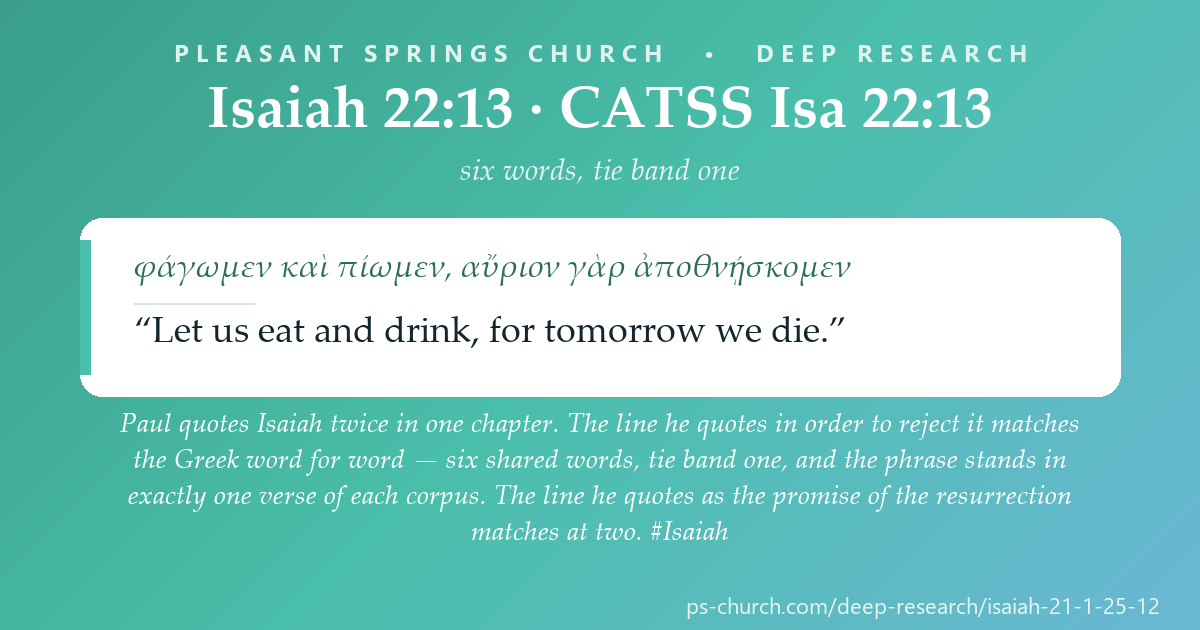
One chapter of Paul reaches into these five chapters twice, and the two reaches do not measure the same. 1 Corinthians 15:32 shares six consecutive words with the Greek of Isaiah 22:13 — φάγωμεν καὶ πίωμεν, αὔριον γὰρ ἀποθνῄσκομεν, tie band one, and that phrase stands in exactly one verse of each corpus. It is the deepest run anywhere in Isaiah 21–25. It is also the line Paul quotes in order to reject it. Twenty-two verses later he quotes this passage again — Death is swallowed up in victory, from Isaiah 25:8 — and against the same Greek column that one measures two, because in the Greek row death is not swallowed: death is the thing doing the swallowing. The same happens twice more. Revelation’s fallen, fallen is Babylon doubles a verb the Greek column does not double; Revelation’s key of David names a key the Greek column does not have. This page measures all four and says what a measurement can and cannot conclude from them. See the method →
Isaiah 21:1–25:12 (selections)
Hebrew · Greek (CATSS, Rahlfs’ Septuaginta) · ESV⚠️ These five chapters were dark on this shelf until now. No page had quoted a verse from Isaiah 21, 22, 23, 24 or 25. Isaiah is a long book and it is still only partly covered; this page closes five of its dark chapters and does not pretend to close the book.
The Shape of the Passage
A sequence — the superscriptions stop, and a banquet is answered by a banquetChapters 21–23 are addressed to named cities; chapters 24–25 are addressed to nobody in particular. That difference is visible on the page itself — the superscriptions stop — and it is the reason 24–27 is usually treated as a separate composition. This page takes no position on when 24–27 was written or by whom. It quotes them because they were dark on this shelf and because they belong to the assigned span.
Author
The book names Isaiah son of Amoz, in Jerusalem, under Uzziah, Jotham, Ahaz and Hezekiah (Isaiah 1:1). Chapter 22 fits that world exactly: it names two real palace officials, Shebna and Eliakim son of Hilkiah, and both turn up again in the Hezekiah narrative at Isaiah 36:3 and 36:22 and in 2 Kings 18:18, 26 and 37 — where Eliakim is over the household and Shebna has been demoted to secretary.
Chapters 24–27 do not name anybody. No king, no official, no foreign capital, no date. Since the nineteenth century they have been called the “Isaiah Apocalypse” and dated all over the map. The page reports the difference and does not settle it, because settling it needs comparative and redactional work that no screen on this disk can do.
Audience
People in a small hill-country kingdom listening to news about bigger places. Babylon, Dumah, Arabia, Tyre — these are the powers and the trade routes that decided whether Judah ate. An oracle about Tyre is an oracle about the shipping that made the eastern Mediterranean work; an oracle about Kedar is about the caravans.
And then, in the middle of the list, themselves. Isaiah 22 turns the same form on Jerusalem: the city is on its rooftops, the wall is breached, the water supply is being engineered, and the response to a siege is a party. The one oracle addressed to the audience is the one that ends with the slogan Paul quotes.
Orient on the oracles against the nations, the officials of chapter 22, and the unnamed city.
Search by topic: oracle / burden (massā’); oracles against the nations; Babylon in the eighth century; Dumah; Kedar; Tyre; Tarshish; Shebna; Eliakim; royal steward; Isaiah Apocalypse (Isaiah 24–27); tōhû; the eschatological banquet.
Which articles are relevant?
- Anchor Bible Dictionary — “Isaiah, Book of,” “Oracles against the Nations,” “Tarshish,” “Tyre,” “Kedar,” “Shebna,” “Eliakim.”
- Dictionary of the OT: Prophets (IVP) — “Isaiah: Book of,” “Apocalypticism,” “Nations,” “Zion.”
- NIDOTTE — מַשָּׂא, תֹּהוּ, בָּלַע, מַפְתֵּחַ, קִרְיָה.
- Dictionary of NT Use of the OT (Beale & Carson) — on 1 Corinthians 15:32 and 15:54, on Revelation 3:7, and on Revelation 14:8 and 18:2. Those entries argue for connections this page’s screen mostly cannot see, and stage 4 prints both the argument and the numbers.
Settle the numbering first — and it was derived here, not copied
The shelf’s stored note for Isaiah was marked PROVISIONAL and named one seam. Reading the three columns off the files on this disk turned up four differences, and none of them is in chapters 21–25.
| where | Hebrew | CATSS Greek | English (ESV) | what it means |
|---|---|---|---|---|
| 2:22 | 22 verses | 21 verses | 22 verses | the Greek column has no row at all for Isaiah 2:22 |
| 8:23 / 9:1 | ch 8 = 23, ch 9 = 20 | ch 8 = 23, ch 9 = 20 | ch 8 = 22, ch 9 = 21 | Hebrew and Greek 8:23 = English 9:1, and Hebrew and Greek 9:1–20 = English 9:2–21 |
| 56:12 | 12 verses | 11 verses | 12 verses | the Greek column has no row at all for Isaiah 56:12 |
| 63:19 / 64:1 | ch 64 = 11 | ch 64 = 11 | ch 64 = 12 | the second half of Hebrew 63:19 is printed as English 64:1, so English 64:2–12 = Hebrew 64:1–11 |
| 21–25 | 17, 25, 18, 23, 12 | 17, 25, 18, 23, 12 | 17, 25, 18, 23, 12 | ★ identical — no offset anywhere in this study |
The Hebrew shapes are Sefaria’s Miqra according to the Masorah; the Greek shapes are the CATSS Isaiah file; the English shapes were taken from a complete public-domain English Bible held on this disk, which carries the same versification as the ESV. The Greek column has a row for every one of the 95 verses of chapters 21–25 — no gaps, no merged rows. It is worth saying out loud even though the answer is nothing: a page that does not state its offset has not checked it.
A form, a tomb, a slogan, and a city that never gets named.
What a מַשָּׂא is, and why it matters that they stop
The word means load. It is the ordinary noun for what a donkey carries, and it is also the technical heading of a prophetic oracle.
Isaiah 13–23 is built out of them: ten superscriptions, running Babylon, Philistia, Moab, Damascus, Egypt, the wilderness of the sea, Dumah, Arabia, the valley of vision, Tyre. Five of the ten are in this study, and Isaiah 23:1 is the last of the series. After it the noun is absent from Isaiah until 30:6.
And once, inside the block, the word is not a heading. Isaiah 22:25 says the peg driven in a sure place will give way, and the מַשָּׂא that was on it will be cut off — the load hanging on the peg. The Greek column renders it ἡ δόξα ἡ ἐπ' αὐτόν, the glory that was on him — which is the same noun the Greek column had already used three verses earlier at 22:22, where the Hebrew has a key. Whatever produced that, the page reports it and does not explain it.
Shebna, Eliakim, and a tomb cut in a rock
Isaiah 22:15–25 is the only passage in these five chapters about two named individuals, and the charge against the first of them is that he built himself a tomb.
What have you to do here, and whom have you here, that you have cut here a tomb for yourself, you who cut a tomb on the height? (22:16). Shebna is over the household; by Isaiah 36:3 he is the secretary and Eliakim has the household. The demotion the oracle announces appears to have happened.
⚠️ What was not checked. A rock-cut tomb inscription from the village of Silwan, opposite the City of David, names a royal steward whose name ends in -yahu and is very often connected with this Shebna. That is an archaeological argument and this page cannot test it. No epigraphic corpus is on this disk; the identification is reported as an inference others have drawn, and it carries no weight in anything measured here.
“Let us eat and drink, for tomorrow we die” — whose line is it?
In Isaiah it is what a besieged city says on its rooftops. In 1 Corinthians it is what Paul says people would be entitled to say if the dead are not raised.
The sentiment is not unique to Israel. Greek and Roman writers report an Egyptian custom of carrying a figure of a corpse round a banquet with the words drink and be merry, for when you die you will be like this; the theme runs through the Egyptian harper songs and through Hellenistic epitaphs. None of that material is held on this disk and none of it is measured here; it is named so the reader knows the slogan had a life outside these two verses.
What the screen can say is narrow and exact. φάγωμεν καὶ πίωμεν occurs in one CATSS verse unit out of 30,348 and one Greek New Testament verse out of 7,927, and the six-word run between them has a tie band of one. Even so, a run of six is not a proof of borrowing — it is contact. The reason this one is safe to call a quotation is not the number: it is that 1 Corinthians 15:32 is quoting a slogan and says so.
The city with no name
Chapters 21, 22 and 23 name their targets. Chapters 24 and 25 name a city four times and never say which one.
24:10 קִרְיַת תֹּהוּ, city of formlessness; 24:12 בָּעִיר, in the city; 25:2 you have made the city a heap, the fortified city a ruin; 25:3 קִרְיַת גּוֹיִם עָרִיצִים, the city of ruthless nations. Commentators have identified it as Babylon, Moab, Samaria, Jerusalem, Carthage and no city at all. The page has no way to adjudicate that and does not try.
What the two columns do differently is measurable. Where the Hebrew has one unnamed city, the Greek column has cities, plural, at 24:12, 25:2 and 25:3, and at 24:10 it has ἠρημώθη πᾶσα πόλις, every city has been made desolate. The Greek column reads the singular as a generalisation. That is a description of the two texts, not a claim about which is older.
A load, a chaos, a key, a chime, and a swallow.
Ten superscriptions in Isaiah 13–23 — 13:1, 14:28, 15:1, 17:1, 19:1, 21:1, 21:11, 21:13, 22:1, 23:1 — and five of them in this study. After 23:1 the noun is absent from Isaiah until 30:6. The one non-heading use inside the block is 22:25, the load on the peg. The Greek column never uses a burden word for the heading: it has ὅραμα (vision) at 21:1, 21:11 and 23:1 and ῥῆμα (word) at 22:1 — and at 21:13 it has no superscription at all, beginning straight in with ἐν τῷ δρυμῷ ἑσπέρας κοιμηθήσῃ.
Isaiah 24:10. Nineteen verses of the Masoretic corpus carry it once prefixes are allowed; ten of them carry it bare (Genesis 1:2; 1 Samuel 12:21; Isaiah 24:10, 34:11, 44:9, 45:18, 45:19, 59:4; Jeremiah 4:23; Job 26:7). Isaiah carries more of them than any other book. The construct phrase קִרְיַת תֹּהוּ stands in exactly one verse. The Greek column has no chaos word here at all.
Isaiah 22:22. In the key sense the noun stands in three verses of the Hebrew Bible — Judges 3:25 (Eglon’s locked roof-chamber), 1 Chronicles 9:27 (the gatekeepers who opened the house of God every morning), and this one. The Greek noun κλείς stands in five places across the CATSS files held here — 1 Chronicles 9:27, Judges 3:25 in both the A and the B text, Job 31:22 (where it is a collarbone) and Bel and the Dragon 1:11, a deuterocanonical witness — and Isaiah 22:22 is not among them. In the Greek New Testament κλείς and its verb stand in twenty-two places across twenty verses, ten of the twenty-two in Revelation; Matthew 16:19 has the keys of the kingdom and Luke 11:52 the key of knowledge.
Isaiah 24:17. Three nouns that chime, and the sequence stands in exactly two verses of the Hebrew Bible: this one and Jeremiah 48:43. The Greek renders them φόβος, βόθυνος, παγίς — three words with nothing in common in sound — and the Greek column of Jeremiah puts them in a different order (παγὶς καὶ φόβος καὶ βόθυνος), so the Greek pair measures 3 where the Hebrew pair measures 5.
Isaiah 25:7 (he swallows the covering) and 25:8 (he swallows death). The phrase בִּלַּע הַמָּוֶת stands in exactly one verse of the Hebrew Bible. The Greek row at 25:8 has the active κατέπιεν with death as the subject; that exact form stands in ten CATSS verse units held here, and in the other nine the swallower is the earth (Deuteronomy 11:6; Exodus 15:12; Numbers 16:32; 26:10; Psalm 105:17 = English 106:17), Aaron’s rod (Exodus 7:12), a flame (Numbers 21:28) or Babylon (Jeremiah 28:34 and 28:44 = English 51:34 and 51:44). The passive κατεπόθη — the form 1 Corinthians 15:54 uses — stands in three CATSS verse units, and Isaiah 25:8 is not one of them.
The Greek column’s word at both Isaiah 22:22 and 22:25, where the Hebrew has key and load. I will give him the glory of David… and the glory that was on him will be taken away. In the Greek column the same noun is given at 22:22 and removed at 22:25; in the Hebrew the two verses do not share a word at that point at all.
And four more places the columns part company
| verse | Hebrew | CATSS Greek row |
|---|---|---|
| 21:11 | מַשָּׂא דּוּמָה — the oracle of Dumah | τὸ ὅραμα τῆς Ιδουμαίας — the vision of Idumea, that is, Edom |
| 22:1 | גֵּיא חִזָּיוֹן — valley of vision | τῆς φάραγγος Σιων — the valley of Zion |
| 23:1, 6, 10, 14 | תַּרְשִׁישׁ — Tarshish | Καρχηδών — Carthage, at all four |
| 24:23 | הַלְּבָנָה and הַחַמָּה — the moon and the sun | ἡ πλίνθος and τὸ τεῖχος — the brick and the wall |
⚠️ The page prints these and explains none of them. It does not say the Greek column misread anything, does not say which reading is older, and does not say what Hebrew stood in front of whoever produced the Greek. It says what stands in each column and where.
One run of six that is a citation, one run of five that is an accident, and three famous echoes the screen cannot see.
What these five chapters reach in the Greek New Testament
All 95 CATSS rows of Isaiah 21–25 were screened against all 7,927 verses of the Greek New Testament. 92 reach two, 52 reach three, 13 reach four, 2 reach five, 1 reaches six, and nothing reaches seven.
| row | NT partner | run | tie band | the shared words | what it is |
|---|---|---|---|---|---|
| Isa 22:13 | 1 Cor 15:32 | 6 | 1 | φάγωμεν καὶ πίωμεν αὔριον γὰρ ἀποθνῄσκομεν | A citation — and the phrase stands in one verse of each corpus |
| Isa 22:24 | Acts 7:20 | 5 | 1 | ἐν τῷ οἴκῳ τοῦ πατρός | An accident — see the row below |
| Isa 25:8 | Rev 7:17 | 4 | 1 | ὁ θεὸς πᾶν δάκρυον | The one deep contact with Revelation — one CATSS unit, two NT verses |
| Isa 25:1 | Rev 15:4 | 4 | 1 | τὸ ὄνομά σου ὅτι | the Song of Moses and the Lamb; four CATSS units carry the same four words, this row among them |
| Isa 21:10 | Luke 1:68 | 4 | 1 | ὁ θεὸς τοῦ Ἰσραήλ | a title |
| Isa 24:21 | Rev 16:14; 19:19 | 4 | 2 | ἐπὶ τοὺς βασιλεῖς τῆς (16:14); τοὺς βασιλεῖς τῆς γῆς (19:19) — two different four-word windows | A stock phrase — βασιλεῖς τῆς γῆς stands in eight NT verses, six of them in Revelation, and in eleven CATSS verse units |
| Isa 22:5 | Acts 8:10; Heb 8:11 | 4 | 2 | ἀπὸ μικροῦ ἕως μεγάλου | a formula |
| Isa 22:12, 22:20, 22:25, 23:15 | Matt 13:1; Luke 10:12; Acts 2:41; 2 Thess 1:10 | 4 | 4 | ἐν τῇ ἡμέρᾳ ἐκείνῃ | A formula — four different rows reach the same four words |
One row in ninety-five reaches six, and it is a citation. One reaches five, and it is not. Everything else in this table is four or less, and most of the fours are formulas.
The counter-example this page has to print
The second-deepest run in these five chapters has a tie band of one and means nothing whatever.
| the clause | |
|---|---|
| CATSS Isa 22:24 | καὶ ἔσται πεποιθὼς ἐπ' αὐτὸν πᾶς ἔνδοξος ἐν τῷ οἴκῳ τοῦ πατρὸς αὐτοῦ… |
| Acts 7:20 | …ὃς ἀνετράφη μῆνας τρεῖς ἐν τῷ οἴκῳ τοῦ πατρός |
Isaiah 22:24 is about everything in Eliakim’s father’s house being hung on him; Acts 7:20 is about Moses being nursed three months in his father’s house. Five consecutive words, a tie band of one, and no relationship at all. ⚠️ And the tie band of one is itself misleading here. The same five Greek words stand in thirteen places across the CATSS files held here — Genesis 31:14, 34:19 and 38:11 (which has it twice), Numbers 30:4, Joshua 2:12, Judges 6:15, Judges 11:2 (which is held in both the A and the B text), 2 Samuel 24:17, 1 Chronicles 21:17, Psalm 151:1 and Isaiah 22:24. A band of one inside the New Testament is not the same thing as a rare phrase. It is a stock expression that happens to occur once on the New Testament side.
1 Corinthians 15 reaches into these chapters twice — at six, and at two
Paul quotes Isaiah 22:13 at 1 Corinthians 15:32 and Isaiah 25:8 at 1 Corinthians 15:54. Against the same Greek column the two quotations measure six and two.
| Isaiah 22:13 | Isaiah 25:8 | |
|---|---|---|
| Hebrew | אָכוֹל וְשָׁתוֹ כִּי מָחָר נָמוּת | בִּלַּע הַמָּוֶת לָנֶצַח — he swallows up death for ever; death is the object |
| CATSS Greek row | φάγωμεν καὶ πίωμεν αὔριον γὰρ ἀποθνῄσκομεν | κατέπιεν ὁ θάνατος ἰσχύσας — death, having prevailed, swallowed; death is the subject |
| 1 Corinthians 15 | 15:32 — φάγωμεν καὶ πίωμεν αὔριον γὰρ ἀποθνῄσκομεν | 15:54 — κατεπόθη ὁ θάνατος εἰς νῖκος — death was swallowed up; death is the subject of a passive |
| measured run | 6, tie band 1 | 2 — ὁ θάνατος |
1 Corinthians 15:54 introduces its quotation with then shall come to pass the saying that is written. It is announcing a citation, and the Greek column in front of us is not what it is citing. The direction of the swallowing is opposite, and the verb form differs: the passive κατεπόθη stands in three CATSS verse units held here and Isaiah 25:8 is not one of them.
⚠️ What the page will not say. It will not say Paul was reading Hebrew, or translating for himself, or using a lost Greek text, or correcting anything. Other Greek versions of Isaiah existed and none of them is held on this disk — there is no Aquila, no Symmachus, no Theodotion of Isaiah here, and the readings of those versions are exactly what would bear on this verse. All the page can report is that against the one Greek column it holds, the run is two.
Three famous echoes, and what the screen actually sees
Three connections out of these chapters are in every commentary. Measured against the Greek column, they run 1, 2 and 2.
| the echo | Hebrew column | CATSS Greek row | New Testament | run |
|---|---|---|---|---|
| The key of David Isa 22:22 → Rev 3:7 | מַפְתֵּחַ בֵּית דָּוִד, and he opens and none shuts, he shuts and none opens | τὴν δόξαν Δαυιδ, and he shall rule and none shall contradict — no key, no opening, no shutting | ὁ ἔχων τὴν κλεῖν Δαυίδ, ὁ ἀνοίγων καὶ οὐδεὶς κλείσει, καὶ κλείων καὶ οὐδεὶς ἀνοίγει | 1 |
| Fallen, fallen is Babylon Isa 21:9 → Rev 14:8; 18:2 | נָפְלָה נָפְלָה בָּבֶל — doubled; one verse in the Hebrew Bible | πέπτωκεν Βαβυλών — said once; one CATSS verse unit | ἔπεσεν ἔπεσεν Βαβυλὼν ἡ μεγάλη — doubled; two NT verses, and nought CATSS verse units | 2 (Rev 14:8); 1 (Rev 18:2) |
| Death swallowed up Isa 25:8 → 1 Cor 15:54 | בִּלַּע הַמָּוֶת לָנֶצַח — death swallowed | κατέπιεν ὁ θάνατος — death swallowing | κατεπόθη ὁ θάνατος εἰς νῖκος — death swallowed | 2 |
⚠️ Read that table carefully, because it is easy to over-read. What the numbers show is that at these three places the New Testament wording is not the wording of the Greek column. That is a fact about word forms. It is not evidence about which text anybody used, in which language, or in what order — and the page asserts none of that. A verbatim screen finds contact, not allusion. All three of these are almost certainly real allusions; the screen simply cannot see them, and a page that only printed its deep runs would leave the reader thinking these connections do not exist.
The one place the Greek column and the New Testament do meet
Isaiah 25:8 against Revelation 7:17 — run 4, tie band 1.
| the clause | |
|---|---|
| CATSS Isa 25:8 | …ἀφεῖλεν ὁ θεὸς πᾶν δάκρυον ἀπὸ παντὸς προσώπου… |
| Revelation 7:17 | …καὶ ἐξαλείψει ὁ θεὸς πᾶν δάκρυον ἐκ τῶν ὀφθαλμῶν αὐτῶν |
πᾶν δάκρυον stands in one CATSS verse unit out of 30,348 and two verses of the Greek New Testament, Revelation 7:17 and 21:4. With ὁ θεός in front of it the run is four and the tie band is one, because Revelation 21:4 does not have ὁ θεός in that clause and so measures two. The same verse of Isaiah that the resurrection quotation does not match is the verse whose second half Revelation does. One verse; two clauses; two very different measurements.
Where these chapters are really connected — Jeremiah 48
The Hebrew-side screen puts the strongest tie of the whole study not in the New Testament but in the oracle against Moab.
| row | deepest Hebrew partner | run | tie band | the shared words |
|---|---|---|---|---|
| Isa 24:17 | Jeremiah 48:43 | 5 | 1 | פחד ופחת ופח עליך יושב |
| Isa 24:18 | Jeremiah 48:44 | 4 | 1 | הפחד יפל אל הפחת |
| Isa 22:15 | Isaiah 10:24 | 5 | 1 | כה אמר אדני יהוה צבאות |
| Isa 22:25 | Jer 30:8; Jer 49:26; Haggai 2:23 | 5 | 5 | ביום ההוא נאם יהוה צבאות |
| Isa 24:21 | Isaiah 27:1 | 4 | 1 | ביום ההוא יפקד יהוה |
★ And the top row has an edge. פַּחַד וָפַחַת וָפָח stands in exactly two verses of the Hebrew Bible, and the shared sentence runs five words — terror and pit and snare are upon you, O inhabitant of — and then stops on the sixth. Isaiah has the earth; Jeremiah has Moab. The run breaks at precisely the word that decides whether the oracle is about one country or about everybody. The next verse repeats the pattern: run 4, band 1, and then Isaiah ends with the windows of heaven opened and the foundations of the earth shaking, where Jeremiah ends with the year of their punishment.
⚠️ And the Greek columns of the two books do not match each other the way the Hebrew columns do. CATSS Isaiah 24:17 has φόβος καὶ βόθυνος καὶ παγίς; CATSS Jeremiah 31:43 — which is Jeremiah 48:43 in a Hebrew Bible, because the Greek Jeremiah is differently arranged — has παγὶς καὶ φόβος καὶ βόθυνος. Same three nouns, different order, and the measured run drops from five to three. The page reports the difference and does not say which order came first.
The verse with no neighbours
Isaiah 24:19 shares no two consecutive words with any verse unit of the Masoretic corpus outside its own chapter.
רֹעָה הִתְרֹעֲעָה הָאָרֶץ פּוֹר הִתְפּוֹרְרָה אֶרֶץ מוֹט הִתְמוֹטְטָה אָרֶץ
“The earth is utterly broken, the earth is split apart, the earth is violently shaken.”Isaiah 24:19 — Masoretic text; ESV
Nine words, three of them אֶרֶץ, and three infinitive-plus-verb pairs of the same root stacked one on another. Every word in it is common; not one adjacent pair occurs anywhere else. ⚠️ Say what the zero means. This is the Hebrew-side screen, which does not fall back to single words, so nought here means no two consecutive words shared, not no word shared. Against the Greek New Testament the same row reaches a run of three with a tie band of two.
Seventeen of the ninety-five rows in this study come out at nought on that screen: 21:5, 21:7, 21:12, 21:13, 22:3, 22:6, 22:7, 22:19, 23:2, 23:3, 23:10, 24:7, 24:12, 24:19, 24:22, 25:5 and 25:11. Across the ninety-five: 78 reach two, 26 reach three, 11 reach four, 3 reach five, and nothing reaches six. ★ And the Greek column of 24:19 is shorter than the Hebrew: it has two clauses where the Hebrew has three.
What this page could not check, and where it is weakest.
The limits, named
The single biggest hole is the one the page’s best finding depends on: this shelf holds one Greek column of Isaiah and no others. There is no Aquila, no Symmachus, no Theodotion, no Lucianic recension and no critical apparatus on this disk. The reading of Isaiah 25:8 that 1 Corinthians 15:54 corresponds to is precisely the sort of thing the later Greek versions are cited for in the literature. The page reports that the run against the one column it holds is two, and it cannot tell you what any other Greek column of Isaiah says. Anyone reading this as evidence about Paul’s source is reading more than the measurement supports.
No Qumran material was consulted. The Great Isaiah Scroll (1QIsaᵃ) is a complete Hebrew Isaiah roughly a thousand years older than the Masoretic manuscripts, and it is not on this disk. Every Hebrew figure on this page is against one printed edition — Sefaria’s Miqra according to the Masorah — and differs from a claim about “the Hebrew text” in general.
The date and unity of Isaiah 24–27 is not addressed. Two of the five chapters here belong to the most argued-over section of the book. The page quotes them without entering the question, which is a real limitation on anything said about them as Isaiah’s.
Nothing here identifies the unnamed city. The literature has identified the city of 24:10 and 25:2 as Babylon, Moab, Samaria, Jerusalem, Carthage and as a deliberate non-identification. This page has no method that can decide it and prints the four references without a candidate.
The Silwan royal-steward inscription was not examined. The connection with Shebna is reported in stage 2 as an inference others have drawn. No epigraphic corpus is held here and no weight rests on it.
What the counts do and do not cover
The Greek Old Testament figures on this page were run over all 64 CATSS files held here, but the screening corpus is 30,348 verse units, not the 30,637 the files contain. The Odes are excluded from run screens, and they should be: Ode 9 is Luke 1 and Ode 13 is Luke 2 copied into a Greek Old Testament manuscript, and ten further Odes are second copies of Exodus 15, Deuteronomy 32, 1 Samuel 2, Habakkuk 3, Isaiah 26, Jonah 2, Daniel 3, Isaiah 5 and Isaiah 38. Leaving them in would have counted the same text twice and, worse, would have produced Greek-Old-Testament ‘matches’ for Luke that are Luke. Every “stands in N verse units” figure on this page is against 30,348. Note that three of the excluded Odes are second copies of Isaiah (Isaiah 26, Isaiah 5 and Isaiah 38), and none falls inside chapters 21–25, so nothing in this study is affected either way.
Twenty of the sixty-four files are deuterocanonical — witnesses, not Scripture on this shelf, and named as such wherever one carries a hit. Three counts on this page include such a file: the eleven CATSS verse units carrying βασιλεῖς τῆς γῆς include 1 Maccabees 1:2; Psalm 151:1 is among the thirteen places carrying ἐν τῷ οἴκῳ τοῦ πατρός; and Bel and the Dragon 1:11 is one of the five places carrying the noun κλείς. All three are named here so no reader has to take the totals on trust.
The Hebrew screen was run chapter by chapter, each of the five chapters against every verse unit of the Masoretic corpus outside that chapter — between 23,179 and 23,192 target verses depending on the chapter’s own length. That means a match between, say, Isaiah 24 and Isaiah 25 would have been counted, and a match inside a single chapter would not. None of the findings reported above turns on that.
Nothing here is an argument from silence about Hebrew or Greek outside these corpora. “The only verse in the Hebrew Bible” means the 23,204 verse units of Sefaria’s Miqra according to the Masorah held on this disk, and nothing more.
Reading list
- Joseph Blenkinsopp, Isaiah 1–39 (Anchor Yale Bible 19).
- John N. Oswalt, The Book of Isaiah, Chapters 1–39 (NICOT).
- Hans Wildberger, Isaiah 13–27 (Continental Commentary).
- J. Alec Motyer, The Prophecy of Isaiah.
- Ronald L. Troxel, LXX-Isaiah as Translation and Interpretation — on the kind of divergence this page prints and refuses to explain.
- Christopher R. Seitz, Isaiah 1–39 (Interpretation) — on chapter 22 and the two officials.
- None of these were consulted for the measurements on this page, which were run on the text files named in the footer.
Two banquets, and a run that stops on one word.
The line that measures deepest is the line you would least want to own
Ninety-five verses were screened against the whole Greek New Testament. One of them reaches six shared words, and it is a party on a rooftop in a city under siege. Let us eat and drink, for tomorrow we die.
Isaiah 22 is the one oracle in this run of five aimed at the prophet’s own people. The wall has been breached, the water supply has been engineered, the armouries have been inventoried — but you did not look to him who did it (22:11) — and the response is a feast. Three chapters later, on a mountain, there is another feast: the LORD of hosts will make for all peoples a feast of rich food. Eating and drinking again; a different host; and at the second one the thing that gets swallowed is death.
And then there is the run that stops. Isaiah 24:17 and Jeremiah 48:43 share five consecutive Hebrew words — terror and pit and snare are upon you, O inhabitant of — and split on the sixth. Jeremiah says Moab. Isaiah says the earth. The oracles against the nations have been naming somebody else for eleven chapters; at chapter 24 the superscriptions stop, the names stop, and the same sentence turns round.
⭐ Five chapters that were dark on this shelf are now quoted. Isaiah is a long book and much of it is still untouched here; this page does not close it. What it does do is put Isaiah 21, 22, 23, 24 and 25 on the record with their runs and their tie bands attached, including the three famous connections its own screen cannot see.
Every Deep Research page traces its passage across the whole sweep — the Old Testament, the Second-Temple world between the testaments (historical witnesses, not Scripture), and the New Testament. Follow the thread:
Pleasant Springs Church — Deep Research
Research method after Michael S. Heiser’s Bible Research Method (examine dictionaries → ancient literature → important words → textual connections → academic publications → share), with the Pleasant Springs “Author & Audience” foundation. Scripture set in the Hebrew, the Greek editions named on each page and the ESV (Old Testament), and the Greek New Testament and the ESV (New Testament), per the practice of Pleasant Springs Church. Isaiah 21–25 research grounded in Blenkinsopp (Anchor Yale 19), Oswalt (NICOT), Wildberger (Continental) and Motyer. Text: Hebrew from the Masoretic text as printed in the edition consulted — Sefaria’s Miqra according to the Masorah, 23,204 verse units; no critical apparatus was consulted for the Hebrew, and no Qumran manuscript. Greek from Rahlfs’ Septuaginta as digitized by CATSS; Greek New Testament from the SBL edition via MorphGNT. The standing caution for this shelf applies: these pages say “the CATSS Greek row reads…” and never call a Greek reading early or late. ⚠️ VERSE NUMBERING — derived, and there is no offset here. The verse counts of Isaiah 21–25 were read off the files on this disk and agree in all three columns: 17, 25, 18, 23, 12. Isaiah’s four measured seams all fall outside this study — the CATSS column has no row for 2:22 or 56:12; Hebrew and Greek 8:23 is English 9:1, so Hebrew and Greek 9:1–20 = English 9:2–21; and the second half of Hebrew 63:19 is printed as English 64:1, so English 64:2–12 = Hebrew 64:1–11. The shelf’s stored note for Isaiah was marked PROVISIONAL and named only the last of these four; this page derived all four from the files. ⚠️ The Greek measurement, in full. Greek against Greek. CATSS FORM column (cols 0–24), beta-code transliterated first; MorphGNT field 6, the normalised word. Both sides lowercased, accents and breathings dropped, final sigma folded, then filtered to Greek letters — the same filter applied to both corpora — and, since 30 August 2026, MorphGNT’s own spelling equivalences applied across the two editions (ου/ουκ/ουχ, εκ/εξ, the movable nu), so that a shared run is not cut at a word the two editions merely spell differently. Every figure on this page was measured after that change and none was copied from a sibling page. Contiguous runs of whole word FORMS, never lemmas. Corpus for the New Testament screen: the 95 CATSS rows of Isaiah 21–25 against 7,927 verses across 27 MorphGNT files. Across those 95 rows: 92 reach two, 52 reach three, 13 reach four, 2 reach five, 1 reaches six, and nothing reaches seven. Exhaustive and deterministic; nothing sampled, so no seed applies. ⚠️ The Greek Old Testament screening corpus is 30,348 verse units, not 30,637. Sixty-four CATSS files are held here and they contain 30,637 verse units, but the Odes are excluded from run screens because they are not independent witnesses: Ode 9 is Luke 1 and Ode 13 is Luke 2, copied into a Greek Old Testament manuscript, and ten further Odes are second copies of Exodus 15, Deuteronomy 32, 1 Samuel 2, Habakkuk 3, Isaiah 26, Jonah 2, Daniel 3, Isaiah 5 and Isaiah 38. Every “stands in N verse units” count on this page — 1 for πᾶν δάκρυον, 1 for πέπτωκεν Βαβυλών, 0 for ἔπεσεν ἔπεσεν, 5 for κλείς, 3 for κατεπόθη, 10 for κατέπιεν, 7 for Καρχηδών, 11 for βασιλεῖς τῆς γῆς and 13 for ἐν τῷ οἴκῳ τοῦ πατρός — is against 30,348. Twenty of the sixty-four files are deuterocanonical: witnesses, not Scripture. Three of them carry hits counted here (1 Maccabees 1:2, Psalm 151:1 and Bel and the Dragon 1:11) and all three are named in stage 5. ⚠️ What a zero means on the Hebrew screen. The Hebrew-side screen runs with no single-word fallback, so the nought reported for Isaiah 24:19 and for sixteen other rows means they share no two consecutive words with any verse unit outside their own chapter — not that they share no word. The Greek-side screens do fall back to single words, and a nought there would mean something different. ⚠️ The three famous echoes: what is claimed and what is not. Claimed: measured against the CATSS Greek rows, Revelation 3:7 runs one shared word with Isaiah 22:22, Revelation 14:8 runs two and Revelation 18:2 runs one with Isaiah 21:9, and 1 Corinthians 15:54 runs two with Isaiah 25:8; and at each of the three the Greek row says something the New Testament does not repeat — no key, one fallen instead of two, death as the subject of the swallowing. Not claimed: that any New Testament writer read Hebrew, used a different Greek text, corrected anything, or that any column is prior to any other. Only one Greek column of Isaiah is held on this disk — no Aquila, no Symmachus, no Theodotion — and those are exactly the witnesses that would bear on Isaiah 25:8. The page reports the run it can measure and stops. ⚠️ Direction of influence is never asserted. Nothing here says which text is prior or what produced any reading — including the single fallen at 21:9, Zion for vision at 22:1, glory for key at 22:22 and for load at 22:25, Carthage for Tarshish through chapter 23, the plural cities in 24–25, the missing third clause at 24:19, the brick and the wall at 24:23, or the direction of the swallowing at 25:8. The same applies to Isaiah 24:17–18 and Jeremiah 48:43–44: the page measures the overlap and says nothing about who wrote first. ⚠️ ESV footprint. This page quotes fragments of 16 verses of Isaiah, a book of 1,292 verses — 1.2% of the book on this page alone. The whole shelf’s Isaiah footprint is remeasured before every deploy against Crossway’s half-a-book limit and stands far inside it — 237 of the book’s 1,292 verses, 18.3%, when this page went up. The English column is the ESV throughout; there is no second English column on this shelf. Typology is handled per the house position: what the text says, what the New Testament itself draws, and what we see from this side of the cross — with the seeing left to the reader.
Scripture quotations marked ESV are from the ESV® Bible (The Holy Bible, English Standard Version®), © 2001 by Crossway, a publishing ministry of Good News Publishers. ESV Text Edition: 2016. Used by permission. All rights reserved. The ESV text may not be quoted in any publication made available to the public by a Creative Commons license, and the ESV may not be translated in whole or in part into any other language. www.esv.org
|
Did this study bless you today? 💚 Give to Support PS Church100% of gifts go to the General Fund — thank you. |