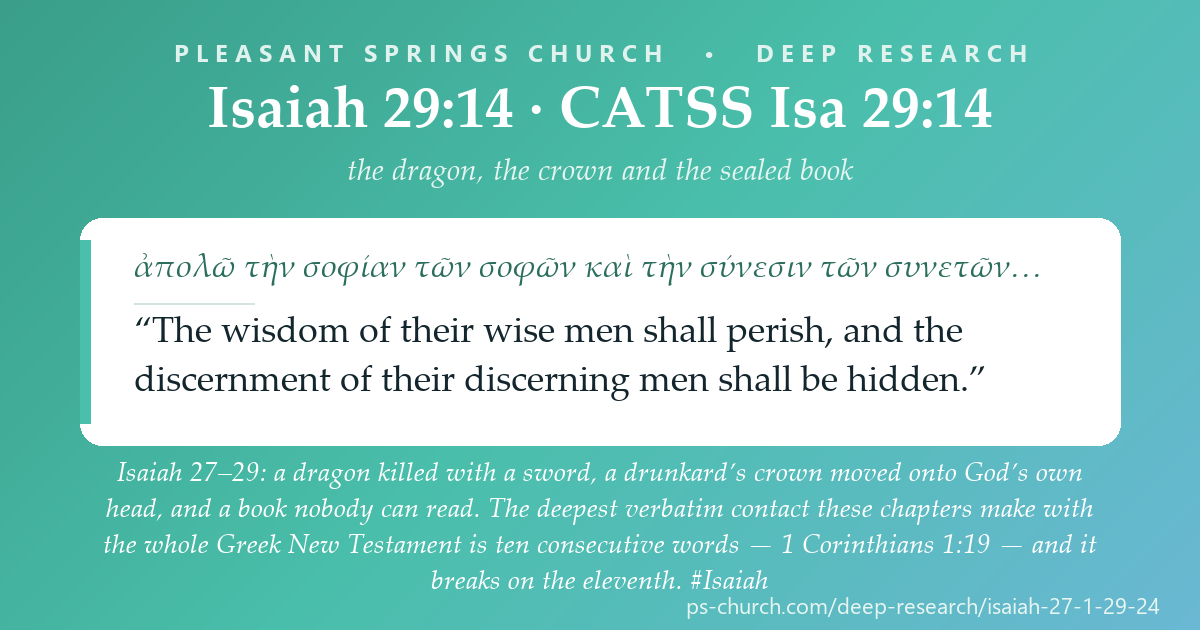
Three chapters, sixty-six verses, and three images nobody forgets: a sea-dragon killed with a sword, a drunkard’s crown taken off a head and put on God’s, and a book that is sealed so that neither the literate nor the illiterate can read it. Then run the whole passage against the 7,927 verses of the Greek New Testament and the deepest verbatim contact anywhere in it is ten consecutive words — Isaiah 29:14 into 1 Corinthians 1:19, tie band one — and it breaks on the eleventh. The second deepest is the tested stone of 28:16, eight words into 1 Peter 2:6, six into Romans 9:33 and five into Romans 10:11: the same stone, two apostles, three depths. And the four links every reader expects to carry weight — the strange tongues of 1 Corinthians 14:21, the spirit of stupor of Romans 11:8, the sealed scroll of Revelation 5:1 and the dragon of Revelation 20:2 — measure three, one, one and two. This page prints all of them. See the method →
Isaiah 27:1–29:24 — sixteen rows across all three chapters (the chapter and verse numbers agree in the Hebrew, the Greek and the ESV throughout these chapters; there is no offset here)
Hebrew (Masoretic) · Greek (CATSS/Rahlfs) · ESVThe Shape of the Passage
Sequence — eighteen scribal sections, three woes, six ‘in that day’Nothing on this page bears on the authorship of the book of Isaiah. The scholarly question of how many hands stand behind these sixty-six chapters is real, it is old, and it is not answerable from the two files on this disk. What follows reports who the text says is speaking and who it says is listening, and stops there.
Author
These three chapters carry no superscription. The book’s one heading stands at 1:1 — the vision of Isaiah the son of Amoz, which he saw concerning Judah and Jerusalem in the days of Uzziah, Jotham, Ahaz and Hezekiah — and nothing between 27:1 and 29:24 names a prophet, a king or a year. The nearest thing to a date inside the passage is a place-name: גִּבְעוֹן and הַר־פְּרָצִים at 28:21, both of them David’s battles.
The speaker changes without warning and the text does not label the changes. 27:3 is first-person divine speech (I, the Lord, am its keeper); 27:4–5 argues with an unnamed vineyard; 28:1 is a human voice crying woe; 28:16 is quoted divine speech introduced by a messenger formula; 28:23–29 is a farmer’s parable in the mouth of a teacher; 29:13 opens and the Lord said. Six changes of voice in sixty-six verses, none of them announced.
What the Greek column adds, and what it does not. The CATSS file for Isaiah runs 1,289 rows against the Masoretic 1,291 verses. The whole difference is two rows: there is no row for Isaiah 2:22 and none for Isaiah 56:12, and everywhere else the two texts have chapter for chapter and verse for verse the same shape. Neither gap is in this passage. Whether those omissions belong to the Greek tradition or only to this edition is a question about manuscripts, and no manuscript evidence was consulted for this page.
The Greek column is used here as a witness to a second ancient text, never as evidence about who wrote the Hebrew one. Where the two disagree — and on this page they disagree at 27:1, 28:1, 28:10, 28:15, 28:16, 29:1, 29:13 and 29:14 — the page prints both and names neither prior.
Audience
The addressee changes three times, and each change is marked by a woe. Chapter 27 speaks about Jacob and Israel in the third person. 28:1 turns and cries woe over Ephraim — the northern kingdom, named by its dominant tribe. 28:14 turns again: hear the word of the Lord, you scoffers, who rule this people in Jerusalem. 29:1 cries woe over Ariel, “the city where David encamped”. A page about a northern crown becomes a page about a southern city, and the seam is visible in the text.
The most quoted line in the passage is addressed to teachers. 28:9 asks whom will he teach knowledge? and answers those weaned from the milk; 28:10 is the answer the drunken priests give back, in syllables. Six verses later the same chapter gives the counter-image — a foundation stone, tested and laid. The audience is not the crowd; it is the people responsible for the crowd.
How it has been carried. 28:16 is read in the Christian churches as the cornerstone text, and 29:13 is heard through the Gospels rather than out of Isaiah. Both of those readings are older than any of us and neither is invented here. What this page adds is only the measurement: 28:16 reaches eight words with 1 Peter and six with Romans, and 29:13 reaches eight with two Gospels at once. The page does not claim the measurements are the meaning.
Orient on Leviathan, the Isaiah Apocalypse, the woe-oracle, and the cornerstone.
Which articles are relevant?
- Anchor Bible Dictionary — “Isaiah, Book of,” “Leviathan,” “Rahab,” “Apocalypse of Isaiah,” “Woe Oracle,” “Ariel,” “Cornerstone.”
- Dictionary of the OT: Prophets (IVP) — “Isaiah: Book of,” “Chaos Tradition,” “Divine Warrior,” “Woe,” “Zion Traditions,” “Prophecy and Society.”
- NIDOTTE / TDOT — לִוְיָתָן (liwyātān), תַּנִּין (tannîn), עֲטֶרֶת (ʿăḏeret, crown), פִּנָּה (pinnāh, corner), הוֹי (hôy).
- TDNT / EDNT — δράκων, ἀκρογωνιαῖος, σφραγίζω, σοφία and σύνεσις — the last two are the words the ten-word run is built out of.
The verse numbers — and there is no offset here
Isaiah 27, 28 and 29 have thirteen, twenty-nine and twenty-four verses in the Masoretic text, in the CATSS Greek and in the ESV alike. Every reference on this page therefore means the same verse in every column. That is stated because this shelf states it even when the answer is nothing: several of its books — Joel, Jonah, Malachi, the Psalter, Jeremiah — are numbered differently in Greek and English, and a reader who has met those pages is entitled to know that this one has no such trap in it.
Across the whole book, the CATSS file and the Masoretic text differ in exactly two places. The Greek file holds 1,289 rows where the Hebrew holds 1,291 verses. It has no row for Isaiah 2:22 and none for Isaiah 56:12; in the other sixty-four chapters the maxima agree exactly, and the book has sixty-six chapters in both files. Neither gap touches this passage.
What that does and does not mean. It is a statement about the file this shelf holds, not about ‘the Septuagint’. Whether the two omissions belong to the Greek tradition or only to this edition is a question about manuscripts, and no manuscript evidence was consulted for this page.
Bibliography surfaced:
- John N. Oswalt (NICOT), Brevard S. Childs (OTL), Joseph Blenkinsopp (Anchor Yale), J. Alec Motyer, H. G. M. Williamson (ICC), Hans Wildberger (Continental) and Otto Kaiser on Isaiah 13–39.
- William R. Millar, Isaiah 24–27 and the Origin of Apocalyptic; Dan G. Johnson, From Chaos to Restoration, on the ‘Isaiah Apocalypse’.
- John Day, God’s Conflict with the Dragon and the Sea; Mary K. Wakeman, God’s Battle with the Monster — on Leviathan and the chaos tradition.
- Moshe Weinfeld and others on the Ugaritic Baal cycle; Mark S. Smith and Wayne T. Pitard, The Ugaritic Baal Cycle, on the Baal texts generally. The KTU 1.5 I 1–3 lines quoted in stage 2 are taken from Day; no volume or page of any of these works was verified for this page.
- Ronald L. Troxel, LXX-Isaiah as Translation and Interpretation; Arie van der Kooij on the translator of Greek Isaiah — cited from the secondary literature and not consulted directly for this page.
The seven-headed serpent, the woe-cry, and a stone under a wall.
Leviathan, counted rather than asserted
The name לִוְיָתָן stands in exactly five verses of the 39-book Masoretic corpus held here.
| verse | what it says |
|---|---|
| Job 3:8 | those ready to rouse up Leviathan |
| Job 40:25 (ESV 41:1) | can you draw out Leviathan with a fishhook? |
| Psalm 74:14 | you crushed the heads of Leviathan |
| Psalm 104:26 | Leviathan, which you formed to play in it |
| Isaiah 27:1 | Leviathan the fleeing serpent, Leviathan the twisting serpent |
Two of the five are in Job and two are in the Psalter. Isaiah 27:1 is the only one in the Prophets, and the only one where the name is said twice in a single verse. The count was made by screening every word form in the corpus, not by consulting a concordance. Three other verses contain the same consonants in a different word — Deuteronomy 28:12 (lend), Proverbs 1:9 and 4:9 (a garland) — and they are excluded by inspection, not by the screen.
And the Greek column does not have a Leviathan in it. Where the Hebrew names the creature twice and then calls a third creature תַּנִּין, the CATSS Greek says δράκων three times and transliterates nothing. Whether that is a translator generalising a name, or a different text in front of him, this page cannot say and does not.
The Ugaritic parallel, and the honest size of it
The Baal cycle from Ras Shamra describes a serpent in words that stand very close to Isaiah 27:1. KTU 1.5 I 1–3 speaks of ltn bṯn brḥ and bṯn ʿqltn — the fleeing serpent and the twisting serpent — and the Hebrew of 27:1 has נָחָשׁ בָּרִחַ and נָחָשׁ עֲקַלָּתוֹן. The correspondence is well known and is not a discovery of this page.
What this shelf can and cannot verify about that. No Ugaritic corpus is held on this disk. The parallel above is cited from the secondary literature (Day; Smith and Pitard) and was not read in the original for this page. Every measurement printed anywhere else on this page was made against files this project holds; this paragraph is the exception, and it is flagged rather than blended in.
What can be verified from the files is the shape of the rest of the Bible around it. Psalm 74:13–14 has God breaking the heads of the תַּנִּינִים and crushing the heads of Leviathan; Job 26:12–13 has him piercing the fleeing serpent. Isaiah 27:1 is a third instance of the same picture, and it is the only one of the three that puts the picture in the future.
הוֹי — the funeral cry used on the living
Twenty verses in Isaiah open with הוֹי. Six of the twenty are in chapters 28–33, and three of those six are in this passage.
| where | verses |
|---|---|
| Isaiah 1–18 | 1:4; 5:8, 11, 18, 20, 21, 22; 10:1, 5; 17:12; 18:1 |
| Isaiah 28–33 | 28:1; 29:1; 29:15; 30:1; 31:1; 33:1 |
| Isaiah 40–66 | 45:9, 10; 55:1 |
The cry is a mourner’s cry — it is what you say at a funeral — and in the prophets it is said over people who are still alive. Chapters 28 to 33 are the book’s densest run of it, and this study holds the first half of that run.
The Greek does not preserve the distinction. οὐαί stands in twenty-one rows of CATSS Isaiah — one more than the Hebrew has הוֹי at the head of a verse — because the same Greek word carries both הוֹי and אוֹי, and because it appears mid-verse where the Hebrew has it mid-verse too. A page that counted οὐαί and reported it as a count of הוֹי would be wrong by one and wrong in kind. The two sets are not nested either: the Greek adds οὐαί at 1:24, 3:9, 3:11 and 24:16, and has none at 45:9, 45:10 or 55:1 where the Hebrew opens on הוֹי. Twenty-one against twenty is a net figure, not a surplus. Both counts are printed.
- Amos 5:18; 6:1; Habakkuk 2:6–19; Jeremiah 22:13 — the woe-oracle outside Isaiah.
- 1 Kings 13:30; Jeremiah 22:18; 34:5 — הוֹי as an actual funeral cry, which is what makes its use on the living a threat.
- Psalm 118:22; Zechariah 4:7 — the other Old Testament stones the New Testament stacks with Isaiah 28:16.
Four words, and what the screen says about each.
Five verses in the whole Hebrew Bible; this is the only one outside Job and the Psalter. The CATSS Greek renders it δράκων and keeps no name.
Four verses in Isaiah — 28:1, 28:3, 28:5, 62:3. Three of the four are in five verses of this chapter, and between the second and the third the crown changes heads.
One verse in the 30,348 Greek Old Testament verse units screened here — Isaiah 28:16 — and two in the Greek New Testament: Ephesians 2:20 and 1 Peter 2:6.
Twice in 29:11, of the book nobody can read. The Greek ἐσφραγισμέν- stands in five of the 30,348 Greek Old Testament verse units screened here, and Revelation 5:1 uses a different, compounded form.
צַו לָצָו קַו לָקָו — the line the two columns disagree about
The Hebrew of 28:10 is thirteen words long and seven of them are two letters. כִּי צַו לָצָו צַו לָצָו קַו לָקָו קַו לָקָו זְעֵיר שָׁם זְעֵיר שָׁם. Whatever else it is, it is a sound: a slurred, repetitive, sing-song mimicry, and the verse before it has the priests and prophets staggering with drink.
The CATSS Greek does not have syllables. It has sentences. θλῖψιν ἐπὶ θλῖψιν προσδέχου, ἐλπίδα ἐπ’ ἐλπίδι, ἔτι μικρὸν ἔτι μικρόν — expect affliction upon affliction, hope upon hope, yet a little, yet a little. Two words with meaning where the Hebrew has two syllables without one.
And that Greek phrase is confined to this chapter. Exactly two of the 30,348 Greek Old Testament verse units screened here carry it, and both are Isaiah: θλῖψιν ἐπὶ θλῖψιν at 28:10 and θλῖψις ἐπὶ θλῖψιν at 28:13 — the screen counts word forms, so the two are not the same string. The Hebrew repetition is just as tight — twelve identical consecutive words shared between 28:10 and 28:13, which is the deepest repetition anywhere inside these three chapters.
This page does not adjudicate the difference. It does not say the translator misread his text, and it does not say he had a different one. Both of those are claims about a direction of influence, and the house rule forbids them. What is printable is that the two texts on this disk say different things here, and that both of them say it twice.
אֶבֶן בֹּחַן — and what the Greek makes of it
The Hebrew stone has four descriptions stacked on it — a stone, a stone of testing, a corner of preciousness, a founded foundation (אֶבֶן, אֶבֶן בֹּחַן, פִּנַּת יִקְרַת, מוּסָד מוּסָּד) — and the last four Hebrew words הַמַּאֲמִין לֹא יָחִישׁ mean the one who believes will not be in haste.
The Greek has a different four and a different last clause. λίθον πολυτελῆ ἐκλεκτὸν ἀκρογωνιαῖον ἔντιμον — a costly, choice, cornerstone, honoured stone — and then ὁ πιστεύων ἐπ’ αὐτῷ οὐ μὴ καταισχυνθῇ, the one who believes in him will not be put to shame. There is no haste in the Greek and no shame in the Hebrew.
Every New Testament use of this verse follows the Greek clause, and none of them follows the Hebrew one. Romans 9:33, Romans 10:11 and 1 Peter 2:6 all end οὐ καταισχυνθήσεται or οὐ μὴ καταισχυνθῇ. That is a fact about which text the New Testament writers are working from at this verse, and it is stated as such: it is not an argument that the Greek is the better text, or the earlier one.
Everything measured, with its tie band, and the counter-examples printed beside it.
Screen 1 — the whole passage against the Greek New Testament
Method: the 66 CATSS rows of Isaiah 27–29 against all 7,927 verses of the Greek New Testament (SBLGNT via MorphGNT). Contiguous runs of whole word forms, never lemmas. Accents, breathings and case dropped on both sides; final sigma folded; MorphGNT’s own spelling equivalences applied — οὐ/οὐκ/οὐχ, ἐκ/ἐξ and the movable nu — so that a shared run is not cut at a word the two editions merely spell differently. Exhaustive and deterministic.
Across the 66 rows: 65 reach two, 39 reach three, 17 reach four, 4 reach six, 3 reach eight, 1 reaches ten, and nothing reaches eleven.
| Isaiah | run | tie band | the other end | what is shared |
|---|---|---|---|---|
| 29:14 | 10 | 1 | 1 Corinthians 1:19 | ἀπολῶ τὴν σοφίαν τῶν σοφῶν καὶ τὴν σύνεσιν τῶν συνετῶν |
| 28:16 | 8 | 1 | 1 Peter 2:6 | καὶ ὁ πιστεύων ἐπ’ αὐτῷ οὐ μὴ καταισχυνθῇ |
| 29:13 | 8 | 2 | Matthew 15:8 and Mark 7:6 | ἡ δὲ καρδία αὐτῶν πόρρω ἀπέχει ἀπ’ ἐμοῦ |
| 29:16 | 6 | 1 | Romans 9:20 | μὴ ἐρεῖ τὸ πλάσμα τῷ πλάσαντι |
| 27:12 and 27:13 | 4 | 4 | Mt 13:1, Lk 10:12, Ac 2:41, 2 Th 1:10 | ἐν τῇ ἡμέρᾳ ἐκείνῃ |
| 28:13 | 4 | 3 | John 6:66, 18:6, 20:14 | εἰς τὰ ὀπίσω καί |
| 28:17 | 4 | 3 | Mt 24:34, Mk 13:30, Lk 21:32 | ὅτι οὐ μὴ παρέλθῃ |
| 28:18 | 4 | 1 | 1 Thessalonians 1:8 | ὑμῶν ἡ πρὸς τόν |
| 29:11 | 4 | 2 | Luke 1:65, 2:51 | πάντα τὰ ῥήματα ταῦτα |
| 29:20 | 1 | 5,546 | — | shares no two consecutive words with any New Testament verse at all |
Read the last two rows together. 29:11 reaches four with two verses of Luke, and those four words are all these words — a phrase, not a quotation. 29:20 reaches one: on the Greek-side screen the unigram fallback is ON, so a 1 means the verse shares individual words and no adjacent pair. Depth without a band, and a band without a reading, are both worthless.
The ten-word run, and where it stops
1 Corinthians 1:19 announces itself: γέγραπται γάρ, for it is written. Then the two texts run together for ten words and part on the eleventh.
| the ten shared words | word eleven | |
|---|---|---|
| CATSS Isaiah 29:14 | ἀπολῶ τὴν σοφίαν τῶν σοφῶν καὶ τὴν σύνεσιν τῶν συνετῶν | κρύψω — I will hide |
| 1 Corinthians 1:19 | ἀπολῶ τὴν σοφίαν τῶν σοφῶν καὶ τὴν σύνεσιν τῶν συνετῶν | ἀθετήσω — I will set aside |
The tie band is one: no other verse in the Greek New Testament reaches ten with this row, and no other Isaiah row reaches ten with 1 Corinthians 1:19. Measured against the whole book, eighteen of the 1,289 CATSS Isaiah rows reach ten or more with the Greek New Testament — Isaiah 6:10 is deepest at twenty-four — and 29:14 is the only one of the eighteen inside chapters 27–29.
What the screen has found is verbatim contact. It has not found, and cannot find, whether Paul had a scroll open, a memory, or a testimonia list; and this page does not say that Paul ‘changed’ the last word, because saying so would assert a direction the measurement does not carry. What is measurable is that the two texts on this disk agree for ten words and differ on the eleventh.
The same stone, two apostles, three depths
Isaiah 28:16 is quoted three times in the New Testament, and the three quotations do not sit at the same distance from the Greek Isaiah on this disk.
| New Testament verse | run against CATSS Isa 28:16 | what is shared |
|---|---|---|
| 1 Peter 2:6 | 8 | καὶ ὁ πιστεύων ἐπ’ αὐτῷ οὐ μὴ καταισχυνθῇ |
| Romans 9:33 | 6 | καὶ ὁ πιστεύων ἐπ’ αὐτῷ οὐ |
| Romans 10:11 | 5 | ὁ πιστεύων ἐπ’ αὐτῷ οὐ |
The three adjectives are the reason 1 Peter’s run does not start earlier. CATSS Isaiah has λίθον πολυτελῆ ἐκλεκτὸν ἀκρογωνιαῖον ἔντιμον; 1 Peter has λίθον ἀκρογωνιαῖον ἐκλεκτὸν ἔντιμον. The same four words in a different order, which on a contiguous-run screen counts as one word at a time. The eight-word run begins after them, at καί.
And ἀκρογωνιαῖος is a rare enough word to be worth counting. It stands in exactly one of the 30,348 Greek Old Testament verse units screened here — Isaiah 28:16 — and in exactly two verses of the Greek New Testament: Ephesians 2:20 and 1 Peter 2:6. That is the whole census. Ephesians 2:20 nevertheless measures one word against Isaiah 28:16, because Paul uses the word in a different case inside a different sentence.
Four counter-examples, printed rather than buried
These are the four connections a reader of Isaiah 27–29 expects to be deep. None of them is.
| the expected link | run | why it is that small |
|---|---|---|
| Isaiah 28:11–12 → 1 Corinthians 14:21 the tongues text | 3 (28:11) 1 (28:12) | Paul marks a quotation — ἐν τῷ νόμῳ γέγραπται — but the wording he quotes is not the wording of the CATSS Greek. The only run is τῷ λαῷ τούτῳ. |
| Isaiah 29:10 → Romans 11:8 the spirit of stupor | 1 | The longest run is one word — κατανύξεως, the very word everyone recognises. It is not the only word the two verses share: καί and ὀφθαλμούς stand in both, and no two of the three are adjacent. Romans 11:8 sets the phrase inside a sentence built from Deuteronomy 29:3 (ESV 29:4). |
| Isaiah 29:11 → Revelation 5:1 the sealed scroll | 1 | Revelation writes κατεσφραγισμένον; CATSS Isaiah writes ἐσφραγισμένου. A compounded form is a different word form, and the screen counts forms. |
| Isaiah 27:1 → Revelation 20:2 the dragon, the ancient serpent | 2 | τὸν δράκοντα, and no more. δράκων stands in twelve New Testament verses, every one of them in Revelation — but a shared vocabulary is not a shared sentence. |
None of that says the four links are not real. Revelation 20:2 unmistakably has Isaiah’s creature in view; Paul at 1 Corinthians 14:21 says he is quoting. It says that this screen measures verbatim contact and not allusion, and that on this passage the two come apart badly. A page that printed the ten-word run and hid these four would be telling the reader something false about what the method can do.
Screen 2 — the Hebrew against the rest of the Hebrew Bible
Method: each of the 66 Masoretic verses of Isaiah 27–29 against the 23,138 verse units of the 39-book corpus outside those three chapters. Consonantal word forms; cantillation and vowel points removed; qere read; final letters folded to medial; maqqef a separator and never a weld. The unigram fallback is OFF, so a row reported as 0 shares no two consecutive words with any other verse — it does not mean the verse shares no words.
Result, with the scribal section markers stripped (see the next panel): 1 row reaches six, 1 reaches five, 4 reach four, 17 reach three, 28 reach two, and 15 reach nothing.
| Isaiah | run | tie band | where else | what is shared |
|---|---|---|---|---|
| 28:16 | 6 | 7 | Ezekiel 5:8, 13:20, 25:16, 26:3 and three more | לכן כה אמר אדני יהוה הנני — a messenger formula |
| 29:22 | 5 | 3 | 2 Kings 19:32, Isaiah 37:33, Jeremiah 22:18 | לכן כה אמר יהוה אל — the same formula, one word shorter |
| 27:1 | 4 | 1 | Isaiah 24:21 | ביום ההוא יפקד יהוה |
| 28:5 | 4 | 1 | Zechariah 14:9 | ביום ההוא יהיה יהוה |
| 29:17 | 4 | 1 | Isaiah 32:15 | לכרמל והכרמל ליער יחשב |
| 28:14 | 4 | 3 | Jer 42:15, Jer 44:26, 2 Chronicles 18:18 | לכן שמעו דבר יהוה |
The deepest Hebrew run in the passage is the least interesting thing in it. Six words with a tie band of seven is a form of words the prophets all share. Beside it, a run of four with a tie band of one — 27:1 against 24:21, 28:5 against Zechariah 14:9, 29:17 against Isaiah 32:15 — is a much smaller number and a much larger finding. This is the single clearest illustration on the shelf of why a run is never reported without its band.
Fifteen of the sixty-six verses share no adjacent word pair with anything outside these three chapters. 27:7, 27:8; 28:3, 28:6, 28:10, 28:17, 28:20, 28:21, 28:23, 28:24, 28:26; 29:3, 29:4, 29:5, 29:24. Among them is 28:10, the most quoted line in the passage — which is not surprising once you look at it, because it is made of syllables no other verse uses. Three of the fifteen are in the farmer’s parable of 28:23–29, the most ordinary-sounding passage in the three chapters.
A correction this page had to make to its own arithmetic
The Masoretic file this shelf holds prints the scribal section markers inside the verse text, and the frozen normaliser tokenises them as words. {ס} and {פ} stand at the end of 18 of this passage’s 66 verses, and of 3,447 of the 23,204 verses in the Masoretic corpus held here. That means a run can be extended by one word that is not a word.
The screen was therefore run twice, and here is the difference.
| rows whose deepest run is exactly… | markers counted | markers stripped |
|---|---|---|
| six | 1 | 1 |
| five | 1 | 1 |
| four | 6 | 4 |
| three | 15 | 17 |
| two | 28 | 28 |
| zero | 15 | 15 |
Exactly two rows move, and both of them move down. 28:13 read as a run of four against Isaiah 8:15 — but the fourth ‘word’ was {פ}. 28:22 read as a run of four against Psalm 83:19 (ESV 83:18), and the fourth was {פ} again. Both are really runs of three. The table printed above this one already has them removed, and the four-word runs it lists — 27:1, 28:5, 28:14, 29:17 — survive the strip untouched. normalize.py is frozen and was not edited; the strip was applied downstream of it.
What was screened, and what was left out of the screen
The Greek Old Testament figures on this page are scoped to the 64 CATSS files held here — 30,637 verse units — screened down to 30,348 with the Odes excluded. The Odes are a Greek manuscript appendix: 289 rows in fourteen numbered pieces. Two of them are New Testament — Ode 9 is Luke 1 and Ode 13 is Luke 2 — and ten more are second copies of passages already in the Greek Old Testament: Exodus 15, Deuteronomy 32, 1 Samuel 2, Habakkuk 3, Jonah 2, Daniel 3, and three from Isaiah itself.
Why that matters particularly here. One of the three Isaiah Odes is Isaiah 26:9–20 — the twelve verses immediately before this passage begins, and the Odes file even keeps Isaiah’s own verse numbers for them, running 5:9 to 5:20. If the Odes were left in the screen, Isaiah 26 would show up as its own doublet and every phrase-count near this passage would be quietly inflated. They are excluded, and the figure this page states as its Greek Old Testament scope is the screened one, 30,348, not the held one.
And ‘second copy’ does not mean identical copy. Compared verse by verse against CATSS Isaiah 26, the twelve Ode rows share runs of 25, 14, 10, 11, 16, 11, 6, 12, 18, 14, 30 and 22 consecutive words — five of the twelve match end to end and seven do not. That is worth stating on a page that reports run lengths: the same passage carried twice in the same manuscript tradition does not come back word-for-word, which is a useful measure of how much a run of ten across two different corpora is actually worth.
Where the argument is, where this page stands, and where it is weakest.
What is actually argued about here
Isaiah 24–27 — the block that 27:1 and 27:13 close — is one of the most contested units in the prophets. Duhm called it an apocalypse; Millar argued for an early prototype of apocalyptic; Blenkinsopp, Wildberger and Williamson read it as later composition worked into an eighth-century book; Oswalt and Motyer defend a unity with the rest of Isaiah. The disagreement is about date and composition, and nothing measurable on this shelf touches it. This page therefore takes no side and says so plainly, rather than letting a silence read as agreement.
Greek Isaiah is itself a scholarly subject. Seeligmann, van der Kooij and Troxel have argued at length about how free its translator is and whether he contemporises. Several divergences printed on this page — the holy sword at 27:1, drunk without wine at 28:1, affliction and hope at 28:10, eating with Moab at 29:1, in vain do they worship me at 29:13 — are exactly the sort of thing that literature is about. This page reports them and does not explain them, because explaining them means asserting a direction, and the house rule forbids it.
What this page did NOT check
No manuscript evidence of any kind was consulted. Not the Great Isaiah Scroll (1QIsaᵃ), which covers all sixty-six chapters and is the single most obvious thing to check against a page about Isaiah; not 4QIsa fragments; not Codex Vaticanus, Sinaiticus or Marchalianus for the Greek; no critical apparatus for either column. The Hebrew is Sefaria’s Miqra according to the Masorah as this project holds it, and the Greek is Rahlfs as digitized by CATSS. Where this page says the two texts differ, it means these two files differ.
No Ugaritic text was read. The Baal cycle parallel in stage 2 is taken from the secondary literature. There is no Ugaritic corpus on this disk and the screen cannot reach one.
The ESV column was not verified against a held ESV text. No ESV file for Isaiah exists in this project and no Crossway API key has ever been issued to it. The English above was typed, and its verse alignment rests on the verse counts and chapter openings, which do agree across all three columns here. The Hebrew and Greek columns were pulled programmatically out of the corpus files and were not typed.
Targum, Peshitta, Vulgate and the Qumran pesharim were not consulted — and the Isaiah pesharim from Qumran Cave 4 reach into these chapters, which is a real gap in a page about them. No Qumran text is held on this disk, no fragment number was verified here, and none is given.
Rabbinic and patristic reception was not surveyed. 28:16 has a long history in both, and none of it was read for this page.
Where this page is weakest
1. The structure diagram rests on one edition’s paragraph marks. The eighteen sections are the {פ} and {ס} of the Sefaria file. Those markers are a real feature of the Masoretic tradition, but manuscripts differ over them, and none was collated. If a different edition divides differently, the diagram would change.
2. The passage boundary is administrative, not literary. 27:1 closes a block that began at 24:1, and 29:24 does not close anything: the woes run on through 30, 31 and 33. This study covers 27:1–29:24 because those were the chapters of Isaiah not yet quoted anywhere on this shelf. That is a coverage decision and the page says so rather than pretending to a literary unit it does not have.
3. Three claims were withdrawn while this page was built. (a) An early draft had Isaiah 29:11 and Revelation 5:1 as a measured connection; it measures one, and the claim was cut back to a counter-example. (b) A draft note said the Greek of 28:10 ‘transliterates the Hebrew syllables’; it does not — it gives ordinary Greek words — and the note was rewritten. (c) A draft counted οὐαί in Greek Isaiah as a count of הוֹי; the two differ by one and are not the same category, and both counts are now printed separately.
4. The Hebrew screen excludes all three chapters from its own target. So when 28:10 is reported as 0, that means outside Isaiah 27–29. Inside them it shares twelve consecutive words with 28:13. Both numbers are true and they answer different questions; a reader who saw only the zero would be misled, so the twelve is printed in three places on this page.
5. Nothing here settles what Leviathan is. Sea creature, empire, chaos, a real being — the page counts five verses and stops. The theology of 27:1 is not a measurement and is not offered as one.
Bibliography, and what was and was not read
- Oswalt (NICOT), Childs (OTL), Blenkinsopp (Anchor Yale), Williamson (ICC), Wildberger (Continental), Motyer, Kaiser — consulted as the standing frame for Isaiah 13–39; no commentary supplied a number printed on this page.
- Millar, Isaiah 24–27 and the Origin of Apocalyptic; Johnson, From Chaos to Restoration — on the block 27:1 closes.
- Day, God’s Conflict with the Dragon and the Sea; Smith and Pitard, The Ugaritic Baal Cycle — the Ugaritic parallel is taken from Day and was not read in the original; no volume or page was verified here.
- Seeligmann, The Septuagint Version of Isaiah; van der Kooij; Troxel, LXX-Isaiah as Translation and Interpretation — named, not consulted.
- Text: Sefaria, Miqra according to the Masorah; Rahlfs’ Septuaginta as digitized by CATSS; SBLGNT as digitized by MorphGNT. These three files are the only evidence behind every number on this page.
What the measurements leave you holding.
The thing worth sitting with
The passage’s deepest contact with the New Testament is a sentence about God destroying wisdom. Ten words, tie band one: I will destroy the wisdom of the wise, and the discernment of the discerning I will… and there the two texts part. Isaiah says hide. 1 Corinthians says set aside. Paul is writing to a church that has been ranking its teachers.
And the second deepest is a sentence about a stone you can stand on. Eight words into 1 Peter: and the one who believes in him will not be put to shame. The chapter that contains it is the chapter where the leaders of Jerusalem said they had a covenant with death and a deal with Sheol — a plan so good that the flood would pass them by. God’s answer is not a better plan. It is a stone, laid in the ground, and a promise that whoever leans on it will not have to be quick.
Between the two stands the sealed book. 29:11–12 hands a scroll first to a man who can read and then to a man who cannot, and neither of them gets a word out of it: the one because it is sealed, the other because he never learned. Seven verses later, inside the woe that begins at 29:15, the deaf shall hear the words of a book. The same two Hebrew nouns, דברי ספר — at 29:11 under a preposition and an article — close the problem and open the answer, and they occur nowhere else in these three chapters.
What the numbers are for. Not to prove the connections — the connections were there before anybody counted, and four of them measure one, one, two and three. The numbers are for keeping the page honest about which claims rest on the text and which rest on the reader. Ten words with a band of one is the text. The dragon of Revelation is the reader, and this page has said so.
Every Deep Research page traces its passage across the whole sweep — the Old Testament, the Second-Temple world between the testaments (historical witnesses, not Scripture), and the New Testament. Follow the thread:
Pleasant Springs Church — Deep Research
Research method after Michael S. Heiser’s Bible Research Method (examine dictionaries → ancient literature → important words → textual connections → academic publications → share), with the Pleasant Springs “Author & Audience” foundation. Scripture set in the Hebrew, the Greek editions named on each page and the ESV (Old Testament), and the Greek New Testament and the ESV (New Testament), per the practice of Pleasant Springs Church. Isaiah research grounded in Oswalt (NICOT), Childs (OTL), Blenkinsopp (Anchor Yale), Williamson (ICC), Wildberger, Motyer and Kaiser; on Isaiah 24–27 in Millar and Johnson; on Leviathan in Day and in Smith and Pitard. Text: Hebrew from the Masoretic text as printed in the edition consulted — Sefaria’s Miqra according to the Masorah; no critical apparatus was consulted for the Hebrew and no Dead Sea Scroll was collated, 1QIsaᵃ included. Greek from Rahlfs’ Septuaginta as digitized by CATSS; Greek New Testament from the SBL edition as digitized by MorphGNT. The standing caution for this shelf applies: these pages say “the CATSS Greek text reads…” and never call a Greek reading early or late, and never say which text acted on which. ⚠️ Verse numbering. There is no offset in this passage. Masoretic, CATSS and ESV all give Isaiah 27, 28 and 29 as 13, 29 and 24 verses, in the same order, with the chapter breaks in the same places, so every reference on this page means the same verse in every column. Across the whole book the CATSS file holds 1,289 rows where the Hebrew holds 1,291 verses — it has no row for Isaiah 2:22 and none for Isaiah 56:12, and the chapter maxima agree in all sixty-six chapters otherwise. Whether those omissions belong to the Greek tradition or only to this edition is a question about manuscripts, and no manuscript evidence was consulted. ⚠️ The ESV column was NOT verified against a held ESV text. No ESV file for Isaiah exists on this disk and no Crossway API key exists in this project; the English was typed and its verse alignment rests on verse counts and chapter openings. The Hebrew and Greek columns were pulled programmatically from the corpus files. ⚠️ Every cross-corpus run figure on this page was measured on 31 August 2026 and applies MorphGNT’s own spelling equivalences — οὐ/οὐκ/οὐχ, ἐκ/ἐξ and the movable nu — so that a shared run is not cut at a word the two editions merely spell differently. Figures published on this shelf before 30 August 2026 are lower for that reason; nothing was copied from a sibling page and every number above was re-measured. ⚠️ A run of zero on the Hebrew screen means NO TWO CONSECUTIVE WORDS. The Hebrew-side screen runs with the unigram fallback off, so max = 0 means the verse shares no adjacent word pair with any verse outside Isaiah 27–29 — it does not mean the verse shares no words. All fifteen zeros on this page share individual words freely, and 28:10 shares twelve consecutive words with 28:13 inside the passage. The Greek-side screen runs with the fallback ON, so the 1 reported for Isaiah 29:20 means it shares isolated words with the New Testament and no adjacent pair at all. ⚠️ The Masoretic text held here counts the scribal section markers as words. {ס} and {פ} stand inside the verse text of the Sefaria file and the frozen normaliser tokenises them — at the end of 18 of this passage’s 66 verses, and of 3,447 of the 23,204 verses in the Masoretic corpus held here. Stage 4 prints the screen both ways: exactly two rows move, 28:13 and 28:22, and both drop from four to three. The Hebrew tables on this page are the marker-stripped figures. normalize.py is frozen and was not edited. ⚠️ Greek Old Testament figures are scoped to the 64 CATSS files held here, 30,637 verse units, screened to 30,348 with the Odes excluded — which matters on an Isaiah page in particular, because one of the Odes is a second copy of Isaiah 26:9–20, the twelve verses immediately before this passage. ⚠️ Three claims were withdrawn while this page was built and all three are named in stage 5. Typology is handled per the house position: what the text says, what the New Testament itself draws, and what we see from this side of the cross — with the seeing left to the reader.
Scripture quotations marked ESV are from the ESV® Bible (The Holy Bible, English Standard Version®), © 2001 by Crossway, a publishing ministry of Good News Publishers. ESV Text Edition: 2016. Used by permission. All rights reserved. The ESV text may not be quoted in any publication made available to the public by a Creative Commons license, and the ESV may not be translated in whole or in part into any other language. www.esv.org
|
Did this study bless you today? 💚 Give to Support PS Church100% of gifts go to the General Fund — thank you. |