Five chapters, eighty verses, and some of the most quoted sentences in the Bible: a king will reign in righteousness, your eyes will behold the king in his beauty, strengthen the weak hands, the ransomed of the Lord shall return. Then run all eighty against the 7,927 verses of the Greek New Testament and nothing reaches six consecutive words. The deepest run in the whole passage is five — Isaiah 31:2 into 1 John 1:10, tie band one — and it is an accident: the sixth word turns the sentence inside out. The single verse that reaches only one, with a tie band of 5,113, is Isaiah 35:3, the verse Hebrews 12:12 unmistakably uses. And the deepest run on the page never leaves the book: nine consecutive Hebrew words between Isaiah 35:10 and Isaiah 51:11, tie band one. This page prints all of it, including the counter-examples. See the method →
Isaiah 31:1–35:10 — sixteen rows across all five chapters (the chapter and verse numbers agree in the Hebrew, the Greek and the ESV throughout these five chapters — 9, 20, 24, 17 and 10 verses in every column; there is no offset here)
Hebrew (Masoretic) · Greek (CATSS/Rahlfs) · ESVThe Shape of the Passage
Sequence — twelve scribal sections, two woes, three kingsNothing on this page bears on the authorship of the book of Isaiah. The scholarly question of how many hands stand behind these sixty-six chapters is real, it is old, and it is not answerable from the three files on this disk. What follows reports who the text says is speaking and who it says is listening, and stops there.
Author
These five chapters carry no superscription. The book’s one heading stands at 1:1 — the vision of Isaiah the son of Amoz, which he saw concerning Judah and Jerusalem in the days of Uzziah, Jotham, Ahaz and Hezekiah — and nothing between 31:1 and 35:10 names a prophet, a king or a year. That silence is measurable. The consonantal string מלכ stands in four verses of Isaiah between 24:23 and 36:1, and three of the four are here: 32:1, 33:17 and 33:22; the fourth is 30:33. Two of the three here are anonymous and the third is the Lord himself. From 36:1 onward the word returns immediately — eleven verses of chapter 36 carry it — and the king it names is almost always a foreign one: the king of Assyria in nine of the eleven, Pharaoh king of Egypt at 36:6, and King Hezekiah at 36:1, 36:2 and 36:21.
The speaker changes with almost no warning and the text hardly ever labels the changes. 31:1 is a human voice crying woe; 31:4 is quoted divine speech introduced by thus the Lord said to me; 32:9 turns and addresses women directly; 33:2 is a congregation praying in the first person plural; 33:10 is God answering in the first person; 34:1 summons the nations; 35:4 is an instruction to speak to somebody else. Seven changes of voice in eighty verses, and only the one at 31:4 is announced.
What the Greek column adds, and what it does not. The CATSS file for Isaiah runs 1,289 rows against the Masoretic 1,291 verses; the whole difference is that there is no row for Isaiah 2:22 and none for Isaiah 56:12, and neither gap is in these chapters. Verse for verse, 31–35 run 9, 20, 24, 17 and 10 in both columns. Whether the two omissions belong to the Greek tradition or only to this edition is a question about manuscripts, and no manuscript evidence was consulted.
Audience
The addressee changes four times and the text names three of them. 31:1–9 addresses people who have gone to Egypt for help — the same policy the Rabshakeh mocks five chapters later at 36:6, that broken reed of a staff, Egypt. 32:9 addresses נָשִׁים שַׁאֲנַנּוֹת, women who are at ease. 34:1 addresses גּוֹיִם, the nations, and tells them to draw near and listen. And 35:4 addresses somebody who is to say something to נִמְהֲרֵי־לֵב, those of an anxious heart.
One nation is named as the object of the vengeance, and it is not Assyria. Chapter 34 names אֱדוֹם at verses 5 and 6 and בָּצְרָה, its city, at verse 6. Four nations are named in the eighty verses: Edom at 34:5 and 34:6, Assyria once at 31:8, Egypt twice at 31:1 and 31:3, and Israel twice at 31:1 and 31:6. Jerusalem stands at 31:5, 31:9 and 33:20, and Zion at 31:4, 31:9, 33:5, 33:14, 33:20, 34:8 and 35:10 — with Lebanon, Sharon and Carmel at 33:9 and 35:2 and Bashan at 33:9. Those are cities and regions, not nations.
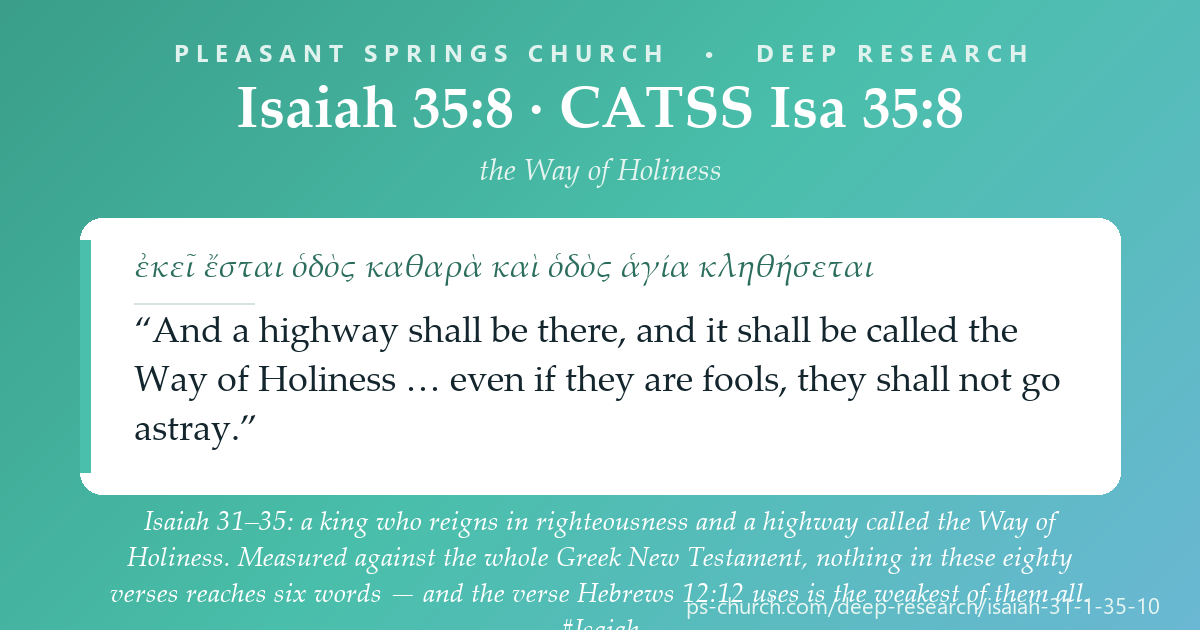
Two things the text says about its readers. 34:16 tells them to seek and read from the book of the Lord — a phrase that stands in exactly one verse of the Hebrew Bible — which assumes readers who have a book. And 35:8 says of the highway that even if they are fools, they shall not go astray, which assumes readers who are afraid they will.
Orient on the Egyptian alliance, the woe-oracle, Edom as the object of the day of vengeance, and the highway of the return.
Which articles are relevant?
- Anchor Bible Dictionary — “Isaiah, Book of,” “Egypt (Israel’s relations with),” “Edom,” “Bozrah,” “Lilith,” “Woe Oracle,” “Zion Tradition.”
- Dictionary of the OT: Prophets (IVP) — “Isaiah: Book of,” “Divine Warrior,” “Day of the Lord,” “Wilderness,” “Nations,” “Justice and Righteousness.”
- NIDOTTE / TDOT — מֶלֶךְ (melek), מְחֹקֵק (məḥōqēq, lawgiver), מַסְלוּל (maslûl, highway), לִילִית (lîlîṯ), פָּדָה (pāḏāh, ransom).
- TDNT / EDNT — ὁδός, μογιλάλος, γραμματεύς (against Greek Isaiah’s γραμματικός), ὀνοκένταυρος and σειρήν — the last two are creatures the Greek column puts into Edom and the Hebrew does not.
The verse numbers — and there is no offset here
Isaiah 31, 32, 33, 34 and 35 have nine, twenty, twenty-four, seventeen and ten verses in the Masoretic text, in the CATSS Greek and in the ESV alike. That was not assumed; it was derived from the two corpus files on this disk. Every reference on this page therefore means the same verse in every column. The offset is stated even though the answer is nothing, because several books on this shelf — Joel, Jonah, Malachi, the Psalter, Jeremiah — are numbered differently in Greek and English, and a reader who has met those pages is entitled to know that this one has no such trap in it.
Across the whole book the CATSS file and the Masoretic text differ in exactly two places, and neither is here. The Greek file holds 1,289 rows where the Hebrew holds 1,291 verses. It has no row for Isaiah 2:22 and none for Isaiah 56:12. The chapter maxima agree in all sixty-six chapters otherwise. Two chapter counts do differ: at Isaiah 2 the Hebrew has 22 verses to the Greek’s 21, and at Isaiah 56 the Hebrew has 12 to the Greek’s 11 — which is the same two omissions seen from the other side.
What that does and does not mean. It is a statement about the file this shelf holds, not about ‘the Septuagint’. Whether the two omissions belong to the Greek tradition or only to this edition is a question about manuscripts, and no manuscript evidence was consulted for this page.
Bibliography surfaced:
- John N. Oswalt (NICOT), Brevard S. Childs (OTL), Joseph Blenkinsopp (Anchor Yale), J. Alec Motyer, H. G. M. Williamson (ICC), Hans Wildberger (Continental) and Otto Kaiser on Isaiah 13–39.
- Bernard Duhm and, after him, most of the twentieth century on whether Isaiah 34–35 belongs with chapters 40–55; Charles C. Torrey’s argument that 34–35 is the opening of Second Isaiah.
- Marvin A. Sweeney and Christopher R. Seitz on the placement of chapters 36–39 and the shape of the book as a whole.
- Bert Dicou, Edom, Israel’s Brother and Antagonist; John R. Bartlett, Edom and the Edomites — on chapter 34.
- Isac Leo Seeligmann, The Septuagint Version of Isaiah; Arie van der Kooij; Ronald L. Troxel, LXX-Isaiah as Translation and Interpretation — cited from the secondary literature and not consulted directly for this page.
A bird in a cage, a broken reed, and Greek monsters in an Edomite ruin.
The bird that Sennacherib used, and the bird Isaiah used
Isaiah 31:5 says the Lord will hover over Jerusalem like birds. The Assyrian record of the same campaign uses a bird too, and uses it for the opposite purpose.
“As to Hezekiah, the Jew, he did not submit to my yoke … Himself I made a prisoner in Jerusalem, his royal residence, like a bird in a cage.”Sennacherib’s Prism, Pritchard, ANET 287–288 — read in translation from the copy held in this project’s reference shelf
The page draws no line between these two. There is no Akkadian corpus on this disk and no measurement can be run between a clay prism and a Hebrew verse. Two texts from the same decade both reach for a bird, and one has Jerusalem caged while the other has Jerusalem covered. That is a juxtaposition, offered as one, and no direction of influence is asserted in either direction. What can be said from the files is smaller and firmer: Sennacherib’s prism does not claim to have taken Jerusalem, and Isaiah 37:36–37 says he went home.
The Egyptian alliance, and the sentence five chapters later that names it
Isaiah 31:1 is about a policy, not an idea. Going down to Egypt for help, relying on horses, trusting in chariots because they are many: this is the specific Judean foreign policy of the years around 701 BC. The book itself supplies the counter-argument, and it puts it in the mouth of an Assyrian officer — Isaiah 36:6, behold, you are trusting in Egypt, that broken reed of a staff, which will pierce the hand of any man who leans on it. The Rabshakeh and the prophet agree about Egypt and about nothing else.
Horses are the specific thing. Egypt was the horse market; Deuteronomy 17:16 forbids a king to cause the people to return to Egypt in order to multiply horses. Isaiah 31:1 and 31:3 name horses twice, and 31:3 puts the theological point in one line: the Egyptians are man, and not God, and their horses are flesh, and not spirit. Three shared Hebrew words there with Ezekiel 28:2 and 28:9, tie band two — אדם ולא אל, man and not God — and in Ezekiel the same three words are said to the prince of Tyre.
What the Greek translator put in the ruins of Edom
Isaiah 34:11–15 lists what will live in Edom after the day of vengeance, and the two columns do not list the same creatures.
| verse | Hebrew | CATSS Greek |
|---|---|---|
| 34:11 | קָאַת, קִפּוֹד, יַנְשׁוֹף, עֹרֵב | ὄρνεα, ἐχῖνοι, ἴβεις, κόρακες — and then ὀνοκένταυροι where the Hebrew has the plumb line of emptiness |
| 34:13 | תַּנִּים (jackals) · בְּנוֹת יַעֲנָה | σειρήνων — sirens · στρουθῶν |
| 34:14 | צִיִּים · אִיִּים · לִילִית | δαιμόνια · ὀνοκενταύροις · ὀνοκένταυροι — donkey-centaurs |
Counted rather than asserted. ὀνοκένταυρ- returns four hits over the 30,348 Greek Old Testament verse units screened here, and all four are Isaiah: 13:22, 34:11 and 34:14 twice. σειρήν returns seven — Isaiah 13:21, 34:13 and 43:20, Jeremiah 27:39 in CATSS numbering (= Jeremiah 50:39 in the Hebrew and the ESV), Job 30:29, Micah 1:8 and 4 Maccabees 15:21. לִילִית returns one over the 23,204 Masoretic verse units, and it is 34:14.
What this is not. It is not evidence that the Greek translator believed in centaurs, and it is not evidence that the Hebrew לִילִית is the Lilith of later Jewish legend. The Babylonian lilîtu and the Lilith of the Alphabet of Ben Sira are real texts and neither is on this disk. What is on this disk is one Hebrew occurrence and one Greek substitution, and that is all this page claims.
Five words that were counted, not characterised.
One verse in the whole Hebrew Bible: Isaiah 35:8. The ordinary word for a made road is מְסִלָּה, and it stands at 33:8 in this same passage (the highways lie waste), at 7:3, 11:16, 19:23 and 40:3, and elsewhere. Chapter 33 empties the roads and chapter 35 builds one with a form the Hebrew Bible never uses again.
One verse in the whole Hebrew Bible: Isaiah 34:14. The ESV prints night bird with a footnote. The CATSS Greek does not translate it; it puts ὀνοκένταυροι there instead. This page counts the occurrence and declines to identify the creature.
One verse of the Greek Old Testament held here (Isaiah 35:6) and one verse of the Greek New Testament (Mark 7:32). 30,348 verse units screened on one side and 7,927 on the other, and each returns exactly one. It is the Greek column’s word for the Hebrew אִלֵּם, mute. The run screen scores the pair at ONE, because one shared word is all there is — which is precisely why this page runs a word screen as well as a run screen.
Four verses of the Greek Old Testament screened here — Daniel 1:4 and Daniel 1:17 in the Old Greek, Daniel 1:17 in Theodotion, and Isaiah 33:18 — and ZERO verses of the Greek New Testament. Paul’s word at 1 Corinthians 1:20 is γραμματεύς, whose forms stand in 87 verses of the Greek Old Testament held here and 62 verses of the Greek New Testament. The threefold ποῦ is shared; the noun is not.
Eight verses of the Hebrew Bible — Genesis 49:10, Numbers 21:18, Deuteronomy 33:21, Judges 5:14, Isaiah 33:22, Psalm 60:9 (= ESV 60:7), Psalm 108:9 (= ESV 108:8) and Proverbs 31:5 — and Isaiah 33:22 is the only one of the eight carrying the first-person plural suffix, our lawgiver. The CATSS Greek does not render it as a lawgiver at all; it gives ἄρχων, ruler.
The פסח problem — and why the count is a count of consonants
A word opening on the consonants פסח stands in 27 verses of the Masoretic corpus held here — 28 times, because Exodus 12:27 carries it twice — and three of the 27 are inside these five chapters.
| verse | form | what it is |
|---|---|---|
| Isaiah 31:5 | פָּסֹ֥חַ | the verb — passing over, sparing; the Exodus 12 word |
| Isaiah 33:23 | פִּסְחִ֖ים | the adjective — the lame, who take the prey |
| Isaiah 35:6 | פִּסֵּ֔חַ | the adjective — the lame man, who leaps like a deer |
⚠️ These are not one word. The frozen normaliser strips vowel points, and once the points are gone pass over and lame are the same three letters. The cluster is real as a fact about letters and it is not a fact about meaning, and this page prints it that way rather than turning a spelling coincidence into a theme. The Greek column keeps them apart without effort: 31:5 has no Passover word in it at all, and 33:23 and 35:6 both have χωλός.
Three ways of saying ‘king’ in these five chapters
Between Isaiah 24:23 and Isaiah 36:1 the string מלכ stands in four verses, and three of the four are in this passage — the fourth is 30:33, the king Topheth is made ready for.
| verse | Hebrew | who the king is |
|---|---|---|
| 32:1 | יִמְלׇךְ־מֶלֶךְ | unnamed; a king who reigns for righteousness |
| 33:17 | מֶלֶךְ בְּיׇפְיוֹ | unnamed; a king your eyes will see in his beauty |
| 33:22 | יְהוָה מַלְכֵּנוּ | named; the Lord is our king |
Then at 36:1 the word comes back: eleven verses of chapter 36 carry it — the king of Assyria, מֶלֶךְ אַשּׁוּר, in nine of them, Pharaoh king of Egypt at 36:6, and King Hezekiah at 36:1, 36:2 and 36:21. The pattern is a count, not an interpretation; what a reader does with the sequence unnamed-unnamed-the Lord-Sennacherib is the reader’s to do.
Every run on this page, with its tie band, including the ones that do not support the connection a reader expects.
Two screens, run on 31 August 2026. Greek side: all 80 CATSS rows of Isaiah 31–35 against all 7,927 verses of the Greek New Testament, contiguous runs of whole normalised word forms, never lemmas, with MorphGNT’s own spelling equivalences applied on both sides (οὐ/οὐκ/οὐχ, ἐκ/ἐξ, the movable nu). Hebrew side: the same 80 verses against the other 23,124 verse units of the 39-book Masoretic corpus, consonantal forms, the qere read, with the unigram fallback OFF — so a Hebrew zero means no two consecutive words, not no shared words. Both exhaustive and deterministic; nothing sampled.
The whole Greek screen in one table
Across the 80 CATSS rows against 7,927 verses of the Greek New Testament: 79 reach AT LEAST two, 52 at least three, 7 at least four, 1 reaches five, and nothing reaches six. The table below counts rows at EXACTLY that depth, which is why its middle column adds to eighty.
| run | rows | which |
|---|---|---|
| 5 | 1 | 31:2 — 1 John 1:10, band 1 |
| 4 | 6 | 31:1 (Lk 18:4, band 1) · 31:3 (Mt 12:49, band 1) · 31:7 (Rev 9:20, band 1) · 33:1 (Lk 10:16, band 1) · 34:17 (Lk 6:6, band 1) · 34:2 (Mt 25:32 / 2 Tim 4:17 / Rev 18:3, band 3) |
| 3 | 45 | the bulk of the passage |
| 2 | 27 | |
| 1 | 1 | 35:3, band 5,113 — the verse Hebrews 12:12 uses |
Read the bands, not the runs. Five of the six rows that stop at four have a tie band of one, which normally means something. Here it does not: 33:1 shares καὶ ὁ ἀθετῶν ὑμᾶς with Luke 10:16 and then says the opposite; 31:1 shares καὶ τὸν θεὸν οὐκ with the unjust judge; 34:17 shares καὶ ἡ χεὶρ αὐτοῦ with a man in a synagogue whose hand was withered. A low band tells you a run is rare. It does not tell you it is a quotation.
The links a reader expects, measured
Every one of these is a connection commentaries make. Here is what the screen says about each.
| Isaiah | New Testament | run | the shared words |
|---|---|---|---|
| 35:3 | Hebrews 12:12 | 1 | the nouns stand in opposite order and χεῖρες is a different case from χεῖρας |
| 35:5 | Matthew 11:5 | 1 | καί |
| 35:5 | Luke 7:22 | 1 | καί |
| 35:6 | Matthew 11:5 | 1 | καί |
| 35:6 | Mark 7:32 | 1 | καί — but the two verses are the only two in either corpus carrying μογιλάλος |
| 33:18 | 1 Corinthians 1:20 | 1 | ποῦ |
| 34:4 | Matthew 24:29 | 1 | καί |
| 34:4 | Revelation 6:13 | 1 | καί |
| 34:4 | Revelation 6:14 | 2 | ὁ οὐρανός |
| 35:10 | Revelation 21:4 | 1 | καί |
| 32:15 | Acts 2:17 | 2 | καὶ ἔσται |
| 34:10 | Revelation 14:11 | 2 | ἡμέρας καί |
| 34:10 | Revelation 19:3 | 3 | ὁ καπνὸς αὐτῆς — one of three expected links that reach three, and three is as deep as any of them gets |
| 35:8 | Revelation 21:27 | 3 | καὶ οὐ μή, tie band 17 |
| 35:9 | Revelation 21:25 | 3 | οὐκ ἔσται ἐκεῖ, tie band 1 |
This table is the page. Fifteen expected connections and the deepest of them is three. Not one of them is being denied. Matthew 11:5 is plainly built out of Isaiah 35:5–6; Hebrews 12:12 is plainly built out of Isaiah 35:3. What the table says is that this screen — contiguous identical word forms — cannot see them, because the New Testament writers reused the images and the vocabulary without reusing the strings. A measurement that finds nothing has found something about the measurement.
The Hebrew screen: twenty-two zeros, and one nine
Twenty-two of the eighty verses share no two consecutive Hebrew words with any verse outside chapters 31–35.
32:1, 32:3, 32:4, 32:7, 32:11, 32:18, 32:19; 33:3, 33:4, 33:7, 33:11, 33:16, 33:17, 33:20, 33:23; 34:3, 34:7, 34:9, 34:15; 35:1, 35:3, 35:7. Three of those twenty-two are among the most quoted sentences in the book — 32:1 a king will reign in righteousness, 33:17 your eyes will behold the king in his beauty, 35:3 strengthen the weak hands. They are famous because of what they say, not because the Hebrew Bible says it anywhere else.
And the deepest Hebrew run on the page:
| verse | run | band | the other end |
|---|---|---|---|
| 35:10 | 9 | 1 | Isaiah 51:11 — ובאו ציון ברנה ושמחת עולם על ראשם ששון ושמחה |
| 31:4 | 5 | 2 | Isaiah 8:11, Isaiah 18:4 — כי כה אמר יהוה אלי |
| 31:1 | 4 | 1 | Jeremiah 10:21 — ואת יהוה לא דרשו |
| 32:15 | 4 | 1 | Isaiah 29:17 — לכרמל והכרמל ליער יחשב |
| 33:10 | 4 | 1 | Psalm 12:6 (= ESV 12:5) — עתה אקום יאמר יהוה |
Four of those five deepest Hebrew runs point back inside Isaiah. Only 31:1 points outside the book at all.
Chapter 35 against Isaiah 51, verse by verse: an edge, not a fade
Isaiah 35:10 and Isaiah 51:11 are the closest pair of verses this page found. Chapters 35 and 51 as wholes are not close at all.
| Isaiah 35 | deepest run against any verse of Isaiah 51 |
|---|---|
| v1 | 0 |
| v2 | 1 |
| v3 | 0 |
| v4 | 2 |
| v5 | 0 |
| v6 | 1 |
| v7 | 1 |
| v8 | 1 |
| v9 | 1 |
| v10 | 9 — against 51:11 |
Nine verses of ordinary noise and then one verse that is nearly identical. The connection is one sentence, not a texture, and the page says so instead of letting a single verse recommend a whole chapter. Which way it travelled is not measurable here and is not asserted.
Chapter 34 against chapter 35: the diptych that shares nothing
Chapters 34 and 35 are read as a pair by nearly everyone — desolation, then flourishing. Measured against each other, the maximum contiguous run between any verse of 34 and any verse of 35 is ONE word.
All 170 verse pairs were run. Six of chapter 34’s seventeen verses (34:1, 34:3, 34:4, 34:7, 34:9, 34:11) share no word at all with any verse of chapter 35; the rest top out at one, and the words are ordinary ones — כי, הנה, לא, שם and יהוה among them, sixteen shared word forms in all. The pairing of 34 and 35 is a reader’s judgement about subject matter. It is not a verbal link, and this page will not dress it as one. The one word that does connect them thematically — נָקָם, vengeance, at 34:8 and 35:4 — is a run of one.
What the 30 August spelling fold changed here
Exactly three of the eighty rows move under MorphGNT’s spelling equivalences, and every one of them moves on a negative.
| verse | before | after | what moved |
|---|---|---|---|
| 31:1 | 3 | 4 | CATSS οὐκ against MorphGNT οὐ — Luke 18:4 |
| 33:19 | 2 | 3 | the same fold — Mark 12:32, Acts 4:12 |
| 35:9 | 2 | 3 | the same fold — Revelation 21:25, οὐκ ἔσται ἐκεῖ |
The top of the table does not move: 31:2 measures five either way. Every figure on this page was re-measured after the fold and nothing was copied from a sibling page. Pages published on this shelf before 30 August 2026 report lower numbers for this reason.
The acrostic screen: nothing
All five chapters were run through the alphabetic screen and none of them is an acrostic. Chapter 31 matches four letters of the twenty-two, chapter 32 five, chapter 33 six, chapter 34 two and chapter 35 two — which is what random verse openings look like in Hebrew. The result is printed because a null result is a result, and because chapter 33 in particular has occasionally been described as having an alphabetic shape. On this file it does not.
Where the argument is, where this page stands, and where it is weakest.
What is actually argued about here
Isaiah 34–35 is one of the standing composition problems of the book. Duhm treated 34–35 as late; Torrey argued they open Second Isaiah; Childs, Seitz and Sweeney read them as the deliberate hinge that carries a reader from the woes of 28–33 into the Hezekiah narrative of 36–39 and on to chapter 40. Nothing measurable on this shelf settles any of it. The nine-word agreement between 35:10 and 51:11 is real and is the kind of thing that gets cited in that argument — and it is equally consistent with every position in it, because a run says nothing about direction. This page takes no side, and says so rather than letting a silence read as agreement.
Greek Isaiah is itself a scholarly subject. Seeligmann, van der Kooij and Troxel have argued at length about how free its translator is. Several divergences printed on this page — ὁ Χερμελ at 32:15, the missing first clause of 34:4, ὀνοκένταυροι for לִילִית, οἱ διεσπαρμένοι for fools at 35:8, συνηγμένοι for the ransomed at 35:10 — are exactly the sort of thing that literature is about. This page reports them and does not explain them, because explaining them means asserting a direction, and the house rule forbids it.
What this page did NOT check
No manuscript evidence of any kind was consulted. Not the Great Isaiah Scroll (1QIsaᵃ), which covers all sixty-six chapters and carries these five in full, and which is the single most obvious thing to check against a page about Isaiah; not any 4QIsa fragment; not Codex Vaticanus, Sinaiticus or Marchalianus for the Greek; no critical apparatus for either column. The Hebrew is Sefaria’s Miqra according to the Masorah as this project holds it and the Greek is Rahlfs as digitized by CATSS. Where this page says the two texts differ, it means these two files differ.
The ESV column was not verified against a held ESV text. No ESV file for Isaiah exists in this project and no Crossway API key has ever been issued to it. The English above was typed, and its verse alignment rests on the verse counts and chapter openings, which do agree across all three columns here. The Hebrew and Greek columns were pulled programmatically out of the corpus files and were not typed.
No Akkadian was read. The Sennacherib prism in stage 2 is quoted from Pritchard’s ANET in English. There is no Akkadian corpus on this disk, the screen cannot reach one, and nothing was measured between the prism and the Bible.
Nothing was checked about Lilith outside the Hebrew Bible. The Babylonian lilîtu, the Arslan Tash amulet, the Alphabet of Ben Sira and the Qumran Songs of the Sage (4Q510–511) all bear on Isaiah 34:14 and none of them is on this disk. The page reports one Hebrew occurrence and stops.
Targum Jonathan, the Peshitta, the Vulgate and the Qumran Isaiah pesharim were not consulted — and 4Q163 comments on Isaiah 30 and 31 directly, which is a real gap in a page whose first chapter is 31.
Rabbinic and patristic reception was not surveyed. Isaiah 35:5–6 has a long history in both, and Jerome’s handling of לִילִית at 34:14 (lamia) is a substantial part of why the English tradition looks as it does. None of it was read for this page.
Where this page is weakest
1. The headline finding is a negative, and negatives are fragile. ‘Nothing reaches six’ is true of this screen, these two editions and this definition of a run. Change the definition — lemmas instead of forms, a gapped run, a different Greek edition of Isaiah — and the number would change. The claim is about a measurement, not about the New Testament’s use of Isaiah, and every sentence on this page that states it also states what it was measured against.
2. The structure diagram rests on one edition’s paragraph marks. The twelve sections are the {פ} and {ס} of the Sefaria file. Those markers are a real feature of the Masoretic tradition, but manuscripts differ over them and none was collated. If a different edition divides differently the diagram would change — and the one-verse section at 33:1 is exactly the sort of division that varies.
3. The passage boundary is administrative, not literary. 31:1 does not open anything: it is the fifth of the six woes that begin at 28:1, and 30:1 is the fourth. 35:10 does close something — the Hezekiah narrative starts at 36:1 — but the front edge of this study is where the previous page on this shelf stopped. That is a coverage decision and the page says so rather than pretending to a literary unit it does not have.
4. Two claims were withdrawn while this page was built. (a) A draft said the three פסח forms in these chapters were ‘the same word three times’. They are not: 31:5 is a verb meaning pass over and the other two are an adjective meaning lame, and the cluster survives on this page only as a fact about consonants, labelled as one. (b) A draft called Isaiah 33:18 a source for 1 Corinthians 1:20. It measures one, the nouns are different words, and the claim was cut back to a counter-example.
5. The Hebrew screen excludes all five chapters from its own target. So when 32:1 is reported as 0, that means outside Isaiah 31–35. Inside them it may share freely. Both numbers are true and they answer different questions.
6. Nothing here settles what the highway of holiness is. A road home from Babylon, a road for pilgrims, a road in the age to come — the page counts one Hebrew word that occurs once and three Greek ὁδός in a single verse, and stops. The theology of 35:8 is not a measurement and is not offered as one.
Bibliography, and what was and was not read
- Oswalt (NICOT), Childs (OTL), Blenkinsopp (Anchor Yale), Williamson (ICC), Wildberger (Continental), Motyer, Kaiser — consulted as the standing frame for Isaiah 13–39; no commentary supplied a number printed on this page.
- Duhm; Torrey, The Second Isaiah; Seitz, Zion’s Final Destiny; Sweeney, Isaiah 1–39 — on where chapters 34–35 belong. Named as the shape of the argument; none was read for this page.
- Dicou, Edom, Israel’s Brother and Antagonist; Bartlett, Edom and the Edomites — on chapter 34, named, not consulted.
- Seeligmann, The Septuagint Version of Isaiah; van der Kooij; Troxel, LXX-Isaiah as Translation and Interpretation — named, not consulted.
- Pritchard, Ancient Near Eastern Texts 287–288 — the Sennacherib prism, read in English translation, not measured.
- Text: Sefaria, Miqra according to the Masorah; Rahlfs’ Septuaginta as digitized by CATSS; SBLGNT as digitized by MorphGNT. These three files are the only evidence behind every number on this page.
What the measurements leave you holding.
The thing worth sitting with
The most important number on this page is a one. Isaiah 35:3 — strengthen the weak hands, and make firm the feeble knees — is the verse Hebrews 12:12 picks up and hands to a tired church. On the screen it is the weakest of the eighty verses: a run of one, with five thousand one hundred and thirteen other verses tied at the same depth. The connection is unmistakable to a reader and invisible to the measurement, because the writer of Hebrews turned the two nouns around and changed a case ending. He was not copying. He was using.
And the deepest number on this page never leaves the book. Nine consecutive Hebrew words, tie band one, between the last verse of chapter 35 and Isaiah 51:11: they shall come to Zion with singing, and everlasting joy shall be upon their heads; they shall obtain gladness and joy. Sixteen chapters apart, word for word, and nowhere else in the Hebrew Bible. Whatever else Isaiah is, it is a book that quotes itself.
Between the two stands a road. Chapter 33 says the highways lie waste and no one travels. Chapter 35 says there will be a highway there, and calls it the Way of Holiness, and uses for it a Hebrew word that occurs nowhere else in the Bible. Then it adds the sentence that makes the whole thing bearable: even if they are fools, they shall not go astray. The road is not for the clever. That is the point of it.
What the numbers are for. Not to prove the connections. Fifteen of the connections a reader expects on these five chapters measure between one and three, and every one of them is still there in the New Testament. The numbers are for keeping the page honest about which claims rest on the text and which rest on the reader. Nine words with a band of one is the text. Matthew 11:5 answering John the Baptist out of Isaiah 35 is the reader — a right reading, and this page has said which is which.
Every Deep Research page traces its passage across the whole sweep — the Old Testament, the Second-Temple world between the testaments (historical witnesses, not Scripture), and the New Testament. Follow the thread:
Pleasant Springs Church — Deep Research
Research method after Michael S. Heiser’s Bible Research Method (examine dictionaries → ancient literature → important words → textual connections → academic publications → share), with the Pleasant Springs “Author & Audience” foundation. Scripture set in the Hebrew, the Greek editions named on each page and the ESV (Old Testament), and the Greek New Testament and the ESV (New Testament), per the practice of Pleasant Springs Church. Isaiah research grounded in Oswalt (NICOT), Childs (OTL), Blenkinsopp (Anchor Yale), Williamson (ICC), Wildberger, Motyer and Kaiser; on the placement of chapters 34–35 in Duhm, Torrey, Seitz and Sweeney; on Edom in Dicou and Bartlett. Text: Hebrew from the Masoretic text as printed in the edition consulted — Sefaria’s Miqra according to the Masorah; no critical apparatus was consulted for the Hebrew and no Dead Sea Scroll was collated, 1QIsaᵃ included. Greek from Rahlfs’ Septuaginta as digitized by CATSS; Greek New Testament from the SBL edition as digitized by MorphGNT. The standing caution for this shelf applies: these pages say “the CATSS Greek text reads…” and never call a Greek reading early or late, and never say which text acted on which. ⚠️ Verse numbering. There is no offset in this passage, and that was derived from the files rather than assumed. Masoretic, CATSS and ESV all give Isaiah 31, 32, 33, 34 and 35 as 9, 20, 24, 17 and 10 verses, in the same order, with the chapter breaks in the same places, so every reference on this page means the same verse in every column. Across the whole book the CATSS file holds 1,289 rows where the Hebrew holds 1,291 verses — it has no row for Isaiah 2:22 and none for Isaiah 56:12, and the chapter maxima agree in all sixty-six chapters otherwise. Whether those omissions belong to the Greek tradition or only to this edition is a question about manuscripts, and no manuscript evidence was consulted. ⚠️ The ESV column was NOT verified against a held ESV text. No ESV file for Isaiah exists on this disk and no Crossway API key exists in this project; the English was typed and its verse alignment rests on verse counts and chapter openings. The Hebrew and Greek columns were pulled programmatically from the corpus files. ⚠️ Every cross-corpus run figure on this page was measured on 31 August 2026 and applies MorphGNT’s own spelling equivalences — οὐ/οὐκ/οὐχ, ἐκ/ἐξ and the movable nu — so that a shared run is not cut at a word the two editions merely spell differently. Exactly three of the eighty rows move under that fold and all three are printed in stage 4. Figures published on this shelf before 30 August 2026 are lower for this reason; nothing was copied from a sibling page and every number above was re-measured. ⚠️ A run of zero on the Hebrew screen means NO TWO CONSECUTIVE WORDS. The Hebrew-side screen runs with the unigram fallback off, so max = 0 means the verse shares no adjacent word pair with any verse outside Isaiah 31–35 — it does not mean the verse shares no words. All twenty-two zeros on this page share individual words freely. The Greek-side screen runs with the fallback ON, so the 1 reported for Isaiah 35:3 means it shares isolated words with the New Testament and no adjacent pair at all. ⚠️ The Masoretic text held here counts the scribal section markers as words. {ס} and {פ} stand inside the verse text of the Sefaria file and the frozen normaliser tokenises them — at the end of 12 of this passage’s 80 verses, and of 3,446 of the 23,204 verses in the Masoretic corpus held here. The Hebrew screen was run twice, once with the markers stripped and once with them left in, and not one of the eighty runs moves — three tie bands shift by a few, and no band printed on this page is among them. normalize.py is frozen and was not edited. ⚠️ Greek Old Testament figures are scoped to the 64 CATSS files held here, 30,637 verse units, screened to 30,348 with the Odes excluded — the Odes are second copies of material that already stands elsewhere in the corpus, including Isaiah 26 and Isaiah 38, and counting them would double-count Isaiah against itself. ⚠️ Two claims were withdrawn while this page was built and both are named in stage 5. Typology is handled per the house position: what the text says, what the New Testament itself draws, and what we see from this side of the cross — with the seeing left to the reader.
Scripture quotations marked ESV are from the ESV® Bible (The Holy Bible, English Standard Version®), © 2001 by Crossway, a publishing ministry of Good News Publishers. ESV Text Edition: 2016. Used by permission. All rights reserved. The ESV text may not be quoted in any publication made available to the public by a Creative Commons license, and the ESV may not be translated in whole or in part into any other language. www.esv.org
|
Did this study bless you today? 💚 Give to Support PS Church100% of gifts go to the General Fund — thank you. |