Romans does not end once. It ends at 15:13, and again at 15:33, and again at 16:20, and then — depending which column you are reading — either at 16:24 or at 16:25–27. Those last two are not two numbers for one sentence. They are two different sentences: the Greek New Testament file held on this disk carries a 16:24 that the ESV keeps in a footnote, and does not carry the doxology the ESV prints at 16:25–27. Greek 430 verses, English 432, and neither column contains the other. And when all eighty verses of Romans 14–16 are screened word for word against the other 7,847 verses of the Greek New Testament, the deepest run in the whole block — ten consecutive words with 2 Thessalonians 3:18, tie band one — falls inside 16:24, the verse most English Bibles do not print. One verse earlier, in the Greek Old Testament screen, Romans 15:12 shares thirteen consecutive words with Septuagint Isaiah 11:10, and the word Paul builds his benediction on, hope, is the Greek reading where the Hebrew reads seek. The measurement says agreement. It never says who read whom, and neither does this page. Stage 4 prints three quotations that measure far shallower than they read, so the deep ones are not taken for more than they are. See the method →
Romans 14:1–16:27 (selections)
Greek New Testament (SBLGNT, via MorphGNT) · ESV★ And the deepest New Testament run in the whole block is in the verse the English does not print. Romans 16:24 shares ten consecutive words with 2 Thessalonians 3:18 at a tie band of one. Romans 15:12 shares thirteen with Septuagint Isaiah 11:10, also at a band of one, and the word Paul turns into a benediction — hope — is the Greek reading where the Hebrew reads seek. Stage 4 gives the measurement, the bands, and the three quotations that measure far shallower than they read.
The Shape of the Passage
A sequence inside one measured inclusio — and then six closing rungs, the last two being one position in two columnsThis is the only letter in the New Testament whose secretary speaks in his own voice, and the only one whose greetings open with a named woman commended to the congregation. Romans 16:22: ἀσπάζομαι ὑμᾶς ἐγὼ Τέρτιος ὁ γράψας τὴν ἐπιστολὴν ἐν κυρίῳ — I Tertius, who wrote this letter, greet you in the Lord. Romans 16:1–2: Phoebe, commended, with a request that they help her in whatever she needs. Both are on the page; what either fact means is inference, and the page keeps the inference separate from the count.
Author
Paul dictating, Tertius writing. The letter names Paul at 1:1 and names nobody else as its author. At 16:22 the man holding the pen inserts a greeting of his own in the first person — the only time in the New Testament a named amanuensis does so. Paul elsewhere signs off in his own hand and says he is doing it (1 Corinthians 16:21; Galatians 6:11; Colossians 4:18; 2 Thessalonians 3:17); here the secretary speaks instead.
Where he is, measurably. 15:19 has him going from Jerusalem and around as far as Illyricum; 15:24 and 15:28 have him planning Spain by way of Rome; 15:25 has him going to Jerusalem first with the collection from Macedonia and Achaia (15:26). 16:1 names Cenchreae, the eastern port of Corinth; 16:23 names Gaius his host and Erastus the οἰκονόμος of the city. Those are the letter’s own words, and they point at Corinth without the letter ever saying Corinth.
What the last chapter does not settle. Whether chapter 16 was always attached to chapters 1–15, where the doxology belongs, and whether the letter ever circulated without either — these are manuscript questions, and no manuscript, apparatus or collation is held on this disk. Stage 5 says so at length rather than gesturing at it.
Audience
A congregation that is arguing about food and days. 14:2 — one eats anything, another eats only vegetables. 14:5 — one judges one day above another, another judges every day alike. 14:21 — meat and wine. Paul never names the practice, never cites the Torah on it, and never says which side is Jewish. He calls one side οἱ ἀσθενοῦντες and the other οἱ δυνατοί, puts himself with the second (15:1), and rules for the first.
Thirty-five people, and at least eight of them named women. Phoebe (16:1), Prisca (16:3), Mary (16:6), Junia (16:7), Tryphaena and Tryphosa (16:12), Persis (16:12), Julia (16:15) — plus two women identified but not named: the sister of Nereus (16:15) and the mother of Rufus, whom Paul calls his own mother (16:13). Prisca and Aquila are named first among those greeted, and Acts 18:2 has that same couple leaving Rome because Claudius expelled the Jews. The page reports that two texts name the same pair in the same city and does not build a chronology on it.
And they are greeted, not addressed. ἀσπάζομαι occurs 59 times in the Greek New Testament and 21 of them are in Romans 16 — more than a third of every "greet" in the New Testament inside one chapter, and none anywhere else in Romans. Sixteen are the imperative ἀσπάσασθε, telling the Roman congregation to greet each other.
Orient on the close of Romans, on the weak and the strong, and on the textual history of the last two chapters — before touching a single number.
Search by topic: Romans, Letter to the; textual criticism of Romans; doxology; the weak and the strong; adiaphora; Phoebe; deacon / diakonos; Junia; Claudius, expulsion of the Jews; collection for the saints; Spain; amanuensis; letter closings in antiquity.
Which articles are relevant?
- Anchor Bible Dictionary — “Romans, Epistle to the,” “Phoebe,” “Junia,” “Prisca and Aquila,” “Collection, The.”
- Dictionary of Paul and His Letters (IVP) — “Romans, Letter to the,” “Strong and Weak,” “Food Offered to Idols and Jewish Food Laws,” “Letters, Letter Forms.”
- New International Dictionary of NT Theology & Exegesis — προσλαμβάνομαι, ἀσθενής, σκάνδαλον, διάκονος, ἀσπάζομαι.
- Commentary on the New Testament Use of the Old Testament, ed. G. K. Beale and D. A. Carson (Baker, 2007) — the Romans chapter, where the catena at 15:9–12 is treated at length.
- Bruce M. Metzger, A Textual Commentary on the Greek New Testament (2nd ed., 1994) — the standard short account of the fifteen manuscript arrangements of the end of Romans.
- These were not consulted for the measurements below. The measurements were run on the text files named in the footer.
Settle the numbering first — and on this page there is something to settle
Every page on this shelf states its versification offset, including the pages where the answer is that there is none. A New Testament page usually gets the short answer: there is no Masoretic or Septuagint column, so there is nothing to be offset from. ⚠️ On Romans 14–16 the short answer is wrong.
| ch 14 | ch 15 | ch 16 | whole book | |
|---|---|---|---|---|
| SBLGNT (MorphGNT), off disk | 23 | 33 | 24 | 430 |
| ESV (printed edition) | 23 | 33 | 26 (numbered 1–23 and 25–27; there is no verse 24 in the text — it is a footnote) | 432 |
The Greek row was counted off the file held here. The ESV row is the printed edition’s shape, because no ESV Romans file is held on this disk; the 1–23, 25–27 shape of chapter 16 and the 432-verse total were checked against a digitised public-domain English text that is on disk and was consulted for verse numbering only — the English printed on this shelf is the ESV, and it is the only English column here.
The three-verse gap is not a shift, and this is the thing to be careful about. An offset means the same words carry different numbers. That is not what is happening here. Romans 14:1 is Romans 14:1 in every column; so is 15:33; so is 16:23. The columns diverge only at the very end, and they diverge by content:
| verse | Greek file held here | ESV |
|---|---|---|
| 16:24 | present — Ἡ χάρις τοῦ κυρίου ἡμῶν Ἰησοῦ Χριστοῦ μετὰ πάντων ὑμῶν. Ἀμήν. | absent from the text; the ESV carries it as a footnote, “Some manuscripts insert verse 24…” |
| 16:25–27 | absent — the file ends at 16:24, and a search of the whole Romans file finds no στηρίξαι and no μυστηρίου at any verse number | present — the doxology |
⚠️ What this page is and is not claiming. It is claiming what is on this disk: the MorphGNT digitisation of the SBL Greek New Testament used for every Greek figure on this shelf ends Romans at 16:24. It is not claiming that this is the arrangement of any manuscript, or that the doxology is late, or early, or spurious, or original. Those are questions for a critical apparatus, and no apparatus is held here. The shelf’s standing caution applies in its strongest form on this page: these studies say “the file on this disk reads…” and never call a reading early or late.
And the Old Testament numbering does reach this page — three times
Romans 15:3 and 15:9–12 quote five Old Testament verses, and three of the five have different numbers in the Greek and the English.
| Romans | Septuagint (CATSS, on disk) | Masoretic (MAM, on disk) | ESV |
|---|---|---|---|
| 15:3 | Psalm 68:10 | Psalm 69:10 | Psalm 69:9 |
| 15:9 | Psalm 17:50 | Psalm 18:50 | Psalm 18:49 |
| 15:10 | Deuteronomy 32:43 | Deuteronomy 32:43 | Deuteronomy 32:43 |
| 15:11 | Psalm 116:1 | Psalm 117:1 | Psalm 117:1 |
| 15:12 | Isaiah 11:10 | Isaiah 11:10 | Isaiah 11:10 |
The Greek Psalter runs one chapter behind the Hebrew from Psalm 9/10 through Psalm 147, which is why 68 answers 69 and 17 answers 18 and 116 answers 117. On top of that, the Hebrew text as printed in the Miqra according to the Masorah counts a psalm’s superscription as verse 1 where the English does not — so Psalm 18 and Psalm 69, which have superscriptions, gain another verse in the Hebrew column, while Psalm 117, which has none, does not. Three numbering systems, and this page prints all three rather than picking one.
A Greek letter that closes four or five times, a Deuteronomy verse that is longer in Greek than in Hebrew, and a name a Roman would have read as a woman’s.
The shape of an ancient letter closing — and a letter with too many of them
A Hellenistic letter closes short: a health wish, a greeting, ἔρρωσο. Paul’s letters close with a grace-wish. Romans closes about five times.
| where | what kind of closing | measured |
|---|---|---|
| 15:5–6 | wish-prayer, ὁ δὲ θεὸς τῆς ὑπομονῆς καὶ τῆς παρακλήσεως | The phrase ὁ δὲ θεὸς τῆς… occurs five times in the whole Greek New Testament: these four and Hebrews 13:20. |
| 15:13 | wish-prayer, ὁ δὲ θεὸς τῆς ἐλπίδος | |
| 15:33 | peace benediction + ἀμήν | |
| 16:20 | peace benediction + grace-wish | |
| 16:24 (Greek column only) | grace-wish + ἀμήν | 10 shared words with 2 Thessalonians 3:18, band 1 |
| 16:25–27 (English column only) | doxology | no Greek row on this disk to measure |
⚠️ What was not checked. The documentary papyri are not held on this disk. That an ordinary Greek private letter closes with a health formula is reported from the reference works, not measured here. What was measured is the five New Testament occurrences of ὁ δὲ θεὸς τῆς… and where they fall.
Deuteronomy 32:43, where the Greek row is about twice the Hebrew one
Romans 15:10 quotes six words. Both the Hebrew and the Greek have them. Almost nothing else in the verse is shared.
| text | the verse |
|---|---|
| CATSS Deuteronomy 32:43 | εὐφράνθητε οὐρανοί ἅμα αὐτῷ, καὶ προσκυνησάτωσαν αὐτῷ πάντες υἱοὶ θεοῦ· εὐφράνθητε ἔθνη μετὰ τοῦ λαοῦ αὐτοῦ, καὶ ἐνισχυσάτωσαν αὐτῷ πάντες ἄγγελοι θεοῦ… (eight cola) |
| Masoretic Deuteronomy 32:43 | הַרְנִינוּ גוֹיִם עַמּוֹ כִּי דַם עֲבָדָיו יִקּוֹם… (four cola; no heavens, no sons of God, no angels) |
| Romans 15:10 | Εὐφράνθητε, ἔθνη, μετὰ τοῦ λαοῦ αὐτοῦ. — run of 6, tie band 1 |
Two things are worth separating here. First, the colon Paul quotes is present in both columns, so this is not a case of quoting a verse the Hebrew lacks. Second, the Hebrew colon is three words with no preposition — shout, nations, his people — and can be construed either as rejoice with his people or as rejoice, O nations his people. The Greek μετά settles it one way, and that way is the way Paul’s argument in 15:8–12 needs: the nations glorifying God alongside Israel, not instead of it.
⚠️ And here is what this page cannot do. The longer Greek form of Deuteronomy 32:43 is famous, and a Hebrew witness from Qumran (4QDeutq) is regularly cited as carrying a longer form too. No Qumran text is held on this disk. The page can print the CATSS row and the Masoretic row because both are here; it cannot check the third witness at all, and it does not pretend to. It also does not say which form is older. See the Deuteronomy 32 study on this shelf, where the same verse is handled from the other side.
Junia, and what the file on this disk actually encodes
Romans 16:7 greets Ἀνδρόνικον καὶ Ἰουνίαν, ἐπίσημοι ἐν τοῖς ἀποστόλοις.
Two questions have been argued over this verse for centuries: whether the second name is the woman’s Junia or a contracted masculine Junias, and whether ἐπίσημοι ἐν τοῖς ἀποστόλοις means outstanding among the apostles or well known to the apostles. Neither is settled by counting, and this page does not settle either. What can be reported is what the file encodes:
- The accusative form in the text column is Ἰουνίαν, which without an accent is the same string for both names — the distinction is an editorial accent, and the earliest manuscripts were not accented.
- The MorphGNT lemma column for this word reads Ἰουνία, the feminine. That is the editors’ decision, recorded in the file; it is not an independent witness.
- ἐπίσημος occurs twice in the whole Greek New Testament: here, and Matthew 27:16, of Barabbas — a notorious prisoner. The word carries no verdict either way.
The page reports the encoding and stops. An argument about apostleship is not a measurement, and the shelf does not let a lemma column decide it.
Five words, and how rare each of them actually is.
Twelve occurrences in the Greek New Testament, and four are in this passage — Romans 14:1, 14:3, and twice in 15:7. They are also every occurrence in Romans. The other eight: Matthew 16:22 and Mark 8:32 (Peter takes Jesus aside), Acts 17:5, 18:26, 27:33, 27:36, 28:2, and Philemon 17 — receive him as you would receive me. It is a hospitality word, and it is the bracket around the whole argument.
Romans 15:1, and nowhere else in the Greek New Testament. The related verb ἀσθενέω stands five times in Romans, three of them in chapter 14 (14:1, 14:2, 14:21). The plural noun makes the weakness a thing that can be carried — βαστάζειν, the verb for shouldering a load.
The word the last quotation hands to the benediction. ἐλπιοῦσιν closes 15:12; ἐλπίδος opens 15:13 and ἐλπίδι closes it; 15:4 has ἐλπίδα already. Four in ten verses. And the word is in the Greek Isaiah, not in the Hebrew one, where the nations יִדְרֹשׁוּ — seek — rather than hope.
Romans 15:16, and nowhere else in the Greek New Testament. It sits in a cluster of temple words Paul applies to his own mission: λειτουργός (five occurrences in the New Testament, two of them in Romans), προσφορά, εὐπρόσδεκτος, ἡγιασμένη. The offering is the Gentiles.
Fifty-nine occurrences in the Greek New Testament; twenty-one of them are in Romans, and all twenty-one are in chapter 16. Sixteen are the imperative ἀσπάσασθε, in 16:3–16. The next-highest book is Acts with five. More than a third of all the greeting in the New Testament happens in this one chapter, and none of it happens anywhere else in this letter.
The three chapters counted, word by word
1,303 words, 80 verses — against 7,055 words and 430 verses for the whole of Romans. Counted off the MorphGNT file.
| word | in 14–16 | in all Romans | where |
|---|---|---|---|
| ἀσπάζομαι | 21 | 21 | every one in chapter 16 |
| ἐσθίω | 13 | 13 | every one in chapter 14 |
| ἔθνος | 11 | 28 | 6 of the 11 in 15:9–12 |
| κρίνω | 8 | 18 | all 8 in chapter 14 |
| ἀλλήλων | 6 | 14 | 14:13, 14:19, 15:5, 15:7, 15:14, 16:16 |
| πίστις | 4 | 39 | 14:1, 14:22, 14:23 (2×) — and none in 15 or 16 |
| προσλαμβάνομαι | 4 | 4 | 14:1, 14:3, 15:7 (2×) |
| ἀρέσκω | 3 | 4 | 15:1, 15:2, 15:3 |
| βρῶμα | 3 | 3 | 14:15 (2×), 14:20 |
| ἐλπίς | 3 | 13 | 15:4, 15:13 (2×) |
| πρόσκομμα | 2 | 4 | 14:13, 14:20 |
| σκάνδαλον | 2 | 4 | 14:13, 16:17 |
| οἰκοδομή | 2 | 2 | 14:19, 15:2 |
The row worth staring at is πίστις. The letter uses the noun 39 times; four of them are in these three chapters, and all four are in chapter 14, and two of those four are in the last verse. The word the first eleven chapters are built on all but disappears from the closing argument — and where it does appear, at 14:22–23, it is a private thing held κατὰ σεαυτόν, before God. The page counts the absence and does not build a theology on it.
The deepest run in the block is in a verse the English does not print — and three of the passage’s clearest quotations measure shallower than its coincidences.
The measurement
All 80 verses of Romans 14–16 were screened twice: once against the other 7,847 verses of the Greek New Testament, once against the 30,348 verse units of Greek Old Testament this shelf screens — the 64 CATSS files less the Odes. Contiguous runs of whole word forms, never lemmas, with the tie band beside every run.
⚠️ HELD AND SCREENED ARE DIFFERENT NUMBERS ON THIS SHELF SINCE 31 AUGUST 2026, AND THIS PAGE USES THE SECOND ONE. The shelf holds 30,637 verse units in 64 CATSS files. It screens 30,348. The difference is the 289 units of the Odes, the fourteen liturgical canticles bound after the Greek Psalter, which are still on the disk and are no longer inside anything this shelf calls “the Greek Old Testament.” Two reasons, either sufficient. Ode 9 is Luke 1 and Ode 13 is Luke 2 — the Magnificat, the Benedictus and the Nunc Dimittis — so a screen holding them can report a Gospel matching itself as an Old Testament contact. And ten of the canticles are second copies of passages the corpus already holds: Ode 1 = Exodus 15, 2 = Deuteronomy 32, 3 = 1 Samuel 2, 4 = Habakkuk 3, 5 = Isaiah 26, 6 = Jonah 2, 7 and 8 = Daniel (Th) 3, 10 = Isaiah 5, 11 = Isaiah 38 — so any tie band touching a canticle was doubled. That second reason is the one that bites on this page, at Romans 15:10.
⚠️ What moved on this page when the Odes came out, in full. The distribution did not move at all — 80 at two, 54 at three, 12 at four, 9 at five, 6 at six, 3 at eight, 2 at eleven, 1 at thirteen, exactly as printed below, and no run on this page changed. Two published tie bands narrowed. Romans 15:10 went from 2 back to 1, because its second partner was Odes 2:43, which is Deuteronomy 32:43 under a second shelfmark; and Romans 14:14’s band went from 126 to 123. Nineteen further bands narrowed by a few apiece and none of them is a figure this page prints. Two of those unprinted rows are worth naming anyway, because they are the trap in miniature: Romans 16:8’s band was 2 and is now 1, its second partner having been Odes 3:1, which is 1 Samuel 2:1; and Romans 15:26’s band was 5 and is now 4, its lost partner being Odes 9:70 — that is, Luke 1:70, the Benedictus. ⚠️ That one is the whole hazard in miniature, and it is worth reading slowly. A New Testament verse was sitting inside a band this page would have described as Old Testament formula. It never showed as a deep run — it showed as one more row in a band of five, which is exactly where nobody looks. Four rows of Romans 14–16 had an Ode 9 or Ode 13 row inside their tie band: 14:3 with Odes 9:68, 15:2 with Odes 9:55, 15:26 with Odes 9:70 and 16:9 with Odes 9:78 — all of them Luke 1, all of them at runs of two or three, none of them changing a maximum. The Odes never distorted a finding on this page; they inflated four bands, and a band is the number this shelf uses to decide whether a run means anything.
Against the rest of the Greek New Testament, across the 80 rows: all 80 reach two, 60 reach three, 24 reach four, 10 reach five, 3 reach six, 2 reach nine, 1 reaches ten, and nothing reaches eleven. Against the Greek Old Testament (64 files, 30,348 units): all 80 reach two, 54 reach three, 12 reach four, 9 reach five, 6 reach six, 3 reach eight, 2 reach eleven, 1 reaches thirteen, and nothing reaches fourteen.
★ This series was re-measured when the corpus grew from 44 CATSS files and 23,061 verse units to 64 files and 30,348, and TWO different things were corrected in it. (1) The growth. On 44 files the same 80 rows gave 51 at three, 11 at four and 7 at five; three rows gained depth, all three in books newly on the disk. (2) An error that was never about the corpus at all. The published series read “2 reach eight, 1 reaches thirteen,” because Romans 15:21 was recorded on this page as a run of 6 when it is a run of 11 — eleven consecutive words against Greek Isaiah 52:15, tie band one, on the 44-file corpus and on the 64-file one alike. That was a transcription error in the first draft, not a stale number, and it propagated into both the series and the table below. Both are corrected here, and the wrong figure is printed rather than quietly swapped, because a shelf that hides its corrections cannot be checked.
| row | deepest partner in the rest of the NT | run | band | deepest partner in the Greek OT held here | run | band |
|---|---|---|---|---|---|---|
| Romans 16:24 | 2 Thessalonians 3:18 | 10 | 1 | nothing above three | 3 | 16 |
| Romans 16:20 | 1 Thessalonians 5:28 | 9 | 1 | nothing above three | 3 | 39 |
| Romans 15:30 | 1 Cor 1:10 · Rom 5:1 · Rom 5:11 · 1 Cor 15:57 · … | 6 | 7 | nothing above three | 3 | 96 |
| Romans 14:17 | Mk 4:26 · Mk 10:14 · Lk 6:20 · Lk 13:18 · Lk 18:16 · Lk 21:31 | 5 | 6 | Psalms of Solomon 17:3 witness, not Scripture | 4 | 1 |
| Romans 15:6 | the phrase τοῦ κυρίου ἡμῶν Ἰησοῦ Χριστοῦ | 5 | 32 | nothing above three | 3 | 48 |
| Romans 16:16 | 1 Corinthians 16:20 | 5 | 1 | nothing above two | 2 | 9 |
| Romans 15:12 | nothing above two | 2 | 321 | Isaiah 11:10 | 13 | 1 |
| Romans 15:3 | nothing above three | 3 | 5 | Psalm 68:10 (ESV 69:9) | 8 | 1 |
| Romans 14:11 | Philippians 2:11 | 3 | 1 | Isaiah 45:23 | 6 | 1 |
| Romans 15:9 | nothing above three | 3 | 6 | Psalm 17:50 (ESV 18:49) | 6 | 1 |
| Romans 15:10 | nothing above two | 2 | 76 | Deuteronomy 32:43 | 6 | 1 was 2 while the Odes were screened; Odes 2:43 is Deuteronomy 32:43 filed twice |
| Romans 15:21 | nothing above three | 3 | 2 | Isaiah 52:15 | 11 corrected from 6 | 1 |
| Romans 15:11 | nothing above three | 3 | 21 | Psalm 116:1 (ESV 117:1) | 4 | 1 |
| Romans 15:11 the same row, deepest partner of any kind | nothing above three | 3 | 21 | Tobit (BA) 14:6 witness, not Scripture | 5 | 1 |
Read the two halves of that table against each other. The block’s deepest New Testament contacts are its two grace-wishes, which are formulas; its deepest Old Testament contacts are its quotations, which are quotations. And the one row that is unmistakably a quotation and still measures only 4 is 15:11. Look also at the two numbers on the Romans 15:12 row: 13 with a tie band of 1 against the Greek Isaiah, and 2 with a tie band of 321 against the New Testament. The same sentence is a fingerprint on one side of the table and noise on the other, and only the band tells you which.
★ The verse the English does not print — and the only other row in Romans like it
Screened across all 430 Greek rows of Romans against the rest of the Greek New Testament, exactly two rows reach ten consecutive words at a tie band of one.
| Romans row | partner | run | band | note |
|---|---|---|---|---|
| Romans 1:7 | 1 Cor 1:3 · 2 Cor 1:2 · Eph 1:2 · … | 12 | 5 | deeper, but a five-way tie — the standard Pauline salutation, i.e. a formula |
| Romans 4:3 | James 2:23 | 10 | 1 | the headline of the James study on this shelf |
| Romans 16:24 | 2 Thessalonians 3:18 | 10 | 1 | not printed in the ESV |
| text | the sentence |
|---|---|
| Romans 16:24 (Greek file only) | Ἡ χάρις τοῦ κυρίου ἡμῶν Ἰησοῦ Χριστοῦ μετὰ πάντων ὑμῶν. Ἀμήν. |
| 2 Thessalonians 3:18 | ἡ χάρις τοῦ κυρίου ἡμῶν Ἰησοῦ Χριστοῦ μετὰ πάντων ὑμῶν. — 10 |
| Romans 16:20b | ἡ χάρις τοῦ κυρίου ἡμῶν Ἰησοῦ Χριστοῦ μεθ’ ὑμῶν. — 8 with 16:24, 9 with 1 Thessalonians 5:28 |
| Galatians 6:18 · 1 Th 5:28 | the same opening five words, ἡ χάρις τοῦ κυρίου ἡμῶν — which 1 Timothy 1:14 also carries, but not at its head |
⚠️ What the page will not say. Not that Romans 16:24 is a scribal borrowing from 2 Thessalonians, or that 2 Thessalonians borrowed from Romans, or that either was copied from a liturgy. Direction of influence is never asserted on this shelf. Nor does the page say the verse is or is not part of the letter: that is a manuscript question, and no manuscript is held here. What is measured is that a ten-word agreement at a tie band of one sits inside a verse the English column keeps in a footnote — and that a run of that length between two closing formulas is exactly the case where a deep run proves least, because closing formulas repeat by design. The page prints it as an oddity, not as evidence.
★ Romans 15:12 and Isaiah 11:10 — thirteen words, and a benediction built on one of them
| text | the sentence |
|---|---|
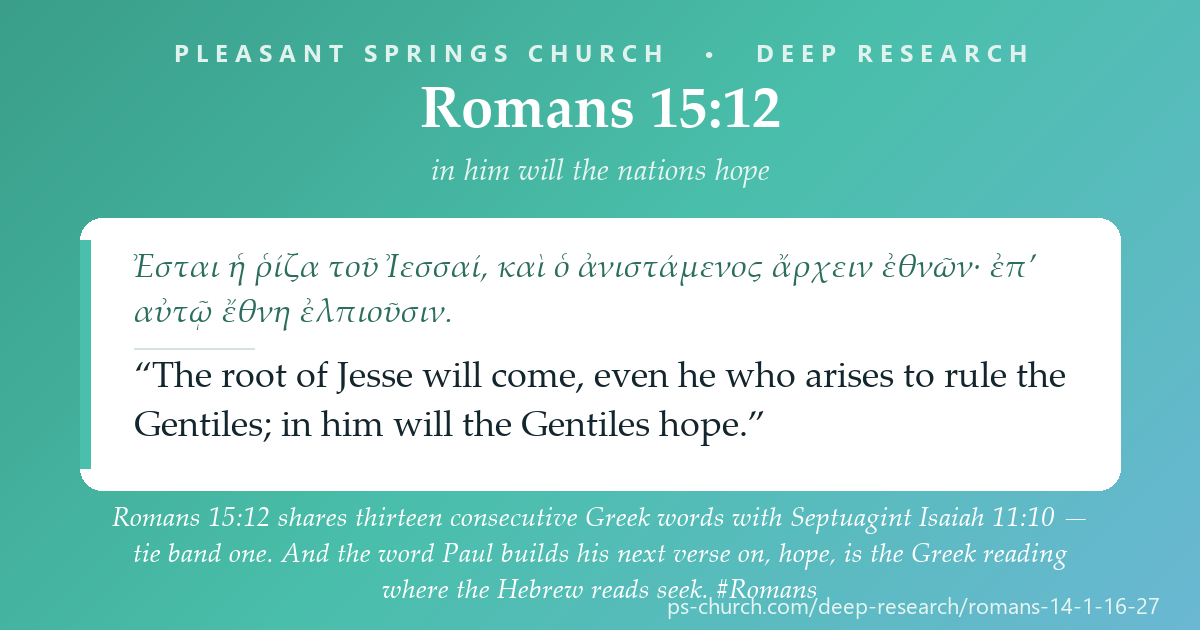
| CATSS Isaiah 11:10 | καὶ ἔσται ἐν τῇ ἡμέρᾳ ἐκείνῃ ἡ ῥίζα τοῦ Ιεσσαι, καὶ ὁ ἀνιστάμενος ἄρχειν ἐθνῶν· ἐπ’ αὐτῷ ἔθνη ἐλπιοῦσιν, καὶ ἔσται ἡ ἀνάπαυσις αὐτοῦ τιμή. |
| Romans 15:12 | καὶ πάλιν Ἠσαΐας λέγει· Ἔσται ἡ ῥίζα τοῦ Ἰεσσαί, καὶ ὁ ἀνιστάμενος ἄρχειν ἐθνῶν· ἐπ’ αὐτῷ ἔθνη ἐλπιοῦσιν. — run 13, band 1 |
| Masoretic Isaiah 11:10 | וְהָיָה בַּיּוֹם הַהוּא שֹׁרֶשׁ יִשַׁי אֲשֶׁר עֹמֵד לְנֵס עַמִּים אֵלָיו גּוֹיִם יִדְרֹשׁוּ — the root of Jesse, who stands as a signal for the peoples; to him the nations will seek |
Three differences, and they are not small. The Hebrew has the root standing; the Greek has him rising. The Hebrew has him a signal for the peoples (לְנֵס עַמִּים); the Greek has him ruling nations. The Hebrew has the nations seeking him; the Greek has them hoping in him. Romans 15:13, the very next verse, is a benediction addressed to ὁ θεὸς τῆς ἐλπίδος and closing on ἐν τῇ ἐλπίδι — the Greek column’s word, not the Hebrew’s.
⚠️ Say what this is and is not. It is an agreement of thirteen consecutive words with one printed Greek edition of Isaiah, and a disagreement with one printed Hebrew edition. It is not evidence that the Greek Isaiah is wrong, or that its translator misread anything, or that the Hebrew tradition changed. Those would all be claims about direction, and the shelf does not make them. The honest sentence is the flat one: the Greek row on this disk reads ἐλπιοῦσιν where the Hebrew row reads יִדְרֹשׁוּ, and the next verse of Romans uses the Greek word.
The counter-examples, printed in the same section
1. Romans 15:11 quotes a whole psalm verse and measures 4.
| text | the sentence |
|---|---|
| CATSS Psalm 116:1 (ESV 117:1) | αλληλουια αἰνεῖτε τὸν κύριον πάντα τὰ ἔθνη, ἐπαινέσατε αὐτόν πάντες οἱ λαοί |
| Romans 15:11 | Αἰνεῖτε, πάντα τὰ ἔθνη, τὸν κύριον, καὶ ἐπαινεσάτωσαν αὐτὸν πάντες οἱ λαοί — run 4 |
Every word of the psalm verse but its opening αλληλουια is shared. Two of them have moved and one has changed person, and the run engine collapses to four. A screen that counts contiguous forms cannot see a transposition, and this is the page’s sharpest demonstration of the limit. The shallow number is the real quotation; the deep numbers at 16:20 and 16:24 are formulas.
2. Romans 16:20 and Genesis 3:15: no two consecutive words at all.
The God of peace will soon crush Satan under your feet is universally read against he shall bruise your head. Measured against Septuagint Genesis 3:15, Romans 16:20 shares no two consecutive words with it — the CATSS Genesis reads αὐτός σου τηρήσει κεφαλήν, καὶ σὺ τηρήσεις αὐτοῦ πτέρναν, with τηρέω rather than συντρίβω, a head rather than feet, and a heel rather than Satan. The screen finds verbatim contact and nothing else, and on this row it finds none where every reader hears an echo.
3. Romans 14:11 and Philippians 2:10–11: the same Isaiah verse, measured twice.
| comparison | run | shared words |
|---|---|---|
| Romans 14:11 vs Septuagint Isaiah 45:23 | 6 | ὅτι ἐμοὶ κάμψει πᾶν γόνυ καί |
| Romans 14:11 vs Septuagint Isaiah 49:18 | 5 | ζῶ ἐγώ λέγει κύριος ὅτι — the oath formula, from a different chapter |
| Philippians 2:10 vs Romans 14:11 | 2 | πᾶν γόνυ |
| Philippians 2:11 vs Romans 14:11 | 3 | καὶ πᾶσα γλῶσσα |
Two Pauline passages use the same Isaiah sentence. One measures 11 against it and the other 2 and 3, and no amount of counting tells you that the second is using Isaiah at all. There is a small consolation in the numbers: Philippians 2:11 is in fact the deepest New Testament partner Romans 14:11 has, at a run of 3 and a tie band of 1 — so the screen does put the two passages together, at a depth far too shallow to have been trusted on its own. Note also that Romans 14:11 itself ends by transposing the Greek Isaiah — the Septuagint has ἐξομολογήσεται πᾶσα γλῶσσα, Paul has πᾶσα γλῶσσα ἐξομολογήσεται — which is why the run stops at six and not at eleven.
4. Romans 15:9 and the same song in two books.
The verse Paul quotes at 15:9 stands twice in the Greek Old Testament: at Psalm 17:50 (ESV 18:49) and again at 2 Kingdoms 22:50, because 2 Samuel 22 and Psalm 18 are the same song. Measured, Romans 15:9 gives 6 against the Psalter row and 4 against the Kingdoms row. And the run breaks on a single word: the Greek Psalter reads ἐξομολογήσομαί σοι ἐν ἔθνεσιν, κύριε — the vocative is in the Hebrew too, יְהֹוָה — and Paul does not have it. Paul’s quoted sentence is eleven words long and every one of them is in the Greek Psalter; the single omitted vocative splits it into runs of 6 and 5, and the screen reports the larger.
Where this page is weakest, what it could not reach, and what would break it.
The largest hole is the one the page is built on: no manuscripts, no apparatus
This page’s headline is a textual-critical fact, and this page has no textual-critical apparatus.
What is on the disk is one digitised printed Greek edition (the SBLGNT via MorphGNT), plus the printed ESV’s shape. No manuscript image, no collation, no critical apparatus, no papyrus, no versional evidence, no patristic citation. So the page can say — and does say — that the Greek file ends at 16:24 and the ESV ends at 16:27. It cannot say which manuscripts support which arrangement, how many there are, how old they are, or what any editor concluded.
The standard account (Metzger’s Textual Commentary, and the apparatus of NA28/UBS5) describes something like fifteen different arrangements of the end of Romans across the witnesses, including copies that place the doxology after 14:23, after 15:33, after 16:23, in two of those places at once, and not at all. ⚠️ That sentence is reported from the reference works and is not a finding of this page. Every number in it would have to be checked against an apparatus this disk does not hold, and a reader should treat it as a pointer to further reading rather than as a measurement.
What this means for the page’s claim. The claim is narrow on purpose: the two scripture columns of this study do not end in the same place, and here is exactly where and how they differ. That is verifiable by anyone with the same two files. Everything beyond it — original or not, Pauline or not, early or late — is outside what was measured, and the page declines all of it.
What the deep runs depend on, and how they could be wrong
One printed edition on each side. The New Testament figures are the SBL Greek New Testament as digitised by MorphGNT; the Old Testament figures are Rahlfs’ Septuaginta as digitised by CATSS; the Hebrew is the Masoretic text as printed in Sefaria’s Miqra according to the Masorah. The run of 13 between Romans 15:12 and Isaiah 11:10 is an exact agreement between two printed texts; manuscripts of both vary, and a different edition could shorten or lengthen it. The same applies to the 10 at 16:24 — with the extra caution that the verse itself is disputed.
A decision about what a ‘word’ is. The screen normalises both sides identically — lowercased, accents and breathings dropped, final sigma folded — and compares word forms, not lemmas. That is exactly why Romans 15:11 scores 4 while quoting a whole psalm verse: ἐπαινέσατε and ἐπαινεσάτωσαν are the same verb and not the same word, and two other words moved. A lemma-based or order-insensitive screen would give different numbers on every row of this page, and would be a different measurement, not a better one.
And a closing formula is the worst possible place to find a deep run. Romans 16:20b, Romans 16:24, 1 Thessalonians 5:28, 2 Thessalonians 3:18 and Galatians 6:18 all begin with the same five words, and 1 Timothy 1:14 carries them mid-verse. The tie band of 1 on 16:24 is real — only 2 Thessalonians 3:18 reaches ten — but the band is measuring a corpus in which the whole family is small and the wording nearly fixed. The page leads with the oddity of where the run falls, not with the run as proof of anything.
What could not be checked at all
No Greek critical apparatus. No papyri — P46 is the great early witness for Romans and its arrangement of the ending is central to every discussion of this passage, and it was not consulted. No versional evidence (Latin, Syriac, Coptic), no patristic citations, no Marcionite evidence, no Qumran text (which bears directly on Deuteronomy 32:43), no rabbinic material, no documentary papyri for the letter form. No commentary on Romans was read for any figure on this page.
★ THIS SECTION USED TO NAME A GAP. THE GAP HAS BEEN FILLED, AND THE MEASUREMENT IT WAS BLOCKING HAS NOW BEEN RUN. When this page was made the shelf held 44 CATSS files and 23,061 verse units, and this paragraph read: “Greek Exodus, Leviticus, Numbers and Joshua are not among the CATSS files held here… any food-law background to Romans 14 could not be screened against Leviticus at all.” The shelf now holds 64 files and 30,348 verse units, all four books among them. Romans 14 has been screened against the whole of Greek Leviticus, and the result is worth more than the gap was.
| Romans 14 against Greek Leviticus, 859 verse units | result |
|---|---|
| The deepest run any of the 23 rows reaches | THREE — and every one of the threes is a formula, not a food law: 14:6 καὶ ὁ ἐσθίων at Leviticus 11:40; 14:10 τὸν ἀδελφὸν σου at Leviticus 16:2 and 19:17; 14:15 and 14:21 ὁ ἀδελφός σου at Leviticus 25:25, 25:35 and 25:36. |
| Romans 14:14, the verse that settles the question — nothing is unclean in itself | ONE. It shares no two consecutive words with any verse of Greek Leviticus. Against the whole 30,348-unit corpus it reaches two, tie band 123 — 126 while the Odes were still being screened — on οἶδα καί and ἐν κυρίῳ. |
| And the reason, which is lexical and not accidental | Leviticus’ word for ritually unclean is ἀκάθαρτος, which stands 96 times in Greek Leviticus, 21 in Numbers, 8 in Deuteronomy and 160 times across the whole held corpus. Paul’s word at Romans 14:14 is κοινός, three times in that one verse — and κοινός is never used of unclean food anywhere in Greek Leviticus. Leviticus’ only κοιν- form, at 5:21, is κοινωνίας, partnership, a different word. |
| Where the ritual sense of κοινός DOES stand on this shelf | Two verse units of 30,348, and both are in 1 Maccabees — 1:47, the order to sacrifice swine and κοινά, and 1:62, “many in Israel stood firm and resolved not to eat κοινά.” 1 Maccabees is a witness, not Scripture, on this shelf. The word Romans 14 argues the food question in is not the Pentateuch’s word for unclean food. It is the word the Maccabean crisis made a test of loyalty. |
⚠️ What that does and does not license. It licenses the flat statement that Romans 14 makes no verbatim contact with the Greek food legislation — a statement this page could not make at all an hour before the corpus grew. It does not license saying Paul is alluding to 1 Maccabees, and the page does not say so: two shared vocabulary items are not a citation, the run between Romans 14:14 and either Maccabean verse is one, and a contiguous-run screen is blind to allusion by design. What the lexical count shows is a register, and register is the weakest kind of evidence this shelf reports.
The other three books that were missing have also been screened. Romans 14–16 reaches FOUR against each of Greek Exodus and Greek Numbers, and nothing deeper. The Numbers four is the interesting one: Romans 14:11 opens its marked citation — γέγραπται γάρ — with the oath formula ζῶ ἐγώ, λέγει κύριος, and those four words stand at Numbers 14:28 with a tie band of ONE. Paul is quoting Isaiah 45:23, which the row reaches at six; the oath formula he prefixes to it is Numbers’ and not Isaiah’s, and until Greek Numbers came onto this disk the page could not see that. The formula is common enough that no dependence is claimed — it is the standard divine oath — but the row is now measurable and the number is printed. The Exodus four is τὰ πρὸς τὸν θεόν at Romans 15:17, tie band 2, at Exodus 4:16 and 18:19 — a formula, and Moses’ role in both. Against Greek Joshua B it gains one row: 15:32 went from 2 to 3, tie band 1, on πρὸς ὑμᾶς διά at Joshua 20:2. Two further rows gained a three in the deuterocanon — 14:19 at 2 Maccabees 2:10 and 12:2 and 3 Maccabees 2:25, and 14:23 at 2 Maccabees 7:28 — and 15:31 went from 4 (band 7) to 5 (band 1) at 2 Maccabees 1:10. All of these are formulas, all of them are labelled witnesses and not Scripture, and none of them touches a quotation.
And the historical questions stay open, because counting is silent on them. Who the weak and the strong were; whether the dispute is Jewish food-law observance, or ascetic practice, or something else; whether chapter 16 was addressed to Rome or to Ephesus; whether Paul ever reached Spain; whether Phoebe held an office or performed a service; whether Junia was an apostle. None of that is decidable by shared word-runs, and this page decides none of it. What it offers is the measurement the arguments have to fit.
One more that is easy to overstate. “Romans ends five times” is a good sentence and a slightly loose one. Four of the six closings counted here are the phrase ὁ δὲ θεὸς τῆς…, which is a wish-prayer and not necessarily a letter-ending; 15:5–6 in particular sits in the middle of an argument and reads like a hinge, not a farewell. What is exactly true is the count — that phrase occurs five times in the Greek New Testament and four of them are in these chapters — and the looser sentence is the interpretation built on it.
Reading list
- Bruce M. Metzger, A Textual Commentary on the Greek New Testament (2nd ed., 1994) — the short standard account of the end of Romans.
- Harry Gamble Jr., The Textual History of the Letter to the Romans (Studies and Documents 42, 1977).
- C. E. B. Cranfield, Romans (ICC, 2 vols.).
- Douglas J. Moo, The Letter to the Romans (NICNT, 2nd ed., 2018).
- Richard B. Hays, Echoes of Scripture in the Letters of Paul (1989) — the book that set the terms for arguing about allusion, which is precisely what this page’s method cannot measure.
- Robert Jewett, Romans (Hermeneia, 2007) — for the Roman house congregations behind chapter 16.
- None of these were consulted for the measurements on this page, which were run on the text files named in the footer.
A letter that cannot stop saying goodbye, and an argument that begins and ends with the same word.
Welcome
The last three chapters of Romans are where the argument stops being an argument and becomes a room full of people with names. Thirty-five of them, eight of them named women, one of them the woman Paul commends to them by name before he greets anyone, one of them the man who physically wrote it and slipped in a greeting of his own. And the instruction Paul leaves them with is not a doctrine. It is a verb he uses four times in the whole letter and nowhere outside these two chapters: welcome.
Welcome the one who is weak in faith (14:1) … welcome one another as Christ has welcomed you (15:7). Between those two sentences there is a congregation split over food and calendars, and Paul — who says plainly which side he is on (15:1) — spends the whole passage taking his own side’s liberties away rather than the other side’s scruples.
And then he tries to finish, four times, and cannot. God of endurance. God of hope. God of peace, Amen. God of peace again, and grace. Then, depending which column you read, either a fifth grace-wish the English keeps in a footnote or a doxology the Greek file does not carry. The deepest New Testament contact in all eighty verses — ten consecutive words, tie band one — is inside the one of those two that most English Bibles do not print.
The page will not tell you what to do with that. It will tell you that the counting found it, that a run of ten between two grace-wishes proves less than a run of ten anywhere else, and that the quotation which actually matters in these chapters — in him will the nations hope — measures thirteen against the Greek and leans on a word the Hebrew does not have. Both of those are true at once, and a study that printed only one of them would be selling you something.
Every Deep Research page traces its passage across the whole sweep — the Old Testament, the Second-Temple world between the testaments (historical witnesses, not Scripture), and the New Testament. Follow the thread:
Pleasant Springs Church — Deep Research
Research method after Michael S. Heiser’s Bible Research Method (examine dictionaries → ancient literature → important words → textual connections → academic publications → share), with the Pleasant Springs “Author & Audience” foundation. Scripture set in the Hebrew, the Greek editions named on each page and the ESV (Old Testament), and the Greek New Testament and the ESV (New Testament), per the practice of Pleasant Springs Church. Romans research grounded in Cranfield (ICC), Moo (NICNT), Jewett (Hermeneia), Gamble on the textual history of the ending, Metzger’s Textual Commentary and Hays on echoes — none of which were consulted for any number on this page. Text: Greek New Testament from the SBL edition as digitized by MorphGNT; Greek Old Testament from Rahlfs’ Septuaginta as digitized by CATSS; Hebrew from the Masoretic text as printed in Sefaria’s Miqra according to the Masorah. No critical apparatus was consulted on any side. The standing caution for this shelf applies with unusual force here: these pages say “the file on this disk reads…” and never call a reading early or late. ⚠️ VERSE NUMBERING — Romans is a New Testament book, so there is no Masoretic or Septuagint Romans and no MT/LXX offset. But the two columns on this page do NOT end in the same place, and the page states it rather than gliding over it. Counted off disk: MorphGNT Romans runs 430 verses and ends at 16:24; the ESV holds 432, numbering its last verse 16:27 and carrying no 16:24 in its text at all, with verse 24 in a footnote. The Greek file carries a 16:24 the ESV keeps in a footnote, and carries no doxology at 16:25–27 at any verse number — the forms στηρίξαι and μυστηρίου occur nowhere in the whole file, though their lemmas do (1:11, 11:25). The Old Testament offset does reach this page: Romans 15:3 quotes Septuagint Psalm 68:10 = Masoretic 69:10 = ESV 69:9; 15:9 quotes Septuagint Psalm 17:50 = Masoretic 18:50 = ESV 18:49; 15:11 quotes Septuagint Psalm 116:1 = ESV 117:1. The Greek Psalter runs one behind the Hebrew from Psalm 9/10 through 147, and the Hebrew edition used here counts superscriptions as verse 1. ⚠️ The measurement, in full. Greek against Greek. MorphGNT field 6, the normalised word (the column that already resolves elision and the movable nu); CATSS FORM column (cols 0–24), beta-code transliterated first. Both sides lowercased, accents and breathings dropped, final sigma folded, then filtered to Greek letters — the same filter applied to both corpora. Contiguous runs of whole word FORMS, never lemmas. Corpus: the 80 MorphGNT rows of Romans 14–16 against the other 7,847 verses of the Greek New Testament, and against 30,348 verse units — the 64 CATSS files less the Odes; plus, for the two-row comparison, all 430 Greek rows of Romans against the rest of the New Testament. Exhaustive and deterministic; nothing sampled, so no seed applies. The tie band — how many target verses reach the same maximum — is printed beside every run on this page. ⚠️ What was NOT measurable. No manuscripts, no apparatus, no papyri (P46 above all), no versions, no patristic citations, no Qumran. The fifteen manuscript arrangements of the end of Romans are reported from Metzger and the standard editions and are NOT a finding of this page. ⚠️ ★ THE CORPUS GREW, AND THIS NOTE USED TO SAY THE OPPOSITE. This page was first measured against 44 CATSS files and 23,061 verse units, and this note read: “Greek Exodus, Leviticus, Numbers and Joshua are not among the CATSS files held here… twenty files missing in all,” and stage 5 said any food-law background to Romans 14 “could not be screened against Leviticus at all.” All twenty are held now — 64 files, 30,348 verse units — and every figure above is against the larger corpus. The food-law screen has been run: Romans 14 reaches THREE against the whole of Greek Leviticus and 14:14 reaches ONE, and Leviticus’ word for unclean, ἀκάθαρτος (96 times in that book), is not the word Romans 14:14 uses. Three rows moved: 14:17 from 3 to 4 at Psalms of Solomon 17:3, 15:11 from 4 to 5 at Tobit (BA) 14:6, 15:31 from 4 to 5 at 2 Maccabees 1:10; and 15:10’s band went from 1 to 2 because Odes 2:43 is Deuteronomy 32:43 filed twice. ⚠️ And on 31 August 2026 the Odes were taken out of every screen on this shelf — Ode 9 is Luke 1 and Ode 13 is Luke 2, and ten more canticles are second copies of passages already in the corpus — so the shelf now HOLDS 30,637 verse units in 64 files and SCREENS 30,348, the 289 Odes units being the difference. Every figure above was re-run over 30,348. Romans 15:10’s band went back to 1, Romans 14:14’s from 126 to 123, and nothing else on this page moved — no run changed and the distribution is untouched. The deuterocanonical books are held as witnesses, not Scripture, and are labelled so every time they supply a result. A separate correction, which was never about the corpus: Romans 15:21 was published on this page as a run of 6 and it is a run of 11 against Greek Isaiah 52:15, on both corpora. Older pages on this shelf print 23,061 and 44 files, and they were correct when they were made. ⚠️ Direction of influence is never asserted. Nothing here says Romans 16:24 depends on 2 Thessalonians or the reverse, that the doxology is or is not original, that the Greek Isaiah’s translator misread the Hebrew, or that either text of Deuteronomy 32:43 is prior. The page reports the agreements, prints the tie bands, prints three quotations that measure shallower than they read, and stops. Typology is handled per the house position: what the text says, what the New Testament itself draws, and what we see from this side of the cross — with the seeing left to the reader.
Scripture quotations marked ESV are from the ESV® Bible (The Holy Bible, English Standard Version®), © 2001 by Crossway, a publishing ministry of Good News Publishers. ESV Text Edition: 2016. Used by permission. All rights reserved. The ESV text may not be quoted in any publication made available to the public by a Creative Commons license, and the ESV may not be translated in whole or in part into any other language. www.esv.org
|
Did this study bless you today? 💚 Give to Support PS Church100% of gifts go to the General Fund — thank you. |