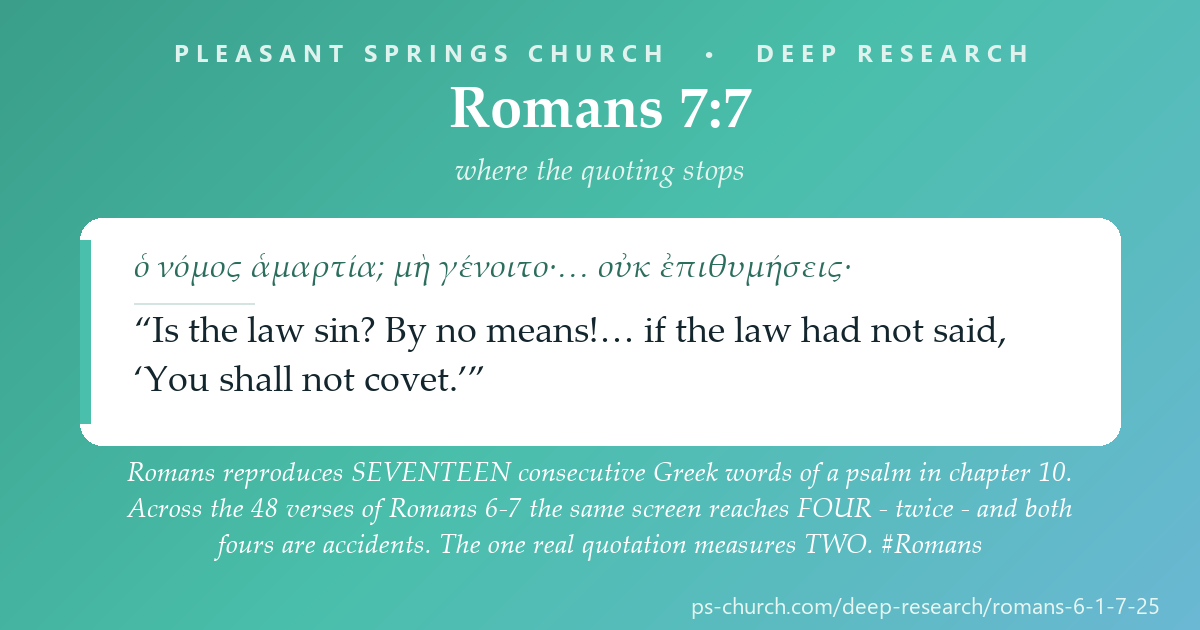
Romans is the New Testament’s heaviest quoter. Screen the whole letter against the Greek Old Testament held on this disk and Romans 10:18 reproduces seventeen consecutive words of Psalm 18:5 (= MT 19:5, ESV 19:4), in a tie band of one. Romans 9:26 reproduces seventeen of Hosea 2:1 (= ESV 1:10). Romans 9:29 reaches sixteen. Romans 3:13 reaches fifteen. Then run the identical screen over Romans 6:1–7:25 — the same letter, the same normaliser, the same corpus — and the ceiling is four. Two rows reach it. One is τοῦ πατρὸς οὕτως καὶ in Romans 6:4, which happens to sit inside Ezekiel 18:4 — the chapter that says the soul that sins shall die — and it straddles a clause boundary there and a comma here. The other is ἐν τῇ σαρκί μου in Romans 7:18, which sits in Psalm 37:4 (= ESV 38:3) — there is no health in my flesh — and also in Galatians 4:14 and Colossians 1:24, where nobody is lamenting anything. Both fours are accidents, and the page proves it rather than asserting it. Meanwhile the one thing in these 48 verses that is actually a quotation — the tenth commandment at 7:7, introduced with the law said — measures two. So the stretch of Romans that argues hardest about sin and the law is the stretch where Paul almost stops quoting. What he does instead is ask four questions and answer every one of them μὴ γένοιτο. See the method →
Romans 6:1–7:25 (selections)
Greek New Testament (SBLGNT / MorphGNT) · ESV★ The result that set this page’s thesis is a shortfall, not a discovery. Romans is a letter that quotes the Greek Old Testament at extreme depth: seventeen consecutive words at 10:18 and again at 9:26, sixteen at 9:29, fifteen at 3:13. Run exactly the same screen over the 48 verses of 6:1–7:25 and the ceiling is four — twice — and neither four is a quotation. The one quotation these chapters do make, at 7:7, measures two. Stage 4 has the full distribution, the tie bands, the controls and the counter-examples.
The Shape of the Passage
Two parallel panels — and this page will not call it a chiasmRomans is the least disputed authorship in the New Testament and the most disputed speaker. Nobody argues about who wrote the letter. Everybody argues about who is talking in 7:14–25. This page answers the first question in a line and refuses to answer the second, because the measurement cannot reach it.
Author
Paul, dictating to a scribe who signs his own name. Romans 16:22 — I Tertius, who wrote this letter, greet you in the Lord — is the only place in the New Testament where the man holding the pen introduces himself. The letter opens Παῦλος δοῦλος Χριστοῦ Ἰησοῦ, Paul, a slave of Christ Jesus — and that is worth noticing before chapter 6, because every one of the six occurrences of δοῦλος in the body of Romans is in chapter 6, and the seventh is the word Paul used of himself in the first line of the letter.
The passage is textually quiet, which is not what a reader expects of it. Counted from the MorphGNT text column, 282 words in Romans carry an SBL apparatus siglum — 40 per thousand. In these 48 verses there are 14, or 16.8 per thousand. Romans 6–7 is less than half as contested, word for word, as the letter around it. The famous disagreements about this passage are disagreements about what it means, not about what it says.
Vocabulary: 7 words in these 48 verses occur exactly once in the Greek New Testament — σύμφυτος (6:5), ἤτοι (6:16), ὕπανδρος (7:2), παλαιότης (7:6), σύμφημι (7:16), συνήδομαι (7:22) and ἀντιστρατεύομαι (7:23). Three of the seven are in the last ten verses.
Audience
A church in Rome that Paul had never visited, addressed in the second person plural throughout chapter 6 and then abandoned for a singular in chapter 7. Chapter 6 is you: do you not know, consider yourselves, present your members, you were slaves. Then at 7:7 the pronoun changes and does not change back until 8:1. Counted: 4 occurrences of ἐγώ in chapter 6, 28 in chapter 7, 18 of those 28 in 7:14–25 alone. Greek does not need the pronoun; it is there for weight.
And this page does not tell you who the I is. Adam; Israel at Sinai; Paul before Damascus; Paul as a Christian; a rhetorical persona adopted for the argument; humanity under law generally — these are the standing options, and a word count cannot choose between them. What a word count CAN say is reported and no more: the passage most often read as an Adam narrative shares no three consecutive words with any verse of Genesis 2–3 in Greek, and its most-cited verbal echo — 7:11 against Genesis 3:13 — measures two words, and they are με καὶ. Stage 4 prints it in full. That is a fact about wording. It is not an argument about who is speaking.
What the letter does assume about these readers is concrete: they know the law well enough to be argued with from it (7:1, I am speaking to those who know the law), and they can be expected to raise the objection of 6:1 themselves. Both panels are written as answers to people who talk back.
Orient on four things this passage is famous for: a baptism, a slave market, a marriage law, and an I nobody can identify.
Search by topic: Baptism; Union with Christ; Old Man / New Man; Sin (hamartia); Law (nomos, Torah); Flesh (sarx); Slavery in the New Testament; Manumission; Wages (opsonion); Romans, Letter to the; Romans 7 and the identity of the ‘I’; Sanctification; Indicative and imperative in Paul.
Which articles are relevant, and what each is actually for
Baptism — because 6:3–4 is the only place Romans uses the word group at all, and the article will tell you the range of first-century immersion practice the readers might have had in mind. Note that the article will also tell you what the passage does NOT say: there is no water in these verses.
Slavery in the Greco-Roman world — because 6:16–22 is an extended argument from a transfer of ownership, and because Paul interrupts himself at 6:19 to say ἀνθρώπινον λέγω — I am speaking in human terms — which is an author flagging his own analogy as an analogy.
Marriage and divorce law, Jewish and Roman — because 7:1–3 argues from a rule about widows, and because the application in 7:4 does not match the illustration: in the illustration the husband dies, in the application the reader dies. Any dictionary article worth reading will say so.
Romans 7 and the ‘I’ — the one article to read with the most suspicion, because the entry you happen to open will usually present one answer as settled. There are at least six live readings and the dictionary you have will reflect its tradition.
Wages — a small one, and rewarding. ὀψώνιον at 6:23 is a soldier’s pay packet, not an abstract recompense; the other three New Testament occurrences are Luke 3:14 (soldiers asking John the Baptist what to do), 1 Corinthians 9:7 and 2 Corinthians 11:8, and all three are about being paid to serve.
What a dictionary will not settle for you
Whether 6:1–14 describes something that happened to the reader at a moment in the past or something true of the reader continuously; whether 7:14–25 describes a Christian; whether σάρξ in 7:18 means the body or means a condition. Those are the three questions readers come to this passage with, and none of them is decidable by looking up a word. This page does not decide them either — see Stage 5.
The divided will was a commonplace of Greek and Latin moral writing long before Romans 7 — and none of those texts is on this disk.
Everything in this stage is cited from printed editions and NONE of it was measured. The corpora held here are the Masoretic Hebrew Bible, the complete Greek Old Testament this shelf screens — the 64 CATSS files less the Odes, 30,348 verse units, with no gaps in it, and the SBL Greek New Testament. No Greek or Latin classical author, no Qumran text, no rabbinic text and no papyrus is held. Where this stage says a text says something, that is a report from an edition, not a measurement.
The I see the better and follow the worse topos
Romans 7:15–19 states a problem that Greek and Latin writers had been stating for four hundred years.
| text | date | what it says |
|---|---|---|
| Euripides, Medea 1078–80 | 431 BC | Medea knows what evils she is about to do, but her thymos is stronger than her deliberations. |
| Plato, Protagoras 352b–358d | 4th c. BC | Socrates argues the opposite — that nobody knowingly does wrong — which is why the topos existed to be argued about. |
| Ovid, Metamorphoses 7.20–21 | c. AD 8 | video meliora proboque, deteriora sequor — I see and approve the better; I follow the worse. |
| Epictetus, Discourses 2.26.4–5 | c. AD 108 | The one who errs does not do what he wishes and does what he does not wish. |
⚠️ What that table is worth, honestly. It is worth exactly this much: the form of Romans 7:15 was available. It does not show that Paul read Ovid or Epictetus — Epictetus is later than Romans anyway — and it does not show that he did not. None of these texts was measured against Romans, because none of them is on this disk, and a Latin poem could not be run against a Greek letter by this method in any case. Anyone who tells you Romans 7 is or is not borrowing a Stoic commonplace is telling you a judgement, and so would we be.
What is measurably different is where Paul puts the blame. The classical topos locates the failure in the agent — passion overpowering reason. Romans 7:17 and 7:20 locate it in an occupying power: ἡ οἰκοῦσα ἐν ἐμοὶ ἁμαρτία, the sin that dwells in me. That is a difference of content, and it is visible in the text rather than inferred from it.
Slaves, wages and manumission
Two ancient realities stand behind chapter 6 and neither is measurable here.
Presenting yourself as a slave. 6:16 uses παριστάνετε ἑαυτοὺς — you present yourselves — and self-sale into slavery was a real legal act in the Roman world, usually to clear a debt. The verb παρίστημι and its by-form run five times in 6:13–19. This is reported from the standard handbooks; no documentary papyrus was consulted.
Sacral manumission. The Delphic manumission inscriptions, in which a slave is notionally sold to a god and thereby freed, are the parallel usually offered for 6:18 and 6:22 — set free from sin… enslaved to God. It is a genuinely attractive parallel and this page cannot check a word of it. The inscriptions are not on this disk. Deissmann popularised the comparison; later work has questioned how close it is. We name the debate and take no side.
Wages. Here the measurement does reach: ὀψώνιον occurs 4 times in the Greek New Testament and every occurrence is about pay for service — soldiers at Luke 3:14, a soldier at 1 Corinthians 9:7, Paul’s support at 2 Corinthians 11:8, and this verse. And in the complete Greek Old Testament — all 64 CATSS files as of 30 August 2026 — it occurs 3 times, every one of them in the identical form ὀψώνια that Romans 6:23 uses: 1 Esdras 4:56, 1 Maccabees 3:28 and 1 Maccabees 14:32. In 1 Maccabees 3:28 Antiochus opens his treasury and gives ὀψώνια to his forces for a year; in 14:32 Simon arms the men of his nation and gives them ὀψώνια out of his own money; in 1 Esdras 4:56 the garrison of the city is granted allotments and ὀψώνια. Every occurrence of the word in both corpora held here, Greek Old Testament and Greek New Testament alike, is a payer paying people who serve him. ⚠️ This sentence used to end “2 Maccabees is NOT on this disk and was not searched,” and that stopped being true on 30 August 2026. All four Maccabean books are held and screened now — 2 Maccabees 9:9 is the deepest partner of Romans 7:24 in Stage 4 below, on this same page — and the count re-run over the whole screened corpus is still three. The stale scope line is printed rather than deleted. Nothing here says Romans is drawing on 1 Maccabees — 6:23 shares no more than TWO consecutive words with any verse of it. What is measured is the word’s company, not a source.
Baptism, and the parallel this page refuses to assert
6:3–4 has been read against Jewish proselyte immersion, against the Qumran washings, and against the Hellenistic mystery cults — the last of these most aggressively in the older German scholarship. The mystery-cult reading depends on dating initiation rites that are attested later than Romans, and on texts none of which are held here. This page reports that the comparison exists, notes that it has been heavily criticised since the middle of the twentieth century, and does not evaluate it.
What is on the page instead is a count: the whole letter to the Romans uses the baptism word group three times and all three are in 6:3–4. Whatever the background, the letter does not build on the word.
Eight entries, each counted rather than characterised — and one of them is a zero.
Counts are of word forms and of MorphGNT lemmas over the SBL Greek New Testament (7,927 verses, 27 files), and of forms over the complete Greek Old Testament as CATSS holds it (64 files less the Odes, 30,348 screened verse units, no gaps). The page says which of the two it is using every time. Density figures are occurrences per thousand MorphGNT word rows.
31 occurrences in these 48 verses — 16 in chapter 6 and 15 in chapter 7. Romans has 48 in all, the New Testament 172. Romans 6 and Romans 7 are the two densest chapters in the entire Greek New Testament for this noun on both measures. By raw count: 16 and 15, and third is Hebrews 10 with 10. By rate among chapters of 200 word rows or more: 43.6 and 32.1 per thousand, and third is 1 John 1 at 19.3, then Hebrews 10 at 18.2. Nothing else is close.
2 occurrences in the whole of Romans 6 — at 6:14 and 6:15 — and 23 in Romans 7. Of Romans’ 74 in total. The two in chapter 6 are the two verses at the seam, which is why the structure diagram breaks the passage where it does.
The two words stand consecutively in exactly 15 verses of the Greek New Testament. Ten are in Romans (3:4, 3:6, 3:31, 6:2, 6:15, 7:7, 7:13, 9:14, 11:1, 11:11), three in Galatians (2:17, 3:21, 6:14), one in 1 Corinthians 6:15 and one on the lips of Jesus at Luke 20:16. Four of the fifteen are in this passage.
4 occurrences in chapter 6; 28 in chapter 7; 18 of the 28 in 7:14–25 alone. That block is 199 word rows, so 90.5 per thousand — the rate of John 14 (90.1), which is the densest chapter in the New Testament for this pronoun among chapters of 300 word rows or more. Every other chapter in that top eight is either Jesus speaking in John (14, 15, 17, 8) or a personal letter or letter-opening (Philemon, 2 Corinthians 1, 2 Timothy 1). Romans 7 is the only sustained argument on the list.
Every one of the six occurrences in the body of Romans is in chapter 6 — 6:16 twice, 6:17, 6:19 twice, 6:20. Add the verbs δουλεύω (6:6, 7:6, 7:25) and δουλόω (6:18, 6:22) and the group runs 11 times across the passage. The letter’s seventh δοῦλος is Paul, in 1:1.
2 occurrences in the Greek New Testament and both are in this passage — newness of life at 6:4 and newness of Spirit at 7:6. Its opposite παλαιότης occurs once, in the same clause as the second.
4 occurrences in the Greek New Testament — Luke 3:14, Romans 6:23, 1 Corinthians 9:7, 2 Corinthians 11:8 — and 3 in the complete Greek Old Testament — all 64 CATSS files — every one of them in the identical form ὀψώνια that Romans 6:23 uses: 1 Esdras 4:56, 1 Maccabees 3:28 and 1 Maccabees 14:32. All three are a ruler paying troops. Sin does not punish; it employs.
ZERO occurrences in Romans 6:1–7:25. The letter uses the noun 39 times — and not once in these 48 verses. The verb πιστεύω appears exactly once, at 6:8. The section of Romans that sits between the two great faith sections contains no faith at all, and no page that quotes 6:23 usually mentions it.
The seven words that occur once in the New Testament, and where they fall
Counted from the MorphGNT lemma column across all 27 books: seven lemmas occur exactly once in the Greek New Testament, and that once is inside Romans 6:1–7:25. Two further lemmas are confined to this passage without being hapax — καινότης (6:4, 7:6) and παράκειμαι (7:18, 7:21), twice each and both times here — so nine lemmas in all occur in these 48 verses and in no other verse of the Greek New Testament.
| word | verse | sense |
|---|---|---|
| σύμφυτος | 6:5 | grown together with, planted with |
| ἤτοι | 6:16 | either… (a correlative particle) |
| ὕπανδρος | 7:2 | under a husband, married |
| παλαιότης | 7:6 | oldness |
| σύμφημι | 7:16 | I say the same thing as, I agree with |
| συνήδομαι | 7:22 | I take pleasure together with |
| ἀντιστρατεύομαι | 7:23 | I campaign against, wage war on |
Three of the seven begin with συν- or συμ-, together-with. The passage needed compound words for joint action and reached for words it never uses again — grown together with Christ, agreeing together with the law, delighting together with the law. That is an observation about the wordstock, not a doctrine; the count is the claim.
All 48 verses screened against the Greek Old Testament held here and against the whole Greek New Testament — with the tie band beside every run, and the controls printed before the finding.
Greek against Greek. MorphGNT field 6, the normalised word form (the column that resolves elision and the movable nu), lowercased with accents and breathings dropped and final sigma folded; the CATSS FORM column put through the same filter after beta-code transliteration. Word forms, never lemmas. Contiguous runs only. The tie band is how many other verses reach the same depth — a run without its band is misleading. Exhaustive and deterministic; nothing sampled, so no seed applies.
First, the counter-examples — because the two deepest numbers here prove nothing
The two deepest verbatim runs Romans 6:1–7:25 has with anything in the Greek New Testament are tied at six, and both are full titles of Christ closing a paragraph.
| Romans | against | run | tie band | what it is |
|---|---|---|---|---|
| 6:23 | 1 Corinthians 15:31 | 6 | 1 | ἐν Χριστῷ Ἰησοῦ τῷ κυρίῳ ἡμῶν. Inside Romans the same six run with 8:39. |
| 7:25 | Jude 25 | 6 | 1 | διὰ Ἰησοῦ Χριστοῦ τοῦ κυρίου ἡμῶν. Inside Romans the same six run with 5:21. |
| 6:11 | Matthew 7:12 and 51 others | 3 | 52 | οὕτως καὶ ὑμεῖς. A wide band is the measurement saying formula. |
| 7:5 | James 3:6 | 4 | 1 | ἐν τοῖς μέλεσιν ἡμῶν, in our members. Narrow band, and still nothing but a phrase. |
Jude is 25 verses long. 1 Corinthians is 437. They tie. A run of six against a 25-verse letter and a run of six against a 437-verse letter cannot both be evidence of contact, and neither of them is: both are the same closing formula, and it is a formula precisely because short books and long books alike reach it.
The finding — a letter that quotes at seventeen, quoting at four
Control first. The whole of Romans, all 430 MorphGNT rows, against all 30,348 verse units of Greek Old Testament this shelf screens — the 64 CATSS files less the Odes.
| Romans | against | run | tie band |
|---|---|---|---|
| 10:18 | Psalm 18:5 (= MT 19:5, ESV 19:4) | 17 | 1 |
| 9:26 | Hosea 2:1 (= ESV 1:10) | 17 | 1 |
| 9:29 | Isaiah 1:9 | 16 | 1 |
| 3:13 | Psalm 13:3 (= MT/ESV 14:3) | 15 | 1 |
| 11:10 | Psalm 68:24 (= ESV 69:23) | 14 | 1 |
| 9:17 | Exodus 9:16 | 11 | 1 |
| 4:7 | Psalm 31:1 (= ESV 32:1) | 10 | 1 |
| 9:15 | Exodus 33:19 | 9 | 1 |
Across all 430 rows: 290 reach three, 91 reach four, 54 reach five, 33 reach six, 22 reach seven, 16 reach eight, 13 reach nine, 10 reach ten, and 2 reach seventeen. The method is not blind and this letter is not shy.
⚠️ TWO OF THOSE EIGHT NUMBERS WENT DOWN ON 31 AUGUST 2026, WHICH IS A DIRECTION THIS SHELF HAD NEVER HAD TO PRINT BEFORE. THE OLD FIGURES ARE KEPT HERE. They read 92 reach four and 34 reach six. What changed is the corpus, and it changed by getting smaller. The Odes — the fourteen liturgical canticles bound after the Greek Psalter, 289 verse units, which came in with the last twenty CATSS files — were taken out of everything this shelf calls “the Greek Old Testament” for screening. They are still held on the disk. They are no longer screened. HELD is 30,637 verse units in 64 files; SCREENED is 30,348, and the difference is exactly the 289 Odes units. Two reasons, either sufficient on its own: Ode 9 is Luke 1 and Ode 13 is Luke 2 — the Magnificat, the Benedictus and the Nunc Dimittis — so a New Testament verse screened against them is being measured against a copy of itself; and ten more canticles are second copies of passages the corpus already holds (Ode 1 = Exodus 15, 2 = Deuteronomy 32, 3 = 1 Samuel 2, 4 = Habakkuk 3, 5 = Isaiah 26, 6 = Jonah 2, 7 and 8 = Daniel (Th) 3, 10 = Isaiah 5, 11 = Isaiah 38), so any tie band touching a canticle was doubled.
⚠️ And exactly two rows of Romans lost depth, both outside this study, and it is worth naming what they lost it to. Romans 11:36 — to him be glory forever, amen — measured 6 in a band of one against Odes 12:15, and now measures 5 against 1 Esdras 5:58 and 4 Maccabees 18:24. Ode 12 is the Prayer of Manasseh, whose closing doxology is the same liturgical formula; the run was a hymn-ending matching a hymn-ending inside a Psalter appendix. Romans 9:5 went from 4 against Odes 12:15 and 14:35 to 3 against 1 Esdras 5:58, 2 Chronicles 6:2, 4 Maccabees 18:24 and Daniel 2:44 — Ode 14 being the morning hymn, the Gloria in excelsis. Neither loss was in Ode 9 or Ode 13, so neither was Luke measured against Luke; they are the other half of the problem, an appendix doubling doxologies the corpus already contained. Nothing inside Romans 6:1–7:25 moved at all, which the next table shows.
⚠️ THIS CONTROL WAS RE-RUN ON 30 AUGUST 2026 OVER A CORPUS ONE THIRD LARGER, AND THE OLD FIGURES ARE PRINTED RATHER THAN QUIETLY REPLACED. When this page was written the shelf held 44 CATSS files, 23,061 verse units, and the line above read: 273 reach three, 80 reach four, 48 reach five, 30 reach six, 20 reach seven, 14 reach eight, 11 reach nine, 9 reach ten, and 2 reach seventeen. The remaining twenty files — Greek Exodus, Leviticus, Numbers, both Joshua recensions, and the deuterocanonical books, which this shelf treats as witnesses, not Scripture and labels so every time — were fetched on 30 August 2026, taking the corpus to 64 files and 30,637 verse units with no gaps in it, of which 30,348 are screened. Every figure in the distribution rose, because a screen against a bigger target can only ever find more.
⚠️ And two rows of the control table are new, because Greek Exodus was not previously on the disk at all. Romans 9:17 — for this very purpose I raised you up, that I might show my power in you — now measures 11 against Greek Exodus 9:16 at a tie band of one. On the 44-file corpus that row measured 4, and its best partners were Jeremiah 16:21 and Ezekiel 43:7: the screen was answering with the wrong books because the right one was not there. Romans 9:15 — I will have mercy on whom I have mercy — moved from 2 to 9 against Greek Exodus 33:19. Both are outside the 48 verses this page studies, and both are printed here anyway, because a control is worthless if it is quietly re-baselined. A third row moved for the same reason and is worth naming: Romans 13:9 quotes you shall love your neighbour as yourself, and it went from 4 to 6 against Greek Leviticus 19:18 — a verse this shelf could not reach an hour before the fetch.
Now the same screen, unchanged, over the 48 verses of 6:1–7:25.
⚠️ This table survived the Odes removal without moving a digit. Re-run over 30,348 units it is still 18 / 27 / 3 / 0, the three four-word rows are still 6:4, 7:18 and 7:24 with the same partners and the same bands, and 6:6 is still 3 in a band of one at Greek Leviticus 9:15. No hit anywhere in these 48 verses was ever in an Ode. Fifteen tie bands narrowed by between one and thirteen rows apiece — 7:7’s 11 to 9 is the sharpest, 6:12’s 2,265 to 2,252 the largest — and not one of the fifteen is a figure this page prints. Three of the fifteen lost an Ode 9 row, which is to say a verse of Luke 1: 6:10 shed Odes 9:47, 6:12 shed Odes 9:69 and 7:6 shed Odes 9:48. All three were two-word runs inside bands of hundreds, so nothing here was ever reported as Luke matching Luke — but the Gospel was inside these numbers, and saying so is the point of printing the correction rather than the new figure alone.
| run reached | rows reaching exactly it | rows reaching at least it |
|---|---|---|
| 2 words | 18 | 48 of 48 |
| 3 words | 27 | 30 |
| 4 words | 3 | 3 |
| 5 or more | 0 | 0 |
⚠️ The ceiling was tested and it held. On the 44-file corpus this table read 21 / 25 / 2 / 0. Stage 5 predicted, in terms, that the four-word ceiling “could only rise if the missing books were added and could never fall.” The missing books were added on 30 August 2026 — all twenty of them, 7,576 further verse units — and the ceiling did not rise. Nothing in these 48 verses reaches five consecutive words of the complete Greek Old Testament. Nor did it fall when the Odes came back out on 31 August 2026. Three rows now reach four instead of two, and the third of them is printed below with the other two.
And here are the only three rows that reach four, with what they actually are.
| Romans | against | run | band | the shared words, and the verdict |
|---|---|---|---|---|
| 6:4 | Ezekiel 18:4 | 4 | 1 | τοῦ πατρὸς οὕτως καὶ. An accident. Romans reads …by the glory of the Father, so we too…; Ezekiel reads …the soul of the father, so also the soul of the son…. The four words cross a comma in one text and a clause boundary in the other, and they carry no shared sense whatever. It looks meaningful only because Ezekiel 18 is the chapter that says the soul that sins shall die. |
| 7:18 | Psalm 37:4 and 37:8 (= ESV 38:3, 7) | 4 | 2 | ἐν τῇ σαρκί μου. Also an accident, and this one is the trap. The psalm says there is no health in my flesh; Romans says nothing good dwells in me, that is, in my flesh. The proof it is a phrase and not a source: the identical four words stand in Galatians 4:14 and Colossians 1:24, neither of which is a lament. |
| 7:24 | 2 Maccabees 9:9 (a witness, not Scripture) | 4 | 1 | ἐκ τοῦ σώματος τοῦ. New on 30 August 2026, and the most interesting accident on the page. Who will deliver me from the body of this death? — against a sentence describing worms swarming out of the body of the dying Antiochus Epiphanes. Romans 7:24 is the most quoted sentence in these 48 verses and the shelf could not measure it properly until the deuterocanon arrived. On the 44-file corpus it measured 3, against Micah 5:5. The four words are an ordinary Greek partitive string, and the page prints the run and draws nothing whatever from it: 2 Maccabees is a witness this shelf reads, not Scripture it teaches from. |
⚠️ One more row moved, and it moved because Greek Leviticus arrived. Romans 6:6 — that the body of sin might be brought to nothing — measured 2 at a tie band of 94 on the 44-file corpus, which is the signature of a row that has found nothing at all. It now measures 3 at a tie band of one, against Greek Leviticus 9:15 — τῆς ἁμαρτίας τοῦ, from the sin offering. A tie band that collapses from 94 to 1 looks like a discovery and is not one: τῆς ἁμαρτίας stands in 37 verse units of Greek Leviticus alone, and the three-word string only goes unique because of the τοῦ that happens to follow it at 9:15 — exactly one verse unit in all 30,348 carries τῆς ἁμαρτίας τοῦ. The band moved because the corpus moved, not because the text did, and a tie band of one is not by itself evidence of anything.
The one actual quotation in these 48 verses, and how deep it goes
Romans 7:7 is the only verse in the passage that attributes words to Scripture — if the law had not said — and the words it attributes are two.
| what was measured | result |
|---|---|
| 7:7 against Deuteronomy 5:21, MorphGNT normalised column (the shelf’s standard) | 1 — ἐπιθυμήσεις alone |
| 7:7 against Deuteronomy 5:21, MorphGNT text column | 2 — οὐκ ἐπιθυμήσεις |
| Where οὐκ ἐπιθυμήσεις occurs across the complete Greek Old Testament — 64 CATSS files less the Odes, 30,348 screened verse units | Deuteronomy 5:21 twice, Deuteronomy 7:25, Exodus 20:17 twice, and 4 Maccabees 2:5 (a witness, not Scripture) |
| Exodus 20:17 | MEASURED — and it is word-for-word identical to Deuteronomy 5:21 |
| 7:7 against 4 Maccabees 2:5, the shelf’s standard screen | 2 — ὁ νόμος |
⚠️ THE EXODUS ROW READ NOT VERIFIABLE FROM LOCAL CORPORA — GREEK EXODUS IS NOT ON THIS DISK UNTIL 30 AUGUST 2026. IT IS VERIFIABLE NOW, AND THE OLD ROW IS RECORDED HERE RATHER THAN QUIETLY OVERWRITTEN. Greek Exodus arrived with the last twenty CATSS files on 30 August 2026. Read off the file, CATSS Exodus 20:17 and CATSS Deuteronomy 5:21 are the same forty-four words in the same order — identical before normalisation, not merely after it. Which is worth saying plainly: the question which Decalogue is Paul quoting? cannot be settled from the Greek at all, because in this edition the two Decalogues do not differ by a single character at the tenth commandment. The Hebrew of the two does differ elsewhere in the commandment — Exodus 20:17 puts the house first and Deuteronomy 5:21 the wife — but the Greek column as CATSS prints it puts the wife first in both. The page reports that and does not resolve it.
⚠️ And one more text now reachable says the same thing Paul says, in almost the same breath. 4 Maccabees 2:5 — a witness, not Scripture — reads λέγει γοῦν ὁ νόμος οὐκ ἐπιθυμήσεις τὴν γυναῖκα τοῦ πλησίον σου — the law says, you shall not covet your neighbour’s wife. Romans 7:7 reads ὁ νόμος ἔλεγεν οὐκ ἐπιθυμήσεις — the law said, you shall not covet. Two Greek-speaking Jewish writers reach for the tenth commandment, introduce it with the law says, and cite the identical opening — and, like Paul, 4 Maccabees stops after the first clause instead of running the list out. ⚠️ What that is not. It is not evidence that Paul read 4 Maccabees, and this page does not say or imply it. Both are doing the obvious thing with the obvious verse. What it does show is that the citation-shape Romans 7:7 uses was available in Greek-speaking Judaism, which is exactly the kind of thing the shelf could not check before the deuterocanon landed — Stage 5 named 4 Maccabees as one of the two absences a reader of Romans 7 should feel most.
⚠️ Why the two figures differ, disclosed rather than patched. MorphGNT’s normalised column writes οὐ where the text has οὐκ; the CATSS column keeps οὐκ. So the shelf’s standard screen cuts every cross-corpus run that crosses a negative. The same defect was found and published on the Galatians page. The normaliser is frozen — every previously published number depends on it — so it was not changed; the two was obtained by re-running the identical screen against the text column, and both numbers are printed. Either way the point stands and is not close: two words is the whole quotation. The tenth commandment runs on for another forty-two words in Greek Deuteronomy and, word for word, in the Greek Exodus that reached this disk on 30 August 2026 — wife, house, field, servant, maidservant, ox, donkey — and Paul takes none of them.
Nor does the passage's most-discussed echo run any deeper. Romans 7:11 says sin ἐξηπάτησέν με — deceived me — which every commentary sets beside Genesis 3:13, ὁ ὄφις ἠπάτησέν με. Measured, the two verses share two consecutive words, με καὶ — and the very verb that makes the echo does NOT match, because Genesis has the simple form and Romans the compound. Screen the whole of Romans 7 against all 49 verses of Genesis 2–3 in Greek and nothing reaches three. Fourteen rows reach two. That is not an argument that the echo is not there — a compound of the same verb in a chapter about a commandment, a deception and a death is a reasonable thing for a reader to hear. It is a statement that the echo is not verbal contact, and the difference matters.
The New Testament screen, book by book — the second control
All 48 verses against every other book of the Greek New Testament, one book at a time. Ceiling per book — thirteen of the twenty-six shown. Titus, Colossians, 1 Thessalonians and 1 Peter also cap at four and are not printed.
| book | verses in it | ceiling with Romans 6–7 | the row |
|---|---|---|---|
| Jude | 25 | 6 | 7:25 → Jude 25 (closing formula) |
| 1 Corinthians | 437 | 6 | 6:23 → 1 Corinthians 15:31 (closing formula) |
| Ephesians | 155 | 5 | 6:23 → Ephesians 3:11 |
| 1 Timothy | 113 | 5 | 6:23 → 1 Timothy 1:12 |
| Galatians | 149 | 4 | 7:18 → Galatians 4:14 |
| James | 108 | 4 | 7:5 → James 3:6 |
| 2 Corinthians | 256 | 4 | 6:17 → 2 Corinthians 8:16 |
| Matthew | 1068 | 3 | 6:11 → Matthew 7:12, band 3 |
| Luke | 1149 | 3 | 6:11 → Luke 17:10, band 2 |
| Acts | 1002 | 3 | 6:17 → Acts 27:25, band 1 |
| John | 866 | 3 | 6:4 → John 11:4 |
| Revelation | 405 | 3 | 6:11 → Revelation 5:9 |
| 3 John | 15 | 2 | 6:23 → 3 John 6 |
Size does not predict the ceiling and neither does subject matter. The three longest books in the New Testament — Luke, Matthew, Acts — all cap at three. Jude, at twenty-five verses, reaches six. What predicts a deep run here is not shared argument but shared liturgical furniture: the four rows at the top of that table are all the same two closing formulas.
Inside Romans itself
The 48 verses against the other 382 verses of the letter. All 48 reach two, 22 reach three, 5 reach four, and 2 reach six. The two sixes are 6:23 with 8:39 and 7:25 with 5:21 — the same two formulas again. The deepest non-formulaic internal link is four: 6:12 with 5:21, ἡ ἁμαρτία ἐν τῷ — sin… in the — band of one, and 5:21 is the verse that says sin reigned. 7:16 and 7:20 each reach four with 8:25.
The link a reader most expects is 7:25 to 8:1, and the two verses are consecutive so the screen has nothing to say about them. What it can say is that ἐν Χριστῷ Ἰησοῦ — three words — stands at 6:11 and at 8:1 and 8:2, in a band of six inside Romans alone. The phrase that carries the whole argument across the chapter break is a phrase the letter uses constantly. That is not a diminishment; it is what a governing phrase looks like when you count it.
Where this page is weakest, what it could not check, and the question it deliberately refuses to answer.
The identity of the I in 7:14–25 is not measurable and this page does not measure it
This is the largest limitation on the page and it belongs at the top of the section. The six standing readings of the first-person block — Adam; Israel under the law at Sinai; Paul before his conversion; Paul as a believer; humanity under law in general; a rhetorical persona (prosopopoeia) — are arguments about theology, biography, and Greco-Roman rhetorical convention. A run-screen touches none of those.
What the measurement contributes, and its exact weight:
- Romans 7, screened against Genesis 2–3 in Greek, does not share three consecutive words with any verse of it. That does not refute the Adam reading — that reading has never rested on verbal reproduction, and 7:9–11 could allude to Genesis without sharing a syllable.
- The passage contains 0 occurrences of πίστις and 1 of πνεῦμα. That is a fact, and it is not an argument that the speaker is or is not a Christian. Silence about faith across 48 verses of a letter is compatible with several readings.
- The pronoun density is high. Density is not identity. A persona speaks emphatically; so does a man describing himself.
Anyone wanting this settled should read Kummel, Cranfield, Dunn, Moo, Stowers and Wasserman against each other; the list is below. They disagree, and the disagreement is not caused by a missing measurement.
The corpus gaps, and the one that bites hardest here
The passage quotes the Decalogue, and both Greek Decalogues are now held and measured. The tenth commandment stands at Exodus 20:17 and Deuteronomy 5:21. Measured the same way against each — one verse against one verse — Romans 7:7 returns 1 on MorphGNT’s normalised column and 2, οὐκ ἐπιθυμήσεις, on the text column, against Exodus 20:17 exactly as against Deuteronomy 5:21; the Deuteronomy figures were reproduced first, on the same code, before the Exodus figures were taken. The two-word run ties across four verse units of the 30,348 screened: Exodus 20:17, Deuteronomy 5:21, Deuteronomy 7:25 and 4 Maccabees 2:5 (a witness, not Scripture). So the run cannot tell the two Decalogues apart, and the reason is measured, not assumed: CATSS Exodus 20:17 and Deuteronomy 5:21 are the same forty-four words. Stage 4 prints the detail.
Until 2026-09-24 this paragraph read: Greek Exodus is not on this disk, and the passage quotes the Decalogue. The tenth commandment stands at Exodus 20:17 and Deuteronomy 5:21. Deuteronomy is held; Exodus is not. So the run reported at 7:7 is a run against ONE of the two possible sources, and no comparison with Exodus 20:17 was made or could be made. The two words are identical in the printed editions of both, so the figure would very likely be the same — but ‘very likely’ is not a measurement and this page will not print it as one. The measurement has now been made, and the figure is the same.
⚠️ TWENTY CATSS FILES WERE ABSENT WHEN THIS PAGE WENT UP. THEY ARRIVED ON 30 AUGUST 2026, AND THIS SECTION KEEPS WHAT IT SAID AND ADDS WHAT HAPPENED NEXT.
The paragraph that stood here read: “Twenty CATSS files are absent — Exodus, Leviticus, Numbers, both Joshua recensions, Judith, both Tobit recensions, 2, 3 and 4 Maccabees, Odes, Wisdom, Psalms of Solomon, Baruch, the Epistle of Jeremiah, and the Bel and Susanna texts. Every count on this page against ‘the Greek Old Testament’ is a count over 39 books, not over the Septuagint — including the three occurrences of ὀψώνια reported in Stage 2, and the four-word ceiling reported in Stage 4, which could only rise if the missing books were added and could never fall. Wisdom and 4 Maccabees are the two absences a reader of Romans 7 should feel most, because both handle exactly this material: the passions, the law, and reason’s failure to govern the flesh. Neither could be checked.”
All twenty are now held, and every one of those three predictions has been tested.
| what the page predicted | what the 64-file corpus returned |
|---|---|
| the four-word ceiling in 6:1–7:25 “could only rise… and could never fall” | It did not rise. Nothing in the 48 verses reaches five against 30,348 verse units. Three rows now reach four instead of two. |
| the ὀψώνια count was over the books held, not over the Septuagint | Unchanged at 3. The twenty new files, the three further Maccabean books included, add no occurrence. It is now a count over the whole Septuagint as CATSS holds it. |
| Wisdom and 4 Maccabees — the two absences to feel most | Measured, and the answer is nearly nothing. Screened row by row against all 914 verse units of Wisdom and 4 Maccabees together, the deepest contact anywhere in Romans 6–7 is three words, twice — Romans 6:4 against Wisdom 5:13 (οὖτως καὶ ἡμεῖς) and Romans 6:5 against Wisdom 10:8. Nothing in 4 Maccabees reaches beyond two. |
That last result is the one worth sitting with. Wisdom and 4 Maccabees are witnesses, not Scripture on this shelf, and they were named as the absences that mattered because they argue about the same thing Romans 7 argues about — the passions, the law, and reason’s failure to govern the flesh. They are now on the disk, they were screened, and they produce no verbatim contact with Romans 6–7 at all. Two writers can work the identical material in the identical language and share no sentence. Which is the whole thesis of this page’s Stage 4, arriving from a direction the page did not choose — and it is worth more as evidence for having been flagged by the page against itself before it could be filled. ⚠️ What it does not show: that Paul was unaware of such writing, or that no relationship exists. A verbatim-run screen sees quotation. It does not see a shared intellectual climate, and the absence of a run is not the absence of a debt.
The apparatus was not consulted, and fourteen words in this passage carry sigla
No critical apparatus was read for any verse on this page. The Greek printed here is one edition — the SBLGNT as digitised by MorphGNT — and 14 of its 834 word rows in these two chapters carry an editorial siglum. Where they fall: 6:1, 6:11 (three), 6:12, 6:13, 6:15, 7:13, 7:14, 7:17, 7:18, 7:20, 7:23, 7:25.
Two of those matter to sentences on this page. At 7:25 the first word is marked: the edition reads χάρις τῷ θεῷ, thanks be to God, where part of the tradition reads εὐχαριστῶ τῷ θεῷ, I thank God. The six-word run reported for 7:25 is downstream of that word, so the run itself is unaffected — but a page that reported the run without mentioning the variant would be presenting one edition as the text. At 6:1 the verb of the objection is marked. Neither variant changes any number on this page; both are disclosed because the reader cannot know that unless we say it.
What was not consulted at all
No Qumran — and 1QS 11 and the Hodayot are where the closest Jewish parallels to the flesh-language of 7:14–25 are usually located. No rabbinic material, so nothing on the yetzer hara. No Philo, whose treatment of ἐπιθυμία and the tenth commandment is the closest Jewish-Greek analogue to 7:7. No Epictetus, no Ovid, no Euripides in machine-readable form — Stage 2 reports them from editions and measures nothing. No Delphic manumission inscriptions and no documentary papyri, which is where the slavery language of chapter 6 would actually be tested. No Apostolic Fathers.
And no patristic reading, which is the most consequential omission on this page. Augustine changed his mind about Romans 7 between the Propositions on Romans and the anti-Pelagian works, and Western reading of this chapter has run in the channel he cut ever since. That history is not a measurement and it is not on this page, and its absence is not neutrality — it is a gap.
Reading list
- C. E. B. Cranfield, Romans (ICC, 1975–79) — the fullest defence of the Christian reading of 7:14–25.
- James D. G. Dunn, Romans 1–8 (WBC 38A, 1988).
- Douglas J. Moo, The Letter to the Romans (NICNT, 2nd ed. 2018).
- Richard N. Longenecker, The Epistle to the Romans (NIGTC, 2016).
- W. G. Kummel, Romer 7 und die Bekehrung des Paulus (1929) — the study that put the non-autobiographical reading on the map.
- Stanley K. Stowers, A Rereading of Romans (1994) — the prosopopoeia case, argued from Greco-Roman rhetorical practice.
- Emma Wasserman, The Death of the Soul in Romans 7 (WUNT 2/256, 2008) — Romans 7 read against Platonic moral psychology.
- A. J. M. Wedderburn, Baptism and Resurrection (WUNT 44, 1987) — the careful assessment of the mystery-religion comparison referred to in Stage 2.
- Dale B. Martin, Slavery as Salvation (1990) — on the slavery metaphor of chapter 6 in its Greco-Roman setting.
- None of these were consulted for the measurements on this page, which were run on the text files named in the footer.
Forty-eight verses, four refusals, and two words of Scripture.
What the shortfall is actually worth
The number that built this page is a number that is missing. Romans reproduces seventeen consecutive words of a psalm in chapter 10. In chapters 6 and 7 it reaches four, twice, and both fours are coincidences. The one place these chapters say the law said, the quotation is two words long and stops before the object: You shall not covet — and nothing after it.
It would be easy to make that mean more than it does, so here is what it does not mean. It does not mean Paul is not thinking about the Old Testament here; chapter 7 is about the law from beginning to end and uses the word twenty-three times. It does not mean these chapters are un-Jewish. It means that when Paul argues about sin and the law, he argues in his own sentences.
And what he does instead of quoting is answer. Four times somebody asks a question — shall we continue in sin? shall we sin because we are under grace? is the law sin? did the good thing kill me? — and four times the answer is the same two words. Then each half closes the same way, with the full name of the Lord: eternal life in Christ Jesus our Lord, and thanks be to God through Jesus Christ our Lord. Those two closings are, measurably, the deepest verbatim contact these chapters have with anything in the New Testament — six consecutive words each, tie band of one each. The passage’s strongest verbal ties are not to its arguments. They are to the way the whole church already said the Lord’s name.
New Testament shelf: Romans 6:1–7:25, 48 verses, Greek New Testament and ESV. The other Romans studies on this shelf are 1:1–2:29, 3:21–26, 5:1–11, 8:31–39 and 14:1–16:27.
Every Deep Research page traces its passage across the whole sweep — the Old Testament, the Second-Temple world between the testaments (historical witnesses, not Scripture), and the New Testament. Follow the thread:
Pleasant Springs Church — Deep Research
Research method after Michael S. Heiser’s Bible Research Method (examine dictionaries → ancient literature → important words → textual connections → academic publications → share), with the Pleasant Springs “Author & Audience” foundation. Scripture set in the Hebrew, the Greek editions named on each page and the ESV (Old Testament), and the Greek New Testament and the ESV (New Testament), per the practice of Pleasant Springs Church. Romans research grounded in Cranfield (ICC), Dunn (WBC), Moo (NICNT), Longenecker (NIGTC), with Kummel (1929), Stowers (1994) and Wasserman (2008) named for the competing readings of the first-person block, and Wedderburn (1987) for the baptism comparison. Text: Greek New Testament from the SBL edition as digitized by MorphGNT; Greek Old Testament from Rahlfs’ Septuaginta as digitized by CATSS. ⚠️ VERSE NUMBERING — there is no offset in this book. Counted from the files themselves, the SBL Greek New Testament and the plain-text English Bible consulted for verse division agree exactly on this passage: Romans 6 has 23 verses and Romans 7 has 25 in both, and the ESV prints the same divisions. No ESV file for Romans is held here, so that column is read from the printed edition. The two files differ once in the whole letter and not in this passage — the MorphGNT file runs 16:1–24 with no verses numbered 25–27, the English file runs 16:1–23 and 16:25–27 with no verse 24. Stated because this shelf states the offset everywhere, including where there is nothing to convert. The texts this page measures AGAINST do carry offsets, and every one is labelled: CATSS/LXX Psalm 18:5 = MT 19:5 = ESV 19:4; Psalm 13:3 = MT/ESV 14:3; Psalm 31:1 = ESV32:1; Psalm 37:4 and 37:8 = MT 38:4, 38:8 = ESV 38:3, 38:7; Psalm 68:24 = ESV 69:23; Hosea 2:1 = ESV 1:10. Every measurement was run against the Greek numbering and labelled with both. ⚠️ The measurement, in full. Greek against Greek. MorphGNT field 6, the normalised word form; the CATSS FORM column (cols 0–24) beta-code transliterated first. Both sides lowercased, accents and breathings dropped, final sigma folded, then filtered to Greek letters — the same filter applied to both corpora. Word forms, never lemmas, except where the page says ‘lemma’ explicitly, which is the vocabulary and hapax counts. Corpus: the 48 MorphGNT rows of Romans 6:1–7:25 against 7,497 New Testament verses outside Romans, against the other 382 verses of Romans, and against 30,348 verse units — all 64 CATSS files less the Odes, the Greek Old Testament this shelf screens, with no gaps in it. ⚠️ That was 23,061 units across 44 files when this page was written; the last twenty files, Greek Exodus, Leviticus, Numbers, both Joshua recensions and the deuterocanonical books — witnesses, not Scripture, and labelled so wherever one of them supplies a result — landed on 30 August 2026, and every Greek Old Testament figure on this page was re-run against the larger corpus. The old numbers are printed beside the new ones in Stages 4 and 5 rather than replaced. ⚠️ And then, on 31 August 2026, the corpus got SMALLER: the Odes, the Greek Psalter’s fourteen-canticle appendix, were taken out of every screen on this shelf. Ode 9 is Luke 1 and Ode 13 is Luke 2, and ten more canticles are second copies of Exodus 15, Deuteronomy 32, 1 Samuel 2, Habakkuk 3, Isaiah 26, Jonah 2, Daniel 3, Isaiah 5 and Isaiah 38, which doubled any tie band touching them. The file is still HELD; it is no longer SCREENED. HELD 30,637 in 64 files; SCREENED 30,348 — the 289 Odes units are the difference. Two figures in the whole-Romans control moved down, and both are printed there: 92 rows reaching four became 91, and 34 reaching six became 33, on Romans 9:5 and Romans 11:36, whose lost partners were the Prayer of Manasseh and the Gloria in excelsis as canticles. Nothing inside Romans 6:1–7:25 moved. Three rows of the passage did have an Ode 9 row — that is, a verse of Luke 1 — sitting inside their tie band: 6:10 with Odes 9:47, 6:12 with Odes 9:69 and 7:6 with Odes 9:48. All three were runs of two, in bands of hundreds, and none of them was a figure this page printed; but they are named because that is where this hazard actually lives — not in a deep run anybody would notice, but in the band width that decides whether a run counts. Exhaustive and deterministic; nothing sampled, so no seed applies. ⚠️ The passage’s deepest runs are formulas, and the page says so before it says anything else. 6:23 against 1 Corinthians 15:31 and 7:25 against Jude 25, both six consecutive words in a tie band of one, and both are full titles of Christ closing a paragraph. Jude is 25 verses long and 1 Corinthians is 437, and they tie. Depth alone is not evidence of quotation. ⚠️ A defect in this shelf’s own tooling, disclosed rather than patched. MorphGNT’s normalised column folds οὐκ to οὐ while the CATSS column does not, so every cross-corpus run that crosses a negative is cut short. At Romans 7:7 the standard screen returns 1 where the two texts agree across 2. The normaliser is frozen and was NOT changed; the 2 was obtained by re-running the same screen on MorphGNT’s text column and is labelled as such wherever it appears. The size of this effect across the rest of the shelf has not been audited. ⚠️ Not measured here. No critical apparatus for any verse, including the χάρις / εὐχαριστῶ readings at 7:25. (Until 2026-09-24 this list also read: No Greek Exodus — that file is one of twenty CATSS files not on this disk, and the tenth commandment stands in Exodus 20:17 as well as Deuteronomy 5:21, so half of that citation’s evidence is unreachable here. No Wisdom and no 4 Maccabees, the two absent books closest to this passage’s subject. All three have been held since 30 August 2026 and are measured on this page: Exodus 20:17 in Stage 4, Wisdom and 4 Maccabees in Stage 5.) No Qumran, no Philo, no rabbinic material, no papyri, no inscriptions, no Apostolic Fathers, and no patristic reading — including Augustine, whose change of mind about Romans 7 shaped every Western reading since. ⚠️ Direction of influence is never asserted. Nothing here says that Romans used 1 Corinthians or Jude, or that any of them used the others, or that Romans 7:11 is or is not drawing on Genesis 3:13. Nothing here identifies the I of 7:14–25. A run of four in a corpus of 30,348 verse units is a shape, not a verdict. Typology is handled per the house position: what the text says, what the New Testament itself draws, and what we see from this side of the cross — with the seeing left to the reader.
Scripture quotations marked ESV are from the ESV® Bible (The Holy Bible, English Standard Version®), © 2001 by Crossway, a publishing ministry of Good News Publishers. ESV Text Edition: 2016. Used by permission. All rights reserved. The ESV text may not be quoted in any publication made available to the public by a Creative Commons license, and the ESV may not be translated in whole or in part into any other language. www.esv.org
|
Did this study bless you today? 💚 Give to Support PS Church100% of gifts go to the General Fund — thank you. |