Romans argues from the Old Testament
by reproducing it, and at remarkable length. Romans 10:18 carries seventeen consecutive
words of the Greek of Psalm 19; Romans 9:26 seventeen of Hosea; 9:29 sixteen of Isaiah;
3:13 fifteen of a Psalm. Every one of those, screened against 30,348 Greek Old Testament verse
units, comes back in a tie band of one — nothing else in the corpus is close.
(Romans is not the deepest-quoting book in the New Testament, and an earlier draft of this
page said it was. Measured across all twenty-seven books: Matthew 13:15 and Acts 28:27 both reach
twenty-four on Isaiah 6:10; Galatians 4:27, Hebrews 8:9 and Hebrews 8:11 reach
twenty-three; Mark 12:30 reaches twenty-one on Deuteronomy 6:5; and Romans’ best is
seventeen, which puts it twelfth-equal rather than fourth. That ranking moved on
2026-08-30, when Exodus, Leviticus, Numbers, Joshua and the deuterocanon took the shelf from
23,061 verse units to 30,348, and the page prints the move rather than the new number
alone. The comparison that follows is Romans against itself, which is the only
comparison this page needs.) So we screened the letter’s opening
sixty-one verses expecting more of the same, and got the opposite. Across Romans
1:1–2:29 the deepest run shared with any Old Testament verse is five. And
the five is a three-way tie in which only one of the three is a quotation: the marked citation of
Habakkuk 2:4 at 1:17 reaches five; the unmarked line at 2:6 reaches five; and Romans 1:3, on the
Son descended from David, reaches five with Genesis 21:3, on Abraham naming Isaac — five
words that mean of his son who was born, and nothing more. The passage’s other
marked citation, Isaiah 52:5 at 2:24, reaches four. The accident beats it.
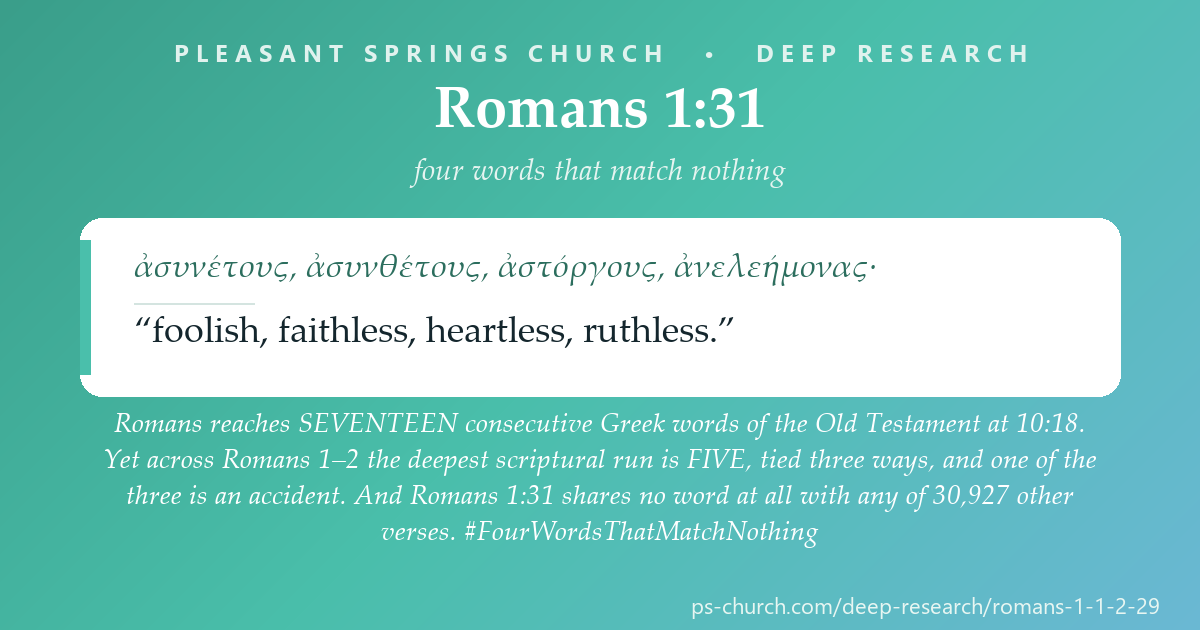
And then there is Romans 1:31. Four words: foolish, faithless, heartless, ruthless.
Screened against the 30,927 other verses this page was written against, it returned
zero — on the convention this shelf uses for Greek, no single word shared
with any of them — and it was one of only two verses in either corpus with that property.
⚠️ On 2026-08-30 the Greek Old Testament here grew from 23,061 verse units
to 30,348, and that finding died. Wisdom of Solomon 12:5 carries
ruthless in the same accusative plural, so Romans 1:31 now returns a run of one in a
band of one. Three of its four forms are still unique to it across all 38,275 verses;
the fourth is not. Stage 4 prints the whole history rather than the new number alone.
See the method →
Romans 1:1–2:29 (selections)
Greek New Testament (SBLGNT / MorphGNT) · ESV★ And the two results that set this page’s thesis were not what we expected. Romans reaches seventeen consecutive words of the Greek Old Testament at 10:18 and again at 9:26, sixteen at 9:29, fifteen at 3:13, every one of them in a tie band of one. Across the sixty-one verses of chapters 1 and 2 the deepest scriptural run is five, and the five is a three-way tie: a marked citation, an unmarked line, and an accident. And Romans 1:31 shares one word with one verse in the 38,214 other verses screened — it shared none at all with any of the 30,927 this page was written against, and on 2026-08-30 Wisdom of Solomon 12:5 arrived on the shelf carrying ἀνελεήμονας. The page prints what it said and what it says now rather than swapping the number. Stage 4 gives the full measurement, the tie bands, the controls and the counter-examples.
The Shape of the Passage
A sequence with one measured bracket — and it is not a chiasmRomans is the least contested letter in the New Testament as to author, and one of the most contested as to why it was written. This page reports the second question as open rather than settling it, and confines itself to what the opening two chapters actually say about the people they address.
Author
The letter names Paul in its first word, and names its scribe in its last chapter. 1:1 opens Παῦλος δοῦλος — one of exactly two verses in the Greek New Testament to do so, the other being Titus 1:1. Six letters open Παῦλος ἀπόστολος instead. And at 16:22 Τέρτιος breaks in to greet the readers in his own name: the man writing it down was not the man dictating it. No serious scholarly tradition disputes that Paul stands behind Romans 1–2, which is why this shelf’s Romans pages spend their effort on the text rather than on the attribution.
The vocabulary of these two chapters is measurably not the vocabulary of the rest of the book. Counted from the MorphGNT lemma column: 20 lemmas occur exactly once in the whole Greek New Testament, and that once is in Romans 1–2, in 992 word tokens — 20.2 per thousand. Romans 3–16 runs 15.7; the book as a whole runs 16.3. Seven of the twenty stand in the three verses 1:29–31 alone. Whatever else the vice list is, it is a stretch of Greek this writer does not use again.
A caution against over-reading that: 16.3 per thousand puts Romans fourteenth of the twenty-seven New Testament books on this measure. 2 Timothy runs 48.6; 1 John runs 0.5. Romans is an ordinary book by vocabulary, with two unusual chapters at the front.
Audience
Christians in Rome the writer has never met. 1:7 addresses πᾶσιν τοῖς οὖσιν ἐν Ῥώμῃ, all those who are in Rome, and 1:13 says plainly that he has been prevented from coming until now. That single fact shapes the whole opening: he cannot appeal to shared history, so he argues from first principles instead, which is why the letter begins with a case rather than with news.
The audience is mixed, and the passage keeps saying so. Ἰουδαίῳ τε πρῶτον καὶ Ἕλληνι — to the Jew first and also to the Greek — stands at 1:16 and returns at 2:9 and 2:10. 2:14 speaks of Gentiles who do not have the law; 2:17 turns and addresses someone who calls himself a Jew. Chapter 2 changes who it is talking to in the middle, and it does it out loud. Whether the letter’s occasion was the return of Jewish believers to Rome after Claudius’ expulsion, or a fundraising letter for Spain (15:24), or a summary of Paul’s gospel written ahead of an unfamiliar visit, is a historical question this page does not settle. The three are not exclusive and the text names only the third.
Orient on the letter’s occasion, on the shape of the argument from 1:18 to 3:20, and on the two things chapter 2 is fought over: natural revelation and the impartiality of God.
Search by topic: Romans, Letter to the; Rome, church at; Claudius, expulsion of the Jews; natural revelation / general revelation; wrath of God; idolatry in Paul; conscience (syneidesis); circumcision of the heart; judgment according to works; Jew and Greek; the New Perspective on Paul; vice lists in the New Testament.
Which articles are relevant?
- Anchor Bible Dictionary — “Romans, Epistle to the,” “Rome (place),” “Conscience,” “Circumcision,” “Wrath of God,” “Natural Theology.”
- Dictionary of Paul and His Letters (IVP) — “Romans, Letter to the,” “Idolatry,” “Law,” “Judgment,” “Universalism,” “Virtues and Vices.”
- New Interpreter’s Dictionary of the Bible — “Romans, Letter to the,” “Gentiles,” “Conscience.”
- Theological Dictionary of the New Testament (Kittel) — the articles on ὀργή, συνείδησις, παραδίδωμι and ἀλήθεια.
What a dictionary will tell you that this page cannot
Everything historical. When Romans was written and from where; who Phoebe was; what the Edict of Claudius did to the Roman congregations and whether Suetonius’ impulsore Chresto refers to Christ; how house churches in Rome were organised; what a first-century reader heard in the word barbarian at 1:14. None of that is measurable from a corpus of Greek text, and none of it is asserted here.
What this page adds to a dictionary article is a set of counts that either agree with the article or do not. Where a commentary says Romans 1:23 ‘echoes Psalm 106:20,’ the count says the two verses share two consecutive words. That does not refute the commentary. It says precisely what kind of claim the commentary is making — a claim about sense, not about wording — and this shelf thinks the reader is owed that distinction.
Romans 1:18–32 is the New Testament passage most often said to be borrowed from Hellenistic Jewish moral literature. Here is what can and cannot be checked from this disk.
★ The hard limit this section used to open with has been lifted. It read: “The text most frequently named as the background to Romans 1:18–32 is Wisdom of Solomon 13–15… The Greek text of Wisdom is one of the twenty CATSS files NOT held on this disk. It was therefore not measured… this shelf simply has not run it.” Greek Wisdom reached this disk on 2026-08-30 — 435 verse units of it — and the comparison has now been run. The result is the next question below. Wisdom of Solomon is held here as a measurement witness and not as Scripture, the same standing Psalm 151, Tobit, the Psalms of Solomon and Jubilees have on this shelf, and it is named as such every time it appears.
★ Romans 1:18–32 against Wisdom of Solomon 13–15, measured at last
Every commentary on this passage compares it to Wisdom 13–15. This shelf could not check that until 2026-08-30. Here is the check.
The fifteen verses of Romans 1:18–32, screened against the 69 verse units of Wisdom 13–15. The deepest verbatim contact anywhere in the comparison is two consecutive words.
| run reached | rows of the 15 |
|---|---|
| 2 | 8 |
| 1 | 5 |
| 0 — no word form shared at all | 2 |
| 3 or more | 0 |
Widening the target to the whole of Wisdom — all 435 units — lifts the ceiling to three, twice: Romans 1:20 with Wisdom 1:14 and Romans 1:25 with Wisdom 3:8. Neither is in chapters 13–15.
⚠️ What that does and does not mean, and this is the whole point of the instrument. A run screen finds verbatim contact. It cannot see an argument reused, a sequence of topics repeated, or a shared way of explaining how idolatry produces moral collapse — and the Romans/Wisdom parallel is argued on exactly those grounds, not on wording. This measurement does not refute the commentaries. It tells you the relationship is not made of shared sentences, which is worth knowing precisely because a reader who has been told the two passages are close may assume the Greek overlaps and it does not. The page ran the comparison it had spent two sections apologising for not running, and reports the answer including the part the instrument is blind to.
What the Greek Old Testament held here does and does not supply
Idol polemic. The material Romans 1:22–23 sounds like is spread across Isaiah 44, Jeremiah 10 and Psalm 113 (Hebrew and ESV 114–115), all of which are on this disk and all of which were screened. No verse in any of them shares more than three consecutive words with any verse in Romans 1. The shared material is a stock of ideas and a stock of objects — birds, four-footed things, creeping things — not a stock of sentences.
The one measurable Second-Temple-shaped contact in the passage is Greek, and it is in the New Testament. Acts 7:42, in Stephen’s speech, is the only verse outside Romans 1 in which God παρέδωκεν αὐτοὺς — gave them over. It stands directly after the golden calf. Two consecutive words is all it shares with Romans 1:24, 1:26 or 1:28, and this page does not claim more than two.
The vice list as a cultural form
Lists of vices were a standing genre in Stoic and Hellenistic-Jewish moralising, and the New Testament carries several — Galatians 5:19–21, 1 Corinthians 6:9–10, 2 Timothy 3:2–5, 1 Peter 4:3. Romans 1:29–31 is the longest of them and the least shared. Measured against the whole New Testament, the deepest verbatim contact any of those three verses makes with any other verse is two consecutive words: γονεῦσιν ἀπειθεῖς, disobedient to parents, with 2 Timothy 3:2, in a tie band of one. The genre is shared. The wording is not.
Not consulted, and it would change this section if it were: the Greek of Wisdom, 3 and 4 Maccabees, Philo’s De Decalogo and De Specialibus Legibus, the Sentences of Pseudo-Phocylides, Epictetus, and the Qumran vice catalogue in 1QS 4. None of these is on this disk in a form this shelf can screen.
Five words and one four-word phrase, every count run over the MorphGNT columns rather than read out of a lexicon.
Exactly two occurrences in the Greek New Testament, and both are in this passage — Romans 1:20 and Romans 2:1, twelve verses apart, each opening with Διό. It is built from ἀπολογία, a legal defence speech; the verb of the same family, ἀπολογέομαι, shows up again at 2:15 for the conscience’s thoughts that defend. The passage is a courtroom in its vocabulary and not only in its shape.
Four consecutive words standing in exactly three verses of the Greek New Testament: Romans 1:24, 1:26 and 1:28. Nowhere else. The verb παραδίδωμι itself is common — 119 occurrences, and it is the word used of Judas handing Jesus over, and of Jesus being handed over at Romans 4:25 and 8:32. The same verb governs the darkest sentence in Romans 1 and the brightest in Romans 8. The page notes that and draws no further conclusion from it.
That exact word form stands in four verses of the Greek New Testament, and two of the four are Romans 1:17 and 1:18. The other two are Luke 17:30 and 1 Corinthians 3:13. Righteousness revealed, then wrath revealed, in consecutive verses and the identical present tense. The lemma occurs 26 times; the coincidence here is in the form, and the form is what this shelf counts.
30 occurrences in the Greek New Testament, of which Romans 2:15 is the first in the letters — Acts 23:1 and 24:16 come earlier — and 1 Corinthians and Hebrews hold thirteen of the other twenty-nine. Literally a knowing-with. At 2:15 it does not accuse on its own: it συμμαρτυροῦσα, bears witness alongside, while the thoughts do the accusing and the defending. A witness in the courtroom, not the judge.
The noun at 2:4, with its adjective χρηστὸν in the same verse. What is measured here is the verb beside it: God’s kindness ἄγει — leads — you to repentance. Not permits, not waits for. The one word in these two chapters that says what God is doing while the indictment runs.
One of the four words of Romans 1:31, and the reason the honest qualification on that verse matters. The FORM ἀσυνθέτους occurs nowhere else in either corpus. The lemma is not rare at all: the Greek of Jeremiah 3 uses it four times of Judah, and there are seven ἀσυνθετ- forms in the Greek Old Testament held here. Faithless is a covenant word. Romans 1:31 applies it to the nations.
Twenty words the New Testament uses only here
Counted from the MorphGNT lemma column across all 137,554 tokens of the Greek New Testament, twenty lemmas occur exactly once in the whole corpus, and that once falls in Romans 1–2. Four more are confined to these two chapters but stand twice inside them — ἀναπολόγητος, μεταλλάσσω, χρῆσις and ἀνόμως — so they are not counted here:
γραπτός (2:15) · δικαιοκρισία (2:5) · θειότης (1:20) · θεοστυγής (1:30) · καθοράω (1:20) · κακοήθεια (1:29) · κατάλαλος (1:30) · ματαιόομαι (1:21) · σεβάζομαι (1:25) · σκληρότης (2:5) · συμπαρακαλέομαι (1:12) · ψιθυριστής (1:29) · ἀμετανόητος (2:5) · ἀνελεήμων (1:31) · ἀσύνθετος (1:31) · ἐκκαίομαι (1:27) · ἐπονομάζομαι (2:17) · ἐφευρετής (1:30) · ἱεροσυλέω (2:22) · ὄρεξις (1:27).
Four verses hold ten of the twenty. 1:29, 1:30 and 1:31 hold seven between them; 2:5 holds three on its own — σκληρότης, ἀμετανόητος and δικαιοκρισία, hardness, unrepentant, righteous-judgement, all in one sentence. No other verse in the passage holds more than two.
The measurement itself: sixty-one verses, screened word form by word form against 30,927 others, with the tie band beside every number.
What was run. Source: the 61 MorphGNT rows of Romans 1 and 2, normalised column (field 6). Target: every one of the other 7,866 verses of the Greek New Testament, plus all 30,348 verse units of the Greek Old Testament in the 64 CATSS files held here — 38,214 target rows (it was 30,927 before 2026-08-30, when twenty CATSS files — Exodus, Leviticus, Numbers, Joshua A and B, and the deuterocanon — joined the shelf and every figure in this stage was re-run). Both sides lowercased, accents and breathings dropped, final sigma folded, then filtered to Greek letters; the CATSS side beta-code transliterated first. Contiguous runs of whole word forms, never lemmas. Exhaustive and deterministic; nothing sampled, so no seed applies. ⚠️ Zero on a Greek-side screen means ‘shares no word at all’, because the Greek convention on this shelf falls back to single words; it does NOT mean ‘shares no two consecutive words’, which is what a zero means on the Hebrew-side screens used elsewhere on the shelf.
The whole distribution — every one of the sixty-one rows
| Deepest run | Rows reaching exactly it | Rows reaching at least it | exactly, on the old 30,927-row target |
|---|---|---|---|
| 12 | 1 | 1 | 1 |
| 5 | 6 | 7 | 6 |
| 4 | 14 | 21 | 12 |
| 3 | 24 | 45 | 25 |
| 2 | 13 | 58 | 14 |
| 1 | 3 | 61 | 2 |
| 0 | 0 | 61 | 1 |
One row reaches twelve and then there is nothing until five. The gap between 12 and 5 is the single most informative feature of the table, because the twelve is a salutation formula and the fives are where the reading actually happens. The gap is where it was; the shape of the table is where it was; and the row at zero is gone.
The greyed column is the same screen run on 2026-08-19, against 30,927 target rows instead of 38,214, and it is printed rather than discarded. Two rows moved up from three to four (1:26 and 1:28, both against Tobit (S) 14:5, a witness and not Scripture), one moved from two to three, and Romans 1:31 moved off zero — see below. Nothing moved down, and nothing can: a larger target corpus can only raise a maximum.
The seven deepest rows, with tie bands
| Row | Run | Band | Where | What it is |
|---|---|---|---|---|
| 1:7 | 12 | 5 | 1 Cor 1:3 · 2 Cor 1:2 · Eph 1:2 · Php 1:2 · Phm 3 | A greeting formula. Five letters carry the identical twelve words. |
| 1:17 | 5 | 1 | LXX Habakkuk 2:4 | A marked citation. καθὼς γέγραπται is in the verse. |
| 2:6 | 5 | 2 | LXX Proverbs 24:12 · LXX Psalm 61:13 (ESV 62:12) | An unmarked line. No citation formula anywhere near it. |
| 1:3 | 5 | 1 | LXX Genesis 21:3 | An accident. τοῦ υἱοῦ αὐτοῦ τοῦ γενομένου — Abraham names Isaac. |
| 1:25 | 5 | 1 | Romans 9:5 | A doxology formula, inside the same letter. |
| 1:32 | 5 | 1 | Galatians 5:21 | ὅτι οἱ τὰ τοιαῦτα πράσσοντες — two vice lists, one clause. |
| 1:4 | 5 | 4 | Rom 5:21 · Rom 7:25 · 1 Cor 1:9 · Jude 25 | A title. Jesus Christ our Lord. |
Three of the six fives are not quotations of anything. One is a doxology, one is a title, one is a coincidence about Isaac. Of the remaining three, one is a marked citation, one is an unmarked scriptural line, and one is a clause shared with another letter of the same author. Sorting by depth does not sort by significance, and this table is printed to show that it does not.
★ Romans 1:31 — the isolate that stopped being one
⚠️ THIS WAS THIS PAGE’S HEADLINE FINDING AND THE CORPUS FALSIFIED IT ON 2026-08-30. What it said, on what corpus, and what it says now:
What it said, against 30,927 other rows (7,927 Greek New Testament and 23,061 Greek Old Testament in 44 CATSS files): “Romans 1:31 returns a maximum run of zero and a tie band of zero… ran the same test over the whole of both corpora at once — 30,988 verses — asking of each whether every word form in it occurs in no other verse. Two verses pass: Romans 1:31, and LXX 2 Esdras 20:25, which is three transliterated Hebrew names… Romans 1:31 is the only verse in either corpus made of Greek words rather than foreign names in which every word form occurs nowhere else.”
What it says now, against 38,214 other rows — 7,927 New Testament plus 30,348 Greek Old Testament in 64 CATSS files:
| Romans 1:31, screened against… | run | band | partner |
|---|---|---|---|
| 30,927 rows · what this page said | 0 | 0 | none — shares no word form with any verse |
| 38,214 rows · what it returns now | 1 | 1 | Wisdom of Solomon 12:5 |
One word did it: ἀνελεήμονας. Wisdom 12:5 has the identical accusative plural — τέκνων τε φονὰς ἀνελεήμονας, merciless slaughterers of children, of the Canaanite rites the book is denouncing. The other three forms of Romans 1:31 are still unique to it across all 38,275 verses of both corpora. It was one word short of surviving, and it did not survive.
⚠️ And the book that broke it is a witness, not Scripture. Wisdom of Solomon is held on this shelf for measurement, on the same footing as Psalm 151, the Psalms of Solomon, Tobit and Jubilees, and it is named as such every time it appears. It was one of the twenty CATSS files absent when this page was written. The page does not now claim that Paul read Wisdom, and it did not previously claim that no such word existed — it claimed a property of a corpus, and the corpus changed.
The isolate screen, re-run over all 38,275 verses of both corpora. Asking of each verse whether every word form in it occurs in no other verse:
| Verse | Forms | What it is |
|---|---|---|
| LXX 2 Esdras 20:25 (MT Neh 10:25 · ESV Neh 10:24) | 3 | Αλωης Φαλαϊ Σωβηκ — three Hebrew names transliterated: Hallohesh, Pilha, Shobek. |
| Odes 14:11 — no longer screened | 1 | ἐπουράνιε — heavenly one, a single-word line of the Gloria in excelsis. It passed while the Odes were inside the screened corpus, and a one-word row makes the test nearly vacuous in any case. The Odes came out of every screen on this shelf on 31 August 2026 and this row went with them. |
| Romans 1:31 — no longer passes | 4 | Three of its four forms are still unique to it; ἀνελεήμονας is not. |
⚠️ The one surviving pass is not what Romans 1:31 was. 2 Esdras 20:25 is three proper names. There is now no verse in either corpus made of ordinary Greek words in which every form occurs nowhere else. The class the page found Romans 1:31 in has emptied, rather than gained a member.
⚠️ And that screen was re-run on 31 August 2026 over a SMALLER corpus, which is a direction this shelf had not had to handle before. The Odes — the fourteen liturgical canticles bound after the Greek Psalter, 289 verse units, which arrived with the last twenty CATSS files — were taken out of everything called “the Greek Old Testament” for screening. They are still held on the disk; they are no longer screened. HELD is 30,637 verse units in 64 files. SCREENED is 30,348. Two reasons, either sufficient: Ode 9 is Luke 1 and Ode 13 is Luke 2, so the file is partly New Testament text under an Old Testament shelfmark; and ten more canticles are second copies of passages the corpus already holds (Ode 1 = Exodus 15, 2 = Deuteronomy 32, 3 = 1 Samuel 2, 4 = Habakkuk 3, 5 = Isaiah 26, 6 = Jonah 2, 7 and 8 = Daniel (Th) 3, 10 = Isaiah 5, 11 = Isaiah 38), which doubled any tie band that touched them. Two figures on this page moved and both are printed above: the isolate screen lost Odes 14:11 and now returns exactly one pass, and Luke 1:48’s eighteen — the row that stood immediately above Romans in the whole-New-Testament ranking — was Luke matching Luke and is gone. Nothing else moved: the sixty-one-row distribution and all seven rows of the deepest-rows table, runs and bands alike, re-run identical over 30,348. Romans 1:31 is still not an isolate; ἀνελεήμονας is in Wisdom of Solomon, which is not an Ode and has not gone anywhere.
⚠️ And one thing that did not move but should still be named, because it is where this hazard actually lives. Nine of the sixty-one rows had their tie band narrow when the Odes left, and five of the nine were losing a verse of Luke: Romans 1:1 shed Odes 9:50, 9:78, 9:79 and 13:32; 1:6 shed Odes 9:78; 1:30 shed Odes 9:51; 2:19 shed Odes 9:79; and 2:21 shed Odes 9:49, 9:68 and 13:31. Every one of those was a run of one or two inside a band of dozens to twelve thousand, so not one of them was ever printed and not one changed a maximum. That is exactly why it is worth saying: the Odes problem does not usually announce itself as a spectacular eighteen-word false hit. Luke 1:48 was the visible case. The ordinary case is a Gospel verse quietly padding a denominator, and this page’s bands were doing that for a day.
⚠️ The qualification, and it is not small. This is a result about word forms, which is what every measurement on this shelf counts. It is not a result about words. Three of the four lemmas are perfectly ordinary:
| Lemma | Forms in the Greek OT held here | Elsewhere in the Greek NT |
|---|---|---|
| ἀσύνετος | 10 — Deut 32:21, Job, Psalms, Sirach | 4 — Mt 15:16, Mk 7:18, Rom 1:21, Rom 10:19 |
| ἀσύνθετος | 7 — Jeremiah 3 four times, Ps 118:158, 2 Esdras twice | none |
| ἄστοργος | 0 | 1 — 2 Tim 3:3 ἄστοργοι |
| ἀνελεήμων | 11 — Job, Proverbs, Sirach | none |
All four words of Romans 1:31 are accusative plurals, and it is the accusative plural of each that stands alone. So the finding is real and it is narrow: this is the only verse in the Greek New Testament in which every inflected form is unique to it. Whether that is design, or the arithmetic of putting four rare-ish adjectives in the same case side by side, is not something a count can decide, and the page does not decide it.
Habakkuk 2:4 — three New Testament quotations, and no two agree
The Greek of Habakkuk 2:4 held here reads ὁ δὲ δίκαιος ἐκ πίστεώς μου ζήσεται — the righteous shall live by MY faithfulness. Three New Testament verses quote it. Here is each measured against that Greek:
| Verse | Run with LXX Hab 2:4 | What it does with the pronoun |
|---|---|---|
| Romans 1:17 | 5 | Drops μου entirely. ὁ δὲ δίκαιος ἐκ πίστεως then ζήσεται — the run stops at the gap. |
| Galatians 3:11 | 3 | Drops ὁ δὲ as well; only δίκαιος ἐκ πίστεως is contiguous. |
| Hebrews 10:38 | 6 | Keeps the pronoun but moves it: ὁ δὲ δίκαιός μου ἐκ πίστεως. Its six is on the OTHER clause of the verse — εὐδοκεῖ ἡ ψυχὴ μου ἐν αὐτῷ — not on the clause about the righteous, where it too reaches three. |
Romans 1:17 and Galatians 3:11 — same author, same half-verse of the same prophet — share four consecutive words with each other, in a tie band of one. Romans 1:17 and Hebrews 10:38 share three. No direction of influence is asserted here, and none can be. What the numbers show is that all three writers had access to a Greek Habakkuk close to the one on this disk and none of them copied it mechanically.
The controls — is the screen simply blind?
No. Run the same screen on the rest of Romans and it lights up.
| Verse | Run | Band | With |
|---|---|---|---|
| Romans 10:18 | 17 | 1 | LXX Psalm 18:5 (MT 19:5 · ESV 19:4) |
| Romans 9:26 | 17 | 1 | LXX Hosea 2:1 (ESV 1:10) |
| Romans 9:29 | 16 | 1 | LXX Isaiah 1:9 |
| Romans 3:13 | 15 | 1 | LXX Psalm 13:3 (MT/ESV 14:3) |
| Romans 11:10 | 14 | 1 | LXX Psalm 68:24 (MT 69:24 · ESV 69:23) |
| Romans 15:12 | 13 | 1 | LXX Isaiah 11:10 |
| Romans 4:7 | 10 | 1 | LXX Psalm 31:1 (MT/ESV 32:1) |
And a correction this page owes, because an earlier draft of it made the mistake. Romans is not the deepest-quoting book in the New Testament. Screening every one of the 7,927 Greek New Testament verses against the whole Greek Old Testament held here, the deepest single run in the corpus is twenty-four, and it occurs twice — Matthew 13:15 and Acts 28:27, both on Isaiah 6:10. Romans’ best is seventeen, and on the corpus this shelf now screens that leaves eleven New Testament verses standing deeper than anything in Romans. Galatians 4:27 reaches twenty-three on Isaiah 54:1, Hebrews 8:9 and 8:11 twenty-three on Jeremiah 38:32 and 38:34 (MT/ESV 31:32, 31:34), Mark 12:30 twenty-one on Deuteronomy 6:5, then Acts 8:33, Acts 2:26, Acts 4:26 and Hebrews 1:9 at twenty, and Acts 2:17 at nineteen. The claim this page makes is narrower and it survives every correction: Romans 1–2 does not do what the rest of Romans does.
⚠️ Two things about that ranking, both printed rather than tidied. First, it moved on 2026-08-30. This paragraph used to read “Romans is fourth at seventeen. Counting rows that reach ten or more: Hebrews 20, Acts 18, Matthew 9, Romans 9.” That was measured against 23,061 Greek Old Testament verse units in 44 files. Against 30,348 units in 64 files it reads: Acts 23, Hebrews 21, Romans 12, Matthew 9 — Romans gained three, and its rank by single deepest run fell from fourth to thirteenth-equal. Second, this list had a twelfth entry until 31 August 2026, and it was not a quotation at all — it was Luke measured against Luke, and the page prints how it was caught rather than deleting the row. Luke 1:48 stood at eighteen, one place above Romans, and its partner was Odes 9:48. Ode 9 is the Magnificat — Luke 1 itself, excerpted as a liturgical canticle and bound into the Greek Psalter’s appendix, from which it reached this shelf inside a file named Odes.mlxx. Eighteen consecutive words is what a verse scores against a copy of itself. What caught it was the tie band and the shelfmark, not a hunch: every one of Luke’s new deep rows came back in a band of one with a partner in a single file, and reading the partner rather than the number showed the file was Luke. On 31 August 2026 the Odes were dropped from every screen on this shelf; the 272 New Testament verses that had an Ode 9 or Ode 13 row in their deepest-partner set are now zero, and Luke’s deepest Old Testament run falls from 18 to 13 (Luke 3:4 on Isaiah 40:3). Ten of Luke’s eighteen rows at ten or more were that same artefact; with them gone Luke has eight, and Romans’ seventeen moves from thirteenth-equal to twelfth-equal. The instrument can do this to you, and the only defence is reading what a run landed on.
Every one of those is in a tie band of one — no other verse in 30,348 comes near. The instrument works. Romans 1–2 is simply not doing what Romans 3–15 is doing. The catena at 3:10–18, the Abraham argument in 4, the Israel chapters in 9–11 and the Gentile chain in 15 are stitched out of Greek Old Testament sentences. The opening indictment is argued in the author’s own words, with two short citations and one allusion, and the citations are not the deepest thing in it.
⚠️ The counter-examples this page owes its reader
1. Romans 1:23 and Psalm 106:20 share two consecutive words. The golden calf is the standard cross-reference for this verse, and the two Greek texts share τὴν δόξαν and no more: Romans has ἤλλαξαν where the Psalm has ἠλλάξαντο, and the shared ἐν ὁμοιώματι is not adjacent to the match. If this page treated depth as evidence, it would have to deny a connection most commentators regard as certain. It does not.
2. Romans 2:15 and Jeremiah 31:33 share one word. LXX Jeremiah 38:33, the law written on the heart, is the obvious background to the work of the law written on their hearts. The screen returns αὐτῶν and nothing else. Hebrews 8:10 reproduces that same Jeremiah verse across a long stretch; Romans 2:15 does not reproduce it at all.
3. Romans 2:29 and the circumcision of the heart share one word. Deuteronomy 10:16, Deuteronomy 30:6, Jeremiah 4:4 and Jeremiah 9:25 all say it. Against each, this row returns one. Against Deuteronomy 30:6, Romans 2:28 returns zero — no shared word at all.
4. And the deepest run on the page is a form letter. Romans 1:7 reaches twelve. That number is more than twice the deepest scriptural run in the passage and it carries no theological weight whatsoever. It is printed first in the codex, above everything else, on purpose.
What is NOT claimed
Nothing here says that Romans is not using the Old Testament in chapters 1 and 2. It plainly is: 1:17 and 2:24 both say so in words. Nothing here says Romans 1:23 has no relation to Psalm 106, or Romans 2:15 none to Jeremiah 31. Nothing here says the writer of Hebrews knew Romans, or that Romans knew Galatians, or the reverse. Nothing here says that Romans 1:31 was constructed to be unique. A run length is a measurement of wording. It is not a measurement of dependence, of intention, or of meaning, and this shelf never lets it stand in for one.
Where the scholarship stands, what this page did not consult, and where this page is weakest.
The commentaries a serious reader should hold against this page
- C. E. B. Cranfield, Romans (ICC, 1975–79) — still the standard verse-by-verse treatment in English of the Greek of chapters 1–2.
- James D. G. Dunn, Romans 1–8 (WBC, 1988) — and the New Perspective reading of 2:17–29 that grew out of his 1983 works of the law essay.
- Douglas J. Moo, The Epistle to the Romans (NICNT, 2nd ed. 2018) — the fullest recent traditional-Protestant answer to Dunn on chapter 2.
- Richard B. Hays, Echoes of Scripture in the Letters of Paul (1989) — the book that this page is in dialogue with whether it likes it or not. Hays’ seven criteria for detecting an echo include volume, which is roughly what is measured here, but it is one test of seven, and the other six — availability, recurrence, thematic coherence, historical plausibility, history of interpretation and satisfaction — are not measurements of wording. A run of two at Romans 1:23 is exactly the case his method is built to handle and this one is not.
- Robert Jewett, Romans (Hermeneia, 2007) — the fullest treatment of the letter’s Roman social setting and of the Spanish-mission thesis.
- N. T. Wright, Romans (NIB X, 2002) — for the reading of 2:14–16 and 2:25–29 as describing Christian Gentiles rather than pagans in general.
- Simon Gathercole, Where Is Boasting? (2002) — on judgment according to works at 2:6–16 and its Second-Temple parallels.
- Stanley E. Porter and Christopher D. Stanley, eds., As It Is Written: Studying Paul’s Use of Scripture (2008) — the methodological pushback on Hays, and the closest thing in print to a debate about whether counting is the right instrument.
⚠️ What this page did NOT consult, could not check, and where it is weakest
★ The single largest gap was Wisdom of Solomon, and it is closed. This section used to read: “Romans 1:18–32 is compared to Wisdom 13–15 in essentially every commentary listed above. The Greek text of Wisdom is not on this disk — it is one of twenty CATSS files absent — so the comparison that matters most for this passage is the one comparison this page could not run.” All twenty files arrived on 2026-08-30. The comparison has been run and it is in Stage 2: across Romans 1:18–32 against Wisdom 13–15 the deepest verbatim contact is two consecutive words, and nothing reaches three. A run screen finds wording, not argument, so that result does not settle the commentators’ case — but the comparison is no longer one this shelf has to decline.
★ And the Decalogue behind 2:21–22, which also could not be screened, now can be — with an answer worth having. This section used to say: “Exodus, Leviticus and Numbers are absent, so the Decalogue behind 2:21–22 (do not steal, do not commit adultery) could not be screened in Greek at all.” All three are held now. Measured, Romans 2:21 against Greek Exodus 20:14 (οὐ κλέψεις) reaches one word, and Romans 2:22 against Greek Exodus 20:13 (οὐ μοιχεύσεις) reaches zero. Paul writes the prohibitions as articular infinitives — μὴ κλέπτειν, μὴ μοιχεύειν — where the Decalogue has second-person futures, and a form screen sees nothing. The commandments are unmistakably there and the instrument cannot see them, which is this page’s own thesis demonstrated on its own passage. Romans 2:21’s maximum against the whole Greek Old Testament is one word, in a tie band of 12,341.
⚠️ And screening the Decalogue turned up a divergence this shelf is obliged to disclose rather than smooth over. The three short commandments do not stand in the same order in the two Greek columns, and neither order is the Hebrew’s. CATSS Exodus 20 runs adultery (20:13), theft (20:14), murder (20:15). CATSS Deuteronomy 5 runs adultery (5:17), murder (5:18), theft (5:19). The Masoretic text of both runs murder, adultery, theft. Romans 13:9 — outside this study, but the place Paul actually quotes them — runs adultery, murder, theft, which is Deuteronomy’s Greek order and not Exodus’s. The page reports the three orders and stops there; which is prior, and what produced any of them, is not something these columns settle, and no critical apparatus was consulted.
★ And Leviticus, absent until 2026-08-30, turns out to carry the deepest Torah contact any New Testament verse makes with a commandment. Not in this study — Romans 1–2 makes none — but the screens are worth printing here because until this month not one of them could be run at all:
| New Testament verse | CATSS row | run | band |
|---|---|---|---|
| Matthew 19:19 | Leviticus 19:18 | 7 | 1 |
| Romans 13:9 · Galatians 5:14 · James 2:8 · Matthew 22:39 · Mark 12:31 | Leviticus 19:18 | 6 | 1 each |
| Romans 10:5 | Leviticus 18:5 | 4 | 1 |
| Galatians 3:12 | Leviticus 18:5 | 3 | — |
| Romans 9:17 | Exodus 9:16 | 11 | 1 |
| Romans 9:15 | Exodus 33:19 | 9 | 1 |
The six is ἀγαπήσεις τὸν πλησίον σου ὡς σεαυτόν, identical in five New Testament verses and in Leviticus. ⚠️ And Galatians 3:12 is the row that repays the screen. It is universally read as a citation of Leviticus 18:5, and against Leviticus 18:5 it does reach three — but its deepest partner among all 30,348 verse units is not Leviticus at all. It reaches three in a tie band of ten, and the band includes Ezekiel 20:11, Ezekiel 20:13 and 2 Esdras 19:29, which quote the same clause. A screen that reported only the maximum would name Ezekiel as the source of a verse that is quoting Leviticus. Which is this shelf’s first rule, arriving on a verse nobody could screen until this month.
The twenty missing Greek files are no longer missing. Exodus, Leviticus, Numbers, Joshua (A and B), Judith, Tobit (BA and S), Wisdom, Baruch, the Letter of Jeremiah, 2–4 Maccabees, Susanna, Bel, Odes and Psalms of Solomon all reached the disk on 2026-08-30, taking the Greek Old Testament here from 44 files and 23,061 verse units to 64 files and 30,348. There is no Greek Old Testament gap left on this shelf. The deuterocanonical books among them are held as measurement witnesses and not as Scripture, and are named as such wherever a hit lands in one — on this page that is Wisdom of Solomon and Tobit.
No critical apparatus was consulted for any verse. That includes the textual questions in this very passage: whether 1:16 read τοῦ Χριστοῦ after the gospel; the punctuation and clause division of 2:15–16, on which the editions differ; the order of items in the 1:29–31 list, which varies in the manuscripts and on which the isolate finding at 1:31 partly depends. The screen was run on the SBL text as digitized by MorphGNT and on no other text. If a manuscript tradition reorders or supplements 1:31, the finding is a finding about SBLGNT, not about ‘the New Testament’.
No ESV file for Romans is held here. The Greek column on this page is read from a file and can be re-derived by anyone with the same disk. The ESV column was set from the printed edition and was not counted from a file, and it is therefore the one column on this page that a reader should check against their own copy rather than trust.
No Hebrew was measured. Every Old Testament comparison here is Greek against Greek. Where the Greek of Habakkuk 2:4 and the Hebrew differ — and they do, over whose faithfulness is in view — this page reports the Greek and says nothing about which is prior.
Where the page is weakest, stated plainly. (1) The near-isolate at 1:31 is a fact about inflected forms, and a reader who thinks in lemmas will find it less impressive than the codex row makes it sound; the qualification table in Stage 4 exists so that nobody is misled. ⚠️ It is also a fact about a corpus, and this is the page’s own cautionary tale: the finding stood as an absolute for as long as twenty CATSS files were off the disk, and one of them killed it. A claim of the form nowhere else is only ever as strong as the shelf it was measured on, and this page now says so from experience rather than as a formality. (2) The claim that Romans 1–2 quotes ‘shallowly’ is a claim about verbatim contact only, and Hays’ entire argument is that verbatim contact is the wrong instrument for allusion — a case this page cannot answer and does not try to. (3) The hapax-density figures compare a 992-word sample against whole books; small samples run noisy, and 20.2 against 15.7 is suggestive, not decisive. (4) No statistical significance was computed for anything on this page.
Everything numbered on this page was produced by the tooling in marketing/deep_research/dr_tools over the text files named in the footer, and can be re-run.
A book that quotes at seventeen, opening at five.
What the counting actually showed
Romans argues from Scripture by reproducing it — seventeen words of a Psalm, seventeen of Hosea, sixteen of Isaiah, each in a tie band of one across twenty-three thousand verses.
And then its opening sixty-one verses do almost none of that. Two citations, one reaching five and one reaching four. An unmarked line that reaches five and beats one of them. An accident about Isaac that reaches five and beats the other. And a greeting formula that reaches twelve and means nothing at all.
The indictment is not built out of quotations. It is argued. Which is what you would expect of a letter written to people who had never met its author — and the moment the argument turns, at chapter 3, the quotations come back in a wall. A word count cannot tell you that was deliberate. It can tell you it happened.
And at the bottom of the list of everything that has gone wrong with humanity sits one verse of four words, sharing nothing with anything. ἀσυνέτους, ἀσυνθέτους, ἀστόργους, ἀνελεήμονας — without understanding, without covenant, without affection, without mercy. Whether that isolation is design or arithmetic is not a question a count can settle, and this page has said so three times rather than let a good line stand unqualified. What it will say is this: the next thing the letter does, at 2:4, is tell you that God’s kindness is leading you somewhere.
New Testament shelf: this study opens Romans at the beginning and joins five existing pages — Romans 3:21–26, 5:1–11, 6:1–7:25, 8:31–39 and 14:1–16:27. Greek New Testament and ESV.
Every Deep Research page traces its passage across the whole sweep — the Old Testament, the Second-Temple world between the testaments (historical witnesses, not Scripture), and the New Testament. Follow the thread:
Pleasant Springs Church — Deep Research
Research method after Michael S. Heiser’s Bible Research Method (examine dictionaries → ancient literature → important words → textual connections → academic publications → share), with the Pleasant Springs “Author & Audience” foundation. Scripture set in the Hebrew, the Greek editions named on each page and the ESV (Old Testament), and the Greek New Testament and the ESV (New Testament), per the practice of Pleasant Springs Church. Romans research grounded in Cranfield (ICC), Dunn (WBC), Moo (NICNT), Jewett (Hermeneia) and Wright (NIB), with Hays’ Echoes of Scripture named as the standing methodological objection to reading run length as evidence of allusion. Text: Greek New Testament from the SBL edition as digitized by MorphGNT; Greek Old Testament from Rahlfs’ Septuaginta as digitized by CATSS. ⚠️ VERSE NUMBERING — there is no offset in this passage. Counted from the files themselves, the SBL Greek New Testament gives Romans 1 thirty-two verses and Romans 2 twenty-nine, and the ESV prints the same divisions; every reference on this page means the same verse in both columns. Stated because this shelf states it everywhere, including where there is nothing to convert. Romans does carry one editorial divergence, at the far end of the book: the MorphGNT file runs 430 verses and closes chapter 16 at verse 24, while the ESV numbers to 16:27 with no verse 24 — a disagreement about where the closing doxology belongs, fourteen chapters past anything quoted here. The Old Testament texts measured against DO carry offsets and every one is labelled twice: Psalm 61:13 Greek = 62:13 Hebrew = 62:12 ESV; Psalm 105:20 Greek = 106:20 Hebrew and ESV; Psalm 18:5 Greek = 19:5 Hebrew = 19:4 ESV; Psalm 13:3 Greek = 14:3 Hebrew and ESV; Psalm 68:24 Greek = 69:24 Hebrew = 69:23 ESV; Psalm 31:1 Greek = 32:1 Hebrew and ESV; Hosea 2:1 Greek and Hebrew = 1:10 ESV; Jeremiah 38:33 Greek = 31:33 Hebrew and ESV; Jeremiah 9:25 Greek = 9:25 Hebrew = 9:26 ESV; 2 Esdras 20:25 Greek = Nehemiah 10:25 Hebrew = Nehemiah 10:24 ESV. Habakkuk 2:4, Isaiah 52:5, Isaiah 1:9, Isaiah 11:10, Genesis 21:3 and Proverbs 24:12 carry the same number in all three. One caution about the Greek Proverbs: the CATSS file reorders the second half of the book — the verse behind Romans 12:20 is labelled Proverbs 32:22 there — but 24:12, the verse behind Romans 2:6, carries the same number in the Greek, the Hebrew and the English. ⚠️ The measurement, in full. Greek against Greek. MorphGNT field 6, the normalised word form; the CATSS FORM column (cols 0–24) beta-code transliterated first. Both sides lowercased, accents and breathings dropped, final sigma folded, then filtered to Greek letters — the same filter applied to both corpora. Word forms, never lemmas, except where the page says ‘lemma’ explicitly, which is the vocabulary and hapax counting. Corpus: the 61 MorphGNT rows of Romans 1–2 against 7,866 other New Testament verses across 27 files and 30,348 verse units — the 64 CATSS files less the Odes — 38,214 target rows. The isolate census ran over all 38,275 verses of both corpora at once. Exhaustive and deterministic; nothing sampled, so no seed applies. ⚠️ THE CORPUS GREW ON 2026-08-30 AND THIS PAGE’S HEADLINE FINDING DID NOT SURVIVE IT. Exodus, Leviticus, Numbers, Joshua (A and B) and the deuterocanon — Judith, Tobit (BA and S), Wisdom, Baruch, the Letter of Jeremiah, 2–4 Maccabees, Susanna, Bel, Odes and Psalms of Solomon — took the Greek Old Testament shelf from 44 files / 23,061 verse units to 64 files / 30,637 held, and the target corpus for this study from 30,927 rows to 38,503. ⚠️ Then it shrank again on 31 August 2026, when the Odes — 289 units, of which Ode 9 is Luke 1 and Ode 13 is Luke 2, with ten more canticles second copies of Exodus 15, Deuteronomy 32, 1 Samuel 2, Habakkuk 3, Isaiah 26, Jonah 2, Daniel 3, Isaiah 5 and Isaiah 38 — were removed from every screen on this shelf. The file is still HELD; it is no longer SCREENED. Screened corpus: 30,348 Greek Old Testament units, 38,214 target rows for this study. Two figures above moved with it and both are printed in place: the isolate screen lost Odes 14:11, and Luke 1:48’s eighteen — which was Luke matched to the Magnificat as an Old Testament canticle — came out of the whole-New-Testament ranking, moving Romans from thirteenth-equal to twelfth-equal. The sixty-one-row distribution and every tie band in Stage 4 were re-run and did not move. Falsified: “Romans 1:31 shares no single word form with any other verse in either corpus” — Wisdom of Solomon 12:5 carries ἀνελεήμονας, so the run is now one in a band of one, and the isolate class is left holding only 2 Esdras 20:25 (three Hebrew names) — Odes 14:11, one word, passed too until the Odes came out of the screen on 31 August 2026. Moved: the 61-row distribution (four or more, 19 rows → 21; the row at zero is gone), and Romans’ rank among New Testament books (fourth-deepest → thirteenth-equal → twelfth-equal, the last step being Luke 1:48’s eighteen against the Magnificat-as-canticle leaving the list; rows at ten or more, Hebrews 20 / Acts 18 / Matthew 9 / Romans 9 → Acts 23 / Hebrews 21 / Romans 12 / Matthew 9, with Luke falling 18 → 8 when the Odes left). Newly measurable, and both are printed in full: Romans 1:18–32 against Wisdom 13–15 (ceiling two words), and the Decalogue behind 2:21–22 against Greek Exodus 20 (one word and zero). Unchanged: the 12 at 1:7 with its band of five, the five at 1:17, 2:6, 1:3, 1:25, 1:32 and 1:4 with their bands, and every Romans figure quoted from outside chapters 1–2. The deuterocanonical books and the Odes are held here as measurement WITNESSES and NOT as Scripture — the standing Psalm 151 and Jubilees have on this shelf — and this page names the book every time a hit lands in one, which here is Wisdom of Solomon, Tobit, 2 Maccabees, Sirach and the Odes. ⚠️ The passage’s deepest run is a formula and the page says so first. Romans 1:7 against 1 Corinthians 1:3, 2 Corinthians 1:2, Ephesians 1:2, Philippians 1:2 and Philemon 3: twelve consecutive words in a tie band of five. Depth alone is not evidence of quotation, and on this page the deepest number carries the least weight. ⚠️ What a zero means here. The Greek-side screens on this shelf fall back to single words, so Romans 1:31’s zero means it shares no word at all with any target row. That is a different zero from the Hebrew-side zero published on the Obadiah page, which means ‘no two consecutive words’. The convention is stated because the two are not interchangeable. ⚠️ Not measured here. No critical apparatus for any verse, including the disputed order of the vice list at 1:29–31 on which the isolate finding partly rests. No Hebrew comparison — every Old Testament measurement is Greek against Greek. ✅ The corpus gaps this paragraph used to list are closed. It read: “No Greek Wisdom of Solomon, the text most often named as the background to 1:18–32; no Greek Exodus, Leviticus or Numbers, so the Decalogue behind 2:21–22 could not be screened. Joshua, Judith, Tobit, 2–4 Maccabees, Odes, Psalms of Solomon, Baruch, Epistle of Jeremiah, Bel and Susanna are also absent.” All twenty files are on the disk as of 2026-08-30, both screens were run, and both results are printed — in Stage 2 for Wisdom and Stage 5 for the Decalogue. Still not consulted: no documentary papyri, no inscriptions, no Josephus, no Philo, no Apostolic Fathers, no Qumran. No statistical significance was computed for any figure on this page. ⚠️ Direction of influence is never asserted. Nothing here says that Romans used Wisdom or that Wisdom used anything, that Hebrews knew Romans or Romans Galatians, that Acts 7 stands behind Romans 1 or the reverse, or that any writer had any other text in front of him. Nothing here says Romans 1:23 is or is not an allusion to Psalm 106:20 — only that the two verses share two consecutive words. A run length measures wording and nothing else. Typology is handled per the house position: what the text says, what the New Testament itself draws, and what we see from this side of the cross — with the seeing left to the reader.
Scripture quotations marked ESV are from the ESV® Bible (The Holy Bible, English Standard Version®), © 2001 by Crossway, a publishing ministry of Good News Publishers. ESV Text Edition: 2016. Used by permission. All rights reserved. The ESV text may not be quoted in any publication made available to the public by a Creative Commons license, and the ESV may not be translated in whole or in part into any other language. www.esv.org
|
Did this study bless you today? 💚 Give to Support PS Church100% of gifts go to the General Fund — thank you. |