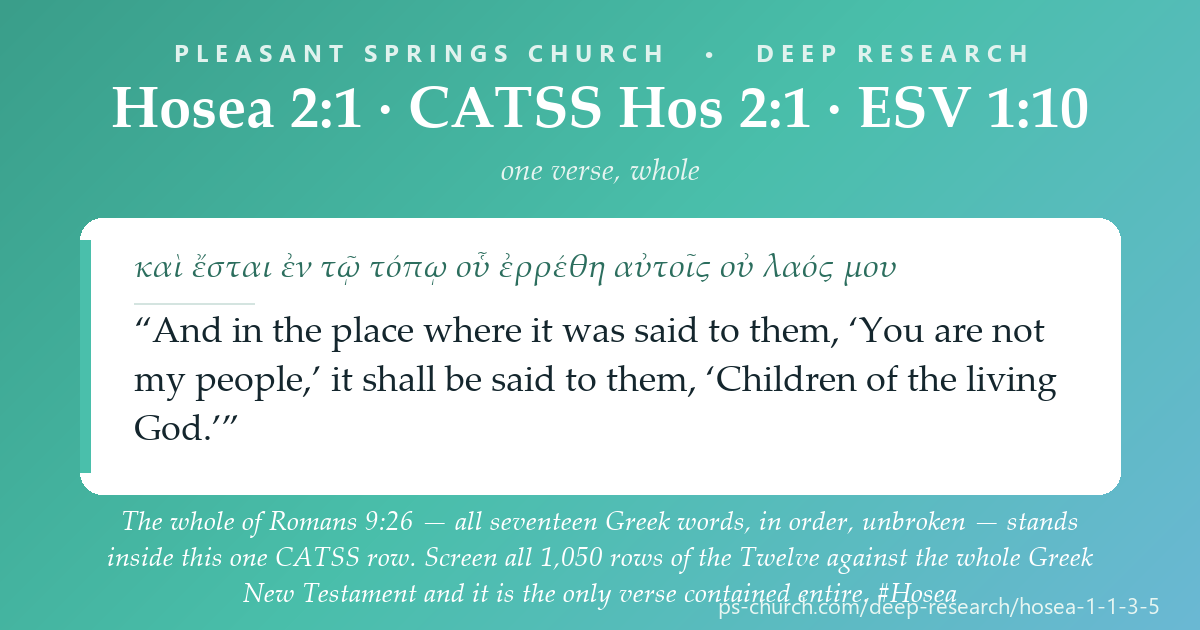
Normalise the CATSS Greek row at Hosea 2:1 and the Greek of Romans 9:26 to the same plain alphabet, and the whole of the Romans verse — all seventeen words, in order, with nothing between them — stands inside that single row, filling exactly half of its thirty-four. That is not what the measurement ordinarily returns. Run it over every one of the 1,050 CATSS rows of the Twelve against every verse of the Greek New Testament and the ordinary row shares three words with its best New Testament partner. Ask the stricter question — for how many New Testament verses does the complete wording appear unbroken inside some row of the Twelve? — and the answer across the whole New Testament is one: Romans 9:26. Romans 9:25, standing one line earlier on the same theme, shares a single word with the Hosea verse it is usually printed against. See the method →
Hosea 1:1–3:5 (selections, Hebrew numbering)
Hebrew · Greek (CATSS, Rahlfs’ Septuaginta) · ESV⚠️ And the row at 2:1 carries a whole New Testament verse. The seventeen bolded Greek words are Romans 9:26 entire, in order, with nothing between them.
The Shape of the Passage
Sequence — a marriage, a lawsuit, and a second purchaseThe book changes person between chapter 1 and chapter 3, and that can be read off the morphology. Chapter 1 speaks about Hosea in the third person; chapter 3 opens וַיֹּאמֶר יְהֹוָה אֵלַי, and the Lord said to me. Chapter 2 is neither — it is divine speech throughout.
Author
1:1 dates the book by five kings. Uzziah, Jotham, Ahaz and Hezekiah of Judah, and Jeroboam son of Joash of Israel. The Greek row spells them Οζιου, Ιωαθαμ, Αχαζ, Εζεκιου and Ιεροβοαμ υἱοῦ Ιωας.
It is a northern book with a southern dating formula. Hosea prophesies to Israel and is placed in time by the kings of Judah, with the northern king named last and alone. That is a fact about the superscription, not an argument about who compiled it.
Audience
The children are addressed directly at 2:3, and they are the ones who carry the names. “Say to your brothers… and to your sisters” — the reversal is put in the mouths of the very children named for the judgment.
And by 2:1 the audience has widened past Israel. “In the place where it was said to them, You are not my people” — a place, not a people. What Romans 9 and 1 Peter 2 later do with that sentence is a matter of reading; what this page measures is how much of the wording they share.
Orient on Hosea's marriage, the three names, and a numbering that shifts.
Search by topic: Hosea, book of; Gomer; Lo-ammi and Lo-ruhamah; Jezreel; Hosea in Romans 9; chapter and verse divisions, history of.
Which articles are relevant?
- Anchor Bible Dictionary — “Hosea, Book of,” “Gomer,” “Jezreel,” “Lo-ammi.”
- Dictionary of the OT: Prophets (IVP) — “Hosea: Book of,” “Marriage and Divorce,” “Israel’s History.”
- NIDOTTE — רָחַם, עַם, זָנָה.
Settle the numbering before anything else
Hosea is one of seven Minor Prophets whose Hebrew verse numbers differ from the English. Get this wrong and every reference on the page is wrong.
| Hebrew & CATSS | ESV | opening words |
|---|---|---|
| 1:9 | 1:9 | Call his name Not My People… |
| 2:1 | 1:10 | Yet the number of the children of Israel… |
| 2:2 | 1:11 | And the children of Judah… shall be gathered… |
| 2:3 | 2:1 | Say to your brothers, You are my people… |
| 2:25 | 2:23 | …I will have mercy on No Mercy… |
| 3:1–5 | 3:1–5 | Go again, love a woman… |
Chapter counts: Masoretic and CATSS both 9 / 25 / 5; the ESV 11 / 23 / 5. The same thirty-nine verses, divided differently. Later in the book the same thing happens twice more, at Hebrew 12:1 and 14:1 — both outside this study.
A whole New Testament verse, sitting inside one row.
Romans 9:26 and the row at Hosea 2:1
Seventeen words, in order, unbroken.
καὶ ἔσται ἐν τῷ τόπῳ οὗ ἐρρέθη αὐτοῖς οὐ λαός μου ὑμεῖς ἐκεῖ κληθήσονται υἱοὶ θεοῦ ζῶντος
That is the whole of Romans 9:26 and it is the second half of the CATSS row at Hosea 2:1, which runs to thirty-four words. Seventeen of seventeen; seventeen of thirty-four.
The screen, and what it returns across the Twelve. Comparing every one of the 1,050 rows against every verse of the Greek New Testament, the ordinary row shares three words with its best partner. Only a handful of rows anywhere in these twelve books reach seven or more.
Then the stricter question: for how many New Testament verses does the complete wording stand unbroken inside some row of the Twelve? Across the whole New Testament, one.
The screen was allowed to crown something else, and on its other measure it did
On raw depth the deepest match in the Twelve is not in Hosea. It is in Joel.
| shared run | of the NT verse | of the row | |
|---|---|---|---|
| Hos 2:1 & Romans 9:26 | 17 | 17 of 17 — all of it | 17 of 34 |
| Joel 3:1 & Acts 2:17 | 19 | 19 of 38 — half | 19 of 34 |
| Hos 2:25 & Romans 9:25 | 1 | 1 of 18 | 1 of 28 |
Joel’s run is longer and Hosea’s is complete. Both fill about half their row; only one fills its New Testament verse.
What the measurement is, and is not. It counts contiguous runs of normalised word forms, Greek against Greek, on the files held here. It says nothing about which text is prior, nothing about a citation formula, nothing about a Hebrew source, and nothing at the level of lemmas or synonyms — a rephrasing that keeps every idea and changes one word registers only as a break. It also depends on where the verse division of Romans falls, and chapter-and-verse division is a later editorial layer belonging to neither text.
Six hyphens in one book.
The Greek writes the children’s names as single words
Hebrew names the children with two words each; the CATSS Greek joins them into one.
| verse | Hebrew | CATSS Greek form | lemma field |
|---|---|---|---|
| 1:6 | לֹא רֻחָמָה | Οὐκ-ἠλεημένη | οὐ+ἐλεέω |
| 1:8 | לֹא רֻחָמָה | Οὐκ-ἠλεημένην | οὐ+ἐλεέω |
| 1:9 | לֹא עַמִּי | Οὐ-λαός-μου | οὐ+λαός+ἐγώ |
| 2:3 | עַמִּי | Λαός-μου | λαός+ἐγώ |
| 2:25 | לֹא רֻחָמָה | Οὐκ-ἠλεημένην | οὐ+ἐλεέω |
| 2:25 | לֹא עַמִּי | Οὐ-λαῷ-μου | οὐ+λαός+ἐγώ |
Six tokens, all in chapters 1 and 2, all inside this study. And at 2:3 the sister’s name is Ἠλεημένη with no hyphen at all — the negative is gone, so there is nothing left to join.
Is that unusual, or just how CATSS writes things?
This is the question that decides whether the table above means anything, so it was run over every file on the disk.
| file | hyphenated forms | what they are |
|---|---|---|
| Hosea | 6 | Greek words joined — every one marked with + in the lemma |
| 2 Esdras | 4 | transliterated names |
| 1 Chronicles | 3 | transliterated names |
| 1 Esdras | 2 | transliterated names |
| 2 Chronicles | 1 | transliterated names |
| Jeremiah | 3 | transliterated names |
| Isaiah | 1 | half Greek — πόλις-ασεδεκ at 19:18 |
| the other 56 files | 0 | — |
Twenty hyphenated forms on the whole disk, in eight files of the sixty-four held (and the same eight of the 63 screened), and the split is nearly clean: thirteen of the fourteen outside Hosea are transliterated proper names — Ιεχονια-Ασιρ, Ρωμεμθι-Ωδ, Γαι-Βαναι-Εννομ, Σαων-εσβι-εμωηδ and the like — and not one of them carries a + in its lemma. The fourteenth is a near miss, and this page names it: the CATSS row at Isaiah 19:18 reads πόλις-ασεδεκ — one ordinary Greek word, πόλις, joined to a transliteration, with a lemma field reading πόλις alone and no +. (The Masoretic verse there reads עִיר הַהֶרֶס, city of destruction; the two columns differ at this word and the page states the difference rather than harmonising it.) Hosea’s six are still the only hyphenated forms anywhere on this disk built entirely out of ordinary Greek words. The other eleven Minor Prophets have none. (Re-run 2026-09-24 and it held: twenty forms in eight files, whether the 64 files held or the 63 screened are counted. Until then this paragraph read “in eight files of forty-four” and the table’s last row “the other 36 files”.)
Scope, and the three hostile checks. Counted on the CATSS form column across the 64 .mlxx files on this disk, re-run 30 August 2026 — and re-run again the same day when the Odes were withdrawn from this shelf’s screening corpus. ⚠️ Two corpus numbers exist here and they are not the same: the 64 files HOLD 30,637 verse units, and a screen of “the Greek Old Testament” now SEES 30,348 of them — the 289 units of the Odes stay on the disk and are excluded, because Ode 9 is Luke 1 and Ode 13 is Luke 2, and ten of the other canticles are second copies of passages the corpus already holds. This particular count does not move either way: the Odes file carries no hyphenated form at all, so the answer is twenty in eight files whether the canticles are screened or not. (1) The 36 Sirach prologue rows, which the older header pattern could not reach and which are now parsed as rows of their own, carry no hyphen — so the negative is not an artefact of a parser skipping rows, and no label line anywhere in the 64 files now goes unparsed. (2) No form field anywhere in the 64 files contains an internal space, so there is no other way of packaging a multi-word name that this screen could be missing. (3) One hyphen in the corpus is not a word at all: the CATSS Daniel (OG) reference line Dan 5:26-28 is a verse RANGE, and a label-blind search counts it as a twenty-first form. It is a label, and this screen reads labels. Threshold sweep: eight files have one or more, and only one has five or more.
⚠️ This screen has now been re-run twice as the corpus grew, and here is the whole record. When this page was first published the shelf held 35 Greek Old Testament files, 18,183 verse units, and the count was sixteen hyphenated forms in five files, with all ten outside Hosea transliterated names. On 19 August 2026 Isaiah, Jeremiah, Lamentations, Ezekiel and both Greek Daniels were added, taking the shelf to 44 files, 23,061 units, and the count became twenty in eight. Hosea’s finding survived, but “all transliterated proper names” did not, because Isaiah 19:18 reads πόλις-ασεδεκ and is half Greek — the correction is printed above rather than the claim quietly restated.
On 30 August 2026 the shelf grew again, and by much more: Exodus, Leviticus, Numbers, Joshua in both the A and B recensions, and the whole deuterocanon — Judith, Tobit in both recensions, Wisdom, Baruch, the Letter of Jeremiah, 2, 3 and 4 Maccabees, Susanna and Bel in both recensions, the Odes and the Psalms of Solomon (witnesses, not Scripture, every one of them, and named as such wherever this shelf prints a hit in one). That took the shelf to 64 files and 30,637 verse units — 7,576 more rows, a third again as much text as the screen had seen. The screen was re-run across all of it.
The count did not move. Twenty hyphenated forms, in the same eight files. The twenty new files contributed none. Hosea’s six are still the only hyphenated forms anywhere on this disk built entirely out of ordinary Greek words; Isaiah 19:18 is still the only near miss; and the other eleven Minor Prophets still have none. A negative that holds when you enlarge the corpus by a third is worth more than the same negative was before, and this is the second enlargement it has survived. Both hostile checks were re-run with it: no form field in any of the 64 files contains an internal space, and no label line in any of the 64 files goes unparsed.
⚠️ And then one of those twenty new files was taken back out of the screening corpus the same day, which is worth printing rather than absorbing. The Odes are the liturgical canticles appended to the Greek Psalter, and they are not a Greek Old Testament witness in the sense this shelf screens for: Ode 9 is Luke 1 — the Magnificat and the Benedictus — and Ode 13 is Luke 2, the Nunc Dimittis; and ten more are second copies of passages already in the corpus (Ode 1 = Exodus 15, 2 = Deuteronomy 32, 3 = 1 Samuel 2, 4 = Habakkuk 3, 5 = Isaiah 26, 6 = Jonah 2, 7 and 8 = Daniel Th 3, 10 = Isaiah 5, 11 = Isaiah 38), so any tie band touching a canticle was silently doubled. The files stay on the disk; they come out of the screen. 30,637 held, 30,348 screened. The hyphen count is one of the figures that does not care: the Odes file contributes no hyphenated form, so twenty in eight stands under either corpus.
Two verses of Romans, and what each actually shares.
Romans 9:25 is the interesting counter-case
Romans 9:25 and 9:26 sit next to each other, on the same argument, both introduced by “as he says in Hosea.” Measured against the Hosea verses they are printed with, they behave completely differently.
9:26 against Hosea 2:1 — seventeen words of seventeen. 9:25 against Hosea 2:25 — one.
Romans 9:25 reads καλέσω τὸν οὐ λαόν μου λαόν μου καὶ τὴν οὐκ ἠγαπημένην ἠγαπημένην. The Hosea row at 2:25 has Οὐκ-ἠλεημένην and Οὐ-λαῷ-μου — the same two names, in a different case, with a different verb behind the second one, and joined rather than loose. The ideas line up; the words do not.
This page reports both numbers and draws no conclusion from the difference. What it does show is that “quoted from Hosea” covers two quite different relations, one verse apart.
1 Peter 2:10
“Once you were not a people, but now you are God’s people; once you had not received mercy, but now you have received mercy.” The two names of Hosea 1, both of them, reversed — and measured as shared wording the run is short.
The page prints the measurement rather than the resemblance. A reader can see the relation perfectly well without a word-run test claiming more than it found.
What the screen cannot see, and what was not reached.
The limits of a contiguous-run test
It finds contiguous runs of word forms and nothing else. A quotation that changes one word in the middle registers as two shorter runs; a quotation that uses a synonym registers as a break; a quotation from a Greek text that is not the one on this disk registers as nothing at all. The Romans 9:26 result is strong precisely because it needed none of those allowances — but the ten other well-known citations of the Twelve mostly fail this test, and that is a fact about the test.
And the containment result leans on a verse boundary. The division between Romans 9:25 and 9:26 happens to fall exactly at the head of the shared string. Chapter-and-verse division is a later editorial layer belonging to neither text, and the page says so rather than letting the tidiness pass unremarked.
What could not be checked at all
No Hebrew or Greek critical apparatus. No Qumran manuscript — the Minor Prophets scroll from Nahal Hever bears directly on the Greek of these books and was not consulted. No Targum, Syriac, Vulgate, Aquila or Symmachus, and no Theodotionic column for any book in this study.
Two limits that stood here have been lifted, and the page keeps both receipts. This page first said that Isaiah, Jeremiah, Ezekiel and Daniel were not among the Greek files held here. They are now: on 19 August 2026 Isaiah, Jeremiah, Lamentations, Ezekiel and both Greek Daniels were added, taking the shelf from 35 files to 44 and from 18,183 verse units to 23,061. It cost the page one clause and gained it a real answer — the correction is printed in stage 3.
Then on 30 August 2026 the shelf grew again and by more: Greek Exodus, Leviticus, Numbers, Joshua in both the A and B recensions, and the whole deuterocanon — Judith, Tobit (both recensions), Wisdom, Baruch, the Letter of Jeremiah, 2, 3 and 4 Maccabees, Susanna and Bel (both recensions), the Odes and the Psalms of Solomon. The shelf now holds 64 CATSS files and 30,637 verse units, of which 30,348 are screened — the 289 units of the Odes are held and not screened, for the reasons printed in stage 3. The hyphen screen in stage 3 has been re-run across all of them, and this time nothing moved — the same twenty forms in the same eight files, with the twenty new files contributing none. The deuterocanonical books are held here as measurement partners and are named on this shelf as witnesses, not Scripture, every time a hit lands in one — the same label this library puts on Psalm 151 and on Jubilees. Nothing here is a claim about the Greek Bible as a whole: CATSS is a Rahlfs-based diplomatic transcription, its apparatus was not consulted, and a negative reported here is a negative over these files.
And nothing about Hosea’s marriage. Whether chapter 1 and chapter 3 describe one woman or two, and whether the account is biography or vision, are questions the text has been argued over for centuries. A word count has nothing to add to them.
Three names, and what is done with them.
The names are the argument
Hosea's children are called Jezreel, No Mercy, and Not My People — and the book spends the next two chapters taking all three back. 2:25 undoes the last two in a single verse.
The Greek keeps them as names throughout, written as single joined words, so that when the negative falls away at 2:3 the hyphen falls away with it. You can watch the reversal happen in the shape of the word.
And in the middle of the judgment, at 2:1, sits the sentence about the sand of the sea and the children of the living God — seventeen Greek words that Paul's letter to Rome would later contain entire.
This is the first study on the Minor Prophets shelf. The verse-numbering table in stage 1 will recur, in one form or another, on seven of these twelve books.
Every Deep Research page traces its passage across the whole sweep — the Old Testament, the Second-Temple world between the testaments (historical witnesses, not Scripture), and the New Testament. Follow the thread:
Pleasant Springs Church — Deep Research
Research method after Michael S. Heiser’s Bible Research Method (examine dictionaries → ancient literature → important words → textual connections → academic publications → share), with the Pleasant Springs “Author & Audience” foundation. Scripture set in the Hebrew, the Greek editions named on each page and the ESV (Old Testament), and the Greek New Testament and the ESV (New Testament), per the practice of Pleasant Springs Church. Hosea research grounded in Andersen & Freedman (Hosea, Anchor), Macintosh (ICC), Stuart (WBC) and Dearman (NICOT). Text: Hebrew from the Masoretic text as printed in the editions consulted — Sefaria’s Miqra according to the Masorah; no critical apparatus was consulted for the Hebrew. Greek from Rahlfs’ Septuaginta as digitized by CATSS; Greek New Testament from the SBL edition. The standing caution for this shelf applies: these pages say “the CATSS Greek text reads…” and never call a Greek reading early or late. ⚠️ VERSE NUMBERING — the defining trap of this shelf. Masoretic and CATSS Hosea 1–3 are 9 / 25 / 5 verses; the ESV is 11 / 23 / 5. Hebrew 2:1–2 = ESV 1:10–11 and Hebrew 2:3–25 = ESV2:1–23. The Hebrew and the Greek agree exactly; only the English differs. Established from content at the seam. Seven of the twelve Minor Prophets carry an offset of this kind, and two of the most-quoted verses in the whole shelf sit on one — Micah 5:2 is Hebrew 5:1, and Joel 2:28 is Hebrew 3:1. ⚠️ The run measurement, in full. Greek against Greek. Both sides reduced to plain lowercase letters — accents and breathings dropped, final sigma folded, CATSS beta-code transliterated — and compared as contiguous runs of whole word FORMS, never lemmas. Corpus: the 1,050 CATSS rows of the Twelve and the SBL Greek New Testament as held here. Every maximum carries its tie band: the containment result band 1 (Romans 9:26), Hosea’s row maximum band 1, Joel’s band 1. Exhaustive and deterministic — nothing sampled, so no seed applies. ⚠️ The screen was allowed to crown something else, and did. On raw depth the winner is Joel 3:1 against Acts 2:17 at nineteen words — reported in stage 2 beside the Hosea figure rather than omitted. Ten well-known citations of these books fail the containment test outright. ⚠️ The hyphen screen is scoped twice and published with its controls, and re-run when the corpus grew. Twenty hyphenated form-fields across the 64 .mlxx files on this disk, in eight files (this clause read “44” until 30 August 2026 and was stale rather than wrong — the count is twenty under 44 files, under 64, and under the 64 less the Odes); thirteen of the fourteen outside Hosea are transliterated proper names carrying no + in the lemma field, and the fourteenth, πόλις-ασεδεκ at Isaiah 19:18, is half Greek and half transliteration with πόλις alone in its lemma. The 36 Sirach prologue rows are clean, no form field anywhere contains an internal space, and the one remaining hyphen in the corpus — the reference line Dan 5:26-28 — is a verse-range label, not a word. Before the 19 August 2026 fetch this page published sixteen forms in five files of thirty-five; the finding that Hosea’s six are the only ones built entirely of ordinary Greek words survived the re-run, the claim that every form outside Hosea is a transliterated name did not. On 30 August 2026 the shelf grew again to sixty-four files and the count did not move; on the same day the Odes were withdrawn from the screening corpus — two of the canticles are New Testament text and ten are second copies of passages already held — and the count did not move for that either, because the Odes file holds no hyphenated form. ⚠️ Direction of influence is never asserted. Nothing here says which text is prior, that anyone quoted, adapted, followed or altered anything, or why any reading stands as it does. Typology is handled per the house position: what the text says, what the New Testament itself draws, and what we see from this side of the cross — with the seeing left to the reader.
Scripture quotations marked ESV are from the ESV® Bible (The Holy Bible, English Standard Version®), © 2001 by Crossway, a publishing ministry of Good News Publishers. ESV Text Edition: 2016. Used by permission. All rights reserved. The ESV text may not be quoted in any publication made available to the public by a Creative Commons license, and the ESV may not be translated in whole or in part into any other language. www.esv.org
|
Did this study bless you today? 💚 Give to Support PS Church100% of gifts go to the General Fund — thank you. |