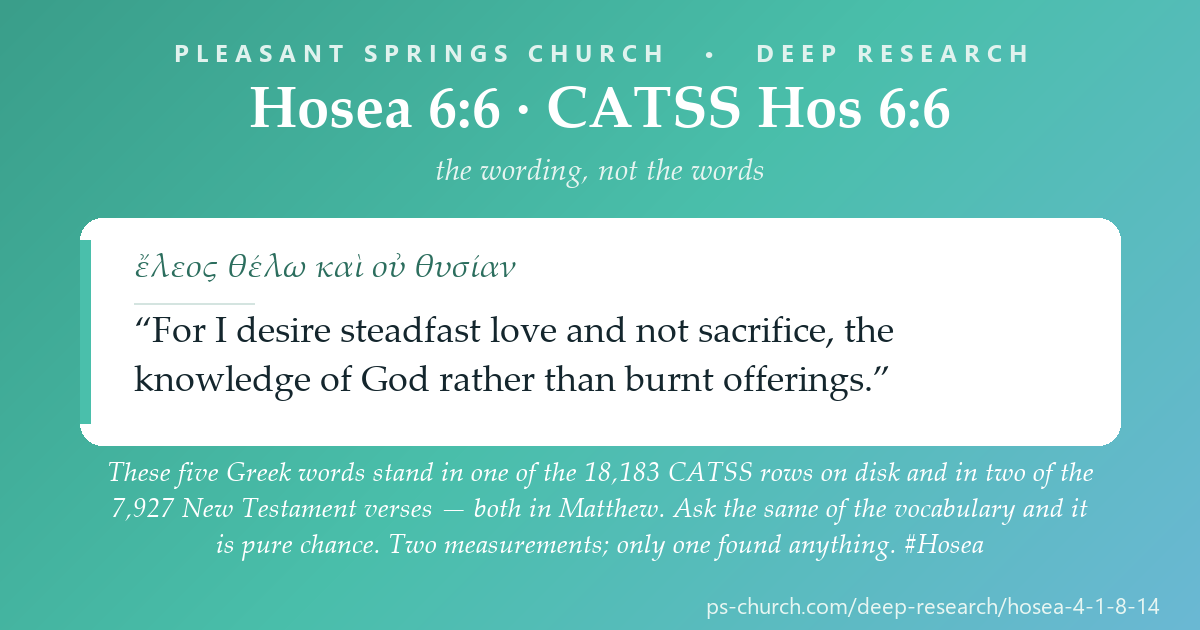
Five words. Reduce the CATSS Greek row at Hosea 6:6 and the Greek New Testament to the same plain alphabet and ἔλεος θέλω καὶ οὐ θυσίαν stands in exactly one of the 30,637 CATSS rows on this disk, and in exactly two of the 7,927 verses of the Greek New Testament — Matthew 9:13 and Matthew 12:7, and nowhere else in either corpus. Then comes the control, and it is the reason this page exists. Ask the same question of the vocabulary rather than the wording and the result evaporates: mercy and wanting are common words, chance predicts about one such row in the Greek Old Testament and delivers one, predicts two-thirds of a verse in the New Testament and delivers two. On vocabulary this is an unremarkable coincidence. What is not ordinary is that the five words stand in the same order, unbroken, on both sides. Those are two different measurements and only one of them found anything. See the method →
Hosea 4:1–8:14 (selections)
Hebrew · Greek (CATSS, Rahlfs’ Septuaginta) · ESV⚠️ And the row at 6:6 carries five words that stand in Matthew twice. ἔλεος θέλω καὶ οὐ θυσίαν — one row of 30,637 here, two verses of 7,927 there. What that does and does not establish is worked out in stage 2, including the control that deflates it.
The Shape of the Passage
Sequence — a lawsuit, a song, and an answerThese five chapters are almost entirely divine speech, and the one place the people get to talk is the passage everything else answers. 6:1–3 is a first-person-plural song — let us return, let us know — and 6:4 replies to it directly. Whether that song is repentance or something thinner is a question the page leaves where the text leaves it.
Author
The book stops telling Hosea’s story at the end of chapter 3 and does not go back to it. Chapters 1 and 3 are marriage and children; from 4:1 to the end of the book there is no wife, no child and no named price. The prophet is not a character in this study.
What replaces the story is a lawsuit. 4:1 opens with רִיב, rendered in the Greek row as κρίσις — a legal contention. The indictment form governs the next several chapters.
Audience
5:1 summons three groups by name. Priests, house of Israel, house of the king. The address narrows and widens repeatedly through these chapters, and the priesthood takes the sharpest of it — 4:6 removes a priest from office in the middle of a sentence about knowledge.
Judah keeps being pulled in. 4:15, 5:5, 5:10, 5:12, 5:13, 6:4, 6:11 — a northern book that will not let the south stand outside the charge. 4:15 says it plainly: though you play the whore, O Israel, let not Judah become guilty.
Orient on the lawsuit, the priesthood, and two words that carry the study.
Search by topic: Hosea, book of; rîb (covenant lawsuit); hesed; knowledge of God; priesthood, Israelite; Ephraim; Hosea 6:6 in Matthew.
Which articles are relevant?
- Anchor Bible Dictionary — “Hosea, Book of,” “Covenant Lawsuit,” “Ephraim,” “Priests and Levites.”
- Dictionary of the OT: Prophets (IVP) — “Hosea: Book of,” “Lawsuit,” “Knowledge of God,” “Sacrifice and Offerings.”
- NIDOTTE — חֶסֶד, דַּעַת, חָפֵץ, רִיב.
- TDNT / EDNT — ἔλεος, ἐπίγνωσις, θυσία.
The numbering, for once, is not a problem
Hosea is one of the seven Minor Prophets whose Hebrew and English verse numbers part company — but not here.
| chapter | Masoretic | CATSS | ESV |
|---|---|---|---|
| 4 | 19 | 19 | 19 |
| 5 | 15 | 15 | 15 |
| 6 | 11 | 11 | 11 |
| 7 | 16 | 16 | 16 |
| 8 | 14 | 14 | 14 |
| 4:1–8:14 | 75 | 75 | 75 |
All three agree through these chapters. The book’s three offsets sit at Hebrew 2:1–2 (covered in the previous study), 12:1 and 14:1 — the last two still ahead. The check is worth doing every time rather than assumed: chapter 4 in particular was fetched twice, because a first pass came back shifted from 4:11 and was caught by comparing the Hebrew and Greek at the seam.
Five words, two Matthews, and the control that deflates it.
The string, and its footprint in both corpora
Normalised to plain lowercase letters, the front of the CATSS row at Hosea 6:6 reads:
ἔλεος θέλω καὶ οὐ θυσίαν
| corpus | size | containing this string |
|---|---|---|
| CATSS Greek, all 64 files on this disk | 30,637 rows | 1 — Hosea 6:6 |
| Greek New Testament (SBL) | 7,927 verses | 2 — Matthew 9:13, Matthew 12:7 |
Both New Testament verses carry the string identically and both introduce it the same way — τί ἐστιν, what this means. 9:13 continues οὐ γὰρ ἦλθον καλέσαι δικαίους; 12:7 continues οὐκ ἂν κατεδικάσατε τοὺς ἀναιτίους. Same five words, different argument each time.
Is it just the function words? — the sub-string sweep
A five-word run that includes καὶ οὐ ought to be checked for whether the rarity is coming from the content words or from the joins. Every sub-string was counted separately.
| sub-string | CATSS rows (64 files, 30,637) | NT verses |
|---|---|---|
| ἔλεος θέλω | 1 | 2 |
| θέλω καὶ | 2 (was 1) | 2 |
| θέλω καὶ οὐ | 1 | 2 |
| καὶ οὐ θυσίαν | 1 | 2 |
| οὐ θυσίαν | 1 | 2 |
| καὶ οὐ — the control | 584 | 189 |
The two-word join on its own stands in 584 rows and 189 verses. Attach either content word to it and the count drops to one and two. So the rarity is in ἔλεος and θυσία sitting either side of it, not in the join.
⚠️ This table was re-run on 30 August 2026 and three of its figures changed. The corpus grew. When this page was first published the Greek Old Testament here was 35 CATSS files and 18,183 rows; Isaiah, Jeremiah, Lamentations, Ezekiel and both Daniels took it to 44 files and 23,061 on 19 August 2026; Exodus, Leviticus, Numbers, both Joshua recensions and the deuterocanon took it to 64 files and 30,637 on 30 August 2026. One count rose because of that: θέλω καὶ was 1 and is now 2 — the second is Greek Isaiah 56:4. And two published figures do not reproduce, so they are withdrawn rather than defended. This page printed 1,166 CATSS rows and 281 New Testament verses for the bare join, and 2 CATSS rows for οὐ θυσίαν. Re-run on the frozen normaliser the join returns 584 rows at 64 files (303 at the 35 files this page was built on) and 189 New Testament verses; and οὐ θυσίαν returns 1 at every corpus size — across all 30,637 rows the only negative standing in front of that noun anywhere is the one at Hosea 6:6. The earlier figures came from a pass whose counting rule this shelf can no longer reproduce. Nothing in the argument turns on them: the join is common on either count, and the content words are what make the string rare.
The control that deflates the finding, run against myself
Word forms in sequence are one measurement. Vocabulary is another, and on the second measurement there is nothing here at all.
| units with ἔλεος | with θέλω | chance predicts | observed | |
|---|---|---|---|---|
| CATSS, 30,637 rows (was 18,183) | 340 (was 225) | 147 (was 92) | 1.63 | 1 |
| NT, 7,927 verses | 26 | 199 | 0.65 | 2 |
Counted at the lemma level, so inflection and case are no barrier. In the Greek Old Testament the two lemmas meet in one row and chance predicts 1.63 — near enough. ⚠️ Those three numbers moved when the corpus grew and the result did not. At 18,183 rows the counts were 225 and 92 and chance predicted 1.14; at 30,637 they are 340 and 147 and chance predicts 1.63. The observed count is still 1. The control still deflates the finding, and it deflates it on a corpus two-thirds again as large. In the New Testament they meet in two verses where chance predicts 0.65, and under a Poisson model seeing two or more happens about 14% of the time. That is not a signal. Anyone reporting the vocabulary pairing as remarkable would be reporting noise.
Which is the whole point. The mercy-not-sacrifice idea is ordinary Greek and turns up where you would expect it to. The five words standing in that order, unbroken, in one row and two verses and nowhere else, is a different fact and the only one this page claims.
The screen was allowed to crown something else, and it did
Run the contiguous-run measurement over all 1,050 CATSS rows of the Twelve against all 1,068 verses of Matthew and Hosea 6:6 does not win.
| row and its best Matthew partner | longest shared run | tie band |
|---|---|---|
| Jonah 2:1 & Matthew 12:40 | 12 | alone |
| Zechariah 9:9 & Matthew 21:5 | 6 | with one other |
| Hosea 6:6 & Matthew 9:13 / 12:7 | 5 | ten-way tie |
Sweep of the whole screen: 93 rows reach a run of 4 or more, 12 reach 5, 2 reach 6, and 1 reaches 12. Hosea 6:6’s run of five is shared with nine other rows — Zephaniah 1:3, Micah 4:2, Jonah 1:9, Joel 4:16, Joel 3:3, Joel 1:2, Hosea 2:14, Haggai 2:6 and Haggai 2:21. Depth is not what distinguishes this row. What distinguishes it is the footprint of the string: unique in 30,637 rows, twice in 7,927 verses.
What the measurement is, and is not. It counts contiguous runs of normalised word forms, Greek against Greek, on the files held here. It says nothing about which text is prior, nothing about a citation formula, nothing about a Hebrew source, and nothing at the level of lemmas or synonyms. It also depends on verse division, which is a later editorial layer belonging to neither text.
A word that stands seven times in the whole Greek Old Testament held here.
όπίγνωσις — every occurrence on the disk
The Greek noun ἐπίγνωσις stands seven times across all 64 CATSS files — it was five across the 35 files held when this page was written, and both new occurrences landed in books this shelf reads as witnesses and never as Scripture. Three of the seven are still inside this study.
| row | form | context |
|---|---|---|
| Hosea 4:1 | ἐπίγνωσις | …nor knowledge of God on the land |
| Hosea 4:6 | ἐπίγνωσιν | because you rejected knowledge |
| Hosea 6:6 | ἐπίγνωσιν | …and knowledge of God rather than whole burnt offerings |
| Proverbs 2:5 | ἐπίγνωσιν | …and find the knowledge of God |
| 1/3 Kingdoms 7:2 | ἐπίγνωσιν | a building description |
| Judith 9:14 (a WITNESS, not Scripture) | ἐπίγνωσιν | …that your whole nation may know that you are God, the God of all power and might — added 30 Aug 2026 with the deuterocanon |
| 2 Maccabees 9:11 (a WITNESS, not Scripture) | ἐπίγνωσιν | Antiochus, broken, coming to a knowledge of God under the scourge — added 30 Aug 2026 with the deuterocanon |
The other eleven Minor Prophets have none. Neither does the Psalter, Job or Ecclesiastes — and the Pentateuch, all five books of which are now held here, has none either, which could not be said when this page was written because Exodus, Leviticus and Numbers were not on the disk. It is a seven-token word, and Hosea holds three of them within three chapters.
⚠️ What the corpus growth did to this count. This page published five occurrences across 35 files. Isaiah, Jeremiah, Lamentations, Ezekiel and both Daniels arrived on 19 August 2026 and added none — it was still five at 44 files. Exodus, Leviticus, Numbers, both Joshua recensions and the deuterocanon arrived on 30 August 2026 and added two, both of them in the deuterocanon: Judith 9:14 and 2 Maccabees 9:11. Those two books are read on this shelf as witnesses and are never levelled with Scripture, and they are counted here because the question is what Greek word usage a first-century reader could meet, not what belongs in a canon. Seven occurrences in 30,637 rows; three of the seven are in this study; the four outside it are one Proverb, one building description, and two Hellenistic-Jewish books.
Two rows in 30,637 carry both ἐλεος and όπίγνωσις, and this study has both
This is the structural result of the page, and it can be stated exactly.
| row | and the pair stands… |
|---|---|
| Hosea 4:1 | οὐκ ἔστιν ἀλήθεια οὐδὲ ἔλεος οὐδὲ ἐπίγνωσις θεοῦ — both denied |
| Hosea 6:6 | ἔλεος θέλω… καὶ ἐπίγνωσιν θεοῦ — both wanted |
Nowhere else in the 30,637 rows do the two lemmas share a row. The other five ἐπίγνωσις rows carry no ἔλεος; the other 338 ἔλεος rows carry no ἐπίγνωσις. The study opens on the row where the pair is absent and turns on the row where it is asked for.
Scope, and what re-running it proved. Counted on the CATSS lemma field across all 64 .mlxx files on this disk, 30,637 rows. When this page was written the corpus was 35 files and 18,183 rows and did not include Isaiah, Jeremiah, Ezekiel or Daniel; it now includes those and Exodus, Leviticus, Numbers, both Joshua recensions and the deuterocanon. The pair was re-run against every one of the 7,576 new rows and the answer did not move: Hosea 4:1 and Hosea 6:6 are still the only two rows in the Greek Old Testament held here where these two lemmas stand together. The count of ἔλεος rows rose from 225 to 340 and the count of ἐπίγνωσις rows from 5 to 7, and not one of the new rows carries both. This is still a statement about the files held here and not about the Greek Old Testament as a whole. Exhaustive within that scope; nothing sampled.
And at 4:6 the row uses two different nouns where the Hebrew repeats one
The Hebrew of 4:6 has הדעת twice — the same consonants both times, pointed differently. The Greek row has two different nouns.
| Hebrew | CATSS form | lemma field | |
|---|---|---|---|
| first | הַדָּעַת | γνῶσιν | γνῶσις |
| second | הַדַּעַת | ἐπίγνωσιν | ἐπίγνωσις |
Read off the columns, that is what is there. Why the row is built that way is not something these files can settle, and the page does not guess.
The claim everybody makes about this verse, and whether it holds.
“The only Old Testament verse Matthew quotes twice” — not established here
It is a commonplace that Hosea 6:6 is the only verse of the Old Testament Matthew uses twice. The screen run for this page cannot establish that, and saying so is more useful than repeating it.
Three reasons, all of them limits of the test rather than arguments against the claim:
(1) The corpus was only the Twelve — and on 30 August 2026 it stopped having to be. The screen behind this page ran 1,050 CATSS rows of the Twelve against Matthew. Isaiah, Jeremiah, Ezekiel, Daniel, the Psalter and most of the Pentateuch were not in it, and Matthew’s most frequent Old Testament partners are exactly the books that were left out. That sentence stood on this page as a limit. The limit is gone: all 64 CATSS files are now held, and the screen has been re-run whole — 30,637 Greek Old Testament rows against all 1,068 verses of Matthew. The result is printed below, and it does not favour this page.
| Greek Old Testament row | deepest Matthew partners | run | band |
|---|---|---|---|
| Isaiah 6:10 | Matthew 13:15 | 24 | 1 |
| Rahlfs 109:1 (English 110:1) | Matthew 22:44 | 14 | 1 |
| Isaiah 6:9 · Isaiah 40:3 | Matthew 13:14 · Matthew 3:3 | 13 | 1 |
| Jonah 2:1 | Matthew 12:40 | 12 | 1 |
| Rahlfs 117:26 (English 118:26) | Matthew 21:9 and Matthew 23:39 | 6 | 2 |
| Hosea 6:6 | Matthew 9:13 and Matthew 12:7 | 5 | 2 |
⚠️ And the commonplace fails on the enlarged screen. Twenty-two rows of the Greek Old Testament reach a run of five or more in two or more distinct verses of Matthew. Most are formulas — the furnace of Daniel 3 tying to Matthew 13:42 and 13:50, heaven and earth will pass away tying Matthew 5:18 to 24:35, the birds-of-the-air phrase tying Matthew 8:20 to 13:32. But one of the twenty-two is not a formula, and it goes deeper than Hosea 6:6: Rahlfs 117:26, blessed is he who comes in the name of the Lord, stands verbatim at six words in Matthew 21:9 and again in Matthew 23:39. So the sentence “Hosea 6:6 is the only Old Testament verse Matthew quotes twice” is now not merely unestablished on this shelf — it is measurably false, on the shelf’s own instrument, and this page prints that against itself.
(2) A run of five is a ten-way tie. Nine other rows of the Twelve reach the same depth against Matthew. Depth alone does not single this verse out.
(3) “Quotes” is not what was measured. Contiguous shared word forms is a mechanical proxy. A citation that changes one word registers as a break; an allusion registers as nothing. The test can confirm that a string is present in two verses. It cannot decide what counts as a quotation.
What survives is narrower and exactly measurable: this five-word string stands in one row of the 30,637 here and in two verses of the 7,927 there, and both of those verses are in the same New Testament book.
Matthew 9:13 and 12:7 put it to two different uses
Same five words, two settings.
9:13 follows the call of Matthew and a meal with tax collectors: πορευθέντες δὲ μάθετε τί ἐστιν — go and learn what this means — then the string, then I came not to call the righteous but sinners.
12:7 follows the disciples plucking grain on the Sabbath: εἰ δὲ ἐγνώκειτε τί ἐστιν — if you had known what this means — then the string, then you would not have condemned the guiltless.
Both frame it as something to be understood rather than merely cited. That is an observation about how the two verses are built, and the page stops there.
Two other verses of this study that get quoted a great deal
6:2 — on the third day he will raise us up. The New Testament nowhere cites this verse. Measured for shared wording against the Greek New Testament as held here, the run is short. The resemblance a reader feels at τῇ ἡμέρᾳ τῇ τρίτῃ is real as a resemblance; it is not a quotation this screen can find. And the two columns differ on the verb: the Hebrew has he will raise us, the Greek row we shall rise.
8:7 — they sow the wind and reap the whirlwind. An English proverb that the Greek row does not supply: no reaping verb stands in it, and the wind/whirlwind pair is not built the same way. Anyone tracing the proverb is tracing the Hebrew.
What the screens cannot see, and what was not reached.
Where this page is weakest
The corpus is 64 files, and it is still not the Greek Old Testament. It was 35 files when this page was written; Isaiah, Jeremiah, Lamentations, Ezekiel and both Daniels were added on 19 August 2026 and Exodus, Leviticus, Numbers, both Joshua recensions and the deuterocanon on 30 August 2026. Every count on this page has been re-run against the enlarged corpus, and where a number moved the old number is printed beside it rather than replaced. Even at 64 files this is Rahlfs as CATSS digitized him and not the whole Septuagint tradition, and it is not Second-Temple Greek in general — no Philo, no Josephus, no Greek Pseudepigrapha. Every “only” is scoped to what is on this disk, and that scope is stated at each claim rather than once at the bottom.
The vocabulary control was run and it came back negative, and that is published above rather than dropped. Had only the word-string screen been run, the lemma-level result would have looked like corroboration. It is not; it is chance. The two measurements disagree and the page reports both.
A run test is blind to the things a reader most wants to know. Whether Matthew is drawing on a Greek text resembling this one, on a Hebrew text, or on neither, is not decidable from word forms in sequence, and nothing here decides it.
What could not be checked at all
No Hebrew or Greek critical apparatus. No Qumran material — the Minor Prophets scroll from Nahal Hever bears directly on the Greek of these books and was not consulted. No Targum, Syriac, Vulgate, Aquila, Symmachus or Theodotion. No patristic citation evidence, which for a verse used twice in one Gospel is a real omission.
And nothing about the history behind the chapters. The Syro-Ephraimite war, the identity of the “great king” of 5:13, and the date of the calf of 8:5 are questions of history that a word count cannot touch.
Absent at 4:1, wanted at 6:6.
The study is shaped by two words
It opens with a list of what is missing from the land — no faithfulness, no mercy, no knowledge of God — and it turns, two chapters later, on a sentence asking for two of the three back.
In the Greek column those two rows are the only two in eighteen thousand where ἔλεος and ἐπίγνωσις stand together. Denied in one, desired in the other. Between them sit the priest who forgot, the people who sang about returning, and the love that burned off like morning cloud.
And five of the words in the second of those rows turn up, unaltered and in order, in two arguments Jesus makes in Matthew — once over a dinner table and once over a grainfield, both times as something to go and learn.
Second study on the Minor Prophets shelf. The verse-numbering table returns in the next Hosea study — chapters 12 and 14 both carry an offset.
Every Deep Research page traces its passage across the whole sweep — the Old Testament, the Second-Temple world between the testaments (historical witnesses, not Scripture), and the New Testament. Follow the thread:
Pleasant Springs Church — Deep Research
Research method after Michael S. Heiser’s Bible Research Method (examine dictionaries → ancient literature → important words → textual connections → academic publications → share), with the Pleasant Springs “Author & Audience” foundation. Scripture set in the Hebrew, the Greek editions named on each page and the ESV (Old Testament), and the Greek New Testament and the ESV (New Testament), per the practice of Pleasant Springs Church. Hosea research grounded in Andersen & Freedman (Hosea, Anchor), Macintosh (ICC), Stuart (WBC) and Dearman (NICOT). Text: Hebrew from the Masoretic text as printed in the editions consulted — Sefaria’s Miqra according to the Masorah; no critical apparatus was consulted for the Hebrew. Greek from Rahlfs’ Septuaginta as digitized by CATSS; Greek New Testament from the SBL edition. The standing caution for this shelf applies: these pages say “the CATSS Greek text reads…” and never call a Greek reading early or late. ✅ VERSE NUMBERING — checked, and clean for once. Masoretic, CATSS and ESV all run 19 / 15 / 11 / 16 / 14 across Hosea 4–8, seventy-five verses, so every reference on this page means the same thing in all three. Verified against content at each chapter seam, not assumed — a first fetch of chapter 4 came back shifted from verse 11 and was caught that way. Hosea’s three offsets sit at Hebrew 2:1–2, 12:1 and 14:1, all outside this study. ⚠️ The word-string measurement, in full. Greek against Greek. Both sides reduced to plain lowercase letters — accents and breathings dropped, final sigma folded, CATSS beta-code transliterated first and then filtered to Greek letters — and compared as whole word FORMS, never lemmas. Corpus: 30,637 CATSS rows across the 64 .mlxx files held here (18,183 rows across 35 files when this page was first published), and the 7,927 verses of the SBL Greek New Testament. Exhaustive and deterministic — nothing sampled, so no seed applies. ⚠️ The control was run and it came back negative, and it is published. At the lemma level ἔλεος stands in 340 of 30,637 CATSS rows and θέλω in 147, so chance predicts 1.63 rows carrying both and the text delivers 1 (225, 92 and 1.14 at 18,183 rows — the counts grew and the observed 1 did not). In the New Testament ἔλεος stands in 26 of 7,927 verses and θέλω in 199, so chance predicts 0.65 and the text delivers 2 — which a Poisson model returns about 14% of the time. The vocabulary pairing is not a finding and this page says so rather than letting it read as corroboration. ⚠️ The screen was allowed to crown something else, and did. Across all 1,050 CATSS rows of the Twelve against all 1,068 verses of Matthew, the deepest shared run is Jonah 2:1 against Matthew 12:40 at twelve words, then Zechariah 9:9 against Matthew 21:5 at six. Hosea 6:6’s run of five sits in a tie band of ten, all of them named in stage 2. Sweep: 93 rows reach 4, 12 reach 5, 2 reach 6, 1 reaches 12. ⚠️ A well-known claim is reported as unestablished. “The only Old Testament verse Matthew quotes twice” does not follow from anything measured here: the screen covers only the Twelve, a run of five is a ten-way tie, and contiguous word forms are not a definition of quotation. ⚠️ Direction of influence is never asserted. Nothing here says which text is prior, that anyone quoted, adapted, followed or altered anything, or why any reading stands as it does. Typology is handled per the house position: what the text says, what the New Testament itself draws, and what we see from this side of the cross — with the seeing left to the reader.
Scripture quotations marked ESV are from the ESV® Bible (The Holy Bible, English Standard Version®), © 2001 by Crossway, a publishing ministry of Good News Publishers. ESV Text Edition: 2016. Used by permission. All rights reserved. The ESV text may not be quoted in any publication made available to the public by a Creative Commons license, and the ESV may not be translated in whole or in part into any other language. www.esv.org
|
Did this study bless you today? 💚 Give to Support PS Church100% of gifts go to the General Fund — thank you. |