Depth and rarity are two different measurements, and in these six chapters they crown two different verses. Screen all 83 CATSS rows of Hosea 9:1–14:10 against all 7,927 verses of the Greek New Testament and the longest run of matching word forms is five, reached by one row — Hosea 12:6 — in a three-way tie the screen cannot separate, and those five forms stand in thirteen of the 30,348 CATSS verse units screened here. One word shorter sits something else entirely: Hosea 10:8 against Luke 23:30, a run of four that is the deepest match Hosea 10:8 has in all 7,927 New Testament verses and the deepest Luke 23:30 has in all 30,348 CATSS verse units — unique in both directions, with nothing else reaching even three from either side. The deeper run is the commoner phrase. A screen that reports only its maximum would have printed the wrong verse. See the method →
Hosea 9:1–14:10 (selections, Hebrew numbering)
Hebrew · Greek (CATSS, Rahlfs’ Septuaginta) · ESV⚠️ And two different verses win two different measurements. The longest run in the section is five words, at 12:6. The run that is unique in both corpora is four words, at 10:8. Stage 2 has both screens.
The Shape of the Passage
Sequence — the harvest fails, the child is loved, the book turnsChapter 11 changes the metaphor and everything follows from it. For ten chapters Israel is a wife. At 11:1 Israel becomes a child — taught to walk, lifted to the cheek, led with cords of kindness. The relationship described is the same one; the picture is not.
Author
Chapter 12 is the one place Hosea argues from the patriarchs. Jacob in the womb, Jacob at Peniel, Jacob serving for a wife. The book that has spent eleven chapters on contemporary politics turns, once, to Genesis.
And it ends by addressing the reader directly. 14:10 — whoever is wise, let him understand these things — is a wisdom formula rather than a prophetic one, and it speaks past Israel to whoever is holding the scroll.
Audience
Assyria and Egypt are named throughout as the two places to run. 9:3, 9:6, 11:5, 11:11, 12:2 — the same pair, over and over. The audience is a small kingdom deciding which empire to trust.
Five New Testament passages are examined on this page against rows from these chapters. Matthew 2:15, Luke 23:30, 1 Corinthians 15:55, Hebrews 13:15 and Revelation 6:16. What this page measures is how much wording each shares with its Hosea row — not what any writer intended by it.
Orient on Jacob, Admah and Zeboiim, and two verse seams.
Search by topic: Hosea, book of; Jacob traditions in the prophets; Admah and Zeboiim; Ephraim; Sheol; chapter and verse divisions, history of.
Which articles are relevant?
- Anchor Bible Dictionary — “Hosea, Book of,” “Jacob,” “Admah,” “Sheol,” “Ephraim.”
- Dictionary of the OT: Prophets (IVP) — “Hosea: Book of,” “Israelite History,” “Death and the Afterlife.”
- Dictionary of NT Use of the OT (Beale & Carson) — on Matthew 2:15, Luke 23:30, 1 Corinthians 15:55, Hebrews 13:15, Revelation 6:16.
- NIDOTTE — שְׁאוֹל, שׁוּב, חֶסֶד, פַּר.
Settle the numbering before anything else — there are two seams here
The previous Hosea study had no offset at all and the one before it turned on one. This study has two.
| Hebrew & CATSS | ESV | opening words |
|---|---|---|
| 11:11 | 11:11 | they shall come trembling like birds… |
| 12:1 | 11:12 | Ephraim has surrounded me with lies… |
| 12:2 | 12:1 | Ephraim feeds on the wind… |
| 13:15 | 13:15 | though he may flourish among his brothers… |
| 14:1 | 13:16 | Samaria shall bear her guilt… |
| 14:2 | 14:1 | Return, O Israel, to the Lord your God… |
Chapter counts — Masoretic and CATSS: 17 / 15 / 11 / 15 / 15 / 10. ESV: 17 / 15 / 12 / 14 / 16 / 9. Eighty-three verses either way, and the Hebrew book has a 14:10 where the English book stops at 14:9. Established from content at each seam rather than assumed: Hebrew 12:1 and English 11:12 both begin Ephraim has surrounded me with lies; Hebrew 14:1 and English 13:16 both begin Samaria shall bear her guilt.
Hosea carries three offsets in all. The first, at Hebrew 2:1, was the subject of the first study on this book; these are the other two. Seven of the twelve Minor Prophets carry an offset of this kind.
Two screens, and they do not crown the same verse.
The screen, and where its maximum falls
All 83 CATSS rows of this study against all 7,927 verses of the Greek New Testament.
| longest run reached | how many of the 83 rows |
|---|---|
| 2 or more | 83 — all of them |
| 3 or more | 48 |
| 4 or more | 10 |
| 5 | 1 |
| 6 or more | 0 |
Every row reaches two, so the two-band carries no information at all; only the upper bands separate anything. The single row reaching five is Hosea 12:6, and on the New Testament side it is a three-way tie the screen does not separate — Revelation 4:8, 19:6 and 21:22 each carry the identical five forms, which the CATSS row reads as κύριος ὁ θεὸς ὁ παντοκράτωρ.
⚠️ That five is a maximum within this section, and the boundary is doing work. Run the identical screen over all 197 rows of Hosea and it reaches 17, at Hosea 2:1 against Romans 9:26 — the subject of the first study on this book. Five is the ceiling for chapters 9–14, not for Hosea.
How common are the five words, and how common are four?
A run’s depth and a run’s rarity are not the same thing, and here they come apart cleanly.
| the shared forms | run | CATSS verse units carrying them | NT verses carrying them |
|---|---|---|---|
| κύριος ὁ θεὸς ὁ παντοκράτωρ (Hos 12:6) | 5 | 13 of 30,348 | 3 |
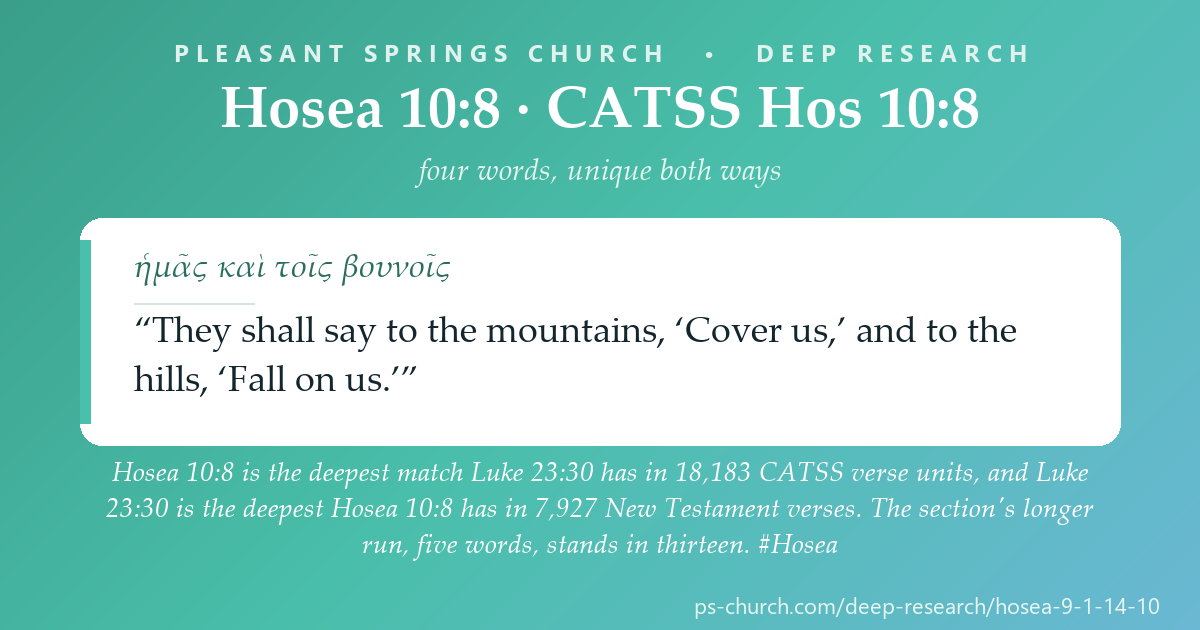
| ἡμᾶς καὶ τοῖς βουνοῖς (Hos 10:8) | 4 | 1 of 30,348 | 1 |
| ἔλεος θέλω καὶ οὐ θυσίαν (Hos 6:6, previous study) | 5 | 1 of 30,348 | 2 |
⚠️ The denominator in that column moved on 30 August 2026 and the numerators did not. All three phrase counts were re-run with the Odes withdrawn from this shelf’s screening corpus, and no canticle carries any of the three: thirteen, one and one, exactly as before. What changed is what the screen is allowed to look at: the 64 files HOLD 30,637 verse units and the screen now SEES 30,348. The 289 units of the Odes stay on the disk. Stage 4 says why they come out.
The thirteen CATSS units carrying the five forms of 12:6 are Hosea 12:6 itself, ten verses of Amos (3:13, 4:13, 5:8, 5:14, 5:15, 5:16, 5:27, 9:5, 9:6, 9:15), Nahum 3:5 and Zechariah 10:3. The section’s deepest run is built from words that recur across the Twelve. Reporting the maximum alone would have made it the headline.
The run of four that is unique in both directions
Hosea 10:8 against Luke 23:30 is the only pair in this study that wins its screen from both ends.
| screened | distribution of longest runs | the maximum |
|---|---|---|
| Hosea 10:8 against all 7,927 NT verses | 4 → 1 · 3 → 0 · 2 → 162 | Luke 23:30, alone |
| Luke 23:30 against all 30,348 CATSS verse units | 4 → 1 · 3 → 23 · 2 → 492 | Hosea 10:8, alone |
From the Hosea side nothing else in the New Testament reaches even three — the distribution drops straight from one verse at four to 162 at two. From the Luke side, twenty-three CATSS units reach three and exactly one reaches four. Each is the other’s single deepest partner across both corpora.
⚠️ This screen has now been re-run twice, against two corpus expansions, and the finding has survived both. The shelf has gone 35 files → 44 → 64, and 18,183 verse units → 23,061 → 30,637. On 19 August 2026 Isaiah, Jeremiah, Lamentations, Ezekiel and both Greek Daniels arrived; on 30 August 2026 Exodus, Leviticus, Numbers, Joshua (A and B) and the whole deuterocanon — Judith, Tobit, Wisdom, Baruch, the Epistle of Jeremiah, 2–4 Maccabees, Susanna, Bel, Odes and the Psalms of Solomon — arrived with them. The finding held both times: Hosea 10:8 is still the only verse unit in the whole of it that reaches four against Luke 23:30. What moved, both times, is the shoulder of the distribution.
⚠️ And then it was re-run a third time, on the same day, because one of the twenty new files should never have been in the screen — and this time a published figure moved. The Odes are the liturgical canticles appended to the Greek Psalter. Two of them are New Testament text — Ode 9 is Luke 1, the Magnificat and the Benedictus, and Ode 13 is Luke 2, the Nunc Dimittis — and ten more are second copies of passages the corpus already holds (Ode 1 = Exodus 15, 2 = Deuteronomy 32, 3 = 1 Samuel 2, 4 = Habakkuk 3, 5 = Isaiah 26, 6 = Jonah 2, 7 and 8 = Daniel Th 3, 10 = Isaiah 5, 11 = Isaiah 38). The files stay on the disk and come out of the screen: 30,637 held, 30,348 screened.
This page is a clean demonstration of the second reason, and it is worth reading slowly. The Luke 23:30 two-band fell from 495 to 492, and the three rows that left are Odes 2:41, Odes 2:43 and Odes 7:33 — which are Deuteronomy 32:41, Deuteronomy 32:43 and Daniel (Th) 3:33, all three of which were already in the band under their own shelfmarks. The screen was counting three verses twice. Not a wrong reading; a doubled one. The 495 printed here until 30 August 2026 was inflated by exactly that much, and the honest figure is 492. Nothing else on this page moved: the four-band is still Hosea 10:8 alone, the three-band is still twenty-three and still carries the same members, and the three phrase counts are still thirteen, one and one.
The first reason did not bite here, but the reader should know the instrument can do it. Screened with the canticles in, Ode 9:48 matches Luke 1:48 at eighteen consecutive words — deeper than anything on this page by a factor of four, and it is Luke measured against Luke under a Greek Old Testament shelfmark. A page reporting that as a Gospel’s deepest Old Testament contact would be measuring its own text. It was caught by asking which file each new hit came out of, not by any number looking wrong. A run of eighteen looks like a discovery until you open the file.
The three-band ran 13 → 19 → 23. The 2026-08-19 additions were Ezekiel 6:3, 36:4 and 36:6, Daniel (OG) 9:12, and Daniel (Th) 9:12 and 9:13. The four added on 2026-08-30 are 2 Maccabees 8:18, Baruch 2:1, Psalms of Solomon 8:27 and Tobit 11:14 (S recension) — every one of them a witness, not Scripture, and not one of them in the books of Moses that arrived the same day. The two-band ran 266 → 347 → 495 → 492 — the last step is the Odes coming back out, and it is the only figure on this page that the withdrawal moved. Every figure in the table above is measured over the screened 30,348, not the held 30,637.
What the measurement is, and is not. It counts contiguous runs of normalised word forms, Greek against Greek, on the files held here — 30,637 CATSS verse units across 64 files, of which 30,348 are screened (the 289 units of the Odes are held and not screened), and 7,927 verses of the SBL Greek New Testament. It says nothing about which text is prior, nothing about citation, and nothing at the level of lemmas or synonyms. Isaiah, Jeremiah, Lamentations, Ezekiel and both Greek Daniels joined the shelf on 19 August 2026 and every Greek-side count on this page has been re-run across them; what the shelf holds is 39 of the Septuagint’s books, not all of them, so no count on this page is a statement about the Greek Old Testament as a whole.
Which column was read, and whether it mattered.
The control: the Greek New Testament files carry two word columns
These files give both a surface form and the edition’s own normalised form, and the difference between them is enormous before this screen touches it.
| verses where the two columns differ | |
|---|---|
| as the columns sit on disk | 7,878 of 7,927 — 99.4% |
| after this screen’s fold (accents, breathings, case, final sigma) | 2,021 of 7,927 — 25.5% |
Nearly all of the raw difference is accentuation, which the screen removes anyway. What survives the fold is 2,547 word rows in 124 shapes — led by οὐκ/οὐ at 825, then a class of restored elisions (ἀλλ’/ἀλλά 213, δι’/διά 149, ἐπ’/ἐπί 143), with ἐξ/ἐκ at 234.
So the whole screen was run twice, once on each column
On the axis this page reports — how deep each of the 83 Hosea rows gets — nothing moves.
The same 48 rows reach three, the same 10 reach four, the same single row reaches five, and Hosea 12:6’s three-way New Testament tie is the same three verses on either column.
Counted any other way, it does move, and the page says so rather than claiming a stability it did not measure. Of 478,516 row-verse pairs, 5,292 carry a different run on the two columns — 2,091 deeper on the surface column, 3,201 deeper on the normalised one. Fourteen of those movers touch a run of three. Counted by New Testament verse, 357 verses reach three on the surface column against 348 on the normalised one.
One figure printed on this page is among the movers. Hosea 11:1 against Matthew 2:15 is 2 on the surface column and 1 on the normalised one, because the CATSS row reads ἐξ and the normalised column reads ἐκ. It is neither the only mover nor the largest: Hosea 11:3 against Matthew 24:39 and against Luke 2:43 each fall from three to one, and Hosea 11:7 against Revelation 22:18 rises from two to three. This page reports the surface column throughout, which is the column that answers the question being asked — what word forms stand in the text.
Scope, twice: this is measured on the 64 CATSS files and the 27 Greek New Testament files held here and on those only, comparing two columns of the same edition’s own rows. The normalised column is that edition’s editorial normalisation. Nothing here is a statement about what any writer wrote, or about which reading is earlier.
Five passages, laid against their rows.
Hosea 10:8 and Luke 23:30 — the same two commands, attached the other way round
The whole sentence stands on both sides, and the run still stops at four. The columns show why.
| to the mountains… | to the hills… | |
|---|---|---|
| Hebrew | כַּסּוּנוּ — cover us | נִפְלוּ עָלֵינוּ — fall on us |
| CATSS row | καλύψατε ἡμᾶς | πέσατε ἐφ' ἡμᾶς |
| Luke 23:30 | πέσετε ἐφ' ἡμᾶς | καλύψατε ἡμᾶς |
Both address mountains first and hills second. The two imperative clauses stand in opposite orders to each other. And only one of the two imperatives is the same word form on both sides: καλύψατε is identical, while the other reads πέσατε in the CATSS form column and πέσετε in the New Testament surface column — same lemma πίπτω, same parse, different form. So the second clause could not have joined a run in any case.
The run of four, ἡμᾶς καὶ τοῖς βουνοῖς, straddles the join: the last word of one clause, the connective, and the two words opening the next. Four words, and no pair in either corpus does better from either side.
Revelation 6:16 carries the sentence too, and shares two. Three different runs tie for it — τοῖς ὄρεσιν, ἐφ' ἡμᾶς and ἡμᾶς καί — and it adds καὶ ταῖς πέτραις, and to the rocks, which stands in neither Hosea column.
Hosea 11:1 — three columns, and the closing words differ
This is the most-discussed verse in the study, and the three readings can simply be laid side by side.
| the closing words | number | person | |
|---|---|---|---|
| Hebrew 11:1 | קָרָאתִי לִבְנִי — I called to my son | singular | first |
| CATSS row | μετεκάλεσα τὰ τέκνα αὐτοῦ | plural | third |
| Matthew 2:15 | ἐκάλεσα τὸν υἱόν μου | singular | first |
The Matthew ending matches the Hebrew in number and person, and differs from the CATSS row in both. The nouns differ lexically and in gender as well — בֵּן, neuter τέκνον, masculine υἱός — while the case is accusative in both Greek rows. The contrast in person sits on the possessive alone: both Greek finite verbs are first-person singular.
How each column was read. The two Greek statements rest on the files’ own tagged parse and lemma columns — the CATSS object is tagged accusative plural, the Matthew object accusative singular. The Hebrew number and person are read off Masoretic pointing, because no tagged Hebrew morphology corpus is held here. And what follows from the three readings — which text anyone was working from, and why the row stands as it does — is not something these files can settle. The page reports the columns and stops.
1 Corinthians 15:55 and Hebrews 13:15, measured
Hosea 13:14 and 1 Corinthians 15:55 — longest run two, and two runs tie for it. Both ask ποῦ twice; both name θάνατε; both carry κέντρον. Three things break the runs: the possessive stands before the noun in one and after it in the other; the second address is ᾅδη in the row and θάνατε again in Paul; and where the row has δίκη, Paul has νῖκος. σου θάνατε and τὸ κέντρον both reach two, and the page names both rather than picking one.
Hosea 14:3 and Hebrews 13:15 — longest run two, and it runs the other way. The Hebrew ends וּנְשַׁלְּמָה פָרִים שְׂפָתֵינוּ, which the ESV renders we will pay with bulls the vows of our lips. The CATSS row ends ἀνταποδώσομεν καρπὸν χειλέων ἡμῶν. Hebrews 13:15 has καρπὸν χειλέων. At 11:1 the New Testament wording sat with the Hebrew; here it sits with the Greek row. Across the five passages examined the pattern does not run one way, and the page does not tidy that into a trend.
Where this page is weakest, and what was not reached.
What a contiguous-run test cannot see
It finds runs of identical word forms and nothing else. A passage that inflects a word differently, reorders a phrase, substitutes a synonym, or works from a Hebrew text registers as a break or as nothing. All four of those happen in the five passages examined above, which is why the numbers are small — and small numbers here are a fact about the test, not a verdict on the passages.
The maxima on this page are local, and both boundaries are load-bearing. Five is the ceiling for these 83 rows; the same screen over all 197 rows of Hosea reaches 17. And the “unique in both directions” result for Hosea 10:8 and Luke 23:30 is scoped to the 30,348 CATSS verse units screened here and the 7,927 New Testament verses. That scope was widened on 19 August 2026 and the result was re-run against the wider one. When this page was first published the Greek Old Testament here did not include Isaiah, Jeremiah, Ezekiel or Daniel, and the page said so. All of them are on the shelf now, with Lamentations and a second Greek Daniel besides, and Hosea 10:8 is still the only one of 30,348 screened verse units reaching four against Luke 23:30 — though twenty-three now reach three where nineteen did after the first expansion and thirteen before it.
⚠️ That scope narrowed again on 30 August 2026, by 289 units, and one number on this page moved with it. The Odes — the canticles appended to the Greek Psalter — were withdrawn from the screening corpus the day after they arrived on it. Two of them are New Testament text and ten are second copies of passages already held. Luke 23:30’s two-band fell from 495 to 492 because Odes 2:41, 2:43 and 7:33 are Deuteronomy 32:41, Deuteronomy 32:43 and Daniel (Th) 3:33, and were being counted twice. The four-band, the three-band and all three phrase counts are unchanged. 30,637 held, 30,348 screened, and this page now says which it means.
And a hand-picked pair can only ever return one number. Four of the five passages here were chosen because they are discussed, not because a screen surfaced them. That is why each is reported against its whole distribution — Matthew 2:15 is one of 145 New Testament verses tied at two against Hosea 11:1, and 1 Corinthians 15:55 one of 71 tied at two against Hosea 13:14. Only Luke 23:30 stands alone at its depth.
What could not be checked at all
No Hebrew or Greek critical apparatus. No Qumran material — the Minor Prophets scroll from Nahal Hever bears directly on the Greek of these books and was not consulted. No Targum, Syriac, Vulgate, Aquila, Symmachus or Theodotion. For Hosea 11:1 in particular the scholarly literature is very large and none of it was consulted; this page reports three columns and stops.
And nothing about the history. The fall of Samaria in 722, the identity of Admah and Zeboiim, and the date of chapter 14 are questions a word count cannot touch.
The deeper match was the commoner phrase.
Two verses, two measurements
One row in these six chapters reaches a run of five against the Greek New Testament. Its five words are κύριος ὁ θεὸς ὁ παντοκράτωρ — and the same five stand in ten verses of Amos, in Nahum, in Zechariah, and in three places in Revelation. Thirteen CATSS verse units carry them.
One word shorter, Hosea 10:8 and Luke 23:30 share four: ἡμᾶς καὶ τοῖς βουνοῖς — us, and to the hills. Screened from the Hosea side, no other New Testament verse reaches even three. Screened from the Luke side, no other CATSS verse unit reaches four. Each is the other’s single deepest partner in twenty-three thousand rows and eight thousand verses.
Had this page reported its maximum and stopped, it would have printed the wrong verse — and a phrase carried across half the Twelve would have been the headline instead of four words about mountains and hills.
Third study on the Minor Prophets shelf, and the last on Hosea — fourteen chapters, 197 verses, three verse offsets, and two studies whose results point in opposite directions.
Every Deep Research page traces its passage across the whole sweep — the Old Testament, the Second-Temple world between the testaments (historical witnesses, not Scripture), and the New Testament. Follow the thread:
Pleasant Springs Church — Deep Research
Research method after Michael S. Heiser’s Bible Research Method (examine dictionaries → ancient literature → important words → textual connections → academic publications → share), with the Pleasant Springs “Author & Audience” foundation. Scripture set in the Hebrew, the Greek editions named on each page and the ESV (Old Testament), and the Greek New Testament and the ESV (New Testament), per the practice of Pleasant Springs Church. Hosea research grounded in Andersen & Freedman (Hosea, Anchor), Macintosh (ICC), Stuart (WBC) and Dearman (NICOT). Text: Hebrew from the Masoretic text as printed in the editions consulted — Sefaria’s Miqra according to the Masorah; no critical apparatus was consulted for the Hebrew. Greek from Rahlfs’ Septuaginta as digitized by CATSS; Greek New Testament from the SBL edition. The standing caution for this shelf applies: these pages say “the CATSS Greek row reads…” and never call a Greek reading early or late. ⚠️ VERSE NUMBERING — two seams in this study, of the book’s three. Masoretic and CATSS Hosea 9–14 are 17 / 15 / 11 / 15 / 15 / 10 verses; the ESV is 17 / 15 / 12 / 14 / 16 / 9. Hebrew 12:1 = ESV 11:12 and Hebrew 14:1 = ESV 13:16, each shifting everything after it by one, and the Hebrew book carries a 14:10 the English does not. The Hebrew and the Greek agree exactly; only the English differs. Established from content at both seams, not assumed. Hosea’s third offset, at Hebrew 2:1, belongs to the first study on this book. ⚠️ The run measurement, in full. Greek against Greek. Both sides reduced to plain lowercase letters — accents and breathings dropped, final sigma folded, CATSS beta-code transliterated first and then filtered to Greek letters — and compared as contiguous runs of whole word FORMS, never lemmas. Corpus: 30,348 CATSS verse units screened out of the 30,637 held across the 64 .mlxx files here — the 289 units of the Odes are held and not screened — and the 7,927 verses of the SBL Greek New Testament across 27 files. Exhaustive and deterministic — nothing sampled, so no seed applies. ⚠️ Every maximum on this page is printed with its tie band and its scope. The section maximum of 5 is reached by one of the 83 rows (Hosea 12:6) and ties three ways on the New Testament side — Revelation 4:8, 19:6 and 21:22 — which the screen does not separate. It is a maximum for this section only: the identical screen over all 197 rows of Hosea reaches 17, at Hosea 2:1 against Romans 9:26. The run of 4 at Hosea 10:8 against Luke 23:30 is the sole maximum from both sides, checked in both directions across all 30,348 screened verse units and all 7,927 New Testament verses. ⚠️ Depth is reported beside rarity, because they disagree here. The five forms behind the section maximum stand in 13 of the 30,348 CATSS verse units; the four forms behind the mutual maximum stand in 1. Reporting the deepest run alone would have made the commoner phrase the headline, and this page says so in stage 2 rather than letting the maximum pass unremarked. ⚠️ The Greek Old Testament corpus grew after this page was first published, and every Greek-side figure on it was re-run. On 19 August 2026 Isaiah, Jeremiah, Lamentations, Ezekiel and both Greek Daniels were added, taking the shelf from 35 files and 18,183 verse units to 44 files and 23,061, and again on 2026-08-30 to 64 files and 30,637. Three findings held unchanged: κύριος ὁ θεὸς ὁ παντοκράτωρ still stands in exactly 13 verse units, ἡμᾶς καὶ τοῖς βουνοῖς in exactly 1, and Hosea 10:8 is still the sole verse unit reaching four against Luke 23:30. One figure moved: the three-band of the Luke 23:30 distribution rose from 13 to 19 and then 23, and the two-band from the 266 printed here to 347 and then 495. Then the Odes were withdrawn from the screening corpus on 30 August 2026 — two of the canticles are New Testament text and ten are second copies of passages already held — and the two-band came back down to 492, because Odes 2:41, 2:43 and 7:33 are Deuteronomy 32:41, 32:43 and Daniel (Th) 3:33 counted a second time. 30,637 held, 30,348 screened; every figure on this page is now the screened one. Nothing measured against the Greek New Testament changed, because that corpus did not. ⚠️ The column control, published because it partly failed. The Greek New Testament files carry a surface word column and the edition’s own normalised column; they differ in 7,878 of 7,927 verses (99.4%) as they sit on disk, and in 2,021 (25.5%) after this screen’s fold — 2,547 word rows in 124 shapes, led by οὐκ/οὐ at 825, with ἐξ/ἐκ at 234. The whole screen was run on both. On the Hosea-row axis nothing moves — same 48 at three, same 10 at four, same single row at five, same three-way tie. On other axes it does: of 478,516 pairs, 5,292 carry a different run (2,091 deeper on the surface column, 3,201 on the normalised one), and by New Testament verse 357 reach three against 348. Hosea 11:1 against Matthew 2:15 is one of the movers, 2 on the surface column and 1 on the normalised one. The page reports the surface column throughout and says which figures move. ⚠️ Hand-picked pairs are reported against their distributions. Four of the five New Testament passages here were chosen because they are discussed, not because a screen surfaced them; a chosen pair can only return one number. Matthew 2:15 is one of 145 verses tied at 2 against Hosea 11:1, and 1 Corinthians 15:55 one of 71 tied at 2 against Hosea 13:14. ⚠️ Direction of influence is never asserted. Nothing here says which text is prior, that anyone quoted, adapted, followed or altered anything, or why any reading stands as it does — including at Hosea 11:1, where the page reports that the Matthew ending matches the Hebrew in number and person and stops there, and notes that the Hebrew reading rests on Masoretic pointing while both Greek readings rest on tagged parse columns. Typology is handled per the house position: what the text says, what the New Testament itself draws, and what we see from this side of the cross — with the seeing left to the reader.
Scripture quotations marked ESV are from the ESV® Bible (The Holy Bible, English Standard Version®), © 2001 by Crossway, a publishing ministry of Good News Publishers. ESV Text Edition: 2016. Used by permission. All rights reserved. The ESV text may not be quoted in any publication made available to the public by a Creative Commons license, and the ESV may not be translated in whole or in part into any other language. www.esv.org
|
Did this study bless you today? 💚 Give to Support PS Church100% of gifts go to the General Fund — thank you. |