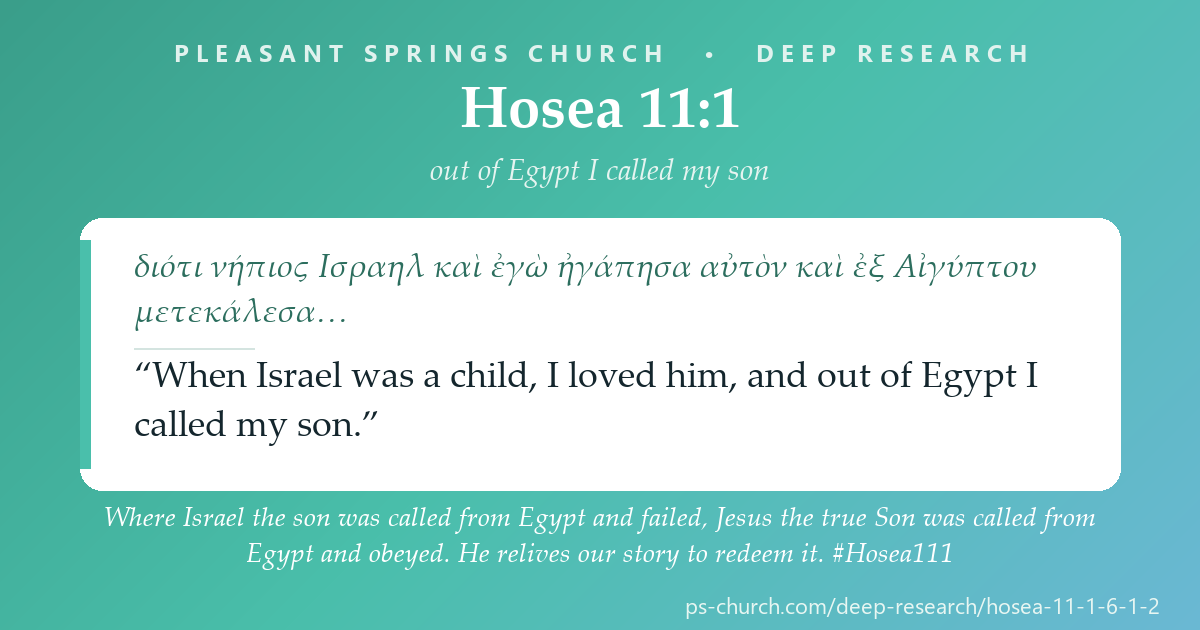
When Israel was a child, I loved him, and out of Egypt I called my son.” Hosea remembers Israel’s infancy with a father’s tenderness — and Matthew hears in that backward-looking line the story of Jesus, the true Son called out of Egypt to relive and redeem his people’s path. (Matthew even quotes the Hebrew “my son” over the Greek “his children.”) Alongside it, Hosea’s call to return promises, “on the third day he will raise us up.” This study works Hosea 11:1 and 6:1–2 from the exodus to the empty tomb. See the method →
Hosea 11:1; 6:1–2 (same numbering in MT, LXX & English)
Hebrew · LXX · ESVThe Shape of the Passage
ParallelismHosea prophesied to the northern kingdom in its last decades before Assyria (8th c. BC), dramatizing God’s covenant love through his own marriage to an unfaithful wife. Chapter 11 pictures God as a father grieving over a wayward son; chapter 6 is a call to return.
Author
Hosea son of Beeri prophesies to Israel (Ephraim) as the northern kingdom rushes toward exile. His own marriage to unfaithful Gomer becomes a living parable of the Lord’s love for a faithless people. In chapter 11 the imagery turns from husband to father: “When Israel was a child, I loved him, and out of Egypt I called my son” — God remembering the exodus as a father remembers teaching a toddler to walk (11:3), wounded by the child’s turning away, yet unable to give him up (11:8).
Looking back, not merely forward. Hosea 11:1 is a historical statement: it recalls the exodus, when God called his “son” Israel out of Egypt (Exod 4:22, “Israel is my firstborn son”). It is not, in Hosea, a bare prediction of a coming individual. That is important for reading Matthew rightly — who sees in this backward-looking line a pattern that Jesus completes.
Audience
A people who had “played the whore” against their God and stood under judgment — yet were loved with a love that would not let them go. Chapter 6 puts a penitent’s song in their mouths: “Come, let us return to the Lord… on the third day he will raise us up” — the hope that after the tearing comes healing, after death, revival.
How the New Testament heard it. Matthew, telling of the holy family’s flight to Egypt and return, writes: “This was to fulfill what the Lord had spoken by the prophet, ‘Out of Egypt I called my son’” (2:15) — reading Jesus as the true Israel, the true Son, who relives and redeems his people’s story. And the “third day” of Hosea 6:2 became one of the scriptural streams behind the apostolic creed, “raised on the third day.”
Orient on sonship, the exodus, typology, and the third day.
Search by topic: Hosea, son of God (Israel), exodus, typology, fulfillment, third day.
Which articles are relevant?
- Anchor Bible Dictionary — “Hosea,” “Son of God,” “Exodus,” “Typology.”
- Dictionary of the OT: Prophets — “Hosea, Book of,” “Israel,” “Repentance,” “Resurrection.”
- NIDOTTE / TDOT — בֵּן (bēn, son), נַעַר (naʿar, child), שׁוּב (šûḇ, return), קוּם (qûm, raise up).
Bibliography surfaced:
- Francis I. Andersen & David Noel Freedman (Anchor Yale), Douglas Stuart (WBC, Hosea–Jonah), J. Andrew Dearman (NICOT), Hans Walter Wolff (Hermeneia) on Hosea.
- R. T. France (NICNT) on Matthew’s fulfillment quotations; studies of Hosea 11:1 in Matthew 2:15.
- Gordon D. Fee (NICNT) on 1 Corinthians 15:4; Beale & Carson, NT Use of the OT.
Israel God’s son, the Hebrew behind Matthew, and the third-day idiom.
Read Hosea’s backward look, weigh the Hebrew/Greek difference, then follow the son to Christ.
Which parallels shed light on religion and worldview?
Israel, God’s son. Long before Hosea, God had called Israel his son: “Israel is my firstborn son… let my son go” (Exod 4:22–23). Hosea 11 draws on that: the exodus was the calling of a beloved child out of slavery. This is corporate sonship — the nation as God’s son — and it is the seedbed for the New Testament’s confession of Jesus as the true Son who embodies faithful Israel.
The Hebrew behind Matthew. Here the traditions differ, and Matthew’s choice is telling. The Masoretic Hebrew reads “out of Egypt I called my son” (singular). The standard Septuagint reads “out of Egypt I called his children” (τὰ τέκνα αὐτοῦ, plural) — a collective rendering. When Matthew quotes the verse of Jesus (2:15), his Greek is “ἐξ Αἰγύπτου ἐκάλεσα τὸν υἱόν μου” — my son, singular — following the Hebrew, not the Old Greek (his wording agrees with the later Jewish-Greek revisers). This study, which normally shows the LXX, here flags the divergence openly: Matthew has reached behind the Septuagint to the Hebrew, because the singular “my son” is exactly the thread he means to pull — Jesus the one true Son.
“On the third day.” Hosea 6:2’s “after two days… on the third day” is a step-parallelism — a Hebrew idiom for a short, certain span, a swift and sure deliverance. In its setting it promises Israel’s national revival after the tearing of judgment. Later readers heard in its raising-language (the Greek uses ἀνίστημι, the resurrection verb) a foreshadowing of the third-day rising of Christ — a canonical, typological hearing, not the verse’s surface prediction.
- Exodus 4:22–23; Deuteronomy 8:5; Jeremiah 31:9, 20 — Israel as God’s son / firstborn; the Lord as father: the background to Hosea 11.
- Numbers 24:8; Hosea 12:13 — other “out of Egypt” sonship/exodus echoes in the prophets.
- Genesis 22:4; Exodus 19:11, 16; Jonah 1:17 — the “third day” as the day of deliverance/decisive act (see Jonah).
- Targum & later Jewish reading of Hosea 6:2 (reception, not the plain sense) — an early resurrection-hearing of “he will raise us up.”
Matthew’s use of Hosea 11:1 is a model of typology — and a favorite battleground for critics who say he “misquotes” a verse that was only ever about the past. But Matthew is not claiming Hosea predicted the flight to Egypt. He is reading Jesus as the true and faithful Israel: where the nation-son was called out of Egypt and then failed in the wilderness, the Son of God is called out of Egypt and proves faithful where Israel fell (recall his forty days in the wilderness, answering every temptation with the very words Israel forgot). Hosea 11:1 looks back at the exodus; Matthew sees the pattern completed in Christ, who relives his people’s story to redeem it. That Matthew follows the Hebrew “my son” rather than the Greek “his children” is the whole point: the singular Son gathers the many children. A guardrail for the doctrine: Israel is God’s corporate son by election and grace; Jesus is the true Son by nature — the analogy runs from the shadow to the reality, not the reverse, and does not blur the difference between a chosen people and the eternal Son.
The vocabulary of sonship, return, and rising.
Watch the singular “my son” and the raising-language of the third day.
“My son” — singular, God’s corporate son Israel (Exod 4:22). The standard LXX reads instead τὰ τέκνα αὐτοῦ (“his children,” plural). Matthew 2:15 follows the Hebrew singular, τὸν υἱόν μου.
“Child, youth” — Israel’s national infancy at the exodus. Hosea looks backward at history, not forward as a bare prediction. The LXX renders it νήπιος (“infant”).
“Return” — the great Hosea word for repentance: “Come, let us return to the Lord.” To turn back to the God who tore is to find the God who heals.
“On the third day” — paired with “after two days”: an idiom for a short, sure span. National revival now; heard by the church as a stream feeding “raised on the third day.”
“Raise up” (Hiphil yeqimenu) — “he will raise us up.” The LXX renders with ἀνίστημι (ἀναστησόμεθα), the very verb-family of resurrection (anastasis).
How the New Testament reuses Hosea:
- Matthew 2:15 — “Out of Egypt I called my son”: Hosea 11:1 (Hebrew form) fulfilled in Jesus, the true Israel and true Son.
- 1 Corinthians 15:4 — “raised on the third day in accordance with the Scriptures”: Hosea 6:2 among the “third day” backgrounds (with Jonah; Gen 22:4).
- Luke 24:46; Acts 10:40 — “on the third day rise from the dead”: the apostolic “third day” formula echoing Hosea’s raising-language.
- Romans 9:25–26; 1 Peter 2:10 — “not my people… my people” (Hosea 1–2): the same covenant-love turned toward the church.
From the son called out of Egypt to the Son raised on the third day.
Trace sonship and the third-day hope from the exodus through Hosea into Christ.
Which cross-references matter?
- Exodus 4:22–23; Jeremiah 31:9, 20 — Israel God’s son/firstborn: the sonship Hosea recalls and Matthew fulfills.
- Matthew 2:15; 3:17; 4:1–11 — the Son called from Egypt, declared at baptism, and faithful in the wilderness where Israel failed.
- Hosea 6:1–3; Ezekiel 37:1–14 — “he will raise us up”; the dead nation revived (see Ezekiel 37).
- 1 Corinthians 15:3–4; Luke 24:46 — raised on the third day according to the Scriptures.
- Hosea 1:10; 2:23; Romans 9:25–26 — “not my people” made “children of the living God”: the gospel in Hosea.
Matthew’s formula — “this was to fulfill” — does not always mean a prediction coming true; often it means a pattern reaching its intended fullness. Hosea 11:1 is such a case: a backward glance at the exodus that Matthew sees completed as Jesus, God’s true Son, retraces Israel’s path and gets it right. Matthew’s decision to quote the Hebrew “my son” over the Greek “his children” is deliberate; the singular is the hinge of his Christology. As for Hosea 6:2, its “third day” is, in context, the swift revival of the nation — but its raising-language, and the wider biblical pattern of the third day as the day of deliverance (Isaac spared on the third day, the Lord descending on the third day at Sinai, Jonah’s three days), form a scriptural stream that the apostles could rightly say the resurrection fulfilled “according to the Scriptures.” It is best held as one probable background among several, not a lone proof-text — but the current runs unmistakably toward the empty tomb.
The scholarship on Hosea 11:1 and 6:1-2.
The commentators on Hosea; the studies of Matthew’s use and the “third day.”
Commentaries & studies:
- Francis I. Andersen & David Noel Freedman (Anchor Yale), Douglas Stuart (WBC, Hosea–Jonah), J. Andrew Dearman (NICOT), Hans Walter Wolff (Hermeneia) on Hosea.
- R. T. France, The Gospel of Matthew (NICNT); studies of Hosea 11:1 in Matthew 2:15 and Matthew’s fulfillment quotations.
- Gordon D. Fee, The First Epistle to the Corinthians (NICNT), on “the third day”; Beale & Carson, eds., Commentary on the NT Use of the OT.
Interpretation notes worth keeping:
- Matthew follows the Hebrew. Hosea 11:1 MT = “my son” (singular); LXX = “his children” (plural). Matthew 2:15 quotes the Hebrew (“my son”) — do not present the LXX plural as what Matthew cites, nor “correct” the LXX.
- Typology, not prediction. Hosea 11:1 looks back at the historical exodus; Matthew reads Jesus recapitulating Israel. Honor both — the original referent and the fulfillment.
- The third day, probable-among-several. Hosea 6:2’s immediate sense is national restoration; its link to 1 Corinthians 15:4 is a likely background (with Jonah and Gen 22:4), not a lone proof-text.
- Versification. Hosea 11:1 and 6:1–2 have no MT/LXX/English offset; only a few other Hosea verses (around ch. 2 and the ch. 11/12 seam) do — cite those with an explicit label.
From the son called out of Egypt to your own return.
Name what you learned, why it matters, and one concrete response.
What should we carry away — and do?
- God’s love is a father’s love. He taught Israel to walk, grieved its wandering, and would not give it up. The same heart names you his own in the true Son.
- Jesus is the faithful Son. Where Israel — and where we — failed, Christ obeyed. Called out of Egypt, tested in the wilderness, he is the Son who gathers all God’s children.
- After the tearing, healing. “He has torn… he will heal… on the third day he will raise us up.” The God who wounds to save always means the third day — resurrection is his last word.
Step in response: take Hosea 6’s invitation and make it your own this week — “Come, let us return to the Lord” — naming one place of wandering and turning back to the Father who runs to meet returning children. Rest your hope on the Son raised on the third day, whose rising is the promise of yours.
Matthew 2:15 · to share
Greek + ESVEvery Deep Research page traces its passage across the whole sweep — the Old Testament, the Second-Temple world between the testaments (historical witnesses, not Scripture), and the New Testament. Follow the thread:
Pleasant Springs Church — Deep Research
Research method after Michael S. Heiser’s Bible Research Method (examine dictionaries → ancient literature → important words → textual connections → academic publications → share), with the Pleasant Springs “Author & Audience” foundation. Scripture set in the Hebrew, the Greek editions named on each page and the ESV (Old Testament), and the Greek New Testament and the ESV (New Testament), per the practice of Pleasant Springs Church. Hosea 11:1 and 6:1–2 research grounded in Andersen & Freedman, Stuart, Dearman, and Wolff, with France on Matthew’s fulfillment quotations and Fee on the “third day”; the Targum and Septuagint as translation/reception witnesses.
Scripture quotations marked ESV are from the ESV® Bible (The Holy Bible, English Standard Version®), © 2001 by Crossway, a publishing ministry of Good News Publishers. ESV Text Edition: 2016. Used by permission. All rights reserved. The ESV text may not be quoted in any publication made available to the public by a Creative Commons license, and the ESV may not be translated in whole or in part into any other language. www.esv.org
|
Did this study bless you today? 💚 Give to Support PS Church100% of gifts go to the General Fund — thank you. |