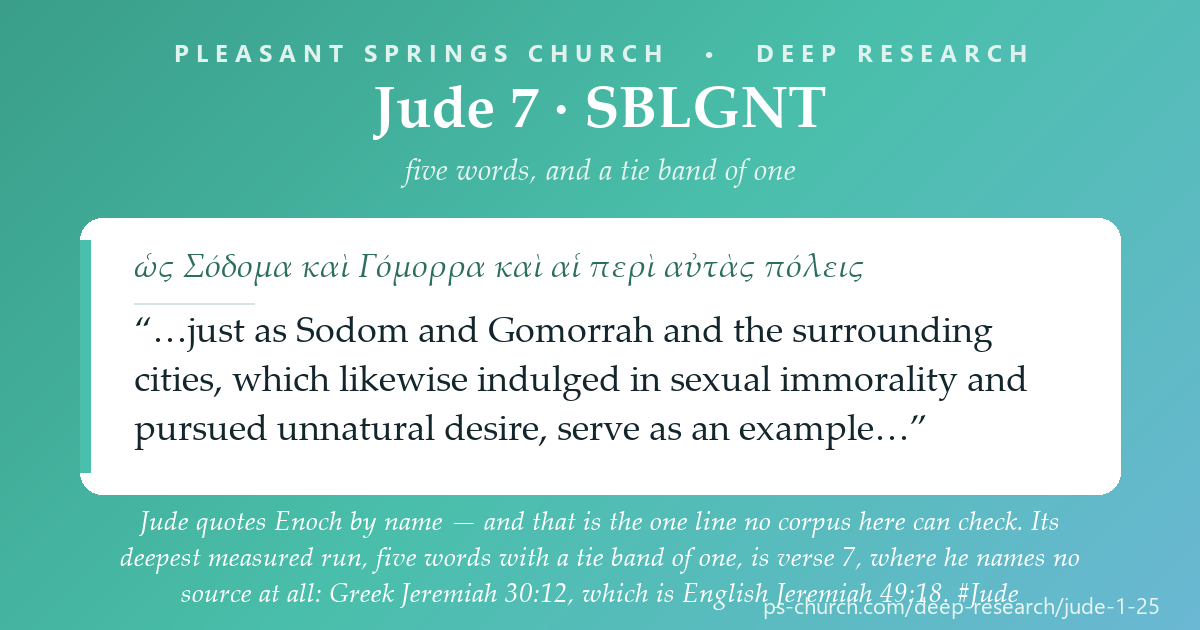
Jude is the book everyone knows one fact about: it quotes a writing that is not in the Bible, by name, as prophecy. So the measurement seemed easy to predict — find the quotation, measure it, report it. The quotation is the one line on this page that cannot be measured at all. 1 Enoch is not held here in any language, and against the 30,348 Greek Old Testament verse units that are screened, Jude 14 shares no three consecutive words with anything. Its maximum is two, and the two words are and also. Against Deuteronomy 33:2 and Zechariah 14:5 — the two verses always named as background — the run is one word each. Meanwhile the deepest verbal contact this letter makes anywhere in the Greek Old Testament is five words with a tie band of one, and it falls at verse 7, where Jude names no source whatever: its single partner in the whole corpus is Greek Jeremiah 30:12, which is English Jeremiah 49:18. The source he names cannot be checked. The source he does not name is exact. See the method →
Jude 1–25 (selections)
Greek New Testament (SBLGNT via MorphGNT) · ESV⚠️ The number that does move on this page is not Jude’s. The single Greek Old Testament partner of Jude 7 is Jeremiah 49:18 in Hebrew and English and Jeremiah 30:12 in the CATSS Greek, because Greek Jeremiah puts the Oracles Against the Nations in a different place and reorders the nations inside them. A reader who takes a printed Septuagint and turns to Jeremiah 49 will not find the verse. The alignment of that block was derived here, verse by verse, and not copied from a table — see stage 1.
The Shape of the Passage
Sequence — five remembered word → these are the ones modules, inside an inclusio. Not a chiasm.Jude names himself in four words and then never mentions himself again. Everything else about the author is inference, and this page keeps the inference separate from the measurement. What can be counted is counted; what cannot be is labelled.
Author
“Jude, a servant of Jesus Christ and brother of James.” The name is Ἰούδας — Judah, one of the commonest Jewish names of the period. He does not call himself an apostle, and at verse 17 he tells the readers to remember what the apostles of our Lord Jesus Christ foretold, which places him outside that group as he writes. He identifies himself by a brother rather than a father, which normally means the brother was the better known man.
What was measured about the James link, and what it is worth. The opening Ἰησοῦ Χριστοῦ δοῦλος is a run of three words, and its partner in all 7,927 Greek New Testament verses is James 1:1, which opens James, a servant of God and of the Lord Jesus Christ. But the row’s tie band is three, not one — the same verse also reaches three on a different phrase, ἐν θεῷ πατρί, and lands on 1 and 2 Thessalonians 1:1. Three words is a small number and the page will not inflate it. Two Jewish Christian letter-writers could reach for the same self-description without either having read the other, and a run screen has no way to tell the difference.
The traditional identification, and why this page does not settle it. Mark 6:3 lists the brothers of Jesus as James, Joses, Judas and Simon; the ancient and most common reading is that this Jude is that Judas and that James is the James of Jerusalem. Others have read the letter as written later in his name. Nothing on this page adjudicates that. The measurements here are about vocabulary and shared sequences, and vocabulary cannot date a letter.
Audience
People who had been taught, and who were sharing meals with the problem. Verse 3 says he was writing about our common salvation before the emergency redirected him. Verse 5 says you once fully knew the exodus story. Verse 17 assumes they heard apostles in person. And verse 12 puts the intruders inside the ἀγάπαι, the love feasts — this is not a warning about outsiders.
Readers who could follow a Jewish argument without footnotes. In 25 verses the letter expects its readers to recognise the wilderness generation, the angels of Genesis 6, Sodom, Michael, Cain, Balaam, Korah and Enoch with no explanation offered for any of them. Two of those — the dispute over the body of Moses and the prophecy of Enoch — are not in the Old Testament at all. That is a fact about the audience before it is a fact about the canon: they were expected to know the material.
And a congregation being asked to do two things at once. Verses 22–23: have mercy on those who doubt, snatch others out of the fire, and show mercy to a third group with fear, hating even the garment stained by the flesh. Mercy and fear in the same sentence, addressed to people who had to keep sitting at table with each other.
Orient on a 25-verse letter, on the books it cites, and on the one number that moves.
Search by topic: Jude, Epistle of; Enoch, First Book of; Watchers; Assumption of Moses; Testament of Moses; Michael (archangel); Korah; Balaam; love feast (agape); canon, formation of; antinomianism.
Which articles are relevant?
- Anchor Bible Dictionary — “Jude, Epistle of,” “Enoch, First Book of,” “Moses, Assumption of,” “Michael,” “Watchers.”
- Dictionary of the Later New Testament & Its Developments (IVP) — “Jude,” “Apocryphal and Pseudepigraphal Writings,” “Adversaries,” “Canon.”
- NIDNTTE — τηρέω, ἀσέβεια, ἔλεος, ζόφος, προφητεύω.
- Dictionary of NT Use of the OT (Beale & Carson) — the Jude chapter, which spends most of its length on texts that are not in the Old Testament.
Settle the numbering — and note where the numbering problem actually is
Jude itself has no offset. This was derived from the corpora rather than copied from a table.
| chapters | verses | |
|---|---|---|
| SBLGNT (MorphGNT) | 1 | 25 |
| English versification | 1 | 25 |
Identical. There is no Hebrew column and no Septuagint column for a New Testament book, so the usual MT/LXX/ESV question does not arise for the passage itself. The only wrinkle is a filing convention: because Jude has one chapter, printed Bibles cite Jude 7 while the MorphGNT files label the same verse Jud 1:7. This page prints both on every row.
One textual note that is not a versification note: at verses 22–23 the manuscripts divide over whether there are two groups of people or three. The SBLGNT prints three; some witnesses have two. The verse numbers are the same either way, so nothing on this page shifts — but a reader comparing translations will see the difference.
The offset that does bite — and it belongs to Jeremiah, not to Jude
The single Greek Old Testament partner of this page’s deepest run sits inside the hardest renumbering on the shelf.
| the reference | Hebrew & English | the CATSS Greek column |
|---|---|---|
| the Sodom clause behind Jude 7 | Jeremiah 49:18 | Jeremiah 30:12 |
Greek Jeremiah is about an eighth shorter than the Hebrew and moves the Oracles Against the Nations from the back of the book (Hebrew 46–51) into the middle, reordering the nations inside the block. The shelf’s versification table marks Jeremiah PROVISIONAL for exactly that reason and forbids copying a printed table. So this one block was aligned here by content, verse by verse:
| CATSS Greek | opening words | Hebrew / English |
|---|---|---|
| Jeremiah 30:1 | To Idumea: thus says the Lord — is there no longer wisdom in Teman? | Jeremiah 49:7 |
| Jeremiah 30:8 | I heard a report from the Lord, and he sent messengers to the nations | Jeremiah 49:14 |
| Jeremiah 30:12 | as Sodom and Gomorrah and her neighbours were overthrown | Jeremiah 49:18 |
| Jeremiah 30:16 | behold, like an eagle he will look and stretch out his wings | Jeremiah 49:22 |
| Jeremiah 30:17 | to the sons of Ammon — thus said the Lord | Jeremiah 49:1 (the block ends; a different nation begins) |
Within the Edom oracle the Greek number is the Hebrew number minus six, and the block runs Greek 30:1–16 = Hebrew 49:7–22. Four independent anchors agree, and the fifth row shows where the block stops. That is a claim about this block only — nothing here should be carried over to the rest of Jeremiah, where the shelf’s own tooling still says PROVISIONAL.
Practical consequence: a reader chasing Jude 7 into a printed Septuagint and turning to Jeremiah 49 will find a different chapter entirely. And a second consequence for this shelf — Jeremiah 49:14 is the verse Obadiah 1 also carries, which is the subject of the Obadiah study. Jude’s deepest Old Testament contact lands four verses further down the same oracle.
Two named sources that are not in the Bible, and one that is.
Enoch, named and quoted — and unmeasurable here
Jude 14–15 names a figure out of Genesis, says he prophesied, and then quotes him — and the words quoted are not in the Old Testament.
The page will not call this the only such passage, because it is not. John 11:50–51 quotes Caiaphas and then says he prophesied, and those words are not in the Old Testament either. What is distinctive about Jude 14 is the combination: a patriarch out of Genesis 5, named with his generation, quoted as a prophet, from a book outside the canon.
The sentence corresponds to 1 Enoch 1:9, part of the Book of the Watchers, a Jewish work of roughly the third to second century BC that survives complete in Ge’ez, in Greek fragments, and in Aramaic pieces from Qumran.
⚠️ 1 Enoch is not held on this shelf in any language, and no part of it was measured for this page. The identification above is the standard one and is reported as background, not as a measurement. What was measured is the other side of the question: how the verse behaves against the corpus that is held.
| Jude 14 against… | longest contiguous shared run | the shared words |
|---|---|---|
| all 30,348 Greek Old Testament verse units screened | 2 (tie band 314; 203 over the 44-file corpus of 23,061 units — corrected 24 September 2026) | δὲ καί — and also |
| Deuteronomy 33:2 (the Lord came from Sinai… with holy myriads) | 1 | καί · κύριος · μυριάσιν · αὐτοῦ — four isolated words, no two of them adjacent in both |
| Zechariah 14:5 (the Lord will come, and all the holy ones with him) | 1 | καί · κύριος · ἐν · αὐτοῦ |
Jude 14 shares no three consecutive words with any verse in the Greek Old Testament held here. Which is what a page ought to expect if the quotation really does come from somewhere else — but the page cannot verify the somewhere else, and says so.
Two genuine MT/LXX divergences sit in the background verses, and both are worth printing. At Deuteronomy 33:2 the Hebrew reads מֵרִבְבֹת קֹדֶשׁ, from myriads of holiness, and the Greek reads σὺν μυριάσιν Καδης — where the Hebrew has the word for holiness the Greek column has the place-name Kadesh. Which column stands behind which is not asserted here. At Zechariah 14:5 the Hebrew ends all the holy ones with you and the Greek ends all the holy ones with him. Jude’s phrase, with his holy myriads, matches the sense of the Hebrew of Deuteronomy and the pronoun of the Greek of Zechariah — and reproduces the running wording of neither, though the single word μυριάσιν does stand in the Greek of Deuteronomy 33:2. Nothing here says which text anyone was reading.
The body of Moses — a source named nowhere in the text and held nowhere here
Jude 9 reports a dispute between Michael and the devil over the body of Moses. That episode is not in the Old Testament.
Origen, Clement of Alexandria and later writers attribute the story to a work they call the Assumption of Moses. A related work, usually printed as the Testament of Moses, survives in a single damaged sixth-century Latin palimpsest and breaks off before any such scene. Whether the two are one book is a live question in the scholarship.
⚠️ None of that was read for this page. Neither the Assumption nor the Testament of Moses is on this shelf in any language. The paragraph above is a summary of the standard account and is labelled as such. It is background, not evidence.
What could be measured is the one clause of verse 9 that does have a canonical neighbour — and the measurement is small. Michael’s reply, ἐπιτιμήσαι σοι κύριος, is the sentence the angel of the Lord speaks to the Adversary at Zechariah 3:2: ἐπιτιμήσαι κύριος ἐν σοί. Same rare optative, same speaker-and-adversary setting, different word order — so the contiguous-run screen scores the pair at one. See stage 4: this is the clearest counter-example on the page.
The Watchers, the wilderness, and the shape of a woe
Verse 6 tells the story of Genesis 6:1–4 in the form it had taken by the first century.
Genesis gives four verses to the sons of God and the daughters of men. In the Second Temple retellings — 1 Enoch 6–21 above all — the Watchers leave their station, are bound, and are kept in darkness until the great day of judgement. Jude 6 uses all four of those elements in one sentence: they did not keep their ἀρχή, they left their dwelling, they are kept in chains under gloom, for the judgement of the great day. Not measured — 1 Enoch is not on this shelf. Read as a witness to how Genesis was being read, not as Scripture.
Verse 11 is a woe, and the form is a prophet’s. οὐαί with a dative and a ὅτι clause is how Isaiah, Amos and Habakkuk open an indictment. The three names inside it — Cain, Balaam, Korah — had by the first century become a standing trio for greed and rebellion; that grouping is a commonplace of the period’s literature and was not measured here, because the sources for it are not on this shelf.
The house position on these books: 1 Enoch, the Assumption of Moses and Jubilees are read here as historical witnesses to how Second-Temple Jews were reading Genesis and Numbers, not as Scripture. That Jude quotes 1 Enoch is a fact about Jude’s rhetoric. It is not, by itself, a canonical judgement, and this page does not make one.
Sixteen words that occur nowhere else, one verb that frames the letter, and three that occur exactly twice.
Jude 1, 6 (twice), 13, 21. Five occurrences of the 71 in the Greek New Testament, in 25 verses. The letter opens on it as a passive — kept for Jesus Christ — and closes on it as an imperative, keep yourselves. In between, the angels who did not keep are the ones God has kept.
The root ἀσεβ- stands 17 times in the Greek New Testament and 6 of them are in Jude — verses 4, 15 (four times) and 18. The verb ἀσεβέω occurs exactly once in the New Testament, in verse 15.
Jude 3. One occurrence in the Greek New Testament. An arena word: to enter a contest on behalf of something. The object is the faith once for all delivered.
Jude 24. One occurrence in the Greek New Testament. Used in ordinary Greek of a horse that does not stumble. The doxology says God is able to keep the readers so.
Jude 6 and 13. Five occurrences in the Greek New Testament, and four of them are in Jude and 2 Peter — Jude 6, Jude 13, 2 Peter 2:4, 2 Peter 2:17; the fifth is Hebrews 12:18. Not the ordinary word for darkness.
Jude 9. An optative — a mood the New Testament uses sparingly. The same form of the same verb stands at Zechariah 3:2 in the Greek Old Testament, spoken to the same adversary. The run screen still scores the pair at one, because the words around it are ordered differently.
Jude 19. One occurrence in the Greek New Testament. Literally to draw a boundary through something. The people who were dividing the congregation are the ones described as having no Spirit.
Sixteen words in twenty-five verses occur nowhere else in the Greek New Testament
Counted by lemma across all 27 books: 16 of Jude’s 226 distinct lemmas occur once in the New Testament and that once is here.
ἐπαγωνίζομαι (3) · παρεισδύω (4) · ἐκπορνεύω (7) · δεῖγμα (7) · ὑπέχω (7) · φυσικῶς (10) · Κόρε (11) · σπιλάς (12) · φθινοπωρινός (12) · ἐπαφρίζω (13) · πλανήτης (13) · ἀσεβέω (15) · γογγυστής (16) · μεμψίμοιρος (16) · ἀποδιορίζω (19) · ἄπταιστος (24)
⚠️ And here is the counter-example this figure needs. Sixteen in 25 verses sounds extraordinary until it is normalised, and then Jude is fourth, not first:
| book | verses | words | hapax legomena | per verse | per 100 words |
|---|---|---|---|---|---|
| 2 Peter | 61 | 1,098 | 52 | 0.85 | 4.74 |
| 2 Timothy | 83 | 1,235 | 60 | 0.72 | 4.86 |
| Titus | 46 | 659 | 31 | 0.67 | 4.70 |
| Jude | 25 | 459 | 16 | 0.64 | 3.49 |
| 1 Peter | 105 | 1,678 | 56 | 0.53 | 3.34 |
| James | 108 | 1,739 | 55 | 0.51 | 3.16 |
| Matthew | 1,068 | 18,329 | 100 | 0.09 | 0.55 |
| 2 John | 13 | 245 | 1 | 0.08 | 0.41 |
| 1 John | 105 | 2,137 | 1 | 0.01 | 0.05 |
Jude’s vocabulary is unusual, and 2 Peter’s is more unusual still. What the table shows is a family: the short late letters cluster at the top and the Gospels and the Johannine letters at the bottom. 1 John has one hapax legomenon in 105 verses. That is the real spread, and any claim about Jude’s vocabulary has to be made inside it.
Three words occur exactly twice in the New Testament, and each time the two are Jude and 2 Peter
| lemma | gloss | occurrence 1 | occurrence 2 | run between those two verses |
|---|---|---|---|---|
| συνευωχέομαι | to feast together | Jude 12 | 2 Peter 2:13 | 2 |
| ὑπέρογκος | swollen, bombastic | Jude 16 | 2 Peter 2:18 | 1 |
| ἐμπαίκτης | scoffer, mocker | Jude 18 | 2 Peter 3:3 | 3 |
This is the sharpest thing the page can say about the two letters, and it is not a run-length finding at all. Three words in the whole Greek New Testament have exactly two occurrences, and in all three cases one is in Jude and one is in 2 Peter. The contiguous-run screen scores those three pairs at two, one and three — which is to say the screen barely notices them. Rarity and run length are different measurements, and a page that reports only one of them will mislead.
The measurement this page was built on, its one real Old Testament result, and its own counter-examples.
Jude against the Greek Old Testament: 25 rows, 30,348 targets
Every one of Jude’s 25 verses was screened against every verse unit of the Greek Old Testament held on this shelf.
| depth reached | how many of the 25 rows |
|---|---|
| at least two words | all 25 |
| at least three | 16 (14 over the 44-file corpus) |
| at least four | 2 |
| five | 1 |
| six or more | 0 |
⚠️ Re-run 24 September 2026 over the 30,348 verse units now screened (63 CATSS files, of 64 held; first run over 23,061 units in 44 files). The top of the table held — the same five at Jude 7, the same single partner. Two rows rose from two to three on the new books, each with a tie band of one: Jude 10, the unreasoning animals, against 4 Maccabees 14:14, and Jude 20, in the Holy Spirit, against Psalms of Solomon 17:37. Neither is claimed as a source. And the band at Jude 25 rose from 2 to 9: seven verses of Tobit carry the same doxological for all the ages.
The two rows that go deepest, with their bands:
| row | run | tie band | the shared words | partner |
|---|---|---|---|---|
| Jude 7 | 5 | 1 | Σόδομα καὶ Γόμορρα καὶ αἱ | Greek Jeremiah 30:12 = English Jeremiah 49:18 |
| Jude 25 | 4 | 9 (2 over the 44-file corpus) | καὶ εἰς πάντας τοὺς at one partner and εἰς πάντας τοὺς αἰῶνας at the other | 1 Samuel (1 Kingdoms) 30:31 and Daniel 3:52 — two different four-word windows, both formulaic |
Why the band at Jude 7 is one, checked by hand. Seven verse units in the screened Greek Old Testament (re-counted 24 September 2026 on the enlarged corpus: still seven, none of them in the newly added books) carry Σόδομα καὶ Γόμορρα as a sequence: Genesis 13:10, Genesis 19:24, Deuteronomy 29:22, Isaiah 13:19, Amos 4:11, Jeremiah 27:40 and Jeremiah 30:12. Only one of them continues with καὶ αἱ.
| Greek verse | what follows Sodom and Gomorrah | run with Jude 7 |
|---|---|---|
| Jeremiah 30:12 (English 49:18) | καὶ αἱ πάροικοι αὐτῆς — and her neighbours | 5 |
| Jeremiah 27:40 (English 50:40) | καὶ τὰς ὁμορούσας αὐταῖς — and those bordering them | 4 |
| Amos 4:11 | καὶ ἐγένεσθε — and you became | 4 |
| Deuteronomy 29:22 | Ἀδαμα — a further place-name | 3 |
| Genesis 19:24 | θεῖον καὶ πῦρ — sulphur and fire | 3 |
| Genesis 13:10 | ὡς ὁ παράδεισος — like the garden | 3 |
| Isaiah 13:19 | nothing — the verse ends there | 3 |
Two of the seven reach four, and only one reaches five — which is exactly the sort of margin a reader should be shown rather than told about. The fifth word is αἱ, the feminine plural article, and it is the whole difference between a band of one and a band of three.
And here is the detail worth the whole row. Hebrew Jeremiah 49:18 and 50:40 are a near-doublet, and both end the clause with the same Hebrew noun שְׁכֵנֶיהָ, her neighbours — 49:18 prefixing it with a plain waw (וּשְׁכֵנֶיהָ) and 50:40 with waw plus the object marker (וְאֶת־שְׁכֵנֶיהָ). The Greek renders that one Hebrew noun two different ways in the two places — αἱ πάροικοι αὐτῆς at Greek 30:12 and τὰς ὁμορούσας αὐταῖς at Greek 27:40. Jude 7 lines up with one of them and not the other, and that is why the tie band is one rather than two. No claim is made about which text Jude was reading, or about whether he was reading one at all.
Jude against the Greek New Testament — where the deepest run is worth least
All 25 rows against all 7,927 Greek New Testament verses, with Jude’s own rows removed from the target.
| depth reached | how many of the 25 rows |
|---|---|
| at least two | all 25 |
| at least three | 18 |
| at least four | 5 |
| at least five | 4 |
| six | 1 |
| row | run | tie band | partner(s) | what it is |
|---|---|---|---|---|
| Jude 25 | 6 | 2 | Romans 5:21, Romans 7:25 | through Jesus Christ our Lord — a formula |
| Jude 13 | 5 | 1 | 2 Peter 2:17 | for whom the gloom of darkness — the letter’s one distinctive run |
| Jude 17 | 5 | 34 | Acts 15:26, Romans 5:1 and 32 others | of our Lord Jesus Christ — a formula |
| Jude 21 | 5 | 34 | the same 34 | the same formula |
| Jude 4 | 4 | 1 | Ephesians 6:24 | our Lord Jesus Christ in the accusative — rare by grammar, not by sense |
The counter-examples, printed here so the five at verse 13 is not read as more than it is. Verses 17 and 21 both reach five and both have a tie band of thirty-four. A run of five with a band of thirty-four tells a reader nothing at all about where it came from. The deepest run in the letter, six words at verse 25, is a doxological formula shared with Romans. Depth without a band is not evidence.
A second counter-example, and this one is instructive. Jude 7 — the verse that reaches five into the Greek Old Testament — reaches only three into the New Testament, and its partner is Mark 4:19, the interpretation of the parable of the sower. The three shared words are καὶ αἱ περί, and in Mark they belong to the desires for other things. Same three words, entirely unrelated sentences. That is what the instrument does when left to itself.
Jude and 2 Peter, measured
The relationship between Jude and 2 Peter 2 is the most discussed literary question in the New Testament letters. Measured as contiguous shared word-forms it is thinner than its reputation, and it is unmistakably there.
First the thinness — the famous paragraph-by-paragraph parallels, measured:
| Jude | 2 Peter | the shared subject | longest run |
|---|---|---|---|
| 6 | 2:4 | the angels who sinned, kept for judgement | 2 |
| 7 | 2:6 | Sodom and Gomorrah as an example | 1 |
| 9 | 2:11 | angels who bring no blasphemous judgement | 1 |
| 11 | 2:15 | Balaam and gain | 3 |
| 12 | 2:13 | feasting with you | 2 |
| 13 | 2:17 | the gloom of darkness reserved | 5 |
| 16 | 2:18 | swollen words | 1 |
| 18 | 3:3 | scoffers in the last days | 3 |
Two of the closest thematic pairs on that list measure one. Whatever the relationship is, at sentence level it is not copying.
Now the reality of it, because “thin” means nothing without a baseline. All 25 Jude rows were screened against every New Testament book in turn:
| target book | verses in it | Jude rows reaching 3+ | reaching 4+ | deepest |
|---|---|---|---|---|
| 2 Peter | 61 | 9 | 4 | 5 |
| Ephesians | 155 | 8 | 3 | 5 |
| Revelation | 405 | 9 | 0 | 3 |
| Romans | 430 | 7 | 3 | 6 |
| Acts | 1,002 | 8 | 2 | 5 |
| 1 Peter | 105 | 5 | 2 | 5 |
| James | 108 | 4 | 2 | 5 |
| Matthew | 1,068 | 4 | 0 | 3 |
| Luke | 1,149 | 4 | 0 | 3 |
| Philemon (25 verses, the same length as Jude) | 25 | 2 | 1 | 4 |
| 1 John | 105 | 0 | 0 | 2 |
| 3 John | 15 | 0 | 0 | 2 |
2 Peter is 61 verses — eight tenths of one per cent of the Greek New Testament — and more Jude rows reach three words into it than into Matthew, Luke, Acts or Romans, each of which is between seven and nineteen times longer. It is also the only book that takes four Jude rows to a depth of four or more and holds the one five with a tie band of one. The gap is the relationship.
What the measurement will not do. It will not say which letter was written first. The shelf’s standing rule applies here without exception: direction of influence is never asserted. A run screen counts shared sequences and has no access to chronology. Every reconstruction — Jude used 2 Peter, 2 Peter used Jude, both used a third source, both drew on a shared body of preaching — produces exactly the numbers above. The numbers are reported. The inference is the reader’s.
The clearest blind spot on this page, stated plainly
Jude 9 against Zechariah 3:2 measures one word. Every commentary connects them, and the commentaries are right.
| the words | |
|---|---|
| Jude 9 | ἐπιτιμήσαι σοι κύριος — may (the) Lord rebuke you |
| Greek Zechariah 3:2 | ἐπιτιμήσαι κύριος ἐν σοί — may (the) Lord rebuke in you |
Same verb, same mood, same subject, same addressee, same scene — an accuser being rebuked rather than answered. Two shared word-forms out of three, and not one of them in the same order, so the longest contiguous run is one.
This is the page’s own argument against itself, and it belongs here rather than in a footnote. A contiguous-run screen finds verbatim contact. It does not find allusion, it does not find shared idiom, and it cannot see a writer reusing a sentence with the words rearranged. Jude 7 reaching five and Jude 9 reaching one does not mean verse 7 is a stronger connection than verse 9. It means the instrument can see one of them and not the other.
What is missing from the corpus, what was not read, and where this page is weakest.
The hole in the headline, named precisely
The claim is that Jude’s deepest contiguous run against the Greek Old Testament is five words, once, at verse 7. That claim is true of the corpus screened here — every CATSS book, 30,348 verse units in 63 files (of 64 held; the Odes are held but withdrawn from screening) — and that corpus is not the whole Septuagint, and not every book Jude draws on.
| the gap | why it matters for Jude |
|---|---|
| Numbers — now held, and measured | This was the real gap, and it has been closed. Verse 11 names Balaam and Korah, and the narratives are Numbers 22–24 and Numbers 16. Measured on 24 September 2026: against the whole of Greek Numbers Jude 11 reaches only two, τῇ ὁδῷ among others (tie band eighteen within Numbers, eleven of them the bare and the; in the way is five, three of them in the Balaam story at 22:23, 31 and 34), and against Numbers 16 one word. Balaam is now named in 57 screened verse units — 50 of them in Numbers, two in Joshua (13:22 and 24:9, B text), and the five this page first counted: Deuteronomy 23:5–6 (English 23:4–5), Micah 6:5, Nehemiah 13:2 (which the Greek files number 2 Esdras 23:2) and Judges 1:27 in the A text, where the same spelling stands for a place and not for the prophet. Against the whole screened corpus Jude 11 still reaches only three, tie band eight, on the unremarkable τῇ ὁδῷ τοῦ and on οὐαὶ αὐτοῖς ὅτι. No deeper run was hiding in Greek Numbers. Until 24 September 2026 this row read “not held”: “Neither could be measured. Balaam is named in five held verse units … and Jude 11 reaches only three words against the whole held corpus, tie band seven … But a deeper run could be hiding in Greek Numbers, and this page cannot say it is not.” |
| 1 Enoch, in any language — not held | The book Jude names and quotes. Verses 14–15 could not be checked against their own stated source. This is the single largest limitation of the page. |
| Assumption / Testament of Moses — not held | The source patristic writers assign to verse 9. Not held, not read, not measured. |
| Exodus, Leviticus, Joshua, Wisdom of Solomon, Tobit, Judith, 2–4 Maccabees, Baruch, Psalms of Solomon, Susanna, Bel — now held | Until 24 September 2026 this row read: “Twenty CATSS files in all are absent. None is obviously in play for Jude, but absent is absent.” All are now held and screened (the Odes are held but withdrawn from screening, because Odes 9 and 13 are Luke 1–2 and ten others duplicate passages already in the corpus). The re-run moved no headline figure; the bands that grew are marked where they are printed. |
So the honest statement of the finding is this: across the 30,348 Greek Old Testament verse units screened on this shelf, Jude’s deepest contiguous run is five words with a tie band of one, at verse 7, partnered with Greek Jeremiah 30:12. The rows where a deeper run was plausibly hiding were 11 and 14–15; Numbers has now been measured and hides nothing, and the book still missing is 1 Enoch. Genesis 6, Genesis 19 and Zechariah 3 are in books that are held, were measured, and come out low. The exodus of verse 5 is no longer a gap: Greek Exodus is held, and that verse’s own wording ἐκ γῆς Αἰγύπτου comes back three words, with a tie band of one hundred and four across the screened corpus — twenty-four of them in Exodus itself. A formula, not a quotation. Until 24 September 2026 this paragraph read “across the 23,061 Greek Old Testament verse units this shelf holds”, named “Numbers and 1 Enoch” as the missing books, and called the exodus “a third gap — the book of Exodus is not held either”, with a tie band of sixty-one.
What else could not be checked
No critical apparatus for the Greek New Testament. This matters twice in 25 verses. At verse 5 the SBLGNT prints Ἰησοῦς — Jesus saved a people out of Egypt — where other witnesses read the Lord or God, and the doctrinal weight of that variant is obvious. At verses 22–23 the witnesses divide over two groups of people or three. The page prints the text it holds and names the alternatives, and has weighed the evidence for neither.
No 1 Enoch in Ge’ez, Greek or Aramaic. No Assumption or Testament of Moses. No Qumran material. No Testaments of the Twelve Patriarchs. No patristic sources read in the original: Eusebius’s classing of Jude among the disputed books, Jerome’s report that some rejected it because of the Enoch citation, and Tertullian’s defence of Enoch are all named here from the standard summaries.
No stylistic or syntactic analysis. Jude’s Greek is good and its sentences are long; whether it is closer to 2 Peter’s register than the run screen can see was not tested, because the instrument on this shelf measures shared sequences and not style.
And a limit on the method itself, which is worth more than any of the above. A contiguous-run screen counts shared word forms in order. It cannot see paraphrase, it cannot see shared structure, and it cannot see an argument built out of an Old Testament story in the writer’s own words. Jude 5–7 and 11 are exactly the kind of writing this screen is blind to — the substance is Exodus, Genesis and Numbers, and the vocabulary is Jude’s. The finding of this page should therefore be read narrowly: the letter does not copy, which is not at all the same as saying the letter does not use. Jude 9 against Zechariah 3:2, printed in stage 4 at a run of one, is the proof of that inside the page’s own numbers.
Authorship, date and canon — and what this page refuses to do with them
Jude was disputed in the early church, and the reason given was the Enoch citation. Eusebius lists it among the antilegomena; the Muratorian Fragment includes it; Jerome reports that it was rejected by some because it cites an apocryphal book. None of those sources was read here in the original.
The measurements on this page are compatible with more than one account of who wrote the letter and when. The three-word overlap with James 1:1 can be read as one family’s habit or as a convention two writers shared. The relationship with 2 Peter can be read in either direction or in neither. The screen cannot choose between those, and neither will this page.
What can be said flatly is that quoting a book is not the same as canonising it, and that this page has no way to measure the difference. Jude names Enoch as a prophet and uses his words. What that implies about the status of 1 Enoch is a theological judgement, made by readers and by councils, and not by a run screen.
Reading list
- Richard J. Bauckham, Jude, 2 Peter (Word Biblical Commentary 50) — the standard technical treatment, and the source of the widely-followed reading of Jude as a structured midrash.
- Richard J. Bauckham, Jude and the Relatives of Jesus in the Early Church.
- Peter H. Davids, The Letters of 2 Peter and Jude (Pillar NTC).
- Gene L. Green, Jude and 2 Peter (BECNT).
- Thomas R. Schreiner, 1, 2 Peter, Jude (New American Commentary).
- George W. E. Nickelsburg, 1 Enoch 1 (Hermeneia) — for the text Jude 14–15 quotes and this page could not check.
- None of these were consulted for the measurements on this page, which were run on the text files named in the footer. They are named as the places to check this page against.
Kept, and keep.
The source he names and the source he doesn't
The thing that came out of the measurement was not what went into it. The expectation was that a page on Jude would be a page about the Enoch quotation. The Enoch quotation is the one line here that no corpus on this shelf can check — and when the verse is screened against everything that is held, it comes back with a maximum of two words and those two words are and also.
Meanwhile the letter’s deepest verbal contact with the Greek Old Testament, five words with a tie band of one, is at verse 7 — a verse that names nobody, cites nothing, and simply says as Sodom and Gomorrah and the surrounding cities. The clause it matches is in an oracle against Edom, and a reader with a printed Septuagint has to know that English Jeremiah 49:18 is Greek Jeremiah 30:12 to find it at all.
Which is a fair description of how anybody actually carries a text. The things we announce we are quoting are the things we have looked up. The things that come out word for word are the things that were already in us. Jude announces Enoch and reproduces Jeremiah.
And the letter knows what it is doing with all of it. Five times in 25 verses a piece of remembered material is followed by οὗτοί εἰσιν — these are the ones. The exodus, the angels, Sodom; Michael; Cain, Balaam, Korah; Enoch; the apostles. Each time the old word is laid down and then aimed. Jude is not writing history. He is naming people at his readers’ own table.
The frame of the letter is one verb. Verse 1: kept for Jesus Christ, passive, done to them. Verse 6: the angels who did not keep are the ones he has kept. Verse 21: keep yourselves in the love of God, imperative. Verse 24: to him who is able to keep you from stumbling — and there the verb changes, which the page notes rather than smooths over. Kept, and keep, and kept again. The letter that opens by naming a danger closes by naming who holds the door.
This page closes a gap: Jude had no study on this shelf at all. Its nearest neighbours are the 2 Peter study, which measured the same relationship from the other side, and the Obadiah study, which works the same Jeremiah oracle four verses further up.
Every Deep Research page traces its passage across the whole sweep — the Old Testament, the Second-Temple world between the testaments (historical witnesses, not Scripture), and the New Testament. Follow the thread:
Pleasant Springs Church — Deep Research
Research method after Michael S. Heiser’s Bible Research Method (examine dictionaries → ancient literature → important words → textual connections → academic publications → share), with the Pleasant Springs “Author & Audience” foundation. Scripture set in the Hebrew, the Greek editions named on each page and the ESV (Old Testament), and the Greek New Testament and the ESV (New Testament), per the practice of Pleasant Springs Church. Jude research grounded in Bauckham (WBC), Davids (Pillar), Green (BECNT) and Schreiner (NAC). Text: Greek New Testament from the SBL Greek New Testament as digitized by MorphGNT; Greek Old Testament from Rahlfs’ Septuaginta as digitized by CATSS; Hebrew from the Masoretic text (Miqra according to the Masorah). There is no Hebrew column and no Septuagint column in this page’s codex, because Jude is a New Testament book; the Greek and Hebrew Old Testaments appear here only as target corpora to measure against. ⚠️ VERSE NUMBERING — there is no offset. Derived, not assumed: SBLGNT Jude holds 25 verses and the English holds 25. Jude has one chapter, so a printed Bible writes Jude 7 where the MorphGNT files write Jud 1:7; both are on every row. The one reference on this page that does move is not Jude’s: the Sodom clause behind verse 7 is Jeremiah 49:18 in Hebrew and English and Jeremiah 30:12 in the CATSS Greek. That block was aligned here verse by verse against four anchors — Greek 30:1 = Hebrew 49:7, 30:8 = 49:14, 30:12 = 49:18, 30:16 = 49:22 — because the shelf’s own versification table marks Jeremiah PROVISIONAL and forbids copying a printed one. The alignment is claimed for that block only. ⚠️ The measurement, in full. Greek against Greek. MorphGNT field 6, the normalised word (the column that already resolves elision and the movable nu); CATSS FORM column (cols 0–24), beta-code transliterated first. Both sides lowercased, accents and breathings dropped, final sigma folded, then filtered to Greek letters — the same filter applied to both corpora. Contiguous runs of whole word FORMS, never lemmas. Corpus: the 25 SBLGNT rows of Jude against 30,348 CATSS verse units in 63 files (of 64 held; the Odes are held but not screened) — first run over 23,061 units in 44 files, re-run 24 September 2026, headline unchanged and the moved bands marked in place — and separately against 7,927 MorphGNT verses in 27 files with Jude’s own rows excluded from the target. Greek-side convention throughout, unigram fallback ON — so a row reporting 1 shares at least one single word and no two consecutive words. Hapax counts are by LEMMA (MorphGNT field 7) across all 27 books. Exhaustive and deterministic; nothing sampled, so no seed applies. ⚠️ What the corpus does NOT contain. Every CATSS Greek Old Testament book is now held; until 30 August 2026 twenty files were missing, among them Exodus, Leviticus, Numbers, Joshua and the Wisdom of Solomon, and Numbers 16 and 22–24, behind Jude 11, could not be measured. They were measured on 24 September 2026 and Jude 11 reaches two against the whole of Numbers. The screened corpus is still not the whole Septuagint. 1 Enoch is not held in any language, so the quotation at Jude 14–15 could not be checked against its own stated source; neither is the Assumption or Testament of Moses behind verse 9. No critical apparatus was consulted, so the variants at verse 5 and verses 22–23 are named and not weighed. ⚠️ Direction of influence is never asserted. Nothing on this page says that Jude used 2 Peter or that 2 Peter used Jude; that Jude used James, Romans, Ephesians or 1 Thessalonians, or was used by them; that Jude 7 depends on Jeremiah or that Jude 9 depends on Zechariah. Runs and tie bands are reported. The inference is the reader’s. ⚠️ What a run screen cannot see. It finds verbatim contact, not allusion. Jude 9 and Zechariah 3:2 share a rare optative, a subject and a scene, and measure one, because the word order differs. That counter-example is printed on the page beside the deepest run so the two are read together. Typology is handled per the house position: what the text says, what the New Testament itself draws, and what we see from this side of the cross — with the seeing left to the reader.
Scripture quotations marked ESV are from the ESV® Bible (The Holy Bible, English Standard Version®), © 2001 by Crossway, a publishing ministry of Good News Publishers. ESV Text Edition: 2016. Used by permission. All rights reserved. The ESV text may not be quoted in any publication made available to the public by a Creative Commons license, and the ESV may not be translated in whole or in part into any other language. www.esv.org
|
Did this study bless you today? 💚 Give to Support PS Church100% of gifts go to the General Fund — thank you. |