Four chapters, four scandals: a man living with his father’s wife, believers suing each other in the Roman courts, a congregation with questions about marriage, and a plate of meat that had passed through a temple. This study measures all 86 verses of 1 Corinthians 5–8, word for word, against 30,637 verse units of the Greek Old Testament. Exactly two rows run to five, and they are opposites: 6:16, which Paul marks with “it says,” lands on one verse, Genesis 2:24, tie band 1 — and 5:13, which he marks with nothing at all, lands on seven verses of Deuteronomy, tie band 7. The second was invisible to this shelf’s own screen until we found out why. Meanwhile the New Testament’s densest Passover paragraph, 5:6–8, measures one, two and one against the whole of Greek Exodus. All of it is printed here. See the method →
1 Corinthians 5:1–8:13 (selections)
Greek New Testament (SBLGNT / MorphGNT) · ESV★ And two of these 86 verses run to five against the whole Greek Old Testament. They are opposites. 6:16 is marked — φησίν, it says — and its five words land on one verse, Genesis 2:24, tie band 1. 5:13 is marked with nothing, and its five words land on seven verses of Deuteronomy, tie band 7. And the shelf’s standing screen scored 5:13 at two, because MorphGNT normalises ἐξ to ἐκ and CATSS does not. Stage 4 gives the audit, the corrected table and the counter-examples.
The Shape of the Passage
Two panels in sequence — what was heard, then what was writtenA church in a Roman colony, split into parties, proud of its knowledge, and unable to see that a case of incest, a lawsuit and a plate of meat were the same problem. Paul answers a report for two chapters and a letter for two, and both halves land on the same question: whose is the body?
Author
Paul, with Sosthenes (1:1), writing from Ephesus (16:8) some time in the mid-fifties. He has already sent one letter that the Corinthians misread (5:9–11), he has heard from Chloe’s people (1:11), and now he has a letter from the church itself (7:1). This study sits exactly on the seam between those two sources.
He argues like a man who expects to be answered back. Twice he quotes the Corinthians’ own words and then qualifies them — all things are lawful for me (6:12), all of us possess knowledge (8:1) — and both times he concedes the premise before limiting the conclusion. He also distinguishes carefully between what the Lord commands and what he himself judges (7:10, 7:12, 7:25, 7:40), which is a striking thing for an apostle to bother doing.
And he cites Scripture in these four chapters exactly once by formula. At 6:16 he says φησίν — it says — and quotes Genesis 2:24. At 5:13 he writes a six-word clause of which five are Deuteronomy’s, word for word, and marks them with nothing at all. The measurement in Stage 4 turns on that difference, and so does this page.
Audience
Corinth — refounded as a Roman colony in 44 BC, a port with two harbours, a city of freedmen and traders where status was new, purchasable and anxiously displayed. Litigation between social unequals was a normal instrument of status; the courts ran on patronage, and a wealthy plaintiff could expect to win. That is why Paul’s question in 6:1 is sharper than it looks.
Most of the congregation would have eaten meat only at a temple. The sacrificial system was the city’s meat supply, its banqueting hall and its social calendar at once; a dining room inside a temple precinct (8:10 has a word for it, εἰδωλεῖον, that occurs nowhere else in the Greek New Testament) was where guilds met and business was done. To refuse was not a dietary preference. It was withdrawing from public life.
The letter treats their strongest people as their biggest problem. The ones with knowledge are right (8:4), the ones with freedom are right (6:12), and both are told that being right is not the end of the matter. Knowledge puffs up; love builds up (8:1). The chapter ends with Paul giving up meat forever rather than trip one weak brother — an argument he wins and then declines to spend.
Orient on Roman Corinth, on porneia, on the courts, on marriage law and on idol food.
Search by topic: Corinth, 1 Corinthians, excommunication and discipline, porneia, Roman litigation, marriage and divorce in Paul, eidolothyton, conscience, weak and strong.
Which articles are relevant?
- Anchor Bible Dictionary — “Corinth,” “Corinthians, First Letter to the,” “Excommunication,” “Marriage (NT),” “Idolatry.”
- Dictionary of Paul and His Letters — “Corinthians, Letters to the,” “Body,” “Sexuality, Sexual Ethics,” “Food Offered to Idols and Jewish Food Laws,” “Discipline.”
- NIDNTTE / TDNT — πορνεία (porneia), σῶμα (sōma), ἐξουσία (exousia), συνείδησις (syneidēsis), εἰδωλόθυτον (eidōlothyton), ἀρσενοκοίτης (arsenokoitēs).
- Dictionary of New Testament Background — “Roman Law and Legal System,” “Banquets,” “Temples, Greco-Roman,” “Slavery,” “Households and Household Codes.”
Bibliography surfaced:
- Anthony C. Thiselton (NIGTC), Gordon D. Fee (NICNT, rev.), Roy E. Ciampa & Brian S. Rosner (Pillar), Richard B. Hays (Interpretation), Joseph A. Fitzmyer (Anchor Yale), David E. Garland (BECNT) on 1 Corinthians.
- Brian S. Rosner, Paul, Scripture and Ethics: A Study of 1 Corinthians 5–7 — the standing monograph on precisely this study’s scope.
- Bruce W. Winter, After Paul Left Corinth; Gerd Theissen, The Social Setting of Pauline Christianity; Wayne A. Meeks, The First Urban Christians.
- G. K. Beale & D. A. Carson, eds., Commentary on the NT Use of the OT — its 1 Corinthians chapter, by Roy Ciampa and Brian Rosner.
A colony’s courts, a temple’s dining room, and a law code that says one sentence seven times.
Read the Roman civil court behind 6:1–8, the sacrificial meat trade behind chapter 8, Deuteronomy’s judicial refrain behind 5:13, and the Second Temple discussion of the same law.
Which parallels shed light on religion and worldview?
The Deuteronomic refrain. The sentence Paul uses at 5:13 is not a quotation of one verse. It is the closing formula of a whole class of capital cases in Deuteronomy, and in the Greek the five words Paul uses repeat identically: the prophet or dreamer who entices to other gods (13:6 in the Greek and Hebrew numbering, 13:5 in English), the convicted idolater’s witnesses (17:7), the false witness (19:19), the rebellious son (21:21), the bride found not to be a virgin (22:21), the adulterous pair (22:24), the kidnapper (24:7). Seven verses, five identical words, tie band 7. ⚠️ The verb in front of the five is not identical: six of the seven read ἐξαρεῖς and 13:6 reads ἀφανιεῖς. It is the five words that repeat, not the whole sentence. Deuteronomy 17:12 and 22:22 carry a shortened form — ἐξ Ἰσραήλ rather than ἐξ ὑμῶν αὐτῶν — and measure three. The formula is a legal drumbeat, and it is the drum Paul is beating.
What the formula meant, and what Paul does with it. In Deuteronomy the purging is done by execution: the community stones the offender. In 1 Corinthians 5 the community expels him — and expels him so that his spirit may be saved in the day of the Lord (5:5). The words are Deuteronomy’s and the penalty is not. This page reports the verbal contact and does not claim that Paul is transferring the death penalty into the church; the text of 5:5 says the opposite.
The court at 6:1. Roman civil procedure in a colony began before a magistrate who assigned a judge or a panel of recuperatores. Selection, patronage and social rank shaped outcomes openly rather than covertly, and the honour gained by a public win was part of the point of suing. Paul’s why not rather suffer wrong? (6:7) is a refusal of the whole economy of status the courts existed to serve, not merely a preference for arbitration.
The temple dining room. Excavated sanctuaries at Corinth — the Asklepieion above all — have small dining rooms with stone couches built into the precinct. 8:10 imagines a man with knowledge reclining in an idol’s temple; the Greek word for the building, εἰδωλεῖον, occurs once in the Greek New Testament. The meat sold in the μάκελλον, the market (10:25), had commonly passed through sacrifice first. The question was unavoidable because the supply chain was.
Second-Temple context, named as context and not as Scripture. Jewish writers of the period treat Gentile sacrificial food as a boundary marker — Daniel 1, Tobit 1:10–12, Judith 12, 1 Maccabees 1:62–63, and the Letter of Aristeas on the fence of the law. The Jerusalem decision of Acts 15:29 asks Gentile believers to abstain from εἰδωλόθυτα. Paul’s answer in 1 Corinthians 8–10 is more layered than a rule, and the relation between the two is a real question this page raises and does not settle.
Primary sources worth reading beside the passage:
- Deuteronomy 13, 17, 19, 21, 22, 24 — the seven verses of the purge formula, read in one sitting. Note the offset: Greek and Hebrew 13:6 is English 13:5.
- Leviticus 18:22 and 20:13 — the two verses whose wording stands behind the shape of ἀρσενοκοίτης. Greek Leviticus was not on this shelf when the study began; it was acquired during it, and it is now inside the 30,637-verse figure.
- Genesis 2:24 — the one verse Paul quotes with a formula in these four chapters.
- Acts 15:20, 15:29, 21:25 — the apostolic decision on idol food, in the same Greek word.
- Tobit 1:10–12; 1 Maccabees 1:62–63; Letter of Aristeas 139–142 — Second-Temple witnesses to the food boundary. Historical sources, not Scripture.
- Cicero, Pro Caecina; the lex Irnitana — how a Roman colonial court actually ran.
Immorality, a body, a purge, a compound nobody had used, and a conscience.
Every count below was taken from the MorphGNT lemma column across all 27 books of the Greek New Testament — 137,554 word tokens — not from a concordance.
25 times in the Greek New Testament, 5 of them in 1 Corinthians — 5:1 twice, 6:13, 6:18 and 7:2. The related noun πόρνος stands 10 times in the New Testament and 4 are in this study (5:9, 5:10, 5:11, 6:9). The word covers a range the English does not; Paul never defines it, and the case in 5:1 shows he did not need to.
142 times in the Greek New Testament and 46 in 1 Corinthians — close to a third of every occurrence in the New Testament, in one letter. Twelve of the 46 stand in this study, across nine verses (5:3; 6:13 twice, 6:15, 6:16, 6:18 twice, 6:19, 6:20; 7:4 twice, 7:34). The same word carries the individual body here, the church in chapter 12 and the resurrection body in chapter 15. Nothing in the measurement decides which sense governs where; the argument does.
Once in the whole Greek New Testament — 1 Corinthians 5:13. A New Testament hapax legomenon that is a standing judicial formula in CATSS Deuteronomy: ἐξαρεῖς τὸν πονηρόν closes eight death-penalty laws — 17:7, 17:12, 19:19, 21:21, 22:21, 22:22, 22:24 and 24:7. ⚠️ The seventh verse carrying Paul’s five words, Deuteronomy 13:6, is not one of the eight: it closes ἀφανιεῖς τὸν πονηρὸν ἐξ ὑμῶν αὐτῶν — the same five words behind a different verb. Paul writes a third form again, the imperative ἐξάρατε. The rarest word in the chapter is the most formulaic word in the source.
Twice in the Greek New Testament — 1 Corinthians 6:9 and 1 Timothy 1:10 — and nowhere in the 30,637 verse units of the Greek Old Testament held here, Leviticus included. Its two components stand adjacent in the compound’s own order in exactly one Greek Old Testament verse: Leviticus 20:13, μετὰ ἄρσενος κοίτην γυναικός; adjacent in the reverse order, κοίτην ἄρσενος, in six more (Numbers 31:17 and 31:18; Judges 21:11 and 21:12, in both texts). That is what the corpus shows. It is not by itself a derivation, and the page does not present it as one.
Four times in the Greek New Testament, and three are in this study — 6:12 and 7:4 twice. Paul refuses to be ἐξουσιασθήσομαι by anything (6:12), then says husband and wife each are (7:4). The same verb, the same letter, twenty-odd verses apart, and the second use is voluntary.
Nine times in the Greek New Testament; five are in 1 Corinthians (8:1, 8:4, 8:7, 8:10, 10:19) and four of those five are in chapter 8. The other four are Acts 15:29, 21:25 and Revelation 2:14, 2:20. In the whole 30,637-verse Greek Old Testament held here it stands exactly once — 4 Maccabees 5:2, where Antiochus orders the Jews to eat sacrificial pork. Not in the Law, not in the Prophets, once in a first-century Jewish martyrdom text: the word belongs to the world between the testaments and to the church, and the page names 4 Maccabees as a historical witness, not as Scripture.
30 times in the Greek New Testament, 8 in 1 Corinthians, and every one of the 8 falls in chapters 8 and 10 (8:7, 8:10, 8:12; 10:25, 10:27, 10:28, 10:29 twice). The word is confined to the idol-food argument. Paul’s worry is not the strong man’s conscience but the weak man’s: to wound it is to sin against Christ (8:12).
Six times in 1 Corinthians, and the first is 8:1: knowledge puffs up, love builds up. The verb returns at 10:23 with the slogan of 6:12 — all things are lawful, but not all things build up. The two panels of this study are answered together in chapter 10, outside its scope.
The hapax legomena of these four chapters, and where they pile up
Fourteen lemmas in 1 Corinthians 5–8 occur nowhere else in the Greek New Testament. By chapter they fall: 5 → 2 · 6 → 2 · 7 → 9 · 8 → 1.
Nine of the fourteen are in chapter 7, and three of the nine are in one verse. 7:35 alone carries βρόχος (a noose or snare), εὐπάρεδρον (well-seated beside, attentive) and ἀπερισπάστως (without distraction). The rest of the chapter’s nine are σύμφωνος (7:5), συγγνώμη (7:6), ἐπισπάομαι (7:18), ἀπελεύθερος (7:22), λύσις (7:27) and ὑπέρακμος (7:36).
⚠️ What that count is and is not. A chapter answering detailed questions nobody else in the New Testament answers will naturally reach for words nobody else needed. The count is a fact; a vocabulary spike is not evidence of a different hand, and this page does not use it as one. Chapter 5’s two are ἑορτάζω (5:8) and ἐξαίρω (5:13) — and the second of those is the hinge of the whole study.
How the rest of the New Testament fills these words out:
- Galatians 5:9 — the other a little leaven leavens the whole lump: six consecutive words, tie band one.
- Matthew 19:5 · Mark 10:8 · Ephesians 5:31 — the other three New Testament homes of Genesis 2:24’s five words (see Genesis 2:18–25).
- Deuteronomy 6:4–9 — the Shema that 1 Corinthians 8:6 is usually read against, and against which it measures one (see the Shema).
- 1 Corinthians 15:1–11 — the same letter’s other study on this shelf, and the other place Paul says this I say, brothers (see 1 Corinthians 15).
86 verses against 30,637 — and the defect that hid one of the two deepest runs.
Greek against Greek. Every verse of 1 Corinthians 5–8, normalised the same way as the target corpus, against every verse of the Greek Old Testament held here and then against the rest of the Greek New Testament. Contiguous runs of whole word forms, never lemmas. The tie band is printed beside every run.
★ The finding: a five-word run the shelf’s own screen could not see
Run as the shelf normally runs it, the screen said this: across the 86 rows against 30,637 verse units of the Greek Old Testament, 85 reach two, 48 reach three, 8 reach four, 1 reaches five, and nothing reaches six. The one was 6:16, Genesis 2:24. 1 Corinthians 5:13 — whose six-word closing clause carries five words of Deuteronomy’s execution formula verbatim — came back at two, with a tie band of 1,504.
The reason is a normalisation, and it is one this shelf had already documented for a different word. MorphGNT’s field 6, the normalised column that every figure on this shelf is measured on, folds three pairs of spellings that CATSS leaves unfolded. Counted across all 137,554 word tokens of the Greek New Testament, the differences between MorphGNT’s printed word and its normalised word are: οὐκ → οὐ, 825 tokens · ἐξ → ἐκ, 234 tokens · οὐχ → οὐ, 105 tokens, plus 162 supplied movable letters. The negative fold was audited on this shelf; the preposition was not. 1 Corinthians 5:13 prints ἐξ ὑμῶν αὐτῶν and is normalised to ἐκ ὑμῶν αὐτῶν; CATSS Deuteronomy prints ἐξ ὑμῶν αὐτῶν and stays that way. The two texts are identical on the page and unequal in the index.
⚠️ The error can only ever run one way. A fold makes two identical words look different. It can break a run; it can never invent one. Every figure this defect touches is too low, never too high — which is the one consolation, and the same one the negative fold carried.
Corrected, with the equivalence οὐκ ≡ οὐχ ≡ οὐ and ἐξ ≡ ἐκ applied to both sides at comparison time, exactly four of the 86 rows change their run length:
- 5:13 — 2 (band 1,504) becomes 5 (band 7). The only row moved by the preposition, and the largest movement on the page.
- 5:6 — 2 (band 52) becomes 3 (band 2). 6:3 — 2 (band 7) becomes 3 (band 2). 6:9 — 2 (band 29) becomes 3 (band 2). All three are the negative fold, and all three gain the same three words: οὐκ οἴδατε ὅτι.
- No other run length moves. The other 82 rows keep the run they had, and no row moves down. Nine of them do shift their tie band — 6:2, 6:12, 6:15, 6:19, 7:9, 7:10, 7:25, 8:7 and 8:8 — because folding the spellings changes how many target verses reach the same depth: 6:15 moves from band 1 to band 3, and 7:9 and 8:7 from 1 to 2. The run is what stays put; the band is a property of the corpus and moves with it.
The corrected distribution: across the 86 rows against 30,637 verse units of the Greek Old Testament, 85 reach two, 52 reach three, 9 reach four, 2 reach five, and nothing reaches six. One row reports one — 7:18 — which on the Greek-side convention used here means it shares single words with the Greek Old Testament but no two consecutive ones. It does not mean it shares nothing.
The two rows at five, side by side
- 1 Corinthians 6:16 → Genesis 2:24 — οἱ δύο εἰς σάρκα μίαν. Run 5, tie band 1. Marked by Paul with φησίν. The only citation formula in the four chapters. Nothing else in 30,637 verse units reaches it.
- 1 Corinthians 5:13 → Deuteronomy 13:6, 17:7, 19:19, 21:21, 22:21, 22:24, 24:7 — τὸν πονηρὸν ἐξ ὑμῶν αὐτῶν. Run 5, tie band 7. Marked by Paul with nothing. Deuteronomy 17:12 and 22:22 carry a shortened form and measure three. CATSS/Hebrew Deuteronomy 13:6 is English 13:5.
- What the pair shows. Depth of verbal contact and visibility of the source run in opposite directions here. The verse Paul flags reaches one target; the verse he does not flag reaches seven. A screen for verbatim contact cannot tell you which of the two Paul thought he was doing, and this page does not pretend otherwise.
⚠️ The counter-examples this page prints against itself
1. The Passover paragraph has almost no Passover words. 1 Corinthians 5:6–8 is the densest Passover language in the New Testament: old leaven, a new lump, unleavened, Christ our Passover has been sacrificed, keeping the festival. Screened against the whole of Greek Exodus — all 1,165 verse rows, the Passover legislation of chapters 12 and 13 included — the three verses reach 1, 2 and 1. The only pair of consecutive shared words in the paragraph is τὸ πάσχα at 5:7 (Exodus 12:21, 12:27, 12:48; tie band 3). 5:6 and 5:8 share single words with Greek Exodus and no two consecutive ones. If the depth of a run measured the depth of a relationship, this paragraph would have no relationship with Exodus, and it plainly does.
2. The Shema sentence measures one. 1 Corinthians 8:6 is the sentence most often described as the Shema opened up around Christ. Against CATSS Deuteronomy 6:4 its longest shared run is one word. 8:4 — there is no God but one — is also one. The instrument finds no contact where the theology finds the deepest.
3. The two deepest New Testament-internal runs are not quotations of anything. Against the 7,841 other verses of the Greek New Testament, 85 of these 86 rows reach two, 63 reach three, 16 reach four, 6 reach five, 2 reach six, and nothing reaches seven. The two sixes are tied, both with a tie band of one: 5:6 against Galatians 5:9 (a proverb used in two letters about two different problems) and 6:12 against 1 Corinthians 10:23 (a Corinthian slogan Paul quotes back twice). Neither is Scripture being cited. Direction of influence is not asserted for either.
Everything else the screen turned up, with its band:
- 6:11 → 1 Esdras 1:46 — τῷ ὀνόματι τοῦ κυρίου, run 4, tie band 1; and 5:4 reaches the same four words in the same verse. Two rows of this study reach their Greek Old Testament maximum in the same non-canonical verse, by accident.
- 6:20 → Leviticus 19:28 and Psalms of Solomon 1:1 — run 4, tie band 2. Leviticus 19:28, which forbids cutting the body for the dead, shares ἐν τῷ σώματι ὑμῶν; Psalms of Solomon 1:1 reaches the same depth on different words, τὸν θεὸν ἐν τῷ. Two targets at four, and almost certainly coincidence in both.
- 7:34 → Esther 2:4 — καὶ ἡ γυνὴ ἡ, run 4, tie band 1. An article, a conjunction and a noun.
- 7:3 → Susanna (Theodotion) 1:63 — δὲ καὶ ἡ γυνή, run 4, tie band 1. Function words again. It completes the list: seven rows of this study reach exactly four against the Greek Old Testament, and these are all seven.
- 7:37 → ten verses — ἐν τῇ καρδίᾳ αὐτοῦ, run 4, tie band 10. Reported with its band precisely so it is not read as a link to any of the ten.
- 6:13 → 2 Esdras 3:6 — τῷ κυρίῳ καὶ ὁ, run 4, tie band 1. Function words.
- 8:6 → Hebrews 2:10 — δι’ οὗ τὰ πάντα, run 4, tie band 1. The only other New Testament verse with the phrase; both are talking about the same thing, and the page still does not assert direction.
- 5:13 → Acts 20:30 — ἐξ ὑμῶν αὐτῶν, run 3, tie band 1. The only other New Testament verse carrying the phrase, and Paul is speaking there too.
- 5:5 → 285 verses — ἐν τῇ ἡμέρᾳ, run 3, tie band 285. The single largest band on this page, and the reason no page on this shelf prints a run without one.
The scholarship, and an honest account of what this page did not check.
The commentators on 1 Corinthians; the literature on Paul’s use of Deuteronomy in chapters 5–7; the long argument over 6:9 and over the idol food of chapters 8–10.
Commentaries & studies:
- Anthony C. Thiselton, The First Epistle to the Corinthians (NIGTC); Gordon D. Fee (NICNT, rev. 2014); Roy E. Ciampa & Brian S. Rosner (Pillar); David E. Garland (BECNT); Richard B. Hays (Interpretation); Joseph A. Fitzmyer (Anchor Yale).
- Brian S. Rosner, Paul, Scripture and Ethics: A Study of 1 Corinthians 5–7 — the monograph on this study’s exact scope, and the standing treatment of the Deuteronomy formula at 5:13.
- Bruce W. Winter, After Paul Left Corinth: The Influence of Secular Ethics and Social Change; Gerd Theissen, The Social Setting of Pauline Christianity; Wayne A. Meeks, The First Urban Christians.
- On 6:9: David F. Wright’s articles on ἀρσενοκοίτης; John Boswell’s contrary case; the replies of Robin Scroggs, William Loader and Preston Sprinkle. The lexical question is genuinely contested and this page does not adjudicate it.
- On chapters 8–10: Wendell Willis, Idol Meat in Corinth; Peter D. Gooch, Dangerous Food; Alex Cheung, Idol Food in Corinth.
- G. K. Beale & D. A. Carson, eds., Commentary on the New Testament Use of the Old Testament — its 1 Corinthians chapter, by Ciampa and Rosner.
⚠️ What this page did NOT check, and where it is weakest
- No manuscript apparatus was consulted. The Greek here is the SBL Greek New Testament as digitized by MorphGNT, and the SBLGNT’s apparatus sigla were stripped before measuring. Eight of the seventeen printed verses carry one — 5:1, 5:7, 5:13, 6:9, 6:11, 6:16, 7:1 and 7:29. At 5:13 there are two sigla, and neither sits on the preposition the finding turns on — one stands on ἐξάρατε and one on the verb the English versions split over. MorphGNT records κρίνει and punctuates 5:13a as a question, where other editions print κρινεῖ, the future, and a statement — a difference of one accent. The ESV reads a statement in the present. The English tradition splits along the same accent: versions following the future print God will judge those outside where the ESV prints God judges those outside — a disagreement over one accent that this page did not adjudicate. This page has not checked a single variant reading in 1 Corinthians against a critical apparatus.
- The finding is about an instrument as much as about a text. The ἐξ/ἐκ fold is a defect this page discovered and reported; it is not yet a fix in the shelf’s frozen normaliser, which is regression-locked and must not be edited. Every number on this page marked “corrected” was produced by applying the equivalence at comparison time, outside
normalize.py. A reader running the shelf’s standing screen against 1 Corinthians 5:13 today will get 2, not 5. The page says so rather than quietly printing the better number. - ★ The corpus this page measures against GREW WHILE THE PAGE WAS BEING WRITTEN, and the page reports the figures as they now stand. When this study opened, the shelf held 44 CATSS files, 23,061 verse units, and Greek Exodus, Leviticus and Numbers were not among them; they were fetched and screened separately. By the time it closed the shelf held 64 files, 30,637 verse units. Every figure printed above is against 30,637 and 64 files, and the two runs of five are unchanged by the enlargement — but tie bands are not: 5:5 moved from 239 to 285, 8:13 from 250 to 316, 5:13’s uncorrected band from 1,160 to 1,504, and 6:20’s Leviticus contact from band 1 to band 2 once Psalms of Solomon 1:1 came in. Older pages on this shelf say 23,061 and 44 files, and they were correct when they were made. A band is a property of the corpus, not of the verse, and this page is the first on the shelf to have to say so about itself.
- The Septuagint held here is Rahlfs as digitized by CATSS, and it is a critical reconstruction. No Göttingen edition was consulted, and no attempt was made to ask which Greek text-form Paul actually had in front of him — a question that matters a great deal for a formula repeated seven times with small variations. The page says “the CATSS row reads…” and never says “the Septuagint says.”
- Direction of influence is never asserted, anywhere. Not for 5:13 and Deuteronomy, where seven verses carry the same five words; not for 5:6 and Galatians 5:9; not for 6:16 and Matthew 19:5; not for 8:6 and Hebrews 2:10. The page reports contact. It does not report who read whom.
- The lexical argument over ἀρσενοκοίτης is NOT settled here and cannot be settled by this instrument. What was measured is where the two components stand adjacent in the Greek Old Testament screened (Leviticus 20:13, once) and how often the compound occurs in the Greek New Testament (twice). A word’s meaning is not its etymology, no Greek literature outside the biblical corpora was searched, and the page offers no translation of its own. The ESV’s rendering of 6:9 collapses two Greek words into one English phrase, and the page flags that rather than repeating it as though it were the Greek.
- Nothing here bears on the composition or partition of 1 Corinthians. The structure diagram records a boundary at 7:1 that every commentator sees, and the hapax count records a spike in chapter 7. Neither is offered as evidence for a partition theory or against one. A contiguous-run screen and a lemma count are the wrong instruments for that question.
- No Hebrew screen was run for this page. The Deuteronomy formula was measured in Greek only. The Hebrew of the seven verses was not compared, and whether the Hebrew repeats as exactly as the Greek does was not checked. That is a real gap in a finding about a repeated formula, and it is named here rather than left for a reader to notice.
- The acrostic and letter screens do not apply. They are Hebrew-alphabet instruments; there is nothing for them to do in a Greek epistle, and the page ran none.
- The ESV wording in the codex was typed and proofread, not extracted from a machine-readable file. No Crossway API key was available to this page; the English verse counts were checked against a complete public-domain English versification held on disk, which agrees with the ESV on all 437 verses of 1 Corinthians and on the 86 verses of chapters 5–8.
- Only seventeen of the 86 verses are printed. A codex is a selection. This one is chosen to give all four chapters a voice and to set the measurement’s best and worst cases beside each other. Chapters 9–16 — apostolic rights, the Lord’s Supper, spiritual gifts, love, the resurrection — are outside this study entirely, and 15:1–11 has its own page.
Interpretation notes worth keeping:
- 5:5 is not a curse. Delivering to Satan for the destruction of the flesh is stated with a purpose clause: so that his spirit may be saved in the day of the Lord. Whatever the phrase means — and it is genuinely obscure — the stated goal is the man’s salvation, and 2 Corinthians 2:5–11 shows Paul urging that a disciplined man be forgiven and comforted.
- 5:9–13 already refuses the isolationist reading. Paul says explicitly that he did not mean the immoral of this world, since then you would need to go out of the world. The purge is internal to the church and does not license withdrawal from society — the same distinction he keeps in 2 Corinthians 6:14.
- 6:9–11 does not end at verse 10. And such were some of you is part of the sentence. The list is a description of a past, and three aorist passives follow it. A page or a sermon that quotes 6:9–10 without 6:11 has cut the paragraph in half.
- 7 is not a low view of marriage. Paul’s stated reason for preferring singleness is ἀπερισπάστως — undistracted attention to the Lord (7:35) — and the shortness of the time (7:29), not any defect in marriage; 7:2–5 assumes mutual obligation in both directions and forbids one-sided abstinence.
- 8 does not conclude that knowledge is bad. Paul agrees with the knowledgeable: an idol is nothing, and there is one God (8:4–6). His point is that a true premise does not by itself decide an action when a brother’s conscience is in the room. He wins the argument and then gives up the right he won.
One quotation flagged, one unflagged, and a screen that had to be corrected to see the second.
What the measurement found, in one paragraph
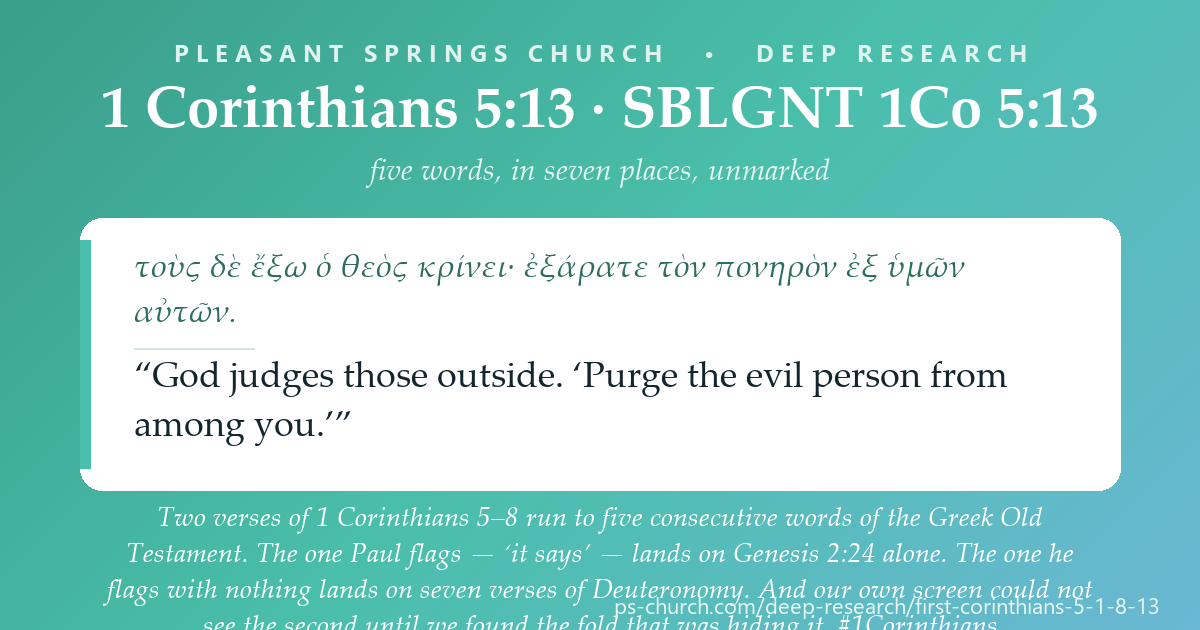
Screened against 30,637 verse units of the Greek Old Testament, exactly two of the 86 verses in 1 Corinthians 5–8 run to five, and they are opposites. 6:16 is marked — φησίν, it says — and its five words land on one verse, Genesis 2:24, tie band 1. 5:13 is marked with nothing at all, and its five words land on seven verses of Deuteronomy, tie band 7. And the shelf’s own screen scored the second one at two, because MorphGNT writes Paul’s ἐξ as ἐκ and CATSS does not — 234 tokens across the Greek New Testament, a fold the shelf had audited for the negative and never for the preposition.
“God judges those outside. ‘Purge the evil person from among you.’”1 Corinthians 5:13 · five words of Deuteronomy in seven places, tie band 7 — and no citation formula at all
And the same screen is nearly blind to the passage everyone can see. 1 Corinthians 5:6–8 — old leaven, a new lump, unleavened, Christ our Passover has been sacrificed — measures one, two and one against the whole of Greek Exodus. Both facts are true at once, and a page that printed only the first would be lying by omission.
Three things a reader can check without any tools
1. Read 1 Corinthians 5:13, then read Deuteronomy 13:5, 17:7, 19:19, 21:21, 22:21, 22:24 and 24:7 in English, one after another. Seven capital cases, one closing sentence. Then ask why Paul, who could have written as it is written, simply said it.
2. Count the do you not knows in chapters 5 and 6. There are seven; there are none in chapters 7 and 8. Paul stops asking that question the moment he starts answering their letter. Ask what changes about his tone when the questions are theirs.
3. Read 6:9–11 out loud without stopping at verse 10. The list is not the end of the sentence. And such were some of you. But you were washed, you were sanctified, you were justified. Three things done to them, none of them by them.
Step in response: take 8:13 at its word. Paul had the better argument and declined to use it. Find the one place this week where you are right, and where being right would cost somebody else something — and give it up. Knowledge puffs up; love builds up.
Four-chapter study, 86 verses in scope, all four chapters represented in the codex above. Greek New Testament and ESV.
1 Corinthians 5:13 · to share
Greek New Testament + ESVEvery Deep Research page traces its passage across the whole sweep — the Old Testament, the Second-Temple world between the testaments (historical witnesses, not Scripture), and the New Testament. Follow the thread:
Pleasant Springs Church — Deep Research
Research method after Michael S. Heiser’s Bible Research Method (examine dictionaries → ancient literature → important words → textual connections → academic publications → share), with the Pleasant Springs “Author & Audience” foundation. Scripture set in the Hebrew, the Greek editions named on each page and the ESV (Old Testament), and the Greek New Testament and the ESV (New Testament), per the practice of Pleasant Springs Church. 1 Corinthians research grounded in Thiselton (NIGTC), Fee (NICNT), Ciampa & Rosner (Pillar), Garland (BECNT), Hays (Interpretation) and Fitzmyer (Anchor Yale), with Rosner’s Paul, Scripture and Ethics on chapters 5–7, Winter on Roman Corinth, and Beale & Carson on the Old Testament use. Text: Greek New Testament from the SBL Greek New Testament as digitized by MorphGNT; Greek Old Testament from Rahlfs’ Septuaginta as digitized by CATSS; English from the ESV. ⚠️ VERSE NUMBERING — there is no offset anywhere in 1 Corinthians, and the page says so rather than leaving it unsaid. 1 Corinthians runs 31 / 16 / 23 / 21 / 13 / 20 / 40 / 13 / 27 / 33 / 34 / 31 / 13 / 40 / 58 / 24 = 437 verses in the SBLGNT as digitized by MorphGNT and 437 in the English editions checked here; chapters 5–8 run 13 / 20 / 40 / 13 = 86 verses in both. Every reference on this page means the same verse in both columns. One of the Old Testament verses this page reaches does carry an offset. Of the seven Deuteronomy verses sharing five words with 1 Corinthians 5:13, six are numbered alike in Hebrew, Greek and English; but CATSS and Masoretic Deuteronomy 13:6 is Deuteronomy 13:5 in the English editions, because the Hebrew and Greek print as 13:1 what the English prints as 12:32, so chapter 13 runs one verse ahead from its start (Masoretic and CATSS Deuteronomy 13 has nineteen verses; the English has eighteen). Genesis 2:24, Leviticus 18:22, Leviticus 20:13 and Exodus 12 are numbered alike in all three. ⚠️ The measurement, in full. Greek against Greek. MorphGNT field 6, the normalised word, on both sides for New Testament comparisons; CATSS FORM column (cols 0–24), beta-code transliterated first, for the Greek Old Testament. Both sides lowercased, accents and breathings dropped, final sigma folded, then filtered to Greek letters — the same filter applied to every corpus. Word forms, never lemmas. The SBLGNT apparatus sigla were stripped from the printed Greek before measuring. Corpora: the 86 verses of 1 Corinthians 5–8 against 30,637 verse units across 64 CATSS files and against the 7,841 other verses of the Greek New Testament. Lemma counts were taken from the MorphGNT lemma column over all 137,554 word tokens of the Greek New Testament. Exhaustive and deterministic; nothing sampled, so no seed applies. ⚠️ THE PAGE CORRECTS THE INSTRUMENT AND SAYS SO. MorphGNT’s normalised column folds spellings that CATSS leaves unfolded: across all 137,554 New Testament tokens, οὐκ → οὐ (825), ἐξ → ἐκ (234), οὐχ → οὐ (105), plus 162 supplied movable letters. The negative fold was already audited on this shelf; the preposition fold was not, and it is what hid 1 Corinthians 5:13. Every figure marked “corrected” above was produced by applying οὐκ ≡ οὐχ ≡ οὐ and ἐξ ≡ ἐκ to both sides at comparison time. normalize.py is frozen and regression-locked and was not edited; a reader running the shelf’s standing screen today will still get 2 for 5:13, and the page prints both numbers. The fold can only ever break a run, never invent one, so every figure it touches is too low and none is too high. Exactly four of the 86 rows change their run length; nine more keep their run and shift their tie band. ⚠️ THE CORPUS GREW WHILE THIS PAGE WAS BEING WRITTEN. The study opened against 44 CATSS files, 23,061 verse units, with Greek Exodus, Leviticus and Numbers absent and screened separately; it closes against 64 files, 30,637 verse units, with all three inside the total (Exodus 1,165 rows, Leviticus 859, Numbers 1,287). Every figure on this page is against 30,637. The two runs of five did not move; several tie bands did, and the page names which. Older pages on this shelf print 23,061 against 44 files and were right when they were made — a tie band is a property of the corpus searched, not of the verse. ⚠️ What a reported 1 or 2 means here. This page uses the shelf’s Greek-side convention, with unigram fallback ON: a row reported as 1 shares single words but no two consecutive words. It does not mean the row shares nothing. One row of this study reports 1 against the whole Greek Old Testament — 7:18 — and two more do against Greek Exodus alone, 5:6 and 5:8. The Hebrew-side pages on this shelf use the opposite convention, where 0 carries that meaning, and the two must not be read across. ⚠️ Tie bands are printed beside every run, because a run without its band is misleading: 1 Corinthians 5:5 reaches three into 285 verses at once, and 5:13 reaches five into seven — the band is the difference between a formula and a contact, and on this page it is also the difference between the two runs of five. ⚠️ Direction of influence is never asserted. Nothing here says that 1 Corinthians 5:6 copies Galatians 5:9 or the reverse; nothing derives ἀρσενοκοίτης from Leviticus; nothing settles the lexical argument over 6:9, and the page names that argument as unsettled rather than choosing a side and calling it a measurement. Typology is handled per the house position: what the text says, what the New Testament itself draws, and what we see from this side of the cross — with the seeing left to the reader.
Scripture quotations marked ESV are from the ESV® Bible (The Holy Bible, English Standard Version®), © 2001 by Crossway, a publishing ministry of Good News Publishers. ESV Text Edition: 2016. Used by permission. All rights reserved. The ESV text may not be quoted in any publication made available to the public by a Creative Commons license, and the ESV may not be translated in whole or in part into any other language. www.esv.org
|
Did this study bless you today? 💚 Give to Support PS Church100% of gifts go to the General Fund — thank you. |