Twice in three chapters Paul appeals to a word of the Lord. At 9:14 he writes the Lord commanded. At 11:23 he writes I received from the Lord. Screened word for word against all 7,927 verses of the Greek New Testament, 1 Corinthians 11:25 shares ten consecutive words with Luke 22:20 — tie band one, and across the whole letter only one other row reaches ten, the grace-and-peace formula in 1:3 that five other letters carry too. 1 Corinthians 9:14 shares one word with Luke 10:7. Both verses claim the same authority; only one of them keeps the wording, and no amount of counting will tell you what that means. ⚠️ Then the page has to print the thing that stands against its own headline. The SBL Greek New Testament this run was measured from encloses Luke 22:19b–20 in square brackets. In a text that drops the bracketed words, Luke 22:20 does not exist and the run is zero. See the method →
1 Corinthians 9:1–11:34 (selections)
Greek New Testament (SBLGNT, via MorphGNT) · ESV⚠️ The offset does reach this page, once, sideways. 1 Corinthians 10:26 shares six consecutive words with Greek Psalm 23:1, which is Hebrew and English Psalm 24:1 — the Septuagint Psalter runs one number behind the Masoretic from Psalm 9/10 through 147. This page writes that reference the way the shelf writes it everywhere: Psalm 24:1 · LXX 23:1. The Greek psalm also carries a superscription the Hebrew does not: τῆς μιᾶς σαββάτων.
★ Two appeals to a word of the Lord, three chapters apart. 1 Corinthians 9:14 says the Lord commanded and shares one word with Luke 10:7. 1 Corinthians 11:23–25 says I received from the Lord and shares ten consecutive words with Luke 22:20, tie band one. Stage 4 gives the measurement, the tie bands, the counter-examples — and the square brackets the printed Luke puts around the second one.
The Shape of the Passage
A sequence in two blocks — with one envelope the vocabulary really does carryThis is the one passage on the shelf where the writer stops to argue about himself. Chapter 9 is a defence — ἡ ἐμὴ ἀπολογία τοῖς ἐμὲ ἀνακρίνουσιν, my defence to those who would examine me (9:3) — and everything the page can say about the author of these chapters is said by the chapters themselves. The rest is inference, and the page keeps it separate from the count.
Author
A man who has rights and will not use them. ἐξουσία stands six times in 9:4–18: to eat and drink, to take along a believing wife, to be free of manual labour, to be supported. Then 9:12: ἀλλ’ οὐκ ἐχρησάμεθα τῇ ἐξουσίᾳ ταύτῃ — but we have not made use of this right. The argument is not that he lacks the right; it is that he has it and declines it.
He names a coworker and a rule of comparison. Barnabas at 9:6, Cephas at 9:5, the other apostles and the brothers of the Lord in the same verse. κερδαίνω — that I might win — five times in 9:19–22, and the fifth is the one everyone quotes: τοῖς πᾶσιν γέγονα πάντα.
What he claims about his sources, twice, in different words. At 11:2, καθὼς παρέδωκα ὑμῖν τὰς παραδόσεις — as I delivered the traditions to you. At 11:23, ἐγὼ γὰρ παρέλαβον ἀπὸ τοῦ κυρίου, ὃ καὶ παρέδωκα ὑμῖν. The same verb pair opens the creed at 15:3, and those are the only two places in 1 Corinthians where both verbs stand together. Measured against each other, 11:23 and 15:3 share a run of 2 — the formula is a formula in sense, not in wording.
Audience
An assembly that eats together and eats badly. ἐκκλησία occurs 22 times in 1 Corinthians, three of them in chapter 11 (11:16, 11:18, 11:22). They συνέρχεσθε — come together — and the letter says the coming together is for the worse and not for the better (11:17). There are σχίσματα (11:18); one goes hungry and another is drunk (11:21).
They buy meat in a market and get invited to dinner. μάκελλον at 10:25 — the provision market — occurs once in the whole Greek New Testament and is a Latin word (macellum) carried into Greek. The situation at 10:27 is an invitation from an unbeliever; the situation at 10:28 is somebody at the table saying this has been offered in sacrifice. συνείδησις five times in five verses, and the last two occurrences are about somebody else’s.
They are Greek enough that Paul argues from a stadium. 9:24–27 is built out of the language of the games: the στάδιον, the βραβεῖον, the perishable στέφανος, the boxer who does not beat the air. That the Isthmian games were held near Corinth is reported here from the reference works and was not measured; what was measured is that the vocabulary is athletic and that δουλαγωγέω occurs nowhere else in the New Testament.
Orient on Corinth, on apostolic support, on the Lord’s Supper traditions and on the head-covering question — before touching a single number.
Search by topic: Corinth; Corinthians, First Letter to the; apostle; Lord’s Supper; Eucharist; Last Supper; food offered to idols; conscience; Isthmian games; head covering; veil; meat market (macellum); Western non-interpolations.
Which articles are relevant?
- Anchor Bible Dictionary — “Corinth,” “Corinthians, First Epistle to the,” “Lord’s Supper,” “Idol Meat,” “Games, Greek.”
- Dictionary of Paul and His Letters (IVP) — “Lord’s Supper,” “Food Offered to Idols,” “Apostle,” “Head,” “Conscience,” “Tradition.”
- New International Dictionary of NT Theology & Exegesis — ἐξουσία, συνείδησις, κοινωνία, ἀνάμνησις, κεφαλή, τύπος.
- Commentary on the New Testament Use of the Old Testament, ed. G. K. Beale and D. A. Carson (Baker, 2007) — the 1 Corinthians chapter, where the Deuteronomy 25:4 and Exodus 32:6 citations are argued at length.
- A Textual Commentary on the Greek New Testament, Bruce M. Metzger — for Luke 22:19b–20, which is the single largest textual question standing behind this page’s headline number.
- None of these were consulted for the measurements below. The measurements were run on the text files named in the footer.
Settle the numbering first — and note what is different about a New Testament page
Every page on this shelf states its versification offset, including the pages where the answer is that there is none. On a New Testament book the answer is stronger than that: there is no second column to be offset from.
| ch 9 | ch 10 | ch 11 | chs 9–11 | whole letter | |
|---|---|---|---|---|---|
| SBLGNT (MorphGNT) | 27 | 33 | 34 | 94 | 437 |
| ESV | 27 | 33 | 34 | 94 | 437 |
The SBLGNT row was counted off disk; the ESV row is the printed edition’s shape, because no ESV 1 Corinthians file is held here. There is no Masoretic and no Septuagint 1 Corinthians, so the columns on this page are Greek New Testament and English, and every chapter-and-verse number means the same verse in both.
⚠️ The offset reaches the page once, through a quotation. 1 Corinthians 10:26 shares six consecutive words with the Greek psalm CATSS numbers 23:1. That psalm is Psalm 24 in the Hebrew and in every English Bible, because the Septuagint Psalter runs one number behind the Masoretic from Psalm 9/10 through Psalm 147. The shelf writes such references Psalm 24:1 · LXX 23:1, and this page does the same. There is also a content difference in the superscription: the Greek carries τῆς μιᾶς σαββάτων where the Hebrew has only לְדָוִד מִזְמוֹר.
⚠️ One chapter division falls where the argument does not. 11:1 (be imitators of me) closes the argument that began at 8:1; 11:2 opens a new one. The page keeps the printed numbering throughout, because the ESV and the MorphGNT file both use it, and says so rather than quietly renumbering.
The wilderness the chapter cites, the market the chapter names, and the honest gap where half the evidence should be.
⚠️ The wilderness warning cites eight episodes, and not one of their source books is inside the corpus this page screened
1 Corinthians 10:1–10 is a chain of Old Testament episodes, and every single one of them comes from Exodus or Numbers. Until 30 August 2026 neither book was on this disk, and this section existed to say so. Both are held now, every screen has been re-run, and the old state of the page is kept below rather than deleted.
⚠️ WHAT THIS SECTION USED TO SAY, AND WHY IT IS PRINTED HERE. It read: “neither book is inside the 44 CATSS files, 23,061 verse units, that every screen on this page was run against… Greek Exodus, Leviticus, Numbers and Joshua did reach this disk on 2026-08-30, but they are not mapped into the shelf’s measured corpus, so not one screen figure on this page saw them.” That second sentence was itself wrong when it was written. The shelf’s Greek Old Testament loader reads every .mlxx file present in the corpus directory; it does not consult the book map to decide what to screen. The twenty files were inside the measured corpus from the moment they landed, and the page said they were not. The screens on this page have now been re-run and the figures below are the complete Greek Old Testament as CATSS holds it — 64 files, 30,637 verse units held and 30,348 screened, the Odes set aside, with no gaps in it. Where a figure moved, both numbers are printed.
| 1 Cor | the episode | source | Greek screened? | what the row measures against the whole Greek OT |
|---|---|---|---|---|
| 10:1 | the cloud and the sea | Exodus 13–14 | yes | 3, band 29 |
| 10:3 | the same spiritual food | Exodus 16 | yes | 2, band 235 |
| 10:4 | the rock that followed | Exodus 17 · Numbers 20 | yes | 3, band 2 |
| 10:5 | overthrown in the wilderness | Numbers 14 | yes | 3, band 133 (134 for one day, while the Odes were screened) |
| 10:7 | “the people sat down to eat” | Exodus 32:6 | yes | 5, band 1 — and the partner is Exodus 32:6 itself |
| 10:8 | twenty-three thousand fell | Numbers 25:9 | yes | 2, band 40 |
| 10:9 | destroyed by serpents | Numbers 21:5–6 | yes | 3, band 2 |
| 10:10 | grumbling, and the Destroyer | Numbers 16–17 | yes | 2, band 52 |
Seven of the eight rows barely move, and that is the finding. Paul’s wilderness chain is allusion, not quotation — he names eight episodes in ten verses and reproduces the wording of none of them, except the one he explicitly flags as a quotation. The corpus hole was hiding a real result, and the result is a negative.
⚠️ AND HERE IS THE WHOLE CASE FOR NAMING A CORPUS HOLE INSTEAD OF LIVING WITH ONE.
| 1 Corinthians 10:7, screened against… | deepest partner | run | band |
|---|---|---|---|
| 44 CATSS files, 23,061 units (the published figure) | 2 Esdras 18:12 (= Nehemiah 8:12) | 4 | 1 |
| 64 CATSS files, Odes set aside — 30,348 units screened | Exodus 32:6 | 5 | 1 |
10:7 is introduced by ὥσπερ γέγραπται — as it is written — and until 30 August 2026 the book it was written in was not on this disk. The best partner the engine could find was Nehemiah 8:12: a feast, with nothing whatever to do with a golden calf, returned at a tie band of one, which is the band a real citation returns. That is what a corpus hole looks like from the inside: not a blank, but a confident wrong answer at a convincing tie band.
With Greek Exodus on the disk the same screen, unchanged, returns Exodus 32:6 — καὶ ἐκάθισεν ὁ λαὸς φαγεῖν καὶ πιεῖν καὶ ἀνέστησαν παίζειν — at a run of 5, tie band 1: ἐκάθισεν ὁ λαὸς φαγεῖν καί. The verse Paul says he is quoting is now the verse the screen returns, and it is the second-deepest row on this page against the Greek Old Testament. This was previously printed here as a hand check off an unmapped file. It is a screen result now, and it is folded into the distribution and the tie bands in Stage 4 like every other figure.
What the Hebrew can still say, since the Masoretic text of all of it is held
The Hebrew side of the wilderness chain is on this disk in full, and two things in it are worth printing.
| text | reading |
|---|---|
| Masoretic Exodus 32:6 | וַיֵּשֶׁב הָעָם לֶאֱכֹל וְשָׁתוֹ וַיָּקֻמוּ לְצַחֵק — the people sat down to eat and drink, and rose up to play |
| 1 Corinthians 10:7 | Ἐκάθισεν ὁ λαὸς φαγεῖν καὶ πεῖν, καὶ ἀνέστησαν παίζειν |
| Masoretic Numbers 25:9 | אַרְבָּעָה וְעֶשְׂרִים אָלֶף — twenty-four thousand |
| 1 Corinthians 10:8 | εἴκοσι τρεῖς χιλιάδες — twenty-three thousand |
The first pair corresponds item for item — sat, people, eat, drink, rose, play, in that order — and it now carries a screen figure of 5 at a tie band of one, not a hand check. The second pair differs by a thousand. ⚠️ And Greek Numbers, screened now rather than read by hand, stands with the Hebrew: CATSS Numbers 25:9 reads τέσσαρες καὶ εἴκοσι χιλιάδες — twenty-four thousand. Both columns of the Old Testament say twenty-four and Paul says twenty-three. The page reports the divergence and does not say which number is ‘right’ or how the other one arose — and it can now say that the Greek does not supply the twenty-three either, which is something it could not say at all a corpus ago.
The market, the games, and the temple dining rooms — reported, not measured
Three cultural facts stand behind these chapters. The page separates what it counted from what it read.
Counted: μάκελλον at 10:25 occurs once in the whole Greek New Testament. It is the Latin macellum in Greek letters. στάδιον, βραβεῖον, στέφανος…φθαρτός, πυκτεύω and ὑπωπιάζω all stand in 9:24–27, and δουλαγωγέω occurs nowhere else in the New Testament. τράπεζα occurs twice in 1 Corinthians, both in 10:21, opposite τράπεζα κυρίου.
⚠️ Read, not measured. That Corinth had a provision market and that the biennial Isthmian games were held nearby; that the Isthmian victor’s wreath was of pine or celery; that the Asklepieion and other Corinthian sanctuaries had dining rooms in which a meal like the one at 10:27–28 could be eaten — all of that comes from the reference literature and from excavation reports, none of which is on this disk. No inscription, no archaeological report and no papyrus was consulted. The page names these as background and does not build a single number on them.
Six words that carry the passage, and how rare each one actually is.
Six times in 9:4–18, then once more at 11:10 — seven of the letter’s ten occurrences in these three chapters. It is the word chapter 9 is about: the right to eat and drink, to take a wife along, not to work with one’s hands. And at 9:12 Paul says he has not used it. When it returns at 11:10 the ESV supplies a symbol of; the Greek says only ἐξουσίαν ἔχειν ἐπὶ τῆς κεφαλῆς.
9:9, and nowhere else in the Greek New Testament. Greek Deuteronomy 25:4 uses φιμόω, which occurs seven times in the New Testament and never in 1 Corinthians; 1 Timothy 5:18 quotes the same commandment and uses φιμόω too. Paul writes an explicit it is written and then does not write the Septuagint’s verb, which is why the row measures 2. The page reports it and asserts nothing about how it happened.
Eight times in 1 Corinthians — three in chapter 8, five in 10:25–29, and none at all in chapter 9. Thirty occurrences in the whole Greek New Testament, so this letter holds more than a quarter of them. With εἰδωλόθυτον it forms the envelope the structure diagram prints: the two words together stand thirteen times in 1 Corinthians and not once inside chapter 9.
Four occurrences in the Greek New Testament, and three of them are this meal: Luke 22:19, 1 Corinthians 11:24, 1 Corinthians 11:25. The fourth is Hebrews 10:3, where the sacrifices are a ἀνάμνησις ἁμαρτιῶν — a yearly reminder of sins. The same noun for what the old sacrifices did and what the new meal does. The page prints the count and leaves the theology to the reader.
Two occurrences in the whole Greek New Testament: 1 Corinthians 11:20 (κυριακὸν δεῖπνον) and Revelation 1:10 (κυριακῇ ἡμέρᾳ). The Lord’s supper and the Lord’s day, and the adjective occurs nowhere else. It is not τοῦ κυρίου — not a genitive of possession but an adjective, Lordly, imperial in ordinary Greek usage. What either phrase meant to its first readers is not something this page can count.
Five occurrences of the word-group in the Greek New Testament, and all five are in 1 Corinthians 11:5–13 — the verb κατακαλύπτομαι, as MorphGNT lemmatises it, three times (11:6 twice, 11:7), and the alpha-privative adjective ἀκατακάλυπτος twice (11:5, 11:13). Neither word occurs in any other New Testament book. Alongside it κεφαλή stands nine times in 11:3–10. The paragraph is lexically self-contained, which is one reason it is so hard to read against anything else.
The three chapters counted, word by word
1,441 words, 94 verses — 449 in chapter 9, 463 in chapter 10, 529 in chapter 11. Counted off the MorphGNT file.
| word | times in 9–11 | where |
|---|---|---|
| κεφαλή | 9 | 11:3 (3×), 11:4 (2×), 11:5 (2×), 11:7, 11:10 |
| ποτήριον | 8 | 10:16, 10:21 (2×), 11:25 (2×), 11:26, 11:27, 11:28 — 1 Corinthians holds 8 of the New Testament’s 31, more than any Gospel |
| ἐξουσία | 7 | 9:4, 9:5, 9:6, 9:12 (2×), 9:18 — and 11:10 |
| ἄρτος | 7 | 10:16, 10:17 (2×), 11:23, 11:26, 11:27, 11:28 |
| συνείδησις | 5 | 10:25, 10:27, 10:28, 10:29 (2×) — none in chapter 9 |
| κατακαλυπτ- group | 5 | 11:5 and 11:13 ἀκατακάλυπτος, 11:6 (2×) and 11:7 the verb — all five in the New Testament |
| κερδαίνω | 5 | 9:19, 9:20 (2×), 9:21, 9:22 |
| πάντες in 10:1–4 | 5 | 10:1 (2×), 10:2, 10:3, 10:4 — and none in 10:5 |
| δαιμόνιον | 4 | 10:20 (2×), 10:21 (2×) — every occurrence in the letter |
| πνευματικός | 4 | 9:11, 10:3, 10:4 (2×) — the letter holds 15 of the New Testament’s 26 |
| ἐπαινέω | 4 | 11:2, 11:17, 11:22 (2×) — 4 of the New Testament’s 6 |
| ἀνάμνησις | 2 | 11:24, 11:25 |
| τράπεζα | 2 | 10:21 (2×) |
| διαθήκη | 1 | 11:25 — the only occurrence in 1 Corinthians |
And one broader count: σῶμα stands 46 times in 1 Corinthians against 142 in the whole Greek New Testament — nearly a third of them in one letter. Six of the 46 are in these chapters (9:27, 10:16, 10:17, 11:24, 11:27, 11:29), and the last of those is the one the commentaries fight over.
Twenty-four imperatives — and only one of them in chapter 9
Counted from the MorphGNT parsing column, mood field: 1 Corinthians 9–11 carries 24 imperative verb forms, distributed like this.
| chapter | verses | imperatives | which |
|---|---|---|---|
| 9 | 27 | 1 | τρέχετε (9:24) |
| 10 | 33 | 12 | 10:7, 10, 12, 14, 15, 18, 24, 25, 27, 28, 31, 32 |
| 11 | 34 | 11 | 11:1, 6 (2×), 13, 24, 25, 28 (3×), 33, 34 |
The chapter about rights is the chapter with no commands in it. It argues by question instead — 9:1 alone asks four. The caveat: this counts imperative forms as MorphGNT tags them. It does not count hortatory subjunctives (μηδὲ πορνεύωμεν, 10:8, is one), commanding futures, or imperatival participles — so the real rate of commanding is higher in every chapter, including chapter 9.
Two claims to a word of the Lord, ten words apart from one word — and four results in the same section that show why that has to be handled carefully.
The measurement
All 94 verses of 1 Corinthians 9–11 were screened twice: once against the other 7,833 verses of the Greek New Testament, once against all 30,348 screened verse units of the complete Greek Old Testament as CATSS holds it. Contiguous runs of whole word forms, never lemmas, with the tie band beside every run.
Against the rest of the Greek New Testament, across the 94 rows: all 94 reach two, 56 reach three, 19 reach four, 4 reach five, the same 4 reach six, one reaches ten, and nothing reaches eleven. The distribution has holes in it: no row in these chapters tops out at exactly five, seven, eight or nine. Against the Greek Old Testament: 93 of the 94 reach two, 50 reach three, 6 reach four, 2 reach five, one reaches six, and nothing reaches seven. ⚠️ That line read 51 at three for one day, while the Odes were being screened; the fifty-first was a canticle reprinting a book the corpus already held.
⚠️ THE OLD TESTAMENT HALF OF THAT WAS RE-RUN ON 30 AUGUST 2026 AND THE OLD FIGURES ARE PRINTED RATHER THAN QUIETLY REPLACED. Over 44 files and 23,061 verse units the Old Testament line read: 93 of the 94 reach two, 47 reach three, 6 reach four, one reaches six, and nothing reaches seven — and no row reached five at all. With Greek Exodus, Leviticus, Numbers, both Joshua recensions and the deuterocanonical books on the disk — witnesses, not Scripture, named as such wherever one supplies a result — 47 becomes 50 and a row appears at five where none stood before. That row is 10:7, and it is the verse the chapter explicitly introduces as a quotation. The ceiling of six did not move, and the four and the seven did not move. The New Testament half is untouched: that corpus did not change.
| row | deepest partner in the rest of the NT | run | band | deepest partner in the Greek OT held here | run | band |
|---|---|---|---|---|---|---|
| 1 Cor 11:25 | Luke 22:20 | 10 | 1 | Ezek 23:33 · Gen 40:11 · Ps 22:5… | 3 | 32 |
| 1 Cor 10:23 | 1 Corinthians 6:12 | 6 | 1 | Dan (Th) 5:22 · Sirach 41:16 (a witness, not Scripture)… | 2 | 7 |
| 1 Cor 11:12 | 2 Corinthians 5:18 | 6 | 1 | 2 Kings 8:3 · Gen 2:23 · Hos 4:9… | 3 | 21 |
| 1 Cor 11:24 | Luke 22:19 | 6 | 1 | Isaiah 42:8 | 4 | 1 |
| 1 Cor 10:13 | 2 Corinthians 1:18 | 4 | 1 | Exod 3:12 · Gen 17:15 · Gen 21:12… | 3 | 24 |
| 1 Cor 9:24 | 1 Corinthians 6:2 | 4 | 1 | nothing above two | 2 | 106 |
| 1 Cor 10:20 | Romans 1:13 | 4 | 1 | Deuteronomy 32:17 · Baruch 4:7 | 4 | 2 |
| 1 Cor 10:26 | Revelation 20:11 | 3 | 1 | Psalm 24:1 · LXX 23:1 | 6 | 1 |
| 1 Cor 10:7 | Mt 4:16 · Mk 7:6 · Lk 1:21… | 2 | 19 | Exodus 32:6 ⚠️ new 30 Aug 2026; was 2 Esdras 18:12 at 4 | 5 | 1 |
| 1 Cor 11:1 | 1 Corinthians 4:16 | 3 | 1 | 2 Chr 30:7 · Zech 1:4 | 2 | 2 |
| 1 Cor 9:14 | Mt 17:12 · Mt 18:35 · Jn 5:21… | 3 | 15 | Hos 4:9 · Sir 6:17… | 3 | 26 |
| 1 Cor 9:9 | Mt 22:30 · Jn 4:37 · 1 Cor 4:15… | 2 | 127 | Esth 9:1 · Isa 51:14… | 3 | 7 |
| 1 Cor 10:15 | John 16:20 · 1 John 2:24 | 2 | 2 | single words only | 1 | 8,342 |
⚠️ Five figures in that table moved when the last twenty CATSS files landed on 30 August 2026, and every one of them moved in the same direction. Tie bands can only grow when the corpus grows, and they did: 11:25 from 16 to 32, 10:13 from 15 to 24, 9:24 from 88 to 106, 9:14 from 23 to 26, 10:23 from 2 to 7, and the single-word count on 10:15 from 6,416 to 8,342. A tie band is the part of a run figure that carries the meaning, and a tie band measured over a small corpus flatters every result it touches. Nothing on this page was made deeper by the larger corpus except 10:7. Two things were made shallower, and they are set out next.
⚠️ Four of those bands then came back down a little, and the page prints the intermediate values rather than the endpoints alone. For one day the Odes were inside the screened corpus, and while they were, 11:25 read 33, 9:24 read 108, 9:14 read 27 and the 10:15 single-word count read 8,398. With the canticles set aside they are 32, 106, 26 and 8,342. Every one of those differences is a canticle reprinting a passage the corpus already held. The figures in the table above are the screened ones.
⚠️ THE ONE FINDING ON THIS PAGE THAT THE LARGER CORPUS WEAKENED. 1 Corinthians 10:20 — they sacrifice to demons and not to God — was published here as 4 consecutive words with Greek Deuteronomy 32:17 at a tie band of one, and a tie band of one is what makes a four-word run worth printing at all. Over 64 files, with the Odes screened, the band was three. The two new partners were Odes 2:17 and Baruch 4:7 — witnesses, not Scripture, both of them, and they are not equal witnesses:
- Odes 2:17 is Deuteronomy 32:17. The Odes are a liturgical appendix to the Greek Psalter that reprints canticles from elsewhere, and Ode 2 is the Song of Moses copied out of Deuteronomy 32. It is not an independent occurrence and this page does not count it as one — it is the same text under a second shelfmark. ⚠️ Not quite character-identical, and the shelf says so: the Ode reads καινοὶ καὶ πρόσφατοι where Deuteronomy 32:17 reads καινοὶ πρόσφατοι, five words past the end of the run. The run itself is the same four words in both.
- Baruch 4:7 is independent, and it is interesting. παρωξύνατε γὰρ τὸν ποιήσαντα ὑμᾶς θύσαντες δαιμονίοις καὶ οὐ θεῷ — for you provoked the one who made you, sacrificing to demons and not to God. Baruch is a witness, not Scripture, and it is doing something close to what Paul does: taking the Song of Moses’ phrase and turning it on its readers in the second person. Deuteronomy and the Ode both have ἔθυσαν, they sacrificed; Baruch has the participle and puts the accusation in παρωξύνατε, you provoked.
So the honest statement of the finding at that point was: 4 consecutive words, tie band 3, of which one partner is Deuteronomy 32:17, one is Deuteronomy 32:17 again under another name, and one is a Second-Temple writer using the same phrase the same way. ⚠️ That is a weaker result than the page published and a more interesting one, because it shows the phrase was in circulation rather than being lifted straight off one scroll — and this shelf prints the number that came back, not the number it wanted.
⚠️ AND THEN THE ODES WERE TAKEN OUT OF THE SCREENING CORPUS, AND THIS FINDING MOVED A SECOND TIME — BACK TOWARDS WHERE IT STARTED. BOTH MOVES ARE PRINTED.
The Odes are the fourteen liturgical canticles bound after the Greek Psalter, and this shelf no longer screens them as part of the Greek Old Testament. Ten of the fourteen are second copies of passages already in the corpus — Ode 1 is Exodus 15, Ode 2 is Deuteronomy 32, Ode 3 is 1 Samuel 2, Ode 4 Habakkuk 3, Ode 5 Isaiah 26, Ode 6 Jonah 2, Odes 7 and 8 Daniel (Th) 3, Ode 10 Isaiah 5, Ode 11 Isaiah 38 — so a verse standing once in the corpus appears to stand twice, and a tie band touching a canticle is doubled for no textual reason. That is exactly what happened to 10:20. The band of three was Deuteronomy 32:17, Baruch 4:7, and Deuteronomy 32:17 a second time. Screened now, the band is two.
The page had already said the Ode was not an independent occurrence, and printed the three anyway. That was the right call then and the number is better now. The finding as it stands: 4 consecutive words, tie band 2 — Deuteronomy 32:17 and Baruch 4:7. One is the Song of Moses; one is a Second-Temple writer, a witness and not Scripture, turning the Song of Moses’ phrase on his readers. The published band of one was too narrow, the band of three was inflated by a duplicate, and two is the count that means what a tie band is supposed to mean.
⚠️ The second reason the canticles are out is worth knowing even though it does not touch this page. Ode 9 is Luke 1 — the Magnificat and the Benedictus — and Ode 13 is Luke 2, the Nunc Dimittis: Gospel text excerpted for the daily office and copied back into a Greek Old Testament manuscript. Screened, Odes 9:48 matches Luke 1:48 at eighteen consecutive words — a run fewer than a dozen pairs in the whole corpus exceed. It is Luke matching Luke. The instrument was not broken — it found a real, exact agreement between two files on this disk, and could not know the two files are the same text. Nothing on these three chapters was affected by that, because no run here landed in Ode 9 or Ode 13; but a page that reports tie bands has to say what its corpus is made of.
The shelf holds 30,637 verse units in 64 files and screens 30,348. The 289-unit difference is the Odes, they stay on the disk, and every screened figure on this page is the 30,348.
The last row is worth reading twice. 1 Corinthians 10:15 — I speak as to sensible people; judge for yourselves what I say — shares no two consecutive words with any verse in the complete Greek Old Testament — all 64 CATSS files, 30,637 verse units held and 30,348 screened. ⚠️ That negative was published over a 44-file corpus and has been re-run over 64. It held. ⚠️ On the Greek side this shelf runs the screen with the single-word fallback on, so a 1 means “no two-word sequence anywhere, but the row does share single words” — 8,342 verse units share at least one of the row’s seven words, and the article ὁ does most of that work on its own (6,851 units); ὡς alone stands in 1,698. It is not a zero and the page does not print it as one. Over 44 files those figures were 6,416, 5,199 and 1,388; for one day, with the Odes screened, they were 8,398, 6,894 and 1,714.
The headline: ten words, and where the run starts and stops
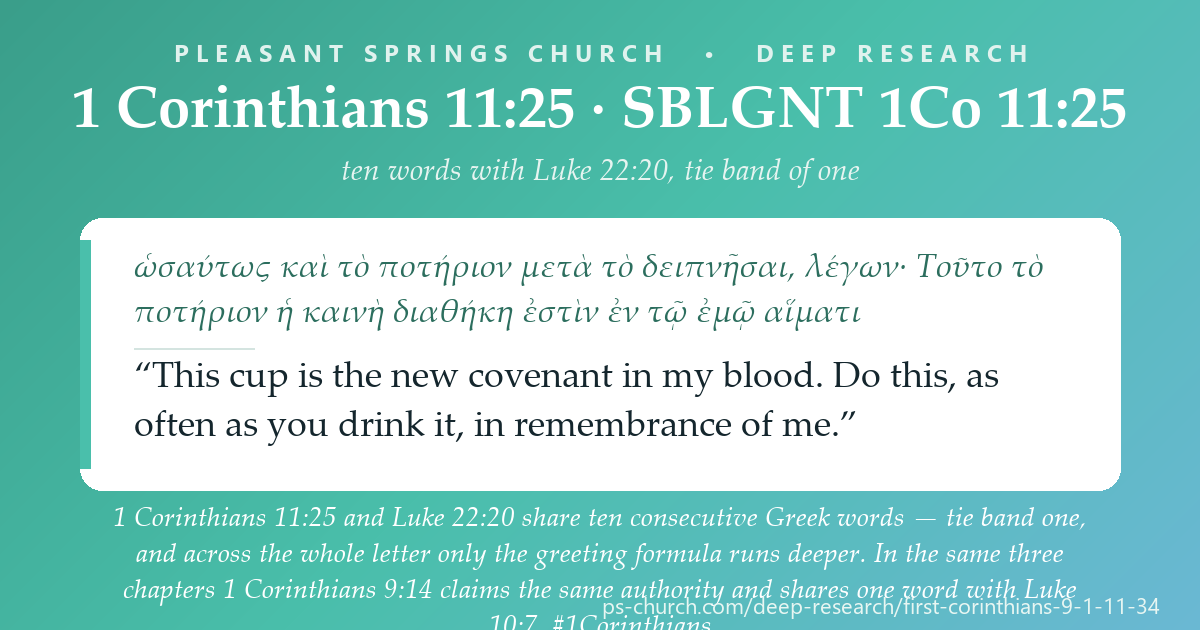
1 Corinthians 11:25 and Luke 22:20 share ten consecutive words. Nothing else in the Greek New Testament shares more than four with that row.
| text | the sentence |
|---|---|
| 1 Cor 11:25 | ὡσαύτως καὶ τὸ ποτήριον μετὰ τὸ δειπνῆσαι, λέγων· Τοῦτο τὸ ποτήριον ἡ καινὴ διαθήκη ἐστὶν ἐν τῷ ἐμῷ αἵματι |
| Luke 22:20 | καὶ τὸ ποτήριον ὡσαύτως μετὰ τὸ δειπνῆσαι, λέγων· Τοῦτο τὸ ποτήριον ἡ καινὴ διαθήκη ἐν τῷ αἵματί μου |
The run stops at both ends on something you can point at. Before it, both sentences carry ὡσαύτως καὶ τὸ ποτήριον — the same four words, in a different order, which the screen cannot count because it counts sequences. After it, Paul writes ἐστίν and Luke writes no copula at all; then Paul has ἐν τῷ ἐμῷ αἵματι and Luke ἐν τῷ αἵματί μου — the same idea, a different possessive. Four words of agreement fall outside the run on one side and three on the other.
The bread verse does the same thing at six. 1 Corinthians 11:24 and Luke 22:19 share τοῦτο ποιεῖτε εἰς τὴν ἐμὴν ἀνάμνησιν, run 6, tie band 1. And the whole three-verse Pauline block measures 3 against Matthew 26:26–28 and 3 against Mark 14:22–24 — the same three words, ἐστιν τὸ σῶμα, in both. Matthew and Mark carry τὸ αἷμά μου τῆς διαθήκης, my blood of the covenant; Paul and Luke carry ἡ καινὴ διαθήκη ἐν τῷ…αἵματι, the new covenant in my blood. Neither Matthew nor Mark has ἀνάμνησις at all.
⚠️ What the page will not say. Not that Paul is quoting Luke. Not that Luke is quoting Paul. Not that Luke was a companion of Paul and therefore wrote what Paul said, and not that a common liturgical form lies behind both. Direction of influence is never asserted on this shelf. What is measured is that two verses agree for ten consecutive words, that nothing else in the corpus comes near that row, that the other two Supper accounts agree for three, and that the agreement stops on a word-order difference and a copula.
The counter-examples, printed in the same section
1. The deepest run in the whole letter is a formula, and it is deeper than the headline.
Screened across all 437 verses of 1 Corinthians against the other 7,490 verses of the Greek New Testament, the deepest row is 1 Corinthians 1:3 at twelve consecutive words — with a tie band of five: Romans 1:7, 2 Corinthians 1:2, Ephesians 1:2, Philippians 1:2 and Philemon 3 carry the identical greeting. A run of twelve at a band of five is a fixed epistolary formula and tells you nothing about which letter got it from which. Only one other row in the letter reaches ten, and that is 11:25. The page prints the twelve first so that the ten is read against it.
2. Six consecutive words, tie band one — and nobody calls it a quotation.
1 Corinthians 11:12 and 2 Corinthians 5:18 share τὰ δὲ πάντα ἐκ τοῦ θεοῦ: six words, band one, exactly the profile that makes 11:24 look significant. One is about men and women and the other about the ministry of reconciliation. Six with a clean band is not, by itself, evidence of anything.
3. The Old Testament partner of “this is my body” is Isaiah saying “this is my name.”
| text | the words | run | band |
|---|---|---|---|
| 1 Cor 11:24 | Τοῦτό μού ἐστιν τὸ σῶμα | — | — |
| CATSS Isaiah 42:8 | ἐγὼ κύριος ὁ θεός τοῦτό μού ἐστιν τὸ ὄνομα | 4 | 1 |
Four consecutive words, a tie band of one, and it is the deepest contact this row makes with the entire Greek Old Testament. It is also an accident. τοῦτό μού ἐστιν τό is four ordinary words in an ordinary order; what follows is body in one and name in the other. A clean band does not make a connection.
4. Paul picks up Deuteronomy 32’s rarest verb and the screen scores zero.
1 Corinthians 10:22 asks ἢ παραζηλοῦμεν τὸν κύριον; — shall we provoke the Lord to jealousy? Greek Deuteronomy 32:21 has κἀγὼ παραζηλώσω αὐτούς. Measured against each other the two verses share no word form at all: run 0. Same verb, first person both times but plural against singular, and a different tense, and the screen compares forms, not lemmas. παραζηλόω occurs four times in the Greek New Testament — Romans 10:19, 11:11, 11:14 and here — and the other three are all in Romans 10–11, where Deuteronomy 32:21 is quoted outright at Romans 10:19. The connection every reader sees is one the counting cannot see, and that is the standing limit of this method.
5. The one place the screen and the citation formula agree.
1 Corinthians 10:26 quotes without saying so and measures 6 against Greek Psalm 24:1 · LXX 23:1, tie band 1 — the deepest Old Testament contact on the page. 1 Corinthians 9:9 says it is written in the Law of Moses and measures 2 against Greek Deuteronomy 25:4. The unmarked quotation is the verbatim one and the marked quotation is not.
The ox, in four texts
One commandment, one Hebrew verb, two different Greek verbs, and two New Testament letters that do not agree with each other.
| text | the sentence |
|---|---|
| Masoretic Deuteronomy 25:4 | לֹא־תַחְסֹם שׁוֹר בְּדִישׁוֹ — you shall not muzzle an ox in his threshing |
| CATSS Deuteronomy 25:4 | οὐ φιμώσεις βοῦν ἀλοῶντα |
| 1 Corinthians 9:9 | Οὐ κημώσεις βοῦν ἀλοῶντα — run 2 against the Greek Deuteronomy |
| 1 Timothy 5:18 | Βοῦν ἀλοῶντα οὐ φιμώσεις — the Septuagint’s verb, the other word order; run 2 against the Greek Deuteronomy as well |
Three Greek sentences of one commandment, and every pairing among them measures 2, because the only two words all three share in sequence are βοῦν ἀλοῶντα. The page reports the three wordings and does not say which is prior, which is quoting which, or why the verbs differ.
And the second half of 1 Timothy 5:18 makes the same point from the other side. It continues ἄξιος ὁ ἐργάτης τοῦ μισθοῦ αὐτοῦ, which shares five consecutive words with Luke 10:7. 1 Corinthians 9:14 makes the same claim about the same instruction and shares one. Two letters, one saying of the Lord, and only one of them reproduces the wording.
Where this page is weakest, what it could not reach, and the brackets that could take the headline away.
⚠️ The largest problem on this page: the SBLGNT brackets Luke 22:19b–20
The ten-word run is measured between 1 Corinthians 11:25 and Luke 22:20. In the MorphGNT file this page reads, Luke 22:19b–20 is printed inside square brackets.
The bracket opens in the middle of Luke 22:19 — Τοῦτό ἐστιν τὸ σῶμά μου [τὸ ὑπὲρ ὑμῶν διδόμενον… — and closes at the end of 22:20, after ἐκχυννόμενον]. That is the edition’s own signal that it does not regard the words as secure. Both of this page’s Lukan runs — the ten with 11:25 and the six with 11:24 — fall entirely inside the brackets. In a printed text that omits the bracketed words, Luke 22:20 does not exist, Luke 22:19 ends at this is my body, and both runs go to nothing.
What this page can and cannot say about that. It can say, and has verified off disk, that the brackets are there. It cannot tell you which manuscripts omit the passage, how the editors weighed them, or whether the shorter text is original — there is no critical apparatus on this disk at all. That the omission is associated with Codex Bezae and part of the Old Latin, and that Westcott and Hort classed it among the ‘Western non-interpolations,’ is reported here from the standard reference literature and was not measured. Anyone who wants the evidence should go to Metzger’s Textual Commentary and to the apparatus of NA28, neither of which was consulted.
Why the page keeps the finding anyway, and prints this section beside it. Because the measurement is a measurement of the printed text this shelf uses, and it is reported as such. A page that quietly measured a bracketed passage and called the result a discovery would be doing something dishonest; a page that suppressed the measurement would be doing something else dishonest. The number stands, with the brackets printed next to it, and the reader decides what it is worth.
How much of this passage is textually contested at all
Counted off the MorphGNT file, which carries the SBL editors’ variation sigla: 1 Corinthians 9–11 contains 82 marked variation units, and 56 of the 94 verses carry at least one.
Counting every opening siglum — ⸀ and ⸁ for single words, ⸂ and ⸄ for phrases — the chapters run 30 in chapter 9, 27 in chapter 10, 25 in chapter 11. Chapter 7 is the most heavily marked chapter in the letter, at 47. 1 Corinthians 11:25 carries one siglum, on ἐάν in ὁσάκις ἐάν — which falls outside the ten-word run; 11:24 carries two, at εἶπεν and ὑμῶν, and the second of those is why some English Bibles read my body, broken for you and the ESV reads only which is for you. 1 Corinthians 10:9 carries three, one of them on the word Χριστόν — the edition itself flags whether the wilderness generation tested Christ or the Lord.
⚠️ A siglum count is not an evaluation. It says the editors saw a variant worth marking; it says nothing about how strong it is, because the readings themselves are not on this disk. The page reports the density and stops.
The corpus holes, named — and then closed, and what closing them did
This section used to name a hole. It now reports what came out of it.
What stood here read: “Greek Exodus, Leviticus, Numbers and Joshua are not among the 44 CATSS files these screens ran against… Every screen figure on this page is the 44-file, 23,061-unit corpus and nothing else; anyone re-running them with Exodus, Leviticus, Numbers and Joshua mapped in should expect the chapter 10 rows to move, and to move toward longer runs.” That was a prediction, and it has been tested. All twenty remaining CATSS files landed on 30 August 2026 — Exodus, Leviticus, Numbers, both Joshua recensions and the deuterocanonical books, which this shelf reads as witnesses, not Scripture and labels so wherever one supplies a result — and every screen on this page was re-run over 64 files, 30,637 verse units held — 30,348 of them screened, the Odes having since been set aside as a liturgical appendix that reprints ten passages the corpus already holds and two chapters of Luke.
| what the page predicted | what happened |
|---|---|
| the chapter 10 rows should move toward longer runs | One did. 10:7 went from 4 to 5, and its partner went from Nehemiah 8:12 to Exodus 32:6. The other seven wilderness rows did not move at all. 10:1 stayed at 3, 10:3 at 2, 10:4 at 3, 10:5 at 3, 10:8 at 2, 10:9 at 3, 10:10 at 2. |
| the screen’s answer for 10:7 is Nehemiah, and it is wrong | Confirmed, and corrected. With the right book on disk the screen returns the right verse at a deeper run and the same tie band of one. |
| — (not predicted) | Six tie bands widened and one headline weakened. 10:20’s tie band against Deuteronomy 32:17 went from 1 to 3, and then to 2 when the Odes were set aside — the third member had been Odes 2:17, which is Deuteronomy 32 under a second shelfmark. See Stage 4. |
The prediction was half right, and the half it got wrong is the more useful half. The expectation was that a chapter built out of Exodus and Numbers would start reproducing Exodus and Numbers once they were on the disk. It does not. Paul alludes to eight wilderness episodes and quotes one, and the screen — now that it can see the books — finds exactly that: one row at five and seven rows flat. The corpus hole was concealing a real negative, not a real positive. The Deuteronomy 25:4 and Deuteronomy 32:17 results were always usable because Deuteronomy was in the corpus; the Psalm 24:1 result because the Psalter was. What was not usable, and now is, is the silence of the other seven.
What the headline depends on besides the brackets
One printed edition, and a decision about what a word is. Every New Testament figure here is the SBL Greek New Testament as digitised by MorphGNT; every Old Testament figure is Rahlfs’ Septuaginta as digitised by CATSS. Neither has an apparatus on this disk. The screen normalises both sides identically — lowercased, accents and breathings dropped, final sigma folded — and compares word forms, not lemmas. That is why 1 Corinthians 10:22 scores 0 against Deuteronomy 32:21 while using its verb, and why 9:9 scores 2 against the commandment it is quoting. A lemma-based screen would give different numbers everywhere on this page, and would be a different measurement, not a better one.
And the sample is what it is. Sixteen codex rows out of 94 verses; the runs were screened over all 94, but the page prints the rows it prints. The claim that only two rows in 1 Corinthians reach ten was checked over all 437 verses of the letter, not over a selection. The claim about Matthew and Mark was checked verse by verse and as blocks, and both give 3.
What could not be checked at all
No Greek critical apparatus. No papyri — P46 carries almost all of 1 Corinthians and was not consulted, nor was P11 or P15, nor P75 for Luke. No patristic citations of the Supper words — Justin, Irenaeus, the Didache. No Syriac, Latin or Coptic versions. No Qumran or rabbinic material on the Passover meal. No inscriptions or excavation reports from Corinth, including the ones that bear on the μάκελλον and the Isthmian games. No commentary on 1 Corinthians was read for any figure on this page.
And the historical and interpretive questions stay open, because the measurement is silent on them. Whether Paul knew a written Gospel or an oral form; whether the Lukan and Pauline wording descend from a liturgy already in use; what the head covering at 11:2–16 actually was and what ἐξουσίαν ἔχειν ἐπὶ τῆς κεφαλῆς meant to a Corinthian; whether the body at 11:29 is the bread or the assembly; what because of the angels means at 11:10. Counting shared word runs cannot decide any of it, and this page does not pretend otherwise. What it offers is the measurement the arguments have to fit.
One more that is easy to overstate. The page reports that κυριακός occurs twice in the Greek New Testament, at 1 Corinthians 11:20 and Revelation 1:10. That is a count of a word, not a link between two texts. No shared run connects the verses, the books are unlike each other, and reading a doctrine of Sunday out of a shared adjective would be exactly the kind of move this shelf exists to resist.
Reading list
- Anthony C. Thiselton, The First Epistle to the Corinthians (NIGTC, 2000).
- Gordon D. Fee, The First Epistle to the Corinthians (NICNT, rev. 2014).
- Joachim Jeremias, The Eucharistic Words of Jesus (ET 1966) — the classic treatment of the four Supper accounts and their wording.
- Bruce M. Metzger, A Textual Commentary on the Greek New Testament (2nd ed., 1994) — on Luke 22:19b–20.
- Bruce W. Winter, After Paul Left Corinth (2001) — on the social setting of the market, the meal and the games.
- Richard B. Hays, Echoes of Scripture in the Letters of Paul (1989) — whose categories of echo and allusion are precisely what a run-length screen cannot measure.
- None of these were consulted for the measurements on this page, which were run on the text files named in the footer.
Two claims to the same authority, and what the counting can and cannot tell you about them.
Ten words and one word
In the space of three chapters Paul twice reaches past his own argument to something he says came from the Lord. At 9:14: the Lord commanded that those who proclaim the gospel should get their living by the gospel. At 11:23: I received from the Lord what I also delivered to you. Measured against Luke, the first shares one word and the second shares ten.
That is not a verdict on either claim. It is a fact about wording, and the two facts point in opposite directions from the same kind of sentence. Whatever Paul means by I received, at 11:25 it produced a sentence almost identical to one in Luke — and at 9:14 the same appeal produced no shared wording at all. A tradition can be handed on as a fixed form of words or as an instruction; this passage appears to contain one of each, and the screen can see only the first.
And the page prints what stands against its own number. The ten words sit inside square brackets in the edition that supplied them. The deepest run in the whole letter is a greeting formula that five other letters carry. Six words with a tie band of one turn up between a verse about men and women and a verse about reconciliation. Four words with a tie band of one connect this is my body to Isaiah saying this is my name. None of those are reasons to discard the finding. They are the reasons the finding has to be stated carefully.
What the chapters are actually about is simpler than any of this. A man with every right to be supported works with his hands so that nobody can say the gospel cost them anything. A church that eats together is told that the generation who all ate the same spiritual food and all drank the same spiritual drink were nevertheless scattered in the desert. And a meal where the rich arrive early and the poor go hungry is told that it is not, whatever it is called, the Lord’s supper. Twenty-four commands in three chapters, and only one of them in the chapter about rights.
Every Deep Research page traces its passage across the whole sweep — the Old Testament, the Second-Temple world between the testaments (historical witnesses, not Scripture), and the New Testament. Follow the thread:
Pleasant Springs Church — Deep Research
Research method after Michael S. Heiser’s Bible Research Method (examine dictionaries → ancient literature → important words → textual connections → academic publications → share), with the Pleasant Springs “Author & Audience” foundation. Scripture set in the Hebrew, the Greek editions named on each page and the ESV (Old Testament), and the Greek New Testament and the ESV (New Testament), per the practice of Pleasant Springs Church. 1 Corinthians research grounded in Thiselton (NIGTC), Fee (NICNT), Jeremias on the eucharistic words, Winter on Roman Corinth and Hays on scriptural echo — none of which were consulted for any number on this page. Text: Greek New Testament from the SBL edition as digitized by MorphGNT; Greek Old Testament from Rahlfs’ Septuaginta as digitized by CATSS; Hebrew from the Masoretic text as printed in Sefaria’s Miqra according to the Masorah. No critical apparatus was consulted on any side. The standing caution for this shelf applies: these pages say “the CATSS Greek row reads…” and never call a reading early or late. ⚠️ VERSE NUMBERING — 1 Corinthians is a New Testament book, so there is no Masoretic or Septuagint column and no offset to state. Counted anyway, off disk: SBLGNT 1 Corinthians runs 27 / 33 / 34 = 94 verses across chapters 9–11 and 437 in the letter, and the ESV prints the same shape — no ESV 1 Corinthians file is held here to count. Stated because this shelf states it everywhere, including where there is nothing to convert. The offset does bear on one row: 1 Corinthians 10:26 matches the Greek psalm CATSS numbers 23:1, which is Psalm 24 in the Hebrew and in English, because the Septuagint Psalter runs one behind the Masoretic from Psalm 9/10 through 147 — and the Greek superscription carries τῆς μιᾶς σαββάτων, which the Hebrew does not. ⚠️ The measurement, in full. Greek against Greek. MorphGNT field 6, the normalised word (the column that already resolves elision and the movable nu); CATSS FORM column (cols 0–24), beta-code transliterated first. Both sides lowercased, accents and breathings dropped, final sigma folded, then filtered to Greek letters — the same filter applied to both corpora. Contiguous runs of whole word FORMS, never lemmas. Corpus: the 94 MorphGNT rows of 1 Corinthians 9–11 against the other 7,833 verses of the Greek New Testament, the whole letter’s 437 rows against the other 7,490, and both against 30,348 verse units screened across all 64 CATSS files — the shelf holds 30,637 and sets aside the 289 units of the Odes, ten of whose canticles are second copies of passages already in the corpus (Ode 2 is Deuteronomy 32) and two of which are New Testament text (Ode 9 is Luke 1, Ode 13 is Luke 2). Exhaustive and deterministic; nothing sampled, so no seed applies. The tie band — how many target verses reach the same maximum — is printed beside every run on this page. The Greek side runs with the single-word fallback on, so a reported 1 means ‘no two-word sequence anywhere, but single words are shared’ — not a zero. ⚠️ THE CORPUS GREW UNDER THIS PAGE, AND EVERY GREEK OLD TESTAMENT FIGURE ON IT WAS RE-RUN. This paragraph used to read: “Greek Exodus, Leviticus, Numbers and Joshua are not among the 44 CATSS files this page’s screens ran against — the files are on this disk but unmapped — so every one of the eight wilderness episodes cited in 1 Corinthians 10:1–10, including the explicit quotation at 10:7 of Exodus 32:6, falls outside every run reported here.” The ‘unmapped’ claim was itself an error: the loader screens every CATSS file present in the corpus directory and never consults the book map, so those files were being screened from the moment they arrived. Both halves are corrected now. The whole Greek Old Testament as CATSS holds it — 64 files, 30,637 verse units held and 30,348 screened — is behind every number on this page, the deuterocanonical books among them as witnesses, not Scripture. The two figures previously printed as hand checks in Stage 2 are screen results. The old numbers are kept beside the new ones in Stages 2, 4 and 5 rather than replaced. ⚠️ A SECOND RE-RUN FOLLOWED, AND FIVE FIGURES MOVED BACK. The Odes were removed from the screening corpus, taking it from 30,637 units to 30,348. Six published figures on this page changed: the three-or-more count fell from 51 to 50, the tie bands at 11:25, 9:24 and 9:14 fell from 33, 108 and 27 to 32, 106 and 26, the single-word count at 10:15 fell from 8,398 to 8,342, and 10:20’s tie band fell from 3 to 2, the removed member being Odes 2:17 — which is Deuteronomy 32:17, the very verse the band was measuring against. All are printed at the point of use. Still not measurable: no papyri, no apparatus, no versions, no patristic citations, no excavation reports. ⚠️ The headline result sits inside brackets. Luke 22:19b–20, which supplies both Lukan runs on this page, is printed with square brackets in the MorphGNT file. That is verified off disk. Which manuscripts stand behind the brackets, and how strong they are, is not something this disk can answer, and Stage 5 says so at length rather than in a footnote. ⚠️ Direction of influence is never asserted. Nothing here says Paul is reading Luke, that Luke is reading Paul, that either depends on the other’s source, or that a common liturgy lies behind both. The page reports that two verses agree for ten consecutive words, that the other two Supper accounts agree for three, and stops. Typology is handled per the house position: what the text says, what the New Testament itself draws, and what we see from this side of the cross — with the seeing left to the reader.
Scripture quotations marked ESV are from the ESV® Bible (The Holy Bible, English Standard Version®), © 2001 by Crossway, a publishing ministry of Good News Publishers. ESV Text Edition: 2016. Used by permission. All rights reserved. The ESV text may not be quoted in any publication made available to the public by a Creative Commons license, and the ESV may not be translated in whole or in part into any other language. www.esv.org
|
Did this study bless you today? 💚 Give to Support PS Church100% of gifts go to the General Fund — thank you. |