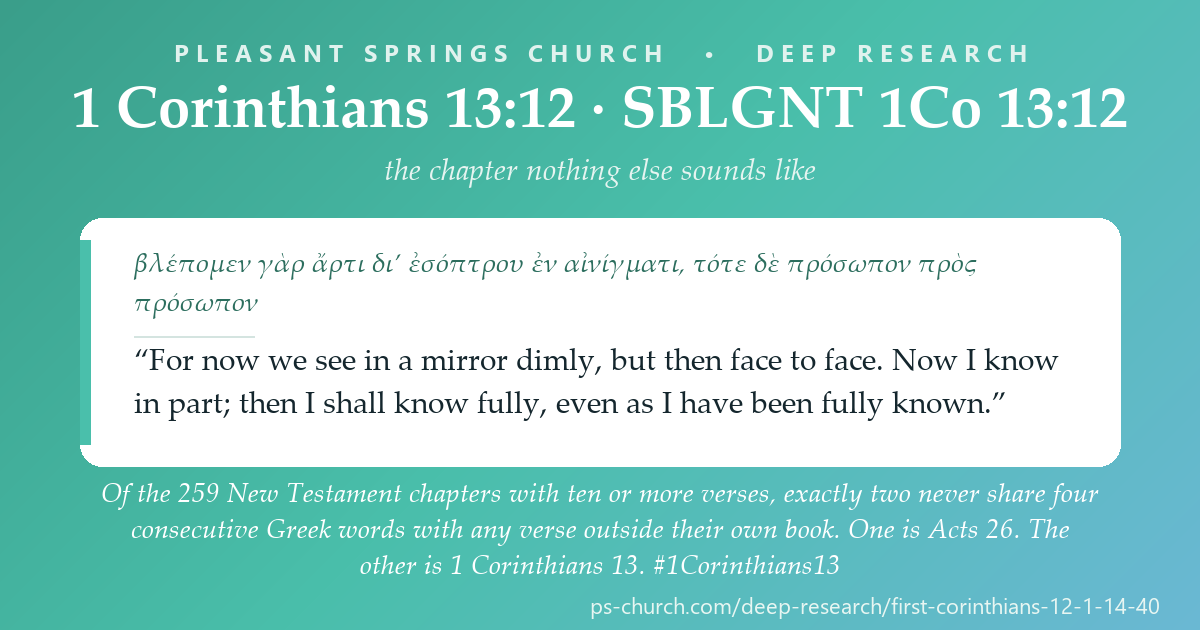
1 Corinthians 13 is probably the most quoted chapter Paul ever wrote. Screened word for word against every other verse in the Greek New Testament, it does not share four consecutive words with any of them — all thirteen verses stop at three. Widen the screen to the whole passage and the picture holds: across 1 Corinthians 12–14, 84 verses, not one reaches a run of five, and the eight that reach four land on Hebrews, on John, on Ephesians 1:23, on Matthew 10:13 and on Acts 2:44 — every one of them an accident. Of the 259 New Testament chapters with ten or more verses, exactly two never reach four outside their own book: Acts 26 and 1 Corinthians 13. And the one place in these chapters where Paul writes it is written — 14:21, quoting Isaiah — measures three against the Greek Isaiah, and four against two verses about Rehoboam’s advisers. The flagged citation is shallower than the coincidences. What holds the three chapters together is not quotation but two words — ζηλοῦτε δέ, at 12:31 and 14:1, and nowhere else in the New Testament. See the method →
1 Corinthians 12:1–14:40 (selections)
Greek New Testament (SBLGNT, via MorphGNT) · ESV★ And the headline is a silence. Screened word for word against the other 7,490 verses of the Greek New Testament, not one of these 84 verses reaches a run of five. 1 Corinthians 13 does not reach four: all thirteen of its verses stop at three. Of the 259 New Testament chapters with ten or more verses, exactly two never reach four outside their own book — Acts 26 and this one. Stage 4 gives the measurement, the tie bands, and the counter-examples.
The Shape of the Passage
A frame with a measured seam — and deliberately not a chiasmThis is the one section of the New Testament where we can hear half of a conversation and know it. 1 Corinthians 7:1 says so outright: περὶ δὲ ὧν ἐγράψατε, now concerning the matters about which you wrote. The same two-word marker opens 12:1. Chapter 12 is a reply, and the letter it replies to is lost.
Author
Paul, and a second name in the greeting. Παῦλος κλητὸς ἀπόστολος Χριστοῦ Ἰησοῦ… καὶ Σωσθένης ὁ ἀδελφός — Paul, called as an apostle of Christ Jesus… and Sosthenes the brother (1:1). The letter names where it is being written from: I will stay in Ephesus until Pentecost (16:8).
He claims the tongues himself, and then argues against using them here. 14:18: I thank God that I speak in tongues more than all of you. 14:19: nevertheless, in church I would rather speak five words with my mind. The argument in chapter 14 is not that the gift is false; it is an argument about what a room full of people can be built by.
What the passage does not do is quote. Across 84 verses there is exactly one citation formula — ἐν τῷ νόμῳ γέγραπται at 14:21 — and one bare appeal to the law with no text attached, at 14:34. Measured, the one formal citation reaches three consecutive words with the Greek Isaiah it points at. Whatever these chapters are made of, it is not mosaic.
Audience
“To the church of God that is in Corinth.” τῇ ἐκκλησίᾳ τοῦ θεοῦ… τῇ οὔσῃ ἐν Κορίνθῳ (1:2). A Roman colony refounded in 44 BC, a port city with two harbours, a congregation that meets in houses (16:19) and includes both Jews and Greeks, both slaves and free — which is exactly the pair-list 12:13 uses.
They are divided, and the letter says so from the first chapter. 1:11: ἔριδες ἐν ὑμῖν, there is quarrelling among you, reported by Chloe’s people. 11:18: ἀκούω σχίσματα ἐν ὑμῖν, I hear that there are divisions among you — and that is the sentence immediately before the chapters on the body. The body image is not decoration; it lands on a congregation that is coming apart in the room where it eats.
And they had asked about this. The περὶ δέ markers at 7:1, 7:25, 8:1, 12:1, 16:1 and 16:12 are six of the sixteen in the whole Greek New Testament. We have the answers to six questions and none of the questions. Every reconstruction of what Corinth actually believed about tongues is an inference from Paul’s reply, and this page keeps that inference separate from the count.
Orient on Corinth, on glossolalia, on the body politic image and on the gift lists before touching a single number.
Search by topic: Corinth; Corinthians, First Letter to the; spiritual gifts; charisma; glossolalia; prophecy, early Christian; body of Christ; love (agape); worship, early Christian.
Which articles are relevant?
- Anchor Bible Dictionary — “Corinth,” “Corinthians, First Epistle to the,” “Tongues, Gift of,” “Spiritual Gifts.”
- Dictionary of Paul and His Letters (IVP) — “Body of Christ,” “Gifts of the Spirit,” “Tongues,” “Worship,” “Love.”
- New International Dictionary of NT Theology & Exegesis — ἀγάπη, χάρισμα, γλῶσσα, οἰκοδομή, πνευματικός, σῶμα.
- Commentary on the New Testament Use of the Old Testament, ed. G. K. Beale and D. A. Carson (Baker, 2007) — the 1 Corinthians chapter, which is where the Isaiah 28:11–12 citation at 14:21 is discussed at length.
- These were not consulted for the measurements below. The measurements were run on the text files named in the footer.
Settle the numbering first — and note what is different about a New Testament page
Every page on this shelf states its versification offset, including the pages where the answer is that there is none. On a New Testament book the answer is stronger than that: there is no second column to be offset from.
| ch 12 | ch 13 | ch 14 | total | |
|---|---|---|---|---|
| SBLGNT (MorphGNT) | 31 | 13 | 40 | 84 |
| ESV | 31 | 13 | 40 | 84 |
The SBLGNT row was counted off disk, and the English chapter-shape file held here gives the same 31 / 13 / 40; the ESV row is the printed edition’s shape, because no ESV 1 Corinthians file is held here. There is no Masoretic and no Septuagint 1 Corinthians, so the columns on this page are Greek New Testament and English, and every chapter-and-verse number means the same verse in all of them.
But the offset problem is still in the room, because the passage’s one citation is screened against books that have one. Five Greek Old Testament verses share four consecutive words with 1 Corinthians 14:21, and one of them is CATSS Jeremiah 34:16. The Greek Jeremiah is a shorter book in a different chapter order from the Hebrew; its 34:16 is Masoretic Jeremiah 27:16. A page that printed the number without the column would have sent a reader to the wrong chapter. The same is not true of Isaiah, where the Greek and the Hebrew run on the same chapter and verse numbers, so 14:21’s source can be named as Isaiah 28:11–12 in either column without conversion.
⚠️ And one offset does land on an English Bible, at 13:12. The verse that carries Paul’s three words is Genesis 32:31 in both the Greek and the Hebrew — but Genesis 32:30 in the ESV and in most English Bibles, because the English runs one verse behind the Hebrew through Genesis 32. Every reference to it on this page is the Greek and Hebrew number with the English beside it. Judges 6:22, Deuteronomy 5:4 and 34:10, Exodus 33:11, Numbers 12:8 and Deuteronomy 28:37 carry no offset — Greek, Hebrew and English agree on all six.
⚠️ One numbering question this page cannot settle. 1 Corinthians 14:34–35 stands after verse 33 in most manuscripts and after verse 40 in the Western tradition. That is a question about placement, not about verse numbers, and it cannot be checked here: no critical apparatus and no manuscript images are held on this disk. The verse count is 40 either way. Stage 5 says more.
A body politic older than Paul, a mirror made of bronze, and the two Greek Old Testament verses about surviving a face.
The body with quarrelling members was already a stock speech
The image in 12:14–26 — the foot resenting the hand, the ear resenting the eye, the body suffering together — is a commonplace of Greek and Roman political rhetoric long before Paul. It is attached to Menenius Agrippa in Livy’s account of the plebeian secession of 494 BC (Livy 2.32), and it turns up in Seneca, in Epictetus, in Marcus Aurelius, and in Plutarch. The usual point of the fable is that the lower orders should stop complaining and get back to work.
What Paul does with it runs the other way, and that much is on the page rather than in a reference book. 12:22–24: the parts that seem weaker are indispensable, the ones we think less honourable get greater honour, and God has composed the body giving greater honour to the part that lacked it. The classical fable defends the hierarchy; this paragraph inverts it.
⚠️ What was not checked. Livy, Seneca, Epictetus, Plutarch and Marcus Aurelius are not held on this disk in Greek or Latin. That the body-politic fable is a rhetorical commonplace is reported here from the reference works, not measured. No verbal comparison between Paul and any of them was run, and none should be inferred from this section.
Corinthian bronze, and a mirror you cannot see clearly in
13:12 says we see δι’ ἐσόπτρου ἐν αἰνίγματι — through a mirror, in a riddle.
Ancient mirrors were polished metal, not silvered glass, and Corinth was famous for its bronze. That association is reported here from the reference works and was not measured — no ancient technical writer is held on this disk. What was measured is the vocabulary: ἔσοπτρον occurs twice in the Greek New Testament, at 13:12 and at James 1:23, where a man looks at his natural face in a mirror and forgets it. Across the sixty-four CATSS files it occurs twice: Sirach 12:11, where a mirror is what a wiped-clean surface resembles, and Wisdom 7:26, where wisdom is ἔσοπτρον ἀκηλίδωτον τῆς τοῦ θεοῦ ἐνεργείας, a spotless mirror of the working of God. The run between 1 Corinthians 13:12 and Wisdom 7:26 is 1. Two writers reach for the same object and share one word, and it is γάρ.
And the second half of the phrase has one Greek Old Testament neighbour, in the curses. The exact sequence ἐν αἰνίγματι occurs once in the 30,348 screened verse units: Deuteronomy 28:37, καὶ ἔσῃ ἐκεῖ ἐν αἰνίγματι καὶ παραβολῇ καὶ διηγήματι — you shall become a riddle, a parable and a byword. The Hebrew of that verse is a different triad: לְשַׁמָּה לְמָשָׁל וְלִשְׁנִינָה, a horror, a proverb and a byword. The Greek’s first term is a riddle where the Hebrew’s is a horror. The page reports the divergence and says nothing about what produced it. The run between 1 Corinthians 13:12 and Deuteronomy 28:37 is 2, and the two verses mean unrelated things by the word.
“Face to face” — four Greek formulas, and only one of them is Paul’s
The Greek Old Testament held here says face to face in four different ways. 1 Corinthians 13:12 uses one of them, and it is not the one from Exodus and not the one from Numbers.
| formula | where, in the 64 CATSS files | in the Greek NT |
|---|---|---|
| πρόσωπον πρὸς πρόσωπον | Genesis 32:31, ESV 32:30 (Jacob at Peniel) · Judges 6:22, A text and B text (Gideon) — and nowhere else | 1 Corinthians 13:12, and nowhere else |
| πρόσωπον κατὰ πρόσωπον | Deuteronomy 5:4 · Deuteronomy 34:10 · Ezekiel 20:35 | never |
| ἐνώπιος ἐνωπίῳ | Exodus 33:11 — the only verse in the corpus carrying the pair. The adjective ἐνώπιος itself stands four times in the 64 files: twice here, plus Exodus 25:30 and Proverbs 8:9. | never |
| στόμα κατὰ στόμα | Numbers 12:8 — mouth to mouth, not face to face | never |
★ This is the result the page did not expect, and it got stronger while the page was being written. Greek Exodus, Leviticus, Numbers and Joshua were absent from this disk when the screen was first run, so the two verses everybody names as the background to 13:12 — Exodus 33:11 and Numbers 12:8 — were unmeasurable and the page said so. They were fetched mid-build, and every screen on this page was re-run against all 64 files. The Torah being complete did not weaken the finding; it sharpened it. Neither Exodus 33:11 nor Numbers 12:8 uses Paul’s phrase, and neither uses the other’s. Exodus reads ἐνώπιος ἐνωπίῳ; Numbers reads στόμα κατὰ στόμα. Measured against 1 Corinthians 13:12, Exodus 33:11 gives a run of 1 (δέ) and Numbers 12:8 gives 1 (διά).
So across all 30,348 verse units now screened, πρόσωπον πρὸς πρόσωπον stands in exactly three: Genesis 32:31 (ESV 32:30), I have seen God face to face, and my life was spared, and Judges 6:22 in both the A and B texts, where Gideon cries out because he has seen the angel of the Lord face to face. Run 3, tie band 3 — and three consecutive words is a short run. The page reports the contact and asserts nothing about direction: it does not say Paul is quoting Genesis, and the sentence has no citation formula attached to it. What it can say is that the two verses carrying his exact words are both about a man who expected to die of the encounter and did not.
⚠️ And the riddle word does not travel with it either. Numbers 12:8 says the Lord speaks to Moses οὐ δι’ αἰνιγμάτων, not through riddles — genitive plural with διά. Paul writes ἐν αἰνίγματι, dative singular. They are the same noun and not the same phrase, which is why the exact sequence ἐν αἰνίγματι still has only one home in the whole corpus, Deuteronomy 28:37. The αἰνιγμ- group now stands ten times in the 64 files: 3 Kingdoms 10:1 and 2 Chronicles 9:1 (the Queen of Sheba’s riddles), Numbers 12:8, Numbers 21:27, Deuteronomy 28:37, Proverbs 1:6, Daniel 8:23, Sirach 39:3, Sirach 47:15 and Wisdom 8:8.
Six words that carry the three chapters, and how rare each one actually is.
The word 12:1 opens with, and the noun the English has to supply. Paul writes περὶ δὲ τῶν πνευματικῶν — now concerning the spiritual ___ — with no head noun. χάρισμα does not appear until 12:4. The adjective occurs 26 times in the Greek New Testament and 15 of them are in 1 Corinthians; three are in these chapters (12:1; 14:1; 14:37). The same construction returns at 14:1, which is the seam.
17 occurrences in the Greek New Testament, seven of them in 1 Corinthians and five of those seven inside chapter 12 (12:4, 9, 28, 30, 31). Zero in chapter 13. Zero in chapter 14. It is built from χάρις with the -μα ending — not the giving, the thing given. Romans has six of the remaining ten.
50 occurrences in the whole Greek New Testament. Twenty-one of the fifty are in these three chapters — four in 12, two in 13, fifteen in chapter 14. Acts 2 has four. James 3, the other chapter about the tongue, has four, and means the organ. Paul never attaches an adjective like unknown to it; the ESV’s a tongue at 14:19 renders a bare ἐν γλώσσῃ.
116 occurrences in the Greek New Testament. Nine of them are in 1 Corinthians 13 — the second-densest chapter in the New Testament for the noun, behind 1 John 4 with twelve. Chapter 12 has none. Chapter 14 has exactly one, at 14:1, the first phrase after the chapter break. The verb ἀγαπάω occurs 143 times in the New Testament and not once in these 84 verses.
The measuring rod of chapter 14, and it is a construction word. Noun and verb together stand seven times in chapter 14 (14:3, 4 twice, 5, 12, 17, 26) and zero times in chapters 12 and 13. 14:26 makes it the rule for everything that happens in the meeting: πάντα πρὸς οἰκοδομὴν γινέσθω. It is the word for putting up a house, used of what a congregation is for.
Five occurrences in the Greek New Testament, and all five are in 1 Corinthians — 12:27, 13:9 twice, 13:10, 13:12. Four of the five are in chapter 13, where knowing and prophesying are both said to be partial; the fifth is 12:27, where the readers are the body of Christ and individually members of it. The same two words do the anatomy and the epistemology.
How the counts were made. Lemma counts are from the MorphGNT lemma column across all 27 New Testament files; phrase counts are contiguous sequences of normalised word forms, the same normalisation the run engine uses. ἐκ μέρους was counted as the two-word sequence, not as a lemma. Nothing on this page was counted by eye.
The measurement, the tie bands, and the counter-examples in the same tables.
The screen. All 84 verses of 1 Corinthians 12–14, normalised, against the other 7,490 verses of the Greek New Testament (1 Corinthians is excluded from its own target set) and against 30,348 screened verse units of the 30,637 held in the sixty-four CATSS Greek Old Testament files — the 289-unit difference is the Odes, and Stage 5 says why they came out and what it did to this page’s numbers (nothing). Contiguous runs of whole word forms, never lemmas. The tie band — how many target verses reach the same maximum — is printed beside every run.
1. The result: 84 verses, and nothing reaches five
Against every other book in the Greek New Testament, the distribution of the deepest run per verse is this:
| deepest run | 1 Cor 12 | 1 Cor 13 | 1 Cor 14 | all 84 |
|---|---|---|---|---|
| 1 (isolated words only) | 3 | 1 | 1 | 5 |
| 2 | 7 | 8 | 19 | 34 |
| 3 | 16 | 4 | 17 | 37 |
| 4 | 5 | 0 | 3 | 8 |
| 5 or more | 0 | 0 | 0 | 0 |
The control matters more than the table. Run the same screen over every verse of the Greek New Testament against every other book, and 16.5% of all 7,927 verses reach five or more. Restrict it to the thirteen letters carrying Paul’s name and the rate is 9.0% (183 of 2,029 verses). Here it is zero of 84.
And the honest qualification, in the same breath. This is uncommon but it is not unique, and inside this letter it is not even isolated. Of the 1,946 sliding 84-verse windows across the Pauline corpus, 96 — 4.9% — are as quiet as this one. And 1 Corinthians 7, 8, 9 and 10 all top out at four as well. What is distinctive about chapters 12–14 is not that they are quiet; it is which chapter is the quietest.
2. The finding: two chapters in the New Testament never reach four
Of the 259 New Testament chapters with ten or more verses, exactly two contain no verse that shares four consecutive words with any verse outside their own book.
| chapter | verses | deepest run, whole chapter |
|---|---|---|
| Acts 26 | 32 | 3 |
| 1 Corinthians 13 | 13 | 3 |
Acts 26 is Paul’s defence before Agrippa. 1 Corinthians 13 is the love chapter. They are the whole list.
Is it a length effect? Partly, and the page checked. Of the 31 New Testament chapters of between 10 and 16 verses, ten stop at four and one stops at three — and that one is this chapter. Acts 26, the other member of the pair, is 32 verses long, which is not short by any measure. Short chapters have fewer chances; that is real, and it does not account for Acts 26.
And chapter 13 does not reach three against its own letter either. Screened against the other 424 verses of 1 Corinthians, no verse gets past two — and 13:5 and 13:7 reach only one. The two-word ties are ordinary: ἐκ μέρους (13:12 against 12:27), καθὼς καί (13:12 against 14:34), νυνὶ δέ (13:13 against 12:18 and 15:20), μείζων δέ (13:13 against 14:5) and ἡ ἀγάπη (13:13 against 16:24). The chapter does not sound like the chapters it sits between, either.
3. The eight fours, every one of them an accident
Here are all eight verses in the passage that reach a run of four, with what they reach it against.
| verse | the four words | band | where they land |
|---|---|---|---|
| 12:6 | τὰ πάντα ἐν πᾶσιν | 1 | Ephesians 1:23 |
| 12:12 | οὕτως καὶ ὁ Χριστός | 2 | Hebrews 5:5; Hebrews 9:28 — both about priesthood and sacrifice |
| 12:15 | οὐκ εἰμὶ ἐκ τοῦ | 7 | John 8:23; 17:14; 17:16; 18:36; 1 John 2:16; 3:10; 4:6 — four of them ‘not of the world’, the other three ‘not of the Father’ (1 John 2:16) and ‘not of God’ (1 John 3:10; 4:6) |
| 12:16 | οὐκ εἰμὶ ἐκ τοῦ | 7 | the same seven verses |
| 12:28 | ὁ θεὸς ἐν τῇ | 2 | 2 Corinthians 7:6; Hebrews 4:4 |
| 14:23 | ἐπὶ τὸ αὐτὸ καί | 1 | Acts 2:44 |
| 14:28 | ἐὰν δὲ μὴ ᾖ | 1 | Matthew 10:13 |
| 14:36 | ὁ λόγος τοῦ θεοῦ | 10 | Luke 8:11; John 10:35; Acts 6:7; 17:13; Romans 9:6; 2 Timothy 2:9 … |
Two of the eight are the same phrase in consecutive verses. One has a tie band of ten, which makes it a formula. Not one of the eight is a case where the shared words carry the shared idea — 12:12 is the body of Christ and the two Hebrews verses are the high priest; 14:23 is an assembly speaking in tongues and Acts 2:44 is believers holding property in common. Eight fours, and eight coincidences.
4. The one citation, and why it measures less than the coincidences
1 Corinthians 14:21 is the only verse in these three chapters introduced by a citation formula: ἐν τῷ νόμῳ γέγραπται. The verse it points at is Isaiah 28:11–12.
| comparison | run | the shared words |
|---|---|---|
| 1 Cor 14:21 vs Septuagint Isaiah 28:11 | 3 | τῷ λαῷ τούτῳ |
| 1 Cor 14:21 vs Septuagint Isaiah 28:12 | 1 | τῷ |
| 1 Cor 14:21 vs the whole 30,348-row screened Greek OT | 4, band 5 | τῷ λαῷ τούτῳ καί — 2 Chronicles 10:7, 3 Kingdoms 12:7, Jeremiah 4:11, Jeremiah 34:16, Judith 5:20 |
Two of the five deepest hits are Rehoboam’s elders telling him to be a servant to this people. None of the five is Isaiah.
The two sentences are simply not the same Greek. The CATSS Isaiah 28:11 reads διὰ φαυλισμὸν χειλέων διὰ γλώσσης ἑτέρας ὅτι λαλήσουσιν τῷ λαῷ τούτῳ; Paul writes ἐν ἑτερογλώσσοις καὶ ἐν χείλεσιν ἑτέρων λαλήσω τῷ λαῷ τούτῳ — a first person verb where the Greek Isaiah has a third person plural, and a compound adjective, ἑτερόγλωσσος, that occurs nowhere in the sixty-four CATSS files — screened or held — and nowhere else in the New Testament. The closing clause is different too: οὐδ’ οὕτως εἰσακούσονταί μου against the Greek Isaiah’s οὐκ ἠθέλησαν ἀκούειν, and Paul adds λέγει κύριος, which is not in the Greek Isaiah 28:11–12 (the two words do stand at 28:16, in a different oracle).
⚠️ What the page will not say. It will not say Paul was translating the Hebrew himself, or using a lost Greek version, or quoting from memory, or that his source read differently from ours. All four are live proposals in the literature and the measurement cannot choose between them. What the measurement establishes is the size of the gap: an explicit it is written that agrees with its named source in three consecutive words, on a page whose accidental agreements reach four.
5. The verses this page expected to match, and the runs they actually give
Every one of these pairings is printed in study Bibles and commentaries. Here is what the screen does with them.
| the pairing everyone prints | run | note |
|---|---|---|
| 1 Cor 13:13 vs 1 Thessalonians 1:3 | 0 | faith, hope and love in both — nominative here, genitive there. No word form in common at all. |
| 1 Cor 13:13 vs Colossians 1:4–5 | 0 | the same triad again, the same result |
| 1 Cor 12:13 vs Galatians 3:28 | 1 | the shared word is καί |
| 1 Cor 12:13 vs Colossians 3:11 | 1 | same |
| 1 Cor 12:28 vs Ephesians 4:11 | 1 | the two lists of appointed persons share one word |
| 1 Cor 12:12 vs Romans 12:4 | 2 | καθάπερ γάρ — the body image’s other Pauline home |
| 1 Cor 12:4–11 vs Romans 12:6–8 | 1 | the two χαρίσματα lists |
| 1 Cor 13:2 vs Matthew 17:20 / Mark 11:23 | 1 | faith that moves mountains, in three books, in three sets of words |
| 1 Cor 14:34 vs 1 Timothy 2:12 | 1 | the shared word is ἐν |
This is the page’s own case against itself. Nine pairings that any reader would call related, and the deepest measured run among them is two. The screen finds verbatim contact and nothing else. It cannot see a shared idea, a shared list, or a shared triad, and on this passage almost everything that matters is one of those three. A page that reported only the deep runs would have told you that 1 Corinthians 12 is closer to Hebrews 5 than to Romans 12, which is false.
6. The two words that hold the section together
The one measured connection inside the passage that is not a coincidence is two words long.
| verse | text |
|---|---|
| 12:31 | ζηλοῦτε δὲ τὰ χαρίσματα τὰ μείζονα |
| 14:1 | Διώκετε τὴν ἀγάπην, ζηλοῦτε δὲ τὰ πνευματικά |
Scanned across all 7,927 verses of the Greek New Testament, ζηλοῦτε δέ occurs in exactly these two verses and no others; as a three-word sequence, ζηλοῦτε δὲ τά is the same two. Tie band 1, in both directions. The object changes from τὰ χαρίσματα τὰ μείζονα to τὰ πνευματικά — which is the exact word 12:1 opened the section with.
That is the structural evidence, and it is why the diagram above prints a frame rather than a chiasm. Two identical commands, fourteen verses apart, with the love chapter between them; and three chapters whose vocabulary is otherwise nearly disjoint — χάρισμα 5/0/0, σῶμα 18/1/0, ἀγάπη 0/9/1, οἰκοδομ‑ 0/0/7, imperative forms 1/0/21. The seam is measured; the centre-pairing a chiasm would need is not there, and the page does not invent one.
Where this page is weakest, what it could not reach, and what would break it.
The corpus changed under this page while it was being written
The Greek Old Testament on this disk grew from 44 files to 64 in the middle of this build, and the page says so rather than quietly reporting the second set of numbers.
Every Greek Old Testament figure on this page was first derived against 44 CATSS files and 23,061 verse units — the corpus that was missing Exodus, Leviticus, Numbers, Joshua, Tobit, Judith, Wisdom, 2–4 Maccabees, Baruch, the Epistle of Jeremiah, Odes, Psalms of Solomon, Bel and Susanna. All twenty arrived before the page was published, and every screen was re-run against all 64 files and 30,637 verse units. Then, on 30 August 2026, the corpus went the other way and every screen was re-run a third time. One of those twenty files — the Odes, 289 verse units — was withdrawn from the screening corpus, so the shelf now HOLDS 30,637 verse units in 64 files and SCREENS 30,348. The figures printed above are the third set, and every one of them is identical to the second.
⚠️ Why the Odes came out, and the hazard this page walked past without being bitten. The Odes are the fourteen liturgical canticles bound after the Greek Psalter, and they fail two independent tests for membership in ‘the Greek Old Testament’. (1) Two of them are New Testament text. Ode 9 is Luke 1 — the Magnificat and the Benedictus — and Ode 13 is Luke 2, the Nunc Dimittis. While they sat in the corpus, screening the Greek New Testament against the Greek Old Testament matched Odes 9:48 to Luke 1:48 at eighteen consecutive words, and twenty-four more rows besides. That is Luke matching Luke under an Old Testament shelfmark. A page reporting it would have been printing a Gospel’s deepest Old Testament contact while measuring its own text, and the instrument would have been working perfectly the whole time. It was caught by reading the shelf’s deepest hits by eye rather than tabulating them: an eighteen-word Old Testament match to Luke 1 is not a result, it is a symptom. (2) Ten of the fourteen are second copies of passages the shelf already holds — Ode 1 = Exodus 15, 2 = Deuteronomy 32, 3 = 1 Samuel 2, 4 = Habakkuk 3, 5 = Isaiah 26, 6 = Jonah 2, 7 and 8 = Daniel Th 3, 10 = Isaiah 5, 11 = Isaiah 38 — so a verse standing alone in Habakkuk appeared to stand twice and every tie band touching a canticle was doubled. They stay on disk; they are out of the screen.
What it did to this page: nothing, and the page can now say so with the re-run behind it. All 84 rows return the identical distribution — 4 rows at one, 40 at two, 31 at three, 8 at four, 1 at five — against 30,348 as against 30,637. πρόσωπον πρὸς πρόσωπον still stands in exactly three units, still Genesis 32:31 and Judges 6:22 A and B. 14:21 is still 4 in a band of 5, still with no Isaiah in it. 13:3 against Tobit 1:20 is still 5 in a band of 1. χρηστεύομαι still stands once, at Psalms of Solomon 9:6. Twenty-one of the 84 rows lost a unit or two from very wide bands — 14:32 from 24,815 to 24,629 is the largest, and it is a band on a single shared word — and not one of those bands is published on this page. The reason none of this page’s figures moved is worth naming rather than assuming: 1 Corinthians 12–14 never touches the Lukan canticles, and its deepest Greek Old Testament partners are Genesis, Judges, Tobit and the Kings/Chronicles doublet — none of which the Odes duplicate at the depths this page reports.
Three things moved, and a reader should know which.
| claim | 44 files | 64 files |
|---|---|---|
| πρόσωπον πρὸς πρόσωπον in the Greek OT | Gen 32:31, Judg 6:22 A and B | unchanged — and now a much stronger result, because the Torah is complete |
| Exodus 33:11 and Numbers 12:8 | not measurable | measured: run 1 each, and neither uses Paul’s phrase |
| χρηστεύομαι in the Greek OT | 0 | 1 — Psalms of Solomon 9:6 |
| ἔσοπτρον in the Greek OT | 1 (Sirach 12:11) | 2 — adds Wisdom 7:26 |
| 1 Cor 14:21’s deepest Greek OT run | 4, tie band 4 | 4, tie band 5 — adds Judith 5:20, still no Isaiah |
| deepest run anywhere in 1 Cor 13 vs the Greek OT | 3 (13:12) | 5 — 13:3 against Tobit 1:20, tie band 1 |
⚠️ That last row is the one that matters, and it is a counter-example against this page. 1 Corinthians 13:3, if I give away all I have, shares five consecutive words with Tobit (BA) 1:20, πάντα τὰ ὑπάρχοντά μου καί, tie band 1. Tobit’s sentence is about his property being plundered. It is the deepest single run this passage makes into the Greek Old Testament anywhere, it is in the love chapter, and it means nothing at all. A page that had been written a day later, with the fetch already done and no memory of the first run, might have led with it.
The headline is untouched by any of this. The New Testament corpus did not change: 7,927 verses in 27 MorphGNT files, the same before and after. ‘1 Corinthians 13 never reaches four outside its own book’ is a claim about the Greek New Testament only, and it measures the same today as it did before the fetch.
What this episode is really evidence of. A measured claim is a claim about a corpus on a particular day. The shelf’s regression lock caught the drift and named it — the corpus tests failed the moment the files landed, and one already-published page on another book is now reporting a number that the enlarged corpus no longer supports. That is the system working, and it is the reason every page on this shelf prints the size of the corpus it was run against.
What the headline result depends on, and how it could be wrong
It depends on one printed edition, and on a decision about what a word is. The New Testament figures are the SBL Greek New Testament as digitised by MorphGNT; the Old Testament figures are Rahlfs’ Septuaginta as digitised by CATSS. Neither has a critical apparatus on this disk. The claim that 1 Corinthians 13 never reaches four is a claim about one printed Greek New Testament; a different edition, or a different set of variant readings, could produce a four somewhere.
The screen compares word forms, not lemmas — and on this passage that is the decision that does the most damage. 1 Corinthians 13:13 and 1 Thessalonians 1:3 both name faith, hope and love; the screen scores them at zero because one has them in the nominative and the other in the genitive. A lemma-based screen would score that pairing at three and would change most of the numbers on this page. It would be a different measurement, not a better one — and it would also have found a great many more accidental threes. The zero is printed here because it is the cost of the method, and a reader is owed the cost.
And a negative result is a weaker thing than a positive one. “Nothing reaches five” is a statement about absence. It is exactly as strong as the corpus and the normalisation behind it, and no stronger. The controls printed in Stage 4 — the 16.5% New Testament rate, the 9.0% Pauline rate, the 96 quiet windows out of 1,946 — are there so the absence can be judged rather than admired.
1 Corinthians 14:34–35, and what this page can and cannot say about it
The page prints no row from 14:34–35 and owes the reader the reason.
Those two verses stand after verse 33 in the great majority of manuscripts and after verse 40 in the Western tradition (Codex Claromontanus and the Old Latin among others), and a marginal bar in Codex Vaticanus at that point has been read by some as a scribal signal. None of that could be checked here. No critical apparatus, no manuscript images, no collations, and no papyri are held on this disk. The page has no measurement to contribute to the question and therefore contributes none.
What it can report is the one number it has. Screened against every verse outside 1 Corinthians, 14:34 reaches a run of 3 — ἐν ταῖς ἐκκλησίαις, tie band 12, which makes it a formula — and against 1 Timothy 2:12, the verse it is most often set beside, the run is 1, the word ἐν. That is a fact about two Greek sentences and it settles nothing about either of them. The interpretation of these verses is a matter for the church’s teaching, and this shelf does not use a word-run to decide it.
What could not be checked at all
No Greek critical apparatus. No papyri — P46, the earliest substantial witness to 1 Corinthians, was not consulted, nor P11, P15 or P123. No patristic citations, no Qumran or rabbinic material, no Syriac, Latin or Coptic versions. No Greek or Latin literature for the body-politic fable in Stage 2, no ancient technical writer for the mirror, no inscriptional or archaeological material from Corinth. No commentary on 1 Corinthians was read for any figure on this page.
And the questions everybody actually wants answered stay open, because the measurement is silent on them. What the tongues of 1 Corinthians 14 are and whether they are the same thing as Acts 2; whether 13:10’s τὸ τέλειον is the return of Christ, the maturing of the church or the closing of the canon; whether the gifts of 12:8–10 continue; who may speak in the assembly. Counting shared word-runs cannot decide any of that, and this page does not pretend otherwise. What it offers is the measurement the arguments have to fit.
One more that is easy to overstate. “Only two New Testament chapters of ten verses or more never reach four” is a true sentence about the corpus and normalisation described in the footer. It is not a statement that 1 Corinthians 13 is unlike the rest of the New Testament in style, or in thought, or in date. It is a statement that its word forms do not line up in sequence with anybody else’s — which is a much smaller claim than it sounds, and the page prefers the smaller claim.
Reading list
- Anthony C. Thiselton, The First Epistle to the Corinthians (NIGTC, 2000).
- Gordon D. Fee, The First Epistle to the Corinthians (NICNT, rev. 2014).
- Richard B. Hays, First Corinthians (Interpretation, 1997).
- Joseph A. Fitzmyer, First Corinthians (Anchor Yale Bible 32, 2008).
- Margaret M. Mitchell, Paul and the Rhetoric of Reconciliation (1991) — the case that the letter is deliberative rhetoric, which is the case this page’s structure diagram takes seriously.
- Christopher D. Stanley, Paul and the Language of Scripture (SNTSMS 74, 1992) — on the citation technique behind 14:21.
- None of these were consulted for the measurements on this page, which were run on the text files named in the footer.
Three chapters that barely use each other's words, and the two words that hold them together.
Nothing else sounds like it
Chapter 12 is anatomy: body eighteen times, member thirteen, gift five, and one imperative in thirty-one verses. Chapter 14 is a meeting: church nine times, building up seven, mind four, and twenty-one imperatives in forty verses. Between them sits a chapter with no imperative in it at all, whose fifteen verbs simply say what love does and does not do, and which uses almost none of the vocabulary on either side of it.
And when the screen is turned on it, it finds nothing. Not one of the 84 verses shares five consecutive Greek words with any verse outside this letter in the Greek New Testament, and chapter 13 does not reach four against any verse outside its own book. (Against the Greek Old Testament the passage does reach five once — 13:3 against Tobit 1:20 — and Stage 5 prints it.) Of the 259 New Testament chapters that long, only Acts 26 keeps it company. The eight fours in the passage all land somewhere irrelevant — the body of Christ on the high priest of Hebrews, an assembly speaking in tongues on the believers of Acts 2 holding property in common.
Even the quotation is quiet. The one it is written in these three chapters, at 14:21, agrees with the Greek Isaiah it names in three consecutive words — and reaches four against a pair of verses about Rehoboam’s advisers. The flagged citation measures less than the accidents. The page reports that and refuses every explanation on offer, because the counting cannot choose between them.
What does hold the three chapters together is two words. ζηλοῦτε δέ — but earnestly desire — stands at 12:31 and again at 14:1 and at no other point in the Greek New Testament. Paul says it, puts the love chapter down in the middle of the sentence, and then says it again with the object changed. The most quoted chapter in Paul is not a digression and it is not a hymn borrowed from somewhere else; it is measurably a parenthesis inside a repeated command — and the command on both sides of it is about gifts in a room full of people who were not speaking to each other.
Every Deep Research page traces its passage across the whole sweep — the Old Testament, the Second-Temple world between the testaments (historical witnesses, not Scripture), and the New Testament. Follow the thread:
Pleasant Springs Church — Deep Research
Research method after Michael S. Heiser’s Bible Research Method (examine dictionaries → ancient literature → important words → textual connections → academic publications → share), with the Pleasant Springs “Author & Audience” foundation. Scripture set in the Hebrew, the Greek editions named on each page and the ESV (Old Testament), and the Greek New Testament and the ESV (New Testament), per the practice of Pleasant Springs Church. 1 Corinthians research grounded in Thiselton (NIGTC), Fee (NICNT), Hays (Interpretation), Fitzmyer (Anchor Yale) and Mitchell — none of which were consulted for any number on this page. Text: Greek New Testament from the SBL edition as digitized by MorphGNT; Greek Old Testament from Rahlfs’ Septuaginta as digitized by CATSS; Hebrew from the Masoretic text as printed in Sefaria’s Miqra according to the Masorah. No critical apparatus was consulted on any side. The standing caution for this shelf applies: these pages say “the CATSS Greek row reads…” and never call a reading early or late. ⚠️ VERSE NUMBERING — 1 Corinthians is a New Testament book, so there is no Masoretic or Septuagint column and no offset to state. Counted anyway: SBLGNT 1 Corinthians 12–14 runs 31 / 13 / 40 = 84 verses off disk, the English chapter-shape file on disk agrees, and the ESV prints the same shape — no ESV 1 Corinthians file is held here to count. Stated because this shelf states it everywhere, including where there is nothing to convert. The offset does bear on one row: one of the five Greek Old Testament verses sharing four consecutive words with 1 Corinthians 14:21 is CATSS Jeremiah 34:16, which is Masoretic Jeremiah 27:16, because the Greek Jeremiah runs on a different chapter scheme. Greek and Hebrew Isaiah share their numbering, so 14:21’s named source needs no conversion. ⚠️ The measurement, in full. Greek against Greek. MorphGNT field 6, the normalised word (the column that already resolves elision and the movable nu); CATSS FORM column (cols 0–24), beta-code transliterated first. Both sides lowercased, accents and breathings dropped, final sigma folded, then filtered to Greek letters — the same filter applied to both corpora. Contiguous runs of whole word FORMS, never lemmas. Corpus: the 84 MorphGNT rows of 1 Corinthians 12–14 against the other 7,490 verses of the Greek New Testament — 1 Corinthians is excluded from its own target set — and against 30,348 screened verse units of the 30,637 held across 64 CATSS files. The Odes, 289 units, stay on disk and are out of the screen: two of the fourteen canticles are New Testament text (Ode 9 is Luke 1, Ode 13 is Luke 2) and ten more are second copies of passages already held. Exhaustive and deterministic; nothing sampled, so no seed applies. The tie band — how many target verses reach the same maximum — is printed beside every run on this page. ⚠️ The control figures. The 16.5% and 9.0% rates in Stage 4 come from running the same book-excluded screen over all 7,927 New Testament verses: 1,311 of 7,927 reach five or more; 183 of the 2,029 verses in the thirteen letters bearing Paul’s name do. The 259-chapter and 1,946-window figures come from the same table. The Gospels dominate the New Testament rate — Mark is at 41.2% and Matthew at 34.6%, because the Synoptics overlap each other — which is exactly why the Pauline rate is quoted beside it. ⚠️ THE CORPUS CHANGED MID-BUILD. The Greek Old Testament on this disk grew from 44 files / 23,061 verse units to 64 files / 30,637 while this page was being written, as Exodus, Leviticus, Numbers, Joshua, Tobit, Judith, Wisdom, 2–4 Maccabees, Baruch, the Epistle of Jeremiah, Odes, Psalms of Solomon, Bel and Susanna were fetched — and then shrank again on 30 August 2026, when the 289 units of the Odes were withdrawn from the screening corpus, leaving 30,637 held and 30,348 screened. Every Greek Old Testament screen on this page was re-run at each change, and the figures printed are the third set — identical to the second. Stage 5 gives the before-and-after table, including the one place the enlarged corpus produced a deeper run than anything the page reports elsewhere (1 Cor 13:3 against Tobit 1:20, five words, tie band 1, and meaningless). The New Testament corpus did not change — 7,927 verses in 27 MorphGNT files — so the headline finding is unaffected. ⚠️ What was NOT measurable. No papyri, no apparatus, no versions, no patristic citations, no Greek or Latin literature for the body-politic fable, and nothing on the placement of 14:34–35. ⚠️ Direction of influence is never asserted. Nothing here says Paul is reading Isaiah in Greek or in Hebrew, that he is reading Genesis at 13:12, that Hebrews or Ephesians is reading him, or that any of them is drawing on a common source. The page reports the runs and the bands, and stops. Typology is handled per the house position: what the text says, what the New Testament itself draws, and what we see from this side of the cross — with the seeing left to the reader.
Scripture quotations marked ESV are from the ESV® Bible (The Holy Bible, English Standard Version®), © 2001 by Crossway, a publishing ministry of Good News Publishers. ESV Text Edition: 2016. Used by permission. All rights reserved. The ESV text may not be quoted in any publication made available to the public by a Creative Commons license, and the ESV may not be translated in whole or in part into any other language. www.esv.org
|
Did this study bless you today? 💚 Give to Support PS Church100% of gifts go to the General Fund — thank you. |