A church has sorted itself into fan clubs — I follow Paul, I follow Apollos, I follow Cephas — and Paul answers by attacking the scoreboard rather than picking a side. This study measures all 91 verses of that answer, word for word, against 30,348 verse units of the Greek Old Testament. Five times in four chapters Paul says a thing is written, and the five measure ten, five, three, three and two. The deepest, 1:19, is ten consecutive words of Isaiah 29:14 with a tie band of one — and it stops at exactly the word Paul changed. Three verses later, 1:22 shares no two consecutive words with any verse of the Greek Old Testament at all. Both facts are printed here. See the method →
1 Corinthians 1:1–4:21 (selections)
Greek New Testament (SBLGNT / MorphGNT) · ESV★ Five times in these four chapters Paul says a thing is written, and the measurement answers five different ways. Screened against 30,348 verse units of the Greek Old Testament held here, the five formula-marked rows return ten (1:19), five (3:20), three (3:19), three (2:9) and two (1:31) — and the two deepest both stop at exactly the word Paul changed. Meanwhile 2:3, which quotes nothing, reaches five with a tie band of one. Stage 4 gives the whole table.
The Shape of the Passage
A slogan quoted at 1:12 and quoted again at 3:4 — then the answer, then the appealA congregation Paul planted, now sorting itself into fan clubs around the men who baptised and taught them. He answers not by picking a side but by attacking the standard they are judging by — and the attack runs on five Old Testament quotations, which is why this page is a study of how a man quotes.
Author
Paul, with Sosthenes (1:1) — writing from Ephesus, after eighteen months in Corinth (Acts 18:11), with a verbal report from Chloe’s people (1:11) in front of him. Χλόη is a New Testament hapax legomenon; she is named once and never explained, and the letter’s first crisis arrives because somebody told somebody.
He refuses the ground he is being judged on. He is being measured against the standards of a city that graded public speakers, and his answer is that he came in weakness and in fear and much trembling (2:3) and decided to know nothing except Jesus Christ and him crucified (2:2). He also declines the rank he could claim: he and Apollos are διάκονοι, waiters (3:5), then ὑπηρέτας, under-rowers (4:1), then the scum of the world (4:13). Only at 4:15 does he claim anything at all, and what he claims is fatherhood.
And he quotes carefully — five times. It is written (1:19), as it is written (1:31), as it is written (2:9), it is written (3:19), and again (3:20). Measured against the Greek Old Testament those five rows return ten, two, three, three and five. The unevenness is the finding of this page, and stage 4 is where it is set out.
Audience
Corinth — refounded as a Roman colony in 44 BC, a two-harbour city on the isthmus, host of the Isthmian games, and a place where rhetoric was a spectator sport. A travelling speaker was rated on delivery, on style, and on whose pupil he was. The church has imported that scoring system: I am of Paul, I am of Apollos, I am of Cephas (1:12). The problem is not four theologies. It is four fan clubs.
They are not poor in gifts and Paul says so first. He thanks God that they were enriched in all speech and all knowledge (1:5) and lack no spiritual gift (1:7) — and then spends four chapters explaining why that is not the same as being grown up. I could not address you as spiritual… I fed you with milk (3:1–2). The verdict is not that they know too little but that they are σαρκικοί, still running on the old scoring system.
The appeal is put to people who are already inside. They are the called, the sanctified, God’s field, God’s building, God’s temple (3:9, 3:16). Not many were wise, powerful or well-born (1:26) — and that is the point, not an insult: the arithmetic of who was called is itself the argument against boasting. The last word of the four chapters is a question about how Paul should arrive, and it leaves the answer with them (4:21).
Orient on Corinth, on the divisions, on wisdom, and on the crucifixion as a Roman penalty.
Search by topic: Corinth, 1 Corinthians, factions and parties, Apollos, Cephas, wisdom (Greek and Jewish), sophist, crucifixion, patron and client, Roman colony, household of Chloe.
Which articles are relevant?
- Anchor Bible Dictionary — “Corinth,” “Corinthians, First Letter to the,” “Apollos,” “Crucifixion,” “Wisdom in the NT.”
- Dictionary of Paul and His Letters — “Corinthians, Letters to the,” “Wisdom,” “Cross, Theology of the,” “Rhetoric,” “Apostle,” “Factions.”
- NIDNTTE / TDNT — σοφία (sophia), μωρία (mōria), σταυρός (stauros), σχίσμα (schisma), ψυχικός (psychikos), οἰκονόμος (oikonomos).
- Dictionary of New Testament Background — “Rhetoric,” “Sophists,” “Social Values and Structures,” “Crucifixion,” “Isthmian Games.”
Bibliography surfaced:
- Anthony C. Thiselton (NIGTC), Gordon D. Fee (NICNT), Roy E. Ciampa & Brian S. Rosner (PNTC), David E. Garland (BECNT), Richard B. Hays (Interpretation), Joseph A. Fitzmyer (Anchor Yale) on 1 Corinthians.
- Bruce W. Winter, Philo and Paul among the Sophists; Stephen M. Pogoloff, Logos and Sophia; Duane Litfin, St. Paul’s Theology of Proclamation.
- G. K. Beale & D. A. Carson, eds., Commentary on the NT Use of the OT (the 1 Corinthians chapter, on 1:19, 1:31, 2:9, 3:19 and 3:20).
A colony that scored speakers, a penalty no one wrote poetry about, and a word for what is scraped off a floor.
Read the Greco-Roman rhetorical contest behind 1:17–2:5, the Roman cross behind 1:18, the household steward behind 4:1–2, and the arena behind 4:9.
Which parallels shed light on religion and worldview?
The city scored its speakers. Corinth was refounded as a Roman colony in 44 BC on the site Rome had destroyed a century before, and by Paul’s day it was a wealthy, socially mobile port with two harbours and a professional class of travelling orators. A sophist arriving in such a city gave a display speech, gathered pupils, and was judged on delivery, on style, and on whose school he came from. The slogans of 1:12 are exactly what that culture produces when it is applied to preachers. Paul’s counter is not a better display: it is a refusal of the category — not with wisdom of word, lest the cross of Christ be emptied (1:17).
The cross was not a symbol yet. σταυρός in the first century meant a Roman execution stake, and the penalty was reserved for slaves, rebels and provincials. Cicero’s line that the very word should be kept far from the thoughts, eyes and ears of Roman citizens is the register Paul is writing against. The measurement makes the strangeness concrete: forms beginning σταυρ- occur in exactly one of the 30,348 Greek Old Testament verse units held here — Esther 7:9, where the king orders Haman hung on the fifty-cubit stake Haman had built for Mordecai. There was no Old Testament vocabulary for what Paul was preaching, and the eleven New Testament occurrences of τοῦ σταυροῦ have no Greek Old Testament counterpart at all.
The steward and the under-rower. 4:1 stacks two ordinary job titles. ὑπηρέτης is literally an under-rower — the man on the lower bench — and by the first century it meant any subordinate assistant; it stands twenty times in the Greek New Testament and exactly once outside the Gospels and Acts, here. οἰκονόμος is the household manager, very often a slave, trusted with the master’s property and answerable for it. Neither title carries any rank of its own. The one thing required of a steward, Paul says, is that he be found faithful (4:2) — and the audit is not the congregation’s (4:3).
The arena, and the scrapings. 4:9 puts the apostles last in the procession, ἐπιθανατίους — men sentenced to death, a New Testament hapax legomenon — made a spectacle to the world, to angels and to men. 4:13 finishes with two more hapax legomena, περικάθαρμα and περίψημα: both are words for what is scraped or rinsed off, and both were used in Greek of a scapegoat figure driven out to purge a city. Paul takes the vocabulary of civic garbage and puts it on the apostolate, three verses before he calls himself their father.
- Isaiah 29:14 — the wisdom of their wise men shall perish: the ten words behind 1:19. No Isaiah 29 page stands on this shelf yet; see Isaiah 52–53 for the shelf’s Isaiah method.
- Jeremiah 9:23–24 (LXX 9:22–23) — let him who boasts boast in this: the passage behind 1:31, and it measures two. See Jeremiah 31.
- Job 5:12–13 — Eliphaz on the God who frustrates the crafty: the source named at 3:19 (see Job 4–7).
- Psalm 94:11 (LXX 93:11) — the Lord knows the thoughts of man: the five words behind 3:20.
A measuring tool in hand is a temptation, and 1 Corinthians 2:2 is the verse that should keep anyone honest. 'I decided to know nothing among you except Jesus Christ and him crucified' is arguably the most quoted sentence in the letter, and against 30,348 verse units of the Greek Old Testament it returns two, with a tie band of 320. The two words are 'for not.' A contiguous-run screen measures one thing: verbatim reuse of word forms. It finds quotations. It is blind to a sentence a man wrote himself, and 1 Corinthians 1-4 is full of those - the word of the cross, the foolishness of God wiser than men, the one foundation, what do you have that you did not receive. None of them light up an instrument. So this page uses the screen for what it can do: it locates the quotations, it prints the tie band so a reader can see whether a run is distinctive or merely common, and it refuses to inflate an echo into a citation or to read a low number as a low value. Where the screen is blind, the page says so instead of pretending the silence means something. A measurement that only ever confirms is not a measurement.
Wisdom and folly, a tear, an under-rower, and the words for what is scraped off a floor.
Every count below was taken from the MorphGNT lemma column across all 27 books of the Greek New Testament — 137,554 word tokens — not from a concordance. Greek Old Testament form counts were taken across all 64 CATSS files held here.
Wisdom; wise. 51 and 19 occurrences respectively in the Greek New Testament; 16 and 10 of them stand in 1 Corinthians 1–3. With μωρία, μωρός and μωραίνω the group runs to 36 tokens in 24 of these 91 verses, every one of them between 1:17 and 4:10. Paul does not attack wisdom; he attacks a scoreboard.
Folly, absurdity. Five occurrences in the Greek New Testament and all five are in 1 Corinthians 1–3. The lemma is effectively absent from the Greek Old Testament held here as well: μωρι- forms stand in two verse units of 30,348, both in Sirach. The word is Paul’s for this argument and almost nowhere else in the Bible.
Cross; to crucify. Forms beginning σταυρ- occur in exactly one of the 30,348 Greek Old Testament verse units held here — Esther 7:9. In the Greek New Testament the noun stands 27 times and the verb 46. τοῦ σταυροῦ: eleven times in the New Testament, zero in the Old as held here.
A tear, a split. Eight occurrences in the Greek New Testament and three of them in this letter (1:10, 11:18, 12:25). Elsewhere it is used of torn cloth (Matthew 9:16, Mark 2:21) and of a crowd dividing over Jesus (John 7:43, 9:16, 10:19). The image is a rip, not a disagreement.
Soulish, natural; spiritual. ψυχικός stands six times in the Greek New Testament and four of them are in this letter (2:14 and three in chapter 15). πνευματικός stands 26 times, fifteen of them in 1 Corinthians. The pair is not body against soul; it is a person left to their own resources against a person the Spirit has taught.
To examine, to cross-question — a courtroom word. Sixteen occurrences in the Greek New Testament, ten of them in 1 Corinthians and six in these four chapters. Luke uses it of Herod and of the Jews at Berea; Paul uses it of the Corinthians putting him in the dock, and answers that he does not even examine himself (4:3–4).
To puff up, to inflate. Seven occurrences in the Greek New Testament, six of them in 1 Corinthians and three in chapter 4 alone. The one occurrence outside this letter is Colossians 2:18. It is the letter’s own diagnostic word for the Corinthian condition.
To grasp, to seize with the hand. A New Testament hapax legomenon — and it is the word that makes Paul’s Job citation diverge from the Septuagint, which reads ὁ καταλαμβάνων. In the Greek Old Testament held here, δρασσ- forms stand in three verse units: two in Sirach and one in 2 Maccabees 4:41.
Scourings; scrapings. Both are New Testament hapax legomena and both stand in the same verse, with a third, δυσφημέω, beside them. Words for what is rinsed out of a pot or scraped off a floor — and in wider Greek, for a person expelled to purge a city.
Household manager; under-rower, assistant. Ten and twenty occurrences in the Greek New Testament; ὑπηρέτης stands exactly once outside the Gospels and Acts, here. ὑπηρέτας Χριστοῦ and οἰκονόμους μυστηρίων θεοῦ each occur once in the whole Greek Bible, both in this verse.
The hapax legomena of these four chapters, and where they cluster
Fifteen lemmas in 1 Corinthians 1–4 occur nowhere else in the Greek New Testament. By chapter they fall 3 · 2 · 4 · 6:
Chapter 1 — Χλόη (1:11), συζητητής (1:20), ἀγενής (1:28).
Chapter 2 — πειθός (2:4), ἀπόδειξις (2:4).
Chapter 3 — γεώργιον (3:9), ἀρχιτέκτων (3:10), καλάμη (3:12), δράσσομαι (3:19).
Chapter 4 — ἐπιθανάτιος (4:9), γυμνιτεύω (4:11), ἀστατέω (4:11), δυσφημέω (4:13), περίψημα (4:13), περικάθαρμα (4:13).
⚠️ Six of the fifteen stand in chapter 4, and three of the six stand in verse 13. The shortest of the four chapters carries the rarest vocabulary, and it carries it in the hardship list — hungry, thirsty, poorly clothed, homeless, scum, refuse. The count is a fact; what it means is not. A passage describing conditions nobody else in the New Testament describes will naturally reach for unusual words, and this shelf does not treat a vocabulary spike as evidence of anything beyond subject matter.
Two more counts worth holding together. Seventeen lemmas used in these chapters stand nowhere in the New Testament outside 1 Corinthians — the fifteen hapax legomena listed above, and two more that occur several times each: μωρία (five occurrences, all in chapters 1–3) and Στεφανᾶς (three, a man’s name). And γραμματεύς, scribe, stands 62 times in the Greek New Testament — 61 of them in the Gospels and Acts, and exactly one outside them, at 1 Corinthians 1:20, in the line where is the scribe?
How the rest of the New Testament fills these words out:
- 1 Corinthians 15:1–11 — the tradition Paul received and delivered: the same letter, and the same refusal to claim anything as his own (see 1 Corinthians 15).
- 2 Corinthians 10:17 — ὁ καυχώμενος ἐν κυρίῳ καυχάσθω again, the only other verse in the Greek Bible with the phrase (see 2 Corinthians 8–13).
- Romans 11:34 — Isaiah 40:13 quoted with the same inserted γάρ, five words shared with 1 Corinthians 2:16 (see Romans 8).
- Colossians 2:18 — the one φυσιόω outside this letter, and again about a man puffed up by what he thinks he knows (see Colossians 1).
The measurement: 91 verses against 30,348, five citation formulas, and five different answers.
Greek against Greek. Every verse of 1 Corinthians 1–4, normalised the same way as the target corpus, against every verse of the Greek Old Testament held here and then against the rest of the Greek New Testament. Contiguous runs of whole word forms, never lemmas. The tie band is printed beside every run.
Against the Greek Old Testament — the whole distribution
Across the 91 rows against 30,348 verse units of the 64 CATSS files held here: all 91 reach one, 89 reach two, 49 reach three, 8 reach four, 3 reach five, 1 reaches ten, and nothing reaches eleven.
Read the shape. There is a cliff between five and ten with nothing in it, and one verse stands on the far side.
| row | run | tie band | best match | what it is |
|---|---|---|---|---|
| 1:19 | 10 | 1 | Isaiah 29:14 | An explicit citation. γέγραπται γάρ. The run stops at the word Paul changed. |
| 2:3 | 5 | 1 | Isaiah 19:16 | An accident. No formula, no citation. Egypt trembling like women. |
| 3:20 | 5 | 1 | Psalm 93:11 (English 94:11) | An explicit citation. καὶ πάλιν. Stops at the word Paul changed, then resumes for three more. |
| 1:2 | 4 | 3 | Psalm 98:6 (English 99:6) · Daniel 2:20 (Old Greek) · 1 Maccabees 1:25 | Address formulas — τὸ ὄνομα τοῦ κυρίου and the like. |
| 1:5 | 4 | 1 | Daniel 1:20 (Old Greek) | ἐν παντὶ λόγῳ καί — a coincidence of ordinary words. |
| 3:17 | 4 | 1 | 1 Esdras 5:55 | τὸν ναὸν τοῦ θεοῦ — the temple phrase, in a building record. |
| 3:18 | 4 | 1 | Deuteronomy 16:11 | ἐν ὑμῖν ἐν τῷ — function words. |
| 4:20 | 4 | 1 | Psalms of Solomon 17:3 | ἡ βασιλεία τοῦ θεοῦ — the only Greek Old Testament verse held here that carries the phrase. |
| 2:9 | 3 | 10 | Deuteronomy 7:9 and nine others | Formula-marked, and the only substantive match is the covenant tag τοῖς ἀγαπῶσιν αὐτόν — five of the ten; the other five tie on ὁ θεὸς τοῖς. |
| 2:16 | 3 | 1 | Isaiah 40:13 | A real quotation capped at three by one inserted γάρ. |
| 3:19 | 3 | 4 | Job 5:13 · Genesis 18:14 · Proverbs 16:2 · Tobit (S) 5:10 | Formula-marked — and the cited verse ties with three verses that are not cited. |
| 1:31 | 2 | 37 | 2 Chronicles 23:18 and 36 others | Formula-marked, and the two matched words are the formula itself. |
| 1:22 | 1 | — | none | Shares no two consecutive words with any of the 30,348 verse units. So does 3:22. |
Seven of the deepest rows are four or five, and five of those seven are coincidences of ordinary words — which is what a tie band is for. Print the band or do not print the run.
★ The finding: five times ‘it is written,’ and five different answers
These four chapters carry five citation formulas. Measured against the same 30,348 verse units, they return ten, five, three, three and two. That spread is the page’s thesis, and every row of it is printed with its band.
| row | formula | named source | run | band | what the measurement shows |
|---|---|---|---|---|---|
| 1:19 | γέγραπται γάρ | Isaiah 29:14 | 10 | 1 | Verbatim for ten words. Isaiah ends κρύψω; Paul writes ἀθετήσω, and the run ends exactly there. |
| 3:20 | καὶ πάλιν | Psalm 93:11 / 94:11 | 5 | 1 | Verbatim for five. The Psalm has ἀνθρώπων; Paul writes σοφῶν; the run ends there and a second run of three follows it. |
| 2:16 | — (unmarked) | Isaiah 40:13 | 3 | 1 | A genuine quotation, capped at three by one inserted γάρ. Against Romans 11:34 the same row measures five. |
| 3:19 | γέγραπται γάρ | Job 5:13 | 3 | 4 | Paul’s Greek is not the Septuagint’s. δρασσόμενος for καταλαμβάνων, πανουργίᾳ for φρονήσει. |
| 2:9 | καθὼς γέγραπται | — none given | 3 | 10 | The corpus does not contain the sentence. The only match is τοῖς ἀγαπῶσιν αὐτόν, a Deuteronomic tag. |
| 1:31 | καθὼς γέγραπται | — none given | 2 | 37 | The deepest match is the formula itself. Jeremiah 9:23 (English 9:24) measures two. |
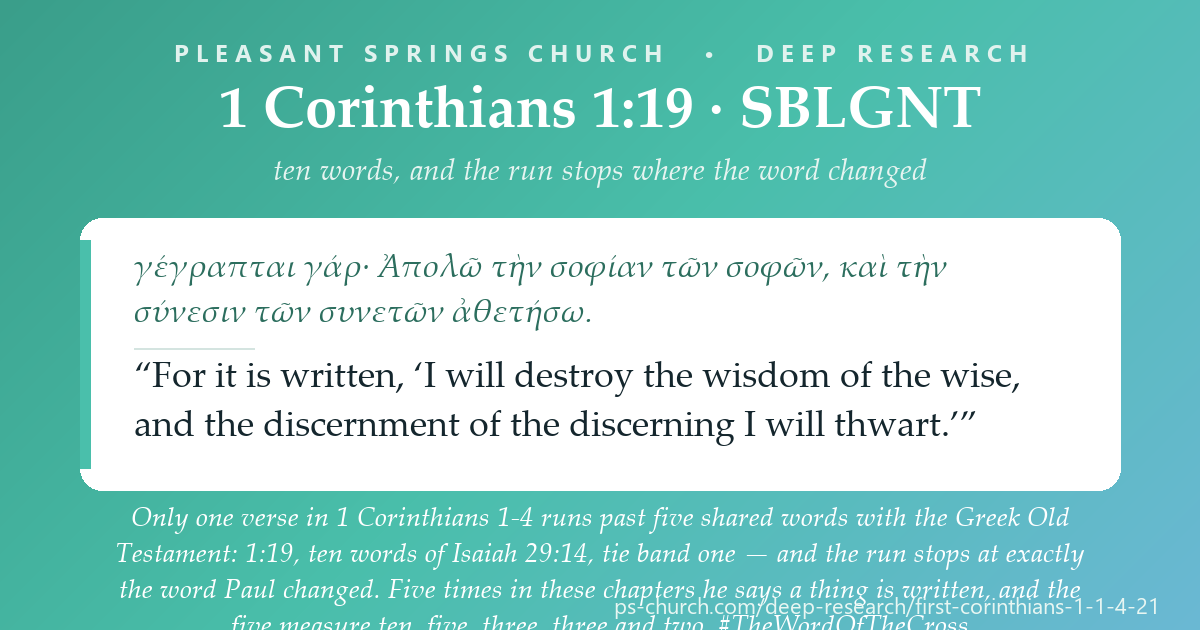
“For it is written, ‘I will destroy the wisdom of the wise, and the discernment of the discerning I will thwart.’”1 Corinthians 1:19 · ten consecutive Greek words shared with Isaiah 29:14, tie band 1
Greek Isaiah 29:14: …καὶ ἀπολῶ τὴν σοφίαν τῶν σοφῶν καὶ τὴν σύνεσιν τῶν συνετῶν κρύψω
1 Corinthians 1:19: γέγραπται γάρ· Ἀπολῶ τὴν σοφίαν τῶν σοφῶν, καὶ τὴν σύνεσιν τῶν συνετῶν ἀθετήσω.
The run begins at ἀπολῶ and ends at συνετῶν, and it ends there because the next word is the one Paul replaced. The tie band is one: no other verse in the 30,348 verse units held here reaches that depth against this row. And the same thing happens at 3:20, where the run of five stops at σοφῶν for ἀνθρώπων and then resumes for three words more. Two citations, two substitutions, and in both cases the substituted word is the one that makes the quotation say what Paul needs it to say — Isaiah’s hidden becomes set aside; the Psalm’s man becomes the wise. The page reports the substitutions and does not adjudicate them.
⚠️ The counter-examples this page prints against itself
1. An explicit ‘as it is written’ over a sentence the corpus does not have. 1 Corinthians 2:9 quotes something. Screened phrase by phrase against 30,348 verse units: ὀφθαλμὸς οὐκ εἶδεν occurs zero times; ἐπὶ καρδίαν ἀνθρώπου zero times; ἃ ἡτοίμασεν ὁ θεός zero times. Only the closing τοῖς ἀγαπῶσιν αὐτόν lands, at Deuteronomy 7:9, 2 Esdras 11:5, Sirach 1:10 and Psalms of Solomon 6:6 and 14:1 (Sirach and the Psalms of Solomon are witnesses, not Scripture, on this shelf). Isaiah 64:3 in the Greek and Hebrew numbering — Isaiah 64:4 in English, the verse usually named — measures one. The page will not manufacture a source. Origen and others in the early church suggested a book outside the canon; Jerome objected; the shelf records the dispute and takes no side, because the local corpora cannot settle it.
2. The deepest non-citation run in the four chapters is a coincidence. 2:3 shares five consecutive words with Isaiah 19:16 — ἐν φόβῳ καὶ ἐν τρόμῳ — with a tie band of one, which makes it look like a signal. It is not. Isaiah 19:16 is about Egyptians trembling; there is no formula in 1 Corinthians 2:3; and Paul’s own habitual phrase is the different one, μετὰ φόβου καὶ τρόμου (2 Corinthians 7:15, Ephesians 6:5, Philippians 2:12), which occurs zero times in the Greek Old Testament held here. A tie band of one is not by itself evidence of contact.
3. A formula-marked citation whose named source ties with three verses nobody cites. 3:19 says γέγραπται γάρ and quotes Job 5:13. The row’s maximum against the whole Greek Old Testament is three, and the tie band is four: Job 5:13 (σοφοὺς ἐν τῇ), Genesis 18:14, Proverbs 16:2 and Tobit (S) 5:10 — Tobit is a witness, not Scripture, on this shelf, and it is one of the twenty files added when the corpus grew — (all three παρὰ τῷ θεῷ). The cited verse and three uncited verses score the same. Its deepest contact anywhere in the New Testament is four, with Luke 18:27 — παρὰ τῷ θεῷ ἐστιν — which is deeper than its contact with the book it names.
4. Three verses after a run of ten, a run of none. 1 Corinthians 1:22 — For Jews demand signs and Greeks seek wisdom — shares no two consecutive words with any of the 30,348 Greek Old Testament verse units held here. It does share single words, with 24,659 of them; on this shelf’s Greek-side convention that is what a reported 1 means. 3:22 does the same; 4:16 no longer does, reaching three against 2 Maccabees 9:26 once the corpus grew — 2 Maccabees is a witness, not Scripture, on this shelf, and is labelled so every time it supplies a result. The instrument that found ten words of Isaiah in 1:19 finds nothing at all three verses later, in a sentence about the very thing Isaiah was quoted for.
5. And the sentence everybody quotes measures two. 2:2 — Jesus Christ and him crucified — returns two against the whole Greek Old Testament with a tie band of 320, and the two words are οὐ γάρ. Low number, high value. The screen cannot tell the difference and the page can.
Against the rest of the Greek New Testament
Across the 91 rows against the 7,490 New Testament verses outside 1 Corinthians: 89 reach two, 58 reach three, 25 reach four, 12 reach five, 6 reach six, 4 reach seven, 1 reaches twelve, and nothing reaches eight through eleven.
| row | run | tie band | matches | what it is |
|---|---|---|---|---|
| 1:3 | 12 | 5 | Romans 1:7 · 2 Corinthians 1:2 · Ephesians 1:2 · Philippians 1:2 · Philemon 3 | A formula. The wide band is the point: this is how Paul greets everyone. |
| 1:1 | 7 | 2 | 2 Corinthians 1:1 · Colossians 1:1 | ἀπόστολος Χριστοῦ Ἰησοῦ διὰ θελήματος θεοῦ καί — three letters, one opening. |
| 1:10 | 7 | 1 | Acts 15:26 | τοῦ ὀνόματος τοῦ κυρίου ἡμῶν Ἰησοῦ Χριστοῦ. |
| 1:8 | 7 | 1 | 2 Corinthians 1:14 | ἐν τῇ ἡμέρᾳ τοῦ κυρίου ἡμῶν Ἰησοῦ. |
| 4:19 | 6 | 1 | James 4:15 | The deepest non-formulaic contact in the four chapters, and it is with James. ὑμᾶς ἐὰν ὁ κύριος θελήσῃ καί — the if the Lord wills formula. Direction of influence is not asserted. |
| 1:2 | 6 | 1 | 2 Thessalonians 1:12 | τὸ ὄνομα τοῦ κυρίου ἡμῶν Ἰησοῦ. |
| 2:16 | 5 | 1 | Romans 11:34 | The same Isaiah quotation in two Pauline letters, both with the inserted γάρ. |
| 1:31 | 4 | 1 | 2 Corinthians 10:17 | καυχώμενος ἐν κυρίῳ καυχάσθω — deeper than the row’s contact with any Old Testament verse. |
| 3:19 | 4 | 1 | Luke 18:27 | παρὰ τῷ θεῷ ἐστιν — deeper than the row’s contact with the Job it cites. |
Against the rest of 1 Corinthians itself — chapters 5–16, 346 verses — nothing in these four chapters reaches six, and exactly five rows reach five: 1:2, 1:7, 1:8 and 1:10, all of them on τοῦ κυρίου ἡμῶν Ἰησοῦ Χριστοῦ or ἐν τῇ ἡμέρᾳ τοῦ κυρίου, and 4:19, which matches 16:7 — πρὸς ὑμᾶς ἐὰν ὁ κύριος, the same travel formula at the two ends of the letter, and the same formula that reaches six into James 4:15. A letter does not repeat itself verbatim, and that is worth knowing before anyone reads a low number between two texts as a sign of different hands.
Which cross-references matter?
- Isaiah 29:14 — ten words, tie band one: the deepest Old Testament contact in these four chapters by a margin of five.
- Psalm 94:11 (LXX 93:11) — five words, tie band one, with one word substituted in the middle and three more matching after it.
- Job 5:13 — named at 3:19 and measuring three, because Paul’s Greek is not the Septuagint’s at two of its words.
- Jeremiah 9:23–24 (LXX 9:22–23) — behind 1:31 and measuring two; the exact phrase ὁ καυχώμενος ἐν κυρίῳ occurs nowhere in the Greek Old Testament held here.
- Isaiah 40:13 — quoted at 2:16 and at Romans 11:34, and the two New Testament verses match each other more closely than either matches Isaiah.
- James 4:15 — six words shared with 1 Corinthians 4:19, tie band one. Reported as contact; nothing is claimed about who read whom.
It would be a poor study of these chapters that ended at a table of run lengths. Four sentences here are load-bearing, and not one of them is a quotation. 'The word of the cross is folly to those who are perishing, but to us who are being saved it is the power of God' (1:18) - the same message, two verdicts, and which one you give is not a measure of your intelligence. 'The foolishness of God is wiser than men, and the weakness of God is stronger than men' (1:25) - a comparative that does not concede the premise so much as detonate it. 'No one can lay a foundation other than the one already laid, which is Jesus Christ' (3:11) - the answer to every party slogan in the letter, and it is not 'follow nobody' but 'the floor is already down.' 'What do you have that you did not receive?' (4:7) - seven Greek words that end boasting without arguing about it. Screened against 30,348 verse units these four rows return 2, 3, 2 and 3. They are written in the plainest words in the letter. That is worth sitting with: the sentences the church has built on are not the ones that light up an instrument. The instrument finds where Paul reused someone else's words. It cannot find where he said something no one had said before.
The scholarship, and an honest account of what this page did not check.
The commentators on 1 Corinthians; the literature on Corinthian rhetoric and the sophists, on the parties of 1:12, and on the source of 2:9.
Commentaries & studies:
- Anthony C. Thiselton, The First Epistle to the Corinthians (NIGTC); Gordon D. Fee (NICNT, rev.); Roy E. Ciampa & Brian S. Rosner (PNTC); David E. Garland (BECNT); Joseph A. Fitzmyer (Anchor Yale); Richard B. Hays (Interpretation); Mark Taylor (NAC).
- Bruce W. Winter, Philo and Paul among the Sophists and After Paul Left Corinth; Stephen M. Pogoloff, Logos and Sophia: The Rhetorical Situation of 1 Corinthians; Duane Litfin, St. Paul’s Theology of Proclamation; Alexandra R. Brown, The Cross and Human Transformation.
- Martin Hengel, Crucifixion in the Ancient World and the Folly of the Message of the Cross — still the standard treatment of what 1:18 sounded like.
- G. K. Beale & D. A. Carson, eds., Commentary on the New Testament Use of the Old Testament — its 1 Corinthians chapter, on all five citations measured here.
- On 2:9: the patristic dispute itself — Origen’s ascription to an Apocalypse of Elijah, Jerome’s objection, and the modern discussions in Thiselton and in the Beale & Carson volume.
⚠️ What this page did NOT check, and where it is weakest
- No manuscript apparatus was consulted. The Greek here is the SBL Greek New Testament as digitized by MorphGNT, and the SBLGNT’s apparatus sigla were stripped before measuring and before printing. Where the SBLGNT differs from NA28 or from the Byzantine text this page is silent. Several rows quoted above carry a siglum in the source file — 1:23, 2:2, 3:4, 4:13 among them — and no variant reading in 1 Corinthians was examined at all.
- No ESV data file for 1 Corinthians exists on this disk and no Crossway API key was available. The ESV column above was typed and proofread against a printed edition, not extracted from a machine-readable text. That makes the English column the one part of this page a reader cannot re-derive by re-running the scripts — every Greek figure can be, and the English cannot. The English verse counts were checked against a digitised public-domain English text held on this disk, consulted for numbering only.
- The Greek Old Testament held here is Rahlfs as digitized by CATSS, and it is a critical reconstruction. No Göttingen edition was consulted, and no attempt was made to ask which Greek text-form Paul actually had in front of him. That question is live at 3:19, where his wording is not the CATSS wording, and this page cannot answer it. The page says “the CATSS row reads…” and never says “the Septuagint says.”
- Direction of influence is never asserted, anywhere. Not for 1:19 and Isaiah 29:14, where a formula makes a quotation obvious; not for 2:16 and Romans 11:34; not for 1:31 and 2 Corinthians 10:17; and emphatically not for 4:19 and James 4:15, where six words coincide with a tie band of one and nothing whatever follows from it.
- The source of 2:9 was NOT identified and this page does not pretend otherwise. Its phrases return zero, zero and zero against 30,348 verse units. Whether Paul is combining Isaiah 64 with Isaiah 65:16 and Jeremiah 3:16, quoting a lost text, quoting a liturgical formula, or paraphrasing freely, the local corpora cannot decide, and the shelf reports the zeros rather than nominating a winner.
- No Hebrew screen was run. The Hebrew of Job 5:13 and Psalm 94:11 is printed above and was read from the Masoretic corpus held here, but no systematic Hebrew measurement was made, because the source text of this study is Greek throughout. The claim that בְּעׇרְמָם is closer to πανουργίᾳ than to φρονήσει is a lexical judgement, not a measurement.
- ★ The corpus grew after this study was first measured, and every figure above was re-measured against the larger one. When the page was drafted the shelf held 44 CATSS files, 23,061 verse units; Greek Exodus, Leviticus, Numbers, Joshua, Tobit, Judith, Wisdom, Baruch, the Epistle of Jeremiah, 2–4 Maccabees, the Odes, Susanna, Bel and the Psalms of Solomon were not among them. It now holds 64 files, 30,637 verse units. The two deepest runs did not move. Tie bands did — 2:2 from 206 to 324, 1:10 from 98 to 123, 1:12 from 111 to 141 (and all three moved once more when the Odes came out: see below) — and one negative result did: 4:16 shared no two consecutive words with the 44-file corpus and reaches three against the 64-file one, at 2 Maccabees 9:26. ★ Then, on 30 August 2026, the corpus SHRANK, and every figure was re-measured a third time. One of those twenty files — the Odes, the 289 verse units of liturgical canticles bound after the Greek Psalter — was withdrawn from the screening corpus. The shelf HOLDS 30,637 verse units in 64 files and SCREENS 30,348, and every number on this page is against the 30,348. Two of the fourteen canticles are New Testament text — Ode 9 is Luke 1, the Magnificat and the Benedictus, and Ode 13 is Luke 2, the Nunc Dimittis — so while they sat in the corpus a screen of the Greek New Testament against ‘the Greek Old Testament’ returned Odes 9:48 against Luke 1:48 at eighteen consecutive words and twenty-four more rows of the same kind. That is Luke matching Luke under an Old Testament shelfmark, and a page could have printed it as a Gospel’s deepest Old Testament contact while measuring its own text. It was caught by reading the shelf’s deepest hits by eye instead of tabulating them. And ten of the fourteen canticles are second copies of passages already held (Ode 1 = Exodus 15, 2 = Deuteronomy 32, 3 = 1 Samuel 2, 4 = Habakkuk 3, 5 = Isaiah 26, 6 = Jonah 2, 7 and 8 = Daniel Th 3, 10 = Isaiah 5, 11 = Isaiah 38), which doubled any tie band touching a canticle. They stay on disk; they are out of the screen. What this did to this page: not one published run, and not one named partner, moved. 1:19 is still ten against Isaiah 29:14 in a band of one; 3:20 still five against Psalm 93:11 in a band of one; the five citation formulas still return ten, five, three, three and two; 1:22 and 3:22 still share no two consecutive words with anything; 2:9’s three phrases still return zero, zero and zero; σταυρ- still stands in exactly one unit, Esther 7:9. Three published band figures moved by a handful: 2:2 from 324 to 320, 1:12 from 141 to 139, and 1:22’s single-word count from 24,844 to 24,659; 1:10 stayed at 123. Twenty-two of the 91 rows lost a unit or two from bands this wide, and only those three are printed anywhere on the page. None of the removed rows was an Ode 9 or Ode 13 row — no verse of 1 Corinthians 1–4 ever touched the Lukan canticles — so nothing withdrawn from this page was Luke measured against itself. It was ordinary Greek connective tissue, counted twice. Older pages on this shelf print 23,061 and 44 files, and they were correct when they were made. A tie band is a property of the corpus, not of the verse. The twenty new files include the deuterocanon, which this shelf holds as WITNESSES AND NOT AS SCRIPTURE and labels so every time one supplies a result — on this page that is 2 Maccabees 9:26 at 4:16, 2 Maccabees 4:41 and Sirach in the πανουργ- counts, Tobit (S) 5:10 in the 3:19 tie band, 1 Maccabees 1:25 in the 1:2 tie band, and Sirach 1:10 with Psalms of Solomon 6:6 and 14:1 in the 2:9 tie band.
- The acrostic, pangram and letter screens do not apply. They are Hebrew-alphabet instruments; there is nothing for them to do in a Greek epistle, and none was run.
- Nothing here bears on the partition of 1 Corinthians or on the identity of the parties. The structure diagram records one measured verbal bracket at 1:12 / 3:4. It is not offered as evidence for or against any theory of composition, and the hapax cluster in chapter 4 is reported as a count and nothing more.
- Only seventeen of the 91 verses are printed. A codex is a selection, chosen here to give every one of the four chapters a voice and to set the measurement’s best and worst cases beside each other. Chapters 5–16 — the lawsuits, marriage, food offered to idols, the Supper, the gifts, love, tongues, the resurrection — are outside this study entirely, and the rest of the letter is covered by five further pages on this shelf: 5–8, 9–11, 12–14, 15:1–11 and 16 — with 15:12–58 not yet studied anywhere.
Interpretation notes worth keeping:
- 1:18–2:5 is not anti-intellectual. Paul argues, quotes, and reasons for four chapters; what he refuses is wisdom of word (1:17) as a credential, and a scoreboard on which the cross must lose. He calls Christ the wisdom of God in the same paragraph (1:24, 1:30).
- ‘Not many were wise’ (1:26) says not many, not none. The verse is an observation about who answered the call, and it is aimed at boasting, not at the educated. Erastus the city treasurer (Romans 16:23) was in this same church.
- ‘I follow Christ’ (1:12) is listed with the other slogans, not above them. Whether the fourth group was a real party or Paul’s own reduction to absurdity is debated; either way, the answer at 1:13 is a question about who was crucified, and it dismantles all four.
- 3:15 is not a doctrine of purgatory and not a doctrine of cheap grace. The fire tests the work, not the worker; the builder whose work burns will be saved, but only as through fire. Read it as the judgement of ministry, which is what 3:5–4:5 is about throughout.
- ‘Do not go beyond what is written’ (4:6) is itself contested. The Greek is elliptical — τὸ μὴ ὑπὲρ ἃ γέγραπται, with no verb — and this page does not settle whether the written thing is the four quotations just made, Scripture generally, or a proverb. It notes that a page about how Paul quotes has to admit that his sixth reference to writing is the one it cannot construe.
- 4:21 leaves the choice with the church. Shall I come to you with a rod, or with love in a spirit of gentleness? The four chapters end in a question, not a verdict, and 2 Corinthians shows the question was still open.
Five formulas, five answers, and a verse that stops where the word changed.
What the measurement found, in one paragraph
Screened against 30,348 verse units of the Greek Old Testament, 91 verses of 1 Corinthians 1–4 produced exactly one run past five: 1:19, ten consecutive words of Isaiah 29:14, tie band one. And the run stops at precisely the word Paul changed — Isaiah’s I will hide becomes I will set aside. The same thing happens at 3:20, where five words of Psalm 93:11 stop at the wise for man and then resume for three more. Five citation formulas stand in these chapters, and they measure ten, five, three, three and two.
“For it is written, ‘I will destroy the wisdom of the wise, and the discernment of the discerning I will thwart.’”1 Corinthians 1:19 · ten words of Isaiah 29:14, tie band 1 — the deepest Old Testament contact in 91 verses
And three verses later the same instrument finds nothing at all. 1:22 — Jews demand signs and Greeks seek wisdom — shares no two consecutive words with any of the 30,348 verse units held here. Both facts are true at once, and a page that printed only the first would be lying by omission.
Three things a reader can check without any tools
1. Read 1:12, then read 3:4. Paul quotes the same slogan twice, in the same four Greek words. Ask what he put between them, and why a man answering a fan-club problem spends two chapters on the cross before he ever mentions Apollos again.
2. Read 1:19 beside Isaiah 29:14 in any English Bible. They will match for a whole line and then diverge on the last word: Isaiah hides, Paul thwarts. Then do the same with 3:20 and Psalm 94:11 — the Psalm says man, Paul says the wise. Notice that in both places the change is the point of the quotation.
3. Look up the reference for 1 Corinthians 2:9 in your Bible’s margin. Then read the verse it sends you to. It will not be a match, and no printed reference will make it one. Sit with a writer who says as it is written about something you cannot find.
Step in response: take 4:7 at its word for one week. What do you have that you did not receive? Every skill, every teacher, every hour, every understanding of Scripture — received. There is nothing left to compete over, and that is the whole cure for chapters 1 to 4.
Whole-section study, 91 verses in scope, all four chapters represented in the codex above. Greek New Testament and ESV.
1 Corinthians 1:19 · to share
Greek New Testament + ESVEvery Deep Research page traces its passage across the whole sweep — the Old Testament, the Second-Temple world between the testaments (historical witnesses, not Scripture), and the New Testament. Follow the thread:
Pleasant Springs Church — Deep Research
Research method after Michael S. Heiser’s Bible Research Method (examine dictionaries → ancient literature → important words → textual connections → academic publications → share), with the Pleasant Springs “Author & Audience” foundation. Scripture set in the Hebrew, the Greek editions named on each page and the ESV (Old Testament), and the Greek New Testament and the ESV (New Testament), per the practice of Pleasant Springs Church. 1 Corinthians research grounded in Thiselton (NIGTC), Fee (NICNT), Ciampa & Rosner (PNTC), Garland (BECNT), Fitzmyer (Anchor Yale) and Hays (Interpretation), with Winter and Pogoloff on Corinthian rhetoric, Hengel on crucifixion, and Beale & Carson on the Old Testament use. Text: Greek New Testament from the SBL Greek New Testament as digitized by MorphGNT; Greek Old Testament from Rahlfs’ Septuaginta as digitized by CATSS; Hebrew from the Masoretic text as printed in Sefaria’s Miqra according to the Masorah; English from the ESV. ⚠️ VERSE NUMBERING — there is no offset in 1 Corinthians, and the page says so rather than leaving it unsaid. 1 Corinthians 1–4 runs 31 / 16 / 23 / 21 = 91 verses in the SBLGNT as digitized by MorphGNT and 91 in the English; the whole letter runs 437 verses in sixteen chapters in both. Every reference on this page means the same verse in both columns. Three of the verses Paul quotes do carry offsets, and the page prints them rather than hiding them. Psalm 94:11 in the Hebrew and English is Psalm 93:11 in the Greek — the Septuagint Psalter runs one behind the Masoretic numbering from Psalm 9/10 through 147 — and 3:20 quotes it. Jeremiah 9:24 in English is Jeremiah 9:23 in the Hebrew and in CATSS Greek, because Hebrew Jeremiah 8:23 is English 9:1; 1:31 alludes to it. Isaiah 64:4 in English is Isaiah 64:3 in the Hebrew and in CATSS Greek, because English 64:1 is Hebrew 63:19b; it is the verse usually named behind 2:9. Isaiah 29:14, Isaiah 40:13 and Job 5:13 carry no offset at all — the same number in the Masoretic text, in CATSS and in English. ⚠️ The measurement, in full. Greek against Greek. MorphGNT field 6, the normalised word — the column that already resolves elision and the movable nu — on both sides for New Testament comparisons; CATSS FORM column (cols 0–24), beta-code transliterated first, for the Greek Old Testament. Both sides lowercased, accents and breathings dropped, final sigma folded, then filtered to Greek letters — the same filter applied to every corpus. Word forms, never lemmas. The SBLGNT apparatus sigla were stripped from the printed Greek before measuring. Corpora: the 91 verses of 1 Corinthians 1–4 against 30,348 screened verse units of the 30,637 held across 64 CATSS files, against the 7,490 New Testament verses outside 1 Corinthians, and against the 346 verses of 1 Corinthians 5–16. Lemma counts were taken from the MorphGNT lemma column over all 137,554 word tokens of the Greek New Testament. Exhaustive and deterministic; nothing sampled, so no seed applies. ⚠️ What a reported 1 means here. This page uses the shelf’s Greek-side convention, with unigram fallback ON: a row reported as 1 shares single words but no two consecutive words. It does not mean the row shares nothing — 1 Corinthians 1:22 shares single words with 24,659 of the 30,348 verse units and no pair with any of them. The Hebrew-side pages on this shelf use the opposite convention, where 0 carries that meaning, and the two must not be read across. ⚠️ Tie bands are printed beside every run, because a run without its band is misleading: 1 Corinthians 1:3 reaches twelve into five other letters at once, and that band of five is the whole reason the page calls it a formula rather than a finding — while 2:3 reaches five with a band of one and is still a coincidence. ⚠️ Direction of influence is never asserted. Nothing here says that 1 Corinthians 4:19 and James 4:15 are related, or which of 1 Corinthians 2:16 and Romans 11:34 came first, or what Greek text of Job Paul had at 3:19. The page reports contact and stops. Typology is handled per the house position: what the text says, what the New Testament itself draws, and what we see from this side of the cross — with the seeing left to the reader.
Scripture quotations marked ESV are from the ESV® Bible (The Holy Bible, English Standard Version®), © 2001 by Crossway, a publishing ministry of Good News Publishers. ESV Text Edition: 2016. Used by permission. All rights reserved. The ESV text may not be quoted in any publication made available to the public by a Creative Commons license, and the ESV may not be translated in whole or in part into any other language. www.esv.org
|
Did this study bless you today? 💚 Give to Support PS Church100% of gifts go to the General Fund — thank you. |