The last chapter of 1 Corinthians reads like the back of an envelope: an offering schedule, a sailing plan, a note about Apollos, four shouted imperatives, a list of names, a kiss, a signature, a curse, a prayer in Aramaic, a blessing. Screened against 30,348 verse units of Greek Old Testament it quotes nothing — it reaches three consecutive words, six times, and every one of the six is common stock. Yet its two deepest runs anywhere in the Greek New Testament are tied at six, and both fall in the last four verses: the signature and the grace. Meanwhile its one real debt to the Old Testament — be men, be strong — measures a single shared word against the psalm that says it best. This study works 1 Corinthians 16:1–24, and prints where the measurement helps and where it cannot see. See the method →
1 Corinthians 16:1–24 — fifteen of the twenty-four verses
Greek NT · ESVThe Shape of the Passage
Sequence — not a chiasmA letter that has just finished arguing the resurrection of the dead (chapter 15) ends with an instruction about where to keep the offering money. That juxtaposition is the point of the chapter, and Paul does not soften it: the same word he used for Christ as ἀπαρχή he now uses for a household in Achaia, and the same word he used for the grace of God he now uses for the cash.
Author
Paul, in Ephesus, with a boat to catch and a fund to raise. He names his own location and his own timetable: he will stay in Ephesus until Pentecost (16:8), come through Macedonia, and perhaps winter at Corinth (16:5–6). He is asking to be sent on his way — προπέμψητε, a word that in this period means provisioned and paid for, not merely waved off. Two of the nine New Testament occurrences of that verb are in this one chapter (16:6, 16:11). The apostle who spent chapter 9 explaining why he would not take money from Corinth for himself spends chapter 16 arranging money that will pass through Corinth for someone else.
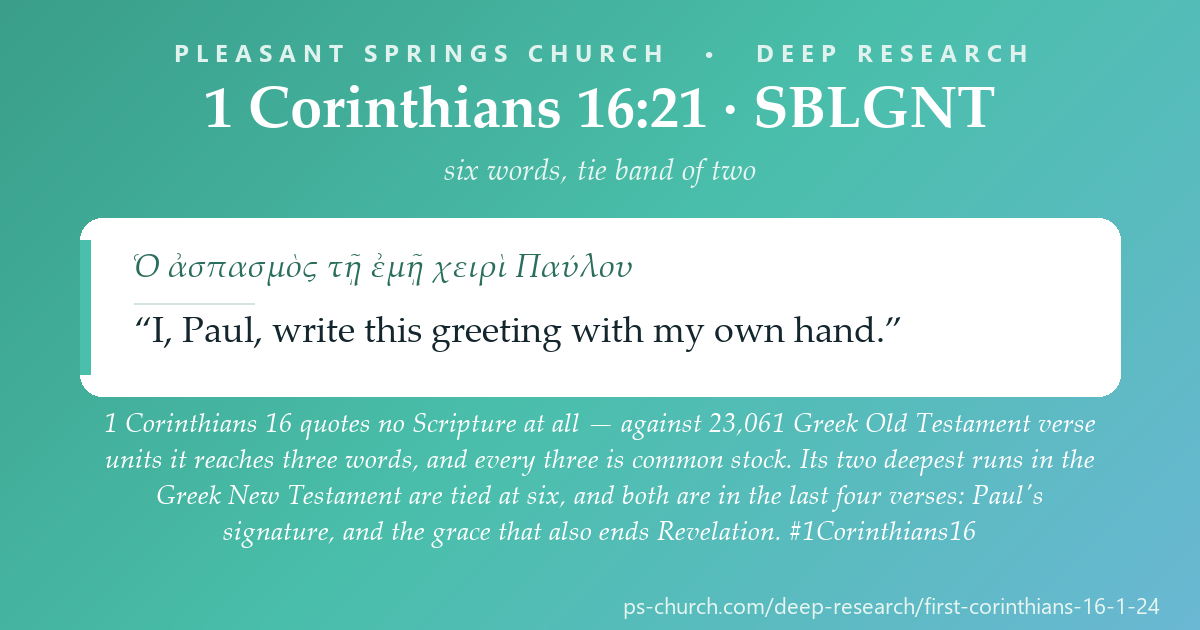
And he takes the pen. The letter was dictated; at 16:21 the handwriting changes and Paul writes for himself: Ὁ ἀσπασμὸς τῇ ἐμῇ χειρὶ Παύλου. That sentence, six words long, is one of the two deepest verbatim runs this chapter reaches anywhere in the Greek New Testament, tied with the grace of 16:23 — and it reaches it not by quoting Scripture but by repeating himself: the identical six words stand at Colossians 4:18 and 2 Thessalonians 3:17. Then, in his own hand, he writes a curse and a prayer, and signs off with grace and with love.
Audience
A divided church being handed a joint project. Corinth had parties (1:12), lawsuits (6:1), a scandal (5:1), a chaotic supper (11:20) and disorderly meetings (14:33). The last thing Paul gives them is not a warning; it is a task that no faction can do alone and no faction can take credit for — a collection for believers they have never met, in a city they have never seen. He gives it a rhythm (the first day of every week), a method (each of you, at home, as he prospers), an audit (those whom you accredit by letter), and a precedent (as I directed the churches of Galatia). Nothing about it is spontaneous, and nothing about it runs through Paul’s own hands alone.
And a church told to submit to the people who had already started. Stephanas’ household is named three times in the New Testament, all three in this letter — 1:16, 16:15, 16:17. They are the ἀπαρχή of Achaia, and Paul says they appointed themselves to the service of the saints. In a congregation arguing about status, the instruction is to fall in behind the volunteers. Then: greet each other with a kiss. The letter that opens by naming the factions closes by making the factions kiss.
Orient on the collection, the Lord’s day, the autograph, and the two words nobody translates.
Search by topic: collection for the saints (Jerusalem collection), first day of the week / Lord’s Day, letter-closing and amanuensis, holy kiss, anathema, Maranatha, Stephanas, Aquila and Priscilla, Ephesus, Pentecost.
Which articles are relevant?
- Anchor Bible Dictionary — “Collection for the Saints,” “Lord’s Day,” “Letters (Greco-Roman),” “Kiss,” “Anathema,” “Maranatha,” “Ephesus.”
- Dictionary of Paul and His Letters — “Collection for the Saints,” “Letters, Letter Forms,” “Travel Plans,” “Coworkers,” “Liturgical Elements,” “Curse, Accursed, Anathema.”
- NIDNTT / TDNT / BDAG — λογεία (logeia, collection), χάρις (charis, grace / gift), ἀπαρχή (aparchē, firstfruits), ἀνάθεμα (anathema), ἀνδρίζομαι (andrizomai).
- Dictionary of New Testament Background — “Letters,” “Benefactor,” “Travel and Hospitality,” “Diaspora Judaism” (for money carried to Jerusalem).
Bibliography surfaced:
- Gordon D. Fee (NICNT), Anthony C. Thiselton (NIGTC), Roy E. Ciampa & Brian S. Rosner (Pillar), David E. Garland (BECNT) on 1 Corinthians.
- Dieter Georgi, Remembering the Poor; David J. Downs, The Offering of the Gentiles; Stephan Joubert, Paul as Benefactor.
- E. Randolph Richards, Paul and First-Century Letter Writing; Hans-Josef Klauck, Ancient Letters and the New Testament.
- None of these were consulted for the measurements on this page. The numbers below come from the text files named in the footer, and can be re-run.
A relief fund, a sailing season, a signature, and an Aramaic prayer.
Read the collection as a real, multi-year, multi-province campaign; read the closing as a real letter-closing, with the conventions that made a letter trustworthy.
Which parallels shed light on religion and worldview?
The collection is not a one-off appeal; it is a campaign that runs across four letters. The trail is visible in the New Testament itself: an agreement at Jerusalem that Paul should “remember the poor” (Gal 2:10); the instructions here (1 Cor 16:1–4); two whole chapters of persuasion when Corinth stalls (2 Cor 8–9; see the Macedonian example); the delivery announced (Rom 15:25–28); and Paul’s own account of it at his trial, “I came to bring alms to my nation” (Acts 24:17). What 1 Corinthians 16 gives is the mechanics — the only place in the New Testament where a church is told when to set money aside, where to keep it, and who will carry it.
‘On the first day of the week’ — and the accounting is done at home. κατὰ μίαν σαββάτου is the same Semitic-Greek way of saying “day one of the week” that stands in every resurrection narrative (Matt 28:1; Mark 16:2; Luke 24:1; John 20:1, 19) and at the breaking of bread in Troas (Acts 20:7). But note what Paul does not say. He does not say “bring it to the assembly.” He says παρ᾽ ἑαυτῷ, by himself, at home, storing it up — so that when he arrives there is no scramble, no public shaming, no counting of who gave what. The weekly rhythm is fixed; the amount is ὅ τι ἐὰν εὐοδῶται, “whatever he may prosper,” and it is nobody else’s business.
The audit is built in. Paul will send “those whom you accredit by letter” (16:3) — the Corinthians choose the couriers, and letters of accreditation travel with them. If it seems advisable, Paul will go too, but only as one of a party (16:4). A first-century traveller carrying temple money to Jerusalem moved in convoy for exactly this reason, and the practice of Diaspora communities sending money to Jerusalem under escort is well attested in the period. The classical sources for that practice — Philo, Josephus, Cicero’s Pro Flacco — are not held on this shelf and were not consulted; what is checkable here is only what the New Testament itself says.
The autograph is a security feature. A dictated letter was authenticated by the sender taking the pen for the last lines — the hand changes, and the recipients can see it. Paul does it at Galatians 6:11, Philemon 19, Colossians 4:18, 2 Thessalonians 3:17 and here. At 2 Thessalonians he says why: “this is the sign in every letter of mine” — written to a church that had been rattled by a letter purporting to be from him (2 Thess 2:2). The signature is not sentiment; it is a countermeasure against forgery.
And then two words nobody translated. Μαράνα θά is Aramaic, left standing in a Greek letter to a Greek-speaking city — the way Abba and Amen and Hosanna were left standing. It survives in the church’s earliest order of worship: the Didache puts it at the end of the eucharistic prayers, in the same position, next to the same warning about who may come. The Didache is not held on this shelf and could not be checked here; that is a report of what the scholarship says, not a measurement.
- Galatians 2:10; 2 Corinthians 8–9; Romans 15:25–28; Acts 24:17 — the same collection, at four stages: agreed, organised, argued for, delivered (see 2 Corinthians 8–13).
- 1 Chronicles 29:1–20 — the other great building fund in Scripture, and the same theology in one sentence: “of your own have we given you” (see David’s offering).
- Acts 19:1–20:1 — Ephesus: the two years in the hall of Tyrannus, and then the riot. Read 16:9 against it: a great and effective door, and many adversaries, in the same sentence.
- 2 Thessalonians 2:2 with 3:17; Galatians 6:11; Colossians 4:18; Philemon 19 — the autograph, and the forgery it guards against.
It is worth sitting with how the letter ends. Paul has just finished the greatest sustained argument about the resurrection of the body anywhere in Scripture — trumpets, the last enemy, the imperishable, death swallowed up in victory — and the very next sentence is about a weekly envelope. There is no transition. The Greek runs straight from “your labour is not in vain in the Lord” into “now concerning the collection.” Modern readers feel the drop; Paul evidently did not. The reason is visible in his vocabulary rather than in any explanation he offers. The word he uses for the money in 16:3 is χάρις — grace — and the word he uses for the household in 16:15 is ἀπαρχή, firstfruits, which in this very letter is what Christ is (15:20, 15:23). He is not changing subject. He is spending the same coinage. A church that believes the body will be raised will do something with its money, its Sunday, its hospitality and its handwriting; and if it will not, the belief has not landed anywhere. That is why the chapter can end with a curse. Loving the Lord, in this letter, is not a feeling one reports; it is a set of arrangements one makes.
A street word for the offering, a battle word for the imperative, and two words left in Aramaic.
Every count below was run over the SBLGNT (7,927 verses) or the 64 Greek Old Testament files held here — 30,637 verse units held, 30,348 screened, the difference being the 289 units of the Odes, which are excluded from anything called ‘the Greek Old Testament’ on this shelf. Word counts are lemma counts — MorphGNT field 7 on the Greek side, the CATSS lemma column on the Septuagint side; phrase and run counts are on the normalised word form. Both can be re-run.
“Collection.” It occurs twice in the whole Greek New Testament, in these two consecutive verses, and nowhere else — and it does not occur in the 64 Greek Old Testament files held here at all. (The near-misses are all a different word, λογεῖον, the high priest’s breastpiece, which stands twenty times in those files: Exodus 28 and 29 and 35 and 36, Leviticus 8:8, and Sirach 45:10.) It is a workaday commercial and religious term from the papyri for a levy or a whip-round; the church’s word for an offering entered Scripture from the street, not from the temple.
“Your gift.” χάρις stands ten times in 1 Corinthians, across eight verses — 1:3, 1:4, 3:10, 10:30, 15:10 (three times), 15:57, 16:3, 16:23. The first is the opening greeting, the last is the closing benediction, and one in the middle means money. The same word does duty for God’s grace and for the Corinthians’ cash, deliberately; 2 Corinthians 8–9 will build a whole argument on the overlap.
“Send me on my way.” Nine occurrences in the Greek New Testament, two of them in this chapter, the rest at Acts 15:3; 20:38; 21:5; Romans 15:24; 2 Corinthians 1:16; Titus 3:13; 3 John 6. In context it means outfitting a traveller — food, money, company for the road. Paul asks Corinth to do it for himself and, in the same breath, for Timothy.
“A door… effective.” Twelve verses in the Greek New Testament hold both θύρα and ἀνοίγω; four of them are the missionary open door — Acts 14:27, 1 Corinthians 16:9, 2 Corinthians 2:12, Colossians 4:3. ἐνεργής itself occurs three times (here, Philemon 6, Hebrews 4:12): working, live, in operation. Note the conjunction: the door is open and the adversaries are many, joined by καί, not by but.
“Act like men.” This is the only occurrence of the verb in the entire Greek New Testament. In the 64 Greek Old Testament files held here the CATSS lemma stands twenty-five times, and it is a battle-and-succession word: Moses to Joshua (Deut 31:6, 7, 23), the LORD and Israel to Joshua (Josh 1:6, 7, 9, 18) and Joshua to his commanders (Josh 10:25), David to Solomon (1 Chr 22:13; 28:20), Joab before the Ammonites (2 Sam 10:12), Hezekiah on the wall (2 Chr 32:7), the angel to Daniel (Dan 10:19, in both Greek Daniels — so the twenty-five sit at twenty-four distinct places), and the Psalter twice (LXX 26:14 and 30:25 = MT/ESV 27:14 and 31:24).
“Be strong.” Forms of the κραται- root stand five times in the Greek New Testament — the verb four times (Luke 1:80 and 2:40, of a child growing strong; here; and Ephesians 3:16) and the adjective once (1 Peter 5:6) — and 143 times in the 64 Greek Old Testament files held here, 62 of them the verb. Paul’s pairing of it with ἀνδρίζεσθε reproduces a fixed Septuagint doublet — “be a man and be strong” — which the verbatim screen in Stage 4 cannot see at all.
“Firstfruits.” Nine occurrences in the Greek New Testament; three of them in 1 Corinthians, and those three are 15:20, 15:23 and 16:15. Christ is the firstfruits of those who have fallen asleep; the household of Stephanas is the firstfruits of Achaia. One word, one letter, two chapters apart (see the creed).
“With a holy kiss.” The exact three-word sequence stands in three verses of the Greek New Testament — Romans 16:16, here, and 1 Thessalonians 5:26. 2 Corinthians 13:12 has the same instruction with the adjective in front (ἐν ἁγίῳ φιλήματι), and 1 Peter 5:14 has “a kiss of love.”
“Let him be accursed.” ἀνάθεμα is the Septuagint’s word for the ḥerem, the devoted-to-destruction thing (Deut 13:16, 18; 20:17; Judg 1:17; 21:11), and Zechariah 14:11 ends by promising there will be no more of it. In the New Testament the noun stands six times in that sense — Acts 23:14, and five in Paul: Romans 9:3, 1 Corinthians 12:3, here, Galatians 1:8 and 1:9. (MorphGNT files the votive offerings of Luke 21:5, ἀναθήμασιν, under the same lemma; that is a different word and it is not counted here.) 1 Corinthians uses it twice — at 12:3 nobody speaking by the Spirit says “Anathema, Jesus,” and at 16:22 anyone who does not love the Lord is anathema.
Aramaic, untranslated: our Lord, come — or, divided the other way (μαρὰν ἀθά), our Lord has come. The word division is the whole question and the manuscripts do not settle it; the SBL edition flags this very phrase as one of the eighteen places in these twenty-four verses where its printed text differs from the editions it collates. The ESV chooses the imperative, and Revelation 22:20 says the same thing in Greek.
The four imperatives, and where they come from
1 Corinthians 16:13 is a Septuagint sentence built out of Septuagint parts. Two of its four verbs are the rarest things in the chapter. ἀνδρίζομαι occurs once in the Greek New Testament — here — and twenty-five times in the Greek Old Testament held on this shelf. κραταιόω occurs four times in the New Testament and sixty-two times in that same Greek Old Testament. And in the Septuagint the two roots keep company:
ἀνδρίζου καὶ ἴσχυε — “be a man and be strong.”LXX Deuteronomy 31:6, 7, 23 — Moses to Israel, and to Joshua, twice
ἀνδρίζεσθε καὶ κραταιούσθω ἡ καρδία ὑμῶν — “be men, and let your heart be strong.”LXX Psalm 30:25 — MT / ESV Psalm 31:24
That second line is the closest thing in the Greek Bible to what Paul writes: the same two roots, in the same order, in the same plural imperative. And the verbatim screen scores it at one. One word — ἀνδρίζεσθε — because Paul writes κραταιοῦσθε where the psalm writes κραταιούσθω, and drops the heart. Against LXX Psalm 26:14 (MT/ESV 27:14), the other great ‘be a man’ verse, the screen scores zero: the two verses share no word at all. The chapter’s clearest debt to the Old Testament is the one thing a run-screen cannot measure.
How the rest of the New Testament uses this vocabulary:
- 2 Corinthians 8:1–9:15 — χάρις stands ten times across those two chapters, for God’s grace and for the Corinthians’ gift alike; the Macedonian churches, the equality principle, and the audit (see 2 Corinthians 8–13).
- 1 Corinthians 15:20, 15:23 — Christ the ἀπαρχή; and then a household in Achaia (see the creed).
- Romans 16:16; 1 Thessalonians 5:26; 2 Corinthians 13:12; 1 Peter 5:14 — the holy kiss, four times, three of them word-for-word identical.
- Galatians 1:8–9; Romans 9:3; 1 Corinthians 12:3 — ἀνάθεμα in Paul: on a false gospel, on himself for his kinsmen’s sake, and on a confession.
- Revelation 22:20–21 — “Come, Lord Jesus. The grace of the Lord Jesus be with all.” The same two moves, in the same order, closing the other end of the canon (see Revelation 21–22).
Two screens, both exhaustive, and what they disagree about.
Greek against Greek. MorphGNT field 6 — the normalised form, which already resolves elision and the movable nu — lowercased, accents and breathings dropped, final sigma folded, filtered to Greek letters; the identical filter on the CATSS side. Contiguous runs of whole word forms, never lemmas. Exhaustive and deterministic: nothing sampled, so no seed applies. This finds verbatim contact. It does not find allusion.
Screen 1 — 1 Corinthians 16 against the whole Greek Old Testament held here
Source: the 24 verses of 1 Corinthians 16, SBLGNT. Target: 30,348 verse units — the 64 CATSS Greek files on this shelf, which hold 30,637 units, less the 289 units of the Odes. Why the Odes are out is the subject of the second note below.
Result: all 24 rows reach two, six reach three, and nothing reaches four. Here are all six threes, with the tie band beside each — the band is the number of target verses tied at that depth, and a run without its band is misleading:
- 16:11 — αὐτὸν μετὰ τῶν, run 3, band 16. (2 Chr 25:28; 26:23; 2 Kgs 12:22…)
- 16:12 — μετὰ τῶν ἀδελφῶν, run 3, band 12. (1 Chr 8:32; 9:38…)
- 16:13 — ἐν τῇ πίστει, run 3, band 1. The single deepest, tightest hit of the whole screen — and it is 1 Chronicles 9:31, about Mattithiah the Levite, who was entrusted with making the flat cakes. Nothing whatever to do with standing firm.
- 16:16 — καὶ παντὶ τῷ, run 3, band 12. (1 Macc 15:1; 2 Sam 17:3; Dan 9:7…)
- 16:17 — δὲ ἐπὶ τῇ, run 3, band 2. (1 Macc 12:12; Job 29:21)
- 16:2 — ὅ τι ἐὰν, run 3, band 2. (1 Sam 19:3; 2 Esdras 7:16)
⚠️ Two of those bands contain deuterocanonical books, and the shelf names what they are rather than folding them into “the Greek Old Testament.” 1 Maccabees 15:1 and 12:12, and the 2 Maccabees rows in the wider bands, are WITNESSES, NOT SCRIPTURE on this shelf — measurement partners for the Greek, held to the same treatment as Psalm 151 and Jubilees. They came onto the disk with the last twenty CATSS files, and they change nothing here: the whole screen was re-verified against the complete 30,637 units on 30 August 2026, and re-verified a second time on 30 August 2026 against the 30,348 units that remain once the Odes are withdrawn, and every one of these six numbers came back identical both times — same six rows, same runs, same bands, including 16:13’s band of one on Mattithiah’s flat cakes.
⚠️ A hazard the twenty new files created for screens of this shape — found on this page while the Odes were still in the corpus, and closed on 30 August 2026. The paragraph is kept rather than deleted, because the instrument doing this is worth a reader knowing about. Odes 9 is Luke 1:46–55 and 1:68–79 and Odes 13 is Luke 2:29–32 — the Magnificat, the Benedictus and the Nunc Dimittis, gathered into the Greek Psalter’s appendix. For a few days they sat inside “the Greek Old Testament” as this shelf measured it, and a New Testament verse screened against that corpus could come back matched to Luke: 272 New Testament verses did, headed by Luke 1:48 against Odes 9:48 at a run of eighteen consecutive words. That is Luke matching Luke under an Old Testament shelfmark — a page could have printed it as a Gospel’s deepest Old Testament contact and been measuring its own text. The Odes were withdrawn from the screening corpus for that reason and for a second one: ten of the fourteen canticles are second copies of passages already held (Ode 1 = Exodus 15, 2 = Deuteronomy 32, 3 = 1 Samuel 2, 4 = Habakkuk 3, 5 = Isaiah 26, 6 = Jonah 2, 7 and 8 = Daniel Th 3, 10 = Isaiah 5, 11 = Isaiah 38), so any tie band touching a canticle was silently doubled. They stay on disk; they are out of the screen. Nothing on this page moved. No row of 1 Corinthians 16 ever reached above two against any Odes row, so the screen returns the identical six threes and the identical six bands at 30,348 units as it did at 30,637 — verified both ways. What changed is only the number this page is entitled to print beside the word screened.
That is the whole result. 1 Corinthians 16 does not quote the Old Testament. Not once, not loosely. The bands say why the threes exist: they are the connective tissue of Greek prose — with the brothers, and to everyone who, whatever. The one three with a band of one is an accident about pastry. This is the page’s own counter-example, printed on purpose: if a run of three in a band of one can be Mattithiah’s flat cakes, then no run of three anywhere on this shelf should be read as contact.
Screen 2 — 1 Corinthians 16 against the rest of the Greek New Testament
Source: the same 24 verses. Target: the other 7,903 verses of the SBLGNT. Result: all 24 rows reach two, 19 reach three, 8 reach four, 4 reach five, 2 reach six, and nothing reaches seven.
The two sixes are tied, and both are in the last four verses of the letter:
- 16:21 — run 6, band 2. ὁ ἀσπασμὸς τῇ ἐμῇ χειρὶ Παύλου — the identical six words open Colossians 4:18 and 2 Thessalonians 3:17. Paul’s signature ties for the deepest verbatim run in the chapter, and it is deep because he wrote it three times.
- 16:23 — run 6, band 1. ἡ χάρις τοῦ κυρίου Ἰησοῦ μετὰ — and the one verse tied with it is Revelation 22:21, the last verse of the Bible.
- 16:20 — run 5, band 1. ἀσπάσασθε ἀλλήλους ἐν φιλήματι ἁγίῳ = Romans 16:16.
- 16:1 — run 4, band 3. τῆς εἰς τοὺς ἁγίους = 2 Corinthians 8:4 and 9:1, the collection chapters; also ταῖς ἐκκλησίαις τῆς Γαλατίας = Galatians 1:2.
- 16:15 — run 4, band 4. παρακαλῶ δὲ ὑμᾶς ἀδελφοί = Rom 15:30; Rom 16:17; 1 Cor 1:10; Heb 13:22. A formula, and the band says so.
Neither six is a quotation. One is a man repeating his own signature; the other is a benediction formula — ἡ χάρις τοῦ κυρίου Ἰησοῦ stands in exactly five places in the Greek New Testament (1 Cor 16:23; 2 Cor 13:13; Phil 4:23; Phlm 25; Rev 22:21). Direction of influence is not asserted here and cannot be measured — a shared formula is evidence of a shared practice, not of one text copying another. What the screen does establish is where the words touch: not in the theology, but in the housekeeping.
And the counter-example again. 16:22, one of the most memorable verses in the letter, reaches only three — εἰ τις οὐ, band 2, matching 2 Thessalonians 3:10 and Revelation 20:15. Depth of run and depth of meaning are unrelated quantities, and this chapter demonstrates it in both directions at once.
What the two screens together say
The chapter’s deepest verbatim contact is with itself — with Paul’s own habits of closing a letter. Its deepest theological debt is to a Septuagint idiom that the same screen scores at one word. Both of those are findings, and they point in opposite directions. A page that printed only the sixes would make 1 Corinthians 16 look like a formulary; a page that printed only ἀνδρίζεσθε would make it look like a tissue of allusion. The measurement supports neither picture on its own.
Three smaller counts, all exhaustive within 1 Corinthians:
- περὶ δέ stands six times in the letter’s 437 verses — 7:1, 7:25, 8:1, 12:1, 16:1, 16:12. The closing chapter is still answering the Corinthians’ questions.
- Stephanas is named three times in the New Testament, all three in this letter: 1:16 (Paul baptised his household), 16:15, 16:17.
- ἀσπάζομαι and its noun stand five times in 1 Corinthians, and all five are in 16:19–21. Greeting is entirely a closing phenomenon in this letter.
Set the last five verses of 1 Corinthians beside the last two of Revelation and the sequence is the same. 1 Corinthians 16:22 pronounces a curse and then prays, in Aramaic, our Lord, come; 16:23 answers with the grace of the Lord Jesus be with you. Revelation 22:20 prays, in Greek, come, Lord Jesus; 22:21 answers with the grace of the Lord Jesus be with all. The six-word run between 1 Corinthians 16:23 and Revelation 22:21 is the deepest single-partner contact anywhere in this chapter, and the prayer that precedes it in each book says the same thing in two languages. What that pattern is evidence of, this page will not overstate. It is not a quotation; neither book cites the other, and no direction of influence can be measured. The most that can honestly be said is that two books written decades apart, in different genres, for different churches, close the same way — and that the way they close is a longing and a blessing, in that order. A church that ends its meetings the way its Scriptures end their books will be a church that asks the Lord to come and then sends people home under grace.
Where this page is weakest, and what was not reached.
The number that moved twice, and why
The most quotable figure on this page changed twice before it was published, and the page prints the history rather than only the last value.
First the corpus grew. The Greek Old Testament on this disk went from 44 CATSS files and 23,061 verse units to 64 files and 30,637 — Exodus, Leviticus, Numbers, Joshua, Judith, Tobit, Wisdom, 2–4 Maccabees, Baruch, the Epistle of Jeremiah, the Odes, the Psalms of Solomon, and Bel and Susanna all arrived, and every screen and every count above was re-run against all 64. That closed the sorest gap exactly: Joshua 1:6, 7, 9 and 18 — the most famous ‘be strong and courageous’ verses in the Bible — and Joshua 10:25 are now counted.
Then the counting was corrected. The first pass counted word forms whose spelling begins ἀνδριζ-, which returned seventeen and silently dropped the future ἀνδριοῦμαι at Jeremiah 2:25 and 18:12 and the aorist ἄνδρισαι at Nahum 2:2. A prefix count is not a word count. The figures above are lemma counts taken from the CATSS lemma column: on the 44-file shelf the lemma stands 20 times, on the 64-file shelf 25.
What the figure still is not. It is CATSS’ lemmatisation of Rahlfs’ text, counting the doubled books as the files hold them — Joshua A and B, Judges A and B, the two Greek Daniels. A different edition, or a different lemmatiser, would return a different number, and this page has no way to check one.
What could not be checked
No critical apparatus. The SBL edition’s sigla are visible in the file, so this page can honestly report that eighteen places in these twenty-four verses are flagged as differing from one or more collated editions, spread over thirteen verses (16:2 twice, 3, 4, 6 twice, 7 twice, 8, 10, 11, 17, 19 twice, 22 twice, 23, 24). What it cannot report is what any manuscript actually reads, because the apparatus itself is not on disk. Where those flags fall matters: on σαββάτου at 16:2, on Πρίσκα / Priscilla at 16:19, on the division of Μαράνα θά at 16:22, and on the divine name at 16:23 and 16:24.
And the last word of the letter is a textual question, not a translation one. The SBL Greek prints no ἀμήν at 16:24 — the letter ends ἐν Χριστῷ Ἰησοῦ, and the ESV row above ends with it — while the Byzantine tradition, and the English versions that follow it, close with “Amen.” This page reports the division and adjudicates neither side, because the manuscript evidence for the closing ἀμήν is exactly what it does not hold.
The Aramaic could not be tested. No Aramaic or Syriac corpus is held here, so the choice between μαράνα θά (“our Lord, come”) and μαρὰν ἀθά (“our Lord has come”) is reported from the printed editions, not decided here. The Didache, the Peshitta and the Targums were not consulted.
The papyri were not consulted. Everything said above about λογεία being a documentary word for a levy rests on the standard lexica and on Deissmann and Moulton–Milligan — not on any papyrus this page has seen. What is measured is only the negative: two occurrences in the Greek New Testament, none in the 64 Greek Old Testament files held here.
The ESV column is quoted, not derived. Fifteen of the chapter’s twenty-four verses are printed here and the other nine are not quoted at all; the English is there to be read alongside the Greek, and no measurement, count or argument on this page rests on an English rendering.
And a historical claim this page deliberately does not make. Whether the collection was ever delivered, and whether it was received, is not in 1 Corinthians. Romans 15:31 shows Paul anxious that it might not be; Acts 24:17 has him mention alms at his trial; after that the New Testament is silent. This page stops where the text stops.
Reading list
- Gordon D. Fee, The First Epistle to the Corinthians (NICNT, rev. ed.).
- Anthony C. Thiselton, The First Epistle to the Corinthians (NIGTC).
- Roy E. Ciampa & Brian S. Rosner, The First Letter to the Corinthians (Pillar).
- David J. Downs, The Offering of the Gentiles; Dieter Georgi, Remembering the Poor.
- E. Randolph Richards, Paul and First-Century Letter Writing.
- None of these were consulted for the measurements on this page, which were run on the text files named in the footer and can be re-run by anyone holding them.
From an offering schedule to a signature, and one thing to do this week.
Name what you learned, why it matters, and one concrete response.
What should we carry away — and do?
- The last chapter is not an appendix. Paul goes straight from the resurrection of the body to a weekly envelope with no transition at all — and he spends the same vocabulary on both: χάρις for grace and for the gift, ἀπαρχή for Christ and for a household in Achaia.
- Generosity here is scheduled, private and audited. A fixed day, a fixed habit, an amount nobody else sees, and couriers the church itself chooses. Paul builds accountability into a gift he is not going to touch.
- The open door and the adversaries are joined by and, not by but. 16:9 does not treat opposition as evidence that the door is shut.
- Four hard imperatives, and one rule over them. Watch, stand, be men, be strong — and then, quietly: let everything of yours be done in love. Courage without 16:14 is just belligerence.
- Say the two words you cannot translate. The earliest church ended its worship asking the Lord to come. So does the last page of the Bible.
Step in response: do the two most ordinary things in the chapter. Pick a day of the week — the first one — and set something aside before anything else claims it, at home, where no one sees. And find the household in your church that appointed itself to the work, and fall in behind it. Then, when you next close a gathering, close it the way 1 Corinthians and Revelation both close: Marana tha, and then grace.
1 Corinthians 16:13–14 · to share
Greek NT + ESVEvery Deep Research page traces its passage across the whole sweep — the Old Testament, the Second-Temple world between the testaments (historical witnesses, not Scripture), and the New Testament. Follow the thread:
Pleasant Springs Church — Deep Research
Research method after Michael S. Heiser’s Bible Research Method (examine dictionaries → ancient literature → important words → textual connections → academic publications → share), with the Pleasant Springs “Author & Audience” foundation. Scripture set in the Hebrew, the Greek editions named on each page and the ESV (Old Testament), and the Greek New Testament and the ESV (New Testament), per the practice of Pleasant Springs Church. 1 Corinthians 16 research grounded in Fee (NICNT), Thiselton (NIGTC), Ciampa & Rosner (Pillar) and Garland (BECNT), with Downs and Georgi on the Jerusalem collection and Richards on first-century letter writing; none of them consulted for the measurements. Text: Greek New Testament from the SBL edition as digitized by MorphGNT — the printed text for the codex column, with the editorial sigla stripped, and field 6, the normalised form, for every measurement. Greek Old Testament from Rahlfs’ Septuaginta as digitized by CATSS, 64 files, 30,637 verse units held and 30,348 screened — the 289-unit difference is the Odes, withdrawn from the screening corpus on 30 August 2026 (Stage 4 says why, and re-verifies that no figure on this page moved). English from the ESV, fifteen of the chapter’s twenty-four verses. ⚠️ VERSE NUMBERING — there is no offset in this passage. 1 Corinthians 16 runs to twenty-four verses in the SBL Greek and twenty-four in the ESV, numbered identically throughout; nothing on this page needs a conversion. The offset appears the moment the page leaves the New Testament. The two psalms quoted in Stage 3 are numbered one behind in the Greek: LXX Psalm 30:25 = MT / ESV Psalm 31:24, and LXX Psalm 26:14 = MT / ESV Psalm 27:14. Both are printed in both numbering systems wherever they appear above. ⚠️ What the runs are and are not. A run is a count of contiguous identical word forms; the band beside it is the number of target verses tied at that depth. A run measures verbatim contact and nothing else. No direction of influence is asserted anywhere on this page — not for the six words shared with Colossians and 2 Thessalonians, not for the six shared with Revelation 22:21, and not for the Septuagint doublet behind 16:13, which the same screen scores at one word. ⚠️ The corpus grew during this build. The Greek Old Testament on this disk went from 44 CATSS files and 23,061 verse units to 64 files and 30,637 — Exodus, Leviticus, Numbers, Joshua, Judith, Tobit, Wisdom, 2–4 Maccabees, Baruch, the Epistle of Jeremiah, the Odes, the Psalms of Solomon, and Bel and Susanna. Every figure printed above is the re-run against all 64 files. Stage 5 sets out what moved, including the five Joshua occurrences of ἀνδρίζομαι that the smaller shelf could not see, and the difference between a prefix count and a lemma count. ⚠️ Then one of those twenty files was taken back out of the screen. The Odes — 289 verse units — are the liturgical canticles bound after the Greek Psalter, and two of them are New Testament text (Ode 9 is Luke 1, Ode 13 is Luke 2) while ten more are second copies of passages the shelf already holds. They remain on disk and they are out of the screening corpus, so the shelf HOLDS 30,637 verse units and SCREENS 30,348, and this page prints the second number wherever it says screened. Every figure above was re-run at 30,348 on 30 August 2026 and not one of them moved.
Scripture quotations marked ESV are from the ESV® Bible (The Holy Bible, English Standard Version®), © 2001 by Crossway, a publishing ministry of Good News Publishers. ESV Text Edition: 2016. Used by permission. All rights reserved. The ESV text may not be quoted in any publication made available to the public by a Creative Commons license, and the ESV may not be translated in whole or in part into any other language. www.esv.org
|
Did this study bless you today? 💚 Give to Support PS Church100% of gifts go to the General Fund — thank you. |