Six chapters of the Book of Jubilees cover the years from Rebecca's death to Joseph's rise in Egypt: two deathbed speeches, a war in which Jacob kills Esau, a list of the kings of Edom, Joseph in Potiphar's house and before Pharaoh. Measured in their own language — the Geʻez of Jubilees beside the Geʻez of Genesis — they share no less of Genesis's wording than the book as a whole does, and the place they share most is the list of kings: seven words at 38:15, a run only four verses of the whole book reach. But the Geʻez Genesis it is measured against carries kings three to eight only between its editor's asterisks — text Dillmann marked as his own addition in 1853 — and in those verses the two Geʻez texts spell no king, father, wife or city alike. The war, which Genesis does not have, shares nothing deeper than three words with any verse of the Pentateuch; at Qumran, about as much of its Hebrew survives as of chapter 35. Jubilees is not Scripture for us; it is read here as a Second-Temple witness and tested by the canon. See the method →
The Book of Jubilees is a Second-Temple Jewish retelling of Genesis 1 through Exodus 24, framed as a revelation given to Moses at Sinai and dictated by the Angel of the Presence. It is not Scripture for us: it belongs to the Pseudepigrapha, though copies of it were kept at Qumran and it is canonical in the Ethiopian Orthodox Church. We read it the way we read the other Second-Temple books — as a window into how Jews before Christ read Genesis — and we read it critically, testing everything by the canon (Acts 17:11). In these chapters Jubilees tells a war Genesis does not tell, in which Jacob kills Esau, and puts on Isaac’s lips the judgment that Esau’s seed will be ‘rooted out’. The page reports what the book says — soberly, as a book’s words about a people — and does not adopt it.
⚠️ What this page can and cannot measure — read this first.
HELD: Charles’s English of the whole book (1,307 verses and the Prologue) with the 1917 edition’s notes, and a scan of his 1902 commentary; the Geʻez of Jubilees (VanderKam’s critical text, the same chapter and verse counts as Charles in all fifty chapters); the Geʻez of all five books of Moses in Dillmann’s edition (5,797 verses); the Masoretic Hebrew (23,204 verses); the CATSS Greek and the Clementine Vulgate of Genesis; and the Hebrew of these very chapters from three Qumran scrolls, as published by the Scripta Qumranica Electronica: 4Q223–224 and 4Q221, fetched for this study, and 1Q18 (for 35:8–10), already held from the chapter 6–10 study of this series. Josephus’s Antiquities in Niese’s Greek.
NOT HELD: the Latin version of Jubilees (Charles supplied words at 38:2 from it); any Greek of Jubilees; Dillmann’s critical apparatus to Genesis; the printed Qumran editions (DJD).
CONSEQUENCE: every run on this page is same-language — Geʻez against Geʻez, or Hebrew against Hebrew. There is no Greek New Testament screen, because there is nothing in Greek to screen, and English-against-anything runs measure translators, not texts. New Testament passages are named in Stage 4 and never measured.
Jubilees 35:1–40:13 — ten verses, in R. H. Charles’s English
English: R. H. Charles (1902; SPCK reprint 1917), verbatim · Geʻez and Hebrew: measured, quoted only in phrasesThe Hebrew of this verse is longer. On the leather of 4Q223–224, after ‘the guardian of Jacob is great and mighty’, eleven whole words survive before Rebecca sends for Esau (35:18) — among them ‘for like dust’ and ‘all the guardians of Esau’. The Geʻez has four words there, and Charles translates those. See Stage 4.
Three jubilees, one week and one year: 3×49 + 7 + 1 = 155, the age Rebecca foresees at 35:6. In Geʻez, ሠለስቱ ፡ ኢዮቤልዉ ፡ ወሱባዔ ፡ አሐዱ ፡ ወዓመት ፡ አሐዱ. Genesis narrates no death of Rebecca; it names her grave once, at 49:31.
A hundred and eighty, and twenty-five weeks and five years: 25×7 + 5 = 180 — Genesis 35:28 has the same age in the Masoretic text, the Greek and Dillmann’s Geʻez. Yet the two Geʻez verses share one word, ‘and eighty’; with 35:29, only ‘Esau and Jacob’. By the book’s own clock this is AM 2162.
No Genesis counterpart. Esau’s four impossibilities — boar, wolf, lion, raven (37:20–23) — share at most two consecutive words with any verse of the Geʻez Pentateuch, and 37:21 none. Part of the boar line survives in Hebrew: החזיר, ‘the boar’ (4Q223–224).
Genesis has no such event: there the brothers bury Isaac together (35:29) and Esau’s line is listed after him (36). Charles’s parentheses mark words he supplied — his 1902 note: ‘Supplied from the Latin and the Yalkut.’ The digitised Geʻez reads ወነደፎ ፡ ለዔሳው ፡ እኁሁ ፡ ወገደሎ, with no breast named.
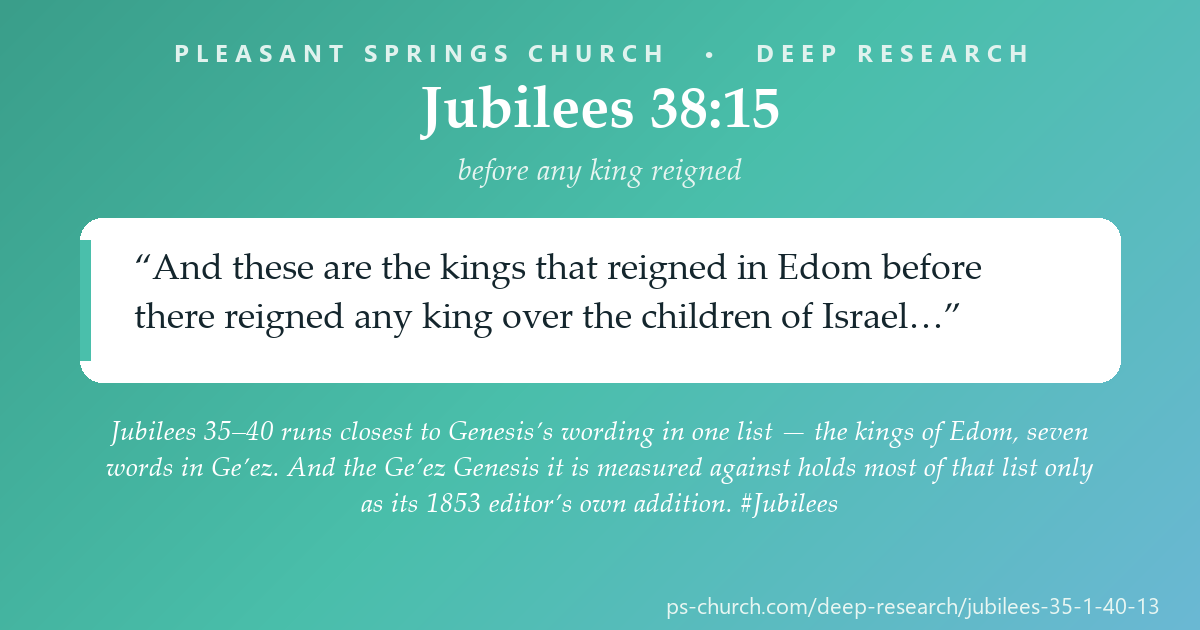
The deepest run in these six chapters: seven Geʻez words shared with Genesis 36:31, ነገሥት ፡ እለ ፡ ነግሡ ፡ በኤዶም ፡ ዘእንበለ ፡ ይንግሥ ፡ ንጉሥ — tie band 1 both ways. Only four verses of the whole book reach seven against Genesis. The run stops where the columns part: Jubilees has ‘to the children of Israel’, ለውሉደ ፡ እስራኤል, like the Masoretic לִבְנֵ֥י יִשְׂרָאֵֽל and the Vulgate’s filii Israël; Dillmann’s Geʻez has ለእስራኤል and the Greek ἐν Ισραηλ.
Measured against text the Geʻez Genesis carries only between its editor’s asterisks. The four shared words are ‘in the field of Moab, and the name of his city’; the king, his father and his city are spelled differently in the two Geʻez texts. See the king-list in Stage 4.
Seventeen, as in Genesis 37:2, and 46:3 counts the same way (‘seventeen years he lived in the land of Canaan’). But Joseph’s birth year, AM 2134 (28:24, a year Charles prints as ‘†sixth†’, judged corrupt), and his sale in AM 2149 (34:10) give fifteen. Stage 2 sets out both reckonings. And the same number is spelled two ways: Jubilees ዐሠርቱ ፡ ወሰብዐቱ, Dillmann’s Genesis ዐሠርቱ ፡ ወሰባዕቱ — a run of one.
Five words shared with Genesis 41:42, ወአዕነቆ ፡ ባዝግና ፡ ወርቅ ፡ ውስተ ፡ ክሳዱ, ‘and put a chain of gold on his neck’ — band 1 both ways. Then the columns part: the Masoretic text has the cry אַבְרֵ֑ךְ; the Greek and Dillmann’s Geʻez have a herald and no cry (κῆρυξ; ዐዋዲ); Jubilees has a cry, ኢል ፡ ኢል ፡ ወአቢርር, and no herald — Charles’s ‘(a herald)’ is in his sign for supplied words.
Isaac’s death is noticed a second time. ወበውእቱ ፡ ዓመት ፡ ሞተ ፡ ይስሐቅ — ‘and in that year Isaac died’, the year Joseph is thirty (40:11). Counted from Joseph’s birth year (28:24) that is AM 2164, two years after the death of 36:1–18 (AM 2162); counted from his sale in AM 2149 (34:10) at seventeen (39:2), it is AM 2162, the same year. Stage 2 sets out both reckonings.
There is no Geʻez column, on purpose. The Geʻez of Jubilees held here is J. C. VanderKam’s critical text (1989), digitised by Ran HaCohen; two hosts label it CC BY-SA, the digitiser says one of them posted it under fair use and that his own copy stands with the editor’s blessing, and the edition itself is in copyright. So this page measures that Geʻez and prints only the few words a finding rests on. The Geʻez of Genesis to Deuteronomy is Dillmann’s Octateuch (1853–55, public domain; HaCohen’s digitisation, CC BY-SA 4.0); the seven words printed at 38:15 and the five at 40:7 are quoted from Dillmann’s Genesis, where they are identical.
Geʻez phrases from Jubilees: VanderKam’s critical text (1989), digitised by Ran HaCohen. The two oldest pages of this series say ‘Charles 1913, lightly modernized’; the text held now is the 1917 reprint of the 1902 translation, and this page quotes it unaltered.
Versification — stated, as on every page here. Jubilees has no Masoretic, Greek, King James, ESV or Vulgate numbering to be offset from: the King James file held here is the Apocrypha, which does not include Jubilees, and the Clementine Vulgate held has no Jubilees. The two witnesses that do exist agree exactly: Charles’s English and the Geʻez both run chapters 35–40 at 27·24·25·24·18·13 = 131 verses. No offset.
The offsets that matter are in Genesis, the book being retold. Counted in four files, Genesis 35–41 run 29·43·36·30·23·23·57 in the Masoretic text and the Vulgate alike; 28·43·36·30·23·23·57 in the CATSS Greek; 28·43·36·30·23·22·57 in Dillmann’s Geʻez. The Greek and the Geʻez have no 35:21 (the tower of Eder stands inside their 35:16), and Dillmann’s Geʻez has no 40:4, a gap in the source itself: his verse numbers follow the Greek, and the digitiser notes gaps where the Ethiopic has no counterpart to a Greek verse. Every other chapter in the range has the same count in all four.
The Shape of the Passage
A sequence: what Genesis has, and what it does not (measured)Where it sits in the book. Jubilees is framed as the Angel of the Presence dictating to Moses on Sinai (ch. 1), from ‘heavenly tablets’, through a scheme of fifty jubilees that ends with Israel at the edge of Canaan (ch. 50). These chapters open the forty-fifth jubilee (AM 2157) and run through Joseph’s seven years of plenty. And here the frame is silent: in these 131 verses neither Charles’s English nor the Geʻez names Moses or the tablets of heaven (the Geʻez pair stands in 27 verses of the whole book, none of them here; the nearest is 39:6, a death penalty ‘ordained in the heavens’ and sin recorded ‘in the eternal books’).
⚠️ Where this page sits. Jubilees is filed on this shelf under Pseudepigrapha & Second Temple. It is canonical in the Ethiopian Orthodox Church, was copied at Qumran, and is not part of the Protestant canon. Nothing taught at Pleasant Springs rests on it.
Author
Anonymous, priestly in outlook, writing in a borrowed voice. The book is usually dated to the middle of the second century BC (see the first page of this series). In these six chapters the borrowed voice almost disappears: the angel never turns to Moses and never cites the tablets. The teaching is carried instead by two deathbed speeches, Rebecca’s and Isaac’s, and its burden is one command — “And love one another, my sons, your brothers as a man who loveth his own soul” (36:4).
Then the story breaks the command. Esau swears it twice (35:24; 36:7–11), and in the next chapter leads four thousand men against his brother. Jacob’s words to him from the tower include “Thou hast broken the oath” (37:17); then he kills him with an arrow.
Audience
Readers for whom Edom may have been a neighbour, not a memory — so the 1917 edition’s notes read it. They set the war beside the Maccabean campaigns and read ‘until this day’ (38:14) as the author’s own time: “i. e. the author's day. Edom was finally made tributary to Israel by John Hyrcanus.” That is the editors’ reading; this page does not test it.
And readers who knew Genesis. The chapters assume it, and lack most of what it says in these years — Esau’s genealogy, the dreams of the butler, the baker and Pharaoh. Stage 2 counts what is passed over; Stage 4 measures what is shared.
Orient on Jubilees, on Edom and on the Ethiopic Bible these chapters are measured against.
Search by topic: Jubilees; Edom and the Edomite king-list; Esau in Second-Temple literature; Testament of Judah; the Ethiopic (Geʻez) Old Testament; Joseph in Egypt.
Which articles are relevant?
- Anchor Bible Dictionary — “Jubilees, Book of” (J. C. VanderKam); “Edom” and “Esau” for the canonical side; the article on the Ethiopic versions of the Old Testament.
- Eerdmans Dictionary of Early Judaism — its articles on Jubilees, on the Testaments of the Twelve Patriarchs and on Idumea.
- Dictionary of New Testament Background (IVP) — “Jubilees” and the articles on the Hasmoneans.
Bibliography surfaced:
- James C. VanderKam, Jubilees (Hermeneia, two volumes) — a commentary on the whole book. Not consulted for this page; see Stage 5.
- James C. VanderKam, The Book of Jubilees: A Critical Text (CSCO 510) — the Geʻez measured here, in a digitisation of its text without the apparatus.
- R. H. Charles, The Book of Jubilees, or the Little Genesis (1902) — the English quoted here, from the 1917 SPCK reprint, and the 1902 commentary, from a scan.
- August Dillmann, Octateuchus Aethiopicus (1853–55) — the Geʻez Genesis measured here. Its apparatus is not held.
- Discoveries in the Judaean Desert XIII — the printed edition of 4Q221 and 4Q223–224. Not held, nor the printed edition of 1Q18; the Hebrew here is the SQE text.
- James L. Kugel, A Walk through Jubilees; Michael Segal, The Book of Jubilees: Rewritten Bible, Redaction, Ideology and Theology; Betsy Halpern-Amaru, The Empowerment of Women in the Book of Jubilees.
What the retelling shares with Genesis and passes over, who else told the war, and the book’s own clock.
Three comparisons: Jubilees against the Genesis it retells (measured, in Geʻez); against other tellings of the war (named, and quoted where the text is held); and against itself — its own dates, which can be computed.
What do these chapters share with Genesis, and what do they pass over?
The coverage map. The Geʻez Genesis verses whose events fall in these years — 142 verses — were each screened against the 131 verses of Jubilees 35–40, and against the whole book. 71 of the 142 share no two consecutive words with any verse of these chapters; 50 share none with any verse of Jubilees.
| Genesis (Geʻez, Dillmann) | contents | verses | no two-word partner in Jub 35–40 | none anywhere in Jubilees |
|---|---|---|---|---|
| Genesis 35:27–35:29 | Isaac’s death | 3 | 1 | 0 |
| Genesis 36:1–36:30 | Esau’s wives, sons, chiefs; the Horites | 30 | 22 | 17 |
| Genesis 36:31–36:39 | the kings of Edom | 9 | 0 | 0 |
| Genesis 36:40–36:43 | the chiefs of Esau | 4 | 4 | 4 |
| Genesis 37:1–37:2 | Jacob in Canaan; Joseph seventeen | 2 | 1 | 0 |
| Genesis 39:1–39:23 | Potiphar’s house; the prison | 23 | 3 | 1 |
| Genesis 40:1–40:23 | the butler and the baker | 22 | 11 | 8 |
| Genesis 41:1–41:49 | Pharaoh’s dreams; Joseph’s rise | 49 | 29 | 20 |
What has no trace at all. The chiefs of Esau (Genesis 36:40–43) share no two consecutive words with any verse of Jubilees. Of Esau’s wives, sons and the Horite chiefs (36:1–30), 17 of 30 verses are silent across the whole book. The dreams themselves are passed over: Pharaoh’s seven cows and seven ears (Genesis 41:2–6), the butler’s vine (40:9–10) and the baker’s sentence (40:18–19) share no two consecutive words with any verse of Jubilees. Jubilees says only that Pharaoh “dreamed two dreams in one night concerning a famine”.
The one block of Genesis in which every verse has a partner in these chapters is the king-list (36:31–39): all nine verses, and Stage 4 shows why that needs a caveat.
And what Jubilees has that Genesis lacks has nothing to measure against. Rebecca’s charge and death, Isaac’s testament, Leah’s death and the war fill 87 of the 131 verses. Genesis 49:31, where Jacob names the graves of Rebecca and Leah, shares no two consecutive words with 35:27 or 36:21.
Who else told the war between Jacob and Esau?
Genesis does not. It ends the brothers’ story with a reconciliation (33) and a shared burial (35:29). The 1917 edition’s note at 37:1 says of the war: “It is also found in Test. Judah ix. and in the Jewish Midrashic literature. Our text contains the oldest form.” Its note at 38:2 adds that “According to later Jewish tradition Esau was killed by Chushim, son of Dan, at the cave of Machpelah”. Neither the Testament of Judah nor the midrashim are held on this disk; they are named on the editors’ authority, not checked.
The editors also read the war against the Maccabean campaigns — “The peoples mentioned here and in the context nearly all played a prominent part in the campaigns of the Maccabees.” — and at 37:10 point to 1 Maccabees 5. That chapter is held, in the King James Apocrypha: Judas “fought against the children of Esau in the land toward the south, where he smote Hebron, and the towns thereof, and pulled down the fortress of it, and burned the towers thereof round about” (5:65). Jubilees’ war is fought at Jacob’s tower in Hebron. The page reports the editors’ comparison and asserts no dependence either way. At 38:8 the same notes identify Esau’s burial-hill ’Adûrâm with Adora, which “was captured by John Hyrcanus and forced to accept circumcision.” Josephus’s account of that campaign is held, in Niese’s Greek: Antiquities 13.257, ‘Ὑρκανὸς δὲ καὶ τῆς Ἰδουμαίας αἱρεῖ πόλεις Ἄδωρα καὶ Μάρισαν’ — Hyrcanus takes the Idumaean cities Adora and Marisa — and lets the Idumaeans stay in the land ‘εἰ περιτέμνοιντο’, if they would be circumcised. The note’s statement about Adora agrees with that section; that Jubilees’ ’Adûrâm is Adora remains the editors’ identification.
Genesis and Jubilees do not end Esau’s story the same way, and the page does not blend them. The church’s reading — see our Genesis 36 study, which reads that chapter as honouring Esau — takes Genesis as Scripture: the brothers reconciled, buried their father together, and Esau’s line is listed without a war. The prophets’ words on Edom (Obadiah; Malachi 1) are Scripture’s own verdict. Jubilees’ war, and Isaac’s words of Esau, ‘neither he nor his seed is to be saved’ (35:14), are read here as a second-century-BC tradition about a neighbouring people — reported, not adopted.
The book’s own clock — computed, not assumed:
Jubilees dates events ‘in the Nth jubilee, in the Mth week, in the Kth year’, so a date converts to a year from creation (Anno Mundi): AM = 49(N−1) + 7(M−1) + K. The three dated verses of these chapters, computed from Charles’s English and checked against the Geʻez numerals, which agree at every one:
| verse | the text’s date | AM by the formula | Charles’s margin |
|---|---|---|---|
| 35:1 | year 1 of week 1, jubilee 45 | 49×44 + 7×0 + 1 = 2157 | 2157 |
| 36:1 | year 6 of week 1, jubilee 45 | 49×44 + 7×0 + 6 = 2162 | 2162 |
| 36:21 | year 4 of week 2, jubilee 45 | 49×44 + 7×1 + 4 = 2167 | 2167 |
Charles’s margin years agree with the formula at all three, and his margin puts 37:1 — “on the day that Isaac the father of Jacob and Esau died” — in AM 2162 too.
The ages, checked against the text’s own arithmetic:
| who | the age the text gives | its own cross-check | Genesis |
|---|---|---|---|
| Rebecca, at death | 155 (35:6) | ‘three jubilees and one week and one year’ (35:27) = 3×49 + 7 + 1 = 155 | no age, no death narrated |
| Isaac, at death | 180 (36:18) | ‘twenty-five weeks and five years’ = 25×7 + 5 = 180 | 180 (35:28): מְאַ֥ת שָׁנָ֖ה וּשְׁמֹנִ֥ים שָׁנָֽה; ἑκατὸν ὀγδοήκοντα |
| Joseph, taken to Egypt | 17 (39:2) | born AM 2134 (28:24), sold AM 2149 (34:10): 15; but 46:3 also counts seventeen years in Canaan | 17 (37:2) |
| Joseph, before Pharaoh | 30 (40:11) | AM 2164 by his birth year; AM 2162 by his sale at seventeen; 46:3: 17 + 10 + 3 = 30 | 30 (41:46): בֶּן שְׁלֹשִׁ֣ים שָׁנָ֔ה |
Joseph’s birth year rests on a word Charles marks as corrupt: 28:24 reads ‘in the †sixth† year in this fourth week’. The Geʻez numeral there is also the sixth, and Charles’s margin prints 2134 against the verse.
Isaac’s death is noticed twice, and whether the two notices agree turns on which of the book’s numbers you count from. At 36:1–18 it falls in AM 2162, the year he blesses his sons. At 40:12 — “And in that year Isaac died.” — it falls in the year Joseph is thirty. Counted from Joseph’s birth year (AM 2134), that is AM 2164, two years later. Counted from his sale (AM 2149, 34:10) at the seventeen of 39:2, it is AM 2162, and the two notices agree. 46:3 counts the same way: ‘seventeen years he lived in the land of Canaan, and ten years he was a servant, and three years in prison’. Charles’s 1902 commentary had already reckoned from 34:10 and 46:1 that ‘these passages when taken together imply that Joseph was born in the year 2132’ — the sale reckoning (2149 − 17 = 2132). So the two notices conflict only through Joseph’s birth year. On Genesis’s own figures — Isaac sixty at the twins’ birth (25:26) and a hundred and eighty at death (35:28), Joseph thirty before Pharaoh (41:46), Jacob a hundred and thirty before Pharaoh (47:9) after two years of famine (45:6) following the seven of plenty — Isaac dies when Joseph is about twenty-nine; at 40:11–12 Jubilees has thirty. The Masoretic text and the Greek agree on every one of those figures.
And Isaac’s birth year depends on which verse you trust. The week-numbers around his birth (15:1; 16:15), as transmitted, give AM 1987, as the previous study computed; Charles marks them corrupt and his margin gives 1980; Isaac’s own ‘one hundred and sixty-five’ (31:27, in AM 2143) implies 1978; and his death at 180 in AM 2162 implies 1982. Four different years. The page does not choose between them. Charles’s 1902 commentary, held here, already notes the last at 36:18 — ‘Hence he must have been born in 1982’, not 1980; the later commentaries were not consulted (Stage 5). See also the previous study, where Isaac’s age at 31:27 first fails to fit. The Samaritan Genesis held here covers only chapters 5 and 11, so no Samaritan figure can be set beside these.
These dates sit inside Jubilees’ own 364-day year, which the book defends against the lunar calendar at 6:32–38. That calendar is the book’s position. This page computes with the book’s numbers and does not adopt its calendar.
A white bird, seven shared words, a guardian, a formula, and a second death notice.
Counts are over the files held here: Geʻez Jubilees (1,307 verses), the Geʻez Pentateuch (5,797 verses), the Masoretic text (23,204 verses). They are not counts over ‘Geʻez literature’ or ‘the Bible’, and each one is said in its scope.
One bird, three readings. Charles leaves the word untranslated: “And when the raven becometh white as the râzâ,”; the 1917 note glosses it, quoting Isenberg’s Amharic dictionary, as “A large white bird which eats grasshoppers”, and Charles’s 1902 note records that Dillmann had taken it for rice. The word stands in one verse of Geʻez Jubilees and in no verse of the Geʻez Pentateuch. The Hebrew from Qumran (4Q223–224 frg. 2 iv, line 11) has the ravens, העורבים, and for the white bird כקא[ת]: three letters on the leather, the third read as uncertain, and a fourth restored — ‘like the qa’at’, a bird whose name stands in five Masoretic verses, two of them the unclean-bird lists (Leviticus 11:18; Deuteronomy 14:17).
The seven words Jubilees 38:15 shares with Genesis 36:31, printed from Dillmann’s Genesis, where they are identical. Tie band 1 from both sides: no other verse of the Geʻez Genesis shares seven with 38:15, and no other verse of Jubilees shares seven with Genesis 36:31. In the whole book only four verses reach seven against Genesis — 3:19, 24:1, 26:17, 38:15 — and the deepest anywhere is eight (24:1 with Genesis 25:11).
The 1917 note reads it, with a query mark, as “? the guardian-angel; cf. Matt. xviii. 10; Acts xii. 15; Heb. i. 14.” The noun stands in two verses of Geʻez Jubilees (24:26 and this one). The Hebrew of the verse has שומר, ‘guardian’ (its last letter read by the edition as unclear), and in the words that follow — which the Geʻez does not have — the plural, כול שומרי עישאו, ‘all the guardians of Esau’.
A formula, and the reason four verses of chapter 40 reach four words. 40:3, 40:4, 40:8 and 40:12 each share exactly these four words with Genesis — with seven Genesis verses at once. ‘All the land of Egypt’ stands in 9 verses of the Geʻez Genesis and 21 of the Pentateuch. A band of seven is the signature of a formula, not of contact. Printed from Dillmann’s Genesis 41:41.
The second notice of Isaac’s death, four chapters after the first (36:18). Both languages carry it: Charles’s English and the Geʻez. Stage 2 sets out the two ways of dating it — one two years after 36:1–18, one the same year.
Counted here, not assumed:
- 131 verses, 2,637 Geʻez word tokens in chapters 35–40, chapter by chapter 27·24·25·24·18·13 in both the English and the Geʻez.
- ‘Until this day’ stands in six verses of these chapters and 13 of the whole book — so nearly half are here — against three verses of the Geʻez Genesis and ten of the Pentateuch. Two of the six close the war and open the king-list (38:14–15); Charles brackets the second as an interpolation.
- The oath is the hinge of the war: Esau “remembered not the oath which he had sworn to his father and to his mother” (37:13). His reply to Jacob (37:18–23) is the four impossibilities; the 1917 note says “The "boar" may symbolize Esau.”
- Esau’s own account of the birthright: “Because I sold my birthright to Jacob for a small mess of lentils” (37:3) — the deed Hebrews 12:16 names.
Geʻez against Geʻez, Hebrew against Hebrew — and a king-list measured against its editor.
How the screen works. Each of the 131 verses of Jubilees 35–40 in Geʻez is compared with every verse of the Geʻez Genesis (1,526 verses) and of the whole Geʻez Pentateuch (5,797) for the longest run of identical consecutive word forms. Normalisation, declared: Dillmann’s editorial signs [ ] ( ) and * are deleted where they stand, so that a bracket inside a word does not split it; full stops and the other Ethiopic punctuation are removed; words are split on the word-divider and spaces; no stemming. The fold, declared and optional: the letters manuscripts interchange — the three h-letters, the two s-letters, the two letters for ʾ and ʿ, the two emphatic s-letters, in all their vowel forms — treated as one. Every headline number is given with and without it. A zero here means no two consecutive words shared; single words are not counted. The tie band is the number of verses that reach the same depth, counted from both sides.
The distribution — against Genesis, and against all five books:
Against the Geʻez Genesis: of the 131 verses of Jubilees 35–40, 29 share no two consecutive words with any verse of Genesis; 102 reach two, 29 reach three, 14 reach four, 3 reach five, none stops at six, 1 reaches seven, and nothing reaches eight. With the fold: 29 share no two consecutive words with any verse of Genesis; 102 reach two, 29 reach three, 15 reach four, 3 reach five, none stops at six, 1 reaches seven, and nothing reaches eight — the fold moves one verse (40:2, with Gen 41:14) from three to four and changes no other run; it adds Genesis 50:13 as a further two-word partner of 35:27 and 36:21, whose bands become 15 and 3 (the table below is unfolded).
Against the whole Geʻez Pentateuch: 17 share no two consecutive words with any verse of the five books; 114 reach two, 33 reach three, 14 reach four, 3 reach five, none stops at six, 1 reaches seven, and nothing reaches eight. With the fold: 17 share no two consecutive words with any verse of the five books; 114 reach two, 33 reach three, 15 reach four, 3 reach five, none stops at six, 1 reaches seven, and nothing reaches eight.
By block (against Genesis):
| Jubilees | verses | no two-word partner | reaching four or more | deepest |
|---|---|---|---|---|
| 35:1–35:27 | 27 | 8 | 1 | 4 |
| 36:1–36:17 | 17 | 2 | 0 | 3 |
| 36:18–36:20 | 3 | 0 | 0 | 3 |
| 36:21–36:24 | 4 | 1 | 0 | 2 |
| 37:1–38:14 | 39 | 15 | 0 | 3 |
| 38:15–38:24 | 10 | 1 | 4 | 7 |
| 39:1–39:18 | 18 | 2 | 4 | 5 |
| 40:1–40:13 | 13 | 0 | 5 | 5 |
Every one of the 14 verses that reach four lies in chapters 35, 38, 39 or 40, and only one of them in 35; chapters 36 and 37 have none. The four in 38 are the king-list. Is that low? No. In the whole book 86 of 1,307 verses (6.6%) reach four against Genesis (91 with the fold), against 14 of these 131 (10.7%); and 309 of the 1,307 (23.6%; 306 with the fold) share no two consecutive words with it, against 29 of these 131 (22.1%). These chapters share no less of Genesis’s wording than the book as a whole. Of their fourteen fours and deeper, five are formulas (35:10, 40:3, 40:4, 40:8, 40:12), four the king-list and five Joseph’s story (39:4, 39:11, 39:12, 39:17, 40:7).
The seventeen verses with no two-word partner in the whole Pentateuch: 35:4, 35:5, 35:11, 35:15, 36:5, 36:13, 36:22, 37:11, 37:21, 37:25, 38:3, 38:4, 38:6, 38:7, 38:21, 39:8, 39:16. Seven of them are in the war.
The deepest runs, with their bands from both sides:
| Jubilees | partner | run | band among Genesis verses | the partner’s own deepest Jubilees run |
|---|---|---|---|---|
| Jub 38:15 | Gen 36:31 | 7 | 1 | 7 (1 verse) |
| Jub 39:11 | Gen 40:3 | 5 | 1 | 5 (1 verse) |
| Jub 40:7 | Gen 41:42 | 5 | 1 | 5 (1 verse) |
| Jub 35:10 | Gen 47:26 | 4 | 1 | 4 (1 verse) |
| Jub 38:16 | Gen 36:32 | 4 | 1 | 4 (1 verse) |
| Jub 38:17 | Gen 36:33 | 4 | 1 | 4 (1 verse) |
| Jub 38:19 | Gen 36:35 | 4 | 1 | 4 (1 verse) |
| Jub 39:4 | Gen 39:3 | 4 | 1 | 4 (2 verses) |
| Jub 39:12 | Gen 39:3 | 4 | 1 | 4 (2 verses) |
| Jub 39:17 | Gen 40:22 | 4 | 1 | 4 (1 verse) |
| Jub 40:3, 40:4, 40:8, 40:12 | seven verses of Genesis 41 and 47 | 4 | 7 | formula |
Four of the ten runs of four or more with a band of one are the king-list (38:15, 38:16, 38:17, 38:19), and the deepest is its opening verse. Joseph’s chapters give the next two: 39:11 with Genesis 40:3 (ቤተ ፡ ሞቅሕ ፡ ውስተ ፡ መካን ፡ ኀበ) and 40:7 with Genesis 41:42.
The king-list (38:15–24) — and what it is measured against:
Dillmann’s Geʻez Genesis prints signs in its text. As the digitiser’s note on the edition explains them: “Square brackets [ ] mark an omission corrected according to later Ethiopic manuscripts.” and “Asterisks * * mark rare additions (mostly of omitted names) by Dillmann himself.” The asterisks enclose words in 26 verses of the whole Geʻez Genesis. The longest stretch they enclose whole is Genesis 36:34–36:39, six verses — the third king to the eighth (the next longest, Genesis 46:10–46:14, five verses, is in the list of Jacob’s descendants).
| Dillmann’s Genesis | unmarked words | in [ ] | in * * | Jubilees partner | run |
|---|---|---|---|---|---|
| Genesis 36:31 | 10 | 0 | 0 | Jub 38:15 | 7 |
| Genesis 36:32 | 2 | 6 | 0 | Jub 38:16 | 4 |
| Genesis 36:33 | 6 | 3 | 0 | Jub 38:17 | 4 |
| Genesis 36:34 | 0 | 0 | 8 | Jub 38:18 | 2 |
| Genesis 36:35 | 0 | 0 | 14 | Jub 38:19 | 4 |
| Genesis 36:36 | 0 | 0 | 7 | Jub 38:20 | 2 |
| Genesis 36:37 | 0 | 0 | 9 | Jub 38:21 | 1 |
| Genesis 36:38 | 0 | 0 | 7 | Jub 38:22 | 2 |
| Genesis 36:39 | 0 | 0 | 17 | Jub 38:23 | 2 |
Of the 89 words of Genesis 36:31–39 in this edition, 62 stand between Dillmann’s asterisks, nine in his brackets and 18 unmarked. The seven-word run of 38:15 lies wholly in unmarked text; the four-word runs of 38:16 and 38:17 run through bracketed words; the four-word run of 38:19 lies wholly between the asterisks. So for kings three to eight, the ‘Geʻez Genesis’ partner of Jubilees is text this edition marks as its editor’s own addition. What Dillmann supplied it from, his apparatus would say; it is not held.
Do the two Geʻez lists spell the names alike? Every name pair, with the Greek and Masoretic forms beside them (Charles’s transliteration stands for the Jubilees Geʻez, which is compared but not printed):
| Jub | Charles | Geʻez spelling, Jubilees vs Dillmann | Dillmann’s Genesis | sign | Greek | Masoretic |
|---|---|---|---|---|---|---|
| 38:16 | Bâlâq | same | ባላቅ | [ ] | Βαλακ | בֶּ֖לַע |
| 38:16 | Beor | differs | ቤኦር | [ ] | Βεωρ | בְּע֑וֹר |
| 38:16 | Danâbâ | differs | ዲናባ | [ ] | Δενναβα | דִּנְהָֽבָה |
| 38:17 | Jobab | differs | ኢዮባብ | [ ] | Ιωβαβ | יוֹבָ֥ב |
| 38:17 | Zârâ | same | ዛራ | — | Ζαρα | זֶ֖רַח |
| 38:17 | Bôsêr | differs | ቦሶራ | — | Βοσορρας | מִבׇּצְרָֽה |
| 38:18 | ’Asâm | differs | ሑሳም | * * | Ασομ | חֻשָׁ֖ם |
| 38:18 | Têmân | differs | ቴማኒ | * * | Θαιμανων | הַתֵּימָנִֽי |
| 38:19 | ’Adâth | differs | አደድ | * * | Αδαδ | הֲדַ֣ד |
| 38:19 | Barad | differs | ብደድ | * * | Βαραδ | בְּדַ֗ד |
| 38:19 | Midian | differs | ለምድያም | * * | Μαδιαμ | מִדְיָן֙ |
| 38:19 | Moab | same | ሞአብ | * * | Μωαβ | מוֹאָ֔ב |
| 38:19 | Avith | differs | ዐዊት | * * | Γεθθαιμ | עֲוִֽית |
| 38:20 | Salman | differs | ሰምላ | * * | Σαμαλα | שַׂמְלָ֖ה |
| 38:20 | ’Amâsêqâ | differs | መስርቃ | * * | Μασεκκας | מִמַּשְׂרֵקָֽה |
| 38:21 | Saul | differs | ሳኦል | * * | Σαουλ | שָׁא֖וּל |
| 38:21 | Râ’abôth | differs | ሮኦቦት | * * | Ροωβωθ | מֵרְחֹב֥וֹת |
| 38:21 | river | same | ፈለግ | * * | ποταμόν | הַנָּהָֽר |
| 38:22 | Ba’êlûnân | differs | በአለናን | * * | Βαλαεννων | בַּ֥עַל חָנָ֖ן |
| 38:22 | Achbor | differs | አክቦር | * * | Αχοβωρ | עַכְבּֽוֹר |
| 38:23 | ’Adâth | differs | አደር | * * | Αραδ | הֲדַ֔ר |
| 38:23 | Maiṭabîth | differs | ምኤጠብኤል | * * | Μαιτεβεηλ | מְהֵֽיטַבְאֵל֙ |
| 38:23 | Mâṭarat | differs | መጥሬድ | * * | Ματραιθ | מַטְרֵ֔ד |
| 38:23 | Mêtabêdzâ’ab | differs | ሜዘአብ | * * | Μαιζοοβ | מֵ֥י זָהָֽב |
Of the 18 name pairs in the six asterisked verses, the two Geʻez texts spell two alike: Moab and river — a country, and the common noun for ‘river’. No king, father, wife or city is spelled the same. In the two verses his manuscripts give, two are alike: Bâlâq and Zârâ. The 1917 notes already set Charles’s names beside the Greek and the Masoretic; this page adds only the Geʻez comparison and the asterisks, and draws no conclusion about which tradition any form came from.
One vowel, one run. Seven verses of the list repeat ‘and he reigned in his stead’. The digitised Geʻez of 38:21 spells the verb ወነገሠ where the others, and Dillmann, have ወነግሠ — and 38:21 falls to zero. Whether that is VanderKam’s text or a digitising slip cannot be checked here.
The war (37:1–38:14) — measured, and nothing to measure against:
39 verses. Against the Geʻez Genesis the deepest run is three and 15 verses share no two consecutive words; against the whole Pentateuch the deepest is again three (7 share none); and against the rest of Jubilees — every verse outside the war — it is three (12 share none). That alone does not make the war unusual: of the 1,269 stretches of 39 consecutive verses in Jubilees 1–50 (in verse order), 124 also have nothing deeper than three against the Pentateuch.
The runs of three are a formula and three accidents. ‘Until this day’ (37:8, 38:14) stands in 10 Pentateuch verses at once. The others have a band of one, and each partner is a different story: 37:4 with Deuteronomy 25:5 (‘a man with his brother’, the levirate law), 38:8 with Deuteronomy 11:6 (‘son of Reuben, which’, of Dathan and Abiram), and 38:9 with Numbers 24:25 — Balaam going home (‘and returned to his house’).
⚠️ The page’s own counter-examples — runs that look like contact and are not, and contact that does not run:
- Jub 35:10 → Genesis 47:26 — four words, band 1 both ways. ‘Until this day, that’. Rebecca’s complaint of Esau and Joseph’s land law in Egypt: a formula plus a conjunction, unique by accident.
- Jub 39:11 → Genesis 40:3, not 39:20. Joseph cast into prison is told in Genesis 39:20, and 39:11 shares three words with it; its deepest partner (five) is the verse where the butler and the baker are put in the same prison. The deepest partner is not always the parallel. Likewise 39:12 reaches four with Genesis 39:3 and three with 39:23, its narrative counterpart.
- Jub 36:18 → Genesis 35:28 — one word. Isaac’s death, the same age in both: ‘and eighty’ is the only shared form; with 35:29 the two verses share ‘Esau and Jacob’, a run of two.
- Jub 39:2 → Genesis 37:2 — one word, with or without the fold. ‘Seventeen’ is spelled two ways (Stage 2, codex). Jub 40:11 → Genesis 41:46, the same thirty years: two words, ‘before Pharaoh’.
- Jub 38:16 — four, or two. The previous page of this series (Jubilees 30–34) replaces Dillmann’s brackets with a space, which splits 140 words of the Geʻez Genesis that have one of Dillmann’s signs (a bracket, parenthesis or asterisk) inside them. On these chapters that changes one run (and the band of 39:10, from 25 to 24): Genesis 36:32 prints Balak as ‘Ba[la]q’, and with the split 38:16 shares two words, not four. Both are printed; this page deletes the brackets and keeps the word.
The Hebrew of these chapters, from Qumran — measured on what the leather preserves:
Three scrolls overlap these chapters, in 148 lines of the Scripta Qumranica Electronica edition (the identifications by content are this page’s own). 1Q18 is read from the copy already held for the chapter 6–10 study of this series:
| scroll | fragment, lines | Jubilees | whole words preserved | partly restored | wholly restored |
|---|---|---|---|---|---|
| 4Q223-224 | frg. 2 i, 45–54 | 35:7–12 | 30 | 15 | 101 |
| 4Q223-224 | frg. 2 ii, 1–22 | 35:12–22 | 56 | 33 | 207 |
| 4Q223-224 | frg. 2 ii, 48–54 | 36:7–10 | 8 | 15 | 74 |
| 4Q223-224 | frg. 2 iii, 1–19 | 36:10–23 | 22 | 24 | 195 |
| 4Q223-224 | frg. 2 iv, 2–33 | 37:17–38:13 | 74 | 60 | 267 |
| 4Q223-224 | frg. 2 v, 1–32 | 39:9–40:7 | 29 | 54 | 293 |
| 4Q221 | frg. 5, 1–7 | 37:11–15 | 25 | 6 | 50 |
| 4Q221 | frg. 6, 1–4 | 38:6–8 | 2 | 6 | 24 |
| 4Q221 | frg. 7, 1–11 | 39:4–9 | 9 | 10 | 87 |
| 1Q18 | frg. 1–2, 1–4 | 35:8–10 | 17 | 9 | 22 |
| total | 272 | 232 | 1,320 | ||
Most of what an edition prints is restoration, commonly made with the help of the Geʻez and of the biblical text; measuring it would measure the editors. Only whole preserved words are screened, and a restored letter breaks a run. Chapter 35 and the war have about the same amount of Hebrew: 103 and 101 of the 272 preserved words (chapter 35 has 86 without 1Q18), against 30 in chapter 36 and 38 in chapters 39–40. No Hebrew of the king-list survives in these editions: 4Q223–224 breaks off at 38:13 and resumes at 39:9.
Where the Hebrew is longer than the Geʻez — 35:17. Lines 11–14 of 4Q223–224 frg. 2 ii (restorations in brackets):
[ולוא] [ימלט] [מידו] [כי] [בידו] [ירד] [ואת]י אל תדאיגי [על] [יעקו]ב כי שומר יע[קו]ב גדול וגבור
[ונכבד] [מהולל] [משומר] [עיש]או כיא כאבק לפנ[י] [רוח] [כ]ן כול שומרי עישאו ל[פ]נ[י] אלוהי
[אברהם] [ואלוהי] [יצחק] [ואלוהי] [י]עקוב ב[ני] [התמים] [והי]קר אבל אנכי אה[ב] [את] [העו]שה רצוננו
אחותי בשלום ותשלח ר[בקה] ותקרא [את]
Line 11 preserves ‘for the guardian of Ja[co]b is great and mighty’ (two letters of the name restored); line 14 preserves ‘and Rebecca sent’, the start of 35:18. Between them the Geʻez has four words (‘and honoured and praised more than the guardian of Esau’). After those words, the leather keeps eleven whole words, eight partly restored and seven wholly restored, for which the Geʻez and Charles have nothing — among the whole words ‘for like dust’, ‘all the guardians of Esau’, ‘but I’, ‘our will’, ‘my sister, in peace’. At 35:13 the leather likewise has two whole words, ‘and does our will’, where the Geʻez goes straight from ‘he honours us’ to ‘I loved Esau’. The page reports what each column has; it does not say which is older.
Where two scrolls overlap — 35:8–10. 1Q18 frg. 1–2 and 4Q223–224 frg. 2 i carry the same verses:
1Q18 frg. 1–2, lines 1–2: [ע]מי על מותך
[ותבוא] [אל] [ישחק] [ותאמר] [לו] [אחת] [בקש]ה אב[ק]ש ממך השבע את עשו אשר ל[וא]
4Q223–224 frg. 2 i, lines 47–48: [והיה] [כוחי] [בי] [כן] [ככוחכי] [ולוא] [תמותי] [כי] [חנם] [תדברי] [עמי] [על] מותתכי ותבו[א] [אל] [יצ]חק
[ותאמר] [לו] [בקשה] [אחת] [אבקש] [ממכה] [השבע] [את] [עי]שאו אשר לו[א] ירע את יעקוב
Both keep Jacob’s ‘thy death’ (35:8), and spell it differently: מותך in 1Q18, מותתכי in 4Q223–224, every letter clear in both. 1Q18 writes Esau עשו (twice, 35:9) and Jacob [י]עקב (35:10); 4Q223–224 writes עישאו (every letter clear at 35:17; at 35:9 the edition prints [עי]שאו, its first two letters restored) and יעקוב (every letter clear at 35:13). Against the Masoretic text, 1Q18’s preserved words reach two consecutive words, folded or not.
Where two scrolls overlap — 38:6–8. 4Q221 frg. 6 and 4Q223–224 frg. 2 iv carry the same verses:
4Q221 frg. 6, line 2: [למזרח] [הבירה] [וחמשיהם] [עמם] [ויהרוגו] [את] [גד]ודי מוא[ב] [ועמון]
4Q223–224 frg. 2 iv, line 23: [יצאו] [למזרח] [הבירה] [וחמשיהם] [ע]מם ויהרוגו את ג[בורי] [מואב] [ועמון] ויצא ראובן
The word after ‘and they killed’ survives as its last letters in 4Q221 and its first letter in 4Q223–224; the edition completes the first as ‘troops of’ and the second as ‘mighty men of’. As the edition reads them, the preserved letters of 4Q221 do not fit the second; whether 4Q223–224 read the same word, its one letter cannot say. And Reuben is spelled two ways: 4Q223–224 writes ראובן, as all 67 Masoretic verses that carry the name do (84 with the gentilic ‘Reubenite’); 4Q221 frg. 6, line 4, has רוב[ן], the last letter restored and the waw and beth read by the edition as incomplete and unclear — and, as read, no aleph.
Against all 23,204 Masoretic verses (paragraph letters removed from the Masoretic tokens), the deepest run of preserved words anywhere in these lines is three — 4Q221 frg. 5, ‘the oath which’, band 1 (Jeremiah 11:5). The war’s ‘not one of them escaped’ (38:5) shares two words with one verse, 1 Samuel 30:17 — David’s rout of the Amalekites. Folding spelling (for the scrolls’ fuller spelling: every waw and yod after a word’s first letter dropped on both sides, and the long second-person suffix read as the short one) lifts ‘the oath which’ to a band of three, the 1 Samuel run to three (band 1), and the Joseph lines from two to four: ‘over all the land of Egypt’, band 4 — Genesis 41:41 and 41:43, which these lines retell, and Exodus 9:9 and 10:14, the plagues. Unfolded, nothing reaches four; folded, one formula does. The folded screen also gives a second run of three in 4Q221 frg. 5, line 5 (‘and in all this, not’), with a band of one: Nehemiah 13:6.
Two restorations that are not evidence. At 38:2 the edition prints the arrow striking Esau on the right breast — [אחיהו] [אל] [שדו] [הימיני] [והרג] [אותו] [והשל]יך חץ שנ[י] [והכה] [את] [אדורים] [הא]רמי אל — and every letter of ‘on his right breast’ is restored, as Charles’s parentheses were supplied. At 40:7 it prints the cry as [אל] [אל] [ואביראל] ויתן את [הטבעת] [בידו] [וימשילהו] [על] [כול] [ביתו] [ויגדילהו]; the cry, too, is wholly restored. The 1917 note had already proposed that Hebrew for Charles’s transliteration: “’Êl ’Êl wa’ Abîrĕr = Heb. ’el ’el wa’ăbîr ’el”.
Named, and never measured — the texts these chapters are read beside:
- Hebrews 12:16–17 — Esau, who sold his birthright for a single meal (Jub 37:3). Hebrews 11:20 — Isaac blessing Jacob and Esau (Genesis 27; Jub 36:15–16 is a different, deathbed blessing).
- Romans 9:10–13 — ‘Jacob I loved, but Esau I hated’, cited from Malachi 1:2–3 with ‘as it is written’. Isaac’s words at Jub 35:13 turn on the same pair. See our Malachi study.
- 1 John 3:11–15 — love one another; not like Cain, who murdered his brother. Jubilees 36:4–11 commands the love and curses the man who plots against his brother. See our 1 John study.
- Acts 7:9–10 — Stephen: God gave Joseph favour and wisdom before Pharaoh, who made him ruler over Egypt and over all his house (Jub 40:5–8).
- Matthew 18:10; Acts 12:15; Hebrews 1:14 — cited, after a query mark, by the 1917 note at 35:17 for the ‘guardian’. See our Hebrews 1 study.
- Obadiah — Edom judged for violence against his brother Jacob. See our Obadiah study.
- No run is possible against any of these. Jubilees 35–40 survives in Geʻez, in Latin (not held) and in Hebrew scraps; the New Testament is Greek.
It settles that these six chapters share no less of Genesis’s wording than the book as a whole, and that the one place they share most is a list. A list repeats its frame (‘and he died, and there reigned in his stead’), so it shares words even where every name differs — as 38:18, 38:20, 38:22, 38:23 do, two words each.
It also shows what ‘the Geʻez Genesis’ is. It is an 1853 edition, reconstructed (as its digitiser describes it) from several manuscripts, with the editor’s own signs in the text. Where those signs mark his own addition, a run against it is a run against his supplement. Agreement between VanderKam’s Jubilees and Dillmann’s Genesis is a lower bound; disagreement may be editorial — and at Genesis 36:34–39 the editing is printed on the page.
It does not settle why. Which Hebrew, Greek or Geʻez stood behind which list is not measurable here.
Every verse: its deepest Geʻez Genesis partner, with the band from both sides (131 rows)
Run = the longest shared sequence of word forms; band = how many Genesis verses reach that run; the last column gives, for each partner, its own deepest run against any verse of Jubilees and how many Jubilees verses reach it. A band over three is listed as a count and marked ‘formula’.
| Jubilees | run | band | Genesis partner(s) | partner’s own deepest / verses |
|---|---|---|---|---|
| 35:1 | 2 | 7 | 7 verses | formula |
| 35:2 | 2 | 34 | 34 verses | formula |
| 35:3 | 3 | 3 | 19:37, 32:33, 47:26 | 3/13, 3/14, 4/1 |
| 35:4 | 0 | — | — | — |
| 35:5 | 0 | — | — | — |
| 35:6 | 2 | 9 | 9 verses | formula |
| 35:7 | 2 | 2 | 3:14, 3:17 | 3/1, 5/1 |
| 35:8 | 2 | 1 | 27:11 | 5/1 |
| 35:9 | 2 | 5 | 5 verses | formula |
| 35:10 | 4 | 1 | 47:26 | 4/1 |
| 35:11 | 0 | — | — | — |
| 35:12 | 3 | 3 | 19:37, 32:33, 47:26 | 3/13, 3/14, 4/1 |
| 35:13 | 2 | 2 | 31:6, 45:20 | 2/2, 2/7 |
| 35:14 | 2 | 15 | 15 verses | formula |
| 35:15 | 0 | — | — | — |
| 35:16 | 2 | 6 | 6 verses | formula |
| 35:17 | 2 | 1 | 27:36 | 2/9 |
| 35:18 | 0 | — | — | — |
| 35:19 | 0 | — | — | — |
| 35:20 | 2 | 3 | 4:20, 4:21, 35:2 | 2/2, 2/2, 2/4 |
| 35:21 | 2 | 1 | 3:5 | 7/1 |
| 35:22 | 3 | 2 | 13:10, 45:28 | 3/1, 3/1 |
| 35:23 | 2 | 2 | 3:5, 20:9 | 7/1, 2/2 |
| 35:24 | 0 | — | — | — |
| 35:25 | 2 | 1 | 27:42 | 3/3 |
| 35:26 | 0 | — | — | — |
| 35:27 | 2 | 14 | 14 verses | formula |
| 36:1 | 2 | 10 | 10 verses | formula |
| 36:2 | 3 | 1 | 50:5 | 3/1 |
| 36:3 | 2 | 8 | 8 verses | formula |
| 36:4 | 2 | 3 | 4:14, 6:12, 7:3 | 2/22, 3/1, 3/1 |
| 36:5 | 0 | — | — | — |
| 36:6 | 2 | 23 | 23 verses | formula |
| 36:7 | 2 | 2 | 23:6, 47:4 | 2/9, 3/10 |
| 36:8 | 2 | 4 | 4 verses | formula |
| 36:9 | 2 | 6 | 6 verses | formula |
| 36:10 | 2 | 2 | 3:20, 17:7 | 3/1, 6/1 |
| 36:11 | 2 | 2 | 31:24, 31:29 | 2/10, 2/5 |
| 36:12 | 3 | 1 | 21:32 | 3/1 |
| 36:13 | 0 | — | — | — |
| 36:14 | 2 | 6 | 6 verses | formula |
| 36:15 | 2 | 6 | 6 verses | formula |
| 36:16 | 2 | 4 | 4 verses | formula |
| 36:17 | 2 | 3 | 26:30, 31:46, 31:54 | 2/6, 3/1, 2/5 |
| 36:18 | 2 | 5 | 5 verses | formula |
| 36:19 | 3 | 1 | 32:4 | 3/1 |
| 36:20 | 2 | 7 | 7 verses | formula |
| 36:21 | 2 | 2 | 19:30, 49:29 | 2/10, 2/6 |
| 36:22 | 0 | — | — | — |
| 36:23 | 2 | 3 | 29:20, 34:19, 48:7 | 2/13, 2/6, 2/6 |
| 36:24 | 2 | 2 | 29:20, 34:19 | 2/13, 2/6 |
| 37:1 | 2 | 11 | 11 verses | formula |
| 37:2 | 0 | — | — | — |
| 37:3 | 2 | 1 | 6:7 | 2/13 |
| 37:4 | 0 | — | — | — |
| 37:5 | 0 | — | — | — |
| 37:6 | 0 | — | — | — |
| 37:7 | 2 | 1 | 43:2 | 2/1 |
| 37:8 | 3 | 3 | 19:37, 32:33, 47:26 | 3/13, 3/14, 4/1 |
| 37:9 | 2 | 1 | 20:16 | 2/1 |
| 37:10 | 0 | — | — | — |
| 37:11 | 0 | — | — | — |
| 37:12 | 2 | 3 | 29:23, 34:6, 42:29 | 2/4, 2/11, 3/6 |
| 37:13 | 2 | 4 | 4 verses | formula |
| 37:14 | 2 | 3 | 31:32, 34:5, 34:6 | 2/13, 3/1, 2/11 |
| 37:15 | 0 | — | — | — |
| 37:16 | 2 | 1 | 34:5 | 3/1 |
| 37:17 | 2 | 6 | 6 verses | formula |
| 37:18 | 2 | 2 | 6:3, 13:15 | 2/27, 3/3 |
| 37:19 | 2 | 2 | 6:3, 13:15 | 2/27, 3/3 |
| 37:20 | 2 | 1 | 49:26 | 2/3 |
| 37:21 | 0 | — | — | — |
| 37:22 | 0 | — | — | — |
| 37:23 | 2 | 2 | 15:13, 20:7 | 4/2, 2/4 |
| 37:24 | 2 | 4 | 4 verses | formula |
| 37:25 | 0 | — | — | — |
| 38:1 | 2 | 3 | 37:10, 44:32, 46:29 | 2/37, 2/10, 2/8 |
| 38:2 | 2 | 1 | 32:14 | 2/6 |
| 38:3 | 0 | — | — | — |
| 38:4 | 0 | — | — | — |
| 38:5 | 0 | — | — | — |
| 38:6 | 0 | — | — | — |
| 38:7 | 0 | — | — | — |
| 38:8 | 2 | 3 | 23:16, 36:15, 36:19 | 2/4, 2/1, 2/1 |
| 38:9 | 2 | 14 | 14 verses | formula |
| 38:10 | 2 | 1 | 36:10 | 2/1 |
| 38:11 | 2 | 2 | 37:32, 45:25 | 2/1, 4/1 |
| 38:12 | 2 | 6 | 6 verses | formula |
| 38:13 | 2 | 16 | 16 verses | formula |
| 38:14 | 3 | 3 | 19:37, 32:33, 47:26 | 3/13, 3/14, 4/1 |
| 38:15 | 7 | 1 | 36:31 | 7/1 |
| 38:16 | 4 | 1 | 36:32 | 4/1 |
| 38:17 | 4 | 1 | 36:33 | 4/1 |
| 38:18 | 2 | 7 | 7 verses | formula |
| 38:19 | 4 | 1 | 36:35 | 4/1 |
| 38:20 | 2 | 7 | 7 verses | formula |
| 38:21 | 0 | — | — | — |
| 38:22 | 2 | 7 | 7 verses | formula |
| 38:23 | 2 | 7 | 7 verses | formula |
| 38:24 | 3 | 1 | 36:31 | 7/1 |
| 39:1 | 2 | 19 | 19 verses | formula |
| 39:2 | 2 | 10 | 10 verses | formula |
| 39:3 | 3 | 1 | 39:5 | 3/1 |
| 39:4 | 4 | 1 | 39:3 | 4/2 |
| 39:5 | 2 | 1 | 39:7 | 2/11 |
| 39:6 | 2 | 15 | 15 verses | formula |
| 39:7 | 2 | 1 | 42:9 | 4/1 |
| 39:8 | 0 | — | — | — |
| 39:9 | 2 | 5 | 5 verses | formula |
| 39:10 | 2 | 25 | 25 verses | formula |
| 39:11 | 5 | 1 | 40:3 | 5/1 |
| 39:12 | 4 | 1 | 39:3 | 4/2 |
| 39:13 | 3 | 3 | 39:21, 39:23, 40:3 | 3/2, 3/4, 5/1 |
| 39:14 | 3 | 5 | 5 verses | formula |
| 39:15 | 3 | 3 | 39:21, 39:23, 40:3 | 3/2, 3/4, 5/1 |
| 39:16 | 0 | — | — | — |
| 39:17 | 4 | 1 | 40:22 | 4/1 |
| 39:18 | 2 | 5 | 5 verses | formula |
| 40:1 | 3 | 1 | 1:29 | 3/2 |
| 40:2 | 3 | 2 | 40:14, 41:14 | 3/1, 3/1 |
| 40:3 | 4 | 7 | 7 verses | formula |
| 40:4 | 4 | 7 | 7 verses | formula |
| 40:5 | 2 | 2 | 39:3, 41:33 | 4/2, 3/6 |
| 40:6 | 2 | 19 | 19 verses | formula |
| 40:7 | 5 | 1 | 41:42 | 5/1 |
| 40:8 | 4 | 7 | 7 verses | formula |
| 40:9 | 2 | 12 | 12 verses | formula |
| 40:10 | 2 | 1 | 41:45 | 2/2 |
| 40:11 | 2 | 7 | 7 verses | formula |
| 40:12 | 4 | 7 | 7 verses | formula |
| 40:13 | 2 | 9 | 9 verses | formula |
What this page could not check, what it found wrong along the way, and where it is weakest.
This is the section that makes the shelf trustworthy.
⚠️ What this page could NOT check:
- Dillmann’s apparatus. What the asterisks at Genesis 36:34–39 rest on — which manuscripts lack the verses, and where Dillmann’s wording came from — is in his critical apparatus, which is not held. The page relies on the digitiser’s summary of the signs.
- The commentaries. VanderKam’s Hermeneia commentary, Segal, Kugel, Halpern-Amaru and the DJD XIII edition of the Qumran pieces were not consulted. Every interpretive sentence on this page is either measured here or attributed to the 1917 notes or to Charles’s 1902 commentary. Whether the later commentaries explain Isaac’s two death notices, his conflicting birth years or the longer Hebrew of 35:17, this page cannot say; Charles’s 1902 notes, which are held, are quoted where they bear on the first two.
- The identifications of the Qumran lines with verses of Jubilees are this page’s own, made by content; the published ones were not consulted.
- The printed critical text. The Geʻez of Jubilees is a digitisation without its apparatus. The spelling of 38:21 and every other single-letter difference cannot be checked against the printed page from here.
- The Latin of Jubilees, from which Charles supplied ‘on his right breast’ at 38:2, the Testament of Judah and the midrashim are not held; they are named on the editors’ authority. Of Josephus only Antiquities 13.257 (Niese’s Greek, held) was read, for the one sentence on Adora.
- Which Hebrew, Greek or Geʻez stands behind what. The usual account is that Jubilees was written in Hebrew and reached Geʻez through Greek, and that the Geʻez Bible was translated from Greek. None of that is tested here, and no sentence on this page depends on it.
- Allusion. A run of identical words finds verbatim contact. It cannot see a story built on another story, and it is not evidence against one.
⚠️ Where this page is weakest:
- Two editors, 136 years apart (1853 and 1989). A run between VanderKam’s Jubilees and Dillmann’s Genesis can be shortened by either editor’s choice of spelling — or, as the king-list shows, measured against text one editor supplied.
- The tokeniser is a choice. Deleting Dillmann’s signs keeps 140 words whole that the previous page of this series splits; on these chapters the difference is one run (38:16, four or two) and one band (39:10, 25 or 24), printed both ways.
- The folds are coarse. The Geʻez fold merges letters manuscripts interchange; the Hebrew fold drops vowel-letters wholesale. Each is printed beside the unfolded number. The Geʻez fold changes no headline; the Hebrew fold lifts the deepest Qumran run from three to four, through a formula.
- The block divisions in the diagram are drawn by hand from the text; the counts inside them are measured.
- The English is quotation, not a measured column. Charles translated the Ethiopic text of his day, not VanderKam’s.
⚠️ Faults found while building this page — reported, not buried:
- Three slips in the Charles transcription in this range, checked against scans of both the 1902 and the 1917 printings: 35:6 ‘this, year’ for ‘this year’, 37:23 ‘that -I’ and 39:13 ‘of -the’. No line printed on this page contains one; they are left in the corpus file and reported.
- The previous page of this series (Jubilees 30–34) tokenises Dillmann’s Geʻez by turning its signs (brackets, parentheses, asterisks) into spaces, though its method note says they are removed; that splits 140 words of Genesis with a sign inside them and 476 more in Exodus to Deuteronomy. With the brackets deleted, its Jubilees 31:29 shares two words with Exodus 38:23 (where Dillmann brackets them), so its list of verses with no Pentateuch partner loses one. Reported, not edited.
- The Qumran text file encodes one word of 4Q223–224 frg. 2 iv, line 13, with a final mem in mid-word. It is counted as a preserved word and touches no run.
- The two oldest pages of this series attribute their English to ‘Charles 1913, lightly modernized’. The text now held is the 1917 reprint of the 1902 translation; this page quotes it unaltered and leaves those pages to be brought into line.
Editions & studies:
- James C. VanderKam, The Book of Jubilees: A Critical Text (CSCO 510, 1989) and the translation volume that accompanies it; and his Jubilees (Hermeneia).
- August Dillmann, Octateuchus Aethiopicus (1853–55) — the Geʻez Genesis to Deuteronomy measured here, in Ran HaCohen’s digitisation.
- R. H. Charles, The Book of Jubilees, or the Little Genesis (1902; reprinted by SPCK in 1917 with an introduction by G. H. Box) — the English and the notes quoted here.
- Discoveries in the Judaean Desert XIII — 4Q221 and 4Q223–224 in print. Not held.
- Kugel, A Walk through Jubilees; Segal, The Book of Jubilees; Halpern-Amaru, The Empowerment of Women in the Book of Jubilees.
Brothers, an oath, and a list that is less certain than it looks.
Name what you learned, why it matters, and one concrete response.
What should we carry away — and do?
- The closest match is not always the strongest evidence. These chapters share most with Genesis in a list of names — and the Geʻez Genesis carries most of that list only as its editor’s addition. Before you trust a match, ask what you matched against.
- Two endings for Esau. Genesis leaves the brothers reconciled and burying their father together; Jubilees has Jacob kill his brother. Read them side by side and let Scripture’s account stand.
- The command sounds the same in both. ‘love one another, my sons’ (36:4) is Isaac’s charge in Jubilees; ‘love one another’ is the apostle’s in 1 John 3:11. Jubilees shows what happens when an oath to it is broken; the gospel shows where the love comes from.
- Numbers can disagree inside one book. Joseph is fifteen or seventeen at his sale depending on which verse you count from, and the book’s own numbers imply three different birth years for Isaac (Charles’s emendation adds a fourth). Count before you cite.
- One concrete response. Read Genesis 33 and Jubilees 37–38 in one sitting this week, and ask at each difference: which of these is the Word of God, and what differs, and on whose authority?
Jubilees 38:15 · to share
English: R. H. Charles (1902; SPCK 1917)Every Deep Research page traces its passage across the whole sweep — the Old Testament, the Second-Temple world between the testaments (historical witnesses, not Scripture), and the New Testament. Follow the thread:
← Jubilees 30–34 · The book’s frame (Prologue & 1) · Jubilees 41–45 →
Pleasant Springs Church — Deep Research
Research method after Michael S. Heiser’s Bible Research Method (examine dictionaries → ancient literature → important words → textual connections → academic publications → share), with the Pleasant Springs “Author & Audience” foundation. Scripture set in the Hebrew, the Greek editions named on each page and the ESV (Old Testament), and the Greek New Testament and the ESV (New Testament), per the practice of Pleasant Springs Church. ⚠️ Status: Jubilees is not part of the Protestant canon; it is filed on this shelf under Pseudepigrapha & Second Temple and nothing taught at Pleasant Springs rests on it. English: R. H. Charles, The Book of Jubilees (1902; SPCK reprint 1917), public domain — quoted verbatim from the transcription held on this disk, every line checked against it; Charles’s 1902 commentary quoted from a scan. Geʻez of Jubilees: VanderKam’s critical text (1989), digitised by Ran HaCohen — measured, and quoted only in short phrases. Geʻez of Genesis to Deuteronomy: Dillmann, Octateuchus Aethiopicus (1853–55); digitised by Ran HaCohen; Beta masaheft, CC BY-SA 4.0. Hebrew of Jubilees: Scripta Qumranica Electronica (text by R. G. Kratz, I. Kottsieper and A. Steudel on the basis of the Qumran-Wörterbuch and M. Abegg), CC BY-SA 4.0. Masoretic Hebrew: Miqra according to the Masorah. Greek: CATSS; Josephus, Antiquities 13.257, in B. Niese’s text (1885–90), Perseus Digital Library, CC BY-SA 4.0. KJV Apocrypha (1769) for 1 Maccabees. Direction of influence is nowhere asserted.
Scripture quotations marked ESV are from the ESV® Bible (The Holy Bible, English Standard Version®), © 2001 by Crossway, a publishing ministry of Good News Publishers. ESV Text Edition: 2016. Used by permission. All rights reserved. The ESV text may not be quoted in any publication made available to the public by a Creative Commons license, and the ESV may not be translated in whole or in part into any other language. www.esv.org
|
Did this study bless you today? 💚 Give to Support PS Church100% of gifts go to the General Fund — thank you. |