1 John is 105 verses long — exactly the length of 1 Peter, which is routinely called the most Old-Testament-saturated letter in the New Testament. (That superlative is not measured here and is not asserted: Hebrews and Romans both run deeper.) So the same measurement was run on both. 1 Peter’s deepest verbatim contact with the Greek Old Testament is ten consecutive words; 1 John’s is five, and every one of its five-word hits turns out to be a stock phrase — his brother, the name of his son. Nothing in the letter reaches six. It never says it is written. The only Old Testament name in it is Cain. So the screen was turned round and pointed at the letter itself — every verse against the other 104 — and the number went UP. Against 30,348 verse units of the Greek Old Testament, 1 John reaches 5. Against the other 7,822 verses of the Greek New Testament, 6, and exactly once. Against its own sentences, SEVEN — and ten of its rows reach six or more. Run the same three screens on 1 Peter and it comes out the other way round. 1 Peter’s deep runs point outward. 1 John’s point home. See the method →
1 John 1:1–5:21 (selections)
Greek New Testament (SBLGNT via MorphGNT) · ESV⚠️ AND THE BOOK QUOTES NOTHING THAT WOULD CARRY AN OFFSET. Where 1 Peter’s numbering trap is the Psalter it quotes — Greek psalm numbers run one behind the Hebrew from Psalm 9/10 through 147 — 1 John never quotes a psalm, or anything else. There is no citation formula anywhere in it. The verb γράφω stands thirteen times in the letter and every single one is first person: I write to you, we write, I wrote to you. The words γέγραπται, it is written, and γραφή, Scripture, do not occur in 1 John at all. So the one place a versification note would normally bite — a chapter-and-verse reference to an Old Testament source — does not exist in this book.
⚠️ ONE OF THE ROWS ABOVE PRINTS A TEXTUAL DECISION. 5:7–8 is given as the SBLGNT prints it, without the Johannine Comma. That is the text this page measured; it is not a verdict on the variant, which was not adjudicated. See stage 5.
The Shape of the Passage
Two panels inside a frame — and the letter names its own seam twice with a word nobody else in the New Testament uses1 John names neither its writer nor its readers nor any place — and unlike 2 John, which also names nobody, it carries no epistolary opening or closing at all. It has no opening greeting, no closing greeting, no travel plans, no co-senders, no personal names at all except Jesus, Christ and Cain. That is a measurable fact about the text before it is a scholarly problem.
Author
The letter never says. It opens with a first person plural — ἀκηκόαμεν… ἑωράκαμεν… ἐθεασάμεθα… ἐψηλάφησαν, we have heard, we have seen, we looked upon, our hands touched — and then slides into a first person singular at 2:1, γράφω ὑμῖν. Neither the plural nor the singular is ever given a name.
What can be measured is that this letter and the Gospel of John share a very small word-stock, and share it very unevenly. Of the 118 occurrences of μένω in the Greek New Testament, 67 stand in John’s Gospel, 1 John and 2 John. Of the 116 occurrences of ἀγάπη, eighteen are in these 105 verses and only seven in the Gospel’s 866. And παράκλητος stands five times in the New Testament — four in John 14–16 of the Spirit, and once here, at 1 John 2:1, of Jesus.
What that does not settle: whether the Gospel and the letter come from one hand, from a school, or from a later imitator is an argument this page does not adjudicate, and shared vocabulary cuts all three ways. Direction of influence is never asserted here — not between 1 John and the Gospel, not between 1 John and 2 John.
Audience
Addressed by relationship, never by place. τεκνία, little children, seven times (2:1, 2:12, 2:28, 3:7, 3:18, 4:4, 5:21); ἀγαπητοί, beloved, six (2:7, 3:2, 3:21, 4:1, 4:7, 4:11); παιδία twice, and once each fathers and young men in the doubled sentence of 2:13–14. No city, no province, no household, no office.
Something has already happened to them, and the letter is written after it. 2:19: they went out from us, but they were not of us. 4:1: many false prophets have gone out into the world. Both verbs are past. The confessional tests the letter keeps applying — that Jesus is the Christ (2:22, 5:1), that he is the Son of God (4:15, 5:5), that he has come ἐν σαρκί, in flesh (4:2) — read as a description of what the departed group would not say.
And they are told they already know. 2:20–21: you have been anointed by the Holy One, and you all have knowledge… I write to you not because you do not know the truth, but because you know it. 2:27: you have no need that anyone should teach you. The letter’s repetitions are addressed to people it says are not being taught anything new — which is worth holding beside the measurement in stage 4.
Orient on a letter with no address, on the group that left it, and on the one variant everybody has heard of.
Search by topic: John, Letters of; Johannine literature; antichrist; propitiation / expiation (hilasmos); Docetism; Cerinthus; Comma Johanneum; abiding (meno); assurance in the New Testament; sin unto death; anointing (chrisma).
Which articles are relevant?
- Anchor Bible Dictionary — “John, Epistles of,” “Antichrist,” “Johannine School,” “Expiation.”
- Dictionary of the Later NT & Its Developments (IVP) — “John, Letters of,” “Antichrist,” “Docetism,” “Adversaries.”
- New International Dictionary of NT Theology & Exegesis — ἀγάπη, μένω, ἱλασμός, χρῖσμα, ἀγγελία.
- Metzger, A Textual Commentary on the Greek New Testament — the entry on 1 John 5:7–8, for the Comma. Named here as the standard reference; it was NOT consulted for this page.
Settle the numbering — and notice what is missing
1 John is one of the easy cases. The Greek and the English agree everywhere.
| ch 1 | ch 2 | ch 3 | ch 4 | ch 5 | total | |
|---|---|---|---|---|---|---|
| SBLGNT (MorphGNT) | 10 | 29 | 24 | 21 | 21 | 105 |
| ESV | 10 | 29 | 24 | 21 | 21 | 105 |
What is missing is the second half of the usual note. Most Deep Research pages on a New Testament book have to add: the book has no offset, but the Psalter it quotes does. 1 John quotes no psalm. It quotes no prophet, no law, no proverb. There is no citation formula in the letter at all — γράφω stands thirteen times and every one is first person (I write / I wrote / we write); γέγραπται and γραφή do not occur.
Practical consequence: nothing on this page needs a Septuagint verse number converted, because nothing on this page is a quotation. Where a Greek Old Testament reference does appear below it is a screen result, and it is printed in Greek numbering with the English beside it — e.g. Greek Psalm 88:25 = ESV Psalm 89:24.
A word the church has used for two thousand years and the Bible uses five times; a group that walked out; and a verse that entered the printed Bible late.
“Antichrist” is a Johannine word, and the count is exact
Measured over the whole Greek New Testament, ἀντίχριστος occurs five times, in four verses, all of them in these two letters: 1 John 2:18 (twice), 2:22, 4:3, and 2 John 7. It occurs nowhere in the Greek Old Testament held here — a negative now carried over all 64 CATSS files and the 30,348 verse units they screen, re-run on 30 August 2026 when twenty files including Wisdom, Judith, Tobit, Baruch and 2–4 Maccabees were added — and nowhere else in the New Testament: not in the Gospels, not in Paul, and not in Revelation.
Two further things the text itself says, and the page will say no more than these. First, 2:18 assumes the readers already know the word: as you have heard that antichrist is coming. It is quoted, not introduced. Second, the letter immediately pluralises it: even now many antichrists have come — and at 2:22 and 4:3 it is defined by a confession, not by a career: whoever denies that Jesus is the Christ, whoever does not confess Jesus.
What was not checked. The literature the discussion usually runs through — Daniel 7 and 11, 2 Thessalonians 2, the Sibylline Oracles, Ascension of Isaiah, and the later patristic identifications — was not consulted for this page. Greek Daniel is on this shelf and the word is not in it; that is the only part of the claim that was measured.
The people who left, and what a letter written afterwards looks like
2:19 is the letter’s one narrative sentence: they went out from us, but they were not of us; for if they had been of us, they would have continued with us.
Everything else is inference, and the page marks it as such. The confessional tests (2:22, 4:2, 4:15, 5:1, 5:5) are usually read as the mirror image of what the departed group denied; 4:2’s ἐν σαρκί is usually read against an early docetic denial of a real body; and Irenaeus’ story about Cerinthus is usually brought in at this point. None of that is measurable from the letter, and none of it was checked here.
What is measurable is the effect on the writing. A letter written to people who have just watched a group walk out repeats itself, and 1 John repeats itself more than any other book of its length in the New Testament — the numbers are in stage 4.
The Johannine Comma — what this page will and will not say
The King James Version reads at 5:7–8: …in heaven, the Father, the Word, and the Holy Ghost: and these three are one. And there are three that bear witness in earth… The SBL Greek New Testament does not contain those words, and neither does the ESV.
This page prints the SBLGNT text because that is the text it measured, and it does not adjudicate the variant. No critical apparatus of any kind was consulted here — not Metzger, not the NA28 apparatus, not the Editio Critica Maior, and no manuscript, Old Latin witness or patristic citation was examined. What can be said from this shelf alone is narrow and true: the words are not in the Greek text file this page measured, so no number on this page depends on them.
Why it still matters to the argument here. The Comma is the one place in 1 John where a reader might expect a formal proof-text, and it is precisely the place the critical Greek text does not supply one. A page claiming this letter quotes nothing has to name that, rather than let a reader discover it as an objection.
A tiny vocabulary used over and over — and one word that occurs nowhere else in the New Testament.
1:5 and 3:11. Twice in the whole Greek New Testament, and both are in this letter. Each time it introduces a summary of everything: God is light, then love one another. The structure diagram above is built on these two occurrences.
24 occurrences in 105 verses — 22.9 per hundred verses; only 2 John, at 3 in 13 verses (23.1), is denser. John’s Gospel runs 4.6; 1 Peter, the same length as this letter, runs 1.9; Romans and Revelation 0.2. Of the 118 in the Greek New Testament, 67 are in John, 1 John and 2 John.
2:2 and 4:10. Twice in the Greek New Testament, and both are here. The related ἱλαστήριον is Romans 3:25 and Hebrews 9:5, and the verb ἱλάσκομαι is Luke 18:13 and Hebrews 2:17 — three different Greek words for one idea, spread across four writers. ⚠️ And the Old Testament side of this word changed on 30 August 2026. In the 44 files this shelf held, ἱλασμός stood in four verses — Psalm 129:4, Amos 8:14, Ezekiel 44:27 and Daniel 9:9 (Theodotion). In the 64 it stands in seven, and the three new ones are the ones that matter: Leviticus 25:9, which is the Day of Atonement itself — on the tenth of the seventh month, on the day of atonement, you shall sound the trumpet — Numbers 5:8, the ram of atonement, and 2 Maccabees 3:33 (a witness, not Scripture). The sacrificial background of 1 John 2:2 was not on this disk when this page was first published and it is now. The page still measures no verbal run between 1 John and any of them; what it can now say is that the word John chose is the Pentateuch’s word for the Day of Atonement, and say it from the corpus rather than from a lexicon.
2:18 (twice), 2:22, 4:3 and 2 John 7. Five occurrences in the Bible, all in these two letters. Not in the Gospels, not in Paul, not in Revelation, and not in the 64 Greek Old Testament files held here — the negative was re-run over the enlarged corpus on 30 August 2026 and held.
2:20 and 2:27 (twice). Three occurrences in the Greek New Testament, all in one chapter of this letter. Set against 2:27’s you have no need that anyone should teach you, in a letter that is itself teaching.
5:4, this is the victory that has overcome the world. The only word in 1 John that occurs just once in the whole Greek New Testament — the letter’s single hapax legomenon, against 1 Peter’s fifty-six. Three further words — ἀγγελία, ἱλασμός, χρῖσμα — occur nowhere outside this letter either, but each of the three occurs in it more than once.
3:12, of Cain and Abel — twice in that one verse. Ten occurrences in the Greek New Testament: those two, and eight in Revelation, four of them of the Lamb (5:6, 5:9, 5:12, 13:8). Greek Genesis 4:8 uses ἀπέκτεινεν, killed, not this verb.
2:1, we have an advocate with the Father, Jesus Christ the righteous. Five occurrences in the Greek New Testament: four in John 14–16, of the Spirit, and this one, of Jesus.
How small is this letter’s vocabulary? — measured, not asserted
Counted over the MorphGNT lemma column: how many word-tokens a book uses, how many different lemmas those tokens draw on, and how many of its lemmas occur exactly once in the whole Greek New Testament — the strict hapax legomena, not merely the words unique to the book.
| book | verses | word tokens | distinct lemmas | tokens per lemma | NT hapax |
|---|---|---|---|---|---|
| John | 866 | 15,438 | 999 | 15.5 | 72 |
| 1 John | 105 | 2,137 | 233 | 9.2 | 1 |
| 1 Corinthians | 437 | 6,812 | 952 | 7.2 | 84 |
| Revelation | 405 | 9,833 | 911 | 10.8 | 88 |
| Hebrews | 303 | 4,935 | 1,029 | 4.8 | 132 |
| James | 108 | 1,739 | 555 | 3.1 | 55 |
| 1 Peter | 105 | 1,678 | 543 | 3.1 | 56 |
The two rows to hold together are the two 105-verse letters. 1 Peter spends 1,678 words on 543 different lemmas and reaches outside the common stock 56 times. 1 John spends more words — 2,137 — on 233 lemmas, and reaches outside it once: νίκη, victory, at 5:4. Same length, and one letter has fifty-six times the rare-word count of the other. Across the whole Greek New Testament only four books use their words more often each — John’s Gospel (15.5), Matthew (10.9), Revelation (10.8) and Luke (9.5) — and every one of them is at least three times longer than this letter.
And the words it does spend go overwhelmingly on one subject. ἀγάπη and ἀγαπάω together stand 46 times in these 105 verses. The Greek New Testament contains 259 occurrences of the two across 7,927 verses. 1 John is 1.3% of the New Testament by verse and carries 17.8% of its love vocabulary.
What this measures and what it does not. It is a count over the SBLGNT as MorphGNT lemmatises it; a different edition or lemmatiser would move the figures a little, and the gap between 56 and 1 is not the kind of gap that moves. A vocabulary count is not an authorship argument and not a quality judgement. A small word-stock used repeatedly is what a catechism looks like as well as what a limited writer looks like, and this page does not choose between them.
The whole letter screened three ways — against the Greek Old Testament, against the rest of the New, and against itself.
Screen one: 1 John against 30,348 verse units of the Greek Old Testament
All 105 verses against all 30,348 screened verse units in the 64 CATSS Greek Old Testament files held here. Contiguous runs of whole word forms, never lemmas. Tie band beside every run.
Across the 105 rows: all 105 reach two, 96 reach three, 38 reach four, 5 reach five, and nothing reaches six.
⚠️ Those five numbers have moved twice, and the page prints the history rather than the last version of it.
| screen one, as run | 2+ | 3+ | 4+ | 5 | 6+ |
|---|---|---|---|---|---|
| 44 files, 23,061 units — as first published | 105 | 93 | 31 | 4 | none |
| 44 files, 23,061 units — after the spelling-equivalence fold | 105 | 94 | 35 | 5 | none |
| 64 files, 30,637 units — 30 August 2026 | 105 | 96 | 38 | 5 | none |
| 64 files, Odes set aside — 30,348 units screened | 105 | 96 | 38 | 5 | none |
Two different things moved these numbers and neither was an error in the letter. The first was the comparison layer: the editions spell οὐ / οὐκ and ἐκ / ἐξ differently, and until the fold was applied a shared run was cut at any such word. That alone added the fifth five — 1 John 4:6, five words against Genesis 17:12. The second was the corpus: 44 files to 64. What did not move, through both changes, is the only sentence that matters here: nothing in 1 John reaches six. The fold could only lengthen runs and the corpus could only add partners, and after both the ceiling is exactly where it was.
⚠️ A THIRD MOVE FOLLOWED, AND IT MOVED NOTHING IN THIS LETTER. THE PAGE SAYS SO ANYWAY.
The Odes — the fourteen liturgical canticles bound after the Greek Psalter — have been taken out of this shelf’s screening corpus, which now runs to 30,348 verse units of the 30,637 held. Two of the canticles are New Testament text: Ode 9 is Luke 1, the Magnificat and the Benedictus, and Ode 13 is Luke 2, the Nunc Dimittis. Screened, Odes 9:48 matches Luke 1:48 at eighteen consecutive words — deeper than anything Romans or 1 Peter reaches, and a run fewer than a dozen pairs on the whole shelf exceed. It is Luke matching Luke under an Old Testament shelfmark. Ten more are second copies of passages already in the corpus: Ode 1 is Exodus 15, Ode 2 Deuteronomy 32, Ode 3 1 Samuel 2, Ode 4 Habakkuk 3, Ode 5 Isaiah 26, Ode 6 Jonah 2, Odes 7 and 8 Daniel (Th) 3, Ode 10 Isaiah 5, Ode 11 Isaiah 38 — so a verse standing once appears to stand twice, and a tie band touching a canticle is doubled for no textual reason.
Screen one was re-run and every published number in it held. All 105 rows still reach two, 96 still reach three, 38 still reach four, five still reach five, and nothing reaches six. All five of the fives keep their partners and their tie bands — Psalm 88:25, Isaiah 31:2, 1 Maccabees 9:65, Genesis 4:17 at a band of one each, and Genesis 17:12 with Numbers 17:5 at a band of two. So do the three-word runs at 1:1, 2:18 and 5:21. ⚠️ 3:12’s tie band did move, and not because of the Odes — the correction is printed with it below. Not one run in 1 John ever landed in a canticle. Thirteen rows elsewhere in the letter lost one or two members from their tie bands, all of them rows topping out at two or three, and none of them is printed on this page. The one figure on this page that did move belongs to another book, and it is corrected below in the letter-by-letter table.
| row | deepest Greek OT partner | run | band | the shared words |
|---|---|---|---|---|
| 1 Jn 1:6 | Ps 88:25 (ESV 89:24) | 5 | 1 | μετ’ αὐτοῦ καὶ ἐν τῷ |
| 1 Jn 1:10 | Isaiah 31:2 | 5 | 1 | καὶ ὁ λόγος αὐτοῦ οὐ |
| 1 Jn 2:11 | 1 Maccabees 9:65 | 5 | 1 | τὸν ἀδελφὸν αὐτοῦ ἐν τῇ |
| 1 Jn 3:23 | Genesis 4:17 | 5 | 1 | τῷ ὀνόματι τοῦ υἱοῦ αὐτοῦ |
| 1 Jn 4:6 | Genesis 17:12 · Numbers 17:5 | 5 | 2 | ὃς οὐκ ἐστιν ἐκ τοῦ — who is not of the; the Numbers partner arrived with the 30 August 2026 fetch |
Every one of the five is an accident, and the fourth is the page’s own counter-example. 1 John 3:23 says believe in the name of his Son, Jesus Christ. Greek Genesis 4:17 says that Cain built a city and named it ἐπὶ τῷ ὀνόματι τοῦ υἱοῦ αὐτοῦ, after the name of his son, Enoch. Five words, tie band one, and no relation whatever.
And now set that beside the one verse in the letter that really does look at Genesis 4. 1 John 3:12 names Cain. Against Greek Genesis 4:8 it measures 4 — τὸν ἀδελφὸν αὐτοῦ καί — and across the whole Greek Old Testament that 4 carries a tie band of 9, matching 2 Samuel 14:6, 14:7 and Amos 1:11 exactly as well — and Hosea 12:4, Isaiah 19:2, Jeremiah 13:14, Jeremiah 32:26 and Exodus 32:27 besides. Inside Genesis chapter 4, the screen’s deepest hit is the coincidence and its shallower hit is the real allusion. That is the clearest statement this shelf can make of what a contiguous-run screen is and is not for.
⚠️ That band read 8 until the Odes were taken out, and the correction has nothing to do with the Odes. It was a 44-file figure that survived the 30 August 2026 re-run of screen one, because this paragraph sits outside screen one’s table and was not re-derived with it. Greek Exodus arrived that day, and Exodus 32:27 carries τὸν ἀδελφὸν αὐτοῦ καί as well — Moses at the golden calf, let each man kill his brother. The band is 9. It was caught by re-deriving every figure on this page when the Odes came out, which is the whole argument for re-deriving rather than patching: the canticles did not move this number, and checking whether they had is what found the number an earlier corpus change already had. The finding is unaffected and slightly strengthened — the real allusion is buried in an even commoner formula than the page said.
How that compares — every New Testament letter of 100 verses or more
The same screen, the same corpus, run book by book. ‘Deepest run’ is the single deepest verbatim contact anywhere in the book.
| letter | verses | deepest run vs Greek OT | rows reaching 6+ |
|---|---|---|---|
| Hebrews | 303 | 23 (Jer 38:34 = ESV 31:34) | 41 |
| Romans | 430 | 17 (Ps 18:5 = ESV 19:4) | 35 (36 for one day — see below) |
| Galatians | 149 | 23 (Isaiah 54:1) | 5 |
| 2 Corinthians | 256 | 11 (Ps 111:9 = ESV 112:9) | 3 |
| 1 Peter | 105 | 10 (Ps 33:16 = ESV 34:15) | 9 |
| 1 Corinthians | 437 | 10 (Isaiah 29:14) | 3 |
| Ephesians | 155 | 8 (Genesis 2:24) | 3 |
| Philippians | 104 | 8 (4 Maccabees 18:24 — a witness, not Scripture) | 1 |
| James | 108 | 7 (Genesis 15:6) | 3 |
| 1 Timothy | 113 | 7 (4 Maccabees 18:24) | 1 |
| 1 John | 105 | 5 — and all five of its fives are accidents | 0 |
The honest reading of this table — and it reads differently than it did. Until 30 August 2026 this paragraph said Philippians and 1 Timothy tie with it at five, and that Titus topped out at three. All three of those numbers were true of a 44-file shelf and are false of a 64-file one. Philippians 4:20 and 1 Timothy 1:17 both close with the doxology to whom be the glory forever and ever, amen, and that doxology stands word for word at 4 Maccabees 18:24 — eight consecutive words for Philippians and seven for 1 Timothy, tie band 1 in both cases. Titus 2:13 reaches four against Tobit 3:16. 4 Maccabees and Tobit are witnesses, not Scripture, and the shelf says so every time it names one. The correction cuts in 1 John’s favour, which is exactly why it has to be printed: among the letters of a hundred verses and more, 1 John no longer ties for last. It stands alone at five.
⚠️ One cell of that table moved again when the Odes came out, and it is a Romans cell, not a 1 John one. For one day Romans showed 36 rows reaching six or more against the Greek Old Testament. It is 35. The row that dropped is Romans 11:36, whose six-word run was against Odes 12:15 — Ode 12 being the Prayer of Manasseh, and the Odes being out of the screened corpus as of the exclusion. Without the canticle, Romans 11:36 tops out at five, against 1 Esdras 5:58 and 4 Maccabees 18:24, tie band two. Every other cell in the table is unchanged, including all four of 1 John’s own. The page corrects a neighbour’s number in a comparison it built, because a comparison is only worth as much as the column it is being compared against.
⚠️ And the caveat this paragraph used to end with is gone, because the measurement it deferred has been run. It read: Greek Exodus, Leviticus, Numbers and Joshua are NOT on this shelf, so a quotation of the Decalogue or of Leviticus 19 would be invisible to screen one. 1 John contains no such quotation to test, but the gap is real. All four books were fetched on 30 August 2026, and the instrument sees Leviticus 19 perfectly well.
| verse | run against Leviticus 19:18 | band | the shared words |
|---|---|---|---|
| Matthew 19:19 | 7 | 1 | καὶ ἀγαπήσεις τὸν πλησίον σου ὡς σεαυτόν |
| Matthew 22:39 · Mark 12:31 · Romans 13:9 · Galatians 5:14 · James 2:8 | 6 each | 1 each | ἀγαπήσεις τὸν πλησίον σου ὡς σεαυτόν |
| 1 John 2:10 · 3:11 · 4:21 — the letter’s own love commands | 1 | — | single words: an article, a conjunction |
Six New Testament verses quote Leviticus 19:18 verbatim and every one of them is measurable now. Not one of them is in 1 John. The letter that says love one another nine times, and calls it both an old commandment and a new one, does not reach two consecutive words of the commandment Jesus, Paul and James all quote when they mean it. The gap that was flagged here has closed into a finding, and the finding is stronger than the caveat was: screen one is no longer blind to Leviticus 19, and 1 John still is not quoting it. What is distinctive about this letter is not this column on its own — it is this column set beside the third screen below, where the letter goes the other way.
Screen two: 1 John against the other 7,822 verses of the Greek New Testament
Across the 105 rows: all 105 reach two, 95 reach three, 55 reach four, 19 reach five, and exactly one reaches six.
| row | deepest NT partner | run | band | the shared words |
|---|---|---|---|---|
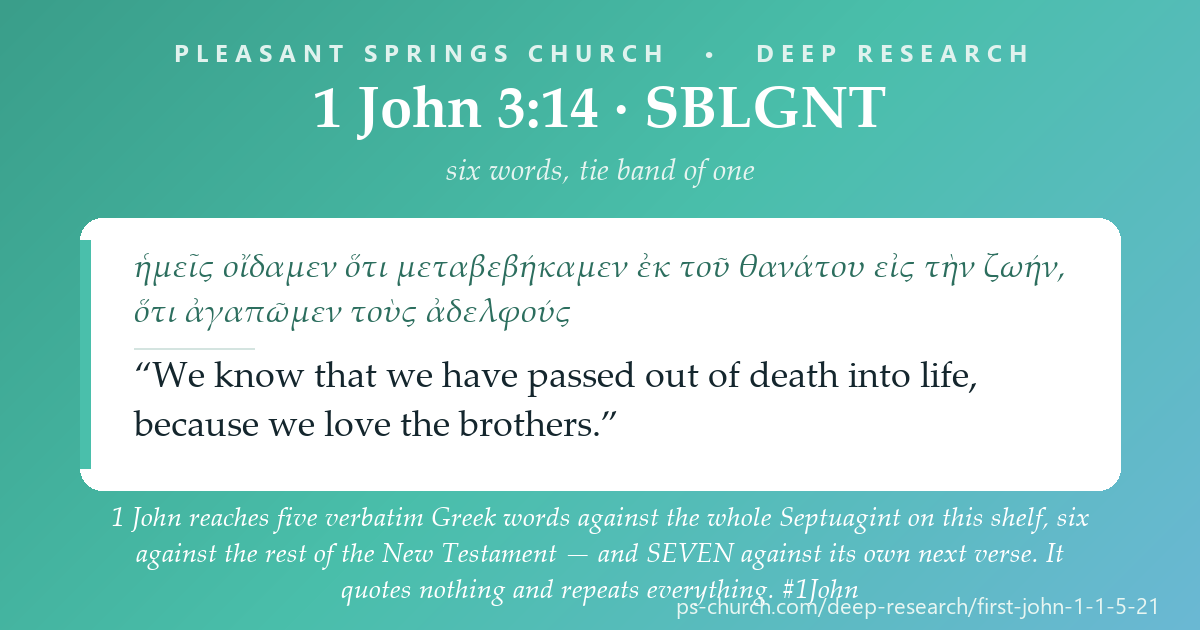
| 1 Jn 3:14 | John 5:24 | 6 | 1 | ἐκ τοῦ θανάτου εἰς τὴν ζωήν |
| 1 Jn 3:11 | 2 John 5 | 5 | 1 | ἀπ’ ἀρχῆς ἵνα ἀγαπῶμεν ἀλλήλους |
| 1 Jn 5:1 | John 20:31 | 5 | 1 | ὅτι Ἰησοῦς ἐστιν ὁ Χριστός |
| 1 Jn 3:9 & 5:18 | John 3:8 | 5 | 1 | πᾶς ὁ γεγεννημένος ἐκ τοῦ |
| 1 Jn 3:4 | John 8:34 | 5 | 1 | πᾶς ὁ ποιῶν τὴν ἁμαρτίαν |
| 1 Jn 2:29 | John 8:34 | 5 | 1 | ὅτι πᾶς ὁ ποιῶν τήν — and 2:29 goes on to say δικαιοσύνην where John says ἁμαρτίαν |
| 1 Jn 5:11 | John 1:19 | 5 | 1 | καὶ αὕτη ἐστὶν ἡ μαρτυρία |
| 1 Jn 5:9 | John 1:19 | 5 | 1 | αὕτη ἐστὶν ἡ μαρτυρία τοῦ |
The single six is 1 John 3:14 against John 5:24, and it stops on a verb ending. John 5:24: μεταβέβηκεν ἐκ τοῦ θανάτου εἰς τὴν ζωήν — he has passed from death into life. 1 John 3:14: μεταβεβήκαμεν ἐκ τοῦ θανάτου εἰς τὴν ζωήν — we have passed. Same verb, same perfect tense, six identical words after it, and the run is six rather than seven only because third singular became first plural. That is the same mechanism the 1 Peter study found governing every one of its quotations — and here it is again, in a letter with no quotations at all.
The counter-examples belong here, in the open.
| the pairing everyone makes | measured run | what they actually share |
|---|---|---|
| 1 John 1:1 ↔ John 1:1 | 1 | ὁ — article in one, relative pronoun in the other |
| 1 John 4:9 ↔ John 3:16 | 2 | τὸν υἱόν |
| 1 John 2:7 ↔ 2 John 5 (new commandment) | 2 | ἐντολὴν καινήν |
If this page reported only the six, it would be reporting a fraction of what the screen returned. The three rows above are the ones a reader would expect to be deepest, and they are among the shallowest in the letter. Measured contact and theological kinship are different things, and 1 John is the clearest demonstration of that on this shelf.
Screen three: 1 John against itself — and the number goes up
Every verse of 1 John screened against the other 104 verses of 1 John. Same engine, same normalisation, same tie-band reporting.
Across the 105 rows: 103 reach two, 91 reach three, 60 reach four, 18 reach five, 10 reach six, and 4 reach seven. Two rows reach only one — 5:7 and 5:21.
| row | its own deepest partner | run | band | the shared words |
|---|---|---|---|---|
| 2:13 ↔ 2:14 | each other | 7 | 1 | ὑμῖν πατέρες ὅτι ἐγνώκατε τὸν ἀπ’ ἀρχῆς |
| 4:15 ↔ 5:5 | each other | 7 | 1 | ὅτι Ἰησοῦς ἐστιν ὁ υἱὸς τοῦ θεοῦ |
| 3:9 ↔ 5:18 | each other | 6 | 1 | πᾶς ὁ γεγεννημένος ἐκ τοῦ θεοῦ |
| 2:5 ↔ 4:13 | each other | 6 | 1 | ἐν τούτῳ γινώσκομεν ὅτι ἐν αὐτῷ |
| 3:24 ↔ 4:15 | each other | 6 | 1 | ἐν αὐτῷ μένει καὶ αὐτὸς ἐν |
| 5:1 ↔ 5:5 | each other | 6 | 1 | ὁ πιστεύων ὅτι Ἰησοῦς ἐστιν ὁ |
Run the identical three screens on 1 Peter — the same 105 verses of length — and the picture inverts.
| vs Greek OT 30,348 units | vs rest of Greek NT 7,822 verses | vs its OWN other 104 verses | |
|---|---|---|---|
| 1 Peter (105 vv) | 10, 9 rows at 6+ | 11 | 8 — and only 2 rows get past 4; 85 of 105 top out at two or below |
| 1 John (105 vv) | 5, 0 rows at 6+ | 6, exactly one row | 7 — 10 rows at 6+, 60 rows at 4+ |
1 Peter’s two deepest self-matches are its two doxologies (4:11 and 5:11), and after those it has almost nothing to say twice. 1 John says almost everything twice, and its deepest run anywhere in any corpus is with its own next verse.
What the third screen does not prove. A high self-match score is a property of any text with a small vocabulary and a repeated formula, and stage 3 already showed that 1 John reuses its word-stock harder than any other New Testament letter — 9.2 tokens per lemma, against 1 Corinthians’ 7.2. The two findings are not independent of each other, and this page does not present them as two pieces of evidence for one conclusion. They are one fact seen twice: the letter says a few things over and over. What the screen adds is the shape of the repetition — that it is verbatim, that it runs up to seven consecutive words, that it is symmetrical (both members of each pair report each other), and that it crosses the letter’s own structural seam.
Where this page is weakest, what it did not consult, and what it could not check at all.
The editorial sigla in the rows printed above
MorphGNT marks in its text column where the SBL editors recorded a variation unit. Those marks were stripped for display, and here is where they fall on this page’s rows.
| row | marked unit | inside the measured run? |
|---|---|---|
| 1 Jn 1:5 | ⸂ἐν αὐτῷ οὐκ ἔστιν⸃ | no — this row’s finding is a lemma count |
| 1 Jn 2:14 | the first ἔγραψα | no — the seven-word run begins after the second ἔγραψα |
| 1 Jn 2:18 | ὅτι | no |
| 1 Jn 3:14 | the closing ἀγαπῶν | no — the six-word run is earlier in the verse |
| 1 Jn 4:16 | the third μένει | YES — the row counts three forms of μένω in this verse, and one of the three is marked |
| 1 Jn 5:5 | ⸂δέ ἐστιν⸃ at the front | no — the seven-word run is at the end |
| 1 Jn 5:21 | εἰδώλων | YES — the closing three-word run is ἀπὸ τῶν εἰδώλων and the last of the three is marked |
| 1 Jn 1:1, 1:9, 2:2, 3:11, 3:12, 4:9, 5:7, 5:8 | no marked unit in the printed verse | — |
Read honestly, this both supports and threatens the page’s argument.
It supports it where the numbers are deep. The three figures the whole page turns on — the seven at 2:13–14, the seven at 4:15/5:5, and the six at 3:14 — carry no marked word inside them. Neither does 3:12 (Cain) or 3:23 (the Genesis 4:17 coincidence). Those numbers do not rest on an editorial choice.
It threatens it at two rows, and both are named above. 5:21’s closing run of three sits on a marked word, and 4:16’s triple μένει has one marked member. If the units there resolve differently, those two rows change. The headline numbers do not.
The apparatus itself was NOT consulted. What is reported above is only where the SBL editors marked a variation unit, read off the sigla in the MorphGNT text column — not what the competing readings are, not how well attested they are, and not which is likely original. Every number on this page is a number over the SBL text as printed. A page built on NA28, on the Editio Critica Maior, or on the Byzantine text could return different figures at the rows marked above and the same figures at the rows that are not.
What was not consulted, and what is not settled
No critical apparatus, and one famous variant left standing. The Johannine Comma at 5:7–8 is described in stage 2 and printed in the codex as the SBLGNT has it. Nothing on this page adjudicates it. No manuscript was examined, no Old Latin witness, no patristic citation, and Metzger’s Textual Commentary was not opened. A reader who wants the case should go there and not to this page.
Twenty CATSS Greek Old Testament files were missing from this shelf when this page was published, and they are here now. This paragraph used to read: Greek Exodus, Leviticus, Numbers and Joshua are not among the 44 CATSS files held here, along with Wisdom, Judith, Tobit, Baruch, 2–4 Maccabees, the Psalms of Solomon, Odes, the Epistle of Jeremiah, Bel and Susanna… the claim nothing in this letter reaches six against the Greek Old Testament is a claim about the 23,061 verse units on this disk, not about the Septuagint entire. All twenty were fetched on 30 August 2026 and screen one was re-run over 30,637 verse units in 64 files — and a third time over the 30,348 that remain once the Odes are set aside, the canticles having turned out to contain Luke 1 and Luke 2 under Old Testament shelfmarks. The claim is unchanged and its scope is a third wider: nothing in this letter reaches six against any of them. Three rows found new partners in the newly arrived books — 1 John 1:2 against Tobit 8:21, 2:18 against Susanna 1:13, 3:4 against Tobit 14:7 — and every one of the three is a run of three or four words. Tobit and Susanna are witnesses, not Scripture. The gap that mattered most was Leviticus 19, and it is measured in stage 4 rather than deferred here. What remains outside the scope is everything outside the CATSS set: no Aquila, no Symmachus, no Theodotion except of Daniel, no papyri and no versions.
The negative claim is the weakest thing on this page, and it is stated twice on purpose. ‘1 John quotes nothing’ is supported here by two independent facts — no citation formula occurs in the letter, and no run against the Greek Old Testament exceeds five. Neither of those excludes allusion. A writer can carry Genesis 4, Deuteronomy 6 or Isaiah 40 in his bones and reproduce none of their words, and 3:12 shows this letter doing exactly that with Cain. A run screen is blind to that, and every number on this page inherits the blindness.
The identity of the opponents is not settled here and no attempt was made. Docetism, Cerinthus, a proto-gnostic secession, an inner-Jewish dispute over messiahship — all are defended in the literature, none was evaluated for this page, and 2:19 is quoted rather than interpreted.
Two hard sentences are left standing. 3:6 and 3:9 — no one born of God makes a practice of sinning… he cannot keep on sinning — set against 1:8 and 1:10, if we say we have no sin, we deceive ourselves, is one of the genuinely difficult problems in the New Testament, and this page prints no solution to it. So is 5:16’s sin that leads to death. Both are named so that a reader does not mistake silence for agreement.
And the relationship to the Gospel is described, not resolved. The page reports that 1 John’s deepest New Testament contact is with John 5:24 and that most of its five-word runs partner with the Gospel. It does not say which came first, or whether one hand wrote both. Direction of influence is never asserted on this shelf.
Reading list
- Raymond E. Brown, The Epistles of John (Anchor Bible 30) — and his The Community of the Beloved Disciple.
- I. Howard Marshall, The Epistles of John (NICNT).
- Colin G. Kruse, The Letters of John (Pillar).
- Judith M. Lieu, I, II, & III John: A Commentary (NTL).
- Bruce M. Metzger, A Textual Commentary on the Greek New Testament — on 1 John 5:7–8.
- None of these were consulted for the measurements on this page, which were run on the text files named in the footer.
A letter that will not stop saying the same thing.
Why say it twice?
The single deepest verbatim run in 1 John is seven consecutive Greek words, and it happens between 2:13 and 2:14 — two verses in a row. I am writing to you, fathers, because you know him who is from the beginning. Then, immediately: I write to you, fathers, because you know him who is from the beginning. The only thing that changes is the tense of the verb.
The second-deepest is also seven, and it is 4:15 and 5:5 saying the same seven words half a letter apart: that Jesus is the Son of God — once as what you confess, once as what you believe. Then 3:9 and 5:18 repeat six words about being born of God. Then 2:5 and 4:13 repeat six words about how we know. Sixty of the letter’s 105 verses reproduce at least four consecutive words of some other verse in the same letter.
Now put that beside what the letter says about its readers. 2:21: I write to you not because you do not know the truth, but because you know it. 2:27: you have no need that anyone should teach you. He is not informing them. He is doing the other thing — the thing that looks, on a screen, like redundancy.
And notice where the repetition stops. Two verses in 1 John share no two consecutive words with any other verse of the letter. One is 5:7. The other is the last verse in the book: Τεκνία, φυλάξατε ἑαυτὰ ἀπὸ τῶν εἰδώλων. Little children, keep yourselves from idols. No amen, no greeting, no benediction — six words that the letter has not said before and does not say again.
A letter that has spent 104 verses circling back on light, love, life, abiding, knowing, and being born of God ends on the one sentence it only says once. What a reader makes of that is left to the reader.
First page on this shelf for 1 John; the companions 2 John and 3 John are already on it, as is 1 Peter, whose numbers this page keeps setting itself beside. All five chapters are represented in the codex above.
Every Deep Research page traces its passage across the whole sweep — the Old Testament, the Second-Temple world between the testaments (historical witnesses, not Scripture), and the New Testament. Follow the thread:
Pleasant Springs Church — Deep Research
Research method after Michael S. Heiser’s Bible Research Method (examine dictionaries → ancient literature → important words → textual connections → academic publications → share), with the Pleasant Springs “Author & Audience” foundation. Scripture set in the Hebrew, the Greek editions named on each page and the ESV (Old Testament), and the Greek New Testament and the ESV (New Testament), per the practice of Pleasant Springs Church. 1 John research grounded in Brown (Anchor Bible 30), Marshall (NICNT), Kruse (Pillar) and Lieu (NTL), with Metzger named for the Comma. Text: Greek New Testament from the SBL edition as digitised by MorphGNT; Greek Old Testament from Rahlfs’ Septuaginta as digitized by CATSS. No critical apparatus of any kind was consulted, and no variant was adjudicated. ⚠️ VERSE NUMBERING — 1 John has NO offset. The SBLGNT and the English Bibles both run 10 / 29 / 24 / 21 / 21 = 105 verses; every reference on this page is the same number in a Greek New Testament and in an ESV. Nor does the book quote anything that would carry an offset — there is no citation formula in 1 John at all, γέγραπται and γραφή do not occur in it, and the thirteen occurrences of γράφω are all first person. Where a Greek Old Testament reference appears above it is a screen result, printed in Greek numbering with the English beside it — Greek Psalm 88:25 = ESV 89:24; Greek Psalm 33:16 = ESV 34:15; Greek Psalm 18:5 = ESV 19:4; Greek Jeremiah 38:34 = ESV 31:34. ⚠️ The measurement, in full. Greek against Greek. MorphGNT field 6, the normalised word (the column that already resolves elision and the movable nu); CATSS FORM column (cols 0–24), beta-code transliterated first. Both sides lowercased, accents and breathings dropped, final sigma folded, then filtered to Greek letters — the same filter applied to both corpora. Contiguous runs of whole word FORMS, never lemmas. Three screens: the 105 SBLGNT verses of 1 John against 30,348 verse units screened across 64 CATSS Greek Old Testament files — the shelf holds 30,637 and sets aside the 289 units of the Odes, two of whose canticles are New Testament text (Ode 9 is Luke 1, Ode 13 is Luke 2) and ten of which are second copies of passages already in the corpus (23,061 across 44 files until 30 August 2026 — screen one was re-run in full on the enlarged corpus and the numbers that moved are printed beside what they replaced); against the other 7,822 verses of the Greek New Testament; and each verse against the other 104 verses of 1 John. Exhaustive and deterministic; nothing sampled, so no seed applies. Zeros and small numbers on this page use the Greek-side convention (unigram_fallback=True): a reported run of 1 means the two verses share one word and no two consecutive words. ⚠️ Greek Exodus, Leviticus, Numbers and Joshua ARE on this shelf as of 30 August 2026. This note used to say they were not, and that screen one therefore covered 23,061 verse units rather than the whole Septuagint. It covers 30,348 now — 30,637 held, the Odes set aside. ⚠️ Screen one was re-run when the Odes came out and every published figure in it held; the one figure on the page that moved is Romans’ rows-at-six-or-more in the letter-by-letter comparison, from 36 to 35, because Romans 11:36’s six was against Odes 12:15. The negative claim nothing reaches six is still a claim about this disk and is still labelled as such — but the disk is a third larger, and Leviticus 19:18, the one omission that could plausibly have hidden something in a letter about loving one another, has been screened and is reported in stage 4. ⚠️ The page prints its own counter-examples. 1 John 1:1 against John 1:1 measures 1; 1 John 4:9 against John 3:16 measures 2; the letter’s deepest hit inside Genesis 4 is a coincidence at 3:23 while its real allusion to Cain at 3:12 measures shallower. A contiguous-run screen finds verbatim contact, not allusion, and on this book the difference is larger than on any other page on this shelf. ⚠️ Direction of influence is never asserted. Nothing here says that 1 John used John’s Gospel or that the Gospel used 1 John; that 1 John and 2 John stand in any particular order; that one hand wrote the Gospel and the letter; or that any Greek reading is early or late. The runs are reported with their tie bands, and the reader is left to weigh them. Typology is handled per the house position: what the text says, what the New Testament itself draws, and what we see from this side of the cross — with the seeing left to the reader.
Scripture quotations marked ESV are from the ESV® Bible (The Holy Bible, English Standard Version®), © 2001 by Crossway, a publishing ministry of Good News Publishers. ESV Text Edition: 2016. Used by permission. All rights reserved. The ESV text may not be quoted in any publication made available to the public by a Creative Commons license, and the ESV may not be translated in whole or in part into any other language. www.esv.org
|
Did this study bless you today? 💚 Give to Support PS Church100% of gifts go to the General Fund — thank you. |