Genesis 46 counts the house of Jacob that went down into Egypt and arrives at seventy; the Greek and the Geʻez Genesis arrive at seventy-five. Jubilees 44 arrives at seventy too — but it is not the same seventy. Counted name by name, its list names Dinah but leaves her out of its sums, has no place for four of the names in Genesis's list, and gives Dan and Naphtali five sons that no Genesis text held here names. Then it says five died in Egypt and had no children. They are the same five, and the book's own subtotals close only if they stand inside the seventy. Around that list, five chapters retell Judah and Tamar, the famine and the brothers in Egypt, and Jacob's descent and death — and measured in their own language, Geʻez beside the Geʻez Genesis, no verse shares more than five consecutive words with Genesis. Jubilees is not Scripture for us; it is read here as a Second-Temple witness and tested by the canon. See the method →
The Book of Jubilees is a Second-Temple Jewish retelling of Genesis 1 through Exodus 24, framed as a revelation given to Moses at Sinai and dictated by the Angel of the Presence. It is not Scripture for us: it belongs to the Pseudepigrapha, though copies of it were kept at Qumran and it is canonical in the Ethiopian Orthodox Church. We read it the way we read the other Second-Temple books — as a window into how Jews before Christ read Genesis — and we read it critically, testing everything by the canon (Acts 17:11). In these chapters Jubilees gives Judah a repentance and a forgiveness in a dream that Genesis does not record, and writes a law of burning for Israel. The page reports what the book says; it does not adopt it.
⚠️ What this page can and cannot measure — read this first.
HELD: Charles’s English of the whole book (1,307 verses and the Prologue); the Geʻez of Jubilees (VanderKam’s critical text, the same chapter and verse counts as Charles in all fifty chapters); the Geʻez of all five books of Moses in Dillmann’s edition (5,797 verses); the Masoretic Hebrew (23,204 verses); the CATSS Greek Genesis; the Samaritan Pentateuch of MS Chester Beatty 751 (Text-Fabric data of the Copenhagen project, read locally for Genesis 46–47); and one Hebrew fragment of these chapters from Qumran, as published by the Scripta Qumranica Electronica.
NOT HELD: any Greek or Latin text of Jubilees. There is no King James or ESV Jubilees at all, and the book survives complete only in Geʻez.
CONSEQUENCE: every run on this page is same-language — Geʻez against Geʻez. There is no Greek New Testament screen, because no Greek text of these chapters is held, and English-against-anything runs measure translators, not texts. The comparisons with the Masoretic, Greek and Samaritan Genesis are counts and arithmetic — names and numbers — never word runs across languages.
Jubilees 41:1–45:16 — ten verses, in R. H. Charles’s English
English: R. H. Charles (1902; SPCK reprint 1917), verbatim · Geʻez: measured, quoted only in phrasesThe book’s clock: jubilee 45, week 2, year 2 — AM 2165, which is also Charles’s margin. Genesis 38:6 gives Tamar no people; Jubilees has her ‘from the daughters of Aram’ — እምነ ፡ አዋልደ ፡ አራም. The two Geʻez verses share two consecutive words, ‘for Er his first-born’: band 3 among Genesis verses (the other two share ‘from the daughters of’), 2 among Jubilees verses.
Judah’s verdict on himself, Genesis 38:26, measures two. Jubilees spells ‘she is righteous’ ጸድቀት; Dillmann’s Genesis 38:26 spells it ጸድቅት — one vowel apart. As the files spell it, the run is two (band 1 among Genesis verses, 2 among Jubilees verses); with that one word read as one, it is five. See Stage 4 for why the page publishes the smaller number.
Genesis 38 has no counterpart to this verse, or to the five after it. Against the whole Geʻez Pentateuch its deepest run is three words, ‘before the Lord because of’, band 2 (Leviticus 15:15 and 15:30), and in one verse of Jubilees, this one — a phrase repeated in two Leviticus verses, not a measured formula. Against Genesis, two, band 10.
Judah’s plea, the closest it comes to Genesis: four words with Genesis 44:30, ሖርነ ፡ ኀበ ፡ ገብርከ ፡ አቡነ (‘we come to thy servant our father’), tie band 1 both ways. The verses on either side reach two (43:11, band 4) and three (43:13, band 1, with a different scene — Stage 4).
The deepest run these five chapters make with Genesis: five words, ዐዘቅተ ፡ መሐላ ፡ ወሦዐ ፡ መሥዋዕተ ፡ ለአምላከ, shared with Genesis 46:1 — the Well of the Oath and the sacrifice to the God of his father. Tie band 1 both ways. Nothing else reaches five.
The two columns disagree on Asher’s number. Charles reads six; the digitised Geʻez reads ኀምስቱ, five. The name Charles prints in parentheses, (and Ishvi), stands in the Geʻez inside square brackets, ወይኡኤል. Count the bracketed name and Asher’s line is six names against the Geʻez figure of five; leave it out and Zilpah’s line is thirteen names against the fourteen of 44:22. Charles’s six closes both. VanderKam’s own English, printed beside this Geʻez on the digitiser’s page held here, also reads six, with [Ishvi] in brackets — so the five may belong to the digitisation and not to the edition; the printed page is not held.
Every Genesis text held here gives Dan one son — Masoretic חֻשִֽׁים, Greek Ασομ, Dillmann’s Geʻez አሳ. Jubilees gives him five, and four of them die the year they arrive.
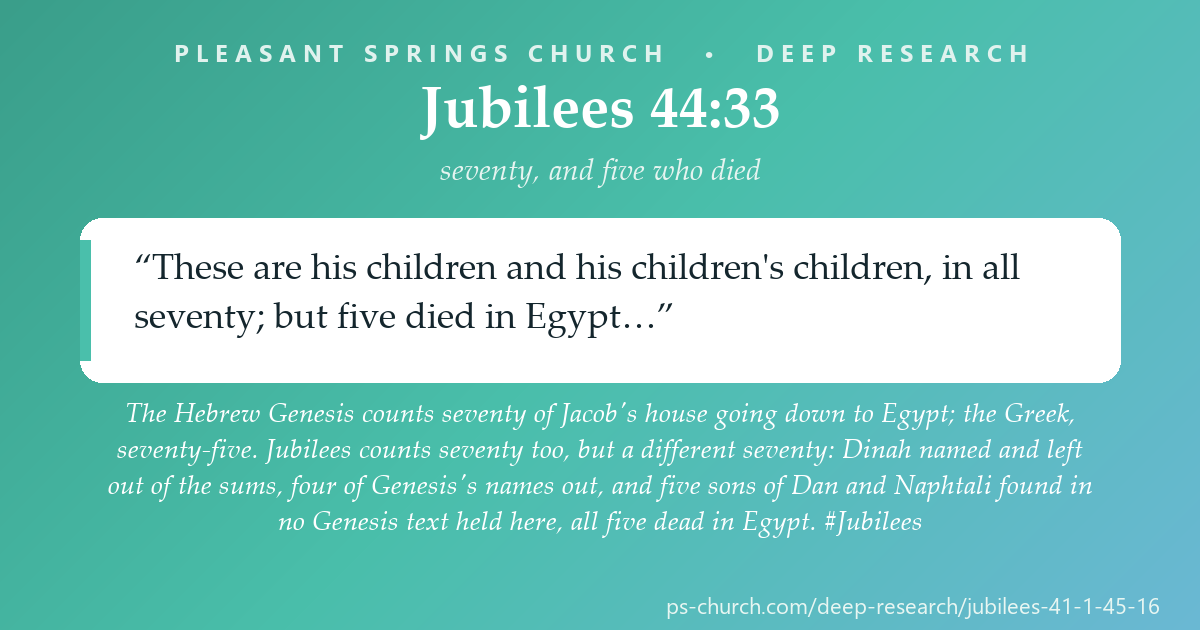
The page’s measured surprise. The five who die are the same five sons of Dan and Naphtali that no Genesis text held here names; and the book’s own subtotals close only if they are inside the seventy. The Geʻez reads ኵሎሙ ፡ ሰብዓ ፡ ወኀምስቱ — ‘all of them seventy, and five’ — and goes on: who died in Egypt, then ዘእንበለ ፡ ያውስቡ, before they married, where Charles has before Joseph. See Stage 4.
The ages are Genesis’s; the dates are the book’s own, and they do not agree. Jacob was born in AM 2046 (19:13) and dies here in AM 2188: 142, not 147. He entered Egypt in AM 2172 (45:1): 16 years before his death, or seventeen if both end-years are counted. Stage 2 sets it out.
No verse of Genesis says this. Its deepest Genesis run is three words, ‘until this day’, band 3 (Genesis 19:37, 32:33, 47:26) — a phrase in 10 verses of the Geʻez Pentateuch and 13 of Geʻez Jubilees. A formula, and the page counts it as one.
There is no Geʻez column, on purpose. The Geʻez of Jubilees held here is J. C. VanderKam’s critical text (1989), digitised by Ran HaCohen; two hosts label it CC BY-SA, the digitiser says one of them posted it under fair use and that his own copy stands with the editor’s blessing, and the edition itself is in copyright. So this page measures that Geʻez and prints only the few words a finding rests on. The Geʻez of Genesis to Deuteronomy is Dillmann’s Octateuch (1853–55, public domain; HaCohen’s digitisation, CC BY-SA 4.0), and the five words printed at 44:1 are quoted from Dillmann’s Genesis, where they are identical.
Geʻez phrases from Jubilees: VanderKam’s critical text (1989), digitised by Ran HaCohen. The two oldest pages of this series say ‘R. H. Charles, 1913 (public domain), lightly modernized’; the text held now is the 1917 reprint of the 1902 translation, and this page quotes it unaltered.
Versification — stated, as on every page here. Jubilees has no Masoretic, Greek, King James, ESV or Vulgate numbering to be offset from. The two witnesses that do exist agree exactly: Charles’s English and the Geʻez both run chapters 41–45 at 28·25·24·34·16 = 127 verses. No offset.
The Genesis being retold has none either, here. Genesis 38 and 41–50 have the same verse counts in the Masoretic text, the CATSS Greek and Dillmann’s Geʻez — 30·57·38·34·34·28·34·31·22·33·26. Dillmann’s Geʻez follows the Greek numbering throughout, and its file lacks the numbers 6:20, 10:12, 19:23, 22:4, 35:21, 40:4 — gaps in the source, none of them in the stretch these chapters retell.
Two references outside Genesis carry an offset. Dillmann’s (and the Masoretic) Exodus 8:12, cited in Stage 4, is Exodus 8:16 in English Bibles; Dillmann’s Exodus 39:6, cited in Stage 3, is by its content (the 1,775 shekels of the hooks for the pillars) the Masoretic and English Exodus 38:28, and is not the CATSS Greek 39:6. Every other Exodus, Leviticus and Deuteronomy reference on this page has the same number in English.
The Shape of the Passage
A sequence: story, law, story, list, story, close (measured)Where it sits in the book. Jubilees is framed as the Angel of the Presence dictating to Moses on Sinai (ch. 1) from ‘heavenly tablets’, through a scheme of fifty jubilees. By the book’s own count at 50:4 Sinai is AM 2410 (forty-nine jubilees, one week and two years) and the crossing of the Jordan forty years later, AM 2450 — fifty jubilees exactly. These chapters run from AM 2165 to AM 2188, all inside the forty-fifth jubilee, and Jacob dies 222 years before Sinai. The frame shows through twice: the angel speaks as we in the law block, and the narrator’s until this day (45:12, 45:16) is the day of the speaker on Sinai.
⚠️ Where this page sits. Jubilees is filed on this shelf under Pseudepigrapha & Second Temple. It is canonical in the Ethiopian Orthodox Church, was copied at Qumran, and is not part of the Protestant canon. Nothing taught at Pleasant Springs rests on it.
Author
Anonymous, writing in a borrowed voice. The book is usually dated to the middle of the second century BC (see the first page of this series). The voice is the Angel of the Presence, dictating to Moses on Sinai, and in these chapters it surfaces in the first person plural: “And we told him in a dream that it was forgiven him because he supplicated earnestly, and lamented, and did not again commit it.” (41:24).
He keeps Genesis’s events and has much that Genesis does not say. Tamar’s people, the name of Judah’s wife, Judah’s repentance and the law that follows it, the date of every stage of the famine, four more sons for Dan, and a library handed to Levi. The page measures how little of Genesis’s wording comes with the events.
Audience
Readers for whom the law of the household was a live question — who may marry whom, and what is to be done when that law is broken. That is how these chapters are commonly read; the page does not test it.
And readers who knew Genesis. That too is the usual reading of a book that retells Genesis, and the page does not test it. Chapter 44 gives its reader a list of seventy names with the sums to check, and the sums, as Stage 4 shows, close. Its seventy is not Genesis’s seventy.
Orient on Jubilees, on Judah and Tamar, and on the lists of Jacob’s house.
Search by topic: Jubilees; Judah and Tamar; levirate marriage; incest laws; the seventy of Jacob’s house; Testament of Judah; heavenly tablets. These are subjects to look up; the exact entry titles were not checked, and none of these works is held on this disk.
Which articles are relevant?
- Anchor Bible Dictionary — the article on Jubilees, and for the canonical side the entries on Tamar, Judah, the levirate and Joseph.
- Eerdmans Dictionary of Early Judaism — its articles on Jubilees and on the Testaments of the Twelve Patriarchs.
- Dictionary of New Testament Background (IVP) — on Jubilees, and on the speech of Stephen for Acts 7:14.
Bibliography surfaced:
- James C. VanderKam, Jubilees (Hermeneia, two volumes) — a commentary. Not consulted for this page; see Stage 5.
- James C. VanderKam, The Book of Jubilees: A Critical Text (CSCO 510) — the Geʻez measured here, in a digitisation of its text without the apparatus.
- R. H. Charles, The Book of Jubilees, or the Little Genesis (1902) — the English quoted here, from the 1917 SPCK reprint.
- August Dillmann, Octateuchus Aethiopicus (1853–55) — the Geʻez Genesis measured here, whose apparatus is not held.
- James L. Kugel, A Walk through Jubilees; Michael Segal, The Book of Jubilees: Rewritten Bible, Redaction, Ideology and Theology; Betsy Halpern-Amaru, The Empowerment of Women in the Book of Jubilees (for Tamar).
What the retelling keeps from Genesis, what it has besides, and the book’s own clock.
Three comparisons: Jubilees against the Genesis it retells (measured, in Geʻez); against other tellings of Judah and Tamar (named, since none is held); and against itself — its own dates, which can be computed.
What does the retelling keep, and what does it pass over?
The coverage map. Every verse of the Geʻez Genesis these chapters retell — chapter 38, and 41:53 to 50:14, 303 verses — was screened against the 127 verses of Jubilees 41–45. 141 of the 303 share no two consecutive words with any of them. Against the whole of Jubilees, 88 still share none.
| Genesis (Geʻez, Dillmann) | verses | no two-word partner in Jub 41–45 | none in all of Jubilees |
|---|---|---|---|
| Genesis 38 | 30 | 14 | 5 |
| Genesis 41:53–57 | 5 | 2 | 1 |
| Genesis 42 | 38 | 15 | 8 |
| Genesis 43 | 34 | 22 | 13 |
| Genesis 44 | 34 | 11 | 9 |
| Genesis 45 | 28 | 12 | 10 |
| Genesis 46 | 34 | 12 | 11 |
| Genesis 47 | 31 | 11 | 6 |
| Genesis 48 | 22 | 9 | 4 |
| Genesis 49 | 33 | 28 | 17 |
| Genesis 50:1–14 | 14 | 5 | 4 |
All 303 verses of Genesis 38 and 41:53–50:14 — each with its deepest partner in Jubilees 41–45, and its deepest run anywhere in Jubilees (open)
| Genesis (Geʻez) | run with Jub 41–45 | band among those 127 verses | partner(s) | run with any of Jubilees’ 1,307 verses |
|---|---|---|---|---|
| Gen 38:1 | 0 | — | — | 2 |
| Gen 38:2 | 2 | 1 | Jub 43:5 | 2 |
| Gen 38:3 | 0 | — | — | 3 |
| Gen 38:4 | 0 | — | — | 2 |
| Gen 38:5 | 0 | — | — | 2 |
| Gen 38:6 | 2 | 1 | Jub 41:1 | 2 |
| Gen 38:7 | 3 | 1 | Jub 41:3 | 3 |
| Gen 38:8 | 3 | 1 | Jub 41:4 | 3 |
| Gen 38:9 | 3 | 2 | Jub 41:4, 41:5 | 3 |
| Gen 38:10 | 2 | 2 | Jub 41:5, 41:23 | 2 |
| Gen 38:11 | 3 | 1 | Jub 41:6 | 3 |
| Gen 38:12 | 2 | 2 | Jub 41:7, 41:14 | 2 |
| Gen 38:13 | 3 | 1 | Jub 41:8 | 3 |
| Gen 38:14 | 3 | 1 | Jub 41:9 | 3 |
| Gen 38:15 | 0 | — | — | 0 |
| Gen 38:16 | 2 | 1 | Jub 41:10 | 2 |
| Gen 38:17 | 4 | 1 | Jub 41:12 | 4 |
| Gen 38:18 | 0 | — | — | 3 |
| Gen 38:19 | 0 | — | — | 2 |
| Gen 38:20 | 0 | — | — | 2 |
| Gen 38:21 | 0 | — | — | 2 |
| Gen 38:22 | 0 | — | — | 0 |
| Gen 38:23 | 2 | 3 | Jub 41:4, 41:6, 43:11 | 2 |
| Gen 38:24 | 2 | 4 | Jub 41:4, 41:6, 41:16, 43:11 | 2 |
| Gen 38:25 | 0 | — | — | 0 |
| Gen 38:26 | 2 | 2 | Jub 41:19, 42:19 | 2 |
| Gen 38:27 | 2 | 2 | Jub 41:18, 43:2 | 2 |
| Gen 38:28 | 0 | — | — | 2 |
| Gen 38:29 | 0 | — | — | 0 |
| Gen 38:30 | 0 | — | — | 0 |
| Gen 41:53 | 0 | — | — | 0 |
| Gen 41:54 | 0 | — | — | 2 |
| Gen 41:55 | 3 | 3 | Jub 43:19, 43:23, 44:4 | 4 |
| Gen 41:56 | 2 | 2 | Jub 42:14, 44:4 | 2 |
| Gen 41:57 | 2 | 12 | Jub 41:25, 42:4, 44:2, 44:4 and 8 more | 2 |
| Gen 42:1 | 2 | 4 | Jub 42:4, 42:20, 44:8, 45:1 | 2 |
| Gen 42:2 | 2 | 4 | Jub 42:4, 42:20, 44:8, 45:1 | 2 |
| Gen 42:3 | 0 | — | — | 0 |
| Gen 42:4 | 3 | 1 | Jub 43:13 | 3 |
| Gen 42:5 | 2 | 8 | Jub 41:25, 42:3, 42:9, 44:4 and 4 more | 3 |
| Gen 42:6 | 3 | 2 | Jub 43:8, 43:23 | 3 |
| Gen 42:7 | 2 | 1 | Jub 44:9 | 2 |
| Gen 42:8 | 2 | 2 | Jub 42:5, 43:15 | 2 |
| Gen 42:9 | 4 | 1 | Jub 42:5 | 4 |
| Gen 42:10 | 2 | 1 | Jub 41:14 | 2 |
| Gen 42:11 | 2 | 2 | Jub 42:5, 43:5 | 2 |
| Gen 42:12 | 4 | 1 | Jub 42:5 | 4 |
| Gen 42:13 | 0 | — | — | 2 |
| Gen 42:14 | 3 | 1 | Jub 42:5 | 3 |
| Gen 42:15 | 0 | — | — | 2 |
| Gen 42:16 | 3 | 1 | Jub 42:5 | 3 |
| Gen 42:17 | 0 | — | — | 3 |
| Gen 42:18 | 0 | — | — | 0 |
| Gen 42:19 | 0 | — | — | 2 |
| Gen 42:20 | 0 | — | — | 0 |
| Gen 42:21 | 0 | — | — | 2 |
| Gen 42:22 | 0 | — | — | 0 |
| Gen 42:23 | 0 | — | — | 2 |
| Gen 42:24 | 0 | — | — | 0 |
| Gen 42:25 | 2 | 3 | Jub 42:7, 42:25, 43:1 | 2 |
| Gen 42:26 | 0 | — | — | 0 |
| Gen 42:27 | 0 | — | — | 0 |
| Gen 42:28 | 2 | 1 | Jub 43:9 | 2 |
| Gen 42:29 | 3 | 1 | Jub 44:18 | 3 |
| Gen 42:30 | 2 | 1 | Jub 42:5 | 2 |
| Gen 42:31 | 2 | 1 | Jub 42:5 | 2 |
| Gen 42:32 | 2 | 4 | Jub 42:9, 44:4, 45:1, 45:2 | 3 |
| Gen 42:33 | 0 | — | — | 2 |
| Gen 42:34 | 2 | 1 | Jub 42:5 | 2 |
| Gen 42:35 | 0 | — | — | 0 |
| Gen 42:36 | 3 | 1 | Jub 42:10 | 3 |
| Gen 42:37 | 2 | 2 | Jub 41:11, 42:18 | 2 |
| Gen 42:38 | 2 | 2 | Jub 42:11, 45:15 | 2 |
| Gen 43:1 | 0 | — | — | 0 |
| Gen 43:2 | 0 | — | — | 2 |
| Gen 43:3 | 2 | 1 | Jub 42:21 | 2 |
| Gen 43:4 | 0 | — | — | 0 |
| Gen 43:5 | 2 | 1 | Jub 42:16 | 2 |
| Gen 43:6 | 0 | — | — | 0 |
| Gen 43:7 | 0 | — | — | 0 |
| Gen 43:8 | 0 | — | — | 2 |
| Gen 43:9 | 0 | — | — | 0 |
| Gen 43:10 | 0 | — | — | 0 |
| Gen 43:11 | 2 | 1 | Jub 43:3 | 2 |
| Gen 43:12 | 0 | — | — | 0 |
| Gen 43:13 | 0 | — | — | 0 |
| Gen 43:14 | 0 | — | — | 2 |
| Gen 43:15 | 2 | 4 | Jub 42:9, 42:20, 44:8, 45:1 | 2 |
| Gen 43:16 | 0 | — | — | 2 |
| Gen 43:17 | 3 | 1 | Jub 43:1 | 3 |
| Gen 43:18 | 0 | — | — | 2 |
| Gen 43:19 | 0 | — | — | 2 |
| Gen 43:20 | 0 | — | — | 0 |
| Gen 43:21 | 2 | 2 | Jub 41:18, 43:2 | 2 |
| Gen 43:22 | 0 | — | — | 2 |
| Gen 43:23 | 0 | — | — | 2 |
| Gen 43:24 | 0 | — | — | 0 |
| Gen 43:25 | 0 | — | — | 0 |
| Gen 43:26 | 3 | 1 | Jub 43:8 | 3 |
| Gen 43:27 | 3 | 1 | Jub 43:19 | 3 |
| Gen 43:28 | 2 | 2 | Jub 42:21, 43:8 | 2 |
| Gen 43:29 | 3 | 1 | Jub 42:21 | 3 |
| Gen 43:30 | 0 | — | — | 0 |
| Gen 43:31 | 0 | — | — | 0 |
| Gen 43:32 | 2 | 1 | Jub 42:14 | 2 |
| Gen 43:33 | 2 | 1 | Jub 43:14 | 2 |
| Gen 43:34 | 0 | — | — | 2 |
| Gen 44:1 | 2 | 1 | Jub 42:25 | 2 |
| Gen 44:2 | 4 | 1 | Jub 43:1 | 4 |
| Gen 44:3 | 0 | — | — | 0 |
| Gen 44:4 | 2 | 2 | Jub 43:1, 43:2 | 2 |
| Gen 44:5 | 2 | 2 | Jub 43:9, 43:10 | 2 |
| Gen 44:6 | 0 | — | — | 0 |
| Gen 44:7 | 3 | 1 | Jub 43:4 | 3 |
| Gen 44:8 | 2 | 1 | Jub 43:4 | 2 |
| Gen 44:9 | 0 | — | — | 0 |
| Gen 44:10 | 2 | 1 | Jub 43:6 | 2 |
| Gen 44:11 | 2 | 5 | Jub 41:5, 42:1, 42:15, 43:8 and 1 more | 2 |
| Gen 44:12 | 0 | — | — | 0 |
| Gen 44:13 | 3 | 1 | Jub 43:8 | 3 |
| Gen 44:14 | 3 | 1 | Jub 43:8 | 3 |
| Gen 44:15 | 2 | 2 | Jub 43:9, 43:10 | 2 |
| Gen 44:16 | 2 | 3 | Jub 41:4, 41:6, 43:11 | 2 |
| Gen 44:17 | 2 | 1 | Jub 43:6 | 2 |
| Gen 44:18 | 2 | 1 | Jub 42:19 | 2 |
| Gen 44:19 | 0 | — | — | 0 |
| Gen 44:20 | 2 | 1 | Jub 43:11 | 2 |
| Gen 44:21 | 0 | — | — | 0 |
| Gen 44:22 | 0 | — | — | 2 |
| Gen 44:23 | 0 | — | — | 0 |
| Gen 44:24 | 2 | 2 | Jub 41:18, 43:2 | 2 |
| Gen 44:25 | 0 | — | — | 0 |
| Gen 44:26 | 2 | 1 | Jub 42:16 | 2 |
| Gen 44:27 | 2 | 2 | Jub 42:11, 43:12 | 2 |
| Gen 44:28 | 0 | — | — | 2 |
| Gen 44:29 | 2 | 2 | Jub 42:11, 45:15 | 2 |
| Gen 44:30 | 4 | 1 | Jub 43:12 | 4 |
| Gen 44:31 | 2 | 4 | Jub 42:12, 43:12, 43:13, 45:15 | 2 |
| Gen 44:32 | 2 | 1 | Jub 42:19 | 2 |
| Gen 44:33 | 2 | 2 | Jub 43:13, 45:5 | 2 |
| Gen 44:34 | 0 | — | — | 0 |
| Gen 45:1 | 2 | 4 | Jub 42:3, 43:13, 44:9, 45:5 | 2 |
| Gen 45:2 | 0 | — | — | 2 |
| Gen 45:3 | 2 | 1 | Jub 43:14 | 2 |
| Gen 45:4 | 2 | 6 | Jub 42:20, 43:9, 43:10, 44:8 and 2 more | 2 |
| Gen 45:5 | 2 | 1 | Jub 43:18 | 2 |
| Gen 45:6 | 2 | 1 | Jub 43:17 | 2 |
| Gen 45:7 | 3 | 1 | Jub 43:18 | 3 |
| Gen 45:8 | 0 | — | — | 0 |
| Gen 45:9 | 2 | 4 | Jub 42:20, 43:10, 44:8, 45:1 | 2 |
| Gen 45:10 | 2 | 2 | Jub 45:1, 45:2 | 2 |
| Gen 45:11 | 2 | 1 | Jub 43:17 | 2 |
| Gen 45:12 | 0 | — | — | 0 |
| Gen 45:13 | 4 | 1 | Jub 43:20 | 4 |
| Gen 45:14 | 0 | — | — | 0 |
| Gen 45:15 | 0 | — | — | 0 |
| Gen 45:16 | 0 | — | — | 0 |
| Gen 45:17 | 0 | — | — | 0 |
| Gen 45:18 | 0 | — | — | 0 |
| Gen 45:19 | 0 | — | — | 2 |
| Gen 45:20 | 2 | 1 | Jub 41:26 | 2 |
| Gen 45:21 | 2 | 1 | Jub 44:34 | 3 |
| Gen 45:22 | 0 | — | — | 0 |
| Gen 45:23 | 2 | 1 | Jub 42:4 | 2 |
| Gen 45:24 | 0 | — | — | 0 |
| Gen 45:25 | 4 | 1 | Jub 42:9 | 4 |
| Gen 45:26 | 0 | — | — | 0 |
| Gen 45:27 | 4 | 1 | Jub 43:24 | 4 |
| Gen 45:28 | 2 | 2 | Jub 42:10, 43:24 | 3 |
| Gen 46:1 | 5 | 1 | Jub 44:1 | 5 |
| Gen 46:2 | 3 | 1 | Jub 44:5 | 3 |
| Gen 46:3 | 4 | 1 | Jub 44:5 | 4 |
| Gen 46:4 | 3 | 1 | Jub 45:1 | 3 |
| Gen 46:5 | 2 | 2 | Jub 43:24, 44:1 | 2 |
| Gen 46:6 | 2 | 5 | Jub 42:13, 42:20, 44:8, 45:1 and 1 more | 2 |
| Gen 46:7 | 0 | — | — | 0 |
| Gen 46:8 | 2 | 6 | Jub 42:20, 44:8, 44:18, 44:20 and 2 more | 2 |
| Gen 46:9 | 0 | — | — | 0 |
| Gen 46:10 | 0 | — | — | 0 |
| Gen 46:11 | 0 | — | — | 0 |
| Gen 46:12 | 2 | 2 | Jub 42:13, 45:15 | 2 |
| Gen 46:13 | 0 | — | — | 0 |
| Gen 46:14 | 0 | — | — | 0 |
| Gen 46:15 | 2 | 3 | Jub 44:18, 44:19, 44:27 | 2 |
| Gen 46:16 | 0 | — | — | 0 |
| Gen 46:17 | 2 | 1 | Jub 44:21 | 2 |
| Gen 46:18 | 2 | 2 | Jub 44:19, 44:27 | 2 |
| Gen 46:19 | 3 | 1 | Jub 44:23 | 3 |
| Gen 46:20 | 2 | 1 | Jub 44:24 | 2 |
| Gen 46:21 | 0 | — | — | 0 |
| Gen 46:22 | 2 | 2 | Jub 44:19, 44:27 | 2 |
| Gen 46:23 | 0 | — | — | 0 |
| Gen 46:24 | 0 | — | — | 0 |
| Gen 46:25 | 2 | 1 | Jub 44:18 | 2 |
| Gen 46:26 | 3 | 2 | Jub 42:20, 44:11 | 3 |
| Gen 46:27 | 3 | 3 | Jub 42:20, 44:11, 44:26 | 3 |
| Gen 46:28 | 3 | 1 | Jub 42:3 | 3 |
| Gen 46:29 | 2 | 2 | Jub 44:24, 45:15 | 2 |
| Gen 46:30 | 3 | 2 | Jub 45:3, 45:4 | 3 |
| Gen 46:31 | 2 | 5 | Jub 42:9, 43:9, 43:10, 44:4 and 1 more | 2 |
| Gen 46:32 | 0 | — | — | 2 |
| Gen 46:33 | 0 | — | — | 0 |
| Gen 46:34 | 2 | 1 | Jub 42:14 | 2 |
| Gen 47:1 | 2 | 3 | Jub 43:4, 45:1, 45:2 | 2 |
| Gen 47:2 | 2 | 1 | Jub 45:12 | 2 |
| Gen 47:3 | 0 | — | — | 0 |
| Gen 47:4 | 2 | 8 | Jub 41:5, 42:1, 42:9, 42:15 and 4 more | 3 |
| Gen 47:5 | 0 | — | — | 2 |
| Gen 47:6 | 2 | 6 | Jub 42:4, 42:13, 43:19, 43:23 and 2 more | 2 |
| Gen 47:7 | 2 | 2 | Jub 45:6, 45:7 | 2 |
| Gen 47:8 | 0 | — | — | 0 |
| Gen 47:9 | 2 | 3 | Jub 42:19, 44:5, 45:6 | 2 |
| Gen 47:10 | 0 | — | — | 0 |
| Gen 47:11 | 3 | 2 | Jub 45:6, 45:7 | 3 |
| Gen 47:12 | 0 | — | — | 2 |
| Gen 47:13 | 3 | 4 | Jub 42:13, 43:19, 43:23, 44:4 | 4 |
| Gen 47:14 | 2 | 2 | Jub 42:14, 45:8 | 2 |
| Gen 47:15 | 3 | 1 | Jub 42:3 | 3 |
| Gen 47:16 | 2 | 2 | Jub 43:9, 43:10 | 2 |
| Gen 47:17 | 2 | 2 | Jub 42:3, 44:9 | 2 |
| Gen 47:18 | 0 | — | — | 2 |
| Gen 47:19 | 0 | — | — | 0 |
| Gen 47:20 | 2 | 2 | Jub 44:22, 44:26 | 2 |
| Gen 47:21 | 0 | — | — | 2 |
| Gen 47:22 | 0 | — | — | 2 |
| Gen 47:23 | 2 | 3 | Jub 42:14, 43:9, 43:10 | 2 |
| Gen 47:24 | 0 | — | — | 0 |
| Gen 47:25 | 0 | — | — | 0 |
| Gen 47:26 | 3 | 2 | Jub 45:12, 45:16 | 4 |
| Gen 47:27 | 2 | 1 | Jub 45:1 | 2 |
| Gen 47:28 | 3 | 1 | Jub 45:13 | 3 |
| Gen 47:29 | 2 | 10 | Jub 42:4, 44:2, 44:6, 44:11 and 6 more | 2 |
| Gen 47:30 | 2 | 3 | Jub 42:20, 44:8, 45:1 | 2 |
| Gen 47:31 | 2 | 1 | Jub 45:1 | 2 |
| Gen 48:1 | 2 | 2 | Jub 43:3, 45:12 | 2 |
| Gen 48:2 | 0 | — | — | 0 |
| Gen 48:3 | 2 | 3 | Jub 42:13, 44:5, 45:15 | 2 |
| Gen 48:4 | 0 | — | — | 3 |
| Gen 48:5 | 0 | — | — | 0 |
| Gen 48:6 | 0 | — | — | 0 |
| Gen 48:7 | 2 | 2 | Jub 42:13, 45:15 | 2 |
| Gen 48:8 | 3 | 1 | Jub 42:15 | 3 |
| Gen 48:9 | 2 | 4 | Jub 43:20, 44:5, 45:6, 45:7 | 2 |
| Gen 48:10 | 0 | — | — | 2 |
| Gen 48:11 | 3 | 1 | Jub 45:3 | 3 |
| Gen 48:12 | 2 | 5 | Jub 41:5, 42:1, 42:15, 43:8 and 1 more | 2 |
| Gen 48:13 | 0 | — | — | 2 |
| Gen 48:14 | 0 | — | — | 2 |
| Gen 48:15 | 2 | 3 | Jub 44:5, 45:12, 45:16 | 2 |
| Gen 48:16 | 2 | 1 | Jub 44:5 | 2 |
| Gen 48:17 | 2 | 3 | Jub 42:3, 42:15, 43:14 | 2 |
| Gen 48:18 | 2 | 2 | Jub 45:6, 45:7 | 2 |
| Gen 48:19 | 0 | — | — | 2 |
| Gen 48:20 | 2 | 1 | Jub 43:19 | 2 |
| Gen 48:21 | 3 | 1 | Jub 45:3 | 3 |
| Gen 48:22 | 0 | — | — | 0 |
| Gen 49:1 | 0 | — | — | 0 |
| Gen 49:2 | 0 | — | — | 0 |
| Gen 49:3 | 0 | — | — | 0 |
| Gen 49:4 | 0 | — | — | 0 |
| Gen 49:5 | 0 | — | — | 2 |
| Gen 49:6 | 0 | — | — | 0 |
| Gen 49:7 | 0 | — | — | 2 |
| Gen 49:8 | 0 | — | — | 0 |
| Gen 49:9 | 0 | — | — | 0 |
| Gen 49:10 | 2 | 1 | Jub 41:6 | 2 |
| Gen 49:11 | 0 | — | — | 2 |
| Gen 49:12 | 0 | — | — | 0 |
| Gen 49:13 | 0 | — | — | 0 |
| Gen 49:14 | 0 | — | — | 0 |
| Gen 49:15 | 0 | — | — | 3 |
| Gen 49:16 | 0 | — | — | 0 |
| Gen 49:17 | 0 | — | — | 2 |
| Gen 49:18 | 0 | — | — | 2 |
| Gen 49:19 | 0 | — | — | 0 |
| Gen 49:20 | 0 | — | — | 0 |
| Gen 49:21 | 0 | — | — | 0 |
| Gen 49:22 | 2 | 1 | Jub 43:14 | 2 |
| Gen 49:23 | 0 | — | — | 0 |
| Gen 49:24 | 0 | — | — | 0 |
| Gen 49:25 | 0 | — | — | 2 |
| Gen 49:26 | 0 | — | — | 2 |
| Gen 49:27 | 0 | — | — | 0 |
| Gen 49:28 | 0 | — | — | 2 |
| Gen 49:29 | 2 | 1 | Jub 45:15 | 2 |
| Gen 49:30 | 3 | 1 | Jub 45:15 | 3 |
| Gen 49:31 | 0 | — | — | 2 |
| Gen 49:32 | 2 | 1 | Jub 45:15 | 2 |
| Gen 49:33 | 0 | — | — | 2 |
| Gen 50:1 | 2 | 1 | Jub 45:2 | 4 |
| Gen 50:2 | 0 | — | — | 0 |
| Gen 50:3 | 2 | 2 | Jub 42:14, 44:33 | 2 |
| Gen 50:4 | 2 | 2 | Jub 41:14, 44:9 | 3 |
| Gen 50:5 | 2 | 3 | Jub 42:13, 45:14, 45:15 | 3 |
| Gen 50:6 | 0 | — | — | 0 |
| Gen 50:7 | 0 | — | — | 2 |
| Gen 50:8 | 2 | 2 | Jub 45:1, 45:2 | 2 |
| Gen 50:9 | 2 | 1 | Jub 45:5 | 2 |
| Gen 50:10 | 0 | — | — | 0 |
| Gen 50:11 | 2 | 4 | Jub 42:9, 44:4, 45:1, 45:2 | 3 |
| Gen 50:12 | 0 | — | — | 0 |
| Gen 50:13 | 2 | 4 | Jub 42:9, 44:4, 45:1, 45:2 | 3 |
| Gen 50:14 | 2 | 10 | Jub 42:4, 44:2, 44:6, 44:11 and 6 more | 3 |
Genesis 49 is the clearest case. Jacob’s blessing of his twelve sons and his charge about his burial run to thirty-three verses; 28 of them share no two consecutive words with these chapters, and 17 none with any verse of Jubilees. Jubilees gives the whole of it one sentence: “he made known to them what would come upon them in the last days” (45:14). Even there the shared phrase in the last days counts as one word, because Jubilees fuses and to it (ወበደኃሪ ፡ መዋዕል) and Genesis 49:1 does not (በደኃሪ ፡ መዋዕል). Genesis 49:10, the sceptre that shall not depart from Judah, shares no more than two consecutive words with any verse of Jubilees, and it reaches two with 28 of them at once — ‘until when’ and ‘to him, and he’. A band that wide is no contact at all.
Also passed over, by the same measure: Genesis 48 (Jacob adopting and blessing Ephraim and Manasseh) is 9 silent verses out of 22; and of Genesis 38 itself, 14 of 30 verses have no partner here — among them the births of Judah’s sons (38:3–5) and the birth of the twins (38:28–30); Jubilees gives the twins one clause, at 41:21.
And what Jubilees has that Genesis lacks cannot be measured against it. Judah’s repentance and the law that follows (41:23–28), the four extra sons of Dan (44:28–29), Iv born after the famine (44:31), and the books given to Levi (45:16) have no Genesis verse to set beside them.
Who else told Judah and Tamar this way?
The 1917 edition’s notes point to two. At 41:1, on Tamar’s people: “Cf. Test. Judah x. ("from Mesopotamia").” — the Testament of Judah, one of the Testaments of the Twelve Patriarchs, which also tells Judah’s story in his own voice. At 41:17, on the sentence of burning: “According to the Targum (Ps.-Jon.), on Gen. xxxviii. 6, 24, Tamar was the daughter of a priest.” Neither the Testament of Judah nor Pseudo-Jonathan’s Genesis 38 is held on this disk (the Pseudo-Jonathan held here covers Genesis 6 only), so both are named and not checked.
Genesis 38 records Judah’s verdict on himself — she is more righteous than I (38:26) — and goes on to the birth of the twins. Jubilees keeps the verdict (41:19) and then has what Genesis does not: Judah’s grief, a dream in which he is told he is forgiven, and a law for Israel. Measured against the laws of Leviticus on these relations — Lev 18:15, Lev 18:17, Lev 20:12, Lev 20:14, Lev 21:9 — the six verses 41:23–28 share at most one consecutive word with any of them. The law in Jubilees is not written in Leviticus’s words.
The church’s reading, set out on our Genesis 38 study, rests on Genesis: Judah’s own confession that Tamar was more righteous than he, and Tamar’s place, by name, in the genealogy of Christ (Matthew 1:3). Jubilees has a penalty — burning, for both parties, for any man who lies with his daughter-in-law or mother-in-law — and calls it a command for Israel. The page reports that law precisely; it does not adopt it. Scripture’s own laws on these relations are Leviticus 18:15 and 20:12 for a daughter-in-law (20:12: both put to death), 18:17 for a woman and her daughter, and 20:14 for a man who takes a woman and her mother — and Leviticus 20:14 itself prescribes burning for that one, as 21:9 does for a priest’s daughter (see our Leviticus 18 and Leviticus 20 studies).
The book’s own clock — computed, not assumed:
Jubilees dates events ‘in the Nth jubilee, in the Mth week, in the Kth year’, so a date converts to a year from creation (Anno Mundi): AM = 49(N−1) + 7(M−1) + K. Every dated verse in these chapters, computed from Charles’s English and checked against the Geʻez numerals, which agree with it at every one. Where a verse says only ‘this week’, the week and jubilee are those of the verse that set them (41:1, 42:1).
| verse | the text’s date | AM by the formula | Charles’s margin |
|---|---|---|---|
| 41:1 | year 2 of week 2, jubilee 45 | 49×44 + 7×1 + 2 = 2165 | 2165 |
| 41:7 | year 5 of week 2, jubilee 45 | 49×44 + 7×1 + 5 = 2168 | 2168 |
| 41:8 | year 6 of week 2, jubilee 45 | 49×44 + 7×1 + 6 = 2169 | 2169 |
| 41:21 | year 7 of week 2, jubilee 45 | 49×44 + 7×1 + 7 = 2170 | 2170 |
| 42:1 | year 1 of week 3, jubilee 45 | 49×44 + 7×2 + 1 = 2171 | 2171 |
| 42:20 | year 2 of week 3, jubilee 45 | 49×44 + 7×2 + 2 = 2172 | 2172 |
| 45:1 | year 2 of week 3, jubilee 45 | 49×44 + 7×2 + 2 = 2172 | 2172 |
| 45:11 | year 1 of week 4, jubilee 45 | 49×44 + 7×3 + 1 = 2178 | 2178 |
| 45:13 | year 4 of week 5, jubilee 45 | 49×44 + 7×4 + 4 = 2188 | 2188 |
Charles’s margin years agree with the formula at all nine. The famine clock closes on itself: the famine begins in AM 2171 (42:1); the second journey is AM 2172, which Joseph calls the second year of the famine (43:17); and the sowing comes in AM 2178, the eighth year (45:9). The Geʻez of 41:1 writes the ‘forty’ of ‘forty-fifth’ as ወበአርብ, without the final letter it has at 42:1 (ዘአርብዓ); read as forty-fifth it agrees with Charles, and the page cannot say from here whether the shorter form is in the printed edition.
Jacob’s three numbers, set against the same clock:
| the text says | every Genesis held here says | by the book’s own dates | |
|---|---|---|---|
| Jacob’s age entering Egypt | 130 (45:6; Geʻez ምእት ፡ ወሠላሳ) | 130 (47:9: Masoretic שְׁלֹשִׁ֥ים וּמְאַ֖ת, Greek ἑκατὸν τριάκοντα, Geʻez ምእት ፡ ወሠላሳ, Samaritan the same) | born AM 2046 (19:13), entering AM 2172: 126 |
| years in Egypt | 17 (45:13) | 17 (47:28) | AM 2172 to AM 2188: 16, or 17 counting both end-years |
| age at death | 147, ‘three jubilees’ (45:13; Geʻez ሠለስቱ ፡ ኢዩቤልውስ) | 147 (47:28; in Dillmann’s Geʻez the seven stands in square brackets, which the digitiser’s note on Dillmann’s signs explains as an omission corrected from later Ethiopic manuscripts) | AM 2046 to AM 2188: 142 |
Three of three: the ages are Genesis’s, and the dates do not produce them. The years in Egypt can be rescued by counting both end-years; the ages at entry and at death are four and five years out, and no counting convention closes those. Because every Genesis held here — Masoretic, Samaritan, Greek and Geʻez — agrees on all three numbers, they cannot show Jubilees nearer to one tradition than another. The page does not explain the difference. The study of Jubilees 30–34 in this series reports the same kind of gap for Dinah, Isaac and Joseph.
One more subtraction. By the book’s dates Perez and Zerah are born in AM 2170 (41:21) and the family goes down in AM 2172 (45:1): Perez is two years old. Every Genesis held here names two sons of Perez among those who went down (46:12); Jubilees names none. The page sets the two facts side by side and draws no conclusion about why.
Jacob sets out on the new moon of the third month, sacrifices on the seventh, keeps the feast of first-fruits with old grain, and sees the vision on the sixteenth (44:1–8). Those dates sit inside Jubilees’ own 364-day year, which the book defends against the lunar calendar at 6:32–38. That calendar is the book’s position. This page reports it and does not adopt it.
Seventy and five, a vowel, a marriage, the nations, and a cup.
Counts are over the files held here: Geʻez Jubilees (1,307 verses), the Geʻez Pentateuch (5,797 verses), the Masoretic text and the CATSS Greek. They are not counts over ‘Geʻez literature’ or ‘the Bible’, and each one is said in its scope. Italic English beside the Geʻez that is not labelled Charles is the page’s own literal gloss.
Two words that are also the Geʻez for seventy-five. Dillmann’s Genesis 46:27 ends with them — ሰብዓ ፡ ወኀምስቱ — where the Greek reads ἑβδομήκοντα πέντε and the Masoretic שִׁבְעִֽים. In the 5,797 verses of the Geʻez Pentateuch the bare pair stands twice as the tokeniser counts — Genesis 46:27, and Genesis 25:7 only because Dillmann’s square bracket inside the word and-seventy (ወ[ሰብዓ ፡] ወኀምስቱ) splits off the and. Written with the conjunction, and seventy, and five also stands in Dillmann’s Exodus 39:6 (part of 1,775 shekels; see Versification) and in Jubilees 21:2 (Abraham’s hundred and seventy-five years), and Jubilees 23:8 has it with an accusative ending. As the bare pair, in Geʻez Jubilees once, 44:33. In Jubilees the five are the five who died, and the subtotals put them inside the seventy (Stage 4). Dillmann’s Geʻez Exodus 1:5 writes its seventy-five in Ethiopic digits, ፸፭, so a search for the words does not find it.
The same three words in both Geʻez texts, but for one vowel. Dillmann’s Genesis 38:26 has ጸድቅት ፡ ትዕማር ፡ እምኔየ. The verb is spelled with a different vowel order on its third letter, and a word-form screen treats different spellings as different words. The run between the two verses is two as spelled and five with the verb read as one word. The house’s declared fold does not touch vowel orders, so the page publishes two.
Where the columns part. Charles reads the five as dying ‘before Joseph’; the digitised Geʻez reads before they married, and VanderKam’s own English, printed beside that Geʻez on the digitiser’s page, reads the verb the same way. Charles translated from the Ethiopic text of his day, not VanderKam’s; the page cannot compare the manuscripts from here. Either way the verse ends and they had no children.
The other seventy. Er and Onan, who died in Canaan without children, are “reckoned among the seventy Gentile nations”. The pair seventy nations stands in no verse of the Geʻez Pentateuch held here and in one verse of Geʻez Jubilees, this one. The seventy of Israel and the seventy of the nations meet in two adjacent verses.
The divining cup — in the Hebrew and the Greek, and in neither Geʻez text. Genesis 44:5 and 44:15 say Joseph divines by the cup: Masoretic נַחֵ֧שׁ יְנַחֵ֛שׁ, Greek as above. Dillmann’s Geʻez Genesis has no such clause at either verse: its 44:15 is five words, “What is this that you have done?”. Jubilees has instead “Know ye not that a man delighteth in his cup as I with this cup?” The 1917 note on that line: “The change in our text may be deliberate.” Measured, the two Geʻez texts agree in lacking the divining, in different words; the note’s ‘change’ names a difference from the Hebrew and Greek, not a direction the page can measure, and its ‘deliberate’ is that editor’s reading of motive, which the page does not adopt.
Counted here, not assumed:
- 127 verses, 2,072 Geʻez word tokens in chapters 41–45, chapter by chapter 28·25·24·34·16 in both the English and the Geʻez.
- Every year, week and jubilee in these chapters agrees between Charles and the Geʻez — nine dated verses, nine agreements.
- Charles’s English and the digitised Geʻez disagree on one count in the list — Asher’s, six against five (44:21), where VanderKam’s own English also reads six — and on at least two phrases: Shaul is ‘the son of the Zephathite woman’ in Charles (his 1917 note: “i. e. a native of the Canaanite city Zephath”), while the Geʻez reads ወልዳ ፡ ለፍኒሰወት, which VanderKam’s English renders ‘the son of the Phoenician woman’ (44:13); and before Joseph stands against before they married (44:33). The two English translations were not compared verse by verse, so these are the disagreements found, not all there are.
- The angel speaks as ‘we’ twice in the law block (41:24, 41:27) and addresses Moses as ‘thou’ (41:26) without naming him; Moses’ name does not occur in these chapters.
- ‘Books’ occurs in four verses of Charles’s whole Jubilees, and 45:16 is the one where Jacob hands his own and his fathers’ books to Levi.
Geʻez against Geʻez — and four lists of the seventy, counted name by name.
How the screen works. Each of the 127 verses of Jubilees 41–45 in Geʻez is compared with every verse of the Geʻez Pentateuch for the longest run of identical consecutive word forms. Normalisation, declared: words split on the Ethiopic word-divider and spaces; full stops, other Ethiopic punctuation and the editors’ brackets removed (a bracket inside a word splits it); no stemming. The fold, declared and optional: the letters manuscripts interchange — the three h-letters, the two s-letters, the two glottal letters, the two emphatic s-letters, in all their vowel forms — treated as one. Vowel orders are not folded. Every headline number is given with and without the fold. A zero here means no two consecutive words shared; single words are not counted. The tie band is the number of verses that reach the same depth, counted from both sides. The two Geʻez texts come from different editors and manuscript bases — VanderKam in 1989, Dillmann in 1853 — so agreement between them is a lower bound, and a disagreement may be editorial.
The distribution — against Genesis, and against all five books:
Against the Geʻez Genesis (1,526 verses): of the 127 verses of Jubilees 41–45, 26 share no two consecutive words with any verse of Genesis; 101 reach two, 42 reach three, 9 reach four, 1 reaches five, and nothing reaches six. With the fold: 25 share no two consecutive words with any verse of Genesis; 102 reach two, 43 reach three, 9 reach four, 1 reaches five, and nothing reaches six.
Against the whole Geʻez Pentateuch (5,797 verses): 16 share no two consecutive words with any verse of the five books; 111 reach two, 46 reach three, 13 reach four, 1 reaches five, and nothing reaches six. With the fold: 15 share no two consecutive words with any verse of the five books; 112 reach two, 47 reach three, 13 reach four, 1 reaches five, and nothing reaches six. The fold changes the depth of two verses, 43:7 and 45:2; it moves the counts below four by one each (against Genesis: no partner, 26 to 25; reaching two, 101 to 102; reaching three, 42 to 43; against the five books, 16 to 15, 111 to 112 and 46 to 47) and leaves the counts reaching four, and the deepest run, unchanged.
| chapter | verses | deepest run with Genesis | verses reaching four | verses with no two-word partner |
|---|---|---|---|---|
| 41 | 28 | 4 | 1 | 6 |
| 42 | 25 | 4 | 2 | 4 |
| 43 | 24 | 4 | 4 | 3 |
| 44 | 34 | 5 | 2 | 12 |
| 45 | 16 | 3 | 0 | 1 |
Is that low? On the same screen, the whole book against Genesis: 83 of Jubilees’ 1,307 verses reach four or more, and the deepest run anywhere is eight words. Section by section:
| stretch | verses | reaching four or more with Genesis |
|---|---|---|
| Jubilees 1–10 | 320 | 14 |
| Jubilees 11–23 | 342 | 12 |
| Jubilees 24–29 | 168 | 31 |
| Jubilees 30–34 | 136 | 4 |
| Jubilees 35–40 | 131 | 13 |
| Jubilees 41–45 | 127 | 9 |
| Jubilees 46–50 | 83 | 0 |
These chapters sit in the middle of this scale, a little above the whole book’s rate: nine of 127 here (7 per cent), against 83 of 1,307 in all (6 per cent) — third of the seven stretches, behind chapters 24–29 (31 of 168), which retell the stolen blessing and the flight to Laban, and chapters 35–40 (13 of 131).
For every verse, not only the deepest. Of the 101 verses with a two-word partner in Genesis, 36 have exactly one deepest partner (band 1), and twenty-one form mutual pairs: the Genesis verse’s own deepest partner in all of Jubilees is that same verse, alone, at the same depth. The widest band is 25, at 45:2, made of three different two-word phrases — chiefly ውስተ ፡ ምድረ, ‘into the land of’, which 24 of the 25 carry. The full table is below.
All 127 verses — each with its deepest Genesis partner, and the band both ways (open)
| Jubilees | run | run with the fold | band among 1,526 Genesis verses | deepest partner(s) | partner’s own best in all of Jubilees: run / band (✓ = it is this verse) |
|---|---|---|---|---|---|
| Jub 41:1 | 2 | 2 | 3 | Gen 24:3, 36:2, 38:6 | 1 of the 3 point back |
| Jub 41:2 | 2 | 2 | 5 | Gen 21:21, 24:37, 27:46 and 2 more | 4 of the 5 point back |
| Jub 41:3 | 3 | 3 | 1 | Gen 38:7 | 3 / 1 ✓ |
| Jub 41:4 | 3 | 3 | 2 | Gen 38:8, 38:9 | 2 of the 2 point back |
| Jub 41:5 | 3 | 3 | 1 | Gen 38:9 | 3 / 2 ✓ |
| Jub 41:6 | 3 | 3 | 1 | Gen 38:11 | 3 / 1 ✓ |
| Jub 41:7 | 2 | 2 | 1 | Gen 38:12 | 2 / 2 ✓ |
| Jub 41:8 | 3 | 3 | 1 | Gen 38:13 | 3 / 1 ✓ |
| Jub 41:9 | 3 | 3 | 1 | Gen 38:14 | 3 / 1 ✓ |
| Jub 41:10 | 2 | 2 | 1 | Gen 38:16 | 2 / 2 ✓ |
| Jub 41:11 | 2 | 2 | 4 | Gen 38:17, 39:8, 40:11 and 1 more | 3 of the 4 point back |
| Jub 41:12 | 4 | 4 | 1 | Gen 38:17 | 4 / 1 ✓ |
| Jub 41:13 | 2 | 2 | 1 | Gen 38:11 | 3 / 1 |
| Jub 41:14 | 2 | 2 | 13 | Gen 8:15, 9:8, 15:4 and 10 more | 9 of the 13 point back |
| Jub 41:15 | 0 | 0 | — | — | — |
| Jub 41:16 | 2 | 2 | 3 | Gen 16:4, 16:5, 38:24 | 3 of the 3 point back |
| Jub 41:17 | 2 | 2 | 2 | Gen 34:11, 38:11 | 1 of the 2 point back |
| Jub 41:18 | 2 | 2 | 8 | Gen 12:11, 12:14, 19:29 and 5 more | 5 of the 8 point back |
| Jub 41:19 | 2 | 2 | 1 | Gen 38:26 | 2 / 2 ✓ |
| Jub 41:20 | 0 | 0 | — | — | — |
| Jub 41:21 | 0 | 0 | — | — | — |
| Jub 41:22 | 2 | 2 | 2 | Gen 41:16, 41:25 | 2 of the 2 point back |
| Jub 41:23 | 2 | 2 | 10 | Gen 6:6, 10:9, 18:22 and 7 more | 9 of the 10 point back |
| Jub 41:24 | 0 | 0 | — | — | — |
| Jub 41:25 | 2 | 2 | 3 | Gen 41:31, 41:57, 42:5 | 2 of the 3 point back |
| Jub 41:26 | 2 | 2 | 1 | Gen 45:20 | 2 / 7 ✓ |
| Jub 41:27 | 0 | 0 | — | — | — |
| Jub 41:28 | 0 | 0 | — | — | — |
| Jub 42:1 | 2 | 2 | 23 | Gen 1:22, 1:25, 1:30 and 20 more | 7 of the 23 point back |
| Jub 42:2 | 0 | 0 | — | — | — |
| Jub 42:3 | 3 | 3 | 2 | Gen 46:28, 47:15 | 2 of the 2 point back |
| Jub 42:4 | 3 | 3 | 1 | Gen 34:5 | 3 / 1 ✓ |
| Jub 42:5 | 4 | 4 | 2 | Gen 42:9, 42:12 | 2 of the 2 point back |
| Jub 42:6 | 0 | 0 | — | — | — |
| Jub 42:7 | 2 | 2 | 1 | Gen 42:25 | 2 / 3 ✓ |
| Jub 42:8 | 2 | 2 | 2 | Gen 26:28, 39:3 | 0 of the 2 point back |
| Jub 42:9 | 4 | 4 | 1 | Gen 45:25 | 4 / 1 ✓ |
| Jub 42:10 | 3 | 3 | 1 | Gen 42:36 | 3 / 1 ✓ |
| Jub 42:11 | 2 | 2 | 3 | Gen 42:38, 44:27, 44:29 | 3 of the 3 point back |
| Jub 42:12 | 2 | 2 | 3 | Gen 32:26, 39:3, 44:31 | 2 of the 3 point back |
| Jub 42:13 | 3 | 3 | 1 | Gen 47:13 | 4 / 4 |
| Jub 42:14 | 2 | 2 | 9 | Gen 12:12, 12:14, 41:56 and 6 more | 7 of the 9 point back |
| Jub 42:15 | 3 | 3 | 1 | Gen 48:8 | 3 / 1 ✓ |
| Jub 42:16 | 2 | 2 | 2 | Gen 43:5, 44:26 | 2 of the 2 point back |
| Jub 42:17 | 0 | 0 | — | — | — |
| Jub 42:18 | 2 | 2 | 3 | Gen 39:8, 40:11, 42:37 | 3 of the 3 point back |
| Jub 42:19 | 2 | 2 | 6 | Gen 3:14, 3:17, 38:26 and 3 more | 4 of the 6 point back |
| Jub 42:20 | 3 | 3 | 3 | Gen 19:25, 46:26, 46:27 | 3 of the 3 point back |
| Jub 42:21 | 3 | 3 | 1 | Gen 43:29 | 3 / 1 ✓ |
| Jub 42:22 | 2 | 2 | 8 | Gen 9:27, 19:3, 20:18 and 5 more | 6 of the 8 point back |
| Jub 42:23 | 0 | 0 | — | — | — |
| Jub 42:24 | 2 | 2 | 3 | Gen 26:30, 31:46, 31:54 | 2 of the 3 point back |
| Jub 42:25 | 2 | 2 | 3 | Gen 42:25, 44:1, 44:2 | 2 of the 3 point back |
| Jub 43:1 | 4 | 4 | 1 | Gen 44:2 | 4 / 1 ✓ |
| Jub 43:2 | 2 | 2 | 14 | Gen 12:11, 12:14, 18:15 and 11 more | 9 of the 14 point back |
| Jub 43:3 | 2 | 2 | 9 | Gen 15:1, 21:11, 22:20 and 6 more | 8 of the 9 point back |
| Jub 43:4 | 3 | 3 | 1 | Gen 44:7 | 3 / 1 ✓ |
| Jub 43:5 | 2 | 2 | 3 | Gen 38:2, 40:21, 42:11 | 3 of the 3 point back |
| Jub 43:6 | 2 | 2 | 4 | Gen 4:15, 30:15, 44:10 and 1 more | 4 of the 4 point back |
| Jub 43:7 | 0 | 2 | — | — | — |
| Jub 43:8 | 3 | 3 | 4 | Gen 42:6, 43:26, 44:13 and 1 more | 4 of the 4 point back |
| Jub 43:9 | 2 | 2 | 10 | Gen 40:8, 42:28, 44:5 and 7 more | 9 of the 10 point back |
| Jub 43:10 | 2 | 2 | 14 | Gen 26:28, 40:8, 41:48 and 11 more | 11 of the 14 point back |
| Jub 43:11 | 2 | 2 | 4 | Gen 38:23, 38:24, 44:16 and 1 more | 4 of the 4 point back |
| Jub 43:12 | 4 | 4 | 1 | Gen 44:30 | 4 / 1 ✓ |
| Jub 43:13 | 3 | 3 | 1 | Gen 42:4 | 3 / 1 ✓ |
| Jub 43:14 | 2 | 2 | 12 | Gen 11:3, 11:7, 13:11 and 9 more | 11 of the 12 point back |
| Jub 43:15 | 2 | 2 | 1 | Gen 42:8 | 2 / 2 ✓ |
| Jub 43:16 | 2 | 2 | 2 | Gen 27:4, 27:7 | 0 of the 2 point back |
| Jub 43:17 | 2 | 2 | 2 | Gen 45:6, 45:11 | 2 of the 2 point back |
| Jub 43:18 | 3 | 3 | 1 | Gen 45:7 | 3 / 1 ✓ |
| Jub 43:19 | 3 | 3 | 10 | Gen 41:29, 41:33, 41:34 and 7 more | 3 of the 10 point back |
| Jub 43:20 | 4 | 4 | 1 | Gen 45:13 | 4 / 1 ✓ |
| Jub 43:21 | 0 | 0 | — | — | — |
| Jub 43:22 | 0 | 0 | — | — | — |
| Jub 43:23 | 3 | 3 | 10 | Gen 41:29, 41:33, 41:34 and 7 more | 3 of the 10 point back |
| Jub 43:24 | 4 | 4 | 1 | Gen 45:27 | 4 / 1 ✓ |
| Jub 44:1 | 5 | 5 | 1 | Gen 46:1 | 5 / 1 ✓ |
| Jub 44:2 | 2 | 2 | 9 | Gen 12:10, 12:11, 12:14 and 6 more | 6 of the 9 point back |
| Jub 44:3 | 2 | 2 | 5 | Gen 2:19, 8:7, 11:5 and 2 more | 5 of the 5 point back |
| Jub 44:4 | 3 | 3 | 9 | Gen 2:11, 6:4, 41:29 and 6 more | 2 of the 9 point back |
| Jub 44:5 | 4 | 4 | 1 | Gen 46:3 | 4 / 2 ✓ |
| Jub 44:6 | 2 | 2 | 10 | Gen 12:10, 12:11, 12:14 and 7 more | 6 of the 10 point back |
| Jub 44:7 | 0 | 0 | — | — | — |
| Jub 44:8 | 2 | 2 | 19 | Gen 37:25, 37:28, 37:36 and 16 more | 12 of the 19 point back |
| Jub 44:9 | 2 | 2 | 12 | Gen 13:6, 41:55, 42:5 and 9 more | 7 of the 12 point back |
| Jub 44:10 | 2 | 2 | 2 | Gen 47:11, 47:28 | 0 of the 2 point back |
| Jub 44:11 | 3 | 3 | 2 | Gen 46:26, 46:27 | 2 of the 2 point back |
| Jub 44:12 | 0 | 0 | — | — | — |
| Jub 44:13 | 0 | 0 | — | — | — |
| Jub 44:14 | 0 | 0 | — | — | — |
| Jub 44:15 | 0 | 0 | — | — | — |
| Jub 44:16 | 0 | 0 | — | — | — |
| Jub 44:17 | 0 | 0 | — | — | — |
| Jub 44:18 | 3 | 3 | 1 | Gen 42:29 | 3 / 6 ✓ |
| Jub 44:19 | 2 | 2 | 4 | Gen 46:15, 46:18, 46:19 and 1 more | 3 of the 4 point back |
| Jub 44:20 | 2 | 2 | 18 | Gen 7:7, 7:13, 7:23 and 15 more | 14 of the 18 point back |
| Jub 44:21 | 2 | 2 | 1 | Gen 46:17 | 2 / 1 ✓ |
| Jub 44:22 | 2 | 2 | 13 | Gen 5:5, 5:8, 5:11 and 10 more | 12 of the 13 point back |
| Jub 44:23 | 3 | 3 | 1 | Gen 46:19 | 3 / 1 ✓ |
| Jub 44:24 | 2 | 2 | 18 | Gen 12:10, 12:11, 12:14 and 15 more | 13 of the 18 point back |
| Jub 44:25 | 0 | 0 | — | — | — |
| Jub 44:26 | 3 | 3 | 1 | Gen 46:27 | 3 / 3 ✓ |
| Jub 44:27 | 2 | 2 | 3 | Gen 46:15, 46:18, 46:22 | 3 of the 3 point back |
| Jub 44:28 | 2 | 2 | 12 | Gen 12:10, 12:11, 12:14 and 9 more | 9 of the 12 point back |
| Jub 44:29 | 0 | 0 | — | — | — |
| Jub 44:30 | 0 | 0 | — | — | — |
| Jub 44:31 | 0 | 0 | — | — | — |
| Jub 44:32 | 0 | 0 | — | — | — |
| Jub 44:33 | 2 | 2 | 13 | Gen 12:10, 12:11, 12:14 and 10 more | 9 of the 13 point back |
| Jub 44:34 | 2 | 2 | 3 | Gen 32:33, 42:5, 45:21 | 0 of the 3 point back |
| Jub 45:1 | 3 | 3 | 3 | Gen 41:36, 46:4, 50:26 | 3 of the 3 point back |
| Jub 45:2 | 2 | 3 | 25 | Gen 4:16, 12:8, 16:3 and 22 more | 6 of the 25 point back |
| Jub 45:3 | 3 | 3 | 6 | Gen 28:13, 32:10, 37:13 and 3 more | 6 of the 6 point back |
| Jub 45:4 | 3 | 3 | 1 | Gen 46:30 | 3 / 2 ✓ |
| Jub 45:5 | 2 | 2 | 7 | Gen 14:4, 27:33, 37:2 and 4 more | 6 of the 7 point back |
| Jub 45:6 | 3 | 3 | 1 | Gen 47:11 | 3 / 2 ✓ |
| Jub 45:7 | 3 | 3 | 1 | Gen 47:11 | 3 / 2 ✓ |
| Jub 45:8 | 2 | 2 | 16 | Gen 13:10, 21:21, 41:19 and 13 more | 5 of the 16 point back |
| Jub 45:9 | 2 | 2 | 17 | Gen 3:1, 6:13, 13:10 and 14 more | 4 of the 17 point back |
| Jub 45:10 | 2 | 2 | 7 | Gen 13:3, 13:4, 13:14 and 4 more | 1 of the 7 point back |
| Jub 45:11 | 0 | 0 | — | — | — |
| Jub 45:12 | 3 | 3 | 3 | Gen 19:37, 32:33, 47:26 | 2 of the 3 point back |
| Jub 45:13 | 3 | 3 | 1 | Gen 47:28 | 3 / 1 ✓ |
| Jub 45:14 | 2 | 2 | 8 | Gen 4:14, 6:12, 7:3 and 5 more | 3 of the 8 point back |
| Jub 45:15 | 3 | 3 | 3 | Gen 23:19, 25:9, 49:30 | 3 of the 3 point back |
| Jub 45:16 | 3 | 3 | 3 | Gen 19:37, 32:33, 47:26 | 2 of the 3 point back |
The twenty-six verses with no two-word partner in Genesis: 41:15, 41:20, 41:21, 41:24, 41:27, 41:28, 42:2, 42:6, 42:17, 42:23, 43:7, 43:21, 43:22, 44:7, 44:12, 44:13, 44:14, 44:15, 44:16, 44:17, 44:25, 44:29, 44:30, 44:31, 44:32, 45:11. Eleven of them are the list (44:12, 44:13, 44:14, 44:15, 44:16, 44:17, 44:25, 44:29, 44:30, 44:31, 44:32) — see below.
The deepest runs, with their bands from both sides:
| Jubilees | partner | run | band among Genesis verses | band among Jubilees verses |
|---|---|---|---|---|
| Jub 44:1 | Gen 46:1 | 5 | 1 | 1 |
| Jub 41:12 | Gen 38:17 | 4 | 1 | 1 |
| Jub 42:5 | Gen 42:9 | 4 | 2 | 1 |
| Jub 42:5 | Gen 42:12 | 4 | 2 | 1 |
| Jub 42:9 | Gen 45:25 | 4 | 1 | 1 |
| Jub 43:1 | Gen 44:2 | 4 | 1 | 1 |
| Jub 43:12 | Gen 44:30 | 4 | 1 | 1 |
| Jub 43:20 | Gen 45:13 | 4 | 1 | 1 |
| Jub 43:24 | Gen 45:27 | 4 | 1 | 1 |
| Jub 44:5 | Gen 46:3 | 4 | 1 | 2 |
Genesis 42:9 and 42:12 both carry ‘you are spies, you have come’, so Jubilees 42:5 reaches four with each (band 2); from either Genesis verse, 42:5 is the only partner.
Jubilees 44:5 → Genesis 46:3 is band 1 from Jubilees’ side and 2 from Genesis’s, because Genesis 46:3 also reaches four with Jub 24:22 — a different four, ‘and he said to him, I am the God of’, in Isaac’s vision, a self-introduction that stands in three verses held here (Gen 46:3, Exod 3:6, Jub 24:22). The four words 44:5 shares with Genesis 46:3, ኢትፍራህ ፡ ወሪደ ፡ ግብጽ ፡ እስመ (‘fear not to go down to Egypt, for’), stand in no other verse of the Geʻez Pentateuch or of Jubilees: that run is contact.
Four more verses reach four, but not with Genesis:
| Jubilees | partner | run | band among Pentateuch verses | the shared words in Pentateuch / Jubilees verses |
|---|---|---|---|---|
| Jub 43:19 | Exod 8:12 | 4 | 1 | 1 / 1 |
| Jub 43:23 | Exod 9:22, 9:23, 10:14, 10:22 | 4 | 4 | 4 / 1 |
| Jub 44:11 | Exod 1:1 | 4 | 1 | 1 / 1 |
| Jub 45:12 | Exod 9:18 | 4 | 1 | 1 / 1 |
Three of them sit in Exodus’s plague chapters, in Jubilees’ account of Joseph’s rule over Egypt and of his fifth part. By this page’s own test only one is a formula: 43:23’s ‘over all the land of Egypt’ is band 4. The other two are band 1 for their exact four words, but each is a stock phrase with one word attached: 43:19’s four are the same phrase with and fused to the front, and 45:12’s are Egypt followed by ‘until this day’, a phrase in 10 verses of the Geʻez Pentateuch and 13 of Jubilees. The fourth is the heading of the list. Jubilees 44:11 shares four words with Exodus 1:1, ግብጽ ፡ ምስለ ፡ ያዕቆብ ፡ አቡሆሙ (‘Egypt with Jacob their father’), band 1 both ways, and no two consecutive words with Genesis 46:8 (three single words, none adjacent), the heading of Genesis’s list. Its deepest Genesis partners are 46:26 and 46:27, at three. The words are the same words; which text shaped which is not measurable here.
The seventy, counted — the page’s measured finding:
Four lists of the house of Jacob that went down into Egypt are held here: Genesis 46:8–27 in the Masoretic text, in the Greek and in Dillmann’s Geʻez, and Jubilees 44:11–34. Each was counted name by name; the figures are the ones each text states. The Samaritan Genesis held here states the same seven figures as the Masoretic (33, 16, 14, 7, 66, two sons of Joseph, 70).
| Masoretic | Greek (CATSS) | Geʻez Genesis (Dillmann) | Jubilees 44 | |
|---|---|---|---|---|
| Leah’s line: names / the figure the text states | 34 / 33 | 34 / 33 | 34 / 33 | 30 / 29, and with Jacob 30 |
| Zilpah’s line | 16 / 16 | 16 / 16 | 16 / 16 | 14 / 14 (two of the names in brackets) |
| Rachel’s line | 14 / 14 | 19 / 18 | 18 / 18 | 14 / 14 |
| Bilhah’s line | 7 / 7 | 7 / 7 | 7 / 7 | 12 / not stated (Rachel’s side together: 26) |
| all names listed | 71 | 76 | 75 | 70 |
| the total the text states | 70 | 75 | 75 | 70 |
| other figures stated | 66 (46:26); Joseph’s sons 2 | 66; Joseph’s sons 9 | sixty, with and six in brackets; Joseph’s sons 7, in brackets | Leah’s and Zilpah’s together 44; Rachel’s and Bilhah’s together 26; five who died |
| do the stated parts add to the stated total? | 33+16+14+7 = 70: yes | 33+16+18+7 = 74, not 75; 66+9 = 75 | 33+16+18+7 = 74, not 75; 66+7 = 73 | 30+14 = 44; 14+12 = 26; 44+26 = 70: yes |
Every name, head by head, in all four lists (open)
| family | Masoretic Genesis 46 | Greek (CATSS) Genesis 46 | Geʻez Genesis 46 (Dillmann) | Jubilees 44, in Charles’s English |
|---|---|---|---|---|
| Reuben | חֲנ֥וֹךְ · וּפַלּ֖וּא · וְחֶצְרֹ֥ן · וְכַרְמִֽי (4) | Ενωχ · Φαλλους · Ασρων · Χαρμι (4) | ሄኖኅ · ወፍሉስ · ወአስሮን · ወከርሚ (4) | Enoch, and Pallu, and Hezron and Carmi (4) |
| Simeon | יְמוּאֵ֧ל · וְיָמִ֛ין · וְאֹ֖הַד · וְיָכִ֣ין · וְצֹ֑חַר · וְשָׁא֖וּל (6) | Ιεμουηλ · Ιαμιν · Αωδ · Ιαχιν · Σααρ · Σαουλ (6) | የሙኤል · ወያሚን · ወአኦድ · ወያክን · ወሳኦር · ወሰኡል (6) | Jemuel, and Jamin, and Ohad, and Jachin, and Zohar, and Shaul, the son of the Zephathite woman (6) |
| Levi | גֵּרְשׁ֕וֹן · קְהָ֖ת · וּמְרָרִֽי (3) | Γηρσων · Κααθ · Μεραρι (3) | ገርሶን · ወቃዓት · ወሜራሪ (3) | Gershon, and Kohath, and Merari (3) |
| Judah | עֵ֧ר · וְאוֹנָ֛ן · וְשֵׁלָ֖ה · וָפֶ֣רֶץ · וָזָ֑רַח · חֶצְרֹ֥ן · וְחָמֽוּל (7) | Ηρ · Αυναν · Σηλωμ · Φαρες · Ζαρα · Ασρων · Ιεμουηλ (7) | ዔር · ወአውናን · ወሴሎም · ወፋሬሰ · ወዛራ · ኤስሮም · ወይሞሔል (7) | Shela, and Perez, and Zerah (3) |
| Issachar | תּוֹלָ֥ע · וּפֻוָ֖ה · וְי֥וֹב · וְשִׁמְרֹֽן (4) | Θωλα · Φουα · Ιασουβ · Ζαμβραμ (4) | ቶላዕ · ወፎሐ · ወያሱብ · ወስምራ (4) | Tola, and Phûa, and Jâsûb, and Shimron (4) |
| Zebulun | סֶ֥רֶד · וְאֵל֖וֹן · וְיַחְלְאֵֽל (3) | Σερεδ · Αλλων · Αλοηλ (3) | ሳሬድ · ወአሎን · ወአሌል (3) | Sered, and Elon, and Jahleel (3) |
| Dinah | דִּינָ֣ה | Διναν | ወዲና | their one sister, Dinah (0) |
| Gad | צִפְי֥וֹן · וְחַגִּ֖י · שׁוּנִ֣י · וְאֶצְבֹּ֑ן · עֵרִ֥י · וַֽאֲרוֹדִ֖י · וְאַרְאֵלִֽי (7) | Σαφων · Αγγις · Σαυνις · Θασοβαν · Αηδις · Αροηδις · Αροηλις (7) | ሰፎን · ወሕግ · ወሱኒ · ወአዜን · ወኣድ · ወአሮሐድ · ወአሪሔል (7) | Ziphion, and Haggi, and Shuni, and Ezbon, (and Eri) and Areli, and Arodi (7) |
| Asher | יִמְנָ֧ה · וְיִשְׁוָ֛ה · וְיִשְׁוִ֥י · וּבְרִיעָ֖ה · וְשֶׂ֣רַח · חֶ֖בֶר · וּמַלְכִּיאֵֽל (7) | Ιεμνα · Ιεσουα · Ιεουλ · Βαρια · Σαρα · Χοβορ · Μελχιηλ (7) | ኢያምን · ወኢያሱ · ወኢዩል · ወባርያ · ወሳራ · ኮቦር · ወሜልኪየል (7) | Imnah, and Ishvah, (and Ishvi), and Beriah, and Serah, their one sister (5) |
| Joseph | מְנַשֶּׁ֖ה · אֶפְרָֽיִם (2) | Μανασση · Εφραιμ · Μαχιρ · Γαλααδ · Σουταλααμ · Τααμ · Εδεμ (7) | ምናሴ · ወኤፍሬም · ማኪር · ለገለአድ · ሱታላ · ወጠኀን · ኤዴን (7) | Manasseh, and Ephraim (2) |
| Benjamin | בֶּ֤לַע · וָבֶ֙כֶר֙ · וְאַשְׁבֵּ֔ל · גֵּרָ֥א · וְנַעֲמָ֖ן · אֵחִ֣י · וָרֹ֑אשׁ · מֻפִּ֥ים · וְחֻפִּ֖ים · וָאָֽרְדְּ (10) | Βαλα · Χοβωρ · Ασβηλ · Γηρα · Νοεμαν · Αγχις · Ρως · Μαμφιν · Οφιμιν · Αραδ (10) | ባዕል · ወቦኮር · ወአሲቤር · ጌራ · ወኖሔማን · ወኤሒ · ወሮስ · ወመፊም · ለአራድ (9) | Bela and Becher, and Ashbel, Gera, and Naaman, and Ehi, and Rosh, and Muppim, and Huppim, and Ard (10) |
| Dan | חֻשִֽׁים (1) | Ασομ (1) | አሳ (1) | Hushim, and Sâmôn, and Asûdî, and ’Îjâka, and Salômôn (5) |
| Naphtali | יַחְצְאֵ֥ל · וְגוּנִ֖י · וְיֵ֥צֶר · וְשִׁלֵּֽם (4) | Ασιηλ · Γωυνι · Ισσααρ · Συλλημ (4) | አሴሔል · ወጎሂን · ወዬሴር · ወሴሌም (4) | Jahziel, and Guni, and Jezer, and Shallum, and ‘Îv (5) |
Each cell lists the descendants named under that head of family, with their number; the head himself is counted in the totals below. The Masoretic and Greek words are printed as they stand in the files, with the conjunction where the text has it. Jubilees’ names are given in Charles’s English, which uses the familiar biblical spellings; the Geʻez forms differ and are not printed in full. Which words are names is this page’s identification.
Jubilees’ seventy is not Genesis’s seventy. Set against the Masoretic list, name by name:
- Dinah is named and not counted. Leah’s six sons and their twenty-three sons make the twenty-nine of 44:18 without her. Genesis names her inside its figure: the Masoretic 46:15 counts his sons and his daughters, בָּנָ֛יו וּבְנוֹתָ֖יו, thirty-three.
- Jacob is counted outright, and the text says so: “…and Jacob their father being with them, they were thirty” (44:18). The 1917 edition’s note: “The number 70, according to our text, includes Jacob with his descendants.” This is not pressed as a difference from Genesis. The Masoretic and Greek headings at 46:8 read Jacob and his sons (יַעֲקֹ֣ב וּבָנָ֑יו; Ιακωβ καὶ οἱ υἱοὶ αὐτοῦ); the Masoretic 33 for Leah’s line is one more than the 32 living descendants it lists once Er and Onan are set aside; and the same note goes on: “Another reckoning makes up the number by excluding Jacob himself”. Whether Genesis’s seventy counts Jacob, Genesis does not say.
- Four of the names in Genesis’s list are not there, all great-grandsons of Jacob: the two sons of Perez, Hezron and Hamul (Masoretic חֶצְרֹ֥ן וְחָמֽוּל), and the two sons of Beriah, Heber and Malchiel (חֶ֖בֶר וּמַלְכִּיאֵֽל). Er and Onan, whom Genesis names in its list and then says died in Canaan, stand outside Jubilees’ list altogether, in its last verse (44:34).
- Five sons appear that no Genesis text held here names. Genesis gives Dan one son; Jubilees gives him five — Hushim, and Sâmôn, and Asûdî, and ’Îjâka, and Salômôn — and says four of them died the year they entered Egypt. Genesis gives Naphtali four; Jubilees gives him a fifth: “‘Îv, who was born after the years of famine, died in Egypt” (44:31). The 1917 note: “Cf. Gen. xlvi. 24 and 1 Chron. vii. 13: ‘Iv is omitted in both texts.”
- Joseph’s line matches the Masoretic: Manasseh and Ephraim only. The Greek and Dillmann’s Geʻez carry five of their descendants as well (Greek Μαχιρ … Εδεμ) — five names the Masoretic list lacks (the Greek lists 76 names to the Masoretic 71; Dillmann, one son of Benjamin short, 75). Whether those five are how either text reaches its stated seventy-five, the page does not say: the Greek names one more than its total, and Dillmann’s names match his total while his stated parts come to 74 and 73 (the table above).
Now the arithmetic. Jubilees states a figure after eleven of the twelve families (Naphtali’s, 44:30, has none), a subtotal for each side, and a total — and they close: Leah’s line 29, with Jacob 30; Zilpah’s 14; together 44 (44:22). Rachel’s 14 (44:26); Rachel’s side with Bilhah’s, 26 (44:32). 44 + 26 = 70. The 26 is reached only if Bilhah’s line is 12 — that is, only if Dan’s five sons and Naphtali’s five are all counted. Take out the five who died and Rachel’s side is 21 and the whole is 65. So by the book’s own sums, the five who died are inside the seventy, not added to it.
And then 44:33. “These are his children and his children's children, in all seventy; but five died in Egypt…” The Geʻez has no stop between seventy and and five — ሰብዓ ፡ ወኀምስቱ — the same two words that end Dillmann’s Genesis 46:27, where they mean seventy-five. Measured: a run of two, in a band of 13 — 44:33 reaches two words with 13 verses of Genesis, mostly with ‘into Egypt’. From Genesis 46:27’s side the pair is not even its nearest contact: that is three words, with three verses of Jubilees at once (44:11, 44:26, 42:20). The page’s counter-example: two numerals that would mean seventy-five in Genesis mean, in Jubilees, seventy and the five within it. Two fives, then, and different ones: the Greek and Dillmann’s Geʻez reach seventy-five with five descendants of Joseph; Jubilees keeps seventy and names five sons of Dan and Naphtali who died without children. The page does not connect them.
Where the two Jubilees columns disagree. At 44:21 Charles reads Asher’s count as six, the digitised Geʻez as five. Two names stand in brackets in both editions — Charles’s parentheses (and Eri) at 44:20 and (and Ishvi) at 44:21, VanderKam’s square brackets around the same two names. With both names counted, Gad’s figure (eight) fits, Asher’s Geʻez figure (five) does not, and the fourteen of 44:22 fits; without Ishvi, Asher’s five fits and the fourteen does not. Charles’s six makes every figure close; the digitised Geʻez leaves one figure one short. VanderKam’s own English, printed beside that Geʻez on the digitiser’s page held here, reads six at 44:21, with Ishvi in square brackets; so the five may belong to the digitisation rather than to the edition. What VanderKam’s brackets mean in his edition, what his printed Geʻez reads at 44:21, and what his manuscripts read, cannot be checked from here.
Even the names do not run.
246:9
·46:10
·46:11
·46:12
246:13
·46:14
·46:15
246:16
·46:17
246:18
246:19
346:20
246:21
·46:22
246:23
·46:24
·46:25
246:26
346:27
3
Each cell is one verse of Dillmann’s Geʻez Genesis 46:8–27, the list, with the longest run of consecutive words it shares with any of the 127 verses of Jubilees 41–45 (unfolded). A dot = no two consecutive words. Darker = deeper.
Nine verses of Genesis 46:9–24 share no two consecutive words with any verse of Jubilees (46:9, 46:10, 46:11, 46:13, 46:14, 46:16, 46:21, 46:23, 46:24). Of the 57 descendants Jubilees names, three have the same word form as Dillmann’s for the same man, and six of the thirteen names that head the entries (Dinah’s among them) — compared letter for letter, with the prefixed conjunction wa- and the accusative ending -hā counted as part of the word. Set those two aside and the figures are five of the 57 and eleven of the thirteen; of the heads, only Reuben and Zebulun are then spelled differently. The two lists also use different words for sons, Jubilees forms of ለውሉዱ and Genesis forms of ወደቂቀ. And most of these names in Dillmann’s Genesis are his own supply: they stand inside his [* … *] signs, which the digitiser’s summary of Dillmann’s apparatus explains as an omission corrected from later Ethiopic manuscripts (square brackets) and additions, mostly of omitted names, by Dillmann himself (asterisks). Of the 1,526 verses of his Genesis, 16 carry an asterisk, and 7 of those are in chapter 46. The Geʻez Genesis list is in large part an editor’s restoration, and the page counts its names as printed.⚠️ The page’s own counter-examples — runs that look like contact and are not:
- Jub 41:19 → Genesis 38:26 — two, or five. Judah’s verdict on himself measures two because one vowel differs (Stage 3). Equalising it after looking would be a fold chosen to raise a number, so the page publishes two and prints five beside it. From Genesis 38:26’s side the band is 2: ‘Judah, and he said’ also stands in 42:19.
- Jub 45:2 → Genesis 46:29 — a run of one. Joseph falls on Jacob’s neck and weeps in both. In Geʻez Jubilees has ወሐቀፈ ፡ ክሳደ ፡ አቡሁ ፡ ወበከየ; Genesis has ሐቀፎ ፡ ክሳዶ ፡ ወበከየ. The verb and the noun carry different endings, so no two words stand together. 45:2’s own deepest partners are 25 Genesis verses at two words, chiefly ‘into the land of’; with the fold, ‘into the land of Goshen’ in four. On the Tobit page of this shelf the same embrace is a six-word Greek formula; in Geʻez the two verses share four single words — Joseph, his father, into, and he wept — and no two in a row.
- Jub 43:13 → Genesis 42:4 — three words, band 1 both ways. ‘With his brothers, for’. It is the deepest Genesis partner of Judah’s offer to stay as a slave — and Genesis 42:4 is a different scene, Jacob keeping Benjamin at home on the first journey. Judah’s own offer in Genesis, 44:33, shares two.
- Jub 45:15 → Genesis 50:13 — one word, or two with the fold. Jacob’s burial. 45:15’s deepest Genesis partners are three verses at three words, ‘in the double cave’ — Genesis 23:19, 25:9 and 49:30, the cave of Abraham and Sarah; the phrase stands in three verses of the Geʻez Pentateuch and one of Jubilees, this one. A burial formula; the band says so.
- Jub 41:26 → Exodus 27:20 — three words, band 1. ‘Command the children of Israel’. Unique in the Geʻez Pentateuch held here, but the angel says it to Moses in five verses of Jubilees. Rare in one corpus, a formula in the other.
The Hebrew of these chapters, from Qumran — and why there is nothing to measure:
One piece held on this disk overlaps these chapters: 4Q223–224 frg. 3 ii, lines 1–3, which this page identifies by content as Jubilees 41:7–10 (Judah going up to Timnah, Tamar told, her widow’s garments put off). It was fetched for the Jubilees 30–34 study and is read here from that file. Line 2, as the edition prints it (restorations in brackets): צא[ונו] [בתמנה] [ותסר] [בגדי] [אלמנותה] [ותכס] [בצעיף] [ותתיפה] [ותשב] [בשער] [בדרך] [תמנה] [ובלכת]
What the fragment preserves: seven letters, and not one whole word. Three words are partly preserved and 26 are wholly the editors’. Restorations are made with the help of the Geʻez and of the biblical text, so measuring them would measure the editors. No Hebrew run is reported for these chapters. Whether other Qumran copies reach chapters 41–45 was not surveyed.
Named, and not measured — the texts these chapters are read beside:
- Acts 7:14–16 — Stephen: Joseph called Jacob and all his kindred, seventy-five in number (SBLGNT ἐν ψυχαῖς ἑβδομήκοντα πέντε, counted as souls); Jacob went down, died, and the fathers were carried back to be buried. Seventy-five is the figure of the Greek Genesis 46:27 and Exodus 1:5 held here. Jubilees says seventy, and buries Jacob ‘in the double cave’ at Hebron (45:15). The 1917 note, anchored at the head of the list (44:12), adds: “The number 75, in Acts vii. 14. is due to the LXX of Exod. i. 5 and Deut. X. 22.” Measured: the CATSS Greek reads seventy-five at Exodus 1:5 (πέντε καὶ ἑβδομήκοντα) but seventy at Deuteronomy 10:22 (ἑβδομήκοντα ψυχαῖς; Dillmann’s Geʻez likewise, በሰብዓ ፡ ነፍስ); the note’s Deuteronomy reference does not match the Greek text held, and its ‘due to’ is that editor’s claim, not the page’s. Whether any Greek manuscript not held here reads seventy-five at Deuteronomy 10:22 was not checked.
- Matthew 1:3 — names Perez and Zerah as Judah’s sons by Tamar, in the genealogy of Jesus. See our Matthew 1 study.
- Hebrews 11:21–22 — Jacob blessing Joseph’s sons; Joseph speaking of the exodus. Jubilees has no counterpart to Genesis 48’s blessing of the two boys beyond “gave to Joseph two portions in the land”.
- Acts 7:53; Galatians 3:19; Hebrews 2:2 — the law given through angels, which is the frame of the whole book, and which surfaces here as the angel’s we (41:24, 41:27). See our Hebrews 2 study.
- No run is possible against any of these. Jubilees 41–45 is held here in Geʻez and in seven letters of Hebrew; the New Testament is Greek.
It shows that, in Geʻez, these five chapters are a retelling and not a re-copying of Genesis. Nine of 127 verses reach four consecutive words with Genesis; one reaches five; the law and the list stand furthest away.
It shows that Jubilees’ seventy is a different seventy, by its own arithmetic. That finding needs no Geʻez fold and no run: it is names and sums, and the sums are the book’s own.
It does not settle why. The page does not say why Jubilees has no sons of Perez, why Dan has five sons who die, or whether either has anything to do with the seventy-five of the Greek. The two Geʻez texts come from different editors on different manuscripts, and are separate translations; agreement between them is a lower bound, and disagreement may be editorial.
What this page could not check, what it found wrong along the way, and where it is weakest.
This is the section that makes the shelf trustworthy.
⚠️ What this page could NOT check:
- The commentaries. VanderKam’s Hermeneia commentary, Segal, Kugel and Halpern-Amaru were not consulted. Where this page interprets, it rests on its own measurements, on the 1917 edition’s notes, or on its own reading of the text. Whether the commentaries explain the five sons of Dan and Naphtali, the missing sons of Perez, or Jacob’s ages, this page cannot say.
- The printed critical texts. The Geʻez of Jubilees is a digitisation of VanderKam’s text without its apparatus; Dillmann’s apparatus is not held either. Asher’s five (against which VanderKam’s own English, on the digitiser’s page, reads six), the bracketed names, the short ‘forty’ at 41:1, and the meaning of every bracket cannot be checked against the printed pages from here.
- The manuscripts behind Charles. Where Charles and the digitised Geʻez differ (Asher’s six, before Joseph), the page cannot say which Ethiopic manuscripts read which.
- The Testament of Judah and Targum Pseudo-Jonathan on Genesis 38, both cited by the 1917 notes. Not held.
- Any other Qumran copy of these chapters. Only 4Q223–224 frg. 3 ii was examined, and it preserves no whole word.
- Allusion. A run of identical words finds verbatim contact. It cannot see Judah’s repentance standing behind anything, and it is not evidence against it.
⚠️ Where this page is weakest:
- The name count is an identification. Which words in each list are names, and under which head they fall, is this page’s judgement; the self-check verifies every position and every sum, not the judgement. A reader who counts Dinah, Jacob, Er or Onan differently will get different totals for the Genesis lists — which is why the table prints names listed and figures stated separately and adjudicates neither.
- The Geʻez Genesis list is largely Dillmann’s restoration. Its names are counted as printed, and its name-counts should be read as an edition’s, not a manuscript’s.
- Two editors, a century and a half apart. A run between VanderKam’s Jubilees and Dillmann’s Pentateuch can be shortened by either editor’s spelling. That is why the fold is printed beside every headline — and why Tamar’s line is two or five.
- The block labels in the diagram are a reading. The counts beside them are measured; the boundaries are drawn by hand from the text and stated.
- The English is quotation, not a measured column. Charles’s 1902 translation was made from the Ethiopic text of his day, not from VanderKam’s; where they differ, the English and the measured Geʻez are not the same witness.
⚠️ Faults found while building this page — reported, not buried:
- The shelf’s Hebrew loader keeps the Masoretic edition’s footnotes as words of the verse. Genesis 46:20 comes back with five extra ‘words’ — the note that Yemenite books write Potiphera as one word. 31 verses in six books carry such a note. It cannot touch this page’s numbers (no Hebrew run is reported, and the name count reads positions), but it lengthens those verses for every Hebrew screen on the shelf. Reported, not patched; the tokeniser is frozen.
- Eight slips in the Charles transcription in this range, checked against the archive.org OCR of scans of both the 1902 and the 1917 printings: ‘bum’ for ‘burn’ at 41:18, 41:25 (twice) and 41:26; a lost colon and opening quotation mark at 42:18; a doubled full stop at 43:10; ‘Me’ for ‘me’ at 43:20; ‘com’ for ‘corn’ at 43:22; a comma for the full stop that ends 45:6. No verse printed whole on this page contains one; where 41:26 and 43:10 are quoted, the quoted words are free of them. They are left in the corpus file and reported.
- The 1917 note on the seventy-five names Deuteronomy 10:22 as a Greek source of the figure; the Greek held here reads seventy there (Stage 4); whether any Greek manuscript not held here reads seventy-five at Deuteronomy 10:22 was not checked.
- The two earlier pages of this series attribute their English to ‘R. H. Charles, 1913 (public domain), lightly modernized’. The text now held is the 1917 reprint of the 1902 translation; this page quotes it unaltered and leaves those pages to be brought into line.
Editions & studies:
- James C. VanderKam, The Book of Jubilees: A Critical Text (CSCO 510, 1989) and the translation volume that accompanies it; and his Jubilees (Hermeneia).
- August Dillmann, Octateuchus Aethiopicus (1853–55) — the Geʻez Genesis to Deuteronomy measured here.
- R. H. Charles, The Book of Jubilees, or the Little Genesis (1902; reprinted by SPCK in 1917 with an introduction by G. H. Box) — the English and the notes quoted here.
- Kugel, A Walk through Jubilees; Segal, The Book of Jubilees; Halpern-Amaru, The Empowerment of Women in the Book of Jubilees.
A list that adds up, and a reminder to check whose list it is.
Name what you learned, why it matters, and one concrete response.
What should we carry away — and do?
- A sum that closes is not the same as the same sum. Every figure Jubilees states in its list adds up (one digitised numeral aside), while in the Greek and Geʻez Genesis the four family figures do not add to the stated total — and Jubilees’ seventy is a different seventy. Arithmetic is not authority; check what is being counted.
- A retelling can feel like Scripture and not be it. In its own language no verse of these chapters shares more than five consecutive words with Genesis. Know which book you are reading.
- Tamar’s vindication is Scripture’s. She is more righteous than I is Genesis 38:26, and Matthew 1:3 names her in the line of Christ. Jubilees keeps the sentence and has a law of burning besides; let Scripture’s verdict stand.
- Five who died without children are named. Whatever the arithmetic, Jubilees names people Genesis does not mention; whether they lived, nothing held here can say. Read a witness as a witness, and let Scripture set the list.
- One concrete response. Read Genesis 46:8–27 with a pencil this week and add up the families yourself; then read Acts 7:14. Ask what each writer is counting, and why it matters that we know.
Jubilees 44:33 · to share
English: R. H. Charles (1902; SPCK 1917)Every Deep Research page traces its passage across the whole sweep — the Old Testament, the Second-Temple world between the testaments (historical witnesses, not Scripture), and the New Testament. Follow the thread:
← Jubilees 35–40 · The book’s frame (Prologue & 1) · Jubilees 46–50 →
Pleasant Springs Church — Deep Research
Research method after Michael S. Heiser’s Bible Research Method (examine dictionaries → ancient literature → important words → textual connections → academic publications → share), with the Pleasant Springs “Author & Audience” foundation. Scripture set in the Hebrew, the Greek editions named on each page and the ESV (Old Testament), and the Greek New Testament and the ESV (New Testament), per the practice of Pleasant Springs Church. ⚠️ Status: Jubilees is not part of the Protestant canon; it is filed on this shelf under Pseudepigrapha & Second Temple and nothing taught at Pleasant Springs rests on it. English: R. H. Charles, The Book of Jubilees (1902; SPCK reprint 1917), public domain — quoted verbatim from the transcription held on this disk, every line checked against it. Geʻez of Jubilees: VanderKam’s critical text (1989), digitised by Ran HaCohen — measured, and quoted only in short phrases. Geʻez of Genesis to Deuteronomy: Dillmann, Octateuchus Aethiopicus (1853–55); digitised by Ran HaCohen; Beta masaheft, CC BY-SA 4.0. Hebrew of Jubilees: Scripta Qumranica Electronica (text by R. G. Kratz, I. Kottsieper and A. Steudel on the basis of the Qumran-Wörterbuch and M. Abegg), CC BY-SA 4.0. Samaritan Pentateuch: Text-Fabric dataset of MS Chester Beatty 751 (Højgaard, Naaijer and Schorch), CC BY-NC 4.0, figures only. Masoretic Hebrew: Miqra according to the Masorah. Greek: CATSS. Direction of influence is nowhere asserted.
Scripture quotations marked ESV are from the ESV® Bible (The Holy Bible, English Standard Version®), © 2001 by Crossway, a publishing ministry of Good News Publishers. ESV Text Edition: 2016. Used by permission. All rights reserved. The ESV text may not be quoted in any publication made available to the public by a Creative Commons license, and the ESV may not be translated in whole or in part into any other language. www.esv.org
|
Did this study bless you today? 💚 Give to Support PS Church100% of gifts go to the General Fund — thank you. |