The blessing has been given — and its first fruit is a death threat. Esau nurses his grudge and dates his revenge; Rebekah, who schemed for the blessing, must now send her favored son into exile with “a few days” that will become twenty years, and never sees him again. Yet the crisis turns to covenant: Isaac, undeceived at last, consciously confers on Jacob “the blessing of Abraham” — El Shaddai, land, seed, a company of peoples. What was grasped in the dark is ratified in the light; the schemer becomes the fugitive, and the road of his flight becomes the road to Bethel. This study works Genesis 27:41–28:9. See the method →
Genesis 27:41, 44; 28:3–4, 9
Hebrew · LXX · ESVThe Shape of the Passage
Parallel panelsThe household that connived to secure the blessing must now pay for it — and yet, in the same breath, the blessing is lifted out of the shadows and named for what it truly is: the promise of Abraham, conferred with open eyes.
Author
Moses closes the great deception scene not with triumph but with its bill. The blessing has been obtained (ch. 27), and its immediate harvest is hatred: Esau “hated Jacob because of the blessing” (27:41) and resolves on fratricide — deferred only out of a son’s regard for his aging father’s remaining days. The narrator is unsparing: the covenant advances through the family’s sin, but Scripture never launders that sin. Rebekah’s scheme has cost her the very son she schemed for; her “a few days” (27:44) is one of the Bible’s quietest tragedies — she speaks of a short absence and will die before Jacob returns two decades later. The deceit that grasped the blessing now scatters the family: one son a fugitive, one son murderous, a mother bereft.
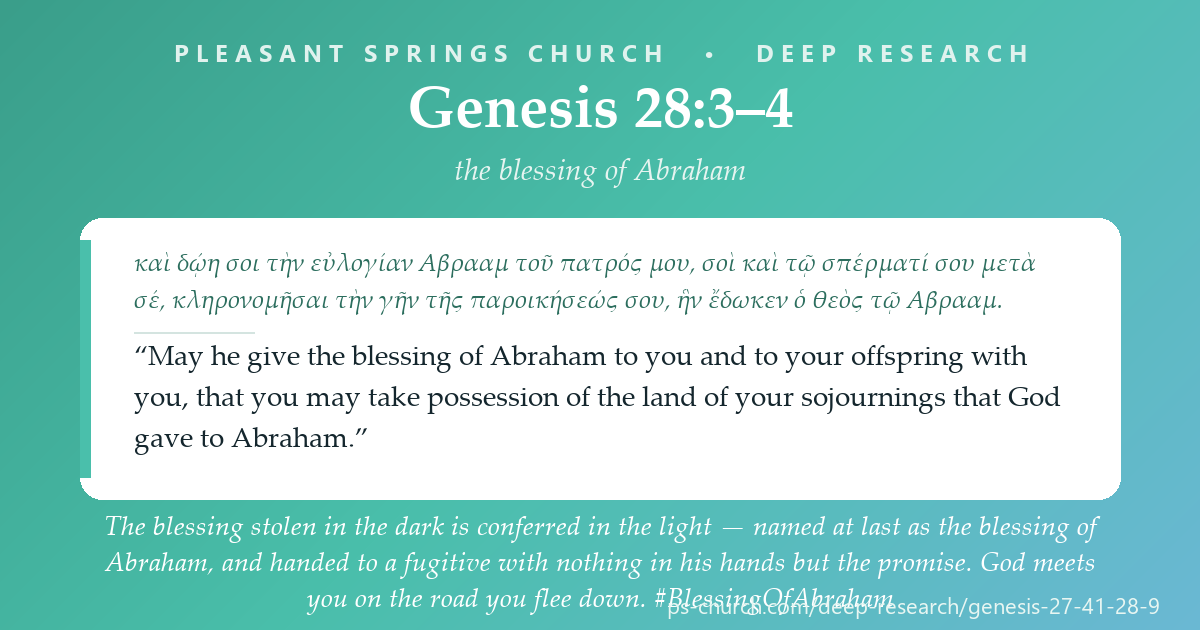
The blessing named. Yet 28:1–5 is the theological hinge, and Moses frames it deliberately. Isaac, no longer deceived and no longer resisting, calls Jacob, blesses him, and charges him — and this blessing is nothing like the trembling, groping benediction stolen in ch. 27. It is spoken in full daylight and in the covenant’s own words: “El Shaddai bless you… and give you the blessing of Abraham, to you and to your offspring… that you may take possession of the land… that God gave to Abraham” (28:3–4). The name El Shaddai (“God Almighty”) is the patriarchal covenant name from 17:1 — the God who makes barren lines fruitful. Isaac now consciously does what he had meant to do for Esau: he hands Jacob the Abrahamic promise, land and seed and multiplied nations. What Rebekah grasped by cunning, God ratifies by grace — the line was always to run through Jacob (25:23), and here the father’s own mouth, at last, agrees with God’s purpose.
Esau’s late gesture. Moses gives Esau a closing scene of genuine, misdirected pathos. Watching Jacob sent off with a charge not to marry a Canaanite, and seeing “that the Canaanite women did not please Isaac his father” (28:8), Esau goes and marries Mahalath, a daughter of Ishmael (28:9) — kin of Abraham, not a Canaanite. It is a son trying, too late and by his own lights, to win parents he has already grieved with his Hittite wives (26:34–35). The gesture is not mockery; it is the sad half-measure of a man who keeps reaching for a blessing whose terms he never grasped (cf. Heb 12:16–17). Ishmael and his line are never denigrated here — but marrying into the branch that was not the covenant branch only underscores how far outside the promise Esau’s instincts run.
Audience
Israel — the nation descended from this fugitive — read its own origin here with sober honesty. The chosen line is carried by a schemer fleeing for his life; its matriarch and patriarch are flawed; its founding blessing passes through a scene of deceit, hatred, and exile. And yet the promise holds. Israel learned that election is God’s free purpose (25:23; Rom 9:10–13), not a reward for merit — Jacob has earned nothing but Esau’s knife — and that the covenant survives the household’s worst, not because the household is good, but because God is faithful. The charge against Canaanite marriage (28:1; cf. Deut 7:3–4) taught later Israel that the line of promise cannot be dissolved into the gods of the land: whom you marry is whom you will worship.
The blessing carried into exile. For the church, this passage is the beginning of the Jacob-abroad cycle, and its shape is the gospel’s: the man who grasped now goes out empty-handed, carrying nothing but a promise — and God will meet him on the road he flees down (Bethel, 28:10–22). Providence turns even flight into pilgrimage. Here too is the sober word about sin and consequence: God’s purpose advanced through Jacob, but the deceit still cost Rebekah her son and split a family for twenty years — forgiven purposes do not erase real wreckage. And here is the “blessing of Abraham” named for the first time as an inheritance handed down — the very phrase Paul will seize: “that in Christ Jesus the blessing of Abraham might come to the Gentiles” (Gal 3:14). The promise conferred on a fleeing Jacob runs, at last, to us.
Orient on the Abrahamic blessing, El Shaddai, Paddan-aram / Haran, and Esau's marriages.
Search by topic: Abrahamic covenant / blessing, El Shaddai, Jacob, Esau, Haran / Paddan-aram, Ishmael, endogamy and marriage law, birthright and blessing.
Which articles are relevant?
- Anchor Bible Dictionary — “Jacob,” “Esau,” “Blessing,” “Shaddai,” “Haran,” “Paddan-aram,” “Ishmael,” “Nebaioth.”
- Dictionary of the OT: Pentateuch — “Blessing,” “Abrahamic Covenant,” “Election,” “Jacob and Esau,” “Marriage.”
- NIDOTTE / TDOT — satam (bear a grudge), chemah (wrath), barak (bless), Shaddai, qahal (assembly/company), yarash (take possession).
Bibliography surfaced:
- Gordon Wenham (WBC), Victor Hamilton (NICOT), Kenneth Mathews (NAC), Bruce Waltke, Nahum Sarna (JPS) on Genesis.
- Studies of the patriarchal blessing, of El Shaddai, and of endogamy in the ancestral narratives (Gen 24; 28; cf. Deut 7).
- Beale & Carson, Commentary on the NT Use of the OT (Galatians 3; Hebrews 11–12; Romans 9).
Blood-vengeance, the deathbed blessing, endogamy, and covenant election.
Read Esau’s vengeance, Isaac’s conferral, and the marriage charge against ancient kinship, inheritance, and vendetta custom — and against the Bible’s own theology of election.
Which parallels shed light on religion and worldview?
Blood-vengeance and the deferred kill. In the ancient clan world, a wronged brother’s vendetta was expected, even honorable; what is striking is Esau’s timing. He waits for “the days of mourning for my father” — not out of repentance but out of a son’s deference and, perhaps, a calculation that with Isaac gone there will be no one to restrain or disinherit him. Rebekah’s counter-move is the ordinary wisdom of feud culture: remove the target until the wronged man’s chemah (hot wrath) cools. What she cannot foresee is the price the narrator quietly totals — the “few days” that become twenty years, and a mother who dies before her son comes home.
The deathbed blessing as legal act. In the patriarchal world an oral blessing functioned like a binding testament: spoken, witnessed, irrevocable (hence the horror of ch. 27, and Isaac’s trembling in 27:33). But 28:1–4 is a second, deliberate act — not a blessing tricked out of a blind man but one conferred with full knowledge, using the covenant’s formal vocabulary: fruitfulness and multiplication (echoing 1:28; 17:6), “a company of peoples,” and above all “the blessing of Abraham… the land… that God gave to Abraham.” Isaac is no longer merely blessing a son; he is transmitting the Abrahamic covenant as trustee, naming Jacob the heir of 12:1–3 and 17:1–8. The stolen blessing and the covenant grant are now made to coincide — God’s purpose and the father’s will at last aligned.
Endogamy and the boundary of the promise. The charge “you must not take a wife from the Canaanite women” (28:1) is not ethnic pride but covenant self-preservation: Canaan’s households came with Canaan’s gods, and the line of promise could be dissolved by the marriage bed faster than by any sword (cf. 24:3; Deut 7:3–4; and Esau’s own Hittite wives, who “made life bitter for Isaac and Rebekah,” 26:35). Esau grasps the symptom but not the disease: seeing that Canaanite wives displease his father, he adds a wife from Ishmael’s line (28:9) — Abrahamic kin, yes, but precisely the branch God had not chosen (17:19–21; 21:12). It is the perennial religion of the near-miss: correcting the form while missing the substance.
- Genesis 24:3–4; 26:34–35; Deuteronomy 7:3–4 — endogamy in the covenant line: marriage as the guardrail of worship.
- Genesis 17:1–8, 19–21; 25:23 — El Shaddai and the covenant grant; the promise line drawn through Isaac, then Jacob, not Ishmael or Esau.
- Genesis 1:28; 17:6; 35:11; 48:3–4 — “be fruitful and multiply… a company of peoples”: the blessing formula Isaac hands down and God later renews to Jacob at Bethel.
Genesis refuses to sanitize the family through which it says salvation comes. By the end of chapter 27 every principal has sinned: Isaac, in willful favoritism, trying to bless Esau against the oracle he surely knew; Rebekah and Jacob, in calculated deceit; Esau, in a contempt for the birthright that now curdles into murder. And into that wreckage the narrator sets chapter 28:1–4 — not a reward, but a ratification. Isaac, undeceived, freely and formally confers on Jacob the blessing of Abraham. The point is not that the deceit worked; the point is that God’s elective purpose stood before the deceit, over it, and after it — announced already in the womb (25:23) and now confessed by the very father who fought it. This is election as Genesis teaches it: real, gracious, sovereign, and never a bare mechanism that cancels human responsibility. Esau’s contempt is genuinely his own and genuinely culpable; Jacob’s scheming is genuinely sin and genuinely costly; Rebekah’s manipulation genuinely severs her from her son. God does not need our sin, and He never blesses it — but neither is He defeated by it. He advances His promise through a flawed household precisely so that no one may say the blessing was earned. The line of grace runs, from first to last, on grace — which is why a fleeing deceiver, and not a robust man of the field, carries the covenant out the door and down the road to Bethel.
The vocabulary of the flight and the conferral: grudge, the reversed 'go,' El Shaddai, the named blessing.
Watch the nursed grudge (satam), Rebekah’s “a few days,” the reversed “go for yourself,” the covenant name El Shaddai, and “the blessing of Abraham” named at last.
“Esau hated” — satam: not a flash of temper but a settled, watching grudge that bides its time (cf. 49:23; 50:15; Ps 55:3). Esau nurses the wound and dates the revenge; the birthright once despised (25:34) has become an obsession.
“Flee for yourself” — a dark echo of Abram’s lekh-lekha, “go for yourself” (12:1). The founder went out in faith to a promise; the grandson flees in fear from a knife. The schemer becomes the fugitive — yet the same God waits down the road.
“God Almighty” — the patriarchal covenant name (17:1; 35:11; 48:3), the God who makes the barren fruitful. Not the Tetragrammaton; ordinary “God.” The LXX renders it simply ὁ δὲ θεός μου, “but my God,” not preserving “Almighty.”
“The blessing of Abraham” — named here for the first time as an inheritance handed down: land, seed, and multiplied nations (12:2–3; 17:4–8; 22:17–18). The stolen blessing is now knowingly conferred as the covenant promise — the phrase Paul lifts in Galatians 3:14.
“A company of peoples” — qahal, the assembly/congregation; the multiplied nations of the promise (LXX συναγωγὰς ἐθνῶν). One fleeing man carries the seed of a multitude out into exile.
“Mahalath,” daughter of Ishmael — Esau’s too-late gesture: an Abrahamic wife to please parents grieved by his Hittite marriages (26:34–35). Kin of Abraham, but of the branch God did not choose (17:19–21). Correcting the form; missing the promise.
How the rest of Scripture fills out the scene:
- Genesis 12:1–3; 17:1–8; 22:17–18 — the Abrahamic promise Isaac now hands to Jacob: land, seed, nations (see the call of Abram).
- Genesis 25:23; Romans 9:10–13; Malachi 1:2–3 — “the older shall serve the younger”: God’s sovereign purpose of election, concerning the nations and their service, held with Esau’s real and culpable contempt.
- Genesis 28:13–15; 35:9–12 — God meets the fugitive at Bethel and renews the very blessing (fruitfulness, land, “a company of nations”) his father here pronounced: providence turns flight into pilgrimage.
- Galatians 3:14, 29; Hebrews 11:20–21; 12:16–17 — the blessing of Abraham reaching the Gentiles in Christ; Isaac blessing “by faith”; Esau who sought the blessing “with tears” too late.
From a fleeing deceiver to the blessing of Abraham reaching the nations.
Trace the conferred blessing, the exile-and-return, and covenant election toward their New Testament fulfillment.
Which cross-references matter?
- Genesis 28:10–22 — the immediate sequel: on the very road of his flight, God stands above Jacob at Bethel and renews the blessing of Abraham to him directly — the fugitive’s stone becomes God’s house.
- Genesis 25:23; Romans 9:6–13 — the election of Jacob before either had done good or evil: God’s free purpose, standing over the household’s sin, never as a bare decree of individual reprobation but as His gracious choice of the line of promise.
- Hebrews 11:20 — “By faith Isaac invoked future blessings on Jacob and Esau”: 28:3–4 read as an act of faith in the promise, not merely a father’s wish.
- Hebrews 12:16–17 — Esau “unholy… who sold his birthright… afterward… he was rejected, for he found no chance to repent, though he sought it with tears”: the sober reading of Esau’s late reaching.
- Galatians 3:14, 29; Ephesians 1:3 — “that in Christ Jesus the blessing of Abraham might come to the Gentiles”; those in Christ are “Abraham’s offspring, heirs according to promise”: the blessing named here runs to the church.
There is a deep irony in the geography of Jacob’s life that begins right here. He has spent two chapters grasping — a heel-grabber from the womb, a birthright-buyer at the stew-pot, a blessing-thief at his father’s bed — and the sum of all his grasping is that he must now leave with nothing in his hands. No flocks, no servants, no bride-price, no land; only a charge, a warning, and a blessing spoken over his head as he goes out the door alone. The contrast with his grandfather is exact and surely intended: Abraham left Haran rich and went toward a promise; Jacob flees to Haran poor and runs from a threat. And yet the word spoken over each is the same word — ‘the blessing of Abraham.’ That is the gospel logic Genesis is quietly teaching: the promise is never secured by the strength of the one who carries it. Jacob will spend twenty years in Laban’s house learning, through being deceived himself, what his deceit cost others — and will limp home a different man with a new name. But the blessing that meets him at Bethel on the first night of his exile is pure gift, attached to nothing he has earned and everything God has promised. The believer who feels he is fleeing rather than marching, empty rather than equipped, poor rather than provisioned, is standing exactly where Jacob stood — on the road, under the promise, with God about to say, ‘Behold, I am with you… I will not leave you.’
The scholarship on Genesis 27:41-28:9.
The commentators on the flight narrative and the blessing; the studies of election, El Shaddai, and the Esau tradition.
Commentaries & studies:
- Gordon J. Wenham (WBC), Victor P. Hamilton (NICOT), Kenneth A. Mathews (NAC), Bruce K. Waltke, Nahum M. Sarna (JPS) on Genesis.
- Studies of the patriarchal blessing and of El Shaddai; treatments of the Jacob cycle and the “exile-and-return” structure (departure ch. 28 ↔ return ch. 32–33).
- G. K. Beale & D. A. Carson, eds., Commentary on the NT Use of the OT (Rom 9; Gal 3; Heb 11–12).
Interpretation notes worth keeping:
- The LXX of 28:3. Where the Hebrew reads El Shaddai (“God Almighty”), the Septuagint has simply ὁ δὲ θεός μου, “but my God” — a consistent Greek habit of not rendering Shaddai as a title. The MT drives the ESV; the divergence is a translation choice, not a different blessing.
- Mahalath / Basemath. Ishmael’s daughter is named Mahalath here (28:9) but Basemath in 36:3 — a well-known crux, likely a second name or a scribal harmonization with Esau’s Hittite wife Basemath (26:34). Not a contradiction of substance; the covenant point (an Ishmaelite, not Canaanite, wife) is unaffected.
- Two blessings, not one. Read 28:1–4 as distinct from ch. 27: the stolen benediction and the conscious covenant conferral. Isaac’s deliberate transmission of “the blessing of Abraham” is the narrative’s way of aligning the father’s will with God’s prior purpose (25:23), not of re-litigating the deceit.
- Election and responsibility. Romans 9:10–13 grounds the choice of Jacob in God’s purpose “before they had done anything” — yet the oracle (25:23) concerns nations and service, and Esau’s contempt (Heb 12:16) is real and culpable. Hold sovereign election and genuine human responsibility together, as the text does.
- Rebekah’s silent cost. The narrator never says Rebekah saw Jacob again, and she does not; her burial is noted only in passing (35:8 records her nurse; 49:31 her tomb). The “few days” of 27:44 is deliberate dramatic irony — the unspoken price of the deceit she engineered.
From a fugitive's flight to the blessing of Abraham carried into exile.
Name what you learned, why it matters, and one concrete response.
What should we carry away — and do?
- Forgiven purposes do not erase real costs. God’s promise advanced through the deceit, but the deceit still cost Rebekah her son and split a family for twenty years. Grace redeems consequences; it does not delete them.
- The blessing is named at last. What was grasped in the dark, Isaac now confers in the light as “the blessing of Abraham.” God’s elective purpose stood before the scheming and outlasts it — the line runs on grace, not on cunning.
- God meets you on the road you flee down. The schemer goes out empty-handed and afraid — and Bethel is waiting. Providence turns flight into pilgrimage; the promise is carried by the one who has nothing but the promise.
Step in response: name one consequence of a past sin — yours or another’s — that you have wanted to pretend away, and instead bring it honestly to God, asking not for amnesia but for redemption of what remains. Then take one road you feel you are “fleeing” down — a hard providence, an exile you did not choose — and ask where God may be about to meet you on it. Receive “the blessing of Abraham” not as something to seize but as something given in Christ (Gal 3:14): go out, if you must go, carrying nothing but the promise — it is enough.
Genesis 28:3–4 · to share
LXX + ESVEvery Deep Research page traces its passage across the whole sweep — the Old Testament, the Second-Temple world between the testaments (historical witnesses, not Scripture), and the New Testament. Follow the thread:
Pleasant Springs Church — Deep Research
Research method after Michael S. Heiser’s Bible Research Method (examine dictionaries → ancient literature → important words → textual connections → academic publications → share), with the Pleasant Springs “Author & Audience” foundation. Scripture set in the Hebrew, the Greek editions named on each page and the ESV (Old Testament), and the Greek New Testament and the ESV (New Testament), per the practice of Pleasant Springs Church. Genesis 27:41–28:9 research grounded in Wenham, Hamilton, Mathews, Waltke, and Sarna: Esau’s nursed grudge (satam, 27:41) and deferred vengeance; Rebekah’s “a few days” (27:44) as the unspoken cost of the deceit she engineered; the reversed berach-lekha (27:43) against Abram’s lekh-lekha (12:1); Isaac’s conscious conferral of “the blessing of Abraham” (28:3–4) — El Shaddai (17:1; MT drives the ESV, the LXX flattening to ὁ δὲ θεός μου), land, seed, and a “company of peoples” — ratifying by grace the line God had already chosen (25:23; Rom 9:10–13, election held with Esau’s real and culpable contempt, Heb 12:16–17); Esau’s well-meant but misdirected marriage to Ishmael’s daughter (28:9); and the blessing carried into exile toward Bethel (28:10–22) and, in Christ, to the nations (Gal 3:14) — the deception recorded, never sanctioned, per the house discipline.
Scripture quotations marked ESV are from the ESV® Bible (The Holy Bible, English Standard Version®), © 2001 by Crossway, a publishing ministry of Good News Publishers. ESV Text Edition: 2016. Used by permission. All rights reserved. The ESV text may not be quoted in any publication made available to the public by a Creative Commons license, and the ESV may not be translated in whole or in part into any other language. www.esv.org
|
Did this study bless you today? 💚 Give to Support PS Church100% of gifts go to the General Fund — thank you. |