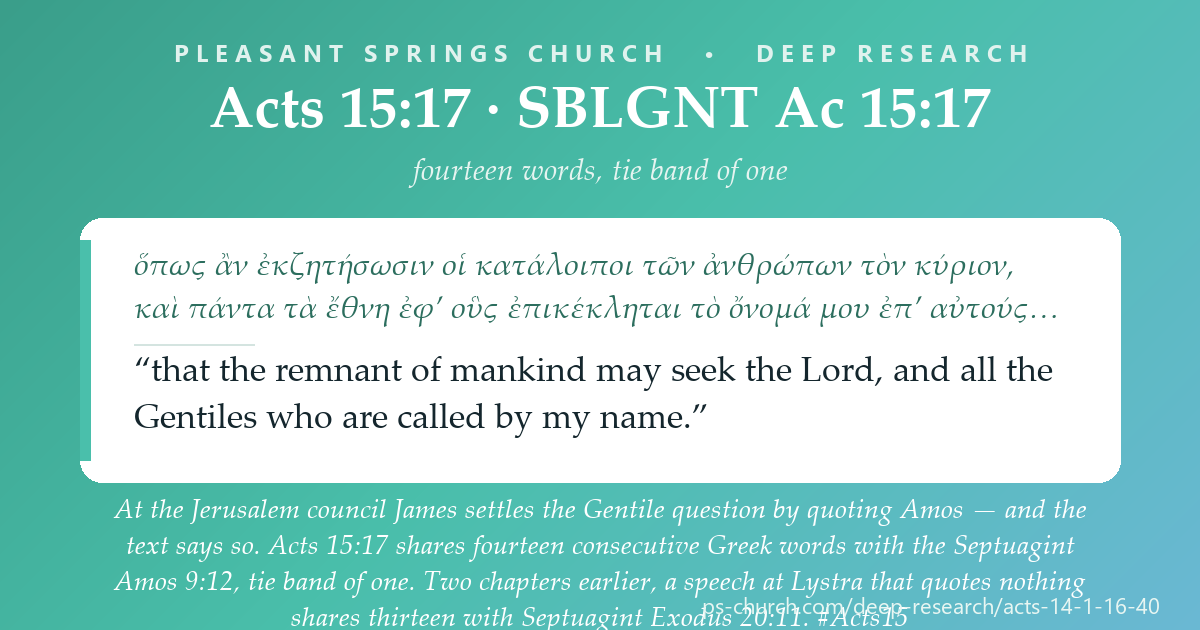
At Jerusalem, James settles the Gentile question by quoting Amos, and the text says so: as it is written. Screened word for word, Acts 15:17 shares fourteen consecutive words with the Septuagint Amos 9:12, with a tie band of one — the deepest run anywhere in these three chapters, against either corpus. One chapter earlier, in Lycaonia, Paul shouts at a crowd about to sacrifice oxen to him. He quotes nothing, names no book, and uses no formula. That sentence shares thirteen consecutive words with the Septuagint Exodus 20:11, also with a tie band of one — and the same thirteen words stand, unaltered, in the church’s prayer at Acts 4:24. Meanwhile the deepest contact any verse of Acts 14–16 makes with any other verse of the New Testament, once those thirteen are set aside, is seven. The marked citation wins by one word. The unmarked speech is a word behind it. And the Greek Amos the ruling depends on says something the Hebrew Amos does not. The measurement says agreement. It does not say who read whom, and neither does this page. See the method →
Acts 14:1–16:40 (selections)
Greek New Testament (SBLGNT, via MorphGNT) · ESV★ The deepest run in these 108 verses is not against the New Testament at all. Acts 15:17 shares fourteen consecutive words with Septuagint Amos 9:12, tie band one — the citation the text itself flags. Acts 14:15 shares thirteen with Septuagint Exodus 20:11, tie band one — a speech to pagans that flags nothing, and the same thirteen words stand in Acts 4:24. Stage 4 gives the measurement, the tie bands, and the counter-examples.
The Shape of the Passage
Out, back, and out again — a sequence with one hingeActs names neither its author nor its date. It names its reader once, in a single vocative at 1:1, and then the narrator disappears until 16:10. Everything else is inference, and this page keeps the inference separate from the count.
Author
The book is anonymous, and its one self-reference is grammatical. Acts 1:1 addresses Θεόφιλε and refers back to a first volume; the name Luke appears nowhere in either book. What can be counted is the narrator’s grammar. Across Acts 1–15 there are 37 first-person-plural finite verbs, and all 37 stand inside quoted speech — the Pentecost crowd, Peter before the council, the suborned witnesses, Cornelius, Paul at Pisidian Antioch, Peter and James at Jerusalem. At 16:10 the first person plural moves into the narration and stays there for eight verses.
What that does and does not establish. It establishes that the text changes person at a fixed point, which is a fact about the Greek. It does not establish who the we is, whether the shift marks a source, a travel diary, an eyewitness, or a literary convention of sea voyages. Those are the arguments; this is the datum they have to fit. The page reports the datum and takes no side.
One more count, offered without a conclusion. διανοίγω occurs eight times in the Greek New Testament and seven are in Luke and Acts. ὕψιστος occurs thirteen times and nine are in Luke and Acts. A shared vocabulary is evidence of a shared hand or a shared source or a shared idiom, and the counting cannot tell you which.
Audience
The passage has three audiences inside it, and they do not overlap. At Iconium the address is to a synagogue of Jews and Greeks (14:1). At Lystra it is to a crowd with oxen and garlands who speak Lycaonian and think Barnabas is Zeus — one of only two speeches in Acts to people with no Scripture at all — the other is the Areopagus speech of 17:22–31. This one argues from rain. At Jerusalem it is to apostles and elders, and the argument is a written text.
The letter of 15:23 names its readers exactly. The brothers τοῖς ἐξ ἐθνῶν in Antioch, Syria and Cilicia — a region, not a congregation. ἔθνος occurs 43 times in Acts and 11 of them are in these three chapters.
And at Philippi there is no Jewish audience to start from. No synagogue in the chapter; a riverside place of prayer; a God-fearing woman from Thyatira in the purple trade; a slave girl owned by a syndicate; a jailer. The four people Acts 16 brings forward are a businesswoman, a slave girl her owners hired out, a prison officer and his household. Acts has the woman baptised with her household, the officer believing and baptised with his; of the slave girl it says only that the spirit came out — and the chapter ends with two Roman citizens refusing to be released quietly.
Orient on the first journey, on the council, on the Roman colony at Philippi, and on the “we” question — before touching a single number.
Search by topic: Acts of the Apostles; Apostolic Council; Apostolic Decree; Galatia (North and South); Lystra; Lycaonia; Philippi; colonia; God-fearers; we-sections; Theodotion; Amos, Book of.
Which articles are relevant?
- Anchor Bible Dictionary — “Acts of the Apostles,” “Apostolic Council,” “Apostolic Decree,” “Philippi,” “Lystra,” “God-fearers.”
- Dictionary of New Testament Background (IVP) — “Roman Colonies,” “Roman Law and Legal System,” “Divination and Magic,” “Citizenship, Roman.”
- New International Dictionary of NT Theology & Exegesis — περιτέμνω, δόγμα, πνικτός, ὕψιστος, διανοίγω.
- Commentary on the New Testament Use of the Old Testament, ed. G. K. Beale and D. A. Carson (Baker, 2007) — the Acts chapter, which is where the Amos 9 quotation is discussed at length, and where the Jeremiah 12:15 proposal for 15:16a is defended.
- These were not consulted for the measurements below. The measurements were run on the text files named in the footer.
Settle the numbering first — and note what is different about a New Testament page
Every page on this shelf states its versification offset, including the pages where the answer is that there is none. On a New Testament book the answer is stronger than that: there is no second ancient column for the numbers to be offset from. There is no Hebrew Acts and no Septuagint Acts. The two scripture columns here are the Greek New Testament and the ESV, and every chapter-and-verse number on this page means the same verse in both.
But the count is still not identical, and one of the differences is inside this study.
| Acts | ch 14 | ch 15 | ch 16 | whole book |
|---|---|---|---|---|
| SBLGNT (MorphGNT), counted off disk | 28 | 40 | 40 | 1,002 |
| Public-domain English edition, counted off disk (a numbering source consulted here, not a column printed on this page) | 28 | 40 | 40 | 1,003 |
| Traditional (King James) numbering | 28 | 41 | 40 | 1,007 |
Four verse numbers are absent from the SBLGNT text of Acts altogether — 8:37, 15:34, 24:7 and 28:29. That was not read off a list; it was found by walking the MorphGNT file and asking which numbers never appear. 15:34 is in this passage. In the traditional numbering it reads “Notwithstanding it pleased Silas to abide there still,” and it sits between the delegates being sent back and Paul and Barnabas remaining in Antioch. The ESV prints it in a footnote and not in the text. The fifth difference is not an omission but a division: SBLGNT Acts 19 ends at verse 40 where the English prints 19:41, which is why the book totals differ by more than four.
⚠️ What this page did not check. No manuscript, apparatus or edition was consulted on why any of those four is absent. The claim here is only that the printed SBLGNT does not carry them and the traditional English numbering does. Whether a verse is ‘original’ is a question about manuscripts, and no manuscript was examined for this page.
A Lycaonian legend, a Roman colony, a Delphic snake, and two Greek Daniels — three of which this page could not measure and one of which it could.
Zeus and Hermes at Lystra — what is measured and what is borrowed
Measured: Ζεύς occurs twice in the whole Greek New Testament, at Acts 14:12 and 14:13, and nowhere else. Ἑρμῆς occurs twice: here as a god, and at Romans 16:14 as a man Paul greets. Λυκαονιστί occurs once. στέμματα — the garlands the priest brings — occurs once.
Borrowed, and flagged as borrowed: The standard reference works connect this scene to Ovid’s story of Baucis and Philemon (Metamorphoses VIII.611–724), in which Jupiter and Mercury walk Phrygia in human form, are turned away by everyone but one old couple, and drown the district. Ovid is not on this disk. That connection is reported from the literature, not measured here, and a reader should treat it as a commonplace worth checking rather than a result of this page.
What the Greek does show without any help is the order of the names: the crowd calls Barnabas Zeus and Paul Hermes, and the text explains the second assignment and not the first — ἐπειδὴ αὐτὸς ἦν ὁ ἡγούμενος τοῦ λόγου, because he was the chief speaker. Nothing is said about why Barnabas looked like Zeus.
A spirit of Python, and a colony that is not a city
Measured: The phrase πνεῦμα πύθωνα occurs once in the Greek New Testament and not once in the 30,637 verse units of Greek Old Testament held here. μαντεύομαι, the verb for what she does for money, also occurs once. κολωνία (16:12) occurs once. ῥαβδοῦχος occurs twice, both in this chapter (16:35, 16:38). στρατηγός occurs ten times in the New Testament; five of the ten are Philippi’s magistrates in this chapter.
Borrowed, and flagged as borrowed: That Πύθων was the serpent Apollo killed at Delphi and that the word came to be used of ventriloquist diviners; that a colonia was a settlement of Roman citizens governed under Italian law with duoviri at its head and lictors carrying rods; that Philippi was settled with veterans after Actium — all of that is from the reference works and from Roman historians not held on this disk. The page reports it as background and measures none of it.
What the background does explain, if it is right: why the charge at 16:21 is about customs unlawful for us Romans rather than about theology, and why the magistrates panic at 16:38 rather than at 16:23. The text supplies the panic; the historians supply the reason.
Two Greek Daniels, and only one of them matches the girl’s words
This one the page could measure, and the result is the most surprising thing in Stage 2.
The slave girl at Philippi shouts δοῦλοι τοῦ θεοῦ τοῦ ὑψίστου. The CATSS corpus holds two Greek Daniels — the Old Greek and Theodotion — and they are different books at exactly this verse.
| text | Daniel 3:93 (English 3:26) | run with Acts 16:17 |
|---|---|---|
| Theodotion | …οἱ δοῦλοι τοῦ θεοῦ τοῦ ὑψίστου, ἐξέλθετε | 5, tie band 1 |
| Old Greek | …οἱ παῖδες τοῦ θεοῦ τῶν θεῶν τοῦ ὑψίστου, ἐξέλθετε | 2 |
Searched across all 30,637 verse units held here, the exact sequence δοῦλοι τοῦ θεοῦ τοῦ ὑψίστου occurs in one verse: Theodotion Daniel 3:93. Nebuchadnezzar calls three men out of a furnace with the words a Philippian slave girl uses about Paul and Silas — and eight verses later Paul and Silas are in a prison whose doors come open in an earthquake.
⚠️ What that is not. It is not evidence that Acts is quoting Daniel. There is no citation formula, the run is five words long, and the phrase is an ordinary way of naming the God of Israel on Gentile lips. What it does show is that a run can be edition-dependent: the same verse in the same book scores 5 in one Greek column and 2 in the other, and a page that named only “the Septuagint” would have hidden that.
Six words that carry these chapters, and how rare each one actually is.
Three occurrences in the whole Greek New Testament — 14:22, 15:32, 15:41 — and all three are inside this study. One before the council and two after it. At 16:5 the motif closes in a different verb, ἐστερεοῦντο, of churches being made solid. The compound is ἐπί on top of στηρίζω: not founding, but bracing something already standing.
Two occurrences in the Greek New Testament and both are in Acts — 1:24, where the eleven pray before casting lots for Judas’ place, and 15:8, where Peter says God who knows the heart bore witness to the Gentiles by giving them the Spirit. Zero occurrences in the Greek Old Testament held here. Both times the word appears, the church is about to decide something it cannot decide by argument.
Eight occurrences in the Greek New Testament; seven of them in Luke and Acts (Luke 2:23; 24:31, 32, 45; Acts 7:56; 16:14; 17:3), the eighth at Mark 7:34. It opens the womb, the eyes at Emmaus, the Scriptures on the road, the minds of the disciples, the heavens over Stephen — and Lydia’s heart. In 16:14 the subject of the verb is not Paul. It is ὁ κύριος.
Five occurrences in the Greek New Testament: Luke 2:1 (Caesar’s census decree), Acts 16:4 (the council’s), Acts 17:7 (the decrees of Caesar), Ephesians 2:15 and Colossians 2:14 (the commandments in ordinances, abolished). The same noun is used of an imperial edict, of the ruling that freed Gentiles from the law, and of the law that was nailed to the cross. The word does not tell you which; the contexts do.
Three occurrences in the Greek New Testament and all three are the decree — Acts 15:20, 15:29, 21:25. Zero occurrences in the Greek Old Testament held here, which is worth stating precisely: the term the decree uses for the third prohibition is not a Septuagint term. The prohibition on blood is (Genesis 9:4; Leviticus 17 — and Greek Leviticus is now on this disk); the adjective πνικτός is not.
Thirteen occurrences in the Greek New Testament; nine of them in Luke and Acts. The exact phrase θεοῦ τοῦ ὑψίστου occurs four times: Mark 5:7 and Luke 8:28, both from a man with a legion; Acts 16:17, from a girl with a python spirit; and Hebrews 7:1, of Melchizedek, quoting Genesis 14. Three of the four times the New Testament calls God Most High in those exact words, the speaker is unclean — twice a demoniac, and once a slave girl the text says had a python spirit.
One thread the counting makes visible: the question is always “can this person be saved?”
σῴζω occurs thirteen times in Acts. Five of the thirteen are in these three chapters, and they are the spine of the narrative.
| verse | who | the words |
|---|---|---|
| 14:9 | a man lame from birth at Lystra | Paul saw that he had faith τοῦ σωθῆναι |
| 15:1 | men from Judea, about Gentiles | unless you are circumcised οὐ δύνασθε σωθῆναι |
| 15:11 | Peter, about everybody | through the grace of the Lord Jesus πιστεύομεν σωθῆναι |
| 16:30 | the jailer | τί με δεῖ ποιεῖν ἵνα σωθῶ; |
| 16:31 | Paul and Silas | believe on the Lord Jesus καὶ σωθήσῃ |
The passage opens with a man who has faith to be saved and closes with a man who asks how, and in between a council decides that the answer does not include circumcision. That is a reading. What is measured is the five occurrences and where they fall.
Every run on this page, with its tie band, its scope, and its counter-example.
The method. Greek against Greek. Both sides are lowercased, accents and breathings dropped, final sigma folded, then filtered to Greek letters — the same filter on both corpora. A run is the longest sequence of consecutive whole word forms, never lemmas, that two verses share. The tie band is how many target verses reach the same maximum. A run of 14 with a band of 1 is a signal; a run of 5 with a band of 4 is a formula. Nothing is sampled, so no seed applies.
The whole result, in one table
| row | deepest match | run | tie band | flagged as a citation? |
|---|---|---|---|---|
| Acts 15:17 | Septuagint Amos 9:12 | 14 | 1 | yes — καθὼς γέγραπται, 15:15 |
| Acts 14:15 | Septuagint Exodus 20:11 and Acts 4:24 | 13 | 1 in each corpus | no — no formula, no book named |
| Acts 15:26 | 1 Corinthians 1:10 | 7 | 1 | no — a stock phrase |
| Acts 15:16 | Septuagint Amos 9:11 | 6 | 1 | yes, same citation |
| Acts 14:22 | Mark 9:47 / John 3:5 | 6 | 2 | no |
| Acts 16:17 | Theodotion Daniel 3:93 | 5 | 1 | no |
| Acts 16:31 | Deuteronomy 14:26 and three others | 5 | 4 | no |
Scope. The 108 verse units of SBLGNT Acts 14–16, run against (a) the other 7,819 verses of the Greek New Testament and (b) 30,637 verse units across 64 CATSS Greek files. Exhaustive and deterministic.
Caveat. This finds verbatim contact. It does not find allusion. A passage can be steeped in a book it shares no five words with, and a run of six can be an accident of common vocabulary.
The run of fourteen — and the Hebrew that would not have carried the argument
Acts 15:17 and Septuagint Amos 9:12 share fourteen consecutive words: καὶ πάντα τὰ ἔθνη ἐφ’ οὓς ἐπικέκληται τὸ ὄνομά μου ἐπ’ αὐτούς, λέγει κύριος. Tie band 1. The next-deepest verse in the entire Greek Old Testament held here reaches 5.
The argument James makes is that God has taken a people from the Gentiles, and the proof is that Amos says the nations will seek. That is what the Greek says. It is not what the Hebrew says.
| column | Amos 9:12, opening clause | what it means |
|---|---|---|
| Masoretic | לְמַעַן יִירְשׁוּ אֶת־שְׁאֵרִית אֱדוֹם | that they may possess the remnant of Edom |
| CATSS Greek | ὅπως ἐκζητήσωσιν οἱ κατάλοιποι τῶν ἀνθρώπων | that the remnant of mankind may seek |
| Acts 15:17 | ὅπως ἂν ἐκζητήσωσιν οἱ κατάλοιποι τῶν ἀνθρώπων τὸν κύριον | the Greek clause, plus an explicit the Lord as object |
Two differences are in play at once, and both are consonantal: Edom and mankind differ by one letter in unpointed Hebrew, and possess and seek differ by one. The page reports both columns and does not say which is prior, which is a misreading, or which is ‘the original’. That is not what a word-run measures, and this shelf does not assert direction of influence. The Amos 9:11–12 page works the same divergence from the Amos side.
What is measured, exactly. That Acts 15:17 agrees with the CATSS Greek Amos for fourteen consecutive words, that no other verse in 30,637 reaches that depth with it, and that the Masoretic Amos at that point has a different noun and a different verb. Not measured: which Greek Amos Luke or James had, whether it read exactly as Rahlfs prints it, or whether any of this happened as narrated.
The run of thirteen — and why it is the more interesting of the two
Acts 14:15 ends ὃς ἐποίησεν τὸν οὐρανὸν καὶ τὴν γῆν καὶ τὴν θάλασσαν καὶ πάντα τὰ ἐν αὐτοῖς. From the heaven to in them is thirteen words, and they stand verbatim in Septuagint Exodus 20:11 and in Acts 4:24. Tie band 1 against the Greek Old Testament; tie band 1 against the New Testament.
| text | run with Acts 14:15 | note |
|---|---|---|
| Septuagint Exodus 20:11 | 13 | the sabbath commandment’s ground |
| Acts 4:24 | 13 | the church at prayer after the first arrest |
| Septuagint Haggai 2:6 / 2:21 | 9 | the shaking of heaven, earth, sea and dry land |
| Septuagint Psalm 145:6 | 7 | drops out one καί before the sea, and the run breaks there |
| Revelation 14:7 | 6 | the angel with the eternal gospel |
| Acts 17:24 | 4 | the counter-example — the Areopagus speech, the closest thing in Acts to this one, and it does not repeat the formula |
Why it matters more than the run of fourteen. The fourteen is expected: the text says it is a quotation. The thirteen is not flagged at all. A missionary speaking to farmers who have never read anything reaches for a sentence out of the Greek Decalogue and does not tell them so — and the same sentence is what the church prayed at Acts 4:24 with nobody outside the room. The formula was evidently how these people talked about God, not a proof-text they deployed.
⚠️ And here is the counter-example printed in full, so the runs above are not read as more than they are. Acts 17:24, the Athens speech, is the nearest parallel in the book to the Lystra speech — same subject, same audience, same argument — and it reaches 4 with Acts 14:15 and 4 with Acts 4:24. Two speeches on the identical theme by the identical speaker share four words. If a run of thirteen proved dependence, a run of four would have to prove independence, and neither conclusion follows from counting.
Three claims this page checked and could not confirm
1. Acts 15:16a from Jeremiah 12:15. The proposal that Μετὰ ταῦτα ἀναστρέψω is drawn from Greek Jeremiah 12:15 (καὶ ἔσται μετὰ τὸ ἐκβαλεῖν με αὐτοὺς ἐπιστρέψω) is standard in the commentaries. Measured against the CATSS Jeremiah held here, the run is 1. The idea is similar; the words are not. This page can measure words, so it records the claim and marks it unconfirmed rather than repeating it as a finding.
2. Acts 15:18 from Isaiah 45:21. Same result: γνωστὰ ἀπ’ αἰῶνος against Greek Isaiah 45:21 measures 1. The verse is three words long in the SBLGNT and there is very little there to match with.
3. The decree’s four items as the Leviticus 17–18 ‘alien in your midst’ laws. This is the most influential reading of the decree, and it is an argument about topics in sequence, not about shared wording. πνικτός does not occur in the Greek Old Testament held here at all, so the third item cannot be matched to a Levitical phrase even in principle. A word-run screen is the wrong instrument for that argument, and reporting a zero here would be misleading rather than informative. The page names the reading and declines to score it.
Two more agreements, reported with their bands
Acts 15:23 and Acts 15:6 share five words (οἱ ἀπόστολοι καὶ οἱ πρεσβύτεροι), tie band 1 — the phrase that names the deciding body twice in one chapter.
Acts 16:29 and Acts 17:4 share five words (τῷ Παύλῳ καὶ τῷ Σιλᾷ), tie band 1 — which is a run about two proper names travelling together and nothing else. It is printed here because it is the kind of run that looks impressive in isolation and means very little.
Zero on this page means “shares no word at all”. Every Greek-side screen here uses the unigram fallback: a row that shares no two-word sequence still scores 1 if any single word matches. So the run of 1 reported for Acts 15:16 against Jeremiah 12:15 means they share one word and no pair, not that they share nothing.
Where this page is weakest, what it could not reach, and what would break it.
The largest hole: one printed edition on each side, and no apparatus
Every number on this page is an agreement between two printed texts. The New Testament figures come from the SBL Greek New Testament as digitised by MorphGNT; the Greek Old Testament figures from Rahlfs’ Septuaginta as digitised by CATSS. Neither has a critical apparatus on this disk, and no manuscript was examined.
That bears on this passage harder than on most. The Western text of Acts — Codex Bezae and its allies — is famously longer and differs at several points in exactly these chapters, including the form of the decree at 15:20 and 15:29, where some witnesses drop what is strangled and add a negative golden rule. None of that was consulted. The run of 14 at Acts 15:17 is a fact about the SBLGNT and Rahlfs, and a different edition on either side could shorten or lengthen it. Acts 16:12 is a textual crux in its own right — whether Philippi is called a leading city of the district or a city of the first district depends on a conjecture, and the page quotes the SBLGNT and takes no view.
What the “we” count does and does not license
The count is solid; the inference is not the count. The 37 first-person-plural finite verbs in Acts 1–15 were pulled from the MorphGNT parsing column (person field 1, number field P, mood field I / S / D / O), and each was then read in context to check whether it stands inside quoted speech. All 37 do. That last step was done by reading, not by a program, because “inside quoted speech” is not a field in the file, and a reader who disagrees about any one of them should say so.
And the interpretation is wide open. Whether the we-sections mark an eyewitness, a source document, a sea-voyage convention, or an authorial device is an argument this page contributes nothing to except the location of the seam. 16:10 to 16:17, then silence until 20:5. Anyone who wants to argue from that has to account for why it stops when Paul and Silas are arrested and resumes years later at the same city.
What could not be checked at all
No Greek critical apparatus. No papyri — P45, P74 and P127 all carry parts of Acts and none was consulted. No Codex Bezae. No patristic citations. No Latin, Syriac or Coptic versions. No inscriptions from Pisidian Antioch or Philippi, no Roman legal sources, no Ovid, no Strabo, no papyrus letters for the χαίρειν / ἔρρωσθε frame. No commentary on Acts was read for any figure on this page.
And the historical questions stay open, because the measurement is silent on them. Whether Acts 15 and Galatians 2 describe the same meeting; whether the letter to Galatia was written before or after the council; whether the decree was a theological compromise or a table-fellowship rule; whether Paul knew of it when he wrote 1 Corinthians 8–10. Counting shared word-runs cannot decide any of that, and this page does not pretend otherwise.
The place this page is thinnest. It leans on two rows. Acts 15:17 and Acts 14:15 carry the whole thesis, and they are two verses out of 108. They were not cherry-picked — they are the top two of an exhaustive screen of every verse in the passage against both corpora — but a pattern established by the top two results of one screen is a pattern of two, and the page says so instead of calling it a rule.
One claim that is easy to overstate, and is deliberately not made. It is tempting to write that Acts 14:15 shows “the apostles thought in Septuagint.” The page will not, because Acts 17:24 — the same speaker, the same argument, a Gentile audience again — shares four words with it and not thirteen. One deep run and one shallow one, from the same mouth on the same subject, is not a habit. It is two data points.
Reading list
- C. K. Barrett, A Critical and Exegetical Commentary on the Acts of the Apostles (ICC, 2 vols., 1994–1998).
- Joseph A. Fitzmyer, The Acts of the Apostles (Anchor Bible 31, 1998).
- Craig S. Keener, Acts: An Exegetical Commentary (4 vols., 2012–2015) — the standard collection of the Greco-Roman background this page had to borrow.
- Richard Bauckham, “James and the Jerusalem Church,” in The Book of Acts in Its Palestinian Setting (1995) — the classic treatment of the Amos citation.
- W. Edward Glenny, Finding Meaning in the Text: Translation Technique and Theology in the Septuagint of Amos (2009) — on the Greek Amos 9:12 specifically.
- None of these were consulted for the measurements on this page, which were run on the text files named in the footer.
A door opened, a door argued about, and a door that came off its hinges at midnight.
Fourteen words and thirteen
Three chapters. A man healed at Lystra and a man stoned at Lystra, in the same paragraph. A council that decides the largest question the church would ever face and writes it down in a letter that opens greetings and closes farewell, like every other letter in the Greek world. Then two men in a Roman colony, singing at midnight with their feet in the stocks.
And underneath it, a measurement. The one sentence in these chapters that the text explicitly calls Scripture agrees with the Greek Amos for fourteen consecutive words. The one sentence addressed to people who had never heard of Amos, spoken at the top of Paul’s voice to stop a sacrifice, agrees with the Greek Exodus for thirteen — and with a prayer the church had already prayed, in Jerusalem, before any of this started.
What the page will not do is tell you what that proves. It does not say Paul was quoting Exodus, because he does not say so and a run is not a claim about intent. It does not say the Greek Amos is right and the Hebrew Amos is wrong, or the reverse; it prints both and names the two letters that differ. It does not say the shift to we at 16:10 means an eyewitness. It says where the words are the same and how unusual that is, and then it stops.
The chapter that begins with a decree about what Gentiles need not do ends with a jailer washing the wounds he was ordered to guard, and setting a table in his own house at three in the morning. The council’s document is being carried through Asia Minor in the same satchel as the men who are living the answer to it.
Every Deep Research page traces its passage across the whole sweep — the Old Testament, the Second-Temple world between the testaments (historical witnesses, not Scripture), and the New Testament. Follow the thread:
Pleasant Springs Church — Deep Research
Research method after Michael S. Heiser’s Bible Research Method (examine dictionaries → ancient literature → important words → textual connections → academic publications → share), with the Pleasant Springs “Author & Audience” foundation. Scripture set in the Hebrew, the Greek editions named on each page and the ESV (Old Testament), and the Greek New Testament and the ESV (New Testament), per the practice of Pleasant Springs Church. Acts research grounded in Barrett (ICC), Fitzmyer (Anchor), Keener, Bauckham and Glenny — none of which were consulted for any number on this page. Text: Greek New Testament from the SBL edition as digitized by MorphGNT; Greek Old Testament from Rahlfs’ Septuaginta as digitized by CATSS; Hebrew from the Masoretic text as printed in Sefaria’s Miqra according to the Masorah. No critical apparatus was consulted on any side, and for Acts that omission is larger than usual, because the Western text of Acts differs from the SBLGNT at several points inside these three chapters. ⚠️ VERSE NUMBERING — Acts is a New Testament book, so there is no Masoretic or Septuagint column and no offset to state. Counted anyway, off disk: SBLGNT Acts 1,002 verse units, and 1,003 in the public-domain English edition kept here as a numbering source and printed nowhere on this page; the traditional King James numbering of 1,007 is from the printed English and not off this disk. Four numbers are absent from the SBLGNT — 8:37, 15:34, 24:7, 28:29 — and 15:34 falls inside this study. One further difference is a division and not an omission: SBLGNT Acts 19 ends at verse 40 where the English prints 19:41. The ESV is not held on this disk as a file; its shape is reported from the printed edition, which puts 15:34 in a footnote. Stated because this shelf states it everywhere, including where there is nothing to convert. ⚠️ The measurement, in full. Greek against Greek. MorphGNT field 6, the normalised word (the column that already resolves elision and the movable nu); CATSS FORM column (cols 0–24), beta-code transliterated first. Both sides lowercased, accents and breathings dropped, final sigma folded, then filtered to Greek letters — the same filter applied to both corpora. Contiguous runs of whole word FORMS, never lemmas. Corpus: the 108 MorphGNT verse units of Acts 14–16 against the other 7,819 verses of the Greek New Testament, and against 30,637 verse units across 64 CATSS files. Exhaustive and deterministic; nothing sampled, so no seed applies. The tie band — how many target verses reach the same maximum — is printed beside every run on this page. Greek-side screens here use the unigram fallback, so a reported run of 1 means “one word shared and no pair”, not “nothing shared”. ⚠️ What was NOT measurable. No papyri, no apparatus, no Codex Bezae, no versions, no patristic citations, no Roman legal or epigraphic sources, no Ovid. The Greco-Roman background in Stage 2 — Baucis and Philemon, the Delphic Python, the colony’s duoviri and lictors — is reported from reference works and measured nowhere. The Leviticus 17–18 reading of the apostolic decree is an argument about topics in sequence and a word-run screen is the wrong instrument for it; the page names it and declines to score it. ⚠️ The ‘we’ count. MorphGNT parsing column, person field = 1 and number field = P, finite moods only, across the whole Acts file: 37 such verbs in chapters 1–15. Whether each stands inside quoted speech was then determined by reading, not by a program, because the file carries no field for it. ⚠️ Direction of influence is never asserted. Nothing here says Luke is quoting Exodus at 14:15, that Acts is quoting Theodotion at 16:17, that the Greek Amos is a misreading of the Hebrew or the Hebrew a correction of the Greek. The page reports where the words are identical, how many other verses reach the same depth, and stops. Typology is handled per the house position: what the text says, what the New Testament itself draws, and what we see from this side of the cross — with the seeing left to the reader.
Scripture quotations marked ESV are from the ESV® Bible (The Holy Bible, English Standard Version®), © 2001 by Crossway, a publishing ministry of Good News Publishers. ESV Text Edition: 2016. Used by permission. All rights reserved. The ESV text may not be quoted in any publication made available to the public by a Creative Commons license, and the ESV may not be translated in whole or in part into any other language. www.esv.org
|
Did this study bless you today? 💚 Give to Support PS Church100% of gifts go to the General Fund — thank you. |