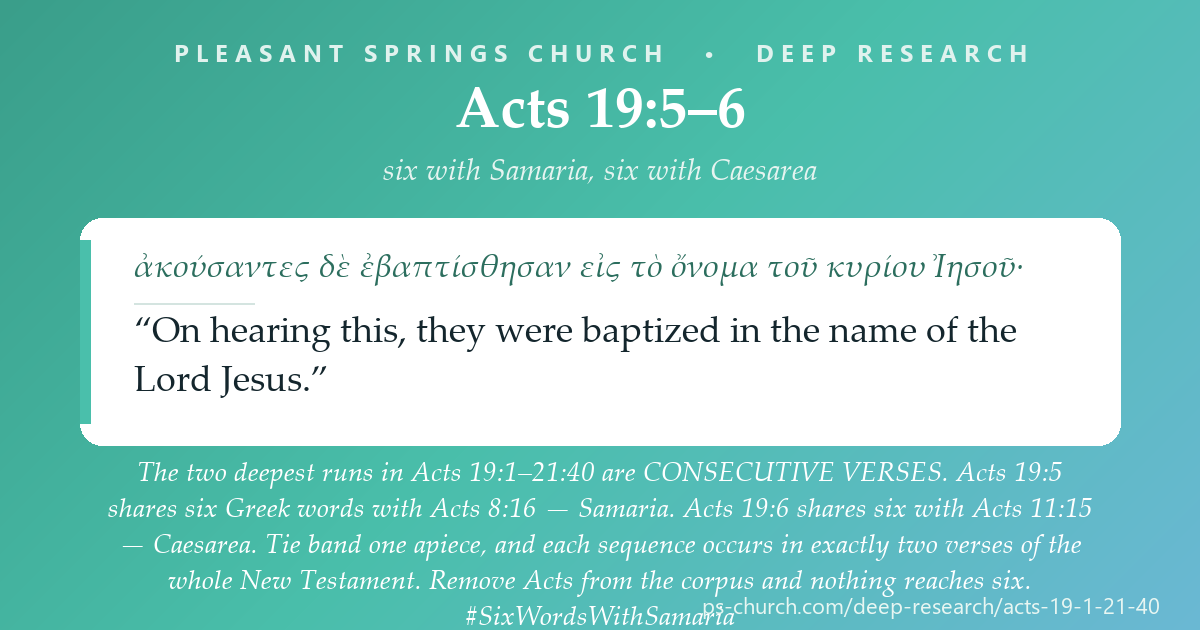
Acts 19:1–21:40 was screened word for word against all 7,927 verses of the Greek New Testament. The two deepest runs in these 118 verses are consecutive verses. Acts 19:5 agrees with Acts 8:16 for six words; Acts 19:6 agrees with Acts 11:15 for six words; both at a tie band of one. Acts 8:16 is Samaria. Acts 11:15 is Caesarea. Each of those six-word sequences occurs in exactly two verses of the entire Greek New Testament, and both times the other verse is the one named here. Then take Acts out of the target corpus and run it again: nothing in the passage reaches six against the other twenty-six books, and only three rows reach five. On the Old Testament side the deepest contact is a surprise of a different kind — a pagan silversmith complaining that Paul says “gods made with hands are not gods” shares five consecutive words with the Epistle of Jeremiah, a 72-verse tract whose whole argument is that idols are not gods. The measurement establishes agreement. It does not establish who read whom, and neither does this page. Five of its own counter-examples are printed in the codex above, on the verses that produce them. See the method →
Acts 19:1–21:40 (selections)
Greek New Testament (SBLGNT, via MorphGNT) · ESV★ The finding the page is built on. Screened word for word against all 7,927 verses of the Greek New Testament, the two deepest runs in these 118 verses are consecutive verses. Acts 19:5 shares six words with Acts 8:16 at a tie band of one; Acts 19:6 shares six words with Acts 11:15 at a tie band of one. Acts 8:16 is Samaria; Acts 11:15 is Peter’s report of Caesarea. Take Acts out of the target corpus and nothing in the passage reaches six at all, and only three rows reach five. Stage 4 gives the tables, the distributions and the counter-examples.
⚠️ And the page prints what it got wrong. Three of the connections a reader most expects here measure almost nothing: the Miletus speech against Ezekiel’s watchman scores 1; “more blessed to give than to receive” against Luke 6:38 scores 1 and against Matthew 10:8 scores 0; and “the will of the Lord be done” against Gethsemane scores 2. They are printed here rather than left out.
The Shape of the Passage
A sequence with one measured frame — and the page calls it a sequenceThe book never names its author and addresses one man — and in these three chapters the narrator starts saying “we.” Acts 1:1 says Τὸν μὲν πρῶτον λόγον ἐποιησάμην… ὦ Θεόφιλε, which ties the book to Luke 1:3. Everything past that is inference, and this page keeps the inference separate from the count.
Author
What is measurable is where the first person plural stands. Counted off disk across all 1,002 MorphGNT verses of Acts: 84 verses carry a first-person-plural verb, but most of them are inside quoted speech. In this passage the narration itself turns: 20:6, 20:8, 20:13, 20:14, 20:15, then 21:1–8, 21:12, 21:14, 21:15, 21:16. Before 20:6 the last narrative “we” was at Philippi in Acts 16. The page reports the distribution of a grammatical form. It does not turn that into an argument about who wrote the book, because a pronoun cannot settle that.
The passage carries 69 lemmas that occur nowhere else in the Greek New Testament. Twenty-one are names and gentilics of the itinerary — Mitylene, Chios, Samos, Cos, Rhodes, Patara, Ptolemais, Assos, Sopater, Secundus, Pyrrhus, Eutychus, Mnason, Tyrannus, Sceva, Artemis and the rest. Forty-eight are ordinary vocabulary: νεωκόρος, διοπετής, ἀργυροκόπος, συμψηφίζω, τρίστεγον, σιμικίνθιον, σικάριος and forty-one more. 118 verses, 2,227 Greek words, 69 lemmas found nowhere else in the corpus. That is the densest concentration of once-only vocabulary this shelf has measured in Acts.
And the narrator is careful about which language is being spoken. The mob in Ephesus recognises Alexander as a Jew and shouts him down (19:34). The tribune in Jerusalem is startled that Paul knows Greek (21:37). Paul then addresses the crowd τῇ Ἑβραΐδι διαλέκτῳ (21:40) — the same noun διάλεκτος that carried the Pentecost miracle at Acts 2:6, 2:8.
Audience
Theophilus — and a reader who needs Roman Asia explained. Luke uses the exact civic vocabulary of the province and then glosses none of it: Ἀσιάρχης (19:31), γραμματεύς as the town clerk (19:35), νεωκόρος as the city’s official title (19:35), ἀνθύπατοι and ἀγοραῖοι for the assize courts (19:38), and the ἔννομος ἐκκλησία, the lawful assembly (19:39). Counted off disk, they are not equally rare. Ἀσιάρχης and νεωκόρος occur once each in the New Testament; ἀγοραῖος and ἔννομος twice; ἀνθύπατος five times, all five in Acts. γραμματεύς is not rare at all — sixty-two occurrences — but everywhere else in the New Testament it is a scribe, and only here a town clerk. The rarity is in the two Ephesian titles, not in the vocabulary as a whole.
The church addressed at Miletus is a body with named officers and expected trouble. Paul sends to Ephesus for the πρεσβυτέρους of the church (20:17) and calls the same men ἐπισκόπους (20:28) — the only occurrence of that noun in Acts. He warns them of wolves from outside and of men ἐξ ὑμῶν αὐτῶν, from among themselves (20:30).
And the Jerusalem church is described in numbers. James tells Paul how many thousands of Jews have believed and that they are all zealous for the law (21:20). The noun is μυριάς, ten thousand — the same noun that priced the burned books at Ephesus two chapters earlier (19:19). It occurs twice in Acts and those are the two.
Orient on Ephesus, on Artemis, on the Miletus farewell and on the Nazirite vow — before touching a single number.
Search by topic: Ephesus; Artemis of the Ephesians; neokoros; Asiarch; magic and the Ephesia grammata; exorcism; disciples of John the Baptist; elders and overseers; farewell discourse; Agabus; Nazirite vow; the tribune and the Antonia; Roman citizenship.
Which articles are relevant?
- Anchor Bible Dictionary — “Ephesus,” “Artemis,” “Asiarch,” “Magic (Greco-Roman),” “Agabus,” “Nazirite,” “Miletus.”
- Dictionary of the Later New Testament & Its Developments (IVP) — “Acts of the Apostles,” “Ephesus,” “Church Order,” “Farewell Discourse,” “Magic and Divination.”
- New International Dictionary of NT Theology & Exegesis — ἐκκλησία, ἐπίσκοπος, πρεσβύτερος, ποίμνιον, δέω, ὄνομα.
- New Documents Illustrating Early Christianity (Macquarie) — the standing collection for the Ephesian inscriptions behind νεωκόρος and Ἀσιάρχης.
- None of these were consulted for the measurements below. The measurements were run on the text files named in the footer.
Settle the numbering first — and here it is not zero
Every page on this shelf states its versification offset, including the pages where the answer is that there is none. On a New Testament book the usual answer is that there is no second column to be offset from. This passage is the exception: it contains a real one-verse difference.
| ch 19 | ch 20 | ch 21 | whole book | |
|---|---|---|---|---|
| SBLGNT (MorphGNT) | 40 | 38 | 40 | 1,002 |
| ESV | 41 | 38 | 40 | 1,007 |
| English text, counted off disk | 41 | 38 | 40 | 1,007 |
The SBLGNT row and the English row were counted off disk; the ESV row is the printed edition’s chapter shape, since no ESV Acts file is held here. The Greek Acts 19:40 carries two sentences: the town clerk’s warning that the city is in danger of being charged with rioting, and then καὶ ταῦτα εἰπὼν ἀπέλυσεν τὴν ἐκκλησίαν. The English Bibles print that second sentence as verse 41. So on this page Greek 19:40 = English 19:40 + 19:41, and every other reference means the same verse in both columns.
The five-verse difference in the whole-book totals is four omissions plus this one split. Counted off disk against the English text file held here, the verse numbers the English Bibles carry and MorphGNT does not are exactly five: Acts 8:37, 15:34, 19:41, 24:7 and 28:29. Four of them are readings the SBL edition prints without text because they are judged later additions, and none of those four falls in these three chapters. The fifth is 19:41 — the split described above, and the one member of the five that does touch this page.
Why it is worth the paragraph. A reader following a reference from this page into a Greek text would land on the right words either way, because the words are in Greek 19:40. But a reader going the other direction — from an English “Acts 19:41” into MorphGNT — would find no such verse and might conclude the sentence is missing. It is not missing; it is numbered differently. That is precisely the failure mode the offset rule exists to prevent, and it is pleasing to find it in the New Testament.
A city that was the goddess’s temple-warden, a satire on manufactured gods that no New Testament writer quotes, and a farewell speech in a recognised ancient genre.
The silversmith and the Epistle of Jeremiah — the deepest Old Testament contact in the passage, and it is in a hostile mouth
Acts 19:26 is Demetrius quoting Paul in order to convict him: λέγων ὅτι οὐκ εἰσὶν θεοὶ οἱ διὰ χειρῶν γινόμενοι — saying that those made by hands are not gods.
Measured against the 30,637 verse units of the Greek Old Testament held on this disk, that clause reaches five consecutive words with Epistle of Jeremiah 49, at a tie band of 1. It is the deepest Old Testament run anywhere in these 118 verses.
| verse | the clause | run with Acts 19:26 |
|---|---|---|
| EpJer 49 | πῶς οὖν οὐκ ἔστιν αἰσθέσθαι ὅτι οὐκ εἰσὶν θεοί, οἳ οὔτε σῴζουσιν ἑαυτοὺς ἐκ πολέμου… | 5 · band 1 |
| EpJer 50 | …γνωσθήσεται… φανερὸν ἔσται ὅτι οὐκ εἰσι θεοὶ ἀλλὰ ἔργα χειρῶν ἀνθρώπων | 4 |
| EpJer 51 | τίνι οὖν γνωστέον ἐστὶν ὅτι οὐκ εἰσιν θεοί | 4 |
| Jeremiah 16:20 | εἰ ποιήσει ἑαυτῷ ἄνθρωπος θεούς; καὶ οὗτοι οὐκ εἰσὶν θεοί | 3 |
Counted: the clause οὐκ εἰσὶν θεοί stands in nine verses of the Greek Old Testament held here, and seven of the nine are the Epistle of Jeremiah — vv. 22, 28, 49, 50, 51, 64 and 71. The other two are Jeremiah 2:11 and 16:20. The Epistle of Jeremiah is a single 72-verse tract whose entire argument is that idols are not gods, and it repeats the sentence as a refrain.
⚠️ What this is and is not. It is not a citation. There is no formula, the surrounding sentences are unlike each other, the Epistle of Jeremiah is not quoted anywhere in the New Testament, and the sentence in Acts is not even on the lips of a believer — it is a guild leader’s summary of the preaching he wants stopped. Direction of influence is not asserted. What is reported is that the deepest Old Testament agreement in this passage is a stock polemical formula, that its home in the Greek Old Testament is overwhelmingly one deuterocanonical tract, and that a run of five whose tie band is one can still be a formula rather than a quotation. Reading the band alone would not have told you that; reading the text does.
⚠️ And this particular run rests on a normalisation decision. MorphGNT’s normalised column folds οὐκ and οὐχ into οὐ; CATSS does not. This shelf therefore applies the equivalence οὐκ ≡ οὐχ ≡ οὐ at comparison time, to both sides. Without it this run is 3 instead of 5. Both texts read οὐκ, so the fold is recovering a real agreement that two digitisations had hidden — but it is a decision, it is the decision that makes this the page’s deepest Old Testament run, and Stage 5 returns to it.
Ephesus, temple-warden of Artemis — three civic titles, three New Testament hapaxes
The town clerk’s speech (19:35–40) is the most technically Roman paragraph in Acts, and the measurement can only confirm how unusual its vocabulary is, not what it meant.
| word | verse | occurrences in the Greek NT | occurrences in the Greek OT held here |
|---|---|---|---|
| Ἀσιάρχης | 19:31 | 1 | 0 |
| νεωκόρος | 19:35 | 1 | 0 |
| διοπετής | 19:35 | 1 | 0 |
| ἀργυροκόπος | 19:24 | 1 | 2 — Judges 17:4, Jeremiah 6:29 |
| Ἄρτεμις | 19:24, 27, 28, 34, 35 | 5, all in this chapter | 0 |
νεωκόρος is literally temple-sweeper and was used as an honorific civic title: the city, not a person, is the goddess’s warden. διοπετής is fallen from Zeus. Acts 19:35 is the only verse in the Greek New Testament, or in the 30,637 verse units of the Greek Old Testament held here, that contains either word. Its deepest run against the whole Greek New Testament is 2, at a tie band of 261 — which is another way of saying the sentence has no verbal relatives at all.
What was NOT checked. The Ephesian inscriptions, the coinage that carries νεωκόρος, the Artemision’s standing in the first century, the identity of the Asiarchs, the meteoritic or aniconic object behind διοπετής, and the ‘Ephesian letters’ associated with magical practice. None of that is on this disk and none of it was consulted. The reference works name it; this page measured only the Greek wording.
Miletus: a farewell speech, and the one place Acts lets Paul preach to the church
Acts 20:18–35 is the only speech in Acts that Paul addresses to Christians — every other set piece of his is to a synagogue, a crowd, a council or a governor. Peter and James do address believers, at 1:16–22, 11:5–17 and 15:7–21; Paul, in this book, never does anywhere else.
Ancient literature has a recognised shape for this: the departing leader gathers his own, reviews his conduct, foretells what is coming, warns of trouble after his death, and commits them to God. Jacob does it in Genesis 49, Moses in Deuteronomy 31–33, Joshua in Joshua 23–24, Samuel in 1 Kingdoms 12, and Jesus in John 13–17. The genre is real; the verbal contact is not. Measured against the Greek Old Testament, no verse of the Miletus speech reaches five, and its deepest single run is 4 — a 4 reached by seven of its twenty-two rows, among them τὸ πνεῦμα τὸ ἅγιον at 20:28, shared with Isaiah 63:10, Isaiah 63:11, Psalm 50:13 = ESV 51:11 and Susanna (Theodotion) 45 — tie band 4.
The honest form of the observation. A shared genre produces shared moves, not shared words, and a screen that only finds verbatim sequences will always report a farewell discourse as unrelated to every other farewell discourse. That is a limit of the instrument, not a finding about the text, and it is stated here so that the zeroes elsewhere on the page are read correctly.
The vow at 21:23–26, and what a text screen cannot settle
James asks Paul to pay the expenses of four men under a vow and to purify himself with them, so that everyone will know he keeps the law.
The vocabulary is priestly: ἁγνίζω (21:24, 26), ἁγνισμός (21:26 — once in the New Testament), ἐκπλήρωσις (21:26 — once in the New Testament), and the shaving of the head. Measured against all 26 verses of Septuagint Numbers 6, the Nazirite chapter, no verse of Acts 21:20–26 reaches beyond 2 — and the two rows that do reach 2 are 21:24 (τὴν κεφαλήν, tie band 6) and 21:26 (τοῦ ἁγνισμοῦ, tie band 1, with Numbers 6:5). The first is furniture; the second is the article plus the very noun this paragraph singled out — and two words is still only two words.
⚠️ NOT VERIFIABLE FROM LOCAL CORPORA. Whether this is a Nazirite vow, how a diaspora Jew discharged one, what the seven days were, and how the payment worked are questions for the Mishnah tractates Nazir and Sheqalim, for Josephus, and for the archaeology of the temple courts. None of those are held here. The theological question that commentators argue over — whether Paul was right to do it — is not a question a word count can touch, and the page does not pretend otherwise.
Six words that carry the passage, and how rare each one actually is.
Seven occurrences in the passage. The five-word phrase τὸ ὄνομα τοῦ κυρίου Ἰησοῦ stands in exactly four verses of the Greek New Testament — Acts 8:16, 19:5, 19:13 and 19:17 — and nowhere outside Acts. Three of the four are this chapter. The fourth is Samaria. At 21:13 the genitive form appears again, matching Acts 15:26 for five words at a tie band of 1.
Five occurrences in the sense ‘bind’ across these three chapters — 20:22, 21:11 twice, 21:13, 21:33 — and they run in one direction: bound in the Spirit, then bound in prophecy, then willing to be bound, then bound with two chains. ⚠️ MorphGNT lemmatises the impersonal δεῖ (it is necessary) under this same lemma, which is why a naive count returns 8 for the passage. Both senses stand at the hinge: δεῖ με καὶ Ῥώμην ἰδεῖν (19:21). The page separates them and reports the count both ways.
Thirteen occurrences in the passage, and they are not all the same referent: the Holy Spirit (19:2 twice, 19:6, 20:23, 20:28, 21:11), evil spirits (19:12, 19:13, 19:15, 19:16), Paul’s own resolve or the Spirit’s constraint (19:21, 20:22), and the Spirit speaking through disciples at Tyre (21:4). The passage never lets the reader forget that the same noun does all this work.
Five occurrences, and three of them are a riot. 19:32 (the mob in the theatre, “the assembly was in confusion”), 19:39 (the lawful assembly), 19:40 (dismissed) — then 20:17 and 20:28, the church of God. Luke uses the civic word for a town meeting and the theological word for the church without changing the noun, in adjacent chapters, and does not comment.
Acts 19:35, and nowhere else in the Greek New Testament or in the 30,637 verse units of the Greek Old Testament held here. An honorific claimed by cities, not persons. It sits in the same sentence as διοπετής, fallen from Zeus, which is also a one-off — the two rarest nouns in the passage share one clause.
Acts 20:28 — five occurrences in the New Testament and this is the only one in Acts. The men addressed were summoned as πρεσβυτέρους (20:17) and are told the Spirit set them as ἐπισκόπους to ποιμαίνειν the flock. The page reports that the same men carry both nouns and a shepherding verb in eleven verses; it does not settle any later question of church order from a count.
The counts behind the structure diagram
Every repeated word in the diagram above was counted from the MorphGNT lemma column across the 118 rows, not taken from an outline.
| lemma | in 19:1–21:40 | where |
|---|---|---|
| πνεῦμα | 13 | 19:2 (×2), 6, 12, 13, 15, 16, 21; 20:22, 23, 28; 21:4, 11 |
| Ἀσία | 7 | 19:10, 22, 26, 27; 20:16, 18; 21:27 — the men who start the Jerusalem riot are “Jews from Asia” |
| δέω (incl. δεῖ) | 8 | 19:21, 36; 20:22, 35; 21:11 (×2), 13, 33 |
| ὄνομα | 7 | 19:5, 13, 17; 21:13 and three more |
| Ἔφεσος | 5 | 19:1, 17, 26; 20:16, 17 |
| ἐκκλησία | 5 | 19:32, 39, 40; 20:17, 28 — three of them a town meeting |
| κράζω | 5 | 19:28, 32, 34; 21:28, 36 — all five in the two riots |
| ὄχλος | 6 | 19:26, 33, 35; 21:27, 34, 35 — all six in the two riots |
| συγχέω | 3 | 19:32; 21:27, 31 — five occurrences in Acts, three of them here |
| λαός | 6 | 19:4; 21:28, 30, 36, 39, 40 |
| γόνυ + προσεύχομαι | 2 + 2 | 20:36 and 21:5 — the only two kneelings in the passage, in adjacent scenes |
| δάκρυον | 2 | 20:19, 20:31 — two occurrences in Acts and both are the Miletus speech |
| μυριάς | 2 | 19:19 (the price of the burned books) and 21:20 (the believing Jews) — the only two in Acts |
Two of these are worth saying out loud. Every occurrence of “crowd” and every occurrence of “cry out” in these three chapters falls inside one of the two riots, which is what makes the frame in the diagram above a counted observation rather than an impression. And “Asia” is the thread that ties the two ends together: the province is named seven times, the last of them at 21:27, where the men who seize Paul in the temple are Jews ἀπὸ τῆς Ἀσίας. Caveat: these are lemma counts over 118 verses. Small numbers move easily, and a different lemmatiser would shift a row or two — the δέω / δεῖ merge above is the clearest example, and it is exactly the kind of thing that turns a real thread into an inflated one if nobody checks.
Two consecutive verses hold the two deepest runs in the passage — and the connections a reader most expects all measure one, two or nothing.
The measurement
All 118 verses of Acts 19:1–21:40 were screened three times: against the other 7,809 verses of the Greek New Testament; against the Greek New Testament with the whole of Acts removed (6,925 verses); and against the 30,637 verse units of the Greek Old Testament held on this disk. Contiguous runs of whole word forms, never lemmas, with the tie band beside every run.
| target corpus | reach 2 | 3 | 4 | 5 | 6 | 7 |
|---|---|---|---|---|---|---|
| rest of the Greek NT, Acts included | 117 | 87 | 32 | 10 | 2 | 0 |
| Greek NT with Acts removed | 116 | 84 | 25 | 3 | 0 | 0 |
| Greek Old Testament (30,637 units) | 117 | 96 | 31 | 2 | 0 | 0 |
That middle row is the finding. Taking one book out of a 7,927-verse corpus leaves three of the ten rows that reached five or more — and both of the six-word runs are among the seven that fall. The three that survive are Acts 19:1 with Luke 5:1, Acts 19:8 with Luke 9:11, and Acts 21:11 with John 11:44 and Hebrews 3:7 — and the first two are Lukan sentence furniture (ἐγένετο δὲ ἐν τῷ τόν; περὶ τῆς βασιλείας τοῦ θεοῦ).
| row | deepest partner in the rest of the NT | run | band | deepest partner in the Greek OT held here | run | band |
|---|---|---|---|---|---|---|
| Acts 19:5 | Acts 8:16 | 6 | 1 | Daniel 2:20 | 4 | 1 |
| Acts 19:6 | Acts 11:15 | 6 | 1 | Isaiah 63:10 · 63:11 · Psalm 50:13 = ESV 51:11 · … | 4 | 4 |
| Acts 19:1 | Luke 5:1 | 5 | 1 | Genesis 21:22 · … | 4 | 10 |
| Acts 19:8 | Luke 9:11 · Acts 1:3 · Acts 8:12 | 5 | 3 | 2 Maccabees 11:5 | 4 | 1 |
| Acts 19:10 | Acts 13:44 | 5 | 1 | Deut 13:14 · Jer 1:14 · … | 4 | 7 |
| Acts 19:13 | Acts 8:16 | 5 | 1 | Daniel 2:20 | 4 | 1 |
| Acts 19:17 | Acts 8:16 | 5 | 1 | Daniel 2:20 | 4 | 1 |
| Acts 20:32 | Acts 14:3 | 5 | 1 | nothing above three | 3 | 27 |
| Acts 21:11 | John 11:44 · Hebrews 3:7 | 5 | 2 | Isaiah 63:10 · … | 4 | 4 |
| Acts 21:13 | Acts 15:26 | 5 | 1 | nothing above three | 3 | 3 |
| Acts 19:26 | John 5:18 · Matt 2:18 · … | 3 | 4 | Epistle of Jeremiah 49 | 5 | 1 |
| Acts 21:15 | John 4:43 · Luke 21:37 · … | 3 | 3 | Daniel 1:18 · Judith 16:21 | 5 | 2 |
| Acts 20:28 | Mark 3:29 · Mark 13:11 · Luke 3:22 · … | 4 | 19 | Isaiah 63:10 · … | 4 | 4 |
| Acts 19:35 | Matt 1:19 · Matt 1:24 · … | 2 | 261 | Deut 3:24 · Job 13:19 · … | 3 | 6 |
| Acts 21:14 | Matt 1:20 · Matt 8:1 · … | 2 | 196 | 1 Esdras 1:6 · … | 3 | 6 |
Read the bands. Acts 20:28’s run of four is shared with nineteen other New Testament verses — it is τὸ πνεῦμα τὸ ἅγιον, and it means nothing about relationship. Acts 19:35 reaches two at a band of 261 and Acts 21:14 at a band of 196: those are grammar, not contact. A run reported without its band would have made all three look like discoveries.
The two runs of six — and why they sit in consecutive verses
1. Acts 19:5 and Acts 8:16 — six words, band one.
| verse | the sentence | run with 19:5 |
|---|---|---|
| Acts 19:5 | ἀκούσαντες δὲ ἐβαπτίσθησαν εἰς τὸ ὄνομα τοῦ κυρίου Ἰησοῦ | — |
| Acts 8:16 | …μόνον δὲ βεβαπτισμένοι ὑπῆρχον εἰς τὸ ὄνομα τοῦ κυρίου Ἰησοῦ — the Samaritans | 6 |
| Acts 19:13 | …ὀνομάζειν… τὸ ὄνομα τοῦ κυρίου Ἰησοῦ | 5 |
| Acts 19:17 | …καὶ ἐμεγαλύνετο τὸ ὄνομα τοῦ κυρίου Ἰησοῦ | 5 |
| Matthew 28:19 | βαπτίζοντες αὐτοὺς εἰς τὸ ὄνομα τοῦ πατρὸς… | 4 · band 5 |
2. Acts 19:6 and Acts 11:15 — six words, band one.
| verse | the sentence | run with 19:6 |
|---|---|---|
| Acts 19:6 | …ἦλθε τὸ πνεῦμα τὸ ἅγιον ἐπ’ αὐτούς, ἐλάλουν τε γλώσσαις… | — |
| Acts 11:15 | …ἐπέπεσεν τὸ πνεῦμα τὸ ἅγιον ἐπ’ αὐτοὺς ὥσπερ καὶ ἐφ’ ἡμᾶς ἐν ἀρχῇ — Cornelius, reported in Jerusalem | 6 |
| Acts 10:44 | ἐπέπεσε τὸ πνεῦμα τὸ ἅγιον ἐπὶ πάντας τοὺς ἀκούοντας — the same scene as it happened | 5 |
| Acts 8:17 | τότε ἐπετίθεσαν τὰς χεῖρας ἐπ’ αὐτούς, καὶ ἐλάμβανον πνεῦμα ἅγιον | 2 |
The exact six-word sequence in each case occurs in exactly two verses of the whole Greek New Testament — which is what a tie band of one means when the source row is excluded from its own target corpus. Two consecutive verses, two runs of six, and the two partners are the only other scenes in Acts where Luke narrates the Holy Spirit falling on a group outside Jerusalem. Not the only place outside Jerusalem where a group is filled with the Spirit — Acts 13:52 is one — but the only two Luke tells with this verb.
⚠️ What the page will not say. Not that Acts 19 is modelled on Acts 8 and 11, nor the reverse. Not that the three episodes are a single redactional pattern. Not that the sequence of baptism, hands and Spirit in these verses settles any question about how the Spirit is given. Direction of influence is never asserted on this shelf, and inside a single book a word count cannot even pose the question properly. What is measured is that these two sequences are exclusive to these four verses, and that removing Acts from the corpus removes both.
The counter-examples, printed in the same section
1. The Miletus speech and Ezekiel’s watchman: run of 1.
| comparison | run | what is shared |
|---|---|---|
| Acts 20:26 vs Septuagint Ezekiel 33:6 | 1 | τῇ |
| Acts 20:26 vs Septuagint Ezekiel 33:8 | 1 | ἐν |
| Acts 20:26 vs Septuagint Ezekiel 3:18 | 1 | ἐν |
| Acts 20:28 vs Septuagint Ezekiel 34:2 | 1 | καί |
| Acts 20:26 vs Matthew 27:24 (Pilate washing his hands) | 4 · band 1 | εἰμι ἀπὸ τοῦ αἵματος |
Every commentary on the Miletus speech hears Ezekiel, and the theological link is real. Verbally there is nothing there at all — and the row’s actual deepest partner is Pilate. This is the clearest demonstration on the page that a certain connection can be verbally invisible, and that the instrument measures one thing only.
2. The one saying of Jesus quoted in Acts that stands in no Gospel has no verbal home either. Acts quotes the Lord with a remembering formula twice — here and at 11:16 — and the words remembered at 11:16 are already printed at Acts 1:5, so this is the only one that stands nowhere else.
| comparison | run |
|---|---|
| Acts 20:35 vs Luke 6:38 (give, and it will be given to you) | 1 |
| Acts 20:35 vs Matthew 10:8 (freely you received, freely give) | 0 |
| Acts 20:35 vs its deepest partner anywhere in the Greek NT | 3 · band 15 |
Μακάριόν ἐστιν μᾶλλον διδόναι ἢ λαμβάνειν appears in no Gospel. On the Greek-side convention used here a 0 means the two verses share no single word at all, which is what Acts 20:35 and Matthew 10:8 do. A saying can be remembered and reported and still leave no trace a sequence-matcher can find.
3. ‘The will of the Lord be done’ and Gethsemane: run of 2.
Acts 21:14 is τοῦ κυρίου τὸ θέλημα γινέσθω. Against Luke 22:42, Matthew 26:42 and Matthew 6:10 the run is 2 in each case — τὸ θέλημα. Its deepest run against the entire Greek New Testament is 2, at a tie band of 196. The sentence everybody hears as an echo of Gethsemane is, to this instrument, ordinary Greek.
4. The growth notice that does not match its own family.
The Acts 5–6 page on this shelf reports Acts 6:7 and Acts 12:24 agreeing for six words at a tie band of one. Acts 19:20, the third notice, measures 2 against Acts 12:24, 2 against Acts 6:7, and reaches only 3 anywhere in the New Testament. Two members of a “refrain” can be verbatim twins while the third shares nothing with either — and a page that reported only the pair would have implied a formula that does not exist.
5. The second-deepest Old Testament run in the passage is a calendar phrase.
Acts 21:15 is Μετὰ δὲ τὰς ἡμέρας ταύτας ἐπισκευασάμενοι ἀνεβαίνομεν εἰς Ἱεροσόλυμα. Its deepest Greek Old Testament run is 5, at a tie band of 2 — with Daniel 1:18 and Judith 16:21. The five words are Μετὰ δὲ τὰς ἡμέρας ταύτας, and after these days. It means nothing. It is here because it is the number the screen returned, and because a page that printed only the runs it liked would not be a measurement.
Where this page is weakest, what it could not reach, and what would break it.
The largest hole: no manuscript apparatus, and Acts is the book where that hurts most
Acts circulates in two substantially different forms, and this page measured one.
The so-called Western text of Acts — Codex Bezae and its allies — is roughly a tenth longer than the text printed in critical editions, and several of its best known expansions fall inside these three chapters, including an addition at 19:9 that gives the hours of Paul’s teaching in the hall of Tyrannus. None of that is on this disk. The Greek here is the SBL edition as digitised by MorphGNT: a single printed text, no apparatus, no variants, no witnesses attached.
And this passage contains the best-known variant in the book. Acts 20:28 reads τὴν ἐκκλησίαν τοῦ θεοῦ in the edition measured here; τοῦ κυρίου is widely attested and is printed by other editions, and the closing words διὰ τοῦ αἵματος τοῦ ἰδίου will bear more than one construal. The page cannot adjudicate either question and does not try. What it can say is what it measured: the row’s deepest New Testament run is four words at a tie band of nineteen, and none of the disputed words is inside it.
The deepest Old Testament run on the page depends on a normalisation decision
Acts 19:26 against Epistle of Jeremiah 49 is a run of 5 with the fold and a run of 3 without it. That is stated here rather than buried.
| corpus | the word as digitised | after this shelf’s comparison rule |
|---|---|---|
| MorphGNT (Acts 19:26) | normalised column gives οὐ | ου |
| CATSS (EpJer 49) | οὐκ | ου |
Both printed texts read οὐκ. The difference is that MorphGNT’s normalised column folds οὐκ and οὐχ into οὐ and CATSS does not, so across the two corpora a Greek Old Testament οὐκ could never match a New Testament οὐ and every shared run reaching a negated verb stopped dead there. This shelf applies the equivalence οὐκ ≡ οὐχ ≡ οὐ at comparison time, to both sides alike, which is true of the language and false of nothing. The fold can only lengthen runs, never invent them — it makes two identical words look identical — but it is a decision, and on this page it is the decision that produces the headline Old Testament figure.
Audited across the whole passage, and the two halves of the audit are kept apart because they are two different rules. The negative fold on its own changes the maximum of exactly one row out of 118 — Acts 19:26, Greek OT screen, 3 → 5. The shelf also applies the editions’ other declared equivalences (ἐκ ≡ ἐξ, the movable nu) to both sides, and those change exactly one more row — Acts 20:30, Greek OT screen, 2 → 3, and that one is ἐκ ≡ ἐξ, not the negative. Two rows out of 118 between them. Neither of the two headline runs of six is affected, and the New Testament distribution is identical with every equivalence applied and with none of them.
What was not consulted at all
No commentaries were used for any figure on this page. Not Bruce, not Barrett (ICC), not Fitzmyer (Anchor), not Keener’s four volumes, not Pervo, not Haenchen, not Witherington, not Peterson. Their names are in the attribution below as the literature a reader should go to next, and as an honest statement that the page did not go there first.
No inscriptions, no coins, no papyri, no Josephus, no Mishnah. Which means the Ephesian νεωκόρος title could not be dated, the office of Asiarch could not be described, the διοπετής could not be identified, the magical texts behind 19:19 could not be examined, and the mechanics of the vow at 21:23–26 could not be checked. Everything measured on this page was measured against the text files named in the footer and nothing else.
No ESV Acts file is held on this disk. The English column was typed from the printed ESV rather than read off a file; the chapter shape in the Stage 1 table is the printed edition’s for the ESV row, and a disk count for the Greek row and for the English row counted beside it.
The Epistle of Jeremiah is not in the Protestant canon this church reads. It is held on this disk because CATSS ships the whole Greek Old Testament collection, and it is reported here as a witness to Greek usage, not as Scripture. Excluding it entirely would drop the passage’s deepest Old Testament run from 5 to the 5 at Acts 21:15 — which is a date formula — and then to 4. The page names the corpus boundary rather than quietly choosing one.
What would break the page
The headline is a claim about a corpus boundary and about two exact sequences, so anything that moves either moves it.
Four things would overturn it. One: a different edition of Acts. If the SBL editors had read εἰς τὸ ὄνομα Ἰησοῦ Χριστοῦ at 19:5, as some witnesses do elsewhere in Acts, the run of six would not exist. Two: a different definition of a word — the screen compares forms, not lemmas, so ἐβαπτίσθησαν and βεβαπτισμένοι are different words to it, and a lemma-based screen would produce a longer and quite different set of runs everywhere. Three: counting non-contiguous agreement. A screen allowing one word of slack would find far more, and would find it in the Gospels too. Four: a different corpus. Include the Apostolic Fathers, or Josephus, or the papyri, and phrases that look exclusive here would very likely stop looking exclusive.
And one thing that would not break it, but should temper it. Acts is a long book — 1,002 verses in this edition, about an eighth of the Greek New Testament — and its subject matter is repetitive by design. A passage has more chances to match its own book than any other single book, simply because Acts is large and Luke retells the same events. Acts 11:15 is Peter recounting Acts 10:44; the two are a report and its source, so finding the passage agreeing with 11:15 rather than 10:44 is partly an accident of which retelling got the preposition. The page reports the effect; it does not claim the effect is surprising in kind. What is worth printing is the size of it: two runs of six with tie bands of one, in consecutive verses, both gone the moment one book leaves the corpus.
What to carry out of this passage, and what to be careful about.
Five things worth saying out loud
1. The word for ‘church’ is also the word for a riot. ἐκκλησία stands five times in these three chapters and three of them are a mob in a theatre that mostly did not know why it had come (19:32). Luke does not change the noun and does not explain himself. The word means assembly; what an assembly is depends on who called it.
2. The passage is held together by two sentences that are the only two of their kind. “Some cried one thing and some another” occurs twice in the whole Greek New Testament — a theatre in Ephesus and a temple court in Jerusalem — and the two riots are what the journey runs between. The measured run is only two words, and the distribution is exhaustive. Both numbers are true and they say different things.
3. The famous lines are not the deep ones. “It is more blessed to give than to receive” measures nothing. “The will of the Lord be done” measures two. “Innocent of the blood of all” measures one against the Ezekiel everyone hears in it. Depth of verbal agreement and weight of meaning are different quantities, and this page has one instrument, which measures the first.
4. Paul goes to Jerusalem against the Spirit-inspired advice of people who love him. The disciples at Tyre tell him διὰ τοῦ πνεύματος not to go (21:4); Agabus says what will happen and the whole company begs him not to go (21:12); and he goes. Luke reports both the warning and the refusal without resolving them, and closes the scene with the company saying τοῦ κυρίου τὸ θέλημα γινέσθω. The page notes what the text does and leaves the theology to the reader.
5. The itinerary is stated once and then obeyed. “I must also see Rome” (19:21) is the hinge, and the verb of binding answers it four times: bound in the Spirit (20:22), bound in Agabus’ sign (21:11), willing to be bound (21:13), bound with two chains (21:33). Two chains is the same phrase as Peter’s in Acts 12:6, where an angel made them fall off. Nobody comes for Paul.
How to check this page yourself
Everything above is reproducible from the substrate this shelf runs on. The screens are exhaustive and deterministic; nothing was sampled, so no seed applies. Every count in Stage 3 comes from the MorphGNT lemma column; every run comes from the normalised word column with the negative fold applied to both corpora.
The passage ends with a man in chains on a flight of steps, motioning for silence, about to speak in the language the crowd was not expecting. Whether the six words Acts 19:5 shares with Samaria and the six Acts 19:6 shares with Caesarea were meant to bind those three cities together, this page does not know and does not say. It says that the sequences are exclusive to those four verses, and that removing one book from the corpus removes them both.
Every Deep Research page traces its passage across the whole sweep — the Old Testament, the Second-Temple world between the testaments (historical witnesses, not Scripture), and the New Testament. Follow the thread:
Pleasant Springs Church — Deep Research
Research method after Michael S. Heiser’s Bible Research Method (examine dictionaries → ancient literature → important words → textual connections → academic publications → share), with the Pleasant Springs “Author & Audience” foundation. Scripture set in the Hebrew, the Greek editions named on each page and the ESV (Old Testament), and the Greek New Testament and the ESV (New Testament), per the practice of Pleasant Springs Church. Acts research grounded in Barrett (ICC), Fitzmyer (Anchor), Bruce (NICNT), Keener, Peterson and Pervo — none of which were consulted for any number on this page. Text: Greek New Testament from the SBL edition as digitized by MorphGNT; Greek Old Testament from Rahlfs’ Septuaginta as digitized by CATSS; Hebrew from the Masoretic text as printed in Sefaria’s Miqra according to the Masorah. No critical apparatus was consulted on any side, and for Acts that is the page’s single largest limitation — the Western text of Acts is substantially longer than the edition measured here, expands several verses inside these three chapters, and is not held on this disk. Acts 20:28 carries a well-known variant (τοῦ θεοῦ / τοῦ κυρίου) which this page reports and does not adjudicate. ⚠️ VERSE NUMBERING — Acts is a New Testament book, so there is no Masoretic or Septuagint column; but this passage does carry a one-verse offset and the page states it. Counted off disk: MorphGNT Acts 19 runs 40 verses where the English runs 41, because the Greek 19:40 ends with καὶ ταῦτα εἰπὼν ἀπέλυσεν τὴν ἐκκλησίαν, which the English Bibles number separately as 19:41. Greek 19:40 = English 19:40 + 19:41. Acts 20 runs 38 verses in both columns and Acts 21 runs 40, so every other reference on this page means the same verse everywhere. The whole-book totals differ — 1,002 against 1,007 — by exactly five verse numbers: Acts 8:37, 15:34, 24:7 and 28:29, which the SBL edition prints without text and English Bibles keep as numbered, footnoted verses, plus 19:41, which is the split described above. Only that last one falls in these three chapters. ⚠️ The measurement, in full. Greek against Greek. MorphGNT field 6, the normalised word (the column that already resolves elision and the movable nu); CATSS FORM column (cols 0–24), beta-code transliterated first. Both sides lowercased, accents and breathings dropped, final sigma folded, then filtered to Greek letters — the same filter applied to both corpora — together with the editions’ own declared spelling equivalences (οὐκ ≡ οὐχ ≡ οὐ, ἐκ ≡ ἐξ, the movable nu) applied at comparison time to both sides. Contiguous runs of whole word FORMS, never lemmas. Corpus: the 118 MorphGNT rows of Acts 19:1–21:40 against the other 7,809 verses of the Greek New Testament, then against the same corpus with all 1,002 verses of Acts removed (6,925 verses), then against 30,637 verse units across 64 CATSS files. Exhaustive and deterministic; nothing sampled, so no seed applies. The tie band — how many target verses reach the same maximum — is printed beside every run on this page. ⚠️ What a zero or a one means here. The Greek-side screens on this shelf use a unigram fallback, so a row that shares no two-word sequence still reports 1 if any single word matches. The runs of 1 reported against Ezekiel 33 and Ezekiel 34 therefore mean “one word in common, no two consecutive words in common” — not “no contact.” The single 0 on this page, Acts 20:35 against Matthew 10:8, does mean no word at all. ⚠️ What was NOT measurable. No apparatus, no Western text, no papyri, no versions, no patristic citations, no inscriptions, no coinage, no Josephus and no Mishnah — so the Ephesian civic titles at 19:31 and 19:35 are described from reference works rather than measured, and the vow at 21:23–26 is named as a question and left open. No ESV Acts file is held here, so the English column was typed from the printed edition rather than read off disk. The Epistle of Jeremiah is quoted as a witness to Greek usage, not as Scripture. ⚠️ Direction of influence is never asserted. Nothing here says Acts 19:5 is built from Acts 8:16 or the reverse, that Acts 19:6 is written from Acts 11:15, that Luke is quoting the Epistle of Jeremiah at 19:26, or that any of these agreements is evidence for a source. The page reports the runs, the tie bands, the exclusive distributions and the corpus boundary, and stops. Typology is handled per the house position: what the text says, what the New Testament itself draws, and what we see from this side of the cross — with the seeing left to the reader.
Scripture quotations marked ESV are from the ESV® Bible (The Holy Bible, English Standard Version®), © 2001 by Crossway, a publishing ministry of Good News Publishers. ESV Text Edition: 2016. Used by permission. All rights reserved. The ESV text may not be quoted in any publication made available to the public by a Creative Commons license, and the ESV may not be translated in whole or in part into any other language. www.esv.org
|
Did this study bless you today? 💚 Give to Support PS Church100% of gifts go to the General Fund — thank you. |