Stephen stands before the council in Acts 7 and speaks for fifty-two verses. Screened word for word against the Greek Old Testament, his speech reaches fifteen consecutive shared words with Septuagint Isaiah 66:1, and eleven with Genesis 12:1, and eleven with Exodus 3:7, and eleven with Exodus 2:14. Paul stands before the same council in Acts 23, having already spoken to a crowd on the temple steps in Acts 22. Screened by the identical instrument, these 65 verses do not reach six with anything. The ceiling is five, in both directions, and the two deepest runs against the Greek Old Testament have tie bands of fourteen and four — which is to say they are formulas. And the one sentence the text itself introduces with for it is written measures four, with a tie band of four — three of whose four ties are verses nobody is quoting. Had that sentence carried the Septuagint’s own plural and word order, it would have measured seven, band one. A singular for a plural, and two words swapped, cost it three words and hid the quotation from the instrument. The measurement finds verbatim contact, not allusion, and this page never says who read whom. See the method →
Acts 22:1–23:35 (selections)
Greek New Testament (SBLGNT, via MorphGNT) · ESV★ Nothing in these 65 verses reaches six. Screened word for word against 30,637 verse units of Greek Old Testament and against the other 7,862 verses of the Greek New Testament, the deepest run anywhere in this passage, in either direction, is five — and the two deepest against the Greek Old Testament have tie bands of 14 and 4. Stephen’s speech in Acts 7 reaches fifteen. Paul’s speech in the synagogue at Pisidian Antioch reaches twelve. Paul’s defence reaches five. Stage 4 gives the tables, the tie bands, and the counter-examples.
The Shape of the Passage
Two hearings, two rescues, and a night — a sequence, not a chiasmThese 65 verses have four audiences and Paul does not use the same vocabulary on any two of them. A crowd on the temple steps, a council, a Roman tribune, and a provincial governor who never hears him speak. The page keeps the audience question separate from the counting.
Author
Acts is anonymous, and this passage adds one specific problem to that. The narrator is not present. The first person plural that ran from 16:10 to 16:17 and resumes at 20:5 stops at 21:18; from 21:19 to 27:1 the narration is third person throughout. Ten first-person-plural pronouns stand between those two points and every one of them is inside quoted speech — 21:23, 21:25, 22:14, 23:15, 24:4, 24:8, 25:24, 26:6, 26:7, 26:14, of which two are in this study. So the two longest documents in this study — a speech delivered in Hebrew to a crowd, and a Roman officer’s private dispatch to his governor — are both reported verbatim by a narrator who does not claim to have been in the room for either. The text says nothing about how it knows.
What can be counted about the letter. Acts 23:26–30 is the only piece of Roman official correspondence quoted in the New Testament. It opens with χαίρειν, the ordinary Greek greeting, which appears in exactly three letters in the New Testament — this one, the Jerusalem council’s at Acts 15:23, and James 1:1. It addresses Felix as κράτιστος, the same adjective the third Gospel uses of Theophilus at Luke 1:3. That is a shared word, not an argument, and the page does not turn it into one.
And the letter does not match the narrative. At 23:27 Claudius Lysias writes that he rescued Paul μαθὼν ὅτι Ῥωμαῖός ἐστιν — having learned that he was a Roman. In the narrative he learns it afterwards, at 22:27–29, having already had him bound for flogging. The page prints both and does not smooth them together. Whether that is Luke characterising an officer who tidies his own report, or a seam in a source, is not something a word-run screen can decide.
Audience
Audience one: a crowd, in Hebrew. 22:2 says that when they heard him address them τῇ Ἑβραΐδι διαλέκτῳ they became quieter still. Three times the text names the language and then prints the words in Greek — 21:40, here, and 26:14 — and all three stand inside a speech of Paul’s, though at 26:14 the words spoken in Hebrew are the voice’s and not his. The noun Ἑβραΐς occurs three times in the Greek New Testament, all in Acts — 21:40, 22:2, 26:14 — and twice in the 30,637 verse units of Greek Old Testament held here, both in 4 Maccabees.
Audience two: the council. He addresses them ἄνδρες ἀδελφοί twice (23:1, 23:6) and never once πατέρες. The crowd on the steps got fathers; the Sanhedrin did not. συνέδριον occurs 22 times in the Greek New Testament, 14 in Acts, and six of the 22 are in these two chapters.
Audiences three and four: Rome, twice over. The tribune, who hears the only sentence in the passage that changes anything — ὁ δὲ Παῦλος ἔφη, but Paul said — and Felix, who is addressed only in writing, by somebody else. Everything Paul says to a Roman in these 65 verses concerns his own status or his nephew’s errand; he makes no defence to either of them. Ῥωμαῖος occurs twelve times in the Greek New Testament, eleven in Acts, and five of the twelve are here.
Orient on the Sanhedrin, on Roman citizenship, on the Antonia, and on the office of a tribune — before touching a single number.
Search by topic: Sanhedrin; Pharisees; Sadducees; Gamaliel I; Tarsus; Roman citizenship; tribunus militum; Fortress Antonia; Antipatris; Caesarea Maritima; Antonius Felix; Ananias son of Nedebaeus; praetorium; Hebrew and Aramaic in first-century Judaea.
Which articles are relevant?
- Anchor Bible Dictionary — “Sanhedrin,” “Pharisees,” “Sadducees,” “Ananias,” “Felix, Antonius,” “Caesarea Maritima,” “Antipatris,” “Tarsus.”
- Dictionary of New Testament Background (IVP) — “Citizenship, Roman,” “Roman Law and Legal System,” “Roman Military,” “Prison, Prisoner,” “Rhetoric” (on the ἀπολογία as a form).
- New International Dictionary of NT Theology & Exegesis — ἀπολογία, ἀνάστασις, συνέδριον, ἀναθεματίζω, κράτιστος.
- Commentary on the New Testament Use of the Old Testament, ed. G. K. Beale and D. A. Carson (Baker, 2007) — the Acts chapter, for Acts 23:5 and Exodus 22:27/28.
- These were not consulted for the measurements below. The measurements were run on the text files named in the footer.
Settle the numbering first — and note what is different about a New Testament page
Every page on this shelf states its versification offset, including the pages where the answer is that there is none. On a New Testament book the answer is stronger than that: there is no second ancient column for the numbers to be offset from. There is no Hebrew Acts and no Septuagint Acts. The two scripture columns here are the Greek New Testament and the ESV, and every chapter-and-verse number on this page means the same verse in both.
Counted off disk, this particular passage is clean.
| Acts | ch 22 | ch 23 | whole book |
|---|---|---|---|
| SBLGNT (MorphGNT), counted off disk | 30 | 35 | 1,002 |
| Modern English versification, counted off disk | 30 | 35 | 1,003 |
| ESV, as printed | 30 | 35 | 1,007 numbers, four of them footnoted |
The four verse numbers absent from the SBLGNT text of Acts are 8:37, 15:34, 24:7 and 28:29. That was not read off a list; it was found by walking the MorphGNT file and asking which numbers never appear. None of the four is in this study. One of them, 24:7, falls one chapter later, in the hearing this passage is being sent to. A fifth difference is a division rather than an omission: SBLGNT Acts 19 ends at verse 40 where the English prints 19:41, which is why the whole-book totals differ by more than four.
⚠️ What this page did not check. No manuscript, apparatus or edition was consulted on why any of those four is absent. The claim here is only that the printed SBLGNT does not carry them and the traditional English numbering does. Whether a verse is ‘original’ is a question about manuscripts, and no manuscript was examined for this page. There is a second numbering wrinkle this page does report because it bears directly on Stage 4: the verse Acts 23:5 quotes is numbered Exodus 22:27 in the Septuagint and Exodus 22:28 in the English, because Greek Exodus counts the chapter one behind from verse 1 — and so does the Masoretic Hebrew, which numbers it 22:27 too. The offset here is between the ancient numbering and the English, not between Hebrew and Greek. Both numbers are printed wherever the verse appears on this page.
A tribune, a purchased citizenship, forty men under an oath, and a word nobody can translate — most of which this page could not measure, and two things it could.
Roman citizenship and a flogging that stops mid-preparation
Measured: Ῥωμαῖος occurs twelve times in the Greek New Testament, eleven of them in Acts, and five of the twelve are in these two chapters (22:25, 22:26, 22:27, 22:29, 23:27). ἀκατάκριτος occurs twice in the New Testament — Acts 16:37 and Acts 22:25 — and not once in the 30,637 verse units of Greek Old Testament held here. πολιτεία occurs twice: Acts 22:28 and Ephesians 2:12. μαστίζω, προτείνω and ἀνετάζω — the three verbs of the flogging preparation — occur once, once and twice, and all four occurrences are inside this study.
Borrowed, and flagged as borrowed: That the lex Iulia de vi publica forbade the scourging of a Roman citizen; that citizenship could be bought and that the traffic in it was notorious under Claudius; that a chiliarchos is the Greek for a tribunus militum commanding a cohort; that the Antonia fortress overlooked the temple court by a stair — all of that is from the reference works and from Roman historians not held on this disk. Nothing in the sentence above was measured here.
What the text supplies without help: the tribune paid πολλοῦ κεφαλαίου for what Paul says he was born with, and the narrative does not comment. The word for the fear that follows is ἐφοβήθη (22:29), and it occurs exactly twice in these two chapters, both of the same officer — here, and at 23:10 when he thinks the council will pull Paul apart.
A word nobody can translate, and a hearing that starts with a dinner order
Measured, and this is the cleanest zero on the page: δεξιολάβος (23:23) occurs once in the Greek New Testament and not once in the 30,637 verse units of Greek Old Testament held here. So do συνωμοσία (23:13) and πραιτώριον (23:35) in the Old Testament column. There is no second occurrence in either corpus to check any of them against.
| word | Greek NT | Greek OT held here | what the versions do with it |
|---|---|---|---|
| δεξιολάβος (23:23) | 1 | 0 | ESV spearmen; elsewhere bowmen, light-armed troops, led horses |
| συνωμοσία (23:13) | 1 | 0 | conspiracy — not disputed |
| πραιτώριον (23:35) | 8 | 0 | a Latin word carried into Greek |
| διακούω (23:35) | 1 | 2 | a legal term: hear a case through |
⚠️ How that zero was produced, precisely. It is a screen over word forms, normalised and stem-matched, across every CATSS file held here. A zero means the string does not occur in the Greek Old Testament this shelf holds. It does not mean the word did not exist — δεξιολάβος is attested in later Byzantine military writers, which is exactly why the versions disagree, and none of those writers is on this disk.
Forty men under an oath, and the one place the New Testament uses that verb of a person
Measured: ἀναθεματίζω occurs four times in the Greek New Testament. Three are in this chapter — 23:12, 23:14, 23:21, all of the same forty men — and the fourth is Mark 14:71, where Peter begins to invoke a curse on himself in the high priest’s courtyard. In the Greek Old Testament held here the verb and its cognate noun stand in 23 verses, and the thing devoted is normally a city or its spoil, not the speaker.
Borrowed, and flagged as borrowed: The rabbinic discussion of releasing a vow that cannot be kept, which the commentaries reach for at this point, is in the Mishnah tractate Nedarim. The Mishnah is not on this disk and nothing about it was measured here. The page reports the connection as a commonplace of the literature and takes no view on whether it bears on a first-century plot.
What the narrative supplies is arithmetic and a family. More than forty men swear to eat nothing until Paul is dead; the plot is undone by the son of Paul’s sister, who is called νεανίας twice and νεανίσκος once. It is the only appearance of any member of Paul’s family anywhere in the narrative of Acts, and the text gives neither the sister nor the son a name.
Six words that carry these chapters, and how rare each one actually is.
Eight occurrences in the Greek New Testament, two of them in Acts (22:1, 25:16), and one in the whole Greek Old Testament held here — Wisdom 6:10. The related verb ἀπολογέομαι occurs ten times, six of them in Acts — and not one of the six is inside this study. Paul announces an ἀπολογία at 22:1 and the book’s own verb for defending is not used of him until 24:10, in front of Felix.
Three occurrences in the Greek New Testament and all three are in Acts — 21:40, 22:2, 26:14 — always in the phrase τῇ Ἑβραΐδι διαλέκτῳ. In the Greek Old Testament held here it stands twice, both in 4 Maccabees. Twice in the space of three verses the text stops to tell you which language is being spoken — 21:40 and 22:2, and only the second of the two is inside this study — and both times the effect on the hearers is reported: the crowd goes quieter (22:2), and one verse before the first of them the tribune is surprised Paul knows Greek at all (21:37).
Two occurrences in the Greek New Testament: Matthew 23:27, where Jesus calls scribes and Pharisees whitewashed tombs, and Acts 23:3, where Paul calls a high priest a whitewashed wall. The two verses share exactly one word: καί. The image is shared; the wording is not, and a run-based screen can only see the wording. τοῖχος, the wall itself, occurs once in the New Testament.
Four occurrences in the Greek New Testament and three are in this chapter — 23:12, 23:14, 23:21. The fourth is Mark 14:71, Peter in the courtyard. In Acts 23 the men curse themselves; in Mark 14 the man curses himself; and in the Greek Old Testament the verb is normally used of devoting something else to destruction. Twenty-three verses of the Greek Old Testament held here carry the verb or its noun — the verb in nine, the noun in sixteen, two verses carrying both — beginning with Leviticus 27:28.
One occurrence in the Greek New Testament and zero in the 30,637 verse units of Greek Old Testament held here. The ESV prints spearmen. Other versions print bowmen, light-armed troops, and led horses. There is no second occurrence in either corpus held here to decide between them, and the honest report is the disagreement plus the zero. Two hundred of whatever they are ride out at nine o’clock at night.
Four occurrences in the Greek New Testament: Luke 1:3, Acts 23:26, Acts 24:3 and Acts 26:25. The first is the dedication of the Gospel to Theophilus; the other three are courtroom address to Roman officials, and this one is inside a quoted letter written by a Roman officer. That the same adjective serves both is a fact about two Greek texts. It is not an argument about who Theophilus was, and the page declines to make it one. In the Greek Old Testament held here forms of the word occur in seven verses, all of them ordinary superlatives.
Every run on this page, with its tie band, its scope, and its counter-example — and the control that makes the result mean something.
The method. Greek against Greek. Both sides are lowercased, accents and breathings dropped, final sigma folded, then filtered to Greek letters — the same filter on both corpora. A run is the longest sequence of consecutive whole word forms, never lemmas, that two verses share. The tie band is how many target verses reach the same maximum. A run of 15 with a band of 1 is a signal; a run of 5 with a band of 14 is a formula. Nothing is sampled, so no seed applies.
The control — the same instrument on three speeches in the same book
A ceiling of five means nothing on its own. It means something beside the numbers the identical screen returns for the other courtroom and synagogue speeches in Acts. All three of the rows below were run in the same session, against the same 30,637 verse units, with the same normaliser.
| passage | verses | deepest run vs Greek OT | tie band | with |
|---|---|---|---|---|
| Acts 7 — Stephen before the council | 60 | 15 | 1 | Septuagint Isaiah 66:1 |
| Acts 13 — Paul in the synagogue at Pisidian Antioch | 52 | 12 | 1 | Septuagint Isaiah 49:6 |
| Acts 15 — the council’s ruling (the sibling page) | — | 14 | 1 | Septuagint Amos 9:12 |
| Acts 22–23 — THIS STUDY | 65 | 5 | 14 | 1 Chronicles 12:18 and thirteen others |
The full distributions, printed so the shape can be compared and not just the peak.
| passage | reach 3 | reach 4 | reach 5 | reach 6 | reach 8+ |
|---|---|---|---|---|---|
| Acts 7 (60 verses) | 57 | 40 | 21 | 16 | 9 |
| Acts 13 (52 verses) | 44 | 19 | 7 | 5 | 2 |
| Acts 22–23 (65 verses) | 45 | 11 | 2 | 0 | 0 |
Scope. The 65 verse units of SBLGNT Acts 22–23, run against (a) 30,637 verse units across 64 CATSS Greek files and (b) the other 7,862 verses of the Greek New Testament. Exhaustive and deterministic.
Caveat. This finds verbatim contact. It does not find allusion. A speech can be saturated in Scripture it shares no six words with, and this page’s whole result is a statement about wording, not about how biblical anyone was thinking.
The one marked citation, and the arithmetic of how it disappeared
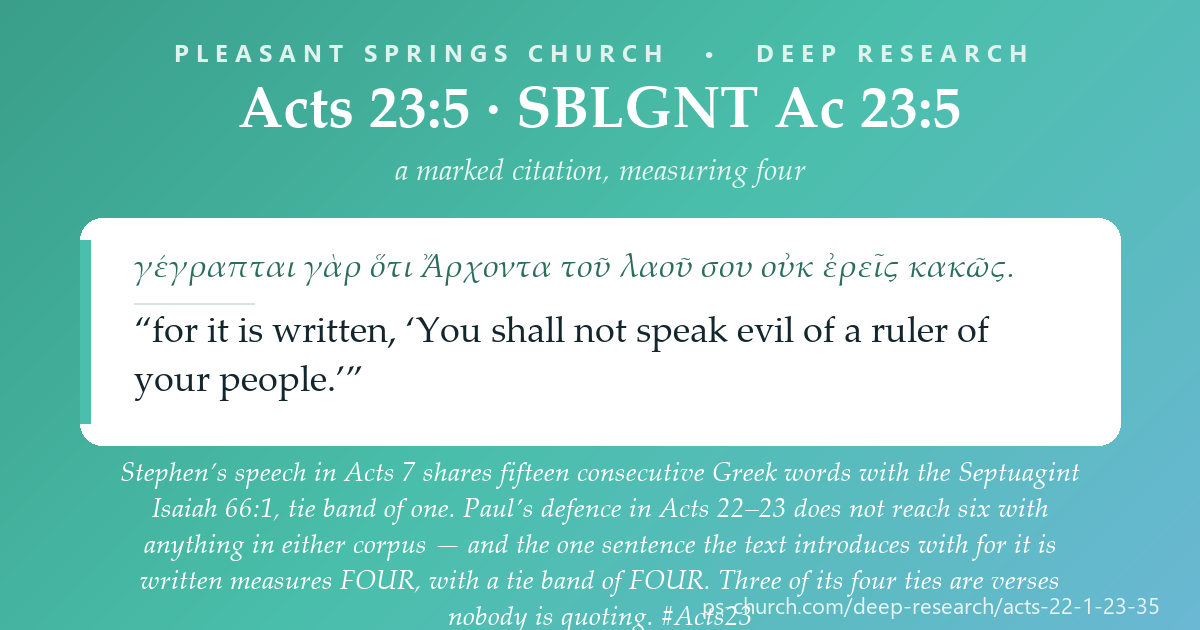
Acts 23:5 is the only verse in these 65 that carries a citation formula: γέγραπται γάρ. The verse behind it is Exodus 22:27 in the Septuagint numbering, Exodus 22:28 in the English.
| text | the clause |
|---|---|
| Septuagint Exodus 22:27 (ESV 22:28) | …καὶ ἄρχοντας τοῦ λαοῦ σου οὐ κακῶς ἐρεῖς |
| Acts 23:5 | Ἄρχοντα τοῦ λαοῦ σου οὐκ ἐρεῖς κακῶς |
Two differences: a singular where the Greek Exodus has a plural, and κακῶς after the verb where the Greek Exodus has it before. Here is what each one costs.
| version screened | run with Septuagint Exodus 22:27 | tie band |
|---|---|---|
| Acts 23:5 as the SBLGNT prints it | 4 | 4 |
| the same verse with the plural restored, order unchanged | 5 | — |
| the same verse with the order restored, singular kept | 6 | — |
| the same verse quoting the Septuagint verbatim | 7 | 1 |
And here is why the tie band matters more than the run. As it stands, the four words τοῦ λαοῦ σου οὐ reach four with four verses of the Greek Old Testament, and only one of the four is the verse being quoted:
| verse | shared run | is it the citation? |
|---|---|---|
| Septuagint Exodus 22:27 | του λαου σου ου | yes |
| 2 Samuel 7:23 | του λαου σου ου | no |
| Ezekiel 33:17 | του λαου σου ου | no |
| Ezekiel 37:18 | του λαου σου ου | no |
⚠️ What this does and does not show. It shows that a marked, explicit, undisputed citation can measure four with a band of four — which is to say, it can be invisible to this instrument. That is a fact about the instrument, and this page prints it against its own interest. It does not show that Acts is quoting from memory, or misquoting, or using a different Greek Exodus, or translating the Hebrew afresh. All four of those are arguments about a source, and the screen cannot reach any of them. Note also that no manuscript was consulted: the counterfactual rows above are arithmetic on the printed SBLGNT and the printed Rahlfs, not a claim about what anyone wrote.
The four deepest runs in the passage, and where they all point
Every one of the four verses that reaches five against the Greek New Testament matches another verse of Acts. Nothing in these 65 verses reaches five with any book outside Acts; outside Acts the ceiling is four.
| row | deepest match | run | tie band | the shared words |
|---|---|---|---|---|
| Acts 22:1 | Acts 7:2 — the first line of Stephen’s speech | 5 | 1 | ἄνδρες ἀδελφοὶ καὶ πατέρες ἀκούσατε |
| Acts 22:10 | Acts 26:15 | 5 | 1 | κύριε ὁ δὲ κύριος εἶπεν |
| Acts 22:7 | Acts 9:4 and Acts 26:14 | 5 | 2 | Σαοὺλ Σαοὺλ τί με διώκεις |
| Acts 22:14 | Acts 3:13 and Acts 5:30 | 5 | 2 | ὁ θεὸς τῶν πατέρων ἡμῶν |
The first row is the one this page keeps. Acts 22:1 and Acts 7:2 share five consecutive words and no other verse in the Greek New Testament reaches five with either. Paul’s defence opens with the words Stephen’s opened with, and nineteen verses later Paul names Stephen — the seventh and last occurrence of Στέφανος in the New Testament, all seven of them in Acts.
⚠️ And the counter-example, printed so the row above is not read as more than it is. ἄνδρες ἀδελφοί is the ordinary way a speaker addresses a Jewish assembly in Acts; it occurs many times in the book. What is measured here is that the five-word form with καὶ πατέρες ἀκούσατε occurs in exactly two verses of the New Testament. Whether that is deliberate echo, a shared convention, or the same author writing two speeches, the screen cannot say and neither will this page. The last two rows of the table are worth as little as they look: ὁ θεὸς τῶν πατέρων ἡμῶν reaches five with fourteen different verses of the Greek Old Testament, and a run matched fourteen times is a formula.
Three runs of four that look like more than they are
1. Acts 23:9 and Pilate. The scribes of the Pharisees say οὐδὲν κακὸν εὑρίσκομεν ἐν τῷ ἀνθρώπῳ τούτῳ. The four words ἐν τῷ ἀνθρώπῳ τούτῳ stand at Luke 23:4 and Luke 23:14, tie band 2, where Pilate says he finds no guilt in Jesus. A run of four is near the noise floor of this corpus. What lifts it slightly is that only two verses tie it, and that both of them attach the phrase to the same verdict. That is all the page claims for it.
2. Acts 23:28 and Luke 22:66. The tribune writes that he brought Paul down εἰς τὸ συνέδριον αὐτῶν; Luke 22:66 leads Jesus away εἰς τὸ συνέδριον αὐτῶν. Run 4, tie band 1. Four words, one of which is a definite article.
3. Acts 23:31 and John 19:24. Both open οἱ μὲν οὖν στρατιῶται, the soldiers therefore. Run 4, tie band 1, and it is a sentence-opening formula in narrative Greek. This one is printed precisely because it is worthless — it is what a run of four with a band of one looks like when it means nothing at all, and it sits in the same table as runs of four that a reader might want to mean something.
Zero on this page means “shares no word at all”. Every Greek-side screen here uses the unigram fallback: a row that shares no two-word sequence still scores 1 if any single word matches. So a reported run of 1 means one word shared and no pair, not that nothing is shared. The run of 1 between Acts 23:3 and Matthew 23:27 — the two whitewash verses — is exactly that: one shared word, and it is καί.
What the Greek Old Testament side returned, in full
| row | deepest match in 30,637 verse units | run | tie band | reading |
|---|---|---|---|---|
| Acts 22:14 | 1 Chronicles 12:18 and 13 others | 5 | 14 | formula |
| Acts 22:22 | 2 Samuel 13:36, Judges 21:2, Ruth 1:9, Ruth 1:14 | 5 | 4 | formula |
| Acts 22:10 | Deuteronomy 17:16 and three others | 4 | 4 | formula |
| Acts 22:21 | 2 Samuel 1:9 and 55 others | 4 | 56 | pure noise |
| Acts 22:3 | 1 Samuel 9:6 and eight others | 4 | 9 | formula |
| Acts 23:3 | Deuteronomy 17:11 and three others | 4 | 4 | formula |
| Acts 23:9 | 1 Maccabees 7:38 | 4 | 1 | coincidence |
| Acts 23:15 | Genesis 37:18 and Tobit 11:7 | 4 | 2 | coincidence |
| Acts 23:14 | Exodus 24:14 | 4 | 1 | coincidence |
| Acts 23:27 | Esther 10:3 | 4 | 1 | coincidence |
| Acts 23:5 the citation | Exodus 22:27 and three others | 4 | 4 | a real citation, scoring like a coincidence |
The row at 22:21 is the clearest statement of what the floor is: καὶ εἶπεν πρός με reaches four with fifty-six verses of the Greek Old Testament. That is what a four is worth in this corpus unless the band says otherwise.
Where this page is weakest, what it could not reach, and what would break it.
The largest hole: one printed edition on each side, and no apparatus
Every number on this page is an agreement between two printed texts. The New Testament figures come from the SBL Greek New Testament as digitised by MorphGNT; the Greek Old Testament figures from Rahlfs’ Septuaginta as digitised by CATSS. Neither has a critical apparatus on this disk, and no manuscript was examined.
That bears on this passage particularly hard, because the Western text of Acts is at its most expansive in exactly these chapters. Codex Bezae and its allies carry additional material around the arrest, the hearing and the plot. None of it was consulted. A different edition on either side could lengthen or shorten any run on this page — including, in principle, the run at 23:5, which is the page’s central claim. If a witness were found reading ἄρχοντας … οὐ κακῶς ἐρεῖς at Acts 23:5, the run would be 7 with a band of 1 and the headline finding would be considerably duller. This page cannot rule that out; it can only say what the SBLGNT prints.
What the ceiling of five does NOT prove
The measurement is that these 65 verses do not reach six with anything. The temptation is to conclude that Paul’s defence is unbiblical, or unscriptural, or argued on other grounds. The page refuses all three.
Consider what is in the speech without being quoted. A vision in the temple. A voice from heaven. The δίκαιος, the Righteous One — a title used of Jesus three times in Acts (3:14, 7:52, 22:14) and never explained. A blinding, a laying on of hands, a washing away of sins, a commissioning to the nations. Every one of those is drenched in the Old Testament and none of them is a quotation. The instrument sees none of it, and a page that treated its silence as an absence would be lying by arithmetic.
What can honestly be said is narrower. In Acts 7 and Acts 13 the speeches make their argument by reciting long stretches of the Greek Old Testament verbatim, and the screen finds them at 15 and 12 words. In Acts 22–23 the argument is made by narrating an experience and claiming a status — Pharisee, citizen, brother. The screen finds nothing because there is nothing of that kind to find. That is a difference in method of argument, which is a literary observation the numbers are consistent with, not something the numbers prove.
The historical questions the counting is silent on
Whether Paul genuinely did not recognise the high priest at 23:5, or was speaking ironically, or could not see him; whether ‘I am a Pharisee’ at 23:6 is a confession or a manoeuvre; whether a Roman tribune would really have convened the Sanhedrin; whether Claudius Lysias’ letter is a document Luke had, a reconstruction, or a composition; whether 23:27 contradicts 22:29 or merely flatters. Word-run screening cannot decide any of these and this page does not pretend otherwise. It reports that the letter and the narrative disagree about when the tribune learned Paul was a Roman, and stops.
The place this page is thinnest. Its headline is a negative — nothing reaches six — and a negative is only as good as the corpus it was run against. If the CATSS collection held here is missing a book, or a verse, or holds a different recension of one, a six could be hiding in the gap. The collection is 64 files and 30,637 verse units, and it does hold two Greek Daniels; it does not hold Aquila, Symmachus, or any hexaplaric material. The negative is a statement about this corpus and is stated as one.
One more limit, on the control. Acts 7 and Acts 13 were screened here for this page and the figures above are ours. They have not been through the shelf’s regression lock, because no published page carries them yet. The Acts 15 figure of fourteen is published, on the Acts 14–16 page — but the lock carries no Acts figure at all, so it does not pin that one either. A reader who wants to check the control should re-run it rather than take it.
What could not be checked at all
No Greek critical apparatus. No papyri — P29, P41, P48 and P74 all touch this stretch of Acts and none was consulted. No Codex Bezae. No Latin, Syriac or Coptic versions. No patristic citations. No Josephus — and Josephus is the source for nearly everything said in the reference works about Ananias son of Nedebaeus, about Felix, and about the Antonia. No Mishnah. No Roman legal sources. No inscriptions. No commentary on Acts was read for any figure on this page.
And one claim that is easy to overstate, and is deliberately not made. It is tempting to write that the man who watched Stephen die opens his own trial with Stephen’s sentence on purpose. The page will not, because the measurement is five shared words and a band of one, and five words is five words. What is reported is that the run exists, that it is unique in the New Testament, and that Stephen is named nineteen verses later. The reader may make of that what the reader likes.
Reading list
- C. K. Barrett, A Critical and Exegetical Commentary on the Acts of the Apostles (ICC, 2 vols., 1994–1998) — vol. 2 covers these chapters.
- Joseph A. Fitzmyer, The Acts of the Apostles (Anchor Bible 31, 1998).
- Craig S. Keener, Acts: An Exegetical Commentary, vol. 3 (2014) — the standard collection of the Roman legal and military background this page had to borrow.
- A. N. Sherwin-White, Roman Society and Roman Law in the New Testament (1963) — the classic treatment of the citizenship scene and the custody arrangements.
- Brian Rapske, The Book of Acts and Paul in Roman Custody (1994).
- Marion L. Soards, The Speeches in Acts (1994) — on how the speeches relate to each other, which is the literary question behind this page’s control table.
- None of these were consulted for the measurements on this page, which were run on the text files named in the footer.
A speech with no quotations in it, and a night with nobody else in the room.
Fifteen, twelve, and five
Two chapters. A man stands on a stair above a crowd that has just tried to kill him, asks for silence, and gets it — because he asks in Hebrew. He tells them where he was born, who taught him, what he did to people like the ones he is now one of, and what happened to him at noon on a road. Twenty-one verses later he says the word Gentiles and the silence ends.
Then a hearing, an order to strike him on the mouth, an insult, an apology of sorts, and a sentence about the resurrection that empties the room into two halves. Then a night. Then forty men with an oath, a boy nobody names, and four hundred and seventy soldiers leaving at the third hour of the night to move one prisoner.
And underneath it, a silence that can be measured. Stephen argued from Scripture and the screen finds fifteen consecutive words of it. Paul in a synagogue argued from Scripture and the screen finds twelve. Paul on trial for his life argued from what had happened to him, and the screen finds five — twice, and both times a stock phrase. The one time he says it is written, he says it about not insulting a judge, and the words he uses are close enough to be recognised and different enough that a machine cannot find them.
The quietest verse in the passage is the one nobody heard. Acts 23:11 makes almost no verbatim contact with anything on this disk — three words against the Greek Old Testament, three against the Greek New Testament — and it is the only place in these 65 verses where somebody speaks to Paul who is not trying to kill him, arrest him, or file a report about him. Everything measurable in this study happens in daylight and in public. The one thing that changes the direction of the book happens at night, to an audience of one.
Every Deep Research page traces its passage across the whole sweep — the Old Testament, the Second-Temple world between the testaments (historical witnesses, not Scripture), and the New Testament. Follow the thread:
Pleasant Springs Church — Deep Research
Research method after Michael S. Heiser’s Bible Research Method (examine dictionaries → ancient literature → important words → textual connections → academic publications → share), with the Pleasant Springs “Author & Audience” foundation. Scripture set in the Hebrew, the Greek editions named on each page and the ESV (Old Testament), and the Greek New Testament and the ESV (New Testament), per the practice of Pleasant Springs Church. Acts research grounded in Barrett (ICC), Fitzmyer (Anchor), Keener, Sherwin-White, Rapske and Soards — none of which were consulted for any number on this page. Text: Greek New Testament from the SBL edition as digitized by MorphGNT; Greek Old Testament from Rahlfs’ Septuaginta as digitized by CATSS. No critical apparatus was consulted on either side, and for Acts that omission is larger than usual, because the Western text of Acts is at its most expansive in exactly these chapters. ⚠️ VERSE NUMBERING — Acts is a New Testament book, so there is no Masoretic or Septuagint column and no offset to state. Counted anyway, off disk: SBLGNT Acts 22 has 30 verse units and Acts 23 has 35; a modern English edition, counted off disk, has 30 and 35; the ESV prints 30 and 35. The four verse numbers absent from the SBLGNT text of Acts — 8:37, 15:34, 24:7, 28:29 — all fall outside this study. Whole-book totals: SBLGNT 1,002 verse units, a modern English edition 1,003, traditional King James numbering 1,007; the extra difference is a division, SBLGNT Acts 19 ending at verse 40 where the English prints 19:41. One offset does bear on this page and is printed wherever it appears: the verse quoted at Acts 23:5 is Exodus 22:27 in the Septuagint and Exodus 22:28 in the English. Stated because this shelf states it everywhere, including where there is nothing to convert. ⚠️ The measurement, in full. Greek against Greek. MorphGNT field 6, the normalised word (the column that already resolves elision and the movable nu); CATSS FORM column (cols 0–24), beta-code transliterated first. Both sides lowercased, accents and breathings dropped, final sigma folded, then filtered to Greek letters — the same filter applied to both corpora. Contiguous runs of whole word FORMS, never lemmas. Corpus: the 65 MorphGNT verse units of Acts 22–23 against the other 7,862 verses of the Greek New Testament, and against 30,637 verse units across 64 CATSS files. Exhaustive and deterministic; nothing sampled, so no seed applies. The tie band — how many target verses reach the same maximum — is printed beside every run on this page. Greek-side screens here use the unigram fallback, so a reported run of 1 means “one word shared and no pair”, not “nothing shared”. ⚠️ The control figures. Acts 7 (60 verse units) and Acts 13 (52 verse units) were screened against the same 30,637 CATSS verse units in the same session, with the same normaliser, for this page. They are reported so that a ceiling of five means something; they have not yet been pinned by the shelf’s regression lock, because no published page carries them. The Acts 15:17 figure of fourteen is published on the Acts 14–16 page, and the lock does not carry that one either. ⚠️ What was NOT measurable. No papyri, no apparatus, no Codex Bezae, no versions, no patristic citations, no Josephus, no Mishnah, no Roman legal or epigraphic sources. The rabbinic material on releasing an unkeepable vow, the lex Iulia de vi publica, the topography of the Antonia, and the meaning of δεξιολάβος in later military writers are all reported from reference works and measured nowhere. ⚠️ Direction of influence is never asserted. Nothing here says that Luke wrote Acts 22:1 with Acts 7:2 in front of him, that Acts 23:9 is modelled on Luke 23:4, that Acts 23:5 misquotes Exodus, or that the tribune’s letter is or is not authentic. The page reports where the words are identical, how many other verses reach the same depth, and stops. Typology is handled per the house position: what the text says, what the New Testament itself draws, and what we see from this side of the cross — with the seeing left to the reader.
Scripture quotations marked ESV are from the ESV® Bible (The Holy Bible, English Standard Version®), © 2001 by Crossway, a publishing ministry of Good News Publishers. ESV Text Edition: 2016. Used by permission. All rights reserved. The ESV text may not be quoted in any publication made available to the public by a Creative Commons license, and the ESV may not be translated in whole or in part into any other language. www.esv.org
|
Did this study bless you today? 💚 Give to Support PS Church100% of gifts go to the General Fund — thank you. |