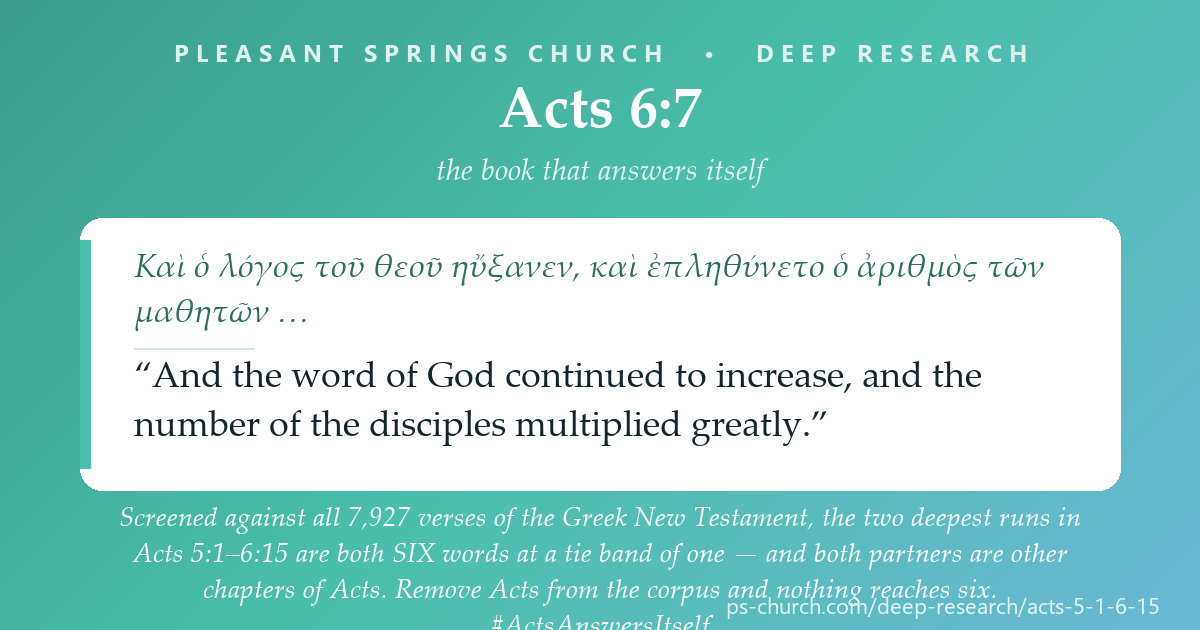
Acts 5:1–6:15 was screened word for word against all 7,927 verses of the Greek New Testament. The two deepest runs in the passage are both six consecutive words, both at a tie band of one — and both partners are other chapters of the same book. Acts 6:7 agrees with Acts 12:24 for six words; Acts 6:12 agrees with Acts 4:5 for six words. Then take Acts out of the target corpus and run it again: nothing in these 57 verses reaches six against the other twenty-six books, and only two rows reach five. The passage’s closest verbal neighbours are its own book. On the Old Testament side the deepest contact is a surprise of a different kind — Acts 5:21 shares six consecutive words with Septuagint Exodus 3:16, the verse where Moses is told to gather the elders, and the only occurrence in the whole Greek New Testament of the noun γερουσία is in that line. The measurement establishes agreement. It does not establish who read whom, and neither does this page. Three of its own counter-examples are printed in the codex above, on the verses that produce them. See the method →
Acts 5:1–6:15 (selections)
Greek New Testament (SBLGNT, via MorphGNT) · ESV⚠️ The offset still reaches this page, once, and it is worth printing. The deepest Old Testament contact of Acts 5:32 is with Septuagint Psalm 50:13 — which is the ESV’s Psalm 51:11. One chapter of offset from the Greek Psalter running behind, plus two verses because the Hebrew numbers the superscription. Naming the reference without naming the column would send a reader to the wrong psalm.
★ And the finding the page is built on. The two deepest runs in these 57 verses against all 7,927 verses of the Greek New Testament are both six, both at a tie band of one, and both partners are other chapters of Acts — Acts 6:7 with Acts 12:24, and Acts 6:12 with Acts 4:5. Take Acts out of the target corpus and nothing in the passage reaches six at all. Stage 4 gives the tables, the distributions, and the counter-examples.
The Shape of the Passage
Two panels in the same order — and the page calls it a sequenceThe book never names its author and addresses one man. Acts 1:1 says Τὸν μὲν πρῶτον λόγον ἐποιησάμην… ὦ Θεόφιλε — the first account I made… O Theophilus, which ties it to Luke 1:3, where the same name stands. Everything past that is inference, and this page keeps the inference separate from the count.
Author
What the text gives is a second volume to one reader. No name, no apostolic claim, no city, no date. The traditional attribution to Luke is external to the book and this page does not rest anything on it.
What is measurable is a habit of writing. Counted across the Greek New Testament: ἀτενίζω occurs 14 times, and 12 of them are in Luke or Acts. ὁμοθυμαδόν occurs 11 times, and 10 are in Acts. προσκαρτερέω occurs 10 times, 6 in Acts. These are vocabulary counts, not an argument about authorship, and the page will not turn them into one.
The passage carries 21 dictionary words that occur nowhere else in the Greek New Testament. The raw MorphGNT lemma count over these 57 rows is 22; the twenty-second is the edition’s capitalised Στοά at 5:12, which is the στοά of Acts 3:11. Nine of the 21 are names or gentilics — Sapphira, Theudas, the Libertines, the Antiochene, and five of the seven. Twelve are ordinary vocabulary: γερουσία, θεομάχος, κλινάριον, καθημερινός, παραθεωρέω and seven more. 57 verses and 1,049 running words, carrying 21 dictionary words the rest of the Greek New Testament never uses.
Audience
“Most excellent Theophilus” — and then everybody else. The book is addressed to one reader and written for a public; it explains Jewish institutions (a συνέδριον, a στρατηγός of the temple, a γερουσία) without assuming they are obvious.
The community in these chapters is bilingual and already divided by it. Acts 6:1 sets Ἑλληνιστῶν against Ἑβραίους. The word Ἑλληνιστής occurs three times in the Greek New Testament and all three are in Acts. All seven men chosen to fix the problem bear Greek names, and one is a proselyte from Antioch.
They are poor, they are watched, and they are winning priests. Widows on a daily list; sick people carried into the street; a council that will not arrest publicly because it fears the λαός (5:26). And 6:7 reports that a great crowd of the priests ὑπήκουον τῇ πίστει.
Orient on Acts, on the Sanhedrin, on the community of goods and on the seven — before touching a single number.
Search by topic: Acts of the Apostles; Ananias and Sapphira; Sanhedrin; gerousia; Sadducees; captain of the temple; Gamaliel; Theudas; Judas the Galilean; Hellenists; widows; deacons; Stephen; proselyte.
Which articles are relevant?
- Anchor Bible Dictionary — “Acts of the Apostles,” “Sanhedrin,” “Ananias,” “Gamaliel,” “Theudas,” “Hellenists,” “Stephen.”
- Dictionary of the Later New Testament & Its Developments (IVP) — “Acts of the Apostles,” “Hellenists,” “Widows,” “Persecution,” “Signs and Wonders.”
- New International Dictionary of NT Theology & Exegesis — ἐκκλησία, γερουσία, διακονία, νοσφίζομαι, ἀτενίζω.
- Commentary on the New Testament Use of the Old Testament, ed. G. K. Beale and D. A. Carson (Baker, 2007) — the Acts chapter, for the Deuteronomy 21:23 question at Acts 5:30.
- None of these were consulted for the measurements below. The measurements were run on the text files named in the footer.
Settle the numbering first — and note what is different about a New Testament page
Every page on this shelf states its versification offset, including the pages where the answer is that there is none. On a New Testament book the answer is stronger: there is no second column to be offset from.
| ch 5 | ch 6 | whole book | |
|---|---|---|---|
| SBLGNT (MorphGNT) | 42 | 15 | 1,002 |
| ESV | 42 | 15 | 1,007 |
| a public-domain English file (held on this disk; consulted for the count only, not printed on this page) | 42 | 15 | 1,003 |
The SBLGNT row and the third row were counted off disk. The ESV row is the printed edition’s numbering, not a count — no ESV Acts file is held here, which Stage 5 says again. The difference is not a chapter-and-verse offset. Four of the five are verses the SBL edition prints no text for because the reading is judged a later addition — Acts 8:37, 15:34, 24:7 and 28:29. The ESV keeps those four numbers in its scheme and puts the readings in footnotes, which is why its total is 1,007; the public-domain English file consulted here has no line for any of the four, which is why it counts off disk at 1,003. The fifth, Acts 19:41, is a difference of verse division: the SBL edition ends chapter 19 at verse 40 where the ESV splits the same sentence into 40 and 41, and the file consulted for the count above does carry a 19:41. Neither chapter on this page is affected, and every reference here means the same verse in Greek and in English.
The offset does reach this page, sideways, exactly once. Acts 5:32’s deepest Old Testament contact is Septuagint Psalm 50:13 — the ESV’s Psalm 51:11. The Greek Psalter runs one chapter behind the Hebrew from Psalm 9/10 to Psalm 147, and the Hebrew numbers the two lines of this psalm’s superscription as verses 1 and 2 where the ESV prints them unnumbered. One chapter and two verses of drift on a single reference. A page that printed ‘Psalm 50:13’ without saying which column it meant would be sending its reader to a different sentence entirely.
A senate that only Exodus and Judith have, a council that fears a crowd, and a rabbi whose two examples this page cannot date.
The γερουσία — one word in the New Testament, and where the Greek Old Testament puts it
Acts 5:21 says the high priest convened τὸ συνέδριον καὶ πᾶσαν τὴν γερουσίαν τῶν υἱῶν Ἰσραήλ — the council, and all the senate of the sons of Israel.
Counted: γερουσία occurs once in the whole Greek New Testament, here. In the 30,637 verse units of the Greek Old Testament held on this disk the word-group occurs in 34 verses, heavily in Exodus and Deuteronomy. The word stands next to τῶν υἱῶν Ἰσραήλ in three — two in the accusative Acts 5:21 has, one in the nominative:
| verse | the phrase in context | run with Acts 5:21 |
|---|---|---|
| Exodus 3:16 | ἐλθὼν οὖν συνάγαγε τὴν γερουσίαν τῶν υἱῶν Ισραηλ καὶ ἐρεῖς πρὸς αὐτούς… — the bush, and the commission | 6 · band 1 |
| Exodus 4:29 | ἐπορεύθη δὲ Μωυσῆς καὶ Ααρων καὶ συνήγαγον τὴν γερουσίαν τῶν υἱῶν Ισραηλ | 5 |
| Judith 15:8 (nominative) | καὶ Ιωακιμ ὁ ἱερεὺς ὁ μέγας καὶ ἡ γερουσία τῶν υἱῶν Ισραηλ… — the high priest and the senate together, which is the pairing Acts 5:21 has | 3 |
Exodus 12:21 has the phrase without its articles — πᾶσαν γερουσίαν υἱῶν Ισραηλ, Moses calling them for the Passover — and scores 3.
⚠️ What this is and is not. It is the deepest Old Testament run the passage produces, and its tie band is 1. It is not a quotation: there is no citation formula, the surrounding sentences are unlike each other, and γερουσία was the ordinary Greek word for a civic senate in the Hellenistic world — 1 Maccabees, 2 Maccabees and 3 Maccabees all use it of Jewish bodies. Direction of influence is not asserted. What is reported is that the one New Testament occurrence of the word sits in a six-word sequence whose only close Old Testament home is Moses gathering the elders — one chapter before a man is charged with speaking against Moses (6:11, 6:13–14).
A council that will not arrest in daylight
Acts 5:26 — ἤγαγεν αὐτούς, οὐ μετὰ βίας, ἐφοβοῦντο γὰρ τὸν λαόν, μὴ λιθασθῶσιν: he brought them, but not by force, for they were afraid of being stoned by the people.
The clause ἐφοβοῦντο γὰρ τὸν λαόν is four words shared with Luke 22:2, tie band 1 — the sentence in the third Gospel about why the chief priests could not seize Jesus openly. λαός stands nine times in these two chapters. The authorities in this passage are not free agents, and the narrative says so twice: 5:26, where the arrest is made without force for fear of a stoning, and 6:12, where the opponents have to stir up the people before they can seize Stephen. Between them stands 5:13, where the people ἐμεγάλυνεν αὐτούς — held the apostles in honour.
What was not checked. The composition, size and competence of the first-century Sanhedrin, the office of στρατηγὸς τοῦ ἱεροῦ, and whether it could impose a flogging are questions for Josephus, the Mishnah tractate Sanhedrin, and the epigraphic record. None of those are on this disk and none were consulted. What was measured is the Greek wording.
Gamaliel’s two examples — the passage’s best-known historical problem, left open
Acts 5:36–37 has Gamaliel cite Theudas first and then Judas the Galilean, μετὰ τοῦτον, after this man, in the days of the census.
The census of Quirinius is ordinarily dated to AD 6. Josephus places a Theudas under the procurator Fadus, in the mid-40s — which is after the scene Acts is narrating, let alone before Judas. The difficulty is real, it is old, and this page cannot adjudicate it, because Josephus is not among the texts held here and no attempt was made to check the reference.
⚠️ NOT VERIFIABLE FROM LOCAL CORPORA. The proposals in the literature — a different and earlier Theudas, a dislocation in Acts, an error by Luke, an error by Josephus — are all arguments about sources this page does not hold. It is named here rather than passed over, because a page that prints the flattering findings and skips the awkward one is not doing research. What can be said from the disk is small and exact: Θευδᾶς occurs once in the Greek New Testament, at 5:36, and προσκλίνομαι, the verb for the four hundred who joined him, occurs once as well.
An assembly formula the Greek Old Testament already had
Acts 6:5 opens καὶ ἤρεσεν ὁ λόγος ἐνώπιον παντὸς τοῦ πλήθους — and the proposal pleased the whole gathering.
Five consecutive words with 1 Maccabees 8:21, tie band 1, where a Jewish council agrees to a treaty with Rome. The shorter formula ἤρεσεν ὁ λόγος stands in four verses held here: 1 Maccabees 6:60 and 8:21, 2 Chronicles 30:4, and Esther 1:21 — a king, a king’s council and two assemblies. This is what a formula looks like when the run is deep and the meaning is ordinary: the church takes a decision the way a Hellenistic body took a decision, and the Greek says so without anybody quoting anybody.
Five words that carry the passage, and how rare each one actually is.
Acts 5:21, and nowhere else in the Greek New Testament. 34 verses of the Greek Old Testament held here carry the word-group; the accusative phrase γερουσίαν τῶν υἱῶν Ἰσραήλ is in Exodus 3:16 and Exodus 4:29, and Judith 15:8 has the same words in the nominative. Luke names two bodies in one breath — the συνέδριον and the γερουσία — and does not explain the difference.
Acts 5:5, 5:10 and 12:23. Three occurrences in the Greek New Testament, all three in Acts, and two in the 30,637 verse units of the Greek Old Testament held here — Judges 4:21 in the A text (ἐξέψυξεν, the same form, of Sisera; the B text has a different sentence and no ἐκψύχω) and Ezekiel 21:12 (ἐκψύξει πᾶσα σὰρξ). The third New Testament occurrence is Herod on the platform at Caesarea. The page reports the distribution; it does not claim Luke reserved the verb for judgement, because a sample of three cannot show that.
Acts 5:2, 5:3 and Titus 2:10 — three in the New Testament. In the Greek Old Testament held here it stands in exactly two verses: Joshua 7:1, where Israel takes from the devoted things and Achan is named, and 2 Maccabees 4:32. And the run between Acts 5:2 and Joshua 7:1 is 1. The word is the link; the sentences are not.
Acts 6:1, 9:29 and 11:20. Three occurrences in the Greek New Testament and all three in Acts; none in the Greek Old Testament held here. Acts never defines it. Every one of the seven men appointed to answer the Hellenists’ complaint bears a Greek name, and the seventh is a proselyte from Antioch.
Acts 6:15. 14 occurrences in the Greek New Testament: 10 in Acts, 2 in Luke — and the only 2 outside Luke and Acts are 2 Corinthians 3:7 and 3:13, where what is gazed at is the face of Moses. Acts 6:15 and 2 Corinthians 3:13 share a run of 3, τὸ πρόσωπον αὐτοῦ. Three words is a distribution, not a proof, and the page treats it as one.
The counts behind the structure diagram
Every repeated word in the diagram above was counted from the MorphGNT lemma column across the 57 rows, not taken from an outline.
| lemma | in 5:1–6:15 | where |
|---|---|---|
| λαός | 9 | 5:12, 13, 20, 25, 26, 34, 37; 6:8, 12 |
| πνεῦμα | 7 | 5:3, 9, 16, 32; 6:3, 5, 10 |
| συνέδριον | 6 | 5:21, 27, 34, 41; 6:12, 15 — four in Panel A, two in Panel B |
| ἀπόστολος | 6 | 5:2, 12, 18, 29, 40; 6:6 — five in Panel A, once in Panel B |
| λόγος | 6 | 5:5, 24; 6:2, 4, 5, 7 — four of the six in Panel B |
| ἵστημι | 6 | 5:20, 23, 25, 27; 6:6, 13 |
| ὄνομα | 5 | 5:1, 28, 34, 40, 41 — none in chapter 6 |
| ἀρχιερεύς | 4 | 5:17, 21, 24, 27 — none in chapter 6 |
| πλῆθος | 4 | 5:14, 16; 6:2, 5 |
| μαθητής | 3 | 6:1, 2, 7 only — the word does not occur in chapter 5 |
| φόβος | 2 | 5:5, 5:11 — the inclusio |
Two of these are worth saying out loud. The Name (ὄνομα) is the argument of chapter 5 and disappears in chapter 6; the disciple (μαθητής) is the subject of chapter 6 and absent from chapter 5. Caveat: these are lemma counts over 57 verses. Small numbers move easily, and a different lemmatiser would shift one or two rows — MorphGNT tags Στοᾷ at 5:12 as a capitalised form, for instance, which a naive count reads as a separate word from the στοά of Acts 3:11.
The passage’s closest verbal neighbours are its own book — and the three cross-references everyone draws all measure two or three.
The measurement
All 57 verses of Acts 5:1–6:15 were screened three times: against the other 7,870 verses of the Greek New Testament; against the Greek New Testament with the whole of Acts removed; and against the 30,637 verse units of the Greek Old Testament held on this disk. Contiguous runs of whole word forms, never lemmas, with the tie band beside every run.
| target corpus | reach 2 | 3 | 4 | 5 | 6 | 7 |
|---|---|---|---|---|---|---|
| rest of the Greek NT, Acts included | 57 | 51 | 29 | 7 | 2 | 0 |
| Greek NT with Acts removed | 57 | 48 | 19 | 2 | 0 | 0 |
| Greek Old Testament (30,637 units) | 57 | 55 | 23 | 6 | 1 | 0 |
That middle row is the finding. Taking one book out of a 7,927-verse corpus removes both of the passage’s six-word runs and five of its seven five-word runs. Counted another way: of the 57 rows, 42 have at least one of their deepest partners inside Acts, and for 13 of them every deepest partner is in Acts.
| row | deepest partner in the rest of the NT | run | band | deepest partner in the Greek OT held here | run | band |
|---|---|---|---|---|---|---|
| Acts 6:7 | Acts 12:24 | 6 | 1 | 1 Chr 11:11 · 1 Macc 6:30 · … | 3 | 16 |
| Acts 6:12 | Acts 4:5 | 6 | 1 | 1/3 Kingdoms 20:8 · 1 Esdras 9:13 · … | 4 | 4 |
| Acts 5:2 | Acts 4:35 · Acts 4:37 | 5 | 2 | Deut 22:22 · Gen 38:20 · … | 3 | 9 |
| Acts 5:24 | Acts 4:1 | 5 | 1 | 1 Chr 17:15 · 1 Macc 10:17 · … | 3 | 84 |
| Acts 5:40 | Acts 4:18 | 5 | 1 | Genesis 4:17 | 4 | 1 |
| Acts 5:30 | Acts 3:13 · Acts 22:14 | 5 | 2 | 1 Chr 12:18 · 2 Chr 20:6 · … | 5 | 14 |
| Acts 5:32 | Hebrews 10:15 · John 14:26 | 5 | 2 | Psalm 50:13 = ESV 51:11 | 5 | 1 |
| Acts 5:21 | Acts 19:38 · Acts 21:28 · John 7:14 · … | 4 | 7 | Exodus 3:16 | 6 | 1 |
| Acts 5:20 | Acts 21:27 · Acts 22:17 · … | 3 | 32 | Exodus 24:3 | 5 | 1 |
| Acts 6:5 | Acts 11:24 · Acts 13:52 · … | 3 | 9 | 1 Maccabees 8:21 | 5 | 1 |
| Acts 6:15 | 2 Cor 3:13 · Acts 20:38 · … | 3 | 11 | Daniel 10:6 (OG and Theodotion) | 4 | 2 |
| Acts 5:39 | 1 Cor 11:16 · 1 Cor 11:31 · … | 2 | 161 | Joshua 7:13 | 3 | 1 |
| Acts 5:10 | Ephesians 1:22 · Luke 7:38 · Mark 5:22 · … | 4 | 6 | Esther 8:3 | 5 | 1 |
| Acts 5:3 | Acts 10:44 · Acts 10:47 · Acts 11:15 · … | 4 | 21 | Isaiah 63:10 · Isaiah 63:11 · … | 4 | 4 |
Read the bands. Acts 5:3’s run of four is shared with twenty-one other New Testament verses — it is the phrase τὸ πνεῦμα τὸ ἅγιον, and it means nothing about relationship. Acts 5:30’s five words reach a band of fourteen in the Greek Old Testament: the God of our fathers is a liturgical formula. A run reported without its band would have made both look like discoveries.
The two runs of six, and why the book itself is the story
1. Acts 6:7 and Acts 12:24 — six words, band one.
| verse | the sentence | run with 6:7 |
|---|---|---|
| Acts 6:7 | Καὶ ὁ λόγος τοῦ θεοῦ ηὔξανεν, καὶ ἐπληθύνετο ὁ ἀριθμὸς τῶν μαθητῶν… | — |
| Acts 12:24 | ὁ δὲ λόγος τοῦ θεοῦ ηὔξανεν καὶ ἐπληθύνετο — the whole verse | 6 |
| Acts 19:20 | οὕτως κατὰ κράτος τοῦ κυρίου ὁ λόγος ηὔξανεν καὶ ἴσχυεν | 2 |
| Acts 16:5 | αἱ μὲν οὖν ἐκκλησίαι ἐστερεοῦντο τῇ πίστει… | 2 |
| Acts 9:31 | …καὶ τῇ παρακλήσει τοῦ ἁγίου πνεύματος ἐπληθύνετο | 1 |
| Acts 2:47 | …ὁ δὲ κύριος προσετίθει τοὺς σῳζομένους καθ’ ἡμέραν… | 1 |
Acts is famous for its growth notices, and a reader who has been told they are a refrain expects them all to read alike. They do not. One pair agrees for six words with nothing else in the New Testament coming near it; the other four notices agree with 6:7 for one or two words. The refrain is a shape, not a formula — except once.
2. Acts 6:12 and Acts 4:5 — six words, band one.
| verse | the sentence | run with 6:12 |
|---|---|---|
| Acts 6:12 | συνεκίνησάν τε τὸν λαὸν καὶ τοὺς πρεσβυτέρους καὶ τοὺς γραμματεῖς… | — |
| Acts 4:5 | …συναχθῆναι αὐτῶν τοὺς ἄρχοντας καὶ τοὺς πρεσβυτέρους καὶ τοὺς γραμματεῖς ἐν Ἰερουσαλήμ | 6 |
| Mark 15:1 | …οἱ ἀρχιερεῖς μετὰ τῶν πρεσβυτέρων καὶ γραμματέων… | 2 |
| Matthew 26:57 | …ὅπου οἱ γραμματεῖς καὶ οἱ πρεσβύτεροι συνήχθησαν | 2 |
| Mark 14:43 | …παρὰ τῶν ἀρχιερέων καὶ τῶν γραμματέων καὶ τῶν πρεσβυτέρων | 1 |
The Gospels have the same three groups, repeatedly, and never in these words: they use genitives and nominatives where Acts 4:5 and 6:12 use accusatives with the article repeated. The grammar of the sentence, not the roster of the council, is what the run is measuring. That is worth remembering before any run on this page is read as evidence of a source.
⚠️ What the page will not say. Not that Acts 6:7 is modelled on Acts 12:24, nor 12:24 on 6:7. Not that 6:12 is written from 4:5. Not that either pair is evidence for a source, a redaction or an itinerary document. Direction of influence is never asserted on this shelf, and inside a single book the question is not even well posed by a word count. What is measured is that the passage’s two deepest agreements in the whole Greek New Testament are with Acts, and that removing Acts removes them.
The counter-examples, printed in the same section
1. Ananias and Achan: the parallel everyone draws measures 1.
Acts 5:2 and 5:3 use νοσφίζομαι, and the Greek Joshua 7:1 uses ἐνοσφίσαντο of Israel taking from the devoted things. Run between Acts 5:2 and Joshua 7:1: 1. Between Acts 5:3 and Joshua 7:1: 1. The Greek-side convention on this shelf uses a unigram fallback, so 1 means one word in common and no two consecutive words in common. The verb is a real lexical link and the screen cannot see it, because the screen only finds verbatim sequences.
2. ‘Hanging on a tree’ and Deuteronomy 21:23: run of 2.
| comparison | run | shared words |
|---|---|---|
| Acts 5:30 vs Septuagint Deuteronomy 21:22 | 2 | ἐπὶ ξύλου |
| Acts 5:30 vs Septuagint Deuteronomy 21:23 | 2 | ὁ θεός |
| Acts 5:30 vs Galatians 3:13 (which quotes Deuteronomy explicitly) | 2 | ἐπὶ ξύλου |
| Acts 5:30 vs Acts 10:39 | 3 | κρεμάσαντες ἐπὶ ξύλου |
Galatians 3:13 is a citation of Deuteronomy 21:23, and against Acts 5:30 it still only measures 2. A theological connection can be certain and verbally invisible, and this is the row that shows it.
3. Stephen’s face and the face of Moses: run of 2.
Acts 6:15 against Septuagint Exodus 34:29 measures 2; against Exodus 34:30, 2. The Greek Exodus says the ὄψις τοῦ χρώματος τοῦ προσώπου αὐτοῦ had been glorified; Acts says the council saw τὸ πρόσωπον αὐτοῦ ὡσεὶ πρόσωπον ἀγγέλου. Different nouns, different verb, same picture.
Meanwhile the row’s deepest Old Testament contact is Daniel 10:6 — a run of four, τὸ πρόσωπον αὐτοῦ ὡσεὶ — which no commentary puts here. The tie band is 2, and both hits are the same verse in two Greek versions, the Old Greek and Theodotion. That is what the screen is for and what it is not for: it finds the sequence nobody was looking for, and it cannot tell you the sequence means anything — four words of a comparison formula are four words of a comparison formula. The nearest thing to a real verbal link runs the other way — ἀτενίζω, whose only two non-Lukan occurrences are 2 Corinthians 3:7 and 3:13, both about gazing at Moses’ face, and Acts 6:15 against 2 Corinthians 3:13 measures 3.
4. ‘We must obey God rather than men’ measures 4, about something else.
Acts 5:29’s deepest New Testament run is δὲ Πέτρος καὶ οἱ — four words shared with Luke 9:32, the transfiguration. Against Acts 4:19, which says the same thing in different words, the run is 3. The most memorable sentence in the passage is verbally unremarkable, and a page that ranked its verses by run length would have buried it.
5. And the verse with the rarest word in the passage has almost no verbal contact anywhere.
Acts 5:39 carries θεομάχοι, a New Testament hapax. Its deepest run against the whole Greek New Testament is 2, at a tie band of 161 — a hundred and sixty-one verses tie for the top score. Rarity of vocabulary and depth of agreement are unrelated quantities, and this row is the cleanest demonstration of it on the page.
Where this page is weakest, what it could not reach, and what would break it.
The largest hole: no manuscript apparatus, and Acts is the book where that hurts most
Acts circulates in two substantially different forms, and this page measured one.
The so-called Western text of Acts — Codex Bezae and its allies — is roughly a tenth longer than the text printed in critical editions, and several of its additions fall inside these two chapters. None of that is on this disk. The Greek here is the SBL edition as digitised by MorphGNT, a single printed text with no apparatus, no variants and no witnesses attached.
What that costs. Every run reported on this page is an agreement between two printed sentences. If the SBL editors made a different judgement at one word in Acts 6:7 or Acts 12:24, the headline run of six could be a five or a seven. The numbers are exact; the text they are exact about is one edition’s. Anyone rechecking this page should start there.
The run of five at 5:5 / 5:11 depends on a normalisation decision, and the page says so
The inclusio in the structure diagram is a run of five — and on the surface forms it is a run of four.
| verse | the fifth word as printed | MorphGNT normalised column |
|---|---|---|
| Acts 5:5 | ἐπὶ | ἐπί |
| Acts 5:11 | ἐφ’ | ἐπί |
The screen compares field 6 of MorphGNT, the normalised word, which resolves elision and the movable nu before anything is counted. That is the right column to use for a cross-corpus comparison — otherwise a run would break at a word two editions merely spell differently — but it is a decision, and it is the decision that turns a four here into a five. The inclusio survives either way; the number does not.
What was not consulted at all
No commentaries were used for any figure on this page. Not Bruce, not Barrett (ICC), not Fitzmyer (Anchor), not Keener’s four volumes, not Pervo, not Haenchen. Their names are in the attribution below as the literature a reader should go to next, and as an honest statement that the page did not go there first.
No Josephus, no Mishnah, no papyri, no inscriptions. Which means the Theudas problem at 5:36 could not be adjudicated, the powers of the Sanhedrin could not be checked, and the claim that γερουσία was ordinary civic Greek is reported from reference works rather than measured. Everything measured on this page was measured against the text files named in the footer and nothing else.
No ESV Acts file is held on this disk. The English column was typed from the printed ESV; the chapter shape in the Stage 1 table is the printed edition’s, not a count. Nothing in the English column on this page was machine-checked against a file on this disk, which is worth knowing when a reader wants to verify a quotation against their own copy.
What would break the page
The headline is a claim about a corpus boundary, so anything that moves the boundary moves it.
Three things would overturn it. One: a different edition of Acts. Two: a different definition of a word — the screen compares forms, not lemmas, so ἐπληθύνετο and πληθυνόντων are different words to it, and a lemma-based screen would produce a different and probably longer set of runs everywhere. Three: counting non-contiguous agreement. A screen that allowed one word of slack would find far more, and would find it in the Gospels too.
And one thing that would not break it, but should temper it. Acts is a long book — 1,002 verses in this edition, about an eighth of the Greek New Testament. A passage has more chances to match its own book than any other single book simply because Acts is large and its subject matter is repetitive. The page reports the effect; it does not claim the effect is surprising in kind. What is worth printing is the size of it: two runs of six with tie bands of one, both gone the moment one book leaves the corpus.
What to carry out of this passage, and what to be careful about.
Four things that are worth saying out loud
1. The word church arrives in Acts at a funeral. ἐκκλησία is not in Acts 1–4. It appears first at 5:11, in the sentence about great fear falling on the whole of it. The first thing the book calls the church is a body that has just buried two of its own for lying about money.
2. The two crises in these chapters are both internal, and both about property. A withheld price in 5:1–11; a neglected list of widows in 6:1–6. Each is followed by outside pressure rather than framed by it. The passage runs inside trouble → summary → council twice over and ends on the second council — which is why the diagram above is drawn as a repeated sequence and not as a centre with matching arms.
3. The famous line is not the deep one. We must obey God rather than men measures four words against Luke’s transfiguration scene and three against its own twin at Acts 4:19. Depth of verbal agreement and weight of meaning are different quantities, and this page has one instrument, which measures the first.
4. Gamaliel’s test is not a doctrine. If it is of God you will not be able to overthrow them is reported speech from a Pharisee inside a council scene. Acts records that they were persuaded by it and flogged the apostles anyway. The page notes what the text does and does not endorse, and leaves the theology to the reader.
How to check this page yourself
Everything above is reproducible from the substrate this shelf runs on. The screens are exhaustive and deterministic; nothing was sampled, so no seed applies.
The passage ends with a council staring at a man’s face and the narrator declining to explain what they saw. The next chapter is a speech of fifty-two verses, 7:2–53, and nine of them name Moses. Whether the six words Acts 5:21 shares with Exodus 3:16 were pointing that way, this page does not know and does not say.
Every Deep Research page traces its passage across the whole sweep — the Old Testament, the Second-Temple world between the testaments (historical witnesses, not Scripture), and the New Testament. Follow the thread:
Pleasant Springs Church — Deep Research
Research method after Michael S. Heiser’s Bible Research Method (examine dictionaries → ancient literature → important words → textual connections → academic publications → share), with the Pleasant Springs “Author & Audience” foundation. Scripture set in the Hebrew, the Greek editions named on each page and the ESV (Old Testament), and the Greek New Testament and the ESV (New Testament), per the practice of Pleasant Springs Church. Acts research grounded in Barrett (ICC), Fitzmyer (Anchor), Bruce (NICNT), Keener and Pervo — none of which were consulted for any number on this page. Text: Greek New Testament from the SBL edition as digitized by MorphGNT; Greek Old Testament from Rahlfs’ Septuaginta as digitized by CATSS; Hebrew from the Masoretic text as printed in Sefaria’s Miqra according to the Masorah. No critical apparatus was consulted on any side, and for Acts that is the page’s single largest limitation — the Western text of Acts is substantially longer than the edition measured here and is not held on this disk. ⚠️ VERSE NUMBERING — Acts is a New Testament book, so there is no Masoretic or Septuagint column and no offset to state. Counted anyway: MorphGNT Acts 5 runs 42 verses and Acts 6 runs 15, the same as the ESV. The whole-book totals differ — 1,002 in MorphGNT against 1,007 in the ESV’s numbering, with the public-domain English file consulted for the Stage 1 table counting 1,003 — because the SBL edition prints no text at Acts 8:37, 15:34, 24:7 and 28:29 and that file has no line for them either, while the ESV keeps all four as numbered verses and prints the readings in footnotes; and because the SBL edition ends chapter 19 at verse 40 where the ESV prints a verse 41. Neither chapter on this page is affected. The offset does bear on one reference: the deepest Old Testament contact of Acts 5:32 is Septuagint Psalm 50:13, which is the ESV’s Psalm 51:11 — one chapter, because the Greek Psalter runs behind from Psalm 9/10 to 147, and two verses, because the Hebrew numbers the superscription. ⚠️ The measurement, in full. Greek against Greek. MorphGNT field 6, the normalised word (the column that already resolves elision and the movable nu); CATSS FORM column (cols 0–24), beta-code transliterated first. Both sides lowercased, accents and breathings dropped, final sigma folded, then filtered to Greek letters — the same filter applied to both corpora. Contiguous runs of whole word FORMS, never lemmas. Corpus: the 57 MorphGNT rows of Acts 5:1–6:15 against the other 7,870 verses of the Greek New Testament, then against the same corpus with all 1,002 verses of Acts removed, then against 30,637 verse units across 64 CATSS files. Exhaustive and deterministic; nothing sampled, so no seed applies. The tie band — how many target verses reach the same maximum — is printed beside every run on this page. ⚠️ What a zero or a one means here. The Greek-side screens on this shelf use a unigram fallback, so a row that shares no two-word sequence still reports 1 if any single word matches. The runs of 1 reported against Joshua 7:1 and 2 Maccabees 7:19 therefore mean “one word in common, no two consecutive words in common” — not “no contact”. ⚠️ What was NOT measurable. No apparatus, no Western text, no papyri, no versions, no patristic citations, no Josephus and no Mishnah — so the Theudas chronology at Acts 5:36 is named as a problem and left open rather than resolved. No ESV Acts file is held here, so the English column was typed from the printed edition rather than counted off disk. ⚠️ Direction of influence is never asserted. Nothing here says Acts 6:7 is built from Acts 12:24 or the reverse, that Acts 6:12 is written from Acts 4:5, that Luke is quoting Exodus at 5:21, or that any of these agreements is evidence for a source. The page reports the runs, the tie bands and the corpus boundary, and stops. Typology is handled per the house position: what the text says, what the New Testament itself draws, and what we see from this side of the cross — with the seeing left to the reader.
Scripture quotations marked ESV are from the ESV® Bible (The Holy Bible, English Standard Version®), © 2001 by Crossway, a publishing ministry of Good News Publishers. ESV Text Edition: 2016. Used by permission. All rights reserved. The ESV text may not be quoted in any publication made available to the public by a Creative Commons license, and the ESV may not be translated in whole or in part into any other language. www.esv.org
|
Did this study bless you today? 💚 Give to Support PS Church100% of gifts go to the General Fund — thank you. |