Ephesians 1 is three sentences long. Thirty words of address, then 202 words without a full stop, then 169 more — and as the SBL Greek New Testament punctuates it, two of those three are among the five longest stretches between full stops in the whole New Testament. The longest of all is not here; it is Colossians 1:9–23, at 285. Three more things this page measures rather than asserts. The deepest verbatim run anywhere in the chapter is the greeting — twelve words shared with five other letters — while the sentence about being chosen before the foundation of the world reaches three. The phrase in the heavenly places stands five times in the Greek New Testament and all five are in Ephesians. And at the end, where Christ is enthroned and all things are put under his feet, Ephesians 1:22 and 1 Corinthians 15:27 agree with each other in five consecutive words and agree with the Greek psalm they are both using in one — while Hebrews, quoting the same psalm, keeps six of its words exactly. See the method →
Ephesians 1:1–23 (selections)
Greek New Testament (SBLGNT via MorphGNT) · ESV⚠️ The offsets that do bite are in the psalms this chapter touches. The Septuagint numbers the Psalter one behind an English Bible from Psalm 10 to Psalm 147, because it joins English Psalms 9 and 10 into one. So the psalm behind 1:22 is Septuagint Psalm 8:7 = English Psalm 8:6, and the psalm behind 1:20 is Septuagint Psalm 109:1 = English Psalm 110:1. Every psalm reference on this page gives both numbers.
Sixteen of the chapter’s 23 verses are quoted here, and seven are not. That is deliberate. The ESV is quoted under Crossway’s standing permission, which allows no more than half of any one book; with this page the shelf quotes 40 of Ephesians’ 155 verses — 25.8%, counted across all three Ephesians pages held here.
The Shape of the Passage
Sequence — three sentences, and a refrain that lands three timesBoth halves of this heading are contested for Ephesians, and this page reports the contest rather than settling it. The letter names Paul in its first word and names Ephesus in its second line — and the second of those stands inside square brackets in the printed Greek text this page quotes. What follows separates what the text says, what can be measured, and what cannot.
Author
The letter’s own claim, and what it shares with three others. Ephesians 1:1 opens Παῦλος ἀπόστολος Χριστοῦ Ἰησοῦ διὰ θελήματος θεοῦ, and those seven words open three other letters word for word: 2 Corinthians, Colossians and 2 Timothy. A run of seven with a tie band of three.
The authorship question is real, and the numbers on this page are used on both sides of it. A large body of scholarship holds that Ephesians was written by someone other than Paul, and the argument turns partly on the very material stage 4 measures: the closeness of Ephesians to Colossians, and the length of its sentences. This page takes no position and asserts no direction of influence. It reports that Ephesians 1:7 and Colossians 1:14 share five consecutive words with a tie band of one, that Colossians is among the deepest New Testament partners for eleven of the chapter’s 23 rows and is the sole deepest partner book on three of them, and that the single longest stretch between full stops in the New Testament is Colossians 1:9–23. Those facts are compatible with several accounts of how the two letters are related, and a run screen cannot choose between them.
What the page can say about the style. Chapter 1 is 401 Greek words in three sentences, and two of the three are in the New Testament’s top four for length. That is a measurable feature of the prose — and the feature it shares most closely with Colossians, whose first chapter holds the longest sentence of all.
Audience
The address stands in brackets. The SBLGNT prints τοῖς ἁγίοις τοῖς οὖσιν [ἐν Ἐφέσῳ] — the square brackets are the editors’ own, and they mean the words’ presence in the text is disputed. No manuscript and no critical apparatus was consulted for this page, so it can report the brackets and nothing more. Without those two words the line reads to the saints who are also faithful in Christ Jesus, with no destination at all.
Whoever they were, they are addressed as people brought in later. The chapter says almost nothing about its readers until 1:13, where the pronoun turns: we who were the first to hope becomes you also, when you heard the word of truth. The letter spends chapter 2 on that distinction — the study of Ephesians 2:1–10 is on this shelf — and chapter 1 only marks it, in one word.
And the whole chapter tells them what they already have. Thirteen times in 23 verses the text says in him, in whom, in Christ or in the Beloved — counted on the normalised Greek: four of ἐν ᾧ, three of ἐν αὐτῷ, three of ἐν τῷ Χριστῷ, two of ἐν Χριστῷ and one of ἐν τῷ ἠγαπημένῳ.
Orient on the letter, on its destination, and on the words nobody translates twice the same way.
Search by topic: Ephesians, letter to the; Ephesus; pseudonymity and ancient letter-writing; berakah; election and predestination; adoption; earnest money; principalities and powers; the body of Christ; recapitulation.
Which articles are relevant?
- Anchor Bible Dictionary — “Ephesians, Letter to the,” “Ephesus,” “Pseudepigraphy,” “Election,” “Adoption,” “Principalities and Powers.”
- Dictionary of Paul and His Letters (IVP) — “Ephesians, Letter to the,” “Body of Christ,” “Election and Predestination,” “Principalities and Powers,” “Holy Spirit.”
- NIDNTT / TDNT — ἐπουράνιος, ἀρραβών, υἱοθεσία, ἀνακεφαλαιόω, πλήρωμα, οἰκονομία.
- Commentary on the New Testament Use of the Old Testament (Beale & Carson) — on Ephesians 1:20–22 and the Psalm 110 / Psalm 8 pairing it shares with 1 Corinthians 15 and Hebrews 1–2.
Settle the numbering first — and here there is nothing to settle
Ephesians is a New Testament book. There is no Masoretic column, no Septuagint column, and no offset. The shelf states this everywhere, including where the answer is nothing, because a page that mentions numbering only when it is awkward teaches readers to assume agreement the rest of the time.
| ch 1 | 2 | 3 | 4 | 5 | 6 | total | |
|---|---|---|---|---|---|---|---|
| SBLGNT (MorphGNT, off disk) | 23 | 22 | 21 | 32 | 33 | 24 | 155 |
| a public-domain English file (off disk) (consulted for the count only, not printed on this page) | 23 | 22 | 21 | 32 | 33 | 24 | 155 |
Both counts were taken from the files, not from a table. The ESV prints the same shape; no ESV Ephesians file is held here to count from, and that is stated rather than assumed.
The offset that does matter on this page is in the Psalter. Ephesians 1:20 and 1:22 stand close to two psalms, and the Septuagint numbers both of them one lower than an English Bible does: Septuagint Psalm 8:7 = English Psalm 8:6 and Septuagint Psalm 109:1 = English Psalm 110:1. A third psalm turns up in stage 4 by accident: Septuagint Psalm 17:10 = English Psalm 18:9. Every psalm cited on this page carries both numbers.
A down-payment, a household steward, and a phrase the Septuagint does not have.
The Spirit is called a deposit — and in the Greek Old Testament that word is Judah’s pledge to Tamar
ἀρραβών is a commercial word. It is the part-payment that makes a contract binding — earnest money.
| corpus | occurrences | where |
|---|---|---|
| Greek New Testament (7,927 verses) | 3 | 2 Corinthians 1:22, 2 Corinthians 5:5, Ephesians 1:14 — all Paul |
| The 64 CATSS Greek Old Testament files held here (30,348 screened of 30,637) | 3 | Genesis 38:17, 38:18, 38:20 — all in one story |
Genesis 38 is Judah and Tamar. Judah promises a goat; Tamar asks what he will leave as a pledge until he sends it, and takes his signet, his cord and his staff. In Genesis the word means exactly what it means on a receipt.
What is and is not being claimed. Nothing here says Ephesians is alluding to Genesis 38, and the page would be embarrassed by the suggestion. ἀρραβών is a Semitic loanword that was ordinary commercial Greek in the first century, attested in papyri and contracts that are not held on this shelf and were not consulted. The point of the count is the register of the word: when Ephesians calls the Spirit a deposit, it reaches for the language of money paid against a balance owing, and the only place in the Greek Old Testament held here that the word turns up at all is a bargain over a pledge.
‘In the heavenly places’ is not a Septuagint phrase
Screened across the whole Greek New Testament and across every CATSS file held here.
| item | count | where |
|---|---|---|
| ἐν τοῖς ἐπουρανίοις in the Greek New Testament | 5 | Ephesians 1:3, 1:20, 2:6, 3:10, 6:12 — and nowhere else |
| the adjective ἐπουράνιος in the Greek New Testament | 19 (in 17 verses) | John once, 1 Corinthians 15 five times, Ephesians five, Philippians once, 2 Timothy once, Hebrews six |
| the same adjective in the 64 CATSS files, as screened | 4 (1 at 44 files; 5 for a few hours at 64 — see below) | Septuagint Psalm 67:15 (English Psalm 68:14); and — added 30 August 2026 — 2 Maccabees 3:39, 3 Maccabees 6:28 and 3 Maccabees 7:6, all three WITNESSES, not Scripture |
| the phrase itself — ἐν τοῖς ἐπουρανίοις — in the 64 CATSS files | 0 | nowhere, at 30,348 screened verse units — nor in the 289 held-but-unscreened Odes units either |
So the letter’s signature phrase for where the action is happening is still not one it inherited from the Greek Old Testament — the phrase returns zero at 30,348 screened verse units, and that negative is now checked against every book CATSS holds. But the sentence underneath it has to be corrected.
⚠️ What this page used to say, and what it says now. It read: “One adjective in 23,061 verse units.” That was true of the 44 CATSS files then held. On the 64 files held since 30 August 2026 the adjective stands five times in the 30,637 units on disk — and four times in the 30,348 units this shelf actually screens, because one of the five is in the Odes, withdrawn from the screening corpus later the same day. All five are named below, the withdrawn one last, because a count is only honest if the reader can see what was taken out of it.
| where | what it says |
|---|---|
| Septuagint Psalm 67:15 | when the Heavenly One scattered kings over her, they were snowed on in Zalmon — the one occurrence this page already had |
| 2 Maccabees 3:39 (WITNESS, not Scripture) | he who has his dwelling heavenly — of God, watching over the temple |
| 3 Maccabees 6:28 (WITNESS, not Scripture) | the sons of the almighty, living, heavenly God — a divine title |
| 3 Maccabees 7:6 (WITNESS, not Scripture) | the heavenly God — a divine title again |
| a one-word vocative, O heavenly one, in the morning hymn that Greek Psalters carry as an appendix — a liturgical text, not a book of the Old Testament |
⚠️ Why that last row is struck through, and what it is NOT. The Odes are the fourteen liturgical canticles bound after the Greek Psalter, and on 30 August 2026 all 289 of their verse units were withdrawn from this shelf’s screening corpus. They stay on disk; they are out of anything called ‘the Greek Old Testament’. Two reasons, either sufficient. (1) Two of the canticles are New Testament text. Ode 9 is Luke 1 — the Magnificat and the Benedictus — and Ode 13 is Luke 2, the Nunc Dimittis. Screened, Odes 9:48 matches Luke 1:48 at eighteen consecutive words, and a page could print that as a Gospel’s deepest Old Testament contact while measuring its own text. (2) Ten of the fourteen are second copies of passages the shelf already holds — Ode 1 = Exodus 15, 2 = Deuteronomy 32, 3 = 1 Samuel 2, 4 = Habakkuk 3, 5 = Isaiah 26, 6 = Jonah 2, 7 and 8 = Daniel Th 3, 10 = Isaiah 5, 11 = Isaiah 38 — so a verse standing alone in Habakkuk appeared to stand twice, and any tie band touching a canticle was doubled for no textual reason.
⚠️ But be exact about which of those two problems the struck row is: it is neither. Odes 14 is the morning hymn. It is not Luke, and it is not a second copy of anything else on this shelf. It comes out because the appendix is one book and is treated as one — not because this occurrence was the instrument reading its own text. So the honest statement of what changed here is a small one: one genuine, non-duplicate occurrence of the adjective sits in a liturgical appendix this shelf no longer screens, and the published count goes from five to four. The occurrence has not been shown to be spurious and it is not being hidden — it is printed above, struck through, so that a reader who wants the number for all 30,637 units held can reconstruct it.
The correction sharpens the point rather than blunting it. Outside one line of one psalm, the adjective’s only home in the Greek Old Testament held here is Hellenistic-Jewish literature written outside the Hebrew canon, where it is a title of God — the heavenly God. Ephesians does not use it that way. It uses it of a place, five times, in a plural substantive phrase that stands nowhere in any of the 64 files. Whatever this way of speaking came from, the corpus held here still cannot show it coming from the Septuagint.
A negative is a negative on the corpus searched, and this is the page that proves it: the corpus searched grew by twenty files on 30 August 2026 and one of this page’s counts went from 1 to 5. The 64 CATSS files are still not the whole Septuagint tradition, and they are still not Second-Temple Greek in general: Philo, Josephus and the Greek Pseudepigrapha were not screened for this page.
The words that run the chapter come from the household and the counting-house
Three of Ephesians 1’s load-bearing nouns are not religious vocabulary at all.
| word | ordinary sense | in Ephesians 1 |
|---|---|---|
| οἰκονομία (1:10) | the running of a household; a steward’s administration | ESV a plan for the fullness of time |
| ἀρραβών (1:14) | earnest money; a deposit against the balance | ESV the guarantee of our inheritance |
| υἱοθεσία (1:5) | the legal placing of a son; adoption into a family and its estate | ESV adoption to himself as sons |
All three belong to one world: an estate, an heir, an administrator and a part-payment. The Greek Old Testament held here has υἱοθεσία zero times. Every one of its five New Testament occurrences is Paul’s — Romans 8:15, 8:23, 9:4, Galatians 4:5 and Ephesians 1:5.
The standing caution about ancient culture on this shelf. The glosses in the middle column are lexical, not the fruit of reading Roman adoption law. No papyrus, no inscription and no legal text was consulted for this page. What is measured is the count; what is offered is the ordinary sense of the word, which the dictionaries in stage 1 supply and which this page has not independently verified.
Two words that occur once in the New Testament, one that occurs twice, and a refrain that is never the same twice.
The phrase ἐν τοῖς ἐπουρανίοις stands five times in the Greek New Testament and all five are in Ephesians — 1:3, 1:20, 2:6, 3:10, 6:12. Two of the five are in this chapter, and they are its two ends: the blessing and the enthronement.
1:14, of the Holy Spirit. Three occurrences in the New Testament, all Paul’s — 2 Corinthians 1:22, 2 Corinthians 5:5, here. Three in the Greek Old Testament held here, all in Genesis 38, of Judah’s pledge to Tamar.
1:10, of all things. Two occurrences in the New Testament. The other is Romans 13:9, where the commandments are summed up in one word. Zero in the Greek Old Testament held here.
1:11. The only occurrence of this verb anywhere in the Greek New Testament — screened over all 7,927 verses; MorphGNT lemmatises it κληρόω. The ESV reads we have obtained an inheritance; the form is passive, and the word family behind it is the one used for a portion assigned by lot.
1:12, one verse from the last chip. Also the only occurrence in the Greek New Testament; lemma προελπίζω. Two words that occur once each, standing one verse apart, in the middle of the longest sentence in the letter.
1:10 the fullness of time and 1:23 the fullness of him who fills all in all. Seventeen occurrences in the New Testament, four of them in Ephesians and two in Colossians — and two of the seventeen, at Mark 6:43 and 8:20, are basketfuls of leftover bread.
The refrain that is never the same twice
εἰς ἔπαινον, to the praise of, occurs four times in the Greek New Testament. Three are in this one sentence.
| verse | the Greek | the ESV |
|---|---|---|
| 1:6 | εἰς ἔπαινον δόξης τῆς χάριτος αὐτοῦ | to the praise of his glorious grace |
| 1:12 | εἰς ἔπαινον δόξης αὐτοῦ | to the praise of his glory |
| 1:14 | εἰς ἔπαινον τῆς δόξης αὐτοῦ | to the praise of his glory |
| 1 Peter 1:7 | εἰς ἔπαινον … | the fourth occurrence, and the only one outside Ephesians |
The first has an extra noun. The second and third differ by a single article — 1:14 carries τῆς where 1:12 does not. The English column on this page does not show it, and no other translation was checked. The ESV renders 1:12 and 1:14 word for word the same — to the praise of his glory twice. A reader in English sees a refrain repeated. A reader in Greek sees three near misses.
Whether the variation is deliberate, or the ordinary looseness of a writer not copying himself, this page does not say. It reports that the three are different and that only one of the differences survives translation.
Every row of the chapter, screened; and a psalm that Ephesians and Corinth quote the same way as each other and a different way from the psalm.
All 23 rows against the rest of the Greek New Testament
Each of the 23 verses of Ephesians 1 was screened against the other 7,772 verses of the Greek New Testament — the whole corpus with Ephesians itself removed — for the longest run of consecutive identical word forms, with the tie band beside it.
| row | deepest partner | run | band | the shared words |
|---|---|---|---|---|
| 1:2 | Rom 1:7, 1 Cor 1:3, 2 Cor 1:2, Php 1:2, Phm 3 | 12 | 5 | χάρις ὑμῖν καὶ εἰρήνη ἀπὸ θεοῦ πατρὸς ἡμῶν καὶ κυρίου Ἰησοῦ Χριστοῦ |
| 1:3 | 2 Cor 1:3, 1 Pet 1:3 | 11 | 2 | Εὐλογητὸς ὁ θεὸς καὶ πατὴρ τοῦ κυρίου ἡμῶν Ἰησοῦ Χριστοῦ, ὁ |
| 1:1 | 2 Cor 1:1, Col 1:1, 2 Tim 1:1 | 7 | 3 | Παῦλος ἀπόστολος Χριστοῦ Ἰησοῦ διὰ θελήματος θεοῦ |
| 1:17 | 2 Cor 1:3 | 7 | 1 | τοῦ κυρίου ἡμῶν Ἰησοῦ Χριστοῦ, ὁ πατὴρ |
| 1:7 | Col 1:14 | 5 | 1 | ἐν ᾧ ἔχομεν τὴν ἀπολύτρωσιν |
| 1:16 | Phm 4 | 5 | 1 | ποιούμενος ἐπὶ τῶν προσευχῶν μου |
| 1:22 | 1 Cor 15:27 | 5 | 1 | ὑπέταξεν ὑπὸ τοὺς πόδας αὐτοῦ |
| 1:5 · 1:8 · 1:10 · 1:12 · 1:13 · 1:15 · 1:19 · 1:20 · 1:21 · 1:23 | ten further rows | 4 | 1–3 | see the caution below |
| 1:4 · 1:6 · 1:9 · 1:11 · 1:14 · 1:18 | six rows | 3 | 3–8 | formulaic |
The distribution: all 23 rows reach three, 17 reach four, seven reach five, four reach seven, two reach eleven, one reaches twelve.
⚠️ The counter-example this page prints against itself. The two deepest runs in Ephesians 1 — twelve words and eleven — are the greeting and the opening benediction, and both are formulas. Twelve words with a tie band of five is not a connection between Ephesians and Philemon; it is what a first-century letter opening looked like. χάρις ὑμῖν καὶ εἰρήνη alone stands in thirteen New Testament verses. Meanwhile the sentence about being chosen before the foundation of the world reaches three. On this chapter, depth of run and depth of thought run in opposite directions, and a reader who takes a big number for a big claim will read the page backwards.
The finding: two letters agree with each other about Psalm 8, and neither agrees with Psalm 8
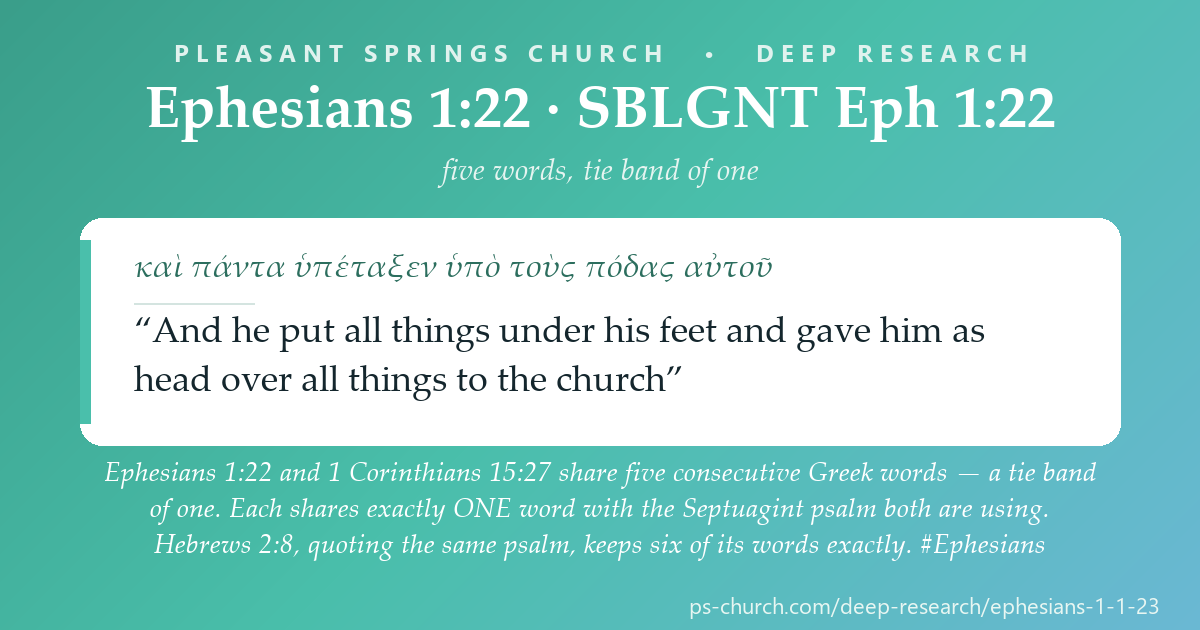
Ephesians 1:22 and 1 Corinthians 15:27 both say that God has put all things under Christ’s feet. Both are drawing on the same psalm. Hebrews 2:8 draws on it too. Here is what the three of them actually share with it.
| comparison | longest run | the shared words |
|---|---|---|
| Septuagint Psalm 8:7 (English 8:6) vs Hebrews 2:8 | 6 | πάντα ὑπέταξας ὑποκάτω τῶν ποδῶν αὐτοῦ |
| Septuagint Psalm 8:7 vs 1 Corinthians 15:27 | 1 | πάντα |
| Septuagint Psalm 8:7 vs Ephesians 1:22 | 1 | καὶ |
| Ephesians 1:22 vs 1 Corinthians 15:27 | 5 | ὑπέταξεν ὑπὸ τοὺς πόδας αὐτοῦ — tie band of one |
Two changes, and both letters make both of them. The psalm has ὑπέταξας, second person — you subjected, God addressed directly. Ephesians and 1 Corinthians both have ὑπέταξεν, third person — he subjected. And the psalm has ὑποκάτω τῶν ποδῶν where both letters have ὑπὸ τοὺς πόδας. Hebrews keeps both of the psalm’s words and reaches six.
And the split runs through the whole New Testament along that one preposition.
| phrase | occurrences | where |
|---|---|---|
| ὑπὸ τοὺς πόδας (the letters’ form) | 4 | Romans 16:20, 1 Corinthians 15:25, 1 Corinthians 15:27, Ephesians 1:22 — all four in Paul |
| ὑποκάτω τῶν ποδῶν (the psalm’s form) | 5 | Matthew 22:44, Mark 6:11, Mark 12:36, Hebrews 2:8, Revelation 12:1 — none of them in Paul |
What this does and does not establish. It establishes that two letters say the same five words in the same order and that the Greek psalm behind them does not say them. It does not establish direction of influence in any of the available directions — not that Ephesians is copying 1 Corinthians, not the reverse, not that both are drawing on a form of words already in circulation, and not that either writer had a Greek psalm in front of him at all. The measurement cannot see any of that, and neither can this page. What it can see is that on this verse the two letters are closer to each other than to their source, and that Hebrews is not.
The enthronement verse does the same thing to Psalm 110
Ephesians 1:20 says Christ was seated at God’s right hand. Several New Testament verses reproduce the Greek psalm’s own words for that. Ephesians is not one of them.
| comparison | longest run | the shared words |
|---|---|---|
| Septuagint Psalm 109:1 (English 110:1) vs the whole Greek New Testament | 14 | κύριος τῷ κυρίῳ μου κάθου ἐκ δεξιῶν μου ἕως ἂν θῶ τοὺς ἐχθρούς σου — Matthew 22:44 and Mark 12:36; the tie band is three, and the third is Hebrews 1:13, on a different fourteen |
| Septuagint Psalm 109:1 vs Ephesians 1:20 | 1 | τῷ |
Fourteen words is one of the deepest Old-Testament-to-New-Testament runs anywhere: when the Gospels quote this psalm they copy it. Ephesians does not quote it. It says what the psalm says, in different words — καθίσας ἐν δεξιᾷ αὐτοῦ against the psalm’s κάθου ἐκ δεξιῶν μου.
Counted across the whole Greek New Testament: ἐκ δεξιῶν in 22 verses and ἐν δεξιᾷ in eight. Every verse that reproduces the psalm uses the first form; not one of the eight verses using the second is a quotation — Romans 8:34, Ephesians 1:20, Colossians 3:1, Hebrews 1:3, 8:1, 10:12, 12:2 and 1 Peter 3:22. The entailment only runs one way, and the page will not run it the other. The first form is also ordinary Greek for on the right, and among its 22 verses are the thief on the cross, the sheep at the judgement and the angel beside the altar — none of which is quoting anything.
Where Ephesians 1 touches the Greek Old Testament at all: almost nowhere
All 23 rows were also screened against every CATSS Greek Old Testament file held here — 30,348 screened verse units of the 30,637 across 64 files, re-run on 30 August 2026 when the corpus grew from 44 files and 23,061 units, and re-run again the same day when the 289 units of the Odes were withdrawn from the screen. Not one run and not one band in the table below moved at that second re-run. Three of the fifteen unlisted rows lost a unit or two from very wide bands — 1:4 from 502 to 500, 1:15 from 23 to 22, 1:16 from 207 to 206 — which is why the last column now reads 500. Stage 2 sets out what the Odes are and why they came out.
| row | deepest Greek Old Testament partner | run | band | at 44 files |
|---|---|---|---|---|
| 1:9 | Sirach 33:13 (a WITNESS, not Scripture) | 5 | 1 | 5 / 1 — unchanged |
| 1:8 · 1:10 · 1:17 · 1:18 · 1:22 | Greek Daniel 1:4 · 1 Esdras 5:49 · Genesis 24:12 · Judges 2:9 · Exodus 24:10, Lamentations 3:34 and Psalm 17:10 | 4 | 2–7 | 4; 1:22’s band was 6 and Exodus 24:10 is the seventh |
| 1:3 — new | Tobit (S) 11:14 (a WITNESS, not Scripture) — blessed be God, and… | 4 | 1 | was 3 in a band of 82 |
| 1:11 — new | Wisdom 6:4 (a WITNESS, not Scripture) — according to the counsel of… | 4 | 1 | was 3 in a band of 6 |
| 1:12 · 1:13 — new | Wisdom 1:14 · Baruch 4:29 (WITNESSES, not Scripture) | 3 | 1 | was 2, in bands of 1,857 and 255 |
| the remaining 15 rows | — | 2 or 3 | up to 500 | up to 1,857 |
⚠️ Read the new rows before treating them as contact. All four rows that rose did so against a book that was simply not on the disk before, and every one of the new partners is a deuterocanonical book — Tobit, Wisdom, Baruch — which this shelf reads as a witness and never levels with Scripture. And the matched strings are grammar, not quotation: blessed be God and, according to the counsel of, so that we might be, of your salvation. A tie band of one on four ordinary words means only that nothing else in the corpus happened to put them in that order — and the growth has just demonstrated how fragile that is. Ephesians 1:22 held a band of six on under his feet at 44 files and holds seven at 64, because Greek Exodus 24:10 was not on the disk. A band is a fact about a corpus, not about a text.
Ephesians 1 does not quote the Old Testament, and the measurement says so loudly. The deepest run in the chapter against the whole Greek Old Testament is five words shared with Sirach — αὐτοῦ, κατὰ τὴν εὐδοκίαν αὐτοῦ at 1:9 — which nobody thinks Ephesians is quoting and which this page does not put forward as an allusion. It is what five shared words look like when they are an accident.
And the sharpest illustration is the one verse in the chapter that really is drawing on a psalm. Among Ephesians 1:22’s deepest Greek Old Testament partners — a run of four with a tie band of seven (six at 44 files; Greek Exodus 24:10 is the seventh, and the band is unchanged by the Odes withdrawal) — are Lamentations 3:34 — to bring low under his feet all the prisoners of the earth — and Septuagint Psalm 17:10 (English 18:9), and thick darkness was under his feet. Each shares the four words ὑπὸ τοὺς πόδας αὐτοῦ. Septuagint Psalm 8:7, the psalm verse standing behind Ephesians 1:22, shares one. A screen that reported only the top hit would have pointed at Lamentations and been completely wrong, and that is the clearest warning this shelf can give about its own method.
What this page cannot check, and where it is weakest.
The three weakest things on this page
1. The sentence-length measurement is a measurement of an editor’s punctuation, not of the text. Ancient manuscripts of Ephesians do not carry the full stops that produce the numbers 30, 202 and 169. Those numbers are what you get by splitting the SBLGNT’s printed text at every token whose trailing punctuation contains a full stop or a Greek question mark, and treating the raised dot as a comma rather than a stop — which is the usual convention and is still a choice. A different editor produces different numbers. Nestle-Aland and the Tyndale House edition were not consulted, and no manuscript was. The claim is precise, but its object is an edition.
2. The bracketed destination is reported and not resolved. The SBLGNT prints [ἐν Ἐφέσῳ] in square brackets. This page carries no critical apparatus and consulted none, so it cannot tell you which manuscripts have the words, which omit them, or how the editors weighed them. The run of seven measured at 1:1 is unaffected either way — the shared words all stand before the bracket — but every other question about the address is out of this page’s reach.
3. The authorship question is named and left open, and that is a real limitation. Serious scholarship argues that Ephesians is not Paul’s, and serious scholarship argues that it is; the arguments run through vocabulary, style, sentence length and the relationship to Colossians — that is, through exactly the material this page measures. Reporting the numbers without engaging the argument is a gap, not a neutrality bonus. The page states the letter’s own claim, states the measurements, and does not pretend the measurements settle anything.
What could not be checked at all
No critical apparatus on any side. No papyri — and for Ephesians that is a named loss, since P46 is central to the discussion of 1:1. No versions: no Latin, no Syriac, no Coptic. No patristic citations, and Marcion’s reported title for this letter belongs to the 1:1 discussion and was not examined. No Qumran material. No Greek papyri or inscriptions for the commercial use of the deposit word, and no Roman legal texts on adoption.
The Greek Old Testament screen is a screen of what is on disk. Sixty-four CATSS files, 30,637 verse units held and 30,348 screened — 44 files and 23,061 units until 30 August 2026, when Exodus, Leviticus, Numbers, both Joshua recensions and the deuterocanon arrived and every negative on this page was re-run; and 30,637 screened for a few hours that same day, until the 289 units of the Odes were withdrawn from the screening corpus and every negative was re-run a second time. That is still not the whole Septuagint tradition and it is not Second-Temple Greek in general: Philo, Josephus and the Greek Pseudepigrapha were not searched, and any statement on this page that a word occurs zero times means zero times in the 30,348 units those 64 files supply to a screen — and one figure on this page that used to read one read five for part of a day and now reads four, which is set out in stage 2 with its full history and with the withdrawn occurrence printed rather than deleted.
And one thing this page deliberately did not measure. The Hebrew of Psalm 8:6 was not brought into the comparison. It could have been — the Masoretic corpus is held here — but the question being asked is about Greek word forms, and a Hebrew column would have invited a comparison the run engine cannot make across languages.
One count on this page is a count of the shelf, not of the world. “All five occurrences are in Ephesians” and “all three are Paul’s” are statements about the 27 MorphGNT files. They are safe statements — the New Testament is a closed corpus and the whole of it is held here — in a way that the Greek Old Testament negatives on this page are not.
Reading list
- Harold W. Hoehner, Ephesians: An Exegetical Commentary.
- Andrew T. Lincoln, Ephesians (Word Biblical Commentary 42).
- Ernest Best, Ephesians (International Critical Commentary).
- Clinton E. Arnold, Ephesians (ZECNT), and Power and Magic: The Concept of Power in Ephesians.
- G. K. Beale and D. A. Carson, eds., Commentary on the New Testament Use of the Old Testament — on Ephesians.
- None of these were consulted for any number on this page, all of which were run on the text files named in the footer.
Three sentences, and where the weight actually falls.
The deepest thing in the chapter is the greeting, and it means nothing
If you sorted Ephesians 1 by how many consecutive Greek words each verse shares with the rest of the New Testament, the order would come out nearly upside down. Top of the list: Grace to you and peace from God our Father and the Lord Jesus Christ — twelve words, and five other letters say them identically. Near the bottom: he chose us in him before the foundation of the world — three.
That is not a paradox; it is what the method is for. A run screen measures how conventional a sentence is. The conventional parts of a letter are conventional. The parts that made this letter worth keeping are the parts nobody else had said.
And then, at the very end, the two things meet. Ephesians 1:22 is neither conventional nor unique. It reaches five words — with a tie band of one, so those five stand in exactly one other verse in the New Testament — and that verse is 1 Corinthians 15:27, saying the same thing about the same psalm in the same altered words. Meanwhile the psalm itself, in the Greek either of them could have copied, shares exactly one word with both. Hebrews had that psalm open and kept its wording. These two did not, and they did not in identical fashion.
This is the shelf’s study of Ephesians chapter 1; Ephesians 2:1–10 — But God, being rich in mercy — is already up. The chapter that follows this one opens with the word and, and takes the power that raised Christ from the dead as something that has now happened to the reader.
Every Deep Research page traces its passage across the whole sweep — the Old Testament, the Second-Temple world between the testaments (historical witnesses, not Scripture), and the New Testament. Follow the thread:
Pleasant Springs Church — Deep Research
Research method after Michael S. Heiser’s Bible Research Method (examine dictionaries → ancient literature → important words → textual connections → academic publications → share), with the Pleasant Springs “Author & Audience” foundation. Scripture set in the Hebrew, the Greek editions named on each page and the ESV (Old Testament), and the Greek New Testament and the ESV (New Testament), per the practice of Pleasant Springs Church. Ephesians research grounded in Hoehner, Lincoln (WBC), Best (ICC) and Arnold (ZECNT) — none of which were consulted for any number on this page. Text: Greek New Testament from the SBL edition as digitized by MorphGNT; Greek Old Testament from Rahlfs’ Septuaginta as digitized by CATSS. No critical apparatus was consulted on either side, and the square brackets the SBLGNT puts around the destination at 1:1 are reported as the editors’ mark of a disputed reading, and nothing is said about the manuscripts behind it. ⚠️ VERSE NUMBERING — Ephesians is a New Testament book, so there is no Masoretic or Septuagint column and no offset to state. Counted anyway, off disk: SBLGNT Ephesians runs 23 / 22 / 21 / 32 / 33 / 24 = 155 verses, and the ESV prints the same shape; no ESVEphesians file is held here to count. The offset that does bear on this page is in the Psalter: Septuagint Psalm 8:7 = English 8:6, Septuagint Psalm 109:1 = English 110:1 and Septuagint Psalm 17:10 = English 18:9, the Greek Psalter running one behind from Psalm 10 to Psalm 147. ⚠️ The measurement, in full. Greek against Greek. MorphGNT field 6, the normalised word (the column that already resolves elision and the movable nu); CATSS FORM column (cols 0–24), beta-code transliterated first. Both sides lowercased, accents and breathings dropped, final sigma folded, then filtered to Greek letters — the same filter applied to both corpora. Contiguous runs of whole word FORMS, never lemmas. Corpus: the 23 MorphGNT rows of Ephesians 1 against the other 7,772 verses of the Greek New Testament (the whole of Ephesians removed from the target side) and against 30,348 screened verse units of the 30,637 held across 64 CATSS files (23,061 across 44 until 30 August 2026; 30,637 screened for part of that day, until the 289 units of the Odes were withdrawn — two of the fourteen canticles are New Testament text, Ode 9 being Luke 1 and Ode 13 Luke 2, and ten more are second copies of passages already held, so the shelf HOLDS 30,637 and SCREENS 30,348). Exhaustive and deterministic; nothing sampled, so no seed applies. The tie band — how many target verses reach the same maximum — is printed beside every run on this page. ⚠️ The sentence-length figures are figures about an edition. 30 / 202 / 169 words, and the New Testament ranking behind them, come from splitting the SBLGNT text column at every token whose trailing punctuation contains a full stop or a Greek question mark, with the raised dot treated as non-terminal and book boundaries forced. On that rule the New Testament has 6,276 sentences and the longest is Colossians 1:9–23 at 285 words, followed by Ephesians 1:3–14 (202), Ephesians 3:1–12 (187) and Ephesians 1:15–23 (169). Ancient manuscripts carry no such punctuation; a different edition gives different numbers. ⚠️ No Greek on this page was typed. Every Greek string in the codex, the tables and the word chips is a slice pulled at build time from the MorphGNT and CATSS files, because hand-writing Greek entities has silently corrupted words on this shelf before. ⚠️ Direction of influence is never asserted. Nothing here says that Ephesians is copying 1 Corinthians or Colossians, that either is copying Ephesians, that any of them had a Greek psalm in front of them, or who wrote what. The page reports runs, bands and counts, and stops. Typology is handled per the house position: what the text says, what the New Testament itself draws, and what we see from this side of the cross — with the seeing left to the reader.
Scripture quotations marked ESV are from the ESV® Bible (The Holy Bible, English Standard Version®), © 2001 by Crossway, a publishing ministry of Good News Publishers. ESV Text Edition: 2016. Used by permission. All rights reserved. The ESV text may not be quoted in any publication made available to the public by a Creative Commons license, and the ESV may not be translated in whole or in part into any other language. www.esv.org
|
Did this study bless you today? 💚 Give to Support PS Church100% of gifts go to the General Fund — thank you. |