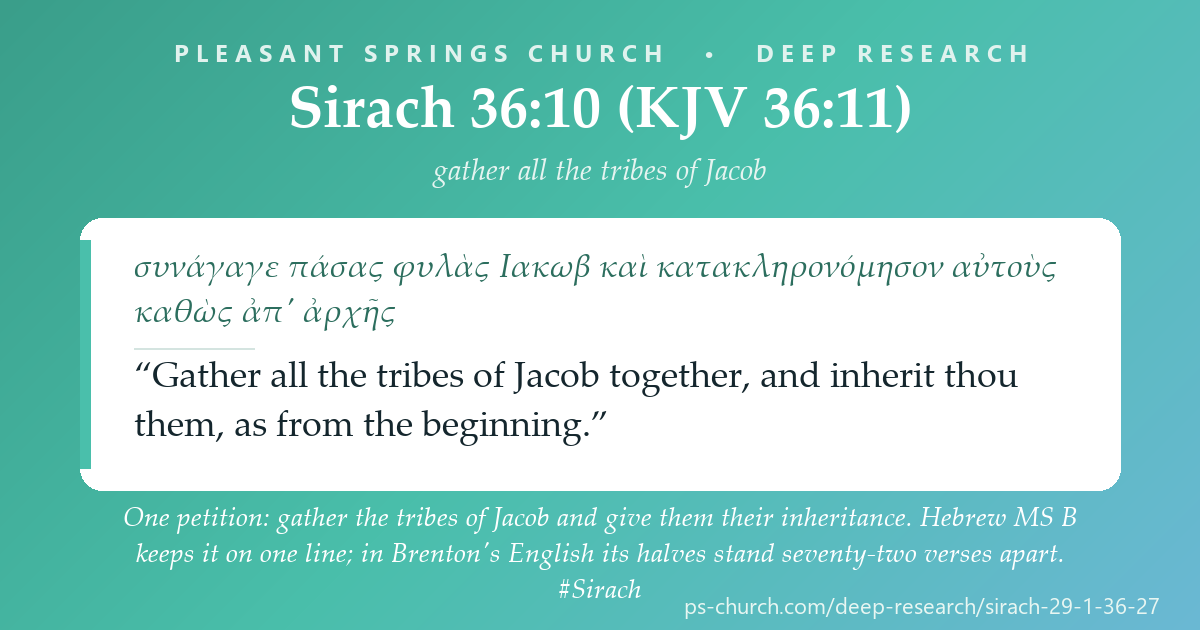
The commentaries report that, in an ancestor of every surviving Greek manuscript of Sirach, two long blocks of chapters 30–36 changed places. This page cannot check that against a Greek manuscript: the Greek file this shelf measures does not carry the exchange, and neither do the King James Apocrypha and the Clementine Latin — measured by content, all three run these chapters in one order, and the Hebrew of Cairo Genizah MS B agrees wherever it survives at a seam. On this disk the other order shows up only in Brenton’s Septuagint — in its English, as the eBible.org file has it, and in the Greek and English columns of a poorly OCR’d Bagster printing of about 1900. And where it does, it cuts a sentence in half. The sentence is the petition at the heart of the book’s prayer for Israel: “Gather all the tribes of Jacob together, and inherit thou them, as from the beginning” (Greek 36:10, KJV 36:11). In Brenton’s order the prayer stops at the first half, one verse short of the end of his chapter 33; the second half turns up seventy-two verses later, joined to the author’s line about being the last to keep watch, and there the inheritance is the speaker’s own. MS B has the whole petition on a single line. Around it are eight chapters of a Jerusalem teacher’s counsel — lending and surety, sons, health, banquets and wine, dreams, sacrifices God refuses, the widow’s tears. It is not Scripture for us, and nothing taught here rests on it. See the method →
One book, six pages. Sirach is set out on this shelf as a series: Prologue–9:18 · 10:1–19:30 · 20:1–28:26 ← previous · 29:1–36:27 (this page) · next → 37:1–43:33 · 44:1–51:30.
Sirach — the Wisdom of Jesus son of Sirach, Ecclesiasticus, Ben Sira — is a Second-Temple book of wisdom teaching, written in Hebrew in Jerusalem and translated into Greek in Egypt by the author’s grandson, who says so in his prologue. It is canonical in the Roman Catholic and Orthodox churches, was printed among the Apocrypha in the Protestant Bibles of the Reformation era, and is absent from the Hebrew Bible. It is not Scripture for us. We read it as a witness — one of the clearest windows we have into how a devout Jerusalem teacher spoke about money, households, worship and the poor in the decades before the Maccabean revolt (on the usual dating) — critically, gratefully, and tested at every point by the canon.
⚠️ What this page can and cannot measure — read this first.
HELD AND MEASURED: the Greek of the whole book (CATSS Sirach.mlxx, 1,402 rows: 36 prologue rows and 1,366 in 51 chapters; this page’s range is 218 rows and 2,668 Greek words); the Greek New Testament (7,927 verses); the Masoretic Hebrew Bible (23,204 verse units); and a Hebrew text of Ben Sira acquired for this series — the Hebrew Wikisource transcriptions of the Cairo Genizah manuscripts and the Qumran and Masada scrolls, 1,411 rows over 865 verse numbers, CC BY-SA 4.0.
HELD AND PRINTED, NOT MEASURED: the King James Apocrypha (1,393 verses of Sirach in 51 chapters) and the Clementine Vulgate (1,592 rows). HELD, USED FOR ORDER ONLY, NOT PRINTED: Brenton’s English Septuagint (the eBible.org verse file).
HELD ONLY AS POOR OCR, READ AT THE SEAMS, NOT MEASURED: the Internet Archive scan of a Bagster printing of Brenton’s edition (catalogued 1900), Greek and English together, which at the three joins read here runs in the other order; Stage 2 prints its Greek at the three joins, OCR errors kept.
NOT HELD: any Greek manuscript of Sirach, or any cleanly digitised Greek edition that prints the manuscripts’ order; Ziegler’s Göttingen edition; the Syriac; a critical edition of the Hebrew.
CONSEQUENCE: chapters 29 and 34 have no Hebrew in this file at all, and only 119 of the 218 Greek rows in this range have any. Greek and Hebrew are never run against each other here — a word run across two languages measures nothing. Each language is screened against its own canon, and the page compares what the two screens report.
Sirach 29–36 — eleven rows, in four languages where four survive
Greek: CATSS (Rahlfs) · Hebrew: Wikisource transcription of Cairo Genizah MS B, CC BY-SA 4.0 · English: KJV Apocrypha (1769 standard text, public domain) · Latin: Clementine VulgateSet beside Matthew 6:19–20 and measured against both verses: a run of one — the shared word is and. The next row says what the treasure is: “Shut up alms in thy storehouses” (29:12). No Hebrew survives for chapter 29 in the Hebrew file used here.
VULGATE 29:14 Pone thesaurum tuum in præceptis Altissimi,/ et proderit tibi magis quam aurum./
Four words — ἐξ οἰκίας εἰς οἰκίαν — that stand once among the 30,348 screened Greek Old Testament units, here, and once among the 7,927 verses of the Greek New Testament: Luke 10:7. Band 1 from both sides. Both verses are about a guest.
VULGATE 29:31 Vita nequam hospitandi de domo in domum :/ et ubi hospitabitur non fiducialiter aget, nec aperiet os./
The last line before the first seam. Our gloss of MS B: jealousy and [anger shorten] days, and before the time anxiety brings old age.
VULGATE 30:26 Zelus et iracundia minuunt dies,/ et ante tempus senectam adducet cogitatus./
SEAM. In MS B, as transcribed, this line follows 30:24 directly — lines 19 and 20 of the chapter-30 page. In Brenton’s English file, 30:24 is followed by the material CATSS numbers 33:16–36:10, and this verse does not arrive until Brenton’s 33:12 — immediately after the words for gather all the tribes of Jacob. The page does not gloss the Hebrew of this line.
VULGATE 30:27 Splendidum cor et bonum in epulis est :/ epulæ enim illius diligenter fiunt.
The deepest New Testament contact in all 218 rows — five words with Ephesians 1:9, band 1 from both sides — and it is not the potter. The run is αὐτοῦ κατὰ τὴν εὐδοκίαν αὐτοῦ — in both texts the last word of the phrase before, then according to his good pleasure (our gloss). Against Romans 9:20 and 9:21, the potter and the clay, this row measures one word.
VULGATE 33:13–14 Quasi lutum figuli in manu ipsius,/ plasmare illud et disponere./ Omnes viæ ejus secundum dispositionem ejus :/ sic homo in manu illius qui se fecit,/ et reddet illi secundum judicium suum./
SEAM. The author speaks in the first person — κἀγὼ ἔσχατος ἠγρύπνησα — and the row shares no two consecutive words with any other of the 30,348 screened Greek Old Testament units or any of the 7,927 New Testament verses (its deepest run is one, both ways). Brenton’s English prints this clause twice, once at each end of the exchanged stretch (Brenton 30:25 and 36:16). The Greek column of the Bagster print, as OCR’d, lacks it at the first join and has it at the far end: after 30:24 that column runs straight on with the row’s second half, ὡς καλαμώμενος ὀπίσω τρυγητῶν (Stage 2). The KJV’s 33:16 also carries the Greek row 33:17.
VULGATE 33:16 Et ego novissimus evigilavi,/ et quasi qui colligit acinos post vindemiatores./
Dreams are vanity, all five of the range’s dream-words standing in 34:1–7 — with the one exception the text itself makes: ἐὰν μὴ παρὰ ὑψίστου ἀποσταλῇ. No Hebrew for chapter 34 in the Hebrew file used here.
VULGATE 34:6 et sicut parturientis, cor tuum phantasias patitur./ Nisi ab Altissimo fuerit emissa visitatio,/ ne dederis in illis cor tuum :/
Two columns, two words. The Greek: the prayer of the lowly (προσευχὴ ταπεινοῦ νεφέλας διῆλθεν). MS B: שועת דל, the cry of the poor (our gloss of those two words; the rest of the half-line is not glossed here). The page does not choose between them. The Greek row shares no three consecutive words with either Greek corpus: its deepest run is two, and 711 Greek Old Testament units and 87 New Testament verses share a two-word sequence with it. Numbering: Hebrew 35:21 = CATSS 35:17 = KJV 35:17, which also carries the Greek 35:18 = Vulgate 35:21.
VULGATE 35:21 Oratio humiliantis se nubes penetrabit,/ et donec propinquet non consolabitur,/ et non discedet donec Altissimus aspiciat./
MS B · Heb. no. 36:2 ... פחדך על כל הגוים:GREEK · CATSS 36:1 ἐλέησον ἡμᾶς δέσποτα ὁ θεὸς πάντων καὶ ἐπίβλεψον καὶ ἐπίβαλε τὸν φόβον σου ἐπὶ πάντα τὰ ἔθνη36:1KJV 36:1–2 “Have mercy upon us, O Lord God of all, and behold us: And send thy fear upon all the nations that seek not after thee.”
The prayer opens. Greek ἐλέησον ἡμᾶς, have mercy on us; MS B הושיענו אלהי הכל, save us, God of all (our gloss). The KJV divides this one Greek row into two verses; MS B numbers it as two.
VULGATE 36:1–2 Miserere nostri, Deus omnium, et respice nos,/ et ostende nobis lucem miserationum tuarum :/ et immitte timorem tuum super gentes quæ non exquisierunt te,/ ut cognoscant quia non est deus nisi tu,/ et enarrent magnalia tua./
THE SENTENCE THE OTHER ORDER SPLITS. CATSS: one row. KJV: one verse, 36:11. Vulgate: one verse, 36:13. MS B: one line, numbered 36:13 — gather all the tribes of Jacob, and let them take possession as in days of old (our gloss). Brenton’s English file ends its 33:11 with the first half alone, and the second half does not come until its 36:16, 72 verses later, fused to the line about being the last to keep watch — where the inheritance is the speaker’s own. The Bagster Greek column, as OCR’d, reads there the first-person κατεκληρονόμησα where CATSS reads κατακληρονόμησον.
VULGATE 36:13 Congrega omnes tribus Jacob,/ ut cognoscant quia non est deus nisi tu,/ et enarrent magnalia tua,/ et hæreditabis eos sicut ab initio./
Aaron is named in the Greek (κατὰ τὴν εὐλογίαν Ααρων), in the KJV and in the Latin. MS B’s line names no Aaron: hear the prayer of your servants, according to your favour toward your people (our gloss). Measured on the rows for Hebrew 36:22–23; the page does not say which is older.
VULGATE 36:18–19 Da mercedem sustinentibus te,/ ut prophetæ tui fideles inveniantur :/ et exaudi orationes servorum tuorum,/ secundum benedictionem Aaron de populo tuo :/ et dirige nos in viam justitiæ,/ et sciant omnes qui habitant terram/ quia tu es Deus conspector sæculorum.
On the columns. The Greek is the CATSS morphological Septuagint (the text of Rahlfs), quoted at verse level with attribution, as on every page of this shelf. The shelf’s licensed English covers only the sixty-six-book canon, so the English here is not that translation. It is the King James Apocrypha, 1769 standard text, public domain, quoted verbatim from the verse-per-line file on this disk, KJV spelling and brackets included — it is a translation of a Greek text, not of the Hebrew printed beside it, and it is a quotation, not a measured parallel. The Hebrew is the Hebrew Wikisource transcription of the Cairo Genizah manuscripts (CC BY-SA 4.0), unpointed, its own half-line divider \ and its lacuna marks kept, the manuscript named on every line; it is numbered in the critical (Ziegler) scheme, so its numbers are printed as Heb. no. and aligned to the Greek by content. The Latin is the Clementine Vulgate with its poetry brackets removed and its line-breaks kept as /; it is a fourth witness, never a source for the English.
Versification — stated, as on every page here, and here it is a third state. There is no Masoretic Sirach, and the shelf’s licensed English does not cover the book, so the usual Hebrew/Greek/English offset does not exist. What exists instead are five numberings of one range, every one measured on the file:
• Greek (CATSS, Rahlfs): 218 rows, by chapter 28 · 25 · 31 · 24 · 33 · 26 · 24 · 27. Every label numeric; the book’s prologue is the separate chapter “Prolog”.
• KJV Apocrypha: 211 verses, by chapter 28 · 25 · 31 · 24 · 31 · 26 · 20 · 26; no prologue in the file at all. Same order as the Greek; the offsets are merges and splits only, listed below.
• Clementine Vulgate: 250 rows, by chapter 35 · 27 · 42 · 28 · 33 · 31 · 26 · 28 — same order, its own (finer) verse division; every Latin line printed above carries its own number.
• Hebrew (Wikisource): numbered in the critical (Ziegler) scheme. In chapters 30–33 its numbers coincide with the Greek labels; in 35–36 they do not — Heb. no. 35:11–26 = CATSS 35:8–24, Heb. no. 36:1–9 = CATSS 36:1–6, Heb. no. 36:13 = CATSS 36:10, Heb. no. 36:17–31 = CATSS 36:11–27, aligned by content. The numbers 36:14, 36:15 and 36:16 do not occur in the file at all — the file labels the whole petition 36:13 and skips from it straight to 36:17. The file also keeps a second, Hebrew-order number in these chapters, and for MS B’s chapter-35 and chapter-33 lines it gives chapters 32 and 36 — the chapter numbers Brenton’s file uses for the same material.
• Brenton’s English (eBible.org file): 212 lines, by chapter 28 · 40 · 26 · 20 · 12 · 31 · 24 · 31 — the other order, set out in Stage 2.
The KJV against the Greek, merge by merge:
- Chapter 29 — 28 and 28, but not the same division: Greek 29:16 = KJV 29:16–17; Greek 29:17–18 = KJV 29:18.
- Chapters 30, 31, 32, 34 — one to one.
- Chapter 33 — Greek 33:16–17 = KJV 33:16; Greek 33:18–31 = KJV 33:17–30; Greek 33:32–33 = KJV 33:31.
- Chapter 35 — Greek 35:4 = KJV 35:4–5; Greek 35:5–10 = KJV 35:6–11; Greek 35:11–12 = KJV 35:12; Greek 35:13–16 = KJV 35:13–16; Greek 35:17–18 = KJV 35:17; Greek 35:19–21 = KJV 35:18; Greek 35:22–23 = KJV 35:19; Greek 35:24 = KJV 35:20.
- Chapter 36 — Greek 36:1 = KJV 36:1–2; Greek 36:2–15 = KJV 36:3–16; Greek 36:16–17 = KJV 36:17; Greek 36:18–25 = KJV 36:18–25; Greek 36:26–27 = KJV 36:26.
Which order does each file carry?
| file on this disk | rows in chapters 29–36 | what follows 30:24 | the petition for the tribes of Jacob |
|---|---|---|---|
| CATSS Greek (Rahlfs) — measured and printed | 218 | 30:25, the cheerful heart | one row, 36:10 |
| KJV Apocrypha, 1769 — printed | 211 | 30:25 | one verse, 36:11 |
| Clementine Vulgate — printed | 250 | its 30:27, the same line | one verse, 36:13 — with a clause between the halves |
| Hebrew, MS B (Wikisource) — printed | 159 MS B rows | 30:25, on the next line | one line, Heb. no. 36:13 |
| Brenton’s English (eBible.org file) — order only, not printed | 212 | the material CATSS numbers 33:16 | two verses, 33:11 and 36:16, 72 apart |
| Bagster print of Brenton’s edition, c. 1900, Greek column (Internet Archive OCR) — read at the seams only, not measured | not counted | the second half of the row CATSS numbers 33:16 | two places, as in Brenton’s English; the second half with a first-person verb |
The Shape of the Passage
A sequence of teaching units — not a chiasm — with three seams markedAnd the order of these units is itself the thing in dispute. The three seams mark where the order of Brenton’s edition departs from the order printed here. Read in Brenton’s order, unit 4 runs straight into the author’s first-person line (unit 8), the household, the dreams, the sacrifices and the prayer follow, and the prayer breaks off at gather all the tribes of Jacob to make way for the cheerful heart, the gold, the banquet and the law, and resumes 72 verses later with a line that joins the watcher’s clause to the petition’s second half. Two sequences of wisdom teaching; only one of them keeps the prayer’s petition in a single sentence.
⚠️ Where this page sits. Sirach is canonical in the Roman Catholic and Orthodox churches, printed among the Apocrypha in the older Protestant Bibles, and absent from the Hebrew Bible. This library reads it as a Second-Temple witness and files it under Apocrypha / Deuterocanon. Nothing taught at Pleasant Springs rests on it.
Author
A teacher who signs his book. The Greek of 50:27 gives him a name and a city — Ἰησοῦς υἱὸς Σιραχ Ελεαζαρ ὁ Ιεροσολυμίτης — and his grandson’s prologue calls him ὁ πάππος μου Ἰησοῦς, my grandfather Jesus. The usual dating puts the book in the early second century BC and the translation in Egypt a generation or two later; the prologue dates the grandson’s arrival to the thirty-eighth year of King Euergetes. Those dates are the commentaries’, not measured here.
In this range he speaks in his own voice three times — to a pupil at 31:22, as the last of the gleaners at 33:16–19, and as a traveller who nearly died at 34:11–12: “When I travelled, I saw many things”. The second of those stands at a seam of the displacement this page is about.
Audience
Men with something to lose. The pupil of these chapters lends money and stands surety, hosts and attends banquets, owns slaves, raises sons, and brings offerings to the altar. Apart from the single my son of 31:22, the author names his hearers once: “Hear me, O ye great men of the people” (Greek 33:19, ἀκούσατέ μου μεγιστᾶνες λαοῦ).
And the poor, as the people he is told not to forget. “Help the poor for the commandment’s sake” (29:9), the widow’s tears (35:15), and a prayer for a scattered nation (36:1–17). The household counsel is an ancient one and the page reports it as such: it includes beating a son (30:12) and “tortures and torments for an evil servant” (KJV 33:26; Greek 33:27), beside “entreat him as a brother” (KJV 33:31; Greek 33:32). These are what the text says; they are not offered here as counsel.
Orient on the book, on its Hebrew, and on the displacement in its Greek.
Search by topic: Ben Sira; Sirach; Ecclesiasticus; Cairo Genizah; Sirach Hebrew manuscripts; Septuagint of Sirach; Sirach 30–36 order; Old Latin Sirach.
Which articles are relevant?
- Anchor Bible Dictionary — the article on Ben Sira (Sirach, Ecclesiasticus); the articles on the Apocrypha and on the Septuagint.
- Eerdmans Dictionary of Early Judaism — Ben Sira; Wisdom literature; Cairo Genizah.
- Dictionary of New Testament Background (IVP) — Sirach; Apocrypha and Pseudepigrapha.
- On the text — any article that says plainly which numbering it uses in chapters 30–36. An article that cites ‘Sirach 33’ without saying whether it means the order printed here or the Greek manuscripts’ order cannot be followed for this range.
Bibliography surfaced:
- Patrick W. Skehan and Alexander A. Di Lella, The Wisdom of Ben Sira (Anchor Bible 39) — a full English commentary.
- Joseph Ziegler, Sapientia Iesu Filii Sirach (Göttingen Septuagint XII/2) — the critical Greek edition, and the source of the verse numbers the Hebrew file uses.
- Pancratius C. Beentjes, The Book of Ben Sira in Hebrew (Brill, 1997) — all the Hebrew manuscripts with a synopsis; the Hebrew file uses its sigla A–F.
- Solomon Schechter and Charles Taylor, The Wisdom of Ben Sira (Cambridge, 1899) — the first edition of the Genizah leaves; page scans of it are held on this disk and were used by the Hebrew file’s builder for spot-checks.
- M. Z. Segal’s complete Hebrew edition — whose own numbering the Hebrew file keeps as a second number in chapters 30–36.
- NETS, Sirach (Benjamin G. Wright) — a modern English of the Greek. Not quoted here; named because it is the obvious next step.
A Hebrew book, its grandson’s Greek, and a Greek tradition that carries a different order.
Three things from outside the text shape how this range must be read: the grandson’s own warning about translation, the Hebrew manuscripts recovered from Cairo, and the displacement in the Greek. Each is labelled measured or reported.
What does the translator say about his own Greek?
The grandson’s prologue has no Hebrew in the file used here, and the Clementine Latin on this disk folds a Latin form of it into its 1:1 — but the King James file on this disk does not carry it at all: its Sirach begins at 1:1, “All wisdom cometh from the Lord”, and all 1,393 of its lines are numbered verses. So the prologue is quoted here from the CATSS rows, with our own gloss:
οὐ γὰρ ἰσοδυναμεῖ αὐτὰ ἐν ἑαυτοῖς Εβραϊστὶ λεγόμενα καὶ ὅταν μεταχθῇ εἰς ἑτέραν γλῶσσαν
for they do not have equal force — the things said in Hebrew in themselves, and when they are carried over into another tongue (our gloss)Sirach, Prologue, CATSS rows 21–22
The Hebrew file acquired for this series lets these pages set his Hebrew beside his Greek, and in this range it can do so for 119 of 218 rows. Where the two differ, the page reports what each column reads and does not say which one moved.
Where does the Hebrew come from?
Reported, not measured: the Hebrew of Ben Sira was lost to the West for centuries and recovered in pieces from the Cairo Genizah from 1896, with further fragments from Qumran and from Masada. Measured, on the file used here: in this range the Hebrew is almost all MS B (159 main rows and 28 margin rows), with MS F (43), MS E (10) and MS D (3) — 243 rows over 118 verse numbers. Chapters 29 and 34 have no row at all.
What the file is and is not. It is a set of diplomatic-style transcriptions on Hebrew Wikisource, made almost entirely by one editor known only by a user name, pinned to fixed revisions; it is not a critical edition. Wikisource marks several of its pages unfinished — in this range the MS B pages for chapters 31, 32 and 35, whose margin readings are partly untyped, and the MS E pages. “No row in the file” is therefore not the same as “not in the manuscript”, and the page says “in this file” every time.
The displacement — what is measured, and what is only reported:
Reported, not measured: the account given in the commentaries and critical editions (not consulted here) is that every surviving Greek manuscript of Sirach carries two long blocks of chapters 30–36 in exchanged order, that the Latin, the Syriac and the Hebrew carry the other order, and that the modern critical editions — Rahlfs and Ziegler — print the latter. The usual explanation is that two runs of leaves changed places in an ancestor copy.
Measured here, by content: the CATSS file, the KJV and the Clementine Vulgate all carry one order. Brenton’s English — commonly described as a translation of the Vatican manuscript’s text — carries the other. Aligned to the KJV line by line (its English is, verse after verse, the KJV’s own wording: 203 of its 212 lines in these chapters share ten or more consecutive words with a KJV verse, median 17), Brenton’s chapters run:
- Brenton 30:1–24 = KJV and CATSS 30:1–24.
- Brenton 30:25–40, 31, 32 and 33:1–11 (73 lines) = KJV 33:16–36:11a — block Y, the household, the dreams, the sacrifices and the prayer, up to “gather all the tribes of Jacob”.
- Brenton 33:12, 34, 35 and 36:1–16 (72 lines) = KJV 30:25–33:15, plus a last line, Brenton 36:16, that matches no whole KJV verse — block X, the cheerful heart, the gold, the banquet and the law — ending with that line, which joins the watcher to the inheritance.
- Brenton 36:17–31 = KJV 36:12–26.
A Greek column in the same order — held only as OCR. The disk also holds the Internet Archive text of a Bagster printing of Brenton’s edition, catalogued 1900, which sets Greek and English together. At the three joins its English column runs as the eBible.org file does. Its Greek column is poorly OCR’d and is not measured here, but at the three joins it can be read. Printed exactly as the OCR has it (OCR errors kept — am is the scan’s misreading of two Greek letters; a slash marks a line-break; margin verse numbers removed), with the OCR line numbers:
- After 30:24 (OCR lines 230809, 230810 and 230812; line 230811 is OCR noise): καὶ θυμὸς ἐλαττοῦσιν ἡμέρας, καὶ πρὸ καιροῦ γῆρας ἄγει / μέριμνα. / Ὡς καλαμώμενος ὀπίσω τρυγητῶν, ἐν εὐλογίᾳ Κυρίου — the end of 30:24, then the second half of the row CATSS numbers 33:16, without κἀγὼ ἔσχατος ἠγρύπνησα.
- The petition’s first half (OCR lines 231199 and 231201; line 231200 is OCR noise): Σύναγε πάσας φυλὰς Ἰακώβ. / Λαμπρὰ καρδία καὶ ἀγαθὴ ἐπὶ ἐδέσμασιν τῶν βρωμάτων — then the cheerful heart of CATSS 30:25.
- The far end (OCR lines 231578–231579, after 33:15’s two and two): Καγὼ ἔσχατος ἠγρύπνησα, καὶ κατεκληρονόμησα αὑτοὺς / καθὼς am ἀρχῆς. — the watcher’s first clause and the petition’s second half, joined by and.
Read beside CATSS, that column has the petition’s first word as Σύναγε where CATSS has συνάγαγε, and the verb of its second half as κατεκληρονόμησα, a first-person form, where CATSS has the imperative κατακληρονόμησον. At the far end, then, its two first-person verbs make one sentence of the watcher’s clause and the inheritance; and the watcher’s clause, which Brenton’s English prints at both joins, is absent from this Greek column’s first join and stands at the far end. These are readings of one poor scan, not a collation; the page uses them only to say that a Greek text in the other order is on this disk, and what it reads at the joins.
The two blocks are nearly the same size — X is 71 CATSS rows and 892 Greek words, Y is 78 rows and 923 words. That is what an exchange of leaves predicts, and it is all this disk can say about the cause.
And the cut falls inside a sentence. The prayer’s petition — συνάγαγε πάσας φυλὰς Ιακωβ καὶ κατακληρονόμησον αὐτοὺς καθὼς ἀπ' ἀρχῆς — is one CATSS row, one KJV verse, one Latin verse, and one line of MS B. In Brenton’s order its first half is where the prayer stops, one verse before the end of his chapter 33, and its second half waits 72 verses, then stands joined to the author’s line about keeping watch — in his English and, as OCR’d, in the Bagster Greek column. This page does not use that to argue which order is original; it reports that the one sentence CATSS, the KJV, the Latin and MS B all keep whole is a sentence the other order splits.
Other ancient material this range touches:
- Deuteronomy 28:8 → Sirach 29:12. “Shut up alms in thy storehouses”: the Greek row ἐν τοῖς ταμιείοις σου shares five consecutive words with Deuteronomy 28:8, where the Lord commands the blessing on Israel’s storehouses — band 1 across the 30,348 screened Greek Old Testament units.
- Proverbs on surety → Sirach 29:14–20. The surety vocabulary stands 15 times in the screened Greek Old Testament: 7 in Sirach and 6 in Proverbs. Proverbs warns against standing surety; Sirach 29:14 says a good man will do it, and then counts the cost.
- The Clementine Latin — reported to be the Old Latin rather than a fresh translation by Jerome — is divided more finely: 250 rows here against the Greek’s 218. At its 36:13 it carries a clause between the two halves of the petition — ut cognoscant quia non est deus nisi tu — that also stands in its 36:2.
Alms, a guarantor, dreams, an offering, a title for God — and two Hebrew words with one Masoretic home.
Greek counts are over the 30,348 Greek Old Testament verse units this shelf screens (the Odes excluded; Tobit, Daniel with Susanna and Bel, Joshua and Judges are held in two Greek forms and counted in both) and the 7,927 verses of the Greek New Testament; Hebrew counts over the 23,204 Masoretic verse units. None of them is a count over “the Septuagint” or “the Hebrew Bible” in general. Each word chip shows the form as it stands in the named row.
70 occurrences in the screened Greek Old Testament; 13 in Sirach, 4 of them in this range — 29:8, 29:12, 31:11, 35:2. In 29:12 alms are shut up in storehouses, and in 29:13 they fight for their owner; in 35:2 giving alms is sacrificing praise. 13 occurrences in the Greek New Testament.
The surety words stand 15 times in the screened Greek Old Testament, 5 of them in 29:14–19. In the Greek New Testament the word stands once: Hebrews 7:22, where Jesus is the guarantor of a better covenant (our gloss). Sirach 29:15 says of a guarantor that he gave his life for you. The page notes the two and draws no line between them.
124 occurrences of the word group in the screened Greek Old Testament, mostly in Genesis and Daniel, where dreams are sent and interpreted; 5 in this range, all in 34:1–7, where they deceive. The exception is the text’s own (34:6). 3 in the Greek New Testament — two in Acts 2:17, quoting Joel, and Jude 8.
15 occurrences in the screened Greek Old Testament, and 9 of them are Sirach — 4 in this range, at 34:18, 34:19, 35:1 and 35:5. 9 in the Greek New Testament, 5 of them in Hebrews 10. Ben Sira’s refused offering is the one made from what was taken from the poor (34:20); his accepted one is keeping the law (35:1).
135 occurrences in the screened Greek Old Testament, and 47 are Sirach — more than any other book, the Psalms next with 25. 7 in this range. 13 in the Greek New Testament, most of them in Luke–Acts.
Once in the 23,204 verse units of the Masoretic Hebrew: Isaiah 49:6, the servant sent to raise up the tribes of Jacob (our gloss). In Greek, φυλὰς Ιακωβ stands three times in the screened Greek Old Testament — Isaiah 49:6, Sirach 36:10 and Sirach 48:10 — and not once in the Greek New Testament.
Two runs that are unique on both sides, a line about prayer that measures two, and the Hebrew screened against its own canon.
Every one of the 218 Greek rows screened against all 7,927 verses of the Greek New Testament: contiguous runs of whole word forms; the tie band — how many verses reach the same depth — is printed beside every run, and for each deep run the New Testament verse is screened back against the 30,348 Greek Old Testament units, so the band is read from both sides. A run of one means one shared word.
The distribution, all 218 rows:
All 218 reach one; 196 reach two; 79 reach three; 11 reach four; 1 reaches five; nothing reaches six. For the whole book, 1,402 rows, the ceiling is the same: 4 rows reach five and nothing reaches six — and one of the four is in this range.
| Sirach row | NT verse at the max | run | NT band | that NT verse’s deepest run into the Greek OT |
|---|---|---|---|---|
| 33:13 | Eph 1:9 | 5 | 1 | 5, band 1 — Sirach 33:13 itself |
| 29:24 | Lk 10:7 | 4 | 1 | 4, band 1 — Sirach 29:24 itself |
| 35:12 | Eph 6:9 (also Mk 12:32, 1Jn 2:27) | 4 | 3 | 4, band 2 — Sirach 35:12 and Bel (OG) 18 |
| 33:23 | Mk 10:37 | 4 | 1 | 4, band 3 — Sirach 33:23, Sirach 47:20, Genesis 40:8 |
| 35:22 | Col 2:8 | 4 | 1 | 4, band 2 — Sirach 35:22 and Wisdom 1:14 |
| 30:5 | Ro 5:10 | 4 | 1 | 4, band 5 — Judges A and B 16:30, Psalm 48:19 (Greek numbering; Masoretic 49:19), Sirach 3:12 and 30:5 |
| 29:3 | 1Jn 1:6 | 4 | 1 | 5, band 1 — Psalm 88:25 (Greek numbering; Masoretic 89:25) |
| 36:2 | Mt 9:18 | 4 | 1 | 5, band 2 — Judges A and B 18:19 |
| 32:17 | 1Jn 5:14 | 4 | 1 | 4, band 11 — eleven units, Daniel among them |
| 32:23 | Mt 22:37 (also Lk 10:27) | 4 | 2 | 5, band 8 — Deuteronomy 6:5 and seven more |
| 36:13 | 2Th 1:9 | 4 | 1 | 8, band 3 — Isaiah 2:10, 2:19 and 2:21 |
Bold rows are band 1 from both sides: the Sirach row has one New Testament partner at that depth, and that New Testament verse has no deeper or equal partner anywhere else in the Greek Old Testament screened here.
The two that are unique both ways:
Sirach 33:13 → Ephesians 1:9: five words, band 1 both ways. The core, κατὰ τὴν εὐδοκίαν αὐτοῦ, occurs once in the 30,348 screened Greek Old Testament units and once in the 7,927 New Testament verses. In Sirach it is the potter’s pleasure over the clay; in Ephesians it is the pleasure by which God made known the mystery of his will. Nothing here says either writer knew the other.
Sirach 29:24 → Luke 10:7: four words, band 1 both ways. ἐξ οἰκίας εἰς οἰκίαν — from house to house — once in each corpus. Sirach: the misery of the lodger who moves from house to house and dare not open his mouth. Luke: the instruction to the disciples sent out in Luke 10 not to keep moving from house to house (our gloss). Two guests, two sets of instructions, one phrase.
⚠️ The page’s own counter-examples:
- The potter is not the run. Sirach 33:13 is a potter-and-clay verse, ὡς πηλὸς κεραμέως, and the New Testament’s potter and clay are in Romans 9:20–21. Measured: one word against each. Even the two nouns of ὡς πηλὸς κεραμέως stand side by side only twice in the screened Greek Old Testament (here and Isaiah 41:25; Isaiah 29:16 and Jeremiah 18:6 have them with the article between) and never in the New Testament, where Romans has them in other cases. The five-word run is elsewhere in the same row.
- Two runs of four that belong to someone else. 36:13 → 2 Thessalonians 1:9 is four words — but that New Testament verse runs eight words into Isaiah 2:10, 2:19 and 2:21. 32:23 → Matthew 22:37 and Luke 10:27 is four — and Matthew 22:37 runs five into Deuteronomy 6:5 and seven more units. Both New Testament verses run deeper into other Greek Old Testament units than into Sirach; Sirach is standing near the same words.
- Lay up treasure → Matthew 6:19–20: one word. 29:10, 29:11 and 29:12 each measure one against the Matthew verses. The idea is near; the wording is not. Sirach’s storehouse is spelled ἐν τοῖς ταμιείοις σου; Luke 12:3 has its first three words, the noun in another spelling, which this screen reads as a different word.
- The tribes of Jacob → Matthew 19:28 and Luke 22:30: one word, tribes. The New Testament speaks of the twelve tribes of Israel; the Greek phrase φυλὰς Ιακωβ is not in it.
- The prayer of the humble → Revelation 8:4: one word. → Luke 18:7: two. And 35:13, that the Lord will show no partiality against a poor man (our gloss), against Luke 20:21: one.
The best run between any row of Sirach 35:11–23 and any verse of Luke 18:1–8 is two words. Yet the parable’s vocabulary is there, in the same forms: κύριος κριτής (35:12; Luke 18:2 and 18:6 have the judge), the widow (35:14; Luke 18:5), vengeance (35:20; Luke 18:7 and 18:8), will do (35:18; Luke 18:8), and over them after a form of the same verb of forbearing (35:19; Luke 18:7). A run engine cannot register a shared scene built from separated words, and the page prints this so its runs of four are not read as more than they are — and its runs of one and two are not read as less. Direction is not asserted.
The Hebrew, screened against the Masoretic text:
Each Hebrew main-text line of the range (215 lines; the 28 margin rows are left out, because their square brackets carry main-text words the transcriber supplied) against all 23,204 Masoretic verse units, single words not counted; a damaged, restored or queried word breaks a run. 110 lines share no two consecutive words with any verse of the Hebrew Bible; 92 reach two; 13 reach three; none reaches four. A line reported at 0 may still share single words. The manuscripts write the divine name differently from the Masoretic text; reading it as the Masoretic spelling lifts 2 lines from 0 to 2 and changes nothing at the top.
| Hebrew line (MS B) | three words, and where else in the Masoretic text | MT band | the Greek row against the same verse in Greek |
|---|---|---|---|
| Heb. 30:22 (CATSS 30:22) | אדם האריך אפו — Proverbs 19:11 | 1 | 0 |
| Heb. 35:15 (CATSS 35:12) | כי אלהי משפט — Isaiah 30:18 | 1 | 2 |
| Heb. 35:16 (CATSS 35:13) | לא ישא פנים — Deuteronomy 10:17; 28:50 | 2 | 1 |
| Heb. 31:22 (CATSS 31:22) | שמע בני וקח — Proverbs 4:10 | 1 | 1 |
| Heb. 31:22 (CATSS 31:22) | לא יגע בך — Job 5:19 | 1 | 2 |
| Heb. 32:23 (CATSS 32:23) | כל עשה אלה — Deuteronomy 18:12; 22:5; 25:16 | 3 | 1 |
| Heb. 36:5 (CATSS 36:4) | כי אין אלהים — 2 Kings 5:15 | 1 | 4 |
The table shows seven of the 13 lines that reach three. The other six reach three only with stock sequences of particles and common words — the nations which… not (30:19, band 6), who is this (31:9 and 31:10, band 3 each), upon all the nations (36:2, band 8), a man who… not (36:31 in MS B, band 2), and a man who has no and which has no (36:31 in MS D, band 5), our glosses — and are left out of the table.
Read across, not down. The last column is not a cross-language run; it is the Greek row screened against the Greek of the same verse. Six of the seven three-word Hebrew contacts do not recur on the Greek side — at Proverbs 19:11 the Hebrew line shares three words and the Greek row shares none. The seventh goes the other way: at 36:5 the Hebrew reaches three with Naaman’s confession in 2 Kings 5:15, while the Greek row 36:4 reaches four with it and five with 2 Samuel 7:22 and Isaiah 45:14. Against 2 Samuel 7:22 the MS B line (אין אלהים זולתך) stops at two, because the Masoretic text joins and to its word for there is no and the screen strips no prefixes. Two screens, two languages, two different pictures, and the page offers no explanation of the difference.
The tribes of Jacob, in both languages:
Hebrew: שבטי יעקב stands once in the Masoretic text (Isaiah 49:6) and in MS B’s 36:13; the line’s other half, בימי קדם, stands once too (Psalm 44:2, Masoretic numbering; 43:2 in the Greek). The whole line’s deepest run into the Masoretic text is two, reached by six verses: Isaiah 49:6, Psalm 44:2, and four that share כל שבטי, all the tribes. Greek: φυλὰς Ιακωβ stands at Isaiah 49:6, Sirach 36:10 and Sirach 48:10, and nowhere else screened; the 36:10 row runs three words into Isaiah 49:6 — one of five Greek Old Testament units it reaches three with, the other four sharing καθὼς ἀπ' ἀρχῆς, as from the beginning. Sirach 48:10, where Elijah is to restore the tribes, belongs to the page after next; its MS B line breaks off before the tribes are named.
What this page could not check, what it relies on, and where it is weakest.
This is the section that makes the shelf trustworthy. It is long for Sirach because four witnesses and two numbering systems leave a lot that one disk cannot settle.
⚠️ What this page could NOT check:
- Any Greek manuscript. The displacement is established on this page only through Brenton’s edition: its English, and the Greek column of the Bagster printing, held only as poor OCR and read at the three joins. Which Greek text Bagster set beside the English, and whether it is the text Brenton translated, cannot be told from local files. The claim that every surviving Greek manuscript carries the displacement is the commentaries’, and is not verified here.
- Ziegler’s Göttingen edition, Beentjes, Skehan–Di Lella, Segal and the NETS Sirach were not consulted for this page. Every statement about them is reported.
- The Syriac. Not on this disk for Sirach. Its order is reported, not checked.
- Whether the Hebrew lines missing from the file are missing from the manuscripts. The file has no rows for chapters 29 and 34, none for Heb. 36:10–12 (CATSS 36:7–9), and Wikisource marks pages in this range unfinished. “Absent from the file” is all the page claims.
- The Masada scroll has no lines in this range and, in the file’s own words, no second source to check it against; it is not used here.
- Why the KJV and the Clementine carry the order they do. Measured: they do. Why: not something this disk can show.
⚠️ Where this page is weakest:
- The thesis rests on one edition. Brenton’s edition is the only witness on disk to the other order: its English in two digitisations, and a Greek column read only through a poor OCR, at three places. If that edition’s arrangement were its editors’ and not the manuscripts’, the page would be describing a printed edition’s order — which is why every sentence about the manuscripts is marked reported.
- The alignments are by content. KJV to Greek: 218 rows onto 211 verses, with every merge and split listed in the versification note and anchored by the self-check on proper names and rare words. Hebrew to Greek in chapters 35–36: by content, anchored the same way, and the coverage figure of 119 rows depends on those alignments.
- The Hebrew is a wiki transcription, one editor’s, unpointed, with lacunae; a page in another range was vandalised in 2025 and is pinned to the revision before. Every Hebrew line printed here is compared character for character with the file, but the file has not been compared with the manuscripts by us.
- Every gloss of the Hebrew and of the prologue is ours and marked so; where a line was too obscure or too damaged to gloss honestly (30:25, most of 35:21) the page says so and does not.
- The run screens find verbatim contact only. Luke 18 is the page’s own demonstration of what that misses.
- A digital Greek Swete text sits in the corpus directory and was deliberately NOT used. It prints these chapters in the order used here, but its labels carry the other order’s numbers: after 33.16a it runs 33.25 to 33.40 — the sixteen numbers Brenton gives the same material in his chapter 30 — and it labels the cheerful heart 30.13b. A text re-ordered by someone, with the old numbers left in, is not a witness to either order.
Commentaries & studies:
- Skehan and Di Lella, The Wisdom of Ben Sira (Anchor Bible 39).
- Ziegler, Sapientia Iesu Filii Sirach (Göttingen Septuagint XII/2).
- Beentjes, The Book of Ben Sira in Hebrew (Brill, 1997).
- Schechter and Taylor, The Wisdom of Ben Sira (Cambridge, 1899).
- Brenton, The Septuagint Version of the Old Testament (1851 is the date eBible.org gives; the file also carries an Apocrypha introduction from a later Bagster printing of about 1900, so which printing it reproduces for Sirach cannot be told from local files) — held here as the public-domain verse-per-line edition from eBible.org; used for its order only.
- The Septuagint Version of the Old Testament and Apocrypha, with an English Translation (London: Samuel Bagster, catalogued 1900) — Greek and English; held here only as the Internet Archive OCR text; read at the three joins, not measured.
A prayer for a scattered people, and a reminder to ask which copy.
Name what you learned, why it matters, and one concrete response.
What should we carry away — and do?
- Ask which order. “Sirach 33” is two different passages depending on whose numbering you are reading. Before you repeat a reference to these chapters, find out whose it is.
- The one sentence CATSS, the KJV, the Latin and MS B all keep whole is a prayer that the scattered be gathered. “Gather all the tribes of Jacob together”. In the other order it is broken off mid-petition; in Hebrew it fits on one line.
- The obvious links measure one word; the measured ones are quiet. The potter and Romans 9: one. Treasure and Matthew 6: one. The two runs unique on both sides are a phrase about good pleasure and a phrase about moving from house to house. Measure before you repeat.
- The Greek reads the lowly; the Hebrew reads the poor. Two witnesses to one line, and the page lets both stand.
- One concrete response. Sirach 29:9 does not name its commandment. The Torah’s own command to open the hand and lend to a poor brother is Deuteronomy 15:7–11, which is Scripture for us; “Help the poor for the commandment’s sake” is a witness to how that kind of command was being heard before Christ. Lend to someone in need this week without setting a day to be repaid.
Sirach 36:10 · to share
Greek (CATSS) · Hebrew MS B · KJV Apocrypha · LatinVULGATE 36:13 Congrega omnes tribus Jacob,/ ut cognoscant quia non est deus nisi tu,/ et enarrent magnalia tua,/ et hæreditabis eos sicut ab initio./
Every Deep Research page traces its passage across the whole sweep — the Old Testament, the Second-Temple world between the testaments (historical witnesses, not Scripture), and the New Testament. Follow the thread:
Pleasant Springs Church — Deep Research
Research method after Michael S. Heiser’s Bible Research Method (examine dictionaries → ancient literature → important words → textual connections → academic publications → share), with the Pleasant Springs “Author & Audience” foundation. Scripture set in the Hebrew, the Greek editions named on each page and the ESV (Old Testament), and the Greek New Testament and the ESV (New Testament), per the practice of Pleasant Springs Church. ⚠️ Status: Sirach is not part of the Protestant canon; it is canonical in the Roman Catholic and Orthodox churches and absent from the Hebrew Bible. This study is filed under Apocrypha / Deuterocanon and nothing taught at Pleasant Springs rests on it. Greek: the CATSS morphologically analysed Septuagint (the text of Rahlfs), quoted at verse level with attribution; rows, words, runs and tie bands re-derived from Sirach.mlxx for this study. Hebrew: the Ben Sira pages of Hebrew Wikisource, transcriptions of Cairo Genizah MS B (and, in the counts, MSS D, E and F), pinned revisions, CC BY-SA 4.0 — the manuscript named on every line; not a critical edition. English: the King James Apocrypha, 1769 standard text, public domain (the verse-per-line edition from eBible.org), every line checked by the page’s self-check against that file. The shelf’s licensed English does not cover this book. Latin: the Clementine Vulgate, a fourth witness. Brenton’s English Septuagint (the eBible.org file, public domain) is used for its order only and is not printed; the Internet Archive OCR of a Bagster printing of his edition (catalogued 1900) is read at three joins only, OCR errors kept. The displacement of chapters 30–36 in the Greek manuscripts is reported from the commentaries; what is measured is the order of each file named. Direction of influence is nowhere asserted.
Scripture quotations marked ESV are from the ESV® Bible (The Holy Bible, English Standard Version®), © 2001 by Crossway, a publishing ministry of Good News Publishers. ESV Text Edition: 2016. Used by permission. All rights reserved. The ESV text may not be quoted in any publication made available to the public by a Creative Commons license, and the ESV may not be translated in whole or in part into any other language. www.esv.org
|
Did this study bless you today? 💚 Give to Support PS Church100% of gifts go to the General Fund — thank you. |