Sirach is the one book on this shelf that tells you, in its own preface, that you are reading a translation. A grandson who came to Egypt in the thirty-eighth year, under Euergetes the king put his grandfather’s Hebrew into Greek, and warned his readers that what is said in Hebrew does not have equal force when it is carried into another language — and that the same is true of the law itself, the prophecies and the rest of the books. Until this study the shelf held only his Greek. It now holds a transcription of the surviving Hebrew manuscripts as well, and 171 of the 229 Greek verses of chapters 1–9 have Hebrew to set beside them, one of them (6:26) only a single letter of the Qumran fragment. The first thing the Hebrew shows is a fork. Two sentences in these chapters have a twin in Greek Proverbs — 8:18 shares five consecutive words with Proverbs 27:1, and 4:21 shares nine, the deepest run anywhere in these chapters, with a line of Greek Proverbs numbered 26:11a; each pairing is unique measured from either end. In Hebrew only one of them is a twin. Manuscript A’s 8:18 shares the same five words with the Masoretic Proverbs 27:1 and with no other verse of the Hebrew Bible. The Hebrew of 4:21 survives in two manuscripts and shares no three consecutive words with any verse of the Hebrew Bible — and the Hebrew Proverbs has no line 26:11a at all. The page does not say how the sentence came to stand in Greek Proverbs. It shows that it does, and that the Hebrew Proverbs does not. Sirach is not Scripture for us: it is filed with the Apocrypha, and nothing taught here rests on it. See the method →
Sirach — the Wisdom of Jesus son of Sirach, Ecclesiasticus in the Latin tradition, Ben Sira in Hebrew — is a Second-Temple wisdom book, commonly dated to the early second century BC, written in Hebrew by a Jerusalem teacher and translated into Greek in Egypt by his grandson. It is canonical in the Roman Catholic and Orthodox churches, was printed among the Apocrypha in the Protestant Bibles of the Reformation era, and is absent from the Hebrew Bible. It is not Scripture for us. We read it as a window into the world the New Testament was written in — how a learned Jew of that world prayed, taught his son, honoured his parents, gave to the poor and read his Bible — and we read it critically, gratefully for the light it throws, testing everything by the canon.
⚠️ What this page can and cannot measure — read this first.
HELD, AND USED: the Greek of Sirach in full (CATSS Sirach.mlxx, 1,402 rows: 36 prologue rows and 1,366 rows in 51 chapters; this page is the 36 prologue rows and the 229 rows of 1:1–9:18); the rest of the Greek Old Testament (30,348 verse units screened, the Odes excluded by convention); the Greek New Testament (SBLGNT, 7,927 verses); the Masoretic Hebrew Bible (23,204 verse units); a Hebrew Ben Sira — the Hebrew Wikisource transcription of the Genizah manuscripts and scroll fragments, 1,411 rows over 865 verse numbers, acquired for this series; the King James Apocrypha (1769 standard text, public domain); and the Clementine Vulgate.
NOT HELD: a critical edition of the Hebrew — the transcription is one unnamed editor’s, unpointed (one word excepted), pinned to dated revisions, and checked against a second source only at a handful of verses; Ziegler’s Göttingen Greek, whose numbering the Hebrew file follows; the Syriac; the Old Latin as distinct from the Clementine; and any licensed English of the New Testament verses compared, which therefore appear in Greek with our gloss, marked as ours. The ESV is quoted only for Proverbs; the other canonical verses compared here are cited by reference, or in Greek or Hebrew with our gloss, even where their ESV text is cached on this disk (as it is for the Psalms compared).
THE RULE THAT GOVERNS EVERY HEBREW SENTENCE BELOW: Hebrew is measured against Hebrew and Greek against Greek. A word-run between a Hebrew line and a Greek line is not a measurement, and none is reported. Across the two languages the page compares only what is present, what is absent, how many, and in what order.
Sirach Prologue–9:18 — eleven lines, four witnesses
Hebrew (MS named on every line) · Greek (CATSS) · English: KJV Apocrypha (1769 standard text, public domain) · Latin: Clementine VulgateOUR GLOSS ‘Many and great things having been given to us through the law and the prophets and the others who followed after them…’
The first of three namings of the books in thirty-six rows — and the five words of the law and of the prophets are this page’s deepest contact with the New Testament (Stage 4).
VULGATE 1:1 (part) Multorum nobis et magnorum per legem, et prophetas, aliosque qui secuti sunt illos,
OUR GLOSS ‘For they do not have equal force, the things said in Hebrew in themselves, when they are carried over into another language. And not only these: the law itself and the prophecies and the rest of the books have no small difference when said in their own language.’
The translator’s own warning, and the reason for this page’s title. The word for in Hebrew stands once in the 30,348 Greek Old Testament units screened here — in this row.
VULGATE 1:1 (part) Nam deficiunt verba hebraica, quando fuerint translata ad alteram linguam : non autem solum hæc, sed et ipsa lex, et prophetæ, ceteraque aliorum librorum non parvam habent differentiam quando inter se dicuntur.
OUR GLOSS ‘For in the thirty-eighth year, under Euergetes the king, having come to Egypt and spent time there, and having found no small … of instruction, I judged it most necessary myself to bring some haste and labour to translating this book.’
We leave ἀφόμοιον untranslated (the dots in the gloss): the only other words of its family in the Greek Old Testament files here are two in the Letter of Jeremiah, verse 4. The Latin names the king Ptolemy; the Greek row does not.
VULGATE 1:1 (part) Nam in octavo et trigesimo anno temporibus Ptolemæi Evergetis regis, postquam perveni in Ægyptum, et cum multum temporis ibi fuissem, inveni ibi libros relictos, non parvæ neque contemnendæ doctrinæ.
The Clementine Vulgate prints the whole prologue and this verse as one row, 1:1.
VULGATE 1:1 (end) Omnis sapientia a Domino Deo est :/ et cum illo fuit semper, et est ante ævum.
‘My son, if you come to serve the Lord, prepare your soul for testing.’ Against James 1:2–4 it shares no word at all (Stage 4).
VULGATE 2:1 Fili, accedens ad servitutem Dei/ sta in justitia et timore,/ et præpara animam tuam ad tentationem.
Four witnesses, four verbs: the Greek will atone, the Hebrew an unpointed imperfect (atones or will atone), the English maketh an atonement, the Latin resistit, ‘resists’. Where the Greek has ἐλεημοσύνη, MS A has צדקה — see Stage 3.
VULGATE 3:33 Ignem ardentem extinguit aqua,/ et eleemosyna resistit peccatis :Translation noteOur gloss of MS A: ‘Blazing fire — water quenches it; so righteousness atones for sin.’
ואל יקראך בן ויחנך ויצילך משחת · 4:10 · MS A · Hebrew Wikisource transcription, CC BY-SA 4.04:10γίνου ὀρφανοῖς ὡς πατὴρ καὶ ἀντὶ ἀνδρὸς τῇ μητρὶ αὐτῶν καὶ ἔσῃ ὡς υἱὸς ὑψίστου καὶ ἀγαπήσει σε μᾶλλον ἢ μήτηρ σου4:10KJV 4:10 “Be as a father unto the fatherless, and instead of an husband unto their mother: so shalt thou be as the son of the most High, and he shall love thee more than thy mother doth.”
The Greek, the English and the Latin all say son of the Most High. MS A says son and has no word for Most High — and where the Greek closes he will love you more than your mother, MS A closes and deliver you from the Pit.
VULGATE 4:10–11 In judicando esto pupillis misericors ut pater,/ et pro viro matri illorum : et eris tu velut filius Altissimi obediens,/ et miserebitur tui magis quam mater.Translation noteOur gloss of MS A: ‘Be like a father to orphans, and in place of a husband to widows; and God will call you son, and be gracious to you, and deliver you from the Pit.’ The first word of the second line, ואל, is read here as and God; unpointed, the same letters also spell and do not, and the manuscript does not decide it.
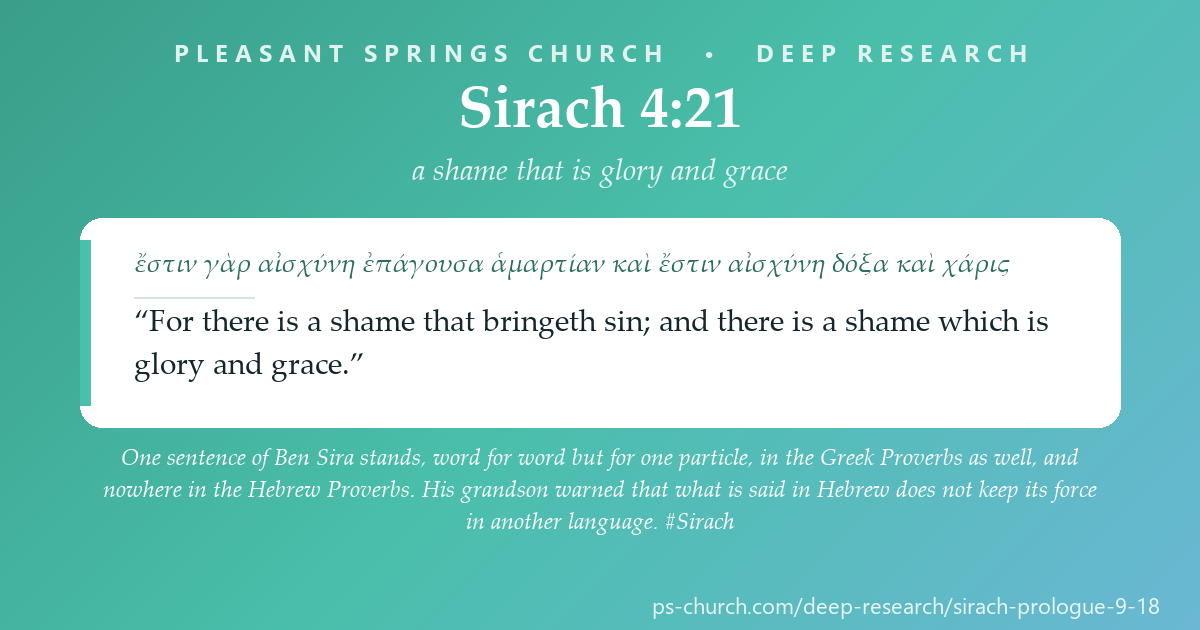
יש בשת משאת עון ויש בשת חן וכבוד · 4:21 · MS C · Hebrew Wikisource transcription, CC BY-SA 4.04:21ἔστιν γὰρ αἰσχύνη ἐπάγουσα ἁμαρτίαν καὶ ἔστιν αἰσχύνη δόξα καὶ χάρις4:21 = KJV 4:21 · Vg 4:25KJV 4:21 “For there is a shame that bringeth sin; and there is a shame which is glory and grace.”
The deepest run anywhere in these chapters: nine consecutive Greek words, shared with Greek Proverbs 26:11a and with nothing else. The Masoretic Proverbs has no 26:11a. The two Hebrew manuscripts of this verse reach no further than two words into the Hebrew Bible. See Stage 4.
VULGATE 4:25 est enim confusio adducens peccatum,/ et est confusio adducens gloriam et gratiam.Translation noteOur gloss of MS C: ‘There is a shame that bears iniquity, and there is a shame of grace and honour.’ MS A ends כבוד וחן:, honour and grace, the Greek’s order (δόξα καὶ χάρις); MS C ends חן וכבוד, the reverse.
היה נכון בשמועה טובה ובארך ענה תענה נכונה · 5:11 · MS C · Hebrew Wikisource transcription, CC BY-SA 4.05:11γίνου ταχὺς ἐν ἀκροάσει σου καὶ ἐν μακροθυμίᾳ φθέγγου ἀπόκρισιν5:11 = KJV 5:11 · Vg 5:13KJV 5:11 “Be swift to hear; and let thy life be sincere; and with patience give answer.”
The English carries a clause the Greek row does not (and let thy life be sincere). And the four witnesses do not agree on how to listen: Greek ταχὺς quick; MS A ממהר hurrying; MS C has neither, reading נכון firm instead; the Latin mansuetus, gentle.
VULGATE 5:13 Esto mansuetus ad audiendum verbum, ut intelligas,/ et cum sapientia proferas responsum verum.Translation noteOur gloss of MS A: ‘Be quick to listen, and with patience return an answer.’
‘Do not repeat a word in your prayer.’ Against Matthew 6:7 it shares no run longer than one word (the forms not and in stand in both). Neither of its two verbs occurs anywhere in the Greek New Testament, and Matthew’s verb occurs nowhere in the Greek Old Testament files held here (Stage 4).
VULGATE 7:15 Noli verbosus esse in multitudine presbyterorum,/ et non iteres verbum in oratione tua.Translation noteOur gloss of the second half of MS A: ‘…and do not repeat a word in prayer.’ The first half is not glossed here. The gloss takes the verb of the second half as a short form of the root shanah, ‘repeat’, as the Greek and the Latin beside it read; as transcribed, with a yod, the same letters could also be taken from another root (yashen, ‘sleep’), and the reading has not been checked against an edition.
לפני זר אל ... ת[ד]ע 8:18 · MS D · Hebrew Wikisource transcription, CC BY-SA 4.08:18ἐνώπιον ἀλλοτρίου μὴ ποιήσῃς κρυπτόν οὐ γὰρ γινώσκεις τί τέξεται8:18 = KJV 8:18 · Vg 8:21KJV 8:18 “Do no secret thing before a stranger; for thou knowest not what he will bring forth.”
Five words shared with Proverbs 27:1 in Greek, and the same five shared with Proverbs 27:1 in Hebrew — band of one in each language. MS D is a fragment here.
VULGATE 8:21 Coram extraneo ne facias consilium :/ nescis enim quid pariet.Translation noteOur gloss of MS A: ‘Before a stranger do not do a secret thing, for you do not know what its end will bring forth.’
The Greek is the CATSS text (Rahlfs), quoted at verse level with attribution. The prologue is set out in CATSS as 36 short rows, 234 words; the rows are printed with their numbers.
On the English. The only English column is the KJV Apocrypha (1769 standard text, public domain), the verse-per-line edition held on this disk, quoted verbatim, spelling and brackets included. It is a translation of a Greek text-form longer than the one printed beside it, and in places it carries a clause the CATSS row lacks; the page flags those lines. Where the King James file this page reads has no text — the whole prologue — the English is our own literal gloss, marked as ours. Glosses of the Hebrew are ours too. The Latin is the Clementine Vulgate, a fourth witness with its own numbering and its own text, and never the source of an English word.
Versification — stated, as on every page here, including where the usual frame does not exist.
There is no Masoretic Sirach, so there is no Masoretic/Septuagint offset to report. The book is not in the Hebrew Bible. What exists instead are four witnesses with four numberings, and every offset between them in this range is listed here, measured from the files.
• Greek (CATSS). The prologue is labelled Prolog 1–36. Chapters 1–9 have 229 rows (27, 18, 29, 31, 15, 36, 36, 19, 18). Six verse numbers are absent from the Greek file in this range: 1:5, 1:7, 1:21, 3:19, 3:25 and 6:1 — chapter 6 begins at 6:2.
• English (KJV Apocrypha). No prologue at all — in any of the three forms of the edition on disk (verse-per-line text, XML, SQL); a second King James Apocrypha e-text on this disk does print one (Stage 5). Chapters 1–9 have 235 verses (30, 18, 31, 31, 15, 37, 36, 19, 18). It carries all six numbers the Greek file lacks. Five of them have no CATSS row at all — KJV 1:5, 1:7 (printed in square brackets in the file), 1:21, 3:19 and 3:25. The sixth is a split, not an addition: CATSS 5:15 is one row, and the KJV prints its first half as 5:15 and its second half as 6:1. Everywhere else in 1–9 the KJV number and the Greek number stand on the same content, checked chapter by chapter by reading.
• Hebrew (Wikisource transcription). Follows the numbering of the critical Greek (Ziegler), not Rahlfs. In this range the two agree except at the two numbers the Hebrew has and CATSS lacks: Hebrew 6:1 (MS A) is the content of CATSS 5:15b, KJV 6:1; and Hebrew 3:25 (MS A) has no CATSS row at all — it is KJV 3:25, באין אישון יחסר אור ובאין דעת תחסר חכמה:, ‘without the pupil light is lacking’ (our gloss of the first half only), and MS A writes it after 3:26 and 3:27. 171 of the 229 Greek rows of 1:1–9:18 have some Hebrew; 58 have none.
• Latin (Clementine). Chapters 1–9 run to 275 rows (40, 23, 34, 36, 18, 37, 40, 22, 25), and the prologue is not separate: it and Greek 1:1 are one row, 1:1. No general offset is claimed; each Latin verse printed here was found by content, and its number is given on the line (Greek 3:30 = Vg 3:33; 4:10 = Vg 4:10–11; 4:21 = Vg 4:25; 5:11 = Vg 5:13; 7:14 = Vg 7:15; 8:18 = Vg 8:21).
• Canonical verses cited. CATSS numbers Proverbs 25–29 as chapters 32–36, so Proverbs 27:1 is CATSS 34:1 and Proverbs 26:11a is CATSS 33:11a. CATSS Psalm numbers are Greek: Ps 138:7 = English 139:7, Ps 36:5 = 37:5, Ps 81:6 = 82:6, Ps 103:4 = 104:4. Both numbers are given where it matters.
The Shape of the Passage
Sequence — three wisdom poems among blocks of instruction (markers counted; not a chiasm)The middle poem is not a hinge. Three wisdom poems placed between blocks of instruction make a rhythm, not a mirror; nothing in chapters 7–9 answers chapters 1–2 in reverse order, and the page claims no centre.
And the shape is not the same in both languages. The address my son — the voice that opens most of these blocks — does not stand at the same verses in the Greek and in the Hebrew (Stage 3).
⚠️ Where this page sits. Sirach is canonical in the Roman Catholic and Orthodox churches, was printed among the Apocrypha in the Protestant Bibles of the Reformation era, and is absent from the Hebrew Bible. This library reads it as a Second-Temple witness and files it under Apocrypha / Deuterocanon. Nothing taught at Pleasant Springs rests on it.
Author
Two authors, and the second one writes the preface. The book is a Jerusalem teacher’s; the prologue is his grandson’s, who translated it in Egypt and says so. The grandson names his grandfather — ὁ πάππος μου Ἰησοῦς, my grandfather Jesus — and never names himself.
The witnesses do not even agree on the author’s name. At 50:27 the Greek reads Ἰησοῦς υἱὸς Σιραχ Ελεαζαρ ὁ Ιεροσολυμίτης, Jesus son of Sirach Eleazar the Jerusalemite; the King James file reads “Jesus the son of Sirach of Jerusalem…”; and MS B reads לשמעון בן ישוע בן אלעזר בן סירא:, of Simeon son of Yeshua son of Eleazar son of Sira (our gloss). Three witnesses, three genealogies. 50:27 belongs to the last study in this series; it is quoted here because the question starts on this page.
He writes as a father to a son. The Greek addresses the reader as child or son at nine verses in these chapters; the Hebrew, where it survives, says my son at eight — and not at the same verses (Stage 3).
Audience
The grandson names his readers: lovers of learning abroad. The prologue ends with those καὶ τοῖς ἐν τῇ παροικίᾳ βουλομένοις φιλομαθεῖν — in the sojourning, who wish to love learning — so as ἐννόμως βιοτεύειν, to live by the law. The love-of-learning word stands three times in the prologue and nowhere else in the 30,348 Greek Old Testament units screened, and nowhere in the Greek New Testament.
The grandfather’s reader is a young man of a Jerusalem household. He has parents to honour, a wife, daughters, servants and cattle, debts and sureties, rulers to keep away from and women he is told not to look at. Chapters 7–9 are written to him, and they read that way; the page reports the frame and does not adopt it as teaching.
And both of them are Jews reading Scripture. The grandfather, the prologue says, gave himself to the law and the prophets and the other ancestral books before he wrote a word.
Orient on the book, its two languages and its two authors.
Search by topic: Sirach / Ecclesiasticus / Ben Sira; Hebrew manuscripts of Ben Sira (Cairo Genizah, Masada, Qumran); Septuagint Sirach, GI and GII; the prologue of Sirach; canon, ‘the law and the prophets’; wisdom literature; almsgiving.
Which articles are relevant?
- Anchor Bible Dictionary — the article on Ben Sira (Sirach, Ecclesiasticus), and those on wisdom in the Old Testament, the Old Testament canon and the Septuagint.
- Eerdmans Dictionary of Early Judaism — the article on Ben Sira, and any on wisdom literature or almsgiving.
- Dictionary of New Testament Background (IVP) — the articles on Sirach, on the Apocrypha and Pseudepigrapha, and on the Old Testament canon. Articles are named here by subject; their exact titles were not checked against the volumes.
- On the text — any article that separates the shorter Greek form (the Rahlfs text quoted here) from the longer one the King James English often follows, and that says which Hebrew manuscript it is reading. An article that speaks of ‘the Hebrew of Sirach’ as if it were one text is not usable for this book.
Bibliography surfaced:
- Patrick W. Skehan and Alexander A. Di Lella, The Wisdom of Ben Sira (Anchor Bible) — a full-length English commentary.
- Pancratius C. Beentjes, The Book of Ben Sira in Hebrew (Brill, 1997) — the text edition whose manuscript sigla the Hebrew file on this disk uses.
- Joseph Ziegler, Sapientia Iesu Filii Sirach (Göttingen Septuagint) — the critical Greek whose verse numbers the Hebrew file follows. Not held.
- Solomon Schechter and Charles Taylor, The Wisdom of Ben Sira (Cambridge, 1899) — the first edition of the Genizah leaves, held on this disk as page images and used by the file’s builder for spot-checks only.
- NETS (A New English Translation of the Septuagint), Sirach, translated by Benjamin G. Wright — an English made from the Greek. Not the edition quoted here; named because it is the obvious next step for a reader who wants the Greek in English.
A Jerusalem teacher, a grandson in Egypt, and the books the prologue says the grandfather read.
Three bodies of background: what the prologue says about itself; where the book’s wording meets the wisdom books of the Hebrew Bible; and the manuscripts through which the Hebrew reached this disk.
What does the prologue say about itself — measured?
It names the books three times, and never the same way twice.
- Prologue 1–2: διὰ τοῦ νόμου καὶ τῶν προφητῶν … καὶ τῶν ἄλλων τῶν κατ' αὐτοὺς ἠκολουθηκότων — through the law and the prophets and the others who followed after them.
- Prologue 8–10: τὴν τοῦ νόμου καὶ τῶν προφητῶν καὶ τῶν ἄλλων πατρίων βιβλίων ἀνάγνωσιν — the reading of the law and the prophets and the other ancestral books.
- Prologue 24–25: αὐτὸς ὁ νόμος καὶ αἱ προφητεῖαι καὶ τὰ λοιπὰ τῶν βιβλίων — the law itself and the prophecies and the rest of the books.
The law is fixed; the second term shifts once, from the prophets to the prophecies; and the third term moves every time — the others who followed, the other ancestral books, the rest of the books. The prologue is commonly read as the earliest surviving witness to a three-part grouping of Israel’s books. That is a claim about all of ancient literature, and it cannot be checked from this disk. What can be measured is that the grouping is here, three times, and that its third member has no fixed name.
The date. ἐν γὰρ τῷ ὀγδόῳ καὶ τριακοστῷ ἔτει ἐπὶ τοῦ Εὐεργέτου βασιλέως — in the thirty-eighth year, under Euergetes the king. The Greek row does not say which Euergetes; the Clementine Latin calls him Ptolemy. The thirty-eighth year is commonly reckoned as 132 BC, of Ptolemy VIII Euergetes II. Reported, not measured: nothing on this page rests on it.
Where. Egypt (row 28), for readers ἐν τῇ παροικίᾳ, in the sojourning — Jews living outside the land.
Where Ben Sira’s wording lands: Proverbs, measured in both languages
In Hebrew. Screened against the Masoretic Bible, 13 rows of MS A reach three consecutive words or more with some verse, and four of those 13 land in Proverbs: 7:6 with Proverbs 22:27, 8:1 with 3:30, 9:11 with 3:31, and 8:18 with 27:1. Two of the four are the prohibition form itself — do not quarrel with, do not envy a man of.
In Greek. Screened against every other unit of the Greek Old Testament, five rows of these chapters reach five words or more with a tie band of one from both sides. Two land in Proverbs (4:21 and 8:18); the others are the law-and-prophets phrase of the prologue (2 Maccabees 15:9), a line of Psalm 37 (2:6), and a string of small words (two pronouns, a conjunction, a preposition, an article and a noun) that happens to stand in Psalm 139 (6:12). See Stage 4.
Among these runs that point to one verse only, Proverbs is the book that recurs: four of the nine such Hebrew rows, and two of the five Greek rows (the Psalms also supply two in Greek, one of them the page’s own counter-example, 6:12). The page reports where the runs land; it does not say who learned from whom, and in one case — 4:21 — it cannot even say which book the sentence started in.
How the Hebrew reached this disk
Medieval copies, and fragments of ancient ones. In this range the Hebrew is carried by three Cairo Genizah manuscripts — A (3:6–9:18, the longest-running witness, with gaps), C (scattered rows from 3:14 to 7:25) and D (7:18–8:18) — and by fragments of the Qumran scroll 2Q18 at 6:26–31.
MS C is not a continuous copy. Its 46 rows in this range are scattered — 8 in chapter 3, 5 in chapter 4, 9 in chapter 5, 14 in chapter 6, 10 in chapter 7 and none in 8 or 9 — and its transcriber notes that it sets 37:1–2 between 6:6 and 6:7, and 3:27 after 6:15. It is commonly described as an anthology of sayings, and its shape here fits that description.
MS A carries its own order too. It writes 3:25 after 3:26 and 3:27, and at several verses (4:10, 4:19, 4:27, 5:4, 5:6, 5:7, 5:14, 6:37, 7:6, 7:17, 9:3, 9:8, 9:9, 9:10, 9:13) it carries two lines under one Greek verse number. A Hebrew manuscript is not a Hebrew original; it is a later copy with its own history, and this page treats every line as a reading of a named manuscript.
A translator’s vocabulary, and what stands under it in Hebrew.
Greek counts are over the 30,348 Greek Old Testament verse units screened here (the Odes excluded) and the 7,927 verses of the SBLGNT. Hebrew counts are over the rows of the Ben Sira transcription. Counts are of word forms, never lemmas; a family is a stated prefix.
Once in the 30,348 Greek Old Testament verse units screened here — in the prologue, row 22. Seven times in the Greek New Testament, every one of them in John (5:2; 19:13, 17, 20; 20:16) or Revelation (9:11; 16:16). This adverb stands in the Greek Old Testament files only where the translator is talking. The language itself is named there by other words: Ioudaisti, ‘in Judean’, in six units (2 Kings 18:26, 28; 2 Chronicles 32:18; Nehemiah 13:24, CATSS 2 Esdras 23:24; Isaiah 36:11, 13), and ‘the Hebrew voice’ at 4 Maccabees 12:7 and 16:15.
Once in the Greek Old Testament files — prologue row 30 — and eight times in the Greek New Testament, almost always in the formula which is translated (Matthew 1:23; Mark 5:41; 15:22, 34; John 1:38, 41; Acts 4:36; 13:8). This compound, one of the New Testament’s words for translating, occurs in the Greek Old Testament files only in the mouth of their one self-declared translator. Other words of its family do stand there — the interpreter of Genesis 42:23; the simple verb at Greek Esther 10:3l (a letter that Lysimachus, it says, had translated) and at Job 42:17b (this is interpreted from the Syriac book, our gloss); and diermēneuetai, is interpreted, at 2 Maccabees 1:36 — but none of them is a translator speaking of his own work.
Three times in the Greek Old Testament files: the prologue (row 21) and twice in 4 Maccabees (3:15; 5:20). Never in the Greek New Testament. The word on which the page’s title hangs, and the grandson uses it in the negative.
Three rows of these chapters carry it: 3:14, 3:30 and 7:10. MS A survives at all three, and at all three it carries a word of the tsedeq family — צדקת, צדקה, ובצדקה — the Hebrew word for righteousness. Measured as presence at the same verse, not as a word-for-word alignment. 3:30 is the verse that says it atones for sins; see Stage 5 for how the page handles that.
The two-word form occurs once in the Greek Old Testament files — here, 4:10 — and once in the Greek New Testament, Luke 1:32. The plural, υἱοὶ Ὑψίστου, occurs once in each: Psalm 82:6 (CATSS Ps 81:6) and Luke 6:35. Sirach applies the phrase to anyone who is a father to orphans; the page draws no line from it to anyone else. And MS A has no Most High here at all.
Counted here, not assumed: the voice that says my son
The Greek addresses the hearer as child or son at nine verses — 2:1, 3:1, 3:12, 3:17, 4:1, 6:18, 6:23, 6:32, 7:3. The Hebrew says בני, my son, at eight — MS A at 3:8, 3:12, 3:17, 4:1, 4:20, 6:32 and MS C at 3:17, 3:18, 6:18.
Where both survive, they agree at five verses (3:12, 3:17, 4:1, 6:18, 6:32). The Hebrew has the address and the Greek does not at three (3:8, 3:18 in MS C, 4:20); the Greek has it and the Hebrew does not at one (7:3, where MS A begins אל תדע). 2:1, 3:1 and 6:23 have no Hebrew to compare. The voice that structures these chapters is not placed identically in the two languages.
Counted here: who is speaking in 4:15–19
In the Greek, wisdom is she. 4:15 ὁ ὑπακούων αὐτῆς — he who obeys her; 4:18 ends ἀποκαλύψει αὐτῷ τὰ κρυπτὰ αὐτῆς — she will reveal to him her hidden things.
In MS A, wisdom is I. 4:15 שומע לי — he who listens to me, and later in the same line בחדרי, in my chambers; 4:18 ends וגליתי לו מסתרי: — and I will reveal to him my secrets (our glosses).
Same poem, same verse numbers, same content — and a different speaker. The King James English follows the Greek (4:18, “shew him her secrets”). This is a comparison of person and suffix across two languages, not a word-run, and the page draws no conclusion about which voice is older.
One sentence in two Proverbs; five words of a translator’s preface; and the parallels this page set out to test, which measure almost nothing.
Three screens, each in one language. Greek against the Greek New Testament (every one of the 265 rows against 7,927 verses) and Greek against the rest of the Greek Old Testament (28,946 units outside Sirach): contiguous runs of whole word forms, a row sharing only single words reporting 1, so 0 means no word shared at all. Hebrew against the Masoretic Bible (273 manuscript rows against 23,204 verse units): single words not counted, so 0 means no two consecutive words shared, and a lacuna mark breaks a run. The tie band — how many target verses reach the same depth — is printed beside every run, and for the runs that matter it is printed from both sides.
Against the Greek New Testament: the distribution
All 265 rows, prologue and chapters together, against 7,927 verses: 264 reach one, 251 reach two, 115 reach three, 15 reach four, 1 reaches five, and nothing reaches six.
Ben Sira’s own chapters, 1:1–9:18, 229 rows: 221 reach two, 107 reach three, 14 reach four, and nothing reaches five. The prologue, 36 rows: 30 reach two, 8 reach three, and one reaches five. The single deepest New Testament contact in this stretch is not in the grandfather’s proverbs at all. It is in the grandson’s first sentence. And one row shares no word with the New Testament at all: the prologue’s last, ἐννόμως βιοτεύειν.
The five words that do reach: the law and the prophets
Prologue 1 → Acts 13:15 and Romans 3:21 — a run of five, tie band 2. τοῦ νόμου καὶ τῶν προφητῶν — of the law and of the prophets.
From the other side the band is also 2. Screened against all 30,348 Greek Old Testament units, Acts 13:15 reaches five and no further, at exactly two places — Sirach’s prologue and 2 Maccabees 15:9 (ἐκ τοῦ νόμου καὶ τῶν προφητῶν); Romans 3:21 reaches five at the same two. The five-word form occurs in two Greek Old Testament units and two New Testament verses, and those are the four. The nominative form — ὁ νόμος καὶ οἱ προφῆται — stands at Matthew 7:12 and Luke 16:16 and nowhere in the Greek Old Testament files.
Acts 13:15: μετὰ δὲ τὴν ἀνάγνωσιν τοῦ νόμου καὶ τῶν προφητῶν — after the reading of the law and the prophets (our gloss), in a synagogue. Romans 3:21: Νυνὶ δὲ χωρὶς νόμου δικαιοσύνη θεοῦ πεφανέρωται μαρτυρουμένη ὑπὸ τοῦ νόμου καὶ τῶν προφητῶν — but now apart from law a righteousness of God has been made manifest, witnessed by the law and the prophets (our gloss).
⚠️ The CATSS row division cuts the phrase the second time. At prologue 8–9 the same five words stand again — τοῦ νόμου | καὶ τῶν προφητῶν — split across two rows, so the row screen sees two and three. Joined into one continuous text, the prologue carries the phrase twice, and its deepest New Testament run is still five, band 2. Short colometric rows depress every run in the prologue.
What this is: the prologue and two New Testament writers naming Scripture in the same genitive phrase. It is not a citation in either direction, and the page does not say anyone read anyone.
The parallels this page set out to test — all measured
| Sirach (Greek) | New Testament | longest shared run | that NT verse’s best anywhere in Prol.–9:18 |
|---|---|---|---|
| 2:1 prepare your soul for testing | James 1:2 / 1:3 / 1:4 | 0 / 0 / 0 — no word form shared | 1 / 1 / 1 (bands 8, 43, 234) |
| 2:18 let us fall into the hands of the Lord | Hebrews 10:31 | 2 εἰς χεῖρας | 2, band 2 (2:18 and 4:19) |
| 3:30 almsgiving will atone for sins | 1 Peter 4:8 | 0 | 1 (band 65) |
| 4:10 you will be like a son of the Most High | Luke 6:35 | 1 (and; also Most High, not adjacent) | 3, band 1 — with 2:8, ὁ μισθὸς ὑμῶν your reward |
| 5:11 be quick to hear | James 1:19 | 1 (ταχὺς) | 2, band 1 (4:31, to the) |
| 7:14 do not repeat a word in your prayer | Matthew 6:7 | 1 (not; also in, not adjacent) | 2, band 6 |
James 1:2–4 and the testing chapter. Sirach 2 has testing (2:1) and endurance (2:14); James 1:2–4 has both ideas — and 2:1 shares no word form at all with any of the three James verses. Πᾶσαν χαρὰν ἡγήσασθε ἀδελφοί μου ὅταν πειρασμοῖς περιπέσητε ποικίλοις (our gloss: count it all joy, my brothers, when you fall into various trials). The best any of the three does against all 265 rows here is a single word, and each ties across many rows (bands 8, 43 and 234; James 1:3’s 43 include rows that share only the or that). The one that carries the theme is James 1:3’s endurance, ὑπομονήν, which stands at 2:14.
Hebrews 10:31 and the hands of the Lord. Sirach 2:18 ἐμπεσούμεθα εἰς χεῖρας κυρίου shares three words with 1 Chronicles 21:13 (ἐμπεσοῦμαι δὴ εἰς χεῖρας κυρίου, David’s choice) and only two with Hebrews 10:31 (φοβερὸν τὸ ἐμπεσεῖν εἰς χεῖρας θεοῦ ζῶντος). The three-word form εἰς χεῖρας κυρίου stands in two Greek Old Testament units, 1 Chronicles 21:13 and here, and in no New Testament verse.
Luke 6:35 and the son of the Most High. The longest run is one word, reached by two different words — and and Most High, genitive in both — never side by side. The singular υἱὸς ὑψίστου is matched in the New Testament only by Luke 1:32, καὶ υἱὸς Ὑψίστου κληθήσεται; Luke 6:35’s plural υἱοὶ Ὑψίστου is matched in the Greek Old Testament only by Psalm 82:6 — ἐγὼ εἶπα θεοί ἐστε καὶ υἱοὶ ὑψίστου πάντες (CATSS Ps 81:6). And Luke 6:35’s deepest run anywhere in these chapters is with 2:8, not 4:10: three words, your reward, band 1. The Hebrew of 4:10, for what it is worth, has no Most High to match.
James 1:19 and the quick listener. One word: ταχὺς. The form occurs in seven Greek Old Testament units (two of them Sirach, 5:11 and 21:22) and in one New Testament verse, James 1:19 — ἔστω δὲ πᾶς ἄνθρωπος ταχὺς εἰς τὸ ἀκοῦσαι (our gloss: let every man be quick to hear). James 1:19’s own best against the whole Greek Old Testament is two words, shared with 485 units.
Matthew 6:7 and the repeated word. The longest run is one word; the verses share two word forms, not and in, never side by side. Προσευχόμενοι δὲ μὴ βατταλογήσητε ὥσπερ οἱ ἐθνικοί δοκοῦσιν γὰρ ὅτι ἐν τῇ πολυλογίᾳ αὐτῶν εἰσακουσθήσονται (our gloss: and when you pray, do not babble like the Gentiles, for they think that in their many words they will be heard). Its verb βατταλογήσητε occurs nowhere in the 30,348 Greek Old Testament units, in any form beginning with its stem; and no word beginning with the stem of either of Sirach’s verbs, ἀδολέσχει or δευτερώσῃς, occurs in the 7,927 New Testament verses. Matthew’s other key word, πολυλογίᾳ, belongs to a family that occurs once in the Greek Old Testament files — Proverbs 10:19, ἐκ πολυλογίας — and not in Sirach.
The fours in Ben Sira’s own chapters — and the counter-examples among them
Fourteen rows of 1:1–9:18 reach four. Every one is a string of common words — and your heart (1:30 → Matthew 6:21), in your house (4:30 → Luke 19:5), stretch out your hand (7:32 → Luke 6:10), according to his will (8:15 → 1 John 5:14) — eleven of the fourteen at band 1, which here measures only that the exact case and order are uncommon. Three of them repay a closer look, and all three dissolve.
- 1:8 → Revelation 7:15, four words, band 1 — and band 1 from the other side too. καθήμενος ἐπὶ τοῦ θρόνου — God seated on the throne, in both. It completes only by grammatical case. Revelation has a participle of sit followed by on the throne(s) in eleven verses, in five different forms of words, and this exact form, ὁ καθήμενος ἐπὶ τοῦ θρόνου, only once. And Revelation 7:15’s own deepest Greek Old Testament run is five — with Leviticus 15:6, a person sitting on something that a man with a discharge has sat on, in a purity law, and with Psalm 41:4 (42:3). Sirach 1:8 is not even its best partner.
- 7:30 → Hebrews 1:7, four words, band 1. καὶ τοὺς λειτουργοὺς αὐτοῦ, and his ministers. Hebrews 1:7 is a citation — it introduces Psalm 104:4 with he says — and against the Greek Old Testament it reaches ten words, band 1, with Psalm 103:4 (104:4). Sirach 7:30’s four words are four of the Psalm’s. Two texts touching a third.
- 3:8 → four words, band 5. Four of the five are honour your father — Mark 7:10, Mark 10:19, Luke 18:20, Ephesians 6:2, the commandment of Exodus 20:12 and Deuteronomy 5:16 — and the fifth, Luke 24:19, shares a different four, in deed and word. A band of five is the measurement saying ‘formula’.
Against the rest of the Greek Old Testament: the distribution, and a nine
All 265 rows against the 28,946 Greek Old Testament units outside Sirach: 256 reach two, 176 reach three, 51 reach four, 10 reach five, 3 reach six, nothing reaches seven or eight — and one row reaches nine.
- 4:21 → Proverbs 26:11a (CATSS 33:11a) — nine, band 1; and 26:11a’s own best is 4:21, band 1. αἰσχύνη ἐπάγουσα ἁμαρτίαν καὶ ἔστιν αἰσχύνη δόξα καὶ χάρις. Proverbs reads ἔστιν αἰσχύνη ἐπάγουσα ἁμαρτίαν καὶ ἔστιν αἰσχύνη δόξα καὶ χάρις — ten forms, all of them in Sirach’s row, which also carries γὰρ as its second word. See the next answer; this is the page’s finding.
- 8:18 → Proverbs 27:1 (CATSS 34:1) — five, band 1; and Proverbs 27:1’s own best is 8:18, band 1. οὐ γὰρ γινώσκεις τί τέξεται — for you do not know what it will bring forth. Proverbs goes on, ἡ ἐπιοῦσα, the coming day; Sirach stops.
- Prologue 1 → 2 Maccabees 15:9 — five, band 1 both ways. The law-and-prophets phrase again.
- ⚠️ Prologue 27 → 2 Chronicles 16:1 — five, band 1 from Sirach’s side. τῷ ὀγδόῳ καὶ τριακοστῷ ἔτει, in the thirty-eighth year. A date formula, and from the other side it is nothing: 2 Chronicles 16:1’s own best is twelve words, with 1 Kings 15:17, its parallel. Band 1 from one side is not band 1 from both.
- ⚠️ 6:12 → Psalm 139:7 (CATSS 138:7) — SIX, band 1, and band 1 from the Psalm’s side too. σοῦ καὶ ἀπὸ τοῦ προσώπου σου — …you, and from your face. A fair-weather friend hides from your face; the psalmist cannot flee from God’s. Six words, unique both ways, and nothing but two pronouns, a conjunction, a preposition, an article and a noun. This is the page’s own proof that depth and uniqueness are not contact.
- 2:6 → Psalm 37:5 (CATSS 36:5) — five, band 1 both ways (σου καὶ ἔλπισον ἐπ' αὐτόν, …your way(s), and hope in him); 2:11 → Psalms 103:8 and 145:8, five, band 2, the Exodus 34:6 formula οἰκτίρμων καὶ ἐλεήμων ὁ κύριος; 1:9 and 4:30, five, bands 2 and 6; 4:4, six, band 7 — do not turn your face away from, a formula found in four Psalms and in three rows of Tobit’s two Greek recensions (seven units in all).
The finding: one sentence, two Proverbs — and the Hebrew that tells them apart
Two sentences of these chapters are, in Greek, unique twins of lines in Proverbs. 8:18 shares five words with Proverbs 27:1; 4:21 shares nine with Proverbs 26:11a. Measured from either end, each pairing has a tie band of one, though they are not the same size of contact: 4:21 carries every word of its Proverbs line, while 8:18 shares only its own closing clause, five of its ten words, and its first half and that of Proverbs 27:1 are different sayings. On the Greek evidence alone both look like unique contact of the same kind.
The Hebrew separates them.
| Sirach 8:18 | Sirach 4:21 | |
|---|---|---|
| Greek Sirach ↔ Greek Old Testament 28,946 units outside Sirach | 5 words with Proverbs 27:1 (CATSS 34:1) — band 1; and Proverbs 27:1’s own best is Sirach 8:18, band 1 | 9 words with Proverbs 26:11a (CATSS 33:11a) — band 1; and 26:11a’s own best is Sirach 4:21, band 1 |
| Hebrew Sirach ↔ Masoretic Bible 23,204 verse units | MS A: 5 words with Proverbs 27:1 — band 1. (MS D is a fragment here and reaches nothing.) | MS A: 2 (band 17, every one of them for there is); MS C: 2 (band 1, Psalm 84:12 in Masoretic numbering, English 84:11, grace and honour). Nothing reaches three. |
| Masoretic Proverbs | Has 27:1: אַֽל־תִּ֭תְהַלֵּל בְּי֣וֹם מָחָ֑ר כִּ֤י לֹֽא־תֵ֝דַ֗ע מַה־יֵּ֥לֶד יֽוֹם׃ | Has no 26:11a. Its 26:11 is כְּ֭כֶלֶב שָׁ֣ב עַל־קֵא֑וֹ כְּ֝סִ֗יל שׁוֹנֶ֥ה בְאִוַּלְתּֽוֹ׃ |
| ESV Proverbs (cached) | 27:1 “Do not boast about tomorrow, for you do not know what a day may bring.” | 26:11 “Like a dog that returns to his vomit is a fool who repeats his folly.” — and no 26:11a |
| Clementine Latin | Sirach 8:21 Coram extraneo ne facias consilium :/ nescis enim quid pariet. · Proverbs 27:1 Ne glorieris in crastinum,/ ignorans quid superventura pariat dies. | Sirach 4:25 has the sentence (see the codex above). Proverbs 26:11–12 does not: Sicut canis qui revertitur ad vomitum suum,/ sic imprudens qui iterat stultitiam suam. |
8:18 is a twin in both languages. MS A’s כי לא תדע מה ילד is the Masoretic כִּ֤י לֹֽא־תֵ֝דַ֗ע מַה־יֵּ֥לֶד — the same five words, and no other verse of the 23,204 carries them. It is one word deeper than Proverbs 27:1 reaches anywhere inside the Hebrew Bible itself: its best there is four, with Ecclesiastes 11:2. And in both languages the run stops at the same place — at the subject of bring forth, where Proverbs has a day and Sirach has something else in Hebrew and nothing at all in Greek, whose verse ends there.
4:21 is a twin only in Greek. Its Hebrew survives in two manuscripts, and neither shares three consecutive words with any verse of the Masoretic Bible. The Masoretic Proverbs has no line numbered 26:11a; the ESV’s Proverbs has none; the Clementine Latin Proverbs has none. The sentence stands in Greek Sirach, Hebrew Sirach, Latin Sirach, English Sirach — and in Greek Proverbs.
It shows a fact about the witnesses: a sentence that is Ben Sira’s in every language held here is also a line of the Greek Proverbs, and is not a line of the Hebrew Proverbs or of the Clementine Latin Proverbs.
It does not show how the line got into Greek Proverbs, or when, or by whose hand. The page does not say the Greek Proverbs took it from Sirach, or the reverse, or that both took it from somewhere else; no measurement on this disk can decide that, and the scholarship on the Greek Proverbs’ extra lines was not consulted (Stage 5).
It is a difference of the kind the grandson’s prologue describes — though the page cannot say that this line arose in translation. His prologue says that the law itself, the prophecies and the rest of the books differ not a little from what they are in their own language. Proverbs is commonly counted among the rest of the books (the page cannot check that, or whether the grandson’s Greek Proverbs had this line), and here is one place where its Greek and its Hebrew are not the same book. That is a description of the witnesses, not a theory about them.
Against the Masoretic Bible: the Hebrew distribution, and one counter-example
273 manuscript rows of 3:6–9:18 against 23,204 verse units. MS A (186 rows): 84 share no two consecutive words with any verse, 89 reach two, 12 reach three, none reaches four, and one reaches five — 8:18. MS C (46 rows): 18 / 26 / 1 / 1 at zero, two, three and four. MS D (34 rows, many of them fragments): 28 at zero and 6 at two. The six 2Q18 rows are fragments, and reach nothing. The one marginal row (MS A’s margin at 3:14) reaches two.
The thirteen MS A rows at three or more: 3:12 and 3:13 (all the days of your / his life, bands 7 and 10 — a formula), 3:23 (1 Kings 19:7), 3:28 (Esther 2:7), 4:5 (Deuteronomy 15:9), 5:1 (Genesis 31:29), 5:7 (band 2), 5:12 (Judges 18:19), 7:6 (Proverbs 22:27), 8:1 (Proverbs 3:30), 8:17 (band 4), 9:11 (Proverbs 3:31) and 8:18 (Proverbs 27:1, five). Three-word band-1 hits like 3:23 — for it is too much for you, Elijah’s road in 1 Kings — are what coincidence looks like at this depth.
⚠️ 5:12 — two languages, two different partners. In Hebrew, MS C שים ידך על פיך shares four words with Judges 18:19 (שִֽׂים־יָדְךָ֤ עַל־פִּ֙יךָ֙, put your hand on your mouth), band 1, and MS A, which lacks the verb, shares three. In Greek, 5:12 shares one word with either Greek text of Judges 18:19 — and four, band 1, with Genesis 41:40, where ἐπὶ τῷ στόματί σου means that at your word all Pharaoh’s people will obey Joseph. The Hebrew points to an idiom; the Greek run is an accident of a preposition and a noun — though Greek 5:12 does carry the hand-on-mouth idiom of Greek Judges 18:19, in other grammatical cases, which a word-form run cannot see. Contrast 8:18, where both languages point to the same verse.
The divine name cuts runs. MS A and MS C write it ייי; the Masoretic text writes the four-letter name. Read as the same word, two rows move — MS A 5:4 (second line) from zero to two, and MS C 5:4 from two to three (the LORD, slow to anger, Numbers 14:18 and its kin). No headline figure changes; the counts above are the unmapped ones.
What this page could not check, what the tools could not do, and where it is weakest.
This is the section that makes the shelf trustworthy. A new Hebrew witness makes it longer, not shorter.
⚠️ Tooling notes — reported, not buried:
- The Hebrew Ben Sira has no loader in the shelf’s tooling yet. This page reads the transcription file directly, never turns it into a dictionary (rows are not unique per verse: doublets, several manuscripts, split lines), and tokenises it itself. Any token carrying a lacuna or restoration mark — brackets, dots, a question mark — is treated as a break that no run may cross. Fed through the Masoretic normaliser unchanged, a restored word such as נ[פש]: (MS A 4:1) would split into two false words.
- The Hebrew file is not numbered like the Greek file. It follows Ziegler; CATSS follows Rahlfs. In this range they differ only at 3:25 and 6:1 (see Versification), and the page aligned those by content. The file’s own notes say the two diverge in chapters 35–36; that is a later page’s problem, and no join on bare keys is safe there.
- The prologue’s chapter label is Prolog. The New Testament screen compares chapters as strings so that it can be included; until the day this page was built it compared them as numbers and failed on this book.
- The Greek New Testament loader returns MorphGNT’s normalised column (accents regularised, the movable nu written in brackets), which is right for measuring and wrong for printing. Every New Testament line printed here is read from the SBLGNT word column of the same files, and the self-check compares it character for character.
⚠️ What this page could NOT check:
- The Hebrew is a transcription, not an edition. One unnamed Wikisource editor typed almost all of it, from the manuscripts, with occasional cross-reference to the Academy of the Hebrew Language’s database. It is unpointed (but for one word on this page), it is not a critical edition, and most of its rows have never been checked against a second source. The file’s builder spot-checked a few passages against the 1899 Schechter–Taylor text and the Qumran data. One of those spot-checks falls on a line this page prints: MS A 3:30, found identical word for word to the Schechter–Taylor text, end punctuation aside. Every other Hebrew line printed here rests on the transcription alone.
- Incomplete pages. In this range Wikisource marks one source page incomplete: the Qumran chapter-6 page, where 2Q18’s fragment 1 (6:14–15) and 6:20–25 are untyped. The Masada gaps and the vandalised MS A page (13:25–14:10, pinned to the revision before the vandal edit) fall outside this range.
- Ziegler’s critical Greek, and the longer Greek text-form. Not held. The KJV verses with no CATSS row (1:5, 1:7, 1:21, 3:19, 3:25) are commonly assigned to that longer form; this page can report that the English has them and the Greek file does not, and nothing more.
- The Syriac, the Old Latin, Ma’agarim, Beentjes. None held, none consulted.
- Proverbs 26:11a. Why the Greek Proverbs has a line the Hebrew Proverbs lacks, and where it came from, is a question for the scholarship on the Greek Proverbs, which was not consulted. The page reports the four witnesses and stops.
- The prologue’s place in the history of the canon. That it is the earliest three-part naming of Israel’s books is reported as a common reading, not checked.
- The date. 132 BC is a common reckoning of the thirty-eighth year of Euergetes; it is reported, not measured.
- The English prologue. The King James file this page reads (eBible’s 1769 text) has none, in any of its three formats. No printed 1769 King James is held, so what it carried cannot be checked directly; but two other English files on this disk do print the prologue — a second King James Apocrypha e-text (Project Gutenberg no. 124, which also prints a shorter prologue made by an uncertain Author) and an 1851 English Septuagint — so the omission is probably the eBible file’s. Neither was used, because this shelf prints one English column for these books and it is that file. The prologue’s English is therefore our gloss.
- Allusion. Every screen here finds verbatim contact. A run of one is not proof of independence, and a run of nine is not proof of borrowing.
⚠️ Where this page is weakest:
- The English column is a different Greek text from the Greek column. The KJV translates a longer form: at 5:11 it carries and let thy life be sincere, which has no word in the CATSS row; at 1:18 and 2:11 it is fuller than the Greek beside it.
- At 5:1 the English file says the opposite of the other three witnesses. It reads “Set thy heart upon thy goods; and say not, I have enough for my life.” with no negative; the Greek row opens μὴ ἔπεχε, do not set; MS A opens אל תשען על חילך, do not lean on your wealth; the Latin opens Noli. Seven verses later the same file renders the same Greek verb phrase “Set not thine heart upon goods”. Whether the negative is missing from the printed King James or only from e-texts is not settled from this disk: the second King James e-text held here (Project Gutenberg no. 124) also reads 5:1 without it, while the 1851 English Septuagint file, whose Sirach often matches the King James word for word, has it. The page prints the file as it stands and says so here.
- Every gloss of the Hebrew and of the New Testament is ours. They are literal and they are marked, but they are one reader’s, and the Hebrew is unpointed: at 4:10 the same letters can be read and God or and do not, and the page says which it chose.
- 3:30 says that almsgiving atones for sins, and the page reports it as written. The Greek reads will atone; MS A reads an unpointed imperfect, atones or will atone; the Latin resists. The page describes a Second-Temple teacher’s sentence; it does not teach it. Pleasant Springs reads Sirach as a witness to its time, and for the church the question of what atones for sin is answered in the canon, not here. Against the New Testament this verse’s deepest run is two words, water and (Acts 8:36; 1 John 5:8).
- The Hebrew counts depend on a tokenising rule this page made. Breaking runs at every lacuna is conservative: it can only shorten runs. A different rule could lengthen some three-word figures; it cannot create the five at 8:18, which crosses no gap. The counts also depend on spelling. The screen matches exact consonants, and the manuscripts often write waw and yod where the Masoretic text does not. Read with every waw and yod ignored on both sides (a crude test), MS A’s zeros fall from 84 to 44 and its rows at three or more rise from 13 to 24; 8:18 stays at five, band 1, and both lines of 4:21 stay at two.
- The structure diagram’s boundaries are a reading. The markers are counted; where one block ends is judged, and is offered as a sequence with no centre.
Commentaries & studies:
- Skehan & Di Lella, The Wisdom of Ben Sira (Anchor Bible).
- Beentjes, The Book of Ben Sira in Hebrew (1997) — the manuscripts in one volume. Not held.
- Ziegler, Sapientia Iesu Filii Sirach (Göttingen). Not held.
- Schechter & Taylor, The Wisdom of Ben Sira (Cambridge, 1899) — page images on disk, read only for the file’s spot-checks.
- NETS, Sirach (B. G. Wright) — the Greek in English.
A translator who warned you, and one place where a Greek book and its Hebrew differ.
Name what you learned, why it matters, and one concrete response.
What should we carry away — and do?
- Some translators warn you, if you read the preface. Sirach’s grandson did: things said in Hebrew do not have equal force in another language, and that goes for the law, the prophets and the other books too. He applied the warning to his own work and, in the same breath, to the law, the prophecies and the rest of the books.
- Here is one place where a Greek book and its Hebrew differ. A sentence about two kinds of shame (ten Greek words; eleven in Ben Sira’s Greek, which has one more particle) stands in Greek Proverbs and not in Hebrew Proverbs — and in Ben Sira in every language held here. The Greek Bible and the Hebrew Bible are not always the same book, and it is fair to ask which one a quotation is from.
- The parallels that look strongest are often the weakest. Be quick to hear and James 1:19 share one word; do not repeat a word in prayer and Matthew 6:7 share no two words in a row; the testing verse, 2:1, and James 1:2–4 share none. The deepest New Testament contact in the whole stretch — preface and nine chapters together, since the nine chapters alone reach four — is five words of the translator’s preface naming Scripture. Measure before you repeat.
- The sentence itself is worth keeping. There is a shame that brings sin, and there is a shame that is glory and grace. Not all embarrassment is to be avoided; some of it is the right response to the right thing.
- One concrete response. Scripture itself gives this charge (Isaiah 1:17; James 1:27), and Ben Sira puts it as a father to the fatherless (4:10). This week, find out what one child without a father near your church actually needs, and meet one of those needs.
Sirach 4:21 · to share
Greek (CATSS) · Hebrew MS C · KJV ApocryphaVULGATE 4:25 est enim confusio adducens peccatum,/ et est confusio adducens gloriam et gratiam.
Sirach in six studies. 1 · Prologue–9:18 (this page) 2 · 10:1–19:30 3 · 20:1–28:26 4 · 29:1–36:27 5 · 37:1–43:33 6 · 44:1–51:30
Next: Sirach 10:1–19:30 →
Every Deep Research page traces its passage across the whole sweep — the Old Testament, the Second-Temple world between the testaments (historical witnesses, not Scripture), and the New Testament. Follow the thread:
Pleasant Springs Church — Deep Research
Research method after Michael S. Heiser’s Bible Research Method (examine dictionaries → ancient literature → important words → textual connections → academic publications → share), with the Pleasant Springs “Author & Audience” foundation. Scripture set in the Hebrew, the Greek editions named on each page and the ESV (Old Testament), and the Greek New Testament and the ESV (New Testament), per the practice of Pleasant Springs Church. ⚠️ Status: Sirach is not part of the Protestant canon. It is canonical in the Roman Catholic and Orthodox churches, was printed among the Apocrypha in the Reformation-era Protestant Bibles, and is absent from the Hebrew Bible. This study is filed under Apocrypha / Deuterocanon and nothing taught at Pleasant Springs rests on it. Greek: the CATSS morphologically analysed Septuagint (Rahlfs), Sirach.mlxx, quoted at verse level with attribution; prologue rows, verse rows, run depths and tie bands re-derived from the file for this study. Hebrew: Hebrew Wikisource manuscript transcriptions, CC BY-SA 4.0, each page pinned to the revision recorded in the file’s provenance — the pages quoted here are בן סירא/כתב יד A/ג rev. 1412980 (2022-07-13); בן סירא/כתב יד A/ד rev. 2959179 (2025-09-25); בן סירא/כתב יד A/ה rev. 3003307 (2026-04-05); בן סירא/כתב יד A/ז rev. 2960232 (2025-10-05); בן סירא/כתב יד A/ח rev. 2962788 (2025-11-06); בן סירא/כתב יד B/נ rev. 1381752 (2022-03-03); בן סירא/כתב יד C/ד rev. 1282990 (2021-10-27); בן סירא/כתב יד C/ה rev. 3003306 (2026-04-05); בן סירא/כתב יד D/ח rev. 1340450 (2022-01-13); quoted as transcribed (unpointed but for one word of MS A 4:21), with the siglum on every line. It is a transcription, not a critical edition. English: the KJV Apocrypha (1769 standard text, public domain), the verse-per-line edition held on this disk, quoted verbatim and checked against the file by this page’s self-check; it has no prologue, and the prologue’s English is our own gloss, as are all glosses of Hebrew and of New Testament Greek. Latin: the Clementine Vulgate (public domain), a fourth witness with its own numbering. Canonical comparison verses: the ESV for Proverbs, where cached; the Masoretic text (Sefaria, Miqra according to the Masorah, CC BY-SA) and the SBLGNT otherwise. No word-run is ever measured across languages. Direction of influence is nowhere asserted. Scholarship after Skehan–Di Lella, Beentjes, Ziegler and Schechter–Taylor.
Scripture quotations marked ESV are from the ESV® Bible (The Holy Bible, English Standard Version®), © 2001 by Crossway, a publishing ministry of Good News Publishers. ESV Text Edition: 2016. Used by permission. All rights reserved. The ESV text may not be quoted in any publication made available to the public by a Creative Commons license, and the ESV may not be translated in whole or in part into any other language. www.esv.org
|
Did this study bless you today? 💚 Give to Support PS Church100% of gifts go to the General Fund — thank you. |