Seven chapters of a Jerusalem scribe’s teaching: how to tell a friend from a flatterer, when to call the physician, how long to mourn, why the farmer and the potter are not sought for the council while the scribe serves among the great, how to face death, what to be ashamed of — and then, from 42:15, a hymn to the works of God in the sky: sun, moon and stars, the rainbow, lightning, hail, snow and frost, the sea and its creatures. It is the stretch a reader would most expect to echo Psalm 104 and the speeches of Job 37–38. Measured, it does not. In the Hebrew manuscripts transcribed here, its 68 surviving lines share not two consecutive words with Psalm 104, 147 or 148, or with Job 37 or 38, and chapter 43, as spelled in the transcription, never shares more than two with any verse of the Hebrew Bible (one line reaches three if the fuller spelling is set aside). In Greek, its deepest run with Psalm 104 is three words. The one five-word run these chapters do make with that psalm is at the potter’s wheel (38:29). This is not Scripture for us: it is filed with the Apocrypha, and nothing taught here rests on it. But for this book a Hebrew text survives for most of these verses — 174 of the 215 Greek rows — and this page sets it beside the Greek, the King James and the Latin, line by line, without ever measuring one language against another. See the method →
Sirach in six studies: Prologue–9:18 · 10:1–19:30 · 20:1–28:26 · ← 29:1–36:27 · 37:1–43:33 (this study) · 44:1–51:30 →
The Wisdom of Jesus son of Sirach — Ecclesiasticus in the Latin tradition, Ben Sira in Hebrew — is a book of instruction written in Hebrew by a Jerusalem scribe, usually dated to the early second century BC, and put into Greek by his grandson in Egypt. It is canonical in the Roman Catholic and Orthodox churches, was printed among the Apocrypha in the Protestant Bibles of the Reformation era, and is absent from the Hebrew Bible. It is not Scripture for us. We read it as a Second-Temple witness: a window into how a learned, devout Jew of the generations before the Maccabees spoke about friendship, sickness, work, death and the sky, and into the Greek and Hebrew the New Testament world inherited. We read it critically, gratefully for the light it throws, and we test everything by the canon.
⚠️ What this page can and cannot measure — read this first.
HELD: the Greek of Sirach in full (CATSS, 1,402 rows: the 36-row prologue and 51 chapters; 215 rows and 2,983 words in 37:1–43:33); the Greek New Testament (7,927 verses); the Greek Old Testament files (30,348 units screened of 30,637 held — the Odes are left out by house convention); the Masoretic Hebrew Bible (23,204 verses); the King James Apocrypha (1,393 Sirach verses); the Clementine Vulgate (1,592 Sirach rows); and, new to this shelf, a Hebrew text of Ben Sira: 1,411 transcribed manuscript lines over 865 verse keys, of which 317 lines fall in these seven chapters — MS B 218, its margin 19, MS D 30 (and one margin line), MS C 4, the Masada scroll 45.
NOT HELD: Ziegler’s Göttingen edition and its apparatus, so no statement here about which Greek manuscripts carry what; the Syriac; any photograph of a manuscript; a second transcription of the Masada scroll; Beentjes’s synopsis; and any ESV of this book.
CONSEQUENCE: runs are measured Greek against Greek and Hebrew against Hebrew, never across the two languages. Where the page compares the Greek and the Hebrew columns, it compares structure, presence and counts — and says so.
Sirach 37–43 — ten verses in four witnesses
Hebrew: the manuscripts, siglum on every line · Greek: CATSS (Rahlfs) · English: King James Apocrypha (1769 standard text, public domain) · Latin: Clementine VulgateThe Greek opens with the verb of the fifth commandment — τίμα, as the Greek Exodus 20:12 opens. Neither Hebrew manuscript opens with the Hebrew verb for honour, כַּבֵּ֥ד (Exodus 20:12): MS B has רעי, MS D רעה רועה. And the Greek’s closing clause, for the Lord created him, comes back word for word at 38:12 — five words that stand in 2 units of the 30,348 screened, both of them here. MS B closes 38:1 instead with גם אתו חלק אל [gloss, ours: him too God has apportioned], and its 38:12 carries no words answering that clause. That line is damaged only at its start; in the Greek the clause stands between place and let him not depart, and in MS B מקום [gloss, ours: place] is followed at once by the half-line mark and ולא [gloss, ours: and not].
VULGATE 38:1 [Honora medicum propter necessitatem :/ etenim illum creavit Altissimus./
Two columns, two sentences. The Greek is a wish: the one who sins before his Maker — [gloss, ours: may he fall into the hands of a physician]. MS B reads יתגבר לפני רופא [gloss, ours: will show himself strong before a physician]. The page reports both and does not decide which sentence Ben Sira wrote.
VULGATE 38:15 Qui delinquit in conspectu ejus qui fecit eum,/ incidet in manus medici.]
The dead man speaks in the Greek, and is spoken about in the Hebrew. The Greek has my judgement and for me yesterday, and so do the King James and the Latin. MS B has חקו [gloss, ours: his decree] and לו אתמול [gloss, ours: for him yesterday]. And MS B carries this line before 38:21, not after it — the transcription keeps the manuscript’s order, and its rows run 38:20, 38:22, 38:21.
VULGATE 38:23 Memor esto judicii mei : sic enim erit et tuum :/ mihi heri, et tibi hodie./
PSALM 103:23 (GREEK) · ESV 104:23 ἐξελεύσεται ἄνθρωπος ἐπὶ τὸ ἔργον αὐτοῦ καὶ ἐπὶ τὴν ἐργασίαν αὐτοῦ ἕως ἑσπέρας38:29KJV 38:29 “So doth the potter sitting at his work, and turning the wheel about with his feet, who is alway carefully set at his work, and maketh all his work by number;”
The deepest run between these seven chapters and the great creation psalm is here, at the potter’s wheel — five words, tie band 1 from both sides. Against the 28,946 Greek Old Testament units outside Sirach, 38:29 reaches five only with Psalm 103:23; and Psalm 103:23, screened against all 30,348, reaches five only with Sirach 38:29. Both verses set a working man’s ἔργον beside his ἐργασία, a pairing found in 8 of the 30,348 units. Four of the five shared words are a preposition, an article, a pronoun and and; the page reports the run and does not say who read whom.
VULGATE 38:32 Sic figulus sedens ad opus suum,/ convertens pedibus suis rotam,/ qui in sollicitudine positus est semper propter opus suum,/ et in numero est omnis operatio ejus./
ESV Psalm 104:23: “Man goes out to his work and to his labor until the evening.”
The scribe’s curriculum, and the grandson’s description of his grandfather. Here: one who gives his soul to the law of the Most High, seeks the wisdom of all the ancients and is busy with prophecies. Prologue 7–10: [gloss, ours: my grandfather Jesus, having given himself] ἑαυτὸν δοὺς to the reading of τοῦ νόμου, τῶν προφητῶν and τῶν ἄλλων πατρίων βιβλίων. The same verb root, and a three-part library in a different order; the page sets them side by side and draws no line between them.
VULGATE 38:39 sed creaturam ævi confirmabunt :/ et deprecatio illorum in operatione artis,/ accomodantes animam suam,/ et conquirentes in lege Altissimi.]
VULGATE 39:1 [Sapientiam omnium antiquorum exquiret sapiens,/ et in prophetis vacabit./
The Latin divides the verse: its law clause closes 38:39 and its 39:1 begins with the wisdom of the ancients.
Three Hebrew words, one other verse, band 1. MS B ends the line with אם כל חי [gloss, ours: mother of all living] — the three words Genesis 3:20 uses of Eve: וַיִּקְרָ֧א הָֽאָדָ֛ם שֵׁ֥ם אִשְׁתּ֖וֹ חַוָּ֑ה כִּ֛י הִ֥וא הָֽיְתָ֖ה אֵ֥ם כׇּל־חָֽי׃. Across the 23,204 Masoretic verses the three-word sequence stands in 1 verse, Genesis 3:20; across the 1,411 Ben Sira rows, in 1, this one. The margin of MS B reads אל אל כל חי [gloss, ours: to the God of all living]. The Greek reads εἰς μητέρα πάντων [gloss, ours: into the mother of all]; the Latin has a word none of the others has, sepulturæ [gloss, ours: burial].
VULGATE 40:1 [Occupatio magna creata est omnibus hominibus,/ et jugum grave super filios Adam,/ a die exitus de ventre matris eorum/ usque in diem sepulturæ in matrem omnium./
In Greek, 41:1 and 41:2 open with the same two words, ὦ θάνατε — a pair found in 2 units of the 30,348 screened, these two. In the Hebrew they do not open alike: MS B’s 41:1 begins חיים למות, its 41:2 האח למות, and Masada’s 41:2 הע למות. The vocative θάνατε stands 3 times in the screened Greek Old Testament (Hosea 13:14 and these two) and 2 times in the Greek New Testament, both in 1 Corinthians 15:55; Sirach 41:1 against that verse is a run of 1.
VULGATE 41:3 O mors, bonum est judicium tuum homini indigenti,/ et qui minoratur viribus,/
VULGATE 41:4 defecto ætate, et cui de omnibus cura est,/ et incredibili, qui perdit patientiam !/
Two Hebrew manuscripts that part company, and the Greek with one of them. MS B’s second half reads מה נורא מעשי ייי [gloss, ours: how awesome are the works of the LORD], the divine name written as MS B writes it, with three yods. Masada’s reads כלי נורא מעש[.] [.]ליון — [gloss, ours: an instrument, awesome, the wor[k of the M]ost High], two letters lost. The Greek line has the same four elements as Masada’s: instrument, marvellous, work, Most High. That is a comparison of structure, not a word run: the page never measures Greek against Hebrew.
VULGATE 43:2 Sol in aspectu annuntians in exitu,/ vas admirabile, opus Excelsi./
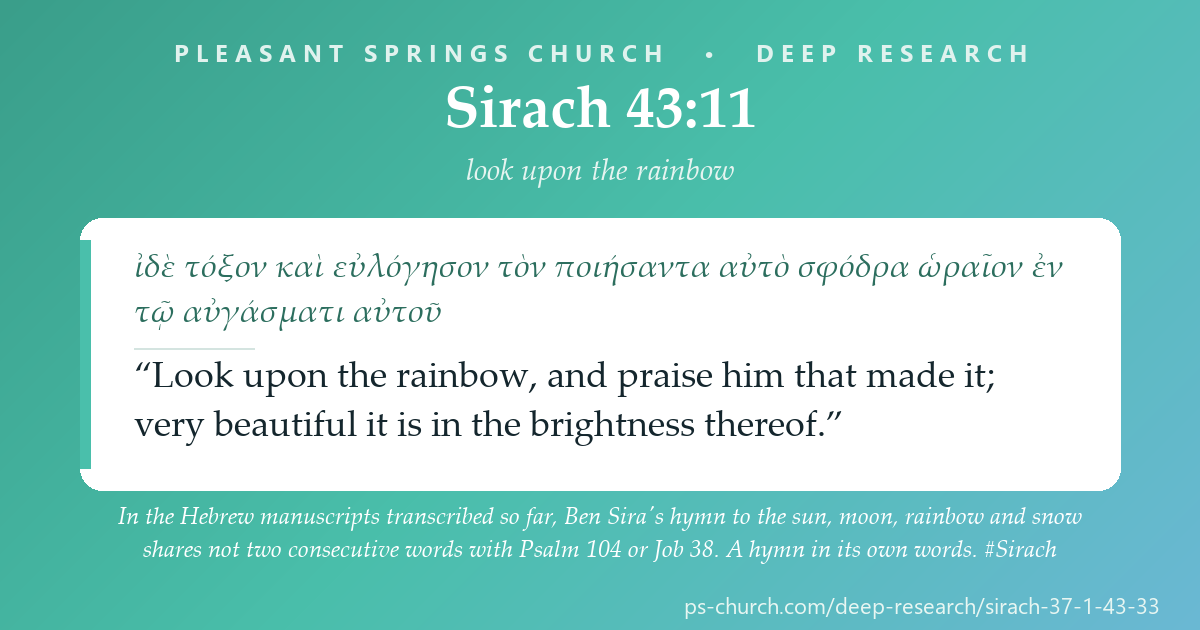
Look at the rainbow, and bless its maker. As transcribed, MS B’s third word is וברף; Masada’s is וברך, the ordinary spelling of and bless. This page prints the transcription as it stands and does not correct it. MS B keys the verse 43:11 and the Latin numbers it 43:12.
VULGATE 43:12 [Vide arcum, et benedic eum qui fecit illum :/ valde speciosus est in splendore suo./
Four witnesses, three sentences. The Greek: he is the all, τὸ πᾶν ἐστιν αὐτός — 1 unit of the 30,348 screened, this one, and 0 of the 7,927 Greek New Testament verses. MS B: הוא הכל [gloss, ours: he is the all], a pair the 23,204 Masoretic verses never have (0). The King James: he is all. The Latin: ipse est in omnibus [gloss, ours: he himself is in all things]. And the very next line, in Greek and in MS B, sets him apart from what he made: αὐτὸς γὰρ ὁ μέγας παρὰ πάντα τὰ ἔργα αὐτοῦ — והוא גדול מכל מעשיו [gloss, ours: and he is greater than all his works].
VULGATE 43:29 [Multa dicemus, et deficiemus in verbis :/ consummatio autem sermonum ipse est in omnibus./
The Hebrew is the diplomatic-style transcription of the medieval Cairo Genizah manuscripts and the Masada scroll made on Hebrew Wikisource, almost all by one editor, pinned to recorded revisions, licensed CC BY-SA 4.0, and printed here with the siglum and the attribution on every line. It is unpointed except for the few vowel and accent signs the manuscripts themselves carry (6 lines in these chapters; a pointed pair of words from MS B 38:26 is printed in the structure note); [...] marks letters the transcriber could not read, and the backslash is the transcriber’s mark for the break between the two halves of a line. It is not a critical edition, and Stage 5 says what that costs. Its rows are keyed by Ziegler’s Göttingen verse numbers, not by the CATSS numbers the Greek column uses, so every Hebrew line here has been matched to its Greek row by content.
The Greek is the CATSS morphological Septuagint (Rahlfs), quoted at verse level with attribution. The English is the King James Apocrypha, 1769 standard text, public domain, read from the verse-per-line file on this disk and quoted as it stands, spelling and all. The Latin is the Clementine Vulgate, printed as its file has it — the slash is the file’s line-break mark, and its square brackets are the file’s own and are not interpreted here — a fourth witness with its own numbering (237 verses for these seven chapters against the Greek’s 215), never a source for the English. Every word in all four languages on this page is read from those files when the page is built, and a binding check compares each one, character for character.
Stated, as on every page here; for this book it is a third state. There is no Masoretic Sirach and no ESV Sirach, so the usual Hebrew/Greek/English offset does not exist. What exists are four numberings, all counted here:
| chapter | Greek (CATSS, Rahlfs) | King James 1769 | Clementine Latin | Greek rows with Hebrew, matched by content |
|---|---|---|---|---|
| 37 | 31 | 31 | 34 | 30 |
| 38 | 34 | 34 | 39 | 26 |
| 39 | 35 | 35 | 41 | 14 |
| 40 | 30 | 30 | 32 | 27 |
| 41 | 27 | 24 | 28 | 23 (+3 fragmentary) |
| 42 | 25 | 25 | 26 | 23 |
| 43 | 33 | 33 | 37 | 31 |
| 37–43 | 215 | 212 | 237 | 174 (+3) |
Equal counts are not equal divisions. Read verse by verse, the King James moves a verse boundary against the Greek 6 times in chapters with the same count — forward at 37:17/18, 38:7/8, 39:16/17 and 40:4/5, where the second half of a Greek verse opens the next English one, and backward at 38:33/34 and 43:17/18, where English 38:33 and 43:17 end with the first half of Greek 38:34 and 43:18 — and in chapter 41 it runs three verses short: English 41:3 takes the first half of Greek 41:4, and the list of things to be ashamed of, Greek 41:18–27, is English 41:18–24. Chapter 42 divides identically. The English 41:8 also carries a clause the CATSS row lacks (for if ye increase, it shall be to your destruction); which Greek manuscripts have it this disk cannot say.
The Hebrew transcription follows the fourth scheme, Ziegler’s. Where a moved boundary can be tested on surviving Hebrew it sides with the King James four times (37:17/18, 38:7/8, 40:4/5, 43:17/18) and with CATSS once (41:3/4); at 39:16/17 it leans the King James’s way, its 39:16 ending where the English verse ends, though its 39:17 is damaged where the moved clause would open. In the shame list it differs from both: its 41:18 holds Greek 41:18 and 41:19, its 41:19 holds Greek 41:20, its 41:22 is Greek 41:25, and the first two lines it keys 42:1 are Greek 41:26 and 41:27. Three damaged MS B lines there (keyed 41:19 and 41:21) correspond to Greek 41:21–23 in an order the page does not try to settle; they are counted as fragmentary, not as matched. The MS D line keyed 37:22 carries a second saying, Greek 37:23 [gloss, ours: and there is a wise man for his people], and is counted for both. Matched by content, 174 of the 215 Greek rows have Hebrew in at least one manuscript, 3 have only those fragments, and 38 have none. Present means a manuscript line stands there, not that a word survives: 3 of the 174 (39:28, 41:8, 43:15) keep no more than a letter or two beside a lacuna, while 41:21–23 are called fragmentary for their unsettled order, not for what is lost. Joined on the transcription’s own keys instead, chapter 41 would have shown 21, and the Hebrew of Greek 41:19–27 would have been attached to the wrong Greek verses.
The prologue is 36 rows labelled Prolog in the Greek, is folded into 1:1 in the Clementine, and is not in the King James verse-per-line file at all: the file’s Sirach begins at 1:1. Its Greek is quoted below with this page’s own gloss.
The Shape of the Passage
A sequence of panels, with measured refrains (not a chiasm)⚠️ Where this page sits. Sirach is canonical in the Roman Catholic and Orthodox churches, printed among the Apocrypha in the older Protestant Bibles, and absent from the Hebrew Bible. This library treats it as a Second-Temple witness worth reading closely and files it under Apocrypha / Deuterocanon. Nothing taught at Pleasant Springs rests on it.
Author
A Jerusalem scribe who signs his book. Near its end the Greek names him: Ἰησοῦς υἱὸς Σιραχ Ελεαζαρ ὁ Ιεροσολυμίτης (50:27). He is usually dated to the early second century BC; nothing on this page rests on the date.
In these chapters he speaks for himself. Yet have I more to say, which I have thought upon (39:12); have left them in writing (39:32); and at the turn into the hymn, I will now remember the works of the Lord, and declare the things that I have seen (42:15) — the line whose Hebrew carries one of the hymn’s two three-word runs with a verse of the Hebrew Bible (Stage 4).
And he describes his own trade. The scribe of 39:1–11 serves among great men, travels in foreign lands, rises early to pray, and leaves a name. It is hard not to read it as a self-portrait, and the page notes that it is a reading.
Audience
Young men being made ready for public life. The counsel of the people, the assembly, the judge’s seat (38:33); the company of rulers (39:4). The farmer and the potter are described with respect — Without these cannot a city be inhabited (38:32) — but they are described to someone who will not be one.
And a second audience, two generations on. The grandson translated the book in Egypt for τοῖς ἐν τῇ παροικίᾳ βουλομένοις φιλομαθεῖν [gloss, ours: those in the sojourning who wish to love learning] (Prologue 34). He tells us he found translation hard — and the word he uses for his own labour is the craftsmen’s word (Stage 3).
Orient on Ben Sira, on the Hebrew manuscripts, and on the physician and the scribe.
Search by topic: Sirach / Ecclesiasticus / Ben Sira; Cairo Genizah; Masada; physicians and medicine in Israel; scribes; wisdom literature; creation hymns.
Which articles are relevant?
- Anchor Bible Dictionary — entries on Ben Sira (Sirach), scribes, medicine and healing, and the Old Testament Apocrypha.
- Eerdmans Dictionary of Early Judaism — entries on Ben Sira, the Cairo Genizah and Masada.
- Dictionary of New Testament Background (IVP) — entries on Sirach, scribes, and medicine and healing. These are subjects to look up; the exact entry titles were not checked on this disk.
- On the text — any article that distinguishes the shorter Greek form from the longer one with additional verses, and that says which Hebrew manuscript covers which chapters. An article that quotes ‘the Hebrew of Sirach’ without naming a manuscript is not usable for these chapters: at 43:2 MS B and Masada read differently.
Bibliography surfaced:
- Patrick Skehan and Alexander Di Lella, The Wisdom of Ben Sira (Anchor Bible) — a commentary in English; nothing on this page is quoted from it.
- Pancratius Beentjes, The Book of Ben Sira in Hebrew — the manuscripts in parallel, with Ziegler’s numbering. Not held here.
- Yigael Yadin, The Ben Sira Scroll from Masada — the first edition of the Masada scroll. Not held here.
- Joseph Ziegler, Sapientia Iesu Filii Sirach (Göttingen Septuagint) — the critical Greek text and the numbering the Hebrew transcription follows. Not held here.
- Solomon Schechter and Charles Taylor, The Wisdom of Ben Sira (Cambridge, 1899) — the first edition of the Genizah leaves; held on this disk as page scans and used by the transcription’s own spot-checks, not by this page.
- Benjamin Wright, “Sirach,” in NETS — an English translation of the Greek. Named as a next step for a reader; not quoted here.
A physician honoured in a world that prayed for healing; a scribe praised over the trades; and a grandson who apologises for his Greek.
Three bodies of material lie behind these chapters. The page names each and says which it could check on this disk.
Which parallels shed light on the world of the text?
The physician in Israel’s own scriptures. The Greek Old Testament files held here have 13 occurrences of the noun ἰατρὸν (5 of them in Sirach, four in chapter 38). One of the others is the king of whom 2 Chronicles 16:12 says he sought not the Lord but the physicians: οὐκ ἐζήτησεν κύριον ἀλλὰ τοὺς ἰατρούς. Ben Sira holds the two together: pray to the Lord (38:9) and give the physician his place (38:12). The page sets the verses side by side; it does not say Ben Sira wrote with Asa in mind.
Marah, without its words. 38:5 asks: Was not the water made sweet with wood? — on the usual reading, the sweetened water of Marah in Exodus 15:25. It is the page’s first counter-example: an allusion a reader sees at once and the run engine all but misses. MS B’s line and the Masoretic Exodus 15:25 share 0 word forms; the Greek lines share a run of 2, and the two shared words are εἰς τὸ — into the. Wood, sweet and water are all there; none of them stands next to another in the same form.
The scribe and the trades. 38:24–39:11 is commonly compared with an Egyptian school text, the Instruction of Dua-Khety (often called The Satire of the Trades), in which a father sets the scribe’s life above the smith’s, the potter’s and the farmer’s. No text of it is held on this disk, and the page measures nothing against it. What the page can say is how Ben Sira’s version ends: not in mockery but in they will maintain the state of the world (38:34).
- The Greek prologue → the grandson on translation. οὐ γὰρ ἰσοδυναμεῖ αὐτὰ ἐν ἑαυτοῖς Εβραϊστὶ λεγόμενα καὶ ὅταν μεταχθῇ εἰς ἑτέραν γλῶσσαν [gloss, ours: for they do not have equal force, the things said in Hebrew in themselves, when they are carried over into another tongue] (Prologue 21–22). The King James verse-per-line file on this disk has no prologue rows, so the page cannot quote its English; the Clementine folds the prologue into its 1:1 and reads Nam deficiunt verba hebraica, quando fuerint translata ad alteram linguam.
- The grandson’s date → ἐν γὰρ τῷ ὀγδόῳ καὶ τριακοστῷ ἔτει ἐπὶ τοῦ Εὐεργέτου βασιλέως [gloss, ours: in the thirty-eighth year in the time of King Euergetes] (Prologue 27). Which Euergetes, and so which year BC, is reported from the commentaries and not measured here.
- Greek medicine → the setting of 38:1–15. Not consulted. The Hippocratic writings are not in any corpus this page measured.
A physician, a sleepless craftsman, a ladder, and a doxology the New Testament never uses.
Every Greek count below is over the 30,348 Greek Old Testament units screened here (the Odes excluded) and the 7,927 verses of the Greek New Testament; every Hebrew count is over the 23,204 Masoretic verses or the 1,411 Ben Sira rows, and the page says which each time.
13 occurrences of the noun in the 30,348 Greek Old Testament units screened, 5 of them in Sirach, and four of those in chapter 38. 7 in the Greek New Testament, one of them Luke the beloved physician (Colossians 4:14). MS B’s word is רופא (38:1, 38:2, 38:7, 38:15; damaged at 38:3). The medicine itself, φάρμακα, belongs to a word family the New Testament uses 5 times and never of medicine — sorcery at Galatians 5:20 and Revelation 18:23, sorcerers at Revelation 21:8 and 22:15, and the noun itself once, at Revelation 9:21.
The noun stands 10 times in the Greek Old Testament units screened, and 9 of them are Sirach (with the verb, the family stands 21 times). Of Sirach’s nine, four are the craftsmen of 38:26–30; one is a father lying awake over a daughter (42:9); and one is the grandson, describing his own translating: πολλὴν ἀγρυπνίαν καὶ ἐπιστήμην προσενεγκάμενος [gloss, ours: having brought much wakefulness and skill] (Prologue 31). The tenth, outside Sirach, is the preface of 2 Maccabees, where the epitomist calls his abridging a matter of sweat and ἀγρυπνίας (2:26). The Latin has the same echo: vigilia for the craftsmen, the daughter and the prologue’s multa vigilia (13 vigil- words in the Clementine Sirach). In the Greek New Testament the noun stands 2 times, both in Paul’s lists of his own labours (2 Corinthians 6:5, 11:27). The page counts the word; it does not say the grandson chose it to echo anything.
9 times, 40:18–26, and nowhere else in the Greek Old Testament held here or in the New Testament. A ladder of good things, each pair topped by a better one, ending in the fear of the Lord. MS B’s word is ומשניהם, legible 9 times in 10 lines (the tenth is damaged after its first three letters). MS B has one rung more than the Greek: at 40:19 it carries two lines, each with its own above both, where the Greek has one verse.
The four words stand in 1 of the 30,348 Greek Old Testament units screened, and in 0 of the 7,927 New Testament verses. Even τὸ πᾶν alone stands 11 times in the Greek Old Testament — among them the Greek Ecclesiastes 12:13 — and 0 times in the New, which says τὰ πάντα instead (34 times). MS B’s הוא הכל never occurs in the Masoretic Bible.
2 occurrences, 41:1 and 41:2, and only there. The vocative alone stands 3 times in the Greek Old Testament (Hosea 13:14 and these two) and 2 times in the New, both in 1 Corinthians 15:55. The Hebrew manuscripts open the two lines with different words (see the codex).
The hymn that should echo the Psalms and does not; the psalm that turns up at the potter’s wheel; and a five-word New Testament run that is mostly pronouns.
Three screens, each inside one language. Greek against the Greek New Testament: every CATSS row against all 7,927 verses. Greek against the Greek Old Testament: every row against the 28,946 screened units outside Sirach. Hebrew against the Masoretic Bible: every one of the 317 manuscript lines against all 23,204 verses. Contiguous runs of whole word forms; the tie band — how many target verses reach the same depth — beside every run, and for the deep ones the band from the other side too. On the Greek side a row reported as 1 shares single words only; on the Hebrew side a 0 means no two consecutive words shared.
The measured surprise: a creation hymn in its own words
The hymn of 42:15–43:33 is the passage in these chapters that reads most like Psalm 104, Psalm 148 and the speeches from the whirlwind. Measured, it shares almost nothing with them word for word, in either language.
| set against… | Greek hymn, deepest run (44 CATSS rows, Greek against Greek) | Hebrew hymn, deepest run (68 manuscript lines, Hebrew against Hebrew) |
|---|---|---|
| Psalm 104 (Greek 103) | 3 | 1 |
| Psalm 147 (Greek 146–147) | 3 | 1 |
| Psalm 148 | 4 | 1 |
| Job 37 | 2 | 1 |
| Job 38 | 2 | 1 |
| Psalm 19 (Greek 18) | 2 | 1 |
| Genesis 1 | 2 | 1 |
| the whole corpus | 6 (42:21; a doxology formula) · chapter 43 alone: 4 | 3 (42:15, 42:16) · chapter 43 alone: 2 |
A named-chapter comparison is a pair measurement and has no tie band; the bands for the whole-corpus rows are given in the text below.
Read the Hebrew column first. The 68 surviving lines of the hymn (362 undamaged words) share not two consecutive words with Psalm 104, 147 or 148, with Job 37 or 38, with Psalm 19 or with Genesis 1. Against the whole Masoretic Bible, 22 lines reach two words and 2 reach three; chapter 43 alone — 52 lines, 274 undamaged words, sun to sea — never reaches three (as spelled; see the robustness note below), and 38 of its lines share no two consecutive words with any verse of the Hebrew Bible. The hymn’s two three-word runs are both in its opening lines, and neither is about nature:
- 42:15, MS B → Job 15:17 — three words, band 1. וזה חזיתי ואספרה [gloss, ours: and what I have seen I will recount] — אֲחַוְךָ֥ שְֽׁמַֽע־לִ֑י וְזֶֽה־חָ֝זִ֗יתִי וַאֲסַפֵּֽרָה׃. Eliphaz says it before he describes the fate of the wicked; Ben Sira says it before he describes the sky. The sequence stands in 1 Masoretic verse and in 1 of the 1,411 Ben Sira rows. The Greek 42:15 against the Greek Job 15:17 is a run of 1.
- 42:16, MS B → Psalm 145:9 and Daniel 9:14 — three words, band 2. על כל מעשיו [gloss, ours: over all his works].
Then the Greek column. Against Psalm 103 [104] the hymn’s deepest run is 3 words (τὸ ἔργον αὐτοῦ, his work, 42:16 with Psalm 103:23 — one of 6 pairs at three; the other five are three-word slices of Sirach’s for ever at 42:21 and 42:23, against Psalm 103:5, 103:29 and 103:31); against Psalm 148 it is 4 (and for ever, 42:21 with Psalm 148:6); against Job 37 and 38 it is 2. Against all 28,946 Greek Old Testament units outside Sirach it reaches 6, once, at 42:21 — τοῦ αἰῶνος καὶ εἰς τὸν αἰῶνα, of the age and unto the age, band 1 from Sirach’s side with Psalm 40:14 [41:13]. From the psalm’s side it is not even the nearest partner: Psalm 40:14’s own deepest run is 9 words, band 1, with the doxology of Psalm 105:48 [106:48]. Chapter 43 alone reaches 4, twice: καὶ ἡ σελήνη ἐν at 43:6 (band 2, with Daniel (Old Greek) 4:11 and Joshua (B) 10:13) and πάντα τὰ ἔργα αὐτοῦ all his works at 43:28 (band 6).
Robustness, because a negative needs it. Ben Sira’s manuscripts spell more fully than the Masoretic text, and a spelling difference cuts a run. Re-run with every internal waw and yod stripped from both sides, the hymn’s run with each of those seven chapters is still 1, and against the whole Bible 3 lines reach three words instead of 2: the new one is 43:28 against 2 Chronicles 4:18 (band 1), three words that become identical only once the waw of MS B’s נחקור is removed. MS B writes the divine name with three yods; folded into the Masoretic four letters, it lifts one line, 40:26, from no shared pair to two words (ביראת ייי [gloss, ours: in the fear of the LORD], band 5), widens the band at 42:16 from 2 to 8, and takes no line to three. The finding is about the lines transcribed: Masada’s 43:14–30 is not yet typed, and Stage 5 lists the rest.
Where the creation psalm does turn up: the potter
Sirach 38:29 → Psalm 103:23 [104:23] — five words, tie band 1 from both sides (printed in the codex). It is the deepest run these seven chapters make with Psalm 103 anywhere, and it is in the trades, not the hymn. The five words stand in 2 units of the 30,348 screened and in no New Testament verse. Psalm 104:23 is a man going out to his work until evening; Sirach 38:29 is a potter bent over his. Four of the five shared words are small ones.
The rest of the Greek Old Testament screen, for the whole range: 214 of the 215 rows reach two, 123 reach three, 31 reach four, 4 reach five and 1 reaches six. Of the five-word rows, 40:8 is the formula from man to beast (band 5), and 42:17 shares all his wonders which with Judges (B) 6:13, band 1 — whose own deepest partner is its other recension, Judges (A) 6:13, at 10.
The New Testament screen, both ways
Across the 215 rows of 37:1–43:33: 207 reach two, 86 reach three, 6 reach four, 1 reaches five, and nothing reaches six. Across the whole book, 1,402 rows, nothing reaches six either.
| rows reaching… | two | three | four | five | six |
|---|---|---|---|---|---|
| Sirach 37–43 (215 rows) | 207 | 86 | 6 | 1 | 0 |
| all of Sirach (1,402 rows, prologue included) | 1,323 | 596 | 74 | 4 | 0 |
| Sirach row | run | band among the 7,927 NT verses | NT verse | that verse’s own deepest Greek OT partner |
|---|---|---|---|---|
| 39:9 | 5 | 1 | Revelation 22:4 | 5 words, band 1: Sirach 39:9 itself |
| 37:26 | 4 | 1 | Revelation 22:4 | (as above) |
| 37:6 | 4 | 2 | Matthew 22:37, Luke 10:27 | Luke 10:27: 11 words with Deuteronomy 6:5, band 1; Matthew 22:37: 5, band 8 |
| 38:29 | 4 | 1 | Mark 13:34 | 4 words, band 6 (Sirach 38:29 one of six) |
| 39:31 | 4 | 8 | eight verses | and upon the earth in 6 of the eight (Matthew 23:9 and John 6:21 share upon the earth, into) — a formula |
| 42:23 | 4 | 5 | five verses | abides for ever — a formula |
The page’s second counter-example is its deepest New Testament run. Sirach 39:9 and Revelation 22:4 share five words, αὐτοῦ καὶ τὸ ὄνομα αὐτοῦ, band 1 from Sirach’s side — and Revelation 22:4 screened against all 30,348 Greek Old Testament units reaches five with Sirach 39:9 and nothing else. Band 1 both ways, and four of the five words are his, and, the, his. Ben Sira says the scribe’s memorial and name will live; Revelation says the servants will see his face and his name will be on their foreheads. A shared shape of pronouns around the word name is not a citation, and the page prints it so its other runs are not read as more than they are.
Three more counter-examples, measured
- 43:3 → Psalm 147:6 [147:17] — three Greek words, band 2. The sun at noon: καὶ ἐναντίον καύματος αὐτοῦ τίς ὑποστήσεται [gloss, ours: and before its heat who will stand?]. The frost: κατὰ πρόσωπον ψύχους αὐτοῦ τίς ὑποστήσεται. The three words stand in 3 units (with Nahum 1:6), and Psalm 147:6’s own deepest run is 3, band 2. In the Hebrew the same pair of lines shares 1 word in sequence: MS B לפני חרבו מי יתלכל, the Masoretic מַשְׁלִ֣יךְ קַֽרְח֣וֹ כְפִתִּ֑ים לִפְנֵ֥י קָ֝רָת֗וֹ מִ֣י יַעֲמֹֽד׃ — ESV: “He hurls down his crystals of ice like crumbs; who can stand before his cold?” Heat for cold, and in Hebrew a different verb.
- 43:27 → Ecclesiastes 12:13 — the same shape, almost none of the words. End of the matter + the all, in both books. Greek: συντέλεια λόγων τὸ πᾶν ἐστιν αὐτός against τέλος λόγου τὸ πᾶν ἀκούεται — a run of 2, τὸ πᾶν. Hebrew (MS B): וקץ דבר הוא הכל against ס֥וֹף דָּבָ֖ר הַכֹּ֣ל נִשְׁמָ֑ע אֶת־הָאֱלֹהִ֤ים יְרָא֙ וְאֶת־מִצְוֺתָ֣יו שְׁמ֔וֹר כִּי־זֶ֖ה כׇּל־הָאָדָֽם׃ — a run of 1. The Masoretic pair ס֥וֹף… occurs in 1 verse, this one. ESV: “The end of the matter; all has been heard. Fear God and keep his commandments, for this is the whole duty of man.”
- 43:26 → Colossians 1:17 — a run of 2. ἐν λόγῳ αὐτοῦ σύγκειται τὰ πάντα [gloss, ours: by his word all things hold together] and τὰ πάντα ἐν αὐτῷ συνέστηκεν. The shared words are τὰ πάντα; the verbs are different words. Set side by side, not measured into a connection.
What the Hebrew screen shows across the whole range
Of the 317 manuscript lines in 37:1–43:33, 191 share no two consecutive words with any verse of the Masoretic Bible, 126 reach two and 9 reach three; none reaches four. Across all 1,411 lines of the transcription the deepest is 10 — in chapter 51, outside this page. The three-word runs in this range include these, all in MS B: אם כל חי with Genesis 3:20 (band 1; see the codex), בין רב למעט [gloss, ours: between much and little] with Numbers 26:56 (band 1), and על שן סלע [gloss, ours: upon the crag of a rock] with Job 39:28 (band 1). Measured this way, Ben Sira writes in the vocabulary of the Hebrew Bible and very seldom in its sentences.
It settles that the hymn is not a cento. Where its Hebrew survives, it is not built from lines of the nature psalms or of Job; the measurable contacts are two three-word runs in its opening lines and a scatter of pairs.
It does not settle that Ben Sira had not read them. The sun, the moon that marks the feasts, the storehouses of snow and hail, the sea and its monsters are the furniture of Psalm 104 and Job 38, and a screen for consecutive words cannot see a shared imagination.
The honest sentence is the narrow one: on these corpora, with this screen, Ben Sira’s creation hymn shares its themes with the Psalms and Job and almost none of their word sequences; and the deepest run these chapters make with the creation psalm belongs to a potter.
What this page could not check, where the Hebrew is weakest, and a defect found while building it.
This is the section that makes the shelf trustworthy. It is long, because a new witness arrived the day this page was built.
⚠️ The Hebrew column: what it is and what it is not
- A transcription, not an edition. The lines are a wiki editor’s reading of the manuscripts, almost all by one person, unpointed apart from the few vowel and accent signs the manuscripts carry, with no apparatus. They are pinned to recorded revisions; a page outside this range carried a 2025 vandal edit and is pinned to the revision before it.
- Incomplete exactly where this page reaches. Wikisource itself marks the MS B pages for chapters 37–43 as unfinished, and Masada’s 39:27–40:16, 41:3–22, 42:10–25 and 43:14–30 as missing or partly typed. MS B’s own 39:29–35 exists and is not typed, which is why 39:33, the second half of the 39:16/39:33 inclusio, has no Hebrew here.
- No second source for Masada. The open Dead Sea Scrolls data used to spot-check other parts of the transcription has no Masada scroll, so no Masada line printed here has been checked against anything.
- Damage is a gap, not a word. For the screens, any lacuna, restoration or doubt mark, whether it stands alone or inside a word, was treated as a break, so no run crosses it. Of the 317 lines in the range, 188 carry at least one such mark. A damaged line can only hide a contact, never invent one; the hymn’s negative is therefore a statement about its legible words.
- Numbering. The transcription is keyed by Ziegler’s numbers; joined on its keys, chapter 41’s Hebrew would land on the wrong Greek verses. The page matched every printed line, and the presence counts, by content (the Versification note).
⚠️ Two tooling defects found while building this page — reported, not patched
- Editorial notes left inside the text. Two rows of the transcription file in this range still carry the transcriber’s Hebrew notes as if they were manuscript text — MS B 40:1 ([יש נקודה מעל המ"ם במילה "אם"]) and MS D 37:8. Tokenised naively, the words of a note become words of Ben Sira. This page prints the 40:1 note apart and drops any bracketed span holding a space before measuring; the file itself is unchanged and the fault is reported for whoever maintains it.
- No shared loader for the Hebrew Ben Sira. The measurement tools read the Greek, the Masoretic text, the New Testament, the King James and the Latin; the Ben Sira transcription has no loader yet, so this page and its binding check read the file directly. Six Sirach pages are being built at once; a common loader would stop them disagreeing about what a word is.
⚠️ What this page could NOT check
- Ziegler’s Göttingen text and apparatus — so nothing here about the longer Greek form, including the clause the King James 41:8 carries and the CATSS row lacks.
- The Syriac, the other ancient version made from Hebrew. Not held.
- The Egyptian Instruction of Dua-Khety, set beside 38:24–39:11 in the commentaries. Not held; nothing measured against it.
- Photographs of the manuscripts. Every Hebrew reading here is the transcriber’s. The spelling וברף at MS B 43:11 may be the manuscript or a typing slip; this page cannot tell.
- Allusion. The screens find consecutive identical word forms. Marah at 38:5 measures 0 in Hebrew; a shared imagination measures nothing.
⚠️ Where this page is weakest
- The headline is a negative, and a negative holds only over what was screened: the legible Hebrew lines of one transcription, against one edition of the Masoretic text. A better reading of a damaged line, or the untyped Masada lines, could add a run.
- The English is quotation, not a measured parallel. The King James moves six verse boundaries against the Greek here and runs three verses short in chapter 41, and its 41:8 has a clause the Greek row lacks; every codex line names its English verse.
- Glosses are this page’s own. Those in the form [gloss, ours: …] are marked; the short italic English set beside a Greek run or a Hebrew word in the structure diagram, Stage 3 and Stage 4 is ours too. All are literal, not polished. Where a Hebrew word is damaged the gloss marks the restoration in brackets.
- Dating (the early second century for Ben Sira; the reign of a Ptolemy Euergetes for the grandson) is taken from the commentaries and not tested here.
Commentaries & studies:
- Patrick Skehan and Alexander Di Lella, The Wisdom of Ben Sira (Anchor Bible).
- Pancratius Beentjes, The Book of Ben Sira in Hebrew — the manuscripts in synopsis.
- Yigael Yadin, The Ben Sira Scroll from Masada.
- Joseph Ziegler, Sapientia Iesu Filii Sirach (Göttingen Septuagint).
- Solomon Schechter and Charles Taylor, The Wisdom of Ben Sira (Cambridge, 1899).
- Hebrew Wikisource, Ben Sira — the transcriptions printed on this page, CC BY-SA 4.0, cited by manuscript on every line.
A doctor to be honoured, a potter to be thanked, and a sky that needed new words.
Name what you learned, why it matters, and one concrete response.
What should we carry away — and do?
- Pray, and call the doctor. The New Testament names Luke a physician (Colossians 4:14), and Ben Sira saw no contradiction: pray unto the Lord, and he will make thee whole… Then give place to the physician (38:9–12). Neither half is a lack of faith in the other.
- The potter holds the city up. Without these cannot a city be inhabited (38:32). The scribe serves among the great (39:4), but the page’s deepest run with Psalm 104 belongs to the man at the wheel — the psalm’s workman, going out to his labour until evening.
- Old words are not the only words. A Jerusalem scribe wrote a hymn to the sky that, where its Hebrew survives, shares hardly a line with the Psalms or Job. Praise in your own words is an old practice.
- Translation costs sleep. The grandson used the craftsmen’s word for his own work. Every Bible you have read in English cost someone that.
- One concrete response. Scripture itself calls the sun, the moon and the stars to praise their Maker (Psalm 148:3). Go outside tonight and join them; Ben Sira’s way of putting it is 43:11, Look upon the rainbow, and praise him that made it — or the moon, if there is no rainbow. Then thank someone whose work keeps your town standing.
Sirach 43:11 · to share
Greek · English (King James Apocrypha) · LatinVULGATE 43:12 [Vide arcum, et benedic eum qui fecit illum :/ valde speciosus est in splendore suo./
Every Deep Research page traces its passage across the whole sweep — the Old Testament, the Second-Temple world between the testaments (historical witnesses, not Scripture), and the New Testament. Follow the thread:
Pleasant Springs Church — Deep Research
Research method after Michael S. Heiser’s Bible Research Method (examine dictionaries → ancient literature → important words → textual connections → academic publications → share), with the Pleasant Springs “Author & Audience” foundation. Scripture set in the Hebrew, the Greek editions named on each page and the ESV (Old Testament), and the Greek New Testament and the ESV (New Testament), per the practice of Pleasant Springs Church. ⚠️ Status: Sirach is not part of the Protestant canon. It is canonical in the Roman Catholic and Orthodox churches, was printed among the Apocrypha in the Reformation-era Protestant Bibles, and is absent from the Hebrew Bible. This study is filed under Apocrypha / Deuterocanon and nothing taught at Pleasant Springs rests on it. Greek: the CATSS morphologically analysed Septuagint (Rahlfs), quoted at verse level with attribution. Hebrew: Hebrew Wikisource transcriptions of the Cairo Genizah manuscripts B, C and D and of the Masada scroll, CC BY-SA 4.0, pinned to recorded revisions and attributed by manuscript on every line; not a critical edition. English: the King James Apocrypha, 1769 standard text, public domain, quoted from the verse-per-line file held here. There is no ESV of Sirach held or licensed here; the ESV appears on this page only for the canonical verses it is compared with (Psalm 104:23, Psalm 147:17, Ecclesiastes 12:13). Latin: the Clementine Vulgate, a fourth witness, never a source for the English. Every string in all four languages is read from those files at build time and checked character for character by the page’s binding check. Runs are measured Greek against Greek and Hebrew against Hebrew, never across the two. Direction of influence is nowhere asserted. Scholarship after Skehan and Di Lella, Beentjes, Yadin, Ziegler, and Schechter and Taylor.
Scripture quotations marked ESV are from the ESV® Bible (The Holy Bible, English Standard Version®), © 2001 by Crossway, a publishing ministry of Good News Publishers. ESV Text Edition: 2016. Used by permission. All rights reserved. The ESV text may not be quoted in any publication made available to the public by a Creative Commons license, and the ESV may not be translated in whole or in part into any other language. www.esv.org
|
Did this study bless you today? 💚 Give to Support PS Church100% of gifts go to the General Fund — thank you. |