Ben Sira tells you who wrote it and who translated it. The author signs his name near the end; his grandson, in a preface, says he carried the book from Hebrew into Greek in Egypt, and warns that things said in Hebrew do not have the same force in another language. These nine chapters hold the passage this shelf’s own John 1:14–18 study sets beside John’s prologue — Wisdom speaking in the first person, come out of the mouth of the Most High, told to pitch her tent in Jacob. So every one of the 244 Greek rows was screened against all 7,927 verses of the Greek New Testament. Nothing reaches five consecutive words. The eight rows that reach four share strings like in all the earth and his mouth like. Then the same rows were screened against the rest of the Greek Old Testament, and one line reached eight: 24:23, which carries every word of Deuteronomy 33:4, in the sentence that says all these things are “the book of the covenant of the most high God, even the law which Moses commanded” (KJV) — commonly read as naming Wisdom the Law. Of these 244 verses the Hebrew transcriptions held here cover 34, all in one manuscript — and none of them is in chapter 24. Sirach is not Scripture for us; it is read here as a Second-Temple witness, and the page says plainly what it could not check. See the method →
The Wisdom of Jesus son of Sirach is a book of instruction from Jerusalem, usually dated to the early second century BC, translated into Greek by the author’s grandson in Egypt. It is canonical in the Roman Catholic and Orthodox churches, was printed among the Apocrypha in the Protestant Bibles of the Reformation era, and is absent from the Hebrew Bible. It is not Scripture for us. We read it as a window into the Judaism the New Testament was born in — how a scribe in the generation before the Maccabees talked about speech, money, marriage, friendship, prayer and the Law — and we test everything by the canon.
Sirach in six studies
Prologue – 9:18 · 10:1–19:30 · 20:1–28:26 (this page) · 29:1–36:27 · 37:1–43:33 · 44:1–51:30
⚠️ What this page can and cannot measure — read this first.
HELD: the Greek of Sirach in full (CATSS Sirach.mlxx, 1,402 rows, 244 of them in this range); the Greek New Testament (7,927 verses, SBLGNT via MorphGNT); the rest of the Greek Old Testament (28,946 units outside Sirach, of 30,348 screened, the Odes excluded); the Masoretic Hebrew Bible (23,204 verses); the King James Apocrypha; the Clementine Vulgate; and, since October 2026, a transcription of the surviving Hebrew manuscripts of Ben Sira.
THIN: in these chapters that Hebrew is 34 verses out of 244, all from one manuscript (MS C), and none of chapter 24, 27 or 28 — so of the eight lines this page set out to measure (24:3, 24:8, 24:19, 24:21, 24:23, 25:24, 27:6, 28:2), only 25:24 has Hebrew to check.
NOT HELD: Ziegler’s critical Greek text and apparatus (the CATSS text is Rahlfs); any Greek for the KJV’s seventeen extra verses; the Syriac; a critical edition of the Hebrew.
WHAT THE SCREENS FIND: verbatim contact — runs of consecutive identical word forms, with the tie band beside each. They do not find allusion, and a short run is not proof that a writer did not know a text, any more than a long one is proof that he did.
Sirach 20:1–28:26 — nine lines, four witnesses
Hebrew: Cairo Genizah MS C where it survives (Hebrew Wikisource transcription, CC BY-SA 4.0) · Greek: CATSS / Rahlfs · English: KJV Apocrypha (1769 standard text, public domain) · Latin: Clementine VulgateOne of 34 verses in these nine chapters for which any Hebrew survives in the transcriptions held here — and all 34 are in a single manuscript, MS C. The Hebrew line and the Greek row have the same two halves: the wise man silent ἕως καιροῦ / עד עת, and the fool who does not keep it.
VULGATE 20:7 Homo sapiens tacebit usque ad tempus :/ lascivus autem et imprudens non servabunt tempus./
MS C ...כות על מת כי נח
MS C ...[מ]מות חיים רעים ·CATSS 22:11 ἐπὶ νεκρῷ κλαῦσον ἐξέλιπεν γὰρ φῶς καὶ ἐπὶ μωρῷ κλαῦσον ἐξέλιπεν γὰρ σύνεσιν ἥδιον κλαῦσον ἐπὶ νεκρῷ ὅτι ἀνεπαύσατο τοῦ δὲ μωροῦ ὑπὲρ θάνατον ἡ ζωὴ πονηρά22:11KJV 22:11 “Weep for the dead, for he hath lost the light: and weep for the fool, for he wanteth understanding: make little weeping for the dead, for he is at rest: but the life of the fool is worse than death.”
MS C writes this one Greek row on three lines, and the second and third are broken at the start. The Latin spreads it over three verses. The KJV prints it as one, and at the same number as the Greek — which in chapter 22 is not a given: see the versification note.
VULGATE 22:10–12 Supra mortuum plora, defecit enim lux ejus :/ et supra fatuum plora, defecit enim sensus./ Modicum plora super mortuum, quoniam requievit :/ nequissimi enim nequissima vita super mortem fatui./
ἀπὸ στόματος ὑψίστου — “from the mouth of the Most High” — stands in no other unit of the 30,348 Greek Old Testament units screened here, and in no verse of the Greek New Testament. With a different preposition, ἐκ στόματος ὑψίστου, it stands once more, at Lamentations 3:38. The Latin is longer: it spreads the row over two verses and carries a clause the Greek row lacks — primogenita ante omnem creaturam, “firstborn before every creature.” The Greek word for firstborn that Colossians 1:15 uses, πρωτότοκος, occurs in no form anywhere in the 1,402 Greek rows of Sirach held here; Sirach’s one firstborn word is a different one, πρωτογόνῳ, at 36:11, said of Israel.
VULGATE 24:5–6 Ego ex ore Altissimi prodivi,/ primogenita ante omnem creaturam./ Ego feci in cælis ut oriretur lumen indeficiens,/ et sicut nebula texi omnem terram./
κατασκήνωσον — “pitch your tent” — occurs once in the 30,348 screened Greek Old Testament units, here, and in none of the 7,927 New Testament verses. John 1:14 has a different verb form, ἐσκήνωσεν; it stands twice in the screened Greek Old Testament (Gen 13:12, Judges (B) 5:17) and never in Sirach. Measured against John 1:14, this row reaches two words, and they are καὶ ὁ.
VULGATE 24:12–13 Tunc præcepit, et dixit mihi Creator omnium :/ et qui creavit me, requievit in tabernaculo meo./ Et dixit mihi : In Jacob inhabita,/ et in Israël hæreditare,/ et in electis meis mitte radices.
Wisdom says those who eat her will hunger again. Against John 6:35 — [gloss: will not hunger] — the run is one word, καὶ. The New Testament verse that carries this row’s two verb forms, πεινάσουσιν and διψήσουσιν, is Revelation 7:16 — [gloss: they will not hunger any more] — and the screen scores that pair one too, because the words stand in a different order. See Stage 3.
VULGATE 24:29 Qui edunt me, adhuc esurient,/ et qui bibunt me, adhuc sitient./
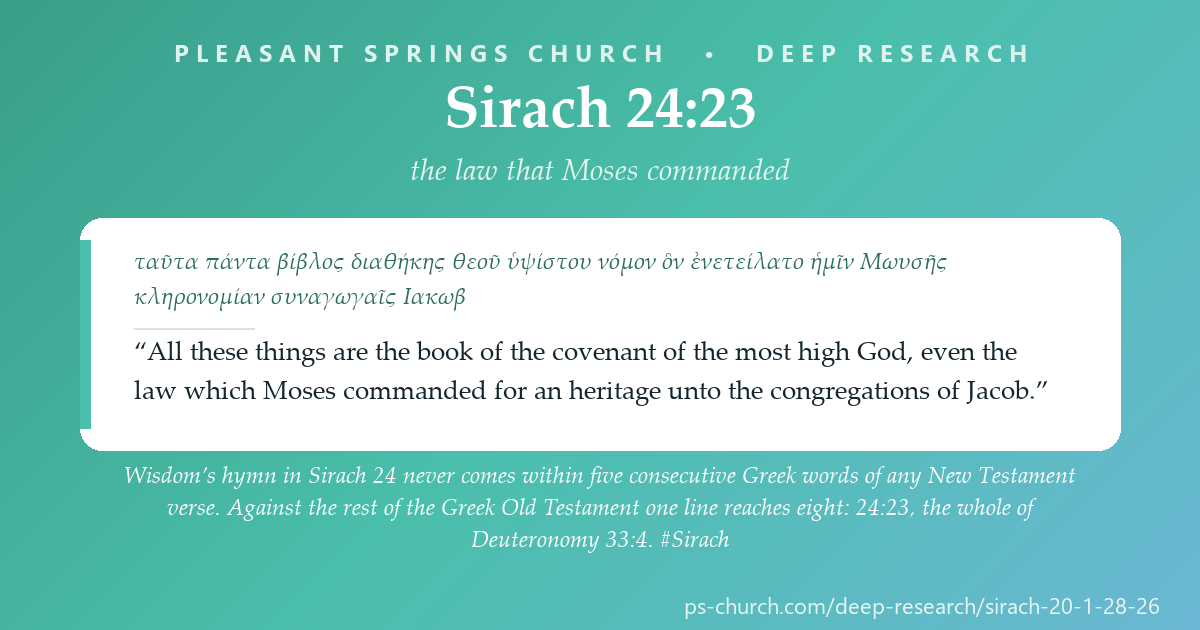
The bold eight words are the whole of Greek Deuteronomy 33:4, word for word, in order — the deepest contact any of these 244 rows makes with any of the 28,946 Greek Old Testament units screened outside Sirach or the 7,927 New Testament verses, tie band 1. The Latin reads liber vitæ, “book of life,” and only after it et testamentum Altissimi, “and the covenant of the Most High,” where the Greek row reads βίβλος διαθήκης, “book of the covenant”; and it puts Moses in the next verse.
VULGATE 24:32–33 Hæc omnia liber vitæ,/ et testamentum Altissimi, et agnitio veritatis./ Legem mandavit Moyses in præceptis justitiarum,/ et hæreditatem domui Jacob,/ et Israël promissiones./
Of the lines this page set out to measure, this is the only one whose Hebrew is held here. The Hebrew ends יחד [gloss: together] where the Greek row ends πάντες [gloss: all]; the KJV and the Latin have “all” with the Greek. The Hebrew line shares no two consecutive words with any verse of the 23,204 in the Hebrew Bible held here.
VULGATE 25:33 A muliere initium factum est peccati,/ et per illam omnes morimur./
The fruit shows the tree. Against Matthew 7:16 and Luke 6:44 this row shares no word form at all; the noun καρπὸς, fruit, stands in all three, in different forms. Against Matthew 12:33 it shares one, αὐτοῦ.
VULGATE 27:7 Sicut rusticatio de ligno ostendit fructum illius,/ sic verbum ex cogitatu cordis hominis./
Forgive, and then your sins are loosed when you pray. Against the Lord’s Prayer (Matthew 6:12) the run is one word, ἄφες; against Mark 11:25, one; against Matthew 6:15, none. This row’s deepest New Testament contact is three words — αἱ ἁμαρτίαι σου, “your sins” — and among the verses that reach it are Luke 5:20 and Matthew 9:2, a paralysed man told his sins are forgiven.
VULGATE 28:2 Relinque proximo tuo nocenti te,/ et tunc deprecanti tibi peccata solventur./
The Hebrew is the newest column on the shelf, and the thinnest here. Of these 244 Greek verses, 34 have any Hebrew at all in the transcriptions held, in 38 manuscript lines, every one of them in MS C. Chapters 24, 27 and 28 have none. Each Hebrew line is printed exactly as transcribed — unpointed, with the transcriber’s brackets and dots for lost letters — and carries its siglum. The transcriptions are from Hebrew Wikisource, the work of one unnamed editor, pinned by revision; they are not a critical edition, and Stage 5 says what that costs.
Every quoted word of Greek, Hebrew, Latin and KJV English on this page is read out of its corpus file when the page is built, and a separate check re-reads every one against the file, character for character. English is the KJV only where a KJV verse number or “(KJV)” stands beside it. Every other English rendering — bracketed and marked gloss, in italics, or in curly quotes beside a Greek, Hebrew or Latin word — is ours, a literal rendering of the words beside it, not a quotation of any English Bible.
Versification — stated, and here it needs a third state. There is no Masoretic Sirach (the book is not in the Hebrew Bible) and no ESV text of it on this shelf, so the usual MT → LXX → ESV offset does not exist. What exists is four witnesses with four shapes, measured:
• Greek (CATSS). 244 rows for 20:1–28:26, chapter by chapter 31 · 28 · 25 · 27 · 32 · 25 · 20 · 30 · 26. The file skips 14 labels — 22:7–8, 24:18, 24:24, 25:12 and 26:19–27 — the numbers Rahlfs keeps for verses his text does not print. (The whole book is 1,402 rows: 36 prologue rows labelled “Prolog” and 1,366 in 51 chapters.)
• English (KJV). 260 verses for the same chapters: 32 · 28 · 27 · 28 · 34 · 26 · 29 · 30 · 26. Aligned by content, not by label: chapters 21, 24, 25, 26, 27 and 28 carry the Greek’s numbers wherever both have a verse. Chapter 20: KJV 20:2 = Greek 20:2 and 20:3 (“he that confesseth his fault” is the Greek’s 20:3); KJV 20:3 has no Greek row; 20:4–31 agree; KJV 20:32 has no Greek row. Chapter 22: KJV 22:7–8 = Greek 22:9–10 (the potsherd and the sleeper); KJV 22:9–10 have no Greek row; from 22:11 the numbers agree. Chapter 23: the Greek’s 23:17 is one long row; the KJV gives its first two clauses to 23:16 and only “All bread is sweet to a whoremonger” to 23:17; KJV 23:28 has no Greek row. So the KJV carries 17 verses in these chapters that have no row in the CATSS file: 20:3, 20:32, 22:9–10, 23:28, 24:18, 24:24, 25:12 and 26:19–27. They are commonly attributed to the longer Greek text-form that Rahlfs leaves out of his text; that attribution is reported, not measured — no Greek for these verses is held here. (The KJV’s Sirach is 1,393 verses in 51 chapters, and the verse-per-line file has no prologue at all: Sirach opens at 1:1.)
• Latin (Clementine). 309 verses for the same chapters: 33 · 31 · 33 · 38 · 47 · 36 · 28 · 33 · 30, with offsets that change verse by verse — Greek 24:3 = Latin 24:5–6, 24:8 = 24:12–13, 24:21 = 24:29, 24:23 = 24:32–33, 25:24 = 25:33. Of the KJV’s 17 extra verses, the Latin has a counterpart for 4 (KJV 20:3 = Vulgate 20:4; 23:28 = 23:38; 24:18 = 24:24; 25:12 = 25:16); for the other thirteen we found none on reading chapters 20, 22, 24 and 26 of the Latin. (The Clementine Sirach is 1,592 verses, 1:1–51:38, with the prologue folded into 1:1.)
• Hebrew (Wikisource). Keyed by the Göttingen (Ziegler) numbers, which run ahead of the CATSS numbers in chapters 35–36. In this range there is no offset: each of the 34 Hebrew keys was read against the CATSS row with the same label and they are the same verse. The 34, all MS C: 20:5–7, 13, 22–23, 30–31; 21:22–23, 26; 22:11–12, 21–22; 23:11; 25:7–8, 13, 17–24; 26:1–3, 13, 15–17 (by chapter 8 · 3 · 4 · 1 · 0 · 11 · 7 · 0 · 0).
The Shape of the Passage
A sequence of eleven panels — not a chiasmWhat does run through all eleven is the mouth. στόμα and γλῶσσα — mouth and tongue — occur 34 times, at least twice in every chapter. In chapter 24 they occur exactly twice, and neither mouth is a man’s: Wisdom opens her mouth in the assembly of the Most High (24:2), and she came out of the mouth of the Most High (24:3).
⚠️ Where this page sits. Sirach is canonical in the Roman Catholic and Orthodox churches, was printed among the Apocrypha in the older Protestant Bibles, and is absent from the Hebrew Bible. This library reads it as a Second-Temple witness and files it under Apocrypha / Deuterocanon. Nothing taught at Pleasant Springs rests on it.
Author
A named man. Near the end of the book the Greek row signs it: Ἰησοῦς υἱὸς Σιραχ Ελεαζαρ ὁ Ιεροσολυμίτης — Jesus son of Sirach, Eleazar, the Jerusalemite. The KJV’s 50:27 reads “Jesus the son of Sirach of Jerusalem hath written in this book the instruction of understanding and knowledge, who out of his heart poured forth wisdom.” — without Eleazar.
And a named translator. His grandson’s preface, which stands before chapter 1 in the Greek, calls the author ὁ πάππος μου Ἰησοῦς, my grandfather Jesus, and says he carried the book into Greek after coming to Egypt in the thirty-eighth year of King Euergetes (Prolog:27) — commonly dated to 132 BC, which puts the grandfather’s writing early in the second century BC. The dates are taken from the standard commentaries; nothing here tests them.
In these nine chapters he is a teacher of a household — speech, money, wives, daughters, friends, anger — who stops once, in chapter 24, to let Wisdom speak, and then speaks in his own voice: κἀγὼ ὡς διῶρυξ ἀπὸ ποταμοῦ, and I, like a canal from a river.
Audience
Students, by his grandson’s account. The preface is addressed to lovers of learning and, at its end, καὶ τοῖς ἐν τῇ παροικίᾳ βουλομένοις φιλομαθεῖν — to those in the sojourning who wish to love learning: Jews living away from the land, reading in Greek.
Children, by the text’s own address. τέκνον [gloss: child] at 21:1, where the KJV has “My son”; παιδείαν στόματος ἀκούσατε τέκνα at 23:7, “Hear, O ye children, the discipline of the mouth” (KJV).
And readers who already know the Torah well enough to hear it. The one line in these chapters that holds the whole of another text’s verse of more than two words, word for word, holds Deuteronomy’s — and it carries no citation formula: it says all these things are “the law which Moses commanded” (KJV).
Orient on the book, its two languages, and the manuscripts that brought the Hebrew back.
Search by topic: Ben Sira / Sirach / Ecclesiasticus; Wisdom (personified); Cairo Genizah; Masada scroll; Septuagint; Old Latin; deuterocanon; Torah and wisdom.
Which articles are relevant?
- Anchor Bible Dictionary — the entries on Sirach (the Wisdom of Ben Sira), on personified Wisdom and on the Old Testament Apocrypha.
- Eerdmans Dictionary of Early Judaism — the entries on Ben Sira, on wisdom literature and on Torah.
- Dictionary of New Testament Background (IVP) — the entries on Sirach, on wisdom and on related topics.
- Entry titles are not given: the volumes are not held here, and the titles were not checked against them.
- On the text — any article that separates the Hebrew manuscripts (Cairo Genizah A–F, Masada, the Qumran fragments) from the Greek, and the Greek’s shorter form from its longer one. An article that quotes ‘Sirach’ without saying which of these it means is not usable for this book.
Bibliography surfaced:
- Patrick W. Skehan and Alexander A. Di Lella, The Wisdom of Ben Sira (Anchor Bible 39, 1987) — a full English commentary on both the Hebrew and the Greek.
- Pancratius C. Beentjes, The Book of Ben Sira in Hebrew (1997) — the manuscripts in one volume, with the sigla used on this page.
- Joseph Ziegler, Sapientia Iesu Filii Sirach (Göttingen Septuagint) — the critical Greek, whose numbers the Hebrew file uses. Not held here.
- Benjamin G. Wright, No Small Difference: Sirach’s Relationship to Its Hebrew Parent Text (1989) — the title is the grandson’s own phrase.
- NETS, Sirach, translated by Benjamin G. Wright — the obvious next English for a reader; not the edition quoted here.
Wisdom who speaks, a translator who apologises, and the Torah inside the hymn.
Each parallel below is a measured lexical fact — a word or name that stands in both places and in few others — not a claim about who read whom.
Which parallels shed light on the world of the text?
- Proverbs 8 · Sirach 24. Wisdom speaks of herself in the first person in Proverbs 8 as well. Measured: the verb form κατεσκήνωσα, I pitched my tent / I dwelt (24:4), occurs four times in the 30,348 screened Greek Old Testament units — Jer 7:12, Prov 8:12, Ps 119:5 (LXX numbering), Sir 24:4 — and at Proverbs 8:12 the speaker is Wisdom too: ἐγὼ ἡ σοφία κατεσκήνωσα. It occurs in no New Testament verse.
- Exodus 30:34 · Sirach 24:15. Wisdom’s fragrance is listed as an incense — χαλβάνη καὶ ὄνυξ καὶ στακτὴ — ending ἐν σκηνῇ, in the tent. Measured: galbanum (χαλβάνη) is named in exactly two of the screened Greek Old Testament units, Exod 30:34, Sir 24:15 — the recipe for the tabernacle incense, and this verse.
- Genesis 2:11–14 · Sirach 24:25–27. The one who fills with wisdom does so like the Pishon, and the one who makes instruction shine, like the Gihon (KJV: “as Phison”, “as Geon”). Measured: Φισων stands in two screened units (Gen 2:11, Sir 24:25); Γηων in three (Gen 2:13, Jer 2:18, Sir 24:27). The list also names the Jordan, which Genesis 2 does not.
- Deuteronomy 33:4 · Sirach 24:23. Moses’ blessing: νόμον ὃν ἐνετείλατο ἡμῖν Μωυσῆς κληρονομίαν συναγωγαῖς Ιακωβ [gloss: a law which Moses commanded us, an inheritance for the congregations of Jacob]. All eight words stand in Sirach 24:23, in order. The Masoretic verse is תּוֹרָ֥ה צִוָּה־לָ֖נוּ מֹשֶׁ֑ה מוֹרָשָׁ֖ה קְהִלַּ֥ת יַעֲקֹֽב׃; Ben Sira’s own Hebrew for 24:23 survives in no manuscript held here, so whether his Hebrew matched Moses’ Hebrew as his grandson’s Greek matches the Greek cannot be checked. See Stage 4.
The grandson’s preface asks the reader’s pardon where his Greek falls short, and gives the reason: οὐ γὰρ ἰσοδυναμεῖ αὐτὰ ἐν ἑαυτοῖς Εβραϊστὶ λεγόμενα καὶ ὅταν μεταχθῇ εἰς ἑτέραν γλῶσσαν [gloss: for they do not have equal force, the things said in Hebrew in themselves, when they are carried over into another language]. And not only his book: ἀλλὰ καὶ αὐτὸς ὁ νόμος καὶ αἱ προφητεῖαι … οὐ μικρὰν ἔχει τὴν διαφορὰν ἐν ἑαυτοῖς λεγόμενα [gloss: but even the law itself and the prophecies … have no small difference when spoken in their own language].
So the translator himself tells you the Law reads differently in Greek. At 24:23, the one place in these chapters where his Greek and the Greek of the Law are identical for eight words, whatever difference translation made, both Greek texts carry the same one. Who supplied those words to whom — or whether both stand on an older Greek phrasing — the measurement cannot say, and the page does not.
What the longer text carries — and what the Latin carries besides
The KJV prints 17 verses in these chapters that have no row in the CATSS Greek. Two of them sit inside Wisdom’s hymn. KJV 24:18: “I am the mother of fair love, and fear, and knowledge, and holy hope: I therefore, being eternal, am given to all my children which are named of him.” And KJV 24:24: “Faint not to be strong in the Lord; that he may confirm you, cleave unto him: for the Lord Almighty is God alone, and beside him there is no other Saviour.” Neither sentence is in the Greek this shelf measures, so neither was screened against anything.
The Latin has the opening of the first and not the second — Vulgate 24:24: Ego mater pulchræ dilectionis, et timoris,/ et agnitionis, et sanctæ spei./ — and carries pluses of its own: the “firstborn” clause at 24:5 (see the codex), and at 24:31 qui elucidant me, vitam æternam habebunt. [gloss: they that explain me shall have life everlasting]. Three witnesses, three different hymns, and a reader who quotes “Sirach 24” is quoting one of them.
A tent, a book, a pronoun, a hunger — and the woman of strength in two languages.
Greek counts are over the 30,348 Greek Old Testament units screened here (63 CATSS files; the Odes excluded) and the 7,927 verses of the Greek New Testament — exact word forms, accents and breathings dropped. Not “the Septuagint”: one edition’s files. Hebrew counts are over the 23,204 verses of the Masoretic text held here.
Once in the 30,348 screened Greek Old Testament units (here); never in the 7,927 New Testament verses. The compound with kata- is Sirach’s verb at 24:4 and 24:8. John 1:14’s ἐσκήνωσεν is the simple verb, and that exact form stands in the Greek Old Testament only at Gen 13:12, Judges (B) 5:17 — Lot pitching his tent in Sodom, and Gilead camped beyond the Jordan. Related verbs, no shared form.
The two-word phrase stands in one unit of the screened Greek Old Testament, this one. With the other noun and the article, the book of the covenant stands in this case form only at Exod 24:7, the scroll Moses reads at Sinai; in the genitive, of the book of the covenant, it stands at 4 Kingdoms 23:2, 4 Kingdoms 23:21, 2 Chronicles 34:30, Josiah’s book; and 1 Maccabees 1:57 has the other noun without the article. Law (νόμον) occurs three times in these nine chapters (21:11, 23:23, 24:23). The KJV renders the line “the book of the covenant of the most high God”; the Latin, liber vitæ et testamentum Altissimi, book of life, and the covenant of the Most High.
Seven forms of the word in the 244 rows, six of them the divine title, three of those in chapter 24 (24:2, 24:3, 24:23); the seventh, ὑψίστοις at 26:16, is plural, in the heights (KJV “in the high heaven”). The three-word ἀπὸ στόματος ὑψίστου, from the mouth of the Most High, stands nowhere else in the screened Greek Old Testament and nowhere in the New.
Five occurrences in these nine chapters, all in chapter 24 — four in Wisdom’s mouth, one (κἀγὼ) in the sage’s. In the whole Greek book the pronoun occurs seven times. The hymn is the only place in this range where anyone says I with the pronoun.
Seven times in the screened Greek Old Testament; once in the New, at Revelation 7:16. Its partner διψήσουσιν, they will thirst, stands in two Greek Old Testament units (Isa 49:10, Sir 24:21) and once in the New — Revelation 7:16 again. Isaiah 49:10 and Revelation 7:16 say they will not hunger or thirst; Sirach says those who eat Wisdom will hunger still.
MS C 26:2 opens with the two words that open Proverbs 31:10. In the Masoretic Bible it stands at Proverbs 12:4, Proverbs 31:10 and Ruth 3:11 (tie band 3). The Greek row shows the same contact in its own language: γυνὴ ἀνδρεία stands in the screened Greek Old Testament at Prov 12:4, Sir 26:2 only. Two languages, measured separately, pointing at the same proverb.
The imperative of the Lord’s Prayer, and it stands in nine screened Greek Old Testament units: a plea to God for pardon (Exodus 32:32; Numbers 14:19; Psalm 24:18 LXX), a plea to Joseph from his brothers (Genesis 50:17), and plain let go — lighten a yoke (2 Chronicles 10:4, 10), let her be (4 Kingdoms 4:27), let me (Judges 16:26). In Sirach it occurs once, at 28:2, addressed to a man about his neighbour.
Nothing reaches five against the New Testament. Against Moses, one line reaches eight.
Every one of the 244 Greek rows screened against all 7,927 verses of the Greek New Testament, and separately against the 28,946 screened Greek Old Testament units outside Sirach. Contiguous runs of whole word forms; the tie band — how many target verses reach the same depth — beside every run. On the New Testament side a 1 means a row shares single words but no two in a row; no row here scores 0.
The distribution against the New Testament:
244 rows against 7,927 verses: 227 reach two, 84 reach three, 8 reach four, and nothing reaches five. 17 rows share no two consecutive words with any New Testament verse.
The wider screen, in the same sentence: across all 1,402 rows of Greek Sirach, four reach five (Prolog:1, 15:17, 33:13, 39:9) and none reaches six. These nine chapters are not unusually shallow; the whole book is shallow against the New Testament, and these chapters, with the hymn of Wisdom in them, are among the rows that never reach five.
The eight rows that reach four — and why none of them is a find:
| Sirach | New Testament verse — the Sirach words shared | Tie band |
|---|---|---|
| 20:15 | Re 13:2 — τὸ στόμα αὐτοῦ ὡς (Greek OT units carrying it: 1; NT verses: 1) | 1 |
| 23:24 | Mt 27:25 — καὶ ἐπὶ τὰ τέκνα (Greek OT units carrying it: 1; NT verses: 2) Lk 23:28 — καὶ ἐπὶ τὰ τέκνα (Greek OT units carrying it: 1; NT verses: 2) | 2 |
| 24:6 | Ac 1:8 — καὶ ἐν πάσῃ τῇ (Greek OT units carrying it: 10; NT verses: 1) Ro 9:17 — ἐν πάσῃ τῇ γῇ (Greek OT units carrying it: 39; NT verses: 1) | 2 |
| 26:5 | Ac 2:26 — ἡ καρδία μου καὶ (Greek OT units carrying it: 8; NT verses: 1) | 1 |
| 26:28 | Ac 2:26 — ἡ καρδία μου καὶ (Greek OT units carrying it: 8; NT verses: 1) | 1 |
| 27:23 | Ac 8:35 — τὸ στόμα αὐτοῦ καὶ (Greek OT units carrying it: 8; NT verses: 1) Mk 6:4 — αὐτοῦ καὶ ἐν τοῖς (Greek OT units carrying it: 6; NT verses: 1) Ro 3:4 — ἐν τοῖς λόγοις σου (Greek OT units carrying it: 5; NT verses: 1) | 3 |
| 28:12 | Lk 19:22 — ἐκ τοῦ στόματός σου (Greek OT units carrying it: 6; NT verses: 1) | 1 |
| 28:18 | Mt 7:29 — καὶ οὐχ ὡς οἱ (Greek OT units carrying it: 1; NT verses: 2) Mk 1:22 — καὶ οὐχ ὡς οἱ (Greek OT units carrying it: 1; NT verses: 2) | 2 |
20:15 → Revelation 13:2, τὸ στόμα αὐτοῦ ὡς, “his mouth like”. Tie band 1 among New Testament verses; and the four-word string stands in one unit of the screened Greek Old Testament (Sirach 20:15 itself) and one New Testament verse. Rare from both directions. And it is nothing: a man who opens his mouth like a town crier, and a beast whose mouth is like a lion’s. 28:18 against Matthew 7:29 is the same kind of accident — καὶ οὐχ ὡς οἱ, “and not as the…”. A tie band of 1 says a string is unusual. It does not say anyone was reading anyone.
The links this study tested, measured:
Two of them — Sirach 24 beside John 1:14 and beside John 6:35 — are drawn on this shelf’s own John 1:14–18 and John 6:35 pages; the others are the New Testament verses this study chose to set beside its other lead lines. Read the fifth column before the third: it counts, from the other side, how many Greek Old Testament units and how many New Testament verses carry the same shared words (Sirach included, spellings folded as the screen folds them). A shared word found in 24,627 Greek units is the word ‘and’.
| Sirach | NT | Run | Sirach words shared | Greek OT units / NT verses carrying them | That row’s actual deepest NT contact |
|---|---|---|---|---|---|
| 24:3 | Jn 8:42 | 2 | ἐξῆλθον καὶ | 6 / 4 | 2 (band 27) |
| 24:3 | Mt 4:4 | 1 | στόματος | 136 / 32 | 2 (band 27) |
| 24:8 | Jn 1:14 | 2 | καὶ ὁ | 762 / 278 | 3 (band 2; 1 unfolded, see below) |
| 24:19 | Mt 11:28 | 2 | πρός με | 367 / 23 | 3 (band 3) |
| 24:21 | Jn 6:35 | 1 | καὶ | 24,627 / 5,112 | 2 (band 221) |
| 24:21 | Re 7:16 | 1 | ἔτι | 514 / 82 | 2 (band 221) |
| 24:23 | Jn 1:17 | 0 | — | — | 2 (band 15) |
| 25:24 | Ro 5:12 | 2 | καὶ δι' | 78 / 43 | 3 (band 1) |
| 25:24 | 1Ti 2:14 | 1 | καὶ | 24,627 / 5,112 | 3 (band 1) |
| 27:6 | Mt 7:16 | 0 | — | — | 2 (band 3) |
| 27:6 | Mt 12:33 | 1 | αὐτοῦ | 6,346 / 1,193 | 2 (band 3) |
| 27:6 | Lk 6:44 | 0 | — | — | 2 (band 3) |
| 28:2 | Mt 6:12 | 1 | ἄφες | 9 / 15 | 3 (band 10) |
| 28:2 | Mt 6:14 | 1 | καὶ | 24,627 / 5,112 | 3 (band 10) |
| 28:2 | Mt 6:15 | 0 | — | — | 3 (band 10) |
| 28:2 | Mk 11:25 | 1 | καὶ | 24,627 / 5,112 | 3 (band 10) |
| 28:2 | Lk 11:4 | 1 | ἄφες | 9 / 15 | 3 (band 10) |
| 28:2 | Lk 5:20 | 3 | αἱ ἁμαρτίαι σου | 4 / 2 | 3 (band 10) |
Wisdom’s tent and John 1:14: two words, καὶ ὁ. The row’s actual deepest contact is three words, tie band 2: John 14:31 (ἐνετείλατό μοι ὁ, commanded me the…) and John 20:17 (μου καὶ εἶπεν, Sirach’s my … and said) — grammar, not theology. And the second of those is the screen’s doing: John 20:17 reads εἰπὲ, the imperative say, which the screen’s spelling fold counts as Sirach’s εἶπεν, he said. Unfolded, John 20:17 shares two words and John 14:31 stands alone at three, tie band 1. See Stage 5.
“They that eat me” (KJV) and John 6:35: one word, καὶ. The row ties at two with 221 New Testament verses.
Wisdom as the Law, and John 1:17 [gloss: the law was given through Moses]: no word form in common — both name the law and Moses, in different grammatical cases.
28:2 and the Lord’s Prayer: one word, ἄφες. The row’s three-word tie band of 10 holds Luke 5:20 and 5:23 (αἱ ἁμαρτίαι σου); Matthew 9:2, 9:5, Mark 2:5, 2:9 and Luke 7:48 (σου αἱ ἁμαρτίαι, the same your sins with the pronoun first) — the paralysed man and the woman who anointed Jesus’ feet, told their sins are forgiven; Matthew 5:43 (πλησίον σου καὶ); and Matthew 5:24 and Luke 6:42 (σου καὶ τότε) — the first of them [gloss: be reconciled to your brother, and then come], whose run is only your … and then, though both verses also carry, elsewhere, the same imperative form as 28:2, ἄφες, leave. The verse that sounds closest in English is in the band for its conjunctions.
⚠️ 25:24, described precisely
The verse stands in a run of sayings about a bad wife (25:13–26). The KJV: “Of the woman came the beginning of sin, and through her we all die.” It is commonly read as a reference to Eve; the verse names no one, and John R. Levison argued from the surrounding sayings that it concerns the wife of the passage (“Is Eve to Blame? A Contextual Analysis of Sirach 25:24,” Catholic Biblical Quarterly, 1985). The page does not decide between them.
Measured: the phrase ἀρχὴ ἁμαρτίας, beginning of sin, stands in no other screened Greek Old Testament unit and in no New Testament verse. Against Romans 5:12, which traces sin and death through ἑνὸς ἀνθρώπου, one man, the run is two words, καὶ δι'; against 1 Timothy 2:14 it is one, καὶ. The row’s deepest New Testament contact is three words with Hebrews 5:3, καὶ δι' αὐτὴν — about a high priest’s own sins.
In Hebrew, MS C: מאשה תחלת עון ובגללה גוענו יחד — ending with together where the Greek ends with all (the KJV and the Latin have all too). The Hebrew line shares no two consecutive words with any verse of the Hebrew Bible. Pleasant Springs reads the verse as a Second-Temple witness to how one teacher talked about women and sin; nothing taught here rests on it.
Against the rest of the Greek Old Testament — where the depth is:
The same 244 rows against the 28,946 screened Greek Old Testament units outside Sirach: 238 reach two, 140 three, 36 four, 7 five, 3 six, 2 seven, and one reaches eight.
24:23 → Deuteronomy 33:4 — eight words, tie band 1. νόμον ὃν ἐνετείλατο ἡμῖν Μωυσῆς κληρονομίαν συναγωγαῖς Ιακωβ. The eight are the whole of the Greek verse, and the string stands in two screened units, those two. Uniqueness completes early: two words, ἡμῖν Μωυσῆς (us, Moses), are already found only in these two; shorten the run to its first four words and Joshua 22:5 (B) joins (3 units). Deep and rare at once.
Printed beside it, every other run of five words or more, each with the point where its uniqueness completes — the shortest stretch of the shared words already confined to the units that carry the whole run:
- 24:6 → Exodus 34:10 — seven words, tie band 1. ἐν πάσῃ τῇ γῇ καὶ ἐν παντὶ, in all the earth and in every. Every word of it is among the commonest in Greek; the four-word core ἐν πάσῃ τῇ γῇ stands in 39 units, and the string becomes unique only at its last four words. A list formula that happens to run long.
- 28:24 → 3 Kingdoms 21:3 and 21:5 — six words, tie band 2. τὸ ἀργύριόν σου καὶ τὸ χρυσίον, your silver and the gold — in Ben Sira, silver and gold bound up just before words are weighed and the mouth is barred (28:24–25); in 3 Kingdoms, a king’s demand for them (1 Kings 20:3, 5 in the Hebrew numbering). Three units carry the string, and three of its words, ἀργύριόν σου καὶ, are already confined to those three: rare as well as deep — though two of the three units are one demand, told twice.
- The fives. 23:19 with Tobit (S) 5:4 (two units carry the string; confined at four words); 26:2 and 26:13 with Ezekiel 16:45, her husband and the… (three units, two of them Sirach’s own; confined at four); 28:14 with 1 Chronicles 16:20, from nation to nation and (two units; confined at three). Rare too, and every one of them built of common words.
So rarity alone does not single out 24:23; depth and shape do. It is the deepest run in these nine chapters, two words past anything but a list formula; its uniqueness completes at two words, sooner than any other run of five or more; and it is the only row here that holds the whole of another verse of more than two words. It is also the run the verse itself labels — “the law which Moses commanded” (KJV).
In Hebrew — MS C against the Masoretic Bible:
38 Hebrew lines against all 23,204 Masoretic verses, Hebrew to Hebrew, consonants only; a token with a lost or doubtful letter is treated as a break, never a match. 22 lines share no two consecutive words with any verse of the Hebrew Bible; 15 reach two; one reaches three — 22:12, כל ימי חייו, all the days of his life, a formula with a tie band of 10.
The six two-word contacts with a tie band of 3 or less lean on Proverbs, the Psalms and Job, though not only on them: אשת חיל (26:2 → Proverbs 12:4, 31:10, Ruth 3:11; band 3); בפי כסילים (21:26 → Proverbs 26:7, 26:9; band 2); אשה משכלת (25:8 → Proverbs 19:14, tied in a band of 2 with Exodus 21:3, which shares a different pair from the same line, בעל אשה, husband of a wife); אשרי איש (25:7 → Psalm 112:1; band 1); טוב איש (20:31 → Psalm 112:5; band 1); אשה ועל (25:21 → Job 31:9; band 1 — a woman, and upon, two words that straddle a clause break in both verses).
And one line the Greek does not have. MS C at 25:8 has two blessings where the Greek row has one sentence with three clauses — and the second Hebrew line runs on: ולא חורש כשור עם חמ[..] [gloss: and does not plough like an ox with a[n ass]] — the last word broken, “ass” being the obvious restoration and a restoration. No Greek row carries the clause. Searched by the three Hebrew words the line uses — plough, ox (כשור) and ass — the whole Masoretic Bible has one verse with all three, Deuteronomy 22:10, the law against ploughing with an ox and an ass together. With other Hebrew words for both animals, Job 1:14 joins it: oxen ploughing and she-asses feeding beside them. A cross-language word run is not a valid measurement, so the page compares presence and absence only.
It settles that no verse of the Greek New Testament held here reproduces a line of these chapters. Against all 7,927 verses the deepest contact is four words, and every four is a string of common words; the links tested here measure two or fewer (the three in that table is 28:2’s own deepest contact, Luke 5:20, your sins).
It does not settle that the New Testament writers did not know Sirach. A screen for verbatim contact cannot see a shared idea: Wisdom coming from God and dwelling among Israel, Wisdom as food and drink, forgiving in order to be forgiven. Those are real resemblances of thought, and this page is precise that they are not resemblances of wording.
And it shows where the wording does go. The deepest run in these rows is Deuteronomy 33:4, at the line that names Moses. Measured, these nine chapters share their deepest wording with the Law of Moses and, at that depth, with no other unit among the 28,946 Greek Old Testament units outside Sirach or the 7,927 New Testament verses screened.
What could not be checked, what the tools nearly got wrong, and where this page is weakest.
The section that makes the shelf trustworthy. Read it before quoting anything above.
⚠️ What this page could NOT check:
- The Hebrew of chapters 24, 27 and 28 — at all. No manuscript transcription held here covers them. Wisdom’s hymn, the fruit-and-tree saying and the forgiveness saying are measured in Greek only, and every statement about them is a statement about the Greek.
- Most of the rest of the Hebrew. 34 of 244 verses, from one manuscript. MS C is not a running text: the transcriber’s own notes record that in it 37:19–26 stand between 20:7 and 20:13, and 20:22–23 between 4:21 and 4:22. It is commonly described as an anthology of extracts; the order on its leaves is its own.
- The quality of the Hebrew transcription. It is Hebrew Wikisource’s, typed almost entirely by one unnamed editor; not a critical edition, unpointed, and the MS C page for chapter 26 is marked incomplete by Wikisource itself. The pages used are pinned by revision: MS C ch. 20 rev. 1424107; MS C ch. 21 rev. 1427199; MS C ch. 22 rev. 3002078; MS C ch. 23 rev. 1427200; MS C ch. 25 rev. 1434234; MS C ch. 26 rev. 1426492. The file’s builders spot-checked other chapters against Schechter and Taylor (1899) and the Qumran data; no chapter in this range was spot-checked.
- Ziegler’s Greek. The CATSS text is Rahlfs. Where the two differ in this range, the page cannot see it; and the Greek of the KJV’s seventeen extra verses is not held, so those verses were never screened against anything.
- Allusion. The screens find verbatim runs. A shared idea in different words — the one kind of link between John 1:14 and Sirach 24 this page leaves open — is invisible to them. A run of one is not evidence of independence.
- Direction. 24:23 and Deuteronomy 33:4 share eight words. The page does not say the grandson copied the Greek Pentateuch, and does not say he did not; it says the eight words are the same.
⚠️ Traps hit while building — reported, not buried:
- A phrase count that would have read zero. The New Testament screen compares words after folding spellings the two editions treat as one (ou / ouch, ek / ex, the movable nu). The shelf’s phrase search does not. Fed the shared string from 28:18 → Matthew 7:29, it finds no Greek Old Testament unit carrying it; folded the same way, the answer is one (Sirach 28:18). Every reverse count on this page was taken with the fold.
- A fold that merges two words. The fold is read off the New Testament edition itself, and one of its pairs, eipe / eipen, is a movable nu on the indicative he said. But accents are dropped before the fold is applied, so the imperative εἰπὲ, say, lands on the same letters and is folded into he said as well — all 12 New Testament tokens the fold touches under that key are imperatives. Re-screened with that one key left unfolded, one row in this range moves: 24:8, whose three-word tie band falls from 2 to 1 (John 20:17 drops to two). Nothing else on this page changes. The page prints the screen’s figure and this correction beside it; the shelf’s comparison layer is frozen and is not edited from a page.
- A count that counted twice. The shelf’s phrase search reports how many times a string occurs, not in how many verses: ἐν πάσῃ τῇ γῇ comes back as 40, and is in 39 units, because one unit has it twice. Every ‘units’ figure on this page counts verses, once each.
- The New Testament loader returns the normalised column, with its own accents and bracketed letters (John 6:35 opens εἶπε(ν) there), not the SBLGNT text. Printed from that loader a verse would have been wrong in a way a reader could see; the Greek New Testament on this page is read from the edition’s text column instead.
- The Hebrew file and the Greek file number differently in chapters 35–36. Not in this range — checked by content, key by key — but a join on labels elsewhere in the book would silently pair the wrong verses.
- The KJV file has no prologue. The grandson’s preface — the one place a translator of this book speaks — is quoted here from the Greek, with our gloss, because the public-domain English on this disk does not contain it.
⚠️ Where this page is weakest:
- The English is quotation, not a measured parallel. The KJV was not made from the CATSS Greek, numbers differently in three of these chapters, and carries seventeen verses that Greek lacks. Every printed English line has been checked word for word against the 1769 file; none of it was measured against the Greek.
- The structure diagram rests on word clusters, which show where a topic is talked about, not how an author planned it. It is offered as a sequence and nothing more.
- The Hebrew-to-Hebrew screen is hobbled by spelling. The manuscripts write the divine name as ‘yy’ or ‘yyy’, use fuller spellings, and are damaged; every one of those breaks a run. The zeros are honest zeros for this transcription, not for Ben Sira.
- Dates, the anthology character of MS C, and the ‘longer Greek text’ are reported from the standard literature, not measured here.
Commentaries & studies:
- Patrick W. Skehan and Alexander A. Di Lella, The Wisdom of Ben Sira (Anchor Bible 39).
- Pancratius C. Beentjes, The Book of Ben Sira in Hebrew (1997).
- Solomon Schechter and Charles Taylor, The Wisdom of Ben Sira (Cambridge, 1899) — an early edition of Genizah leaves; public domain.
- Benjamin G. Wright, No Small Difference (1989).
- John R. Levison, “Is Eve to Blame? A Contextual Analysis of Sirach 25:24”, Catholic Biblical Quarterly (1985).
- Joseph Ziegler, Sapientia Iesu Filii Sirach (Göttingen). Not held.
A teacher of a household, and the one place he stops talking.
Name what you learned, why it matters, and one concrete response.
What should we carry away — and do?
- Resemblance is not quotation. Wisdom’s tent, Wisdom’s food, forgive-and-be-forgiven: the ideas are near the New Testament, and the wording never comes within five words of it. Say “like” when you mean like.
- The deepest line is the Law. The deepest verbatim run in these nine chapters falls where the hymn names the book of the covenant and the law Moses commanded. Read in the usual way, that verse equates Wisdom with the Law; the measurement shows the wording, not the reading.
- Ask which text. Hebrew from one anthology manuscript, Greek in a shorter and a longer form, a Latin with pluses of its own. When someone quotes Sirach, it is fair to ask which.
- Guard the mouth. Scripture itself prays for a guard over the mouth (Psalm 141:3; 140:3 in the Greek numbering), and these nine chapters, with 34 mouths and tongues in them, put the same request in the KJV’s words: “Who shall set a watch before my mouth, and a seal of wisdom upon my lips, that I fall not suddenly by them, and that my tongue destroy me not?” (KJV 22:27). This week, before one conversation you are dreading, pray Psalm 141:3.
Sirach 24:23 · to share
Greek (CATSS) · KJV Apocrypha (1769 standard text, public domain)Every Deep Research page traces its passage across the whole sweep — the Old Testament, the Second-Temple world between the testaments (historical witnesses, not Scripture), and the New Testament. Follow the thread:
Pleasant Springs Church — Deep Research
Research method after Michael S. Heiser’s Bible Research Method (examine dictionaries → ancient literature → important words → textual connections → academic publications → share), with the Pleasant Springs “Author & Audience” foundation. Scripture set in the Hebrew, the Greek editions named on each page and the ESV (Old Testament), and the Greek New Testament and the ESV (New Testament), per the practice of Pleasant Springs Church. ⚠️ Status: Sirach is not part of the Protestant canon; it is canonical in the Roman Catholic and Orthodox churches and absent from the Hebrew Bible. This study is filed under Apocrypha / Deuterocanon and nothing taught at Pleasant Springs rests on it. Greek: the CATSS morphologically analysed Septuagint (Rahlfs), Sirach.mlxx, quoted at verse level with attribution; every run, band and count re-derived from it for this study. Hebrew: Hebrew Wikisource transcription, MS C, CC BY-SA 4.0; transcriptions of the Cairo Genizah manuscript pages on Hebrew Wikisource (he.wikisource.org, the “Ben Sira / MS C” pages), pinned by revision and printed with the siglum on every line; shared under the same licence. English: the KJV Apocrypha (1769 standard text, public domain), verse-per-line edition from eBible.org; every English line checked against that file. No ESV text is quoted on this page; this shelf holds no ESV text of Sirach and is licensed for none. Latin: the Clementine Vulgate, public domain, a fourth witness with its own numbering. Greek New Testament: SBLGNT via MorphGNT. Masoretic Hebrew: Sefaria, Miqra according to the Masorah. Direction of influence is nowhere asserted. Scholarship after Skehan–Di Lella, Beentjes, Wright and Ziegler.
Scripture quotations marked ESV are from the ESV® Bible (The Holy Bible, English Standard Version®), © 2001 by Crossway, a publishing ministry of Good News Publishers. ESV Text Edition: 2016. Used by permission. All rights reserved. The ESV text may not be quoted in any publication made available to the public by a Creative Commons license, and the ESV may not be translated in whole or in part into any other language. www.esv.org
|
Did this study bless you today? 💚 Give to Support PS Church100% of gifts go to the General Fund — thank you. |