Flesh and blood. The New Testament uses the pair five times — Matthew 16:17, 1 Corinthians 15:50, Galatians 1:16, Ephesians 6:12, Hebrews 2:14. Across the 30,348 units of the Greek Old Testament this shelf screens, the two nouns joined by ‘and’ stand exactly twice, and both are in these ten chapters: Sirach 14:18 and 17:31. In the 23,204 verses of the Masoretic Hebrew held here the bare phrase does not occur at all; the two nouns are joined by ‘and’ once, as the meat and the blood of a burnt offering (Deuteronomy 12:27). The Hebrew of Ben Sira held here has the phrase once, at 14:18, on a line its transcriber marks as marginal — and that is the second surprise of these chapters: for most of their rows a Hebrew text of the book itself survives to set beside the Greek. Hebrew survives for 177 of the 266 Greek rows here, from three Cairo Genizah manuscripts, and the manuscript that carries most of them ends at 16:26, on the line that opens the passage about the making of humankind. Read with the Hebrew, the witnesses do not even agree on how many verses there are: the 1769 English has fifteen the Greek does not number, and the Hebrew has four of them. Sirach is not Scripture for us; it is filed with the Apocrypha and read as a witness, and the page says exactly what each of its four columns can and cannot show. See the method →
Sirach — also called Ecclesiasticus, or the Wisdom of Ben Sira — is a book of instruction written in Hebrew by a Jerusalem teacher, usually dated in the commentaries to the early second century BC (not tested here), and put into Greek in Egypt by his grandson, who says so in a prologue of his own. It is canonical in the Roman Catholic and Orthodox churches, was printed among the Apocrypha in the Protestant Bibles of the Reformation era — including the King James Version of 1611, whose standardised text is quoted on this page — and is absent from the Hebrew Bible. It is not Scripture for us. We read it as a witness: to how a teacher between the Testaments talked about pride, money, friendship, death and the making of humankind, in words the New Testament world still used. We test everything by the canon.
⚠️ What this page can and cannot measure — read this first.
HELD: the Greek of Sirach (CATSS Sirach.mlxx, 1,402 rows, every label parsing); a Hebrew text of Ben Sira — the Hebrew Wikisource transcriptions of the surviving manuscripts, 1,411 lines over 865 chapter-and-verse numbers, 220 of those lines in this range; the 30,348 screened units of the Greek Old Testament (30,637 held; the Odes are not screened); the Greek New Testament (7,927 verses, SBLGNT via MorphGNT); the Masoretic Hebrew of the canonical books (23,204 verses); the King James Apocrypha’s Sirach (1,393 verses); the Clementine Vulgate’s Sirach (1,592 verses).
NOT HELD: the critical Greek edition and its apparatus, and so no manuscript of the longer Greek text that carries the English’s fifteen extra verses; any photograph of the Hebrew manuscripts; any modern edition of the Hebrew manuscripts (what is held besides the transcription: a page scan of Schechter and Taylor’s 1899 edition, used only for the by-eye spot-checks reported in Stage 5, and David Kahana’s 1912 eclectic text as typed on Wikisource, which is partly translated back from the Greek and is not used on this page); the Syriac.
CONSEQUENCE: the Hebrew is compared with the Greek by presence, absence, structure and count — never by word runs across the two languages, which would measure nothing. Word runs are measured Greek against Greek, and Hebrew against Hebrew.
Sirach 10:1–19:30 — nine rows, four witnesses
Hebrew: Hebrew Wikisource transcription, MS named on every line (CC BY-SA 4.0) · Greek: CATSS Sirach (Rahlfs) · English: KJV Apocrypha (1769 standard text, public domain) · Latin: Clementine VulgateSet beside the Magnificat — Luke 1:52, [gloss, ours: he brought down rulers from thrones] — the longest run the two verses share is ONE word: καθεῖλεν (the only other word they have in common is and). The Hebrew line shares no two consecutive words with any of the 23,204 verses of the Masoretic text held here. And the witnesses do not overturn the same people: the Greek row has the thrones of ἀρχόντων (rulers); MS A has כסא גאים (the throne of the proud); the English and the Latin carry both — proud princes; ducum superborum. The Latin reaches this sentence at its 10:17.
VULGATE 10:17 Sedes ducum superborum destruxit Deus,/ et sedere fecit mites pro eis./
The man who says now I shall eat. Against Luke 12:19 — the rich fool’s [gloss, ours: rest, eat, drink, be merry] — the measured run is ONE word: the two verses have and and my in common, never side by side. The two words εὗρον ἀνάπαυσιν (I have found rest) stand in no other of the 30,348 Greek Old Testament units screened and in no verse of the New Testament; φάγομαι stands in 13 of those units and in no New Testament verse. MS A survives here in fragments, and its gaps are printed as the transcription marks them.
VULGATE 11:19 In eo quod dicit : Inveni requiem mihi,/ et nunc manducabo de bonis meis solus :/
VULGATE 11:20 et nescit quod tempus præteriet, et mors appropinquet,/ et relinquat omnia aliis, et morietur./
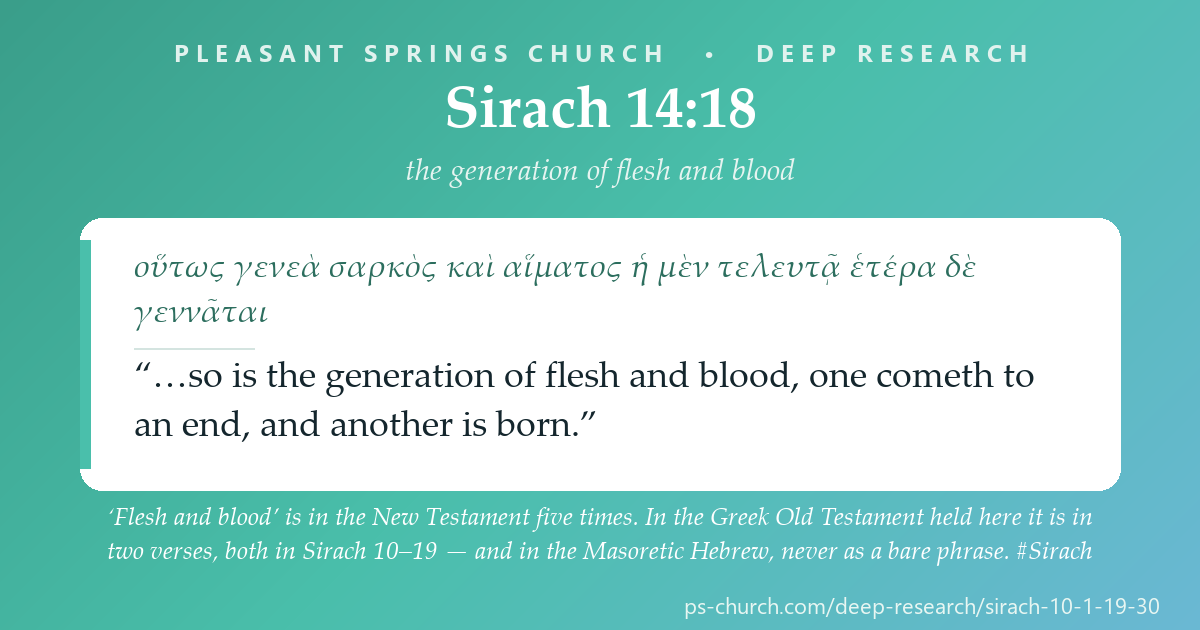
MS A, margin כן מחסות\אחסות(?) · כן דורות בשר ודם אחד · גוע ואחר גומל:SIRACH (CATSS) 14:18 ὡς φύλλον θάλλον ἐπὶ δένδρου δασέος τὰ μὲν καταβάλλει ἄλλα δὲ φύει οὕτως γενεὰ σαρκὸς καὶ αἵματος ἡ μὲν τελευτᾷ ἑτέρα δὲ γεννᾶται14:18KJV 14:18 “As of the green leaves on a thick tree, some fall, and some grow; so is the generation of flesh and blood, one cometh to an end, and another is born.”
The first of the two. σαρκὸς καὶ αἵματος — of flesh and blood — is one of only two places in the 30,348 Greek Old Testament units screened where the two nouns stand joined by and; the other is 17:31, below. In MS A the leaves are on the main line; the words כן דורות בשר ודם (so are the generations of flesh and blood) stand on a second line which the transcription labels MARGINAL. The tree is δένδρου δασέος — a pair found in these forms in one other Greek Old Testament unit, Deuteronomy 12:2, and in the plural at Isaiah 57:5 (Stage 3). The Latin spreads the verse over its 14:18–19.
VULGATE 14:18 Omnis caro sicut fœnum veterascet,/ et sicut folium fructificans in arbore viridi./
VULGATE 14:19 Alia generantur, et alia dejiciuntur :/ sic generatio carnis et sanguinis, alia finitur, et alia nascitur./
He left him in the hand of his own counsel. The four words ἐν χειρὶ διαβουλίου αὐτοῦ stand in no other Greek Old Testament unit screened. Where the Greek has one in the hand of, MS A has two: וישתיהו ביד חותפו [gloss, ours: and set him in the hand of one who seizes him — the sense is disputed] and ויתנהו ביד יצרו [gloss, ours: and gave him into the hand of his inclination]. The Latin has a clause neither the Greek row nor MS A has: adjecit mandata et præcepta sua.
VULGATE 15:14 Deus ab initio constituit hominem,/ et reliquit illum in manu consilii sui :/
VULGATE 15:15 adjecit mandata et præcepta sua./
The deepest New Testament run in all ten chapters — and its fifth word is not the same word. Against Revelation 20:13 and 20:14 the engine counts five: καὶ ὁ θάνατος καὶ ὃ. Here the last of them is ὃ, whatever; in Revelation it is ὁ, the [gloss, ours: and death and Hades]. They are the same letter only once the accents are stripped. The honest figure is four — and death and (Stage 4).
VULGATE 15:18 Ante hominem vita et mors, bonum et malum :/ quod placuerit ei dabitur illi :/
A verse the Greek printed here does not have. The 1769 English prints 16:15 and 16:16, and so does MS A. It is the only verse in the English file or the Hebrew transcription held here that names Pharaoh — את לב פרעה, the heart of Pharaoh: once in the English, once in MS A, and in neither the CATSS Greek nor the Clementine Latin, which name him nowhere in Sirach. The three Hebrew words stand in seven verses of Exodus (Stage 4).
VULGATE no counterpart: the Latin’s 16:15 is the Greek’s 16:14, and its 16:16 is the Greek’s 16:17.
Where the Hebrew stops. The transcriber’s note on this line reads סוף כתב יד A — end of manuscript A. The line is the opening of the passage on the works of creation and the making of humankind. For the next 60 Greek rows, 16:27–18:30, no Hebrew survives in the transcription held here at all.
VULGATE 16:26 In judicio Dei opera ejus ab initio,/ et ab institutione ipsorum distinxit partes illorum,/ et initia eorum in gentibus suis./
The second of the two — σὰρξ καὶ αἷμα, in exactly the forms of Matthew 16:17 and 1 Corinthians 15:50. Three words; tie band 2 among the 7,927 New Testament verses, and those two are the two. From the other side, 1 Corinthians 15:50’s deepest contact with any of the 30,348 Greek Old Testament units screened is this verse, alone. The Latin has it at 17:30: caro et sanguis.
VULGATE 17:30 Quid lucidius sole ?/ et hic deficiet ;/ aut quid nequius quam quod excogitavit caro et sanguis ?/ et hoc arguetur./
Three witnesses, three adverbs. The Greek: κοινῇ — in common, together. The English: in general. The Latin: simul — at the same time. ἔκτισεν τὰ πάντα (created all things) stands in no other Greek Old Testament unit screened and in no New Testament verse. The English line’s capital ‘Hath’ is the file’s (the Project Gutenberg text of the King James Apocrypha on this disk, eBook #124, has no ‘Hath’ in this verse); it is quoted as it stands.
VULGATE 18:1 Qui vivit in æternum creavit omnia simul./ Deus solus justificabitur,/ et manet invictus rex in æternum./
⚠️ The two Greek rows the page is named for are 14:18 and 17:31. Both are in passages about mortality; one has a Hebrew witness, in a line marked marginal, and the other has none.
On the columns. The Greek is the CATSS morphological Septuagint, quoted at verse level with attribution, as on every page of this shelf. The Hebrew is a diplomatic-style transcription of the medieval manuscripts made on Hebrew Wikisource, almost entirely by one editor who is not named, and published there under CC BY-SA 4.0; each line is quoted as transcribed — unpointed except where the manuscript points, lacunae shown as [...] — and every line names its manuscript. Attribution: Hebrew Wikisource, ‘Ben Sira’, the manuscript pages named in Stage 5, at the revisions recorded there, CC BY-SA 4.0. It is not a critical edition. The English is the King James Apocrypha, standardised text of 1769, public domain, read from the verse-per-line file on this disk and printed with its own spelling; it is the page’s only English column, quoted as it stands, and no English is ever measured against the Greek by word runs. The Latin is the Clementine Vulgate, a fourth witness aligned by content and labelled with its own numbers; it is never a source for the English.
Versification — stated, as on every page here, and here it is a third state: there is no Masoretic Sirach and no Masoretic-numbered English of this book, so the usual Hebrew/Greek/English offset does not exist. The shelf’s versification table has no entry for Sirach and the page will not invent one. What exists is four witnesses, each counted, and aligned by reading them side by side:
• Greek (CATSS, Rahlfs). 1,402 rows: 36 prologue rows labelled Prolog and 1,366 in 51 chapters. This page: 266 rows, chapters 10–19 = 30 · 32 · 18 · 25 · 27 · 20 · 28 · 27 · 32 · 27. The numbering skips fifteen verse numbers inside the range.
• English (KJV, 1769). 1,393 verses in 51 chapters; 281 in this range = 31 · 34 · 18 · 26 · 27 · 20 · 30 · 32 · 33 · 30. Read row by row against the Greek, every one of the 266 Greek rows has its English verse at the same number — no offset anywhere in 10–19 — and the English carries fifteen verses more, standing exactly at the fifteen numbers the Greek skips: 10:21; 11:15, 16; 13:14; 16:15, 16; 17:5, 9, 16, 18, 21; 18:3; 19:18, 19, 21. Equal numbers are not equal text: at several shared numbers the English carries a longer sentence than the Greek row (10:9, 18:2, 19:5, 19:6 among them), and at 17:10 the English has only the first half of the Greek row: the second half, ἵνα διηγῶνται τὰ μεγαλεῖα τῶν ἔργων αὐτοῦ (that they may tell the greatness of his works), reads, by our reading, like the end of the English 17:9. The verse-per-line file holds no prologue at all: its Sirach begins at 1:1, straight after the last verse of Wisdom (the Project Gutenberg text of the King James Apocrypha on this disk, eBook #124, does carry one).
• Hebrew (Wikisource transcription). Numbered by the Greek chapter and verse of the critical edition (Ziegler’s), not Rahlfs’; in this range the two agree wherever both have a verse (checked by reading every line against its Greek row). The Hebrew has rows at four of the Greek’s fifteen missing numbers — 11:15, 11:16, 16:15, 16:16 — and they are the English’s verses of those numbers.
• Latin (Clementine). 1,592 verses, the prologue folded into its 1:1; 293 in this range = 34 · 36 · 19 · 32 · 27 · 22 · 31 · 31 · 33 · 28, with lines the Greek rows lack and its own division. It runs ahead and behind the Greek by different amounts in every chapter (Greek 10:14 is Latin 10:17, Greek 15:17 is Latin 15:18, Greek 17:31 is Latin 17:30), so every Latin line on this page carries the Latin’s own number.
The Shape of the Passage
Sequence of nine instructions — the openers counted, not a chiasmThe colours are measured, not decorative. Units 1–7 share a colour because Hebrew survives for 168 of their 173 Greek rows; units 8–9 share the other because it survives for 9 of their 93. The break falls inside unit 8, at 16:26 — the line on which manuscript A ends.
And the page’s two ‘flesh and blood’ rows stand among sentences about mortality — 14:18 between all flesh grows old like a garment (14:17) and every work decays (14:19); 17:31 between the son of man is not immortal (17:30) and all men are earth and ashes (17:32). That is where they stand; the page does not claim the placement was planned.
⚠️ Where this page sits. Sirach is filed here under Apocrypha / Deuterocanon. This library treats it as a witness worth reading closely; nothing taught at Pleasant Springs rests on it.
Author
A book whose author signs it near its end — and the two languages do not sign it the same way. The Greek at 50:27: Ἰησοῦς υἱὸς Σιραχ Ελεαζαρ ὁ Ιεροσολυμίτης — Jesus son of Sirach, Eleazar, of Jerusalem. MS B at the same verse: לשמעון בן ישוע בן אלעזר בן סירא — of Simeon son of Yeshua son of Eleazar son of Sira. Measured on the two files; the page does not decide between them.
A teacher who speaks as a father. In these ten chapters he addresses the reader as τέκνον five times, and he talks like a man who has sat in councils, eaten at rich men’s tables, lent money and watched it go: “And he will shame thee by his meats, until he have drawn thee dry twice or thrice” (13:7, KJV).
And his grandson put the book into Greek. The prologue, which the Greek carries and the English file does not, is the grandson’s own account of doing so in Egypt (Stage 2).
Audience
Young men learning to live among the powerful. Most of these chapters are about other people: the ruler, the rich neighbour, the stranger you let into the house, the enemy with tears in his eyes. Whom to trust runs from 11:29 to 13:26 — the longest unit in the range.
People who would rather not think about dying. Call no one happy before his end (11:28); death will not delay (14:12); all flesh grows old like a garment (14:17). Both of the page’s ‘flesh and blood’ lines stand among sentences about death.
And readers who blame God. “Say not thou, It is through the Lord that I fell away” (15:11, KJV) — the teacher answers an excuse he expects to hear, and answers it with the making of man (15:14).
Orient on the book, its two languages, and the manuscripts that brought its Hebrew back.
Search by topic: Ben Sira; Sirach / Ecclesiasticus; Cairo Genizah; Ben Sira, Hebrew manuscripts; Masada scroll; yetzer (inclination); free will in Second-Temple Judaism; Apocrypha, Old Testament. None of the dictionaries below is held on this disk; their entries are named here by topic, and the exact entry titles were not checked.
Which articles are relevant?
- Anchor Bible Dictionary — the entries on Sirach (the Wisdom of Ben Sira) and on the Old Testament Apocrypha.
- Eerdmans Dictionary of Early Judaism — the entries on Ben Sira, on wisdom literature, and on free will.
- Dictionary of New Testament Background (IVP) — the entries on Sirach and on the Apocrypha and Pseudepigrapha.
- On the text — any article that separates the Hebrew manuscripts (the Cairo Genizah copies A–F, the Masada scroll, the Qumran fragments) from the Greek, and that separates the Greek’s shorter and longer forms. An article that says ‘Sirach 16:15 says’ without saying in which witness is not usable for this range: the Greek printed here has no 16:15.
Bibliography surfaced:
- Patrick W. Skehan and Alexander A. Di Lella, The Wisdom of Ben Sira (Anchor Bible 39) — an English commentary on the whole book. Not held here.
- Pancratius C. Beentjes, The Book of Ben Sira in Hebrew — the Hebrew manuscripts printed side by side, with a synopsis. Not held here.
- Joseph Ziegler, Sapientia Iesu Filii Sirach (the Göttingen Septuagint) — the critical Greek edition, whose numbering the Hebrew transcription follows. Not held here.
- Solomon Schechter and Charles Taylor, The Wisdom of Ben Sira (Cambridge, 1899) — an early edition of Genizah leaves. A scan is on this disk and was used only for the by-eye spot-checks reported in Stage 5.
- NETS (the New English Translation of the Septuagint), Sirach, translated by Benjamin G. Wright — an English made from the Greek, and the obvious next step for a reader. Not the edition quoted here.
A grandson’s warning, a storeroom in Cairo, and fifteen verses the Greek does not number.
Three things from outside the text bear on reading these chapters, and each is labelled with what this disk can and cannot check.
The grandson’s warning — in his own Greek
Ben Sira’s translator tells us, in his own words, that he translated it. The prologue (36 rows in the Greek file, labelled Prolog) ends its apology like this:
SIRACH (CATSS) Prolog 21–22 οὐ γὰρ ἰσοδυναμεῖ αὐτὰ ἐν ἑαυτοῖς Εβραϊστὶ λεγόμενα καὶ ὅταν μεταχθῇ εἰς ἑτέραν γλῶσσανGreek prologue, rows 21–22. [gloss, ours: For things said in Hebrew do not have the same force in themselves when they are carried over into another language]
The English file does not have this sentence: its Sirach begins at 1:1. (The Project Gutenberg text of the King James Apocrypha on this disk, eBook #124, does carry the prologue; it is a check, not this page’s English column.) The Latin folds the whole prologue into its own 1:1. So on this page the only witness to the translator’s warning is the Greek it warns about. The rows that follow date his arrival in Egypt (Prolog 27–28): ἐν γὰρ τῷ ὀγδόῳ καὶ τριακοστῷ ἔτει ἐπὶ τοῦ Εὐεργέτου βασιλέως — in the thirty-eighth year in the reign of Euergetes — which the commentaries usually take as 132 BC (reported, not tested here).
This page is a measurement of that warning. Where both languages survive, they run side by side in sense and differ in detail line after line (10:14, 14:18, 15:14 in the Passage above), and the page reports each difference as what each column has — never as something one of them did to the other.
A storeroom in Cairo — the manuscripts in this range
No manuscript of Sirach in Hebrew was known to modern scholarship until the 1890s, when leaves were identified among the discarded manuscripts of the Ben Ezra synagogue in Cairo (the Genizah); Solomon Schechter’s identification and the 1899 edition named in Stage 1 are the usual account. Reported, not checked: this disk holds a scan of that edition, not the manuscripts. The Genizah copies are usually dated to the Middle Ages, and the Masada and Qumran fragments of other chapters to antiquity (reported). None of the ancient fragments touches 10:1–19:30.
Measured on the transcription held here, three Genizah manuscripts reach this range: MS A runs from the start of the range to סוף כתב יד A at 16:26; MS B covers 10:19–11:10 and 15:1–3 (the acquisition record lists MS B’s 16:1–7 as surviving but untranscribed: Stage 5); MS C has 18:31–19:3. Between 16:27 and 18:30 — 60 Greek rows — there is nothing, and after 19:3 nothing again to the end of the range.
Fifteen verses the Greek does not number — and four of them in Hebrew
The 1769 English has 281 verses where the Greek has 266, and every one of the fifteen extras sits at a number the Greek file skips. They are commonly identified as additions belonging to a longer form of the Greek (often called GII), which the critical editions keep out of their main text. That identification is reported, not measured: no manuscript of the longer Greek is on this disk. Which printed Greek the translators of 1611 used is likewise not something this disk can show.
What IS measured is who has them:
- 11:15–16 and 16:15–16 — in the English, and in MS A, at the same numbers. 16:15 is the verse naming Pharaoh. The Latin has 11:15–16 (sapientia, et disciplina, et scientia legis) and has no Pharaoh anywhere in the book.
- 10:21 and 13:14 — in the English; not in MS A, although MS A has the verse before and the verse after each of them (and at 10:21, MS B does too). The Latin has the substance of 13:14 at its own 13:18: Omni vita tua dilige Deum.
- 17:5, 9, 16, 18, 21; 18:3; 19:18, 19, 21 — in the English, in passages where no Hebrew survives in the transcription at all. Nothing can be said from this disk about whether a Hebrew copy ever had them.
A manuscript having a verse does not tell us which form of the book is older, and the page does not draw that conclusion. It records that the four witnesses do not agree on how many verses these chapters contain.
The making of man, the ‘inclination’, and later readers
15:11–20 answers an excuse: do not say it was the Lord who made me fall. The answer is that God made the human being from the beginning and left him in the hand of his counsel; fire and water, life and death, are set before him, and whichever he wishes will be given him (15:17). The passage sets a choice before the human being and refuses to make God its cause; it does not discuss how that choice relates to grace, and the page does not supply a doctrine the text does not state.
MS A’s word for that inner faculty is יצרו, his inclination (Hebrew yēṣer). Later rabbinic teaching made the good inclination and the evil inclination a standing pair (reported from the secondary literature; no rabbinic text is held here). Augustine is reported to cite the Latin of this passage in On Grace and Free Choice, and to read the Latin of 18:1, creavit omnia simul, as creation all at once in his literal commentary on Genesis — reported, not checked: no text of Augustine is held on this disk. Both uses rest on the Latin wording, which at 18:1 is not the Greek’s (Passage, line 18:1).
A pair of nouns, a hand, an adverb, a tree and a name — each counted in every witness that has it.
Greek counts are over the 30,348 screened units of the Greek Old Testament (the Odes excluded) and the 7,927 verses of the Greek New Testament; Hebrew counts over the 23,204 verses of the Masoretic text and the 1,411 lines of the Ben Sira transcription. None of them is a count over ‘the Septuagint’ or ‘the Hebrew Bible’ as such, and each says which corpus it is.
Two units in the 30,348 screened Greek Old Testament units join the two nouns with and, and both are on this page: σαρκὸς καὶ αἵματος (14:18) and σὰρξ καὶ αἷμα (17:31). Five verses of the 7,927 in the Greek New Testament do: Matthew 16:17, 1 Corinthians 15:50, Galatians 1:16, Ephesians 6:12, Hebrews 2:14. In the 23,204 verses of the Masoretic Hebrew the two-word phrase בשר ודם occurs nowhere; the two nouns stand joined by and once, Deuteronomy 12:27, as הַבָּשָׂ֣ר וְהַדָּ֔ם — the meat and the blood of a burnt offering, where the Greek has a different word for the meat. Without and they also stand next to each other at Leviticus 17:11, 17:14 (twice) and Deuteronomy 32:42, each time in separate phrases (Leviticus 17:11, נֶ֣פֶשׁ הַבָּשָׂר֮ בַּדָּ֣ם, [gloss, ours: the life of the flesh is in the blood]). Ben Sira’s Hebrew has the phrase once, at 14:18, in the line the transcription marks as marginal. Search: the two nouns in any case or number, either order, joined by and; allow one word between them and one more Greek unit appears, Wisdom 12:5, a feast of human flesh and blood.
Eleven occurrences in the Greek Old Testament units screened, none in the New Testament: Hosea 4, Sirach 3, Psalms 2, Ezekiel 1, Wisdom 1. The four words ἐν χειρὶ διαβουλίου αὐτοῦ stand at 15:14 and nowhere else. MS A at the same verse has ביד יצרו, in the hand of his inclination — preceded by a second, different in the hand of clause the Greek row does not have. The page compares what the two columns have; it does not say how one became the other.
Six occurrences in the Greek Old Testament units screened, none in the New Testament: 2 Maccabees 4:5, 9:26; Proverbs 32:24 (the CATSS file’s numbering; the same verse is 25:24 in the Masoretic text and English Bibles); Sirach 18:1, 50:17; Susanna (Theodotion) 14. At 18:1 the three witnesses that have the verse give three adverbs: Greek together, English in general, Latin simul, at the same time. A doctrine of creation all at once is reported to have been read out of the Latin word by Augustine (Stage 2; not checked here); the English words do not say at once. No Hebrew of the verse survives here to say which the author meant.
In the Greek Old Testament units screened, the pair in these exact forms stands twice: Sirach 14:18 and Deuteronomy 12:2 — ὑποκάτω δένδρου δασέος, under a leafy tree, the places Israel is told to destroy. In the plural it stands once more, Isaiah 57:5, ὑπὸ δένδρα δασέα, under leafy trees, in a verse of idols and slaughtered children. Searched: any form of the one word followed by any form of the other, in either order; no other unit, and no New Testament verse. MS A’s tree is עץ רענן, a pair that stands in eleven verses of the Masoretic text — Deuteronomy 12:2, 1 Kings 14:23, 2 Kings 16:4 and 17:10, Isaiah 57:5, Jeremiah 2:20, 3:6, 3:13 and 17:2, Ezekiel 6:13, 2 Chronicles 28:4 — and in every one of the eleven, read in context, the green tree is a site of forbidden worship. MS A’s three words על עץ רענן share a run of three with Jeremiah 17:2 alone. Ben Sira uses it of leaves and generations; the coincidence is measured in both languages; what, if anything, he meant by it is not.
Named once in the 1,393 verses of the English Sirach (16:15) and once in the 1,411 lines of the Hebrew transcription (MS A, 16:15); named nowhere in the 1,402 rows of the CATSS Greek or the 1,592 verses of the Clementine Latin. The sentence he stands in — The Lord hardened Pharaoh — is one of the fifteen the English carries at numbers the Greek skips. A reader who knows Sirach only from the Greek printed here, or only from the Clementine Latin, has not met him in this book.
Counted here, not assumed:
- Greek 266 rows, 3,427 words; English 281 verses; Latin 293 verses; Hebrew 220 lines (MS A 177, its margin 6; MS B 29, its margin 2; MS C 6). 177 of the 266 Greek rows have Hebrew.
- The Greek rows with no Hebrew while MS A is running: 10:15, 11:26, 12:7, 14:7, 14:8. The transcription’s pages for chapters 11 and 14 of MS A are marked incomplete on Wikisource, so a missing row there may be an untyped one.
- The 60 Greek rows from 16:27 to 18:30 have no Hebrew at all, and nor do the 24 from 19:4 to 19:30.
- Pride (the word group ὑπερηφανία): 10 times in the 266 rows, 5 of them in chapter 10; 22 times in the whole Greek Sirach.
- The English file reads ‘ungodly’ at 11:17 — The gift of the Lord remaineth with the ungodly — where the Greek row reads εὐσεβέσιν (the godly), MS A [.]דיק (…righteous, its first letter lost) and the Latin justis. The English is printed as it stands; whether a printed 1769 text reads so was not checked. The Project Gutenberg text of the King James Apocrypha also on this disk (eBook #124) reads ‘godly’ here, so ‘ungodly’ may be an error of the eBible file.
Nothing reaches six in the New Testament. The deepest New Testament run has a false fifth word. And the link that matters measures three.
Every Greek row of 10:1–19:30 screened against all 7,927 verses of the Greek New Testament; contiguous runs of whole word forms; the tie band — how many verses reach the same depth — printed beside every run, from both sides: the Sirach row’s band among New Testament verses, and the New Testament verse’s own deepest run and band among the 30,348 screened Greek Old Testament units. A row sharing only single words scores 1, however many single words it shares; 0 would mean no shared word at all, and no row scores 0. The screen finds verbatim contact, not allusion.
The distribution — 266 rows against the New Testament:
All 266 share at least one word with some New Testament verse; 250 reach two, 129 reach three, 13 reach four, ONE reaches five, and nothing reaches six. Sixteen rows never get past a single shared word.
For comparison of shape, not of quality: the same screen run on the Greek Old Testament against itself — each of these 266 rows against every other screened unit — gives 262 at two, 190 at three, 76 at four, 14 at five, 2 at six and 1 at seven. The two screens are not like for like: the Greek Old Testament screened holds 619,498 words against the New Testament’s 137,554, about four and a half times as many, and it includes the rest of Sirach. With every unit of Sirach itself left out, the figures are 259 at two, 176 at three, 65 at four, 9 at five, 1 at six and 1 at seven.
| Sirach | shared words (Sirach’s Greek) | run · band among 7,927 NT verses | each NT verse: its deepest run · band among 30,348 Greek OT units |
|---|---|---|---|
| 15:17 | καὶ ὁ θάνατος καὶ ὃ | 5 · 2 | Revelation 20:13 — 5 · 1 Revelation 20:14 — 5 · 1 |
| 10:2 | τοῦ λαοῦ οὕτως καὶ | 4 · 1 | Hebrews 5:3 — 4 · 1 |
| 11:17 | αὐτοῦ εἰς τὸν αἰῶνα | 4 · 1 | Luke 1:55 — 4 · 23 |
| 11:29 | εἰς τὸν οἶκόν σου | 4 · 5 | Matthew 9:6 — 4 · 15 Mark 2:11 — 4 · 12 Mark 5:19 — 4 · 13 Luke 5:24 — 4 · 12 Luke 8:39 — 5 · 3 |
| 12:16 | ἐν τῇ καρδίᾳ αὐτοῦ (Matthew 5:28, Matthew 13:19, Matthew 24:48, Mark 11:23, Luke 12:45, 1 Corinthians 7:37) καὶ ἐν τῇ καρδίᾳ (Romans 10:8) | 4 · 7 | Romans 10:8 — 9 · 1 Matthew 5:28 — 4 · 10 Matthew 13:19 — 4 · 10 Matthew 24:48 — 4 · 10 Mark 11:23 — 4 · 16 Luke 12:45 — 4 · 10 1 Corinthians 7:37 — 4 · 10 |
| 13:23 | καὶ τὸν λόγον αὐτοῦ | 4 · 2 | John 5:38 — 4 · 1 John 8:55 — 4 · 1 |
| 14:1 | ἐν τῷ στόματι αὐτοῦ | 4 · 1 | 1 Peter 2:22 — 9 · 1 |
| 14:21 | αὐτοῦ καὶ ἐν τοῖς | 4 · 1 | Mark 6:4 — 4 · 9 |
| 15:19 | καὶ οἱ ὀφθαλμοὶ αὐτοῦ | 4 · 1 | Revelation 1:14 — 4 · 9 |
| 16:12 | κατὰ τὰ ἔργα αὐτοῦ | 4 · 2 | Romans 2:6 — 5 · 2 2 Timothy 4:14 — 4 · 5 |
| 16:14 | ἕκαστος κατὰ τὰ ἔργα (Revelation 20:13) κατὰ τὰ ἔργα αὐτοῦ (Romans 2:6, 2 Timothy 4:14) | 4 · 3 | Revelation 20:13 — 5 · 1 Romans 2:6 — 5 · 2 2 Timothy 4:14 — 4 · 5 |
| 16:17 | ἡ ψυχή μου ἐν | 4 · 1 | Hebrews 10:38 — 9 · 1 |
| 17:19 | καὶ οἱ ὀφθαλμοὶ αὐτοῦ | 4 · 1 | Revelation 1:14 — 4 · 9 |
Read the last column first. Where a New Testament verse reaches 9 elsewhere (Romans 10:8 with Deuteronomy 30:14; 1 Peter 2:22 with Isaiah 53:9; Hebrews 10:38 with Habakkuk 2:4), the Sirach row is touching the edge of a much deeper match with another book. Where the bands are as low as they go — Sirach 10:2 with Hebrews 5:3 (band 1 from both sides), and Sirach 13:23 with John 5:38 and 8:55, and his word (band 2 among New Testament verses, because the two John verses tie; 1 from each John verse) — the contact is as rare as the screen can show and is still an accident of common words. Rarity is not significance.
The deepest New Testament run in ten chapters — the page’s first counter-example:
Sirach 15:17 → Revelation 20:13 and 20:14: a run of five, tie band 2; and from the other side, each Revelation verse’s deepest contact anywhere in the 30,348 Greek Old Testament units is this Sirach row, alone. It looks like a find. It is two things at once:
- The fifth word is a different word. Sirach: καὶ ὁ θάνατος καὶ ὃ ἐὰν — and death, and whatever. Revelation 20:13: καὶ ὁ θάνατος καὶ ὁ ᾅδης [gloss, ours: and death and Hades]. Accents stripped, the relative pronoun and the article are the same single letter. The engine is right about the letters and wrong about the words.
- The four genuine words are common ones. καὶ ὁ θάνατος καὶ — and death and — stands in one Greek Old Testament unit of the 30,348 (this one) and in two New Testament verses (these two). Rare as a string; ordinary as language. Sirach sets life beside death; Revelation sets death beside Hades.
The link this page is about — and why the engine nearly misses it:
Sirach 17:31 → Matthew 16:17 and 1 Corinthians 15:50: a run of three, σὰρξ καὶ αἷμα, tie band 2. From the other side: 1 Corinthians 15:50’s deepest contact in the 30,348 Greek Old Testament units is Sirach 17:31, and nothing else reaches three (band 1); Matthew 16:17 reaches three with 37 units, most of them on ὁ πατήρ μου, my father.
1 CORINTHIANS 15:50 (SBLGNT) Τοῦτο δέ φημι ἀδελφοί ὅτι σὰρξ καὶ αἷμα βασιλείαν θεοῦ κληρονομῆσαι οὐ δύναται οὐδὲ ἡ φθορὰ τὴν ἀφθαρσίαν κληρονομεῖ[gloss, ours: This I say, brothers: that flesh and blood cannot inherit the kingdom of God, nor does corruption inherit incorruption] — no ESV of this chapter is held on this disk.
Sirach 14:18 has the same pair in another case — σαρκὸς καὶ αἵματος — and the engine, which matches word forms in order, cannot see the pair. Its best New Testament run is two words, in a tie band of 17: four verses on τὰ μὲν, four on σαρκὸς καὶ (2 Corinthians 7:1, Ephesians 2:3, Hebrews 2:14, 1 John 2:16), two on καὶ αἵματος (Acts 15:29, 1 John 5:6), and seven on three other pairs of small words. None of the seventeen has all three words; Hebrews 2:14, one of the five New Testament ‘flesh and blood’ verses, has the two nouns in the other order, αἵματος καὶ σαρκός. Against Matthew 16:17 it scores ONE; and the word the engine reports is not even the same word — ἄλλα (others) in Sirach, ἀλλ’ (but) in Matthew, alike only once accents and elision are normalised away. The shelf’s signature measurement rates the page’s central connection at one word, and the word it reports is a coincidence of spelling. That is why the pair was counted in Stage 3 by a search that allows for case, and why the run engine is never the only instrument on a page.
What the measurement does not show. It does not show that Matthew or Paul read Sirach. The pair also lives on in later Hebrew (reported; no rabbinic text is held here), and a phrase in common speech needs no book to travel. What it shows is narrower and firmer: in the Greek and Hebrew texts of the Old Testament and the Apocrypha that this shelf holds, the only places the New Testament’s ‘flesh and blood’ also stands as a bare pair (Deuteronomy 12:27 joins the meat and the blood of an offering, each noun with the article) are two lines of Ben Sira.
⚠️ The connections a reader may expect — measured:
- 10:14 → Luke 1:52, the Magnificat — run of ONE (καθεῖλεν; the only other word the two verses share is and). The row’s own deepest New Testament run is three words, ὁ κύριος καὶ, tie band 7. καθεῖλεν stands 24 times in the Greek Old Testament units and once in the New Testament, at Luke 1:52. Luke 1:52’s own deepest contact in the 30,348 units is two words, tie band 12. The Magnificat is also in the Greek Psalter’s appendix, as the ninth Ode — καθεῖλεν δυνάστας ἀπὸ θρόνων καὶ ὕψωσεν ταπεινούς — identical to Luke 1:52, all seven words, which is exactly why the Odes are left out of every screen on this shelf: Luke would be measuring Luke.
- 11:19 → Luke 12:19, the rich fool — run of ONE (and and my are shared, never side by side); the row’s own deepest New Testament run is three common words, tie band 5. Luke 12:19’s own deepest contact in the Greek Old Testament units is three words, τῇ ψυχῇ μου, tie band 10. Two rich men talking to themselves about eating, and no two consecutive words in common.
- 15:11–12 → James 1:13 — run of ONE each [gloss, ours: let no one say, when tempted, I am tempted by God] (15:11 shares ὅτι and γὰρ with it, 15:12 those two and αὐτός, never two side by side); the two rows’ own deepest New Testament runs are two words, tie bands 12 and 95. The same excuse refused, in different words.
- 14:17 → Hebrews 1:11 — run of TWO (ὡς ἱμάτιον, as a garment). Hebrews 1:11 reaches ten with Psalm 101:27 (the Greek’s numbering; ESV 102:26). 14:17 → 1 Peter 1:24 reaches three, tie band 1 (πᾶσα σὰρξ ὡς) — and 1 Peter 1:24 reaches seven with Isaiah 40:7. In both, Sirach shares the edge of a much deeper match with another book.
- 17:3, the image → James 3:9 — run of ONE; the row’s own deepest New Testament run is two words, tie band 21. And against the whole of Genesis 1–11 in Greek, no row of 16:26–17:14 — the passage on the works and the making of humankind — reaches more than three words, and every three is ordinary phrasing: τὰ ἔργα αὐτοῦ (his works, with Genesis 2:2–3), εἰς τὴν γῆν (into the earth, with 3:19 and 11:31), καὶ εἶπεν αὐτοῖς (and he said to them, with 9:1), and once ἀπὸ τῶν ἔργων (from the works, with 5:29). The image phrase κατ' εἰκόνα is two. The passage covers the ground of Genesis 1–3 — earth, image, dominion, good and evil — in its own words.
Hebrew against Hebrew — the manuscripts against the Masoretic text:
Each of the 220 Hebrew lines of this range screened against all 23,204 verses of the Masoretic text, consonants only, final letters folded. Here a zero means “no two consecutive words shared” (single words are not counted). A word carrying a lacuna, a restoration, an uncertainty mark or an alternative reading breaks a run; punctuation is ignored; the divine name is left as the manuscripts write it, ייי, so it never matches the Masoretic spelling.
Result: 118 of the 220 lines reach two words, 13 reach three, ONE reaches four, nothing reaches five, and 102 share no two consecutive words with any verse of the Hebrew Bible. Read the divine name as the Masoretic spelling and 122 reach two; nothing at three or four changes.
- The deepest: 16:10, MS A → Numbers 11:21 — four words, tie band 1: שש מאות אלף רגלי, six hundred thousand on foot — Numbers 11:21: וַיֹּ֘אמֶר֮ מֹשֶׁה֒ שֵׁשׁ־מֵא֥וֹת אֶ֙לֶף֙ רַגְלִ֔י הָעָ֕ם אֲשֶׁ֥ר אָנֹכִ֖י בְּקִרְבּ֑וֹ וְאַתָּ֣ה אָמַ֗רְתָּ בָּשָׂר֙ אֶתֵּ֣ן לָהֶ֔ם וְאָכְל֖וּ חֹ֥דֶשׁ יָמִֽים׃ [gloss, ours: and Moses said, six hundred thousand on foot are the people among whom I am, and you have said, I will give them meat to eat a whole month]. The Greek of the same line goes somewhere else: its deepest Greek Old Testament contact is Exodus 12:37 (ἑξακοσίας χιλιάδας πεζῶν, three words, band 1). The Hebrew of Exodus 12:37 puts a one-letter preposition on six, and the Greek of Numbers 11:21 puts the number in another case — so each language’s measurement lands on a different verse for reasons of grammar alone.
- 16:18, the heaven and the heaven of heavens. Greek: seven words, tie band 4 (Deuteronomy 10:14, 3 Kingdoms 8:27 — 1 Kings 8:27 in English Bibles — 2 Chronicles 2:5, which English Bibles number 2:6, and 2 Chronicles 6:18) — the deepest Greek Old Testament contact in the range. Hebrew, MS A: three words, tie band 3 — the same verses less 2 Chronicles 6:18, whose first heavens lacks the article. Two languages, one formula, measured separately.
- 16:15, the verse the Greek lacks — three words, tie band 17: את לב פרעה stands in seven verses of the Masoretic text, every one in Exodus (7:3, 9:12, 10:20, 10:27, 11:10, 14:4, 14:8); the other ten verses of the band of 17 share a different three-word string, אשר לא ידעו (who did not know). A formula of the plague story, in a verse only the Hebrew and the English have.
- Zeros worth naming. 10:14 (the throne of the proud), 15:14 (in the hand of his inclination), 16:26 (the last line of MS A) and the margin line at 14:18 that carries בשר ודם share no two consecutive words with any verse of the Masoretic text.
What this page could not check, where it is weakest, and what the Hebrew text is and is not.
This is the section that makes the shelf trustworthy. It is long for this page because the Hebrew column is a wiki transcription, not an edition, and a reader should know exactly what it rests on.
⚠️ The Hebrew column — what it is, and what it is not:
- A transcription, not a critical edition. It was made on Hebrew Wikisource, almost entirely by one editor who is not named, page by page from the manuscripts. It declares no source edition and was not compared here with any printed one beyond the by-eye spot-checks its acquisition record reports (Schechter and Taylor’s 1899 edition at 13:25–14:10 among them).
- Pinned, because it is a live wiki. The page carrying MS A chapter 14 — and so the 14:18 line this study is named for — had an anonymous edit in 2025 that changed two words and inserted two lines that are not in the manuscript (so the acquisition record, which caught it against the 1899 edition); it is used at the revision before that edit. The Wikisource pages, at the revisions used, behind every Hebrew line printed here: בן סירא/כתב יד A/י, revision 2961689; בן סירא/כתב יד A/יא, revision 3005345; בן סירא/כתב יד A/יד, revision 2867847; בן סירא/כתב יד A/טו, revision 2883289; בן סירא/כתב יד A/טז, revision 1395099; בן סירא/כתב יד B/נ, revision 1381752.
- Marked incomplete by Wikisource itself: in this range, the pages for MS A chapters 11 and 14 and MS B chapter 15. A Greek row with no Hebrew in those chapters may be a row nobody has typed yet. The acquisition record also lists MS B’s 16:1–7 as surviving Hebrew that has no Wikisource page at all, so MS B is absent here for those verses (MS A has them).
- The 14:18 margin. The transcription puts כן דורות בשר ודם on a line of its own and labels it marginal; the main line has a correction above it. This page could not check that layout against a photograph of the leaf. If the line is in the main text after all, the count of Hebrew ‘flesh and blood’ does not change; its description does.
- Hebrew is never measured against Greek by word runs. The two languages are compared by what each has and lacks, by structure and by counts; runs are Greek-Greek and Hebrew-Hebrew only.
⚠️ What this page could NOT check:
- The longer Greek text. The fifteen English-only verses are reported as the longer Greek form’s on the word of the critical literature; no witness to it is held, and neither is Ziegler’s apparatus.
- Which Greek the 1611 translators used, and whether the 1769 printed text reads ‘ungodly’ at 11:17. The file does; the Project Gutenberg King James Apocrypha on this disk (eBook #124) reads ‘godly’; no printed copy was consulted.
- The Syriac, an independent witness to this book, is not held.
- Augustine, the rabbis, and the date. Every statement about later readers, and the dating of the book and of the grandson’s translation, is reported from the secondary literature and labelled as such.
- The Latin alignment. Latin verses were matched to Greek rows by reading; the Clementine Sirach is divided differently in every chapter and carries lines the Greek rows lack, and only the matches printed on this page were made. The statement that the Latin carries 11:15–16 and the substance of 13:14 is a reading; the statement that it never names Pharaoh is a count.
⚠️ Where this page is weakest:
- The ‘flesh and blood’ count is a pattern search, not a run. It finds the two nouns, in any case or number and either order, joined by and. Allow one word between them (an article, say) and Wisdom 12:5 joins in Greek; the nearest Hebrew is Deuteronomy 12:27, with the article on both nouns. The page prints both edges rather than hiding them.
- The Hebrew tokeniser is a choice. Damaged words break runs; the divine name is left as written. Both choices are stated beside the numbers, and the second is shown to change nothing at three words or more.
- The structure is a reading. Five of the nine units open on a counted marker; the other four openings, and every cut, are ours.
- Content alignment was done by reading. All 266 Greek rows were read against the English and the 220 Hebrew lines against the Greek; the binding check confirms the labels and the counts, not the sense.
- A page about one phrase can make it look more central than it is. These chapters are mostly about money, friends and speech; ‘flesh and blood’ is two lines of 266.
- The English column is one electronic file. Set against the Project Gutenberg text of the King James Apocrypha on this disk (eBook #124), the 281 English verses of this range differ in wording at three, 11:17 (ungodly against godly), 11:24 and 18:1 (the capital Hath), and elsewhere only in punctuation. Neither file was checked against a printed 1769 copy.
Commentaries & studies:
- Skehan & Di Lella, The Wisdom of Ben Sira (Anchor Bible 39).
- Beentjes, The Book of Ben Sira in Hebrew — the manuscripts in synopsis.
- Ziegler, Sapientia Iesu Filii Sirach (Göttingen) — the critical Greek.
- Schechter & Taylor, The Wisdom of Ben Sira (1899) — an early edition of Genizah leaves.
- NETS, Sirach (Wright) — English from the Greek.
Flesh and blood, a hand and a choice, and a friend to do good to before you die.
Name what you learned, why it matters, and one concrete response.
What should we carry away — and do?
- ‘Flesh and blood’ has a history you can count. In the Greek Old Testament this shelf holds — canonical books and Apocrypha together — the pair stands in only two lines, both Ben Sira’s, and both among sentences about dying. When Paul says flesh and blood cannot inherit the kingdom, the only Greek Old Testament lines this shelf can set beside him stand among sentences about mortality.
- Measure, then read. The engine scored 14:18 against Matthew 16:17 at one word, and the word it reported was a coincidence of spelling. Numbers are where reading starts, not where it stops.
- Ask which copy. Pharaoh is in Sirach in the English file and the Hebrew transcription held here, and not in the CATSS Greek or the Clementine Latin. ‘Sirach says’ is incomplete until it says where.
- Do not blame God for what you chose. 15:11–20 is a witness, not Scripture for us — but James 1:13 refuses the same excuse, in different words.
- One concrete response. “Do good unto thy friend before thou die” (14:13, KJV). Name one friend, and do one good thing for them this week.
Sirach 14:18 · to share
Greek · Hebrew (MS A, margin) · EnglishEvery Deep Research page traces its passage across the whole sweep — the Old Testament, the Second-Temple world between the testaments (historical witnesses, not Scripture), and the New Testament. Follow the thread:
Sirach on this shelf — one book in six studies
Prologue & 1:1–9:1810:1–19:30 · this study20:1–28:2629:1–36:2737:1–43:3344:1–51:30← Previous: Sirach Prologue & 1:1–9:18 · Next: Sirach 20:1–28:26 →
Pleasant Springs Church — Deep Research
Research method after Michael S. Heiser’s Bible Research Method (examine dictionaries → ancient literature → important words → textual connections → academic publications → share), with the Pleasant Springs “Author & Audience” foundation. Scripture set in the Hebrew, the Greek editions named on each page and the ESV (Old Testament), and the Greek New Testament and the ESV (New Testament), per the practice of Pleasant Springs Church. ⚠️ Status: Sirach is not part of the Protestant canon. It is canonical in the Roman Catholic and Orthodox churches, was printed among the Apocrypha in the Reformation-era Protestant Bibles, and is absent from the Hebrew Bible. This study is filed under Apocrypha / Deuterocanon and nothing taught at Pleasant Springs rests on it. Greek text: the CATSS morphologically analysed Septuagint (Rahlfs), quoted at verse level with attribution; rows, words, run depths and tie bands were re-derived for this study. Hebrew text: the Hebrew Wikisource transcriptions of the Cairo Genizah manuscripts of Ben Sira (MS named on every line), CC BY-SA 4.0, used at pinned revisions; a transcription, not a critical edition. Canonical Hebrew comparisons: the Masoretic text, Miqra according to the Masorah (Sefaria). English: the King James Apocrypha, standardised 1769 text, public domain (the verse-per-line edition from eBible.org, held here with its provenance); every English line on this page is read from that file at build time and checked again by the page’s self-check. The KJV is the only English of Sirach on this page. No ESV is cached on this disk for the canonical verses glossed here (the New Testament verses, Numbers 11:21 and Leviticus 17:11), so those carry our own glosses, marked as such. Latin: the Clementine Vulgate (public domain), a fourth witness aligned by content and never a source for the English. Direction of influence is nowhere asserted. Scholarship after Skehan–Di Lella, Beentjes, Ziegler and Schechter–Taylor.
Scripture quotations marked ESV are from the ESV® Bible (The Holy Bible, English Standard Version®), © 2001 by Crossway, a publishing ministry of Good News Publishers. ESV Text Edition: 2016. Used by permission. All rights reserved. The ESV text may not be quoted in any publication made available to the public by a Creative Commons license, and the ESV may not be translated in whole or in part into any other language. www.esv.org
|
Did this study bless you today? 💚 Give to Support PS Church100% of gifts go to the General Fund — thank you. |