The last quarter of Proverbs is where the two files agree most exactly. All 202 Masoretic verses of 25:1–31:31 have a Greek row of the matching number — 28, 28, 27, 28, 27, 33 and 31, both sides, nothing absent — against twenty-four absent numbers everywhere else in the book, nineteen of them in one section. And then, inside the acrostic that ends the book, one verse does not answer one row. Hebrew 31:26 is the pe verse. Its content stands in two Greek rows: the one numbered 31:25 carries four of its six content words, and the one numbered 31:28 — three rows later — carries five. Between them stands the row that answers Hebrew 31:25 cleanly and completely, five constituents in the same order with nothing left over. The Hebrew puts that verse in one place. The Greek rows put its material in two, with the neighbouring verse lying between them. See the method →
Proverbs 25:1–31:31 (selections)
Hebrew · Greek (CATSS, Rahlfs’ Septuaginta) · ESVAll 202 Masoretic verses of 25:1–31:31 have a Greek row of the matching number: 28, 28, 27, 28, 27, 33 and 31, both sides, nothing absent. Across the rest of Proverbs, twenty-four numbers have no Greek row — nineteen of them in 16:1–22:16 alone.
And yet inside the acrostic at the end, one verse breaks the pattern. Hebrew 31:26 is the pe verse. Its content stands in two Greek rows — the one numbered 31:25 carries four of its six content words, and the one numbered 31:28, three rows later, carries five. Between them sits the row carrying Hebrew 31:25, the ayin verse, which answers it cleanly and completely.
Each of the two rows carries a word that occurs nowhere else in the book. ἐννόμως stands in one row of the twenty-five Greek files on disk, and νομοθέσμως in one. They are these two rows.
The Shape of the Passage
Sequence — four collections and a poemThree of the four units here carry a name in the Hebrew, and the Greek rows carry only one of the three. Hebrew 25:1 names Solomon and Hezekiah, and the Greek row at label 32:1 names σαλωμῶντος and Εζεκιου. Hebrew 30:1 names Agur son of Jakeh; the row at 30:1 names no one. Hebrew 31:1 names Lemuel; the row at 31:1 names no one. The page reports what each file carries at each point and says nothing about how the difference arose.
Author
Solomon again at 25:1, by a second hand. The superscription is the only one in the book that names anyone besides the author — אַנְשֵׁי חִזְקִיָּה, the men of Hezekiah, where the Greek row has οἱ φίλοι, the friends. The two words גַּם־אֵלֶּה that open it stand adjacent in exactly three verses of the thirty-nine books, and two of the three are collection headings in Proverbs.
Then two names the Greek rows do not carry. Agur at 30:1 and Lemuel at 31:1 are both absent from the corresponding rows. Whether either name was ever read as a name rather than as ordinary words is a question about vocalisation this page cannot reach, and does not attempt.
Audience
A court, and then a household. The Hezekiah collection is full of kings, courts, messengers and lawsuits; 31:1–9 addresses a king directly; and the poem that ends the book is domestic throughout.
And a reader who has been taught to expect a shape. The book opens with wisdom personified as a woman calling in the street and closes with a woman whose worth is counted in her work. That is a literary observation, not a measurement, and it is offered as one.
Orient on the Hezekiah collection, Agur and Lemuel, and the acrostic poem.
Search by topic: Proverbs, the Hezekian collection; Agur; Lemuel; the acrostic of Proverbs 31; alphabetic acrostics in the Hebrew Bible.
Which articles are relevant?
- Anchor Bible Dictionary — “Proverbs, Book of,” “Acrostics,” “Agur,” “Lemuel.”
- Dictionary of the OT: Wisdom, Poetry & Writings (IVP) — “Acrostic,” “Woman of Valour,” “Numerical Sayings.”
- NIDOTTE — חַיִל, מָשָׁל.
What the numbering agreement does and does not show
Zero absent numbers across 202 verses is the tightest correspondence in the book. It is a fact about how the two files are numbered, and it sits oddly beside another fact established on the previous page of this shelf: this is also the material the Greek file places out of order, at labels 32 to 36, after the rows carrying Masoretic 30:15–31:9.
The blocks are moved; inside them the verses line up exactly. That is what the counting shows and it is all the counting shows.
The acrostic, and every other acrostic in the Hebrew Bible.
Proverbs 31:10–31 is exceptionless
Twenty-two verses; the first consonant of the first word of each runs א through ת, in order, no letter missing and none doubled, and in no verse does the letter sit anywhere but at the head.
Set against every alphabetic acrostic in the thirty-nine books, on the same verse-initial test:
| Acrostic | ayin / pe order | complete and in order? |
|---|---|---|
| Proverbs 31:10–31 | ayin → pe | yes |
| Lamentations 1 | ayin → pe | yes |
| Psalm 119 (every 8th verse) | ayin → pe | yes |
| Psalm 111 (by colon) | ayin → pe | yes |
| Psalm 112 (by colon) | ayin → pe | yes |
| Psalms 25, 34, 145 | ayin → pe | no — letters missing or doubled |
| Lamentations 2, 3, 4 | pe → ayin | no |
Five of the thirteen are complete and in order, and Proverbs 31 is one of them. Three acrostics in the Hebrew Bible put pe before ayin, and all three are in Lamentations.
Psalms 111 and 112 are acrostic by colon, not by verse — 22 letters across 10 verses — so a verse-initial test understates them. They are counted as complete here because they are, on their own structure. An earlier draft of this page excluded them by a clause that penalised colon acrostics for being colon acrostics, and reported three complete instead of five.
The pe verse, and the two rows that carry it.
One direction is clean
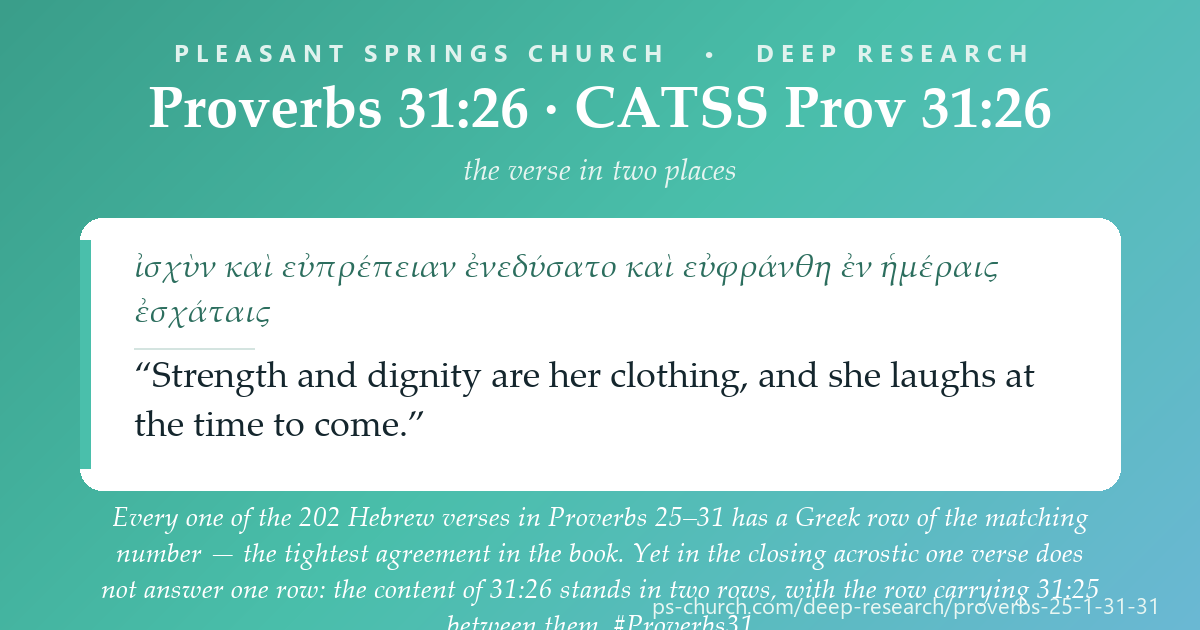
The row numbered 31:26 carries Hebrew 31:25 and nothing else.
ἰσχὺν καὶ εὐπρέπειαν ἐνεδύσατο καὶ εὐφράνθη ἐν ἡμέραις ἐσχάταις
Constituent for constituent, in the same order: ἰσχύν / עֹז · εὐπρέπειαν / הָדָר · ἐνεδύσατο / לְבוּשָׁהּ · εὐφράνθη / וַתִּשְׂחַק · ἐν ἡμέραις ἐσχάταις / לְיוֹם אַחֲרוֹן. Five constituents, no residue. Of the 939 rows in the Greek book, εὐπρέπεια stands in that one.
The other direction is not, and that is the finding
The content of Hebrew 31:26 stands in two rows, one on each side.
| Hebrew 31:26 | row 31:25 | row 31:28 |
|---|---|---|
| פִּיהָ | στόμα | τὸ στόμα |
| פָּתְחָה | διήνοιξεν | ἀνοίγει |
| בְחׇכְמָה | — | σοφῶς |
| וְתוֹרַת | ἐννόμως | νομοθέσμως |
| חֶסֶד | — | ἐλεημοσύνη |
| לְשׁוֹנָהּ | γλώσσῃ | — |
| constituents answered | 4 of 6 | 5 of 6 |
The two rows are not interchangeable, and the fuller of them is the later one. Each carries an adverb that occurs nowhere else: searched across all 939 rows of the Greek book, ἐννόμως stands in one and νομοθέσμως in one, and they are these two. σοφῶς likewise stands in one row, 31:28.
What this page will not say. It will not say the Greek rows put pe before ayin. That verdict requires choosing row 31:25 as the pe row, and the fuller candidate is row 31:28, on the far side — which would give the same order as the Hebrew. An earlier draft of this page did say it, and set the result beside the three Lamentations acrostics that run pe before ayin. That comparison was withdrawn: in Lamentations the two units are each one unit and they trade places, which is a fact about the Hebrew; here the Hebrew is exceptionlessly ayin-then-pe and only the Greek rows are involved, with one verse’s material in two positions. Those are different things and they do not belong in one tally.
Ten words into Romans, and a row that matches Sirach.
Proverbs 25:22 and Romans 12:20
Ten Greek words of the row at label 32:22 stand, in order, at Romans 12:20.
ἄνθρακας πυρὸς σωρεύσεις ἐπὶ τὴν κεφαλὴν αὐτοῦ ὁ δὲ κύριος
It is the second-deepest run between this book and the Greek New Testament — only Proverbs 3:12 with Hebrews 12:6 goes further, at eleven — and just two of the file’s 939 rows reach ten or more. The tie band has one member on each side.
A lettered row that is not in Proverbs alone
The row at label 33:11a — a lettered row with no Masoretic verse of that number — matches Sirach 4:21 element for element, apart from one particle.
ἔστιν αἰσχύνη ἐπάγουσα ἁμαρτίαν καὶ ἔστιν αἰσχύνη δόξα καὶ χάρις
Ten forms, all matching; Sirach 4:21 carries γάρ in addition. Both files sit on the same disk and the page reports the overlap without saying anything about which way it runs, or when.
What was withdrawn, and what could not be reached.
Two results this page ran and will not publish as stated
1. That the pair at 31:25–26 is the only place in the Greek book where two adjacent rows stand against the Hebrew in reverse order. A swap test over all 890 adjacent pairs left it as the sole survivor — but the control used was the Greek Psalter, which is among the most literal books in the corpus, and the test fires there on 0.34% of pairs against 1.57% in Proverbs and 3.28% in Job. Run against the Greek wisdom books, which is the control this shelf requires, Job yields survivors of the same filter too. What survives is the margin, not the uniqueness: the crossing at 31:25–26 scores 2.1× the next Proverbs pair and 2.6× the largest in Job.
2. That the reversal is a pe-then-ayin ordering. Withdrawn for the reason given in stage 3. The test that produced it compared only adjacent pairs, so a reversal was the only answer it could return; the row three positions away was outside what it could see.
What could not be checked at all
No Hebrew or Greek critical apparatus. No Qumran manuscript of Proverbs, no Cairo Geniza fragment, no Syriac, no Vulgate, no Aquila, Symmachus or Theodotion. Nothing bearing on the vocalisation of Agur or Lemuel, and nothing on the date or direction of the Sirach overlap.
And the correspondences in stage 3 are readings, not measurements. “Answers four of six” counts constituents that a reader can match; a different reader could count differently, and the full table is printed so that they can.
The end of the book, and what a careful count is worth.
Where the agreement is tightest, the interesting thing is small
Two hundred and two verses and two hundred and two rows, matching number for number — the closest the two files come anywhere in Proverbs. And inside that agreement, one verse whose material is in two places.
It would have been easy to call that a reversal and set it beside Lamentations, and this page nearly did. What stopped it was looking three rows further on and finding the same verse again, more fully.
The book ends with a woman whose worth is counted, item by item, in what she actually does. That seems a reasonable note for a shelf that counts things to finish on.
Every Deep Research page traces its passage across the whole sweep — the Old Testament, the Second-Temple world between the testaments (historical witnesses, not Scripture), and the New Testament. Follow the thread:
Pleasant Springs Church — Deep Research
Research method after Michael S. Heiser’s Bible Research Method (examine dictionaries → ancient literature → important words → textual connections → academic publications → share), with the Pleasant Springs “Author & Audience” foundation. Scripture set in the Hebrew, the Greek editions named on each page and the ESV (Old Testament), and the Greek New Testament and the ESV (New Testament), per the practice of Pleasant Springs Church. Proverbs 25–31 research grounded in Fox (Proverbs 10–31, Anchor Yale), Waltke (NICOT), Clifford and Longman. Text: Hebrew from the Masoretic text as printed in the editions consulted — Sefaria’s Miqra according to the Masorah; no critical apparatus was consulted for the Hebrew. Greek from Rahlfs’ Septuaginta as digitized by CATSS; Greek New Testament from the SBL edition. The standing caution for this shelf applies: these pages say “the CATSS Greek text reads…” and never call a Greek reading early or late. ⚠️ The label map. Greek labels 32, 33, 34, 35 and 36 carry the material answering Masoretic 25, 26, 27, 28 and 29; labels 30 and 31 answer Masoretic 30 and 31. Established on the previous page by content, row by row, not by verse counts. Read at those labels, 202 Masoretic verses have 202 Greek rows and nothing is absent. Read literally the labels would report 138 absent numbers here; that figure is an artefact of the numbering and is not used. One row-level exception outside the acrostic: the row at 34:27 does not carry the content answering Masoretic 27:27. ⚠️ The stage 3 correspondences are constituent readings, and the rule is published with them. “Masoretic 31:26’s six content words” means its seven tokens under the shelf word rule minus the preposition עַל. A row “answers” one of them where it carries a word standing for it. Row 31:25 answers four; row 31:28 answers five; the full table is printed so a reader can disagree. Under a Dice lexicon trained on 8,051 number-matched verses of fourteen CATSS books with Proverbs excluded, the two score 2.184 and 2.469 against Masoretic 31:26, a gap of 0.285 — reported as two candidates with both numbers, not as a ranked pair. ⚠️ Two results were withdrawn before publication and both are named in stage 5 — the “pe-then-ayin” verdict and the tally beside Lamentations 2, 3 and 4, because the fuller candidate row points the other way and the adjacent-pair test could return no other answer; and the “only reversal in 890 pairs” uniqueness claim, because its control was the Greek Psalter rather than the Greek wisdom books. The margin survives and is what is printed. ⚠️ The acrostic table. Verse-initial first consonant after cleaning, on the MAM spelling. Complete and in order: Proverbs 31:10–31, Lamentations 1, Psalm 119, and Psalms 111 and 112 — the last two acrostic by colon rather than by verse, 22 letters across 10 verses, and counted as complete on their own structure. Pe before ayin: Lamentations 2, 3 and 4, and no others. ⚠️ Hebrew counts are FORM counts. No Hebrew lemmatiser is held here. Word counts follow the shelf rule: split on whitespace and maqqef, count a token only if it carries a letter in the range א–ת, count a ketiv/qere pair once. Under that rule the Psalter comes to 19,586 words in 2,527 verses and the thirty-nine books to 305,579 words. Proverbs is 915 verses; this study is 202 of them. ⚠️ The parsing trap. CATSS rows are fixed-width and the shelf’s general-purpose reader folds a lettered row into its base verse. Every Greek reading here was parsed with the label anchored, and the parsed key order was checked to equal the file’s physical row order. Typology is handled per the house position: what the text says, what the New Testament itself draws, and what we see from this side of the cross — with the seeing left to the reader.
Scripture quotations marked ESV are from the ESV® Bible (The Holy Bible, English Standard Version®), © 2001 by Crossway, a publishing ministry of Good News Publishers. ESV Text Edition: 2016. Used by permission. All rights reserved. The ESV text may not be quoted in any publication made available to the public by a Creative Commons license, and the ESV may not be translated in whole or in part into any other language. www.esv.org
|
Did this study bless you today? 💚 Give to Support PS Church100% of gifts go to the General Fund — thank you. |