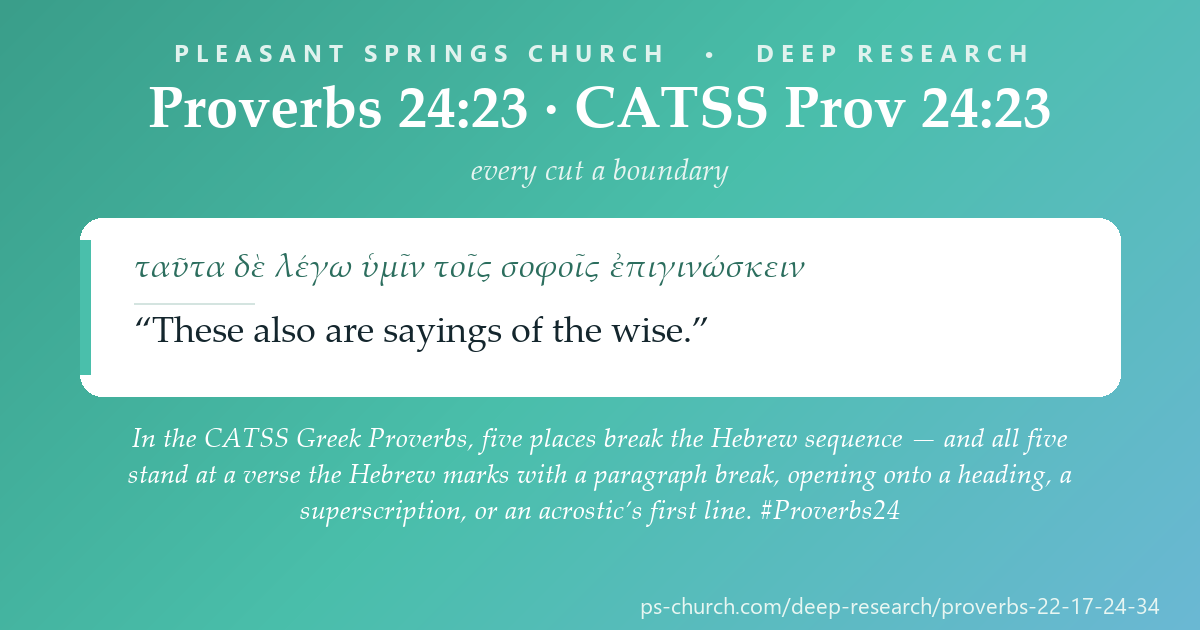
Read the CATSS Greek Proverbs from the row labelled 24:21 to the end of the file and it stands in six blocks of consecutive Masoretic material — not one. This section's own material arrives in two of them, with fourteen rows carrying Masoretic 30:1–14 standing in between. Five Masoretic-consecutive pairs are not physically adjacent anywhere in the file, and here is what makes that worth printing: all five stand at a verse the Hebrew marks with a petuchah, the paragraph break. Proverbs has 48 such verses and no setumot; three of the five cuts fall mid-chapter, and the chance of three mid-chapter verses landing on pe-marks at random is 6.2×10⁻⁵. Each cut also opens onto a formal head — the heading at 24:23, the two superscriptions at 25:1 and 30:1, the head of the three-and-four series at 30:15, and the aleph line of the acrostic at 31:10. One of the five falls inside this study, at exactly the point where the tradition divides its two sub-collections. See the method →
Proverbs 22:17–24:34 (selections)
Hebrew · Greek (CATSS, Rahlfs’ Septuaginta) · ESV24:21–24:22 with its five lettered rows · then the fourteen rows carrying Masoretic 30:1–14 · then the twelve carrying 24:23–34 · then 30:15–31:9 · then 25:1–29:27, at labels 32:1–36:27 · then 31:10–31.
So this section’s own material arrives in two pieces, and what stands between them is the block answering Masoretic 30:1–14 — 256 physical lines of the file.
⚠️ Five Masoretic-consecutive pairs are not physically adjacent in the file. All five stand at a verse the Hebrew marks with a petuchah. Proverbs carries 48 pe-marked verses and no setumot. Three of the five cuts are mid-chapter, and the exact hypergeometric for three mid-chapter verses landing on pe-marks by chance is 6.2×10⁻⁵.
The Shape of the Passage
Sequence — two sub-collections, and a cut between themThis is the one part of Proverbs that names no author at all. 22:17 heads it דִּבְרֵי חֲכָמִים, the words of the wise, and 24:23 heads its second half גַּם־אֵלֶּה לַחֲכָמִים, these also are of the wise. Neither names anyone. Solomon is named at 1:1, 10:1 and 25:1 — before this section and after it, but not in it.
Author
Anonymous, and marked off as a separate body of material by its own two headings. The words גַּם־אֵלֶּה stand adjacent in exactly three verses of the thirty-nine books — Isaiah 49:15, Proverbs 24:23 and Proverbs 25:1 — and two of the three are collection headings in this book.
The Egyptian question, reported and not measured. It is standard in the literature to set 22:17–24:22 beside the Egyptian Instruction of Amenemope, and to connect the thirty chapters of that work with the reading thirty at 22:20. John Walton sets out the comparison and the caution in Ancient Near Eastern Thought and the Old Testament. No Egyptian text is among the files this library holds — a sweep of all 466 entries in the corpus directory returns none — so nothing on this page tests that parallel, and nothing here should be read as evidence for or against it.
Audience
A son, addressed directly, and more insistently here than anywhere else in the book. Five of the book’s twenty-two instances of בְּנִי, my son, stand in this section — and all five are in 22:17–24:22, none in 24:23–34.
And addressed with commands. The section carries 24 instances of אַל with patah, of which 22 govern a second-person jussive. Its Greek rows run 4.60% imperative-or-second-person-finite against 0.05% in the rows for Proverbs 10–15. The one-verse sentence has given way to instruction that expects an answer.
Orient on the Sayings of the Wise, on the Egyptian comparison, and on the Masoretic paragraph marks.
Search by topic: Proverbs, the Sayings of the Wise; Instruction of Amenemope; Egyptian wisdom literature; petuchah and setumah; the Septuagint of Proverbs.
Which articles are relevant?
- John H. Walton, Ancient Near Eastern Thought and the Old Testament — the Amenemope comparison and its limits.
- Anchor Bible Dictionary — “Proverbs, Book of,” “Wisdom, Egyptian,” “Amenemope, Instruction of.”
- Dictionary of the OT: Wisdom, Poetry & Writings (IVP) — “Egyptian Wisdom Literature,” “Proverb, Genre of.”
- NIDOTTE — שליש, חכם.
The Egyptian parallel — what this page can and cannot do with it
The comparison with the Instruction of Amenemope is the best-known thing about this section, and this page reports it rather than testing it.
No Egyptian text is among the files this library holds. A sweep of all 466 entries in the corpus directory for any Egyptian instruction text returns nothing. The comparison is therefore cited from the secondary literature — Walton sets it out with its cautions — and no measurement on this page bears on it either way.
Even with an Egyptian text on disk, this shelf’s method could not test it. Every comparison here runs Hebrew and Greek through one tokenisation and counts unbroken runs of shared word-forms. An English translation of an Egyptian original shares neither alphabet nor lexicon with either, so there would be no run to count. That is a limit of the method, and it is stated rather than worked around.
The six blocks, the five cuts, and what the Hebrew has at each.
Where the file's rows part company with the Hebrew order
| Rows, in file order from the one labelled 24:21 | Masoretic material | rows |
|---|---|---|
| 24:21–24:22, then 24:22a–e | 24:21–24:22 | 7 |
| labelled 30:1–30:14 | 30:1–14 | 14 |
| labelled 24:23–24:34 | 24:23–34 — this study | 12 |
| labelled 30:15–31:9 | 30:15–31:9 | 28 |
| labelled 32:1–36:27 | 25:1–29:27 | 144 |
| labelled 31:10–31:31 | 31:10–31 | 22 |
Six blocks. Five joins in the Hebrew sequence are broken by them: 24:22 | 24:23, 24:34 | 25:1, 29:27 | 30:1, 30:14 | 30:15, and 31:9 | 31:10.
And every one of the five is a paragraph break in the Hebrew
| Cut after | petuchah? | the verse it opens onto |
|---|---|---|
| 24:22 | yes | 24:23 — the heading גַּם־אֵלֶּה לַחֲכָמִים |
| 24:34 | yes | 25:1 — the Hezekiah superscription |
| 29:27 | yes | 30:1 — the Agur superscription |
| 30:14 | yes | 30:15 — the head of the three-and-four series |
| 31:9 | yes | 31:10 — אֵשֶׁת־חַיִל מִי יִמְצָא, the aleph line |
Proverbs carries 48 pe-marked verses and no setumot at all. Twelve are chapter-final and 36 are mid-chapter, out of 884 non-chapter-final verses. Three of the five cuts — 24:22, 30:14 and 31:9 — are mid-chapter, and the exact hypergeometric for three mid-chapter verses falling on pe-marks by chance is C(36,3) / C(884,3) = 6.2×10⁻⁵. For the two chapter-final cases it is C(12,2) / C(31,2) = 0.14, which is not remarkable and is printed as such.
And the acrostic is real: the first letters of Masoretic 31:10–31, taken after consonant-stripping, run א through ת in order without exception. The same test on 31:1–9 gives ד מ א א פ ת י פ פ.
One measure this page ran and will not use
Proverbs is the only one of the twenty-five Greek files here whose row labels ever step backwards — twice, at 30:14 → 24:23 and 36:27 → 31:10. It looks like a decisive result and it is not one, so it is not the measure this page uses.
Label order records how a book was numbered, not how its text runs. The file’s own step from 31:9 to 32:1 is one of the largest departures from the Hebrew order in the book, and the labels step forward across it. In 3Kgdms.mlxx the labels never step back at all, yet the row labelled 20:1 carries the content answering 1 Kings 21:1 — Naboth’s vineyard — and the row labelled 21:1 carries 1 Kings 20:1, Ben-hadad gathering his army. Two whole chapters stand against reversed numbers and a monotonicity test sees nothing.
An earlier draft of this page led with the monotonicity result. It was replaced because order agreement has to be read off the content, which is what the block map above does.
The word behind the thirty sayings.
22:20, and a spelling that occurs once
The Hebrew of 22:20 carries a ketiv/qere. The ketiv is שלשום; the qere is שָׁלִישִׁים. The ESV renders thirty sayings. The Greek row reads τρισσῶς, threefold.
Counted across the thirty-nine books, on consonantal skeletons:
| spelling | in the 39 books | in Proverbs |
|---|---|---|
| שלשים — the ordinary spelling of thirty | 114 | 0 |
| שלש | 109 | 0 |
| שלושים | 2 | 0 |
| שלישים — the qere here | 1 | 1 |
The ordinary word for thirty stands 114 times in the Hebrew Bible and never once in Proverbs. The spelling the qere gives at 22:20 stands once in the whole corpus, and this is it.
That is a count of spellings, and it settles nothing about what the verse means. It does show that whatever שָׁלִישִׁים is, it is not the word this book uses for a number of that size anywhere else, because this book never uses that word at all. The page reports the three readings and adopts none.
Two more words worth the count
בְּנִי, my son. Twenty-two instances in Proverbs; five are in this section, and all five are in 22:17–24:22. The twelve verses of 24:23–34 have none.
The divine name. 7.1% of the verses in 22:17–24:22 carry it, against 18.3% in 16:1–22:16. In 24:23–34 it does not stand at all — nought of twelve, which at the book’s rate of 9.5% is unremarkable in twelve verses and is reported without a claim.
Two New Testament contacts, and what each is worth.
Proverbs 24:12 and Romans 2:6
Five Greek words of the row at 24:12 stand at Romans 2:6 — ἑκάστῳ κατὰ τὰ ἔργα αὐτοῦ, with the relative before it. It is the deepest contact in this section, and Romans 2:6 is the only verse in the Greek New Testament held here that carries the string.
And it does not point here uniquely. The identical five-word string stands at one other row in the twenty-five Greek files: Rahlfs’ Psalm 61:13. So the run establishes that the phrase is shared, and cannot establish which verse Romans is drawing on.
Proverbs 23:31 and Ephesians 5:18
Where the Hebrew of 23:31 says do not look at wine, the Greek row says μὴ μεθύσκεσθε οἴνῳ, do not get drunk with wine.
The form μεθύσκεσθε stands at exactly one row among the twenty-five Greek files and in exactly one verse of the Greek New Testament, Ephesians 5:18 — and the three-word string is likewise one and one. This is the one place in the section where a difference between the two texts is also the point of contact with the New Testament.
Reported as an overlap of wording. Nothing here establishes that Ephesians is drawing on this row rather than on common usage, and no direction is claimed.
What was checked and came back negative, and what could not be reached.
What was checked and came back negative
The seven ketiv/qere pairs in this section are not statistically unusual. Seven in 70 verses looks dense, but against the book’s own rate the hypergeometric probability of seven or more is 0.14 — not a result. Printed because the temptation to call it one is real.
The five lettered rows at 24:22 are not lexically strange to the book. They carry 44 distinct word-types, of which 36 — 81.8% — stand elsewhere in the file. Measured against all 935 five-consecutive-row windows, whose mean type-share is 0.912, 63 windows score lower, so this one sits at the 6.7th percentile. Unusual, and not an outlier.
What could not be checked at all
No Hebrew or Greek critical apparatus. No Qumran manuscript of Proverbs, no Cairo Geniza fragment, no Syriac, no Vulgate, no Aquila, Symmachus or Theodotion. And no Egyptian text of any kind — the Amenemope comparison in stage 1 is cited from the secondary literature and is not tested here.
The paragraph marks are a medieval layer. The petuchah result depends entirely on the Masoretic paragraphing as printed in the edition used here, counted from one span class and that spelling only. Where a scribe placed a break before that system was written down is not something this page can reach.
What it means that the cuts fall where they do.
The joins are where the seams already were
Two books, ordered differently, and five places where one departs from the other’s sequence. Every one of the five falls at a verse the Hebrew itself marks as the end of a paragraph, and every one opens onto a heading, a superscription, or the first line of something formal.
That is not a claim about which order came first, and this page makes none. It is a statement about where the joins are: not in the middle of a thought, but at the places the Hebrew text had already marked off.
One of those places is inside this section — between 24:22 and 24:23, exactly where the tradition has always drawn the line between the Sayings of the Wise and the shorter collection that follows.
Every Deep Research page traces its passage across the whole sweep — the Old Testament, the Second-Temple world between the testaments (historical witnesses, not Scripture), and the New Testament. Follow the thread:
Pleasant Springs Church — Deep Research
Research method after Michael S. Heiser’s Bible Research Method (examine dictionaries → ancient literature → important words → textual connections → academic publications → share), with the Pleasant Springs “Author & Audience” foundation. Scripture set in the Hebrew, the Greek editions named on each page and the ESV (Old Testament), and the Greek New Testament and the ESV (New Testament), per the practice of Pleasant Springs Church. Proverbs 22:17–24:34 research grounded in Fox (Proverbs 10–31, Anchor Yale), Waltke (NICOT), Clifford, Longman, and Walton (Ancient Near Eastern Thought and the Old Testament) for the Egyptian comparison. Text: Hebrew from the Masoretic text as printed in the editions consulted — Sefaria’s Miqra according to the Masorah; no critical apparatus was consulted for the Hebrew. Greek from Rahlfs’ Septuaginta as digitized by CATSS; Greek New Testament from the SBL edition. The standing caution for this shelf applies: these pages say “the CATSS Greek text reads…” and never call a Greek reading early or late. ⚠️ The block map is read off CONTENT, not off verse counts. Labels 32–36 were checked against Masoretic 25–29 row by row, and labels 30 and 31 against Masoretic 30 and 31 row by row. The correspondence is block-level and has row-level exceptions, which are stated rather than smoothed: the row at 34:27 does not carry the content answering Masoretic 27:27, and the rows at 31:25 and 31:26 stand against Masoretic 31:26 and 31:25 respectively. ⚠️ The label order is NOT the measure, and this page says why. Proverbs is the only one of the twenty-five Greek files whose header labels ever step backwards — at 30:14 → 24:23 and 36:27 → 31:10 — but that records how the book was numbered, not how its text runs. The file’s step from 31:9 to 32:1 is one of its largest departures from the Hebrew order and the labels step forward across it; and 3Kgdms.mlxx has no backward step anywhere while its rows labelled 20:1 and 21:1 carry the content answering 1 Kings 21:1 and 20:1 respectively. An earlier draft of this page led with the monotonicity result and it was replaced. ⚠️ The petuchah result, stated so it can be repeated. Paragraph marks counted from the mam-spi-pe span and that spelling only: Proverbs carries 48 pe-marked verses and 0 setumot; 12 are chapter-final and 36 mid-chapter, against 884 non-chapter-final verses. A cut is defined as a Masoretic-consecutive pair that is not physically adjacent in the file; there are five. Exact hypergeometric for the three mid-chapter cases C(36,3)/C(884,3) = 6.22×10⁻⁵; for the two chapter-final cases C(12,2)/C(31,2) = 0.142. ⚠️ The Egyptian comparison is cited, not measured. A sweep of all 466 entries in the corpus directory returns no Egyptian text of any kind. Even with one, this shelf’s method could not test the parallel: it counts unbroken runs of shared word-forms between Hebrew and Greek, and a translation of an Egyptian original shares neither alphabet nor lexicon with either. ⚠️ Hebrew counts are FORM counts. No Hebrew lemmatiser is held here. Word counts follow the shelf rule: split on whitespace and maqqef, count a token only if it carries a letter in the range א–ת, count a ketiv/qere pair once and count the qere. Under that rule the Psalter comes to 19,586 words in 2,527 verses and the thirty-nine books to 305,579 words. Proverbs is 915 verses; this study is 82 of them. The שלישים count at stage 3 is a skeleton count over the same corpus. ⚠️ The parsing trap. CATSS rows are fixed-width, the Greek form is columns 0–24, and the shelf’s general-purpose reader matches its verse header with a regex unanchored at the end, folding a row labelled Prov 24:22a into 24:22. Every Greek reading here was parsed with the label anchored, and the parsed key order was checked to equal the file’s physical row order. Typology is handled per the house position: what the text says, what the New Testament itself draws, and what we see from this side of the cross — with the seeing left to the reader.
Scripture quotations marked ESV are from the ESV® Bible (The Holy Bible, English Standard Version®), © 2001 by Crossway, a publishing ministry of Good News Publishers. ESV Text Edition: 2016. Used by permission. All rights reserved. The ESV text may not be quoted in any publication made available to the public by a Creative Commons license, and the ESV may not be translated in whole or in part into any other language. www.esv.org
|
Did this study bless you today? 💚 Give to Support PS Church100% of gifts go to the General Fund — thank you. |