Proverbs runs to 915 verses, and across almost all of them the Hebrew and the CATSS Greek text agree about what number a saying carries. Twenty-four Masoretic verse numbers have no Greek row of the same number in the whole book — and nineteen of the twenty-four fall in this one section, which is a fifth of Proverbs. Nine of them are consecutive: Hebrew 20:14–22, the longest such run anywhere in the book. But nineteen numbers are not nineteen missing sayings, and the difference is the whole point. Three of the nine stand in the file already, eleven rows earlier, in a lettered block numbered 20:9a, 20:9b and 20:9c — they carry the sayings that answer Hebrew 20:20, 20:21 and 20:22. Two more of the nineteen turn up elsewhere too. Fourteen have no counterpart that could be found, and six of those are consecutive. This page prints both figures, because a gap in a numbering and a missing saying are not the same thing, and only one of them is easy to count. See the method →
Proverbs 16:1–22:16 (selections)
Hebrew · Greek (CATSS, Rahlfs’ Septuaginta) · ESVProv 19:3 — so the four Masoretic numbers 18:23, 18:24, 19:1 and 19:2 fall in a single gap across the chapter seam.9b μερὶς ἐπισπουδαζομένη ἐν πρώτοις ἐν τοῖς τελευταίοις οὐκ εὐλογηθήσεται
9c μὴ εἴπῃς τείσομαι τὸν ἐχθρόν ἀλλὰ ὑπόμεινον τὸν κύριον ἵνα σοι βοηθήσῃ20:9a–c · CATSS Prov 20:9a, 20:9b, 20:9c · no Hebrew verses of those numbersThese three rows carry the sayings that answer Hebrew 20:20, 20:21 and 20:22 — in that order. Curses his father or mother, his lamp is put out; a portion hastened at the first is not blessed at the last; do not say I will repay, wait for the Lord. All three of those Hebrew numbers are inside the nine-number gap that follows. So the gap is a fact about numbering, not about what the file contains.
In the CATSS Greek text of Proverbs, nineteen of the 191 Masoretic verse numbers in 16:1–22:16 have no Greek row of the same number: 16:1, 16:3, 16:4, 16:6, 18:23, 18:24, 19:1, 19:2, 20:14 through 20:22, 21:5 and 22:6. That is 9.9% of the section.
Across the whole of the rest of the book there are five. Nineteen of the book’s twenty-four sit in this one section, which is a fifth of Proverbs.
⚠️ And nineteen numbers are not nineteen missing sayings. Five of the nineteen stand in the file under another label — three of them in a single lettered block eleven rows earlier. Fourteen have no counterpart that could be found, and six of those are consecutive: Hebrew 20:14–19. Fourteen is the honest figure, and this page gives both because they answer different questions.
The Shape of the Passage
Sequence — the second half of the Solomon collectionThis is the second half of the collection the Hebrew heads at 10:1, and it runs to 22:16. Neither file carries a heading anywhere inside it; the next heading in the Hebrew is at 22:17, דִּבְרֵי חֲכָמִים, the words of the wise. What changes across the seam at 16:1 is not the form of the sayings but how often the two files agree about the numbering.
Author
Solomon, by the heading at 10:1 that governs this stretch. No further attribution appears until 22:17, and nothing in these seven chapters names anyone.
What the counting can say about the section’s distinctness. The tetragrammaton stands in 18.3% of the verses here, against 10.9% in 10:1–15:33 and 7.4% in 1:1–9:18. There are 87 tetragrammaton tokens in Proverbs and no verse in the book carries it twice, so those percentages are verses as well as tokens. The commentaries call 16:1–9 a cluster of Lord sayings; the density figure supports that there is something to cluster, and does not by itself establish a deliberate grouping.
Audience
The same reader as chapters 10–15, being handed one-verse sayings. 191 verses, mean length 7.665 words against 7.293 in the previous section — slightly longer, with 15.2% of verses running to nine words or more against 2.7% before.
And a reader whose second half no longer turns as sharply. The mark this shelf counted on the previous page — the word after the atnach beginning with waw — runs at 56.0% here against 87.0% in 10:1–15:33. That is a count of a spelling in a position, not a measurement of contrast, and the same caution applies as before.
Orient on the Solomonic collection, and on the Greek Proverbs and its arrangement.
Search by topic: Proverbs, the Solomonic collections; the Septuagint of Proverbs and its order; the sentence proverb; the LORD sayings of 16:1-9.
Which articles are relevant?
- Anchor Bible Dictionary — “Proverbs, Book of,” “Septuagint,” “Wisdom in the OT.”
- Dictionary of the OT: Wisdom, Poetry & Writings (IVP) — “Proverb, Genre of,” “Translations, Ancient,” “Fear of the Lord.”
- NIDOTTE — יהוה in Proverbs, גאון, חנך.
The claim the files can test, and the one they cannot
Every treatment of Proverbs says the Greek text differs from the Hebrew in its arrangement, most visibly after 24:22. That is visible here: the Greek chapter labels in this file run 1–24 and then 30–36, with none numbered 25–29.
What the files cannot tell you is why. Whether a saying stands at a different number because of the history of the Greek text, or the Hebrew, or the numbering applied to either, is not something a count can reach. This page reports which numbers each file carries and whether a saying can be found elsewhere in it, and stops there.
The nineteen, and the whole book for comparison.
Where the twenty-four fall
| Section | Masoretic verses | numbers with no Greek row of the same number |
|---|---|---|
| 1:1–9:18 | 256 | 2 — 4:7, 8:33 |
| 10:1–15:33 | 184 | 2 — 11:4, 15:31 |
| 16:1–22:16 | 191 | 19 — 9.9% of the section |
| 22:17–24:34 | 82 | 1 — 23:23 |
| 25:1–29:27 | 138 | 0 |
Nineteen of twenty-four in a fifth of the book.
How the last row of that table is measurable at all. The CATSS chapter labels run 1–24 and then 30–36; there are no labels 25–29. The rows labelled 32 to 36 stand against Masoretic chapters 25 to 29 verse for verse — 28, 28, 27, 28 and 27 rows against 28, 28, 27, 28 and 27 verses — and the content agrees at every point checked, from the Hezekiah heading at 32:1 through to 36:27. Read at those labels, Masoretic 25:1–29:27 has no absent number at all. A scan that reads the labels literally reports 138 absent numbers there. That figure is a fact about the numbering and it is not used on this page.
The gaps, and where they sit
The nineteen fall in five stretches:
| Stretch | Length | Note |
|---|---|---|
| 16:1 | 1 | — |
| 16:3–16:4 | 2 | — |
| 16:6 | 1 | — |
| 18:23–19:2 | 4 | across the chapter seam; in the raw file the header Prov 18:22a is followed directly by Prov 19:3 |
| 20:14–20:22 | 9 | the longest run of absent numbers anywhere in Proverbs |
| 21:5 | 1 | — |
| 22:6 | 1 | — |
And the asymmetry runs one way only: no Greek base row in chapters 16–22 lacks a Masoretic verse of the same number.
Checking whether the sayings are actually missing.
Five of the nineteen are in the file under another label
| Masoretic verse | stands in the file at | reading |
|---|---|---|
| 20:20 | row 20:9a | κακολογοῦντος πατέρα ἢ μητέρα σβεσθήσεται λαμπτήρ |
| 20:21 | row 20:9b | μερὶς ἐπισπουδαζομένη ἐν πρώτοις… οὐκ εὐλογηθήσεται |
| 20:22 | row 20:9c | μὴ εἴπῃς τείσομαι τὸν ἐχθρόν… ὑπόμεινον τὸν κύριον |
| 16:6 | row 15:27a | a lettered row in the previous chapter |
| 16:4 | row 16:9 | πάντα τὰ ἔργα τοῦ κυρίου… εἰς ἡμέραν κακήν — both halves |
Three of the nine consecutive numbers are among them, standing together in a lettered block eleven rows before the gap begins. So the nine-number run is a fact about numbering. It is not nine missing sayings, and this page does not call it that.
Fourteen have no counterpart that could be found
The remaining fourteen were each screened against all 939 rows of the file on their own decisive vocabulary. Nothing was found for any of them. Six are consecutive — Hebrew 20:14–19 — and that six-verse stretch is the sharpest single result on this page.
“No counterpart that could be found” is exactly as strong as the screen behind it, and the screen is printed in stage 5. A saying can be present in wording so different that a vocabulary probe will not see it. This page therefore says could not be found and never is not there, and it never says that anything was removed from anything.
One warning about this kind of search
The obvious way to do it produces false positives, and one nearly reached this page.
A draft matched Hebrew 15:31 — the ear that listens to life-giving reproof — to the clause ὁ δὲ φυλάσσων ἐλέγχους σοφισθήσεται inside the row at 16:17. But παιδεία with ἔλεγχος is a stock pair in this file, standing in eight rows — 3:11, 5:12, 6:23, 12:1, 13:18, 15:10, 15:32 and 16:17 — and the row at 13:18 carries the identical participle phrase one word from it. Meanwhile Hebrew 15:31’s own decisive words find nothing: no row in the file carries a lodging-word at all, and of the sixteen rows carrying an ear-word, 16:17 is not one. The match was to a formula, not to the verse.
A lettered row in the New Testament, and one verse in the middle of the book.
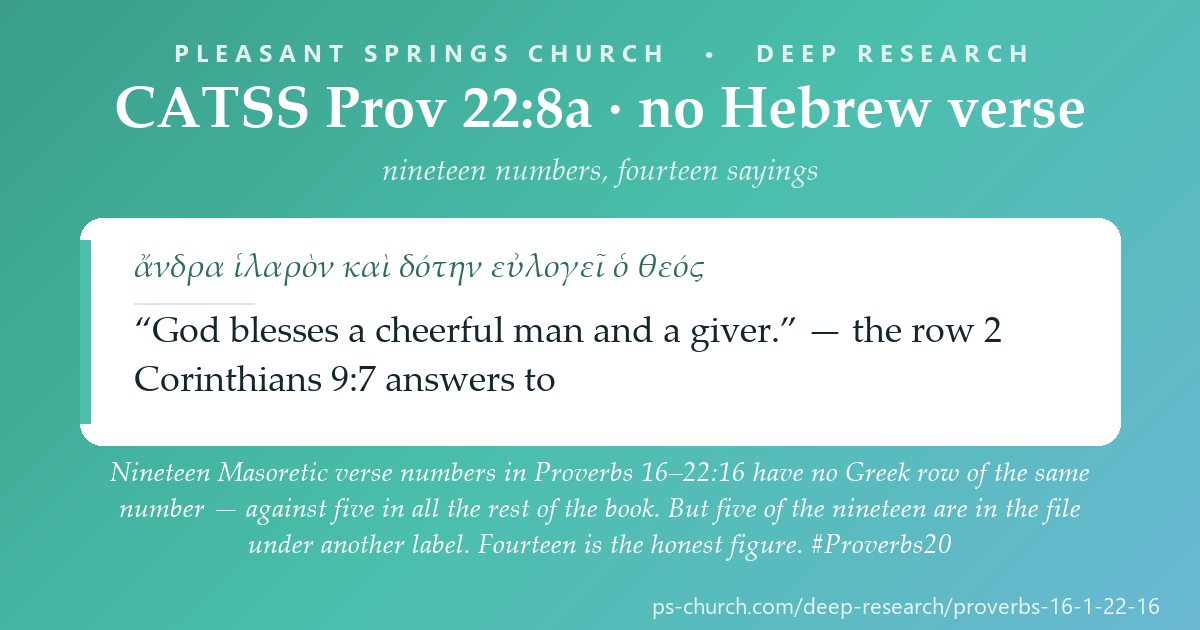
2 Corinthians 9:7 and a row with no Hebrew verse
2 Corinthians 9:7 ends ἱλαρὸν γὰρ δότην ἀγαπᾷ ὁ θεός — God loves a cheerful giver.
The row numbered 22:8a in this file reads ἄνδρα ἱλαρὸν καὶ δότην εὐλογεῖ ὁ θεός — God blesses a cheerful man and a giver. There is no Masoretic verse numbered 22:8a.
The two share ἱλαρόν, δότην and ὁ θεός, and differ in the verb. The page reports the overlap and says nothing about which text is drawing on which, because nothing here can settle that.
The section against the New Testament, measured
Every one of the 181 Greek rows in 16:1–22:16 was swept against all 7,927 verses of the SBL Greek New Testament. 23.8% reach a three-word run; 0.6% reach four; none reaches five. The maximum is four, at the row numbered 21:23, and the band has one member on each side — Acts 8:35.
For comparison on the same measure: Proverbs 1–9 reaches a maximum of eleven, at 3:12 with Hebrews 12:6; Proverbs 10–15 reaches nine, at 11:31 with 1 Peter 4:18. This section is the shallowest of the three.
The middle verse
Proverbs has 915 verses. The 458th is 16:18, with 457 before it and 457 after.
That is arithmetic on the verse divisions in the edition used here. The page does not attribute it to the Masoretes and cites no source for a traditional mid-book note, because none was consulted. The middle word of the book falls elsewhere, inside 17:2.
The screens, and three things this page will not say.
The screens behind “no counterpart found”
Each search was run over all 939 rows, accent-stripped, matching on word-initial stems. For Hebrew 20:14–19: gold-word with lips-word together — none; pearl-word — none; garment-word with surety-word together — none; pledge-word — none; bread-word with falsehood-word together — none; gravel-word — one row, at 34:3, which answers the Masoretic verse of its own number. For Hebrew 22:6, no row pairs a child-word with a training-word. For Hebrew 18:23, no row carries a supplication-word.
Every one of those is a negative result about a probe, scoped to this file and to these stems.
Three comparisons this page ran and will not print
1. That the Greek runs terser here. By label the Greek-to-Hebrew word ratio falls across the three sections — 1.786, 1.525, 1.460 — and that is an artefact of the nineteen absent rows. This section has 181 Greek rows for 191 Hebrew verses, while the previous one has 192 for 184. Counted on number-matched pairs only, which is the only measure where the two sides being divided actually answer each other, the ratio is 1.677, then 1.454, then 1.527 here — the section is above its neighbour, not below. Per row the Greek here is the longer one: 11.81 words against 10.66.
2. That the section is unusually isolated in the canon. No verse here shares a four-word run with any other book — but Proverbs is the lowest book in the thirty-nine on that measure, at 0.3%, and three of its six collections reach four words zero times. Measured at the three-word grain the section is on the high side of its own book, at 4.2%. The isolation belongs to Proverbs, not to this section, and the corpus-wide figure that made it look remarkable is produced by Kings, Chronicles, Deuteronomy, Jeremiah and Numbers.
3. That any saying was removed or added. Nothing on this page says that, and nothing here could establish it.
What could not be checked at all
No Hebrew or Greek critical apparatus. No Qumran manuscript of Proverbs, no Cairo Geniza fragment, no Syriac, no Vulgate, no Aquila, Symmachus or Theodotion. No manuscript evidence bearing on any of the nineteen numbers or on the nine lettered rows. And no published English rendering of the lettered rows was consulted — the glosses here are working translations.
The difference between a gap and an absence.
Counting numbers is easy; counting sayings is not
The first figure on this page took one line of code: nineteen Masoretic numbers with no Greek row to match, against five in all the rest of the book. The second figure took the rest of the work, and it is the one that is true.
Five of the nineteen were in the file the whole time. Three of them sat together, eleven rows before the gap that supposedly swallowed them. A count of labels would have called them missing and been wrong.
What is left is smaller and firmer: fourteen sayings that could not be found, six of them in a row. That is worth knowing, and it is worth knowing that it is fourteen and not nineteen.
Every Deep Research page traces its passage across the whole sweep — the Old Testament, the Second-Temple world between the testaments (historical witnesses, not Scripture), and the New Testament. Follow the thread:
Pleasant Springs Church — Deep Research
Research method after Michael S. Heiser’s Bible Research Method (examine dictionaries → ancient literature → important words → textual connections → academic publications → share), with the Pleasant Springs “Author & Audience” foundation. Scripture set in the Hebrew, the Greek editions named on each page and the ESV (Old Testament), and the Greek New Testament and the ESV (New Testament), per the practice of Pleasant Springs Church. Proverbs 16–22 research grounded in Fox (Proverbs 10–31, Anchor Yale), Waltke (NICOT), Clifford and Longman. Text: Hebrew from the Masoretic text as printed in the editions consulted — Sefaria’s Miqra according to the Masorah; no critical apparatus was consulted for the Hebrew. Greek from Rahlfs’ Septuaginta as digitized by CATSS; Greek New Testament from the SBL edition. The standing caution for this shelf applies: these pages say “the CATSS Greek text reads…” and never call a Greek reading early or late. ⚠️ Everything here is a count of rows and labels in two files, plus a set of vocabulary probes. “No Greek row of the same number” is a statement about what Proverbs.mlxx labels. “No counterpart could be found” is a statement about a published probe over the file’s 939 rows, not about what exists. Nothing is called early or late, and nothing is said to have been added to or taken from anything. ⚠️ The nineteen, and the five that are elsewhere. Absent numbers in 16:1–22:16: 16:1, 16:3, 16:4, 16:6, 18:23, 18:24, 19:1, 19:2, 20:14–20:22, 21:5, 22:6 = 19 of 191 = 9.9%. Elsewhere in the book: 4:7 and 8:33; 11:4 and 15:31; 23:23; and none in 25:1–29:27 — 24 in the book, 19 of them here. Found under another label: 20:20 at row 20:9a, 20:21 at 20:9b, 20:22 at 20:9c, 16:6 at row 15:27a, and 16:4 at row 16:9 in both cola. The identification of 20:9a is independently tight — the stem κακολογ- has exactly one holder among all 939 rows and it is that row. ⚠️ The chapter-label artefact, and why the last table row is safe. CATSS labels run 1–24 then 30–36. Rows 32–36 stand against Masoretic 25–29 verse for verse (28/28, 28/28, 27/27, 28/28, 27/27) with content agreeing at 32:1, 33:11, 34:1, 34:20, 35:15, 36:1 and 36:27. Read literally the labels would report 138 absent numbers in 25:1–31:31; that figure is not used anywhere on this page. ⚠️ Three results were withdrawn before publication and are named in stage 5 — the Greek-to-Hebrew ratio “trend” (it reverses when the four chapter-15 lettered rows that answer Masoretic 16:6–9 are counted with the Hebrew they answer rather than the label they carry: number-matched pairs give 1.677, 1.454, 1.527, 1.606); the four-word canonical-isolation claim (Proverbs is the lowest book in the thirty-nine at 0.3%, so the isolation is the book’s, not the section’s); and a match of Masoretic 15:31 to the row at 16:17, which was a παιδεία-plus-ἔλεγχος formula standing in eight rows. ⚠️ Hebrew counts are FORM counts. No Hebrew lemmatiser is held here. Word counts follow the shelf rule: split on whitespace and maqqef, count a token only if it carries a letter in the range א–ת, count a ketiv/qere pair once. Under that rule the Psalter comes to 19,586 words in 2,527 verses and the thirty-nine books to 305,579 words. Proverbs 16:1–22:16 = 191 verses and 1,464 words, mean 7.665; the Greek file carries 181 numbered rows and 9 lettered ones there. The 87 tetragrammaton tokens in Proverbs stand in 87 distinct verses; no verse carries two. ⚠️ The parsing trap. CATSS rows are fixed-width, the Greek form is columns 0–24, and the shelf’s general-purpose reader matches its verse header with a regex unanchored at the end — so a row labelled Prov 20:9a is folded into 20:9 and the verse silently lengthens. On this page that trap would have destroyed the central finding, because the three rows that answer Masoretic 20:20–22 are exactly the lettered ones. Every Greek reading here was parsed with the label anchored. Typology is handled per the house position: what the text says, what the New Testament itself draws, and what we see from this side of the cross — with the seeing left to the reader.
Scripture quotations marked ESV are from the ESV® Bible (The Holy Bible, English Standard Version®), © 2001 by Crossway, a publishing ministry of Good News Publishers. ESV Text Edition: 2016. Used by permission. All rights reserved. The ESV text may not be quoted in any publication made available to the public by a Creative Commons license, and the ESV may not be translated in whole or in part into any other language. www.esv.org
|
Did this study bless you today? 💚 Give to Support PS Church100% of gifts go to the General Fund — thank you. |