From Proverbs 10:1 the book stops making speeches and starts making sentences — one verse long, split down the middle, the second half answering the first. Both texts mark that join, with different words, at almost the same rate. The Masoretic accents divide all 184 verses of chapters 10–15 in two, and in 160 of them — 87.0% — the first word after the atnach begins with waw. In the CATSS Greek text, 164 of the 182 rows numbered to those verses — 90.1% — contain de. Both are the highest figures anywhere in their own file. And neither is a measurement of contrast. Both count a spelling in a position: Hebrew waw is also plain addition, and Greek Ecclesiastes — a book of 4,768 words on disk — contains the particle de exactly zero times. What can be said is that two texts run at nearly the same rate across the same six chapters. What cannot be said is that either mark means but. See the method →
Proverbs 10:1–15:33 (selections)
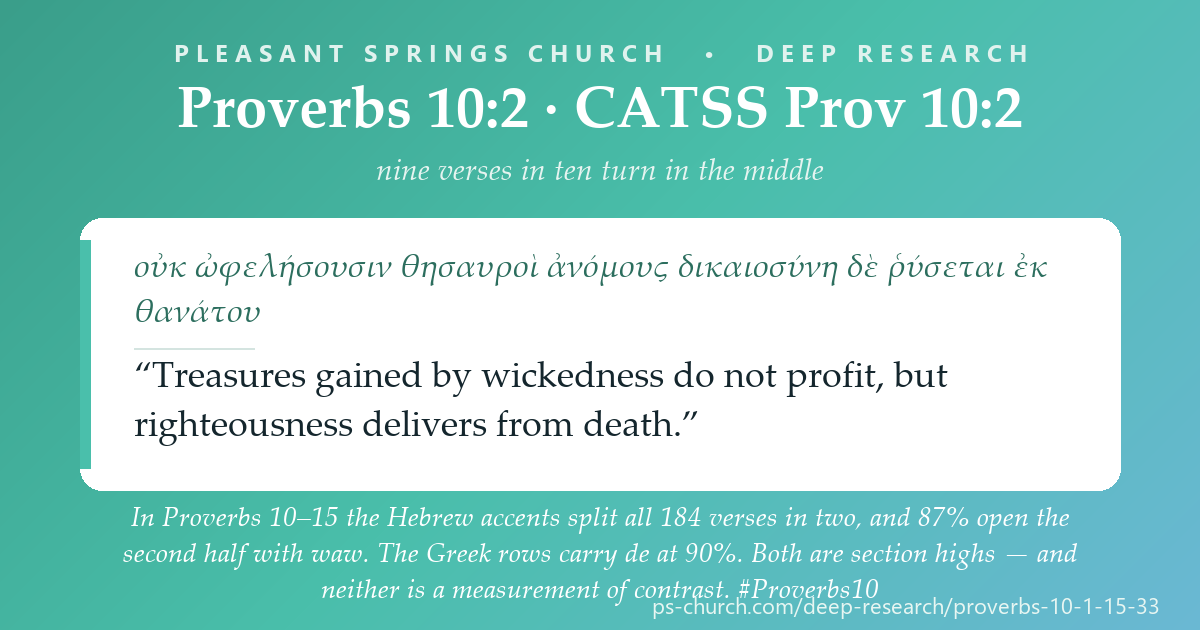
Hebrew · Greek (CATSS, Rahlfs’ Septuaginta) · ESVIn Proverbs 10–15 the Masoretic accents divide all 184 verses in two, and in 160 of them — 87.0% — the first word after the atnach begins with waw. In the CATSS Greek text, 164 of the 182 rows numbered to those same verses — 90.1% — contain δέ.
Both are section highs against the rest of the same two files. Hebrew: 51.0% in chapters 1–9, 54.9% in 16–22, 59.1% in 25–29. Greek: 42.5% in 1–9, 58.9% in 16–22, 43.1% in the rows labelled 30–36.
⚠️ But both are counts of a spelling in a position, and neither is a measurement of contrast. Hebrew waw is also simple addition — 15:33 below is one of the 160 and is plainly additive. And the Greek particle cannot be read as a contrast marker either: Greek Ecclesiastes contains no δέ at all, in 4,768 tokens, while running 83.3% καί by row. Whether a given verse is antithetical is a judgement. What is counted here is where a letter stands.
The Shape of the Passage
Sequence — the Solomon collection opensThe Hebrew heads this collection at 10:1 with two words, מִשְׁלֵי שְׁלֹמֹה. The Greek row at 10:1 carries no heading at all. It begins straight on the proverb, υἱὸς σοφὸς εὐφραίνει πατέρα.
Author
Solomon, by the Hebrew heading at 10:1. The consonantal string שלמה stands at exactly four places in Proverbs — 1:1, 10:1, 11:1 and 25:1 — and one of the four is not the name at all: 11:1 is שְׁלֵמָה, a full weight, in the verse about a false balance. A search on consonants alone would report five occurrences of Solomon and be wrong once.
One number worth stating carefully. Masoretic Proverbs 10:1–22:16 runs to 375 verses, and the numerical value of the letters in שלמה is 375. Both figures are exact and this page reports the coincidence without drawing anything from it — nothing on disk can test whether a collection was sized to a name.
Audience
Someone being handed sentences rather than speeches. Chapters 1–9 are sustained discourse addressed to בְּנִי, my son. From 10:1 the units are one verse long: 184 verses in these six chapters and a mean length of 7.29 words, with 97.3% of them between six and eight words.
And someone expected to hold two things at once. The characteristic verse here sets one half against the other, and both texts mark the join — the Hebrew with a letter, the Greek with a particle. What neither mark can tell you is whether the two halves contrast or simply continue; that is a reading, and this page says so wherever it counts them.
Orient on the Solomon collection, on parallelism, and on the Greek of Proverbs.
Search by topic: Proverbs, the Solomonic collections; antithetic parallelism; the sentence proverb; Masoretic accents and verse division; the Greek Proverbs.
Which articles are relevant?
- Anchor Bible Dictionary — “Proverbs, Book of,” “Poetry, Hebrew,” “Parallelism,” “Masoretic Accents.”
- Dictionary of the OT: Wisdom, Poetry & Writings (IVP) — “Proverb, Genre of,” “Parallelism,” “Retribution,” “Righteousness and Wickedness.”
- NIDOTTE — צדיק, רשע, חכם, כסיל.
The standard description, and the part of it this page can check
Every treatment says the same two things: that 10:1–22:16 is a collection of one-verse sentences, and that chapters 10–15 are predominantly antithetic while what follows is not.
The first is visible in the files and is not in dispute. The second is a claim about meaning, and meaning is not what a file holds. What can be counted is whether the two texts mark the join more often here than elsewhere — and they do, both of them, by a wide margin. That is what this page reports, and it reports the gap between that and the traditional claim rather than closing it.
The measurement, and every attempt made to break it.
The two counts
| Hebrew: word after the atnach begins with waw | Greek: row contains δέ | |
|---|---|---|
| Proverbs 10–15 | 160 of 184 = 87.0% | 164 of 182 = 90.1% |
| Proverbs 1–9 | 51.0% | 42.5% |
| Proverbs 16–22 | 54.9% | 58.9% |
| Proverbs 25–29 | 59.1% | — |
| rows labelled 30–36 | — | 43.1% |
No verse is dropped from the Hebrew denominator here. All 184 verses of 10–15 carry an atnach, none carries it on the final word, and none carries segolta or shalshelet, the only accents that outrank it. Elsewhere the question is live — nine verses in chapters 1–9 carry no atnach — so the comparison figures above use verses that carry one.
Four ways the measurement was attacked, and what happened
1. A different colon division. Splitting at the top-ranked disjunctive accent, or at the first atnach-or-zaqef, gives the identical 160 of 184. Splitting instead by word count — simply halving the verse — collapses the figure to 38.0%, which is the point: the accents are doing the dividing, not the arithmetic.
2. Is waw just commoner here? No. Waw opens 13.6% of all tokens in these chapters against 12.5% in 1–9. But 160 of the block’s 183 waw-initial tokens sit in that one slot. The slot before it runs 4.3%, the slot after 1.6%.
3. Is it verse length? No. Restricted to verses of six to eight words — which is 97.3% of the block — the rate is 88.3% here against 52.7% in 1–9, 60.2% in 16–22 and 66.7% in 25–29.
4. Do the two marks fall on the same verses? Mostly, and not entirely. Of the 182 verses carried in both files: 151 have both marks, 8 have waw without δέ, 13 have δέ without waw, and 10 have neither. That is 88.5% agreement, Cohen’s kappa 0.424. So this page says the two texts run at near-identical rates across the same six chapters. It does not say that one tracks the other verse by verse.
And the block is not uniform
Chapter 15 is the weakest of the six on both texts independently — 72.7% Hebrew, 78.1% Greek — and on the Greek measure chapter 16, outside the block, sits at 79.3%, a difference too small to rank.
The unit that runs above 90% on both texts is Proverbs 10–14: Hebrew 136 of 151 = 90.1%, Greek 139 of 150 = 92.7%.
Why the Greek particle cannot be read as a contrast marker.
The control that settles it
If δέ marked antithesis, it would appear wherever a Greek wisdom text sets two poles against each other. It does not. Every Greek wisdom book on disk, counted by row:
| Greek book | rows | carry δέ | carry καί |
|---|---|---|---|
| Proverbs 10–15 | 182 | 90.1% | 12.6% |
| Job | 1,083 | 53.5% | 40.4% |
| Sirach | 1,366 | 3.6% | 81.6% |
| Ecclesiastes | 222 | 0.0% | 83.3% |
| Song of Songs | 117 | 0.0% | 53.0% |
Now the decisive test. Take only the rows that carry both a righteous-family stem and an ungodly-family stem — rows with two poles in them by their own vocabulary:
| Greek book | two-pole rows | of which carry δέ |
|---|---|---|
| Proverbs 10–15 | 52 | 49 (94%) |
| Sirach | 35 | 4 (11%) |
| Ecclesiastes | 23 | 0 (0%) |
Twenty-three two-pole rows in Greek Ecclesiastes and not one contains the particle. So δέ is a property of the book a row sits in, not of the row’s shape. The 90.1% is a real and striking figure about Greek Proverbs 10–15. It is not a measurement of antithesis, and this page does not present it as one.
An earlier draft of this page did present it as one, on the strength of comparing the section only against other parts of the same Greek file and against the Greek New Testament. The wisdom books were on the same disk and had not been opened. The claim is withdrawn here rather than deleted.
And the Hebrew mark has its own exceptions
At least six of the 160 waws are plainly additive rather than adversative — 10:22, 11:10, 11:25, 13:12, 14:19 and 15:33. 15:33 is printed in the codex above for that reason: and humility comes before honour continues its first half; it does not oppose it.
On a deterministic forty-verse sample of the 160 — random.Random(20260805).sample(sorted(refs), 40), pool size 160 — a reading of each gave 34 genuinely adversative, 3 additive and 3 arguable. That is a judgement made by a reader, published with its call and its seed so it can be repeated and disagreed with. It is not a measurement, and nothing on this page rests on it.
A five-chapter stretch that shares almost nothing, and one verse that shares nine words.
Proverbs 10–14 is the longest stretch in the Hebrew Bible whose chapters share no three-word run with any other book
Every chapter of the thirty-nine books was tested for the longest unbroken run of consonantal word-forms it shares with any chapter of a different book.
Sixty-six of the 929 chapters share no three-word run with any other book at all — their ceiling is two words. Consecutive runs of chapters at that ceiling: five, at Proverbs 10–14; four, at Psalms 73–76; and nothing else above two.
Restricted to substantial chapters — the 685 of 200 words or more — only thirteen reach that ceiling, and four of the thirteen are consecutive in Proverbs.
This is a statement about shared wording between books, under the shelf’s word rule, which splits on whitespace and maqqef. It is not a claim that these chapters are unconnected to the rest of Scripture, and it says nothing about direction — only that the words in them do not run three-deep anywhere else.
Proverbs 11:31 and 1 Peter 4:18
Nine Greek words of Proverbs 11:31 stand, in the same order, at 1 Peter 4:18.
δίκαιος μόλις σῴζεται, ὁ ἀσεβὴς καὶ ἁμαρτωλὸς ποῦ φανεῖται
No other verse among the 7,927 in the SBL Greek New Testament held here reaches that run with it — the band has exactly one member. Across all 192 rows of Greek Proverbs 10–15 the run distribution is 46 rows at one word, 118 at two, 25 at three, two at four and this one at nine; 14.6% reach three.
⚠️ Corrected 2026-08-30, and the old figures are printed beside the new ones rather than replacing them. This line used to read 119 at two, 24 at three, 14.1% reach three. A Greek word can be spelled two ways depending on the first letter of the word after it — οὐ / οὐκ / οὐχ, ἐκ / ἐξ, the movable nu — and the New Testament edition folds each pair into one form in the column this shelf measures on, while the Greek Old Testament edition does not. Every run measured ACROSS the two editions therefore stopped dead at the first such word. The row at 12:13 was cut at ἐξ and read two; it reads three, against a tie band of five. The fold could only break a run and never make one, so every movement is upward and no figure here was ever overstated. The printed one/two split was also a row out on its own account — re-measured on the unchanged code it was 47 and 118, not 46 and 119 — so the line above is what reproduces today rather than a repair of one row only. The nine at 11:31, its band of one, and what this paragraph is for are all untouched.
A run of three is the ordinary case and is not evidence of contact. The nine is not ordinary, and it is reported as a measured run rather than as a quotation, because run length cannot establish who is drawing on whom.
What was checked, what failed, and what was never available.
What was checked and came back negative
No verse in Proverbs 10–15 pairs a righteous-word with a wicked-word in Job. Under an independent screen — up to two prefix letters from והלבכמ, shin excluded, plural and construct endings allowed — Job has 7 verses carrying a צדיק-token and 28 carrying a רשע-token, and zero carrying both. The pairing that characterises this section of Proverbs does not occur once in Job.
Proverbs has exactly three whole-verse duplicate pairs in the entire book — 6:10 with 24:33, 14:12 with 16:25, and 18:8 with 26:22 — identical at the consonants and identical at the full pointing, with no fourth pair at either level.
What could not be checked at all
No Hebrew or Greek critical apparatus. No Qumran manuscript of Proverbs, no Cairo Geniza fragment, no Syriac, no Vulgate, no Aquila, Symmachus or Theodotion. No manuscript evidence bearing on the ten lettered rows or on the two Hebrew verses without a Greek row of the same number.
And the accents themselves are a medieval layer. Every Hebrew figure on this page depends on the Masoretic accentuation as printed in the edition used here. Where the colon fell before that system was written down is not something this page can reach, and the measurement should be read as being about the text as the Masoretes pointed it.
What it is worth counting, and what counting cannot reach.
Two texts, one habit
Across six chapters, two texts in two languages put a mark in the same place nine times out of ten. That is worth knowing, and it is about as far as counting goes.
Whether the second half of a proverb opposes the first or extends it is a question for a reader, not for a script. This page ran the count four different ways to see whether the shape would hold, printed the exceptions it found, and then opened the other Greek wisdom books and discovered that the particle it had been treating as a contrast marker is absent from two of them entirely.
The number survived. The explanation did not. That is the ordinary outcome of checking, and the page prints both.
Every Deep Research page traces its passage across the whole sweep — the Old Testament, the Second-Temple world between the testaments (historical witnesses, not Scripture), and the New Testament. Follow the thread:
Pleasant Springs Church — Deep Research
Research method after Michael S. Heiser’s Bible Research Method (examine dictionaries → ancient literature → important words → textual connections → academic publications → share), with the Pleasant Springs “Author & Audience” foundation. Scripture set in the Hebrew, the Greek editions named on each page and the ESV (Old Testament), and the Greek New Testament and the ESV (New Testament), per the practice of Pleasant Springs Church. Proverbs 10–15 research grounded in Fox (Proverbs 10–31, Anchor Yale), Waltke (NICOT), Clifford and Longman. Text: Hebrew from the Masoretic text as printed in the editions consulted — Sefaria’s Miqra according to the Masorah; no critical apparatus was consulted for the Hebrew. Greek from Rahlfs’ Septuaginta as digitized by CATSS; Greek New Testament from the SBL edition. The standing caution for this shelf applies: these pages say “the CATSS Greek text reads…” and never call a Greek reading early or late. ⚠️ The two carrier counts, stated so they can be repeated. Hebrew: for each verse, split at the atnach (U+0591) and test whether the first token after it begins with waw. In Proverbs 10–15 that is 160 of 184 = 87.0%. All 184 carry exactly one atnach, none on the final word, and none carries segolta (U+0592) or shalshelet (U+0593), so no verse is dropped and the figure is the same under either denominator policy. Comparison figures use verses carrying an atnach: 1–9 126/247, 16–22 112/204, 25–29 81/137. Greek: base rows only, and the unelided spelling δέ/δὲ only — 164 of 182 = 90.1%. ⚠️ Both are counts of a spelling in a position, and the page says so wherever it prints them. Neither is a measurement of adversative force. The Greek control is decisive and is printed in stage 3: Greek Ecclesiastes carries no δέ in 4,768 tokens, and none of its 23 two-pole rows contains one, against 49 of 52 in Greek Proverbs 10–15. An earlier draft of this page claimed the count measured antithesis; that claim is withdrawn on the page. It had compared the section only against other parts of the same Greek file and against the Greek New Testament — whose verses average 17.35 words against a Greek Proverbs row’s 10.60 — while the Greek wisdom books sat unopened on the same disk. ⚠️ Robustness checks, all four printed in stage 2. Top-ranked disjunctive and first-atnach-or-zaqef both return the identical 160/184; ole-we-yored returns 159/184 and is untestable here because exactly one verse in the block carries ole, namely 10:1; a word-count split returns 38.0%. Only two of the 184 have the atnach-bearing word itself waw-initial, so a boundary placed one word out could move the count by at most two. ⚠️ The 40-verse sample is a judgement, not a measurement — random.Random(20260805).sample(sorted(refs), 40) over the 160, read as 34 adversative, 3 additive, 3 arguable. Published with its call and seed. Nothing on the page rests on it. ⚠️ Hebrew counts are FORM counts. No Hebrew lemmatiser is held here. Word counts follow the shelf rule: split on whitespace and maqqef, count a token only if it carries a letter in the range א–ת, count a ketiv/qere pair once. Under that rule the Psalter comes to 19,586 words in 2,527 verses and the thirty-nine books to 305,579 words. Proverbs 10–15 = 184 verses and 1,342 words; the Greek file carries 192 rows there, 182 numbered and 10 lettered. ⚠️ The parsing trap. CATSS rows are fixed-width, the Greek form is columns 0–24, and the shelf’s general-purpose reader matches its verse header with a regex unanchored at the end — so a row labelled Prov 12:11a is folded into 12:11 and the verse silently lengthens. Every Greek reading here was parsed with the label anchored. The Greek chapter labels in this file also run 1–24 and then 30–36, with none numbered 25–29; this study is chapters 10–15 and is unaffected. Typology is handled per the house position: what the text says, what the New Testament itself draws, and what we see from this side of the cross — with the seeing left to the reader.
Scripture quotations marked ESV are from the ESV® Bible (The Holy Bible, English Standard Version®), © 2001 by Crossway, a publishing ministry of Good News Publishers. ESV Text Edition: 2016. Used by permission. All rights reserved. The ESV text may not be quoted in any publication made available to the public by a Creative Commons license, and the ESV may not be translated in whole or in part into any other language. www.esv.org
|
Did this study bless you today? 💚 Give to Support PS Church100% of gifts go to the General Fund — thank you. |